

Introduction
Semiconductor architecture is moving from one large die toward systems assembled from specialised dies. UCIe defines an open die-to-die interconnect and software stack intended to support interoperable chiplets [1-5]. Intel describes disaggregated architectures, advanced packaging and chiplet integration as part of its foundry offering [6-8]. TSMC reports continued development and production of CoWoS, SoIC and related three-dimensional integration technologies [9-12]. AMD, Cadence, Synopsys and other public companies describe multi-die products, system design tools and intellectual property that support increasingly complex integration [13-23].
These developments create acquisition opportunities across interface controllers, physical-layer intellectual property, network-on-chip technology, verification, thermal and power analysis, packaging design, test, security, photonics and reusable domain chiplets. They also create a valuation trap. A technically impressive asset can remain several qualification cycles away from meaningful revenue. An open standard can expand the addressable ecosystem while reducing a seller's ability to charge a proprietary toll. A production design win can be durable, yet its economics may depend on one foundry process, one packaging line or one customer programme.
This paper is designed for strategic buyers, private-equity investors, semiconductor founders, corporate-development teams and transaction committees. It provides a decision system for diligence, valuation and deal protection. It does not provide engineering, legal, tax, accounting, regulatory or investment advice. Each transaction requires current specialist review of the target's technology, contracts, intellectual property, export position and manufacturing chain.
1 Define the asset before pricing the moat
The first diligence task is to identify what the buyer can legally control and commercially scale. A chiplet company can own patents, source code, layouts, firmware, validation suites, reference designs, test vehicles, documentation, trademarks, trade secrets, customer contracts and manufacturing data. It can also rely on third-party standards, licensed processor cores, electronic-design-automation tools, foundry process-design kits and packaging technologies. The transaction perimeter should distinguish owned assets, licensed inputs, jointly developed material and customer-specific deliverables.
The asset map should connect every product claim to four questions. What right is owned or licensed? Which technical function does it perform? Which customer programme uses it? Which cash flow results from that use? A patent portfolio without claim mapping can overstate exclusionary value. Source code without maintainable build systems can be costly to transfer. A reference design without a qualified manufacturing route can demonstrate function while leaving the buyer unable to ship.
Interconnect value often spans several layers. The physical layer determines signalling, reach, power and package requirements. The controller and protocol layer handle transport, reliability and flow. Firmware and management functions support discovery, configuration, telemetry, repair and security. Verification intellectual property and test systems establish confidence before expensive fabrication. The buyer should map ownership and dependency at each layer because a gap in one layer can prevent commercial delivery of the whole product.
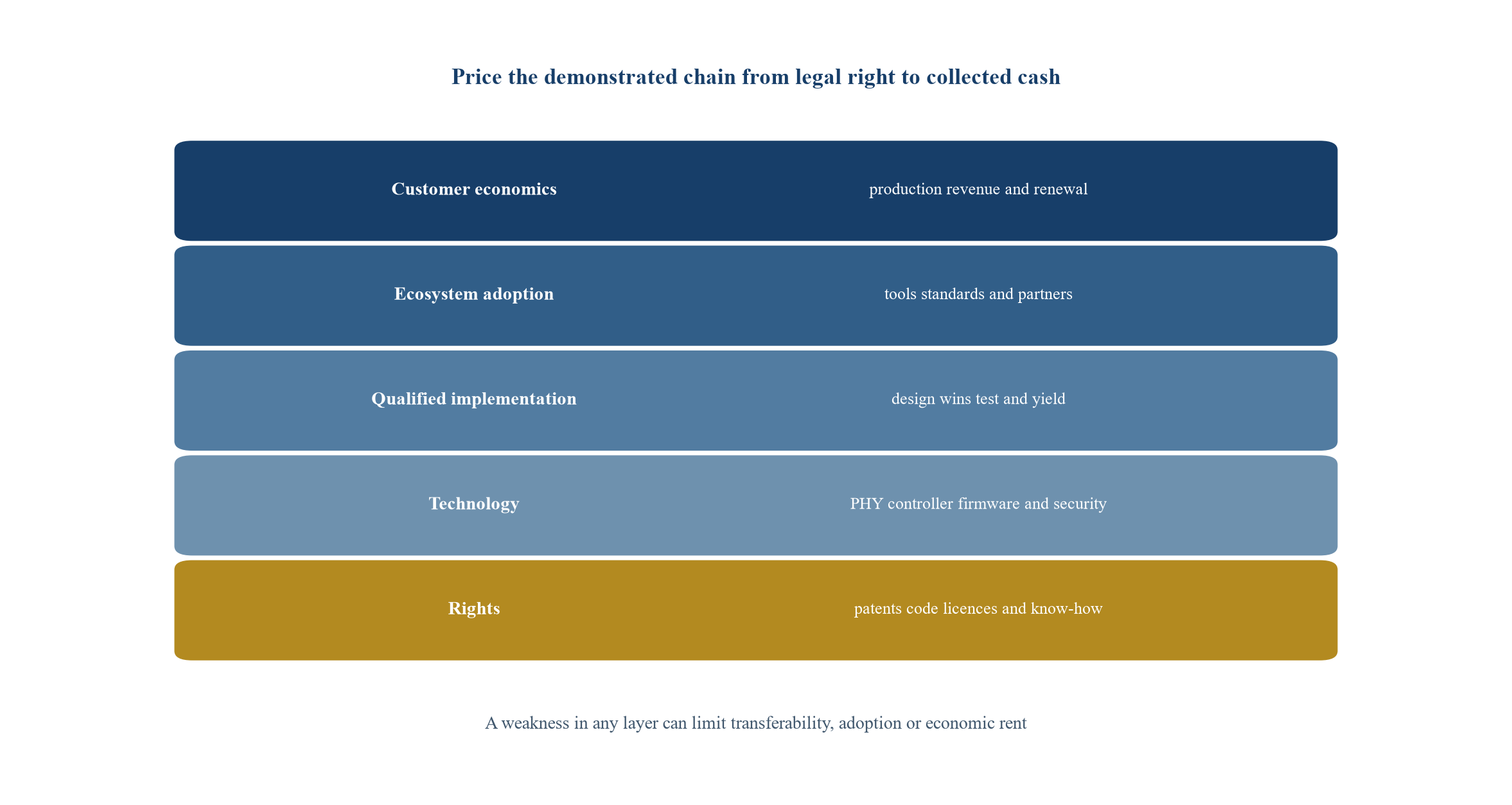
Proposed diligence map; ownership and commercial control require transaction-specific evidence.
The map should be reconciled to repositories, agreements and accountable owners. It should identify open-source components and their licence terms, third-party blocks, invention assignments, consultant contributions, university rights and government funding conditions. It should also identify technical material held only by individuals or external partners. Closing deliverables should include verified repositories, build instructions, test assets, credentials, key licences and continuity arrangements.
| Value layer | Claimed asset | Minimum evidence | Principal transaction risk |
|---|---|---|---|
| legal rights | patents, code, layouts, trade secrets and licences | title chain, licence schedule, claim map and freedom-to-operate work | incomplete ownership or restricted transfer |
| technology | interface, protocol, management, verification and security | source, build, simulation, silicon test and benchmark records | performance claim cannot be reproduced |
| implementation | qualified design and package | tape-out, test vehicle, yield, reliability and acceptance | prototype does not reach production |
| ecosystem | standard, tool, foundry and packaging participation | memberships, integrations, support commitments and roadmaps | dependence is mistaken for control |
| customer economics | licence, support and royalty cash | executed contract, invoice, shipment, royalty report and collection | engagement is counted as recurring revenue |
Proposed diligence structure; evidence should be verified against source records and contracts.
2 Separate specification compliance from real interoperability
Standards can reduce integration friction and expand the pool of compatible dies. UCIe 3.0 supports 48 GT/s and 64 GT/s data rates, extended sideband reach and further management functions while retaining backward compatibility [1-5]. These features matter to a buyer because they can expand use cases and reduce the risk that an acquired interface becomes isolated. Compliance claims still require evidence.
The diligence ladder should progress from documentation to implementation. The target should identify which version, package type, data rate, protocol mapping and optional feature it supports. Simulation evidence should cover normal and adverse conditions. Emulation and field-programmable-gate-array work can show integration progress. Test-chip evidence can demonstrate electrical performance. Multi-vendor silicon and package demonstrations provide stronger evidence of interoperability. Production use under a customer's workload is stronger again.
Backward compatibility should be tested rather than assumed from a marketing statement. The target may support a subset of a specification, use proprietary extensions or depend on a particular vendor's interpretation. Management, telemetry, debug, security and error recovery can create integration work even when the basic link operates. The buyer should review compliance plans, test ownership, unresolved exceptions and the cost of maintaining support across specification versions.
Open standards have two opposing valuation effects. They can enlarge the market, reduce customer adoption cost and make a specialist product relevant to more partners. They can also lower switching costs and invite competitors. The economic moat therefore may sit in implementation quality, power efficiency, latency, validation coverage, tool integration, field reliability and customer support rather than exclusive control of the interface definition.
3 Convert customer programmes into an evidence-weighted design-win pipeline
Semiconductor revenue frequently follows a long sequence: evaluation, architecture selection, licence, integration, tape-out, qualification, product launch, volume production and royalty collection. The target's commercial pipeline should be rebuilt at programme level. Each programme needs a customer, application, product generation, decision maker, technical scope, contract status, expected tape-out, foundry, package, expected unit volume, price and evidence source.
The term design win should have a controlled definition. An engineering discussion, evaluation licence or proof of concept is not a production award. A signed licence can generate cash without guaranteeing a tape-out. A tape-out can fail or be cancelled. Customer qualification can complete while the end product fails commercially. A royalty forecast depends on end-market volume, yield, die content, price and reporting. The valuation model should retain these distinctions.
Programme probability should be tied to evidence, not management confidence alone. A buyer can assign stage weights to demonstrate the method, while recognising that historical conversion differs by customer and product. The company should provide a closed cohort of prior programmes, including losses and delays. Conversion analysis should identify the stage at which programmes fail, the reasons, time to the next gate and the resulting revenue profile.
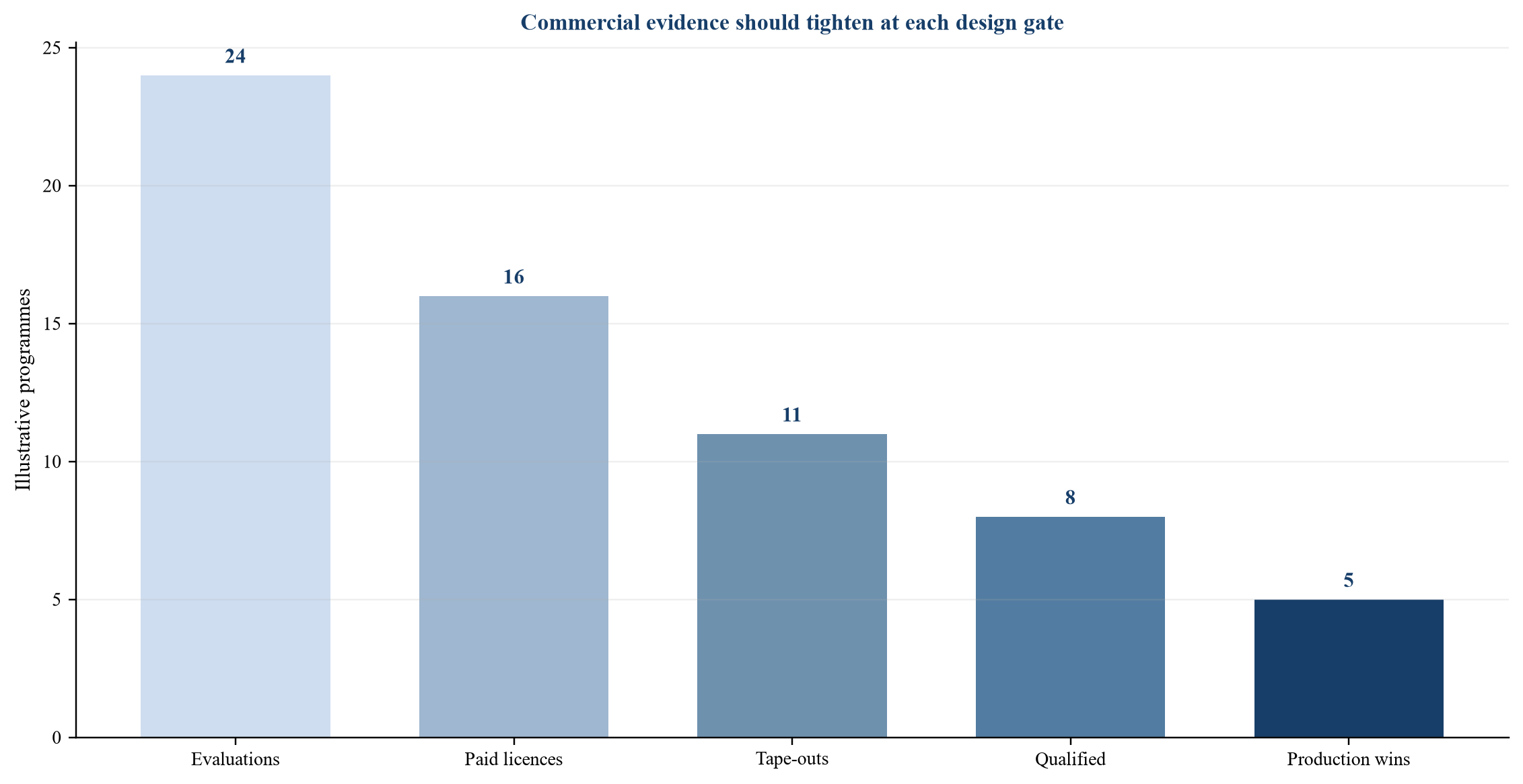
Programme counts and conversion percentages are management assumptions used to demonstrate the method.
Contract terms affect the programme's value. The buyer should review exclusivity, field-of-use limits, modification rights, support obligations, source access, indemnity, price resets, audit rights, royalty reporting, most-favoured terms, assignment and change of control. A customer may have broad rights that reduce future monetisation. A change-of-control consent can weaken closing certainty. A source-code escrow or customer ownership of improvements can affect the value of the common platform.
| Stage | Evidence required | Revenue treatment | Common overstatement |
|---|---|---|---|
| evaluation | named team, scope, hardware or software access and dated plan | no production value; limited option value | informal interest counted as pipeline |
| paid licence | executed agreement, invoice and collection | recognised licence economics under contract | upfront fee treated as recurring royalty |
| tape-out | locked design, foundry submission and schedule | probability-weighted future value | tape-out assumed to equal qualification |
| qualification | test results, customer acceptance and product release plan | higher probability with launch timing risk | end-product demand assumed without evidence |
| production | shipment or royalty statement and collected cash | evidenced current economics | early ramp annualised without yield or demand adjustment |
Proposed classification; stage weights require target-specific historical calibration.
4 Reconstruct the unit economics of intellectual property
Interconnect-IP revenue can include upfront licences, milestone payments, engineering services, maintenance, per-unit royalties and minimum commitments. Each stream has a different margin, duration and risk. The buyer should restate revenue by programme and contract, separating non-recurring engineering from reusable-product economics. Services can be strategically important while consuming scarce engineers and limiting scalability.
Gross margin should include the direct cost of product support, verification, customisation, customer enablement, third-party royalties and cloud or tool usage. Research and development should then be divided among platform maintenance, current customer work and future products. The distinction helps a buyer understand the cost to preserve existing cash and the investment required to reach the next standard, process node or packaging generation.
Royalty economics require an auditable base. The agreement may calculate royalties by chip, wafer, package, net selling price or another measure. It may include caps, floors, credits and geographic differences. The model should reconcile customer reports to shipment or product evidence where audit rights permit. It should also assess collection timing and the effect of returns, inventory cycles and end-product concentration.
The buyer should analyse customer acquisition and programme lifetime. A high cost of winning an initial design can be attractive when the interface persists across several product generations. Retention needs evidence: repeat licences, porting, derivative products, support renewals and continued royalty streams. A design that must be won again for every generation has different economics from a platform embedded in the customer's architecture.
5 Value standards participation without capitalising a logo wall
Standards participation can create information, influence, credibility and early implementation readiness. Membership alone does not prove that the target shaped a specification or can deliver compliant silicon. The buyer should identify the target's actual contributions, working-group roles, authored proposals, test participation, reference implementations and relationships with other members.
Ecosystem value should be measured through outcomes. Useful evidence includes integrations with electronic-design-automation tools, foundry reference flows, packaging design kits, test providers, interoperability demonstrations and joint customer programmes. Each relationship should have an owner, scope, agreement, technical deliverable and commercial path. A public announcement without a maintained integration can become a stale credential.
Network effects can arise when more tools, chiplets, customers and manufacturers use a common interface. Merger review can examine whether an acquisition lets a platform owner restrict interoperability, disadvantage participants or acquire a nascent threat [36-39]. The transaction thesis should therefore consider both value and conduct. A buyer that owns important tools, IP or manufacturing capacity may need open access, information barriers, licensing commitments or governance controls.
| Dimension | Weak evidence | Strong evidence | Valuation implication |
|---|---|---|---|
| standard contribution | membership and event attendance | accepted technical contributions and maintained test assets | supports credibility and roadmap access |
| tool integration | manual demonstration | supported flow with current releases and joint validation | lowers customer implementation cost |
| foundry enablement | generic process claim | verified process design kit, test chip and support path | improves portability and closing readiness |
| packaging access | non-binding discussion | qualified package, capacity route and commercial terms | reduces schedule and supply risk |
| multi-vendor operation | self-test only | reproduced third-party interoperability | strengthens adoption evidence |
| repeat customer use | one programme | derivatives across products and generations | supports duration and switching friction |
Proposed scorecard; ratings require documented evidence and accountable review.
6 Map manufacturing and packaging dependence
A chiplet asset can be fabless and still be highly dependent on physical capacity. Interconnect performance depends on process characteristics, package design, substrate, bump pitch, thermal path, power delivery, memory and test. TSMC and Intel describe substantial investment and differentiated capabilities in advanced packaging [6-12]. Outsourced assembly and test providers report growing demand and capital needs [24-27]. The buyer should understand which part of this chain is available, qualified and transferable.
The manufacturing map should include foundry, process node, intellectual-property port, wafer test, package technology, substrate, memory, assembly, final test and logistics. It should state the approved supplier, alternative, lead time, minimum order, reserved capacity, yield evidence and customer consent. A nominal second source is weak if it requires a new physical-layer implementation, package redesign or customer requalification.
Yield should be decomposed. Known-good-die performance, assembly yield, interconnect yield and final system test all affect economics. A larger number of dies can improve the ability to mix process nodes while increasing assembly and test complexity. The target should provide lot-level evidence where available, failure analysis, qualification reports and the responsibility split among suppliers.
Capacity rights should be distinguished from forecasts. A letter of intent, historical access and an executed reservation have different value. The buyer should model prepayments, cancellation, take-or-pay obligations, price adjustments and priority during shortages. It should also examine whether the target's customer, rather than the target, controls the manufacturing relationship. In that case, a change of control can alter access or bargaining power.
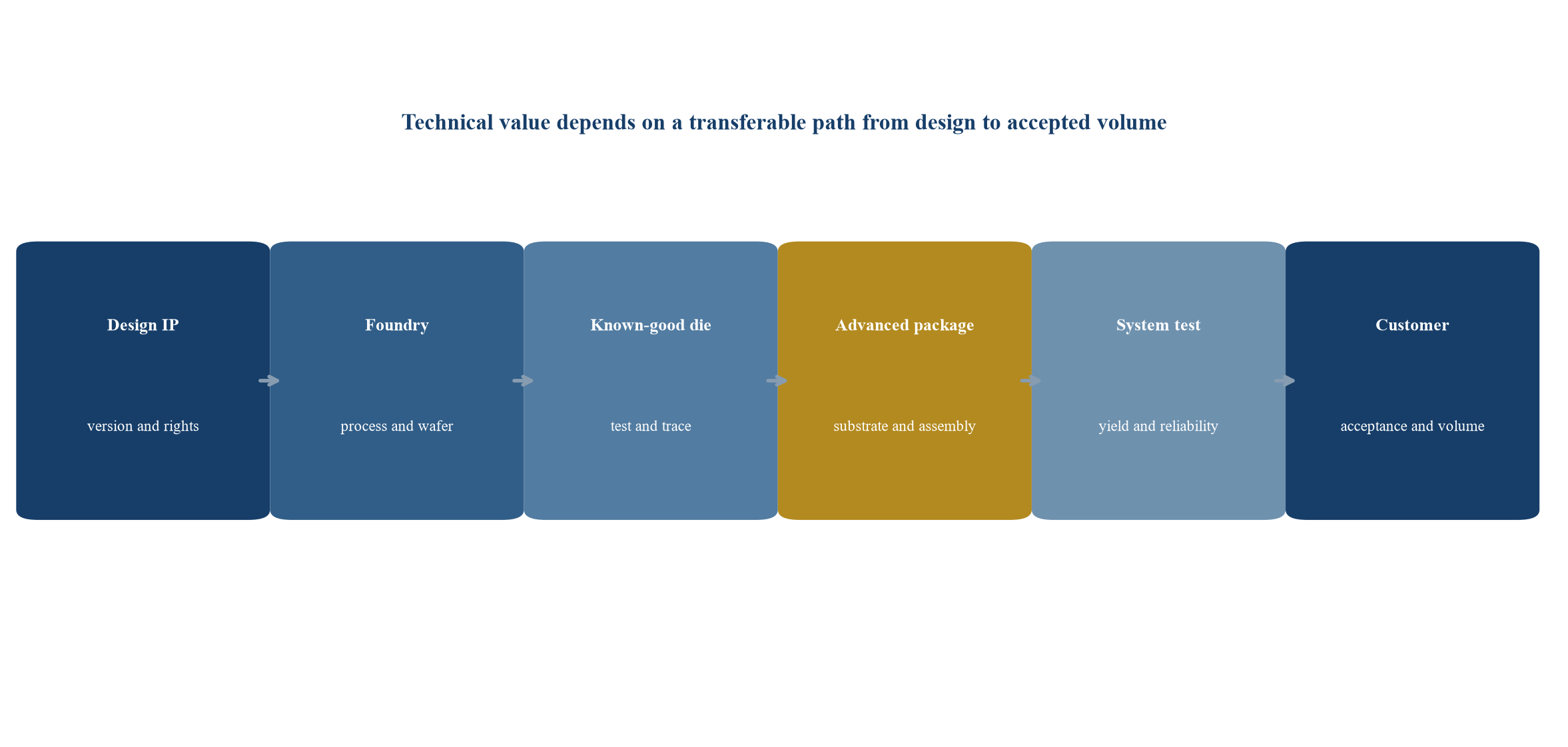
Proposed evidence chain; each hand-off requires qualified capacity, data and contractual responsibility.
7 Test export, security and sovereignty constraints
Advanced semiconductor tools, design technology and products can be subject to export controls, sanctions, investment review and end-use restrictions. Synopsys and other public companies describe controls affecting electronic-design-automation software and advanced packaging in certain markets [21-23]. US and European programmes also direct public support toward domestic capability and secure supply [28-35]. A buyer should treat these factors as operating constraints and potential sources of strategic value.
The diligence team should map products, technology, source code, personnel, customers, distributors, cloud systems and technical support by jurisdiction. It should identify classifications, licences, exceptions, restrictions, prior disclosures and pending reviews. A revenue line can appear contractually durable while depending on an export authorisation that can change. A planned transfer of engineers, repositories or manufacturing data can trigger separate analysis.
Security diligence should cover the design environment, source repositories, build chain, keys, third-party access, vulnerability handling, malicious modification controls and product-security obligations. Chiplets expand the trust boundary across dies and vendors. Management, debug and firmware paths deserve particular review because they can create privileged access. The buyer should connect security findings to remediation cost, customer acceptance and transaction conditions.
Public incentives can support capacity and ecosystem development while carrying milestones, reporting, location, change-of-control or clawback conditions. The transaction model should include grants, tax support and preferred access only when the relevant conditions survive the proposed ownership. Government customer programmes may add security, audit and supply obligations that affect integration.
8 Build a reproducible technology diligence room
Technology diligence should enable an independent specialist to reproduce material claims within the permitted environment. The room should contain architecture documents, requirements, version history, source and binary controls, build instructions, regression results, physical-design reports, signal and power analysis, test-chip data, silicon results, errata, vulnerability records and customer acceptance evidence.
Benchmark evidence should state hardware, package, process, data rate, traffic pattern, error assumptions, temperature, voltage, tool version and comparison basis. A headline bandwidth or efficiency claim is difficult to value without these conditions. The buyer should obtain raw or reproducible results for the claims that drive the investment case. Exceptions and failed tests are useful because they show engineering discipline and remaining work.
The room should distinguish platform code from customer branches. Custom forks can create support burden and weaken reuse. The buyer should measure common-code share, unresolved merge work, test coverage and release cadence. It should identify unsupported languages, obsolete tools, expired licences and single-person processes. Technical debt should become a costed integration plan rather than a general discount.
Key-person analysis should map architectural authority, customer knowledge, standards participation, physical design, verification, firmware, test and commercial ownership. Retention should follow the knowledge and execution plan. Deferred consideration tied only to employment can create accounting and incentive consequences, so compensation, purchase price and performance terms require specialist design.
| Claim | Reproduction test | Required record | Decision use |
|---|---|---|---|
| data rate and reach | rerun agreed channel and package cases | model, configuration, tool version and raw result | product eligibility and roadmap cost |
| power efficiency | reproduce workload and operating conditions | silicon or validated model, measurement method and variance | competitive positioning and margin |
| interoperability | connect independent implementations under agreed cases | version, feature matrix, logs and exceptions | ecosystem and standards value |
| portability | rebuild or port critical block in supported flow | source, scripts, licences, process assumptions and effort | dependency and integration cost |
| reliability | review stress, ageing and failure analysis | qualification plan, sample, failures and corrective actions | warranty, acceptance and product risk |
| security | test privileged interfaces and update path | threat model, access design, findings and remediation | customer eligibility and closing conditions |
Proposed review plan; scope should reflect transaction materiality and confidentiality constraints.
9 Price the stand-alone business from programme cash flows
A conventional revenue multiple can hide the quality of a chiplet target's economics. The stand-alone model should be constructed from programmes, not a top-down market share. For each programme, forecast licence milestones, engineering revenue, maintenance, royalties and direct support cost. Apply evidence-weighted probabilities and stage-specific timing. Retain a separate forecast for uncontracted opportunities.
The model should avoid capitalising the same value twice. Research and development supports existing products, future releases and customer work. A buyer that values current programme cash and then adds the entire replacement cost of the technology can double count. Replacement cost can inform a floor or make-versus-buy comparison while income value reflects expected cash. Market multiples can provide a reasonableness check when the comparator's mix, growth, margin and dependency are understood.
Management assumes a specialist target with USD 38 million of annual recurring licence and royalty revenue, USD 11 million of engineering and other revenue, and USD 29 million of research and development expenditure. Management assumes twelve active programmes and five production wins. These figures are hypothetical. The central model assigns programme values according to stage, timing, margin and duration, then deducts central platform cost, tax, working capital and sustaining investment.
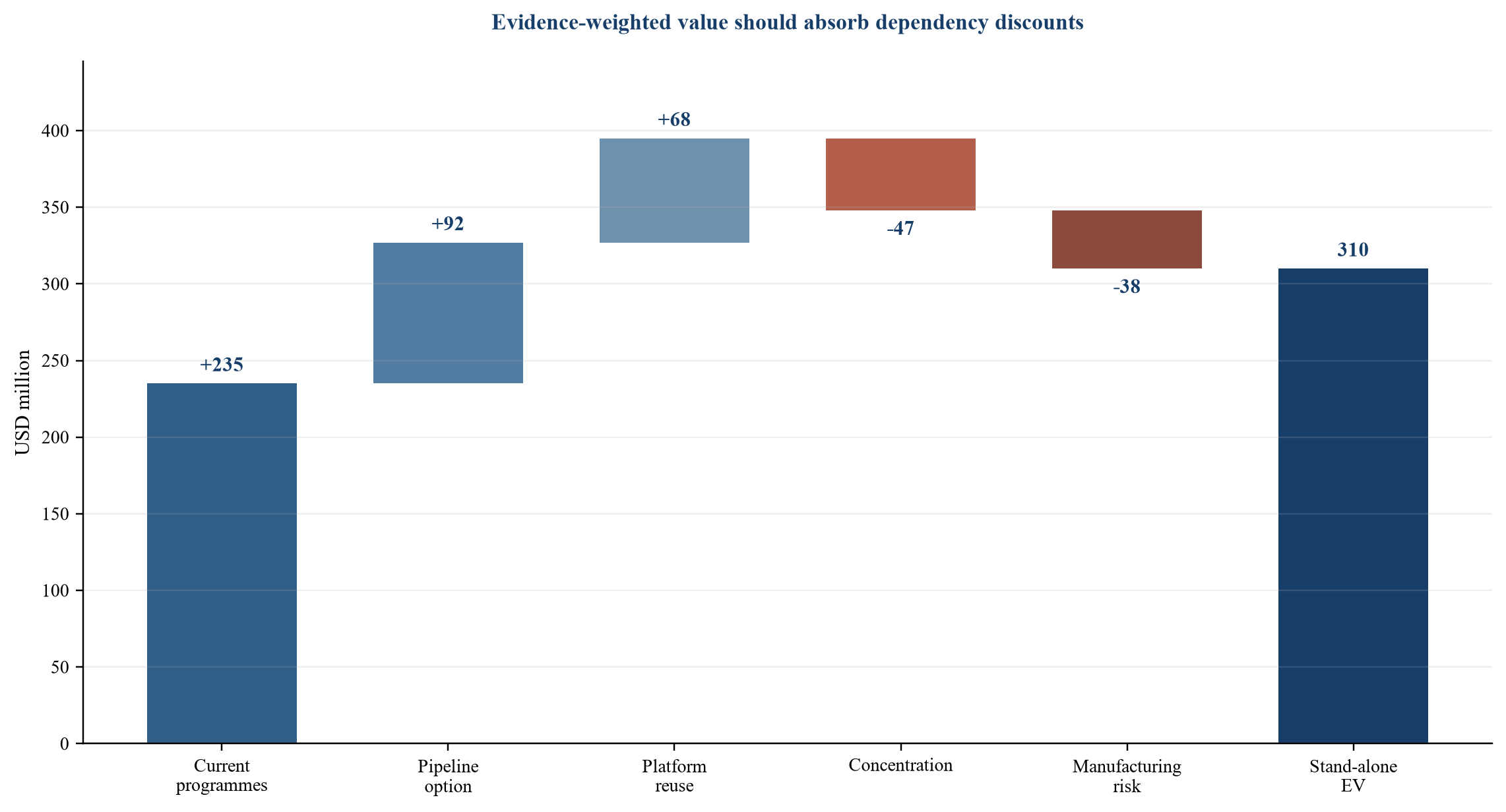
All amounts are management assumptions in USD millions and do not describe an identified company.
Useful life should be constrained by standards, customer products, process support and competitive alternatives. An indefinite terminal value is difficult to support for a specific interface implementation. The model can include renewal, derivative products and platform reuse when historical evidence and customer architecture support them. It should also include the cost of supporting old versions while developing new ones.
| Programme stage | Programme count | Illustrative probability | Average present value per successful programme | Probability-weighted value |
|---|---|---|---|---|
| production | 5 | 100% | USD 27.0m | USD 135.0m |
| qualified | 3 | 80% | USD 22.0m | USD 52.8m |
| tape-out | 3 | 60% | USD 20.0m | USD 36.0m |
| paid licence | 4 | 40% | USD 16.0m | USD 25.6m |
| evaluation | 9 | 15% | USD 12.0m | USD 16.2m |
| total before platform cost and dependency adjustments | 24 | mixed | mixed | USD 265.6m |
Values and probabilities are management assumptions for method demonstration only.
10 Build buyer-specific synergy without paying for execution twice
Strategic value can arise when the buyer distributes the target's IP through a larger customer base, integrates it with tools or manufacturing, accelerates internal products, avoids development cost or improves product performance. Each synergy should have a baseline, owner, action, timing, cost, dependency and evidence source. Broad strategic language should remain outside the valuation until converted into an executable initiative.
Revenue synergy should identify the customer and product route. It should account for customer overlap, channel conflict, qualification time and the possibility that customers prefer an independent supplier. Cost synergy should protect the engineering capacity needed for roadmap and support. Removing duplicated corporate cost can be credible. Removing verification or customer engineers can weaken the asset that justified the acquisition.
Avoided development cost is not automatically equal to transaction value. Internal development may take longer, carry higher risk or produce a different result. The buyer should compare time to market, probability of success, opportunity cost, retained rights and integration burden. The acquired technology may accelerate a product while requiring substantial porting and validation.
Synergy should be presented net of tax, implementation cost, retention, lost revenue, integration disruption and capital. The purchase-price decision should distinguish value available to any owner from value unique to the buyer. Competitive tension can justify sharing some buyer-specific value with the seller. The board should know how much and why.
11 Adjust for concentration and common-cause risk
Chiplet businesses can appear diversified across customers while sharing one foundry, package, standard or end market. Concentration should be measured by revenue, programme value, royalty units, foundry, process, packaging technology, electronic-design-automation tool, geography and key personnel. The buyer should identify common causes that impair several programmes together.
A package-capacity shortage can delay multiple customers. A standards transition can require simultaneous product investment. An export restriction can affect a geography and the support staff serving it. A defect in a common physical layer can reach several customer designs. A large customer's architecture change can remove current revenue and a reference that supports other wins.
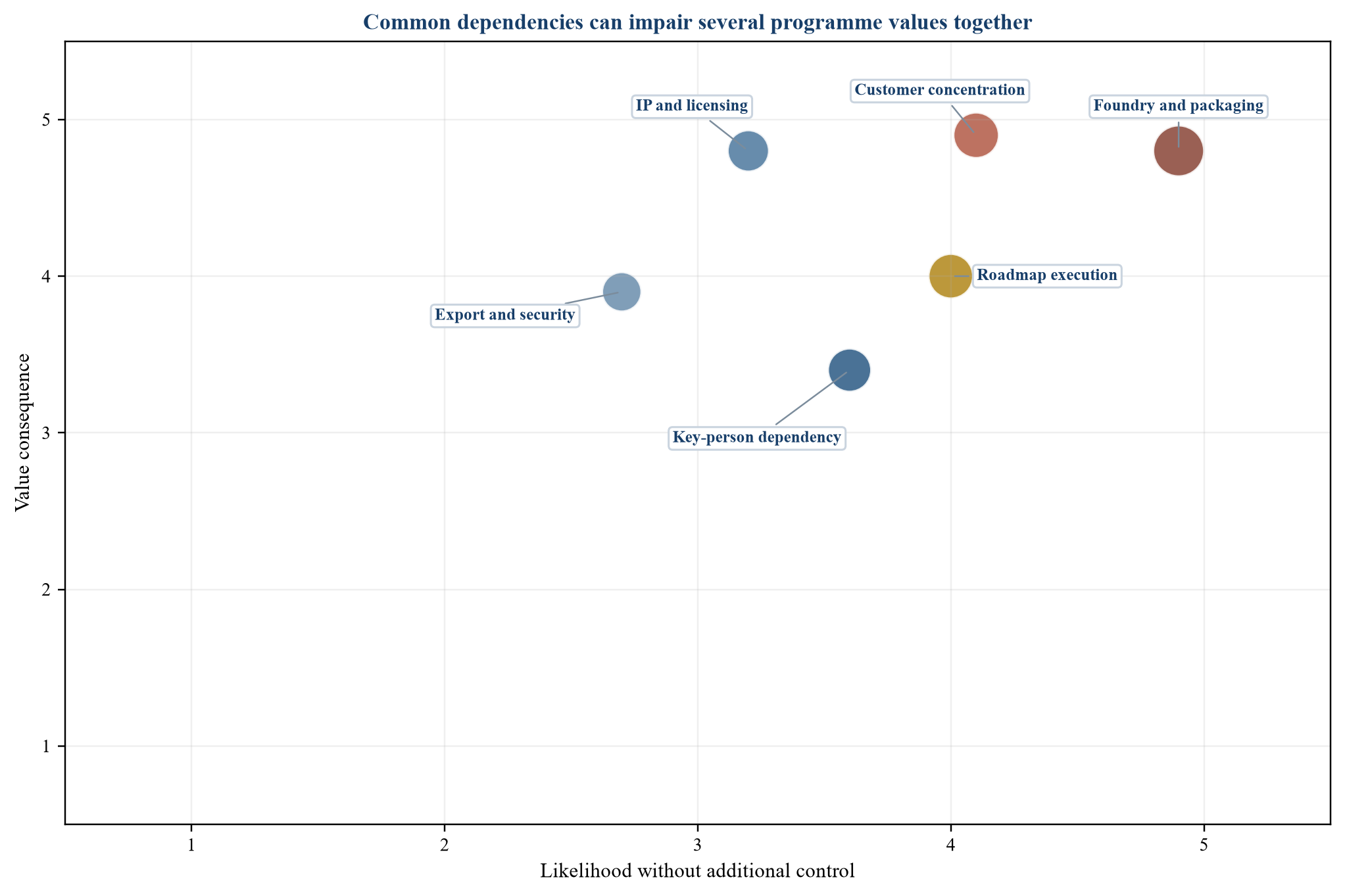
Scores are management assumptions on a one-to-five scale used to demonstrate prioritisation.
The risk model should change both price and terms. A known technology remediation can be costed and deducted. Uncertain customer conversion can be addressed through contingent value. A title or infringement issue may require a closing condition, escrow or indemnity. Manufacturing dependence can justify a capacity covenant and integration milestone. Key-person exposure can require funded retention and documented knowledge transfer.
12 Choose the transaction structure that matches the evidence
A full acquisition transfers control and can support deep integration. It also concentrates technical, regulatory and customer risk at closing. A minority investment can preserve independence and provide access while limiting control. A joint venture can combine complementary assets while creating governance and intellectual-property complexity. A licence or option can test adoption before a larger commitment.
The choice should follow the buyer's objective and evidence maturity. A target with verified production wins, clear ownership and strategic fit may support an acquisition. A pre-production asset with promising test silicon may be better suited to a staged investment, licence with milestones or option. A technology needed by many ecosystem participants may preserve more value as an independent supplier with commercial partnerships.
| Structure | Suitable evidence state | Buyer control | Principal protection | Principal limitation |
|---|---|---|---|---|
| full acquisition | verified rights, production use and integration plan | high | closing conditions, escrow, indemnity and retention | upfront exposure and possible customer neutrality concern |
| majority staged acquisition | strong technology with remaining commercial gates | high after milestones | staged consideration and call or put mechanics | governance and future pricing complexity |
| minority investment | developing adoption with strategic learning value | limited | information, consent and participation rights | limited ability to direct execution |
| joint venture | complementary assets need combined development | shared | field, budget, contribution and deadlock rules | IP leakage and divided authority |
| licence with option | technology needs customer or silicon validation | contractual | test scope, milestones and option pricing | seller can remain dependent on funding and capacity |
Proposed decision framework; legal and accounting consequences require specialist advice.
Consideration can combine cash, shares, retention and contingent payments. Earn-outs should use measurable events that reflect seller contribution and buyer control. Technical milestones need objective test conditions. Revenue milestones need defined contracts, accounting, pricing, returns and transfer pricing. The agreement should address the buyer's obligation to support the business without promising an impractical level of effort.
13 Protect interoperability and customer trust through integration
Integration should preserve the target's product, roadmap, customers and ecosystem relationships. The first hundred days should establish decision rights, repository control, product security, customer ownership, standards representation, tool and manufacturing relationships, retention and financial reporting. It should avoid forcing technical consolidation before the buyer understands the asset.
Customer communication should address continuity, support, roadmap, confidentiality and neutrality. Some customers may have chosen the target because it was independent from a competitor or platform owner. The buyer should identify conflicts, information barriers and contractual restrictions before announcement. Customer consents and key-person continuity can be closing conditions where material.
The roadmap should distinguish committed releases, standards updates, customer customisation and buyer integration. Every item needs resources and a decision owner. The combined company should preserve regression coverage and release discipline while integrating systems. A rapid migration to the buyer's tools can create value only if licences, build reproducibility and customer schedules remain protected.
Standards participation should continue under clear governance. Technical representatives need authority to contribute while protecting confidential information. Competition counsel may review information exchange and commitments when the buyer occupies several ecosystem roles. The integration plan should preserve open interfaces promised to customers and regulators.
14 Establish board gates from diligence through value realisation
The board should approve the transaction through evidence gates. The strategic gate defines the capability needed and alternative routes. The technology gate verifies rights, performance, reproducibility and roadmap. The commercial gate verifies design wins, contracts and programme economics. The supply gate verifies foundry and packaging pathways. The regulatory gate assesses export, security, investment and competition matters. The valuation gate reconciles stand-alone and buyer-specific value. The integration gate confirms owners, resources, customer protection and measurement.
Each gate should contain a stop condition. Missing title, irreproducible core performance, material customer misclassification, unavailable manufacturing capacity, an unmanageable regulatory restriction or unfunded integration can prevent commitment. A condition can also lead to a staged structure or price adjustment. The decision record should state the evidence reviewed, unresolved matters, sensitivity and accountable approver.
| Gate | Required evidence | Approval question | Failure response |
|---|---|---|---|
| strategic | capability gap, alternatives and timing | does ownership create more value than build, licence or partner? | revise route or stop |
| rights and technology | title, reproducible tests, roadmap and security | can the buyer control and maintain the claimed asset? | condition, remediate or stop |
| customer | contract, stage, acceptance, economics and concentration | are design wins and cash durable enough for the price? | haircut, stage or use contingent value |
| manufacturing | qualified foundry, package, test, yield and capacity | can products reach accepted volume on schedule? | secure capacity or reduce value |
| regulatory | export, competition, investment, security and incentives | can the transaction close and operate under required conditions? | restructure, commit or stop |
| valuation | programme model, dependency discounts and net synergy | does risk-adjusted value exceed total consideration and integration cost? | reprice or stop |
| integration | people, customer, roadmap, systems and measurement | can the buyer preserve the moat while realising value? | fund plan before signing |
Proposed approval record; each gate requires transaction-specific evidence.
15 Practical execution controls
The transaction team should maintain one programme register, one dependency map and one value bridge. The programme register should connect customer evidence to timing and cash. The dependency map should connect each product to rights, people, tools, foundry, package and regulatory conditions. The value bridge should reconcile stand-alone programme economics, platform value, dependency adjustments, synergy, implementation cost and consideration.
Version control matters. Commercial pipeline, technical results and valuation assumptions can change during a process. Every investment-committee paper should identify its data cut, model version and open issues. Customer status should change only when the required evidence is present. Technical claims should link to the tested version. Valuation should refresh after a programme loss, schedule change, export event or material diligence finding.
Confidential information should be restricted by role and purpose. Customer design data, foundry materials and standards work can carry contractual limits. Clean teams may be required where parties compete or share sensitive customers. The room should preserve access logs, export conditions and return or destruction obligations.
The closing plan should list consents, licence transfers, key repositories, credentials, standards memberships, insurance, retention, customer communications and capacity arrangements. The integration plan should begin before signing and remain conditional. Day-one access should protect operations and security. Longer-term consolidation should follow controlled testing.
Value realisation should use the same evidence structure as valuation. Report production design wins, recurring cash, programme conversion, release performance, customer retention, foundry and package readiness, integration cost and net synergy. If a synergy relied on a specific customer or product, report that outcome directly. Broad revenue growth should not be attributed to the transaction without a supported causal bridge.
16 Use a transaction control model for the signing-to-production period
The interval between signing and the first full production cycle can contain more value risk than the legal closing itself. A buyer can complete the acquisition while customer programmes, packaging capacity, key staff and standards work continue to move. The transaction control model should cover the period from the final diligence cut through closing, integration and at least the first audited royalty cycle. It should assign one owner to every assumption that affected price.
The model should begin with a frozen signing baseline. That baseline should list the programmes included in value, their evidence stage, expected gate dates, customer economics, foundry and package route, required staff, regulatory conditions and forecast cash. Changes should be recorded against the baseline. A slipped tape-out, reduced customer scope, failed interoperability test or constrained package allocation can affect value before it becomes visible in reported revenue.
Interim operating covenants should be linked to material assets and programmes. The seller should preserve repositories, licences, standards memberships, test environments, manufacturing relationships and key staff in the ordinary course. Material customer amendments, new exclusivity, broad intellectual-property grants, unplanned technical forks and capacity cancellations may require buyer consent, subject to applicable law and negotiated thresholds. The purpose is to preserve the agreed asset without transferring operational control before closing.
Closing readiness should include technical and operational handover. Repository access needs tested credentials and backup. Build and regression environments should run under accounts that survive the transaction. Customer support ownership and escalation should be clear. Foundry, package and tool licences should be assigned or replaced. Export classifications and access rules should be implemented in the buyer's environment before controlled technical information moves.
Post-close measurement should retain a programme ledger. Every forecast programme should be classified as on track, delayed, reduced, lost or expanded, with the evidence and economic effect recorded. Revenue should be reconciled to the acquisition model by licence, engineering, maintenance and royalty stream. Integration costs should be linked to the initiative that caused them. This creates a credible bridge between transaction value and realised value.
The model should also track technical health. Release punctuality, regression pass rate, unresolved critical defects, interoperability exceptions, customer escalations, package qualification, yield and security remediation provide leading indicators. They should be reported with cash and programme conversion. A business can meet short-term revenue while accumulating roadmap and support risk that weakens future value.
Contingent consideration should use the same controlled evidence. If a payment depends on qualification or production, the agreement should define the product, version, test, customer acceptance and date. If it depends on revenue or royalties, it should define accounting, currency, transfer pricing, bundled contracts, returns and collection. The buyer should retain operating flexibility while avoiding actions that arbitrarily prevent the metric. Disputes can be reduced through periodic statements, access rights and an independent determination process.
17 Translate diligence findings into price, terms and integration actions
Diligence creates value when findings change a decision. Every material finding should be classified as a price item, structural item, closing condition, contractual protection, integration action or monitored risk. The classification should include the evidence, financial exposure, timing, accountable owner and decision deadline. A long issue list without treatment can create the appearance of control while leaving the investment case unchanged.
A price item changes expected cash or required investment. Examples include programme attrition, lower royalty economics, duplicated research cost, additional porting work and unavailable tax attributes. A structural item changes the preferred transaction route, such as using a staged acquisition when production evidence remains incomplete. A closing condition requires resolution before risk transfers, such as intellectual-property title, a key customer consent or a required regulatory approval.
Contractual protection is appropriate when the seller controls historical facts or a bounded exposure remains after closing. Representations, indemnities, escrows, holdbacks and contingent consideration should match the nature and duration of the risk. They are weaker substitutes for understanding a core technology or recurring operating dependency. An indemnity does not make an unavailable packaging route operational and may not restore a lost customer schedule.
Integration actions should be funded in the transaction model. Tool migration, repository control, security remediation, process-node porting, customer support, test automation and retention can be essential to preserve value. The buyer should identify the cost, people and critical path before signing. Treating these activities as general integration can understate both required capital and execution risk.
The final investment paper should reconcile headline price, net debt, working capital, contingent value, retention, transaction cost and integration funding. It should present stand-alone value, buyer-specific value and consideration on the same basis. It should show how each major diligence finding changed those numbers or terms. This record allows the board to distinguish optimism from evidence and provides the baseline for post-close accountability.
Conclusion
Chiplet M&A combines intellectual property, product engineering, customer qualification and manufacturing dependence. The strongest transaction case follows a reproducible chain from owned rights through interoperable technology, accepted design, qualified supply and collected cash. Standards participation and ecosystem relationships strengthen value when they reduce customer cost and produce repeat adoption. They remain weak substitutes for commercial evidence.
Buyers should price the business from programme-level cash flows, then adjust for platform reuse, common dependencies and buyer-specific synergy. Open standards can expand the market and narrow proprietary rent at the same time. Foundry, package, export, security, customer and key-person constraints can impair several programmes together. Those risks belong in the model, the structure and the integration plan.
The resulting discipline is practical. Define the asset. Verify interoperability. Rebuild the design-win pipeline. Map manufacturing and regulatory dependencies. Reproduce the claims that drive value. Choose a structure that matches evidence maturity. Preserve customer neutrality and ecosystem trust during integration. A premium becomes supportable when the buyer can show how the acquired capability reaches production, remains transferable and produces durable cash after the full cost of control.
Sources
- UCIe Consortium, UCIe Specifications, Read the primary source
- UCIe Consortium, UCIe 3.0 press release, Read the primary source
- UCIe Consortium, UCIe resources and white papers, Read the primary source
- UCIe Consortium, The Value of an Open Specification, Read the primary source
- UCIe Consortium, UCIe 3.0 specification overview, Read the primary source
- Intel Corporation, 2025 Annual Report on Form 10-K, Read the primary source
- Intel Corporation, 2025 Annual Report PDF, Read the primary source
- Intel Corporation, 2024 Annual Report, Read the primary source
- Taiwan Semiconductor Manufacturing Company, 2025 Annual Report, Read the primary source
- Taiwan Semiconductor Manufacturing Company, 2025 Annual Report PDF, Read the primary source
- Taiwan Semiconductor Manufacturing Company, 3DFabric advanced packaging, Read the primary source
- Taiwan Semiconductor Manufacturing Company, CoWoS technology, Read the primary source
- Advanced Micro Devices, 2025 Annual Report on Form 10-K, Read the primary source
- Advanced Micro Devices, 2025 filing index, Read the primary source
- Cadence Design Systems, 2025 Annual Report on Form 10-K, Read the primary source
- Synopsys, 2025 Annual Report on Form 10-K, Read the primary source
- Synopsys, 2025 filing index, Read the primary source
- Arteris, 2025 Annual Report on Form 10-K, Read the primary source
- Arm Holdings, 2026 Annual Report on Form 20-F, Read the primary source
- Marvell Technology, 2026 Annual Report on Form 10-K, Read the primary source
- Synopsys, 2026 Annual Report PDF and export-control discussion, Read the primary source
- US Bureau of Industry and Security, semiconductor manufacturing equipment and advanced computing controls, Read the primary source
- US Bureau of Industry and Security, export administration regulations, Read the primary source
- Amkor Technology, 2025 Annual Report on Form 10-K, Read the primary source
- ASE Technology Holding, 2025 Annual Report on Form 20-F, Read the primary source
- JCET Group, annual reports and investor materials, Read the primary source
- SEMI, advanced packaging and heterogeneous integration resources, Read the primary source
- US Department of Commerce, CHIPS for America, Read the primary source
- National Institute of Standards and Technology, CHIPS research and development, Read the primary source
- National Advanced Packaging Manufacturing Program, Read the primary source
- European Commission, European Chips Act, Read the primary source
- European Commission, Chips for Europe Initiative, Read the primary source
- European Commission, advanced chips and packaging pilot, Read the primary source
- European Commission, European Chips Act funding overview, Read the primary source
- European Commission, technological sovereignty package, Read the primary source
- US Department of Justice and Federal Trade Commission, 2023 Merger Guidelines, Read the primary source
- US Department of Justice and Federal Trade Commission, 2023 Merger Guidelines PDF, Read the primary source
- US Department of Justice, Guideline 6 on dominant positions and ecosystems, Read the primary source
- US Department of Justice, market definition under the Merger Guidelines, Read the primary source
- Federal Trade Commission, Hart-Scott-Rodino premerger notification programme, Read the primary source
- IFRS Foundation, IFRS 3 Business Combinations, Read the primary source
- IFRS Foundation, IAS 38 Intangible Assets, Read the primary source
- IFRS Foundation, IAS 36 Impairment of Assets, Read the primary source
- IFRS Foundation, IFRS 13 Fair Value Measurement, Read the primary source
- Financial Accounting Standards Board, Accounting Standards Codification Topic 805 Business Combinations, Read the primary source
- Financial Accounting Standards Board, Accounting Standards Codification Topic 350 Intangibles, Read the primary source
- World Intellectual Property Organization, IP valuation, Read the primary source
- World Intellectual Property Organization, semiconductor intellectual property and patents, Read the primary source
- National Institute of Standards and Technology, Cybersecurity Framework 2.0, Read the primary source
- International Organization for Standardization, ISO 56005 intellectual property management, Read the primary source
