

1. Define the roll-up investment decision
The investment committee must decide whether acquiring and combining multiple Indian colocation operators creates a stronger and more financeable platform. The thesis should identify the value sources: contracted customer cash, metropolitan presence, power rights, network density, operating expertise, land, construction capability, procurement, cross-selling and capital access. Each source requires evidence, cost, timing, accountable ownership and a downside case.
Market growth is context rather than target revenue. A seller can cite national digital adoption while operating facilities with low billable utilisation, short customer tenure or expensive expansion. Reported capacity can mix operating, commissioned, under-construction, planned and land-bank phases. The board needs a common conversion ladder from legal power rights and physical systems to accepted customer service and collected cash.
The acquisition case should separate current operations, contracted conversion, approved expansion and strategic options. Operating cash supports operating value. Contracted load supports conversion value after remaining capex, conditions and customer acceptance. Planned capacity supports option value only when land, power, permits, funding and demand are evidenced.
| Value layer | Required evidence | Principal failure | Deal treatment |
|---|---|---|---|
| billable service | accepted load, invoice and cash | utilisation is reported but not billable | operating value |
| contracted conversion | executed contract, power, build and acceptance plan | customer or capacity misses schedule | milestone value |
| installed spare capacity | tested systems and available customer configuration | capacity cannot support required density | leasing scenario |
| expansion | land, grid, permits, design, capex and demand | planned MW lacks deliverable infrastructure | contingent value |
| customer portfolio | contract, cohort, margin, renewal and collection | concentration or churn is hidden | customer adjustment |
| integration | system, network, people and procurement plan | benefits require disruptive migration | costed synergy case |
Proposed diligence classification; transaction-specific contracts and engineering determine actual value.
2. Establish a common capacity dictionary
The roll-up should adopt one definition for land capacity, grid allocation, contracted power, energised power, commissioned critical capacity, customer-usable IT load, saleable power, contracted load, installed load, billable load and collected load. Each figure answers a different question. Combining them produces a false utilisation ratio.
The buyer should reconcile utility agreements, single-line diagrams, commissioning records, data-centre infrastructure management systems, customer contracts, rack inventories, meters, invoices and cash. Redundancy, cooling, electrical losses, safety limits and customer design reduce the conversion from gross power to usable IT load. Density and resilience requirements determine how much nominal capacity a particular customer can use.
The Competition Commission of India assessed a 2024 colocation combination using existing installed capacity, medium-term installed capacity and spare capacity by metropolitan area. The order also recorded limited customer switching after equipment installation because relocation can create cost, latency, data-loss and security concerns. This supports metropolitan and cohort analysis rather than a single national MW total. [1]
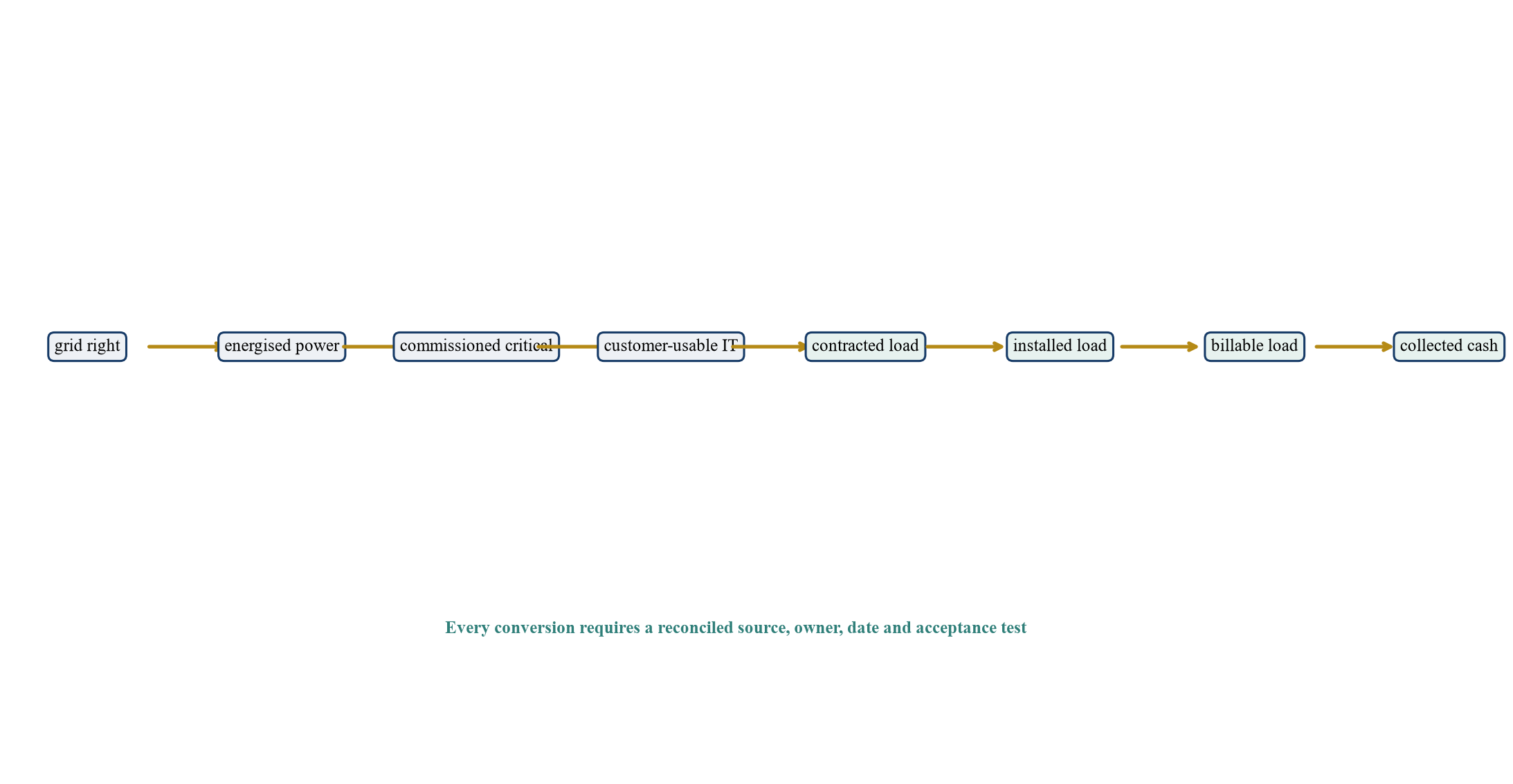
Analytical framework; engineering, contracts and customer acceptance determine actual conversion.
3. Reconstruct the metropolitan asset map
Indian colocation competition is shaped by metropolitan demand, power, fibre, cloud connectivity, subsea routes, latency, land and operating ecosystems. The buyer should map facilities by Mumbai, Chennai, Delhi NCR, Hyderabad, Bengaluru, Pune, Kolkata and other relevant markets. National presence does not make capacity interchangeable.
The asset register should identify ownership, lease, land, building, substation, generators, uninterruptible power, cooling, halls, racks, meet-me rooms, network routes, permits, maintenance, condition and expansion. It should distinguish facilities designed for hyperscale, retail colocation, enterprise, edge or mixed workloads. A facility can have spare power while lacking the space, density, network or certification needed for the target customer.
The map should expose overlap. Two acquired facilities can compete for the same customer while duplicating sales, network and support. Another pair can provide valuable diversity or disaster recovery. Integration economics should follow customer use cases and network topology rather than distance alone.
4. Build the AI-assisted diligence architecture
AI can classify documents, match entities, extract contract terms, reconcile identifiers, detect anomalies and prioritise exceptions across large datasets. The buyer should define source systems, permitted data, model version, validation, human review, access and audit records before use. Outputs should remain traceable to the underlying contract, meter, ticket, invoice or bank receipt.
The architecture should create a controlled evidence graph linking facility, hall, rack, meter, customer, contract, order, acceptance, ticket, invoice, receipt and project. Deterministic rules should handle exact accounting and contractual tests. Statistical models can identify unusual utilisation, churn, pricing, incidents or capex performance. Generative systems can summarise evidence for reviewers while preserving citations.
The Digital Personal Data Protection Act 2023 establishes duties for processing digital personal data. Customer and employee information used in diligence requires purpose, access, retention and security controls. Commercially sensitive information in a notifiable transaction should be restricted through clean teams and proportionate sharing. [2][3]
| Use | Source evidence | AI task | Human control |
|---|---|---|---|
| capacity reconciliation | engineering, DCIM and meters | match definitions and flag variance | engineer approves usable MW |
| contract extraction | executed agreements and amendments | extract term, price, SLA and consent | counsel validates clause |
| cohort analysis | CRM, billing and collections | group customers and detect churn | commercial lead checks causality |
| incident analysis | tickets, alarms and credits | identify patterns and clusters | operations verifies event |
| capex review | budget, purchase order, progress and acceptance | compare cost and schedule | project director validates forecast |
| board reporting | approved analyses | summarise evidence and scenarios | decision owner signs record |
Proposed governance; human reviewers remain responsible for consequential conclusions.
5. Create rack and power cohorts
The customer unit should be defined at the level where economic behaviour can be observed. A customer can occupy several racks, halls or facilities under multiple contracts. The buyer should link those records to one economic customer while retaining site, density, service and contract detail.
Power cohorts can group commitments by contract vintage, metropolitan area, density, resilience, price, term and customer type. Rack cohorts can track installed, active, billable and vacated units. Cohort curves reveal whether utilisation growth reflects durable customer ramp, temporary migration, internal affiliates or broad market demand.
The model should avoid treating a signed power reservation as occupied capacity. Customer equipment installation, testing, service acceptance, billing and collection are separate events. Delays between them affect cash, capital and debt service. Cohort analysis should preserve each date.
6. Measure utilisation quality
Headline utilisation is sensitive to denominator and numerator. The denominator may be design capacity, installed systems, saleable capacity or operational capacity. The numerator may be reserved, contracted, installed, energised, billed or collected. The buyer should publish a bridge among all combinations and use one approved base metric.
Quality includes price, margin, contract term, credit, density, capital burden, renewal and collection. A highly utilised hall can produce weak returns when power is passed through poorly, customer pricing is legacy, fit-out is expensive or service credits are frequent. Spare capacity can be valuable when it is immediately saleable at attractive returns.
AI anomaly detection can identify facilities where reported utilisation diverges from meters, invoices or access records. Each exception requires review. Planned maintenance, shared systems, metering boundaries and customer testing can explain a variance without misstatement.
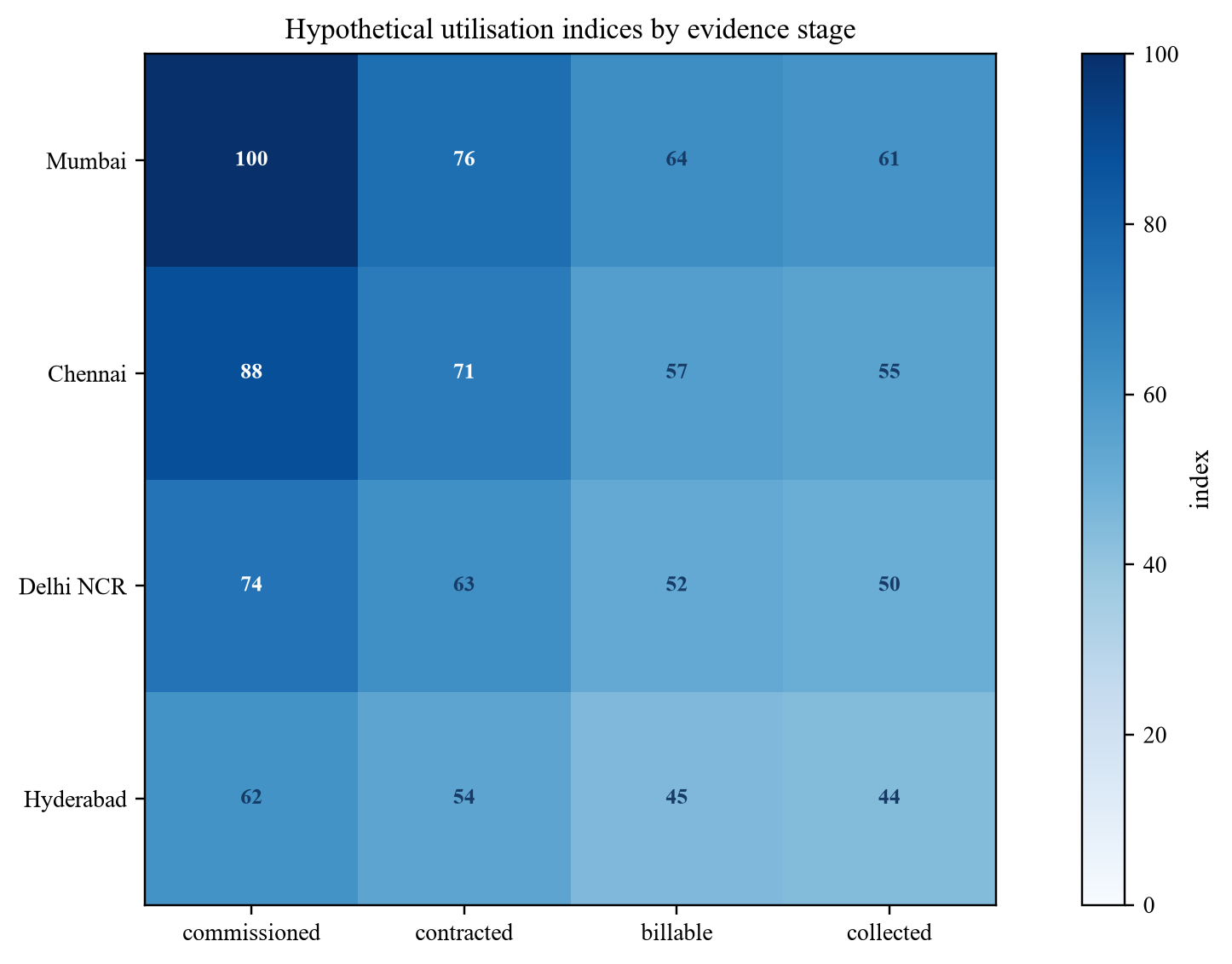
The framework separates physical, contractual, billing and cash measures.
7. Reconstruct customer cohorts
The customer register should reconcile legal entity, group, sector, service, site, load, rack, contract, start, acceptance, price, invoice, collection, tickets, credits, renewal and termination. Resellers and managed-service providers should be traced to the economic exposure where lawful and practical.
Cohorts should include hyperscale, cloud, telecommunications, financial services, public sector, digital-native, enterprise and reseller customers. They should also include contract vintage, acquisition channel, metro, density, service bundle and credit. The buyer can then distinguish broad retention from dependence on a few long-tenor anchor contracts.
Related parties and internal group usage require separate treatment. A telecommunications parent can be a valuable anchor customer and a source of network services. Pricing, term and volume should be governed by enforceable agreements. Historical internal allocations may not represent standalone economics.
8. Measure churn correctly
Customer churn should be measured by logo, contracted kW, billable kW, recurring revenue, contribution and cash. Each measure can tell a different story. Partial downsizing, site migration, contract consolidation and price renegotiation should not be hidden inside a binary retained or lost label.
Gross churn measures lost customers or load. Net retention incorporates expansion from existing customers. Renewal retention should be measured only among contracts reaching a decision point. Early-life failure should be separated from mature churn. Cohort curves should track the original starting base and avoid survivorship bias.
The CCI's observation that installed colocation customers can face switching frictions does not remove churn risk. Customers can consolidate future expansion elsewhere, decline renewal, reduce reserved capacity or negotiate price. The buyer should model both physical exit and share-of-wallet loss. [1]
| Measure | Numerator | Denominator | Decision use |
|---|---|---|---|
| logo retention | retained customer groups | opening customer groups | breadth and relationship |
| load retention | retained billable kW | opening billable kW | capacity durability |
| gross revenue retention | recurring revenue excluding expansion | opening recurring revenue | downside cash |
| net revenue retention | retained plus expansion revenue | opening recurring revenue | wallet growth |
| contribution retention | retained customer contribution | opening contribution | economic quality |
| renewal retention | renewed eligible load | load reaching renewal | contract risk |
Proposed definitions; the buyer should reconcile each measure to contracts, invoices and cash.
9. Diagnose churn causes
The buyer should assign a reviewed cause to every material loss or contraction: customer failure, price, service, latency, network, capacity, density, power quality, location, consolidation, cloud migration, security, relationship or strategic change. Free text can be classified by AI, but the commercial owner should confirm the cause and evidence.
Incident and service-credit data should be linked to churn. A facility can report high availability while a particular customer experiences recurring cross-connect, access or change-management issues. Correlation should not be labelled causation without review. Contract renewal, customer budget and competitive bids provide additional context.
Retention actions should follow verified causes. Service problems require operating remediation. Price problems require contribution analysis. Concentration requires relationship and diversification plans. Customer distress requires credit control. A generic retention programme can spend money without addressing the reason for loss.
10. Test price and margin durability
The pricing register should identify recurring space, power, cross-connect, remote hands, installation, connectivity, managed service and pass-through charges. It should capture discounts, free periods, escalation, minimum commitments, credits, taxes and renewal mechanics. A blended revenue per kW can conceal material differences.
Power pricing deserves separate review. Contracts can use fixed price, indexed price, actual pass-through, mark-up or bundled pricing. Utility tariff, demand charge, open-access renewable procurement, losses and taxes can change margin. The buyer should model the contract's ability to transmit cost changes.
Contribution should deduct site operating cost, network, customer support, recurring maintenance and customer-specific capex. The model should show margin by cohort and facility. Cross-selling claims should require a defined product, customer eligibility, pricing, sales capacity and conversion evidence.
11. Verify customer concentration
Concentration should be measured by group revenue, billable load, contracted load, receivables, remaining contract value, contribution and renewal schedule. Several legal entities can belong to one cloud or financial-services group. Resellers can create indirect end-customer concentration.
The buyer should assess contract term, credit, parent support, termination, service credits, change of control, data location, security and expansion rights for major customers. A long contract can still allow termination for service failure, regulatory change or prolonged force majeure. Large deposits can support liquidity while creating refund obligations.
Debt sizing should include customer-specific downside cases. Loss can occur through full exit, delayed ramp, partial renewal, price reset or relocation of future growth. The model should avoid assuming simultaneous replacement at the same price and capex.
12. Reconcile service quality and incidents
Operating diligence should combine alarms, tickets, outages, maintenance, root-cause analyses, service credits, customer complaints and insurance notifications. Event identifiers should be standardised across acquired businesses. Similar incidents can be classified differently and disappear from aggregate statistics.
AI can cluster incident descriptions and identify repeated equipment, facility, shift or vendor patterns. Engineering review should validate the physical cause and remediation. Availability should be calculated at the service boundary promised to customers, not only at a facility-wide level.
Deferred maintenance and single points of failure should enter the capital plan. A facility with strong historical availability can still face rising risk where batteries, generators, switchgear or cooling approach end of life. The purchase price and integration plan should fund required remediation.
13. Separate maintenance, remediation and growth capex
Maintenance capex preserves current service. Remediation corrects deficiencies or brings acquired assets to approved standards. Growth capex creates new usable capacity. Customer-specific fit-out enables a contract. These categories should not be mixed because they have different cash-flow and valuation treatment.
The buyer should reconcile approved budgets, purchase orders, invoices, physical progress, commissioning, customer milestones and payments. Capitalised cost should be tested against the physical asset and accounting policy. Related-party procurement and advance payments require specific review.
Expansion returns should use remaining cost to cash, not historical spend. A partly completed project can have a high percentage-complete report while retaining the most difficult grid, commissioning or customer work. Contingency should follow unresolved engineering and contracting risk.
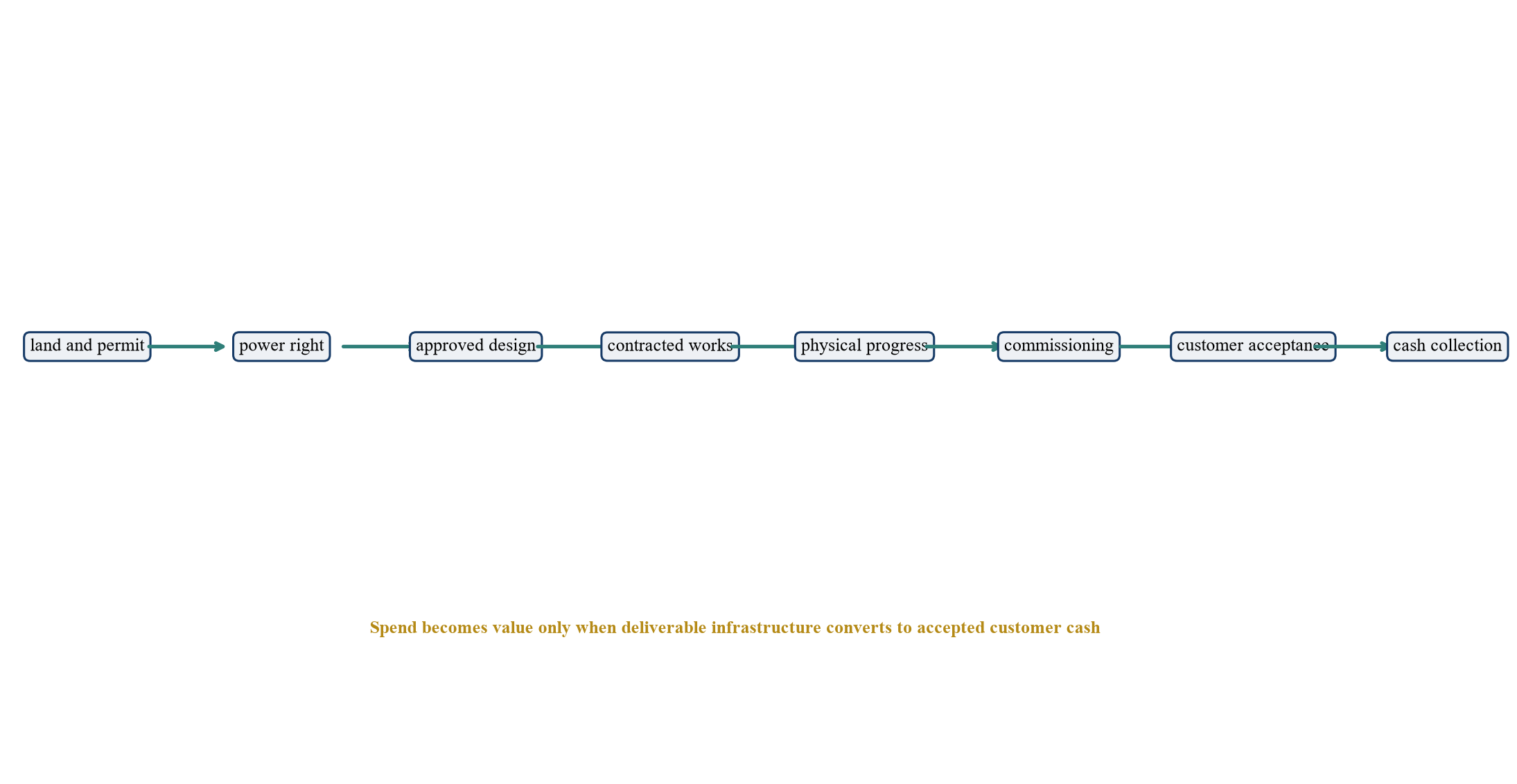
Each stage requires independent evidence before value or debt capacity increases.
14. Test power procurement and deliverability
The buyer should inspect utility connection, contracted demand, voltage, energisation, security deposit, tariff, open-access arrangements, renewable supply, backup generation, curtailment, outage and expansion. A group procurement arrangement may require novation or new credit support after acquisition.
Nxtra reported 49 per cent renewable-energy usage across core sites in FY25, 482,800 MWh of contracted renewable capacity and a 10 per cent PUE reduction from its FY21 baseline. These company disclosures illustrate metrics available for diligence; they do not establish another operator's performance. [4][5]
The platform model should retain site and state differences. Tariff, open access, banking, losses, taxes and regulation can vary. Renewable claims should be traced to contracts and instruments. Power synergy should reflect actual transferable procurement rights and load profiles.
15. Assess cooling, water and density
Customer-usable capacity depends on cooling architecture, climate, water, density, redundancy and operating limits. The buyer should review design, commissioning, measured performance, maintenance, water source, discharge, permits and expansion. AI accelerator workloads can require liquid cooling or higher rack density that legacy halls cannot support without retrofit.
PUE should use a consistent boundary, period and load. A lower PUE at high utilisation is not directly comparable with a newly commissioned low-load facility. Water-use metrics should identify source and stress. Energy and water improvements should be supported by meters and engineering, not vendor estimates alone.
The valuation model should treat retrofit cost and downtime explicitly. A facility can have spare nominal MW while lacking economically usable high-density capacity. Customer interest in high-density service supports value only after design, power, cooling, network and commercial terms are evidenced.
16. Review data, cyber and regulatory obligations
Customer contracts can impose data location, access, security, audit, incident and subcontracting requirements. The buyer should identify the responsible entity, certifications, controls and change-of-control obligations. Government and regulated customers may require additional approvals.
The DPDP Act framework applies to digital personal data. The buyer should govern diligence access, clean-team use, migration, retention and deletion. Operating telemetry and customer usage data can contain sensitive commercial information even when it is not personal data. [2]
India's draft Data Centre Policy 2020 described enabling infrastructure and recognised data centres as an important part of digital infrastructure. The draft status and subsequent legal developments should be stated accurately. Transaction teams should verify current central, state and local requirements rather than treat the draft as final law. [6]
17. Test merger-control and standstill requirements
The Competition Act combination regime can require notification and approval before consummation. CCI guidance describes mandatory and suspensory standstill obligations and warns against pre-closing operational control or inappropriate exchange of commercially sensitive information. [3]
The buyer should assess filing thresholds, deal-value rules, control, horizontal overlap, vertical links and metropolitan concentration with current counsel. The 2024 STT GDC India combination order examined metro-level installed and spare capacity. A 2026 CCI press release confirmed approval for CPPIB's proposed investment in CtrlS. These are transaction-specific decisions rather than blanket clearance for consolidation. [1][7]
Pre-closing diligence should use clean teams for competitively sensitive customer, price, capacity and pipeline information. Integration planning should preserve independent conduct until clearance and completion. Covenants should be objective and proportionate.
18. Build the integration thesis
Integration should identify which functions remain local and which can be combined. Facility operations, customer obligations, licences, utility relationships and incident authority may require local control. Procurement, finance, reporting, selected systems and commercial coverage can support scale.
The buyer should map network, DCIM, maintenance, ticketing, CRM, billing, finance, identity, cyber and data. A common platform can improve visibility while creating migration and outage risk. Critical systems should use phased migration, parallel running, reconciliation and rollback.
Synergies require baselines and owners. Procurement benefit should use supplier offers and comparable specifications. Cross-selling should use identified customers and conversion assumptions. Staff savings should preserve safe coverage. Capital avoidance should not defer required maintenance.
The operating model should define decision rights across the group, metropolitan cluster and facility. Site teams need authority for safety, access, incident response and customer service. Group functions can set standards, capital priorities, procurement and reporting. Escalation should be fast enough for live infrastructure. Reserved matters should reflect materiality and customer commitments rather than require central approval for routine restoration work.
Network integration requires particular discipline. Acquired operators can use different carriers, internet exchanges, cross-connect processes, route maps and network-operation tools. A common commercial catalogue can improve sales while physical diversity remains protected. Contract consolidation should not remove route diversity, create a single supplier failure or weaken customer-specific service obligations. Network savings should therefore follow engineering confirmation and completed migration.
Brand and go-to-market choices should reflect contract and customer evidence. Immediate rebranding can simplify market presentation and create confusion during consent, billing or support. A phased plan can preserve local customer relationships while establishing one proposition, service catalogue, pricing authority and account ownership. The buyer should identify competing account claims between acquired sales teams before incentives are combined.
Integration should also manage vendor concentration. Common generators, batteries, switchgear, cooling equipment and software can improve spares, training and purchasing. Rapid standardisation can strand usable assets or introduce a common defect across the portfolio. The engineering authority should approve standards by lifecycle and risk, supported by total-cost evidence.
| Benefit | Initial evidence | Delivery evidence | Cash evidence |
|---|---|---|---|
| power procurement | comparable tariff and load analysis | executed supply arrangement | paid invoice reduction |
| network | duplicate route and contract map | migrated service and cancelled contract | recurring payment reduction |
| vendor procurement | item-level price comparison | amended or new contract | invoice saving |
| customer cross-sell | named eligible accounts | signed order and acceptance | invoice and collection |
| systems | target architecture and cost | tested migration and retired system | licence and support saving |
| capital avoidance | engineering comparison | approved common design | cancelled or reduced committed spend |
Proposed proof standard; measured cash determines realised value.
19. Govern model risk and false precision
AI models can produce confident classifications from incomplete or inconsistent source data. The buyer should record model purpose, training or reference data, prompts, rules, versions, thresholds, validation, exceptions and approvals. Sensitive or consequential analyses should be reproducible.
Data quality should be scored by completeness, timeliness, consistency, provenance and control. Low-quality inputs should reduce confidence and trigger manual sampling. An unexplained result should not change price, customer treatment or employee decisions.
Scenario outputs should be labelled as assumptions. Observed data should remain separate from prediction. The board should see ranges and drivers rather than one optimised number. Independent reviewers should challenge conclusions that materially affect valuation or leverage.
20. Design the hypothetical portfolio
The hypothetical portfolio combines four operators and fourteen facilities across six metropolitan areas. Sellers report 248 MW of installed or planned capacity. Diligence identifies 176 MW of commissioned critical capacity, 129 MW of customer-usable IT load, 94 MW contracted, 76 MW installed and 64 MW billable.
The customer graph contains 486 legal customer records that reconcile to 371 economic customer groups. The largest ten groups represent 52 per cent of billable load and 47 per cent of recurring contribution. Twelve-month gross revenue retention is 91 per cent in the base data after correcting for internal migrations and reseller duplicates. These are wholly hypothetical assumptions.
The portfolio includes INR 28 billion of separation, remediation and committed expansion capital. The programme covers electrical remediation, cooling upgrades, customer fit-out, one metro expansion and systems integration. Uncommitted pipeline and conceptual land capacity are excluded from base value.
The four sellers use seven capacity definitions and three customer-master structures. One reports reservations as contracted capacity. Another reports total building power rather than customer-usable IT load. The diligence team reconciles all sites to a common dictionary and preserves the seller figures only as source fields. This adjustment explains most of the reduction from 248 MW stated to 129 MW customer-usable capacity.
The customer analysis finds that 38 legal entities belong to nine larger groups and that 21 apparent churn events are internal site migrations. It also identifies 14 contracts where power price escalation does not fully match projected utility cost. The base model adjusts retention and contribution for these findings. These are hypothetical results created to demonstrate the framework.
Project review identifies three expansion programmes. One has secured land, power and permits and is included in the funded plan. One has land and preliminary design but a conditional power route and remains contingent. One is an early market concept and receives no base value. This treatment prevents the same future demand from supporting several competing sites.
The integration case includes power procurement, network contracts, selected software, insurance, finance and vendor purchasing. It excludes facility-staff reductions during the first year and assigns no value to customer cross-selling until a signed order is accepted. The result is a smaller and more measurable synergy case than a broad percentage of seller overhead.
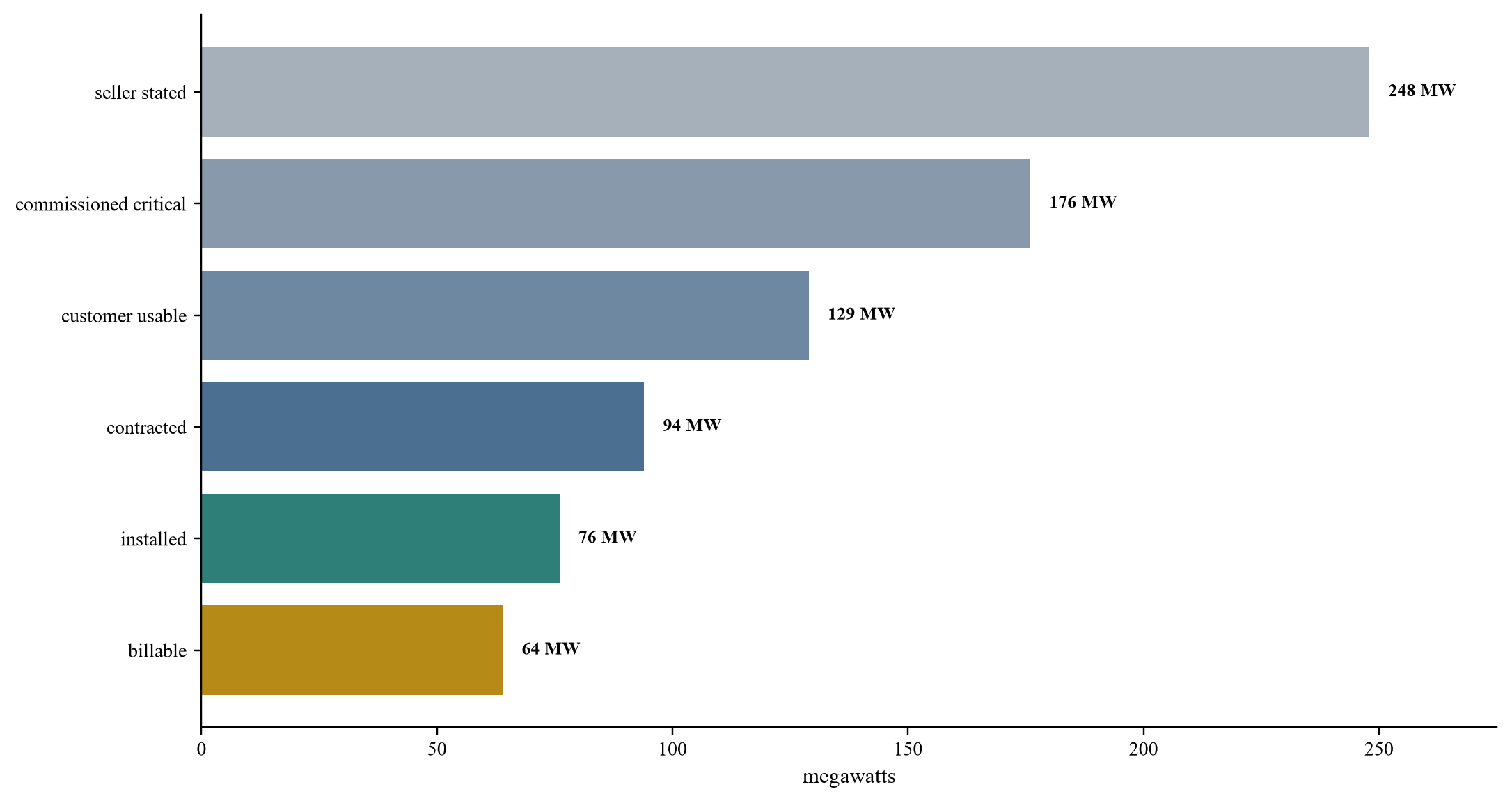
Wholly hypothetical figures; they do not describe an identified operator or transaction.
21. Model churn and utilisation scenarios
The base case converts contracted load according to evidenced customer and project milestones. It assumes normal renewal by cohort, specific price resets and no revenue from uncommitted pipeline. The downside delays 12 MW of acceptance, loses part of one large customer at renewal and extends integration cost.
The severe case combines delayed power, customer contraction, slower re-leasing and capex overrun. Vacated capacity requires sales time, fit-out and customer acceptance before replacement cash. The model therefore avoids immediate backfill. The upside includes only executed expansions and named cross-selling opportunities.
AI models can estimate risk scores using contract, service, payment and engagement features. The score should support review rather than become a mechanical churn forecast. Leakage, changes in customer strategy and small sample sizes can make model performance unstable.
| Driver | Base | Downside | Severe |
|---|---|---|---|
| opening billable load | 64 MW | 64 MW | 64 MW |
| delayed contracted conversion | 4 MW | 12 MW | 20 MW |
| gross revenue retention | 91% | 84% | 76% |
| expansion capex overrun | 5% | 15% | 28% |
| integration delay | 3 months | 9 months | 15 months |
| replacement leasing after churn | 12 months | 20 months | 30 months |
Wholly hypothetical; figures are illustrative management assumptions.
22. Bridge enterprise value to funded equity
The hypothetical transaction has INR 112 billion of enterprise value. INR 28 billion of separation, remediation and committed expansion capital increases uses to INR 140 billion before fees, taxes, refinancing and reserves. Acquisition debt of INR 46 billion leaves substantial equity and liquidity requirements.
| Item | INR billion | Evidence treatment |
|---|---|---|
| enterprise value | 112 | transferred operating and conversion perimeter |
| separation and remediation | 11 | funded work packages and controls |
| committed expansion | 17 | approved power, build and customer gates |
| total before fees and reserves | 140 | minimum identified uses |
| acquisition debt | 46 | resilient collected cash and security |
| equity before fees and reserves | 94 | funded at completion |
Wholly hypothetical; amounts exclude transaction-specific fees, taxes, refinancing and reserves.
The buyer should compare enterprise value with current billable contribution, contracted conversion and remaining capex. A multiple of stated MW can obscure power, utilisation, capital and customer differences. Value should be allocated among operating cash, conversion and options.
Consideration can be deferred against customer acceptance, commissioned capacity or collected revenue. The metric should be objective, auditable and protected from buyer or seller manipulation. Deferred price should not replace adequate opening liquidity.
The valuation should use several lenses. A discounted cash-flow model captures customer ramp, churn, pricing, capital and financing. A contribution multiple tests operating cash. A value-per-billable-MW comparison can provide a market reference when definitions are consistent. Replacement cost can test physical asset value while remaining separate from commercial value. None should import seller-stated planned capacity without adjustment.
The buyer should bridge reported EBITDA to standalone and combined EBITDA. Adjustments should cover related parties, one-off installation, power pass-through, customer credits, deferred maintenance, shared services, leases and normalised staffing. Planned synergies should appear below the standalone case until implemented. Each adjustment should reconcile to source evidence and cash.
The purchase-price allocation should identify tangible assets, leases, customer relationships, contracts, software, brands, deferred tax and goodwill under applicable accounting standards. The accounting exercise should not determine the investment decision, though it can reveal assumptions about useful lives, customer attrition and impairment. Those assumptions should reconcile to the commercial diligence.
Sensitivity should vary retention, conversion timing, price, utility cost, capex and exit conditions. A tornado chart can show which assumptions dominate equity value. The board should focus negotiation and protection on those drivers. A scenario with plausible operating performance and inadequate liquidity should fail even if its long-term valuation remains positive.
23. Size debt from collected cash
Debt should be sized from resilient cash after operating cost, maintenance capital, tax, lease, working capital and customer-specific obligations. Contracted load that is not accepted should not support base debt. Pipeline should remain outside the borrowing case.
Security should match the legal location of assets and cash. The review should cover shares, property, movable assets, bank accounts, receivables, insurance, contracts, utility deposits and permitted security. Minority investors, joint ventures, leases and customer restrictions can affect enforcement and distributions.
The downside should test churn, delayed ramp, power cost, service credits, capex overrun and integration. Liquidity should cover the full separation and conversion period. Covenants should use the approved capacity and earnings dictionary.
24. Design transaction protections
The purchase agreement should connect diligence findings to conditions, warranties, indemnities, price adjustments, holdbacks, earn-outs and covenants. Missing power, permits, customer consent or systems require specific solutions rather than reliance on generic warranty language.
The customer and project schedules should define contracted load, acceptance, remaining capex and responsibility. Completion accounts should address intercompany balances, customer deposits, power collateral, capex creditors, deferred revenue and working capital. Locked-box structures require clear leakage and permitted-payment rules.
Pre-closing covenants should preserve customers, staff, maintenance, permits, cyber controls, projects and ordinary-course independence. Information sharing and integration planning should remain consistent with competition rules. Closing readiness should include cash, authority, access, incident command and customer communication.
25. Execute the first hundred days
The first phase should stabilise service, safety, cash, customers, people, cyber and projects. The buyer should avoid simultaneous changes to critical facility and commercial systems. A control room should track dependencies, incidents, customer commitments and integration.
The second phase should establish common capacity, customer, contract and finance reporting. It should confirm procurement actions, renewal priorities, capital gates and systems sequencing. Customer teams should protect major renewals and communicate responsibility clearly.
The third phase can execute approved integrations and commercial initiatives. Each benefit should retain a baseline, owner, target, cost and evidence. The board should stop initiatives whose operating risk exceeds supported value.
Customer protection should begin before completion within permitted boundaries. The buyer should prepare account-specific contact, consent and continuity plans. After closing, senior management should meet major customers, confirm service responsibility and address open incidents. Commercial teams should avoid using integration as a reason for unsupported price or contract changes during sensitive renewals.
People continuity requires a role map, retention plan and decision-rights communication. Facility engineering, network operations, security, customer support and project delivery roles can be difficult to replace. Retention awards should align with safe operations, knowledge transfer and delivery. The combined company should establish consistent safety, ethics and escalation standards while respecting valid employment terms.
Cash control should cover bank accounts, customer receipts, supplier payments, power deposits, payroll, taxes and capital commitments. The first invoice and collection cycles should reconcile to contracts, meters and service acceptance. Exceptions should be resolved before data is used for synergy or covenant reporting. Opening liquidity should remain segregated from discretionary expansion until day-one risks stabilise.
The programme office should publish one dependency and value register. Operational dependencies, customer commitments, regulatory actions, system migrations, capital projects and synergies should use the same owner and evidence discipline. A closed item should contain proof of operating effectiveness, not only a completed task status. Internal audit or an independent reviewer should sample high-risk closures.
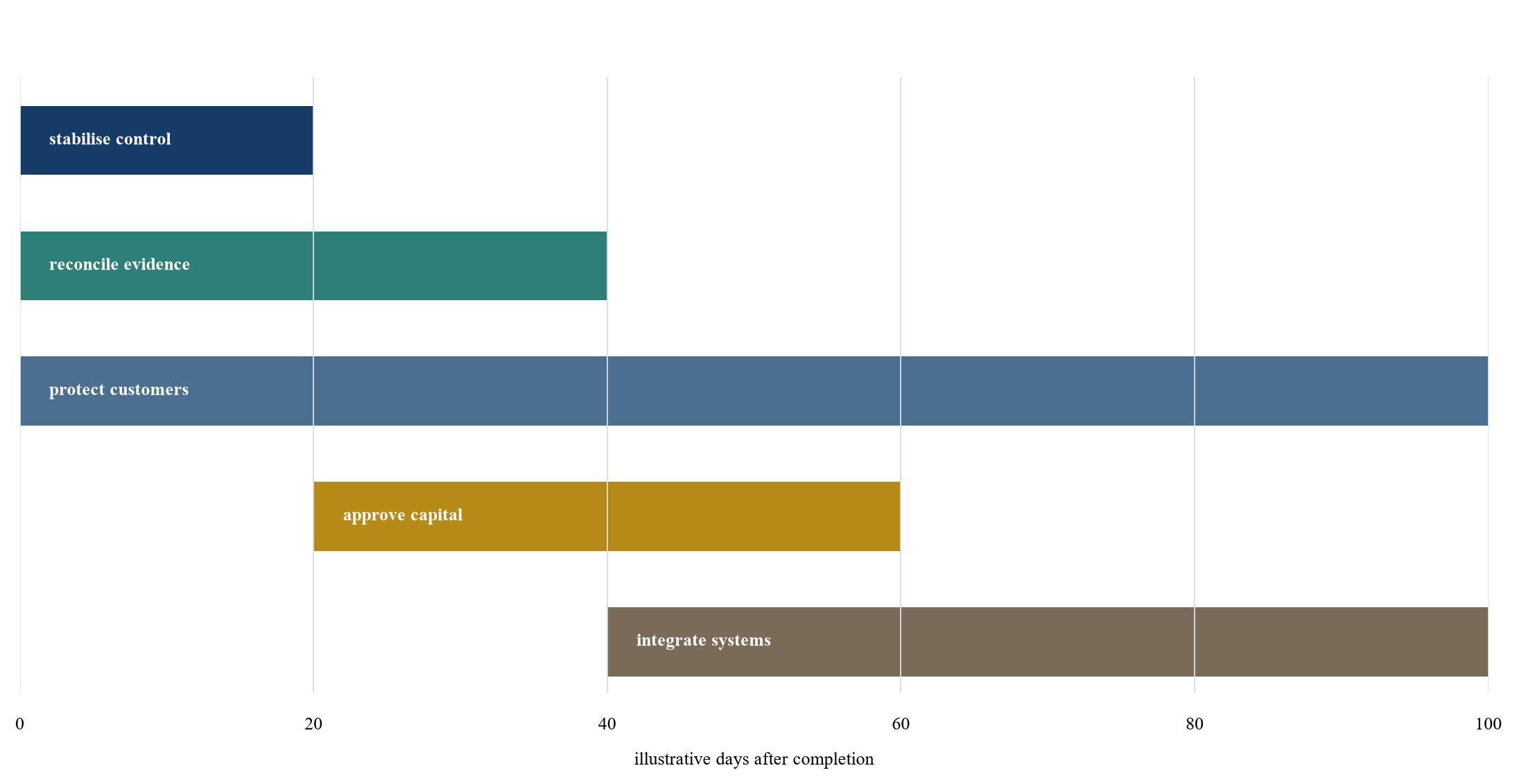
Timing is illustrative; customer and facility risk determine actual sequence.
26. Establish board decision gates
The board dashboard should cover capacity conversion, utilisation, churn, concentration, incidents, power, capital, integration, cash, leverage and compliance. Every metric needs a definition, source, owner and threshold. Exceptions should lead to decisions and actions.
Capital release should require land, power, permits, design, procurement, construction and customer evidence. Revenue recognition in the acquisition case should require contract, delivery, acceptance, invoice and collection. Synergy recognition should require implemented change and measured cash.
| Gate | Required evidence | Decision |
|---|---|---|
| perimeter | entities, assets, customers, power, people and systems | approve signing basis |
| capacity | reconciled engineering and contract ladder | approve MW classification |
| customer | cohort retention, concentration and consent | approve revenue case |
| capital | remaining cost, schedule, power and demand | release expansion funds |
| day one | authority, liquidity, access, incident and communication | approve completion |
| leverage | collected cash, capex and downside headroom | draw or refinance debt |
| integration | stable control and tested migration | combine selected functions |
Proposed governance; thresholds should be tailored to the transaction.
27. Create continuing assurance and exit readiness
The combined platform should retain the evidence graph and refresh it monthly. Capacity, customer, service, billing, collections and capital should reconcile. Model drift, data gaps and overrides should be reported. Independent engineering, cyber and financial reviews should test material claims.
Exit readiness should improve through consistent definitions, audited reporting, current contracts, documented power rights, maintained facilities, reliable customer cohorts and disciplined project records. A future buyer or lender should be able to reproduce utilisation and retention without rebuilding the data estate.
Potential exits include strategic operators, infrastructure funds, pension investors, sovereign investors, listed vehicles and continuation funds. Value should follow durable cash, customer quality, operating resilience and funded expansion. A higher market multiple should not be the main exit plan.
The platform should test customer cohorts at least quarterly. Retention measures should reconcile opening and closing populations, and reasons for loss should remain reviewable. New products, high-density workloads and channel sales should receive distinct cohort tags so that early growth does not obscure weak economics. Model performance should be monitored against realised outcomes.
Capacity assurance should include annual engineering certification, commissioning records, maintenance status and meter reconciliation. Planned capacity should remain outside operating metrics. Any change in definition should restate the comparative history. This protects lenders, investors and management from artificial growth created by reclassification.
Capital assurance should compare approval, commitment, spend, physical progress, commissioning, customer acceptance and cash. Cost savings should be measured against a controlled baseline with scope held constant. A project that spends less by deferring resilience or customer requirements has not created value.
Exit preparation should start with buyer questions: which contracts transfer, which power is firm, which customers renew, which capex remains, which systems are independent, and which earnings convert to cash. Continuous evidence reduces disruption and allows management to run the business while a future diligence process proceeds.
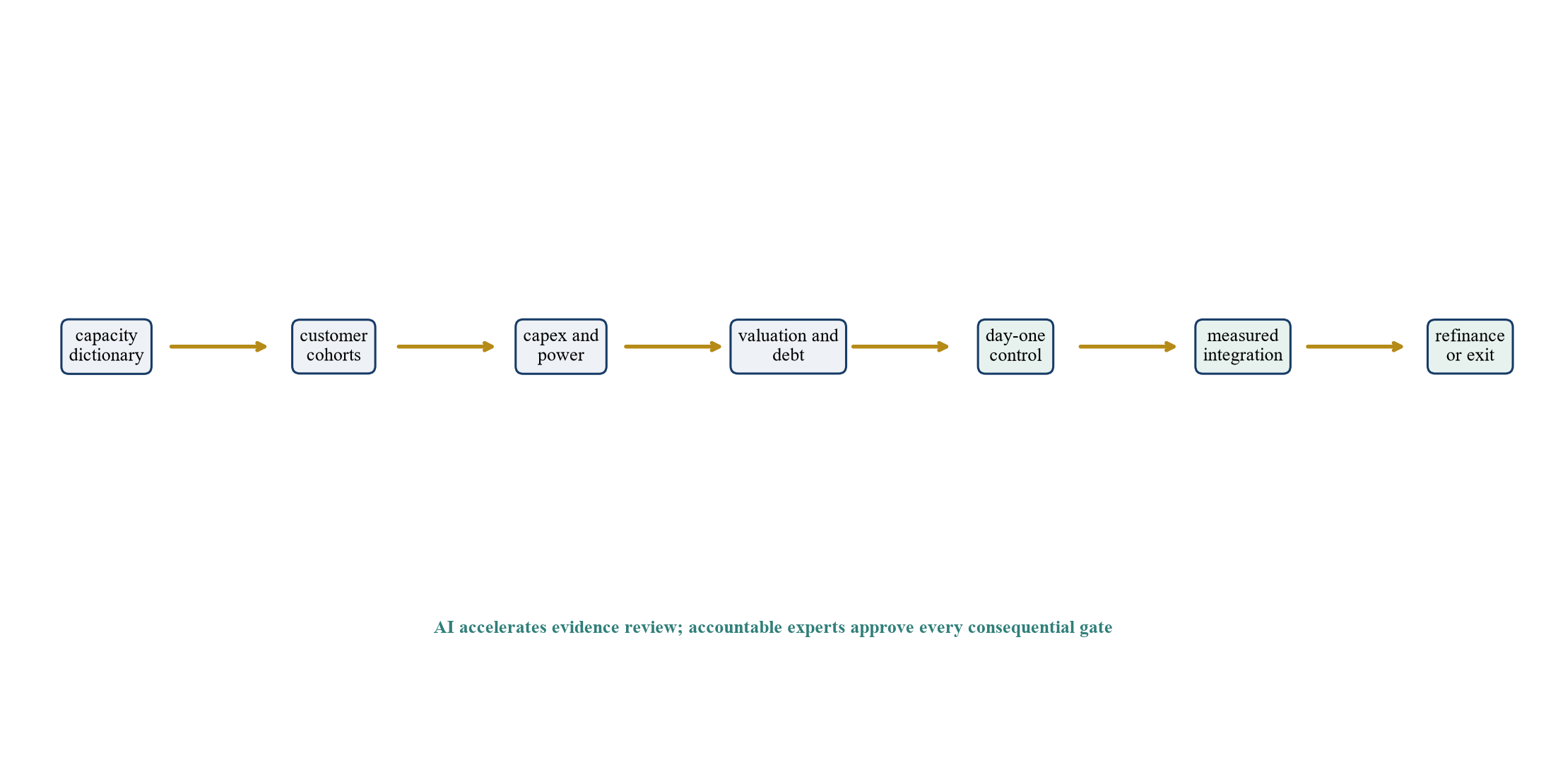
Each gate requires source evidence, human approval and a funded fallback.
28. Conclusion
Indian colocation roll-ups can create value through customer reach, metropolitan coverage, power, network density, procurement and access to capital. The investment case becomes credible when capacity definitions, customer cohorts, churn, pricing, incidents and expansion capital reconcile to accepted service and collected cash.
AI can accelerate contract extraction, entity matching, anomaly detection and cohort analysis. Its output should remain traceable and reviewed. Engineering, commercial, legal, privacy, cyber and board judgement remain essential where evidence conflicts or decisions affect customers, people and capital.
The buyer should pay operating value for billable and collected capacity, conversion value for contracted load with funded delivery, and contingent value for earlier-stage expansion. This discipline converts a portfolio of reported megawatts into a controlled operating platform with measurable integration economics and refinancing evidence.
Sources
- Competition Commission of India, Combination Registration No. C-2024/07/1168, 2024. Read the primary source
- Ministry of Electronics and Information Technology, Digital Personal Data Protection Act 2023. Read the primary source
- Competition Commission of India, Frequently Asked Questions on combinations and standstill obligations. Read the primary source
- Nxtra by Airtel, Sustainability performance. Read the primary source
- Nxtra by Airtel, Sustainability reports. Read the primary source
- Ministry of Electronics and Information Technology, Draft Data Centre Policy 2020. Read the primary source
- Competition Commission of India, Approval of proposed CPPIB investment in CtrlS Datacenters, 12 May 2026. Read the primary source
- Competition Commission of India, Summary of proposed STT GDC India combination, 2024. Read the primary source
- Bharti Airtel, Carlyle investment in Nxtra at a USD 1.2 billion valuation, 1 July 2020. Read the primary source
- Bharti Airtel, Integrated Report and Annual Financial Statements 2022-23. Read the primary source
- Nxtra Data Limited, Annual Report 2020-21. Read the primary source
- Nxtra by Airtel, company and network profile. Read the primary source
- Ministry of Environment, Forest and Climate Change, Environmental Impact Assessment. Read the primary source
- Ministry of Environment, Forest and Climate Change, Environment Protection framework. Read the primary source
- Ministry of Electronics and Information Technology, State Data Centre Guidelines. Read the primary source
- Competition Commission of India, Combination legislation and guidance. Read the primary source
- Central Electricity Authority, official reports and statistics. Read the primary source
- Central Electricity Regulatory Commission, regulations and orders. Read the primary source
- Securities and Exchange Board of India, Infrastructure Investment Trusts regulations. Read the primary source
- Ministry of Power, Green Energy Open Access Rules and power-market policy resources. Read the primary source
- Bureau of Energy Efficiency, energy-efficiency programmes and standards. Read the primary source
- National Critical Information Infrastructure Protection Centre, Guidelines for protection of critical information infrastructure. Read the primary source
- Indian Computer Emergency Response Team, Directions and cybersecurity guidance. Read the primary source
- IFRS Foundation, IFRS 15 Revenue from Contracts with Customers. Read the primary source
- IFRS Foundation, IAS 36 Impairment of Assets. Read the primary source
- IFRS Foundation, IFRS 16 Leases. Read the primary source
