
Introduction
India's private-launch sector now includes suborbital demonstrations and a successful private orbital mission. This evidence changes the diligence question. Investors can move beyond valuing only engineering intent, yet a single orbital mission remains an early observation in a business whose value depends on repeat manufacturing, launch operations, customer acceptance and cash collection. [3][4][5][6][7]
Reusability adds another evidence gap. A reusable design can reduce replacement hardware, shorten responsive-launch cycles and support a higher lifetime flight rate. It can also add recovery hardware, performance penalties, refurbishment work, inspection uncertainty and capital requirements. The valuation must separate an expendable service that can operate today from a reusable option that still needs technical and economic proof.
This paper addresses acquisition, growth-capital and strategic-investment decisions. Each value claim links to an observed milestone, remaining work, probability, cash consequence and contractual protection.
1. Define the acquisition thesis
The transaction team should write the acquisition thesis as a set of measurable claims. Examples include acquiring an operational launch service, securing sovereign launch access, integrating launch with spacecraft manufacturing, obtaining propulsion or avionics intellectual property, entering a government procurement channel or accelerating a buyer's vehicle programme. Each claim needs a value mechanism, evidence standard, owner and failure case.
The thesis should identify which cash flows belong to the target on a stand-alone basis and which arise only after integration. Customer revenue, contract margin and working capital belong in the operating case when supported by target evidence. Procurement savings, shared range infrastructure, constellation demand and cross-selling are buyer synergies. Separating them prevents the seller from being paid twice for value created by the buyer.
2. Separate company value from programme value
A launch company can contain an operating vehicle, a vehicle in development, propulsion assets, test facilities, launch-site rights, mission software, payload-integration capability and government qualifications. These assets mature at different rates and should not be valued through one revenue multiple. The operating service can be valued from accepted missions and cash generation. A development programme requires completion cost, schedule and probability adjustments.
Technology option value should be tied to an identified future decision. A reusable stage, larger vehicle or responsive-launch capability can create value if the technical path, customer requirement, funding plan and expected economics are credible. An idea without those components remains an opportunity narrative. The buyer should preserve options through staged funding and governance instead of capitalizing the full forecast at closing.
3. Reconstruct verified flight history
The diligence team should rebuild every attempted flight, static-fire campaign and integrated test from primary evidence. Record the vehicle configuration, authorised activity, site, date, payload, target trajectory or orbit, achieved result, anomaly, customer acceptance and corrective action. ISRO records the Vikram-S suborbital mission of November 2022 and the Agnibaan SOrTeD suborbital flight of May 2024. ISRO and the Government of India record Vikram-1's successful orbital launch in July 2026. These milestones should remain separate because they tested different vehicles, mission profiles and operating systems. [3][4][5][6][7]
Ground evidence should be linked to the exact flight configuration. Static fires, stage tests, tank qualification, avionics validation, separation tests and software simulations can lower technical uncertainty. They do not substitute for the integrated environment of orbital flight. The buyer should trace every claim to a report, serial number, requirement, acceptance authority and closure status.
Flight heritage belongs to the configuration that generated it. A suborbital demonstrator may prove propulsion, structures, avionics or operations without proving payload delivery to orbit. An orbital success establishes a stronger evidence point. Repeat missions establish process control and schedule reliability. The model should use an evidence ladder rather than pool unlike events into one success percentage.
4. Measure cadence as repeatable throughput
Cadence is the number of completed and accepted missions the full operating system can sustain. It depends on vehicle production, engine supply, test capacity, payload readiness, range access, licensing, launch-site operations, weather, mission engineering and customer decisions. A launch calendar that ignores these constraints is a sales plan rather than a capacity model.
Measure scheduled-to-actual variance, turnaround time, work in process, manufacturing cycle, engine-test throughput, launch-site occupancy and causes of delay. Separate target-controlled delay from customer, range and weather delay. Both affect cash timing, while remediation differs. Cadence receives valuation credit after repeated delivery across representative missions, sites and operating conditions.
5. Underwrite reliability and learning
Reliability should be measured at vehicle, stage and critical-system level. The sample for a new private launcher will initially be small. A buyer should therefore combine flight results with qualification margins, acceptance testing, manufacturing yield, non-conformance records, supplier escapes, telemetry and closure of anomalies. The analysis should report the size and relevance of each evidence set rather than imply statistical confidence that the sample cannot support.
Learning has financial value when it reduces cycle time, defects, rework, launch delay or required contingency. The buyer should compare planned and actual labour, material, test and launch-site use across builds. A successful first orbital mission supports a higher milestone score. Repeatable production and accepted customer missions support a separate cadence score.
Reusability requires its own reliability chain. Recovery survival, post-flight inspection, component life, refurbishment labour, replacement parts, recertification, turnaround and successful reflight are distinct milestones. A recovered stage that cannot be economically returned to service has salvage or data value, not demonstrated reusable-service value.
6. Classify backlog by enforceability
Backlog should be reconstructed contract by contract. Record signed value, funded amount, customer options, deposits, termination rights, refund rights, launch windows, price escalation, performance conditions, cancellation payments, assignment restrictions and change-of-control consent. The buyer should reconcile this schedule with the general ledger, deferred revenue, invoices, cash receipts and customer confirmations.
The register should distinguish launch-service commitments from engineering, payload-integration, grant and development income. It should also separate minimum customer obligations from options, forecast missions and maximum framework values. This contract-level definition prevents a broad commercial pipeline from being presented as committed launch revenue.
7. Verify government backlog
Government-linked demand ranges from policy support and facility access to an awarded, funded launch order. The diligence team should obtain the authorisation, tender, award, executed contract, modifications, statement of work, delivery schedule, termination rights, funding evidence and acceptance record. Policy announcements and ecosystem funding establish context; the executed instrument and customer confirmation determine economic treatment.
The Government of India reported in July 2026 that active space start-ups exceeded 400, private investment had crossed USD 600 million and IN-SPACe had granted 108 authorisations for space activities. A later parliamentary response reported 113 authorisations to 52 non-government entities. These figures describe sector development. They do not identify a specific launch company's funded backlog, delivery margin or probability of winning future missions. [8][19]
Government demand should be tested for payload readiness, security, compatible orbit, mission assurance and procurement timing. Base-case backlog should include only funded and executable obligations. Strategic eligibility, approved programmes and expected missions belong in scenarios with explicit probabilities and bid costs.
8. Distinguish frameworks from funded orders
A framework establishes contractual machinery for later competitions or call-offs. It may identify qualified suppliers, pricing rules, a maximum value and ordering terms. It does not ordinarily prove that the authority will order the maximum or allocate any specific share to one supplier. The buyer should distinguish guaranteed minimums, funded call-offs, exercisable options, non-binding pipeline and maximum programme value. [16][17]
The same discipline applies to grant-supported demonstrations and letters announcing government support. A grant can fund capability development without creating launch-service revenue. A memorandum can document cooperation without obligating missions. Valuation should follow enforceable scope, funding, acceptance conditions, customer readiness and expected contribution margin. Strategic eligibility can be recorded as an option with a separate probability and remaining bid cost.
9. Test commercial customer quality
Commercial customers vary in credit, mission readiness and financing. A launch contract with a funded satellite programme and completed payload can have greater conversion probability than an agreement with an early-stage constellation still raising capital. Diligence should examine the customer's financing, spacecraft production, regulatory approvals, spectrum position, insurance and launch dependency.
The contract schedule should include customer deposits, milestones and cancellation behaviour. Customer interviews can test launch-date priority, switching alternatives and willingness to accept a different vehicle or window. Revenue scenarios should avoid assuming every customer is ready when the target is ready. A launch company can appear supply-constrained while a material portion of its manifest remains customer-constrained.
10. Map deposits and cancellation rights
Deposits provide evidence of commitment only after their legal and accounting treatment is understood. The buyer should identify whether each amount is refundable, credited against launch price, forfeitable after a date, secured, held in escrow or subject to performance conditions. Cash already spent on vehicle production can create a future delivery obligation without providing future liquidity.
Cancellation clauses should be modelled under customer delay, target delay, mission failure, licensing delay and force majeure. The economic result may include refund, termination fee, replacement flight, priority rebooking or damages cap. These outcomes affect both backlog value and working capital. The quality of a manifest is partly the quality of its cancellation economics.
11. Normalize pricing and mission mix
Headline price per launch can obscure mission-specific services. Price may include payload processing, range support, mission design, separation systems, special studies, schedule priority, responsive-launch capability, insurance or orbital transfer. Normalize each mission to a standard configuration and separately value mission-unique work.
The transaction model should therefore reconcile quoted price with the signed statement of work and the accounting ledger. It should identify whether revenue belongs to launch, integration, engineering, site services or reimbursable items. A consistent mission bridge allows the buyer to compare price, scope, cost and cash contribution across customers and vehicle configurations.
12. Build per-launch unit economics
The buyer should construct cost per accepted mission from bill of material, engine and stage production, direct labour, test, consumables, freight, integration, launch-site operations, range charges, mission-unique engineering, insurance, allocated support and expected rework. Separate recurring cost, fixed operating cost and programme development.
Margin should be reconciled at mission and cohort level. A target may report improving unit cost while shifting development labour, overhead or launch-site expense elsewhere. The model should compare management's standard cost with purchase orders, payroll, inventory movements and actual mission closeouts. Cash contribution matters because revenue recognition can precede or follow mission delivery.
13. Model fixed-cost absorption
Launch businesses carry facilities, engineering, range, safety and programme-management costs that do not move proportionally with missions. Higher cadence can improve absorption if the additional flights use available capacity and do not require another site, factory or shift structure. The model should therefore represent capacity in steps rather than assume a smooth cost curve.
At each cadence level, identify headcount, engine-test slots, stage flow, integration bays, pad occupancy, maintenance windows and supporting capital. A ten-mission plan that needs a second production line should include its completion cost and ramp loss. Fixed-cost absorption creates value after the system passes its next bottleneck.
14. Underwrite engine and vehicle supply
Supply diligence should trace propulsion, structures, avionics, valves, tanks, composite materials, separation systems and controlled components to qualified sources. Record lead times, minimum orders, sole-source exposure, export classification, quality history, tooling ownership, intellectual-property rights and change-of-control provisions.
The buyer should test whether the forecast cadence can be supported by released purchase orders and supplier capacity. A target can hold a large manifest while lacking engines or long-lead components for the scheduled year. Supplier substitution can require redesign, qualification and regulator engagement. Inventory should be assessed for configuration obsolescence and recoverability after programme changes.
15. Assess launch-site and range access
Launch-site access is a package of authorisation, physical capacity, services and scheduling rights. Diligence should inspect the site agreement, integration facilities, permitted vehicle envelope, range allocation, ground-support interfaces, storage, utilities, emergency response, security, fees, priority rules and termination rights. IN-SPACe authorisation establishes permission for the stated activity. It does not prove that the target controls a commercially usable launch window. [2]
Satish Dhawan Space Centre supported the private suborbital and orbital milestones recorded in public sources. Agnikul also developed the Dhanush private launch pad at Sriharikota. India is building a dedicated SSLV complex at Kulasekarapattinam, and government disclosures describe support for non-government launch activity. The buyer should still evidence the target's contractual access, compatible trajectories, range resources and schedule priority. [5][6][11][17]
The cadence model should translate nominal site capability into usable windows. Weather, airspace and maritime coordination, other missions, maintenance, payload delay and vehicle readiness can reduce utilisation. An alternative site has value only when the vehicle can be transported, integrated and authorised there within the modelled time and cost.
16. Review manufacturing capacity
Factory capacity should be demonstrated through routing, cycle time, yield and work-in-process. The buyer should walk the production line and reconcile serial numbers, material status, non-conformance, labour bookings and stage completion. Prototype facilities often require different controls to support repeatable production.
Capacity should be modelled at the constraint, which may be engine test, tank production, avionics acceptance, final integration or site logistics. Overall floor area provides limited evidence. The buyer should require a funded debottlenecking plan, supplier commitment and quality controls before valuing the higher cadence case.
17. Test schedule realism
An integrated master schedule should connect engineering release, supplier delivery, manufacturing, qualification, licensing, site readiness, payload availability, range windows and customer milestones. Each critical path needs an accountable owner and evidence of duration. Schedule reserve should reflect maturity and historical variance.
The transaction model should preserve date-specific cash effects. A launch delayed across a fiscal period can change revenue recognition, milestone receipts, working capital and covenant compliance. Multiple missions relying on the same unresolved qualification test should be treated as correlated rather than independent.
18. Evaluate licences and regulatory approvals
Indian Space Policy 2023 assigns IN-SPACe responsibility for authorising and supervising space activities by non-government entities. The 2024 norms address launch operators, launch facilities, registration, safety, liability and continuing obligations. Diligence should map every current and planned activity to the relevant authorisation, conditions, validity period, reporting requirement and change process. [1][2]
The buyer should compare the authorised configuration, launch facility and mission with the business plan. A material vehicle change, reusable recovery operation, new site or altered trajectory may require additional evidence or approval. Counsel should confirm whether a change of control, foreign investment or access to protected technology affects existing permissions.
The completion schedule should include regulator engagement, safety analysis, environmental and range work, insurance, registration and customer approvals. Management should identify the evidence package for each gate, responsible authority, expected review duration and the cash required while approval is pending.
19. Review mishaps and corrective actions
Incident diligence should cover flight failures, test events, pad damage, near misses, safety occurrences and material quality escapes. India's recent private-launch milestones demonstrate the importance of configuration-specific evidence across suborbital tests, vertical test flights and orbital missions. Transaction diligence requires the underlying technical record: telemetry, causal analysis, corrective actions, independent review, requalification and acceptance by the responsible authority. [3][5][6][7]
Regulatory closure does not by itself establish economic closure. A corrective action may increase mass, reduce payload, extend inspection, change a supplier or consume future test inventory. The buyer should update mission performance, cadence, unit cost, insurance and liquidity for every material action. Shared causes across vehicle, site and range should be treated as correlated risks.
20. Verify sovereign demand
Sovereign demand can support value when it is connected to funded missions, measurable avoided delay or protected downstream capability. Indian policy seeks stronger private participation and commercial presence in space. Government programmes also support infrastructure, technology transfer, testing and capital formation. These measures improve the probability that domestic capability will be used. They do not allocate missions or margin to an individual company. [1][8][11][12][17]
The diligence team should map civil, defence and strategic missions by payload, orbit, launch window, security, procurement route and funding. It should identify substitute launch options and the consequence of delay. A buyer-specific value can arise when ownership protects a required mission or integrates launch with a funded satellite programme. General national importance should remain outside stand-alone enterprise value unless an enforceable payment mechanism supports it.
Strategic access can also affect transaction structure. Government customers may require Indian control, protected information, domestic supply or mission-priority rights. These conditions should be reflected in governance, reserved matters, security protocols, pricing and capacity allocation.
21. Review investment screening and export controls
India's foreign-investment framework allows 100 percent foreign investment in the space sector, with different automatic-route thresholds by activity. Launch vehicles, associated systems and spaceports permit up to 49 percent under the automatic route; investment beyond that level requires government approval. The buyer should classify the target's activities, instruments, beneficial owners and rights before signing. [9][10]
Foreign components, software, technical data and personnel can also carry third-country export restrictions. Diligence should create a controlled list of classifications, licences, end-use limits, re-export conditions and nationality restrictions. An integration synergy should be excluded until the buyer has a lawful route to combine teams or systems.
Transaction documents can use closing conditions, information barriers, governance limits and long-stop dates to manage approval risk. The valuation should include the cost of delayed closing, duplicated operations, restricted technology access and any required ownership or board arrangements.
22. Assess intellectual-property control
The buyer should map patents, trade secrets, source code, design files, test data, manufacturing know-how, government rights, university licences, employee assignments and supplier licences. Ownership of a vehicle design can be less valuable if the target lacks rights to essential tooling, software or technical data.
Government funding can introduce data-rights regimes that differ by contract. Open-source components and commercial software require licence review. The integration plan should protect restricted data while allowing the buyer to operate, improve and support the acquired system. Technology value should be reduced where rights are incomplete, disputed or dependent on a departing individual.
23. Test insurance and liability
The IN-SPACe authorisation norms address liability and insurance for authorised space activities. The buyer should identify liability allocated to the launch operator, facility operator, customer, government and insurer for each mission. Contractual caps should be reconciled with applicable law, authorisation conditions and policy wording. [2]
Insurance diligence should examine coverage, exclusions, deductibles, aggregation, subrogation, premium assumptions and the consequences of anomaly or loss. Early missions may carry higher cost or limited market capacity. A reusable vehicle can introduce recovery, landing, transport and refurbishment exposures that differ from expendable launch.
The cash model should include premiums, deductibles, collateral, uninsured retention and delay. Customer remedies, replacement flights and refund obligations can exceed the accounting provision. Transaction protection can address known incidents, while operating capital must cover future mission risk.
24. Model working capital and cash conversion
Cash conversion depends on deposits, milestone billing, long-lead purchases, inventory build, payroll, customer acceptance and refund exposure. The buyer should construct a mission-level cash curve from signing through launch and final acceptance. Aggregate annual EBITDA can hide a liquidity trough before a high-cadence period.
Deferred revenue should be reconciled with delivery obligations. Customer cash spent on development may leave the buyer responsible for future launches. Payables extended beyond supplier terms can flatter liquidity and threaten supply. Completion funding belongs in the purchase-price bridge or committed financing plan.
25. Fund remaining development and completion
Remaining development capital should be estimated through an engineering-based cost-to-complete, not a percentage of historic spend. Work packages should cover design closure, hardware, testing, qualification, software, sites, licences, mission assurance, contingency and working capital. The estimate should identify dependencies and schedule confidence.
IN-SPACe authorisation requirements, ISRO programme evidence and NSIL's commercial framework provide transaction-relevant anchors for evaluating maturity, evidence and system integration. They do not determine transaction value. The acquirer should connect every maturity gap to specific spend, milestone, probability and commercial consequence. [2][11][17][21]
26. Value government relationships carefully
Government relationships create value through lawful capabilities: qualification, delivery performance, cleared facilities, secure systems, procurement eligibility and trusted execution. Policy references, meetings and announcements provide context while funded orders, accepted deliverables and repeat awards provide stronger economic evidence. The buyer should map each relationship to an institutional process rather than an individual.
Sovereign-access value should be calculated from an identifiable benefit to the buyer, such as an executable mission pipeline, avoided overseas-launch delay, protected satellite revenue or access to a funded programme. The value should remain in synergy when it depends on the buyer's assets, procurement position or integration. A separate probability should reflect policy change, budget timing, competing providers and allied launch alternatives.
27. Value technology options separately
Reusability should be valued as a sequence of contingent options. The first option funds a recoverable design and verifies performance impact. The second funds recovery and establishes that the stage survives within inspection limits. The third funds refurbishment and measures labour, replacement parts and turnaround. The fourth earns operating value only after a successful reflight using the recovered hardware.
Each gate requires a technical definition, budget, date, probability and economic consequence. The model should include payload penalty, recovery hardware, reserve propellant, recovery operations, refurbishment facilities, recertification and expected loss. It should compare lifetime cost per accepted mission with an expendable baseline at the same cadence and mission mix.
Option value belongs outside the core operating case until the relevant gate is met. A strategic buyer may have lower development cost or greater use for recovered hardware; that benefit is buyer-specific synergy. Milestone consideration can pay the seller when recovery, turnaround and reflight evidence appears without transferring the full risk at closing.
28. Apply evidence-weighted valuation
The valuation should triangulate mission contribution, discounted cash flow, comparable companies, precedent transactions, replacement cost and strategic option value. Multiples require normalization for vehicle maturity, service mix, backlog definition, capital intensity, government concentration and accounting policy. A space-systems company with launch operations is not directly comparable to a pure launch provider.
Fair-value and impairment standards provide general principles for market-participant assumptions, cash-generating units and identifiable intangibles. Transaction teams should apply the relevant accounting framework with advisers and auditors. [24][25][26]
29. Construct the hypothetical transaction
The worked case assumes INR 2,400 crore of stated backlog. It includes INR 750 crore of funded firm orders, INR 700 crore of framework capacity, INR 550 crore of customer options and INR 400 crore of letters of intent or internal pipeline. Evidence weights of 85 percent, 25 percent, 35 percent and 10 percent produce INR 1,045 crore of economic backlog before delivery cost. The weights are hypothetical and do not describe any company.
The operating plan begins at one accepted mission and reaches six annual missions in Year 4. Fully absorbed expendable mission cost declines from INR 210 crore to INR 125 crore as material purchasing, labour learning and fixed-cost absorption improve. The model includes step costs for engine testing, integration and site operations. It does not assume that reusability is required to achieve the base cadence.
The unadjusted present value is INR 3,500 crore. The bridge deducts INR 1,100 crore of remaining development and completion capital and INR 700 crore for schedule, access, reliability and demand risk. It adds INR 450 crore of buyer-specific industrial synergies and INR 250 crore of probability-weighted reusability option value. The resulting illustrative enterprise value is INR 2,400 crore.
The reusability option assumes staged probabilities for controlled recovery, acceptable inspection, economically bounded refurbishment and successful reflight. A failure at one gate stops later value unless a redesigned route is funded. The investment committee should see both the expendable operating value and the contingent reusable value so that one does not conceal the other's capital requirement.
30. Stress cadence cost and backlog
The first sensitivity holds economic backlog at INR 1,045 crore and varies Year 4 cadence. At three missions, fixed site, range and engineering costs remain thinly absorbed and terminal value falls sharply. At four missions, contribution improves while the programme still carries concentration risk. At six missions, the base case reaches its planned operating point. An eight-mission case requires fresh evidence for manufacturing capacity, launch windows, payload readiness and working capital.
The second sensitivity reduces evidence-weighted backlog by 20% and increases remaining completion capital by 25%. The combined downside affects revenue timing, liquidity and value more than either input alone. The board should examine a severe case in which a flight anomaly delays two missions, triggers corrective-action spend and causes customer cancellation. Financing must cover the trough without depending on unsigned orders.
31. Structure consideration and protection
Closing consideration can reflect verified operating assets and funded backlog. Deferred consideration can follow named milestones such as licence approval, successful flight, required reliability, funded order, customer acceptance or gross margin. Milestones should be objective, within defined control and protected against deliberate diversion of resources.
Representations should address backlog, contracts, licences, export controls, security, intellectual property, product performance, incidents and financial records. Escrow, indemnity, warranty insurance and specific covenants can allocate identified risk. The buyer should also reserve sufficient capital to complete the plan; reducing price without funding completion can still destroy the asset.
32. Plan integration before signing
Integration planning should protect mission delivery from Day One. The buyer should define authority for flight safety, engineering change, customer commitments, government communication, supplier release, cash control and incident response. Critical personnel and cleared teams need retention and governance that preserves lawful independence where required.
The integration plan should sequence systems, finance, procurement and commercial changes around launches. Disrupting configuration control or supplier approvals near a mission can create disproportionate risk. Synergies should have owners, costs, timing and customer safeguards. The first objective is continuity of safe contracted service.
33. Define the acquisition decision
The acquisition decision should compare price with an evidence-weighted value range and a fully funded operating plan. Approval requires a configuration-specific flight record, executable demand, secured launch access, credible cadence, reconciled mission contribution, sufficient liquidity and a lawful ownership structure. The board should identify which claims remain dependent on future milestones and how the agreement allocates that risk.
Reusability should improve the decision only when the expected lifetime saving exceeds development, payload, recovery, refurbishment and reliability costs. Before reflight evidence, the value is a contingent option. After repeated recovery and reflight, the model can transfer a growing share into the operating case using observed turnaround, component life and mission cost.
The decision record should state the evidence date, base configuration, downside case, value range, completion commitment and first irreversible action. It should identify which mission, recovery or regulatory event would cause repricing, delayed closing or withdrawal. This keeps capital linked to evidence as the company moves from technical achievement to repeat commercial service.
Conclusion
India's private launch market now has credible orbital and suborbital evidence, a defined authorisation framework and expanding industrial support. These developments create investable opportunities and raise the standard of diligence. Investors need to establish which capabilities have flown, which can be manufactured repeatedly, which contracts can convert to cash and how much capital remains before dependable service.
The proposed valuation framework separates achieved expendable-service value from future reusability value. It recognises reusability through milestone probabilities and verified economics rather than through an unrestricted revenue multiple. It also makes cadence, backlog, completion capital, launch access, liability and foreign-investment conditions visible in the same transaction model.
A well-structured transaction can fund technical progress while protecting the buyer from paying the full price before evidence appears. The practical objective is a launch business that can deliver accepted missions, preserve safety and regulatory confidence, manage liquidity and earn the right to capitalise reusable economics through recovery and reflight.
Appendix A. Flight and cadence checklist
Reconstruct every mission by configuration, site, scheduled window, actual date, payload, target orbit, achieved result, customer acceptance and anomaly. Reconcile the operating forecast with vehicle work in process, engine-test capacity, supplier releases, site windows, licence scope and payload readiness.
The schedule should show the source and review date for each fact. Flight evidence should distinguish regulatory outcome, customer outcome and internal engineering outcome because the three can differ. A payload can reach an orbit outside its original tolerance, a vehicle can complete a test objective without completing a customer mission, and a regulator can require additional action after an event. Record each conclusion in the terms used by the responsible authority or customer. For cadence, calculate the interval between completed missions, planned-to-actual variance, pad occupancy, rework and the proportion of delay controlled by the target. Reconcile the next twelve months of missions with serialized hardware and customer payload status.
Appendix B. Backlog checklist
For every agreement, record funded amount, contract ceiling, minimum guarantee, task order, option, deposit, cancellation right, launch window, price escalation, change-of-control consent, customer readiness and expected gross margin. Confirm material balances with customers and accounting records.
The contract schedule should connect legal rights to accounting and cash. For each line, include recognized revenue, deferred revenue, billed receivable, collected cash, remaining performance obligation and estimated fulfilment cost. Identify agreements that share one customer financing event, satellite factory or regulatory approval because apparent diversification may be illusory. Government entries should show appropriation, obligation and issued order separately. Commercial entries should record the customer's payload, financing, licence and launch-alternative status. The buyer should require written explanations for every difference among stated backlog, accounting backlog, funded order value and the risk-adjusted economic schedule.
Appendix C. Technical and regulatory checklist
Review configuration control, qualification, telemetry, failure analysis, corrective actions, software, cyber security, intellectual property, export classification, licences, environmental approvals, site agreements, insurance and government security. Link each issue to cost, schedule and transaction protection.
Configuration control should establish which drawings, software, materials and processes produced each flight article. The qualification matrix should distinguish analysis, component test, subsystem test, integrated test and flight evidence. For each open waiver or deviation, identify approving authority, affected missions and expiry. The regulatory schedule should show current approval, pending action, responsible counsel and the operating consequence of delay. Export-control diligence should limit access before sensitive data enters the deal room. Cyber review should cover development environments, mission systems, supplier access and incident response. Every red item should result in a priced remediation, a closing condition, a covenant or a specific decision to accept the exposure.
Appendix D. Financial checklist
Build mission-level revenue, cash collection, recurring cost, fixed cost, development spend, working capital and replacement obligations. Reconcile management forecasts with source records. Present base, downside and severe-downside liquidity with committed funding.
The model should preserve both calendar timing and vehicle cohort. Revenue and cash should follow contract milestones, including refunds and replacement-flight obligations. Cost should follow purchase orders, labour routing, test slots and site activity. Development work should be separated from recurring production even when the same engineers perform both. Forecast improvements require a named mechanism such as yield, labour learning, supplier pricing or asset utilization. Each mechanism should have a starting observation, target, implementation cost and accountable owner. The acquisition bridge should show debt, cash, leases, customer deposits, provisions and cost to complete. Liquidity should include minimum operating cash and covenant headroom rather than only ending cash.
Appendix E. Transaction checklist
Separate stand-alone value, buyer synergy and technology option value. Define closing conditions, regulatory filings, representations, escrow, indemnities, milestone consideration, retention and integration governance. Assign each material risk to a contract term or funded operating response.
The definitive agreement should identify the evidence date for backlog and major operational representations. Between signing and closing, ordinary-course covenants should govern new launch contracts, price concessions, customer refunds, supplier commitments, engineering changes, incidents and regulator communication. The buyer should decide how milestone consideration is treated when a customer or regulator delays an event outside seller control. Integration governance should name the authority for flight safety and engineering release, preserving technical independence from short-term financial pressure. Retention should focus on roles and documented knowledge transfer. A closing checklist should confirm that committed completion funding, insurance and operating liquidity are available on Day One.
The board paper should include a one-page claim register. Each material value claim should point to its contract, flight record, cost schedule or independent confirmation. The register should state who verified the claim, when it was verified, what remains open and which valuation line depends on it. This makes the acquisition decision auditable and helps the integration team preserve the assumptions that justified the price.
Appendix F. Decision figures and tables
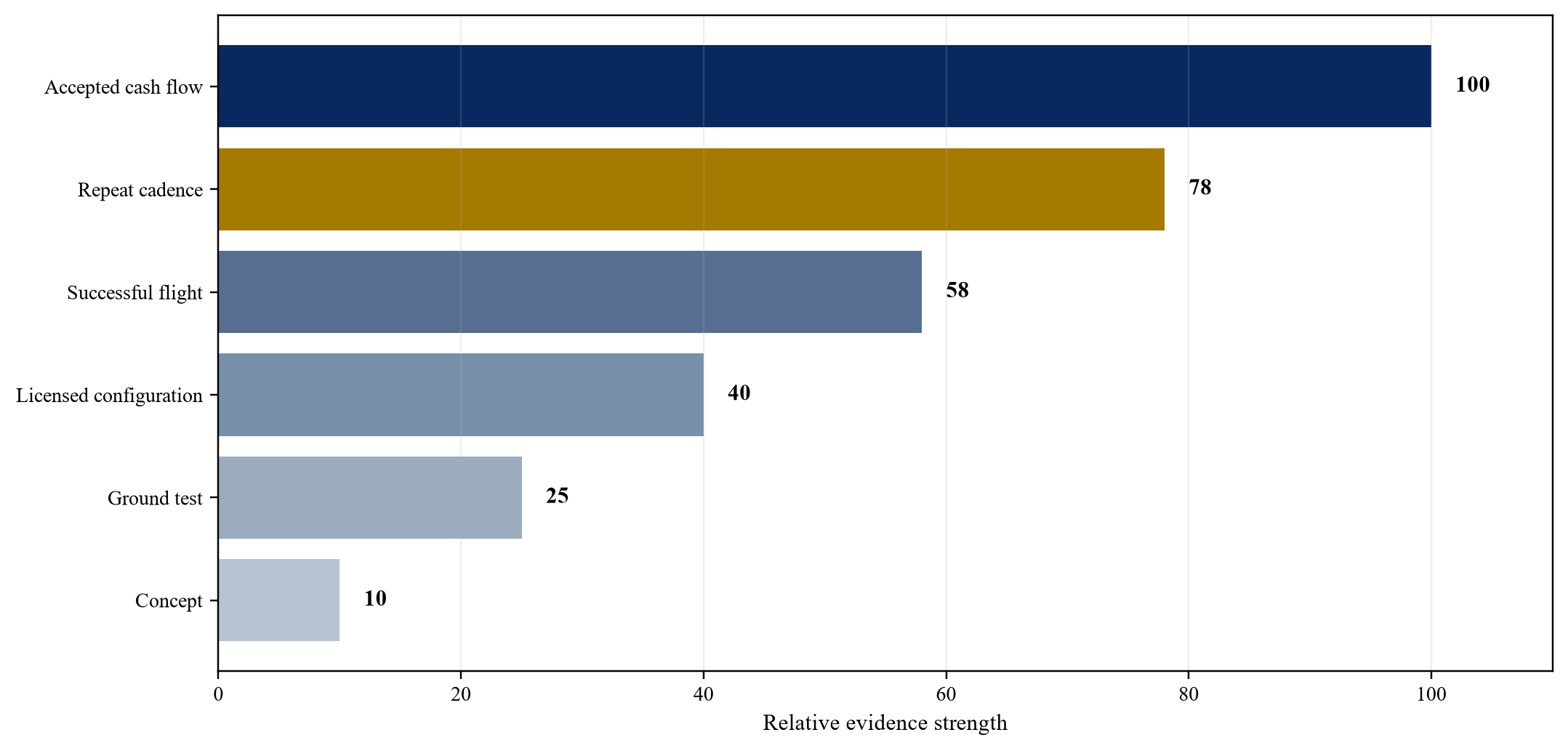
Proposed transaction framework; higher levels require stronger verification.
| Category | Required evidence | Base-case treatment |
|---|---|---|
| Funded firm order | executed order, funding and mission scope | include with delivery probability and margin |
| framework or framework ceiling | base vehicle and minimum guarantee | include only minimum and issued orders |
| Customer option | exercisable terms and customer readiness | scenario probability outside contracted base |
| Letter of intent | non-binding expression and conditions | pipeline only |
| Internal forecast | sales estimate without customer obligation | exclude from backlog |
Proposed evidence treatment.
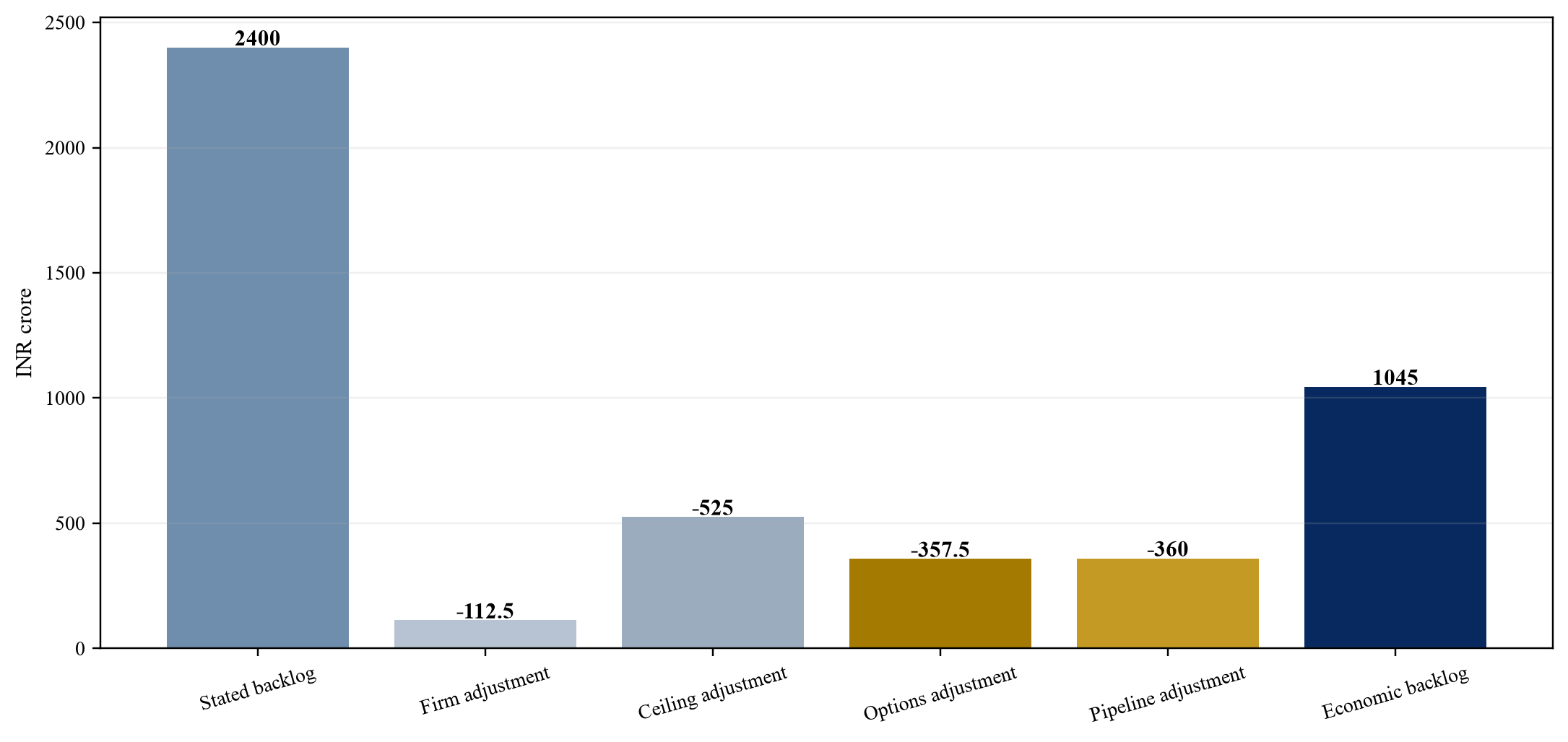
Wholly hypothetical; INR crore.
| Instrument | What it proves | What it does not prove |
|---|---|---|
| Framework appointment | eligibility and ordering mechanism | future call-offs up to the ceiling |
| Guaranteed minimum | binding minimum obligation | full programme share |
| Funded call-off | defined scope and committed funding | automatic follow-on work |
| Option | contractual right to order | exercise or appropriation |
| Public announcement | agency intent and context | executed terms and collected cash |
Proposed contract review.
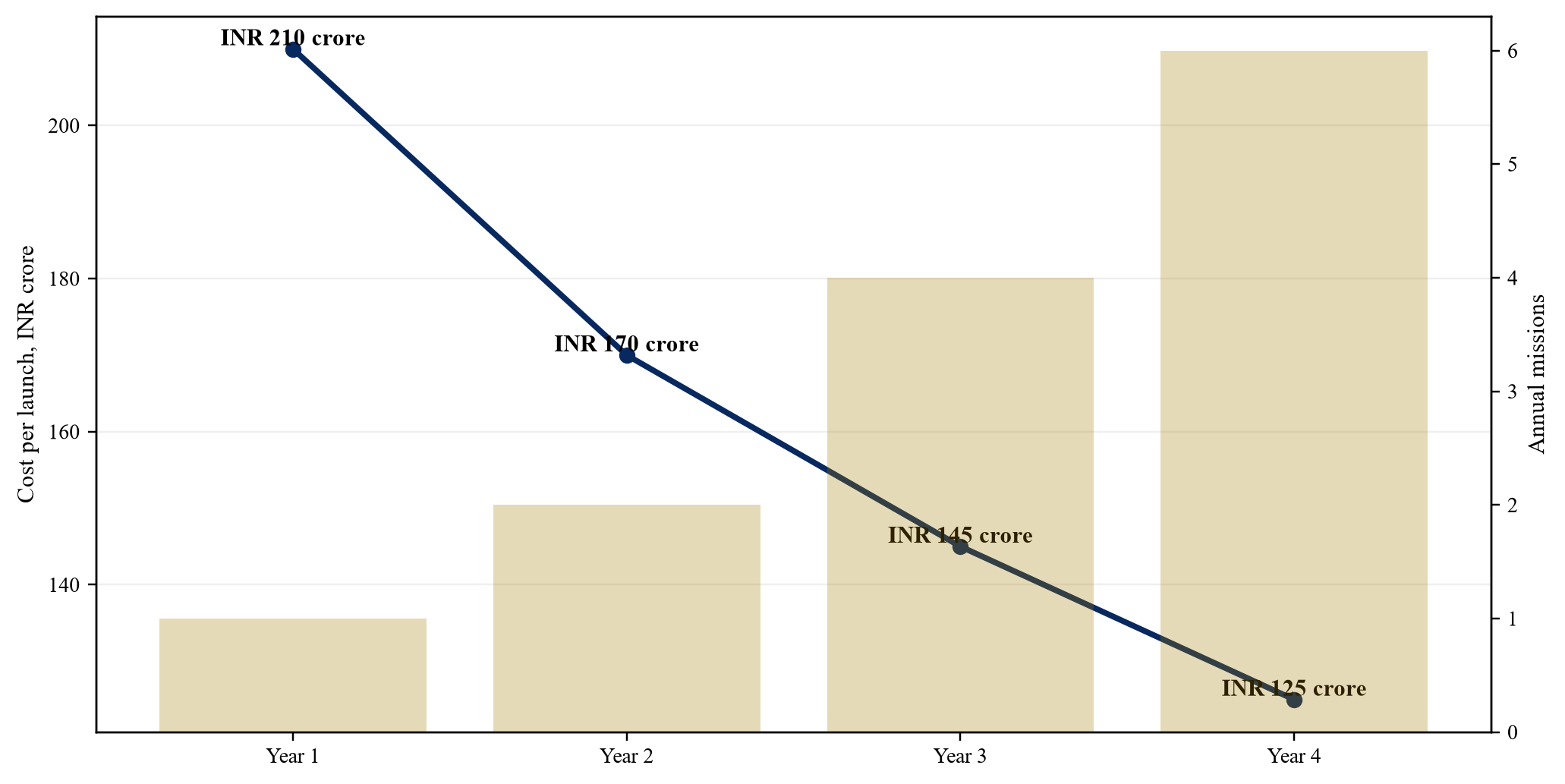
Wholly hypothetical annual missions and INR crore fully absorbed cost per launch.
| Cost component | Year 1 | Year 4 | Evidence |
|---|---|---|---|
| Vehicle hardware and engines | 105 | 70 | purchase orders and build records |
| Direct labour and test | 40 | 20 | payroll and routing |
| Range and launch operations | 30 | 15 | site and service agreements |
| Mission engineering and integration | 20 | 10 | mission closeout |
| Allocated fixed support | 15 | 10 | capacity and cost ledger |
Hypothetical cost build for diligence.
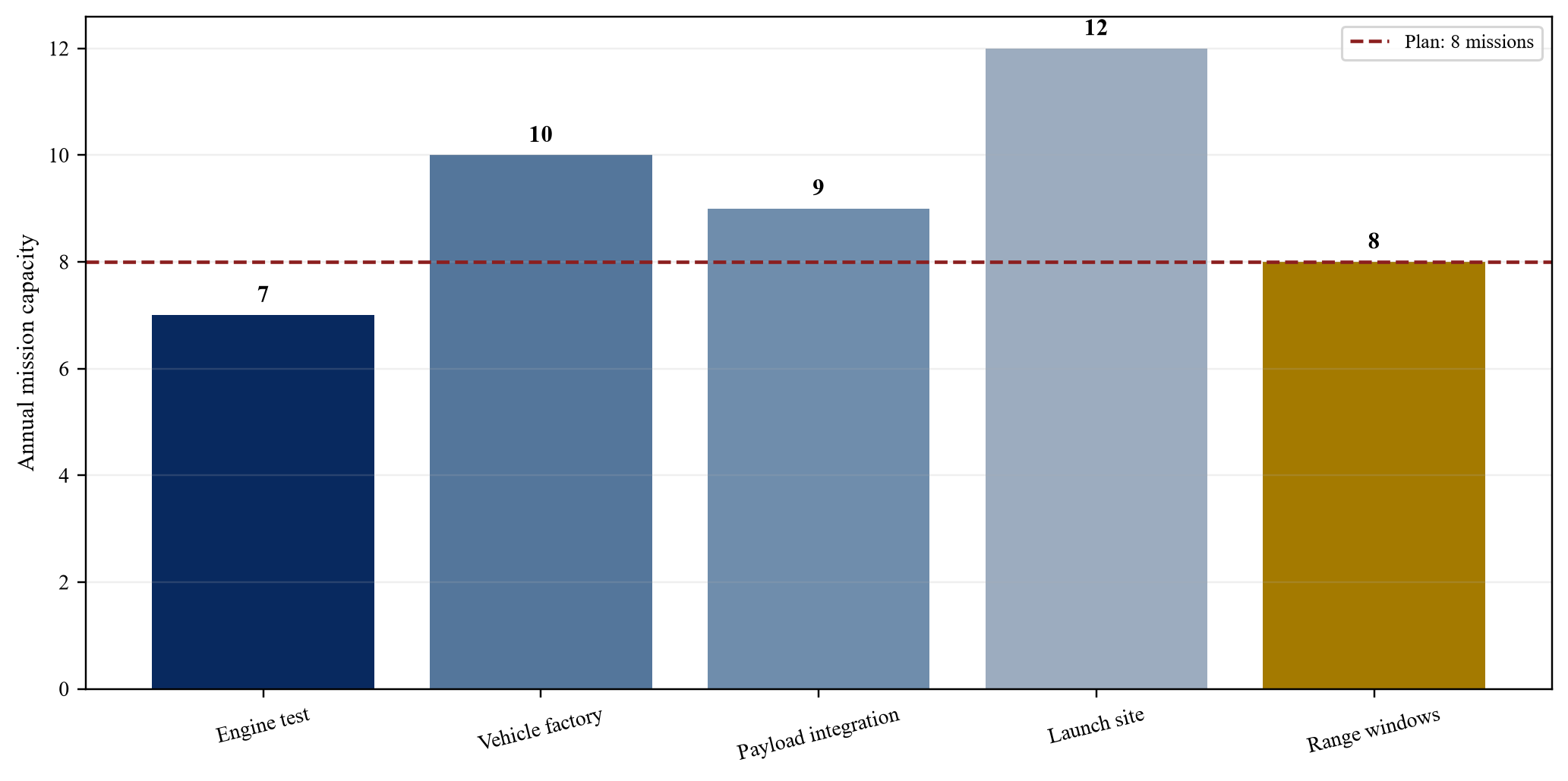
Wholly hypothetical missions per year by principal operating constraint.
| Area | Principal question | Evidence |
|---|---|---|
| IN-SPACe authorisation | which operator facility vehicle and activities are covered | licences and correspondence |
| Mishap history | are corrective actions verified and costed | investigation and return-to-flight record |
| Export control | who may access hardware software and data | classification and licences |
| FDI approval | does ownership or control exceed the automatic-route threshold | counsel analysis and filing record |
| Security | can cleared programmes continue after closing | facility and personnel approvals |
Proposed workstream.
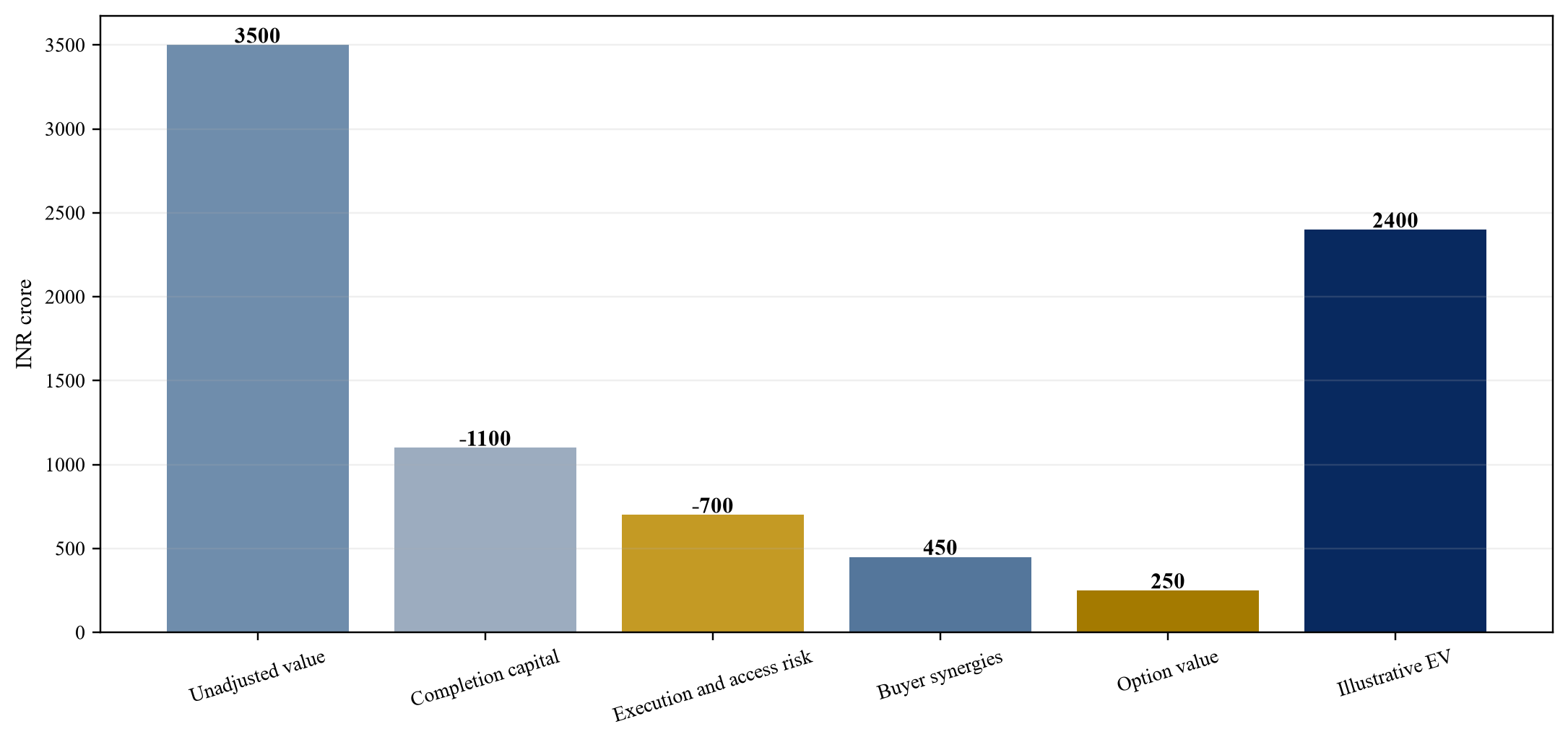
Wholly hypothetical; INR crore.
| Uncertainty | Structure | Verification event |
|---|---|---|
| Licence scope | closing condition | approved configuration and site |
| Development completion | milestone consideration | qualification and successful flight |
| Backlog conversion | earnout | funded order and collected cash |
| Reliability | escrow or milestone | defined mission-success record |
| Compliance | representation and indemnity | clean regulatory and export review |
Proposed allocation of evidence risk.
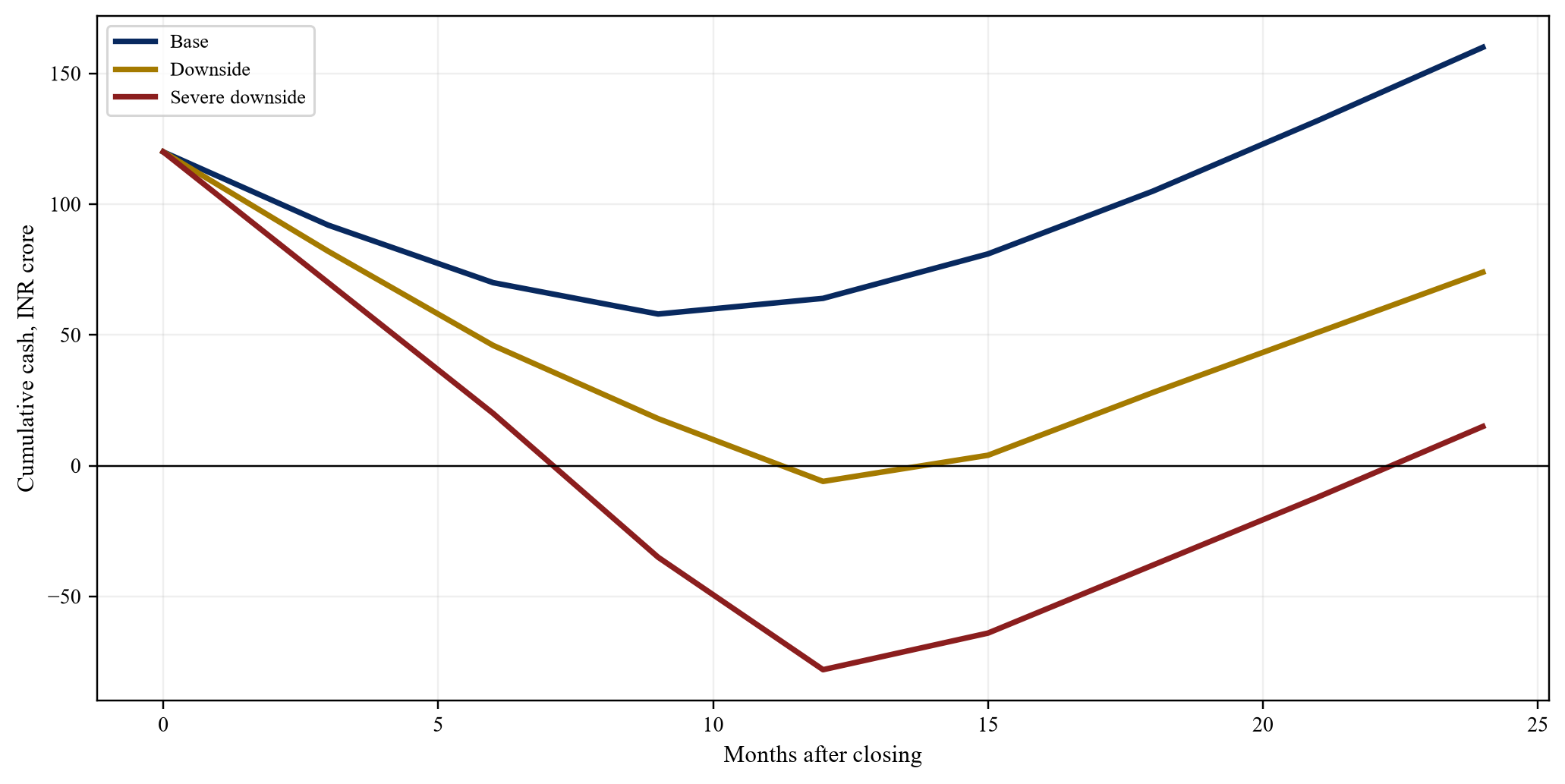
Wholly hypothetical cumulative cash after acquisition in INR crore.
| Criterion | Investable evidence | Red flag |
|---|---|---|
| Cadence | repeat missions supported by capacity | calendar without bottleneck proof |
| Reliability | configuration-specific flight and closure | pooled or incomplete success record |
| Backlog | funded executable orders | ceilings and letters presented as revenue |
| Economics | reconciled mission cash contribution | unsupported cost curve |
| Completion | funded work packages and schedule | percentage uplift without engineering basis |
| Control | licences security and integration plan | unresolved change-of-control dependency |
Proposed approval framework.
| Decision item | Required conclusion | Owner |
|---|---|---|
| Strategic thesis | defined stand-alone and synergy value | deal sponsor |
| Technical evidence | accepted configuration and maturity | chief engineer |
| Commercial evidence | risk-adjusted backlog and customer readiness | commercial lead |
| Financial case | value range completion funding and downside liquidity | chief financial officer |
| Regulatory clearance | IN-SPACe FDI export-control and security path | general counsel |
| Integration | Day-One continuity and milestone governance | integration lead |
Proposed board output.
Sources
- Government of India, Indian Space Policy 2023. Read the primary source
- IN-SPACe, Norms Guidelines and Procedures for Implementation of Indian Space Policy 2023 in respect of Authorisation of Space Activities. Read the primary source
- ISRO, Launch missions facilitated by ISRO. Read the primary source
- ISRO, Mission Prarambh and the Vikram-S suborbital launch. Read the primary source
- Government of India, Technology Development Board support for Agnikul Cosmos and Agnibaan. Read the primary source
- ISRO, First private orbital launch lifts off from Sriharikota. Read the primary source
- Government of India, Successful launch of Vikram-1. Read the primary source
- Government of India, Private sector participation in the space sector. Read the primary source
- Government of India, Cabinet approval of amended foreign direct investment policy for the space sector. Read the primary source
- Government of India, Foreign direct investment in the space sector. Read the primary source
- NewSpace India Limited, Annual Report 2024 to 2025. Read the primary source
- IN-SPACe, Selection of fund manager for the INR 1000 crore Venture Capital Fund for the Indian Space Sector. Read the primary source
- ISRO, Reusable Launch Vehicle Landing Experiment. Read the primary source
- ISRO, Completion of reusable launch vehicle technology demonstrations through the LEX series. Read the primary source
- ISRO, Demonstration of Vikas engine restart. Read the primary source
- ISRO, Spark torch igniter trial for reusable launch stages. Read the primary source
- Government of India, SSLV technology transfer and dedicated launch-complex development. Read the primary source
- Government of India, India's space launch programme. Read the primary source
- Government of India, Space startups authorisations and technology transfers. Read the primary source
- Government of India, Private-sector achievements and space-sector schemes. Read the primary source
- ISRO, Annual Report 2024 to 2025. Read the primary source
- Government of India, India's Space Odyssey Building India's Space Future. Read the primary source
- Competition Commission of India, Combination regulations and merger-control resources. Read the primary source
- IFRS Foundation, IFRS 13 Fair Value Measurement. Read the primary source
- IFRS Foundation, IAS 36 Impairment of Assets. Read the primary source
- IFRS Foundation, IAS 38 Intangible Assets. Read the primary source
- International Private Equity and Venture Capital Valuation Guidelines. Read the primary source
- United Nations Office for Outer Space Affairs, Convention on International Liability for Damage Caused by Space Objects. Read the primary source
- United Nations Office for Outer Space Affairs, Convention on Registration of Objects Launched into Outer Space. Read the primary source
- ISRO, Reusable Launch Vehicle Technology Demonstrator overview. Read the primary source
