

Introduction
Industrial decarbonisation is a capital-allocation problem before it becomes a transaction problem. A manufacturer may need lower-temperature heat, electrified process equipment, carbon capture, hydrogen systems, new materials, digital control, waste-heat recovery or a redesigned production route. Management can build the capability internally, license technology, partner with a developer, invest in a supplier, acquire selected assets and intellectual property, acquire a business, or buy a complete operating project.
The attraction of acquisition is speed and control. The danger is paying for a laboratory result that has not survived industrial conditions, an intellectual-property portfolio that does not provide freedom to operate, a team that leaves after closing, or projected synergies that require customer, infrastructure and regulatory changes outside the buyer's control. The International Energy Agency reports that demonstration remains difficult for clean-energy technologies because large projects require substantial capital and carry significant risk; it also estimates that technologies still at a pre-commercial stage account for an important share of the emissions reductions needed by 2050.[1]
Public policy is accelerating investment. The United States Industrial Demonstrations Program targets energy-intensive sectors and was established with USD 6.3 billion of funding.[2] The European Union's Net-Zero Industry Act seeks to strengthen manufacturing capacity for a defined set of net-zero technologies and gives strategic projects advantages including priority status and faster permitting.[3] These programmes can de-risk technologies, while their conditions, timing and transferability still require diligence.
This paper addresses one decision: when should an industrial group buy decarbonisation technology rather than build or access it through another route, and how should a justified acquisition be valued, protected and integrated?
1. Define the operating problem before the transaction
Start with the industrial constraint, not a target list. State the process step, operating envelope, emissions source, production requirement, product specification and required completion date. A steel furnace, cement kiln, refinery train, chemical reactor and food-processing line require different temperatures, uptime, feedstocks, controls and regulatory approvals.
The specification should quantify the required change in energy use, emissions intensity, yield, throughput, downtime, product quality and operating cost. It should also identify the interfaces with power, water, fuels, gases, logistics, digital systems and maintenance. Without this baseline, a technology can appear attractive while solving the wrong bottleneck.
The board paper should state the consequence of doing nothing. That consequence may be a carbon cost, customer loss, inability to expand, exposure to power-price volatility, an asset impairment, or a missed product premium. The decision clock begins when delay starts destroying value, not when a seller begins a process.
2. Establish the decision clock
Build, license, partner and acquire have different lead times. The comparison should begin with the date by which the industrial result must be operating, accepted and commercially useful. A transaction completed quickly can still miss the operating deadline if engineering, permitting, grid reinforcement or commissioning takes several years.
Create a critical path for each route. Include internal approval, diligence, design freeze, equipment manufacture, site preparation, permitting, infrastructure, installation, trials and customer qualification. Use probability-adjusted dates rather than one deterministic schedule. The cost of delay includes lost margin, carbon cost, customer attrition, foregone incentives and the declining value of the existing asset.
An acquisition earns a speed premium only when it shortens this critical path. Buying a company whose technology still requires the same demonstration, certification and site integration as an internal build may transfer ownership without advancing the operating date.
3. Map the full route set
The relevant routes are internal development, non-exclusive licence, exclusive licence, development partnership, joint venture, minority investment with commercial rights, acquisition of selected assets, acquisition of a business and acquisition of an operating project. Each route allocates control and risk differently.
Internal development offers control and preserves future economics, while requiring time, specialist talent and tolerance for technical failure. Licensing can provide rapid access with lower capital, while creating dependence on contract scope, know-how transfer and continuing support. A partnership can combine complementary capabilities, while governance and foreground intellectual property must be negotiated. Minority investment can secure visibility and influence, while leaving control and execution with the target.
Asset acquisition can isolate valuable patents, data, equipment and contracts. A business acquisition can add people, processes, customers and operating capability. A project acquisition can provide proven performance and cash flow, while its economics may be site-specific. The screening process should keep all feasible routes open until evidence supports exclusion.
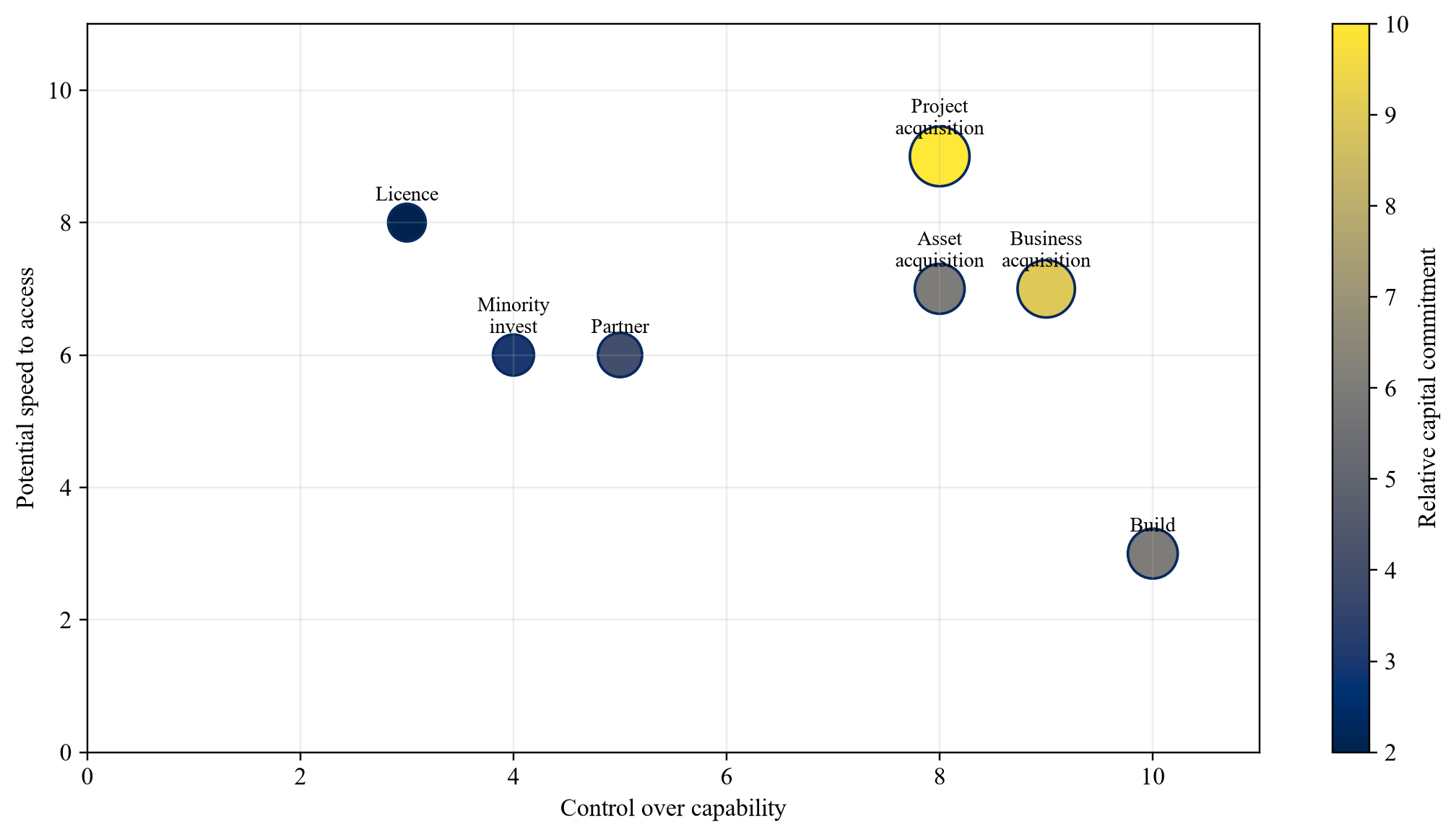
Proposed decision map; route selection depends on evidence, timing and control requirements.
4. Set the option-screening criteria
Use the same criteria for every route: time to operating result, probability of technical success, control, exclusivity, capital at risk, operating cost, intellectual-property position, supply resilience, customer evidence, regulatory exposure, integration burden and exit flexibility. Weight the criteria before reviewing targets.
A score supports discipline but does not replace judgement. Some criteria are thresholds. A route that cannot meet safety, product-quality or regulatory requirements should fail regardless of its aggregate score. A target without transferable ownership of critical intellectual property may also fail despite attractive market forecasts.
The board should approve the weights and thresholds. Management should record why each route was retained or rejected. This makes the decision auditable and reduces the risk that a preferred transaction is justified after the fact.
Table 1. Strategic route benchmark
| Route | Typical control | Potential speed | Capital exposure | Main diligence focus | Useful when |
|---|---|---|---|---|---|
| Internal build | high | low to medium | staged | talent, patents, scale-up and schedule | capability is core and time permits |
| Licence | low to medium | medium to high | low to medium | scope, exclusivity, know-how and support | technology is proven and rights are sufficient |
| Partnership or JV | shared | medium | shared | governance, contributions and foreground IP | capabilities are complementary |
| Minority investment | influence | medium | limited | information rights, commercial rights and follow-on funding | optionality has strategic value |
| Asset acquisition | high over acquired assets | medium | medium | title, transferability and missing capabilities | selected assets create the required capability |
| Business acquisition | high | medium to high | high | full commercial, technical, legal and integration diligence | people, process and market access matter |
| Project acquisition | high over project | high for demonstrated operation | high | site economics, contracts, permits and performance | operating proof and cash flow are valuable |
Illustrative framework; scores and conclusions require transaction-specific evidence.
5. Distinguish scientific validity from industrial readiness
A technology can be scientifically valid and commercially unsuitable for a particular plant. Industrial readiness requires performance at relevant scale, feedstock, temperature, pressure, duty cycle and environmental conditions. Laboratory efficiency does not establish availability, maintainability or product quality.
Review the progression from concept to prototype, pilot, demonstration, first commercial deployment and repeatable product. Record the size of each test, operating hours, interruptions, maintenance events, degradation and independent verification. Identify which assumptions have never been tested together. A component proven individually may fail when integrated with the buyer's process.
The IEA emphasises the role of demonstration projects in moving pre-commercial technologies toward market readiness and notes the capital and risk involved.[1] Transaction valuation should therefore separate proven value from option value. The buyer should pay full value for demonstrated capability and structure uncertain value around milestones.
6. Define the performance envelope
Prepare a performance envelope covering throughput, input quality, output specification, energy use, emissions, water, consumables, availability, maintenance interval, degradation, start-up, shutdown and safety. Define normal, minimum, maximum and transient conditions.
Compare seller claims with test protocols and raw data. Determine whether tests used representative feedstock and utilities. Identify excluded periods, operator intervention and equipment substitutions. Recalculate key ratios from source data where possible. Customer demonstrations should be confirmed directly and bounded by confidentiality.
Performance guarantees should use measurable acceptance tests at the buyer's site or an agreed reference facility. The contract should define test duration, measurement equipment, tolerances, remedies and retesting. A broad promise of commercial performance provides little protection when the acceptance condition is ambiguous.
7. Test repeatability and manufacturability
One successful unit does not prove repeatable delivery. Review the bill of materials, tolerances, critical components, supplier concentration, quality controls, yield, lead times and field-failure history. Determine whether production depends on founder knowledge or undocumented manual adjustment.
Assess the path from bespoke engineering to a repeatable product. Standardisation can reduce cost and schedule risk, while excessive standardisation can fail to accommodate site conditions. The buyer should identify which modules are standard, which require site engineering, and which are still being redesigned.
Manufacturing diligence should estimate learning curves using actual units and documented changes. Forecast cost reduction should be separated into procurement scale, design-to-value, labour learning and process automation. Each source needs an owner and delivery plan.
8. Establish intellectual-property ownership
Identify every patent, application, design, copyright, database, trade secret, domain, software component and material item of know-how. Confirm legal owner, inventor or author, assignment, jurisdiction, term, encumbrance and dispute status. Review employee, contractor, university, government and joint-development agreements.
Ownership can differ from practical control. A patent may be owned while essential know-how remains undocumented with employees. Software may contain open-source components with obligations. A university licence may restrict fields, territories, sublicensing or change of control. Public funding may create access rights, reporting duties or repayment conditions.
WIPO recommends examining ownership, third-party rights, transferability and the support required to use acquired intellectual property.[4] The diligence conclusion should identify what the buyer receives at closing, what requires consent, and what cannot be transferred.
9. Determine freedom to operate
Patent ownership does not establish freedom to operate. Map the product and process against third-party patents, licences, standards and contractual restrictions in the jurisdictions where the buyer will manufacture, use and sell. Review pending claims and expiry dates.
Freedom-to-operate analysis should be led by qualified counsel and informed by technical specialists. It should address design alternatives, licences, invalidity arguments and litigation exposure. The analysis should be refreshed if the product configuration or target markets change.
Value should reflect the usable field and geography. A strong patent portfolio with narrow commercial freedom may have lower value than a modest portfolio supported by broad licences and difficult-to-replicate know-how.
10. Assess trade secrets and tacit knowledge
Industrial technology often depends on operating windows, recipes, calibration, troubleshooting and supplier relationships that patents do not disclose. Identify where this knowledge resides, how it is documented and whether it can be taught.
Review laboratory notebooks, process specifications, control logic, maintenance records, failure analyses and training materials. Interview technical leaders and operators. Determine which individuals are essential to transfer, commissioning and improvement.
Retention should support a knowledge-transfer plan rather than reward presence alone. The plan should list documents, training, site support, validation tasks and successors. Deferred consideration can be linked to transfer deliverables, subject to applicable employment and tax rules.
11. Analyse data rights and digital dependence
Digital controls, optimisation software and machine-learning models can be central to decarbonisation performance. Identify ownership and access rights for source code, training data, operating data, models, APIs and cloud services. Determine whether customer or site data can be reused after acquisition.
Review cyber architecture, update rights, escrow, model monitoring, third-party services and data localisation. A system that requires a seller-controlled cloud environment may create continuing dependency. A model trained on narrow operating data may perform poorly at a new site.
The buyer should obtain the rights, documentation and technical environment needed to operate, maintain and improve the system. The valuation should include migration, cybersecurity remediation and continuing compute or licence costs.
12. Verify customer evidence
Separate pilots, paid demonstrations, commercial contracts, framework agreements, memoranda and expressions of interest. Review price, scope, acceptance, warranty, termination, exclusivity, minimum volume, renewal and liability terms. Revenue quality matters more than logo count.
Interview a representative set of customers. Ask what problem was solved, what alternative was considered, whether performance met specification, how much integration was required, and whether the customer will buy again. Confirm whether references can be transferred to the buyer's ownership.
Pipeline should be probability-weighted by evidence and timing. A proposal awaiting site data differs from a negotiated contract awaiting signature. Synergy cases that assume immediate access to the buyer's customers should account for qualification cycles and channel conflict.
13. Test unit economics at relevant scale
Calculate installed capital, commissioning, operating labour, energy, water, consumables, maintenance, replacements, software, royalties, downtime and decommissioning. Express economics per unit of product and per unit of emissions avoided. Reconcile seller models with invoices, purchase orders and operating records.
First-of-a-kind costs can differ substantially from repeat units. Separate non-recurring engineering from repeatable equipment. Identify which cost reductions require design changes or supplier commitments. Include buyer-specific site modifications and lost production.
Revenue or savings should reflect customer contracts, carbon rules and product value. Avoid counting both a carbon saving and a green premium unless both are independently realisable. The model should show the price, utilisation and performance required to reach the target return.
14. Map policy and incentive transferability
Identify grants, tax credits, contracts for difference, concessional finance, permits and strategic-project designations. Review eligibility, milestones, reporting, domestic-content rules, clawbacks and change-of-control provisions. An incentive can support economics while restricting ownership or location.
The US Industrial Demonstrations Program and EU strategic-project framework illustrate how public support can accelerate deployment.[2][3] Transaction documents should not assume that an award transfers automatically. Obtain consent or condition closing where value is material.
Model incentive cash flows by expected receipt date and compliance cost. Keep unawarded support outside the base case. Include the risk that project changes made during integration affect eligibility.
15. Review environmental, safety and product regulation
Map permits, emissions limits, hazardous materials, waste, pressure systems, electrical standards, product certification and worker safety. Identify whether the technology changes the host plant's permit or environmental baseline. Review incidents, notices and remediation obligations.
Novel equipment can fall between existing standards. The buyer should identify the responsible authority, certification path, evidence required and expected timeline. Regulatory acceptance in one country may not transfer to another.
The transaction perimeter should allocate historical liabilities and future compliance. Escrow, indemnity, insurance and price adjustment can protect known exposures, subject to enforceability and counterparty credit.
16. Map infrastructure dependencies
Many industrial decarbonisation technologies depend on power, grid capacity, hydrogen, carbon dioxide transport and storage, water, renewable heat, biomass or new logistics. A technology acquisition does not create this infrastructure.
For each deployment site, identify capacity, connection, route, quality, price, permit, counterparty and completion date. Review contracts and development status. Test whether the technology can operate during interruption or delay.
The acquisition case should value only deployments supported by a credible infrastructure path. Sites without that path remain option value. The board should understand whether infrastructure or technology is the true critical path.
17. Analyse supply-chain concentration
Identify single-source equipment, critical minerals, catalysts, membranes, power electronics, specialist fabrication and long-lead components. Review supplier contracts, tooling ownership, capacity, quality and change-of-control rights.
Estimate the cost and time to qualify alternatives. A proprietary component can strengthen differentiation while increasing supply risk. A standard component can reduce risk while allowing competitors to reproduce the system.
Transaction protection can include supplier consents, inventory, dual-source milestones and working-capital adjustments. Integration plans should avoid disrupting small suppliers through abrupt payment or specification changes.
18. Assess organisation and key-person dependence
Map leadership, technical disciplines, project delivery, manufacturing, sales, service and regulatory capability. Compare current capacity with the acquisition case. A target designed for pilots may lack the systems needed for multiple industrial deployments.
Identify key-person dependence and succession. Review incentive arrangements, notice, restrictive covenants, location, culture and retention risk. Retention packages should align with knowledge transfer, customer continuity and integration milestones.
The buyer should decide which capabilities remain separate and which integrate. Immediate absorption can damage an innovative team. Complete autonomy can prevent the buyer from obtaining scale and governance benefits.
19. Separate a business acquisition from an asset acquisition
IFRS 3 distinguishes acquisition of a business from acquisition of a group of assets and requires an acquirer in a business combination to recognise and measure identifiable assets and liabilities, goodwill and required disclosures.[5] The accounting classification does not determine strategy, while it affects financial reporting and integration planning.
An asset acquisition may suit a buyer that needs patents, designs, equipment and selected contracts. It may leave behind people, liabilities, permits or operating processes. A business acquisition can preserve continuity and assembled capability, while bringing broader exposures.
The legal perimeter should follow the capability required. The buyer should model taxes, consent requirements, employee transfer, contract assignment, liabilities and accounting for each structure before selecting it.
20. Build the standalone valuation
Value the target on a standalone basis using probability-weighted cash flow, market evidence and relevant asset or replacement-cost checks. Reflect technology maturity, customer concentration, capital requirements and funding risk. Use scenarios rather than one heroic forecast.
Early-stage intellectual property often lacks historical cash flow and robust comparables. WIPO notes that valuation in this setting requires defensible assumptions, scenario forecasting and judgement.[6] A wide range should lead to structure and diligence, not false precision.
Reconcile enterprise value to equity value, debt, cash, leases, grants, working capital, contingent liabilities and transaction costs. Identify the value attributable to patents, software, customer relationships, contracts, permits and goodwill under the applicable reporting framework.
21. Value the build alternative
The build case should include research, engineering, prototypes, pilots, failures, facilities, talent, licences, capitalised equipment, opportunity cost and time. It should include the probability that the internal programme reaches the required performance and date.
Internal cost is not automatically lower than purchase price. The organisation may lack specialist talent, test facilities or freedom to operate. Internal development can also create reusable capability and avoid integration cost.
Discount the build cash flows from the same valuation date as the acquisition. Include the value of flexibility to stop or redirect the programme. State which learning can be retained after failure.
22. Value the licence and partnership alternatives
A licence model should include upfront fees, milestones, royalties, minimums, engineering support, equipment margin, audit, exclusivity and termination. It should reflect field, territory and duration. Include dependency on the licensor's solvency and technical support.
A partnership or joint venture model should include each party's contributions, governance, funding, deadlock, exclusivity, foreground intellectual property, customer ownership and exit. Shared economics can reduce capital while slowing decisions.
These routes create useful price discipline. If a licence provides the necessary rights and support at a lower risk-adjusted cost, acquisition needs a separate control, scarcity or synergy benefit to justify its premium.
23. Build the acquisition valuation bridge
Start with standalone value. Add only buyer-specific benefits supported by an owner, investment, timing and probability. Deduct integration cost, disruption, stranded systems, retention, financing, tax, regulatory remedies and execution risk.
Classify benefits as revenue, cost, capital avoidance, risk reduction or option value. Avoid counting the same benefit twice. A lower equipment cost and higher target margin may describe the same procurement synergy. A faster deployment benefit should reflect the actual critical path.
The maximum price should preserve the buyer's required return after the premium and risk. Negotiation should focus on risk allocation and value sharing rather than one headline multiple.
Table 2. Hypothetical acquisition valuation bridge
| Item | Value units | Evidence required |
|---|---|---|
| Standalone target value | 80 | probability-weighted target plan |
| Accelerated deployment value | 18 | verified critical-path reduction |
| Buyer-channel contribution | 12 | qualified customers and conversion timetable |
| Procurement and manufacturing benefit | 9 | supplier quotes and production plan |
| Avoided internal development cost | 14 | approved build budget and capability gap |
| Integration and retention cost | -17 | workstream budget and retention plan |
| Remaining scale-up risk | -13 | performance and delivery risk assessment |
| Regulatory and remedy risk | -5 | jurisdiction and competition analysis |
| Risk-adjusted strategic value | 98 | reconciled buyer case |
| Illustrative maximum price at required return | 89 | investment-committee threshold |
Wholly hypothetical; monetary amounts are illustrative units and describe no identified company or transaction.
24. Use probability and timing explicitly
For each value driver, state the probability of technical success, commercial adoption and delivery by the required date. These probabilities may be related. A technology can work while missing the customer's qualification window.
Model milestone dates and cash flows directly. A three-year delay can destroy much of a claimed speed advantage. Probability-adjusted value should be supplemented by downside and failure cases so the board can see capital at risk.
Update probabilities as evidence changes. Transaction signing should not freeze assumptions. Conditions precedent and closing mechanics can respond to material developments.
25. Price optionality separately
Technology platforms can create future applications beyond the initial use case. Value those applications as options with identifiable technical, commercial and capital gates. Do not include an undifferentiated platform premium.
For each option, state the market, required development, incremental capital, competition, rights and earliest decision date. The value of an option rises with exclusivity and learning while falling with obsolescence and funding needs.
Real-options analysis can support staged investment where management can expand, pause, redirect or abandon. WIPO identifies timing and strategic flexibility as important in technology-transfer valuation.[7]
26. Design consideration around evidence
Use cash, shares, deferred consideration, earn-outs, milestone payments, royalties and retention selectively. Structure should align payment with the evidence that creates value. It should remain understandable and enforceable.
Technical milestones can cover specified performance at scale, acceptance at a buyer site, cost targets or certification. Commercial milestones can cover collected revenue or repeat orders. Milestones should exclude outcomes controlled solely by the buyer unless the agreement defines operating obligations.
Earn-outs can create disputes over accounting, integration and resource allocation. Define measurement, access, governance, permitted actions and dispute resolution. A lower fixed price with clear milestones can preserve upside while limiting payment for unproven claims.
27. Protect the intellectual-property perimeter
Transaction documents should define transferred and retained intellectual property, licences, fields, territories, improvements, data, source code, records, domain names and physical materials. Obtain required consents before closing.
Representations should address ownership, assignments, infringement claims, licences, open-source use, funding restrictions, employee inventions and security interests. Remedies should reflect materiality, survival, caps and counterparty credit.
Where ownership cannot transfer, negotiate a durable licence with change-of-control, sublicensing, continuity and step-in rights. Escrow can support source-code or documentation access, while it does not replace maintainable systems and capable people.
28. Address competition and foreign-investment review
Technology acquisitions can affect product competition, potential entry, access to inputs and innovation. The US merger guidelines address concentration, potential entrants, access to competitively significant products and trends toward consolidation.[8] The European Commission states that merger review considers price, choice and innovation and is updating its framework to reflect decarbonisation and other market changes.[9]
Map overlaps in current products, pipelines, capabilities, data and essential inputs. Assess whether the target could become a competitor or whether the buyer might restrict rivals' access after acquisition. Consider minority rights and information exchange where a full acquisition is not planned.
Identify merger-control, foreign-investment and sector approvals early. Model timing, information burden, remedies and closing risk. A transaction that misses the operating decision clock may lose strategic value even if ultimately approved.
29. Plan integration before signing
Define the integration thesis, operating model and Day One requirements before final approval. Decide which functions integrate immediately, which remain separate and which migrate after technical milestones. Protect safety, customers, engineering and project delivery.
Workstreams should cover governance, people, intellectual property, product roadmap, manufacturing, suppliers, customers, systems, finance, compliance and sites. Assign accountable owners, dependencies, budget and measures.
The integration plan should preserve a protected technical baseline. Product changes made to meet buyer standards can alter performance or certification. Use change control and configuration management.
30. Protect the innovation engine
Acquisition can slow innovation through approvals, talent loss and conflicting priorities. Define decision rights, funding, technical autonomy and escalation. Preserve rapid experimentation while applying appropriate safety and capital controls.
Set a small number of outcomes: verified performance, deployment milestones, cost reduction, customer acceptance and knowledge transfer. Avoid overwhelming the team with corporate reporting that does not improve these outcomes.
Retention should combine role clarity, incentives, resources and credibility. Founders and specialists need a clear mandate and access to industrial assets. The buyer needs accountability and succession.
31. Build the separation plan when autonomy matters
Some acquisitions need operational separation to protect customers, confidential information or regulatory commitments. Define legal entities, systems, facilities, data barriers, branding, procurement and service agreements.
Separation can preserve focus while increasing cost and delaying synergies. The model should include duplicate functions, transition services and eventual migration. Governance should specify reserved matters and conflict management.
Reassess the model at defined milestones. Integration can increase after the technology is stable and customer commitments are secure.
32. Establish capital-release gates
Release transaction and integration capital through evidence-based gates. Early gates confirm strategic fit and ownership. Later gates confirm performance, commercial demand, infrastructure and integration readiness.
Each gate should list required evidence, accountable owner, independent review and decision. Define stop, redesign, partner and divest options. A sunk transaction cost should not force continued investment.
The board should approve maximum cumulative exposure at each stage. Contingent consideration, project capital and working capital should be viewed together.
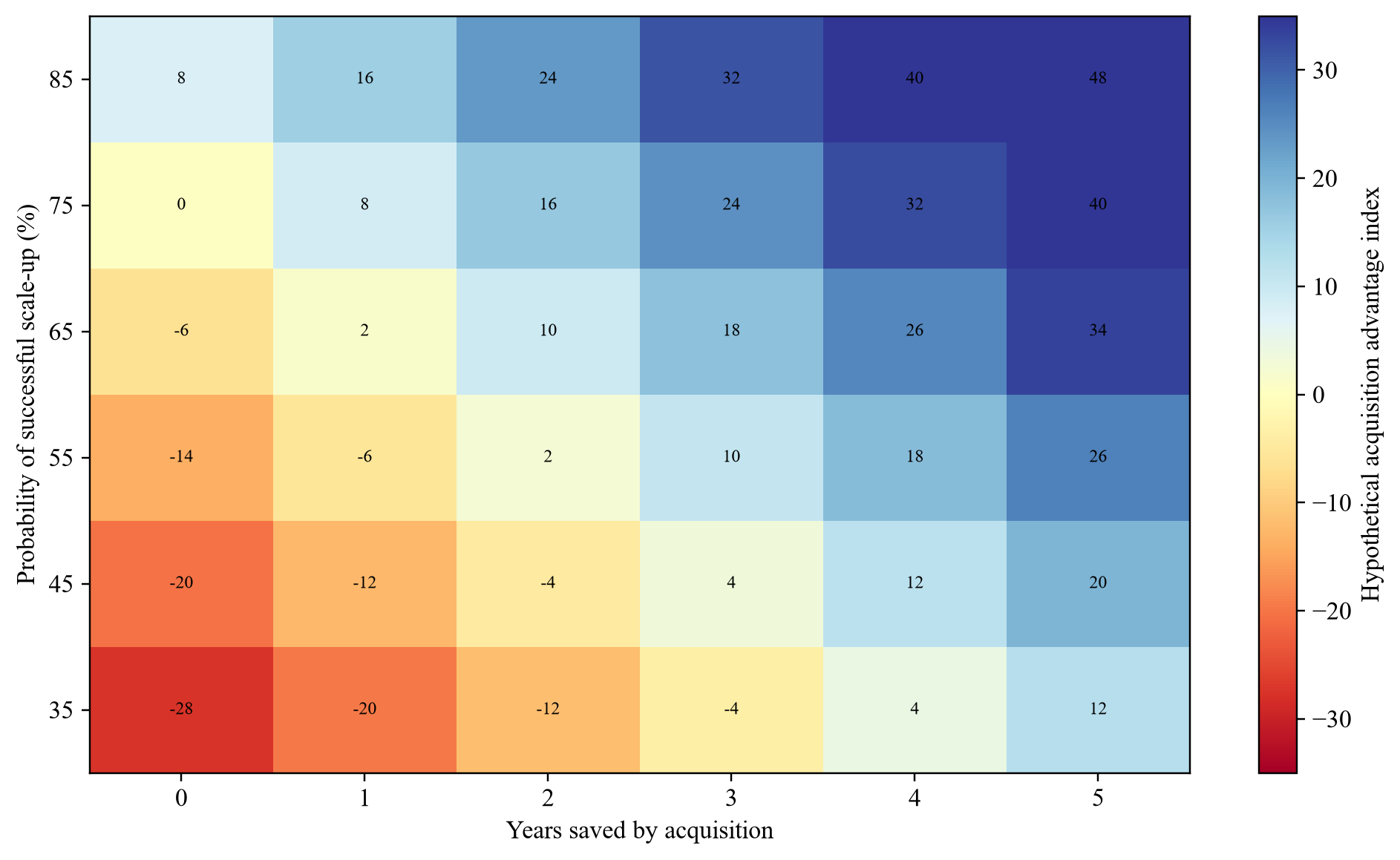
Wholly hypothetical; score is a decision index, not a forecast. Positive values favour acquisition under the stated assumptions.
33. Define operating and transaction metrics
Track technical availability, energy intensity, emissions intensity, output quality, maintenance, installation cycle and cost per unit. Track commercial conversion, order quality, gross margin, cash collection and repeat orders. Track people retention, knowledge-transfer completion and integration cost.
Compare results with the acquisition case. Separate market movement from execution. Report leading technical indicators alongside financial outcomes.
Metrics should trigger action. A persistent performance shortfall may require redesign, supplier support, claim enforcement or capital stop. Strong results may support accelerated deployment.
34. Create an integration and separation roadmap
The roadmap should connect signing, closing, Day One, technical transfer, customer continuity, manufacturing scale-up, first buyer-site deployment, acceptance and repeatable delivery. Include regulatory and infrastructure dependencies.
Assign decisions to the lowest competent level while retaining board control over capital, safety and material deviations. Use a joint integration office with technical and transaction leadership.
Define the end state. The target may become a centre of excellence, a product division, a shared technology platform or a separately governed business. Ambiguity creates duplicate systems and delayed decisions.
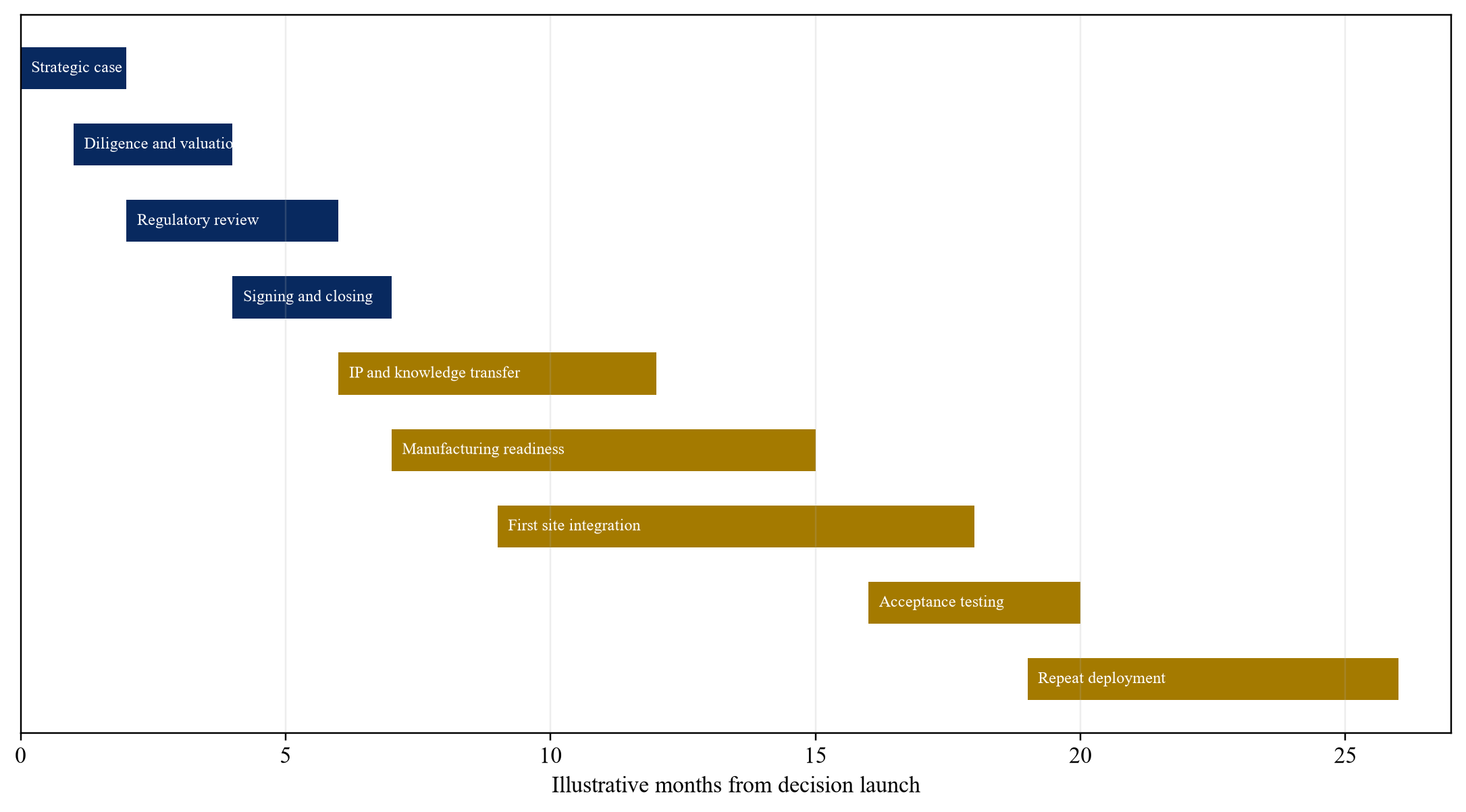
Proposed sequence; timing depends on evidence, approvals and site conditions.
Table 3. Transaction and capital-release gates
| Gate | Required evidence | Decision | Principal protection |
|---|---|---|---|
| Operating problem | quantified plant need and decision clock | open route analysis | capped diagnostic budget |
| Route selection | comparable build, licence, partner and buy cases | authorise target engagement | route remains reversible |
| Confirmatory diligence | technology, IP, customer, regulatory and financial evidence | approve signing case | price range and walk-away conditions |
| Signing | negotiated perimeter, consideration and conditions | sign transaction | conditions, covenants, escrow and termination |
| Closing | approvals, consents and no material adverse change | transfer control | closing adjustment and retained consideration |
| First deployment | site-ready design and infrastructure | release project capital | milestone funding and performance security |
| Acceptance | verified operating performance | release final consideration | acceptance remedies and holdback |
| Repeat deployment | stable economics and delivery system | scale portfolio | approved expansion envelope |
Proposed governance framework; thresholds must be approved for the specific transaction.
35. Compare outcomes against the original decision
Post-acquisition review should revisit the original alternatives. Compare actual purchase price, integration cost, operating date, performance and value with the approved build, licence and partnership cases. This reveals whether the transaction created advantage and improves future decisions.
Record forecast errors by source: technical performance, schedule, customer adoption, infrastructure, cost, regulation or integration. Update the organisation's assumptions and diligence standards.
The review should occur after commissioning and after a period of stable operation. Early closing metrics do not prove industrial value.
36. Recognise failure early
Define failure conditions before commitment. They can include inability to transfer rights, repeated performance shortfalls, unavailable infrastructure, lost key people, customer rejection, regulatory blockage or a cost path above the approved threshold.
For each condition, define cure, redesign, licence, sale, wind-down or litigation options. Preserve documentation and rights needed to execute them. Avoid indefinite funding based on the next technical promise.
Failure management protects capital and credibility. It can also preserve useful intellectual property, people or data for another application.
37. Board decision framework
The board should approve an acquisition only when five propositions are evidenced. The operating problem and deadline are specific. The target capability is transferable and works at relevant scale. Acquisition provides a risk-adjusted advantage over build, licence and partnership. Price and structure preserve the buyer's required return. Integration, infrastructure and governance are funded and owned.
The board pack should contain the route comparison, diligence exceptions, valuation bridge, downside cases, competition analysis, transaction protections, integration roadmap and capital gates. It should state unresolved matters and the conditions for proceeding.
A recommendation can remain conditional. Conditions should be measurable and assigned, with authority to stop if they fail.
38. Conclusion
Industrial decarbonisation M&A creates value when it buys a scarce, transferable and commercially useful capability faster and more reliably than the buyer can obtain it through another route. Technology novelty, patents and policy support can strengthen the case; none substitutes for industrial performance, customer demand, infrastructure and execution.
The disciplined process begins with the plant problem and decision clock. It compares build, licence, partner, invest and acquire on common criteria. It verifies technology, intellectual property, people, customers, regulation and supply chain. It values standalone economics and buyer benefits separately. It protects uncertain value through structure and releases capital through evidence gates.
The result is a transaction designed around industrial outcomes. The acquisition succeeds when the technology operates safely, meets specification, reaches customers, transfers knowledge and produces a return after the full cost of integration and scale-up.
Appendix A Investment committee questions
1. What industrial problem, site, operating envelope and deadline define the decision?
2. Which routes were compared and why was each retained or rejected?
3. What performance has been demonstrated at relevant scale and for how long?
4. Who owns each critical patent, software component, dataset and trade secret?
5. Does the buyer have freedom to operate in each intended market and application?
6. Which knowledge depends on named people and how will it transfer?
7. What customer evidence supports demand, price and repeat purchasing?
8. Which infrastructure, permits, incentives and suppliers are required?
9. How do standalone value, buyer benefits, integration cost and risk reconcile?
10. What consideration is fixed, deferred or contingent on evidence?
11. What competition, foreign-investment and sector approvals affect timing?
12. Who owns each integration workstream and what capital is approved at each gate?
13. Which failure conditions stop investment or trigger an alternative route?
14. When will the board compare actual outcomes with the approved case?
References
- International Energy Agency, Advancing Clean Energy Demonstration Projects, 13 December 2024. https://www.iea.org/reports/advancing-clean-energy-demonstration-projects
- US Department of Energy, Industrial Demonstrations Program, accessed 2 October 2026. https://www.energy.gov/cmei/oced/industrial-demonstrations-program-0
- European Commission, The Net-Zero Industry Act, accessed 2 October 2026. https://single-market-economy.ec.europa.eu/industry/sustainability/net-zero-industry-act_en
- World Intellectual Property Organization, Manage Your IP Portfolio, accessed 2 October 2026. https://www.wipo.int/en/web/ip-business-moments/manage-portfolio
- IFRS Foundation, IFRS 3 Business Combinations, accessed 2 October 2026. https://www.ifrs.org/issued-standards/list-of-standards/ifrs-3-business-combinations/
- World Intellectual Property Organization, Intellectual Property Valuation Basics for Technology Transfer Professionals, 2025. https://www.wipo.int/edocs/pubdocs/en/wipo-pub-2004-2025-en-intellectual-property-valuation-basics-for-technology-transfer-professionals.pdf
- World Intellectual Property Organization, The Real Options Method, accessed 2 October 2026. https://www.wipo.int/web-publications/intellectual-property-valuation-basics-for-technology-transfer-professionals/en/7-the-real-options-method.html
- US Department of Justice and Federal Trade Commission, 2023 Merger Guidelines, 18 December 2023. https://www.justice.gov/atr/merger-guidelines
- European Commission, Mergers Overview, accessed 2 October 2026. https://competition-policy.ec.europa.eu/mergers/overview_en
- European Commission, Review of the Merger Guidelines, accessed 2 October 2026. https://competition-policy.ec.europa.eu/mergers/review-merger-guidelines_en
- World Intellectual Property Organization, Uncovering IP Risks and Potential: IP Audit, accessed 2 October 2026. https://www.wipo.int/en/web/business/ip-audit
- World Intellectual Property Organization, Transferring Technology from Lab to Market, accessed 2 October 2026. https://www.wipo.int/en/web/technology-transfer/access-market
- European Commission, Strategic Energy Technology Plan, accessed 2 October 2026. https://energy.ec.europa.eu/topics/research-and-technology/strategic-energy-technology-plan_en
- International Energy Agency, Achieving Net Zero Heavy Industry Sectors in G7 Members: Recommendations, 2022. https://www.iea.org/reports/achieving-net-zero-heavy-industry-sectors-in-g7-members/recommendations-for-the-g7
About the Author
Authored by Chennakeshav Adya Independent Researcher
Chennakeshav (CK) is a corporate finance and investment banking executive with 25+ years of global experience in deal origination, structuring and execution across M&A, growth capital and corporate strategy. He has led value-creation mandates for founders, corporates and funds — bridging the boardroom view to hands-on execution and close.
His career spans Morgan Stanley, HSBC, Lloyds Banking Group, EWEC, ADQ portfolio companies and Emirates Growth Fund, across TMT, real estate, fintech, deeptech, cleantech, infrastructure and energy. He has partnered with C-suite leaders, private equity and venture funds, sovereign wealth funds and family offices to finance complex fund raises and scale-up ventures, and has led M&A due diligence, post-merger integration and business-transformation initiatives to create value.
At Matchpoint Partners he is Managing Partner, leading the firm's corporate finance, M&A and capital-raising practice. He holds an MBA from London Business School, an engineering degree from VTU and a Master of Laws (LLM, in progress) from UCL London.
An active start-up mentor, CK mentors at Techstars, DIFC FinTech Hive, Startup Grind, Founder Institute and IN5, serves as Entrepreneur Mentor in Residence (EMiR) at London Business School, and judges the Entrepreneurship World Cup.
Matchpoint profile: https://www.matchpoint-partners.com/team/ck-adya.html LinkedIn: https://www.linkedin.com/in/ckadya/
