

Introduction
Life insurers receive premiums today and promise payments that can extend for decades. Infrastructure sponsors need capital for assets whose economic lives can also span decades. This creates a compelling financing proposition: long liabilities can fund long assets, and infrastructure can diversify portfolios while supplying stable income. The transaction still has to convert a physical asset into a credit instrument that fits the insurer's liability profile, regulatory framework, investment mandate and operational capabilities.
Duration alone does not establish a match. A thirty-year loan with an uncertain construction date, discretionary prepayment, inflation exposure, refinancing risk or a weak offtaker can create cash flows that diverge from expected claims. A regulated network may have predictable demand but uncertain tariff recovery. A renewable project may have a long power contract and material merchant exposure after expiry. A social-infrastructure concession may have an availability payment and political termination risk. A data centre may have contracted revenue and rapid technology or customer-concentration risk. The underlying infrastructure label therefore provides only a starting point.
Prudential regimes translate these differences into capital, valuation and governance consequences. The United Kingdom's matching adjustment framework recognises that predictable liability cash flows closely matched by asset cash flows reduce exposure to short-term market movements. Reforms effective from June 2024 widened eligible assets and liabilities, including a framework for assets with highly predictable rather than fully fixed cash flows, while strengthening attestation, internal credit assessment and data requirements. European Solvency II rules require cash-flow replication, hold-to-maturity capacity and active monitoring of qualifying infrastructure investments. The International Association of Insurance Supervisors' Insurance Capital Standard classifies infrastructure across energy, transport, digital and social assets and connects risk treatment to contractual and regulatory protections. In the United States, risk-based capital depends on the inherent riskiness of assets and operations rather than the infrastructure label alone.
The financing challenge is to design debt that survives all of those lenses. The project must be creditworthy. The instrument must produce cash flows that fit the liabilities. The insurer must hold sufficient capital and liquidity. Governance must cover origination, independent credit assessment, valuation, monitoring, workouts and conflicts. Where infrastructure is in an emerging market, the structure may also need local-currency funding, guarantees, political-risk protection or portfolio diversification.
This paper develops a decision framework for issuers, insurers, asset managers, development institutions and transaction advisers. It begins with the liability rather than the asset. It then tests which infrastructure risks can be accepted, reduced, transferred or deferred to another capital provider. The framework avoids the assumption that every insurer should originate direct infrastructure debt or that every project should target insurance capital. It assigns each stage to the capital able to bear it.
1. Start with the liability promise
The insurer's investment problem begins with promised claims. Annuities can create long, relatively predictable nominal or inflation-linked payments. Life protection liabilities contain mortality, lapse and expense uncertainty. General insurers often need shorter liquidity because claims emerge over a different horizon. Savings products may contain policyholder options, guarantees and surrender risk. The same infrastructure loan can therefore be suitable for one liability portfolio and unsuitable for another.
The investment team should map liability cash flows by currency, duration, convexity, inflation sensitivity, optionality and liquidity. The relevant measure is not simply average duration. A portfolio can have the correct duration while generating cash at the wrong points on the curve. Reinvestment risk arises when assets mature before liabilities. Liquidity strain arises when claims accelerate or collateral calls occur. Inflation-linked liabilities require a credible inflation hedge rather than a nominal spread assumption.
The liability map should also identify the economic value of predictability. An asset that offers a higher spread may still destroy value if capital charges, hedging costs, expected loss, illiquidity, operating expense and cash-flow mismatch exceed the premium. The governing body should evaluate risk-adjusted return after these costs. This discipline prevents a long-dated asset from being accepted merely because it resembles the duration of the liabilities.
2. Define the investable infrastructure universe
Infrastructure debt includes more than traditional project-finance loans. The universe can contain senior secured project loans, investment-grade project bonds, infrastructure corporate debt, utility private placements, public-private partnership debt, subordinated tranches, revolving facilities, warehouse loans, asset-backed securities, infrastructure collateralised loan obligations and fund interests. Each route transfers a different package of origination, construction, diversification, valuation and workout risk.
The infrastructure sectors are equally varied. Energy includes generation, transmission, distribution, storage and district heating. Transport includes roads, rail, ports and airports. Digital infrastructure includes fibre, towers and data centres. Social infrastructure includes hospitals, schools, housing and other public-service assets. Water, waste, telecommunications and regulated utilities add further contractual and policy regimes.
The International Association of Insurance Supervisors identifies long-term concessions, regulation, availability-based payments, long-term business contracts and essential public demand as factors that can make infrastructure safer. These characteristics are evidence inputs rather than automatic protections. A concession can be terminated. Regulation can change. A long contract can sit with a weak counterparty. Essential demand can still produce insufficient revenue when tariffs are constrained. The investable universe should therefore be defined through credit attributes and liability fit, with sector labels used for classification and concentration management.
3. Separate project stage from asset life
An infrastructure asset can have a forty-year operating life and still be highly risky during its first four years. Development risk covers land, permits, design, environmental approval, procurement and offtake negotiation. Construction risk covers cost, schedule, contractor performance, supply chain and interface. Ramp-up risk covers commissioning, early operating performance and customer adoption. Operating risk covers availability, maintenance, regulation, demand, counterparty credit and refinancing.
Many insurers prefer operating assets because stable performance history and enforceable revenue contracts make cash flows easier to model. Specialist teams and funds can accept construction risk when completion protections, contingency, contractor strength and covenants are sufficient. The UK matching adjustment reforms allow a broader range of assets, including assets with construction phases, subject to eligibility, risk-management and attestation requirements. That flexibility still leaves the insurer responsible for assessing the cash-flow uncertainty and fundamental spread.
The financing plan should match each stage to appropriate capital. Sponsor equity, development finance and bank construction debt may absorb early risk. Insurance capital can enter through a committed take-out, delayed-draw private placement, project bond after completion, refinancing or seasoned portfolio acquisition. The transition should depend on objective milestones: permits, fixed-price scope, financial close, mechanical completion, performance tests, stable operations and revenue evidence.
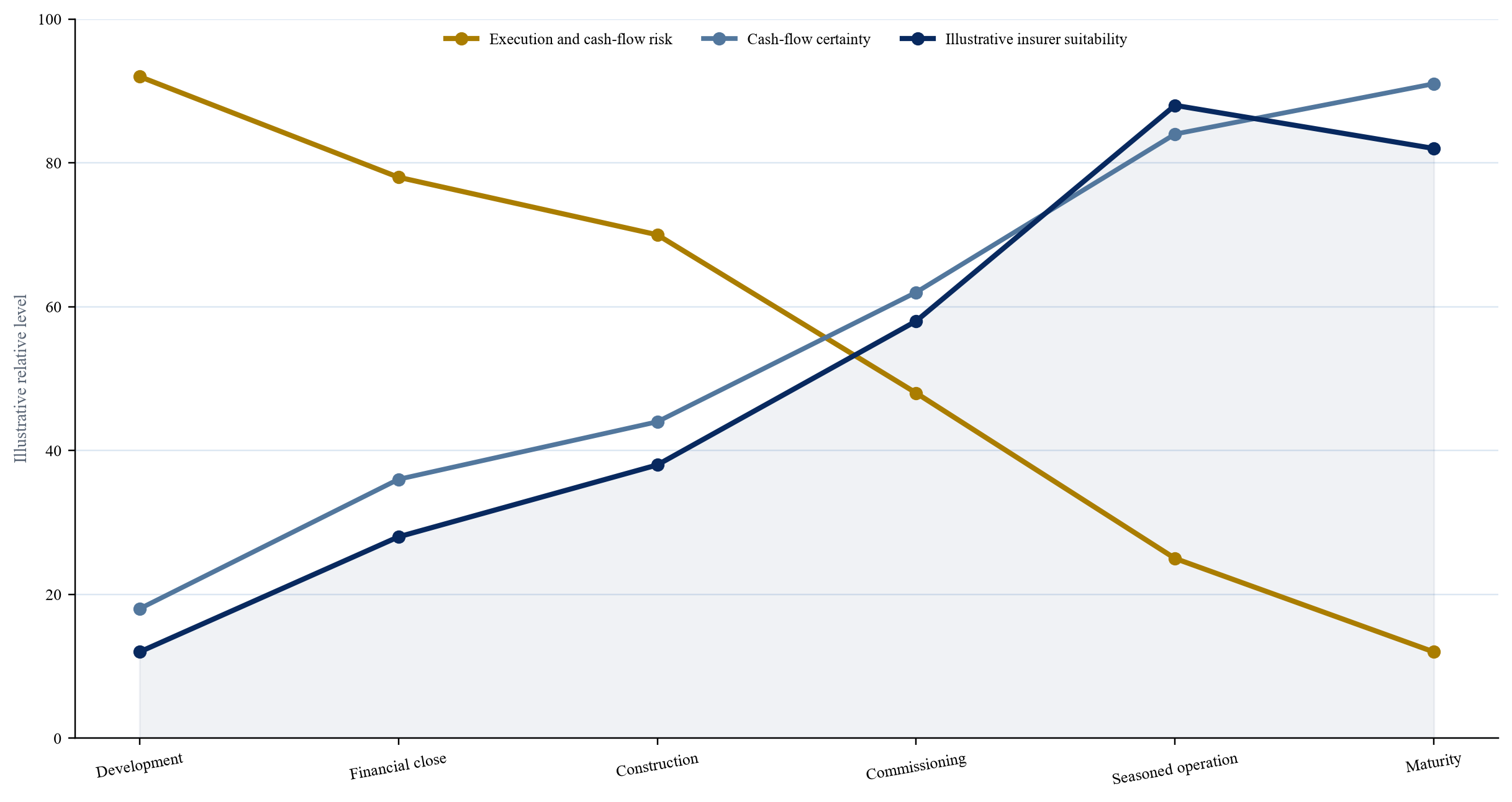
The curves are illustrative. Suitability depends on the insurer, liability portfolio, contract and prudential framework.
4. Make cash-flow predictability contractual
Infrastructure debt becomes suitable for liability matching when expected payments arise from enforceable mechanisms. The core questions are who pays, why they must pay, how the amount changes, when payment can be reduced, and what happens after default or termination. Predictability may come from an availability payment, regulated revenue, take-or-pay contract, power purchase agreement, transmission charge, lease or diversified user fees.
Fixed cash flows are easier to match than optional cash flows. Prepayment, refinancing, extension, indexation, cure periods and termination compensation can alter timing. A loan with a make-whole provision can protect reinvestment economics. A power contract indexed to inflation can support inflation-linked liabilities when the index, lag and caps align. An availability payment can reduce demand risk while retaining deductions for service failure. A regulated asset base can provide long-duration cash flow when the methodology, periodic reviews and cost-recovery rules are credible.
The contract should be modelled under base, downside and disruption scenarios. Cash-flow certainty is not a binary status. It is the distribution of possible payments after applying contractual rights, counterparty behaviour and legal enforceability. Prudential eligibility and internal risk assessment should use the same underlying cash-flow model to avoid inconsistent views across investment, actuarial and regulatory teams.
5. Build an asset-liability cash-flow test
The cash-flow test should compare asset receipts and liability payments in each relevant period and currency. It should incorporate scheduled principal, interest, indexation, fees, reserves, prepayment, default, recovery and hedging. The liability side should incorporate expected claims, expense, lapse or longevity assumptions and stress cash flows. The objective is to identify gaps that require cash, liquid assets, derivatives or reinvestment.
Duration and convexity remain useful summary measures, while period-by-period matching provides stronger evidence. A portfolio may need several infrastructure assets with staggered maturities rather than one large loan. Amortising debt can fit annuity outflows better than a bullet. Sculpted debt service can align with the project's revenue while leaving uneven receipts for the insurer. The transaction adviser should test both project bankability and portfolio fit.
The European matching adjustment rules require assigned assets whose expected cash flows replicate the relevant liability cash flows in the same currency without material mismatch. The UK regime contains its own eligibility and matching tests. These regulatory tests are jurisdiction-specific. An insurer should retain an economic cash-flow test even where it does not claim a matching adjustment, because mismatch can create liquidity, reinvestment and solvency risk independent of formal eligibility.
6. Treat rating evidence as a starting point
An external rating can support investment limits, capital treatment and marketability. Infrastructure private debt is frequently unrated, privately rated or assessed internally. The absence of a public rating does not make the debt uninvestable, while it increases the burden on the insurer's internal credit assessment, governance and validation.
The credit opinion should examine probability of default and loss given default separately. Infrastructure can have low default frequency and strong recoveries where creditors hold security, step-in rights and control over cash. Recovery can still be weak when assets are highly specific, politically sensitive or dependent on a concession. Seniority, collateral, intercreditor arrangements, reserve accounts and termination value all affect expected loss.
Internal ratings should be independent from origination incentives. Models require data, expert judgement, sector overlays and periodic validation. A project should not be assigned an investment-grade equivalent because the portfolio needs a particular capital outcome. The committee should document uncertainty and apply conservative treatment where evidence is limited.
7. Price the full capital burden
The relevant spread is the margin after expected loss, capital cost, hedging, liquidity, origination, monitoring and workout expense. A nominal illiquidity premium can disappear after those costs. The insurer should compare the asset with public corporate bonds, sovereign debt, mortgages, private credit and alternative infrastructure instruments on a consistent basis.
Capital treatment differs across regimes, ratings, duration and instrument structure. European rules include differentiated treatment for qualifying infrastructure investments, subject to detailed criteria. The International Insurance Capital Standard includes infrastructure definitions and risk factors within a global framework for internationally active insurance groups. United States risk-based capital links minimum capital to insurer size and the riskiness of assets and operations. The paper does not attempt to calculate a universal charge because no universal charge exists.
The board should view regulatory capital as a constraint and a price. A favourable charge cannot repair weak credit. A higher charge does not necessarily make a strong asset uneconomic when the spread and diversification benefit compensate for it. Transaction design should improve genuine cash-flow quality, creditor protection and transparency, with capital efficiency arising from those improvements.
8. Preserve liquidity despite a hold-to-maturity strategy
Infrastructure private debt is often illiquid. The insurer may intend to hold it to maturity and still need liquidity for claims, collateral, policyholder options, margin calls or portfolio rebalancing. A hold-to-maturity assumption therefore requires a credible ability to hold, not an expectation that liquidity will never be needed.
The liquidity plan should include contractual receipts, claims, collateral requirements, derivative cash flows, committed facilities and sale capacity. It should stress delayed project payments, downgrade, prepayment, market closure and simultaneous policyholder or collateral outflows. A portfolio with ample long-term solvency can face short-term liquidity pressure when cash is trapped in projects.
Liquidity should be managed at portfolio level. The insurer can maintain public bonds, cash and repo-eligible assets alongside private debt. Infrastructure allocations can be capped by liability segment, currency, maturity bucket and stressed sale horizon. The portfolio should avoid relying on distressed sales of private loans to meet predictable cash needs.
9. Design covenants around the infrastructure system
Corporate covenants often focus on leverage, interest coverage and restricted payments. Infrastructure debt also requires construction, operating, regulatory and cash-control protections. The covenant package should reflect the asset's sources of value and failure.
During construction, protections may include cost-to-complete tests, contingency minimums, sponsor support, contractor security, milestone reporting and draw stops. During operations, covenants may cover debt-service coverage, reserve funding, maintenance, insurance, availability, licence compliance, distributions and additional debt. Information covenants should provide technical, financial, environmental and counterparty evidence rather than a generic quarterly report.
The structure should preserve corrective action before value is lost. Cash sweeps, distribution blocks, cure plans, additional reserves and early refinancing can protect creditors without forcing premature enforcement. Step-in rights and direct agreements allow lenders to preserve the concession or contract. Their value depends on legal enforceability, operational capacity and public-authority cooperation.
Table 1. Infrastructure debt suitability matrix for insurer capital
| Dimension | Stronger suitability | Warning condition | Transaction response |
|---|---|---|---|
| Liability fit | Same currency, aligned payment dates and appropriate duration | Material currency or maturity mismatch | Hedge, resize, amortise or assign to another liability segment |
| Project stage | Seasoned operation or protected construction exposure | Unresolved permits, cost or completion interfaces | Delay take-out or require completion support and contingency |
| Revenue | Contractual, regulated or diversified with clear indexation | Merchant exposure, weak collection or discretionary subsidy | Add reserves, guarantee, floor, diversification or shorter tenor |
| Credit quality | Independent assessment supported by cash-flow and recovery evidence | Rating driven by target capital treatment | Re-underwrite, validate and apply conservative limits |
| Capital | Risk-adjusted return exceeds capital and operating cost | Spread premium disappears after charges and hedging | Reprice, restructure or reject |
| Liquidity | Hold-to-maturity capacity plus liquid portfolio buffer | Asset sales needed under plausible stress | Reduce allocation or increase liquid resources |
| Covenants | Early warning, cash control, step-in and workout rights | Covenant-lite documentation or weak information | Strengthen terms and monitoring before commitment |
| Concentration | Diversified by asset, sector, sponsor, payer and geography | Correlated exposures or repeated sponsor risk | Use limits, syndication, funds or portfolio vehicles |
| Valuation | Observable model inputs and independent governance | Stale marks or optimistic recovery assumptions | Independent valuation, challenge and uncertainty reserve |
| Emerging-market risk | Local-currency revenue and debt or credible protection | Hard-currency debt against local revenue | Local funding, hedge, guarantee, insurance or lower leverage |
The matrix supports screening. The insurer's own liability profile, mandate and prudential regime determine the final decision.
10. Govern prepayment and reinvestment risk
Infrastructure assets are long lived, while their debt may refinance early. Sponsors seek lower pricing after construction, improved ratings or falling market rates. A voluntary prepayment can return principal when the insurer has limited opportunities to reinvest at the original yield. Liability duration then remains while asset duration shortens.
The debt instrument should define voluntary and mandatory prepayment, make-whole amounts, break costs, asset-sale proceeds and refinancing conditions. A fixed-rate private placement may use a make-whole formula tied to a reference curve. A floating-rate loan may offer weaker reinvestment protection while reducing interest-rate risk. Project bonds may include call protection or declining premiums. The economics should be modelled rather than inferred from the stated maturity.
Mandatory prepayment can arise from insurance proceeds, illegality, concession termination, excess cash or asset disposal. These events may coincide with market stress. The insurer should assess whether the payment amount includes principal, accrued interest, hedge breakage and an appropriate premium. Strong prepayment protection improves cash-flow predictability while it cannot eliminate reinvestment risk after default or extraordinary termination.
11. Allocate construction risk explicitly
Construction debt can offer yield and earlier access to attractive assets. It also exposes the insurer to cost overruns, delay, contractor default, technical failure, permitting and supply-chain risk. The underwriting decision should identify which risks are fixed, capped, shared or retained.
A bankable construction package can include a fixed-price and date-certain engineering contract, performance guarantees, liquidated damages, contingency, sponsor equity, cost-overrun support, independent engineering and completion tests. Complex infrastructure often retains exclusions for ground conditions, utility relocation, land, customs, grid connection or changes in law. The financing documents should allocate those exclusions rather than describe the contract as turnkey.
Completion should represent economic service. Mechanical completion alone may not establish revenue. Tests can cover output, availability, reliability, efficiency, environmental compliance, customer connection and contract acceptance. The insurer should understand the cure path if performance is below target. A committed bank or development-finance bridge with an insurer take-out after completion can allocate construction risk to capital designed to manage it.
12. Assess the counterparty network
Infrastructure credit is frequently supported by a network of counterparties: sponsor, construction contractor, operator, offtaker, utility, regulator, government, guarantor, insurer and hedge provider. The project can fail when one critical party fails even if the physical asset remains sound.
Counterparty assessment should cover standalone credit, contractual obligation, replacement options, concentration and correlation. A government-owned offtaker may have strategic importance and weak cash generation. A strong contractor may provide a guarantee through a thin subsidiary. A hedge can reduce currency risk while creating collateral and counterparty exposure. A highly rated guarantor can improve loss protection while concentrating reliance on one institution.
The debt contract should define direct agreements, cure rights, replacement, assignment and termination. Counterparty exposure should be monitored across the insurer's portfolio. Several projects can share the same sponsor, offtaker, contractor, equipment supplier or sovereign. A portfolio that appears diversified by asset may still contain one correlated credit chain.
13. Treat regulation and policy as credit inputs
Regulated infrastructure can offer stable revenue and material political exposure. The credit case depends on the legal framework, regulator independence, tariff methodology, cost-recovery process, review timetable and appeal rights. A policy objective does not itself create a payment obligation.
The insurer should examine how capital expenditure enters the regulated asset base, how operating costs are allowed, how inflation and interest rates are treated, and whether efficiency targets can reduce revenue. It should test delayed reviews, disallowance, affordability measures and political intervention. Historical regulatory behaviour may inform the analysis but cannot guarantee future outcomes.
Where revenue comes from a concession or public-private partnership, the documents should specify performance standards, deductions, change in law, force majeure, public-authority default and termination compensation. The credit view should distinguish enforceable contractual rights from expected government support. Political-risk insurance or a guarantee may cover defined events while leaving ordinary regulatory and commercial risk with the project.
14. Use guarantees for defined barriers
Guarantees can transform infrastructure debt when they cover a risk that prevents insurer participation. A partial credit guarantee may cover scheduled principal or a portion of loss. Political-risk insurance may cover expropriation, transfer restriction, war, civil disturbance or breach of contract. A liquidity guarantee can protect payment timing without transferring ultimate credit loss. Construction completion support can bridge the project to operating status.
Coverage should be measured against the insurer's loss path. The contract needs an exact covered obligation, trigger, waiting period, claim process, exclusions, recovery rights and termination. A guarantee that pays only after a lengthy dispute may fail a liquidity test. Coverage that expires before refinancing may leave a maturity concentration. A guarantee that absorbs every loss can weaken lender discipline and create moral hazard.
The World Bank Group Guarantee Platform issued USD 12.3 billion of guarantees across 77 projects in 40 countries and one regional development bank during fiscal 2025. The scale demonstrates an expanding toolkit. Suitability still depends on the particular obligation. The transaction should quantify how the guarantee changes probability of default, loss given default, rating, tenor, capital, pricing and mobilisation.
15. Create local-currency instruments for local liabilities
Domestic insurers often hold liabilities in local currency and can provide a natural funding base for domestic infrastructure. Local-currency debt avoids the operating mismatch created by hard-currency debt against local revenue. It can also develop a yield curve, market infrastructure and long-term savings channel.
The main constraints are project credit quality, benchmark depth, instrument supply, rating standards, concentration limits and secondary liquidity. Infrastructure bonds may need credit enhancement to reach institutional thresholds. The World Bank's account of Nigeria's InfraCredit describes guarantees for local-currency infrastructure debt and reports long tenors and participation by domestic institutional investors. South Africa's credit-guarantee initiative similarly aims to mobilise rand-denominated institutional capital for electricity, water, freight, education and health infrastructure.
The structure should avoid converting public support into hidden foreign-exchange exposure. Guarantees, capital and contingent funding should be aligned with the instrument currency where possible. Domestic insurers require the same independent credit, liquidity and concentration discipline as global investors. Local-currency status solves one risk and leaves construction, payment, governance and recovery risks intact.
16. Use pooled vehicles when direct origination is inefficient
Direct lending provides control, asset selection and covenants. It requires origination capability, technical diligence, documentation, valuation and workout resources. Smaller insurers or investors entering new sectors may achieve stronger diversification through infrastructure debt funds, managed accounts, syndications or securitised portfolios.
A fund transfers selection and monitoring to a manager, while adding management fees, fund-level leverage, liquidity terms and governance considerations. A managed account can tailor duration, currency and exclusions. A syndication can preserve direct asset exposure with shared diligence and agency. An infrastructure collateralised loan obligation can transform a pool of loans into rated tranches, while introducing structural, model and manager risk.
IFC's Managed Co-Lending Portfolio Program and later risk-sharing structures illustrate portfolio approaches to mobilising insurer capacity. In December 2024, IFC announced a USD 3 billion credit-insurance policy with 14 global insurers for real-sector lending and stated that capacity across its MCPP platforms would exceed USD 19 billion. The arrangement uses IFC origination and portfolio construction to connect insurers with emerging-market credit exposure. Investors should still understand selection, attachment point, diversification, claims and portfolio governance.
Table 2. Routes for insurers to access infrastructure debt
| Route | Principal advantage | Principal risk | Required capability |
|---|---|---|---|
| Direct project loan | Bespoke covenants and asset control | Concentration and resource intensity | Technical, legal, credit, valuation and workout teams |
| Private placement | Fixed terms, call protection and direct issuer relationship | Limited liquidity and information dependence | Internal rating and ongoing covenant monitoring |
| Project bond | Tradable instrument and broad investor base | Market execution and potentially weaker control | Public-market credit and documentation analysis |
| Infrastructure debt fund | Diversification and specialist management | Fees, manager selection and fund-level terms | Manager diligence, mandate governance and look-through risk |
| Managed account | Tailored portfolio and delegated origination | Reliance on manager and pipeline | Detailed investment guidelines and oversight |
| Syndicated loan | Shared origination and agent administration | Majority decisions and lender coordination | Intercreditor and agency analysis |
| Credit-enhanced local bond | Domestic-currency match and improved rating | Guarantor dependence and local-market liquidity | Guarantee analysis and domestic capital-markets capability |
| Infrastructure securitisation | Portfolio diversification and tranched risk | Structural complexity and model dependence | Cash-flow modelling, collateral review and surveillance |
Access route changes the ownership of origination, monitoring, liquidity and workout responsibilities.
17. Control concentration and correlated transition risk
Infrastructure loans can be individually resilient and collectively correlated. A portfolio may concentrate in one regulatory regime, sponsor, contractor, technology, commodity, customer or climate exposure. Energy-transition assets can share power-price, curtailment, grid and policy risks. Digital infrastructure can share electricity, cooling, fibre and hyperscale-customer risks.
Concentration limits should operate across several dimensions. Sector and geography limits are insufficient when projects share one offtaker or sovereign. Sponsor groups and contractors should be aggregated. Technology exposure should reflect common equipment and degradation assumptions. Climate exposure should map physical hazards and adaptation. Maturity concentrations should identify refinancing and reinvestment clusters.
Portfolio construction can deliberately combine regulated utilities, availability-based social infrastructure, contracted renewables, transport, digital and water assets. Diversification benefits should be evidenced under stress. A guarantee from the same provider across many assets may reduce individual loss and create portfolio concentration. Correlation should be considered in capital, liquidity and recovery planning.
18. Build independent valuation and impairment governance
Private infrastructure debt lacks continuous market prices. Valuation commonly relies on discounted cash flow, comparable spreads, ratings, modelled prepayment and recovery assumptions. The apparent stability of reported values can reflect infrequent marking rather than low economic volatility.
Valuation governance should separate origination from marking. Inputs should include reference curves, credit spreads, liquidity, cash-flow changes, covenant events, rating migration and market transactions. Model uncertainty should be documented. Independent price verification and periodic third-party review can challenge stale assumptions.
Impairment and valuation should respond to early evidence rather than only payment default. Construction delay, cost escalation, offtaker weakness, regulatory disallowance, covenant breach and deteriorating coverage can reduce value. Workout scenarios should estimate time, expense, control rights, replacement and termination recovery. Capital and accounting outcomes are jurisdiction-specific, while the underlying economic deterioration should be recognised consistently.
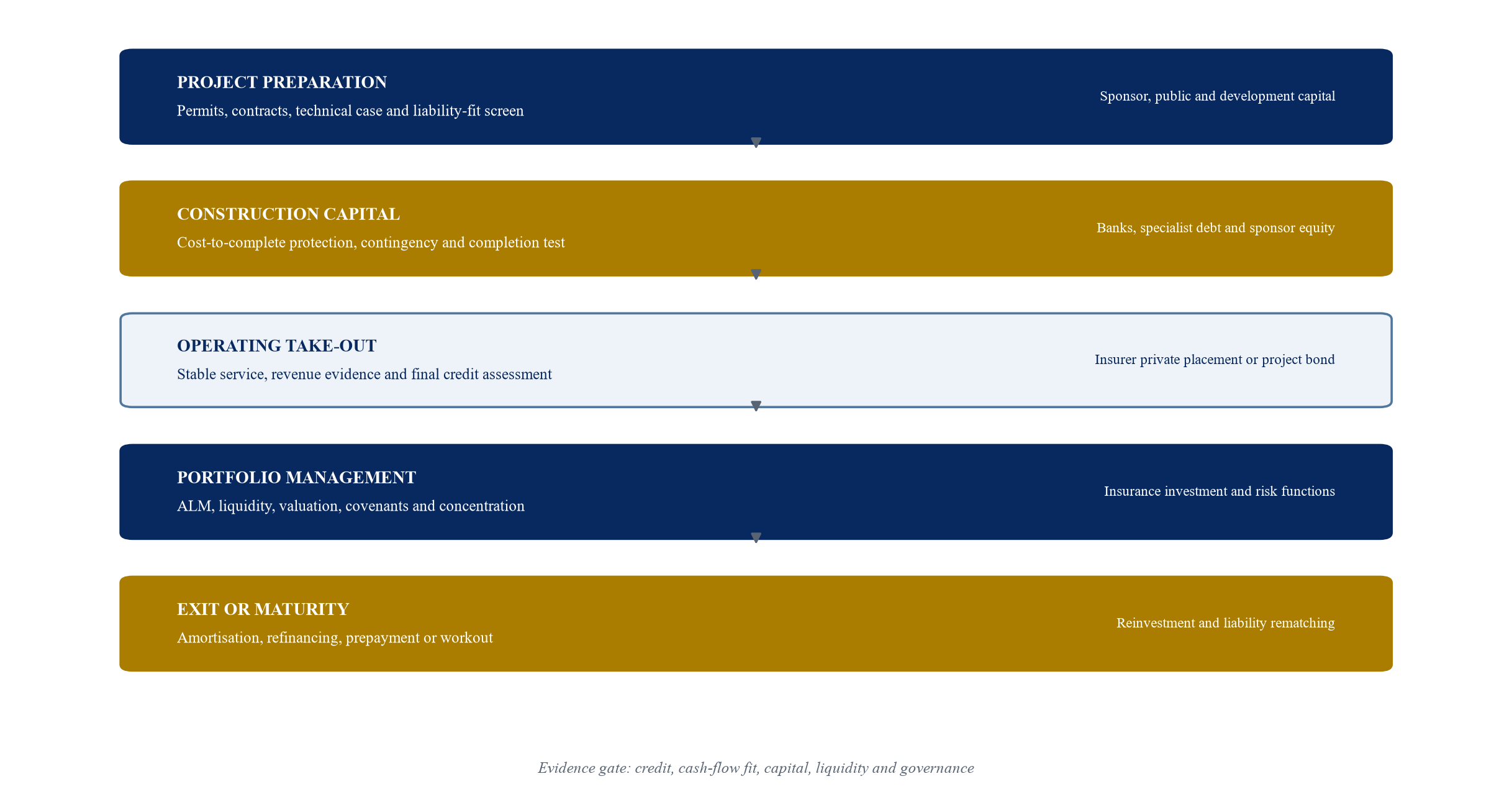
Each gate requires evidence. Capital should move only after the incoming investor's risk conditions are satisfied.
19. Integrate sustainability without weakening credit analysis
Infrastructure assets can support energy transition, resilience, mobility, digital access, water and social services. Sustainability objectives can affect eligibility, disclosure, mandate design and stakeholder expectations. They do not replace analysis of repayment capacity.
The lender should identify which environmental or social outcomes arise from the financed asset, how they are measured, and whether they affect cash flow. Climate transition can create revenue opportunity and stranded-asset risk. Physical climate hazards can damage assets, interrupt service and increase insurance cost. Biodiversity, land, community and labour issues can delay construction or threaten a concession.
Labelled debt should follow the relevant framework and avoid broad claims unsupported by use of proceeds or performance evidence. Covenants can require reporting, remedial plans and compliance with environmental and social obligations. The credit committee should see sustainability risks in the same cash-flow, covenant and recovery analysis used for other material risks.
20. Distinguish investment-grade design from rating engineering
Insurer demand can encourage sponsors to target investment-grade debt. The target should be achieved through durable credit quality: conservative leverage, predictable revenue, adequate reserves, strong contracts, sponsor commitment and credible recovery. A guarantee or structural enhancement can improve credit quality when it transfers real loss capacity.
Rating engineering occurs when documentation, tranching or assumptions seek a rating outcome without improving the underlying loss distribution. Overly optimistic refinancing, recovery, correlation or termination assumptions can hide risk. A thin subordinated layer may protect senior debt in the base case and fail under correlated stress.
The insurer should reconstruct the rating logic. It should test debt-service coverage, break-even performance, downside cash, recovery and sensitivity to delays. It should understand the guarantor or subordinated provider as a separate credit. The investment decision remains the insurer's responsibility even when external ratings, arranger models and expert reports are available.
21. Align origination incentives and governance
Infrastructure transactions can involve long pipelines, substantial diligence cost and pressure to deploy capital. Origination teams may be rewarded for commitments, asset managers for fees, sponsors for financial close and advisers for execution. Governance should prevent these incentives from weakening credit standards.
The investment policy should define eligible assets, liability segments, rating methods, capital hurdles, concentration limits and exceptions. Independent risk should challenge the cash-flow model and downside. Actuarial and treasury teams should confirm liability fit and liquidity. Legal, technical, environmental and tax specialists should address their domains. The governing body should receive a clear decision paper rather than a collection of unintegrated reports.
Post-close accountability should remain with named owners. Monitoring needs covenant dates, valuation cycles, technical reports, rating reviews and escalation triggers. Manager mandates should disclose fees, conflicts, affiliated transactions and allocation. A transaction that cannot be monitored efficiently may be uneconomic despite an attractive spread.
22. Learn from current market structures
Recent official initiatives illustrate several ways to connect insurance capacity with infrastructure and real-economy credit. IFC's 2024 MCPP Real Sector program uses credit insurance from a group of global insurers to expand lending across energy, transport, telecoms, water, waste and other sectors. The insurers provide risk-bearing capacity through a portfolio platform rather than originating each loan independently.
The World Bank Group has described infrastructure asset-backed securitisation and credit-enhancement structures that can create investable instruments from project loans. Its 2025 account of a USD 510 million IFC securitisation describes a diversified pool of IFC-originated emerging-market assets intended to broaden institutional access. The OECD's InfraCredit case documents local-currency guarantees supporting Nigerian infrastructure bonds with long tenors and domestic institutional participation.
The United Kingdom's matching adjustment reforms and later Matching Adjustment Investment Accelerator create a different path. They seek to widen and speed the inclusion of suitable assets while requiring firm attestation, risk management and supervisory evidence. European rules similarly connect qualifying treatment with conservative debt service, contractual revenue, hold-to-maturity capacity and active monitoring.
These structures solve different barriers. Portfolio insurance uses risk sharing and origination scale. Securitisation creates diversification and tranches. Local guarantees address rating and currency constraints. Prudential reform changes eligibility and process. A project should select the route that addresses its actual financing barrier.
23. Build a transaction diligence sequence
Diligence should begin with the insurer's liability and mandate. The team should confirm currency, duration, cash-flow pattern, liquidity tolerance, capital budget and concentration capacity. It should then test project stage, transaction perimeter, revenue, counterparties, technical case, legal rights, environmental obligations and downside loss.
The diligence plan should integrate reports. Technical delay affects interest during construction and debt-service coverage. Tariff indexation affects inflation matching and affordability. Currency hedging affects liquidity and counterparty exposure. Termination rights affect recovery and rating. Each workstream should feed one shared cash-flow and risk model.
The investment committee should receive evidence on base and downside cash flows, rating, expected loss, capital, hedging, liquidity, valuation and covenant protection. Open issues should be explicit. Conditions precedent should correspond to evidence required before funding. Conditions subsequent should be limited, dated and monitored. Material unresolved risks should remain a decision, not disappear into a closing checklist.
24. Hypothetical operating-infrastructure portfolio
Consider a hypothetical insurer with long-duration local-currency annuity liabilities. It is evaluating a USD-equivalent 1.20 billion portfolio of operating infrastructure debt. The example is a structural model and does not describe an actual insurer, issuer, transaction or forecast.
The proposed portfolio contains regulated electricity-network debt, availability-based transport debt, contracted renewable loans, data-centre private placements and water-infrastructure bonds. All instruments are senior debt. Most amortise over 12 to 25 years. The insurer's liability segment has a longer average life, so the portfolio supplements rather than fully matches the liabilities.
The base case assumes contractual cash flows, no default and reinvestment of scheduled principal. The moderate stress assumes rating migration, delayed tariff recovery, one renewable offtaker cure and refinancing at wider spreads. The severe stress assumes a construction-related draw under a completion exposure, correlated sovereign and utility weakness in one market, a data-centre tenant default and delayed recoveries. The modelling values are hypothetical and expressed in USD-equivalent millions.
Table 3. Hypothetical insurer infrastructure-debt portfolio and downside allocation
| Portfolio component | Amount | Weighted life | Primary cash-flow support | Severe-stress principal loss | Principal control |
|---|---|---|---|---|---|
| Regulated electricity networks | 300 | 18 years | Allowed revenue and asset-base return | 9 | Regulatory review, reserve and covenants |
| Availability-based transport | 240 | 16 years | Public-authority availability payment | 7 | Performance regime and termination protection |
| Contracted renewable energy | 210 | 14 years | Power purchase agreements | 17 | Offtaker diversity, reserves and security |
| Data-centre private placements | 180 | 12 years | Long-term customer contracts | 18 | Tenant limits, asset coverage and cash sweep |
| Water and wastewater bonds | 150 | 20 years | Regulated tariff and public-service revenue | 5 | Tariff covenant and debt-service reserve |
| Construction bridge exposure | 120 | 7 years | Completion support and take-out commitment | 20 | Cost-to-complete test and sponsor support |
| Total portfolio | 1,200 | 15.3 years | Diversified contractual and regulated cash flows | 76 | Portfolio limits, liquidity and workout governance |
All amounts and stress assumptions are hypothetical. The table demonstrates decision logic and does not provide a forecast or investment recommendation.
The illustrative severe-stress loss is 76, or 6.3 percent of principal, before any tax or capital effect. The construction bridge and concentrated data-centre exposure create the highest percentage losses. Regulated and availability-based assets remain exposed to delay and public counterparty risk but show lower modelled loss because the hypothetical structure includes reserves and termination protection.
The portfolio still leaves a liability gap beyond its weighted life. The insurer therefore needs longer assets, reinvestment capacity or derivatives. It also needs liquid assets outside the infrastructure allocation. The example shows why a portfolio can be economically attractive and still fail to complete the liability-matching task on its own.
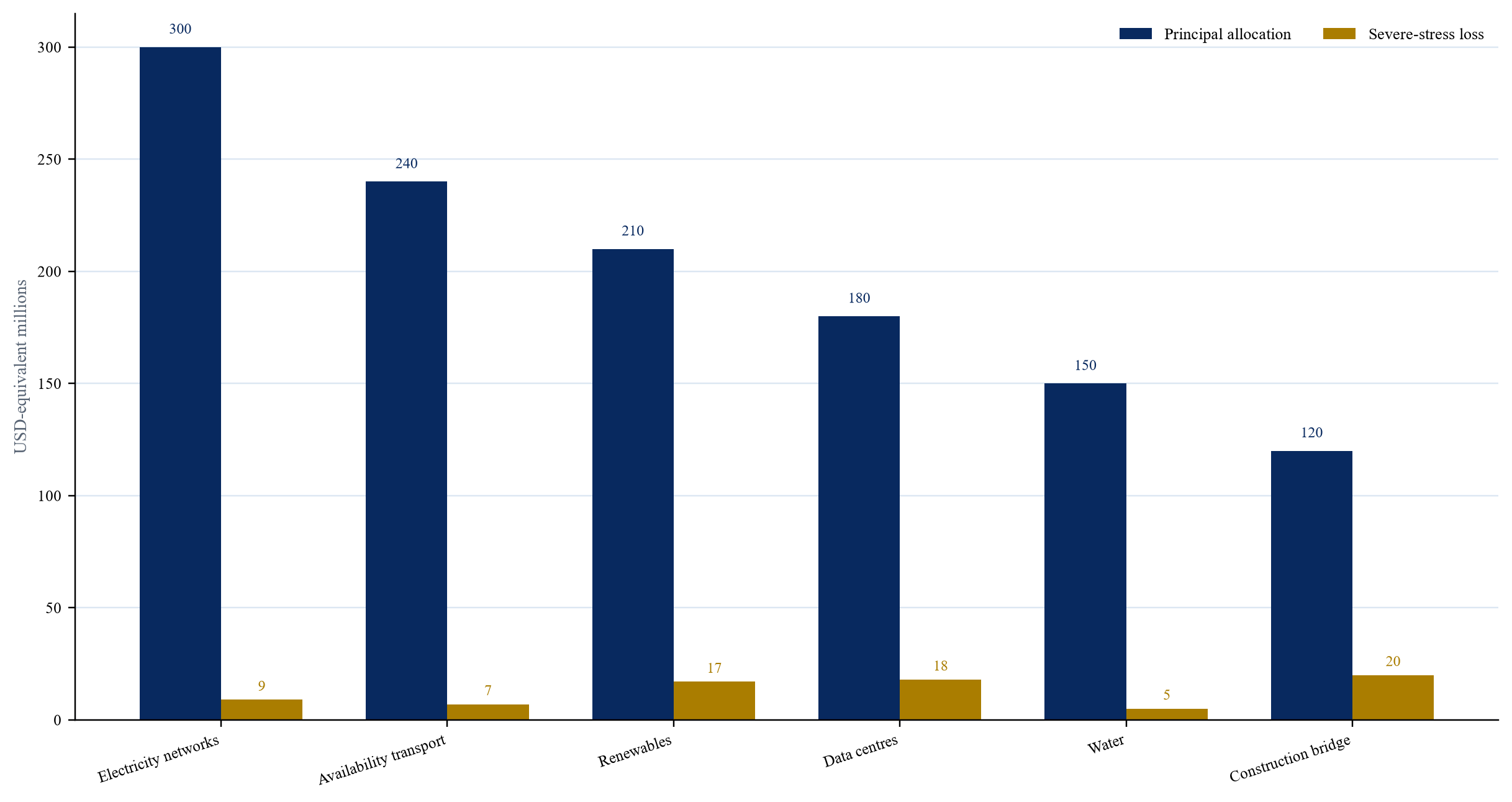
Values are hypothetical USD-equivalent millions. Loss estimates demonstrate framework behaviour and are not forecasts.
25. Test the portfolio against liability and liquidity needs
The hypothetical portfolio should be tested as part of the insurer's entire balance sheet. The first test is cash-flow coverage by period. Scheduled receipts should be compared with liability payments under base and stress. The second test is duration and convexity. The third is currency and inflation alignment. The fourth is liquidity after delayed payments, collateral calls and policyholder stress.
The credit test should aggregate defaults, migrations and recoveries across correlated scenarios. The capital test should apply the relevant prudential regime and internal model. The valuation test should widen spreads and change recovery assumptions. The concentration test should aggregate sponsor, sovereign, offtaker, contractor and technology relationships.
Management should define actions for each breach. Options include holding additional liquid assets, reducing construction exposure, shortening commitments, increasing local-currency assets, purchasing protection, syndicating concentration, adding reserves or declining the investment. The solution should improve the total balance sheet rather than maximise the infrastructure allocation.
26. Apply a board decision framework
The governing body can use ten questions. First, which liabilities will the asset support? Second, do currency, timing, duration and indexation align? Third, which project-stage risks remain? Fourth, what contractual mechanism creates cash? Fifth, what is the independent view of default and recovery? Sixth, what capital, liquidity, hedging and operating costs reduce the spread? Seventh, what covenants and control rights protect value? Eighth, how does the exposure affect concentration? Ninth, can the insurer value, monitor and work out the debt? Tenth, what happens under prepayment, default, refinancing and regulatory change?
The answers should be documented in one transaction memorandum that reconciles investment, actuarial, risk, treasury, legal, technical and sustainability evidence. The committee should see assumptions, uncertainty and disagreement. Approval conditions should be measurable. Post-close monitoring should use the same metrics that supported the original decision.
An infrastructure asset can fit long liabilities when its cash flows are sufficiently predictable, enforceable and resilient. The label, stated maturity and public importance do not establish that fit. The decision depends on the complete instrument and the insurer's complete balance sheet.
Conclusion
Infrastructure debt can connect long-term savings with productive assets and public services. Life insurers and annuity writers have a genuine economic reason to participate: their liabilities can support patient capital, and well-structured infrastructure can provide long-duration income, diversification and creditor protection.
The match requires more than duration. Project stage, revenue contract, currency, optionality, prepayment, credit quality, capital, liquidity, covenants, valuation, concentration and governance determine whether the debt performs as a liability-matching asset. Construction and emerging-market risks may require other capital, guarantees, local-currency structures or portfolio vehicles before insurer ownership becomes efficient.
The strongest transaction begins with the liability promise, designs the instrument around reliable cash flows, prices the full balance-sheet burden and preserves monitoring and workout capacity. Prudential eligibility then confirms a framework for holding the asset; it does not replace underwriting. This discipline allows insurer capital to finance infrastructure while protecting policyholders and preserving credible investment decisions.
Frequently Asked Questions
1. Why can infrastructure debt suit life insurers?
Many infrastructure assets generate contractual or regulated cash flows over long periods. Those receipts can support long-duration insurance liabilities when currency, payment timing, duration, indexation and liquidity are appropriately aligned.
2. Does a long maturity automatically create a liability match?
No. The insurer must consider amortisation, prepayment, extension, refinancing, default, recovery, currency, inflation and liquidity. A stated maturity is only one input to the cash-flow test.
3. Can insurers finance infrastructure during construction?
Some insurers and specialist strategies can accept construction risk. The decision requires clear allocation of cost, schedule, contractor, completion and interface risks, together with sufficient capital, liquidity and governance. An operating-asset take-out can separate construction capital from long-term insurer capital.
4. What makes infrastructure debt investment grade?
Investment-grade quality depends on durable repayment capacity, conservative leverage, predictable revenue, strong counterparties, reserves, covenants and credible recovery. An external or internal rating should reflect those attributes rather than a desired capital outcome.
5. How should an insurer assess the illiquidity premium?
The insurer should deduct expected loss, capital cost, hedging, origination, monitoring, valuation, liquidity and workout expense from the observed spread. The remaining risk-adjusted return should be compared with relevant liquid and private alternatives.
6. What role can guarantees play?
Guarantees can address defined credit, political, payment, construction or liquidity risks. The insurer should examine coverage, trigger, waiting period, exclusions, claim process, tenor and recovery rights and should retain diligence on uncovered risks.
7. How can emerging-market infrastructure become suitable for insurers?
Structures can use local-currency debt, credit enhancement, political-risk insurance, development-finance participation, diversified portfolios, reserves and strong contractual rights. Each tool should address a specific barrier and preserve lender discipline.
8. What is the board's central decision?
The board should determine whether the instrument improves the insurer's risk-adjusted balance sheet while supporting the intended liabilities. The decision should integrate cash-flow matching, credit, capital, liquidity, concentration, valuation and governance.
References
- Prudential Regulation Authority. Review of Solvency II: Reform of the Matching Adjustment, Policy Statement PS10/24, 2024. https://www.bankofengland.co.uk/prudential-regulation/publication/2024/june/review-of-solvency-ii-reform-of-the-matching-adjustment-policy-statement
- Prudential Regulation Authority. Solvency II: Matching Adjustment, Supervisory Statement SS7/18, June 2024 update. https://www.bankofengland.co.uk/prudential-regulation/publication/2018/july/solvency-2-matching-adjustment
- Prudential Regulation Authority. Matching Adjustment Investment Accelerator, Consultation Paper CP7/25, 2025. https://www.bankofengland.co.uk/prudential-regulation/publication/2025/april/matching-adjustment-investment-accelerator-consultation-paper
- Prudential Regulation Authority. Annual Report 2024/25, 2025. https://www.bankofengland.co.uk/prudential-regulation/publication/2025/june/pra-annual-report-2024-25
- European Insurance and Occupational Pensions Authority. Qualifying Infrastructure Corporate Investments, Article 164b. https://www.eiopa.europa.eu/rulebook/solvency-ii-single-rulebook/article-6089_en
- European Insurance and Occupational Pensions Authority. Risk Management for Qualifying Infrastructure Investments, Article 261a. https://www.eiopa.europa.eu/rulebook/solvency-ii-single-rulebook/article-6088_en
- European Insurance and Occupational Pensions Authority. Matching Adjustment to the Relevant Risk-Free Interest Rate Term Structure, Article 77b. https://www.eiopa.europa.eu/rulebook/solvency-ii-single-rulebook/article-2162_en
- European Insurance and Occupational Pensions Authority. Final Report on Revised ITS on Matching Adjustments, 2026. https://www.eiopa.europa.eu/publications/final-report-revised-its-matching-adjustments-solvency-ii-review_en
- International Association of Insurance Supervisors. Insurance Capital Standard Level 1 and Level 2 Texts, 2024. https://www.iaisweb.org/uploads/2024/12/ICS-Level-1-and-Level-2-texts.pdf
- National Association of Insurance Commissioners. Risk-Based Capital, updated 2026. https://content.naic.org/insurance-topics/risk-based-capital
- National Association of Insurance Commissioners. Global Insurance Market Report 2025. https://content.naic.org/sites/default/files/inline-files/Global-Insurance-Market-Report-2025.pdf
- Organisation for Economic Co-operation and Development. Global Debt Report 2026. https://www.oecd.org/en/publications/global-debt-report-2026_59d2d627-en.html
- Organisation for Economic Co-operation and Development. Green Infrastructure in the Decade for Delivery, 2020. https://www.oecd.org/en/publications/green-infrastructure-in-the-decade-for-delivery_f51f9256-en.html
- Organisation for Economic Co-operation and Development. InfraCredit: Making Infrastructure Projects in Nigeria More Bankable Through Credit Enhancement, 2025. https://www.oecd.org/en/publications/blended-finance-case-studies_2fb90b9a-en/infracredit-making-infrastructure-projects-in-nigeria-more-bankable-through-credit-enhancement_bdb679c6-en.html
- World Bank Group. Infrastructure Asset-Backed Securitization Case Studies. https://ppp.worldbank.org/infrastructure-asset-backed-securitization-iabs-case-studies
- World Bank Group. South Africa's Credit Guarantee Vehicle, 2026. https://www.worldbank.org/en/news/factsheet/2026/03/05/south-africa-s-credit-guarantee-vehicle
- World Bank Group. Annual Report 2025, Multilateral Investment Guarantee Agency. https://www.worldbank.org/en/about/annual-report/miga
- World Bank Group. Transforming Finance to Meet Today's Development Needs, 2026. https://www.worldbank.org/en/about/unit/brief/transforming-finance-to-meet-today-s-development-needs
- International Finance Corporation. IFC Mobilizes USD 3 Billion from Leading Global Insurers, 2024. https://www.ifc.org/en/pressroom/2024/ifc-mobilizes-3-billion-from-leading-global-insurers-to-boost-real-sector-investments-in-emerging-markets
- International Finance Corporation. Mobilization of Private Finance by Multilateral Development Banks and Development Finance Institutions in 2024, 2026. https://www.ifc.org/en/insights-reports/2026/mobilization-of-private-finance-by-mdbs-dfis-2024-joint-report
- International Energy Agency. Financing the ASEAN Power Grid, 2026. https://www.iea.org/reports/financing-the-asean-power-grid
- Global Infrastructure Hub. Infrastructure Monitor 2024: Debt Performance. https://ppp.worldbank.org/sites/default/files/2025-05/infrastructure-monitor-2024-report.pdf
About the Author
Chennakeshav (CK) is a corporate finance and investment banking executive with 25+ years of global experience in deal origination, structuring and execution across M&A, growth capital and corporate strategy. He has led value-creation mandates for founders, corporates and funds — bridging the boardroom view to hands-on execution and close.
His career spans Morgan Stanley, HSBC, Lloyds Banking Group, EWEC, ADQ portfolio companies and Emirates Growth Fund, across TMT, real estate, fintech, deeptech, cleantech, infrastructure and energy. He has partnered with C-suite leaders, private equity and venture funds, sovereign wealth funds and family offices to finance complex fund raises and scale-up ventures, and has led M&A due diligence, post-merger integration and business-transformation initiatives to create value.
At Matchpoint Partners he is Managing Partner, leading the firm's corporate finance, M&A and capital-raising practice. He holds an MBA from London Business School, an engineering degree from VTU and a Master of Laws (LLM, in progress) from UCL London.
An active start-up mentor, CK mentors at Techstars, DIFC FinTech Hive, Startup Grind, Founder Institute and IN5, serves as Entrepreneur Mentor in Residence (EMiR) at London Business School, and judges the Entrepreneurship World Cup.
