Introduction
An acquisition can transfer legal ownership in a day while leaving the operating system of the business dependent on people whose authority, knowledge, customer relationships and work authorisation were designed for the seller's organisation. In GCC transactions, that dependency can include an employer-linked work permit or residence process. It can also include a founder who approves prices, settles disputes, recruits informally, carries customer trust and acts as the practical escalation point. The first post-closing workforce question is therefore broader than whether named executives accept a retention bonus. The buyer needs to know which people carry value, whether they can lawfully continue in the required role, which employment entity and permit record apply, and how decision rights will move without interrupting customers or controls.
therefore uses transaction-specific cohorts and denominators. Every reported rate should state the population, role set, legal entity, jurisdiction, period, voluntary or involuntary classification, and source. The framework uses stage windows of days 0 to 30, 31 to 100 and 101 to 365. It separates departures from role continuity and value continuity. A person may remain while authority or engagement falls. A person may leave after transferring knowledge and relationships successfully. An involuntary departure may be part of a documented integration decision. The governing question is whether the transaction preserves the human capabilities required by the investment case.
Inside the analysis, employer-linked work authorisation is used instead of treating every GCC employee as legally "visa-tied" in the same way. National laws, free-zone regimes, entity structures and worker circumstances differ [1-36]. A share acquisition may leave the employing entity unchanged. An asset, business or entity transfer may require employment, permit, sponsor-record, consent, notice or cancellation actions. Qualified employment and immigration counsel should confirm the route for each person and jurisdiction.
The framework rests on nine principles:
- define the legal-employer and work-authorisation route before promising workforce continuity;
- identify value-carrying roles through customer, knowledge, authority and control pathways;
- fix transaction-specific cohorts and denominators at legal close;
- separate retention risk from performance, succession and lawful workforce-mobility questions;
- design the employment proposition around role, authority, autonomy, career path, team and compensation;
- document the founder's handover as a transfer of relationships, decisions, evidence and reputation;
- connect diligence, transaction documents, Day One and the first 100 days through one controlled register;
- measure outcomes without inferring motive, regret or causation from a raw departure count; and
- place legal, accounting, tax, data-protection and employee-communication review at the relevant decision gates.
The source set combines official GCC labour, work-permit and data-protection materials; ILO fair-recruitment guidance; IFRS requirements; and peer-reviewed M&A, identity, communication, integration and human-capital research [1-60]. Research based outside the GCC informs mechanisms and design choices. It does not establish Gulf outcomes.
No approved observed Matchpoint or client evidence was supplied for revenue, cash cost reduction, loss reduction or alpha. Those attributed values remain USD 0. Illustrative examples demonstrate a workforce-continuity architecture. They do not represent completed mandates, client outcomes, forecasts or universal benchmarks.
| approximately 47 percent year-one turnover | practitioner estimate for senior managers under a stated no-coordinated-retention condition; not universal and not GCC-specific [46] | disclose the source and limitation; use transaction-specific cohorts |
| GCC value can sit with a founder and employer-linked team | transaction-specific proposition requiring diligence | map customer, knowledge, authority, control and permit dependencies |
| retention protects the value paid | plausible mechanism with heterogeneous evidence [47-60] | specify the value pathway and test continuity at role level |
| a cash retention award is sufficient | unsupported as a general proposition | combine role, authority, autonomy, leadership, communication and compensation |
| one GCC workforce-transfer route applies | unsupported | maintain a country, entity and person-level route register |
| Research proposition | Evidence position | |
|---|---|---|
| approximately 47 percent year-one turnover | practitioner estimate for senior managers under a stated no-coordinated-retention condition; not universal and not GCC-specific [46] | disclose the source and limitation; use transaction-specific cohorts |
| GCC value can sit with a founder and employer-linked team | transaction-specific proposition requiring diligence | map customer, knowledge, authority, control and permit dependencies |
| retention protects the value paid | plausible mechanism with heterogeneous evidence [47-60] | specify the value pathway and test continuity at role level |
| a cash retention award is sufficient | unsupported as a general proposition | combine role, authority, autonomy, leadership, communication and compensation |
| one GCC workforce-transfer route applies | unsupported | maintain a country, entity and person-level route register |
Buyer And Owner Decision Perimeter
institutional buyer requirement
An buyer needs a workforce case that can survive investment-committee review, financing, legal diligence, audit and portfolio governance. The case should identify the capabilities required by the investment thesis, the people and teams that carry those capabilities, and the conditions required for lawful and effective continuity. It should also identify where the business relies on one founder, one signatory, one customer relationship holder or one technical expert.
The buyer's risk starts before closing. Management presentations may list senior staff without showing who makes operational decisions. Payroll data may show cost without showing customer ownership, code or process knowledge, professional licensing, authority limits, work-permit status, leave balance, gratuity exposure, unresolved complaints or mobility intentions. Personal information should be limited to what is necessary, shared on a lawful basis and protected through access and transfer controls [8-12].
The buyer should require a workforce-continuity memorandum before final investment approval. The memorandum should reconcile the transaction perimeter, employing entities, work locations, work-authorisation records, critical roles, founder dependencies, succession capacity, proposed retention terms, Day-One communications and the first 100-day organisation model. Open legal conclusions should be assigned to named qualified advisers.
owner requirement
A founder or family-business owner needs clarity over what remains personal and what must become institutional. The transaction may require continued involvement as employee, director, consultant, shareholder or seller under a handover covenant. Each status creates distinct duties, authority and accounting or tax questions. The transition should state what the founder will decide, introduce, document and cease doing, with dates and evidence.
The seller also needs an accurate message for employees. Promising that "nothing changes" can conflict with a new reporting line, employing entity, reward plan, authority matrix or work-permit route. A controlled communication can state what is known, what remains subject to review, when the next decision will be communicated, and where employees can raise individual questions.
Shared control object
The parties should maintain one workforce-continuity register. It links diligence, the sale agreement, employment documentation, permit actions, retention terms, the organisation model, the communication plan, data access and the 100-day plan. Each record needs a source, owner, reviewer, date, status, next action and evidence link.
| Decision field | Buyer question | Owner question | Required record |
|---|---|---|---|
| employing entity | who employs each person after close? | which obligations remain with the seller? | before-and-after entity map |
| work authorisation | which action is required and by when? | what consent, notice or cancellation applies? | person-level route register |
| critical role | what value fails if the role is disrupted? | who currently carries the relationship or knowledge? | role dependency map |
| founder transition | when does authority move? | what support and boundaries apply? | founder handover schedule |
| retention proposition | what behaviour and continuity are sought? | what is credible to the employee? | term sheet and approval record |
| communication | what can be said at each gate? | who carries trust with the team? | audience and message matrix |
| outcome | what evidence shows continuity? | how is the transition judged fairly? | cohort dashboard and decision log |
Evidence Boundary: What Turnover Statistics Can And Cannot Say
Different populations produce different rates
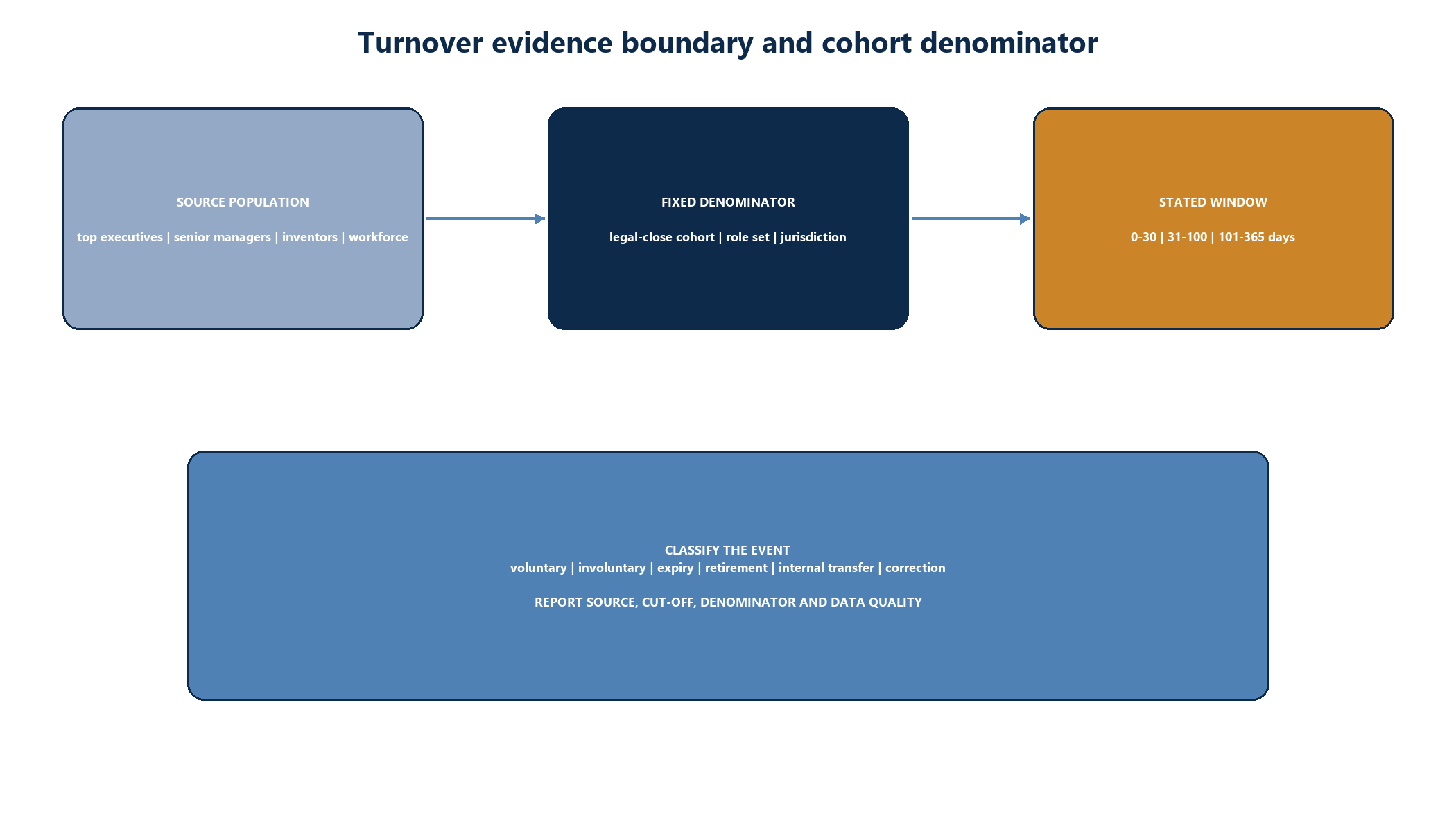
Acquisition studies use different units of analysis: chief executives, top-management teams, senior managers, inventors, technical employees, employees of a target, or combined-workforce samples. A first-year rate for top executives cannot be applied to all employees. A five-year cumulative figure cannot be presented as a first-year rate. Voluntary departure, dismissal, retirement, contract expiry and internal transfer also have different meanings.
Walsh examined top-management turnover after acquisition in a defined historical United States sample [42]. Hambrick and Cannella analysed executive departure as a function of relative standing and autonomy [43]. Krug, Wright and Kroll reviewed acquired top-management turnover and emphasised that performance effects are complex [44]. Pritchett offered a practitioner estimate concerning senior managers and coordinated retention action [46]. treats these as evidence that acquisition can create elevated leadership-continuity risk in some circumstances. It does not convert them into a current GCC workforce statistic.
Denominator control
The denominator should be fixed at legal close for each agreed cohort. Later hires belong in a separate cohort. If the legal close occurs during a payroll period, the register should reconcile active employment status, notice, garden leave, secondment, long-term leave, fixed-term expiry and accepted offers. The organisation should record any boundary decision.
The basic count for a cohort is:
Departure rate = qualifying departures during the stated window / active people in the fixed close-date cohort.
The formula is only meaningful when "qualifying departure" is defined. Voluntary and involuntary departures should be shown separately. A regretted or avoidable label should only be used when an approved rule exists and the evidence is documented. Nationality, work-authorisation status, age, sex, health, family circumstances or another protected or sensitive characteristic should not be used as an automated proxy for retention value or expected departure.
Role continuity and value continuity
Headcount retention is an incomplete outcome. A retained customer leader without pricing authority may no longer preserve the customer pathway. A technical expert who remains without system access or team support may not preserve knowledge continuity. A departing founder who completes the required introductions, delegations and evidence handover may reduce dependency successfully.
therefore adds four measures:
- role continuity, whether the required role is staffed and authorised;
- relationship continuity, whether named customers, suppliers and regulators have an accepted relationship owner;
- knowledge continuity, whether specified knowledge is documented, transferred and tested; and
- control continuity, whether required approvals, segregations and escalation paths operate.
Causation discipline
A departure after closing does not prove that the acquisition caused it. The employee may have resigned before signing, reached contract expiry, relocated, retired or been removed under a buyer decision. The dashboard should report observed events and documented reasons. Causal language should be reserved for evidence that supports it.
| Metric | Required denominator | Classification | Evidence boundary |
|---|---|---|---|
| day 0-30 departure | fixed close-date cohort | voluntary or involuntary | observed event, not inferred motive |
| day 31-100 departure | same fixed cohort | voluntary or involuntary | later hire excluded from denominator |
| day 101-365 departure | same fixed cohort | voluntary or involuntary | cumulative and period rates shown separately |
| critical-role vacancy | approved role list | staffed, interim or vacant | role list fixed and versioned |
| knowledge transfer | specified transfer item | planned, evidenced, tested | completion requires evidence |
| relationship handover | named account or counterparty | introduced, accepted, active | acceptance method stated |
Gcc Employer And Work-Authorisation Routing
Start with transaction form and legal employer
Workforce continuity depends first on what the transaction changes. In a share acquisition, the target legal entity may remain the employer while ownership changes. An asset or business transfer can move activities to a different entity and create a different employment and work-authorisation route. A merger, legal-form change, free-zone migration, secondment or internal group transfer can create another route. The transaction team should avoid assigning a route from the commercial deal label alone.
The route register should show, for each affected person or defined cohort: legal employer before and after; work location; permit, sponsor or authority record before and after; contract status; worker communication or consent step; notice or cancellation step; regulatory action; document owner; evidence; target date; and fallback. Qualified advisers should confirm every field that carries a legal conclusion.
Six-state routing matrix
Official sources confirm distinct systems across the six GCC states [1-36]. UAE law includes continuity provisions when an establishment's form or legal status changes and a formal transfer-work-permit service [1-4]. Saudi law regulates non-Saudi employment, work licences and employer change through the current labour and Qiwa framework [13-20]. Bahrain's Labour Market Regulatory Authority publishes transfer routes and employee guidance [21-24]. Qatar removed the former no-objection requirement through its labour-reform framework and provides a Ministry employer-change process [25-30]. Oman operates a Ministry service for transferring non-Omani workers [31-33]. Kuwait's private-sector law, Public Authority for Manpower decisions and residence process form a separate route [34-36].
The matrix is an operational index. It is not a legal opinion and does not state that one procedure applies to every employee or transaction.
| State | Official route sources | Transaction question | Required confirmation |
|---|---|---|---|
| UAE | labour law, Cabinet resolution, MOHRE service, free-zone rules [1-7] | does the employer remain the same, and which permit record changes? | mainland, DIFC, ADGM or other free-zone route |
| Saudi Arabia | Labor Law, amendments, regulations, Qiwa and licence materials [13-20] | is an employer transfer, contract action or new licence required? | current eligibility, notice, fees and localisation controls |
| Bahrain | LMRA guide, form and transfer service [21-24] | which consent or without-consent route applies? | current permit status and service requirements |
| Qatar | Law 19/2020, Ministry guide and form [25-30] | when does the notice period start and what employer-change action applies? | current Ministry process and worker circumstances |
| Oman | Labour Law, transfer service and service level [31-33] | is a transfer between employers available for the person? | consent, documents and current Ministry decision |
| Kuwait | labour law, PAM decisions and Article 18 residence [34-36] | which work-permit and residence actions follow the transaction? | current PAM and Ministry requirements |
Worker-cost and fair-recruitment control
The ILO's general principles state that workers should not be charged recruitment fees or related costs [37]. National rules may allocate permit, transfer, recruitment or return costs. The buyer should establish who bears each cost and prevent informal recovery from workers. The diligence request should include agency contracts, worker receipts, payroll deductions, complaints and remediation records where legally appropriate.
Data boundary
Work-authorisation records can contain passport, identity, nationality, family, health or contact information. The diligence and integration team should collect only the data required for a defined purpose, restrict access, control cross-border transfer, set retention periods and record disclosures [8-12]. A summary risk field is preferable to broad circulation of full identity documents.
UAE Workforce Continuity
Federal employment continuity
UAE Federal Decree-Law No. 33 of 2021 states in Article 48 that employment contracts in force remain valid when the form or legal status of an establishment changes, and that the new employer is responsible for implementing them after establishment data are amended [1]. That provision should be applied to the facts by qualified counsel. It does not establish that every share, asset, merger or free-zone transaction has the same employee and permit outcome.
The buyer should record whether the employing entity continues, whether establishment data change, whether the employee's contract or job offer changes, and whether a permit or immigration record requires action. The MOHRE transfer-work-permit service identifies current service conditions for moving a non-national worker between registered establishments, including a signed official job offer and cancellation of the previous permit [3]. Current service timing is an administrative target, not a guaranteed transaction timetable.
Mainland and financial free zones
DIFC Employment Law No. 2 of 2019 provides the employment-law framework for employees within its scope [5]. ADGM published Employment Regulations 2024 with effect from 1 April 2025 and accompanying guidance [6,7]. The transaction register should therefore record the applicable regime rather than use a single UAE field. Other free zones and regulated sectors can add licence, immigration or authority requirements.
Day-One UAE control pack
The UAE pack should include:
- before-and-after employing-entity chart;
- establishment and licence data requiring amendment;
- person-level permit-action list;
- employment-contract and job-offer review;
- accrued salary, leave, gratuity and benefit reconciliation;
- payroll, bank, insurance and pension or social-insurance continuity where applicable;
- data-protection access and transfer record;
- employee communication and question route; and
- exception and escalation log.
| UAE control | Evidence at close | Owner | Escalation trigger |
|---|---|---|---|
| legal employer | entity chart and transaction structure | transaction counsel | entity outcome unresolved |
| permit status | official system or authorised record | HR and immigration adviser | expiry, cancellation or mismatch |
| employment terms | signed contract and approved variation | employment counsel and HR | proposed change lacks review |
| payroll continuity | reconciled payroll and bank instruction | finance and HR | missed or duplicate payment risk |
| benefits continuity | policy, insurer and enrolment list | HR | coverage gap |
| employee data | access log and transfer basis | data-protection owner | excessive or unapproved disclosure |
Saudi And Other Gcc Workforce Routes
Saudi Arabia
Saudi Labor Law regulates the employment of non-Saudis and links lawful work to the required Ministry licence and authorised occupation [13]. The 2025 amendments and implementing regulations should be read with the current official services [14,15]. The Labor Reform Initiative introduced an employee-mobility service subject to specified controls, and current employer-transfer services operate through Qiwa [16,17]. Official guidance also addresses work licences and employer-borne costs [18,19].
The transaction team should identify the employing establishment, Qiwa contract and permit status, occupation, localisation implications, notice and transfer eligibility, cost owner, and any professional registration. A commercial intention to move a team does not establish transfer eligibility for each worker.
Bahrain
LMRA guidance describes transfer paths with and without current-employer consent, subject to the published conditions [21,22]. The live transfer service provides current process and service information, while LMRA separately warns employees to verify legal status and cease work for an old employer until transfer is completed and a new permit is issued [23,24]. The buyer should use current LMRA records and qualified local advice.
Qatar
Qatar's Law No. 19 of 2020 removed the former no-objection-certificate requirement for changing employers within the reform framework [25]. The Ministry guide and form establish the service workflow and the role of the submission date in the notice process [26,27]. Government and ILO materials describe the broader mobility reforms [28-30]. Individual notice, contract and administrative requirements still require confirmation.
Oman
Oman's Labour Law and Ministry transfer service provide the current official starting point [31,32]. The Ministry's service-level page lists processing targets for relevant electronic routes [33]. A target time is not approval. The register should record consent, required documents, current permit status and the Ministry decision.
Kuwait
Kuwait's private-sector labour law, current Public Authority for Manpower decisions and the government Article 18 residence service should be read together [34-36]. The buyer should confirm the work-permit and residence actions for the exact transaction, employer and employee population.
Cross-border programme controls
| Control | Minimum evidence | Decision owner | Programme output |
|---|---|---|---|
| route authority | current official source and local advice | employment or immigration counsel | approved route by person or cohort |
| employee status | contract, permit and system record | HR | clean, exception or urgent |
| transaction dependency | signing, closing and operational timetable | integration lead | critical-path date |
| employee step | consent, notice, signature or information as applicable | HR and counsel | completed evidence |
| authority step | submission, fee, decision and updated record | authorised sponsor representative | official proof |
| cost allocation | law, contract and approved policy | finance and counsel | payer and no-worker-charge control |
| fallback | interim lawful operating plan | integration committee | activation trigger |
Talent Value At Diligence
Start from the investment thesis
The critical-role list should begin with the investment case rather than the organisation chart. If value depends on retaining enterprise customers, the buyer should map relationship ownership, pricing authority, service delivery and escalation. If value depends on technology, the map should cover architecture, code ownership, deployment access, security, product decisions and technical team leadership. If value depends on licences or professional standing, the map should identify authorised signatories and regulated individuals.
Ranft and Lord's research on high-technology acquisitions treats retention of critical human capital as a central acquisition challenge and reports that autonomy, status and commitment were significant in its study, while economic incentives alone were not significant [47]. Paruchuri, Nerkar and Hambrick link acquisition integration to changes in inventors' status and centrality and to productivity disruption [48]. These findings support a role-and-context design. They do not establish the outcome for a specific GCC target.
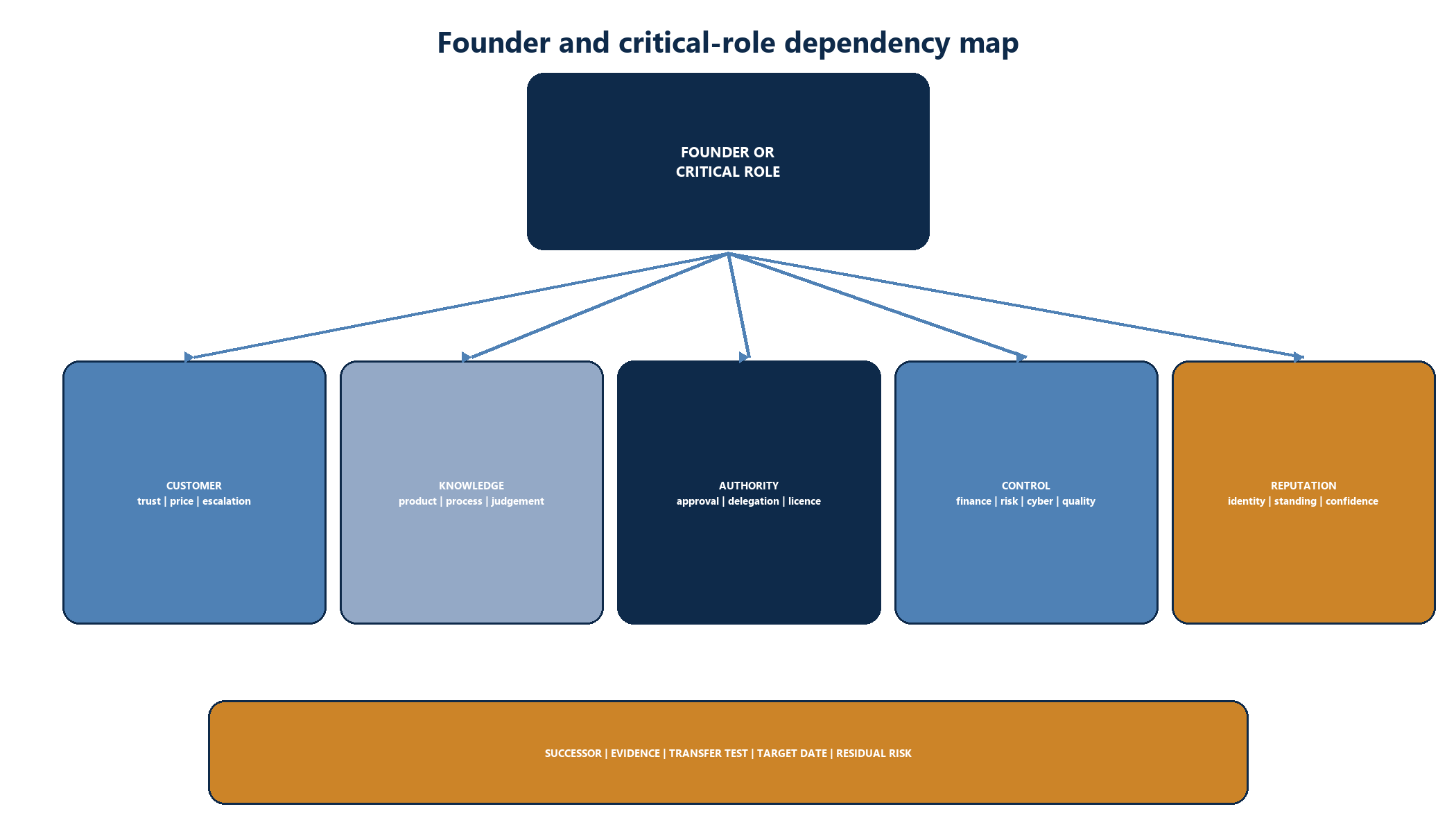
Five value pathways
maps each critical role to one or more value pathways:
- customer, including trust, commercial terms, pipeline and escalation;
- knowledge, including systems, processes, product, market and tacit judgement;
- authority, including approvals, delegations, licence and external signatory status;
- control, including financial, risk, cyber, quality and regulatory operation; and
- reputation, including founder identity, professional standing and stakeholder confidence.
The role can then be assessed for concentration, successor readiness, documentation, transfer time and consequence of disruption. Personal attributes unrelated to the value pathway should not be used.
Diligence without premature disclosure
Named retention discussions before announcement can create confidentiality, fairness and market-sensitivity issues. The buyer can begin with role-coded data and a clean team. Names should be introduced only when necessary and authorised. The data request should distinguish a critical role from a preferred individual. The buyer should also test whether the seller has over-centralised knowledge or used retention status as a proxy for seniority.
| Diligence field | Question | Evidence | Output |
|---|---|---|---|
| value pathway | which investment-case assumption depends on the role? | thesis, customer, process and control evidence | stated dependency |
| concentration | how many people can perform the role? | skills and delegation map | single, limited or distributed |
| successor | who can assume the role and when? | assessment and documented development | readiness date |
| work authorisation | can the person lawfully continue in the intended role? | counsel-confirmed route | status and action |
| retention signal | what evidence shows intention or concern? | authorised interview or documented event | observed fact only |
| transfer | what must move before the role changes? | handover list and test | owner and deadline |
| Diligence field | Question | Evidence | Output |
|---|---|---|---|
| value pathway | which investment-case assumption depends on the role? | thesis, customer, process and control evidence | stated dependency |
| concentration | how many people can perform the role? | skills and delegation map | single, limited or distributed |
| successor | who can assume the role and when? | assessment and documented development | readiness date |
| work authorisation | can the person lawfully continue in the intended role? | counsel-confirmed route | status and action |
| retention signal | what evidence shows intention or concern? | authorised interview or documented event | observed fact only |
| transfer | what must move before the role changes? | handover list and test | owner and deadline |
Founder Dependency
The founder as an operating system
In an owner-led business, the founder may carry several systems at once: commercial approval, customer confidence, supplier negotiation, employee arbitration, recruitment, banking relationships, regulator contact, credit judgement and informal quality control. An organisation chart can show one chief executive role while the practical dependency spans the enterprise. The handover should therefore decompose the founder's contribution into repeatable objects.
Graebner's work on acquired leaders describes value creation roles for target chief executives after acquisition [51]. Larsson and Finkelstein's cross-case analysis connects integration management and organisational combination to acquisition outcomes [49]. Birkinshaw, Bresman and Hakanson distinguish human and task integration and examine how their interaction can foster value creation [52]. These studies support a deliberate transition process. They do not establish that retaining every founder for a long period is always beneficial.
Dependency map
The founder-dependency map should list each pathway, the decisions or relationships carried, frequency, evidence location, secondary owner, required authority, transfer method, test and target date. A dependency score can help sequencing when its components remain visible. One useful internal scale assesses concentration, consequence, documentation, successor readiness and transfer time from 1 to 5. The score is a prioritisation device, not a valuation or prediction.
| Dependency | Current founder contribution | Transfer object | Acceptance test |
|---|---|---|---|
| key customer | trust, history, pricing judgement | joint account plan and introduction | customer recognises new owner and escalation route |
| supplier | negotiated terms and dispute history | contract file and relationship handover | new owner can manage renewal or exception |
| pricing | informal discount authority | approved price and delegation matrix | decisions recorded under new authority |
| people | recruitment and conflict resolution | hiring criteria and employee escalation route | managers use defined process |
| banking | personal relationship and signatory | mandate, covenant and signatory handover | access and approvals tested |
| regulator or licence | named contact or professional standing | contact map, filing calendar and successor | authority and licence record confirmed |
Founder role after closing
The founder's post-closing status should be explicit. An employment role, consultancy, board seat, rollover shareholding, seller obligation and earnout interest can overlap. The documents should reconcile authority, time commitment, reporting line, confidentiality, intellectual property, customer contact, expenses, objectives, termination and dispute routes. The operating team should know which document controls each action.
A founder should not remain the informal final approver after formal authority has moved. That arrangement obscures accountability and can weaken the successor. The transition plan should specify shadowing, joint decision, successor-led decision and founder-available-on-call phases where appropriate.
Founder departure risk
The buyer should test three scenarios: planned transition completed; earlier-than-planned departure; and continued presence with unresolved authority. Each scenario needs a customer plan, internal communication, decision-rights response, knowledge evidence and governance trigger. Insurance, escrow, earnout or covenant mechanisms cannot replace operational transfer.
Critical-Role And Cohort Baseline
Cohort architecture
A useful baseline distinguishes at least six cohorts:
- founder and key executives;
- critical customer, product and knowledge roles;
- regulated, licensed or professional roles;
- employer-linked work-authorisation cohort;
- finance, control, technology and integration roles; and
- broader workforce.
One person may belong to more than one analytical cohort. The dashboard should prevent double counting in total workforce rates while retaining the overlapping risk tags. Each cohort should have a purpose and an approved owner.
Close-date census
The close-date census should reconcile HR information, payroll, employment contracts, permit or authority records, organisation charts and the legal entity perimeter. It should identify accepted offers, notice, leave, secondment, contractors and agency workers separately. Data gaps should be visible. A completed census does not mean the buyer should circulate every field.
The baseline should be digitally preserved with a date, source manifest and access record. Later corrections should be appended rather than silently rewriting the close-date population. A material correction should state the reason and effect on previously reported rates.
Departure taxonomy
The minimum taxonomy is voluntary, involuntary, fixed-term expiry, retirement, death, internal transfer and data correction. "Regretted" and "avoidable" require a documented decision rule. "Visa issue" is too broad for a formal cause field. The record should state the observed administrative or legal event and the source.
| Event field | Allowed treatment | Prohibited shortcut | Reviewer |
|---|---|---|---|
| effective date | official HR and payroll evidence | announcement date used without reconciliation | HR |
| voluntary or involuntary | documented initiating party | assumed from informal comment | HR and counsel where needed |
| work-authorisation event | exact expiry, cancellation, rejection or pending action | generic visa problem | authorised immigration owner |
| reason | employee-provided or documented employer reason | inferred motive | HR |
| criticality | approved role dependency | senior title alone | integration lead |
| regretted | approved criteria and decision record | automatic label | talent committee |
Stage dashboard
The dashboard should show counts and rates for days 0 to 30, 31 to 100 and 101 to 365, plus cumulative values. It should show the denominator and data cut-off on every view. The dashboard should also show critical-role vacancy, successor readiness, permit-action exceptions, knowledge-transfer status and customer-handover status.
Retention Programme Architecture
Define the continuity objective
A retention programme should state the value pathway and required period for each role. "Retain the management team" is insufficient. A customer leader may be required through the first renewal cycle. A technical architect may be needed until the platform is documented and the successor passes a recovery test. A finance controller may be required through first close and audit. The required period can differ by role.
Four-layer proposition
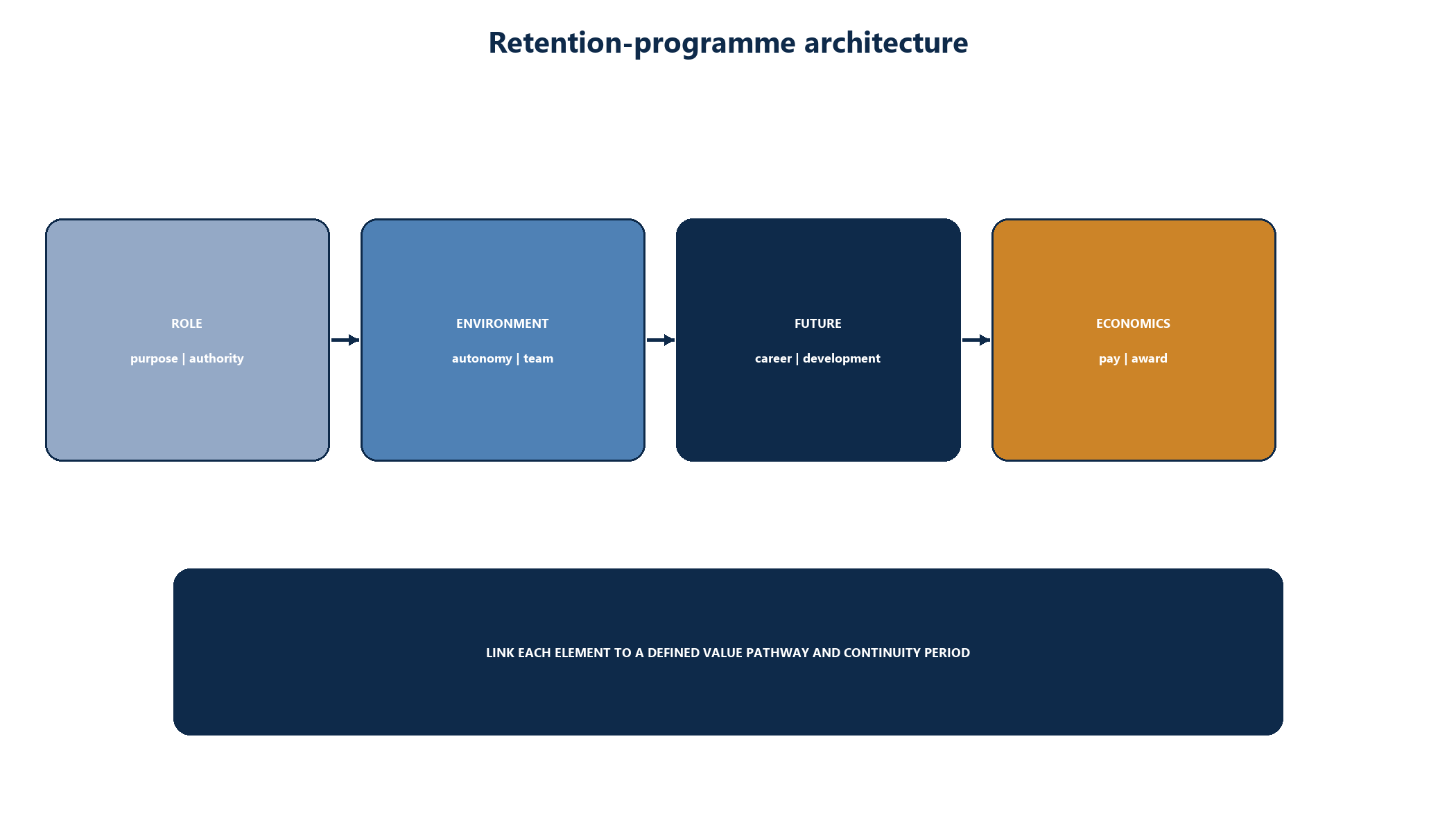
The proposed architecture has four layers:
- role, including purpose, scope, reporting line and decision rights;
- environment, including autonomy, status, team, systems and leadership access;
- future, including career path, development, equity or long-term participation where appropriate; and
- economics, including salary, benefits, retention award, deferred award or other approved compensation.
Ranft and Lord's findings support attention to autonomy, status and organisational commitment alongside financial incentives [47]. Hambrick and Cannella link post-acquisition departure to relative standing and autonomy [43]. The transaction team should test these mechanisms with the actual role and employee rather than treating them as universal preferences.
Selection and fairness
The buyer should document why each role enters the programme, the continuity period, the award logic, the approving authority and the communication boundary. Selection should be based on the value pathway and operational risk. Personal characteristics unrelated to the role should not influence the decision. Employment counsel should review discrimination, wage, benefit and enforceability questions.
Retention term sheet
Each term sheet should identify the employer and employee, role, reporting line, location, work-authorisation dependency, service period, performance conditions if any, payment dates, treatment on termination, change of role, leave, misconduct, transaction failure, tax withholding, confidentiality, governing law and dispute route. It should also identify whether the payment is intended as employee compensation, purchase consideration or another arrangement, subject to accounting, tax and legal review.
Non-cash controls
The programme should include manager availability, role clarity, decision speed, resource commitments, team continuity, systems access, recognition and a credible forum for questions. A signed award can lose force when the operating environment contradicts the stated role.
| Programme element | Required decision | Evidence | Review gate |
|---|---|---|---|
| role | scope, authority and reporting | approved role card | before employee discussion |
| continuity period | value milestone and date | dependency and transfer plan | transaction committee |
| economics | amount, form and payment event | compensation model | finance, tax, accounting and legal |
| treatment on exit | defined good, bad and other leaver events as lawful | term sheet | employment counsel |
| work authorisation | confirmed route and owner | route register | before start or transfer |
| communication | authorised message and question route | communication pack | announcement and offer |
| monitoring | outcome, risk and privacy fields | dashboard specification | monthly talent committee |
Retention Economics And Accounting
Value-at-risk model
The retention model should estimate the investment-case pathway affected by a role, the consequence period, the probability assumption, the mitigation effect assumption and the programme cost. Every assumption should carry an owner, source and sensitivity. The result is an internal decision model. It is not an observed benefit.
The model should avoid multiplying a person's salary by a generic replacement-cost percentage and presenting the result as deal value. A role may affect customer revenue, delivery capacity, product delay, control failure or transition cost. Those pathways need separate logic and should not be added when they overlap.
Scenario economics
Illustrative example A buyer identifies a customer director, platform architect and finance controller as three separate value pathways. The model records a plausible interruption range for each pathway, the time to restore continuity, the overlap between customer and platform effects, and the proposed programme cost. The investment committee receives downside, base and upside assumptions with no probability-weighted amount represented as fact. Attributed Matchpoint or client revenue, saving, loss reduction and alpha remain USD 0.
IFRS classification questions
IFRS 3 governs business combinations and distinguishes consideration transferred from separate transactions [38]. IFRS guidance on payments contingent on continued employment during a handover period states that such payments are usually compensation for post-combination services unless the service condition is not substantive [39]. The exact classification depends on the arrangement and facts. IAS 19 addresses employee benefits [40]. IAS 37 governs provisions and sets conditions for recognising restructuring provisions, including a detailed formal plan and valid expectation [41].
The retention schedule should therefore identify who receives the payment, whether the recipient was a selling shareholder, whether payment depends on continued employment, the service period, the link to remuneration, forfeiture conditions, formula, settlement form and transaction rationale. Accounting, audit, tax and legal advisers should document their conclusions before financial reporting and employee communication.
Cost governance
The programme budget should distinguish salary and benefit changes, cash retention awards, share-based or equity-linked awards, employer taxes, permit and transfer costs, professional fees, replacement cost, duplicated roles and integration support. Finance should reconcile approved awards to contracts, payroll, accruals, payments and forfeitures.
| Economics field | Required control | Evidence boundary |
|---|---|---|
| value pathway | link to investment-case assumption | management estimate until observed |
| disruption probability | source and range | unverified model assumption unless supported |
| mitigation effect | mechanism and sensitivity | unverified model assumption unless observed |
| programme cost | approved gross employer cost | forecast until incurred |
| accounting class | written technical conclusion | entity and fact specific |
| tax treatment | jurisdictional advice | person and arrangement specific |
| realised outcome | approved observed evidence | no attributed value before approval |
Communication And Employee Voice
Communication as an operating control
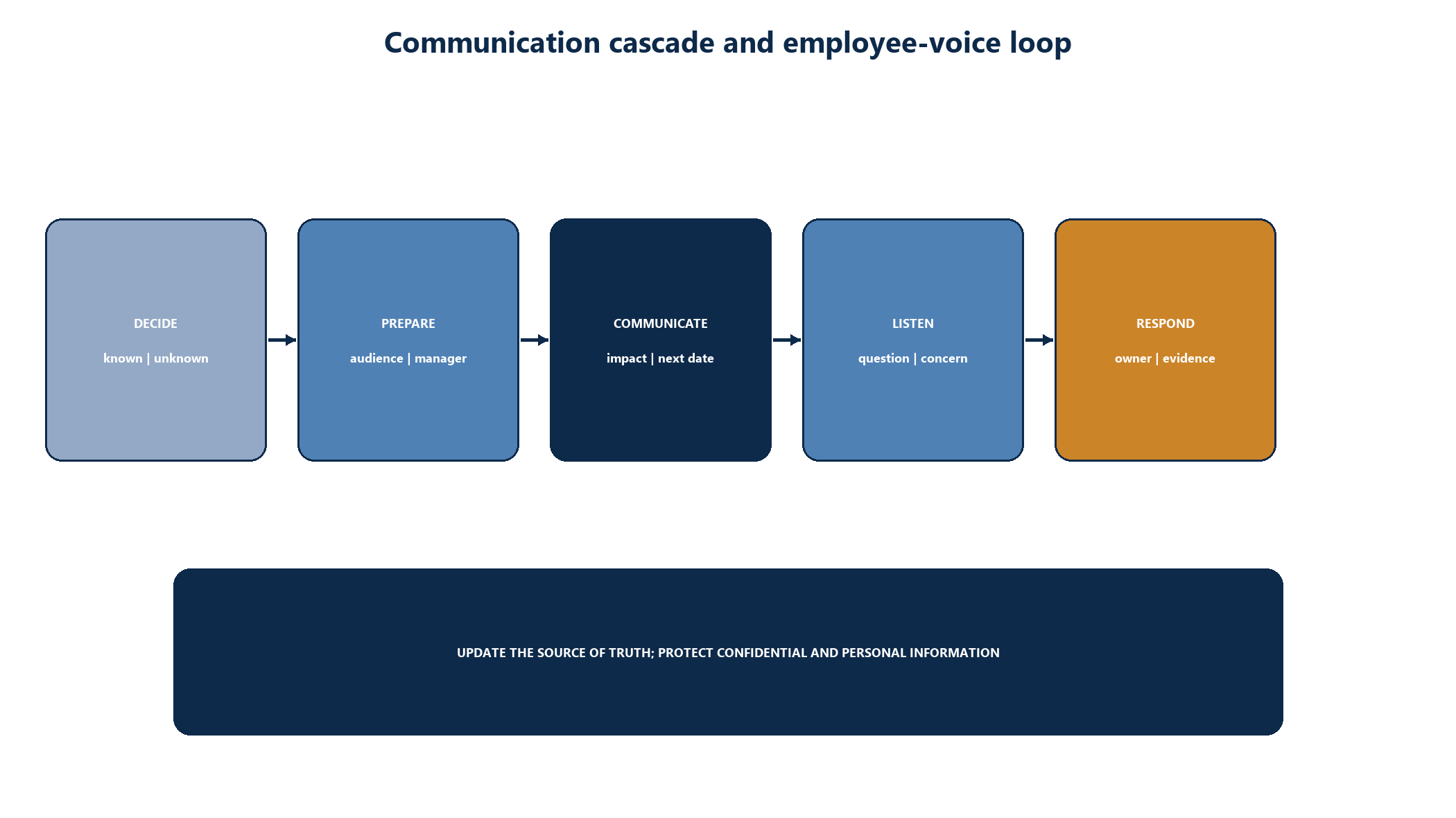
Employees interpret a transaction through changes to manager access, job scope, authority, systems, benefits and team behaviour. A one-time announcement cannot carry the full integration. Communication should operate as a recurring control with a source of truth, named owner, update date and feedback loop.
Research links communication approaches, identity and justice perceptions to employee responses during combinations [55-60]. The studies use different contexts and measures. They support careful attention to process, status, explanation and voice. They do not provide a universal communication formula.
Known, unknown and decision date
Every communication should distinguish:
- what is decided;
- what remains under review;
- who decides;
- when the next update is due;
- what the employee needs to do; and
- where an individual concern can be raised.
The message should avoid promising unchanged employment, benefits, location or reporting arrangements unless the relevant decision and legal review support that statement. The organisation should update employees when a stated decision date changes.
Cascade design
The sequence should identify regulatory constraints, seller and buyer leadership, people managers, critical-role conversations, the wider workforce, customers and external stakeholders. Managers need a question pack and escalation route before they brief teams. The organisation should record recurring questions and use them to improve later updates.
Employee voice and grievance
Employees need a confidential route for individual contract, pay, permit, conduct, discrimination, health or safety concerns. The transaction should not convert every concern into a retention-risk score. HR should separate operational questions, grievances, whistleblowing, legal claims and wellbeing support, with appropriate confidentiality and escalation.
| Message field | Required content | Owner | Evidence |
|---|---|---|---|
| audience | named group and jurisdiction | communications lead | approved matrix |
| known | verified decision | decision owner | source record |
| unknown | specific open question | decision owner | issue log |
| next date | committed update date | communications lead | publication schedule |
| employee action | required document, meeting or no action | HR | instruction and acknowledgement where needed |
| feedback | channel and response owner | HR | question log and closure |
Organisation Design And Decision Rights
Integration degree follows the value thesis
The buyer should decide which capabilities require preservation, which require combination, and which require replacement. Puranam, Singh and Zollo examine the relationship between integration and acquired technological capability [50]. Birkinshaw and colleagues distinguish human and task integration [52]. Larsson and Finkelstein show that organisational combination and integration management need to be considered together [49]. The practical implication is a documented integration thesis rather than a default instruction to centralise or preserve.
Role cards
Every critical post-close role should have a short role card stating purpose, decisions, financial authority, people authority, customer authority, systems access, information rights, escalation, interfaces and success measures. The card should identify temporary arrangements and the date for review. It should reconcile to employment terms and the formal delegation matrix.
Decision-rights transfer
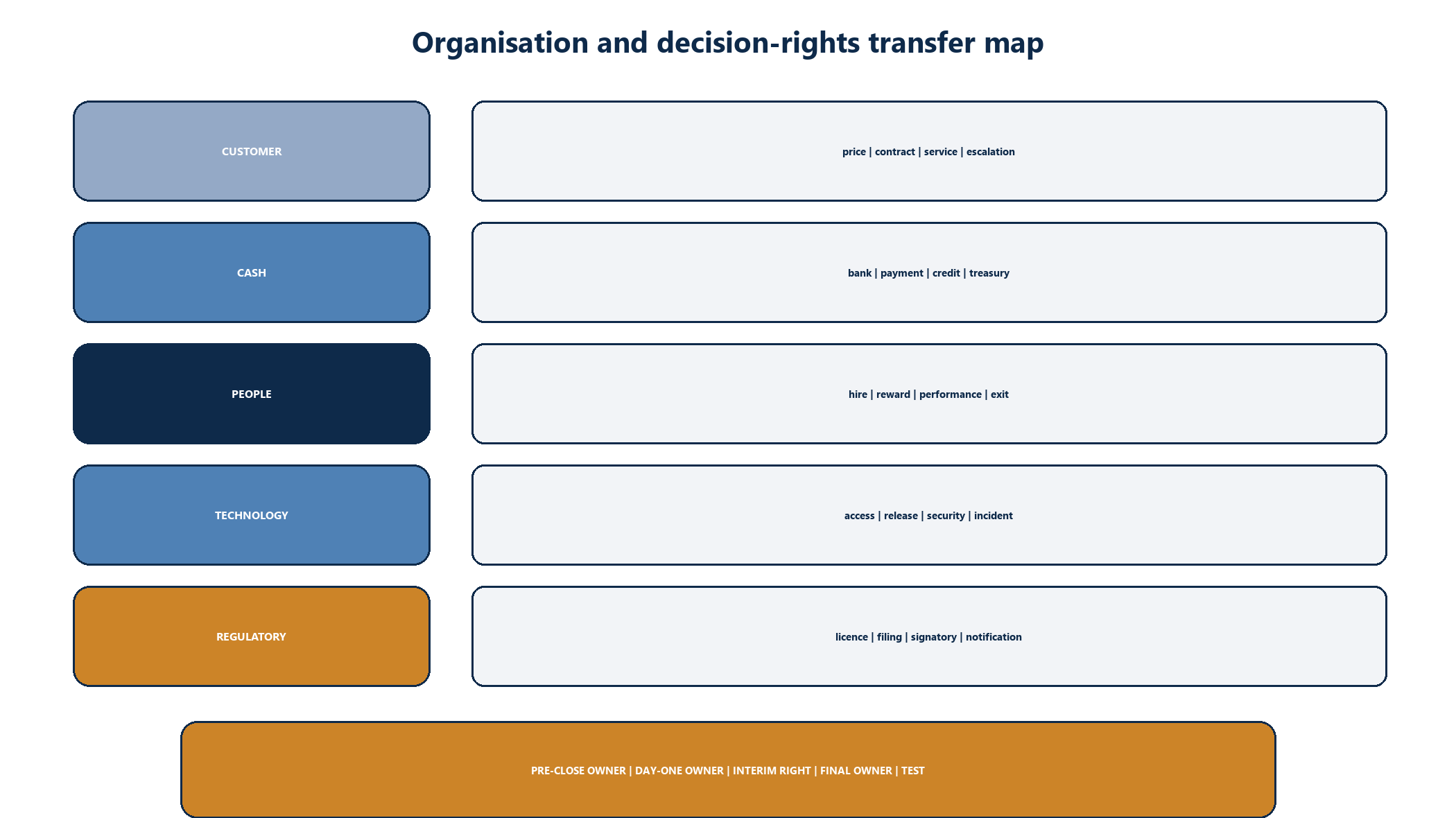
The founder or seller team can retain informal influence after legal authority moves. The 100-day plan should transfer decisions explicitly. A decision register can show the pre-close owner, Day-One owner, interim consultation right, final owner, evidence and effective date. The organisation should test bank, payment, pricing, hiring, contracting, access, cyber and regulatory decisions before the first live need.
Autonomy and status
Acquired leaders may interpret reporting-line, title, budget and access changes as reductions in status or autonomy [43,47,48]. Some changes may be required for control or integration. The buyer should state the business reason, decision scope, duration and review date. A retention offer that preserves pay while removing meaningful authority can fail to address the relevant mechanism.
| Decision family | Pre-close owner | Day-One owner | Control evidence | Test |
|---|---|---|---|---|
| customer pricing | documented current approver | named buyer or target role | delegation matrix | sample approval completed |
| cash and banking | authorised signatories | approved signatories | bank mandate and limits | access and dual approval tested |
| hiring and termination | founder or functional lead | named manager and HR | policy and authority | case walkthrough |
| technology release | technical lead | product and technology roles | access and change control | controlled release or simulation |
| regulatory filing | named licence holder or officer | confirmed successor | authority record and calendar | deadline and submission test |
| critical incident | informal escalation | defined incident team | playbook and contacts | tabletop exercise |
Cultural Integration
Culture as observable practice
Culture should be analysed through decisions and routines: how issues are escalated, how customers are prioritised, how people challenge senior leaders, how performance is reviewed, how risk is accepted and how recognition is allocated. Generic labels such as "entrepreneurial" or "institutional" conceal the operating mechanism.
Identity research shows that perceived continuity, status and justice can influence employee responses to mergers [55-60]. Kroon and Noorderhaven examine social identification during post-merger integration [53]. Steigenberger and Mirc examine how integration processes shape identification [54]. Giessner studies identity-management strategies [55]. These sources support explicit attention to how the combined organisation explains belonging, status and continuity. They do not establish that one identity strategy fits every transaction.
Cultural due diligence
Interviews and observations should focus on examples. The team can ask how a failed customer delivery was handled, who can stop a transaction, how an employee challenges a founder, how hiring decisions are made, how information moves and how performance is recognised. The output should state observed practices, not personality judgements or national stereotypes.
Integration choices
For each practice, the buyer can preserve, adopt, combine, replace or pilot. The choice needs an owner, rationale, affected groups, communication and review date. Some practices are constrained by law, regulation, group policy or control standards. The organisation should state those constraints.
Leader behaviour
Employees will evaluate the integration through leader actions. Decision delays, unexplained access removal, inconsistent messages and visible status differences can undermine the formal proposition. Leaders should follow the decision and communication controls established for the programme.
| Practice | Evidence before close | Integration choice | Review measure |
|---|---|---|---|
| customer escalation | observed case and authority path | preserve then formalise | response time and customer acceptance |
| risk challenge | committee records and interviews | adopt stronger route | issue escalation and closure |
| performance review | forms, calibration and examples | pilot combined approach | completion and employee feedback |
| recognition | award and promotion evidence | define transparent criteria | distribution and documented rationale |
| information flow | meeting and reporting pattern | combine with group governance | decision latency and rework |
Customer And Knowledge Continuity
Customer continuity
The customer handover should identify relationship owner, contractual contact, commercial decision maker, delivery owner and escalation owner. A founder introduction is one event. Continuity requires the customer to accept and use the new relationship path. The account plan should record concerns, commitments, renewal dates, service risks and the next interaction.
The transaction should avoid disclosing confidential deal or employee information beyond the authorised communication. Where customer consent, notification or assignment is required, transaction counsel should connect the contractual action to the workforce and relationship plan.
Knowledge objects
"Knowledge transfer" should be converted into specified objects. Examples include product architecture, deployment procedure, incident history, pricing exceptions, key contract interpretation, supplier workaround, regulator correspondence, forecast logic and month-end control. Each object needs an owner, recipient, format, deadline and acceptance test.
Paruchuri and colleagues identify the organisational position of inventors as relevant to post-acquisition productivity [48]. Ranft and Lord focus on critical human capital in technology acquisitions [47]. These findings support protecting the context in which expertise is exercised, including access, team links and decision authority.
Transfer methods
Possible methods include paired work, recorded walkthrough, documented playbook, customer meeting, simulation, shadow close, incident tabletop, controlled release and reverse presentation by the recipient. A document upload alone does not demonstrate usable knowledge. The acceptance test should reflect the consequence of failure.
Access and security
The buyer should balance continuity with least-privilege access. Day-One access decisions should cover identity, privileged accounts, source code, cloud platforms, customer systems, finance, banking and physical facilities. Access removal should be linked to a lawful, documented employment or security action. Retaining an employee while removing access needed for the role creates an operating contradiction.
| Continuity object | Transfer method | Acceptance evidence | Escalation |
|---|---|---|---|
| top customer account | joint meeting and account plan | customer accepts named owner and next step | customer concern or silence after defined follow-up |
| product architecture | walkthrough and reverse presentation | successor explains dependencies and recovery | unresolved single-person dependency |
| month-end close | shadow close then owner-led close | reconciled timetable and review sign-off | control failure or late close |
| regulatory calendar | file review and deadline simulation | successor produces complete calendar | missing licence or filing evidence |
| cyber incident | tabletop exercise | roles, access and escalation function | material gap or unavailable owner |
| supplier exception | case walkthrough | successor can apply approved rule | undocumented commitment |
Day One And First-30-Day Controls
Day-One readiness
Day One should be tested as an operating event. The organisation needs legal-employer clarity, lawful work status, payroll and benefits continuity, manager and reporting-line clarity, decision authority, systems access, customer coverage, incident escalation and an employee question route. Open items should have a lawful interim control.
Cutover command centre
The command centre should maintain one exception log. Each issue should record severity, affected person or process, legal or operational constraint, owner, next action, deadline and evidence. Personal details should be restricted. The command centre should distinguish a delayed administrative update from an inability to work lawfully or operate a critical control.
First ten days
The first ten days should validate payroll instructions, benefits, access, delegations, customer communication, critical-role conversations and permit actions. Leaders should hold structured listening sessions and publish answers to recurring questions where appropriate. Decisions should be added to the source of truth.
Days eleven to thirty
The organisation should complete the first stage cohort report, test knowledge and customer transfers, review critical-role risk, resolve interim decision rights and reconcile approved retention arrangements to signed documents and payroll. It should also identify integration choices that require more evidence.
| Day-One control | Green evidence | Amber condition | Red condition |
|---|---|---|---|
| lawful work status | counsel-confirmed route and valid record | administrative action pending with lawful interim position | person cannot lawfully perform intended work |
| payroll | reconciled employee and bank data | controlled timing exception | missed, duplicate or unauthorised payment risk |
| manager | employee informed of named manager | temporary manager with review date | conflicting or absent authority |
| systems | role-based access tested | non-critical access pending | critical access absent or excessive privilege |
| customer coverage | owner and escalation accepted | introduction scheduled | critical account without coverage |
| critical knowledge | transfer owner and test scheduled | dependency documented | dependency unknown or owner unavailable |
| employee voice | active confidential channel | response backlog within stated time | concern lacks owner or safe route |
100-Day Integration Plan
Phase architecture
The 100-day plan begins before close. It should use six phases:
- Day -30 to close: confirm population, routes, roles, communications, access and contingencies;
- Day 1: activate lawful operating controls and source-of-truth communications;
- Days 2 to 10: validate employees, systems, customers, payments and authority;
- Days 11 to 30: produce the first cohort and continuity report;
- Days 31 to 60: execute organisation, knowledge, customer and cultural integration choices; and
- Days 61 to 100: test institutional ownership, remove resolved interim controls and approve the next-stage plan.
Workstreams
The plan should integrate people and organisation, employment and work authorisation, customer continuity, knowledge and technology, finance and controls, communication, data protection and governance. Each workstream should use the same legal-close date, entity perimeter and critical-role register.
Gates
Three formal gates are useful. The close-readiness gate asks whether the business can operate lawfully and safely on Day One. The Day-30 gate asks whether the baseline, departures, exceptions and dependencies are correctly understood. The Day-100 gate asks whether value-carrying roles and controls have moved into a sustainable operating model.
Evidence and decision log
The plan should distinguish an action from its evidence. "Communicate reporting lines" is an action. The approved organisation chart, employee communication and acknowledgement where required are evidence. "Transfer customer relationships" is an action. The joint meeting record, updated account plan and customer acceptance are evidence.
| Phase | Principal decisions | Minimum evidence | Gate owner |
|---|---|---|---|
| Day -30 to close | route, role, access, message and fallback | signed readiness pack | transaction and integration leads |
| Day 1 | legal-employer, manager, authority and incident route | command-centre checklist | integration executive |
| Days 2-10 | exceptions and employee questions | daily log and closure evidence | workstream leads |
| Days 11-30 | cohort and dependency response | Day-30 continuity report | talent committee |
| Days 31-60 | operating-model and transfer choices | approved role cards and transfer tests | executive committee |
| Days 61-100 | sustainable ownership and residual risk | Day-100 memorandum | buyer governance body |
Illustrative example Visa-Tied Gcc Workforce
Scenario boundary
Illustrative example An buyer agrees to acquire a owner-led services and technology group with operating entities in the UAE and Saudi Arabia and smaller customer-facing teams in Bahrain and Qatar. The legal transaction form, employee population, amounts, timing, customer dependencies, risk scores and outcomes in this section are invented to demonstrate the framework. They are not observed Matchpoint or client facts.
Diligence findings
Illustrative example The target reports 186 active employees at the proposed close date. Reconciliation identifies 179 active employees, four accepted offers, two people serving notice and one contractor previously included as an employee. The fixed close-date denominator is therefore 179, subject to final close-date confirmation. Sixty-eight employees have employer-linked work-authorisation actions or confirmations in the four operating states.
Illustrative example The buyer identifies twelve critical roles. The founder carries seven customer relationships, pricing exceptions, two bank mandates and the principal regulator relationship. A platform architect controls production deployment and holds undocumented recovery knowledge. A finance controller carries the month-end close and payroll approval. Three customer directors manage 61 percent of the pipeline reported in the target's unverified management forecast.
Route design
Illustrative example Transaction counsel concludes that the UAE operating entity remains the legal employer under the proposed share acquisition, subject to current employment, establishment, permit and free-zone review. The Saudi team requires person-level confirmation of Qiwa, work-licence and occupation records. Bahrain and Qatar teams require current local employer-change analysis because the buyer plans to move activity into existing group entities. These are fictional adviser conclusions for the scenario and are not legal advice.
Illustrative example The integration team creates a person-level route register. Each route has a legal owner, HR owner, employee step, authority step, fee owner, target date and fallback. The register excludes passport copies from the general command-centre view and links authorised reviewers to a restricted repository.
Retention design
Illustrative example The buyer does not offer the same award to all twelve roles. The founder receives a defined transition role with customer, pricing, banking and regulator handover milestones. The platform architect receives a role card preserving technical authority within approved security controls, a successor-development commitment and a time-based cash award. The finance controller receives role clarity through first audit, additional team support and a time-based award. Customer directors receive account ownership, pricing authority within defined limits and awards linked to continued service rather than customer outcomes they cannot fully control.
100-day execution
Illustrative example Day One confirms employing entities, managers, payroll, benefits, access and employee-question channels. Days 2 to 10 complete critical customer introductions and test banking and incident authority. By Day 30, the buyer records one voluntary departure from the broader workforce and no departure from the twelve-role critical cohort. This is an invented event and provides no benchmark or evidence of programme effectiveness.
Illustrative example By Day 60, the platform recovery procedure passes a reverse-presentation and tabletop test. By Day 100, five of seven founder-held customer relationships have an accepted successor; two remain under joint coverage. The buyer retains those two dependencies in the next-stage risk register. The scenario illustrates honest residual-risk reporting.
Economics and outcome boundary
Illustrative example The programme model contains invented award cost and value-at-risk ranges. It is used only for sensitivity and approval. No modelled amount is reported as revenue protected, cash saved, loss reduced or alpha created. Approved observed Matchpoint or client benefit for remains USD 0.
| Scenario control | Day-One state | Day-100 state | Evidence boundary |
|---|---|---|---|
| workforce denominator | 179 fictional active employees | unchanged close-date denominator | invented scenario |
| critical roles | 12 fictional roles | 12 staffed | invented scenario, no causal claim |
| work-authorisation routes | 68 fictional confirmations or actions | exceptions resolved in fictional register | no legal conclusion for a real worker |
| founder customer dependencies | 7 fictional relationships | 5 transferred, 2 joint | invented scenario |
| knowledge transfer | recovery dependency open | fictional test passed | no observed client evidence |
| attributed benefit | USD 0 | USD 0 | no approved observed evidence |
Measurement, Governance And Escalation
Governance bodies
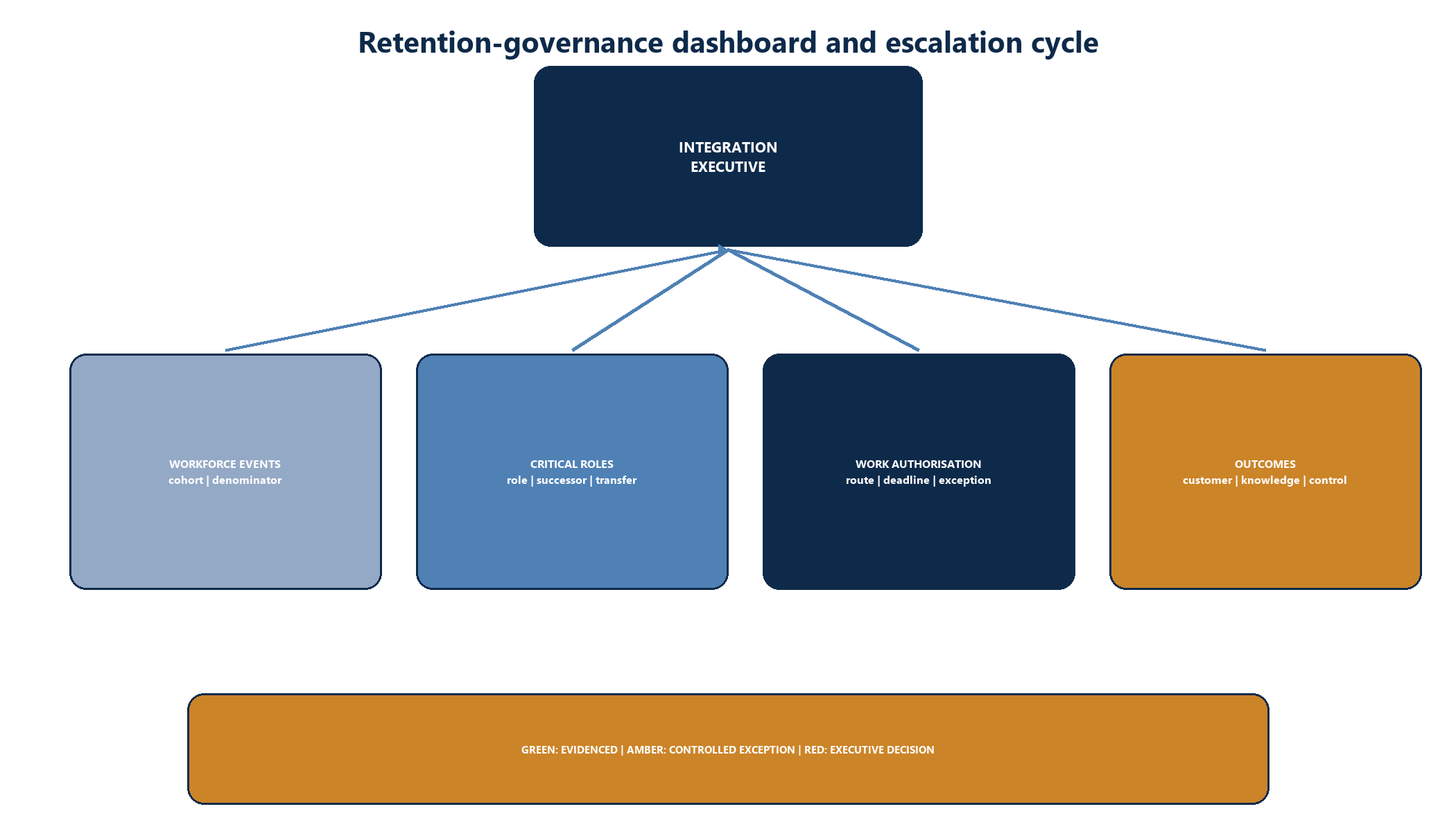
The integration executive owns overall continuity. A talent and organisation committee should decide critical-role status, retention arrangements, succession and organisation design. Employment and immigration counsel should own legal conclusions. Finance should control award budget, accounting and payroll. Data-protection owners should control employee-data access and transfer. Workstream owners should provide evidence, not self-certified completion labels.
Dashboard
The dashboard should have four layers: workforce events, critical-role continuity, work-authorisation actions, and transfer outcomes. Each chart should state source, cut-off date, denominator and unresolved data quality. Restricted personal data should remain outside broad governance views.
Escalation rules
Examples of red escalation include inability to work lawfully, critical payroll failure, loss of a required signatory, uncovered customer dependency, unavailable incident authority, unapproved employee-data disclosure and a critical-role resignation. Amber escalation includes a pending administrative route with a confirmed lawful interim position, delayed customer acceptance or incomplete transfer evidence. The committee should define these rules before the first report.
Decision memorandum
At Day 30 and Day 100, management should produce a concise decision memorandum. It should state the observed workforce events, critical dependencies, route exceptions, programme cost, accounting status, employee themes, unresolved risks, decisions requested and evidence links. It should distinguish facts from management estimates and scenario assumptions.
| Governance metric | Owner | Frequency | Escalation condition |
|---|---|---|---|
| cohort departures | HR data owner | weekly to Day 30, monthly thereafter | critical-role event or data mismatch |
| critical-role status | talent committee | weekly to Day 30, fortnightly to Day 100 | vacancy, authority gap or failed transfer |
| permit and employer-change actions | authorised HR and counsel | daily around close, weekly thereafter | lawful-work risk or missed deadline |
| customer handover | commercial lead | weekly | critical account lacks accepted owner |
| knowledge transfer | functional lead | fortnightly | failed test or unavailable holder |
| award cost and classification | finance | monthly | unauthorised term, payment or accounting gap |
| employee questions and grievances | HR | weekly aggregated view | safety, retaliation, legal or conduct concern |
| Decision family | Pre-close owner | Day-One owner | Control evidence | Test |
|---|---|---|---|---|
| customer pricing | documented current approver | named buyer or target role | delegation matrix | sample approval completed |
| cash and banking | authorised signatories | approved signatories | bank mandate and limits | access and dual approval tested |
| hiring and termination | founder or functional lead | named manager and HR | policy and authority | case walkthrough |
| technology release | technical lead | product and technology roles | access and change control | controlled release or simulation |
| regulatory filing | named licence holder or officer | confirmed successor | authority record and calendar | deadline and submission test |
| critical incident | informal escalation | defined incident team | playbook and contacts | tabletop exercise |
Limitations And Conclusion
The paper has five principal limitations. First, official service pages and laws can change after the 2 August 2026 source cut-off. Current transaction-specific advice is required. Second, GCC employment, immigration, data-protection, free-zone and sector regimes differ; the six-state matrix is a routing aid. Third, the academic evidence uses different countries, periods, populations and measures. It supports mechanisms and control questions, not a universal GCC turnover rate. Fourth, the quality of a workforce-continuity plan depends on accurate employee, role, permit, customer and authority data. Fifth, the illustrative scenario contains no observed outcome evidence.
The approximately 47 percent estimate is traceable to a practitioner estimate for senior managers under a stated no-coordinated-retention condition [46]. It should not be presented as a universal employee or GCC rate. A defensible baseline fixes the transaction population at close, separates cohorts and event types, and states every denominator and period.
The central implementation conclusion is that workforce continuity belongs inside transaction design. The buyer should connect legal employer, work authorisation, critical roles, founder handover, retention terms, organisation authority, communication, data control and the first 100 days through one register and one governance cycle. A cash award is one instrument. Role clarity, autonomy, status, team, leadership, future path, lawful work status and credible communication also shape continuity.
The result is a decision system rather than a promise that everyone will stay. It shows which capabilities matter, what must be transferred, what can be measured, where the legal route is unresolved and who decides. Approved observed Matchpoint or client revenue, cash cost reduction, loss reduction and alpha for remain USD 0.
Appendix A. Workforce-Continuity Intake
| Field | Required content | Source | Reviewer |
|---|---|---|---|
| transaction form | share, asset, merger or other structure | transaction documents | transaction counsel |
| entity before and after | legal employer and ownership path | entity chart | corporate and employment counsel |
| population | fixed close-date census | HR, payroll and contracts | HR data owner |
| jurisdiction and work location | actual and contractual location | HR and manager evidence | employment counsel |
| work authorisation | permit, sponsor or authority record | official record | authorised immigration owner |
| critical role | value pathway and consequence | investment thesis and operating evidence | integration lead |
| founder dependency | customer, knowledge, authority, control and reputation | interviews and documents | buyer sponsor |
| employment terms | contract, benefits and approved changes | signed records | HR and employment counsel |
| employee data | purpose, access, transfer and retention | data map | data-protection owner |
| Day-One action | owner, deadline, evidence and fallback | readiness plan | integration executive |
Appendix B. Critical-Role Dependency Map
| Role | Value pathway | Concentration | Successor | Transfer object | Work-authorisation dependency | Day-100 target |
|---|---|---|---|---|---|---|
| role code | customer, knowledge, authority, control or reputation | 1-5 with definition | name or role and readiness date | specified evidence and test | counsel-confirmed status | measurable continuity condition |
The full register should include evidence source, data owner, restricted fields, review date and decision history. A score should never replace the underlying facts.
Appendix C. Retention-Offer Term Sheet
| Term | Required definition |
|---|---|
| employing entity | legal employer responsible for the arrangement |
| employee and role | person, position, location, reporting and authority |
| programme purpose | value pathway and continuity period |
| service period | start, end and treatment of transaction delay |
| award | amount, form, currency and approval |
| payment | date, conditions, payroll and withholding |
| termination | voluntary, employer-initiated, misconduct, disability, death and other lawful events |
| role change | treatment of reporting, scope, location or authority change |
| leave | treatment under applicable law and approved plan |
| transaction failure | lapse, continuation or alternative treatment |
| confidentiality | lawful and proportionate obligations |
| accounting and tax | review owner and documented conclusion |
| governing law and dispute | entity and person-specific route |
Appendix D. Employer-Change And Permit Register
| Field | Entry standard |
|---|---|
| person or cohort | restricted identifier and approved grouping |
| state and regime | country, mainland, free zone or other authority |
| employer before and after | exact legal entities |
| contract status | current, variation, new offer, transfer or other advised route |
| permit or sponsor record | current official status in restricted system |
| employee step | information, consent, notice or signature as advised |
| employer step | submission, cancellation, fee or evidence as advised |
| authority step | service, decision and updated record |
| deadline | legal, administrative and operational dates separated |
| owner and adviser | authorised operational owner and qualified reviewer |
| fallback | lawful interim response and activation trigger |
| evidence | official receipt, approval or updated record |
Appendix E. 100-Day Integration Plan
| Workstream | Day -30 to close | Day 1 | Days 2-10 | Days 11-30 | Days 31-60 | Days 61-100 |
|---|---|---|---|---|---|---|
| employment and permits | confirm routes and exceptions | activate lawful controls | complete urgent actions | reconcile stage-one status | close residual actions | audit evidence |
| organisation | approve interim role cards | communicate managers and authority | test decisions | resolve conflicts | implement target choices | confirm sustainable ownership |
| retention | approve role-based terms | deliver authorised messages | record questions and acceptances | reconcile contracts and payroll | monitor continuity | approve next-stage plan |
| customers | prioritise accounts and messages | activate coverage | complete introductions | record acceptance and risk | move remaining dependencies | confirm account ownership |
| knowledge and technology | specify transfer objects | protect access and incident response | start transfer tests | report failures | complete critical tests | close or carry residual risk |
| communication | prepare known and unknown matrix | publish source of truth | answer recurring questions | Day-30 update | explain organisation choices | Day-100 update |
| data protection | approve purpose and access | monitor transfers | close excess access | audit restricted fields | update retention periods | complete review |
| governance | approve readiness | command centre | daily exceptions | Day-30 memorandum | integration decisions | Day-100 memorandum |
| Governance metric | Owner | Frequency | Escalation condition |
|---|---|---|---|
| cohort departures | HR data owner | weekly to Day 30, monthly thereafter | critical-role event or data mismatch |
| critical-role status | talent committee | weekly to Day 30, fortnightly to Day 100 | vacancy, authority gap or failed transfer |
| permit and employer-change actions | authorised HR and counsel | daily around close, weekly thereafter | lawful-work risk or missed deadline |
| customer handover | commercial lead | weekly | critical account lacks accepted owner |
| knowledge transfer | functional lead | fortnightly | failed test or unavailable holder |
| award cost and classification | finance | monthly | unauthorised term, payment or accounting gap |
| employee questions and grievances | HR | weekly aggregated view | safety, retaliation, legal or conduct concern |
Appendix F. Transaction And Pmi Decision Memorandum
The memorandum should contain:
- transaction perimeter and legal-close date;
- workforce denominator and data-quality statement;
- legal-employer and work-authorisation route summary by state;
- critical roles and founder dependencies;
- approved retention architecture and cost;
- organisation and decision-rights status;
- customer and knowledge-transfer outcomes;
- stage-cohort departures with definitions;
- employee communication, voice and grievance themes in an appropriately aggregated form;
- accounting, tax, legal and data-protection conclusions or open items;
- residual risks, decision requests, owners and dates; and
- source manifest and evidence links.
References
[1] United Arab Emirates Government. Federal Decree-Law No. 33 of 2021 Regarding the Regulation of Employment Relationships. UAE Legislation. https://uaelegislation.gov.ae/en/legislations/1541
[2] United Arab Emirates Government. Cabinet Resolution No. 1 of 2022 on the Implementation of Federal Decree-Law No. 33 of 2021. UAE Legislation. https://uaelegislation.gov.ae/en/legislations/1547
[3] Ministry of Human Resources and Emiratisation. Transfer Work Permit. https://www.mohre.gov.ae/en/services/transfer-work-permit-2022
[4] UAE Government. Employment Contracts: Duration and Models in the Private Sector. https://u.ae/en/information-and-services/jobs/employment-in-the-private-sector/job-offers-and-work-permits-and-contracts/employment-contracts-duration-and-models-in-the-private-sector
[5] Dubai International Financial Centre. Employment Law, DIFC Law No. 2 of 2019. https://www.difc.com/business/laws-and-regulations/legal-database/enactment-notices/employment-law-difc-law-no-2-2019
[6] Abu Dhabi Global Market. ADGM Publishes New Employment Regulations. 2024. https://www.adgm.com/media/announcements/adgm-publishes-new-employment-regulations
[7] Abu Dhabi Global Market Employment Affairs Office. Guidance: Employment Regulations 2024. 2025. https://assets.adgm.com/download/assets/ADGM%2BEAO%2B-%2BGuidance%2B-%2BER%2B2024%2B%28Feb%2B2025%29.pdf/ee708fc8edbe11efbfef7630b32848cb
[8] United Arab Emirates Government. Federal Decree-Law No. 45 of 2021 Regarding the Protection of Personal Data. UAE Legislation. https://uaelegislation.gov.ae/en/legislations/1972
[9] Dubai International Financial Centre. Data Protection Law, DIFC Law No. 5 of 2020. https://www.difc.com/business/laws-and-regulations/legal-database/difc-laws/data-protection-law-difc-law-no-5-2020
[10] Dubai International Financial Centre Commissioner of Data Protection. Guidance. https://www.difc.com/business/registrars-and-commissioners/commissioner-of-data-protection/guidance
[11] Abu Dhabi Global Market. ADGM Enacts New Data Protection Regulations 2021. https://www.adgm.com/media/announcements/adgm-enacts-its-new-data-protection-regulations-2021
[12] Abu Dhabi Global Market Office of Data Protection. Guidance. https://www.adgm.com/operating-in-adgm/office-of-data-protection/guidance
[13] Ministry of Human Resources and Social Development, Kingdom of Saudi Arabia. Labor Law. https://www.hrsd.gov.sa/sites/default/files/2023-02/Labor.pdf
[14] Ministry of Human Resources and Social Development, Kingdom of Saudi Arabia. Amendments to Labor Law Articles. 2025. https://www.hrsd.gov.sa/sites/default/files/2025-03/Amendments%20to%20Labor%20Law%20Articles_0.pdf
[15] Ministry of Human Resources and Social Development, Kingdom of Saudi Arabia. Implementing Regulations of Labor Law and Annexes. https://www.hrsd.gov.sa/sites/default/files/2023-02/The%20Implementing%20Regulations%20of%20Labor%20Law%20and%20its%20Annexes.pdf
[16] Ministry of Human Resources and Social Development, Kingdom of Saudi Arabia. Labor Reform Initiative. https://www.hrsd.gov.sa/bn/node/770957
[17] Ministry of Human Resources and Social Development, Kingdom of Saudi Arabia. Request for Transfer of Expatriate Workers. https://www.hrsd.gov.sa/id/node/5557115
[18] Ministry of Human Resources and Social Development, Kingdom of Saudi Arabia. Work Licenses. https://www.hrsd.gov.sa/en/knowledge-centre/articles/64432
[19] Ministry of Human Resources and Social Development, Kingdom of Saudi Arabia. Employer Cost Obligations. https://www.hrsd.gov.sa/en/knowledge-centre/articles/64434-0
[20] Ministry of Human Resources and Social Development, Kingdom of Saudi Arabia. Employment of Non-Saudis. https://www.hrsd.gov.sa/en/%D8%AA%D9%88%D8%%D9%8A%D9%81-%D8%BA%D9%8A%D8%-%D8%%D9%84%D8%%D8%%D9%88%D8%AF%D9%8A%D9%8A%D9%86
[21] Labour Market Regulatory Authority, Kingdom of Bahrain. Expatriate Employee Guide. https://www.lmra.gov.bh/files/cms/shared/employee-guide/lmra-expatriate-guide-english.pdf
[22] Labour Market Regulatory Authority, Kingdom of Bahrain. Intention to Transfer Form. https://www.lmra.gov.bh/files/cms/downloads/english_attachment/intention-to-transfer-form.pdf
[23] Labour Market Regulatory Authority, Kingdom of Bahrain. Transfer of Expatriate Employee Services. https://www.lmra.gov.bh/ar/page/show/169
[24] Labour Market Regulatory Authority, Kingdom of Bahrain. Calls on Expatriate Workers to Verify Legal Status. 2022. https://blog.lmra.gov.bh/en/2022/10/12/labour-market-regulatory-authority-calls-on-expat-workers-to-verify-legal-status/
[25] International Labour Organization. Qatar Law No. 19 of 2020: Removal of the No-Objection Certificate Requirement. https://www.ilo.org/resource/law-no-19-2020-removal-noc-requirement
[26] Ministry of Labour, State of Qatar. Changing Employer User Guide. https://www.mol.gov.qa/admin/EServices/Chaning%20emplyment%20%281%29_compressed.pdf
[27] Ministry of Labour, State of Qatar. Change Employer Form. https://www.mol.gov.qa/admin/EServices/%D9%86%D9%85%D9%88%D8%%D8%AC%20%D8%%D9%84%D8%%20%D8%AA%D8%BA%D9%8A%D9%8A%D8%%20%D8%AC%D9%87%D8%%20%D8%%D9%84%D8%%D9%85%D9%84.pdf
[28] Government Communications Office, State of Qatar. Labour Reform. https://www.gco.gov.qa/en/media-centre/in-focus/labour-reform/
[29] International Labour Organization. Labour Mobility in Qatar: Key Information for Employers. https://www.ilo.org/publications/labour-mobility-qatar-key-information-employers
[30] International Labour Organization. Overview of Qatar's Labour Reforms. https://www.ilo.org/resource/overview-qatars-labour-reforms
[31] Ministry of Labour, Sultanate of Oman. Labour Law. https://www.mol.gov.om/Laborlaw?lid=18
[32] Ministry of Labour, Sultanate of Oman. Transfer Non-Omani Workforce Services. https://mol.gov.om/ManpowerAllEServices/Details/286
[33] Ministry of Labour, Sultanate of Oman. Electronic Services Level Agreement. https://www.mol.gov.om/pages/SLA
[34] Public Authority for Manpower, State of Kuwait. Private Sector Labour Law. https://www.manpower.gov.kw/PdfProxy.ashx?path=docs%2FLaborLaw%2FLabor_Law_Eng.pdf
[35] Public Authority for Manpower, State of Kuwait. Decisions. https://www.manpower.gov.kw/Decisions.aspx
[36] State of Kuwait. Work Residence, Article 18. https://www.e.gov.kw/sites/kgoEnglish/Pages/Services/MOI/WorkResidenceArticle18.aspx
[37] International Labour Organization. General Principles and Operational Guidelines for Fair Recruitment and Definition of Recruitment Fees and Related Costs. 2019. https://www.ilo.org/publications/general-principles-and-operational-guidelines-fair-recruitment-and-0
[38] IFRS Foundation. IFRS 3 Business Combinations. https://www.ifrs.org/issued-standards/list-of-standards/ifrs-3-business-combinations/
[39] IFRS Interpretations Committee. Payments Contingent on Continued Employment During Handover Periods, IFRS 3. 2024. https://www.ifrs.org/projects/completed-projects/2024/payments-contingent-on-continued-employment-during-handover-periods-ifrs-3/tad-and-cls-payments-contingent-on-continued-employment/
[40] IFRS Foundation. IAS 19 Employee Benefits. https://www.ifrs.org/issued-standards/list-of-standards/ias-19-employee-benefits/
[41] IFRS Foundation. IAS 37 Provisions, Contingent Liabilities and Contingent Assets. https://www.ifrs.org/content/dam/ifrs/publications/pdf-standards/english/2022/issued/part-a/ias-37-provisions-contingent-liabilities-and-contingent-assets.pdf?bypass=on
[42] Walsh, J. P. Top Management Turnover Following Mergers and Acquisitions. Strategic Management Journal. 1988;9(2):173-183. https://doi.org/10.1002/smj.4250090207
[43] Hambrick, D. C., and Cannella, A. A. Relative Standing: A Framework for Understanding Departures of Acquired Executives. Academy of Management Journal. 1993;36(4):733-762. https://doi.org/10.5465/256757
[44] Krug, J. A., Wright, P., and Kroll, M. J. Top Management Turnover Following Mergers and Acquisitions: Solid Research to Date but Much Still to Be Learned. Academy of Management Perspectives. 2014;28(2):147-163. https://wrap.warwick.ac.uk/id/eprint/77798/
[45] Krug, J. A. Mergers and Acquisitions: Turmoil in Top Management Teams. Business Expert Press. 2009. https://www.perlego.com/book/402538/mergers-and-acquisitions-turmoil-in-top-management-teams-pdf
[46] Pritchett, P. After the Merger: The Authoritative Guide for Integration Success. McGraw-Hill. 1997. https://books.google.com/books/about/After_the_Merger_The_Authoritative_Guide.html?id=x4JLtQEACAAJ
[47] Ranft, A. L., and Lord, M. D. Acquiring New Knowledge: The Role of Retaining Human Capital in Acquisitions of High-Tech Firms. Journal of High Technology Management Research. 2000;11(2):295-319. https://doi.org/10.1016/S1047-8310(00)00034-1
[48] Paruchuri, S., Nerkar, A., and Hambrick, D. C. Acquisition Integration and Productivity Losses in the Technical Core: Disruption of Inventors in Acquired Companies. Organization Science. 2006;17(5):545-562. https://doi.org/10.1287/orsc.1060.0207
[49] Larsson, R., and Finkelstein, S. Integrating Strategic, Organizational, and Human Resource Perspectives on Mergers and Acquisitions: A Case Survey of Synergy Realization. Organization Science. 1999;10(1):1-26. https://doi.org/10.1287/orsc.10.1.1
[50] Puranam, P., Singh, H., and Zollo, M. Organizing for Innovation: Managing the Coordination-Autonomy Dilemma in Technology Acquisitions. Academy of Management Journal. 2006;49(2):263-280. https://doi.org/10.5465/amj.2006.20786062
[51] Graebner, M. E. Momentum and Serendipity: How Acquired Leaders Create Value in the Integration of Technology Firms. Strategic Management Journal. 2004;25(8-9):751-777. https://doi.org/10.1002/smj.419
[52] Birkinshaw, J., Bresman, H., and Hakanson, L. Managing the Post-Acquisition Integration Process: How the Human Integration and Task Integration Processes Interact to Foster Value Creation. Journal of Management Studies. 2000;37(3):395-425. https://doi.org/10.1111/1467-6486.00186
[53] Kroon, D. P., and Noorderhaven, N. G. The Role of Occupational Identification During Post-Merger Integration. Group & Organization Management. 2018;43(2):207-244. https://doi.org/10.1177/1059601116666168
[54] Steigenberger, N., and Mirc, N. Should I Stay or Should I Go? Multi-Focus Identification and Employee Retention in Post-Acquisition Integration. Human Relations. 2020. https://doi.org/10.1177/0018726719847521
[55] Giessner, S. R. Is the Merger Necessary? The Interactive Effect of Perceived Necessity and Sense of Continuity on Post-Merger Identification. Human Relations. 2011;64(8):1079-1098. https://doi.org/10.1177/0018726711406979
[56] Soontornchaiya, P., and Charoensukmongkol, P. Leadership Communication and Employee Responses in Mergers and Acquisitions. International Journal of Business Communication. 2024. https://doi.org/10.1177/23294884241235661
[57] Bebenroth, R., Ismail, A., and Sekiguchi, T. The Effects of Organizational Justice on Employee Reactions After Mergers. Human Systems Management. 2016;35(4):297-309. https://doi.org/10.3233/HSM-160864
[58] Edwards, M. R., Lipponen, J., Edwards, T., and Hakonen, M. Trajectories and Antecedents of Integration in Mergers and Acquisitions: A Comparison of Two Longitudinal Studies. Human Relations. 2017;70(10):1258-1290. https://doi.org/10.1177/0018726716686169
[59] Angwin, D. N., Mellahi, K., Gomes, E., and Peter, E. How Communication Approaches Impact Mergers and Acquisitions Outcomes. International Journal of Human Resource Management. 2016;27(20):2370-2397. https://doi.org/10.1080/09585192.2014.985330
[60] Colman, H. L., and Lunnan, R. Organizational Identification and Serendipitous Value Creation in Post-Acquisition Integration. Journal of Management. 2011;37(3):839-860. https://doi.org/10.1177/0149206309354645
Source Register
The full paper records the scope, evidence setting and limitations applied to these sources.
- [1] United Arab Emirates Government. Federal Decree-Law No. 33 of 2021 Regarding the Regulation of Employment Relationships. UAE Legislation. Open source
- [2] United Arab Emirates Government. Cabinet Resolution No. 1 of 2022 on the Implementation of Federal Decree-Law No. 33 of 2021. UAE Legislation. Open source
- [3] Ministry of Human Resources and Emiratisation. Transfer Work Permit. Open source
- [4] UAE Government. Employment Contracts: Duration and Models in the Private Sector. Open source
- [5] Dubai International Financial Centre. Employment Law, DIFC Law No. 2 of 2019. Open source
- [6] Abu Dhabi Global Market. ADGM Publishes New Employment Regulations. 2024. Open source
- [7] Abu Dhabi Global Market Employment Affairs Office. Guidance: Employment Regulations 2024. 2025. Open source
- [8] United Arab Emirates Government. Federal Decree-Law No. 45 of 2021 Regarding the Protection of Personal Data. UAE Legislation. Open source
- [9] Dubai International Financial Centre. Data Protection Law, DIFC Law No. 5 of 2020. Open source
- [10] Dubai International Financial Centre Commissioner of Data Protection. Guidance. Open source
- [11] Abu Dhabi Global Market. ADGM Enacts New Data Protection Regulations 2021. Open source
- [12] Abu Dhabi Global Market Office of Data Protection. Guidance. Open source
- [13] Ministry of Human Resources and Social Development, Kingdom of Saudi Arabia. Labor Law. Open source
- [14] Ministry of Human Resources and Social Development, Kingdom of Saudi Arabia. Amendments to Labor Law Articles. 2025. Open source
- [15] Ministry of Human Resources and Social Development, Kingdom of Saudi Arabia. Implementing Regulations of Labor Law and Annexes. Open source
- [16] Ministry of Human Resources and Social Development, Kingdom of Saudi Arabia. Labor Reform Initiative. Open source
- [17] Ministry of Human Resources and Social Development, Kingdom of Saudi Arabia. Request for Transfer of Expatriate Workers. Open source
- [18] Ministry of Human Resources and Social Development, Kingdom of Saudi Arabia. Work Licenses. Open source
- [19] Ministry of Human Resources and Social Development, Kingdom of Saudi Arabia. Employer Cost Obligations. Open source
- [20] Ministry of Human Resources and Social Development, Kingdom of Saudi Arabia. Employment of Non-Saudis. Open source
- [21] Labour Market Regulatory Authority, Kingdom of Bahrain. Expatriate Employee Guide. Open source
- [22] Labour Market Regulatory Authority, Kingdom of Bahrain. Intention to Transfer Form. Open source
- [23] Labour Market Regulatory Authority, Kingdom of Bahrain. Transfer of Expatriate Employee Services. Open source
- [24] Labour Market Regulatory Authority, Kingdom of Bahrain. Calls on Expatriate Workers to Verify Legal Status. 2022. Open source
- [25] International Labour Organization. Qatar Law No. 19 of 2020: Removal of the No-Objection Certificate Requirement. Open source
- [26] Ministry of Labour, State of Qatar. Changing Employer User Guide. Open source
- [27] Ministry of Labour, State of Qatar. Change Employer Form. Open source
- [28] Government Communications Office, State of Qatar. Labour Reform. Open source
- [29] International Labour Organization. Labour Mobility in Qatar: Key Information for Employers. Open source
- [30] International Labour Organization. Overview of Qatar's Labour Reforms. Open source
- [31] Ministry of Labour, Sultanate of Oman. Labour Law. Open source
- [32] Ministry of Labour, Sultanate of Oman. Transfer Non-Omani Workforce Services. Open source
- [33] Ministry of Labour, Sultanate of Oman. Electronic Services Level Agreement. Open source
- [34] Public Authority for Manpower, State of Kuwait. Private Sector Labour Law. Open source
- [35] Public Authority for Manpower, State of Kuwait. Decisions. Open source
- [36] State of Kuwait. Work Residence, Article 18. Open source
- [37] International Labour Organization. General Principles and Operational Guidelines for Fair Recruitment and Definition of Recruitment Fees and Related Costs. 2019. Open source
- [38] IFRS Foundation. IFRS 3 Business Combinations. Open source
- [39] IFRS Interpretations Committee. Payments Contingent on Continued Employment During Handover Periods, IFRS 3. 2024. Open source
- [40] IFRS Foundation. IAS 19 Employee Benefits. Open source
- [41] IFRS Foundation. IAS 37 Provisions, Contingent Liabilities and Contingent Assets. Open source
- [42] Walsh, J. P. Top Management Turnover Following Mergers and Acquisitions. Strategic Management Journal. 1988;9(2):173-183. Open source
- [43] Hambrick, D. C., and Cannella, A. A. Relative Standing: A Framework for Understanding Departures of Acquired Executives. Academy of Management Journal. 1993;36(4):733-762. Open source
- [44] Krug, J. A., Wright, P., and Kroll, M. J. Top Management Turnover Following Mergers and Acquisitions: Solid Research to Date but Much Still to Be Learned. Academy of Management Perspectives. 2014;28(2):147-163. Open source
- [45] Krug, J. A. Mergers and Acquisitions: Turmoil in Top Management Teams. Business Expert Press. 2009. Open source
- [46] Pritchett, P. After the Merger: The Authoritative Guide for Integration Success. McGraw-Hill. 1997. Open source
- [47] Ranft, A. L., and Lord, M. D. Acquiring New Knowledge: The Role of Retaining Human Capital in Acquisitions of High-Tech Firms. Journal of High Technology Management Research. 2000;11(2):295-319. Open source
- [48] Paruchuri, S., Nerkar, A., and Hambrick, D. C. Acquisition Integration and Productivity Losses in the Technical Core: Disruption of Inventors in Acquired Companies. Organization Science. 2006;17(5):545-562. Open source
- [49] Larsson, R., and Finkelstein, S. Integrating Strategic, Organizational, and Human Resource Perspectives on Mergers and Acquisitions: A Case Survey of Synergy Realization. Organization Science. 1999;10(1):1-26. Open source
- [50] Puranam, P., Singh, H., and Zollo, M. Organizing for Innovation: Managing the Coordination-Autonomy Dilemma in Technology Acquisitions. Academy of Management Journal. 2006;49(2):263-280. Open source
- [51] Graebner, M. E. Momentum and Serendipity: How Acquired Leaders Create Value in the Integration of Technology Firms. Strategic Management Journal. 2004;25(8-9):751-777. Open source
- [52] Birkinshaw, J., Bresman, H., and Hakanson, L. Managing the Post-Acquisition Integration Process: How the Human Integration and Task Integration Processes Interact to Foster Value Creation. Journal of Management Studies. 2000;37(3):395-425. Open source
- [53] Kroon, D. P., and Noorderhaven, N. G. The Role of Occupational Identification During Post-Merger Integration. Group & Organization Management. 2018;43(2):207-244. Open source
- [54] Steigenberger, N., and Mirc, N. Should I Stay or Should I Go? Multi-Focus Identification and Employee Retention in Post-Acquisition Integration. Human Relations. 2020. Open source
- [55] Giessner, S. R. Is the Merger Necessary? The Interactive Effect of Perceived Necessity and Sense of Continuity on Post-Merger Identification. Human Relations. 2011;64(8):1079-1098. Open source
- [56] Soontornchaiya, P., and Charoensukmongkol, P. Leadership Communication and Employee Responses in Mergers and Acquisitions. International Journal of Business Communication. 2024. Open source
- [57] Bebenroth, R., Ismail, A., and Sekiguchi, T. The Effects of Organizational Justice on Employee Reactions After Mergers. Human Systems Management. 2016;35(4):297-309. Open source
- [58] Edwards, M. R., Lipponen, J., Edwards, T., and Hakonen, M. Trajectories and Antecedents of Integration in Mergers and Acquisitions: A Comparison of Two Longitudinal Studies. Human Relations. 2017;70(10):1258-1290. Open source
- [59] Angwin, D. N., Mellahi, K., Gomes, E., and Peter, E. How Communication Approaches Impact Mergers and Acquisitions Outcomes. International Journal of Human Resource Management. 2016;27(20):2370-2397. Open source
- [60] Colman, H. L., and Lunnan, R. Organizational Identification and Serendipitous Value Creation in Post-Acquisition Integration. Journal of Management. 2011;37(3):839-860. Open source