

1. Treat the standstill as an executable bridge to a sale
A lender standstill can give a distressed company enough time to preserve operations and complete a sale. Its value depends on what the company and lenders can execute during the protected period. A calendar extension without reliable cash evidence, defined milestones, controlled payments and a credible transaction path can allow value to decay while enforcement options become weaker.
The parties should frame the standstill as a conditional bridge between the current default and a defined outcome. The bridge needs a starting position, an end date, decision gates and remedies for failure. Management should show why continued trading is expected to protect value, how much liquidity it consumes, which stakeholders must remain supportive and what evidence will demonstrate progress. Lenders should define the rights they preserve and the information needed to make each continuation decision.
This paper develops a framework for a consensual lender standstill before the sale of a distressed business. It covers the debt and security perimeter, a thirteen-week cash case, permitted payments, information covenants, sale milestones, bidder qualification, bridge funding, decision records and termination triggers. The framework can inform negotiation, but applicable documents, duties, insolvency law, priority and regulatory issues require company-specific legal, financial and tax advice.
2. Define the decision and the value-protection thesis
The central decision is whether a temporary restriction on enforcement gives creditors a better executable route than immediate action. That question cannot be answered by comparing headline enterprise values alone. The analysis must consider operating deterioration, cash burn, transaction cost, completion risk, funding priority, stakeholder behaviour, time to proceeds and the creditor waterfall. It must also identify who bears each incremental risk during the protected period.
The company should state a concise value-protection thesis. It may be that continued performance of customer contracts preserves recurring revenue, that a controlled process creates competition, that a licence or key workforce remains intact only while the company trades, or that an orderly separation produces a more transferable perimeter. Each proposition requires evidence. A general claim that more time produces a higher price does not establish that the proposed standstill protects recoveries.
The decision paper should compare at least three executable routes: enforcement or formal insolvency at the earliest practical date, a consensual standstill without incremental funding, and a milestone standstill with funded preservation actions. The routes should use the same debt, cash and valuation definitions. Differences should be shown as assumptions rather than hidden in separate models. Directors and lenders can then see which evidence changes the preferred path.
3. Distinguish a contractual standstill from a statutory moratorium
A contractual standstill arises from agreement. Its scope depends on the finance documents, parties, amendments and governing law. It may suspend specified enforcement actions, waive or defer particular defaults, preserve interest and fees, require reporting, restrict payments and establish termination events. A creditor that does not participate may retain rights. Security, guarantees, hedging, leases, trade claims and public obligations may sit outside the agreement.
A statutory moratorium has a different source and effect. In the United Kingdom, Part of the Insolvency Act 1986 can provide a formal breathing space supervised by a licensed insolvency practitioner acting as monitor. Official guidance describes a twenty-business-day initial period, possible extensions and restrictions on creditor action, while identifying debts that remain payable and controls over security, credit and disposals [2]. Eligibility and the monitor's continuing assessment are statutory matters.
The options may interact, but they should not be described as interchangeable. A consensual standstill can be tailored to financing relationships and a transaction timetable. A statutory process may affect a wider set of actions and carries prescribed requirements. The board should obtain advice on availability, timing, publicity, creditor coverage, payment obligations and consequences of failure. The paper and model should identify which route is actually assumed.
Table 1. Proposed debt, security and authority perimeter
| Instrument or right | Evidence | Decision owner | Standstill treatment |
|---|---|---|---|
| Senior facilities | Executed agreements, balances, defaults and votes | Agent and required lenders | Specify suspended actions and reserved rights |
| Security and guarantees | Registrations, asset schedules and release mechanics | Security trustee and counsel | Define enforcement and release controls |
| Hedging and cash management | Confirmations, close-out, set-off and account terms | Counterparties and treasury | State coverage, payment and termination position |
| Leases and critical trade | Contracts, arrears, termination and continuity terms | Management and counterparties | Document support outside finance standstill |
| Shareholder and intercompany | Agreements, balances, ranking and cash flows | Board and relevant creditors | Restrict leakage and clarify subordination |
Proposed transaction record. Rights, duties, authority and priority require advice based on the actual documents and jurisdiction.
4. Map the debt, security and authority perimeter
The standstill perimeter begins with a complete debt map. The company should identify each facility, lender, agent, security trustee, guarantor, hedge counterparty, lessor and material creditor. For every instrument, the map should record principal, accrued interest, fees, maturity, covenant status, events of default, acceleration rights, security, guarantees, set-off, voting thresholds and governing law. Intercompany debt and shareholder support should be included when they affect cash or priority.
Authority must be established on both sides. The company needs board authority to negotiate, share information and enter the arrangement. Lenders may act through an agent, majority instruction or unanimous consent depending on the amendment and right involved. A purported standstill that lacks the required creditor consent can create false comfort. The transaction timetable should allow for credit committee approvals, documentation and satisfaction of conditions.
The map should separate rights that are suspended, rights that are waived for a period and rights expressly reserved. It should also identify creditors outside the arrangement and actions they could take. A standstill becomes operational only when management knows which payments, disposals, new security, information releases and transaction steps require consent and who can give it.
5. Establish the verified opening position
Negotiation should begin with a common fact base. The opening position includes unrestricted bank cash, blocked and secured accounts, drawn debt, undrawn commitments, unpaid interest, arrears, taxes, payroll, critical suppliers, guarantees, litigation, covenant breaches and near-term contractual events. Each material number should reconcile to source evidence and a clear cut-off date.
The thirteen-week forecast should begin from bank-confirmed cash rather than the accounting ledger alone. Cash held by different legal entities or in different currencies may not be freely transferable. Set-off, cash-pooling, security, exchange controls, trust arrangements and banking access can limit availability. The opening certificate should explain these restrictions and name the people who can initiate and approve payments.
The company should provide a short sources-and-uses bridge from the latest audited or management balance sheet to the standstill opening date. This bridge helps lenders distinguish operating loss, working-capital movement, debt service, exceptional payments and data error. Unreconciled items should stay visible with owners and deadlines. Hiding uncertainty inside a balancing number makes later variance reporting less credible.
6. Build the minimum lender information pack
The information pack should be sufficient for the lender to assess liquidity, viability, collateral, transaction progress and compliance. It should remain proportionate to the company and exposure. A practical core includes daily bank positions, the weekly cash forecast, aged receivables and payables, customer and supplier concentration, payroll, tax status, covenant calculations, debt schedules, security information, management accounts and a sale-process report.
Every schedule needs an owner, source, reporting date and reconciliation control. The same definition should be used in management, lender and bidder materials. For example, recurring revenue, adjusted EBITDA, net debt and working capital should not shift between packs without an explicit bridge. A data dictionary prevents a large volume of information from creating multiple versions of the truth.
Reporting frequency should reflect volatility. Daily cash and weekly variance reporting may be needed at the start, while detailed commercial and sale-process reports can follow an agreed weekly rhythm. Material adverse events should be reported promptly under a defined protocol. The pack should state which information is preliminary, which has been independently reviewed and which depends on management estimates.
Table 2. Proposed milestone architecture
| Gate | Required evidence | Cash or value purpose | Decision |
|---|---|---|---|
| Control established | Executed standstill, opening cash and authority map | Prevent ungoverned cash movement | Continue to preparation |
| Process launched | Advisers, perimeter, materials, data room and buyer list | Create credible market access | Approve controlled approach |
| Initial demand proven | Qualified indications and material diligence status | Test value and execution interest | Fund confirmatory phase |
| Preferred bid selected | Funding, conditionality, recovery and timetable assessment | Choose executable value path | Enter exclusivity or retain competition |
| Completion ready | Documents, approvals, releases, funds flow and handover | Convert protected time into proceeds | Complete, extend or use fallback |
Illustrative governance design. Dates and standards should be negotiated from the verified cash runway and transaction dependencies.
7. Convert the standstill period into milestones
Milestones translate time into observable progress. They should address financing, operations, diligence, marketing, bids, documentation, approvals and completion. A milestone should specify the deliverable, owner, evidence, due date, review body and consequence of a miss. Terms such as satisfactory progress or acceptable bids require a decision standard or governance process if they are to guide action.
The first milestones usually establish control: execution of the standstill, delivery of the verified opening position, approval of the cash forecast, appointment of advisers, opening of the controlled data room and confirmation of essential stakeholder arrangements. Later milestones can include distribution of marketing materials, initial indications, management meetings, binding bids, selection of a preferred bidder, signed transaction documents and completion.
The timetable must allow for dependencies. A buyer cannot submit a credible binding offer without access to material contracts, cash evidence, employee information and regulatory requirements. A lender cannot approve bridge funding before security, priority and draw conditions are resolved. The critical path should distinguish company-controlled steps from third-party approvals. A missed dependency should trigger an updated route rather than a cosmetic change to the date.
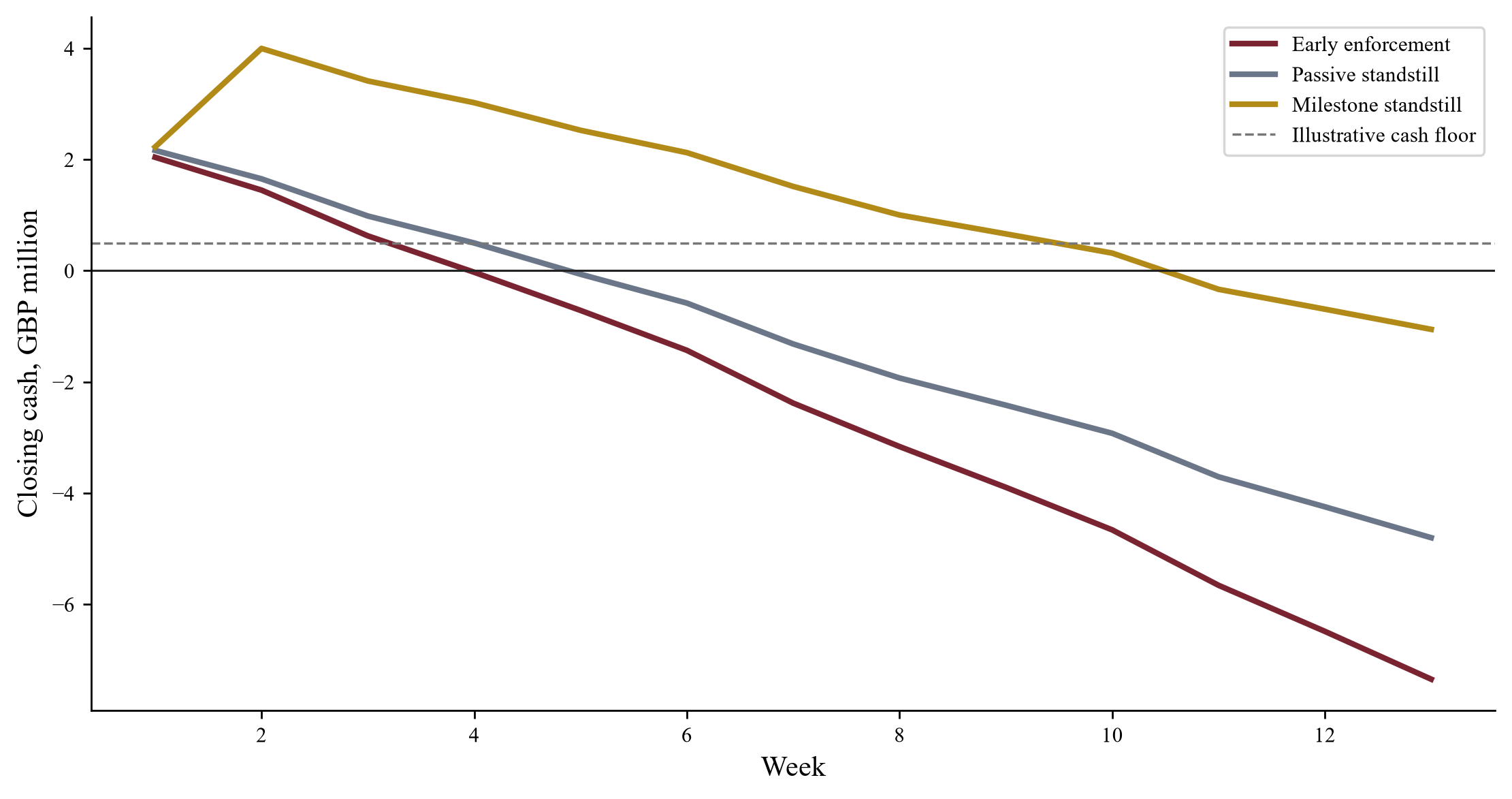
Author assumptions only. The routes have no assigned probability and do not represent financing or transaction forecasts.
8. Link every milestone to liquidity and value
A milestone is economically relevant when it changes cash requirement, completion certainty or recoverable value. The cash forecast should identify what each stage costs and which operating payments it protects. The sale model should show how delay affects customer retention, supplier support, employee continuity, inventory, maintenance and bidder appetite. This linkage prevents the timetable from becoming a list of process activities detached from creditor outcomes.
Management should estimate the cash required to reach each gate. The estimate includes operating burn, adviser cost, preservation expenditure, taxes, interest, funding fees and contingency. The next funding release can be tied to evidence that the preceding gate was met and the remaining route is executable. A lender can then decide whether incremental cash purchases a defined amount of time and progress.
Value protection should be tested at the level of the transferable business. If a delay preserves a customer renewal or required licence, its benefit can be explained. If it merely extends an uncompetitive process while orders decline, the model should show the cost. The standstill should support actions that protect enterprise value and recovery rather than delay the recognition of failure.
9. Design information covenants that support decisions
Information covenants should specify content, format, frequency, materiality and permitted recipients. They should require enough evidence to monitor the agreed case without creating an impossible reporting burden. A company in distress has limited finance capacity; repeated bespoke requests can weaken the same control environment that lenders need. A common pack and controlled question log improve efficiency.
The covenant should address accuracy and change. Management may certify that reports are prepared in good faith from stated sources, reconcile material balances and identify known limitations. A correction protocol should require prompt notice of material errors and show the effect on cash, milestones and decisions. The purpose is reliable governance rather than an unrealistic promise that every forecast will prove accurate.
Access and confidentiality also matter. Sale information may include personal data, customer secrets, price-sensitive information and competitively sensitive material. Recipients, advisers, clean teams, download rights and onward disclosure should be controlled. The lender should receive the evidence needed for its decision while the company preserves legal duties, bidder equality and transaction integrity.
10. Establish permitted payments and cash controls
The standstill should connect the weekly cash case to a permitted-payments framework. Categories may include payroll, essential suppliers, utilities, taxes, insurance, maintenance capital, professional fees and approved transaction costs. The agreement should define thresholds, exceptions, payment authority and the process for urgent changes. A broad prohibition can interrupt trading; an unconstrained budget can dissipate collateral.
Criticality should be evidenced. A supplier payment is value-preserving when the goods or services are necessary to deliver customer work, maintain safety, protect assets or sustain legal compliance. The schedule should identify the consequence of non-payment and any negotiated terms. Related-party, shareholder, management incentive and unusual payments require specific scrutiny because they can create conflicts or weaken recoveries.
Cash controls should include bank reconciliation, dual approval, beneficiary controls, daily limits, restricted-account monitoring and a decision log. The company should record payments deferred from contractual due dates and the consequences of that deferral. Forecast timing does not alter legal entitlement. The board and lenders need a transparent view of arrears accumulating during the standstill.
11. Protect customers and cash conversion
Customer continuity often determines whether the sale retains value. The company should rank customers by revenue, cash contribution, contractual rights, renewal timing, concentration and operational dependency. For each strategic account, management should identify the service commitment, outstanding invoice, acceptance evidence, collection action and communication owner.
The standstill should support delivery that converts into cash. A payment to a supplier or employee may be justified when it unlocks an identifiable customer receipt or preserves a valuable contract. The forecast should link the payment, delivery milestone, invoice and expected receipt. That chain allows lenders to distinguish working capital that supports value from spending that prolongs loss-making activity.
Communications require care. Premature disclosure of distress can accelerate termination or demands for security. Misleading reassurance can damage trust and expose the company. The board should approve a fact-based communication plan with consistent messages for customers, employees, suppliers and bidders. Material changes should be reflected in the forecast and transaction plan rather than treated as a public-relations issue.
12. Stabilise critical suppliers and operational dependencies
Supplier mapping should cover contractual rights, arrears, retention of title, termination, step-in, access, lead times, single-source exposure and substitute availability. The company should identify the minimum cash and assurance needed to maintain each critical relationship. Suppliers may request cash on delivery, deposits, guarantees, shorter terms or payment of arrears. Each concession affects liquidity and priority.
Negotiated support should be documented and reconciled to the cash model. A supplier standstill can specify continued delivery, payment dates, information and termination triggers. Management should avoid assuming that historical credit terms will continue after public evidence of distress. The downside case should show the cash and service impact if a material supplier tightens terms.
Operational dependencies extend beyond physical supply. Software access, payment processing, insurance, premises, licences, logistics, utilities and maintenance may be essential. The sale perimeter should prove that these dependencies can transfer or continue through completion. A bidder discount may reflect the cost and uncertainty of replacing them, so early resolution can preserve both cash and value.
13. Retain the people required to trade and transfer
The standstill plan should identify the roles required to operate, maintain controls, support diligence and execute separation. It should distinguish individuals from capabilities. Payroll must reconcile to the employee population, deductions, benefits and payment file. Contractor and agency arrangements should be included when they are operationally critical.
Retention decisions need a documented value case and appropriate approval. A payment or award should relate to defined service, timing, transaction dependency and clawback or lapse conditions where applicable. The board should consider fairness, legal requirements, creditor interests and the impact on the wider workforce. Unexplained insider payments can damage lender support and bidder confidence.
The transaction plan should address consultation, information, transfer, pensions, benefits, immigration, licences and change-of-control provisions with qualified advice. A buyer needs evidence that the operating capability will remain available. The cash case should include the actual timing of payroll, retention, redundancy, accrued leave and adviser costs rather than assuming a simple monthly run rate.
14. Control capital expenditure and asset preservation
Distress can lead management to defer maintenance and capital expenditure indiscriminately. Some deferrals release cash without immediate harm; others weaken safety, compliance, capacity or asset value. The standstill should classify expenditure as mandatory, maintenance, value-preserving, growth or discretionary. Each material item should have an operational consequence and approval route.
Asset preservation includes insurance, inspection, maintenance, cybersecurity, data backup, licences and environmental obligations. The lender may have security over assets whose value depends on these activities. A sale buyer may reduce price or refuse completion when maintenance records, title, condition or regulatory compliance are uncertain. Funding a defined preservation programme can therefore support recovery.
The model should distinguish expenditure that benefits the standstill period from spending whose return occurs after the expected sale. A bidder may fund or assume later investment, but that assumption needs evidence. Management should avoid presenting all capex as essential because doing so prevents decision makers from identifying the minimum viable trading plan.
15. Build the sale process around a verified critical path
The process should start with the proposed transaction perimeter, seller authority and route. A share sale, asset sale, pre-packaged transaction or sale through another formal process can produce different liabilities, consents, tax effects, employee consequences and execution risks. The standstill model must assume an identifiable route and show alternatives if that route fails.
The critical path should cover preparation, market approach, confidentiality, information release, management access, initial offers, confirmatory diligence, financing, regulatory review, documentation, creditor decisions and completion. Each stage should identify the minimum viable evidence and decision. Parallel work can compress time, although dependencies should remain visible.
The timetable should be tested against the cash runway and enforcement rights. If the company reaches its cash floor in week eight, a completion milestone in week eleven is not executable without new liquidity or operating action. A standstill that expires before realistic completion creates a late renegotiation when bargaining power is weakest. The initial plan should include extension conditions and a fallback route.
16. Qualify bidders by certainty as well as price
A distressed seller cannot evaluate bids solely on headline consideration. The assessment should include funding evidence, conditionality, diligence requirements, regulatory risk, treatment of employees and customers, assumed liabilities, working-capital mechanics, required seller support, execution team and timetable. A lower nominal offer can produce a better creditor outcome when it is funded and executable.
The bidder scorecard should distinguish information supplied by the bidder from seller or adviser judgement. Funding letters, investment committee approval, debt terms, antitrust analysis and draft transaction documents should support claims of certainty. The standstill milestones can require a minimum number of credible bids or a reasoned recommendation if the process produces fewer.
Bidder engagement should be governed consistently. Material information should be released through the data room and question process, subject to appropriate confidentiality and competition controls. Preferential access may be justified for a leading bidder only through a documented decision that considers price, certainty, time and process integrity. Lenders need a clear explanation because the choice can affect recovery.
17. Operate a controlled and decision-ready data room
The data room should mirror the questions that determine cash, continuity, liabilities, value and completion. Priority materials include corporate authority, finance documents, security, cash and working capital, customer and supplier contracts, employees, tax, litigation, property, intellectual property, technology, licences, insurance, environmental matters and the transaction perimeter.
Readiness is measured by decision usefulness. A folder containing thousands of unsorted files can conceal missing evidence. The index should identify the source, date, owner, scope, status and relationship to key claims. Missing documents and limitations should remain visible. Management should reconcile data-room schedules to the cash model and sale materials.
Access should follow role and stage. Competitors may require clean-team controls for sensitive customer, pricing or employee information. Personal data should be processed and shared on an appropriate basis. Download, printing and onward disclosure can be restricted. The access log and question register become part of the process record and help explain which bidder had the evidence needed to make its offer.
18. Coordinate security, intercreditor rights and releases
A sale can require releases of security, guarantees and claims across several lenders and entities. The debt map should identify who controls enforcement, voting thresholds, turnover obligations, priority, hedging rights, release mechanics and application of proceeds. A delay in obtaining a release can prevent completion even when commercial terms are agreed.
The standstill should state how sale proceeds will be received and applied, subject to definitive documents and law. It should identify transaction accounts, deductions, bridge repayment, costs, reserves and distributions. Disputes about the waterfall should be surfaced before bidders incur substantial cost. The model can show a provisional outcome while clearly separating assumptions from legal entitlement.
Security over cash, receivables, inventory, property, intellectual property and shares may affect operating permissions during the standstill. The company should verify whether ordinary-course disposals, new financing or asset transfers require consent. Lenders should coordinate instructions through the appointed agent or trustee where applicable, preserving a controlled decision route.
19. Draft waiver, reservation and termination mechanics clearly
The document should identify existing and anticipated defaults and specify their treatment. A waiver may address a defined breach; a standstill may suspend stated actions; a reservation-of-rights clause may preserve other remedies. Ambiguous language can create different expectations about acceleration, enforcement, interest, fees, set-off and future defaults. Qualified counsel should align the document with the finance and security package.
Termination events should protect against material deterioration while allowing the process to absorb ordinary forecast variance. Examples can include missed cash floors, unauthorised payments, material information error, failure to deliver reports, loss of a critical contract, failure of a milestone, invalid security, insolvency action or breach of the standstill. Cure periods and decision authority should be explicit.
A milestone miss should not automatically produce the same response in every case. The decision body may accept a short cure where cash, value and completion remain protected. A serious information failure may justify immediate action. The agreement should preserve lender rights while requiring prompt, evidence-based escalation. This creates discipline without turning the timetable into a trap that destroys an otherwise executable sale.
20. Structure bridge liquidity around conditions and control
The company may need new money to reach completion. The bridge request should state amount, timing, use of proceeds, cash floor, milestones, source of repayment, security, priority, fees, covenants, draw conditions and downside rights. The lender should be able to see which preservation actions the funding buys and what happens if the sale is delayed or fails.
Funding should not be entered in the cash model until its conditions and timing are understood. A term sheet, credit approval, executed document and drawable facility represent different levels of certainty. The downside case should show the effect of a delayed draw or smaller amount. Management should avoid using assumed funding to conceal a gap before the approval date.
Priority and security require specific advice, especially where existing creditors, pension claims, taxes, suppliers or a statutory process may affect outcomes. The bridge can change incentives among creditor classes. The decision record should explain why the financing is expected to preserve value, how alternatives were considered and which parties bear incremental risk.
21. Maintain the directors' decision record
Directors remain responsible for company decisions during a consensual standstill. Section 172 of the Companies Act 2006 is subject to rules requiring directors in certain circumstances to consider or act in the interests of creditors. The Supreme Court's Sequana judgment explains the creditor-interest rule as an aspect of the duty owed to the company and discusses its relevance as insolvency approaches [5]. Application depends on the facts and requires legal advice.
The board record should set out financial position, forecasts, alternatives, advice, stakeholder effects, conflicts, valuation evidence, funding, milestones and reasons for decisions. It should record what information was available at the time and how limitations were handled. A later outcome does not by itself establish whether the original decision was reasonable; contemporaneous evidence matters.
Conflicted directors, shareholders or proposed buyers should be identified and governed. Related-party bids, insider funding, retention arrangements and selective information access require particular care. The process should use independent challenge, appropriate recusals and documented approvals. The standstill does not transfer management responsibility to lenders merely because they receive information or consent to specified actions.
22. Run a disciplined reporting and variance cycle
The weekly cycle should begin with bank reconciliation and forecast-to-actual analysis. Material receipt and payment variances should be classified as timing, permanent, scope or data differences. Each variance should have an explanation, owner, action and effect on the remaining horizon. The prior forecast should be preserved so decision makers can assess forecasting performance.
The report should combine cash, milestones and value indicators. It can show headroom to the cash floor, forecast funding need, overdue receipts, critical supplier status, customer events, bidder progress, diligence gaps, documentation, approvals and termination risks. A concise exception report should direct attention to decisions rather than repeat every schedule.
The meeting should produce an approved forecast, an updated milestone status, decisions, consent requests and a communication plan. Lenders should state questions and required evidence through a common channel. Management should track whether repeated misses reflect poor execution, optimistic assumptions or a changing business. Persistent error is itself a risk indicator and should change the route.
Table 3. Hypothetical standstill-case assumptions
| Input | Early enforcement | Passive standstill | Milestone standstill |
|---|---|---|---|
| Opening unrestricted cash | GBP 2.60m | GBP 2.60m | GBP 2.60m |
| Secured debt | GBP 11.50m | GBP 11.50m | GBP 11.50m |
| Completion week | 4 | 11 | 9 |
| Assumed sale proceeds | GBP 8.60m | GBP 10.40m | GBP 12.80m |
| Incremental bridge | None | None | GBP 2.25m in week 2 |
| Weekly deterioration assumption | 2.5% | 1.2% | 0.4% |
All values are author assumptions. The cases exclude transaction-specific priority, tax, working-capital, guarantee and legal effects.
23. Establish the hypothetical decision model
The original model considers a hypothetical industrial-services company with GBP 2.60 million of unrestricted opening cash and GBP 11.50 million of secured debt. Baseline weekly receipts are GBP 1.55 million before case adjustments. Weekly payroll is GBP 0.72 million, supplier payments are GBP 0.68 million, fixed operating outflows are GBP 0.27 million and preservation spending is GBP 0.16 million through week eight before reducing to GBP 0.08 million.
The cases are early enforcement, passive standstill and milestone standstill. Each uses different receipt conversion, operating deterioration, process cost, completion week and assumed sale proceeds. The milestone case includes a hypothetical GBP 2.25 million bridge in week two. Sale proceeds are GBP 8.60 million, GBP 10.40 million and GBP 12.80 million respectively. These values are author assumptions chosen to illustrate mechanics.
Lender recovery is calculated as the lower of secured debt plus the hypothetical bridge and assumed sale proceeds plus cash at completion. The model excludes insolvency distributions, priority disputes, taxes, working-capital adjustments, foreign exchange, guarantees, interest after the opening date and transaction-specific legal effects. No probability is assigned to a case or sensitivity cell.
Table 4. Hypothetical case results
| Route | Cash at completion | Sale proceeds | Lender recovery, GBPm / rate |
|---|---|---|---|
| Early enforcement | -0.03 | 8.60 | 8.57 / 74.6% |
| Passive standstill | -3.71 | 10.40 | 6.69 / 58.2% |
| Milestone standstill | 0.66 | 12.80 | 13.46 / 97.9% |
GBP million except percentages. Results follow directly from author assumptions; no probability, legal entitlement or recommendation is assigned.
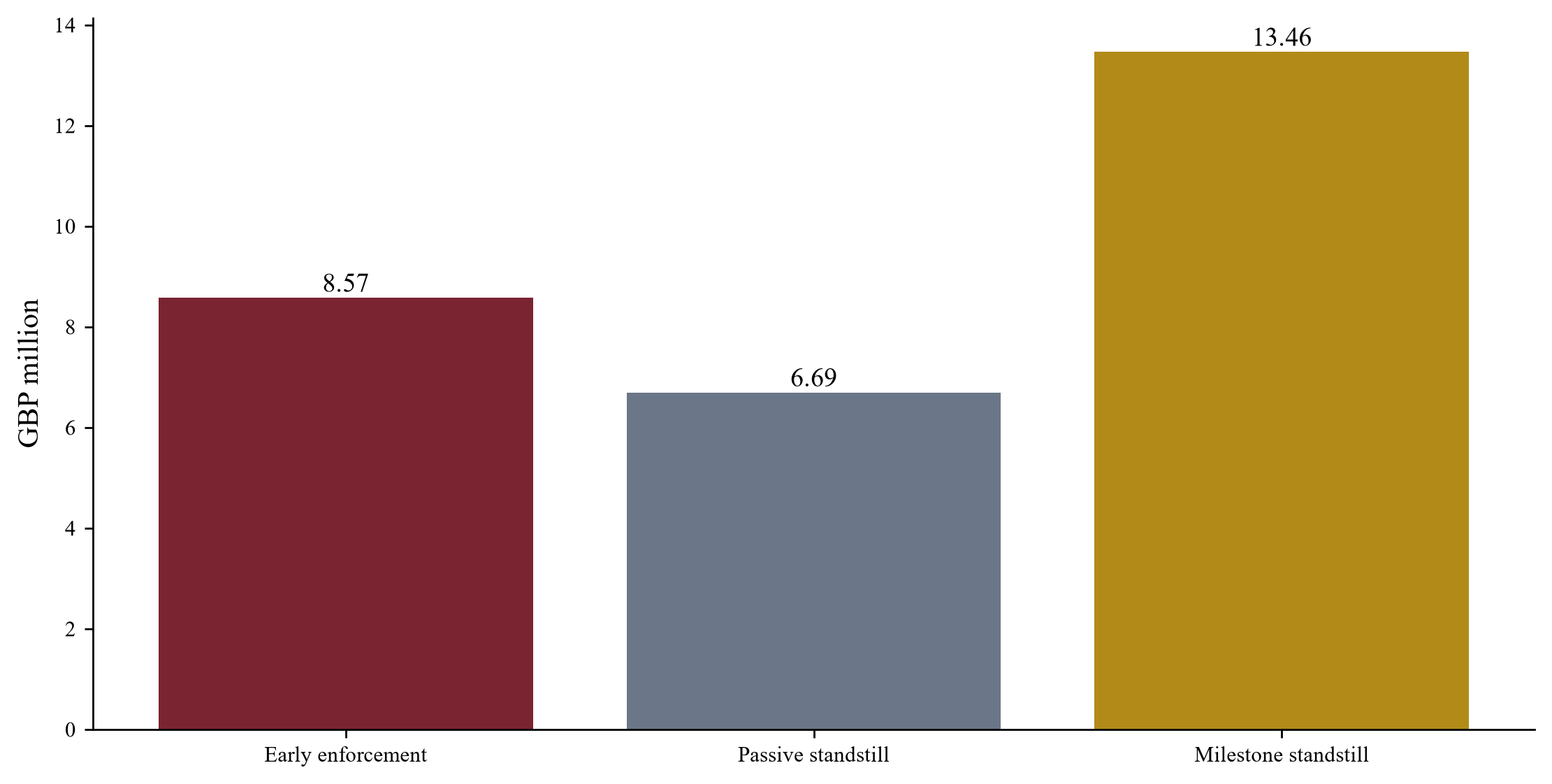
Author assumptions. Gross value equals assumed sale proceeds plus modeled cash at the stated completion week, before transaction-specific distributions.
24. Compare the three standstill routes
The early-enforcement case assumes weaker receipts and faster weekly deterioration, with a sale in week four at GBP 8.60 million. Cash at completion is approximately negative GBP 0.03 million and calculated lender recovery is about 74.6 percent of the assumed secured claim. The case illustrates how speed can limit cash consumption while producing a lower assumed transaction value.
The passive standstill assumes moderate receipt performance, no incremental bridge and completion in week eleven at GBP 10.40 million. Cash at completion is approximately negative GBP 3.71 million. Calculated lender recovery falls to about 58.2 percent because the business consumes cash without enough funded preservation or transaction progress. Time alone does not create value in this case.
The milestone standstill assumes stronger receipts, slower deterioration, a hypothetical GBP 2.25 million bridge and completion in week nine at GBP 12.80 million. Cash at completion is approximately GBP 0.66 million and calculated recovery is about 97.9 percent of secured debt plus bridge. The result follows from the assumptions and demonstrates the value bridge required to justify the additional time and funding.
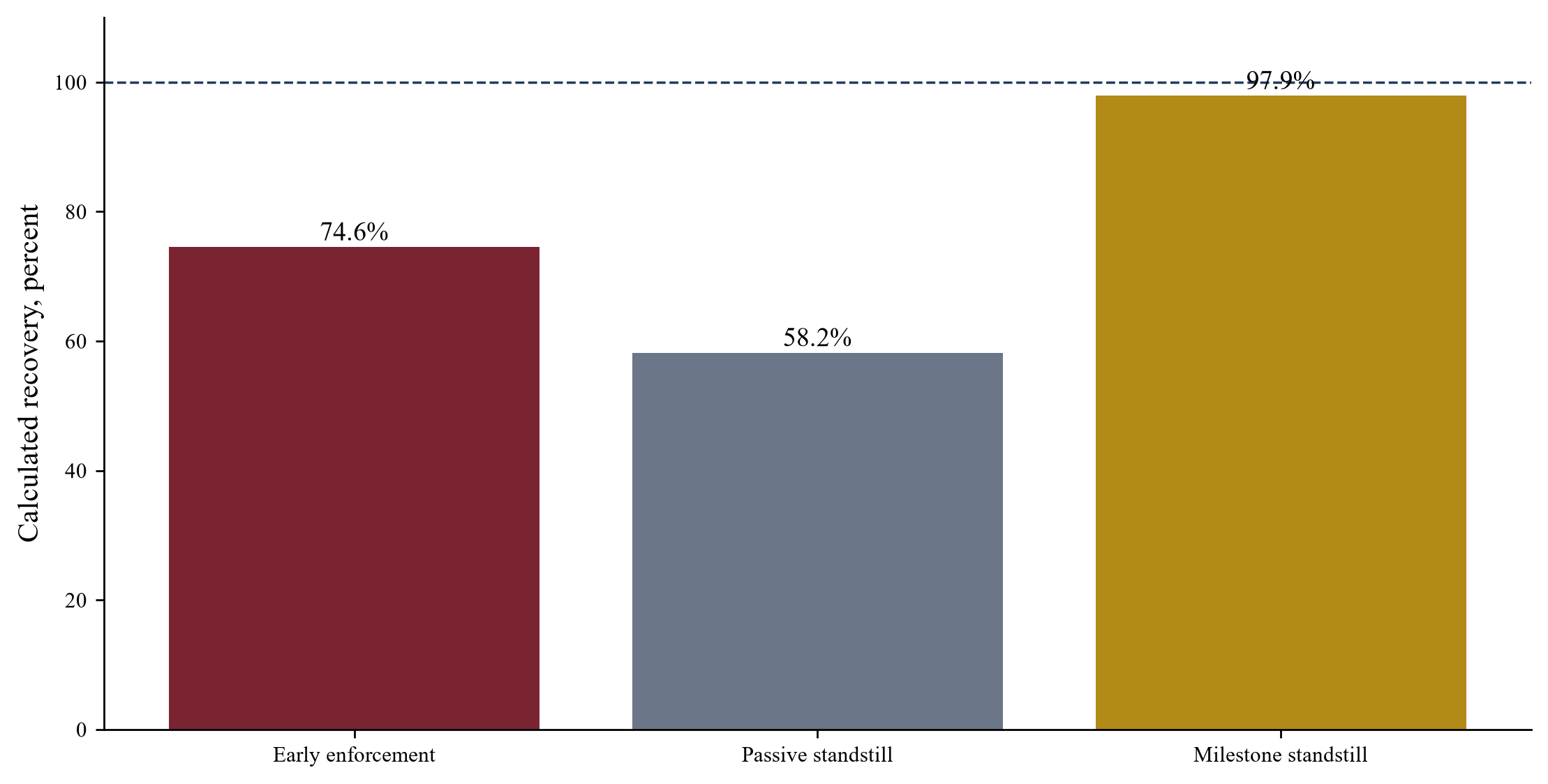
Author assumptions. Recovery is capped at the assumed secured debt plus bridge claim and does not establish legal entitlement or expected outcome.
25. Use sensitivity to find the decision boundary
The sensitivity varies completion from week seven to week eleven and sale proceeds from eighty to one hundred and ten percent of the GBP 12.80 million milestone-case assumption. It holds the operating case and bridge constant. The grid shows calculated lender recovery rather than probability or expected value. Its purpose is to identify which combinations preserve the assumed claim.
At one hundred percent of assumed proceeds, calculated recovery is full in weeks seven and eight, approximately 97.9 percent in week nine, 95.4 percent in week ten and 90.7 percent in week eleven. At eighty percent of assumed proceeds, calculated recovery ranges from approximately 85.5 percent in week seven to 72.0 percent in week eleven. Delay consumes cash and reduces the proceeds available to creditors under the model.
Decision makers should replace these assumptions with evidence from bids, trading, funding documents and the applicable waterfall. The grid can be extended for customer losses, supplier tightening, bridge fees, regulatory delay and different completion routes. It should remain transparent enough for management, lenders and advisers to identify the driver of each result.
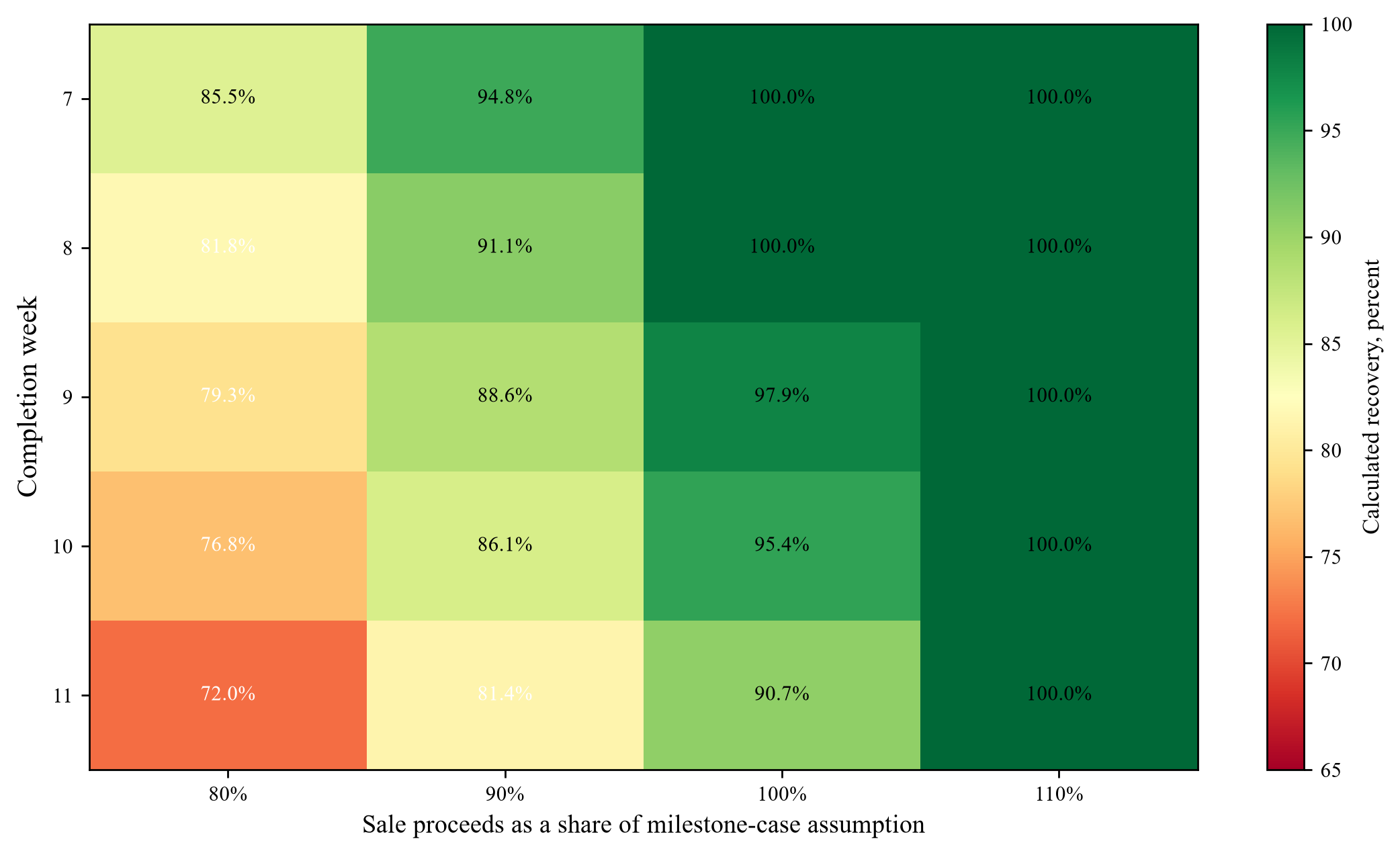
Author assumptions. Each cell varies completion timing and assumed sale proceeds; no probability is assigned.
Table 5. Proposed standstill risk-control matrix
| Failure mode | Early indicator | Control | Decision evidence |
|---|---|---|---|
| Cash case unreliable | Unreconciled balance or repeated variance | Bank reconciliation, source map and independent challenge | Approved forecast and variance history |
| Milestone slippage | Dependency or deliverable misses critical path | Named owner, cure plan and fallback trigger | Updated route and decision log |
| Unauthorised cash leakage | Payment outside agreed schedule | Dual approval, limits and consent protocol | Bank and approval record |
| Customer or supplier loss | Termination, hold or adverse term change | Critical-stakeholder plan and funded response | Contract, communication and cash effect |
| Bridge unavailable | Approval or condition misses required date | Conditions tracker and no-funding case | Executed facility and draw test |
| Bid fails | Funding, diligence or approval remains unresolved | Qualification scorecard and alternate route | Bid evidence and board recommendation |
Proposed controls. The accountable board, lenders and qualified advisers determine actual risk treatment and legal consequence.
26. Maintain a standstill risk-control matrix
The risk register should connect each failure mode to an early indicator, control, owner, evidence and consequence. Priority risks include unreliable cash, unauthorised payments, information failure, milestone slippage, customer loss, supplier interruption, bridge delay, bidder withdrawal, regulatory delay and disputed releases. The register should state the effect on liquidity, value, completion or creditor rights.
Controls need objective evidence. A cash control is supported by bank reconciliation and approval logs. A customer control is supported by service and collection records. A bidder control is supported by financing and diligence evidence. A milestone should not be shown as green because a meeting occurred when the required deliverable remains incomplete.
The board and lenders should review residual risk and decide whether the standstill continues, changes or terminates. The matrix should preserve closed issues and their evidence because old problems can recur. It should also identify risks created by the standstill itself, including information leakage, management distraction, cost, creditor inequality and false confidence in an uncommitted buyer.
27. Negotiate from a single integrated term sheet
The term sheet should integrate duration, scope, defaults, suspended actions, reservations, reporting, permitted payments, milestones, bridge funding, security, fees, consents, confidentiality, governance, termination and costs. Commercial positions should be linked to the model. A request for ten weeks should show the cash and transaction gates that require ten weeks. A funding amount should reconcile to the cash floor and uses.
Open issues should be maintained in a decision log with owner, proposed solution, consequence and deadline. Legal drafting, credit approval and transaction preparation should proceed in parallel where dependencies allow. The company should avoid circulating inconsistent term sheets to different creditors. An agreed working version and controlled redline process reduce execution risk.
The negotiation should preserve a credible fallback. If the required creditor threshold cannot be reached, management needs to know whether another consensual arrangement, statutory moratorium, restructuring plan, administration or accelerated sale route is available. HMRC guidance on restructuring schemes and plans stresses realistic prospects and adequate disclosure [6]. The company should obtain current advice before relying on any route.
28. Execute a thirteen-week implementation roadmap
Week one should establish the debt map, bank-confirmed opening cash, board process, adviser roles, critical stakeholders and first integrated forecast. Week two should complete the information pack, standstill documentation, permitted-payments schedule and any bridge conditions. The sale team should confirm the perimeter, materials, buyer universe, data-room priorities and regulatory path.
Weeks three to five should evidence customer and supplier stability, distribute controlled process materials, resolve material data gaps and obtain initial bidder feedback. The weekly committee should reconcile cash, assess milestone status and decide consent requests. Funding releases should follow the agreed evidence gates. Management should test the fallback route before cash pressure makes it unusable.
Weeks six to nine should focus on confirmatory diligence, funded bids, definitive documentation, releases, regulatory submissions and completion readiness. Later weeks provide contingency for approvals or a controlled alternative. Every week should end with an updated cash case, milestone decision, risk matrix and action log. The roadmap remains a management framework; actual timing depends on the company, transaction and jurisdiction.
29. Exit the standstill through a controlled handover
The standstill should end through completion, a documented extension, refinancing, restructuring, formal process or enforcement. The agreement should define notice, outstanding obligations, accrued amounts, information and survival provisions. A last-minute expiry without a decision can damage operations and create avoidable disputes.
At a successful sale, the parties should reconcile proceeds, transaction accounts, debt repayment, bridge settlement, releases, retained liabilities, working capital and remaining cash. The buyer should receive the operational evidence needed to trade, including bank authority, customer and supplier commitments, payroll, systems, licences and the latest cash forecast. Open risks should transfer to named owners.
The final record should explain the route selected, alternatives considered, milestones achieved, deviations, consents, distributions and remaining claims. This record supports directors, creditors and the buyer. A well-designed standstill earns time by converting it into verified decisions and value-preserving action. Its success is demonstrated by an executable outcome, not by the length of the protected period.
References
- UK Government. Corporate Financial Distress Guidance Note. Updated 15 June 2026; accessed 6 September 2026. https://www.gov.uk/government/publications/the-sourcing-and-consultancy-playbooks/corporate-financial-distress-guidance-note-html
- The Insolvency Service. Insolvency Act 1986 Part : moratorium, guidance for monitors. Published 26 June 2020; accessed 6 September 2026. https://www.gov.uk/government/publications/insolvency-act-1986-part-a1-moratorium-guidance-for-monitors
- European Banking Authority. Guidelines on management of non-performing and forborne exposures. Published 31 October 2018; accessed 6 September 2026. https://www.eba.europa.eu/activities/single-rulebook/regulatory-activities/credit-risk/guidelines-management-non-performing
- Financial Reporting Council. Guidance on the Going Concern Basis of Accounting and Related Reporting, including Solvency and Liquidity Risks. Published 25 February 2025; accessed 6 September 2026. https://www.frc.org.uk/library/standards-codes-policy/accounting-and-reporting/annual-corporate-reporting/guidance-on-going-concern-basis/
- UK Supreme Court. BTI 2014 LLC v Sequana SA and others, UKSC 2019/0046. Judgment 5 October 2022; accessed 6 September 2026. https://www.supremecourt.uk/cases/uksc-2019-0046
- HM Revenue & Customs. Using debt management schemes to restructure a company's finances. Published 1 November 2023; accessed 6 September 2026. https://www.gov.uk/guidance/using-debt-management-schemes-to-restructure-a-companys-finances
- IFRS Foundation. IFRS 7 Financial Instruments: Disclosures. Accessed 6 September 2026. https://www.ifrs.org/issued-standards/list-of-standards/ifrs-7-financial-instruments-disclosures/
- UK Government. Navigating the risks of PFI project distress, Part 3: Project company insolvency. Published August 2026; accessed 6 September 2026. https://www.gov.uk/government/publications/navigating-the-risks-of-pfi-project-distress/part-3-project-company-insolvency
