

Introduction
Project finance is designed for assets whose risks can be defined, allocated and monitored through a network of contracts. The project company raises debt against future cash generated by the project. Lenders examine whether each material construction, operating, supply, demand, regulatory, environmental and financial risk is borne by a creditworthy party with the capability and incentive to manage it. [2][3]
A LEO data-centre project challenges familiar infrastructure categories. There may be no single construction site, engineering-procurement-construction contractor or physical asset to which a lender can gain practical access. Hardware is launched in cohorts, operates in a changing radiation and debris environment, and may need continuous replacement. Computing and communications technology can become obsolete before legal maturity. Customer value may depend on an integrated service rather than physical availability alone.
These features do not make debt impossible. They shift the bankability question from whether the concept is exciting to whether a defined operating cluster has achieved completion, accepted revenue and durable contractual control. The financeable perimeter may be narrower than the venture's enterprise ambition. Lenders may finance commissioned cohorts and contracted service while equity retains development, new-technology and expansion risk.
1. Define bankability precisely
Bankability means that lenders can identify a reliable repayment source, quantify downside, control project cash, enforce material rights and obtain adequate protection for risks that the project cannot bear. It does not mean that every risk has disappeared. It means that risk has been reduced, allocated, reserved, insured or supported sufficiently for the proposed debt structure.
Define the requested facility. A pre-completion development loan, launch bridge, equipment facility, vendor financing, customer-receivables facility, working-capital line and post-completion project loan require different evidence. The paper focuses on senior debt whose repayment depends primarily on the operating cash flow of a ring-fenced commercial cluster.
State the non-bankable perimeter. Unlicensed scale, unqualified technology, speculative customers, unsupported performance improvements, future launch-price reductions and uncontracted replacement capacity should remain outside the debt base case. Equity may retain those options.
2. Establish the project company
Create a project special-purpose vehicle with defined ownership, business purpose, assets, contracts, bank accounts, governance and permitted activities. Identify the jurisdiction of incorporation, tax residence, licensing position and relationship with the technology sponsor and operating affiliates.
Transfer or license the rights required to build, launch, operate and monetize the financed cluster. These can include spacecraft hardware, payload software, patents, design data, spectrum and orbital authorizations, ground-system access, customer contracts, launch rights, insurance and operating procedures. Review transferability, change-of-control restrictions, export controls and insolvency treatment.
Limit leakage and competing claims. Related-party services, intellectual-property licences, data access and shared infrastructure should have arm's-length scope, pricing, term, service levels, audit rights, termination support and lender protections. A project company that depends on revocable sponsor discretion cannot support durable limited-recourse debt.
3. Define the financed asset
The financed asset should be described by node configuration, cohort, orbit, commissioned capacity, usable power, thermal envelope, compute performance, communications routes, ground systems, customer allocation and remaining design life. Planned or manufactured hardware is different from launched, commissioned and service-available hardware.
Separate core project assets from shared services. A cluster may rely on a sponsor's network operations centre, another constellation's optical relay, third-party gateways, cloud orchestration, key management or customer interface. Each dependency should have a contract capable of surviving sponsor distress and lender enforcement.
Maintain an asset register with serial number, ownership, supplier, launch mission, commissioning record, telemetry status, insurance, customer allocation, impairment, remaining life and disposal obligation. This register supports security, insurance, covenant testing and replacement planning.
4. Separate development debt from project debt
Architecture design, technology qualification and first-of-kind flight testing carry venture-style risk. Repayment depends on successful innovation and future financing rather than established project cash. Sponsor equity, strategic capital, grants or milestone financing are generally more aligned with these risks.
Project debt can enter after a defined completion event. Completion should establish that the financed cluster has been delivered, commissioned, meets sustained performance tests, can provide the contracted service, holds necessary authorizations and has sufficient reserves and operations capability.
Where lenders fund before completion, require sponsor completion support, cost-overrun funding, liquidity, delayed-draw mechanics and conditions precedent. The support should remain in force until objective completion, rather than expiring on launch or first contact.
5. Design the completion regime
Completion is the central conversion from sponsor-supported exposure to project cash-flow exposure. It should be certified against a schedule of technical, regulatory, contractual and financial tests. Launch alone cannot constitute completion.
Technical completion can require a minimum number of commissioned nodes, service-available power, sustained representative workload, thermal stability, data integrity, communications availability, fault recovery and disposal readiness. Commercial completion can require customer acceptance, contracted minimum revenue, invoice issuance and payment.
Financial completion can require final uses funded, no material unpaid claims, funded reserves, an agreed base-case model, minimum prospective debt-service coverage, working capital and absence of default. An independent technical adviser, model auditor, insurance adviser and counsel should certify within their mandates.
6. Allocate completion risk
Allocate manufacturing defects to suppliers through warranties, acceptance tests, liquidated damages where obtainable and replacement obligations. Allocate integration and launch obligations through defined interfaces, schedules, remedies and insurance. Allocate sponsor-controlled software and operating readiness through completion support and service agreements.
No single contractor may offer a full turnkey guarantee. The lender should therefore use an interface matrix showing each requirement, responsible party, evidence, remedy and residual project exposure. Gaps require sponsor support, reserve, insurance, contingency or reduced debt.
Set a long-stop date with cure and restructuring options. If completion is delayed, lenders need updated cost, launch and customer evidence. A forced acceleration against unfinished orbital hardware may have limited recovery value.
7. Underwrite sponsor support
Assess sponsor experience, financial capacity, governance, technical ownership and incentive to complete. World Bank guidance notes that sponsor quality and ability to stand behind completion guarantees are foundational lender considerations. [2]
Completion support can cover cost overruns, debt service before completion, failed tests, replacement hardware, additional launch and customer delay. Define cap, duration, demand mechanics, credit support and release conditions. A support undertaking from a thin holding company provides little protection.
Retain sponsor equity at risk. Require minimum equity contribution before or alongside debt drawing. Restrict distributions and related-party payments until completion and reserve funding. Consider contingent equity or a standby letter of credit for identified downside.
8. Build the contractual matrix
The project company needs an integrated contract suite: technology and intellectual-property rights, manufacturing, launch, integration, ground-station and network capacity, operations and maintenance, customer service, insurance, hedging, account bank and direct agreements.
Reconcile definitions across contracts. “Available node,” “service capacity,” “accepted workload,” “scheduled outage,” “force majeure” and “completion” should produce consistent rights. If a customer can reject service for an event that gives no remedy under a supplier contract, the project retains the mismatch.
Map term, termination, liability caps, exclusions, change control, assignment, step-in, cure, insolvency, governing law and dispute resolution. Critical contracts should extend beyond debt maturity or contain credible renewal and replacement provisions.
9. Create bankable customer contracts
Lenders need revenue that is enforceable, measurable and resilient. Customer contracts should define service, reserved capacity, availability, performance, security, acceptance, price, indexation, invoice, payment, credit support, service credits and termination.
Take-or-pay or availability-based minimums can improve predictability when obligations are subject to clear project performance. Usage revenue may provide upside and should receive appropriate debt-sizing treatment. Development grants and pilot payments should remain separate from recurring service revenue.
Assess counterparty credit, concentration and appropriations risk. Government or sovereign-linked customers can provide strategic demand while introducing procurement, budget and termination conditions. Commercial customers may require portability, data rights and rapid technology refresh. Model the actual contract.
10. Control customer acceptance
Define output quality, completeness, latency, availability and security tests. Acceptance should be evidenced through system records and customer confirmation. Invoice quantities should reconcile to telemetry and ground-delivery records.
Limit subjective rejection. Include cure periods, independent expert determination and deemed acceptance where appropriate. Service credits should be capped and modelled. Repeated failure can create termination and lender default risk.
Require direct agreements for material customers where feasible. Lenders may seek notice of default, cure rights, limits on amendment and assignment acknowledgements. The commercial balance should remain workable for the customer.
11. Underwrite manufacturing
Review design maturity, bill of materials, supplier concentration, long-lead items, quality system, manufacturing yield, acceptance testing, configuration control and capacity for replacement cohorts. Qualification evidence should match the financed configuration.
Use fixed or bounded pricing where the supply chain can support it. Indexation, change orders and foreign currency should be transparent. Supplier warranties should identify defects, exclusions, remedy and timing. A warranty that requires return of hardware may have limited practical value after launch.
Maintain spares and replacement options. Lenders should know the lead time from failed node to commissioned replacement. Long lead time increases revenue loss and required liquidity.
12. Underwrite launch services
Review executed launch agreements, reservation status, payload compatibility, orbit, integration, schedule rights, payment, termination, provider liability and insurance. A quotation or announced cadence does not reserve project capacity.
Public launch cadence demonstrates sector activity while giving no assurance for a project. The United States Space Force reported 93 Eastern Range launches in 2024 and described higher cadence as an operational objective. [4]
Model launch failure, delay, stand-down and shared-ride displacement. Require a backup strategy for replacement launches and a liquidity plan for uninsured or delayed recovery. Contracted launch rights should align with manufacturing and customer milestones.
13. Prove power and thermal capacity
Debt capacity depends on service-available compute, not installed hardware. Start with end-of-life solar generation and energy storage. Deduct platform, communications, thermal-control and reserve loads. Apply eclipse, degradation and failure scenarios. NASA's current spacecraft reviews describe these power and thermal constraints. [5][6][7]
Test sustained workload under representative thermal conditions. High-duty computing may be limited by heat rejection. Require ground correlation and in-orbit telemetry for the financed configuration.
Define the capacity certificate used by the financial model. It should state commissioned nodes, service-available kilowatts, workload throughput, availability and limitations. Changes should trigger model and covenant review.
14. Prove communications capacity
Map input, inter-satellite transfer, storage, ground downlink, terrestrial backhaul and customer delivery. NASA's optical-communications programme demonstrates high-rate links while noting the importance of ground-station diversity and atmospheric conditions. [8][9]
Measure effective throughput after geometry, weather, acquisition, congestion, technical availability and protocol overhead. Contract sufficient ground and relay capacity for base-case customer obligations. Include alternate routes and outage procedures.
Communications capacity should have a measurable service test and direct contractual remedies. Lenders should avoid relying on a technical interface unsupported by enforceable capacity rights.
15. Complete regulatory diligence
Review satellite and earth-station authorization, spectrum, ITU filings, debris mitigation, launch and re-entry, remote sensing, data, cybersecurity, export control, sanctions and customer-specific permissions. ITU procedures for non-GSO networks can require advance publication or coordination, followed by notification and recording. [10][11]
Record licence conditions, milestones, reporting, transfer and change-of-control rules. Determine whether lenders can take security, exercise step-in or transfer project ownership without fresh consent. Regulatory rights that terminate on insolvency or cannot be transferred affect recovery.
Use conditions precedent for rights required at financial close and drawdown. Maintain a compliance calendar and reserve for fees, reporting and mitigation obligations.
16. Build the insurance programme
Insurance should reflect the actual risk allocation. Potential cover can include pre-launch property, launch and initial operation, in-orbit property, third-party liability, business interruption, cyber and political risk. Availability, exclusions, deductibles, limits and claims history require current market evidence.
FAA financial-responsibility rules require licensed launch or re-entry operators to demonstrate funds based on maximum probable loss through insurance, escrow or financial reserves. These regulatory requirements protect specified third-party and government-property exposures; they do not insure the project's revenue or replace tailored lender cover. [12]
World Bank guidance treats insurance as part of the lender security package while recognizing that each programme must reflect project risks. Lenders may require assignment of proceeds, lender endorsement, notice of cancellation and control of reinstatement. Some technical or commercial risks may be unavailable or uneconomic to insure and need another allocation. [13]
Translate the programme into the financing model policy by policy. Premium timing, deductibles, waiting periods, reinstatement cost and uninsured exclusions should appear in cash flow and liquidity requirements. Insurance advisers should confirm placement assumptions before first debt draw and again before each launch. Annual renewal deserves a covenant calendar because market capacity, pricing and exclusions can change during the debt tenor. The finance documents should define which adverse changes require lender consent, additional reserves, sponsor support or a reduction in distributions.
17. Separate insured and retained risk
Create a risk-to-policy map. For each launch, deployment, node, gateway, cyber, liability and revenue risk, identify policy, insured party, limit, deductible, exclusions, waiting period, proceeds and residual exposure.
Test aggregation. A common launch can concentrate multiple nodes, and a common design defect can affect a fleet. Policy limits and deductibles should be assessed against correlated loss. Replacement lead time can make business-interruption exposure longer than physical repair assumptions.
Model claims timing. Insurance proceeds may arrive after debt service falls due. Fund liquidity reserves and sponsor support accordingly. A disputed claim should have a governance and cash plan.
Create a loss-response decision tree before close. It should identify the authority to notify insurers, preserve evidence, appoint adjusters, approve repairs or replacement, settle claims and direct proceeds. Separate proceeds required to reinstate productive capacity from proceeds permitted to repay debt. A lender should test whether a partial loss can leave the project technically operational while commercially unable to meet customer acceptance, revenue or covenant thresholds. That intermediate state is often more demanding than a clearly defined total loss.
18. Design redundancy economically
Redundancy can improve service availability while increasing capital, mass, power and replacement cost. Define redundancy at processor, node, orbit, launch, gateway, network and supplier levels.
Avoid counting standby capacity twice. Capacity reserved for fault tolerance should not be sold simultaneously without a documented degradation policy. The customer service level and lender model should use the same reserve assumptions.
Link redundancy to failure evidence. Early cohorts may require larger margins. Observed reliability can update spares, insurance and debt sizing. A lender should require minimum operating nodes and service capacity rather than relying on fleet count alone.
Redundancy should be expressed through tested service outcomes. Availability calculations need common-cause adjustments for shared launch, software, component, ground-station and control-system dependencies. Two nominally independent nodes can remain exposed to one design defect or one operational command path. Completion tests should therefore include failover under realistic workload, degraded power, interrupted communications and cyber-recovery conditions. Results should set the minimum spare capacity, permitted maintenance window and cash-trap threshold used by the financing model.
19. Fund replacement and replenishment
LEO assets can have design lives shorter than debt tenor. GAO reported that one proliferated LEO architecture expects roughly five-year replacement cycles and identified lifecycle-cost and schedule concerns. The programme differs from commercial orbital compute, while illustrating why replenishment is a recurring capital requirement. [14]
Build a cohort schedule with launch date, design life, degradation, failure assumption, replacement order date, manufacturing lead time, launch window and cost. Include disposal and regulatory obligations.
Fund a lifecycle reserve through operating cash before distributions. Set minimum coverage for scheduled replacement and downside failures. Debt maturity should align with remaining asset life, contracted revenue and replacement funding.
Treat replenishment as a recurring operating requirement rather than discretionary growth capital. The base case should distinguish scheduled cohort replacement, early random failures, fleet-wide corrective action and capacity expansion. Reserve releases should require evidence that manufacturing slots, compatible launch access, regulatory authority and operating integration remain available. If replacement technology differs from the qualified configuration, lenders should require a bounded change process, independent technical confirmation and customer compatibility evidence before reserve money enters construction or launch commitments.
20. Construct the operating agreement
The operations and maintenance agreement should cover network operations, telemetry, flight dynamics, workload scheduling, software, cybersecurity, gateways, customer delivery, incident response and regulatory reporting. Define staffing, service levels, change control and business continuity.
If the sponsor is operator, require arm's-length fees, performance standards, audit, assignment, step-in and transition support. Maintain escrow or controlled access for critical software, keys, configuration and operating records where legally and technically appropriate.
Measure operator performance against project obligations. Lender remedies should address persistent underperformance without causing unsafe operations or loss of authorization.
Operating budgets should separate essential safe-mode functions, minimum contracted service and discretionary optimization. This hierarchy supports a realistic downside plan when liquidity is tight. Key-person dependency, export-controlled access, encryption keys and proprietary diagnostic tools should be mapped to named roles and controlled repositories. Periodic transition exercises can test whether an approved replacement operator could obtain information, authority and access quickly enough to maintain lawful operations and preserve customer service after sponsor distress.
21. Create practical step-in rights
Physical repossession of an operating satellite is not practical. Lender control depends on project shares, accounts, contracts, software and regulatory cooperation. Security analysis should focus on rights that can preserve service and cash after default.
Direct agreements with critical suppliers, launch providers, network operators, customers and intellectual-property licensors can provide notice, cure, continuation and transfer rights. Consent requirements should be addressed before close.
Each direct agreement should match the remedy that the underlying contract can actually deliver. A cure period has limited value when a launch slot has passed, specialist hardware has no substitute or a licence cannot be transferred. Lenders should identify long-lead irreversible events and require earlier notice, dedicated reserves or alternate capacity. The enforcement memorandum should cover project shares, accounts, receivables, insurance proceeds, material contracts, intellectual property and data, with local counsel confirming perfection, priority and restrictions in each relevant jurisdiction.
Step-in must respect space safety, spectrum, export control, cybersecurity and licensing. An approved substitute operator or transition plan may be necessary. Enforceability requires jurisdiction-specific counsel.
22. Control project cash
Establish secured project accounts with an agreed waterfall. Customer receipts should fund taxes and essential operations, insurance, debt service, reserves and permitted distributions in defined order.
Use debt-service reserve, lifecycle reserve, insurance-deductible reserve and working-capital minimums where supported by the risk profile. Define permitted investments, account bank standards and replacement rights.
Cash-trap triggers can include low coverage, missing nodes, customer concentration, reserve shortfall, licence risk, uninsured loss or material contract default. Cure mechanics should be clear and time-bound.
The waterfall should also control extraordinary cash. Insurance proceeds, termination payments, liquidated damages, warranty recoveries, tax refunds and disposal receipts need predetermined uses. The model should prevent a one-time recovery from masking weak recurring coverage. Account-bank concentration, set-off rights, permitted investments and intraday control merit review because a legally secured account can still expose the project to operational delay. Daily visibility and monthly reconciliation should connect bank balances to customer invoices, service acceptance and reserve requirements.
23. Build the lender financial model
The model should connect physical capacity to contracted revenue and cash. Commissioned nodes, usable power, workload throughput, communications availability, customer acceptance and price should reconcile to invoices and collections.
Include manufacturing, launch, operations, gateways, insurance, service credits, tax, working capital, replacement and decommissioning. Separate nominal growth from contracted minimums. Apply current currency, inflation and interest assumptions.
Independent model audit should test logic, consistency, formulae, scenarios and documentation. Technical assumptions should be certified by the relevant adviser rather than accepted through the financial model alone.
Build an evidence register alongside the model. Every material input should point to a contract clause, technical report, insurance indication, regulatory instrument, tax opinion or clearly identified management assumption. Version control should show when evidence changed and which financing outputs moved. This allows lenders to distinguish a commercial disagreement from a formula error and makes the model auditable after financial close. The register should remain part of covenant reporting while launch, customer and replenishment evidence continues to mature.
24. Size debt from resilient cash flow
Calculate cash available for debt service after operating cost, tax, working capital and required lifecycle funding. Apply a coverage ratio appropriate to volatility, contract strength, technology and tenor. Size debt to the lower of coverage, leverage, asset-life and lender-limit constraints.
Use downside cash rather than peak expected growth. Exclude speculative expansion and residual enterprise value from mandatory repayment. Balloon debt requires a credible refinancing or contracted terminal cash plan.
Track annual and minimum debt-service coverage, loan life coverage and project life coverage where relevant. Ratios are outputs of contract and operating evidence, not substitutes for diligence.
25. Allocate market and technology risk
Fixed-price customer contracts can support debt while exposing the project to input-cost and performance risk. Usage-based pricing transfers volume risk to the project. Pass-through provisions can reduce cost risk and affect competitiveness.
Technology refresh creates a financing choice. The financed cluster can use a frozen qualified configuration, while future cohorts remain equity-funded until accepted. Mixing unproven refresh hardware into the debt perimeter can reopen completion risk.
Define obsolescence tests. Customer renewal, workload competitiveness, component support and replacement availability should inform tenor and amortization. Debt should decline as technical and contract visibility declines.
26. Address currency interest and tax
Match debt currency with contracted revenue and major costs where feasible. Hedge material mismatches within a documented policy. Review hedge counterparty, collateral, termination and waterfall treatment.
Use fixed or hedged interest where debt service needs predictability. Model basis, refinancing and break costs. Interest during construction or commissioning should be funded within the completion budget.
Review project-company tax, withholding, transfer pricing, customs, permanent establishment, intellectual-property payments and cross-border services. Tax assumptions require current specialist advice and adequate reserves.
27. Complete environmental and sustainability review
Review launch emissions, manufacturing, ground facilities, orbital debris, collision avoidance, disposal, casualty re-entry and astronomy impacts within applicable requirements. NASA, FCC and ISO sources establish debris-mitigation processes and standards relevant to project design. [15][16][17]
Lenders may apply environmental and social standards to project and associated infrastructure. The assessment should identify affected facilities, data, suppliers and mitigations. Document monitoring, incidents and corrective action.
Treat sustainability obligations as operating requirements with cost and schedule effects. A disposal or collision-avoidance commitment can affect propulsion, power, software and reserves.
28. Set conditions precedent
Conditions to first draw can include project formation, equity funding, licences, critical contracts, technical-adviser report, approved budget, insurance, security, accounts, model audit, know-your-customer and legal opinions.
Conditions to launch or completion draw can require accepted hardware, completed tests, launch integration, customer readiness and updated insurance. Conditions should match the draw's risk purpose.
Use objective deliverables and named approvers. Waivers should record rationale, compensation and remaining action. Repeated waivers can undermine the original risk allocation.
29. Design covenants and reporting
Financial covenants can include minimum coverage, leverage, reserve funding, liquidity and distribution tests. Operating covenants can include minimum nodes, service capacity, launch access, gateway diversity, insurance and customer concentration.
Information should cover telemetry-derived capacity, incidents, test failures, regulatory correspondence, contract amendments, insurance claims, customer acceptance, invoices, collections and forecasts. Reporting should be timely enough for intervention.
Permit ordinary technical changes within controlled thresholds. Require lender consent for changes that affect project capacity, licence, customer service, replacement, security or cash. Governance should preserve safe operations.
30. Define events of default and remedies
Events can include payment failure, covenant breach, misrepresentation, insolvency, loss of licence, termination of critical contract, uninsured material loss, failure to complete by long-stop date and abandonment.
Provide cure periods appropriate to the risk. A payment default may require immediate action. A replaceable gateway outage may permit cure. Unsafe operation or regulatory suspension may require controlled shutdown.
Remedies can include cash trap, sponsor cure, additional equity, replacement contract, enforcement, sale or restructuring. The plan should recognize limited physical recovery and prioritize continuity of service and rights.
31. Stress the integrated project
Run launch delay, node loss, lower power, downlink interruption, customer reduction, cost increase, interest increase and replacement acceleration. Combine stresses that can occur together.
For each scenario, calculate revenue, operating cash, lifecycle reserve, debt-service coverage, liquidity, covenant status and cure requirement. Identify management actions supported by contracts.
Use reverse stress. Determine the combination of unavailable nodes, lost customers or added cost that reduces coverage to 1.0 times and exhausts reserves. This reveals the project's true risk capacity.
32. Apply the hypothetical financing case
The hypothetical project funds a 12-node commercial cluster with USD 1.20 billion of uses. Node manufacturing and integration consume USD 540 million, launch and commissioning USD 180 million, ground and network systems USD 120 million, development and qualification USD 150 million, reserves and working capital USD 130 million, and contingency USD 80 million.
Sources comprise USD 600 million of sponsor and strategic equity, USD 120 million of customer and supplier-linked funding, and USD 480 million of senior debt. The 40 percent senior-debt share reflects an illustrative post-completion structure and is not evidence of market appetite.
The central operating case assumes USD 310 million of annual revenue and USD 128 million of operating cost. Tax and working-capital movement consume USD 22 million, and lifecycle reserve funding consumes USD 30 million. Cash available for debt service is USD 130 million. Hypothetical debt service of USD 86 million produces a 1.51 times ratio.
The combined downside assumes lower accepted service and higher operating cost. Cash available for debt service falls to USD 75 million, producing 0.87 times coverage. The deficit demonstrates the need for lower debt, stronger contracts, reserves, sponsor support, insurance or operating resilience before financing.
33. Apply the lender decision test
Confirm that the project perimeter contains the rights and contracts needed to operate. Confirm objective completion and independent certification. Confirm accepted customer revenue, service capacity, insurance, replacement and controlled cash.
Test whether security and step-in can preserve value. Confirm that regulatory and contractual rights survive enforcement or have an approved transfer path. Review every material interface gap and residual exposure.
Approve debt only when base and downside cases support repayment with adequate headroom and executable cures. Keep expansion, unproven technology and speculative demand funded by equity until they meet the same evidence standard.
Conclusion
A LEO data-centre cluster can approach bankability after development and deployment risks have been substantially converted into operating evidence. The financeable asset is a ring-fenced, commissioned and contractually supported service system rather than a proposed satellite count or launch plan.
The lender framework requires objective completion, sponsor support until completion, enforceable customer payments, controlled manufacturing and launch arrangements, verified power and downlink capacity, tailored insurance, funded lifecycle replacement, project cash control and practical contractual step-in.
The likely financing sequence is staged equity for architecture and demonstration, sponsor-supported capital for initial deployment, and post-completion debt against accepted service cash. Bankability should be tested on the smallest operating cluster that can repay debt through verified contracts and resilient performance.
Appendix A. Completion certificate checklist
Confirm commissioned nodes, approved configuration, environmental tests, launch and deployment records, power and thermal results, workload tests, communications availability, customer acceptance, licences, insurance, final cost, reserves and prospective coverage.
Record exceptions, waivers and remedial obligations. The independent technical adviser, model auditor, insurance adviser and counsel should certify only within their professional scopes.
Appendix B. Contract checklist
Review ownership, term, performance, price, liability, termination, assignment, change control, force majeure, insolvency, step-in, governing law and dispute resolution for every critical contract.
Reconcile service definitions, availability, acceptance and remedies across suppliers, operator and customers. Identify retained interface risk and its funding.
Appendix C. Insurance checklist
Map pre-launch, launch, initial operation, in-orbit, liability, business interruption, cyber and political risk. Record insured party, limit, deductible, exclusions, waiting period, reinstatement, lender endorsement and proceeds control.
Identify uninsured and uninsurable risks. Assign sponsor support, reserve, contract remedy or reduced debt to each gap.
Appendix D. Model checklist
Reconcile physical capacity to accepted service and cash. Test cost, timing, tax, currency, interest, replacement and decommissioning. Validate formulae, scenario logic and source links.
Report annual and minimum coverage, reserve use, liquidity, covenant headroom and cure requirements in central and downside cases.
Appendix E. Security checklist
Review share security, account security, receivables, insurance proceeds, movable assets, intellectual property, contracts and direct agreements. Test perfection, priority, transfer restrictions and enforcement.
Confirm regulatory consent, substitute-operator arrangements, export-control boundaries and access to software, keys, records and operational capability.
Appendix F. Decision figures and tables
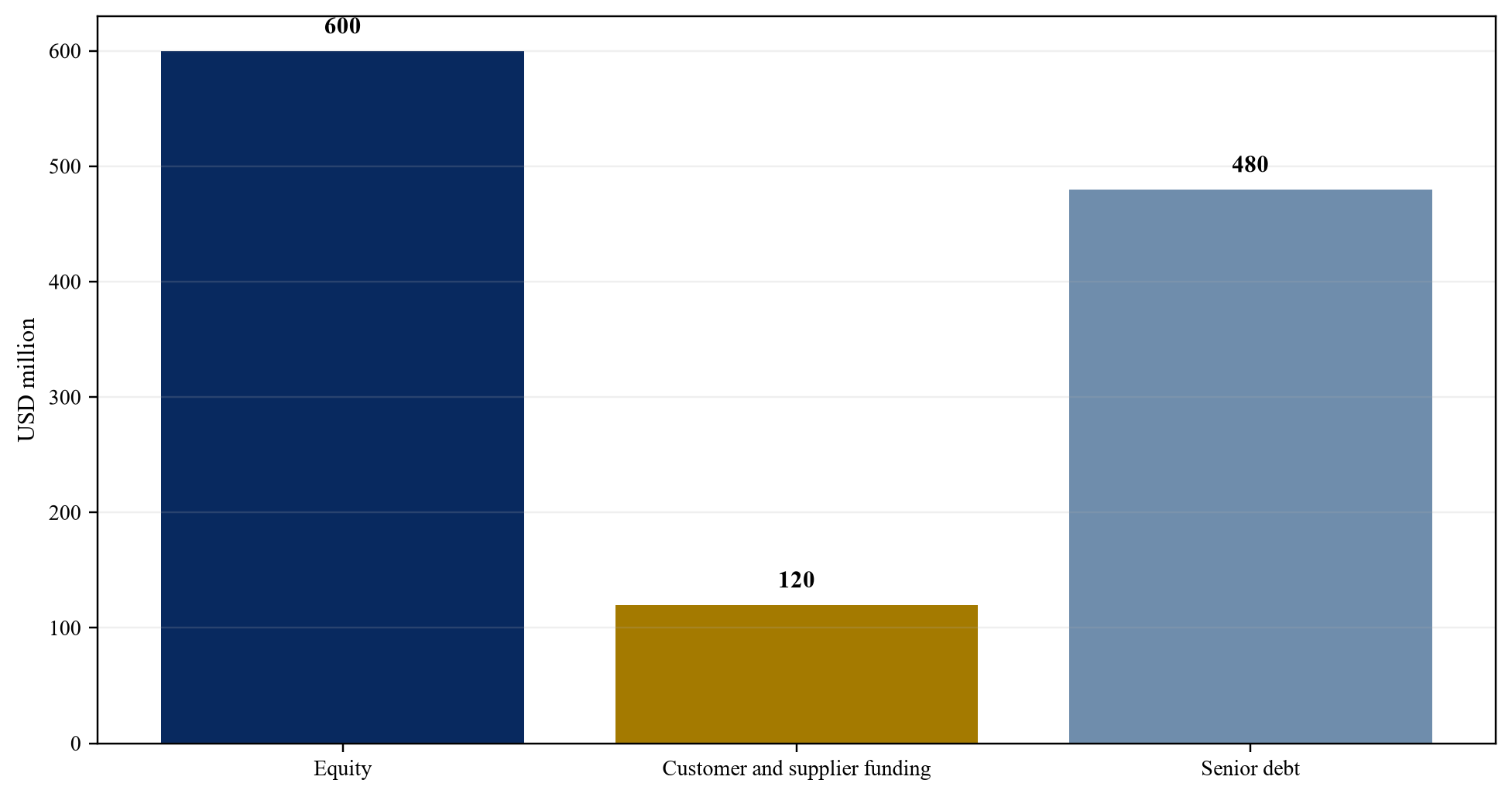
Wholly hypothetical; USD million.
| State | Minimum evidence | Debt treatment |
|---|---|---|
| Development | design and regulatory plan | equity or sponsor risk |
| Qualified | representative tests and controlled configuration | sponsor-supported pre-completion exposure |
| Commissioned | in-orbit completion tests | eligible subject to commercial completion |
| Accepted | customer service acceptance and payment | operating cash-flow evidence |
| Repeatable | replenishment, launch and service history | potential project-finance perimeter |
Proposed lender framework.
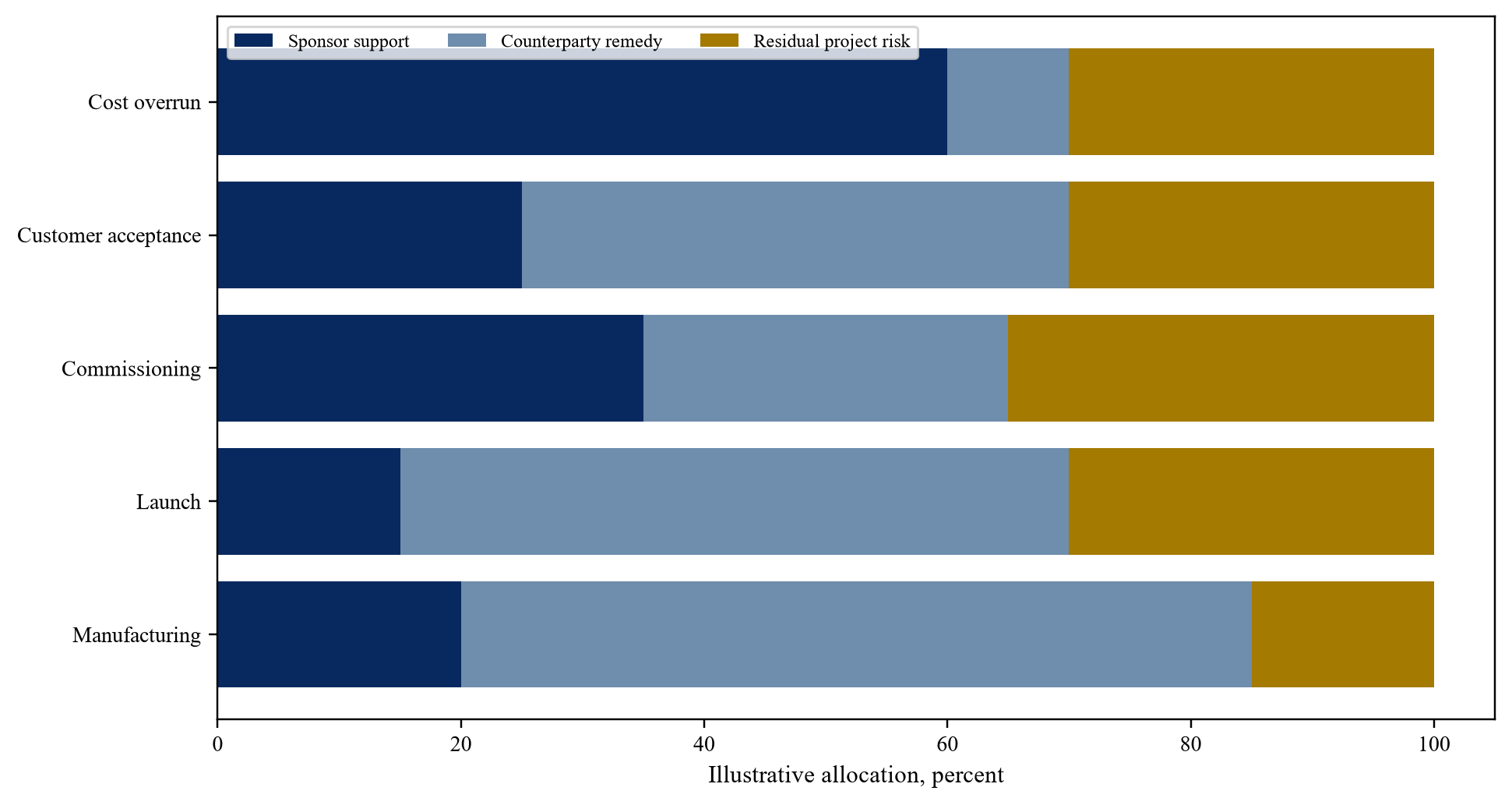
Proposed allocation of principal completion obligations.
| Contract | Bankability purpose | Key lender right |
|---|---|---|
| Manufacturing | controlled hardware delivery and remedy | notice, cure, assignment and warranty benefit |
| Launch | compatible reserved deployment | schedule evidence, insurance and replacement path |
| Network and gateways | service delivery capacity | continuity, cure and transfer |
| Customer service | enforceable accepted revenue | amendment control and direct agreement |
| Operations | safe and continuous service | step-in and transition support |
Proposed framework.
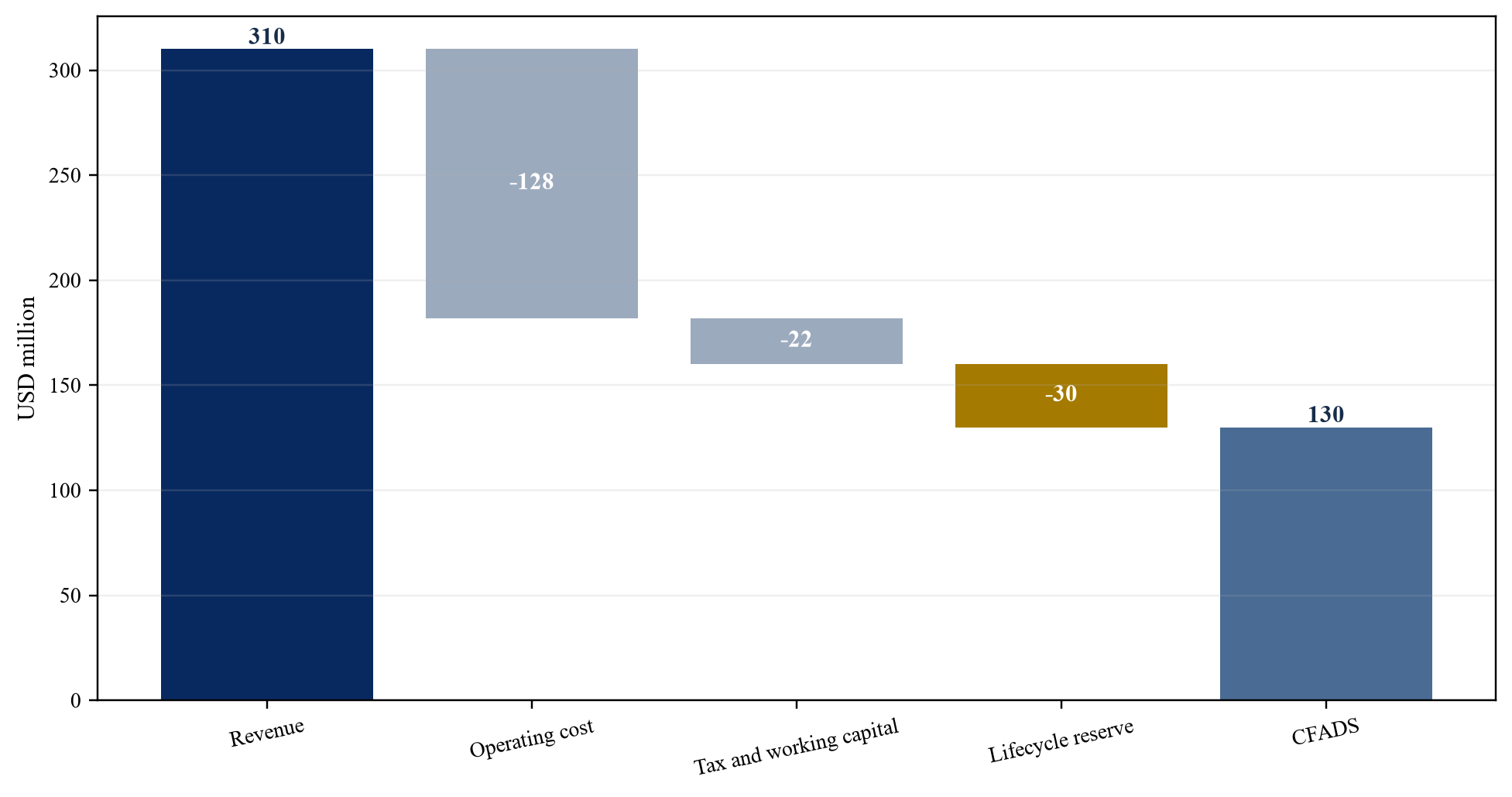
Wholly hypothetical central operating year; USD million.
| Test | Evidence | Completion consequence |
|---|---|---|
| Commissioned fleet | minimum operating nodes and telemetry | physical completion |
| Service capacity | sustained power, thermal, workload and link results | technical completion |
| Customer acceptance | accepted output, invoice and payment | commercial completion |
| Regulatory | licences and conditions satisfied | lawful operation |
| Financial | costs funded, reserves and prospective coverage | financial completion |
Proposed requirements.
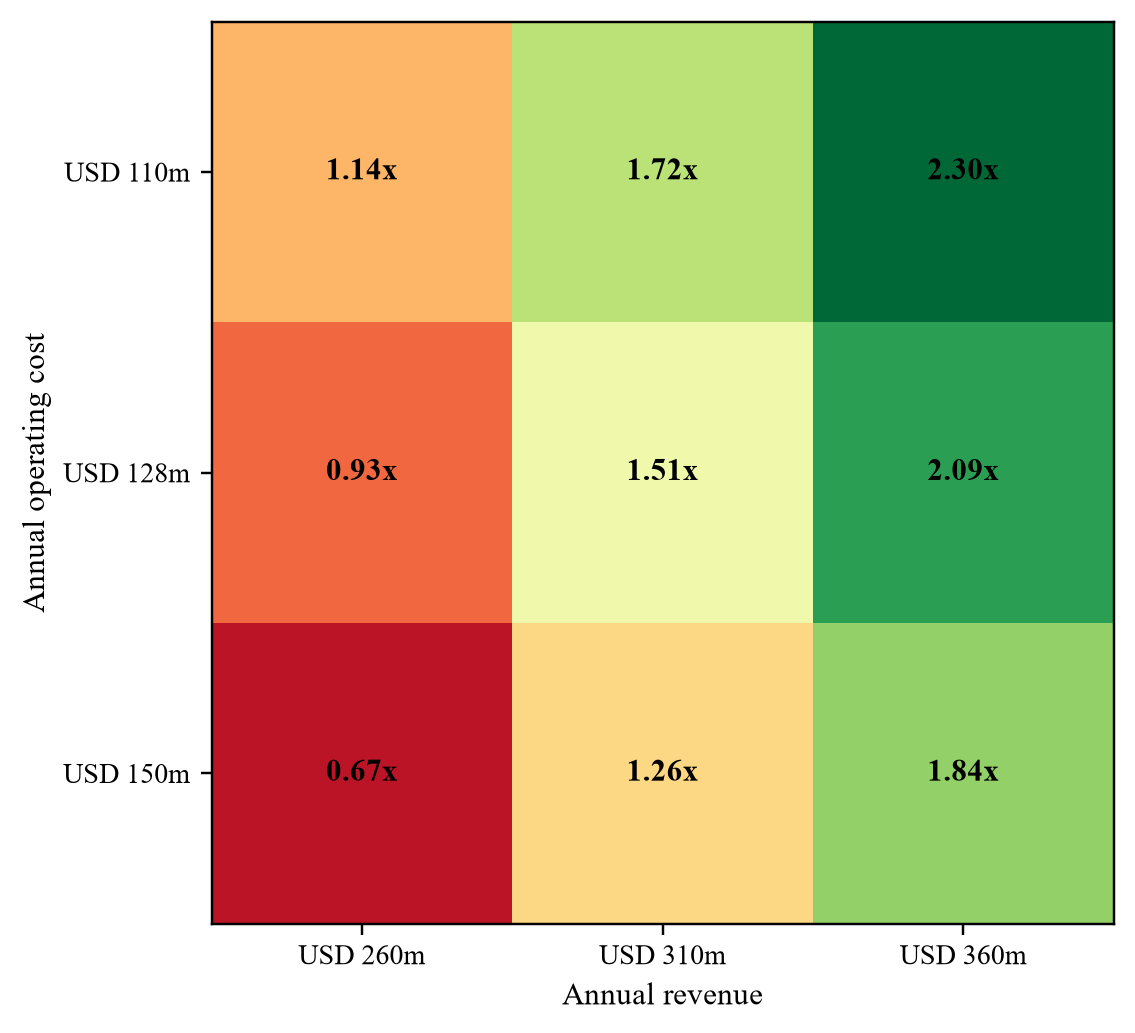
Wholly hypothetical sensitivity to revenue and operating cost.
| Uses | Amount | Sources | Amount |
|---|---|---|---|
| Node manufacturing and integration | 540 | Sponsor and strategic equity | 600 |
| Launch and commissioning | 180 | Customer and supplier funding | 120 |
| Ground and network systems | 120 | Senior debt | 480 |
| Development and qualification | 150 | ||
| Reserves and working capital | 130 | ||
| Contingency | 80 | ||
| Total | 1,200 | Total | 1,200 |
Wholly hypothetical; USD million.
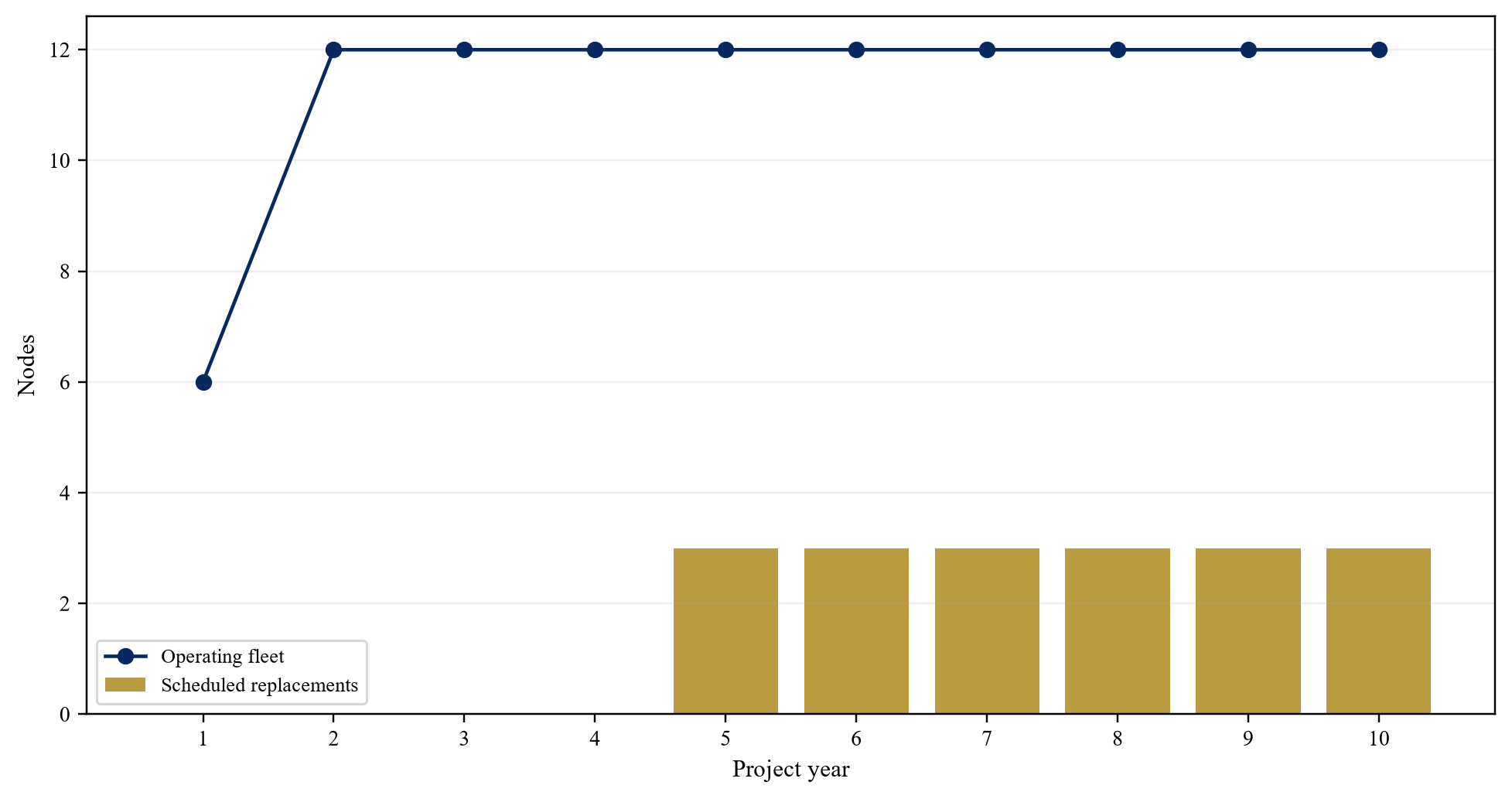
Wholly hypothetical 12-node fleet with scheduled three-node annual cohorts from year five.
| Metric | Central | Combined downside |
|---|---|---|
| Revenue | 310 | 260 |
| Operating cost | 128 | 133 |
| Tax and working-capital movement | 22 | 22 |
| Lifecycle reserve | 30 | 30 |
| Cash available for debt service | 130 | 75 |
| Annual debt service | 86 | 86 |
| Debt-service coverage | 1.51x | 0.87x |
Wholly hypothetical; USD million except ratios.
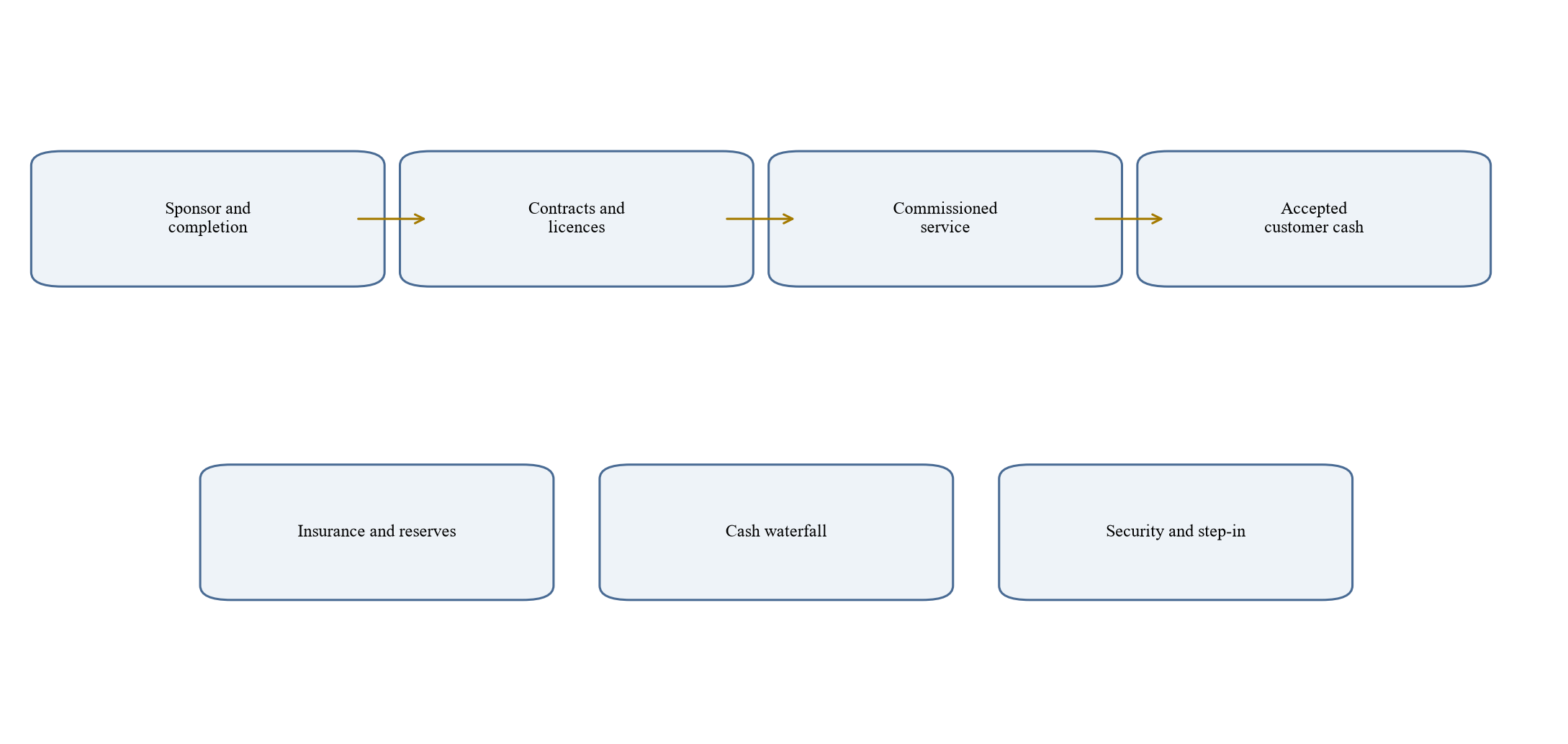
Proposed lender-control framework.
| Element | Purpose | Principal limitation |
|---|---|---|
| Project shares | governance and enforcement control | regulatory and change-of-control consent |
| Project accounts | cash waterfall and reserve control | account-bank and jurisdiction risk |
| Receivables and contracts | preserve revenue and services | assignment restrictions and counterparty rights |
| Insurance proceeds | fund repair, replacement or debt | exclusions, timing and reinstatement |
| Intellectual property rights | preserve operation | licence scope, export control and sponsor dependency |
| Direct agreements | notice, cure and step-in | counterparty consent and operational capability |
Transaction-specific legal advice is required.
| Covenant | Evidence | Trigger response |
|---|---|---|
| Minimum debt-service coverage | controlled financial model and accounts | cash trap and cure |
| Minimum operating nodes | telemetry and asset register | replacement plan and distribution stop |
| Service-available capacity | technical certificate | customer and forecast review |
| Lifecycle reserve | secured account | mandatory funding |
| Insurance compliance | adviser report and policies | cure or additional support |
| Customer concentration | contract register and collections | reduced distributions or debt sizing |
Proposed framework.
Sources
- Federal Communications Commission, Space Bureau Accepts for Filing SpaceX Application for Orbital Data Centers, DA 26-113, 4 February 2026. Read the primary source
- World Bank Group, Project Finance and Bankability Guidance, lender perspective and risk allocation. Read the primary source
- World Bank Group, Public-Private Partnership Reference Guide. Read the primary source
- United States Space Force, Launch Organization Leans into Modern Mission Assurance and Agile Integration, 2025. Read the primary source
- National Aeronautics and Space Administration, State-of-the-Art of Small Spacecraft Technology 2026. Read the primary source
- National Aeronautics and Space Administration, Small Spacecraft Power Systems. Read the primary source
- National Aeronautics and Space Administration, Small Spacecraft Thermal Control. Read the primary source
- National Aeronautics and Space Administration, Laser Communications Relay Demonstration Overview. Read the primary source
- National Aeronautics and Space Administration, Exploration and Space Communications LCRD. Read the primary source
- International Telecommunication Union, Non-geostationary-satellite networks. Read the primary source
- International Telecommunication Union, Satellite regulation and coordination. Read the primary source
- Federal Aviation Administration, Financial Responsibility for Commercial Space Transportation. Read the primary source
- World Bank Group, Insurance Checklist for Infrastructure Projects. Read the primary source
- United States Government Accountability Office, Missile Warning Satellites Risks to Capability Delivery, GAO-26-107085. Read the primary source
- National Aeronautics and Space Administration, NPR 8715.6B Requirements for Limiting Orbital Debris. Read the primary source
- Federal Communications Commission, Space Innovation; Mitigation of Orbital Debris in the New Space Age, FCC 24-6. Read the primary source
- International Organization for Standardization, ISO 24113 Space systems Space debris mitigation requirements. Read the primary source
- UK Government, Third-party liability insurance requirements and limits for licensed space activities. Read the primary source
- UK Government, Guidance on insurance and liabilities under the Space Industry Act 2018. Read the primary source
- Multilateral Investment Guarantee Agency, Political Risk Insurance. Read the primary source
- Multilateral Investment Guarantee Agency, Enhancing Credit and Increasing Access to Commercial Financing. Read the primary source
- National Aeronautics and Space Administration, High Performance Spaceflight Computing. Read the primary source
- National Aeronautics and Space Administration, Small Spacecraft Communications. Read the primary source
- National Aeronautics and Space Administration, Small Spacecraft Avionics. Read the primary source
- European Space Agency, Data Systems. Read the primary source
- European Space Agency Space Solutions, SpaceCloud Demonstration. Read the primary source
- IFRS Foundation, IFRS 13 Fair Value Measurement. Read the primary source
- IFRS Foundation, IAS 36 Impairment of Assets. Read the primary source
- IFRS Foundation, IAS 38 Intangible Assets. Read the primary source
- NASA Technical Reports Server, State-of-the-Art Small Spacecraft Technology, 2025. Read the primary source
