

1. Define the protection problem
A distressed buyer may receive few contractual warranties and little useful seller recourse. The seller may be an office holder, a special-purpose entity or a party distributing proceeds quickly. A negotiated damages clause has limited economic value when the claimant cannot collect. The buyer therefore needs a protection plan that starts with the operating facts and available funding rather than a conventional warranty schedule.
The proposed method separates four functions. Diligence establishes what can be supported before signing. The acquisition agreement records the allocated risk and any conditions. Insurance may transfer a defined part of specified unknown risk. A buyer-funded reserve supports exposures that remain outside recoverable seller or insurer claims. Each function has a different evidential standard and cash consequence.
The method does not assume insurance is available. It requires an actual indication, policy wording and underwriting position before insured recovery enters an approved transaction case. A broker presentation or expected market practice remains preliminary. The investment committee should see the uninsured case whenever coverage has not been bound or a material exclusion remains unresolved.
This paper supplies an evidence register, a coverage-to-model bridge and a hypothetical loss waterfall. It uses selected insurer and broker reports to show that claims exist and require proof. Those portfolio observations do not establish the probability or value of a claim in a particular acquisition. Transaction documents and professional advice control the actual allocation.
2. Treat seller recourse as a collectible asset
A warranty has three economic components: the statement made, the remedy for breach and a solvent source of payment. Deal teams often examine the first two in detail and leave the third as a background assumption. In distress, collectability deserves a separate diligence line. The claimant may face a cap, short survival period, restricted covenant, insolvency process or distribution of sale proceeds.
The proposed recourse schedule records the liable person, cap, duration, permitted claims, security and enforcement conditions. It also records where the liable person expects to hold cash after completion. This is not a credit rating. It is a transaction-specific map showing whether a contractual claim has an identified route to cash and what facts remain unsupported.
Escrow, retention, guarantee and set-off rights should be shown separately. They differ in control, priority and availability. A nominal warranty cap of five million pounds does not provide five million pounds of usable protection when only one million is held in escrow and the remaining obligor has no verified resources. The model should include only an established source on its applicable terms.
The schedule also prevents double counting. A buyer cannot assume the same sale proceeds fund creditor distributions, working capital and a warranty reserve without establishing the legal and contractual basis. Where recovery depends on litigation or an insolvency claim, the transaction case should state the timing, costs and uncertainty or exclude the recovery entirely.
3. Build the diligence plan from the loss mechanism
Limited warranties increase the importance of deciding what the buyer must know before completion. A broad request list can consume scarce time without resolving the issues that change value or continuity. The proposed diligence plan begins with the operating forecast and identifies the events that could make each material cash-flow assumption wrong.
For revenue, the team tests customer identity, contract rights, concentration, cancellations, credits and collection history. For costs, it tests payroll, suppliers, leases, maintenance and regulatory obligations. For assets, it reconciles ownership, condition, access and required investment. Each workstream states which forecast line it supports and the consequence of an unresolved exception.
The plan should distinguish missing evidence from adverse evidence. A missing tax return does not prove a tax liability. It prevents a supported conclusion about the filing position. An unpaid assessment is a different fact. The register preserves that distinction so the team does not convert absence into an invented number or treat an identified exposure as a documentation gap.
Diligence also needs a stop rule. If a material right, liability or cash source cannot be established by the decision date, the buyer must choose an authorised response. Possible responses include a closing condition, price adjustment, funded reserve, excluded perimeter or withdrawal. The paper does not prescribe which response is legally available in a particular process.
Table 1. Proposed protection evidence register
| Protection | Evidence required | Cash treatment |
|---|---|---|
| Seller recourse | Obligor, cap, period and collectability | Established recovery only |
| Diligence | Source, test and exception | Adjust forecast or condition |
| Insurance | Bound wording and underwriting position | Apply exact waterfall |
| Reserve | Authority, purpose and release rule | Opening funding |
| Operating control | Owner, deadline and verification | Costed implementation |
Proposed decision register. Transaction documents and specialist advice determine the actual rights and obligations.
4. Connect every warranty to evidence
The transaction team should map proposed warranties to the underlying diligence evidence. The map records the subject, source documents, testing performed, exceptions and intended remedy. Its purpose is to show whether the contractual statement reflects a completed review, a negotiated allocation or an unsupported expectation.
A warranty does not replace diligence where the buyer needs the fact to operate. Insurance may respond later to a covered financial loss, while a missing licence or inaccessible system can stop trading at completion. Continuity matters therefore require operational confirmation and, where appropriate, a condition or transition arrangement. The protection strategy follows the timing of the business need.
The map should flag knowledge qualifiers and disclosure standards. A statement limited to named individuals' awareness differs from an unqualified statement. A data room disclosure differs from a specifically identified exception if the agreement or policy treats them differently. Counsel and the insurer must determine the operative effect. The financial model should not silently assume that all disclosed material remains recoverable.
The resulting register provides a common reference for legal drafting, underwriting and investment review. It also supports post-completion monitoring because the buyer can identify the documents and assumptions connected to a later issue. The register is proposed analytical infrastructure; it is not a legal opinion about the adequacy of disclosure.
5. Separate known issues from unknown breaches
Insurance and contractual warranties often address unknown breaches of specified statements. A known environmental remediation requirement, disputed tax assessment or overdue maintenance programme requires separate treatment unless a dedicated policy or indemnity expressly covers it. The acquisition model should classify identified exposures before applying any assumed insurance waterfall.
The proposed classification has four categories. Established amounts enter the sources-and-uses schedule. Bounded but unresolved amounts receive an explicit range or scenario. Unquantified issues remain decision conditions with an identified owner and evidence request. Remote or immaterial items may be recorded without a financial adjustment when the authorised materiality policy supports that treatment.
This classification avoids a common modelling error. A buyer may include a premium for broad warranty cover and then reduce every identified risk as though the policy paid it. Actual recovery depends on the bound wording, exclusions, retention, limit, causation and proof of loss. The approved case should show the insurance response only after those terms are established.
Known issues can also affect underwriting. The insurer may request further work, exclude the matter or require another solution. The team should record this as an underwriting fact rather than presenting it as a general rule. A specific exclusion changes the residual risk and may change the bid even though the headline policy limit remains unchanged.
6. Read policy architecture as a cash waterfall
A policy should be translated into a cash waterfall that the investment committee can read. The waterfall begins with gross financial loss under a defined scenario. It then identifies loss outside the covered warranty, applies the retention, applies any sublimit or overall limit, and records the assumed recovery timing. Premium and related costs remain acquisition outlays rather than claim deductions.
Definitions matter at every step. The acquisition agreement and policy may define breach, loss, damages, knowledge, materiality and disclosure differently. The broker's claims guide states that recovery typically requires a covered breach and financial loss, with the policy defining those terms [4]. The guide is process guidance; the actual contract must be read.
The waterfall should show policy periods and notice requirements. A claim identified after the relevant period or notified contrary to the wording may receive different treatment. Deal teams should establish responsibility for monitoring, notice, document preservation and insurer communications before completion. These controls support a possible claim without asserting that the insurer will accept it.
Settlement and subrogation rights also need an owner. A buyer negotiating with a third party or releasing a seller may affect insurer rights under the policy. The policy and specialist advice determine the required consent. The financial model should not assume an immediate recovery simply because a possible breach has been identified.
7. Use claims data within its limits
Marsh reported that its clients' 2023 transactional-risk claim notifications rose 17 percent from 2022. Tax and financial-statement breaches each represented 20 percent of notified claims, while financial-statement breaches represented 45 percent of payments [1]. These figures describe Marsh's reported portfolio and do not provide a probability distribution for a new transaction.
AIG reports significant claim activity across its M&A insurance portfolio and states that its study covers policies written from 2012 to 2021. AIG also cautions that the results are not conclusive for all private acquisitions because many deals do not use this insurance [3]. That limitation should travel with every use of the data.
The appropriate use of portfolio data is to challenge diligence priorities and operational readiness. Financial statements, tax and compliance warrant focused evidence because they appear in reported claims data. The data does not justify assigning the reported proportions to a particular target or multiplying them by enterprise value to create an expected loss.
Current placement statistics require the same discipline. Marsh reported higher primary pricing in several regions during 2025 and record limits placed through its own practice [2]. A buyer still needs a transaction-specific quotation. The hypothetical model in this paper uses no market premium, retention, limit or claim-frequency assumption.
Table 2. Selected external evidence and its use
| Source | Observed scope | Permitted analytical use |
|---|---|---|
| Marsh 2024 claims report | Marsh client claims reported and paid in 2023 | Challenge diligence priorities |
| Marsh 2025 market report | Marsh placements and pricing observations | Context only, no quotation |
| AIG claims series | AIG policies written from 2012 to 2021 | Evidence that insured claims occur |
| Marsh claims guide | Broker process guidance | Design evidence and notice controls |
| UK distress guidance | General administration and pre-pack context | Frame execution constraints |
| US Code section 363 | Specified statutory sale provisions | Bounded legal illustration |
Source populations and legal scope differ. None supplies a probability or transaction-specific conclusion for the hypothetical model.
8. Account for distressed execution constraints
Distressed processes can compress diligence and negotiation. The UK Government's guidance notes that a pre-pack sale may occur immediately after an administrator's appointment and describes the administrator's control over continued trading and working-capital needs [5]. The guidance explains a process context; it does not set the terms of a buyer's warranties or insurance.
Compressed timing changes the evidence plan. The buyer should identify the small number of facts required to operate on day one, the matters required to support value, and the issues that can be monitored after completion. Each deferred item needs an authorised risk treatment. A generic post-completion diligence promise does not fund a loss or restore a missing right.
The buyer should agree data-room cut-off times and preserve the version reviewed. Late uploads need triage because they may alter a warranty, disclosure or underwriting position. The evidence register records when the document arrived, who reviewed it and whether it changed the transaction case. This supports a traceable decision under limited time.
The sale process may also limit access to management, customers or sites. The bidder should identify which conclusions depend on that access. Where the seller cannot provide it, the model should state the resulting limitation and the selected response. No scoring system can create evidence that the process does not provide.
9. Keep statutory sale effects bounded
In a United States bankruptcy sale, section 363(f) permits a sale free and clear of an interest only when one of its listed conditions is met. Section 363(e) addresses adequate protection, and other provisions affect sale mechanics [6]. The statute does not support a universal claim that every liability or operating obligation disappears.
The transaction team must identify the jurisdiction, order, assets and asserted interests that matter. Counsel should connect the requested sale protections to the actual exposure. The financial model then uses the established transaction effect. It should not use the phrase free and clear as a substitute for an exposure schedule.
The same discipline applies outside the United States. Insolvency procedures, employee rules, tax treatment, licences and successor exposure vary. This paper offers no cross-jurisdictional conclusion. Its framework records the applicable advice and prevents a label drawn from one process from becoming an unsupported assumption in another.
An insurer may also take its own view of the sale order and diligence. The underwriting position must be obtained for the proposed deal. Statutory process, acquisition agreement and policy are separate evidence layers. The buyer's retained exposure is the result of their actual interaction.
10. Quantify the uninsured perimeter
The uninsured perimeter includes matters outside the insured warranties, excluded items, the retention, loss above the limit, timing costs and expenses not covered by the definition of loss. The perimeter should be presented by issue and by cash date. A single residual-risk percentage hides differences that matter for funding.
The proposed schedule links each material issue to a gross scenario, established recoveries and residual cash. It also identifies the evidence needed to change the treatment. If a tax indemnity is being considered separately, it receives a separate line. If no coverage position exists, the schedule shows zero insured recovery rather than an assumed market solution.
The buyer should distinguish ultimate loss from interim liquidity. A policy payment, seller claim or tax refund may arrive after the business must pay employees, suppliers or authorities. The opening funding plan must support the gross payment until recovery is received. The discounted cost of a delayed recovery is only one part of that liquidity problem.
The schedule should be reconciled to the bid model. Premium, diligence costs, reserves and excluded liabilities affect the total funds required. A buyer that focuses only on enterprise value can understate the cash needed to close and operate the acquired business.
11. Establish the hypothetical model
The numerical example uses GBP millions and examines a single loss at time zero. It assumes a premium of 0.45, retention of 0.75, limit of 5.00 and covered share of 80 percent. The assumed insurer recovery arrives after six months and is discounted at one percent per month. Every number is an author assumption without empirical calibration.
The covered share is a mechanical allocation. It does not represent claim probability or an insurer's expected acceptance. The uncovered portion is paid entirely by the buyer. Recovery equals the covered loss above the retention, capped at the limit. Premium remains payable in every case and no seller recovery is included.
The model tests gross losses of 1, 3, 6 and 10. It also tests recovery delays of zero, three, six and twelve months for a gross loss of 6. A sensitivity grid varies gross loss from zero to 12 and the mechanically covered share from 50 to 100 percent. No likelihood is assigned to any cell.
The model excludes tax, legal costs, defence costs, financing costs, sublimits, policy erosion, mitigation proceeds and disputes about causation or quantum. It is a teaching device for connecting wording assumptions to cash. It is not a policy valuation, insurance quotation or recommendation.
Table 3. Hypothetical insurance assumptions
| Input | Assumption |
|---|---|
| Premium | GBP 0.45 million |
| Retention | GBP 0.75 million |
| Limit | GBP 5.00 million |
| Mechanically covered share | 80 percent |
| Recovery delay | 6 months |
| Monthly discount rate | 1 percent |
Author assumptions without empirical calibration. No insurer quotation, claim probability, seller recovery, tax or financing cost.
12. Test the coverage waterfall
At a gross loss of 1.00, the model allocates 0.80 to the covered part. After the 0.75 retention, assumed recovery is 0.05. The buyer's nominal residual cost, including the 0.45 premium, is 1.40. The policy therefore costs more than the modelled recovery in this isolated scenario.
At gross losses of 3.00 and 6.00, assumed recoveries are 1.65 and 4.05. Nominal residual costs including premium are 1.80 and 2.40. At a gross loss of 10.00, covered loss is 8.00 but recovery is capped at 5.00, producing a nominal residual cost of 5.45.
These results do not establish that one programme is economic. A decision requires multiple supported scenarios, acquisition value, programme terms, risk appetite and funding capacity. This example deliberately avoids expected-value analysis because no calibrated probability distribution is available.
The waterfall exposes where the buyer pays. Small losses remain largely within the retention. A proportion of each loss is mechanically outside coverage. Large covered losses reach the policy limit. The team can use the same structure with actual policy terms and transaction-specific loss cases once those inputs are verified.
Table 4. Hypothetical loss waterfall
| Gross loss | Assumed recovery | Nominal residual cost | PV cost at month 6 |
|---|---|---|---|
| 1.00 | 0.05 | 1.40 | 1.40 |
| 3.00 | 1.65 | 1.80 | 1.90 |
| 6.00 | 4.05 | 2.40 | 2.63 |
| 10.00 | 5.00 | 5.45 | 5.74 |
GBP million. Residual cost includes the assumed premium. The buyer funds the gross loss before recovery; no likelihood is assigned.
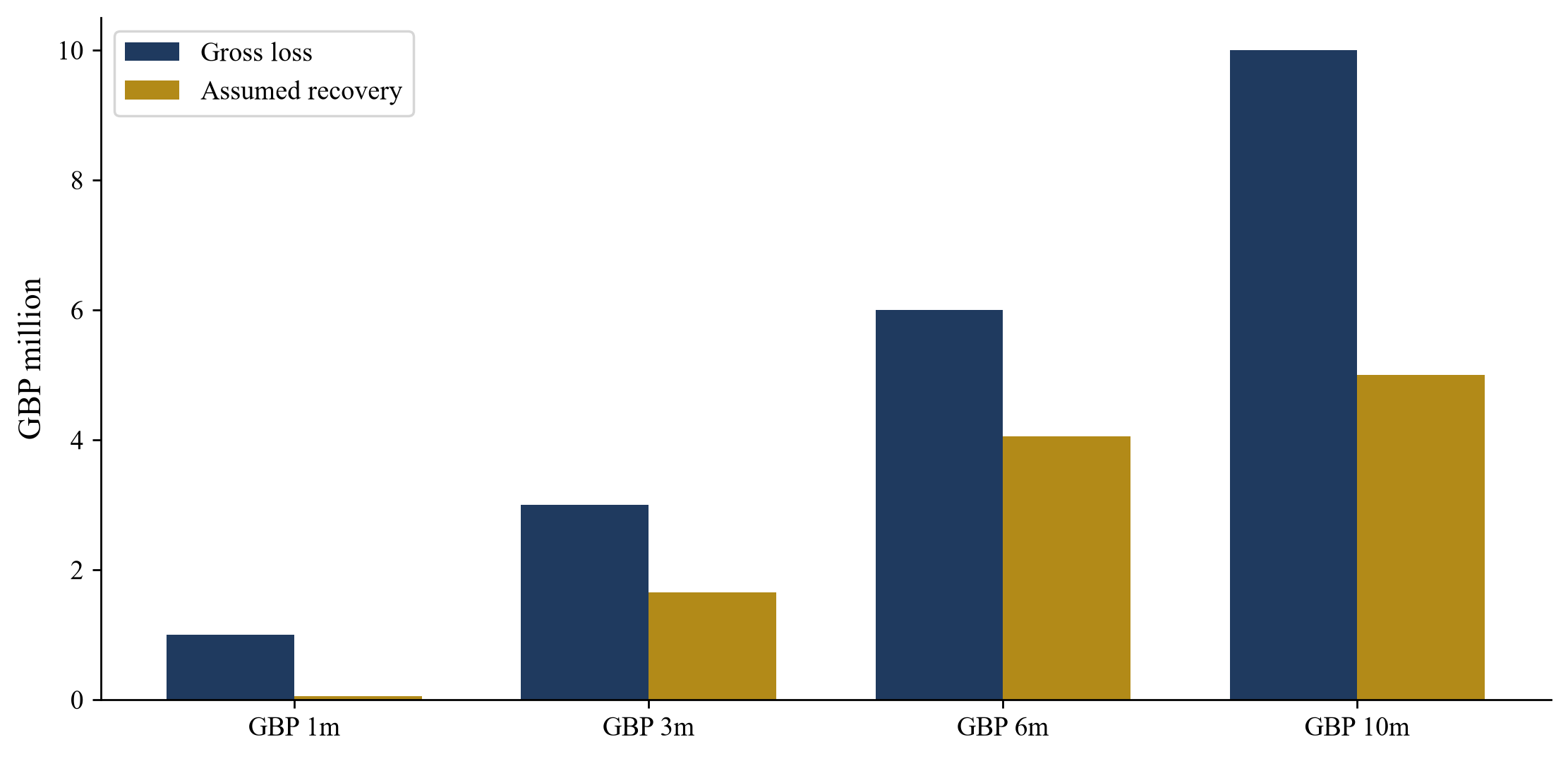
Author assumptions. Recovery applies the stated covered share, retention and limit; buyer liquidity before recovery equals gross loss.
13. Model timing and liquidity separately
For the 6.00 gross-loss case, nominal recovery remains 4.05 across the delay scenarios. Its present value falls as the assumed payment date moves from completion to month twelve. At one percent monthly discounting, the modelled present-value cost therefore rises with delay. This is a valuation effect within the assumed convention.
The interim liquidity requirement is more direct. The buyer must fund the 6.00 payment before any recovery arrives. A later insurer payment does not reduce the cash needed on the loss date. A revolving facility or equity reserve may support that requirement only if its terms, borrower and availability permit the draw.
The operating plan should identify likely payment timing for each material exposure. Some losses develop over time, while others require immediate cure or settlement. The team should model the actual cash schedule rather than forcing every matter into the paper's time-zero example.
Claim preparation can also consume management time and professional fees. Marsh's claims guide describes notice, investigation and supporting documentation [4]. The hypothetical model excludes those costs. A transaction-specific case should include established fees and internal capacity constraints where material.
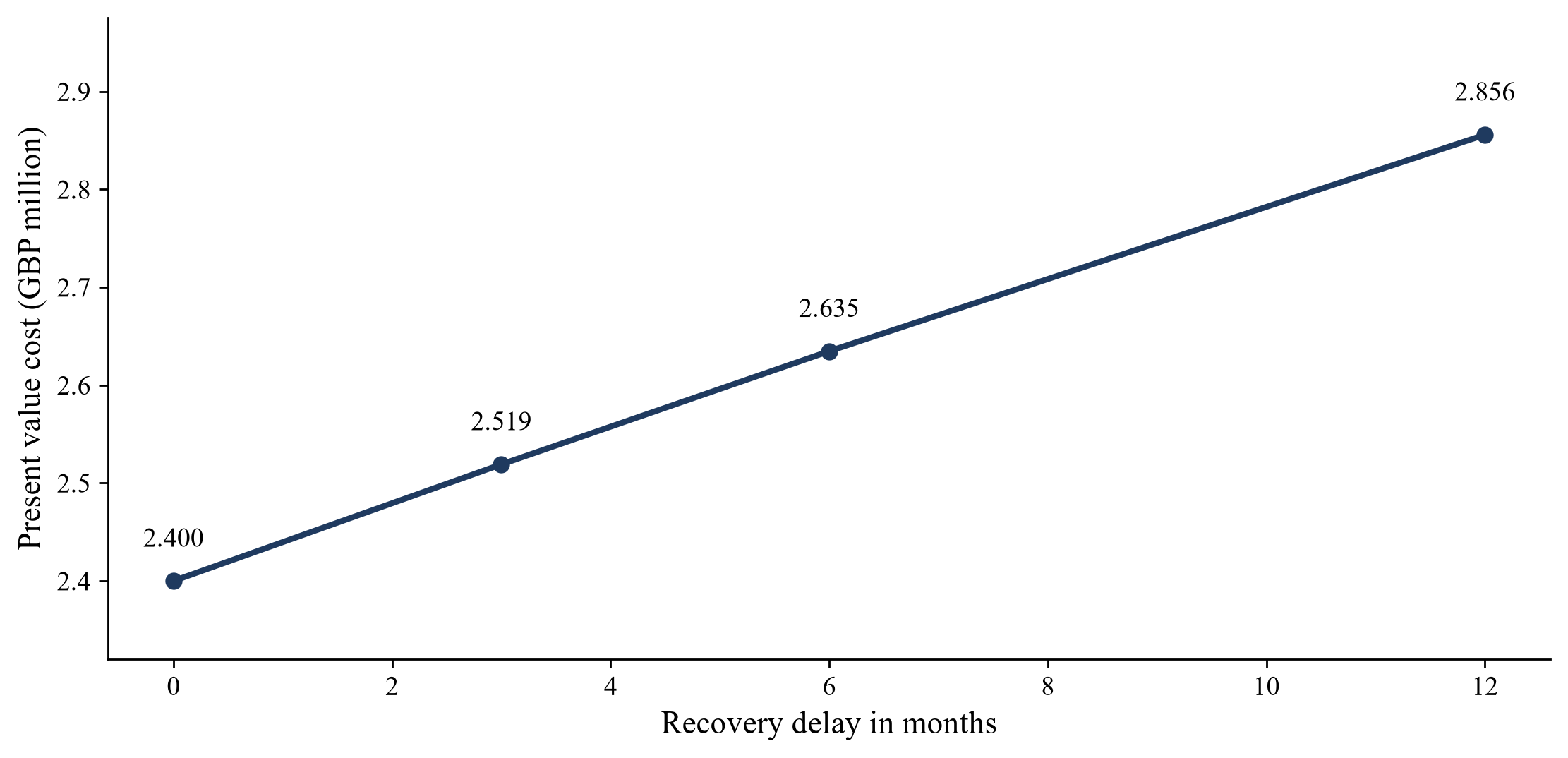
Gross loss GBP 6.00 million; nominal assumed recovery GBP 4.05 million; monthly discount rate 1 percent. Interim liquidity remains GBP 6.00 million.
14. Set reserves from scenarios and authority
A reserve is cash allocated to an identified purpose under an approved governance rule. It is not evidence that a loss will occur. The proposed reserve schedule records the scenario, payment date, available recovery, authority to use the cash and release condition. Restricted cash and unrestricted liquidity should remain separate.
The committee should see how reserve size relates to the selected scenarios. A reserve may cover the retention, excluded known issues, immediate continuity spending or a period before expected recovery. The appropriate amount depends on the actual risk and financing plan. The paper supplies no market benchmark.
Reserve releases require evidence. The expiration of a warranty period may matter, but so may completed tax filings, remediation work or resolution of a claim. The owner should report changes to the same register used at signing. This prevents unused cash from being released merely because the original project team has moved on.
Where the buyer cannot fund an adequate reserve, that is a transaction constraint. It may affect price, perimeter, conditions or willingness to proceed. The financial model should display the shortfall rather than assuming that future operating cash will absorb it.
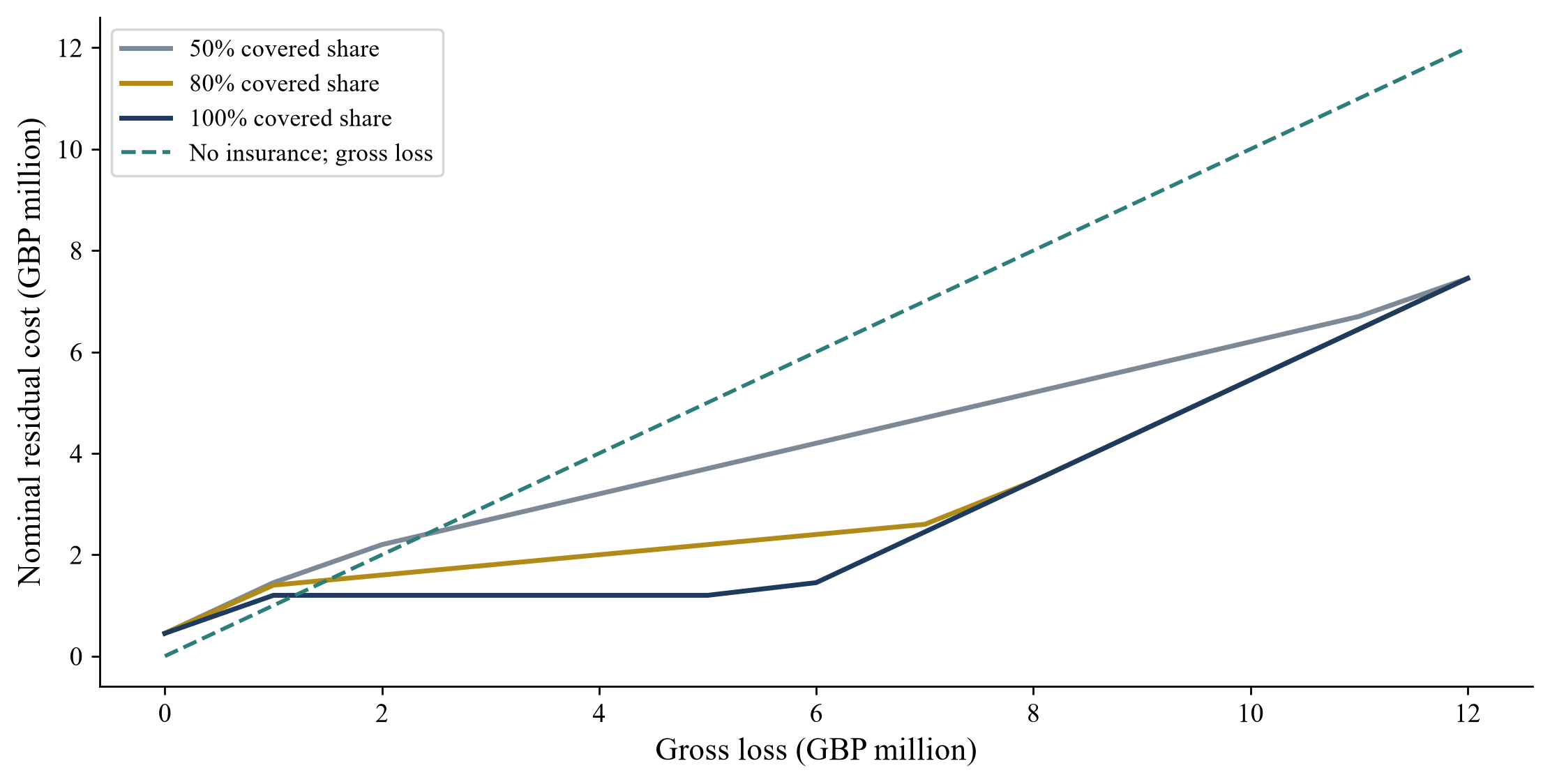
Author assumptions. Premium, retention and limit are held fixed. Coverage share is a mechanical allocation, not a claim probability.
15. Convert exclusions into diligence actions
An exclusion should create a clear action. The team first identifies the precise subject and policy wording. It then assesses available evidence, potential cash exposure and operating consequence. The response may involve deeper diligence, a specific indemnity, separate insurance, a reserve, a price adjustment or a decision condition.
The action must fit the issue. A broad cyber exclusion cannot be answered by counting policies in the data room. The buyer may need architecture evidence, incident history, access testing and a costed remediation plan. A tax exclusion may require returns, assessments, advice and a payment schedule. Specialists determine the required work.
The register should record whether additional diligence changed the underwriter's position. A verbal indication remains distinct from revised written terms. If the exclusion persists, the investment paper should show the residual exposure and funding. The headline policy limit stays unchanged, yet the usable protection for that issue may remain zero.
This discipline also identifies overlap. A known matter could appear in an exclusion schedule, a price adjustment and a reserve. The sources-and-uses model should prevent the same exposure from being deducted twice. Conversely, two different cash consequences arising from one event may both require funding.
16. Design post completion claim readiness
Claim readiness begins before signing. The buyer should preserve the final data room, acquisition agreement, disclosure materials, underwriting submissions and policy. It should record which individuals made relevant statements and where source evidence is held. Access controls must protect confidentiality while allowing authorised retrieval.
The buyer also needs an issue-escalation rule. Finance, tax, operations and legal teams should know which facts require immediate review. The responsible person then assesses notification requirements with advisers and the insurer. The paper does not define a universal notice threshold because the policy controls.
Loss calculation should retain the operational evidence. A financial-statement issue may affect earnings, working capital, tax or a third-party payment. The claimant needs a supported causal bridge rather than a headline valuation difference. Appropriate experts and policy wording determine the recoverable measure.
The governance record should preserve decisions about mitigation, settlement and communications. An insurer may have consent or participation rights. The team should establish those rights before taking an action that could affect recovery. Claim readiness supports evidence; it does not guarantee payment.
17. Use AI for controlled evidence review
AI tools may assist with locating warranty language, grouping diligence documents and comparing versions. A tool can also flag candidate differences between disclosure schedules, underwriting submissions and the signed agreement. Each output should retain its source, page or clause and review status so an authorised person can inspect it.
The tool should not decide whether a fact is disclosed, whether a warranty is breached or whether a loss is covered. Those conclusions depend on context, governing terms and professional judgement. A confident generated summary can still omit a qualifier, exception or incorporated document.
Access controls matter because transaction materials may contain personal, privileged or commercially sensitive information. The responsible organisation should approve the environment, users, retention and permitted processing. This paper makes no claim about a particular product's security, accuracy or legal suitability.
The useful performance measure is evidence quality. The team can test whether the process finds the relevant source, preserves version history and reduces unresolved items without increasing review errors. Time saved is secondary when an incorrect extraction changes a material bid or claim assumption.
18. Translate protection into bid conditions
The bid should state which protection assumptions support the price. These may include access to specified records, completion of a diligence test, receipt of an insurance indication, absence of a named exclusion or funding of a reserve. Counsel should determine how the authorised process expresses each condition.
The financial model should show the consequence of failure. If the policy excludes a material issue, the buyer may add a reserve or revise price. If day-one evidence is missing, the buyer may require another operating arrangement. The alternatives should be calculated separately and approved by the relevant decision maker.
The buyer should avoid describing insurance as committed before the policy is bound. A non-binding indication can support planning when clearly labelled and accompanied by the uninsured case. Final terms may change after underwriting, disclosure or drafting. The investment paper should record the version and date of every relied-on document.
At signing and completion, the team reconciles the executed agreement, policy and model. Any difference in retention, limit, exclusions, period or recovery mechanics should be reflected in funds required and residual risk. The reconciliation closes the gap between an approved concept and the protection actually purchased.
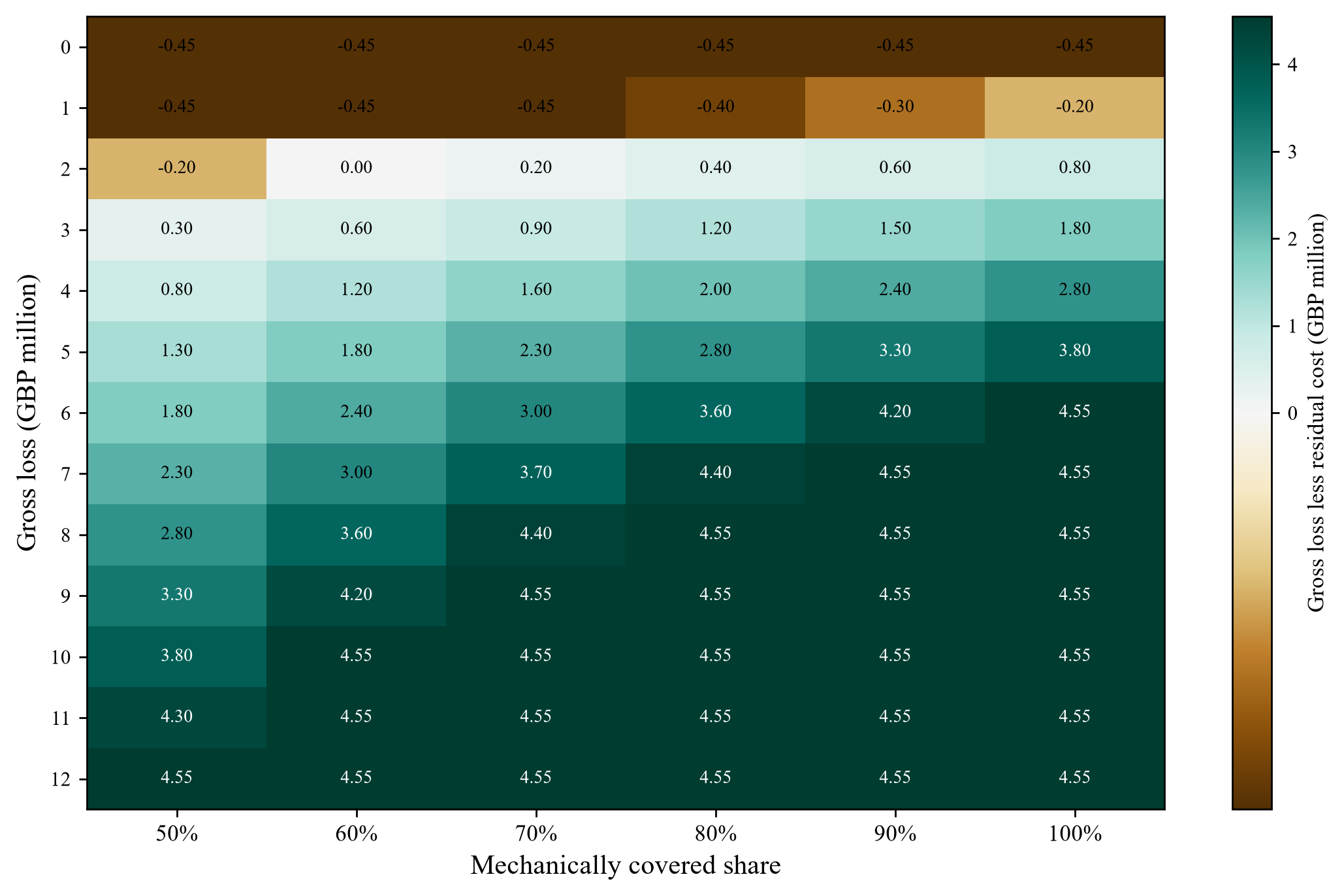
Positive cells show lower nominal cost than gross loss; negative cells show premium exceeding assumed recovery. No probability or market quotation is used.
19. Govern the decision after completion
The protection register should transfer to an accountable post-completion owner. That owner maintains policy deadlines, reserves, identified exposures and required remediation. The acquisition team should explain the assumptions and outstanding evidence rather than handing over only a closing binder.
Management reporting should separate realised losses, open matters, notified claims, insurer recoveries and reserve movements. A notification is not a payment. A reserve is not a forecast. Clear categories allow the board to see cash exposure without overstating either protection or loss.
The buyer should compare actual outcomes with the original scenarios. Differences may arise from timing, coverage, quantum or operating performance. The purpose is to improve the evidence process and funding model. One transaction cannot establish a general claim probability for future deals.
The record can also support future underwriting. Complete evidence about controls, remediation and prior claims may answer insurer questions. The underwriter decides its relevance. The buyer should provide accurate information and preserve the distinction between verified fact and management estimate.
20. Apply the framework within its limits
The proposed framework connects limited seller recourse to diligence, insurance terms, residual risk and liquidity. It helps the committee see which protection exists, what evidence supports it and when cash may be required. It does not transform an unavailable warranty into recoverable value.
The cited reports describe particular insurer or broker portfolios and process guidance. Their findings do not represent every acquisition, jurisdiction or policy. The UK Government and US statutory sources provide bounded process context. Transaction-specific legal, tax, insurance and financial advice remains necessary.
The hypothetical model has no claim probabilities or market quotations. Its premium, retention, limit, covered share, loss amounts and timing are author assumptions. It excludes several costs and legal questions. The results show how a stated waterfall behaves and should not be used as a bid or reserve without replacement inputs.
The practical decision record comprises a recourse schedule, evidence-linked diligence register, policy waterfall, residual-risk funding plan and signed-term reconciliation. Together they allow the buyer to identify unsupported assumptions before committing capital and to preserve evidence for any later claim.
21. Test financial statements against operating records
Financial-statement warranties appear prominently in the cited claims data, yet a distressed target's reporting may also be delayed or affected by unusual transactions. The buyer should reconcile the latest accounts to management ledgers, bank activity and operational records. The purpose is to understand the specific cash forecast rather than to assume that a reported claims category predicts a breach.
Revenue testing should connect invoices and receipts to customers, contracts and delivery evidence. The team should examine credits, returns, disputes and related-party items. Where the forecast assumes continued customer activity, the review should establish whether the proposed acquisition perimeter includes the required contract and performance capability. A historical invoice alone does not establish future continuity.
Cost testing should reconcile payroll, suppliers, leases, maintenance and accruals. Distress can defer payments and make a recent margin appear stronger than the cash requirement after completion. The model should distinguish recurring operating costs from arrears, cure payments and transition spending. The legal allocation of each item requires separate advice.
Working-capital analysis should use transaction-specific definitions and a dated bridge. A buyer may inherit a business with low inventory, stretched payables or overdue receivables. The protection plan should show which conditions are addressed through price, completion mechanics, warranties, insurance or retained funding. Each response has a different collection and timing profile.
22. Separate tax history from future compliance
Tax diligence should identify entities, jurisdictions, filing periods, outstanding returns, assessments, elections and payment status. The buyer should separate an established pre-completion liability from uncertainty about a filed position. The former belongs in the transaction funding schedule. The latter requires an evidence-based scenario or a clearly stated unresolved condition.
The insurance analysis should identify whether tax warranties, a tax covenant or a separate tax policy is proposed. The actual wording determines scope, exclusions, periods and loss. A broad label such as tax cover is insufficient. The team should reconcile the policy with the acquisition agreement and any disclosed or known matters.
Future compliance also needs funding. The acquired business may require systems, advisers and cash to meet obligations after completion. These costs can arise even when no historical warranty is breached. They belong in the operating plan rather than an assumed insurance recovery.
The cited Marsh portfolio reported tax as 20 percent of notifications in 2023 and only a smaller share of aggregate payments than financial statements [1]. That observation does not establish severity for this buyer. It supports careful evidence collection while leaving transaction-specific probability and value unestimated.
23. Examine compliance as an operating dependency
Compliance warranties can cover many subjects, including licences, sanctions, anti-bribery controls, environmental requirements and sector rules. The buyer should disaggregate the category. Each subject has its own authority, evidence, operating consequence and possible remedy. A single compliance score obscures the fact that one missing permission may stop trading while another issue creates a later cash exposure.
The evidence plan should identify the required licence holder and the effect of the proposed acquisition structure. It should also record inspections, notices, remedial commitments and correspondence with authorities where available. Counsel and sector specialists determine legal effect. The transaction model uses their supported conclusion rather than an automated classification.
Insurance wording may exclude or limit a known investigation, identified non-compliance or forward-looking remediation. The underwriter's written position should be recorded. If no protection exists, the buyer needs a funded response and a decision on whether the business can operate within the required timetable.
Post-completion controls should address both remediation and evidence preservation. The new owner may need to make a filing, implement a control or monitor a deadline. The handover plan assigns responsibility and cash. It should not assume that an historic warranty pays for ordinary future compliance.
24. Diligence the insurance programme itself
The proposed policy requires its own diligence. The buyer should review the insured, policy period, warranties covered, definitions, exclusions, retention, limit, sublimits, defence arrangements, notice rules, consent rights and governing law. The acquisition agreement and policy should be compared clause by clause where their interaction is material.
Underwriting submissions also matter. Information supplied to the insurer should be accurate and consistent with the final data room and agreement. Late changes require a controlled update. The team should retain the final submission and written responses so a later reviewer can see what the underwriter received.
The insurer's identity and financial standing may be relevant to the buyer's risk assessment. The appropriate review depends on jurisdiction and policy structure. This paper makes no assessment of a named insurer. The buyer should use verified regulatory and financial information and follow its approved counterparty process.
The committee should receive a concise exception report. It should identify material differences between the requested programme and the bound terms, together with the cash effect. A long policy summary can sit behind that report. The decision paper should expose the limitations that affect value or funding.
25. Reconcile transaction documents at each gate
The proposed process uses four document gates. The first compares the initial bid assumptions with the diligence plan. The second compares the draft acquisition agreement with the proposed insurance scope. The third compares the final underwriting position with the investment approval. The fourth compares executed terms and completion cash with the approved model.
At each gate, the owner records changes rather than replacing the prior version without explanation. A new exclusion, narrower warranty or higher retention should produce a visible model adjustment. A new source document may resolve a condition and reduce a reserve. The record therefore shows why the approved risk position changed.
The gate should also identify authority. Legal counsel advises on drafting and effect, insurance specialists advise on placement and claims, finance owns the cash model, and the investment body accepts the residual risk within its mandate. Actual responsibilities depend on the organisation. The proposed allocation must be adapted and approved.
This reconciliation is especially important in a rapid process. Several workstreams may negotiate simultaneously. A committee can approve a protection package that no longer matches the latest documents if changes are not connected. The final gate creates a single dated record before funds are released.
Table 5. Proposed implementation gates
| Gate | Required evidence | Decision output |
|---|---|---|
| Initial bid | Recourse map and critical diligence | Conditional price case |
| Draft documents | Warranty and policy comparison | Exception report |
| Final approval | Bound-term indication and funding | Approved residual risk |
| Completion | Executed terms and cash schedule | Funds release |
| Post completion | Issue, notice and reserve register | Governed claim readiness |
Proposed workflow. Legal authority, insurance advice and internal approvals must be established for the actual acquisition.
26. Measure whether the protection system works
Performance measures should test evidence and cash readiness. Useful measures include unresolved material items at signing, exceptions without funded treatment, differences between approved and bound terms, missed notification deadlines and claim files lacking source support. Each measure requires a defined denominator and owner.
The organisation can also record time spent locating documents, responding to insurer questions and reconciling loss calculations. These observations may identify process improvements. They should not be presented as universal productivity gains or attributed to a tool without controlled evidence.
After a transaction, the buyer should compare actual issues with the original register. It can determine whether the diligence plan addressed the relevant operating mechanism, whether reserves were available at the required date and whether the policy response matched the recorded assumption. The review should preserve adverse findings rather than rewrite the original rationale.
Aggregate experience across multiple completed transactions may eventually support better internal scenarios. The dataset should retain deal context, policy terms, exposure definitions and outcome status. Management estimates and unresolved claims remain labelled. Until a sufficient and comparable evidence base exists, the paper's deterministic scenarios provide transparency without claiming predictive accuracy.
References
- Marsh. Global Transactional Risk Insurance Claims Report 2024. Marsh-client claims reported and paid in 2023. Accessed 5 September 2026. https://www.marsh.com/en/services/private-equity-mergers-acquisitions/insights/global-transactional-risk-insurance-claims-report-2024.html
- Marsh. Marsh reports shifts in transactional risk market in 2025. Published 19 March 2026; accessed 5 September 2026. https://www.marsh.com/en/corp/about/news/shift-transactional-risk-insurance-market-2025-report.html
- AIG. Mergers and Acquisitions Claims Intelligence Series, Seventh Edition. Study period includes policies written from 2012 to 2021. Accessed 5 September 2026. https://www.aig.com/home/risk-solutions/business/management-and-professional-liability/mergers-and-acquisitions/mergers-and-acquisitions-claims-reports
- Marsh. R&W Insurance Claims: A Practical Guide. Accessed 5 September 2026. https://www.marsh.com/content/dam/marsh/Documents/PDF/US-en/reps-warranties-insurance-claims-guide.pdf
- UK Government. Corporate Financial Distress Guidance Note, sections on administration and pre-pack sales. Updated 2026; accessed 5 September 2026. https://www.gov.uk/government/publications/the-sourcing-and-consultancy-playbooks/corporate-financial-distress-guidance-note-html
- United States Code. Title 11, section 363, Use, sale, or lease of property. Reviewed 5 September 2026. https://www.law.cornell.edu/uscode/text/11/363
