

1. Define the decision before assembling the report
The board's decision is whether a defined business can be sold on terms that preserve more executable value than the available alternatives. Vendor due diligence should therefore begin with the proposed transaction perimeter, the liquidity available to reach closing, the liabilities that remain with the seller and the operating conditions that must survive transfer. The report should support that decision directly.
A conventional review often begins with historical financial statements and moves toward adjusted earnings. A distressed review should begin with the cash and authority needed to sustain the company while buyers evaluate it. The sequence changes the evidence request. Bank balances, receipts, payroll, critical suppliers, debt controls, customer obligations and approvals become early workstreams rather than late confirmatory items.
The board should specify the claims that the diligence must establish. These normally include the revenue and earnings that belong to the sale perimeter, the cash required before and after closing, the completeness of debt and liabilities, the transferability of material contracts and licences, and the continuity of people, systems and suppliers. Each claim should have named evidence, an owner, a current date and a clear treatment when evidence is missing.
The legal context matters from the outset. UK guidance states that directors of an insolvent company must protect assets, consider creditors and avoid worsening creditor outcomes. [1] The UAE Financial Restructuring and Bankruptcy Law and its executive regulations establish separate procedures and thresholds. [2] [3] A cross-border group may contain entities under several regimes. The diligence perimeter should therefore be legal-entity specific even when the commercial narrative presents one integrated business.
The output should be a decision system rather than a static report. It combines a sustainable-earnings bridge, direct liquidity forecast, working-capital analysis, debt and security map, liability schedule, operational dependency map, buyer evidence room, remediation register and proceeds model. The board and buyers should be able to trace every material conclusion to evidence and every unresolved point to a quantified or operational consequence.
2. Establish the liquidity-first diligence architecture
Liquidity-first diligence connects four layers. The first layer is bankable cash: unrestricted balances, reliable receipts, required payments and access to facilities. The second is economic performance: revenue quality, margins, costs and cash conversion for the sale perimeter. The third is transferability: assets, contracts, people, licences, data and systems that permit continued operation. The fourth is transaction execution: approvals, releases, cure amounts, fees and the buyer's funding path.
The layers should reconcile. Revenue described as recurring should be supported by contracts, invoices, acceptance and collection history. EBITDA adjustments should tie to the ledger and should state their cash effect. Debt balances should agree to lender statements, security records and the funds flow. Employee and supplier schedules should agree to payroll, purchase commitments and the minimum operating cash requirement.
The report should distinguish observed evidence from management assumptions. Observed evidence includes signed contracts, bank records, filed returns, payroll data, facility statements and documented customer acceptance. Management assumptions include expected collections, forecast renewals, potential supplier extensions and future cost reductions. Assumptions can be used, but they should carry owners, dates, sensitivities and a route to confirmation.
The architecture also needs a time dimension. A document can be accurate at the start of a process and misleading six weeks later. Cash, orders, employees, supplier terms and buyer requirements change quickly in distress. Every schedule should carry a version date, and the report should state which sections are refreshed weekly, at bid milestones or upon a defined event.
The Financial Reporting Council's going-concern guidance emphasises company-specific analysis of solvency and liquidity risks, assumptions and feasible actions. [4] ISA 570 (Revised 2024) strengthens the evaluation of management's going-concern assessment and related transparency, although its effective date is for periods beginning on or after 15 December 2026. [5] These sources support disciplined assessment; they do not turn a vendor report into an audit opinion.
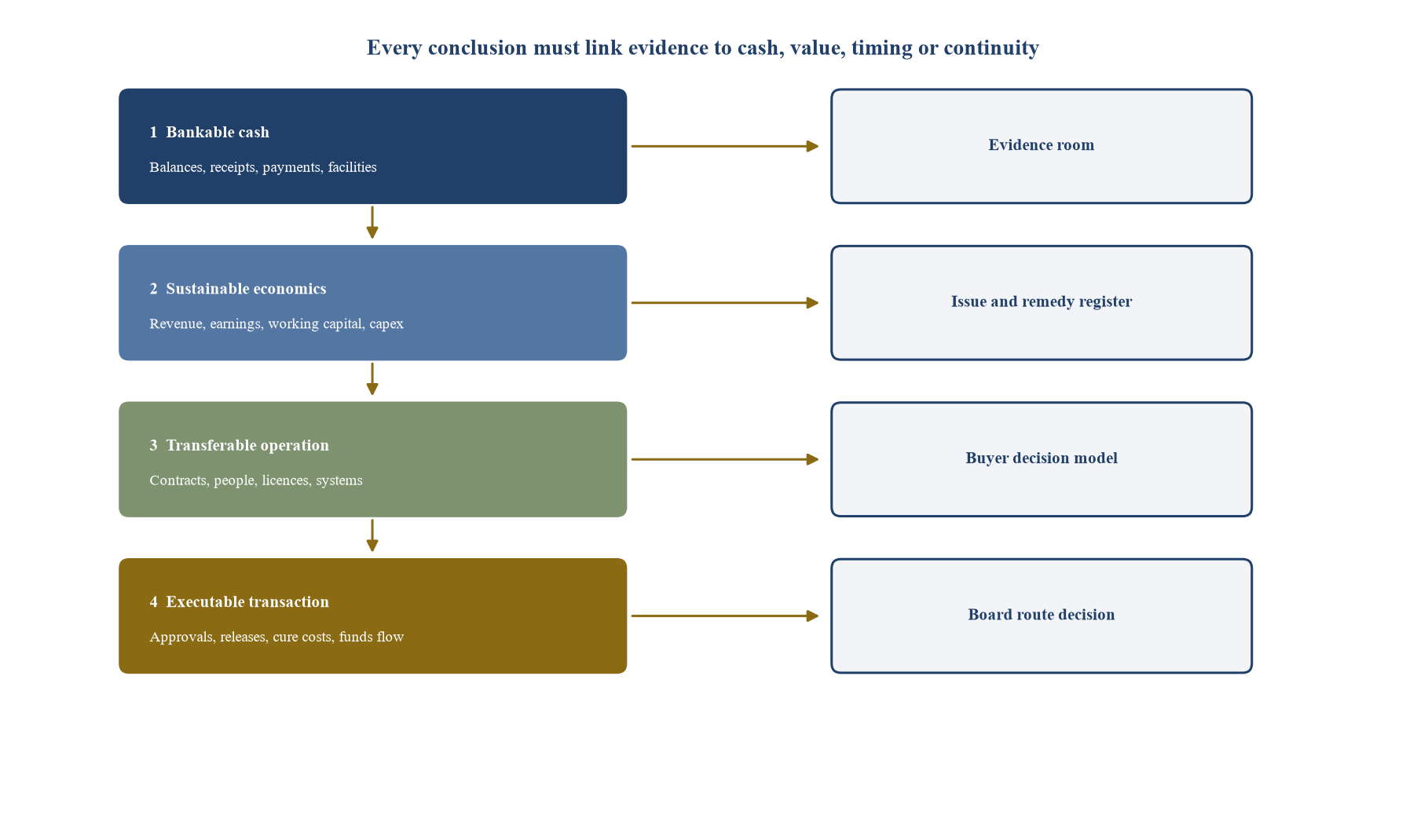
Original framework. The sequence is illustrative and requires entity-specific legal, accounting and transaction review.
3. Define the sale perimeter and reporting perimeter
The sale perimeter states which shares, assets, contracts, employees, liabilities and locations the buyer is expected to acquire. The reporting perimeter states which financial results and cash flows belong to that package. They should be aligned before the earnings analysis begins. A group-level EBITDA figure can overstate value when shared costs, guarantees, debt or systems remain outside the transaction.
The perimeter schedule should identify each legal entity, business line, site and material asset. It should show ownership, operating role, revenue, employees, licences, bank accounts, security and intercompany balances. Shared services should be allocated through an evidenced methodology and accompanied by a Day One replacement or transition-services plan.
Historical accounts may not match the sale perimeter. Management should produce a carve-out bridge from audited or filed accounts to the perimeter, including eliminations, allocations and transactions with related parties. Buyers need enough detail to test whether the resulting business can operate independently and whether its cost base is complete.
Intercompany balances require particular care. A receivable may be unavailable to the sold business, a payable may be demanded before closing, and a guarantee may survive the transfer. The diligence should distinguish balances that settle at closing, continue, are waived or create a proceeds deduction. Legal and tax advice should confirm the intended treatment.
The perimeter should remain controlled through the process. A customer loss, asset claim, licence problem or buyer request can change the package. Changes should be logged, approved and reflected consistently in the model, data room, bid instructions and transaction documents. Buyers should price the same perimeter at each comparable stage.
4. Build a quality-of-earnings bridge that survives cash testing
The quality-of-earnings analysis should reconcile reported EBITDA to sustainable EBITDA for the defined perimeter. Each adjustment needs a description, source, period, accounting treatment, cash effect, recurrence assessment and buyer relevance. The analysis should avoid aggregate management add-backs that cannot be traced to transactions or contracts.
Distress creates unusual effects in both directions. Lost volume, expedited freight, professional fees, employee departures and supplier disruption may depress recent earnings. Unpaid expenses, deferred maintenance, under-accrued obligations and temporary non-payment may inflate them. The report should identify both, rather than presenting only adjustments that increase value.
Revenue adjustments should focus on delivery and collection. A booked sale may require further cost, acceptance or cure work before cash is received. A contract may be profitable on an accounting basis and consume cash during the sale period. The earnings bridge should therefore connect major revenue adjustments to backlog, milestones, receivables and remaining cost to complete.
Cost adjustments should distinguish removal from deferral. A supplier balance that has not been paid does not create sustainable margin. A vacant role may require replacement after closing. Reduced marketing or maintenance may be temporarily possible and commercially damaging. The buyer case should include the cost required to operate the business safely and competitively.
SEC guidance on non-GAAP financial measures highlights clear labels, comparable GAAP measures, reconciliations and sufficient detail for readers to understand adjustments. [6] ESMA's Alternative Performance Measure guidance similarly stresses definitions, reconciliation, reliability and comparability. [7] [8] A private distressed sale may fall outside those rules, but the disciplines are useful for a credible earnings bridge.
| Item | EBITDA effect | Cash effect through closing | Evidence | Diligence treatment |
|---|---|---|---|---|
| Reported EBITDA | USD 8.6m | Starting point | Ledger and management accounts | Reconcile to filed accounts and perimeter |
| Non-recurring restructuring advisers | +USD 1.0m | USD 1.4m payment requirement | Invoices and engagement terms | Add back for earnings; retain cash requirement |
| Unfunded maintenance catch-up | -USD 1.2m | USD 0.9m before or shortly after closing | Asset records and engineering review | Treat as recurring operating requirement |
| Under-accrued supplier claims | -USD 1.0m | USD 1.0m cure or liability | Supplier statements and disputes | Reduce earnings and include liability |
| Lost customer contribution | -USD 1.5m | USD 0.7m working-capital release | Termination and trading data | Remove from sustainable earnings |
| Temporary freight and disruption cost | +USD 0.8m | Already paid except USD 0.2m | Purchase and logistics records | Add back evidenced portion only |
| Required standalone systems and leadership | -USD 1.8m | USD 0.6m transition requirement | Carve-out and organisation plans | Include complete standalone cost |
| Sustainable EBITDA | USD 4.9m | Separate cash bridge required | Reconciled adjustment schedule | Use as one valuation input |
All amounts are hypothetical and represent a simplified analytical case. They are not a valuation, audit conclusion or forecast.
5. Reconcile earnings to a direct liquidity forecast
Sustainable EBITDA does not show whether the company can reach closing. The liquidity model should record actual expected receipts and payments by week. It should begin with reconciled unrestricted cash and should exclude balances that are blocked, pledged, restricted, trapped or otherwise unavailable.
Receipts should be invoice based. The schedule should state the customer, invoice, due date, acceptance condition, dispute status, collection action and expected bank date. Large receipts should have downside dates and confidence evidence. A historic collection ratio alone is too coarse when one delayed receipt can determine whether payroll is funded.
Payments should be organised by consequence. Payroll, tax, insurance, utilities, data hosting, health and safety, critical suppliers, debt service and transaction expenses may have different legal and operational priorities. The forecast should distinguish documented arrangements from assumed extensions. It should also identify costs triggered by the transaction, including retention, consent, cure, regulatory and closing costs.
Forecast versions should be compared with actual cash each week. Variances need reasons and owners. Repeated optimistic collection assumptions or omitted payments should lead to a bias adjustment and board escalation. A diligence report that uses an unreliable liquidity forecast should state that limitation and should avoid presenting a precise closing path.
The forecast should continue beyond the intended closing date. Funds can arrive late, approvals can slip and the residual seller may require liquidity after transfer. The buyer may also need Day One funding for payroll, supplier normalisation, backlog completion and customer remediation. The diligence should show pre-closing and post-closing cash separately.
6. Test working capital for availability and transfer
Working capital analysis should explain what converts into cash, what transfers to the buyer and what must be funded. Accounts receivable need ageing, disputes, acceptance status, set-off rights, security and collection history. Inventory needs ownership, condition, location, obsolescence, retention-of-title exposure and its connection to live orders.
Accounts payable should be reconciled to supplier statements, purchase commitments and overdue amounts. Distress can make the ledger incomplete when invoices are delayed, disputes are informal or suppliers suspend service. The report should show ordinary trade balances, critical arrears, disputed claims and amounts required to restore normal terms.
The normalised working-capital target may be unstable. Historic averages can be distorted by rapid growth, seasonality, payment deferrals or the onset of distress. The analysis should use monthly history, the latest position and an operating forecast. It should identify which components are included in the transaction and which become debt-like or seller liabilities.
Customer deposits, deferred revenue, warranties and contract liabilities deserve separate treatment. They may provide cash before closing while obligating the buyer to deliver future work. The proceeds bridge should recognise the economic burden instead of treating the cash balance as freely distributable.
The report should also consider cash trapped by structure. Receipts may belong to a secured account, joint venture, foreign subsidiary or client-money arrangement. Legal and financing advice should determine availability. Management should never assume that group cash can be moved merely because it appears on a consolidated balance sheet.
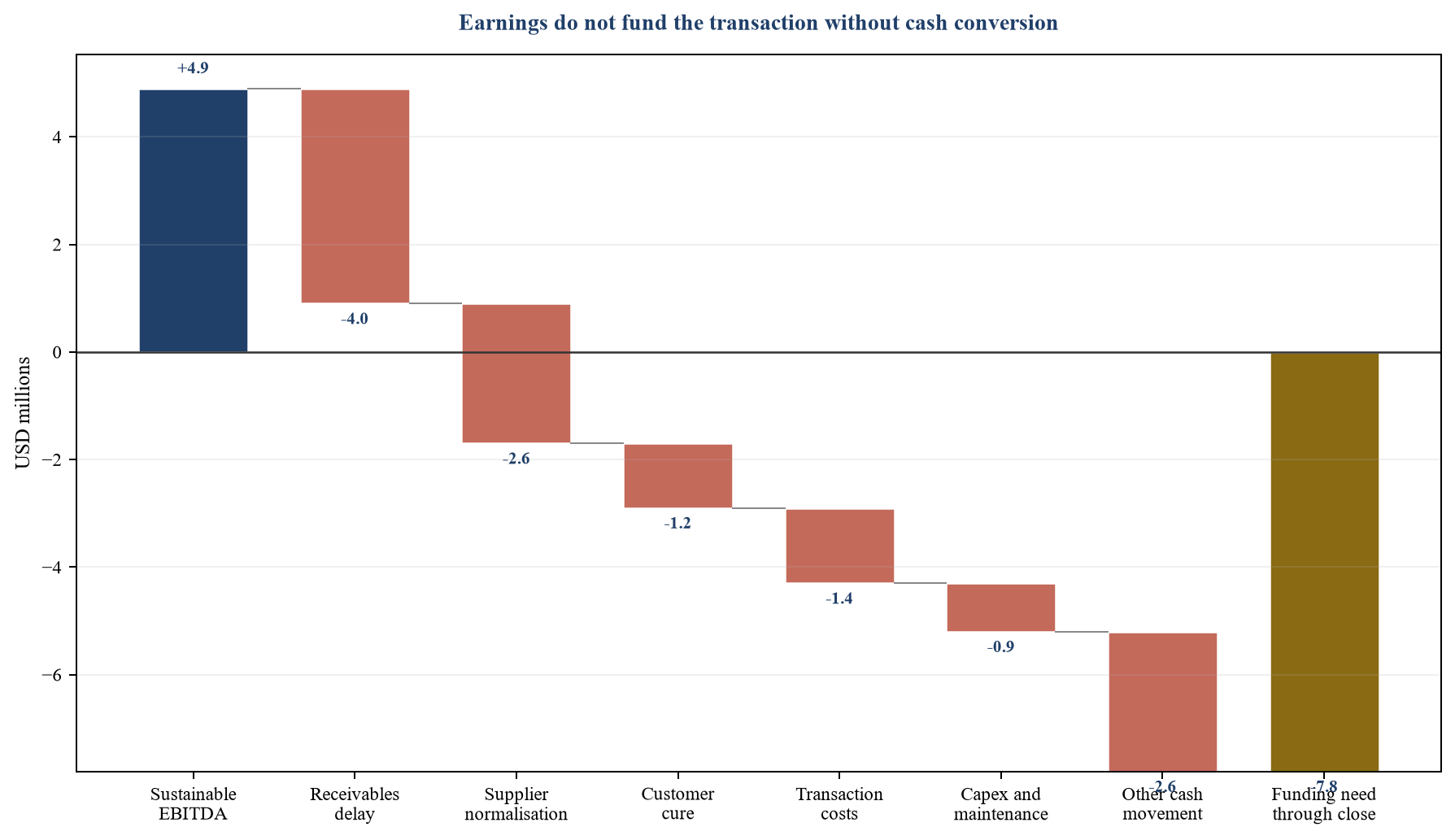
Original analysis using hypothetical amounts. Negative bars represent cash requirements; the result is not a forecast for any company.
7. Establish debt, security and cash-control facts
The debt schedule should identify every borrower, lender, guarantor, facility, drawn amount, accrued interest, fee, maturity, covenant, event of default and repayment requirement. It should be supported by executed agreements, amendments, lender statements and correspondence. Management summaries are useful indexes; they are not substitutes for the underlying terms.
Security should be mapped by asset, account, entity and jurisdiction. The report should identify fixed and floating security, share pledges, guarantees, receivables assignments, account control, negative pledges and retention-of-title claims. The buyer needs to know what can be transferred and which releases are required.
Cash-control provisions can change the liquidity analysis. A lender may sweep receipts, block accounts, reserve availability or refuse further drawings after a default. The forecast should use the contractual position and actual bank operation. Facilities should be treated as liquidity only when borrowing capacity, conditions and lender discretion have been tested.
The payoff and release process belongs in diligence. The seller should request indicative payoff amounts, release documents, filing steps, authorities and the lender's approval timetable early. A sale can have enough enterprise value and still fail because the funds flow does not deliver the lender's required amount or the security cannot be released on time.
United States Courts guidance on Chapter 11 explains that cash collateral generally requires secured-party consent or court authority, while sales outside the ordinary course require court permission. [9] The exact mechanics vary by jurisdiction. The universal diligence point is that cash and assets can be subject to rights that materially affect use and sale.
8. Identify liabilities that alter price or closing
The liability review should include recorded balances, unrecorded obligations, contingencies and transaction-triggered amounts. Tax, payroll, pensions, litigation, warranties, customer credits, environmental matters, leases, employee claims, data incidents and regulatory issues may affect price or the transaction route.
Completeness matters more than optimistic classification. The report should state how each liability was identified and whether it is quantified, estimated or unresolved. Claims should be reconciled to advisers, correspondence, filings and counterparty statements where available. Material uncertainty should be presented with a range or decision consequence rather than hidden in a general caveat.
Distress can create new liabilities during the process. Continued trading may require deposits, accelerated payments, retention awards or customer remediation. A failed transaction can create termination fees, adviser costs and loss of stakeholder support. The liquidity and proceeds models should contain these items under relevant scenarios.
The report should separate liabilities assumed by the buyer, discharged at closing, retained by the seller and subject to legal procedure. That allocation must agree with the sale perimeter and transaction document. A buyer may price an asset deal differently from a share sale because the liabilities and consents differ.
The UAE executive regulations state thresholds for debtor and creditor applications under the federal bankruptcy framework. [3] Thresholds and procedures can affect available routes, but a paper cannot determine their application to a live company. The board should obtain current advice for every relevant entity and financial free zone.
9. Prove revenue, customers and contract transferability
The revenue analysis should connect the ledger to customers, contracts, orders, delivery, acceptance, invoices and cash. It should identify concentration, renewal, termination, change-of-control, set-off, service-credit and assignment provisions. A high revenue figure can have limited transferable value when a small number of customers can leave or withhold consent.
Backlog should be tested for enforceability and remaining economics. The schedule should show contract value, revenue recognised, cash received, cost to complete, margin, milestone status and delivery risk. Loss-making or unfunded backlog can consume liquidity and may need cure before a buyer will rely on it.
Management forecasts should separate contracted work, evidenced pipeline and speculative opportunities. Conversion assumptions should be compared with history and current capacity. Distress can reduce new awards when customers perceive continuity risk. The report should state that risk and should avoid treating pipeline as contracted revenue.
Customer interviews or confirmations can improve evidence, but they require controlled timing and legal advice. Premature contact can expose distress, disrupt negotiations or breach confidentiality. The transaction team should rank customers by value and transfer importance and should plan who speaks, when and with what approved message.
Collection evidence should feed the liquidity model. A disputed milestone, offset claim or delayed acceptance can change the funding requirement. The revenue report and cash forecast should never use different views of the same invoice.
10. Map suppliers and operational dependencies
The supplier analysis should identify which counterparties can stop delivery, revoke access, terminate a licence, repossess goods or demand cash in advance. It should combine contract terms with operational reality. A low-spend software vendor or specialist subcontractor can be more critical than the largest supplier by value.
The schedule should include balances, ageing, disputes, payment terms, security or title rights, substitute availability, lead time and the cash required for continuity. Documented standstill or payment arrangements should appear in both the report and forecast. Informal promises should remain assumptions until confirmed.
Inventory and work in progress should be connected to customer receipts. The company should identify materials needed to complete milestones, ownership restrictions and obsolete or excess stock. Cash allocated to completion may preserve value; cash spent on non-essential stock may reduce the ability to close.
Operational dependencies extend beyond suppliers. Facilities, utilities, insurance, logistics, maintenance, data hosting, cyber access and health and safety controls may determine whether the business can continue. The buyer should receive a Day One dependency list and the cost of sustaining it.
The report should state where continuity depends on management intervention. A buyer may accept the risk when the remedy, owner, cost and timeline are clear. A generic statement that operations are stable provides little decision value.
11. Test people, technology and licences
The people schedule should identify employees by entity, role, location, cost, notice, accrued obligations, transfer treatment and operational importance. Critical capability should be based on customer, licence, safety, systems or technical dependency. Seniority alone does not establish criticality.
Retention arrangements need cost, approval and service conditions. The report should show amounts already earned, future milestones, payroll treatment and funding. It should also identify employees who have resigned, are absent, hold competing offers or are required for customer consent and regulatory approval.
Technology diligence should focus on continuity and ownership. The buyer needs to know which systems run finance, payroll, customer delivery, production, cyber security and data. Shared group systems require replacement or transition services. Material licences should be checked for transfer, termination, arrears and user limits.
Data quality affects the transaction itself. Customer and employee information may be subject to privacy, competition and confidentiality restrictions. Access should be staged, anonymised or clean-team controlled where appropriate. The report should record what buyers have reviewed and what remains restricted.
Licences and permits should be mapped by entity, site and activity. The schedule should show status, renewal, breach, transferability and regulator engagement. Equipment, employees and contracts do not create an executable business when the buyer lacks authority to operate.
12. Build an evidence room around buyer decisions
The evidence room should be organised around decisions rather than corporate history. An initial layer should allow qualified buyers to understand the perimeter, economics, liquidity, debt, principal customers, critical suppliers, people and major liabilities. Detailed records can follow after qualification and appropriate confidentiality controls.
Every document should have an owner, source, date, confidentiality level and link to a report conclusion. Superseded items should be archived rather than silently replaced. A buyer should be able to see which version supports a number and whether a later event changed it.
The seller should reconcile schedules before release. Revenue should agree across the ledger, customer analysis and cash forecast. Employees should agree to payroll. Debt should agree to lender statements. Assets should agree to ownership and security. Unreconciled differences should enter the issue register with an owner and date.
Issue summaries should explain the fact, evidence, consequence, proposed remedy and transaction treatment. They should disclose adverse matters accurately. Early controlled disclosure allows buyers to price or structure a solution. Late discovery increases the risk of retrading, warranty expansion or withdrawal.
Access logs and buyer questions should be monitored. Repeated questions indicate that the report or room is unclear. Sensitive data requests should be escalated. The seller should provide equal process information to comparable bidders, subject to conflicts, competition rules and legitimate restrictions.
| Decision claim | Primary evidence | Reconciliation | Refresh frequency | Consequence if unresolved |
|---|---|---|---|---|
| Cash reaches closing | Bank records, direct forecast and payment calendar | Opening and closing cash to banks | Weekly or more often | Funding condition or route change |
| Earnings are sustainable | Ledger, contracts, invoices and adjustment support | Reported to perimeter EBITDA | At bid milestones | Valuation discount or earn-out |
| Working capital transfers | Ageing, inventory and payable statements | Ledger to counterparty records | Weekly | Price adjustment or cure payment |
| Debt can be released | Agreements, statements and security filings | Payoff to funds flow | On lender update | Closing failure or proceeds reduction |
| Customers continue | Contracts, delivery and collection evidence | Revenue to orders and cash | On material event | Consent condition or value haircut |
| Operations continue | Supplier, people, system and licence records | Dependency map to Day One plan | Weekly | Additional funding or perimeter change |
| Liabilities are complete | Claims, tax, employee and legal schedules | Accounts to adviser and filing evidence | On material event | Retention, indemnity or route change |
Original framework. The required evidence depends on the company, transaction structure and governing law.
13. Convert exceptions into remedies and transaction terms
The issue register should contain matters that can change value, funding, timing, legal route or continuity. Each issue should state the evidence, consequence, owner, remedy, required cash, target date and buyer treatment. The register should avoid vague ratings that do not identify an action.
Remedies can take several forms. The seller may cure a payment, obtain consent, correct a filing, replace a system, amend the perimeter or provide additional evidence. A buyer may accept a price adjustment, escrow, retention, indemnity, transitional service or condition. Some matters require a formal procedure or cannot be cured within the runway.
Prioritisation should combine severity and time. A licence needed on Day One may deserve immediate action even when the probability of refusal appears low. A large litigation claim may affect proceeds but not closing. The register should show both and should avoid collapsing different consequences into one score.
The cash forecast should contain funded remedies. A remediation plan without cash is not executable. Cure payments, adviser work, retention, system migration and additional inventory can consume the same liquidity needed to sustain operations. The board should approve the allocation of scarce cash against expected value preservation.
The transaction document should reflect the final treatment. Issues resolved before closing should be evidenced. Items assumed by the buyer should be listed. Retained liabilities, conditions, escrows and disclosures should agree with the register. This alignment reduces last-minute disagreements over matters already identified.
14. Manage buyer questions as transaction evidence
Buyer questions should be logged by topic, date, bidder, priority, owner, response and evidence. The transaction office should identify repeated questions, contradictory responses and requests that exceed the agreed access level. Responses should use the controlled numbers and perimeter.
The company should distinguish clarification from new diligence. A clarification explains existing evidence. New diligence requires additional documents, analysis or third-party work. The distinction helps the board understand whether a bidder is progressing or extending the process without increasing closing certainty.
Responses should avoid unsupported commitments. Management should not promise a collection, consent, licence outcome or supplier extension that has not been obtained. The answer can state the current evidence, planned action and consequence if the event does not occur.
Buyer-specific findings may affect comparability. A strategic buyer may need competition controls; a financial buyer may require financing diligence; an asset buyer may focus on title and transfer. The seller should maintain a common core report and a controlled set of bidder-specific workstreams.
Question volume and closure can serve as process indicators. A buyer that continues to reopen resolved topics or does not deploy appropriate advisers may have weak execution readiness. The board should combine this behavioural evidence with funding, approvals and document progress.
15. Translate diligence into value and proceeds
The valuation analysis should start with a transparent earnings range and should show how working capital, debt-like items, liabilities, capex, cure costs and transaction expenses affect equity or asset proceeds. It should avoid treating every uncertainty as both an earnings reduction and a separate price deduction.
The seller should prepare a proceeds bridge for each serious bid. Headline value should be reconciled to cash received at closing, debt repayment, fees, tax, employee amounts, working-capital adjustment, escrow, deferred consideration and residual liabilities. The timing and security of each amount should be shown.
Evidence quality changes value. A buyer may apply a larger haircut when revenue, liabilities or standalone costs are unclear. Better evidence does not guarantee a higher price, but it can isolate genuine commercial differences and reduce broad contingency. The report should identify which deductions arise from facts and which arise from unresolved evidence.
The board should compare value with the cash needed to obtain it. A higher bid that requires several extra weeks, substantial cure spending or uncertain financing may produce lower expected distributable value. The comparison should keep probability assumptions explicit and should not create a false impression of precision.
Connected or insider bids require additional process safeguards. UK rules restrict certain substantial disposals in administration to connected persons within the first eight weeks unless creditor approval or an evaluator's report is obtained. [10] Government review materials also emphasise transparency, market testing and creditor confidence. [11] Other jurisdictions apply different rules.
16. Assess closing readiness without invented probabilities
Closing readiness can be assessed through observable evidence. The scorecard can record confirmed funds, investment-committee approval, financing conditions, diligence completion, document mark-up, regulatory path, customer consents, lender release and Day One preparedness. Each item should use a defined standard and an evidence date.
The score should not be described as a statistical probability unless it is supported by a validated model and relevant data. It is a structured comparison. A bidder with 80 points is not necessarily 80 percent likely to close. The board should review the underlying conditions and the cash consequence of delay.
The scorecard should also identify disqualifying gaps. Missing funds, an impossible regulatory timetable or refusal to accept the sale perimeter may outweigh strength elsewhere. A weighted total should never conceal an issue that makes the bid non-executable.
Readiness should be refreshed at each gate. A bidder can improve by confirming funds and closing diligence. It can deteriorate when approvals slip or new conditions appear. The board should compare the current scorecard with the remaining liquidity and alternative routes.
The United States Chapter 11 framework requires disclosure sufficient for creditors to make an informed judgement on a plan and court authority for major asset sales. [9] UNCITRAL similarly emphasises transparent, value-maximising sale procedures and appropriate notice. [12] These principles reinforce evidence and process discipline even when a transaction occurs outside those procedures.
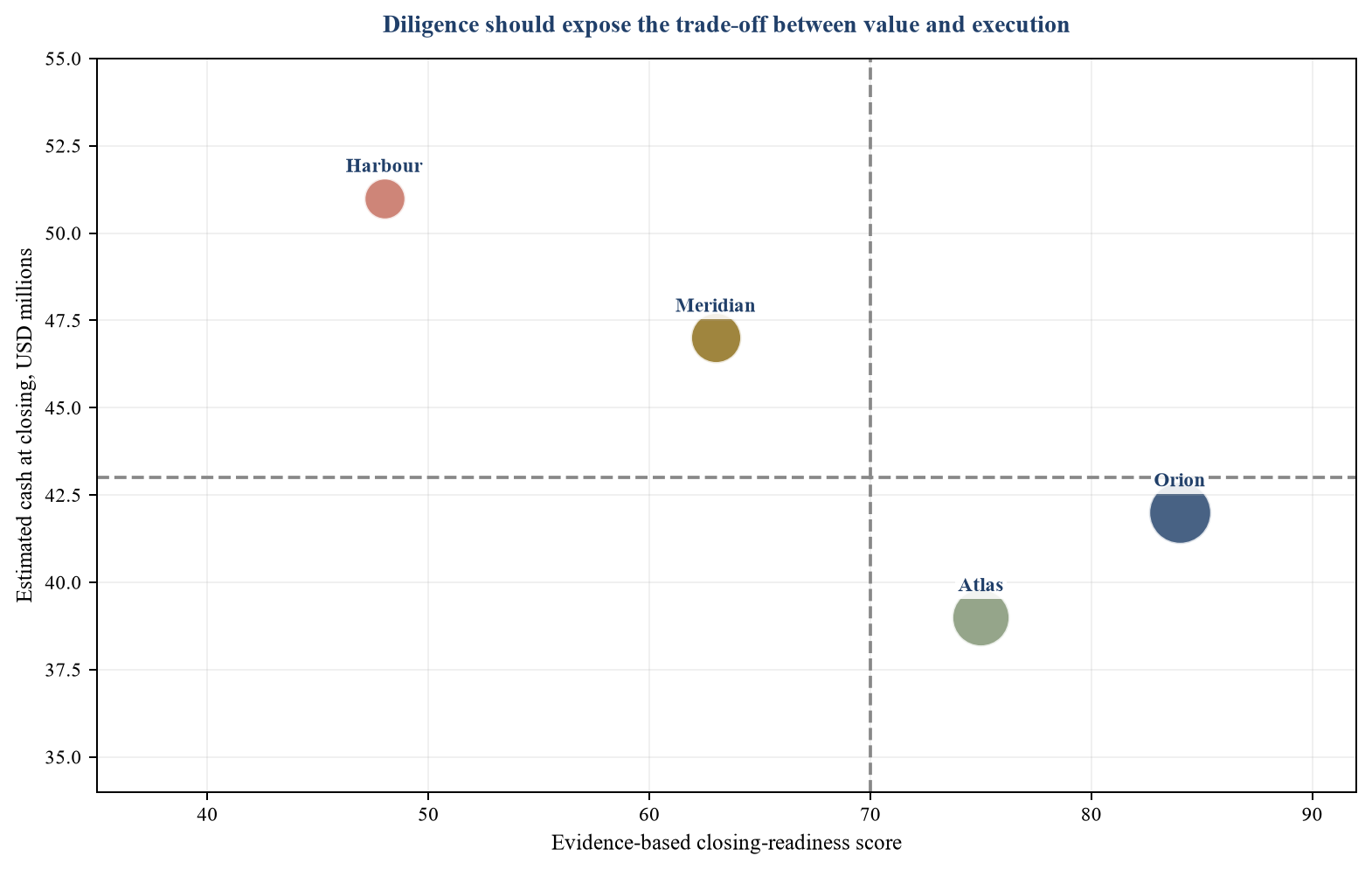
Original analysis using hypothetical bidder positions. Bubble size represents confirmed funding capacity; the chart does not estimate closing probability.
17. Apply the hypothetical industrial-services case
The hypothetical company provides inspection, maintenance and project services across three jurisdictions. It reports USD 84.0 million of revenue and USD 8.6 million of EBITDA for the latest twelve months. It has secured debt, customer concentration, overdue receivables, specialist employees and shared technology with its parent.
The perimeter review removes a discontinued customer contract and includes the full standalone cost of finance, systems and leadership. Supplier statements reveal USD 1.0 million of under-accrued claims. An engineering review identifies USD 1.2 million of annual maintenance required to sustain the asset base. Evidence supports an add-back for USD 1.0 million of restructuring-adviser cost and USD 0.8 million of temporary logistics cost. The resulting sustainable EBITDA is USD 4.9 million.
The direct cash bridge produces a different decision view. Delayed receivables, supplier normalisation, customer cure work, transaction expenses, maintenance and other movements create a USD 7.8 million funding requirement through the intended close. The company cannot infer transaction funding from positive EBITDA. It needs existing cash, collections, lender accommodation, shareholder support, buyer funding or a formal route that changes the timing and authority over cash.
The working-capital review finds USD 11.8 million of gross receivables, of which USD 4.0 million is delayed under the downside case. It also finds customer deposits supporting unfinished obligations and supplier balances required for ongoing delivery. The buyer model therefore treats selected items as funding needs or debt-like deductions rather than ordinary working capital.
The evidence room resolves contract and payroll reconciliations but leaves one customer consent, a lender release and a licence transfer outstanding. The issue register assigns cash, owners and latest safe dates. The board compares three credible buyers and one high-value bidder that lacks confirmed funding and requires a timetable beyond the available runway.
| Measure | Orion | Meridian | Atlas | Harbour |
|---|---|---|---|---|
| Headline value | USD 49m | USD 55m | USD 46m | USD 58m |
| Estimated cash at closing | USD 42m | USD 47m | USD 39m | USD 51m |
| Additional seller funding to close | USD 3.2m | USD 6.8m | USD 2.4m | USD 9.6m |
| Evidence-based readiness score | 84 / 100 | 63 / 100 | 75 / 100 | 48 / 100 |
| Funds evidence | Signed equity commitment and cash confirmation | Conditional facility | Cash confirmation | Indicative financing only |
| Principal unresolved matter | One customer consent | Financing and working-capital diligence | Narrow asset perimeter | Financing, approvals and extended diligence |
| Earliest credible close | Week 9 | Week 12 | Week 8 | Week 15 |
| Board issue | Lower value with strongest execution evidence | Higher value consumes most liquidity buffer | Fast route leaves residual liabilities | Runway does not reach stated close |
All values, readiness scores and outcomes are hypothetical. Scores compare observed evidence and do not represent statistical probabilities.
18. Use a risk heat map that connects consequence to action
The risk heat map should plot likelihood and consequence using defined scales. Consequence should include cash, value, timing, legal route and continuity. Bubble size can represent potential cash exposure or the amount of value affected. The map should link directly to the issue register rather than operating as a separate presentation exercise.
High-consequence items should have an immediate action and a route treatment. A lender release may require engagement, payoff evidence and a closing condition. A customer consent may require a communication plan and a perimeter alternative. A licence transfer may require regulator contact and interim operating authority.
The map should avoid false precision. Ratings are management assessments unless supported by data. The report should state the basis and should update them when evidence changes. A risk can move even when its description stays the same because cash runway or buyer conditions change.
Correlations matter. Customer delay can reduce cash, trigger a covenant issue and weaken buyer value. Supplier withdrawal can affect backlog, revenue and safety. The issue register should record linked risks so that management does not count the same consequence several times or miss a compound effect.
The board should focus on the risks that can still be changed. Some liabilities can only be priced. Others can be cured through evidence, consent, payment or structure. The allocation of management time should reflect both materiality and the remaining opportunity to improve the outcome.
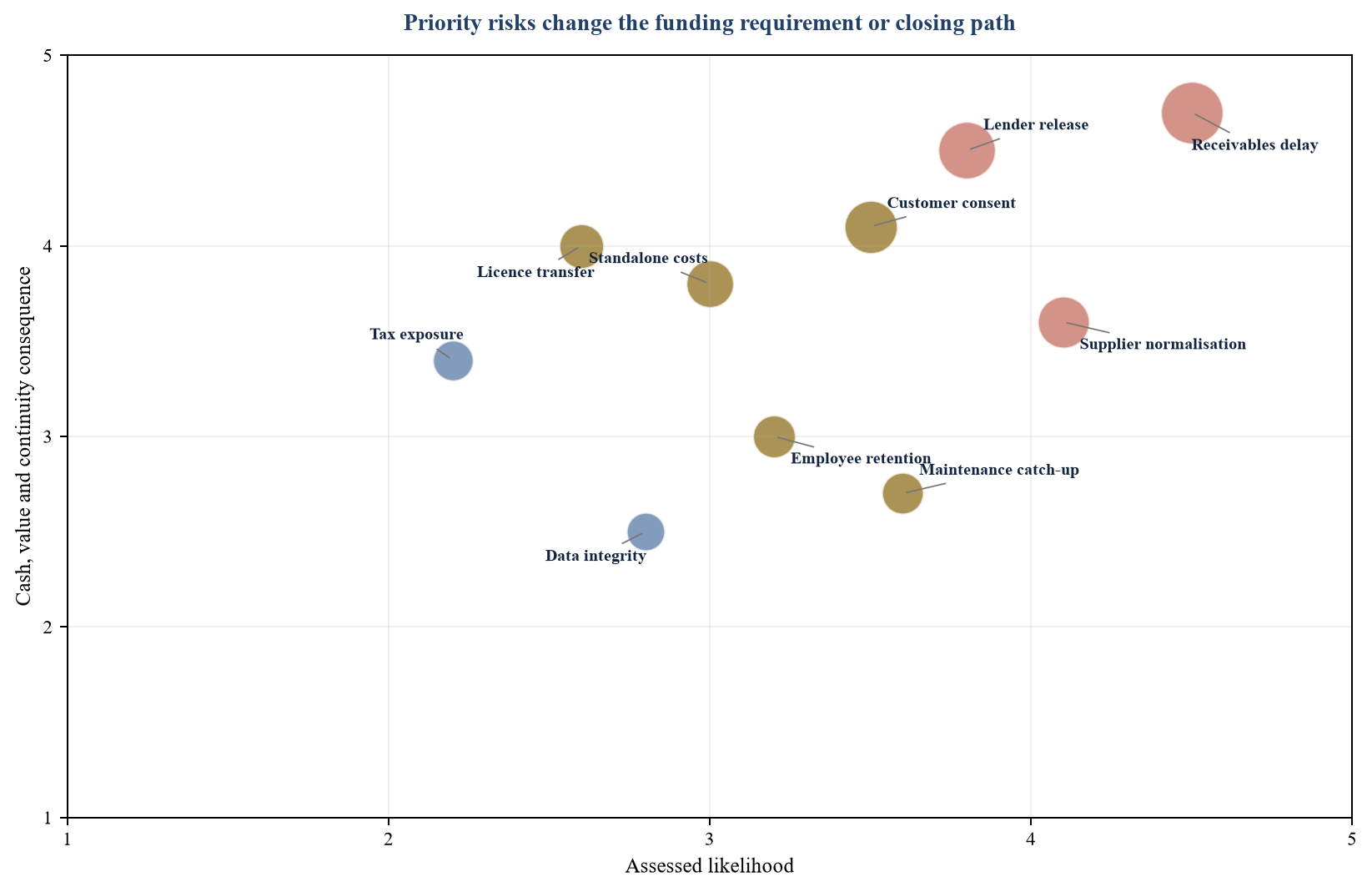
Original framework using hypothetical positions and cash exposures. Live ratings require documented evidence and board review.
19. Govern the report as a live transaction control
The board should approve the diligence scope, materiality, sale perimeter, reporting frequency and escalation triggers. A transaction committee may supervise detailed work, but reserved matters should remain clear. These may include route selection, exclusivity, connected-party participation, material funding, entry into a formal procedure and acceptance of a binding bid.
The chief financial officer or another accountable executive should own financial integrity. The transaction leader should own buyer process and issue closure. Legal, operations, tax, people and technology owners should certify their schedules at defined gates. Advisers should state the scope and limitations of their work.
Conflicts should be disclosed and managed. Directors may represent shareholders or lenders. Executives may discuss future employment with bidders. Advisers may have relationships with counterparties. Recusal, independent advice, information barriers and committee structures should be documented where appropriate.
The report should use controlled versions. Material changes to earnings, cash, liabilities or perimeter should require approval and a buyer communication decision. The company should know which bidders received which version and whether their bids remain comparable.
The board pack should remain concise. It can summarise liquidity headroom, material adjustments, open risks, buyer readiness, funding needs, approvals and route alternatives. Detailed evidence stays in the room and appendices. The minutes should record the evidence considered and the reasons for decisions.
20. Implement the framework in five phases
Phase one establishes control. The company reconciles bankable cash, obtains current legal and restructuring advice, defines the sale perimeter, appoints owners and sets decision triggers. It also records the minimum operating cash required for safe continuity.
Phase two constructs the evidence. Finance builds the sustainable-earnings bridge and direct forecast. Workstream owners complete customer, supplier, people, debt, liability, licence and technology schedules. The transaction office reconciles them and opens the issue register.
Phase three prepares the market. The company assembles the minimum evidence room, qualifies buyers, releases controlled information and records questions. Material exceptions are disclosed with remedies, cash and timing. Comparable bid instructions require funding and a complete conditions schedule.
Phase four converts diligence into selection. The board compares cash at closing, funding required, conditions, readiness, continuity and residual liabilities. Documents, lender releases, consents and Day One planning proceed in parallel. Alternatives remain prepared until funds clear.
Phase five validates the result. The company reconciles actual cash and proceeds with the decision model, transfers control, funds residual obligations and archives evidence. It reviews forecast accuracy, diligence exceptions and transaction outcomes to improve future controls.
| Phase | Indicative timing | Core outputs | Board gate | Escalation if incomplete |
|---|---|---|---|---|
| Control | Days 1 to 5 | Cash perimeter, duties advice, sale perimeter, owners and triggers | Is continued operation funded and governed? | Emergency liquidity and formal-route preparation |
| Evidence | Days 3 to 15 | Earnings bridge, cash model, debt, liabilities and dependency schedules | Are material conclusions reconciled to evidence? | Narrow scope, deploy specialists or revise route |
| Market | Days 10 to 30 | Evidence room, buyer qualification, questions and remedy register | Can qualified buyers price and fund the defined perimeter? | Expand outreach or restructure the package |
| Select and execute | Days 25 to closing | Proceeds bridge, readiness score, documents, approvals and funds flow | Does the selected bid fit the liquidity runway and relevant duties? | Use the pre-approved alternative before headroom fails |
| Validate | Closing onward | Day One control, proceeds reconciliation and evidence archive | Did cash, value and continuity match the decision case? | Remediate variances, claims and control failures |
Original framework. Timing should follow verified runway, applicable law and transaction complexity.
21. Conclusion
Liquidity-first vendor due diligence begins with the business that can be funded and transferred. Sustainable earnings remain central to value, but they should be reconciled to cash conversion, working capital, debt, liabilities and operating dependencies. The report should show what belongs to the perimeter and what must happen before closing.
The hypothetical case illustrates the gap. USD 4.9 million of sustainable EBITDA coexists with a USD 7.8 million funding requirement through closing. A transaction team that presents only the earnings bridge leaves the board and buyers without the cash decision. A report that integrates both can identify the funding route, latest safe dates and buyer conditions.
Evidence quality affects price and execution. Reconciled schedules can reduce broad uncertainty and focus negotiation on identified issues. Missing evidence should produce an owner, consequence and remedy. It should never be converted into an unsupported positive assumption.
The board should compare bids through cash at closing, additional funding, conditions, timing, continuity and retained liabilities. A high headline value may be unavailable within the runway. Observable readiness evidence provides a disciplined comparison without pretending to predict closing probabilities.
The reusable principle is direct: every reported adjustment should connect to cash, every material cash need should connect to an operating or legal obligation, and every unresolved diligence issue should connect to a decision. That chain allows boards and buyers to act quickly while preserving evidence and accountability.
Sources
- UK Insolvency Service, Director information hub: Director duties upon insolvency, Read the primary source
- United Arab Emirates, Federal Decree-Law No. 51 of 2023 Promulgating the Financial Restructuring and Bankruptcy Law, Read the primary source
- United Arab Emirates, Cabinet Resolution No. 94 of 2024 concerning the Executive Regulations of the Financial Restructuring and Bankruptcy Law, Read the primary source
- Financial Reporting Council, Guidance on the Going Concern Basis of Accounting and Related Reporting, 2025, Read the primary source
- IAASB, ISA 570 (Revised 2024), Going Concern, issued 2025, Read the primary source
- US Securities and Exchange Commission, Non-GAAP Financial Measures Compliance and Disclosure Interpretations, updated 2022, Read the primary source
- European Securities and Markets Authority, Financial Reporting and Alternative Performance Measures, Read the primary source
- European Securities and Markets Authority, Interaction of APM Guidelines with IFRS 18, 2026, Read the primary source
- United States Courts, Chapter 11 Bankruptcy Basics, Read the primary source
- The Administration (Restrictions on Disposal etc. to Connected Persons) Regulations 2021, Read the primary source
- UK Insolvency Service, Pre-pack sales in administration report, 2020, Read the primary source
- UNCITRAL, Legislative Guide on Insolvency Law, Read the primary source
- World Bank, Principles for Effective Insolvency and Creditor/Debtor Regimes, revised 2021, Read the primary source
- UK Government, Corporate Financial Distress Guidance Note, Read the primary source
