

1 Make adviser selection an evidence decision
The founder is choosing a firm, a group of people and a method of taking the business to market. Those three choices should be evaluated separately. A respected franchise may supply institutional resources while the available team has little time for a smaller transaction. A specialist may know the sector well but have no credible route to the few buyers who could finance the acquisition. A well-connected senior banker may win the pitch and delegate the work to a different group. The founder needs evidence about the actual proposed mandate, not an abstract ranking of advisers.
The decision starts with the owner's objective. The owner may want a full exit, a majority sale with continuing management, a minority investment, a strategic combination or a succession solution. Each route creates different buyer requirements and execution tasks. A candidate who is excellent at sponsor auctions may be unsuitable for a regulated carve-out with complex customer consents. Asking every candidate to respond to the same written transaction brief makes the comparison meaningful. The brief should state the company perimeter, ownership structure, latest available accounts, expected role of the founder, confidentiality constraints and reasons for considering a transaction. It should distinguish verified facts from management aspirations.
This paper uses a UAE private-company sale as its decision setting. It does not treat the UAE as one uniform legal regime. Main-land, free-zone and cross-border entities can have different permissions, filings and contractual requirements. The owner should ask counsel and any relevant regulator to confirm the applicable route. Sector proof, team capacity and buyer reach remain useful questions across jurisdictions, but regulatory conclusions and empirical results cannot be carried across borders without examination.
The central research question is which observable adviser attributes, measured before appointment, are associated with the receipt of qualified offers after company and transaction characteristics are taken into account. That question is not answered by a candidate interview or a public deal list. The practical framework helps the owner make a disciplined appointment now and specifies the records that would be needed to test the question later.
2 Review what existing research can support
The M&A adviser literature offers reasons to examine reputation, specialist experience and networks, but it does not deliver a universal ranking rule. Golubov, Petmezas and Travlos study bidder advisers and report that reputation effects depend on transaction characteristics, particularly public-target deals; they also address the non-random matching of advisers and clients [1]. Their findings cannot establish that a prominent sell-side brand generates more qualified offers for a UAE private-company owner. Ecer and Trautmann study adviser participation and report relationships with completion and pricing in their sample [2]. That work likewise examines different engagement constellations rather than the three pre-appointment claims tested here.
Graham and co-authors examine industry-specialist advisers for acquirers and report a mixture of outcomes, including lower fees and differences in deal selection and completion [3]. The study is useful precisely because expertise is not synonymous with one favourable metric. Chaudhry and co-authors consider advisory-firm network centrality and its informational role in matching companies [4]. A network measure in a research dataset is different from a pitch claim that an adviser can call a named buyer this month. Xu's study of adviser contracts identifies potential tensions between completion-linked fees, speed and shareholder pricing [5]. It supports asking how the mandate pays for a stopped or changed process, without implying that any specific fee structure always produces a poor result.
There are two important selection problems. Better prepared companies may attract better advisers and more bidders. Owners facing difficult facts may hire a specialist precisely because a sale is hard. A closed-deal sample omits processes in which adviser choice was consequential but no offer was accepted. League tables often emphasise announced or completed deals and therefore may exclude the information the owner most needs. A decision protocol should rely on evidence available before selection, record why candidates were invited, and follow all mandates to their eventual outcome, including pause and withdrawal.
The research reviewed here contains no verified UAE cohort with candidate scorecards, named-team staffing records and qualified-offer outcomes. We therefore do not report a probability of receiving an offer, a valuation uplift, a faster closing time or a return on adviser fees. The framework below is an author-developed proposal, not an estimated predictive model.
3 Define the mandate before testing candidates
Adviser capability cannot be judged without a sufficiently clear assignment. A request for proposals should specify whether the candidate is being asked to diagnose sale readiness, prepare a full auction, negotiate with an existing bidder, identify a strategic partner or arrange a capital transaction. Those are related but different services. If the owner is not ready to disclose the company name, the brief can initially be anonymised, with a later controlled data room for shortlisted candidates under confidentiality obligations.
The scope should name the legal entities and assets potentially offered, the countries in which material revenue is earned, any regulated operations, key customers and the known financing obligations. It should explain whether the founder intends to remain operational after a sale and whether the family or other shareholders have agreed to explore one. A candidate cannot credibly map buyers without knowing whether the target is a standalone operating company, a group with related-party assets or an equity interest subject to transfer restrictions. The owner may not yet know the precise perimeter; that uncertainty should be written as a task rather than hidden inside an ambitious valuation request.
The same brief should request the candidate's proposed buyer thesis, workplan, named team, conflicts statement, permissions analysis, fee terms and a short example of how it would verify a contested financial claim. Ask for assumptions and exclusions in a standard format. The purpose is to compare the thinking and available resources of each adviser against the same fact pattern. A highly polished, bespoke presentation is still useful; it should not replace the written answers that the owner can validate.
The initial process can have two stages. Stage one tests credentials and approach without disclosing commercially sensitive customer or pricing detail. Stage two gives shortlisted teams controlled access to the materials needed to demonstrate a specific plan. The owner should record when each candidate received each document, what it asked and whether the proposed team attended. The record helps separate lack of information from a weak answer, and it avoids rewarding a bidder for confident claims based on facts it was never given.
4 Test sector proof at the level of the named people
Sector proof is more demanding than a list of transactions with familiar logos. The owner should ask which proposed team member worked on each cited engagement, in what role, during which phase, and on which problem. Was the work sell-side origination, financial modelling, strategic buyer outreach, debt structuring, due diligence, valuation, negotiation or only a later fairness opinion? Did the professional join the candidate firm after the transaction? The distinction matters because a firm's marketing history and a person's experience are different assets.
Comparable does not mean identical. A transaction in the same industry may have a very different size, jurisdiction, customer concentration or regulatory profile. Conversely, a deal in another sector may show highly relevant expertise in a carve-out, founder succession, restricted share transfer or government counterparty approval. The owner should match the evidence to the actual execution problem. A concise deal sheet can include transaction perimeter, public date if any, side represented, named individuals, work performed, key decision, outcome and information that cannot be disclosed. It should be reviewed for confidentiality before sharing.
Public announcements can corroborate that a transaction occurred and sometimes name the adviser. They rarely prove who drafted the buyer map, resolved a diligence issue or remained engaged through completion. A consented client reference can establish more, but reference selection is itself biased: candidates will tend to offer satisfied clients. The owner can ask for a reference involving an interrupted transaction as well as a completed one, and can ask the same questions of both. A former client should never be pressured to reveal confidential deal terms. The candidate should identify what may lawfully be verified and provide an alternative source where it cannot.
The key interview question is practical: what unexpected sector-specific issue did this person recognise early, what source established it, and how did the team change the process? An answer about a customer-consent right, an ageing project backlog or a revenue-recognition bridge is stronger than a generic claim of domain knowledge when supported by a permissible record. The owner should also ask what the team misunderstood in a previous process. A credible adviser can explain limits and correction mechanisms.
Table 1. Evidence hierarchy for sector and execution claims
| Candidate claim | Minimum inspectable evidence | Additional check | Residual uncertainty |
|---|---|---|---|
| Relevant sector transactions | Dated deal sheet with side, scope and comparable business features | Public announcement or consented client reference | Public sources seldom show the precise work done |
| Named team experience | Role, dates, workstream and employing firm at the time | Interview each proposed lead; check permitted references | Past role does not prove current capacity |
| Problem-solving capability | Redacted example of a decision, source and resulting workplan | Ask team to analyse a shared sample issue | A simulation is not a live transaction |
| Comparable buyer universe | Transaction-specific buyer rationale and exclusions | Test a sample of buyer theses against public strategy | An eligible buyer may decline or lack financing |
| Transaction completion | Defined stage and owner's actual outcome | Separate signed, completed and cash-received cases | Closed deals omit stopped or failed mandates |
Author-developed verification protocol. No row assigns an empirically estimated success probability.
5 Distinguish firm history from transferable capability
The existence of a relevant transaction on a firm's website does not show that the proposed team can repeat its work. People move, mandates change, and a prior deal may have depended on a client relationship that is unavailable now. The owner should request a dated role map. For each relevant deal, the map should identify the individuals proposed for this engagement and show whether each was the lead, a supporting banker or a specialist brought in for a short assignment. The owner can then assess how much of the claimed experience remains in the room.
Transferability also depends on the source of the previous deal's advantage. If a candidate solved a technical diligence issue through a specialist it no longer employs, ask who will provide that function now. If its buyer access came through a former colleague, ask whether a present team member has a legitimate route. If a public-sector approval was central, ask what jurisdiction and activity the previous approval covered. Claims should be granular enough to survive changes in personnel and context.
The founder should avoid treating a small number of comparable deals as a mechanical penalty. A boutique adviser may have a capable senior team with fewer transactions but more direct involvement. A large institution may have a broader record but less continuity for a smaller client. The comparison should identify the capability actually required: sector judgment, transaction mechanics, a cross-border contact network, capital structuring or project management. Different capabilities can compensate for one another only when the owner understands the trade-off.
Finally, the evidence should be dated. A pre-pandemic buyer map or a five-year-old valuation case may still reveal expertise but may not describe today's financing costs, technology or regulatory requirements. The candidate should state what has changed since its comparable transaction and what new research it has done for this company. Sector proof includes the ability to update a thesis, not merely repeat a precedent.
6 Test capacity as a measurable work commitment
Team capacity is frequently obscured by an impressive pitch meeting. The owner should ask the candidate to identify a day-to-day lead, the senior decision maker, financial-modelling owner, buyer-outreach owner, data-room coordinator and specialist interfaces. One person may cover several roles in a small mandate. The critical question is whether the combination has enough time and authority to deliver. An organisation chart alone is inadequate; the engagement should include expected availability, review points and a method for covering absence or competing assignments.
Calendar evidence can be shared without disclosing other clients. The candidate can show a proposed work budget by phase, name the senior review meetings and explain how many concurrent transaction processes the essential people are running. It can distinguish work performed internally from tasks passed to lawyers, accountants, vendors or a sister firm. The owner should ask for the first six weeks of deliverables, the time assumed for management information and the point at which buyer contact could responsibly begin. A credible plan includes dependencies the candidate does not control.
Capacity is also a governance question. If a buyer requests a revised price bridge within two business days, who can approve the response? If a draft information memorandum contains a disputed customer claim, who can stop circulation? If a lead banker leaves, who has the information and authority to continue? The answer should be visible in the team and escalation plan. A written substitution clause can require equivalent experience and owner consent for a material change to the named team.
The owner should not confuse senior attendance with senior execution. A senior adviser may contribute most by opening the correct conversations, adjudicating a strategy question and negotiating a difficult term, while junior bankers carry the document and process load. That can be an effective design if the roles are explicit and the junior team is capable. The risk arises when the sold service and delivered service differ. Weekly progress records and milestone acceptance can make that discrepancy observable before months of exclusivity pass.
7 Tie the timetable to deliverables and decision rights
A proposed schedule should show the tasks needed to reach each owner decision, not just a projected closing date. The sequence can begin with perimeter and ownership verification, financial reconciliation, commercial claim testing, buyer hypothesis, conflict and permission checks, information packaging, approved outreach, indication of interest, diligence, binding offer, signing and completion. Some workstreams overlap. Others are gates. A permission question or material accounting disagreement may block credible outreach even when the marketing presentation is polished.
The timetable should identify who controls each gate. The adviser may recommend a launch; owners or the board should authorise it. Counsel may identify an approval requirement; only the relevant authority can determine the formal treatment. Buyers may submit indicative terms; they should not be described as funded offers until financing evidence supports that description. The founder's calendar is a scarce input, so each phase should state the expected management hours and which meetings require founder participation.
Deliverables should be concrete enough to accept or reject. An initial buyer map might contain categories, named candidates, investment rationale, likely decision makers, obstacles, conflict status and priority. A financial bridge should reconcile to a specified statement and disclose open adjustments. A weekly report should identify completed outreach, replies, reasons for non-response, next actions and owner approvals requested. These are examples of work products; the engagement must adapt them to confidentiality and legal advice.
The appointment timeline below is illustrative. It is an author-designed sequence with no empirical duration assigned. It shows how the founder can preserve a decision gate between proving the team and authorising the market approach. The candidate's fee and exclusivity terms should be consistent with that sequence, so an owner can stop after a diagnostic if critical facts undermine the sale case.
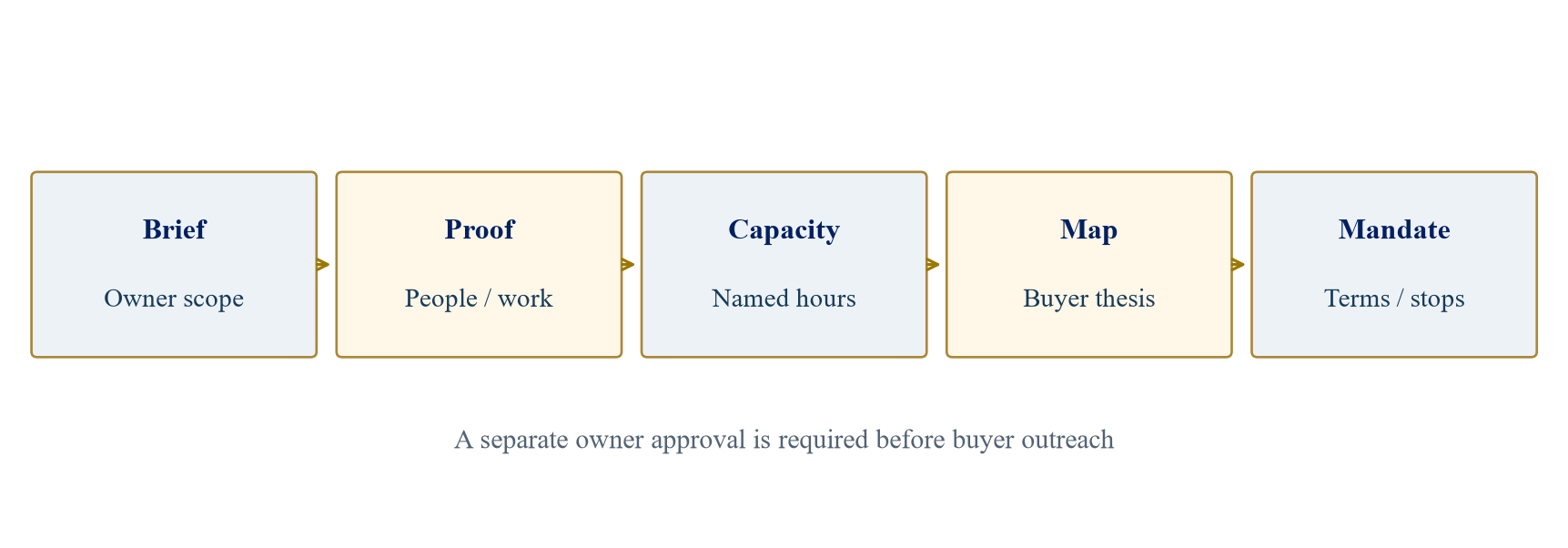
Author-developed mandate sequence. The boxes are decision gates, not estimated durations.
8 Define buyer reach as a qualified route
A buyer list is not proof of buyer reach. A credible map distinguishes who might value the business, who is legally and commercially able to acquire it, who can fund it, who can approve it internally, and whether the adviser has an appropriate route to a decision maker. Those tests can change rapidly. A name copied from a market database may be useful for market mapping but is not evidence of a current relationship or appetite. Conversely, an adviser may reach a suitable buyer through an introduction it has not used before if its thesis and access path are sound.
The map should segment strategic acquirers, private-equity platforms, independent sponsors, family offices and other relevant investors. For each, the adviser should explain the value-creation thesis: geographic expansion, customer access, capability acquisition, supply-chain integration, consolidation, cash yield or a specific strategic asset. The thesis should identify why this business, rather than a generic company in the same sector, might matter. It should also identify likely deal breakers such as size, funding, leverage, jurisdiction, competition, ownership policy, customer concentration or a required founder role.
Ask the candidate to label its access path accurately. Has it worked with the buyer firm, with the specific investment team, or only with someone elsewhere in the organisation? Can it seek permission to approach, or is there a current conflict? A claim of a personal relationship should be tested through an interview and, where appropriate, a limited non-confidential introduction after the owner has approved the contact. The adviser should not disclose the target's identity to demonstrate access before confidentiality and conflict checks are complete.
Buyer reach should be evaluated as an owner-approved funnel. The broad universe can be large; the contactable pool is narrower; the genuinely interested set is narrower still. A qualified bidder must have a credible strategic or investment fit, a route to decision authority, an apparent financing plan and willingness to engage under the process rules. These are operational definitions proposed for the mandate, not measured conversion rates. The owner can ask why a candidate was excluded and whether a different adviser would reach the same buyer differently.
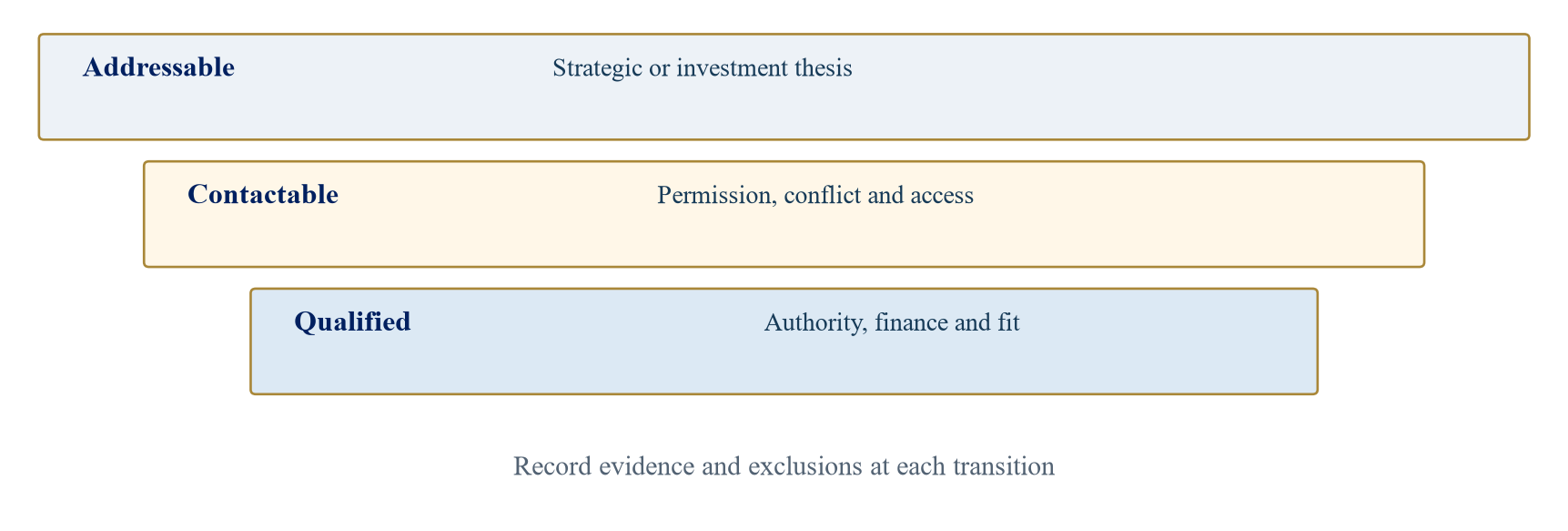
Author-developed funnel. The widths are illustrative and imply no observed conversion rate.
9 Stress-test the proposed buyer map
A buyer map becomes useful when the owner can challenge it. Choose several names representing different categories and ask why each would have a reason to transact, which executive or investment committee would consider the opportunity, whether capital is available and what public or permitted source supports the thesis. Ask which attractive-sounding buyer should be excluded and why. A candidate willing to exclude names for a reason may be showing better judgment than one offering the longest list.
The owner should also ask whether the adviser has considered buyers beyond the most visible regional firms. A UAE company with international revenue may interest a foreign strategic acquirer, while a domestic operating business may fit a local platform better. Cross-border interest introduces currency, financing, regulatory, management and cultural questions; it does not automatically increase competitive tension. The map should identify where the adviser needs a local specialist, legal advice or a co-adviser and who bears the cost.
Testing the map does not require disclosing client secrets to every potential adviser. The owner can provide a bounded fact pattern and ask for a redacted rationale. Once a team is shortlisted, deeper evidence can be requested under confidentiality and need-to-know controls. A seller may prohibit contact with key customers, suppliers or competitors until a defined stage. The adviser should state how it will test interest without breaching that restriction or falsely implying that a buyer has already been approached.
The owner should preserve an outreach log after appointment. The log records owner approval, name, contact route, date, what was disclosed, confidentiality status, response, reason for declining and next step. A preliminary indication of interest should be distinguished from a financed, authorised and executable offer. Without this record, a post-hoc claim that an adviser reached many buyers can be inflated by duplicate contacts, inaccessible senior people or polite meetings with no ability to bid.
10 Make conflicts and permissions part of the test
Buyer access can create conflicts. A candidate may advise a likely acquirer, hold a financing role, seek future work from one of the buyers or have confidential information from another mandate. That history can make an introduction easier and an unconflicted sale process harder. The owner should ask for a written conflicts search across the proposed buyer categories and related entities, followed by an update as the buyer list changes. If a conflict can be managed, the proposed information barriers, disclosure and client consent should be specific and reviewed by counsel.
Regulatory status must be checked against the activity and jurisdiction. The DFSA public register lists authorised firms and their permissions for activities such as arranging deals and advising on financial products in the DIFC [6]. The FCA explains that UK corporate-finance permissions can include advising and arranging, and its register can be used to inspect a firm's recorded permissions [7, 8]. These examples demonstrate a verification method, not a conclusion that a particular UAE private-company mandate requires the same licence. Main-land UAE, ADGM, DIFC and cross-border activities can be governed differently. The candidate and counsel should identify where each activity is performed and which entity contracts with the owner.
The DFSA's 2026 discussion of its conflicts review emphasises documented and proportionate controls for authorised firms in the DIFC [9]. A private-company owner can borrow the discipline of documenting conflicts even where another regulator applies. The owner should seek a clear answer to whether the adviser expects to provide financing, receive referral compensation, represent a buyer, or place debt or equity for another party in the same process. The engagement letter should state which activities are excluded or require separate approval.
An undisclosed conflict can distort buyer mapping and information release. A broad consent clause at the back of an engagement is not a substitute for understanding the particular relationship. If a team cannot describe its conflict procedure or permission perimeter in a way the owner and counsel can test, the appointment is not ready to be signed.
11 Examine incentives before signing exclusivity
The adviser is paid through the engagement terms, and those terms shape which work is economical for it to perform. A retainer may fund preparatory analysis; an exclusively contingent fee may direct attention toward a near-term close; a minimum fee can change the economics of a smaller transaction. These are incentive mechanisms, not universal predictions about adviser behaviour. Xu's adviser-contract research identifies a possible tension between completion-linked compensation and target pricing in its studied setting [5]. Calomiris and Hitscherich find that fee structures also reflect transaction and target characteristics, cautioning against a one-variable conclusion [10].
The founder should ask each candidate for a fee model under the same three scenarios: no launch after diagnosis, launched process that stops, and completion under alternative structures. The model should state the retainer, credit against a success fee, minimum fee, reimbursable expenses, fee base, treatment of debt and assumed liabilities, earn-outs, minority sales, staged closings and VAT or other applicable tax. It should also identify whether an introduction made during the mandate triggers a fee after termination, for how long and under what evidence standard.
Exclusivity should match the work the owner is buying. An initial diagnostic may warrant confidentiality and a short, bounded engagement without a blanket right over every capital transaction. A full auction may require one adviser to coordinate buyer contact and avoid conflicting messages. The owner should be able to terminate for cause, replace a materially changed team and stop an unpromising process under stated economics. These are negotiation topics, not template terms suitable for every jurisdiction or transaction.
The fee comparison should include management time, specialist costs and exposure of information, not only the percentage headline. A low fee paired with a diffuse team and a weak buyer map can be expensive in opportunity cost. A higher fee may be warranted by a demonstrable capability that matters to the owner's objective. The paper does not estimate either proposition in money terms. The owner should treat the comparison as a contract and resource decision, with legal and tax review before signature.
12 Build a comparison matrix without false precision
A candidate matrix is valuable when it records evidence and open questions rather than disguising subjective judgments as a precise forecast. The owner can compare sector proof, named-team capacity, buyer thesis, conflict status, permission route, scope, fee terms and the approach to adverse information. Each entry should cite a document, interview or source and say what remains to be checked. A number may help organise discussion, but a weighted score of 83 versus 79 has no predictive meaning without a validated model.
Before viewing pitches, owners should agree which items are gates and which are preferences. An unresolved permission issue, a material undisclosed conflict or an unavailable essential team member may be a gate. Familiarity with a particular adjacent sector may be a preference if the execution problem can be solved by a credible specialist. A candidate should be allowed to explain an apparent weakness and supply evidence. The matrix is an audit trail of the decision, not a method for automating it.
The owner should separate four evidence statuses: independently corroborated, candidate-documented, explained but not documented, and unresolved. That classification is author-developed. It does not label any candidate dishonest and should not be converted to a numerical likelihood of success. It helps reviewers recognise that a public deal announcement and a verbal claim are different kinds of support. A reference interview can be recorded with permission; the owner should protect the reference's confidential information.
Table 2. Candidate comparison record for an owner decision
| Test | Evidence requested | Minimum decision question | Escalation when unresolved |
|---|---|---|---|
| Sector proof | Named roles, dated comparable work, permitted references | Can this team solve the relevant transaction problem? | Specialist interview or narrower mandate |
| Team capacity | Named workstreams, first-six-week plan, substitution terms | Can the proposed people do the work on the proposed timetable? | Revised staffing and milestone plan |
| Buyer reach | Buyer thesis, access route, exclusions, conflict screen | Can the adviser reach buyers able to make a qualified offer? | Redesign buyer map and consent route |
| Governance | Permissions, conflicts, information controls | Can this entity perform the proposed work appropriately? | Counsel and regulator-specific review |
| Economics | Fee scenarios, expenses, exclusivity and tail | Does the contract preserve the owner's stop and hold options? | Negotiate terms before appointment |
Author-developed matrix; blank cells should be completed from each live candidate's evidence.
13 Use references and sample work carefully
Client references are useful when questions are specific. Ask a former client who did the work after the pitch, how quickly issues were escalated, whether the original buyer thesis changed, and what happened when the transaction became difficult. Ask whether the adviser respected confidentiality and owner decision rights. These questions test process quality. A reference should not be asked to disclose protected buyer bids or another client's data.
The owner should understand how the reference was selected. A candidate may present its most successful deal, which is reasonable marketing but creates a one-sided sample. Requesting a stopped or delayed mandate can reveal whether the team will recommend restraint when a sale is unattractive. A candidate may be unable to supply such a reference because of confidentiality; it can then provide an anonymised process account and explain why external confirmation is unavailable. The owner should record the residual uncertainty rather than filling it with a favourable assumption.
A short sample work exercise can be more revealing than a broad claim. Provide every finalist with the same limited fact pattern: perhaps two reconciled periods of revenue, a customer-concentration issue and a proposed buyer category. Ask for the first questions, an information request, a buyer hypothesis and a proposed communication to the owner. This is a practical demonstration, not free completion of a full transaction plan. Timebox it, agree use rights and avoid distributing sensitive material unnecessarily.
The exercise should be evaluated against reasoning quality, disclosure discipline and ability to identify a stop condition. A confident valuation range unsupported by the supplied data is a negative signal even if the number appeals to the owner. A team that asks about contract renewal, earnings quality, debt and shareholder consent may be doing the difficult work earlier. The owner should give candidates enough context to be fair, and should document that the exercise does not predict the eventual offer price.
14 Keep the founder's alternatives visible
Selecting an adviser can make a sale feel inevitable. The owner should maintain an explicit alternative: continue operating, refinance, bring in a minority investor, recruit management, sell a division or wait for a better reporting period. Those alternatives may require their own advisers and costs. They should be recorded before a proposed sale fee creates pressure to pursue the easiest buyer. A credible sell-side candidate can explain when it would recommend a different path and what information would trigger that recommendation.
The appointment decision should therefore be conditional. The owner may retain a team for a bounded readiness or buyer-mapping phase, assess whether the company's claims survive verification, and then decide whether to authorise a full process. A candidate unwilling to separate diagnosis from outreach may still have a reason for that design; the owner should ask for it in writing. The issue is whether the proposed mandate fits the owner’s uncertainty and the business's ability to support a transaction.
The board or shareholder group should agree who can approve buyer contact, an indicative price range, exclusivity, a binding offer and final signing. The adviser can provide analysis and coordination. It should not acquire authority to disclose sensitive information or commit the owner through silence. A decision register makes the process legible when multiple family members or executives are involved. It also provides a later basis for evaluating whether the adviser delivered the promised work.
A paper about adviser selection should not imply that the best adviser necessarily produces a sale. A strong team may advise against launch after finding an accounting defect or an unfinanceable valuation expectation. That can be valuable service, but a closed-deal-only performance metric would count it as a failure. The owner should judge the mandate against the decisions and deliverables it was designed to support, as well as the eventual economic result.
15 Define a qualified offer before measurement
The research question requires an outcome that can be observed consistently. A qualified offer should be more than an expression of interest or a meeting. For a given sale process, an offer could require a written price or price formula, a defined transaction perimeter, cash versus deferred consideration, stated financing sources or funding path, required approvals, material conditions, proposed timetable and evidence that a decision maker authorised the proposal. The threshold should be set before launch and may be adapted to the transaction; it should not be relaxed after a preferred adviser produces many weak indications.
The owner should count distinct economic decision makers, not the number of intermediary emails or affiliates. Two vehicles controlled by the same sponsor may represent one bidder. A strategic buyer and its financing bank are not two bids. A non-binding offer may be qualified for a first-round research measure if the terms and authority are sufficiently defined, while an unfinanced verbal range is not. Later stages can distinguish a revised offer, exclusivity, signing, completion and cash received. Each stage answers a different question about process quality.
Buyer quality is not reducible to a count. One well-funded strategic acquirer may offer a cleaner, higher-cash solution than several highly conditional bidders. A large bidder pool may expose information or consume management resources. The study should therefore report both number and characteristics of qualified offers, and should separately examine owner outcomes such as net cash, retained liabilities, founder obligations and time. The owner can use those categories in a live bid-comparison sheet without claiming a causal adviser effect.
The same definition should be applied to all advisers in a research cohort. It should include processes with no qualified offer. Otherwise, a researcher may describe one adviser as more effective because its clients happened to run easier businesses or because its records classify preliminary contacts generously. A blinded coding panel with access to redacted offer documents could improve consistency if clients consent.
16 Design a study that can challenge the selection framework
A credible empirical test would recruit a consented cohort when owners decide to explore a transaction, before an adviser has been selected. It would record all candidates approached, the same pre-appointment brief, each candidate's documented attributes, the owners' reasons for selection, company quality and constraints. Company variables could include sector, size, profitability, cash conversion, customer concentration, ownership complexity, geographic footprint, existing unsolicited interest and sale urgency. The exact definition and availability of each variable would have to be registered before analysis.
The cohort would then follow chosen advisers and processes through diagnosis, launch, outreach, bids, pause, signing, completion or abandonment. It would preserve the dates and evidence behind each event. Buyer-contact data should be minimised or pseudonymised under a lawful protocol. It should identify whether a buyer was already known to the owner, introduced by the adviser, introduced by another professional or inbound independently. The outcome would be the receipt and composition of qualified offers, with secondary outcomes that reflect cost, time and realised consideration.
Selection bias remains. Owners do not randomly assign advisers. Companies that attract experienced teams may already have higher buyer appeal. A study could stratify by sector, size and deal complexity, compare only candidates who sought the same mandate, and use prespecified controls. It might use adviser availability as an instrument only if the exclusion restriction could be defended, which is a demanding condition. Matching and regression can reduce measured imbalance but cannot remove unobserved founder quality, private buyer interest or adviser judgment. Sensitivity analysis and transparent limitations are essential.
The study should report the full enrollment flow and missing-data pattern. Firms that decline consent, advisers who will not supply team records, unsold mandates and buyers whose terms cannot be shared should not silently disappear. A protocol should define when a result is too thin to publish. No such cohort was available to this paper, and no coefficient or UAE benchmark is reported. The contribution is a falsifiable measurement plan tied to the founder's real appointment decision.
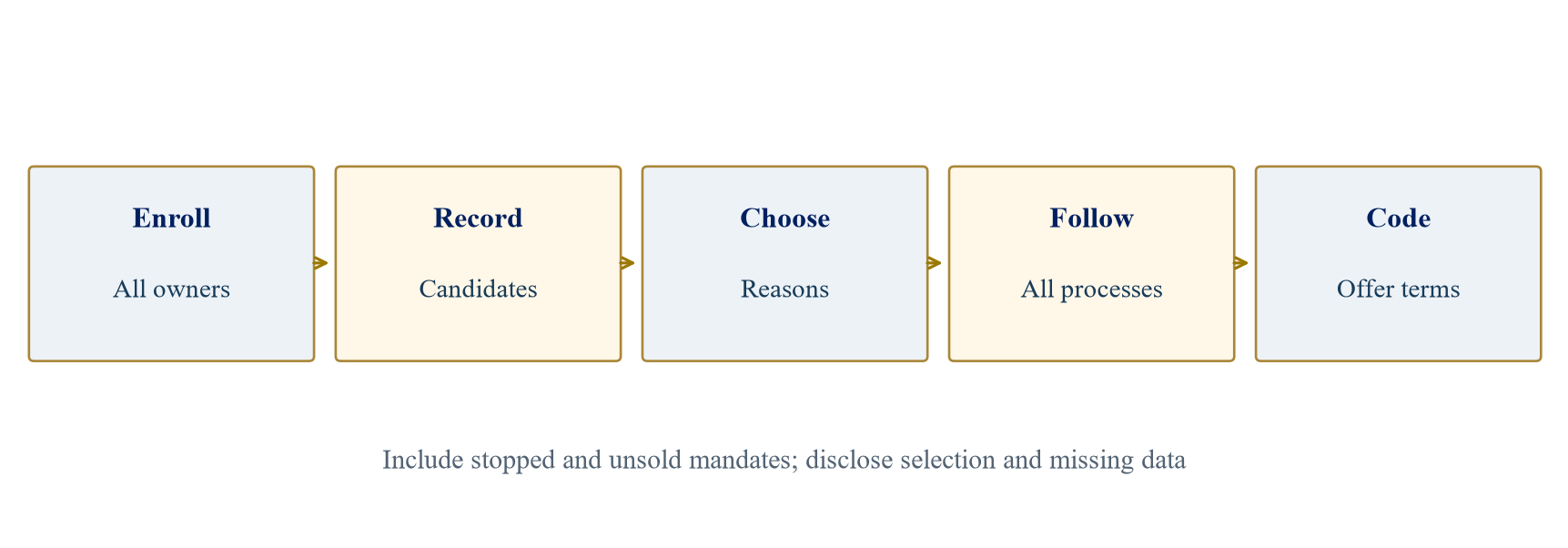
Author-developed research design. No causal estimate is implied.
17 Protect confidential evidence and legal rights
Adviser selection materials can contain client names, bid strategies, proposed fees and commercial forecasts. A research study can become an information leak if it collects more than is needed or circulates identifiable deal records. Owners should permit only the fields needed for the research question, define a custodian, separate identifying keys from analysis data, restrict access and state retention and deletion periods. A small private-company transaction may remain identifiable from sector, size and year even after its name is removed. Aggregation should be tested for re-identification risk before publication.
The UAE federal personal-data framework identifies obligations that may be relevant where personal data is processed [11]. The paper does not decide the lawfulness of any proposed sharing, cross-border transfer or research exemption. Counsel and data specialists must evaluate the particular records, entity and jurisdiction. The adviser may also owe duties to prior clients, and client references need informed permission for whatever may be disclosed. Public announcements are safer as corroboration but do not supply all role and outcome information.
Independent coding would reduce the danger that an adviser classifies its own work favourably. A pre-specified form could capture the difference between firm-level and person-level experience, named versus generic buyer routes, original versus substituted staffing, and terms of every offer. Disagreements should be resolved against source documents without making them public. If a researcher also advises a participating client, that role and any financial interest should be disclosed, and an independent review path should be considered.
The proposed study might never be feasible. Mandate documents may be inaccessible, comparable companies rare and clients reluctant to share bidder records. In that event, the research question should remain unanswered rather than be replaced by a survey of favourable anecdotes. The founder can still use the appointment checklist as a governance tool. Its value is in making claims and decisions inspectable, even without a published effect size.
18 Use a disciplined candidate meeting
Before the first meeting, the owner should send the same bounded brief to each candidate. During the meeting, ask the proposed day-to-day lead to explain a relevant transaction problem and show permissible evidence of personal involvement. Ask the senior sponsor to identify when they will review and escalate work. Ask the buyer-outreach lead to describe two plausible acquirers, one unsuitable name and the source for each view. Ask who checks permissions and conflicts. A candidate should be able to answer with a method even when client confidentiality prevents disclosure of deal details.
After the meeting, request a written response with named personnel, a six-week workplan, buyer-category map, information request, draft engagement terms and unresolved assumptions. The owner should review the response with finance, legal and relevant operating leaders. Inconsistencies should be raised once and documented. A candidate who corrects a claim with evidence may be more reliable than one whose story remains polished but untestable. Do not reward certainty when the available information does not support it.
For shortlisted teams, conduct references and a controlled sample exercise. Check any required register and permissions against the proposed contracting entity. Review conflict disclosures and the deal's confidentiality protocol. Compare fee scenarios and owner stop rights. The decision record should state why the chosen team fits this transaction, which weaknesses are accepted and which conditions must be satisfied before buyer contact. The owner can choose a limited diagnostic mandate if a full sale is premature.
The meeting process is not intended to turn owners into regulators or professional investigators. It gives them a structured basis to ask competent specialists for confirmation. A live engagement should be documented and reviewed by counsel, with accounting, tax, valuation and regulatory support where the transaction requires it.
19 Convert promises into an accountable mandate
The engagement letter should identify the client entity, transaction scope, named team, permitted subcontractors or affiliates, services, deliverables, reporting cadence, fees, expenses, exclusivity, conflicts, confidentiality, term and termination. If the adviser promised a specific sector specialist or cross-border team, the contract should state when that person's role begins and how replacement is approved. If the buyer map was decisive, the first accepted deliverable should be a documented map with assumptions and exclusions, not an undocumented claim of contacts.
Milestones can connect payment and continuation to useful work. A diagnostic fee may buy a perimeter and evidence report. The next phase may buy an owner-approved buyer thesis and information package. External outreach begins only after a separate launch decision. A success fee can then be evaluated against a clearly defined transaction and fee base. The owner and adviser should agree what happens if a buyer contacts the company directly, if a minority transaction replaces a sale, or if the mandate stops and the same buyer returns later.
Progress reports should show the distinction between work performed and outcomes outside the adviser's control. The adviser can control whether it delivered a clean analysis, sought approvals and approached authorised targets appropriately. It cannot force a buyer to bid or finance to remain available. The owner can use milestones to identify a resourcing problem early and agree a remedy. A replacement or termination process should protect the company's data and the continuity of its records.
Table 3. Claims converted into mandate evidence
| Selection promise | Initial mandate evidence | Owner approval gate | Review if promise changes |
|---|---|---|---|
| Sector judgment | Source-linked issue and valuation workplan | Accept diagnostic findings | Interview replacement specialist |
| Senior attention | Named review and escalation schedule | Approve staffing plan | Require consent to material substitution |
| Buyer access | Prioritised map with thesis, route and conflicts | Approve each disclosure stage | Rebuild map when interest differs |
| Process control | Calendar, decision register and weekly report | Authorise launch and exclusivity | Record variance and corrective action |
| Fee alignment | Scenario model and signed terms | Authorise expenses and phase changes | Reprice changed scope before work |
Author-developed contracting checklist; transaction-specific legal advice is required.
20 State the decision and the research boundary
The owner can choose an adviser through an evidence record rather than a brand contest. Ask for proof of who did relevant work, who is available now, how a qualified buyer can be reached, and which conflicts or permissions constrain that route. Use the same brief and questions for every candidate. Protect confidential information during the comparison. Make an explicit decision on scope, team, economics and the conditions for buyer outreach.
This paper does not find that sector credentials, larger teams or denser networks cause more qualified offers for UAE private-company sellers. The cited studies examine other samples and constructs, and no consented local cohort was available. The matrices and figures are author-developed decision tools. They identify observable evidence and a research protocol; they do not estimate a premium, completion probability or time saving. A founder should not use them as a substitute for transaction-specific financial, legal, tax or regulatory advice.
The practical test is whether the adviser can turn a credible thesis into accountable work while preserving the owner's choices. A team that can explain its limits, source its claims, commit available people, map executable buyers and accept a reversible launch gate has passed a more meaningful selection test than one that offers only a confident valuation headline. A future study could test whether those measured attributes are associated with qualified offers. Until then, the owner can require evidence before granting the mandate.
References
- Golubov, A., Petmezas, D. and Travlos, N. G. “When It Pays to Pay Your Investment Banker: New Evidence on the Role of Financial Advisors in M&As.” Journal of Finance 67(1), 2012, 271-311. Accessed 6 October 2026. https://onlinelibrary.wiley.com/doi/10.1111/j.1540-6261.2011.01712.x
- Ecer, C. F. J. and Trautmann, S. T. “Done Deal! Advisor Impact on Pricing, Premia, Returns, and Deal Completion in M&A.” CentER Discussion Paper, Tilburg University, 2020. Accessed 6 October 2026. https://research.tilburguniversity.edu/en/publications/done-deal-advisor-impact-on-pricing-premia-returns-and-deal-compl/
- Graham, M., Walter, T. S., Yawson, A. and Zhang, H. “Comparative Advantage, Industry Specialization, and the Role of Investment Banks in M&As.” Working paper, 2012. Accessed 6 October 2026. https://papers.ssrn.com/sol3/papers.cfm?abstract_id=2520274
- Chaudhry, A. N., Kontonikas, A. and Vagenas-Nanos, E. “Social Networks and the Informational Role of Financial Advisory Firms Centrality in Mergers and Acquisitions.” British Journal of Management 33(2), 2022, 958-979. Accessed 6 October 2026. https://onlinelibrary.wiley.com/doi/10.1111/1467-8551.12477
- Xu, J. “The Double Agency Problem in Mergers and Acquisitions: An Examination of Advisor Contracts.” Working paper, 2023. Accessed 6 October 2026. https://papers.ssrn.com/sol3/papers.cfm?abstract_id=4556840
- Dubai Financial Services Authority. “Public Register: Firms.” Accessed 6 October 2026. https://www.dfsa.ae/public-register/firms
- Financial Conduct Authority. “Corporate Finance Firms.” Updated 17 September 2024. Accessed 6 October 2026. https://www.fca.org.uk/firms/authorisation/wholesale-markets/corporate-finance
- Financial Conduct Authority. “How to Check a Firm or Individual Is Authorised.” Updated 22 September 2026. Accessed 6 October 2026. https://www.fca.org.uk/consumers/how-check-firm-individual-authorised
- Dubai Financial Services Authority. “New DFSA Thematic Review: Conflicts of Interest across DIFC Firms.” 9 January 2026. Accessed 6 October 2026. https://www.dfsa.ae/news/new-dfsa-thematic-review-conflict-interest-across-difc-firms
- Calomiris, C. W. and Hitscherich, D. M. “Banker Fees and Acquisition Premia for Targets in Cash Tender Offers: Challenges to the Popular Wisdom on Banker Conflicts.” NBER Working Paper 11333, 2005. Accessed 6 October 2026. https://www.nber.org/papers/w11333
- United Arab Emirates. Federal Decree-Law No. 45 of 2021 Concerning the Protection of Personal Data. Accessed 6 October 2026. https://www.uaelegislation.gov.ae/en/legislations/1972/download
About the Author
Chennakeshav (CK) is a corporate finance and investment banking executive with 25+ years of global experience in deal origination, structuring and execution across M&A, growth capital and corporate strategy. He has led value-creation mandates for founders, corporates and funds — bridging the boardroom view to hands-on execution and close.
His career spans Morgan Stanley, HSBC, Lloyds Banking Group, EWEC, ADQ portfolio companies and Emirates Growth Fund, across TMT, real estate, fintech, deeptech, cleantech, infrastructure and energy. He has partnered with C-suite leaders, private equity and venture funds, sovereign wealth funds and family offices to finance complex fund raises and scale-up ventures, and has led M&A due diligence, post-merger integration and business-transformation initiatives to create value.
At Matchpoint Partners he is Managing Partner, leading the firm's corporate finance, M&A and capital-raising practice. He holds an MBA from London Business School, an engineering degree from VTU and a Master of Laws (LLM, in progress) from UCL London.
An active start-up mentor, CK mentors at Techstars, DIFC FinTech Hive, Startup Grind, Founder Institute and IN5, serves as Entrepreneur Mentor in Residence (EMiR) at London Business School, and judges the Entrepreneurship World Cup.
