

1. Separate the two succession decisions
Define management succession as transfer of executive accountability and ownership succession as transfer of economic and governance rights.
The succession team should reconcile family objectives, strategy, ownership map, organisation, governance and transition constraints. Each conclusion records the accountable body, source, timing, candidate or owner, evidence, dependency, control and unresolved exception. The immediate output is a two-track succession charter.
Management continuity must be proved through operating outcomes while ownership choices remain explicit. Reviewers test capability, authority, relationships, stakeholder confidence and downside response against native records and observed performance. Company strategy, role requirements, family objectives and governing law control every conclusion.
Material gaps require an owner, corrective action, test, advice and decision date. Consequences should flow through leadership capacity, customer delivery, cash, financing, value, control, fairness and transaction timing. Residual risk remains visible until authority is operable, stakeholders are protected and the relevant governing bodies approve the next gate.
2. Set the enterprise continuity objective
Translate customer, employee, supplier, lender, regulator and investment needs into measurable continuity outcomes.
The succession team should reconcile strategy, stakeholder map, operating plans, obligations, risk appetite and value drivers. Each conclusion records the accountable body, source, timing, candidate or owner, evidence, dependency, control and unresolved exception. The immediate output is an enterprise-continuity mandate.
Management continuity must be proved through operating outcomes while ownership choices remain explicit. Reviewers test capability, authority, relationships, stakeholder confidence and downside response against native records and observed performance. Company strategy, role requirements, family objectives and governing law control every conclusion.
Material gaps require an owner, corrective action, test, advice and decision date. Consequences should flow through leadership capacity, customer delivery, cash, financing, value, control, fairness and transaction timing. Residual risk remains visible until authority is operable, stakeholders are protected and the relevant governing bodies approve the next gate.
3. Map current roles and overlapping hats
Identify where family members act as owner, director, executive, employee, adviser or beneficiary and record conflicts.
The succession team should reconcile organisation charts, role descriptions, delegations, board records, contracts and family governance. Each conclusion records the accountable body, source, timing, candidate or owner, evidence, dependency, control and unresolved exception. The immediate output is a role-and-capacity map.
Management continuity must be proved through operating outcomes while ownership choices remain explicit. Reviewers test capability, authority, relationships, stakeholder confidence and downside response against native records and observed performance. Company strategy, role requirements, family objectives and governing law control every conclusion.
Material gaps require an owner, corrective action, test, advice and decision date. Consequences should flow through leadership capacity, customer delivery, cash, financing, value, control, fairness and transaction timing. Residual risk remains visible until authority is operable, stakeholders are protected and the relevant governing bodies approve the next gate.
4. Define the future operating model
Specify the leadership structure, accountabilities, decision forums, capabilities and interfaces required by future strategy.
The succession team should reconcile strategy, business model, growth plan, risk profile, governance and operating evidence. Each conclusion records the accountable body, source, timing, candidate or owner, evidence, dependency, control and unresolved exception. The immediate output is a future-leadership blueprint.
Management continuity must be proved through operating outcomes while ownership choices remain explicit. Reviewers test capability, authority, relationships, stakeholder confidence and downside response against native records and observed performance. Company strategy, role requirements, family objectives and governing law control every conclusion.
Material gaps require an owner, corrective action, test, advice and decision date. Consequences should flow through leadership capacity, customer delivery, cash, financing, value, control, fairness and transaction timing. Residual risk remains visible until authority is operable, stakeholders are protected and the relevant governing bodies approve the next gate.
5. Build the management timeline
Sequence CEO, executive, key-role and relationship transitions against operating milestones and risk.
The succession team should reconcile retirement intentions, talent pipeline, contracts, projects, customer calendar and funding events. Each conclusion records the accountable body, source, timing, candidate or owner, evidence, dependency, control and unresolved exception. The immediate output is a management-succession critical path.
Management continuity must be proved through operating outcomes while ownership choices remain explicit. Reviewers test capability, authority, relationships, stakeholder confidence and downside response against native records and observed performance. Company strategy, role requirements, family objectives and governing law control every conclusion.
Material gaps require an owner, corrective action, test, advice and decision date. Consequences should flow through leadership capacity, customer delivery, cash, financing, value, control, fairness and transaction timing. Residual risk remains visible until authority is operable, stakeholders are protected and the relevant governing bodies approve the next gate.
6. Build the ownership timeline
Sequence gifts, inheritances, trusts, foundations, transfers, redemptions and liquidity events separately.
The succession team should reconcile ownership records, family mandate, estate plans, transfer rules, valuation and funding. Each conclusion records the accountable body, source, timing, candidate or owner, evidence, dependency, control and unresolved exception. The immediate output is an ownership-succession critical path.
Management continuity must be proved through operating outcomes while ownership choices remain explicit. Reviewers test capability, authority, relationships, stakeholder confidence and downside response against native records and observed performance. Company strategy, role requirements, family objectives and governing law control every conclusion.
Material gaps require an owner, corrective action, test, advice and decision date. Consequences should flow through leadership capacity, customer delivery, cash, financing, value, control, fairness and transaction timing. Residual risk remains visible until authority is operable, stakeholders are protected and the relevant governing bodies approve the next gate.
7. Identify timeline dependencies
Map decisions where ownership rights constrain management appointments or management performance affects ownership routes.
The succession team should reconcile reserved matters, appointment rights, financing terms, transfer provisions, strategy and valuation evidence. Each conclusion records the accountable body, source, timing, candidate or owner, evidence, dependency, control and unresolved exception. The immediate output is a cross-track dependency register.
Management continuity must be proved through operating outcomes while ownership choices remain explicit. Reviewers test capability, authority, relationships, stakeholder confidence and downside response against native records and observed performance. Company strategy, role requirements, family objectives and governing law control every conclusion.
Material gaps require an owner, corrective action, test, advice and decision date. Consequences should flow through leadership capacity, customer delivery, cash, financing, value, control, fairness and transaction timing. Residual risk remains visible until authority is operable, stakeholders are protected and the relevant governing bodies approve the next gate.
8. Establish board ownership
Assign the board and nomination body accountability for leadership continuity, candidate selection and emergency cover.
The succession team should reconcile law, articles, committee terms, board calendar, delegations and independence criteria. Each conclusion records the accountable body, source, timing, candidate or owner, evidence, dependency, control and unresolved exception. The immediate output is a succession-governance architecture.
Management continuity must be proved through operating outcomes while ownership choices remain explicit. Reviewers test capability, authority, relationships, stakeholder confidence and downside response against native records and observed performance. Company strategy, role requirements, family objectives and governing law control every conclusion.
Material gaps require an owner, corrective action, test, advice and decision date. Consequences should flow through leadership capacity, customer delivery, cash, financing, value, control, fairness and transaction timing. Residual risk remains visible until authority is operable, stakeholders are protected and the relevant governing bodies approve the next gate.
Table 1. Two-track succession architecture
| Track | Primary decision | Core evidence |
|---|---|---|
| management | who leads and when | capability and continuity |
| ownership | who owns and on what terms | rights, value and funding |
| governance | who decides | law and authority |
| integration | where tracks interact | dependency evidence |
Illustrative programme design; company-specific facts and authorised advice govern.
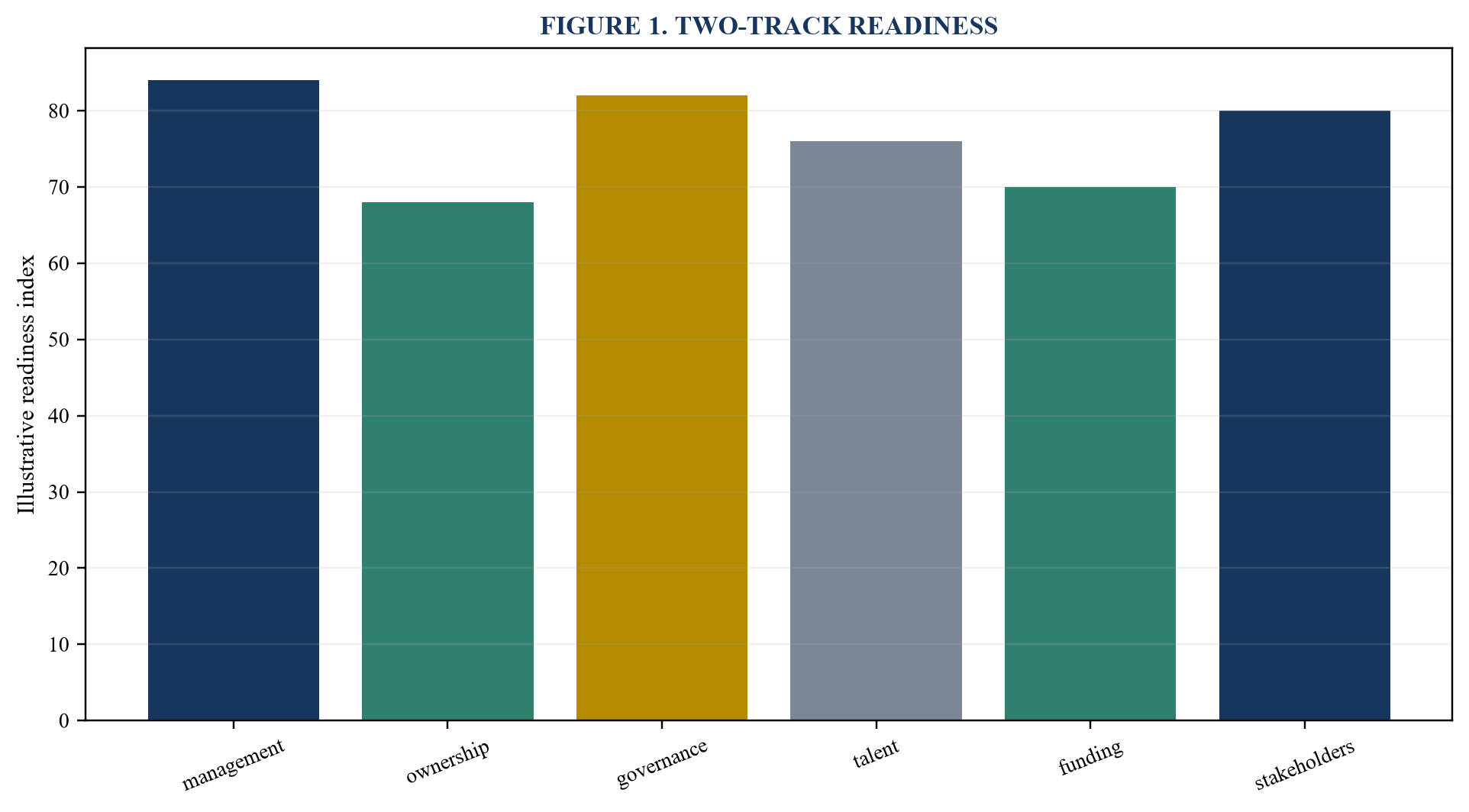
Values are illustrative readiness indices and require company-specific evidence.
9. Define leadership success profiles
Translate strategy into objective CEO and executive capabilities, experience, behaviours, values and availability.
The succession team should reconcile strategy, risk, operating model, stakeholder needs, performance history and culture. Each conclusion records the accountable body, source, timing, candidate or owner, evidence, dependency, control and unresolved exception. The immediate output is role-specific success profiles.
Management continuity must be proved through operating outcomes while ownership choices remain explicit. Reviewers test capability, authority, relationships, stakeholder confidence and downside response against native records and observed performance. Company strategy, role requirements, family objectives and governing law control every conclusion.
Material gaps require an owner, corrective action, test, advice and decision date. Consequences should flow through leadership capacity, customer delivery, cash, financing, value, control, fairness and transaction timing. Residual risk remains visible until authority is operable, stakeholders are protected and the relevant governing bodies approve the next gate.
10. Assess family candidates objectively
Evaluate family members against the same published criteria, evidence and development standards used for any candidate.
The succession team should reconcile career records, assessment, performance, references, development evidence and conflict controls. Each conclusion records the accountable body, source, timing, candidate or owner, evidence, dependency, control and unresolved exception. The immediate output is a family-candidate assessment pack.
Management continuity must be proved through operating outcomes while ownership choices remain explicit. Reviewers test capability, authority, relationships, stakeholder confidence and downside response against native records and observed performance. Company strategy, role requirements, family objectives and governing law control every conclusion.
Material gaps require an owner, corrective action, test, advice and decision date. Consequences should flow through leadership capacity, customer delivery, cash, financing, value, control, fairness and transaction timing. Residual risk remains visible until authority is operable, stakeholders are protected and the relevant governing bodies approve the next gate.
11. Assess internal non-family candidates
Test capability, aspiration, credibility, retention, stakeholder relationships and readiness for expanded authority.
The succession team should reconcile performance records, assessments, succession slates, references, incentives and development plans. Each conclusion records the accountable body, source, timing, candidate or owner, evidence, dependency, control and unresolved exception. The immediate output is an internal-candidate readiness map.
Management continuity must be proved through operating outcomes while ownership choices remain explicit. Reviewers test capability, authority, relationships, stakeholder confidence and downside response against native records and observed performance. Company strategy, role requirements, family objectives and governing law control every conclusion.
Material gaps require an owner, corrective action, test, advice and decision date. Consequences should flow through leadership capacity, customer delivery, cash, financing, value, control, fairness and transaction timing. Residual risk remains visible until authority is operable, stakeholders are protected and the relevant governing bodies approve the next gate.
12. Assess external candidates
Define search scope, market mapping, due diligence, references, conflicts, compensation and onboarding requirements.
The succession team should reconcile search evidence, candidate records, market benchmarks, background checks and board interviews. Each conclusion records the accountable body, source, timing, candidate or owner, evidence, dependency, control and unresolved exception. The immediate output is an external-search decision file.
Management continuity must be proved through operating outcomes while ownership choices remain explicit. Reviewers test capability, authority, relationships, stakeholder confidence and downside response against native records and observed performance. Company strategy, role requirements, family objectives and governing law control every conclusion.
Material gaps require an owner, corrective action, test, advice and decision date. Consequences should flow through leadership capacity, customer delivery, cash, financing, value, control, fairness and transaction timing. Residual risk remains visible until authority is operable, stakeholders are protected and the relevant governing bodies approve the next gate.
13. Create a credible talent pipeline
Develop multiple candidates for critical roles through assignments, mentoring, education and measured performance.
The succession team should reconcile skills matrix, career paths, rotations, projects, feedback and retention risk. Each conclusion records the accountable body, source, timing, candidate or owner, evidence, dependency, control and unresolved exception. The immediate output is a multi-level leadership pipeline.
Management continuity must be proved through operating outcomes while ownership choices remain explicit. Reviewers test capability, authority, relationships, stakeholder confidence and downside response against native records and observed performance. Company strategy, role requirements, family objectives and governing law control every conclusion.
Material gaps require an owner, corrective action, test, advice and decision date. Consequences should flow through leadership capacity, customer delivery, cash, financing, value, control, fairness and transaction timing. Residual risk remains visible until authority is operable, stakeholders are protected and the relevant governing bodies approve the next gate.
14. Plan emergency succession
Pre-authorise interim leadership, signatures, communications and stakeholder actions for sudden unavailability.
The succession team should reconcile delegations, deputies, crisis plans, contact routes, key obligations and board authority. Each conclusion records the accountable body, source, timing, candidate or owner, evidence, dependency, control and unresolved exception. The immediate output is an emergency-succession playbook.
Management continuity must be proved through operating outcomes while ownership choices remain explicit. Reviewers test capability, authority, relationships, stakeholder confidence and downside response against native records and observed performance. Company strategy, role requirements, family objectives and governing law control every conclusion.
Material gaps require an owner, corrective action, test, advice and decision date. Consequences should flow through leadership capacity, customer delivery, cash, financing, value, control, fairness and transaction timing. Residual risk remains visible until authority is operable, stakeholders are protected and the relevant governing bodies approve the next gate.
15. Transfer founder knowledge
Capture strategy logic, relationships, tacit operating knowledge, negotiation context and risk signals in usable form.
The succession team should reconcile interviews, account plans, decision histories, contracts, operating records and shadowing. Each conclusion records the accountable body, source, timing, candidate or owner, evidence, dependency, control and unresolved exception. The immediate output is a founder-knowledge transfer programme.
Management continuity must be proved through operating outcomes while ownership choices remain explicit. Reviewers test capability, authority, relationships, stakeholder confidence and downside response against native records and observed performance. Company strategy, role requirements, family objectives and governing law control every conclusion.
Material gaps require an owner, corrective action, test, advice and decision date. Consequences should flow through leadership capacity, customer delivery, cash, financing, value, control, fairness and transaction timing. Residual risk remains visible until authority is operable, stakeholders are protected and the relevant governing bodies approve the next gate.
16. Transfer customer and partner relationships
Move relationship ownership through joint coverage, documented context, authority and observed independent performance.
The succession team should reconcile CRM, account plans, contracts, stakeholder maps, meeting records and feedback. Each conclusion records the accountable body, source, timing, candidate or owner, evidence, dependency, control and unresolved exception. The immediate output is a relationship-continuity ledger.
Management continuity must be proved through operating outcomes while ownership choices remain explicit. Reviewers test capability, authority, relationships, stakeholder confidence and downside response against native records and observed performance. Company strategy, role requirements, family objectives and governing law control every conclusion.
Material gaps require an owner, corrective action, test, advice and decision date. Consequences should flow through leadership capacity, customer delivery, cash, financing, value, control, fairness and transaction timing. Residual risk remains visible until authority is operable, stakeholders are protected and the relevant governing bodies approve the next gate.
Table 2. Leadership continuity gates
| Gate | Required proof | Stop signal |
|---|---|---|
| capability | role criteria met | unresolved skill gap |
| authority | delegations executable | founder bottleneck |
| relationships | independent coverage proved | single-person dependency |
| resilience | downside response tested | continuity failure |
Illustrative programme design; company-specific facts and authorised advice govern.
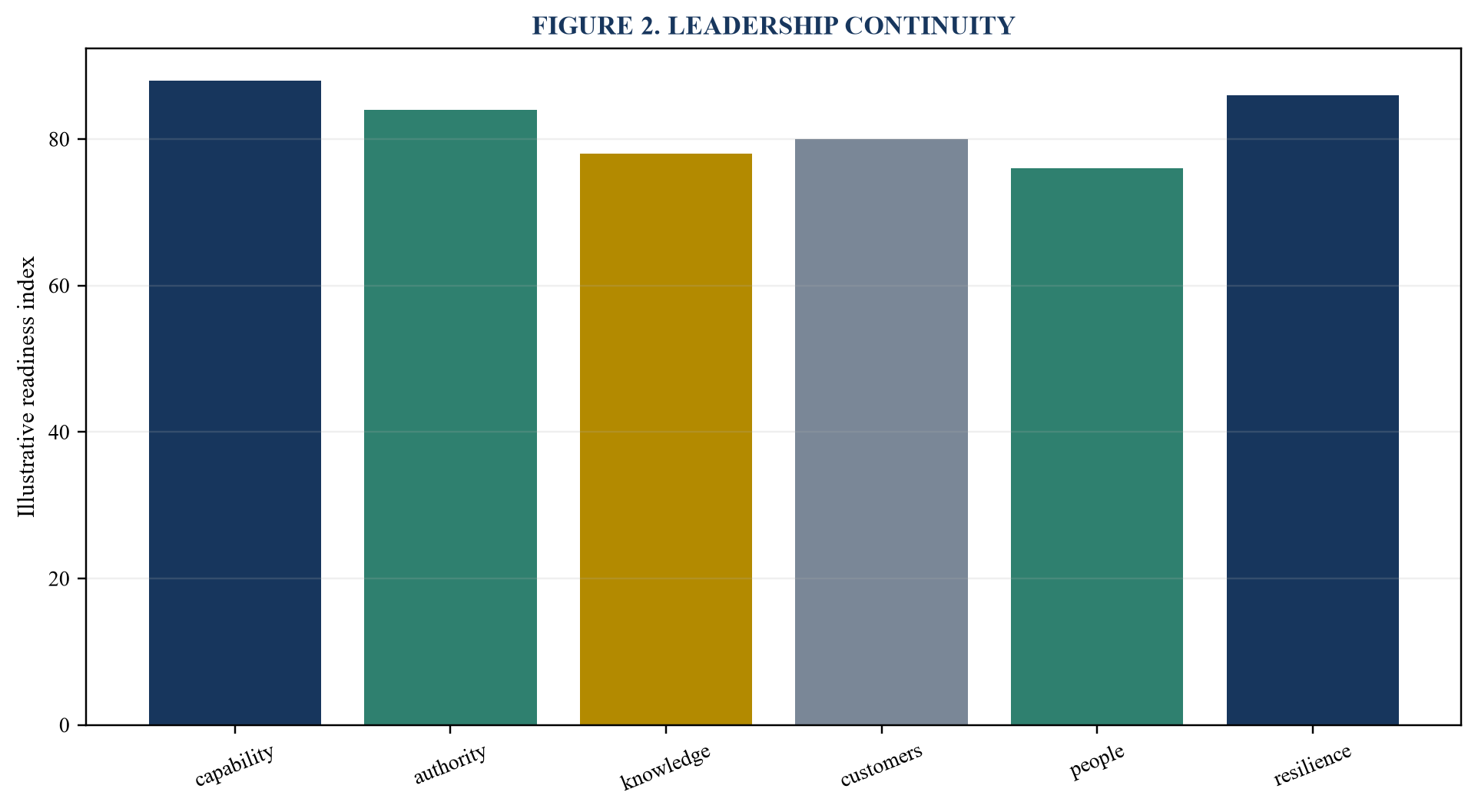
Values are illustrative readiness indices and require company-specific evidence.
17. Strengthen the management bench
Fill functional gaps, clarify accountabilities, develop deputies and reduce single-person dependencies.
The succession team should reconcile organisation, workload, role charters, performance, capacity, risk and recruitment data. Each conclusion records the accountable body, source, timing, candidate or owner, evidence, dependency, control and unresolved exception. The immediate output is a management-depth improvement plan.
Management continuity must be proved through operating outcomes while ownership choices remain explicit. Reviewers test capability, authority, relationships, stakeholder confidence and downside response against native records and observed performance. Company strategy, role requirements, family objectives and governing law control every conclusion.
Material gaps require an owner, corrective action, test, advice and decision date. Consequences should flow through leadership capacity, customer delivery, cash, financing, value, control, fairness and transaction timing. Residual risk remains visible until authority is operable, stakeholders are protected and the relevant governing bodies approve the next gate.
18. Test candidate readiness
Use real decisions, simulations, acting assignments, crisis exercises and board exposure to observe capability.
The succession team should reconcile assessment criteria, operating cases, feedback, outcomes and evidence. Each conclusion records the accountable body, source, timing, candidate or owner, evidence, dependency, control and unresolved exception. The immediate output is a candidate-readiness test report.
Management continuity must be proved through operating outcomes while ownership choices remain explicit. Reviewers test capability, authority, relationships, stakeholder confidence and downside response against native records and observed performance. Company strategy, role requirements, family objectives and governing law control every conclusion.
Material gaps require an owner, corrective action, test, advice and decision date. Consequences should flow through leadership capacity, customer delivery, cash, financing, value, control, fairness and transaction timing. Residual risk remains visible until authority is operable, stakeholders are protected and the relevant governing bodies approve the next gate.
19. Design fair appointment governance
Separate family influence from board judgement through conflicts, recusal, independent input and recorded rationale.
The succession team should reconcile interest register, committee process, criteria, assessments, minutes and advice. Each conclusion records the accountable body, source, timing, candidate or owner, evidence, dependency, control and unresolved exception. The immediate output is an appointment-fairness protocol.
Management continuity must be proved through operating outcomes while ownership choices remain explicit. Reviewers test capability, authority, relationships, stakeholder confidence and downside response against native records and observed performance. Company strategy, role requirements, family objectives and governing law control every conclusion.
Material gaps require an owner, corrective action, test, advice and decision date. Consequences should flow through leadership capacity, customer delivery, cash, financing, value, control, fairness and transaction timing. Residual risk remains visible until authority is operable, stakeholders are protected and the relevant governing bodies approve the next gate.
20. Set performance and probation gates
Define outcomes, behaviours, milestones, support, review cadence and consequences for the incoming leader.
The succession team should reconcile strategy, operating plan, role profile, scorecard, incentives and board expectations. Each conclusion records the accountable body, source, timing, candidate or owner, evidence, dependency, control and unresolved exception. The immediate output is a leadership-transition scorecard.
Management continuity must be proved through operating outcomes while ownership choices remain explicit. Reviewers test capability, authority, relationships, stakeholder confidence and downside response against native records and observed performance. Company strategy, role requirements, family objectives and governing law control every conclusion.
Material gaps require an owner, corrective action, test, advice and decision date. Consequences should flow through leadership capacity, customer delivery, cash, financing, value, control, fairness and transaction timing. Residual risk remains visible until authority is operable, stakeholders are protected and the relevant governing bodies approve the next gate.
21. Align executive incentives
Connect reward and retention to sustainable performance, transition outcomes, conduct and long-term value.
The succession team should reconcile remuneration policy, market data, contracts, performance measures and ownership objectives. Each conclusion records the accountable body, source, timing, candidate or owner, evidence, dependency, control and unresolved exception. The immediate output is a succession-aligned incentive plan.
Management continuity must be proved through operating outcomes while ownership choices remain explicit. Reviewers test capability, authority, relationships, stakeholder confidence and downside response against native records and observed performance. Company strategy, role requirements, family objectives and governing law control every conclusion.
Material gaps require an owner, corrective action, test, advice and decision date. Consequences should flow through leadership capacity, customer delivery, cash, financing, value, control, fairness and transaction timing. Residual risk remains visible until authority is operable, stakeholders are protected and the relevant governing bodies approve the next gate.
22. Design authority migration
Transfer decisions, signatures, system access, bank mandates and external representation in controlled stages.
The succession team should reconcile delegations, process maps, access rights, mandates, licences and approval logs. Each conclusion records the accountable body, source, timing, candidate or owner, evidence, dependency, control and unresolved exception. The immediate output is an authority-transition schedule.
Management continuity must be proved through operating outcomes while ownership choices remain explicit. Reviewers test capability, authority, relationships, stakeholder confidence and downside response against native records and observed performance. Company strategy, role requirements, family objectives and governing law control every conclusion.
Material gaps require an owner, corrective action, test, advice and decision date. Consequences should flow through leadership capacity, customer delivery, cash, financing, value, control, fairness and transaction timing. Residual risk remains visible until authority is operable, stakeholders are protected and the relevant governing bodies approve the next gate.
23. Clarify founder role after handover
Define any chair, adviser, ambassador or owner role with boundaries, term, information access and review.
The succession team should reconcile governance documents, role charter, conflicts, remuneration and stakeholder expectations. Each conclusion records the accountable body, source, timing, candidate or owner, evidence, dependency, control and unresolved exception. The immediate output is a post-handover founder mandate.
Management continuity must be proved through operating outcomes while ownership choices remain explicit. Reviewers test capability, authority, relationships, stakeholder confidence and downside response against native records and observed performance. Company strategy, role requirements, family objectives and governing law control every conclusion.
Material gaps require an owner, corrective action, test, advice and decision date. Consequences should flow through leadership capacity, customer delivery, cash, financing, value, control, fairness and transaction timing. Residual risk remains visible until authority is operable, stakeholders are protected and the relevant governing bodies approve the next gate.
24. Separate board from management
Ensure owner and director oversight does not recreate executive interference after management succession.
The succession team should reconcile articles, reserved matters, board calendar, delegations, reporting and observed behaviour. Each conclusion records the accountable body, source, timing, candidate or owner, evidence, dependency, control and unresolved exception. The immediate output is a board-management boundary protocol.
Management continuity must be proved through operating outcomes while ownership choices remain explicit. Reviewers test capability, authority, relationships, stakeholder confidence and downside response against native records and observed performance. Company strategy, role requirements, family objectives and governing law control every conclusion.
Material gaps require an owner, corrective action, test, advice and decision date. Consequences should flow through leadership capacity, customer delivery, cash, financing, value, control, fairness and transaction timing. Residual risk remains visible until authority is operable, stakeholders are protected and the relevant governing bodies approve the next gate.
Table 3. Founder role boundary
| Role | Permitted contribution | Required control |
|---|---|---|
| owner | purpose and reserved decisions | governance channel |
| director | board judgement | duties and conflicts |
| adviser | defined expertise | term and scope |
| ambassador | selected relationships | no executive authority |
Illustrative programme design; company-specific facts and authorised advice govern.
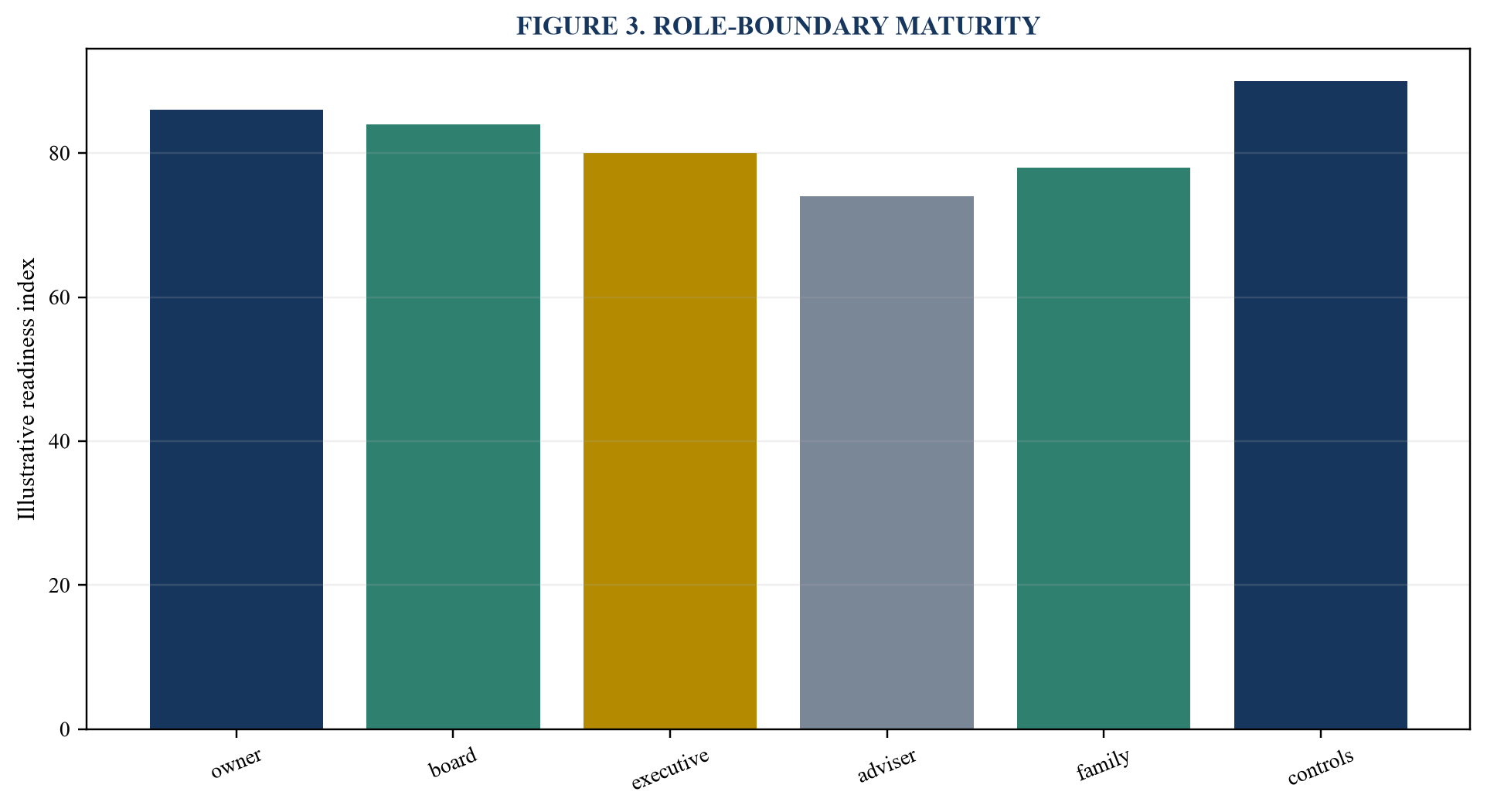
Values are illustrative readiness indices and require company-specific evidence.
25. Prepare the organisation
Explain the rationale, maintain confidence, retain critical people and create clear escalation routes.
The succession team should reconcile stakeholder plan, workforce data, retention analysis, communications and issue logs. Each conclusion records the accountable body, source, timing, candidate or owner, evidence, dependency, control and unresolved exception. The immediate output is an internal transition plan.
Management continuity must be proved through operating outcomes while ownership choices remain explicit. Reviewers test capability, authority, relationships, stakeholder confidence and downside response against native records and observed performance. Company strategy, role requirements, family objectives and governing law control every conclusion.
Material gaps require an owner, corrective action, test, advice and decision date. Consequences should flow through leadership capacity, customer delivery, cash, financing, value, control, fairness and transaction timing. Residual risk remains visible until authority is operable, stakeholders are protected and the relevant governing bodies approve the next gate.
26. Prepare external stakeholders
Sequence communications and assurances for customers, suppliers, lenders, regulators and partners.
The succession team should reconcile contracts, consent needs, relationship map, covenants, licences and communication plans. Each conclusion records the accountable body, source, timing, candidate or owner, evidence, dependency, control and unresolved exception. The immediate output is an external continuity plan.
Management continuity must be proved through operating outcomes while ownership choices remain explicit. Reviewers test capability, authority, relationships, stakeholder confidence and downside response against native records and observed performance. Company strategy, role requirements, family objectives and governing law control every conclusion.
Material gaps require an owner, corrective action, test, advice and decision date. Consequences should flow through leadership capacity, customer delivery, cash, financing, value, control, fairness and transaction timing. Residual risk remains visible until authority is operable, stakeholders are protected and the relevant governing bodies approve the next gate.
27. Protect financing continuity
Test change provisions, key-person clauses, representations, covenants, guarantees and lender confidence.
The succession team should reconcile facility documents, security, forecasts, relationship history and lender dialogue. Each conclusion records the accountable body, source, timing, candidate or owner, evidence, dependency, control and unresolved exception. The immediate output is a financing-continuity plan.
Management continuity must be proved through operating outcomes while ownership choices remain explicit. Reviewers test capability, authority, relationships, stakeholder confidence and downside response against native records and observed performance. Company strategy, role requirements, family objectives and governing law control every conclusion.
Material gaps require an owner, corrective action, test, advice and decision date. Consequences should flow through leadership capacity, customer delivery, cash, financing, value, control, fairness and transaction timing. Residual risk remains visible until authority is operable, stakeholders are protected and the relevant governing bodies approve the next gate.
28. Protect regulatory continuity
Confirm fit-and-proper, responsible-person, licence, notification and approval requirements for leadership change.
The succession team should reconcile licences, regulation, filings, correspondence, roles and legal analysis. Each conclusion records the accountable body, source, timing, candidate or owner, evidence, dependency, control and unresolved exception. The immediate output is a regulatory succession map.
Management continuity must be proved through operating outcomes while ownership choices remain explicit. Reviewers test capability, authority, relationships, stakeholder confidence and downside response against native records and observed performance. Company strategy, role requirements, family objectives and governing law control every conclusion.
Material gaps require an owner, corrective action, test, advice and decision date. Consequences should flow through leadership capacity, customer delivery, cash, financing, value, control, fairness and transaction timing. Residual risk remains visible until authority is operable, stakeholders are protected and the relevant governing bodies approve the next gate.
29. Integrate ownership rights later
Design voting, board appointment, information, dividend and transfer rights around the proven management model.
The succession team should reconcile ownership structure, governance, valuation, family mandate and management evidence. Each conclusion records the accountable body, source, timing, candidate or owner, evidence, dependency, control and unresolved exception. The immediate output is an ownership-governance design.
Management continuity must be proved through operating outcomes while ownership choices remain explicit. Reviewers test capability, authority, relationships, stakeholder confidence and downside response against native records and observed performance. Company strategy, role requirements, family objectives and governing law control every conclusion.
Material gaps require an owner, corrective action, test, advice and decision date. Consequences should flow through leadership capacity, customer delivery, cash, financing, value, control, fairness and transaction timing. Residual risk remains visible until authority is operable, stakeholders are protected and the relevant governing bodies approve the next gate.
30. Fund ownership transition separately
Compare gifts, redemptions, internal sales, debt, insurance and external capital without distorting operating leadership.
The succession team should reconcile cash flow, valuation, tax, financing, security and owner objectives. Each conclusion records the accountable body, source, timing, candidate or owner, evidence, dependency, control and unresolved exception. The immediate output is an ownership-transition funding plan.
Management continuity must be proved through operating outcomes while ownership choices remain explicit. Reviewers test capability, authority, relationships, stakeholder confidence and downside response against native records and observed performance. Company strategy, role requirements, family objectives and governing law control every conclusion.
Material gaps require an owner, corrective action, test, advice and decision date. Consequences should flow through leadership capacity, customer delivery, cash, financing, value, control, fairness and transaction timing. Residual risk remains visible until authority is operable, stakeholders are protected and the relevant governing bodies approve the next gate.
31. Value management continuity
Quantify customer, margin, execution, funding and risk consequences of leadership readiness or disruption.
The succession team should reconcile forecast, customer evidence, key-person analysis, scenarios and market data. Each conclusion records the accountable body, source, timing, candidate or owner, evidence, dependency, control and unresolved exception. The immediate output is a management-continuity value bridge.
Management continuity must be proved through operating outcomes while ownership choices remain explicit. Reviewers test capability, authority, relationships, stakeholder confidence and downside response against native records and observed performance. Company strategy, role requirements, family objectives and governing law control every conclusion.
Material gaps require an owner, corrective action, test, advice and decision date. Consequences should flow through leadership capacity, customer delivery, cash, financing, value, control, fairness and transaction timing. Residual risk remains visible until authority is operable, stakeholders are protected and the relevant governing bodies approve the next gate.
32. Create parallel risk registers
Track management and ownership risks independently while escalating cross-track dependencies.
The succession team should reconcile risk workshops, timelines, obligations, scenarios, owners and controls. Each conclusion records the accountable body, source, timing, candidate or owner, evidence, dependency, control and unresolved exception. The immediate output is a dual-track succession risk register.
Management continuity must be proved through operating outcomes while ownership choices remain explicit. Reviewers test capability, authority, relationships, stakeholder confidence and downside response against native records and observed performance. Company strategy, role requirements, family objectives and governing law control every conclusion.
Material gaps require an owner, corrective action, test, advice and decision date. Consequences should flow through leadership capacity, customer delivery, cash, financing, value, control, fairness and transaction timing. Residual risk remains visible until authority is operable, stakeholders are protected and the relevant governing bodies approve the next gate.
Table 4. Cross-track risk matrix
| Risk | Management effect | Ownership effect |
|---|---|---|
| sudden departure | leadership gap | accelerated transfer pressure |
| contested successor | decision paralysis | branch conflict |
| weak bench | execution risk | valuation pressure |
| funding stress | retention risk | delayed liquidity |
Illustrative programme design; company-specific facts and authorised advice govern.
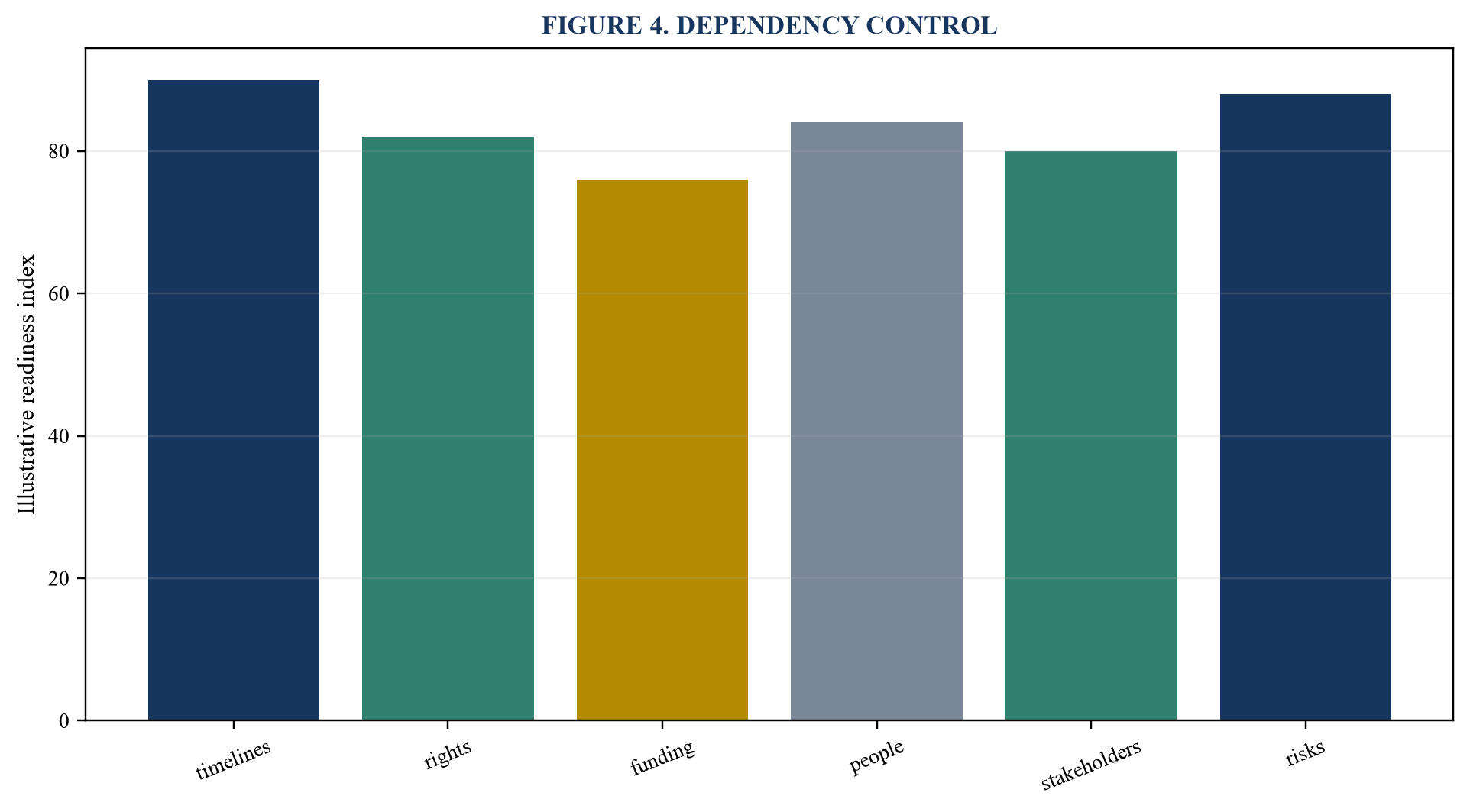
Values are illustrative readiness indices and require company-specific evidence.
33. Run transition simulations
Test sudden departure, contested appointment, family disagreement, lender concern and operating shock.
The succession team should reconcile scenarios, roles, authority, communications, data and observed response. Each conclusion records the accountable body, source, timing, candidate or owner, evidence, dependency, control and unresolved exception. The immediate output is a succession stress-test report.
Management continuity must be proved through operating outcomes while ownership choices remain explicit. Reviewers test capability, authority, relationships, stakeholder confidence and downside response against native records and observed performance. Company strategy, role requirements, family objectives and governing law control every conclusion.
Material gaps require an owner, corrective action, test, advice and decision date. Consequences should flow through leadership capacity, customer delivery, cash, financing, value, control, fairness and transaction timing. Residual risk remains visible until authority is operable, stakeholders are protected and the relevant governing bodies approve the next gate.
34. Establish go and no-go gates
Require objective evidence before each authority transfer, appointment, ownership step or public announcement.
The succession team should reconcile gate criteria, test results, stakeholder readiness, approvals and residual risk. Each conclusion records the accountable body, source, timing, candidate or owner, evidence, dependency, control and unresolved exception. The immediate output is a staged succession certificate.
Management continuity must be proved through operating outcomes while ownership choices remain explicit. Reviewers test capability, authority, relationships, stakeholder confidence and downside response against native records and observed performance. Company strategy, role requirements, family objectives and governing law control every conclusion.
Material gaps require an owner, corrective action, test, advice and decision date. Consequences should flow through leadership capacity, customer delivery, cash, financing, value, control, fairness and transaction timing. Residual risk remains visible until authority is operable, stakeholders are protected and the relevant governing bodies approve the next gate.
35. Control information and confidentiality
Set access to candidate, family, compensation, ownership and transaction information by legitimate role.
The succession team should reconcile data map, privacy rules, confidentiality, permissions, advisers and communication plan. Each conclusion records the accountable body, source, timing, candidate or owner, evidence, dependency, control and unresolved exception. The immediate output is a succession information-control protocol.
Management continuity must be proved through operating outcomes while ownership choices remain explicit. Reviewers test capability, authority, relationships, stakeholder confidence and downside response against native records and observed performance. Company strategy, role requirements, family objectives and governing law control every conclusion.
Material gaps require an owner, corrective action, test, advice and decision date. Consequences should flow through leadership capacity, customer delivery, cash, financing, value, control, fairness and transaction timing. Residual risk remains visible until authority is operable, stakeholders are protected and the relevant governing bodies approve the next gate.
36. Document decisions and dissent
Record purpose, evidence, alternatives, conflicts, challenge, votes, conditions and unresolved concerns.
The succession team should reconcile board and family papers, minutes, assessments, advice and resolutions. Each conclusion records the accountable body, source, timing, candidate or owner, evidence, dependency, control and unresolved exception. The immediate output is an auditable succession decision record.
Management continuity must be proved through operating outcomes while ownership choices remain explicit. Reviewers test capability, authority, relationships, stakeholder confidence and downside response against native records and observed performance. Company strategy, role requirements, family objectives and governing law control every conclusion.
Material gaps require an owner, corrective action, test, advice and decision date. Consequences should flow through leadership capacity, customer delivery, cash, financing, value, control, fairness and transaction timing. Residual risk remains visible until authority is operable, stakeholders are protected and the relevant governing bodies approve the next gate.
37. Monitor the first hundred days
Track operating performance, relationships, decisions, people, culture and early warning indicators after handover.
The succession team should reconcile scorecard, management reports, stakeholder feedback, incidents and board reviews. Each conclusion records the accountable body, source, timing, candidate or owner, evidence, dependency, control and unresolved exception. The immediate output is a one-hundred-day transition dashboard.
Management continuity must be proved through operating outcomes while ownership choices remain explicit. Reviewers test capability, authority, relationships, stakeholder confidence and downside response against native records and observed performance. Company strategy, role requirements, family objectives and governing law control every conclusion.
Material gaps require an owner, corrective action, test, advice and decision date. Consequences should flow through leadership capacity, customer delivery, cash, financing, value, control, fairness and transaction timing. Residual risk remains visible until authority is operable, stakeholders are protected and the relevant governing bodies approve the next gate.
38. Review at twelve months
Assess sustained leadership outcomes, role boundaries, bench strength, strategy delivery and ownership readiness.
The succession team should reconcile performance record, board evaluation, stakeholder evidence, risks and lessons. Each conclusion records the accountable body, source, timing, candidate or owner, evidence, dependency, control and unresolved exception. The immediate output is a twelve-month succession review.
Management continuity must be proved through operating outcomes while ownership choices remain explicit. Reviewers test capability, authority, relationships, stakeholder confidence and downside response against native records and observed performance. Company strategy, role requirements, family objectives and governing law control every conclusion.
Material gaps require an owner, corrective action, test, advice and decision date. Consequences should flow through leadership capacity, customer delivery, cash, financing, value, control, fairness and transaction timing. Residual risk remains visible until authority is operable, stakeholders are protected and the relevant governing bodies approve the next gate.
39. Advance ownership only when ready
Use proved management continuity, governance and cash resilience to select the timing and form of ownership transfer.
The succession team should reconcile management review, valuation, funding, family alignment, tax and legal advice. Each conclusion records the accountable body, source, timing, candidate or owner, evidence, dependency, control and unresolved exception. The immediate output is an ownership-succession readiness decision.
Management continuity must be proved through operating outcomes while ownership choices remain explicit. Reviewers test capability, authority, relationships, stakeholder confidence and downside response against native records and observed performance. Company strategy, role requirements, family objectives and governing law control every conclusion.
Material gaps require an owner, corrective action, test, advice and decision date. Consequences should flow through leadership capacity, customer delivery, cash, financing, value, control, fairness and transaction timing. Residual risk remains visible until authority is operable, stakeholders are protected and the relevant governing bodies approve the next gate.
40. Issue the two-track succession conclusion
Present leadership readiness, ownership options, dependencies, residual risks, approvals and implementation sequence.
The succession team should reconcile integrated timelines, assessments, tests, stakeholder plans, valuation and advice. Each conclusion records the accountable body, source, timing, candidate or owner, evidence, dependency, control and unresolved exception. The immediate output is a board-and-family succession decision paper.
Management continuity must be proved through operating outcomes while ownership choices remain explicit. Reviewers test capability, authority, relationships, stakeholder confidence and downside response against native records and observed performance. Company strategy, role requirements, family objectives and governing law control every conclusion.
Material gaps require an owner, corrective action, test, advice and decision date. Consequences should flow through leadership capacity, customer delivery, cash, financing, value, control, fairness and transaction timing. Residual risk remains visible until authority is operable, stakeholders are protected and the relevant governing bodies approve the next gate.
Table 5. Succession decision certificate
| Dimension | Required conclusion | Decision use |
|---|---|---|
| capable | leadership proved | appointment |
| continuous | stakeholders protected | timing |
| governed | roles and authority clear | control |
| financeable | ownership route funded | transfer |
Illustrative programme design; company-specific facts and authorised advice govern.
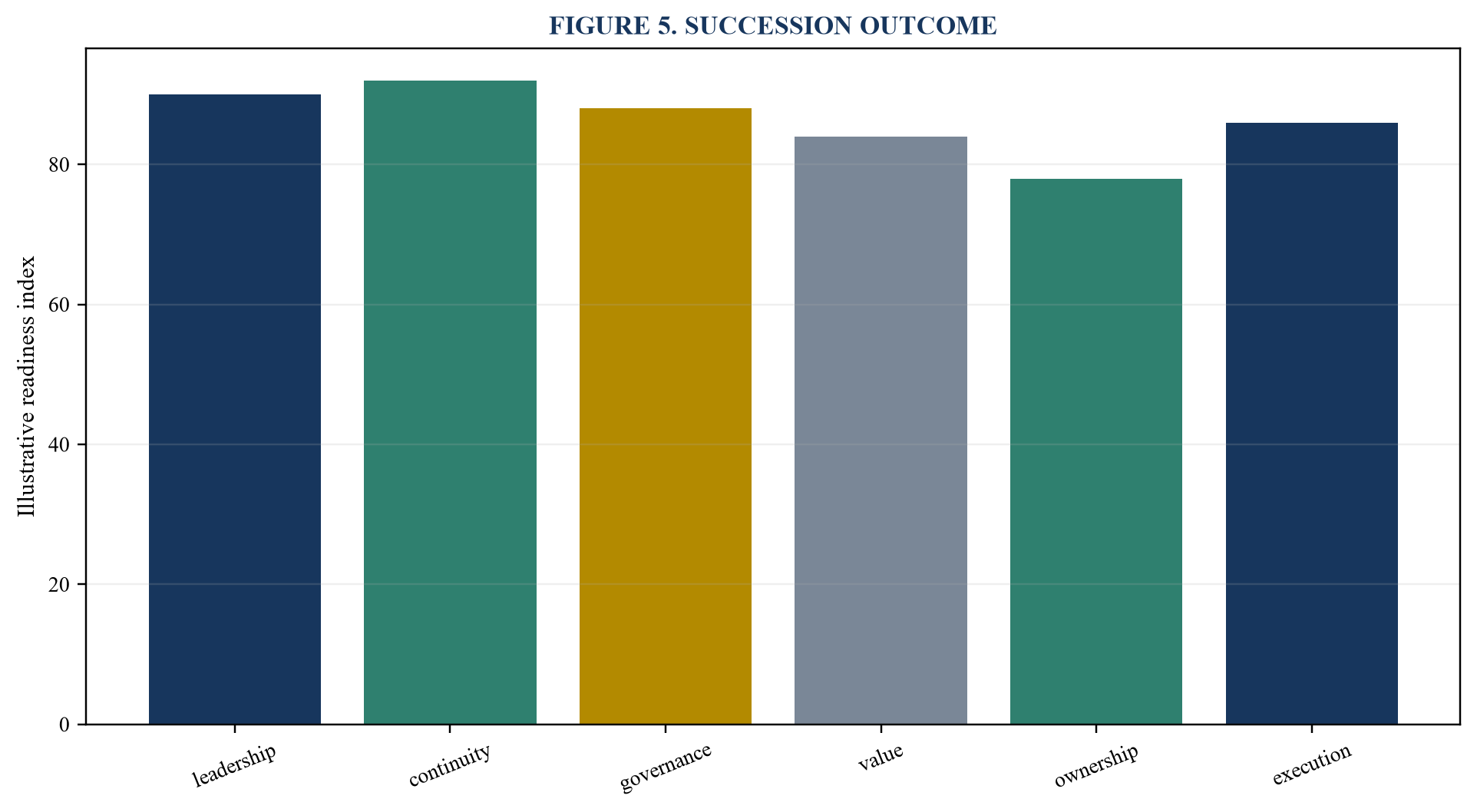
Values are illustrative readiness indices and require company-specific evidence.
References
- International Finance Corporation, Family Business Governance Handbook, https://www.ifc.org/en/insights-reports/2011/ifc-family-business-governance-handbook
- International Finance Corporation, Family Business Governance, https://www.ifc.org/en/what-we-do/sector-expertise/corporate-governance/family-business-governance
- Financial Reporting Council, UK Corporate Governance Code 2024, https://www.frc.org.uk/library/standards-codes-policy/corporate-governance/uk-corporate-governance-code/
- Financial Reporting Council, Corporate Governance Code Guidance, https://www.frc.org.uk/library/standards-codes-policy/corporate-governance/corporate-governance-code-guidance/
- Financial Reporting Council, Wates Corporate Governance Principles for Large Private Companies, https://www.frc.org.uk/library/standards-codes-policy/corporate-governance/the-wates-corporate-governance-principles-for-large-private-companies/
- OECD, G20/OECD Principles of Corporate Governance 2023, https://doi.org/10.1787/ed750b30-en
- OECD, The Responsibilities of the Board, G20/OECD Principles of Corporate Governance 2023, https://www.oecd.org/en/publications/g20-oecd-principles-of-corporate-governance-2023_ed750b30-en/full-report/component-8.html
- OECD, Corporate Governance Factbook 2023, https://www.oecd.org/en/publications/oecd-corporate-governance-factbook-2023_6d912314-en.html
- United Arab Emirates, Federal Decree-Law No. 37 of 2022 Concerning Family Businesses, https://uaelegislation.gov.ae/en/legislations/1608
- UAE Ministry of Economy and Tourism, Companies Legislation, https://www.moet.gov.ae/en/companies-legislations
- Dubai International Financial Centre, Family Arrangements Regulations 2023, https://assets.difc.com/v1/media/edge/images/dubaiintern0078-difcexperie96c5-production-3253/media/project/difcexperiences/difc/difcwebsite/documents/familydocs/family_arrangements_regulations_updated_april23.pdf
- UK Government, Companies Act 2006 section 172, https://www.legislation.gov.uk/ukpga/2006/46/section/172
- UK Government, Companies Act 2006 Part 10 Directors, https://www.legislation.gov.uk/ukpga/2006/46/part/10
- IFRS Foundation, IAS 24 Related Party Disclosures, https://www.ifrs.org/issued-standards/list-of-standards/ias-24-related-party-disclosures/
- IFRS Foundation, IFRS 10 Consolidated Financial Statements, https://www.ifrs.org/issued-standards/list-of-standards/ifrs-10-consolidated-financial-statements/
- IFRS Foundation, IFRS 13 Fair Value Measurement, https://www.ifrs.org/issued-standards/list-of-standards/ifrs-13-fair-value-measurement/
- International Organization for Standardization, ISO 31000 Risk Management Guidelines, https://www.iso.org/iso-31000-risk-management.html
- International Organization for Standardization, ISO 22301 Business Continuity Management Systems, https://www.iso.org/standard/75106.html
- International Auditing and Assurance Standards Board, ISA 500 Audit Evidence, https://www.iaasb.org/publications/international-standard-auditing-isa-500-audit-evidence
- National Institute of Standards and Technology, Cybersecurity Framework 2.0, https://doi.org/10.6028/NIST.CSWP.29
- US Securities and Exchange Commission, Regulation S-K, https://www.sec.gov/rules-regulations/staff-guidance/corporation-finance-interpretations/regulation-s-k
- UK Takeover Panel, The Takeover Code, https://www.thetakeoverpanel.org.uk/the-code/download-code
- World Bank, Corporate Governance, https://www.worldbank.org/en/topic/financialsector/brief/corporate-governance
- International Labour Organization, Governance and Tripartism Department, https://www.ilo.org/about-ilo/organizational-structure/governance-and-tripartism-department
- OECD, Guidelines for Multinational Enterprises on Responsible Business Conduct, https://doi.org/10.1787/81f92357-en
- International Finance Corporation, Corporate Governance Methodology, https://www.ifc.org/en/what-we-do/sector-expertise/corporate-governance/cg-methodology-tools
