

1. Treat management incentives as a post-deal operating system
The first months after an acquisition convert an investment thesis into operating choices. Management must decide which initiatives matter, who owns them, what resources they receive, how progress is measured and when the board intervenes. An equity plan can reinforce that operating system when it rewards the evidence that builds durable value. It can weaken execution when it pays primarily for the passage of time, relies on a single valuation measure or allows participants to benefit from leverage and market movement without delivering the operating plan.
The board should therefore treat management incentives as a governed value-creation system. The system begins with the acquisition baseline: revenue quality, margin, cash conversion, capital intensity, strategic positioning, risk and the entry capital structure. It then identifies the limited set of actions expected to change those drivers. Each action receives an accountable executive, a measurable definition, a dated evidence trail and a consequence for vesting or allocation. The economic design follows the operating design rather than preceding it.
International governance standards support this connection. The G20/OECD Principles state that executive remuneration should align with long-term company and shareholder interests through measurable, ex ante performance criteria, and they recognise malus and clawback as good practice [1][2]. The United Kingdom Corporate Governance Code states that remuneration should support strategy and long-term sustainable success, with independent judgement over outcomes [3]. These public-company principles are not a private-equity rulebook. They provide useful design disciplines for a concentrated ownership setting in which incentive errors can materially affect execution and exit.
An effective plan has eight gates. The value thesis must be explicit. The eligible population and pool must be defensible. The instrument must fit the corporate and jurisdictional structure. Performance conditions must measure controllable value drivers. Vesting and leaver rules must retain talent without rewarding failure. Dilution and proceeds must be understood under multiple outcomes. Governance, tax, securities and accounting work must be complete. The plan must remain administrable through add-ons, refinancing, leadership changes and exit.
The output is more than a legal document. It is a chain of evidence that connects board-approved strategy to individual accountability and economic consequences. Every material term should answer a value-creation question. Every metric should have a source and owner. Every discretion should have an authority and rationale. Every participant should understand how their decisions can improve the company and how proceeds would actually be calculated.
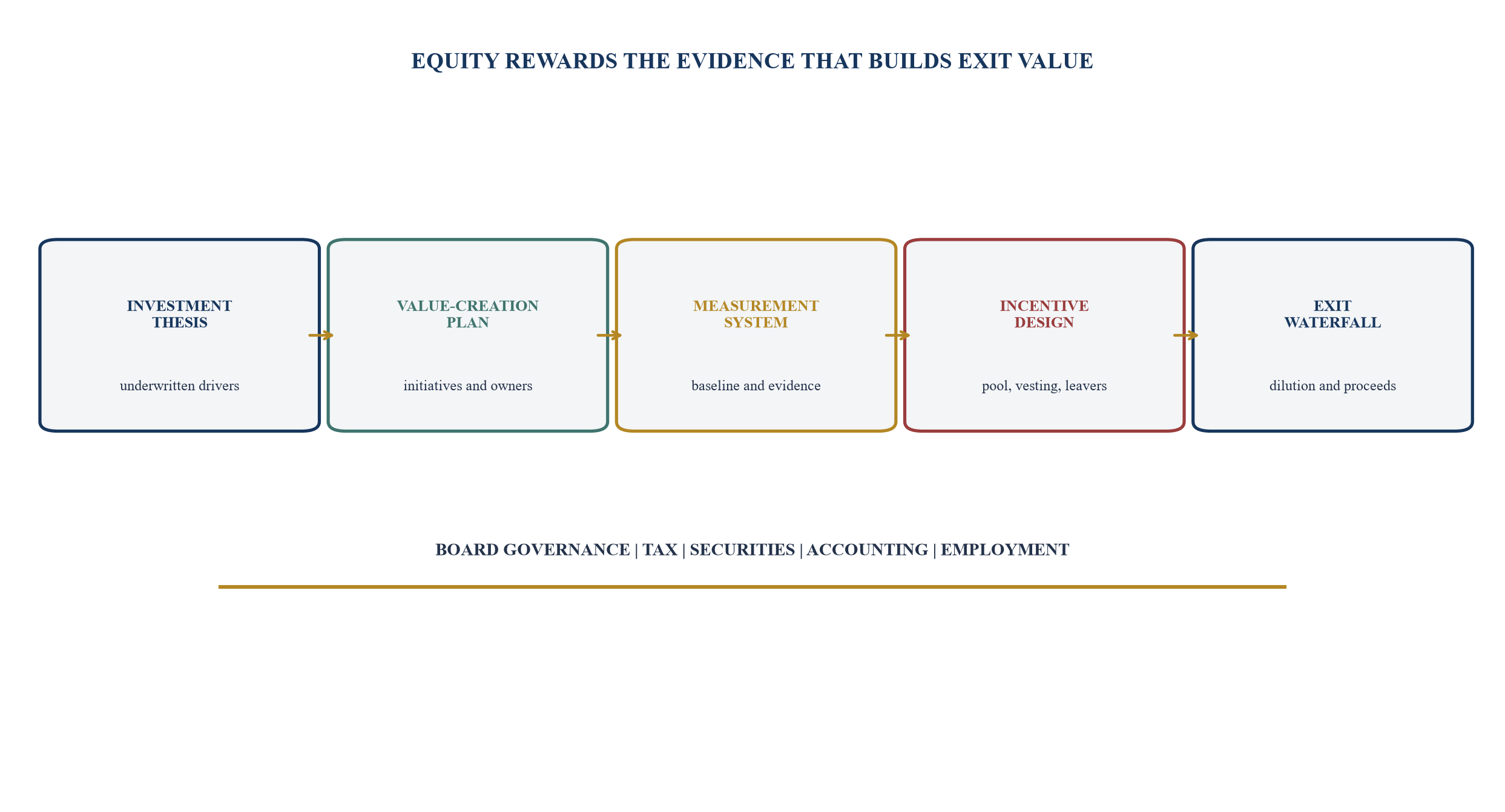
The architecture is a strategic design aid. Governing documents and qualified advice determine the final plan.
2. Reconstruct the underwritten value bridge before allocating equity
The incentive plan should begin with the acquisition model and the evidence that supported the investment decision. Entry enterprise value, debt, cash, working capital, earnings quality, customer concentration, maintenance investment and expected operational improvements establish the economic starting point. The board should reconcile that starting point with completion accounts, purchase accounting and the first reliable post-close forecast. A plan anchored to an unreconciled bid model can reward or penalise management for numbers that never existed in the operating company.
The value bridge should distinguish operating value from financing and market effects. Revenue growth, gross-margin improvement, recurring-cost removal, working-capital discipline, capital productivity and strategic repositioning may be management-influenced. Debt paydown reflects cash generation and capital allocation. Multiple movement can arise from business-quality improvements, market sentiment, buyer competition or sector re-rating. Currency and tax changes may affect proceeds without reflecting management performance. The plan can recognise total shareholder value while applying greater weight to drivers that management can influence and evidence.
Each initiative needs a baseline, target, calculation method, data source, owner, timing and independent verification route. A margin target should define revenue and cost classifications. A cash-conversion target should identify exceptional items, factoring, supplier finance and acquisition effects. A recurring-revenue target should define renewal, churn, pricing and contract duration. An acquisition target should address price, synergies, integration and return on capital rather than completed deal count alone.
The bridge also needs a downside. Incentives that pay only on an upside path can encourage risk accumulation or accounting acceleration. The board should model value under slower growth, delayed initiatives, customer loss, working-capital stress, higher financing cost and lower exit multiples. It should identify which actions remain valuable in those states. Measures such as cash resilience, quality, safety, compliance, customer retention and critical-talent continuity can protect value when headline growth slows.
The result is a board-approved value taxonomy. Tier one contains the few outcomes that determine the investment case. Tier two contains operational drivers that predict those outcomes. Tier three contains risk controls and evidence requirements. The incentive plan should use this hierarchy so that participants understand the difference between an activity, an operating result and an equity-value outcome.
Table 1. Value-creation baseline and evidence register
| Value driver | Baseline evidence | Performance definition | Verification source | Incentive treatment |
|---|---|---|---|---|
| organic revenue quality | customer-level revenue, contracts, churn and pricing | growth from retained and new customers, excluding acquired revenue | finance system and contract register | weighted score with minimum retention threshold |
| operating margin | quality-of-earnings bridge and cost ownership | recurring margin after agreed normalisations | audited or board-approved management accounts | threshold, target and stretch schedule |
| cash conversion | working-capital history, capex and cash taxes | operating cash after required investment | bank, ledger and capex approval records | gate to value-based vesting |
| strategic repositioning | segment economics and market evidence | agreed mix, capability or product milestones with economic proof | board papers and customer evidence | milestone plus financial confirmation |
| add-on integration | acquisition case, synergy baseline and integration plan | realised synergies, retention and return on invested capital | integration office and finance validation | vesting only after sustained delivery |
| risk and resilience | safety, compliance, quality and control baseline | absence of material failure plus leading-control evidence | audit, risk and compliance reports | malus, downward discretion or zero gate |
The register is a design aid. Actual baselines and targets require company-specific verification.
3. Define the eligible population through role-specific value influence
Eligibility should reflect a role's ability to create and protect enterprise value over the investment horizon. Title alone is an unreliable allocation method. The chief executive may control portfolio-wide priorities and capital allocation. A commercial leader may own pricing and retention. An operations leader may deliver margin and service reliability. A technology leader may remove a capacity constraint or build a defensible product capability. A country manager may influence only a defined business unit. The plan should recognise these different value pathways.
The board can score roles across four dimensions: magnitude of value influence, uniqueness of capability, retention risk and time required to deliver. A role with high influence and scarce capability may merit a larger initial award. A role with narrower influence can receive a smaller award linked to relevant metrics. Critical employees below the executive tier may merit participation when their decisions directly affect an underwritten initiative. Broad participation can support culture, but it should be designed separately from the concentrated pool used to motivate enterprise-level outcomes.
Allocation should also consider existing compensation and personal investment. Executives who invest meaningful capital alongside the sponsor experience genuine downside as well as upside. Sweet equity, options, restricted shares and co-investment produce different risk profiles. The board should compare expected value across base, downside and upside scenarios rather than quoting only a percentage of fully diluted equity. Participants need to understand the purchase price, tax exposure, vesting risk, liquidity constraints and potential proceeds.
The pool needs capacity for future joiners, promotions and corrective grants. Allocating the entire pool at close can make later recruitment expensive and dilute existing participants unexpectedly. An initial reserve creates flexibility, but an oversized reserve obscures dilution and can weaken perceived ownership. The board should set a reserve policy with authority, use cases, expiry and reporting. Cancelled awards should return to the pool only where plan documents and applicable law permit.
4. Select the instrument after testing corporate, tax and accounting fit
Management incentives can use ordinary shares, growth shares, options, restricted shares, restricted stock units, phantom equity, cash-settled appreciation rights, profit interests or contractual value-participation units. Each instrument creates a different combination of ownership, voting, dividend rights, purchase price, tax timing, accounting cost, securities compliance and cash-settlement exposure. The chosen instrument should fit the company's legal structure, the participant population and the intended exit path.
Actual shares provide visible ownership and can align dividends and voting, but they introduce shareholder rights, transfer restrictions, cap-table administration and potentially immediate tax or funding requirements. Options defer acquisition until exercise and can create a clear hurdle, but participants may face exercise cost and tax before liquidity. Growth shares can concentrate participation in value above a threshold, provided rights and valuation are carefully designed. Phantom equity avoids issuing shares and can simplify some cross-border cases, while creating a cash liability and different accounting treatment.
IFRS 2 requires entities to recognise the effects of share-based payment transactions, including employee options, in profit or loss and financial position [5]. Equity-settled and cash-settled arrangements follow different measurement paths, and vesting conditions affect recognition. The accounting model should be assessed before grants are approved because plan modifications, cancellations and settlement choices can change expense and volatility. Fair-value work should use supported assumptions, cap-table terms and consistent valuation dates.
Securities law can apply even when the plan is compensatory. In the United States, SEC Rule 701 provides an exemption for qualifying compensatory sales by non-reporting companies, with additional disclosure where sales exceed the applicable threshold [8]. Securities remain restricted and state-law requirements can still apply. Delaware corporate law allows boards to create rights or options subject to the certificate and board resolution, including defined limits where authority is delegated [11]. Other jurisdictions have their own offer, prospectus, filing and employee-plan requirements.
The instrument decision should be captured in a comparative memorandum signed by legal, tax, accounting and company owners. The memorandum should address the issuing entity, security rights, valuation, settlement, withholding, mobility, reporting, cash needs, exit mechanics and participant communications. The plan then becomes an operating choice supported by professional work rather than a copied precedent.
Table 2. Instrument decision matrix
| Instrument | Economic profile | Administration | Principal design risk | Best-fit question |
|---|---|---|---|---|
| ordinary or restricted shares | direct ownership from issue or acquisition | cap table, transfers, valuation and shareholder documents | tax or funding before liquidity; minority rights | should participants hold current equity and accept ownership obligations? |
| growth shares | participates above a defined hurdle | bespoke rights, valuation and waterfall testing | hurdle or class rights fail to match intended economics | is value above a supported threshold the desired reward base? |
| options | right to acquire shares at an exercise price | grant, vesting, exercise, expiry and securities records | exercise cost, tax timing and underwater awards | should ownership begin only after exercise and continued service? |
| restricted stock units | contractual promise to deliver shares or value | vesting, settlement and withholding process | settlement timing and cross-border treatment | is deferred delivery more practical than current ownership? |
| phantom equity or appreciation rights | cash linked to equity value or increase | liability valuation and payment funding | cash requirement at exit or interim settlement | does the company need value alignment without new shareholders? |
| co-investment plus incentive equity | invested capital and performance participation | subscription, funding, transfers and two-part waterfall | participants misunderstand different risk layers | should leaders combine downside capital with earned upside? |
The comparison is indicative. Jurisdiction, entity form and participant facts determine actual treatment.
5. Size the pool from scenario economics and labour-market reality
Pool size should be tested through proceeds, dilution and expected value. A headline percentage does not show what management receives after debt, preferred instruments, shareholder loans, transaction costs, liquidation preferences, ratchets and exercise prices. The board should model the fully diluted waterfall under downside, base and upside exits. It should calculate the value received by each security class and compare participant outcomes with the contribution, retention objective and sponsor return.
The initial capital structure matters. A ten percent pool behind a large shareholder loan or preference may have little value at moderate exits. A smaller pool that participates from a lower hurdle may deliver greater expected value. A plan based on enterprise value can overstate proceeds when leverage is high. A plan based only on equity value can encourage risk-taking through additional debt. The design should therefore show both enterprise-value creation and the distribution waterfall.
Market practice can inform recruitment, but company economics should govern. Benchmark data often aggregates different sectors, geographies, deal sizes, seniority and instruments. It can also reflect granted percentages rather than realised value. The board should document the relevance and limits of any benchmark. A transparent expected-value comparison can be more useful than matching a nominal pool percentage from a different capital structure.
Dilution should be allocated explicitly. New awards may dilute sponsor equity, existing management, rollover shareholders or all holders according to the documents. Acquisitions funded with shares can create further dilution. Capital restructurings, anti-dilution adjustments, share splits and new financing need defined treatment. The plan should state whether the pool is measured before or after exercise and whether unallocated reserve is included in the fully diluted denominator.
The board should approve a pool range and an allocation budget. It should see the economic cost at each exit, the reserve available and the sensitivity to financing choices. Shareholder approvals may be required. The G20/OECD Principles recognise that equity schemes can dilute shareholder capital and shape managerial incentives, supporting transparent approval and disclosure [2]. In a private company, that discipline can be reflected in the investment committee and board record.
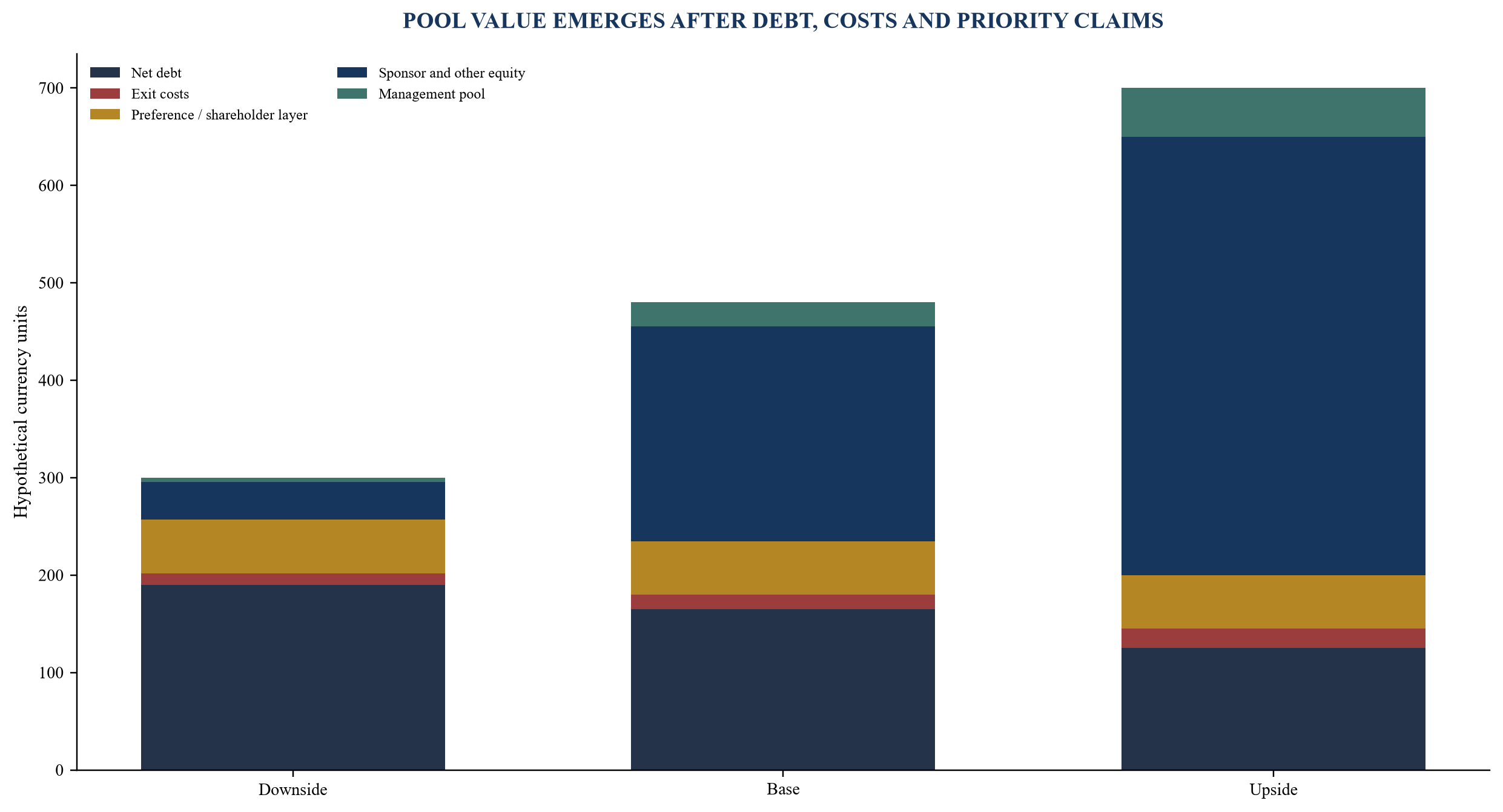
Amounts and percentages are hypothetical management assumptions and do not represent a transaction or market benchmark.
6. Build a balanced performance scorecard from controllable drivers
A single EBITDA target is easy to communicate and easy to distort. EBITDA can rise while cash conversion weakens, customers leave, maintenance investment is deferred or risk accumulates. Total shareholder return can reward leverage and multiple expansion that management did not create. A balanced scorecard should combine enterprise outcomes, operational drivers and value-protection gates in a form that remains understandable.
The scorecard can use four layers. The first is a threshold below which performance equity does not vest, such as minimum equity value or return. The second is a small set of financial outcomes, including revenue quality, EBITDA, cash conversion or return on invested capital. The third is strategic delivery, such as integration, recurring-revenue mix, capacity commissioning or product milestones. The fourth is a risk gate covering material compliance, safety, reporting integrity and misconduct. The weighting should reflect the investment thesis.
Metric design requires precision. Baselines and targets should be fixed or governed through an agreed adjustment mechanism. Acquisitions, disposals, foreign exchange, accounting changes, exceptional items and central allocations need defined treatment. Where management can influence classification, the audit or finance committee should validate the calculation. A target should specify the measurement period, source, approval date and consequence of missing evidence.
The scorecard should limit duplication. Revenue, EBITDA and equity value are related, so weighting all three heavily can reward the same outcome several times. A milestone can be credited only after its economic result is visible. Integration should measure customer and talent retention, synergy delivery and return, not project completion alone. Non-financial measures should have objective evidence and should not become a discretionary route to fill a financial shortfall.
The board should also test behaviour. Aggressive pricing can improve near-term margin and damage retention. Working-capital extraction can weaken suppliers. Delayed maintenance can lift cash temporarily. A metric library should identify foreseeable gaming, the control that detects it and the authority to adjust. FRC guidance encourages reliable and credible financial, non-financial and strategic measures, with attention to behaviours they may encourage [4].
Table 3. Performance metric design register
| Metric | Definition discipline | Leading evidence | Anti-gaming control | Vesting role |
|---|---|---|---|---|
| quality revenue growth | organic constant-scope revenue from retained and new customers | pipeline conversion, renewal and price realisation | exclude acquired revenue and unsupported pull-forward | weighted outcome with retention gate |
| sustainable EBITDA | recurring earnings after defined normalisations | gross margin, productivity and cost ownership | cap adjustments and require finance validation | threshold, target and stretch curve |
| cash conversion | cash after working capital, cash tax and required capex | debtor days, inventory and capex commitments | identify factoring, supplier finance and deferred maintenance | minimum gate plus weighted score |
| strategic milestone | dated capability with operating and customer proof | adoption, service level and unit economics | no credit for activity without economic evidence | binary or graduated milestone |
| add-on value | realised integration and return against acquisition case | retention, synergies and integration risks | charge acquisition cost and delayed dis-synergies | separate tranche or modifier |
| risk and conduct | material compliance, safety, quality and reporting integrity | control testing and incident trends | independent review and board discretion | malus, clawback or zero gate |
Measures and weights are illustrative. The investment thesis and company evidence should determine the final scorecard.
7. Combine time vesting, performance vesting and an exit condition
Time vesting supports retention. Performance vesting supports delivery. An exit condition links value to shareholder liquidity. A robust plan often uses all three, with a design that matches the expected hold period and avoids an incentive cliff. Pure time vesting can pay despite value destruction. Pure performance vesting can become unstable when targets are set too early or depend on external variables. Exit-only vesting can leave participants uncertain during a prolonged hold.
Time-based awards can vest periodically while remaining subject to transfer restrictions and settlement conditions. Performance-based awards can vest against cumulative results, annual tranches or a measurement at exit. Cumulative measures can absorb timing shifts but may delay feedback. Annual tranches create regular accountability but can promote short-term management. A hybrid can use annual operating evidence to bank provisional credit, with final confirmation against cash and exit value.
The plan should specify treatment at exit. Unvested awards may accelerate, continue, convert into buyer equity or lapse. Acceleration can reward participants whose initiatives have not matured. No acceleration can undermine retention during a sale. A board can use partial acceleration, continued vesting, or performance measurement through the exit date. The purchase agreement and plan documents need compatible mechanics for consideration, escrow, earn-outs, rollover and withholding.
Vesting curves should be monotonic and understandable. Threshold, target and stretch points can be connected linearly or through a defined schedule. The board should test small changes around each point to identify disproportionate pay jumps. Caps limit windfalls. Floors preserve motivation only when company and shareholder outcomes justify them. A risk gate can override the formula for material misconduct, control failure or misstatement.
Plan duration should reflect the value-creation horizon. A three-year operational programme and a five-year expected exit require a design that sustains motivation after the main vesting date. Holding requirements, rollover, refresh grants and deferred settlement can extend alignment. The board should review expected value annually without resetting targets merely because the original plan became difficult.
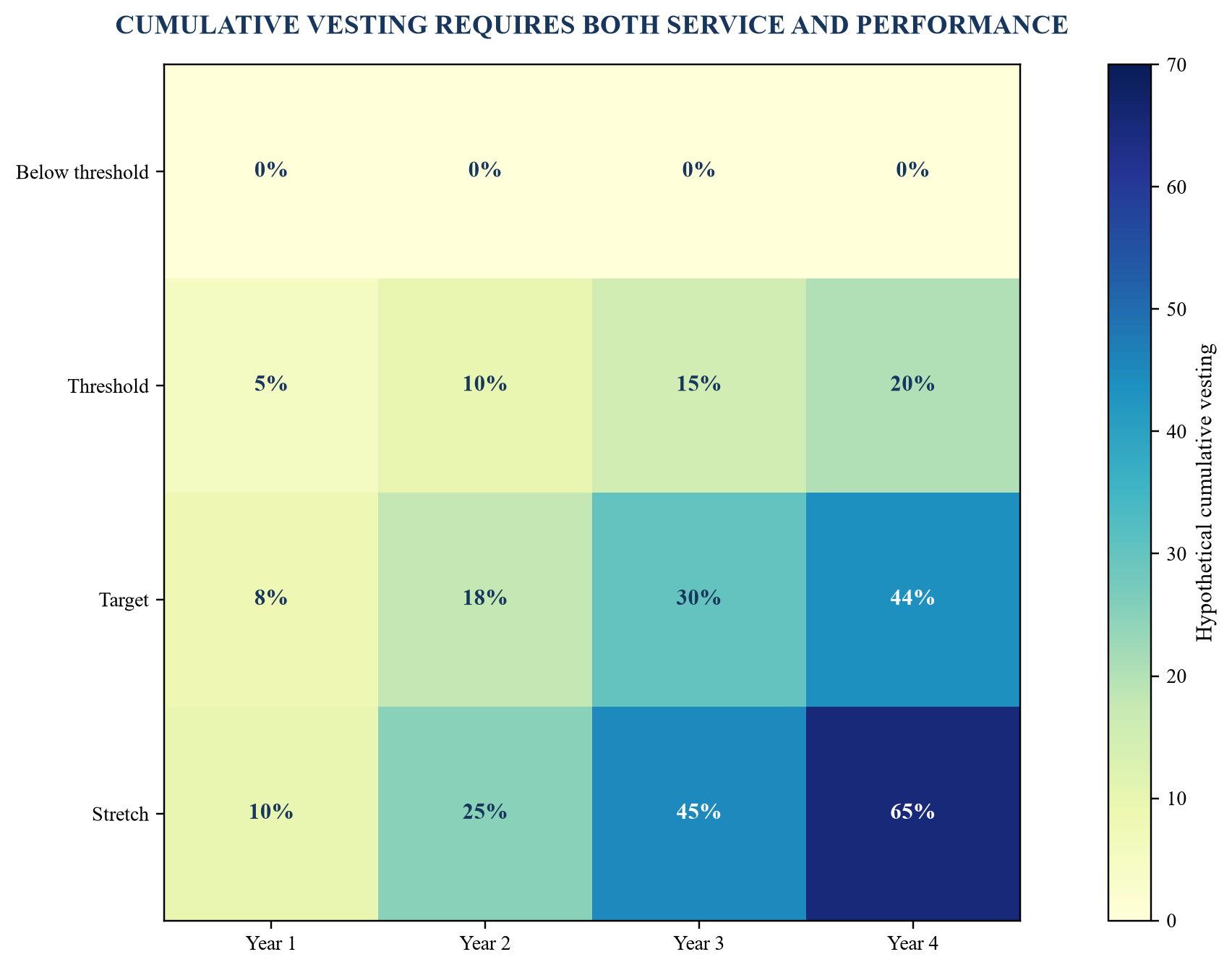
Percentages and years are hypothetical management assumptions for method illustration.
8. Translate enterprise value into participant proceeds
Participants need a clear path from enterprise value to cash or securities received. The waterfall should begin with gross transaction value and deduct net debt, debt-like items, transaction costs, working-capital adjustments and priority claims. It should then apply security-class rights, hurdles, exercise prices, vesting, leaver treatment, escrow, rollover, tax withholding and any earn-out. A simple percentage of enterprise value is rarely the actual result.
The model should use a fully diluted cap table. It should identify issued shares, options, warrants, convertibles, management reserve and any securities created by an add-on or refinancing. It should explain whether unallocated pool capacity shares in proceeds. It should also model partial exits, secondary sales, recapitalisations and continuation transactions because management liquidity may not coincide with the sponsor's full exit.
Debt matters twice. It reduces equity value at exit and can influence management behaviour before exit. If the plan rewards only equity proceeds, executives may pursue leverage that increases short-term distributions while narrowing resilience. The scorecard can counterbalance this through cash conversion, leverage, liquidity and return-on-capital gates. The board should show how additional debt changes both sponsor and management outcomes.
Hurdles need careful construction. A fixed money hurdle can be diluted by time. An internal-rate-of-return hurdle introduces timing dependence and can be affected by shareholder cash flows outside management's control. A multiple hurdle is simpler but ignores time. A value threshold can be tied to entry equity plus agreed investments. The selected mechanism should match the economic objective and be explained through examples.
The waterfall should be independently checked before grant and before any liquidity event. Legal documents, finance models and participant communications should reconcile. Errors discovered at exit can create disputes, delay payments and damage the transaction. A signed calculation protocol, cap-table owner and data-room evidence reduce that risk.
9. Control dilution through a living cap-table policy
Dilution is a capital-allocation decision. The company should maintain a living fully diluted cap table that reconciles legal registers, board approvals, grant documents, cancellations, exercises and available reserve. The board pack should show issued, vested, unvested and unallocated interests by instrument. It should also show ownership under each likely financing and exit scenario.
New joiners and promotions create recurring allocation needs. A reserve policy can specify award ranges, approval levels and the conditions for refresh grants. Grants should reflect the remaining value-creation horizon. An executive joining late should not automatically receive the same economic opportunity as a close-date participant who carried greater execution risk. The board can use a current-value hurdle, smaller award, role-specific tranche or required co-investment.
Add-on acquisitions can change the denominator and the value plan. Seller rollover, acquisition equity, new debt and integration incentives all affect dilution. The board should decide whether legacy management participates in acquired value, whether acquired leaders join the main plan and how acquisition performance is measured. Crediting value created by purchase-price multiple arbitrage alone can reward deal completion without integration or return.
Recapitalisations and share reorganisations need adjustment rules. Splits, consolidations, rights issues, bonus issues and new classes may require equitable changes to units or exercise prices. Adjustments should preserve intended economics without creating a discretionary transfer of value. The plan should identify the decision-maker, professional input and participant notice.
Regular reconciliation is essential. Finance, legal, human resources and the company secretary may hold different records. A quarterly control should compare them and resolve discrepancies. Before fundraising, audit or exit, the company should produce a signed cap-table certificate and supporting grant archive. This is both governance and transaction readiness.
Table 4. Dilution and allocation controls
| Event | Dilution question | Approval evidence | Participant communication | Transaction-readiness output |
|---|---|---|---|---|
| initial grant | what issued and fully diluted percentage is allocated? | board and shareholder approvals plus valuation | grant statement and hypothetical waterfall | reconciled legal register and cap table |
| new joiner or promotion | what remaining value can the role influence? | allocation rationale, reserve use and conflicts record | current hurdle, vesting and leaver terms | updated reserve and grant archive |
| add-on acquisition | who participates in acquired and integrated value? | acquisition return case and integration scorecard | scope and metric adjustments | pro forma cap table and waterfall |
| refinancing or recap | how do new securities and debt change proceeds? | capital-structure model and plan adjustment memo | updated examples without promise of value | revised fully diluted waterfall |
| cancellation or leaver | do interests lapse, transfer or return to reserve? | leaver determination and document authority | written outcome and calculation | clean register and available pool record |
| exit | which interests vest, settle, roll or remain contingent? | board calculation, adviser checks and buyer mechanics | proceeds statement and withholding | signed payout schedule and audit trail |
Controls require adaptation to the company's articles, shareholder arrangements and plan rules.
10. Design leaver provisions as a fair decision system
Leaver rules balance retention, fairness and protection of the value plan. A binary good-leaver and bad-leaver framework can produce harsh outcomes when circumstances fall between death and misconduct. The board should define categories, consequences and discretion with enough precision to be enforceable and understandable. It should also consider local employment law and the risk that a forfeiture provision is treated as a penalty or conflicts with mandatory rights.
Good-leaver circumstances often include death, disability, retirement with consent, redundancy or termination without cause. Bad-leaver treatment may address fraud, gross misconduct, material breach, competition or resignation in specified circumstances. Intermediate cases can include agreed departure, persistent underperformance, role elimination after integration or resignation after a material change. The plan should avoid using a label as a substitute for evidence.
Consequences can differ for vested and unvested awards. Unvested interests may lapse. Vested shares may remain, transfer at fair value, transfer at cost or receive another defined price. Options may have a shortened exercise period. Performance awards may be measured to departure or remain contingent. The board should understand the economic outcome under each category because a nominally vested award can still be repurchased at a low price.
Decision governance matters. The committee should receive the facts, contractual provisions, conflicts, legal advice where needed and calculated outcomes. The affected executive should not participate in the determination. The record should explain any discretion and maintain consistency with prior cases while recognising material factual differences. The company should communicate the decision in writing and update all registers promptly.
Leaver terms can affect behaviour before departure. Extremely punitive rules may reduce trust or encourage executives to delay disclosure of problems. Overly generous treatment can weaken retention and reward failure. A graduated framework linked to conduct, reason for departure, time served and delivered performance can support a more credible balance.
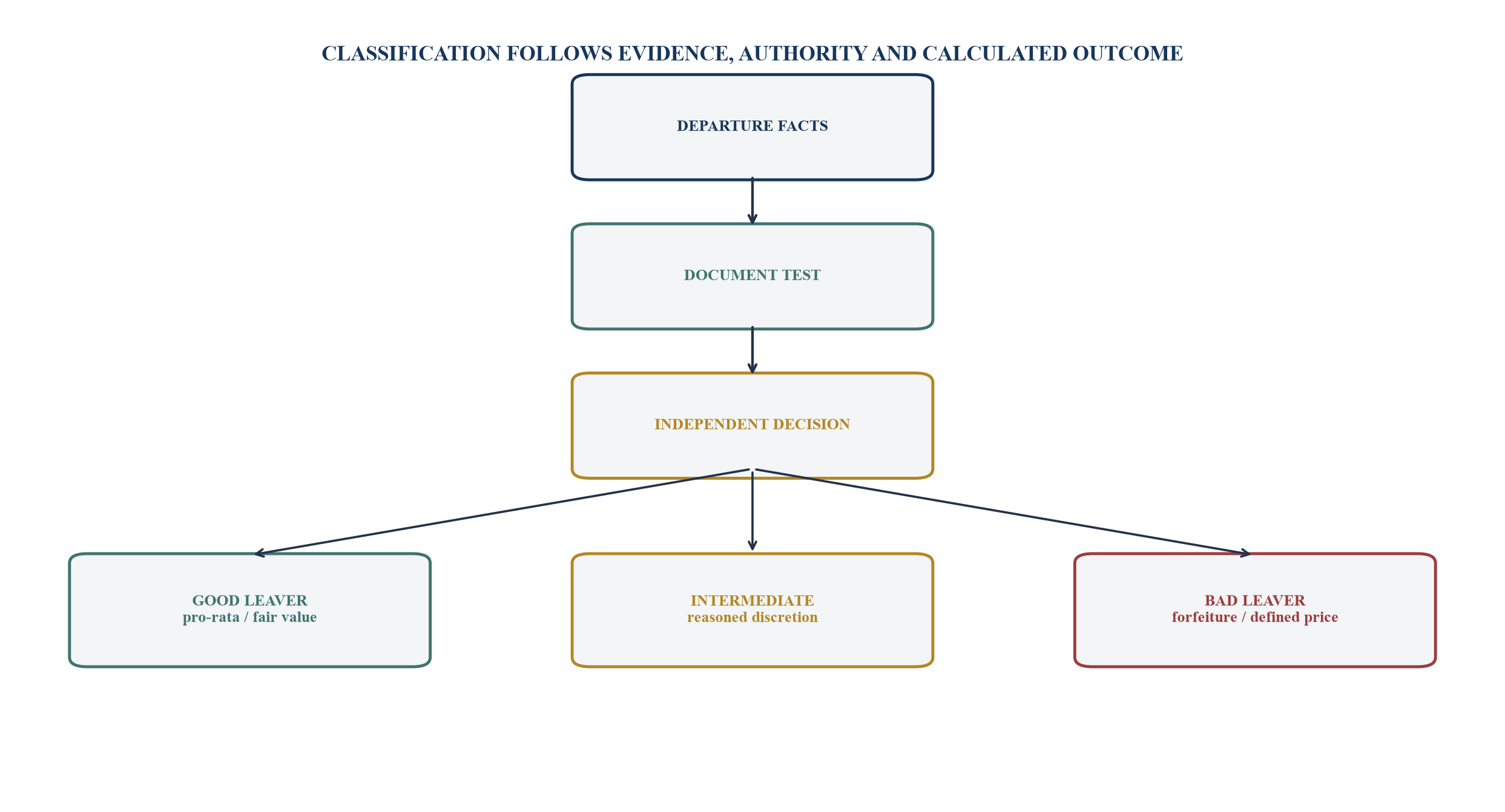
The pathway is an illustrative governance sequence. Plan documents and applicable law determine actual outcomes.
11. Create rules for joiners, promotions, transfers and refresh grants
A management plan must remain useful after close. Executives leave, responsibilities expand, high-potential employees emerge and integration changes the organisation. The plan should define how new awards are sized and approved. Ad hoc grants can consume the reserve, create inequity and disconnect incentives from the remaining value plan.
New-joiner awards should use current facts. The company should update enterprise value, debt, achieved initiatives and remaining priorities. A current-value hurdle can protect existing participants and shareholders from giving away value already created. Where a recruit is expected to repair a missed plan, a turnaround tranche can be linked to the specific recovery evidence. A participant who invests capital should receive separate documentation for the investment and incentive components.
Promotions can justify incremental awards when the role's value influence materially changes. The committee should compare the new responsibility, remaining horizon, existing award and market need. A promotion grant should not automatically reset service or performance already completed. The company can add a new tranche with its own baseline and vesting while leaving the original grant intact.
Cross-border transfers create tax, securities, employment and payroll complexity. The company should track grant location, residence, workdays, vesting, exercise and settlement. It should determine withholding and reporting responsibilities in each relevant jurisdiction. Plan documents can include mobility provisions, but generic wording does not replace current advice. Participants should receive a mobility briefing before a transfer where practical.
Refresh grants should have a defined purpose: retention through an extended hold, reward for newly approved value creation, or correction of an award that has become economically irrelevant for reasons outside the participant's control. Resetting a difficult target without structural change undermines credibility. The board record should explain the new objective, economic cost and effect on other participants.
12. Govern conflicts, discretion, malus and clawback
Management incentive decisions contain inherent conflicts. Sponsors influence the board, executives possess operating information and participants may be asked to recommend metrics that determine their own awards. A remuneration committee or a defined independent board group should own plan design, awards, measurement, leaver decisions, modifications and settlements. Its authority should be documented and compatible with shareholder reserved matters.
The committee needs reliable information. Finance should certify calculations, human resources should confirm service and employment facts, legal should confirm document authority, and risk or audit should identify conduct and control events. Advisers can support design and valuation, but the board retains judgement. OECD and FRC guidance both support independent oversight, transparent procedure and the exclusion of executives from decisions on their own remuneration [1][3][4].
Discretion should be structured. Upward discretion may be appropriate when a formula misses material value that was clearly delivered, but it can dilute the performance contract. Downward discretion may be needed for windfalls, poor quality of earnings, serious stakeholder harm or an outcome inconsistent with the company's condition. The plan should describe relevant factors, approval authority, limits and disclosure to shareholders and participants.
Malus allows the company to reduce or withhold an unvested award. Clawback seeks recovery after vesting or payment. Triggers can include material misstatement, misconduct, calculation error, risk failure, reputational damage or corporate failure. Enforceability and tax consequences vary. The company should align plan rules, grant agreements, service contracts and recovery process. It should also consider practical recovery from proceeds, escrow, deferred settlement or set-off where lawful.
The committee should maintain a decision log. Each award, modification, metric determination, leaver outcome and exercise of discretion should record facts, conflicts, authority and economic impact. This record supports audit, consistency, buyer diligence and participant trust. It also allows the board to test whether the plan is influencing behaviour as intended.
13. Map UK legal, tax and governance requirements
United Kingdom participants may fall within the employment-related securities regime. HMRC states that shares and securities acquired by reason of employment, along with rights or opportunities to acquire them, are within a detailed tax framework [6]. Employers must consider reportable events, including grants and exercises, and HMRC provides guidance for tax-advantaged and non-tax-advantaged plans [7]. Eligibility, valuation, elections, withholding and filing should be confirmed for the actual company and participant.
Enterprise Management Incentives can be relevant to eligible smaller independent trading companies, subject to statutory company, employee, share and option conditions. A sponsor-controlled company may fail independence or other conditions, so eligibility should never be assumed. Other arrangements, including Company Share Option Plans and non-tax-advantaged plans, have different requirements. The plan should be designed with current HMRC guidance and specialist advice because transaction ownership and group structure matter.
Restricted securities can involve elections and valuations that affect tax treatment. The company and participant should understand acquisition value, restrictions, lifting of restrictions, disposal and National Insurance consequences. Where shares are acquired for consideration, funding and documentation should be completed. Payroll teams need a clear withholding protocol, especially where shares are readily convertible assets or a sale creates cash proceeds.
The Companies Act, articles and shareholder agreement determine corporate authority, allotment, pre-emption, class rights, transfers and buybacks. Board and shareholder approvals should be mapped before grants. Leaver transfers and repurchases need an executable route. The company should maintain statutory registers and issue documents that reconcile with the plan model.
For a company approaching a UK listing, the 2024 Corporate Governance Code and listing requirements become relevant. The Code applies to specified listed categories and emphasises long-term alignment, independent remuneration governance, phased vesting and malus or clawback [3]. A private company can prepare by building clear metric definitions, committee records, holding arrangements and disclosure-ready data well before an initial public offering.
14. Map US securities, tax and corporate-law requirements
In the United States, the plan should coordinate federal securities exemptions, state securities law, corporate authority, tax and accounting. SEC Rule 701 can exempt qualifying compensatory offers and sales by non-reporting companies. The SEC states that companies can sell at least one million dollars of securities under the exemption and may sell more under specified formulas, with enhanced disclosure above the applicable twelve-month threshold [8]. The company should calculate usage across eligible plans and persons and deliver disclosure within the required timing.
Restricted stock can create an early tax decision. IRS Form 15620 provides the current model for a Section 83(b) election [9]. The election can cause income recognition at transfer rather than vesting and has a strict filing timetable. The company should provide factual information and access to advice without directing an individual's tax choice. Records should show the transfer date, fair market value, restrictions and filed election where the participant supplies evidence.
Nonqualified deferred compensation rules under Section 409A can affect options, stock appreciation rights, restricted units and deferred settlement. Below-market exercise prices, discretionary acceleration or changes in payment timing can create significant tax consequences. The plan should use a supported valuation process and define permissible payment events. Incentive stock options, nonqualified options and other instruments follow different tax rules; participant residence and mobility can add complexity.
Delaware law permits corporations to create rights or options to acquire stock, with terms set in the certificate or board resolution [11]. Board delegation must comply with statutory limits and the corporation's own documents. Transfer restrictions, repurchase rights and class terms should be reflected in the certificate, bylaws, plan, grant and stockholder agreements as applicable. Cap-table administration should match legal issuances rather than relying only on software records.
US plans should also address payroll withholding, Form W-2 reporting, tender-offer considerations for liquidity programmes, restricted-security legends and post-exit registration or exemption. A cross-functional closing checklist can prevent a commercial grant decision from outrunning the required legal and tax steps.
15. Design UAE, ADGM and DIFC arrangements with jurisdictional precision
The United Arab Emirates combines federal law, emirate-level licensing and financial-free-zone regimes. The company should identify the issuing entity, employing entity, participant work location and governing employment contract. A mainland company, an ADGM company and a DIFC company may face different corporate, employment and procedural requirements. A group-wide label such as UAE plan does not resolve those differences.
The Federal Tax Authority states that wages of a natural person are outside the business or business-activity categories used to determine natural-person corporate-tax exposure [17]. That statement does not decide every tax, payroll, residence or cross-border question associated with an equity award. Companies should confirm current federal rules, any foreign tax exposure, reporting, exchange and the accounting treatment of issuer or recharge arrangements.
ADGM applies its Employment Regulations 2024 to ADGM registered entities and employees from 1 April 2025 [18]. Its legal framework is based on English common law, with company regulations and official guidance available through ADGM [19]. The board should confirm share authority, class rights, transfers, filings, employment documentation and plan enforcement under the current legislation. DIFC entities should conduct the same exercise under the current DIFC Companies Law, Employment Law and applicable rules.
Many regional management teams are internationally mobile. A participant may be hired in London, work in Dubai, transfer to Abu Dhabi and exit after becoming resident elsewhere. Grant, vesting and settlement may each have different sourcing and reporting consequences. The company should maintain a mobility ledger and require notice of changes in residence or work location. Payroll and advisers should determine obligations before exercise or settlement.
Commercial design also matters. A cash-settled phantom plan may avoid adding numerous shareholders but creates a company payment obligation. Direct shares can deepen ownership while complicating transfers, repurchase and holding structures. A holding-company plan can unify economics across operating subsidiaries but requires careful recharge, employment and corporate analysis. The decision should be documented for the actual group.
16. Prepare for Singapore, Australia, Canada and European mobility
Singapore taxes gains from employee share option and other employee share ownership plans when the relevant conditions are met, including plans granted during Singapore employment [20]. Employers and participants need to understand the exercise or vesting event, valuation, reporting and any deemed exercise rules on departure. A regional plan should capture Singapore work periods and provide data to payroll before settlement.
Australia's employee share scheme rules cover shares and rights provided through employment and include upfront and deferred tax treatment. The Australian Taxation Office describes specific concessions and valuation pathways for eligible start-up companies, along with conditions that determine access [21][22]. A sponsor-backed portfolio company may not meet start-up criteria. The company should confirm the taxing point, reporting, valuation and treatment of cessation or cross-border service.
Canada treats employee security options through detailed rules that distinguish, among other matters, Canadian-controlled private corporations and other issuers. The Canada Revenue Agency explains that exercise can create an employment benefit, with timing affected by issuer status and later disposal [23]. Employers may have withholding and reporting obligations. The plan should identify the issuer, participant status, grant value, exercise value and any deduction limits under current law.
European arrangements require country-by-country analysis. The Shareholder Rights Directive includes remuneration-policy and reporting requirements for listed companies within scope [24]. Prospectus, securities, employment, data-protection, works-council and tax rules vary by member state. A private company preparing for a European listing or operating across several jurisdictions should build a local-law matrix and avoid assuming that one grant document produces the same result everywhere.
The practical control is a jurisdiction ledger. For every participant, it records grant entity, employing entity, residence, work location, instrument, vesting, exercise, settlement, withholding, securities exemption, filings and adviser confirmation. The ledger should be updated at least quarterly and before any mobility, exercise, leaver or exit event. Central plan terms can remain consistent while local addenda address mandatory differences.
Table 5. Cross-border legal, tax and accounting control map
| Jurisdiction lens | Primary control question | Evidence before grant | Ongoing trigger | Exit evidence |
|---|---|---|---|---|
| United Kingdom | how do employment-related securities, valuation and reporting apply? | eligibility, valuation, elections, approvals and filing plan | grant, restriction change, exercise, mobility and leaver | payroll, disposal and proceeds reconciliation |
| United States | which securities exemption, tax treatment and corporate authority apply? | Rule 701 analysis, valuation, board action and tax memorandum | rolling sales, 83(b), 409A, exercise and tender | withholding, restricted-security and payout record |
| UAE, ADGM and DIFC | which legal regime governs issuer, employer and participant? | entity authority, employment terms, tax and plan enforceability | transfer, work location, grant, vesting and settlement | corporate, payroll and cross-border clearance |
| Singapore | when are option or share-plan gains taxed and reported? | grant and employment-location analysis | vesting, exercise, departure and deemed event | valuation, reporting and withholding record |
| Australia | does upfront, deferred or concessionary ESS treatment apply? | instrument, issuer and eligibility review | vesting, disposal restriction, cessation and mobility | ESS statement and taxing-point evidence |
| Canada and Europe | how do issuer status, local tax, securities and employment rules interact? | country addendum and participant facts | exercise, settlement, workdays and listing change | payroll, disclosure and proceeds file |
The table identifies diligence domains. Qualified advisers must determine actual requirements for each person and entity.
17. Connect incentives to add-on M&A and integration
An add-on acquisition changes the value-creation plan. It adds purchase price, debt, goodwill, integration risk, new leadership and potential synergies. Incentives should reward realised acquisition value rather than transaction volume. The board should define the return case before signing and decide how it affects existing metrics and the management pool.
The measurement baseline should include stand-alone performance, acquisition price, transaction costs, integration cost, required capital and financing. Synergies should be counted only when evidenced, recurring and net of implementation cost and dis-synergies. Revenue synergy requires customer proof, not pipeline aspiration. Cost synergy should distinguish removed cost from cost shifted elsewhere. Working-capital and capex consequences belong in the return calculation.
Management should be accountable for integration outcomes within its control: customer retention, critical-talent continuity, operating-system migration, service quality, synergy delivery and control remediation. The plan can use a separate add-on tranche that vests when both integration milestones and a return threshold are met. This avoids rewriting the core scorecard after every acquisition.
Acquired leaders need a considered path. Seller rollover compensates ownership value and should not be confused with employment incentives. Retention awards can protect continuity. Participation in the main plan should reflect the leader's future role and the remaining value bridge. Different instruments can coexist if communications explain them clearly.
The board should preserve discretion for a value-destructive acquisition. A formula based only on combined EBITDA can reward size while return on invested capital deteriorates. A cash, leverage or return gate can block that outcome. The plan should also address divestitures, discontinued initiatives and integration delays so that metric adjustments do not become negotiation at exit.
18. Adapt the plan through downside, restructuring and recapitalisation
Downside conditions test whether the incentive system is credible. If the plan becomes worthless early, critical leaders may leave when execution matters most. If awards are reset without a genuine change in capital structure or strategy, participants can receive repeated free options while shareholders absorb losses. The board needs a principled approach to underwater plans.
The first response should be diagnosis. The committee should separate external shocks, execution failure, capital-structure pressure and changes in strategy. It should calculate the current value of existing awards and identify the performance still required. Retention risk should be evidenced through role criticality and market alternatives. The company should assess whether non-equity retention, a new-money co-investment or a targeted recovery tranche better addresses the problem.
A restructuring can change ownership, debt priority and governance. Existing awards may be cancelled, diluted, rolled or exchanged. New investors may require a new pool. The board should show the transfer of value across stakeholder classes and document conflicts. Leaders responsible for misconduct or avoidable failure should not receive the same treatment as those recruited to execute a recovery.
Dividend recapitalisations and partial liquidity events also require plan rules. Management may or may not participate in distributions before exit. Allowing participation can provide liquidity and demonstrate value, but it can weaken retention or reward additional leverage. The plan should specify dividend rights, option adjustments, withholding and whether proceeds affect hurdles or return measures.
Reset decisions should be approved as new capital-allocation decisions. The committee should disclose the old and new economics to shareholders, including dilution and expected value. It should preserve completed service where fair, establish a current baseline and set new performance evidence. A written rationale protects trust and future transaction diligence.
19. Build measurement, audit and anti-gaming controls
Incentive calculations should be reproducible by a reviewer who did not design the plan. The company needs a metric dictionary, source systems, data owners, calculation files, approvals and version control. Each reporting period should show actual, prior forecast, target, variance and supporting evidence. Adjustments should be separately identified and approved under the plan's authority.
Finance should own financial calculations. Operating leaders can supply evidence but should not approve their own results. Internal audit, risk, compliance or an external adviser can review sensitive non-financial measures. The remuneration committee should receive both the formulaic outcome and an assessment of quality, risk and unintended behaviour. It should document any discretion.
Common gaming risks include revenue pull-forward, channel loading, delayed maintenance, reclassification of recurring cost, factoring, extended supplier terms, acquisition accounting and selective adjustment of foreign exchange. The metric register should state how each is detected. Cash, customer and control measures can provide triangulation. A result unsupported by source data should remain uncredited until resolved.
Forecast accuracy is another control. Repeated favourable bias can cause targets to be set too low or interventions to arrive late. The board should compare submitted forecasts with actual outcomes and incorporate the quality of planning into leadership assessment. The purpose is accountability for the decision process as well as the result.
The evidence archive should support exit diligence. Buyers, lenders, auditors and tax authorities may examine grants, valuations, approvals, calculations and settlements. A clean archive reduces disputes and enables the purchase agreement to describe award treatment precisely. The plan administrator should maintain a closing checklist long before a transaction begins.
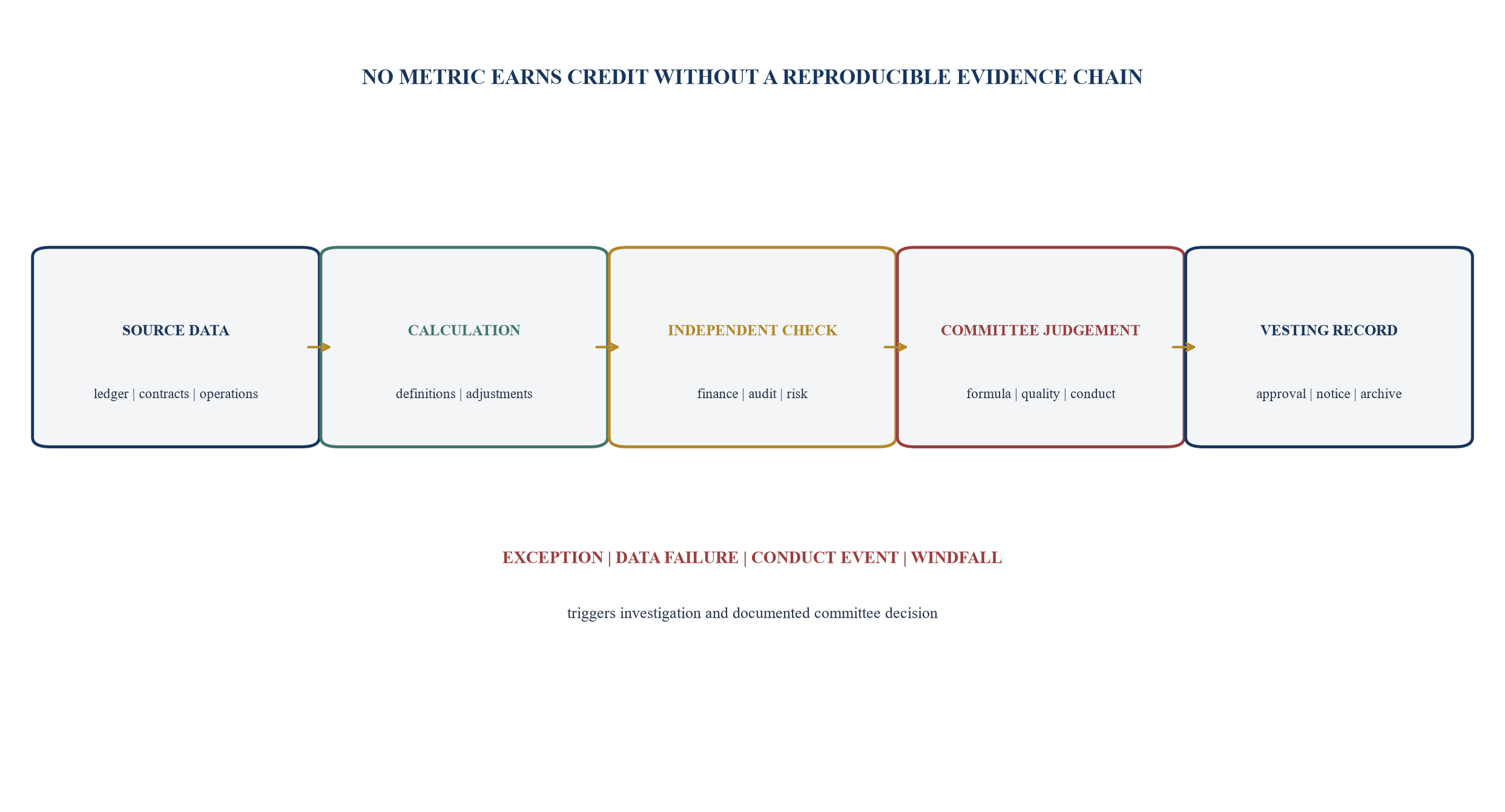
The evidence chain is an illustrative control model and should be adapted to company systems.
20. Apply the framework to a hypothetical worked case
Consider a hypothetical business acquired for an enterprise value of 400 currency units with net debt of 160 and entry equity of 240. The sponsor approves a management pool equal to ten percent of fully diluted ordinary equity, with two percent reserved for future hires. Half of each initial award is time-based and half is performance-based. These figures are assumptions for method illustration and do not represent a transaction, benchmark or recommendation.
The value-creation plan targets organic revenue quality, sustainable EBITDA, cash conversion and a strategic service-platform launch. A material compliance event operates as a negative gate. The base case assumes exit enterprise value of 560 after four years and net debt of 120. The upside assumes 700 and net debt of 90. The downside assumes 330 and net debt of 190. Exit costs and a 50 preference layer are included before ordinary equity participates.
The initial management presentation focuses on a ten percent pool and a possible 52 of aggregate proceeds in the base case. The fully diluted waterfall shows a lower amount after unvested reserve, leavers, exercise prices and the priority layer. The board also identifies that multiple expansion contributes a large part of the upside. It therefore weights cash conversion, customer retention and realised strategic milestones alongside equity value.
During year two, the company acquires a smaller competitor. Combined EBITDA rises, but customer churn and integration cost exceed the acquisition case. The committee does not credit the full acquired EBITDA. It creates a separate integration tranche that requires retention, net synergy and return evidence after twelve months. Existing participants retain their original metrics with defined perimeter adjustments.
At the end of year three, a senior executive leaves by mutual agreement after delivering most of a strategic programme. The leaver framework preserves vested time awards, measures performance through the departure date and lapses the remaining unvested service component. The decision record explains the intermediate classification and economic result. The worked case shows how the framework supports consistent decisions across value, acquisition and talent events.
Table 6. Hypothetical worked-case incentive decision
| Decision item | Initial proposal | Board refinement | Evidence required | Resulting control |
|---|---|---|---|---|
| management pool | ten percent fully diluted | eight percent initial awards plus two percent reserve | waterfall and role-allocation analysis | future capacity remains visible |
| award mix | time vesting only | half time and half performance | role influence and value-plan mapping | retention and delivery are both tested |
| performance | exit equity value | cash conversion, retention, strategic delivery and value | metric dictionary and finance verification | market and leverage effects do not dominate |
| add-on acquisition | combined EBITDA credit | separate integration and return tranche | customer, synergy, cost and invested-capital evidence | deal completion alone earns no credit |
| mutual leaver | binary committee discretion | intermediate category with measured performance | departure facts, plan authority and calculation | reasoned outcome is documented |
| exit | headline percentage | fully diluted waterfall after debt, costs, preferences and vesting | reconciled cap table and adviser review | participant proceeds can be reproduced |
All amounts, percentages and outcomes are hypothetical management assumptions used solely to demonstrate the method.
21. Execute a one-hundred-day incentive implementation plan
Days zero to twenty establish authority and economics. The board confirms the value-creation plan, post-close baseline, eligible roles, pool range, issuing entity and governance body. Finance builds the fully diluted waterfall. Legal, tax, accounting, employment and securities advisers identify jurisdictional requirements. The company prepares the metric dictionary and participant data map.
Days twenty-one to forty-five design the plan. The committee selects instruments, allocation principles, time and performance vesting, leaver categories, malus, clawback, mobility and adjustment provisions. The team models expected value under downside, base and upside outcomes. It tests behaviour, dilution, tax timing, accounting expense and cash settlement. Draft documents and participant examples are reconciled to the model.
Days forty-six to seventy-five complete approvals and infrastructure. The board and shareholders approve the plan and securities where required. Valuations, exemptions, elections, filings and payroll controls are prepared. The company establishes the legal register, cap-table record, grant archive, jurisdiction ledger and metric evidence repository. Managers receive a briefing on the value plan and reporting duties.
Days seventy-six to one hundred execute grants and begin monitoring. Participants receive plan documents, individual grants and hypothetical waterfall statements. The company records acceptance, payment, elections and filings. Finance issues the first scorecard with baseline evidence. The committee reviews exceptions, reserve use and the forward calendar. Internal audit or another independent function tests the calculation process.
The operating cadence continues quarterly. The board reviews performance, forecast accuracy, cap-table changes, jurisdictional movements and conduct events. It updates participant communications when the capital structure or exit path changes. Before an add-on, refinancing, recapitalisation or sale, the committee runs a specific plan-impact review. Success at day one hundred means the company can explain every award, reproduce every calculation and connect every vesting condition to the value-creation plan.
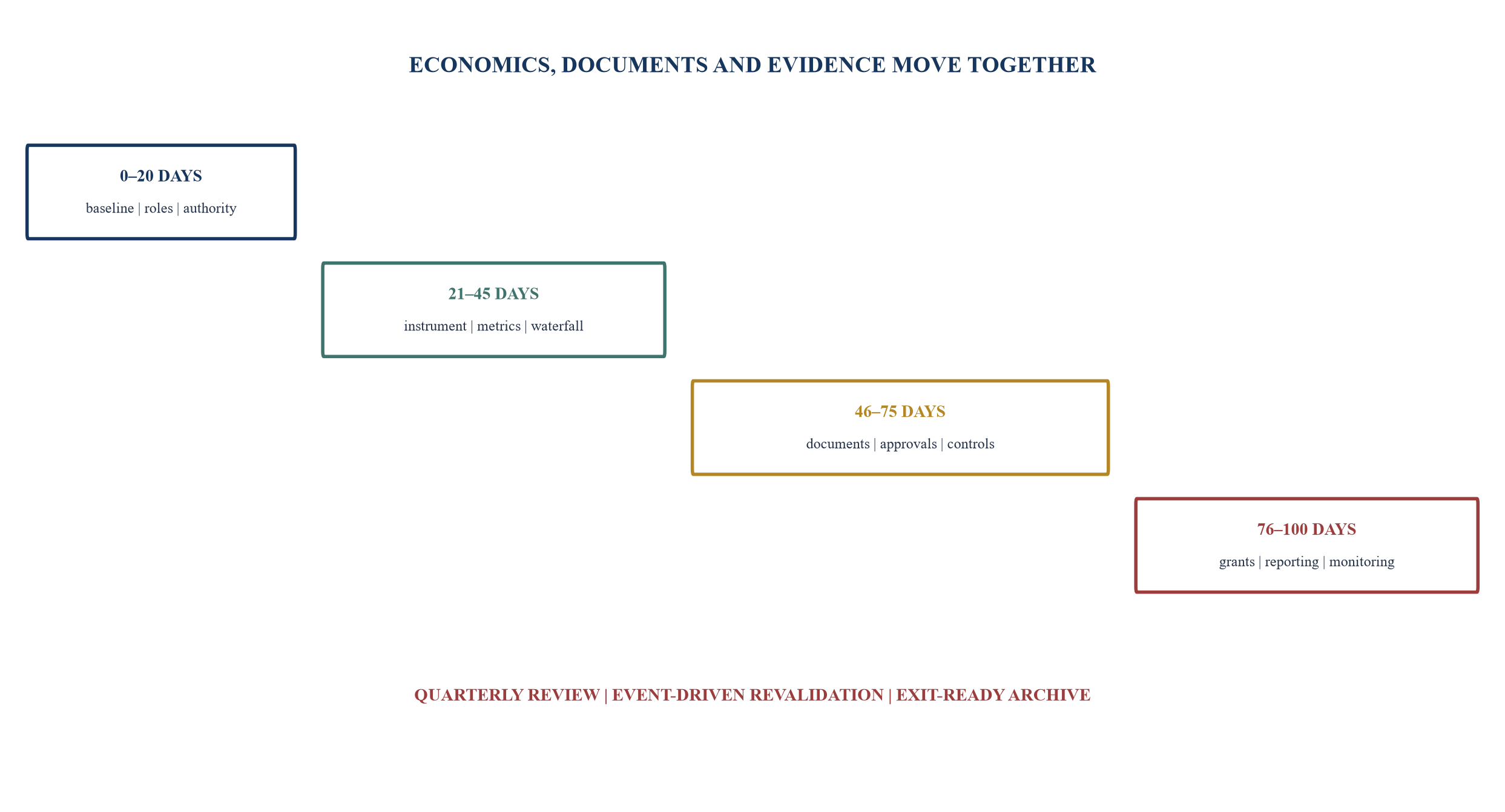
Timing is an illustrative management sequence. Transaction complexity and approval requirements determine the actual calendar.
Sources and further reading
- Organisation for Economic Co-operation and Development, G20/OECD Principles of Corporate Governance 2023 Official source
- Organisation for Economic Co-operation and Development, Responsibilities of the Board Official source
- Financial Reporting Council, UK Corporate Governance Code 2024 Official source
- Financial Reporting Council, Corporate Governance Code Guidance Official source
- IFRS Foundation, IFRS 2 Share-based Payment Official source
- HM Revenue and Customs, Employment-related Securities and Options Overview Official source
- HM Revenue and Customs, How Employment Related Securities Work for Employers Official source
- United States Securities and Exchange Commission, Employee Benefit Plans Rule 701 Official source
- United States Internal Revenue Service, Form 15620 Section 83(b) Election Official source
- United States Internal Revenue Service, Topic 427 Stock Options Official source
- State of Delaware, General Corporation Law Section 157 Official source
- Financial Accounting Standards Board, Accounting Standards Codification Topic 718 Compensation Stock Compensation Official source
- United Kingdom, Companies Act 2006 Official source
- HM Revenue and Customs, Employment Related Securities Detailed Information Official source
- HM Revenue and Customs, Employee Tax Advantaged Share Scheme User Manual Official source
- The Takeover Panel, The Takeover Code Official source
- United Arab Emirates Federal Tax Authority, Basis of Taxation for Natural Persons Official source
- Abu Dhabi Global Market, Employment Affairs Office and Employment Regulations 2024 Official source
- Abu Dhabi Global Market, Guidance Templates and Policy Statements Official source
- Inland Revenue Authority of Singapore, Gains from the Exercise of Stock Options Official source
- Australian Taxation Office, Employee Share Schemes Official source
- Australian Taxation Office, Key Employee Share Scheme Changes in Detail Official source
- Canada Revenue Agency, Employee Security Stock Options Official source
- European Union, Directive 2017/828 on Shareholder Engagement Official source
- International Corporate Governance Network, Global Governance Principles Official source
- International Labour Organization, Protection of Wages Convention 1949 Official source
- IFRS Foundation, IFRS 13 Fair Value Measurement Official source
- United States Securities and Exchange Commission, Form S-8 Official source
- Australian Securities and Investments Commission, Legislative Relief for Employee Share Schemes Official source
- Monetary Authority of Singapore, Code of Corporate Governance 2018 Official source
