

1. Define the continuity question
Translate the investment case into roles, outcomes, dependencies and time-bound retention decisions.
The transaction team should reconcile investment case, operating model, value thesis, integration plan and risk appetite. Each conclusion records the accountable owner, source, assessment date, affected role, evidence, dependency, economic consequence, control and unresolved exception. The immediate output is a management-continuity mandate.
Management continuity must be proved through operating outcomes and role-specific evidence. Reviewers test capability, authority, relationships, motivation, replaceability and downside response against native records and observed performance. The investment case, operating model, employee facts, transaction timetable and governing law control every conclusion.
Material gaps require an owner, corrective action, acceptance test, advice and decision date. Consequences flow through leadership capacity, customer delivery, controls, integration, cash, financing, value, fairness and transaction timing. Residual risk remains visible until critical work is covered, handovers are tested and authorised governing bodies approve the next gate.
2. Map the transaction timeline
Separate signing, closing, Day One, integration, stabilisation and long-term leadership horizons.
The transaction team should reconcile transaction documents, regulatory path, integration plan, milestones and dependencies. Each conclusion records the accountable owner, source, assessment date, affected role, evidence, dependency, economic consequence, control and unresolved exception. The immediate output is a retention decision calendar.
Management continuity must be proved through operating outcomes and role-specific evidence. Reviewers test capability, authority, relationships, motivation, replaceability and downside response against native records and observed performance. The investment case, operating model, employee facts, transaction timetable and governing law control every conclusion.
Material gaps require an owner, corrective action, acceptance test, advice and decision date. Consequences flow through leadership capacity, customer delivery, controls, integration, cash, financing, value, fairness and transaction timing. Residual risk remains visible until critical work is covered, handovers are tested and authorised governing bodies approve the next gate.
3. Establish evidence integrity
Preserve source, date, scope, version, owner and limitation for each people conclusion.
The transaction team should reconcile organisation records, contracts, performance data, interviews, workpapers and approvals. Each conclusion records the accountable owner, source, assessment date, affected role, evidence, dependency, economic consequence, control and unresolved exception. The immediate output is a people-evidence register.
Management continuity must be proved through operating outcomes and role-specific evidence. Reviewers test capability, authority, relationships, motivation, replaceability and downside response against native records and observed performance. The investment case, operating model, employee facts, transaction timetable and governing law control every conclusion.
Material gaps require an owner, corrective action, acceptance test, advice and decision date. Consequences flow through leadership capacity, customer delivery, controls, integration, cash, financing, value, fairness and transaction timing. Residual risk remains visible until critical work is covered, handovers are tested and authorised governing bodies approve the next gate.
4. Map value-critical work
Identify decisions, relationships, knowledge, licences, controls and delivery obligations that protect value.
The transaction team should reconcile value-creation plan, customer data, projects, systems, controls and operating records. Each conclusion records the accountable owner, source, assessment date, affected role, evidence, dependency, economic consequence, control and unresolved exception. The immediate output is a value-critical activity map.
Management continuity must be proved through operating outcomes and role-specific evidence. Reviewers test capability, authority, relationships, motivation, replaceability and downside response against native records and observed performance. The investment case, operating model, employee facts, transaction timetable and governing law control every conclusion.
Material gaps require an owner, corrective action, acceptance test, advice and decision date. Consequences flow through leadership capacity, customer delivery, controls, integration, cash, financing, value, fairness and transaction timing. Residual risk remains visible until critical work is covered, handovers are tested and authorised governing bodies approve the next gate.
5. Map role criticality
Score roles by value contribution, replaceability, dependency, authority and failure consequence.
The transaction team should reconcile job architecture, workflows, performance, succession data and interviews. Each conclusion records the accountable owner, source, assessment date, affected role, evidence, dependency, economic consequence, control and unresolved exception. The immediate output is a role-criticality matrix.
Management continuity must be proved through operating outcomes and role-specific evidence. Reviewers test capability, authority, relationships, motivation, replaceability and downside response against native records and observed performance. The investment case, operating model, employee facts, transaction timetable and governing law control every conclusion.
Material gaps require an owner, corrective action, acceptance test, advice and decision date. Consequences flow through leadership capacity, customer delivery, controls, integration, cash, financing, value, fairness and transaction timing. Residual risk remains visible until critical work is covered, handovers are tested and authorised governing bodies approve the next gate.
6. Distinguish role from incumbent
Test whether dependence belongs to the position, the individual, undocumented knowledge or weak process.
The transaction team should reconcile role descriptions, decision rights, process maps, systems, relationships and observation. Each conclusion records the accountable owner, source, assessment date, affected role, evidence, dependency, economic consequence, control and unresolved exception. The immediate output is an incumbent-dependency assessment.
Management continuity must be proved through operating outcomes and role-specific evidence. Reviewers test capability, authority, relationships, motivation, replaceability and downside response against native records and observed performance. The investment case, operating model, employee facts, transaction timetable and governing law control every conclusion.
Material gaps require an owner, corrective action, acceptance test, advice and decision date. Consequences flow through leadership capacity, customer delivery, controls, integration, cash, financing, value, fairness and transaction timing. Residual risk remains visible until critical work is covered, handovers are tested and authorised governing bodies approve the next gate.
7. Identify key-person concentration
Locate revenue, product, customer, supplier, regulatory and control outcomes concentrated in few people.
The transaction team should reconcile account data, code ownership, approvals, licences, contracts and governance. Each conclusion records the accountable owner, source, assessment date, affected role, evidence, dependency, economic consequence, control and unresolved exception. The immediate output is a key-person concentration map.
Management continuity must be proved through operating outcomes and role-specific evidence. Reviewers test capability, authority, relationships, motivation, replaceability and downside response against native records and observed performance. The investment case, operating model, employee facts, transaction timetable and governing law control every conclusion.
Material gaps require an owner, corrective action, acceptance test, advice and decision date. Consequences flow through leadership capacity, customer delivery, controls, integration, cash, financing, value, fairness and transaction timing. Residual risk remains visible until critical work is covered, handovers are tested and authorised governing bodies approve the next gate.
8. Assess leadership capability
Test strategic judgement, execution, team leadership, credibility and fit for the combined business.
The transaction team should reconcile performance records, references, interviews, outcomes and observed behaviour. Each conclusion records the accountable owner, source, assessment date, affected role, evidence, dependency, economic consequence, control and unresolved exception. The immediate output is a leadership capability assessment.
Management continuity must be proved through operating outcomes and role-specific evidence. Reviewers test capability, authority, relationships, motivation, replaceability and downside response against native records and observed performance. The investment case, operating model, employee facts, transaction timetable and governing law control every conclusion.
Material gaps require an owner, corrective action, acceptance test, advice and decision date. Consequences flow through leadership capacity, customer delivery, controls, integration, cash, financing, value, fairness and transaction timing. Residual risk remains visible until critical work is covered, handovers are tested and authorised governing bodies approve the next gate.
Table 1. Role-criticality architecture
| Dimension | Evidence | Decision use |
|---|---|---|
| value | cash and strategic outcomes | priority |
| dependency | knowledge and relationships | continuity |
| replaceability | successor and market depth | horizon |
| authority | decisions and controls | Day One |
Illustrative programme design; company-specific facts and authorised advice govern.
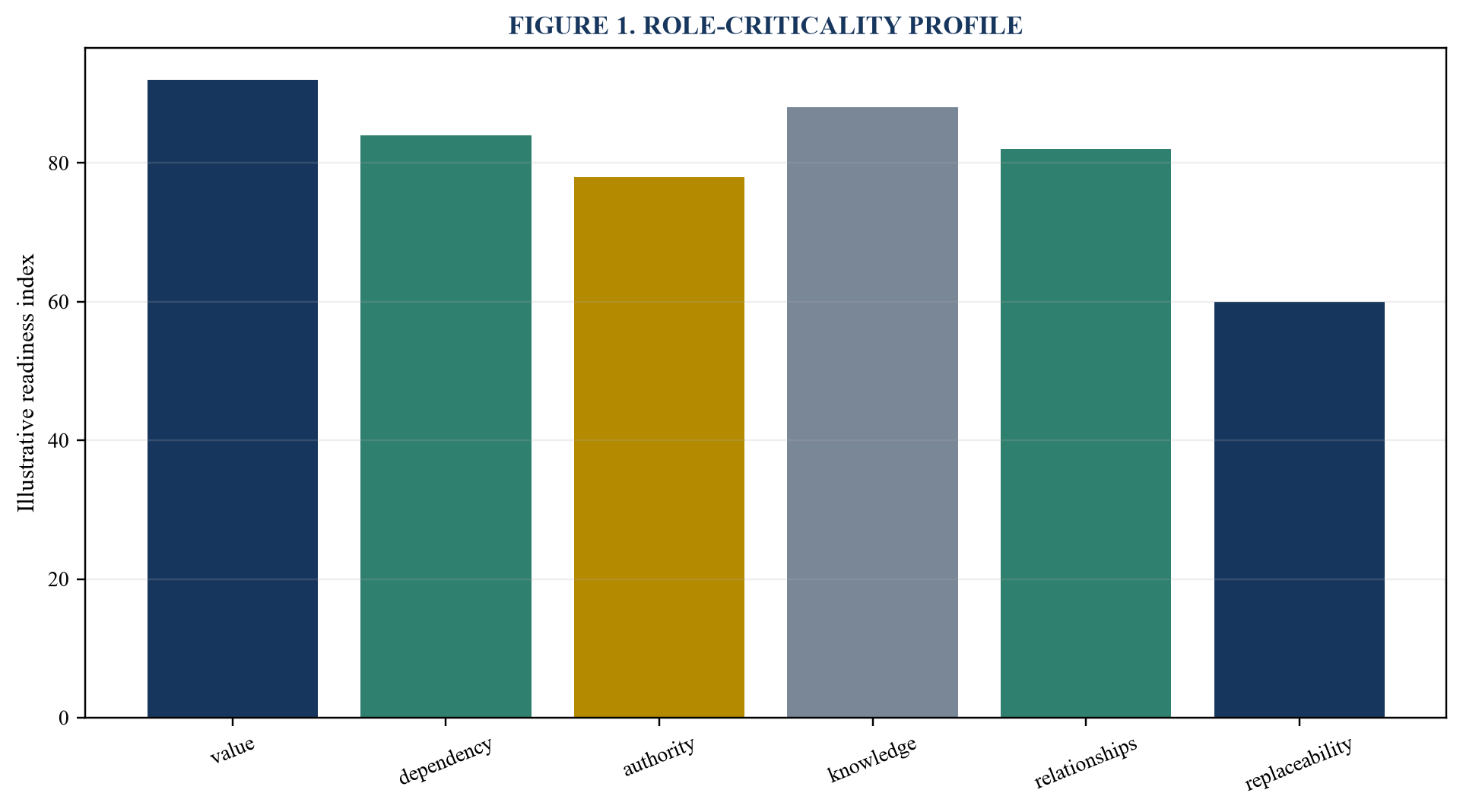
Values are illustrative readiness indices and require company-specific evidence.
9. Assess technical and institutional knowledge
Identify tacit knowledge, proprietary methods, history and exceptions required for continuity.
The transaction team should reconcile repositories, documentation, incident records, interviews and work shadowing. Each conclusion records the accountable owner, source, assessment date, affected role, evidence, dependency, economic consequence, control and unresolved exception. The immediate output is a knowledge-dependency register.
Management continuity must be proved through operating outcomes and role-specific evidence. Reviewers test capability, authority, relationships, motivation, replaceability and downside response against native records and observed performance. The investment case, operating model, employee facts, transaction timetable and governing law control every conclusion.
Material gaps require an owner, corrective action, acceptance test, advice and decision date. Consequences flow through leadership capacity, customer delivery, controls, integration, cash, financing, value, fairness and transaction timing. Residual risk remains visible until critical work is covered, handovers are tested and authorised governing bodies approve the next gate.
10. Assess customer relationship risk
Measure relationship ownership, contractual portability, trust, concentration and handover readiness.
The transaction team should reconcile CRM, contracts, renewal data, call records, interviews and customer evidence. Each conclusion records the accountable owner, source, assessment date, affected role, evidence, dependency, economic consequence, control and unresolved exception. The immediate output is a customer-continuity map.
Management continuity must be proved through operating outcomes and role-specific evidence. Reviewers test capability, authority, relationships, motivation, replaceability and downside response against native records and observed performance. The investment case, operating model, employee facts, transaction timetable and governing law control every conclusion.
Material gaps require an owner, corrective action, acceptance test, advice and decision date. Consequences flow through leadership capacity, customer delivery, controls, integration, cash, financing, value, fairness and transaction timing. Residual risk remains visible until critical work is covered, handovers are tested and authorised governing bodies approve the next gate.
11. Assess supplier and partner reliance
Identify commercial, technical and regulatory relationships dependent on named individuals.
The transaction team should reconcile supplier records, contracts, escalations, partnerships and interviews. Each conclusion records the accountable owner, source, assessment date, affected role, evidence, dependency, economic consequence, control and unresolved exception. The immediate output is a partner-dependency map.
Management continuity must be proved through operating outcomes and role-specific evidence. Reviewers test capability, authority, relationships, motivation, replaceability and downside response against native records and observed performance. The investment case, operating model, employee facts, transaction timetable and governing law control every conclusion.
Material gaps require an owner, corrective action, acceptance test, advice and decision date. Consequences flow through leadership capacity, customer delivery, controls, integration, cash, financing, value, fairness and transaction timing. Residual risk remains visible until critical work is covered, handovers are tested and authorised governing bodies approve the next gate.
12. Assess control-function continuity
Test whether finance, compliance, risk, security and operational controls depend on key holders.
The transaction team should reconcile control matrices, delegations, close records, incidents and audit evidence. Each conclusion records the accountable owner, source, assessment date, affected role, evidence, dependency, economic consequence, control and unresolved exception. The immediate output is a control-continuity assessment.
Management continuity must be proved through operating outcomes and role-specific evidence. Reviewers test capability, authority, relationships, motivation, replaceability and downside response against native records and observed performance. The investment case, operating model, employee facts, transaction timetable and governing law control every conclusion.
Material gaps require an owner, corrective action, acceptance test, advice and decision date. Consequences flow through leadership capacity, customer delivery, controls, integration, cash, financing, value, fairness and transaction timing. Residual risk remains visible until critical work is covered, handovers are tested and authorised governing bodies approve the next gate.
13. Assess founder dependence
Separate founder access, judgement, brand, product, sales and governance contributions.
The transaction team should reconcile decision logs, relationships, product records, strategy and stakeholder interviews. Each conclusion records the accountable owner, source, assessment date, affected role, evidence, dependency, economic consequence, control and unresolved exception. The immediate output is a founder-dependency map.
Management continuity must be proved through operating outcomes and role-specific evidence. Reviewers test capability, authority, relationships, motivation, replaceability and downside response against native records and observed performance. The investment case, operating model, employee facts, transaction timetable and governing law control every conclusion.
Material gaps require an owner, corrective action, acceptance test, advice and decision date. Consequences flow through leadership capacity, customer delivery, controls, integration, cash, financing, value, fairness and transaction timing. Residual risk remains visible until critical work is covered, handovers are tested and authorised governing bodies approve the next gate.
14. Assess management motivation
Understand career intent, role clarity, trust, workload, location, autonomy and perceived fairness.
The transaction team should reconcile structured interviews, engagement evidence, offers, mobility facts and governance. Each conclusion records the accountable owner, source, assessment date, affected role, evidence, dependency, economic consequence, control and unresolved exception. The immediate output is a motivation evidence map.
Management continuity must be proved through operating outcomes and role-specific evidence. Reviewers test capability, authority, relationships, motivation, replaceability and downside response against native records and observed performance. The investment case, operating model, employee facts, transaction timetable and governing law control every conclusion.
Material gaps require an owner, corrective action, acceptance test, advice and decision date. Consequences flow through leadership capacity, customer delivery, controls, integration, cash, financing, value, fairness and transaction timing. Residual risk remains visible until critical work is covered, handovers are tested and authorised governing bodies approve the next gate.
15. Assess flight risk
Estimate voluntary departure risk using observable signals and scenario ranges.
The transaction team should reconcile tenure, market demand, compensation, engagement, role change and interviews. Each conclusion records the accountable owner, source, assessment date, affected role, evidence, dependency, economic consequence, control and unresolved exception. The immediate output is a flight-risk assessment.
Management continuity must be proved through operating outcomes and role-specific evidence. Reviewers test capability, authority, relationships, motivation, replaceability and downside response against native records and observed performance. The investment case, operating model, employee facts, transaction timetable and governing law control every conclusion.
Material gaps require an owner, corrective action, acceptance test, advice and decision date. Consequences flow through leadership capacity, customer delivery, controls, integration, cash, financing, value, fairness and transaction timing. Residual risk remains visible until critical work is covered, handovers are tested and authorised governing bodies approve the next gate.
16. Assess replaceability
Test internal successors, external supply, search duration, onboarding time and failure risk.
The transaction team should reconcile succession plans, talent market data, recruiters, benchmarks and operating needs. Each conclusion records the accountable owner, source, assessment date, affected role, evidence, dependency, economic consequence, control and unresolved exception. The immediate output is a replacement-time model.
Management continuity must be proved through operating outcomes and role-specific evidence. Reviewers test capability, authority, relationships, motivation, replaceability and downside response against native records and observed performance. The investment case, operating model, employee facts, transaction timetable and governing law control every conclusion.
Material gaps require an owner, corrective action, acceptance test, advice and decision date. Consequences flow through leadership capacity, customer delivery, controls, integration, cash, financing, value, fairness and transaction timing. Residual risk remains visible until critical work is covered, handovers are tested and authorised governing bodies approve the next gate.
Table 2. Departure-loss stack
| Loss layer | Primary evidence | Model output |
|---|---|---|
| revenue | accounts and renewals | cash exposure |
| delivery | projects and capacity | margin risk |
| control | delegations and incidents | failure cost |
| integration | milestones and dependencies | delay value |
Illustrative programme design; company-specific facts and authorised advice govern.
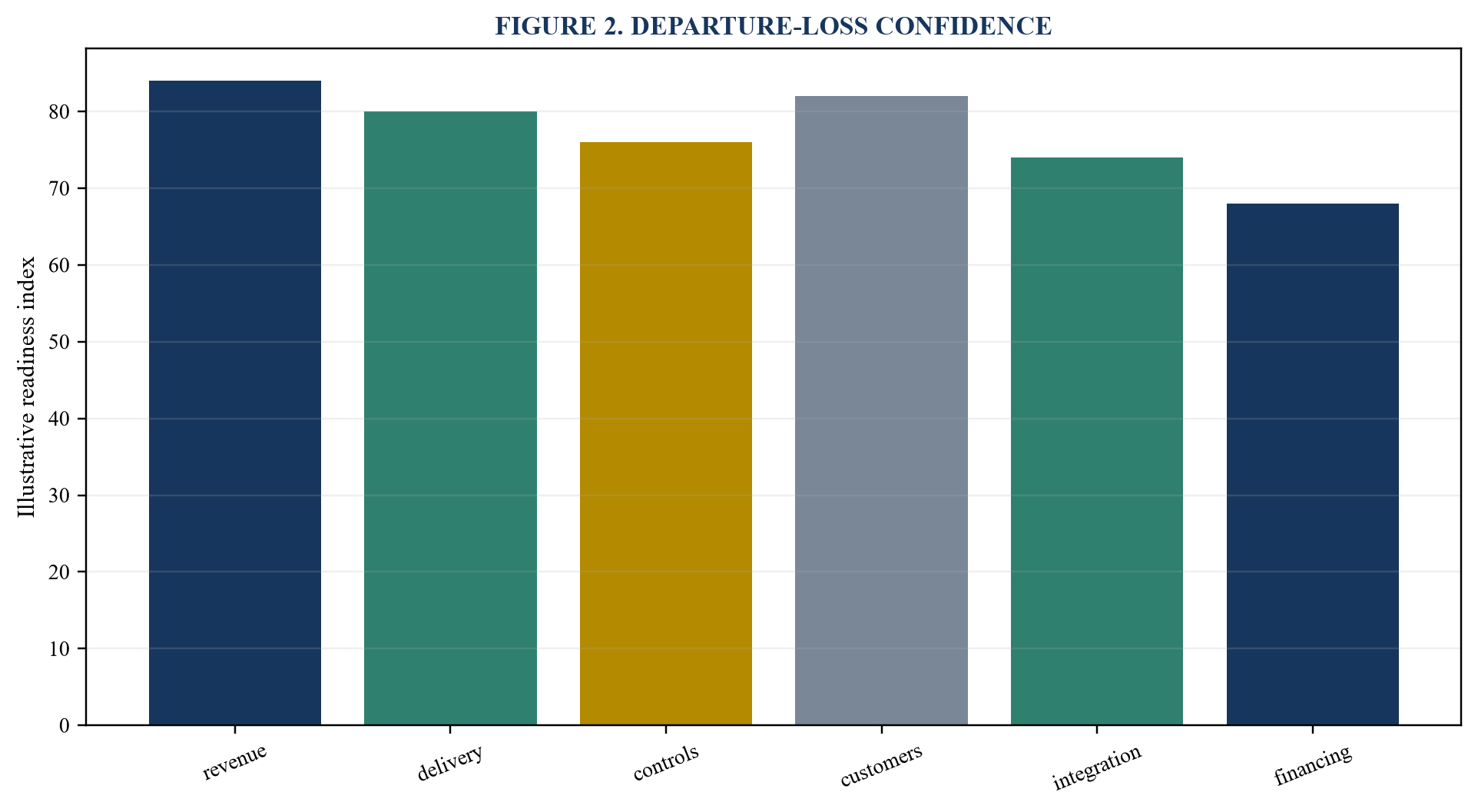
Values are illustrative readiness indices and require company-specific evidence.
17. Quantify departure impact
Model revenue, margin, delivery, control, integration and financing consequences by role.
The transaction team should reconcile forecasts, customer and project data, controls, dependencies and scenarios. Each conclusion records the accountable owner, source, assessment date, affected role, evidence, dependency, economic consequence, control and unresolved exception. The immediate output is a departure-loss model.
Management continuity must be proved through operating outcomes and role-specific evidence. Reviewers test capability, authority, relationships, motivation, replaceability and downside response against native records and observed performance. The investment case, operating model, employee facts, transaction timetable and governing law control every conclusion.
Material gaps require an owner, corrective action, acceptance test, advice and decision date. Consequences flow through leadership capacity, customer delivery, controls, integration, cash, financing, value, fairness and transaction timing. Residual risk remains visible until critical work is covered, handovers are tested and authorised governing bodies approve the next gate.
18. Set retention horizons
Match required tenure to knowledge transfer, customer renewal, integration and stabilisation milestones.
The transaction team should reconcile dependency map, integration plan, contracts, projects and operating cycles. Each conclusion records the accountable owner, source, assessment date, affected role, evidence, dependency, economic consequence, control and unresolved exception. The immediate output is a role-specific retention horizon.
Management continuity must be proved through operating outcomes and role-specific evidence. Reviewers test capability, authority, relationships, motivation, replaceability and downside response against native records and observed performance. The investment case, operating model, employee facts, transaction timetable and governing law control every conclusion.
Material gaps require an owner, corrective action, acceptance test, advice and decision date. Consequences flow through leadership capacity, customer delivery, controls, integration, cash, financing, value, fairness and transaction timing. Residual risk remains visible until critical work is covered, handovers are tested and authorised governing bodies approve the next gate.
19. Segment the population
Group incumbents into retain, transition, replace, develop and monitor categories.
The transaction team should reconcile criticality, capability, motivation, flight risk and succession evidence. Each conclusion records the accountable owner, source, assessment date, affected role, evidence, dependency, economic consequence, control and unresolved exception. The immediate output is a management action portfolio.
Management continuity must be proved through operating outcomes and role-specific evidence. Reviewers test capability, authority, relationships, motivation, replaceability and downside response against native records and observed performance. The investment case, operating model, employee facts, transaction timetable and governing law control every conclusion.
Material gaps require an owner, corrective action, acceptance test, advice and decision date. Consequences flow through leadership capacity, customer delivery, controls, integration, cash, financing, value, fairness and transaction timing. Residual risk remains visible until critical work is covered, handovers are tested and authorised governing bodies approve the next gate.
20. Design role outcomes
Specify authority, deliverables, behaviours, transition duties and success measures.
The transaction team should reconcile operating model, integration plan, value thesis, controls and scorecards. Each conclusion records the accountable owner, source, assessment date, affected role, evidence, dependency, economic consequence, control and unresolved exception. The immediate output is a retained-role charter.
Management continuity must be proved through operating outcomes and role-specific evidence. Reviewers test capability, authority, relationships, motivation, replaceability and downside response against native records and observed performance. The investment case, operating model, employee facts, transaction timetable and governing law control every conclusion.
Material gaps require an owner, corrective action, acceptance test, advice and decision date. Consequences flow through leadership capacity, customer delivery, controls, integration, cash, financing, value, fairness and transaction timing. Residual risk remains visible until critical work is covered, handovers are tested and authorised governing bodies approve the next gate.
21. Design cash retention
Link staged payments to service, milestones, conduct, handover and recoverability.
The transaction team should reconcile cash model, market evidence, tax advice, employment terms and milestones. Each conclusion records the accountable owner, source, assessment date, affected role, evidence, dependency, economic consequence, control and unresolved exception. The immediate output is a cash-retention schedule.
Management continuity must be proved through operating outcomes and role-specific evidence. Reviewers test capability, authority, relationships, motivation, replaceability and downside response against native records and observed performance. The investment case, operating model, employee facts, transaction timetable and governing law control every conclusion.
Material gaps require an owner, corrective action, acceptance test, advice and decision date. Consequences flow through leadership capacity, customer delivery, controls, integration, cash, financing, value, fairness and transaction timing. Residual risk remains visible until critical work is covered, handovers are tested and authorised governing bodies approve the next gate.
22. Design equity alignment
Evaluate rollover, options, restricted equity and long-term incentives against value creation.
The transaction team should reconcile capital structure, valuation, vesting, tax, leaver terms and governance. Each conclusion records the accountable owner, source, assessment date, affected role, evidence, dependency, economic consequence, control and unresolved exception. The immediate output is an equity-alignment model.
Management continuity must be proved through operating outcomes and role-specific evidence. Reviewers test capability, authority, relationships, motivation, replaceability and downside response against native records and observed performance. The investment case, operating model, employee facts, transaction timetable and governing law control every conclusion.
Material gaps require an owner, corrective action, acceptance test, advice and decision date. Consequences flow through leadership capacity, customer delivery, controls, integration, cash, financing, value, fairness and transaction timing. Residual risk remains visible until critical work is covered, handovers are tested and authorised governing bodies approve the next gate.
23. Design performance incentives
Tie rewards to controllable value, continuity and integration outcomes without harmful distortion.
The transaction team should reconcile value plan, KPIs, baselines, accounting policy, controls and scenarios. Each conclusion records the accountable owner, source, assessment date, affected role, evidence, dependency, economic consequence, control and unresolved exception. The immediate output is a performance-incentive scorecard.
Management continuity must be proved through operating outcomes and role-specific evidence. Reviewers test capability, authority, relationships, motivation, replaceability and downside response against native records and observed performance. The investment case, operating model, employee facts, transaction timetable and governing law control every conclusion.
Material gaps require an owner, corrective action, acceptance test, advice and decision date. Consequences flow through leadership capacity, customer delivery, controls, integration, cash, financing, value, fairness and transaction timing. Residual risk remains visible until critical work is covered, handovers are tested and authorised governing bodies approve the next gate.
24. Design stay and transition terms
Define duration, duties, milestones, confidentiality, cooperation and departure consequences.
The transaction team should reconcile employment documents, transaction terms, legal advice and operating plan. Each conclusion records the accountable owner, source, assessment date, affected role, evidence, dependency, economic consequence, control and unresolved exception. The immediate output is a retention-terms matrix.
Management continuity must be proved through operating outcomes and role-specific evidence. Reviewers test capability, authority, relationships, motivation, replaceability and downside response against native records and observed performance. The investment case, operating model, employee facts, transaction timetable and governing law control every conclusion.
Material gaps require an owner, corrective action, acceptance test, advice and decision date. Consequences flow through leadership capacity, customer delivery, controls, integration, cash, financing, value, fairness and transaction timing. Residual risk remains visible until critical work is covered, handovers are tested and authorised governing bodies approve the next gate.
Table 3. Retention instrument map
| Instrument | Best use | Control |
|---|---|---|
| cash | defined service period | staged vesting |
| equity | long-term value creation | leaver terms |
| performance | controllable outcomes | balanced metrics |
| transition | knowledge and handover | acceptance tests |
Illustrative programme design; company-specific facts and authorised advice govern.
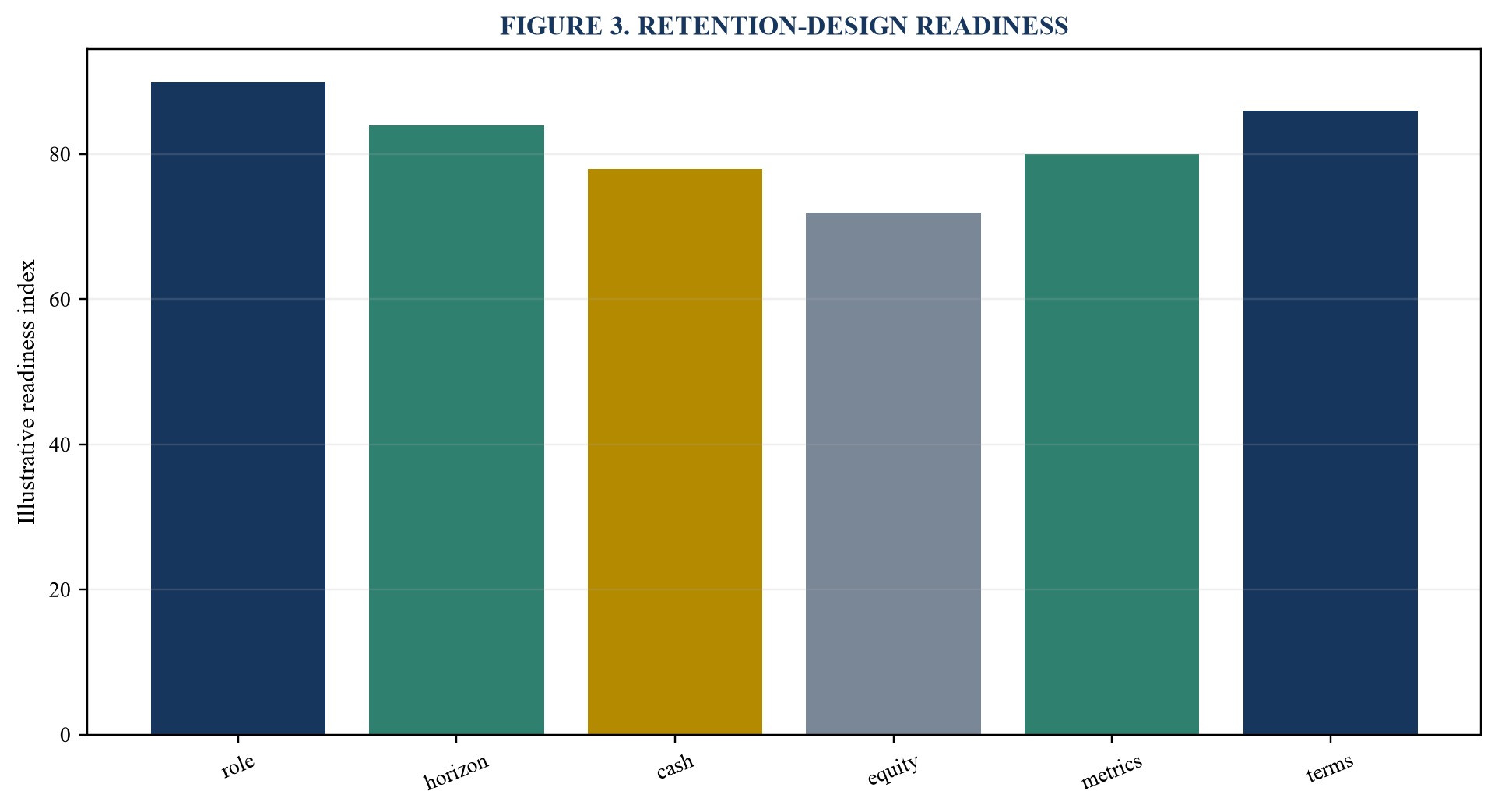
Values are illustrative readiness indices and require company-specific evidence.
25. Test tax and accounting effects
Determine cost recognition, payroll, withholding, classification and transaction-accounting consequences.
The transaction team should reconcile award terms, purchase agreement, accounting policy and specialist advice. Each conclusion records the accountable owner, source, assessment date, affected role, evidence, dependency, economic consequence, control and unresolved exception. The immediate output is a retention-cost bridge.
Management continuity must be proved through operating outcomes and role-specific evidence. Reviewers test capability, authority, relationships, motivation, replaceability and downside response against native records and observed performance. The investment case, operating model, employee facts, transaction timetable and governing law control every conclusion.
Material gaps require an owner, corrective action, acceptance test, advice and decision date. Consequences flow through leadership capacity, customer delivery, controls, integration, cash, financing, value, fairness and transaction timing. Residual risk remains visible until critical work is covered, handovers are tested and authorised governing bodies approve the next gate.
26. Test legal enforceability
Review employment, restrictive covenant, discrimination, consultation, privacy and mobility rules.
The transaction team should reconcile governing law, employee location, contracts, policies and legal advice. Each conclusion records the accountable owner, source, assessment date, affected role, evidence, dependency, economic consequence, control and unresolved exception. The immediate output is a legal-enforceability matrix.
Management continuity must be proved through operating outcomes and role-specific evidence. Reviewers test capability, authority, relationships, motivation, replaceability and downside response against native records and observed performance. The investment case, operating model, employee facts, transaction timetable and governing law control every conclusion.
Material gaps require an owner, corrective action, acceptance test, advice and decision date. Consequences flow through leadership capacity, customer delivery, controls, integration, cash, financing, value, fairness and transaction timing. Residual risk remains visible until critical work is covered, handovers are tested and authorised governing bodies approve the next gate.
27. Test regulatory constraints
Identify merger-control, licensing, fit-and-proper and regulated-role conditions affecting appointments.
The transaction team should reconcile regulatory filings, licences, interim measures, approvals and advice. Each conclusion records the accountable owner, source, assessment date, affected role, evidence, dependency, economic consequence, control and unresolved exception. The immediate output is a regulated-role plan.
Management continuity must be proved through operating outcomes and role-specific evidence. Reviewers test capability, authority, relationships, motivation, replaceability and downside response against native records and observed performance. The investment case, operating model, employee facts, transaction timetable and governing law control every conclusion.
Material gaps require an owner, corrective action, acceptance test, advice and decision date. Consequences flow through leadership capacity, customer delivery, controls, integration, cash, financing, value, fairness and transaction timing. Residual risk remains visible until critical work is covered, handovers are tested and authorised governing bodies approve the next gate.
28. Protect fairness and culture
Test internal equity, communication, inclusion, workload and trust across retained and non-retained groups.
The transaction team should reconcile pay architecture, workforce data, engagement, culture evidence and plans. Each conclusion records the accountable owner, source, assessment date, affected role, evidence, dependency, economic consequence, control and unresolved exception. The immediate output is a workforce-fairness assessment.
Management continuity must be proved through operating outcomes and role-specific evidence. Reviewers test capability, authority, relationships, motivation, replaceability and downside response against native records and observed performance. The investment case, operating model, employee facts, transaction timetable and governing law control every conclusion.
Material gaps require an owner, corrective action, acceptance test, advice and decision date. Consequences flow through leadership capacity, customer delivery, controls, integration, cash, financing, value, fairness and transaction timing. Residual risk remains visible until critical work is covered, handovers are tested and authorised governing bodies approve the next gate.
29. Prevent adverse incentives
Identify cliff effects, disengagement, knowledge hoarding, short-termism and retention of poor performers.
The transaction team should reconcile award design, conduct history, controls, scenarios and independent challenge. Each conclusion records the accountable owner, source, assessment date, affected role, evidence, dependency, economic consequence, control and unresolved exception. The immediate output is an incentive-risk register.
Management continuity must be proved through operating outcomes and role-specific evidence. Reviewers test capability, authority, relationships, motivation, replaceability and downside response against native records and observed performance. The investment case, operating model, employee facts, transaction timetable and governing law control every conclusion.
Material gaps require an owner, corrective action, acceptance test, advice and decision date. Consequences flow through leadership capacity, customer delivery, controls, integration, cash, financing, value, fairness and transaction timing. Residual risk remains visible until critical work is covered, handovers are tested and authorised governing bodies approve the next gate.
30. Align price and terms
Separate operating retention cost from seller obligations, purchase consideration and identified dependency risk.
The transaction team should reconcile valuation, purchase agreement, retention plans, forecasts and accounting advice. Each conclusion records the accountable owner, source, assessment date, affected role, evidence, dependency, economic consequence, control and unresolved exception. The immediate output is a people-risk value bridge.
Management continuity must be proved through operating outcomes and role-specific evidence. Reviewers test capability, authority, relationships, motivation, replaceability and downside response against native records and observed performance. The investment case, operating model, employee facts, transaction timetable and governing law control every conclusion.
Material gaps require an owner, corrective action, acceptance test, advice and decision date. Consequences flow through leadership capacity, customer delivery, controls, integration, cash, financing, value, fairness and transaction timing. Residual risk remains visible until critical work is covered, handovers are tested and authorised governing bodies approve the next gate.
31. Allocate funding
Determine seller, buyer, target and financing responsibility for retention and transition commitments.
The transaction team should reconcile sources and uses, cash model, purchase agreement, payroll and approvals. Each conclusion records the accountable owner, source, assessment date, affected role, evidence, dependency, economic consequence, control and unresolved exception. The immediate output is a retention funding plan.
Management continuity must be proved through operating outcomes and role-specific evidence. Reviewers test capability, authority, relationships, motivation, replaceability and downside response against native records and observed performance. The investment case, operating model, employee facts, transaction timetable and governing law control every conclusion.
Material gaps require an owner, corrective action, acceptance test, advice and decision date. Consequences flow through leadership capacity, customer delivery, controls, integration, cash, financing, value, fairness and transaction timing. Residual risk remains visible until critical work is covered, handovers are tested and authorised governing bodies approve the next gate.
32. Plan communications
Sequence confidential engagement, offers, announcements, manager scripts and stakeholder messaging.
The transaction team should reconcile deal timeline, legal constraints, employee map and communication plan. Each conclusion records the accountable owner, source, assessment date, affected role, evidence, dependency, economic consequence, control and unresolved exception. The immediate output is a retention communication calendar.
Management continuity must be proved through operating outcomes and role-specific evidence. Reviewers test capability, authority, relationships, motivation, replaceability and downside response against native records and observed performance. The investment case, operating model, employee facts, transaction timetable and governing law control every conclusion.
Material gaps require an owner, corrective action, acceptance test, advice and decision date. Consequences flow through leadership capacity, customer delivery, controls, integration, cash, financing, value, fairness and transaction timing. Residual risk remains visible until critical work is covered, handovers are tested and authorised governing bodies approve the next gate.
Table 4. Day-One continuity controls
| Control | Failure signal | Immediate action |
|---|---|---|
| authority | unclear decision rights | issue delegations |
| access | critical system gap | restore controlled access |
| payroll | award or benefit error | reconcile obligations |
| customers | relationship interruption | activate handover |
Illustrative programme design; company-specific facts and authorised advice govern.
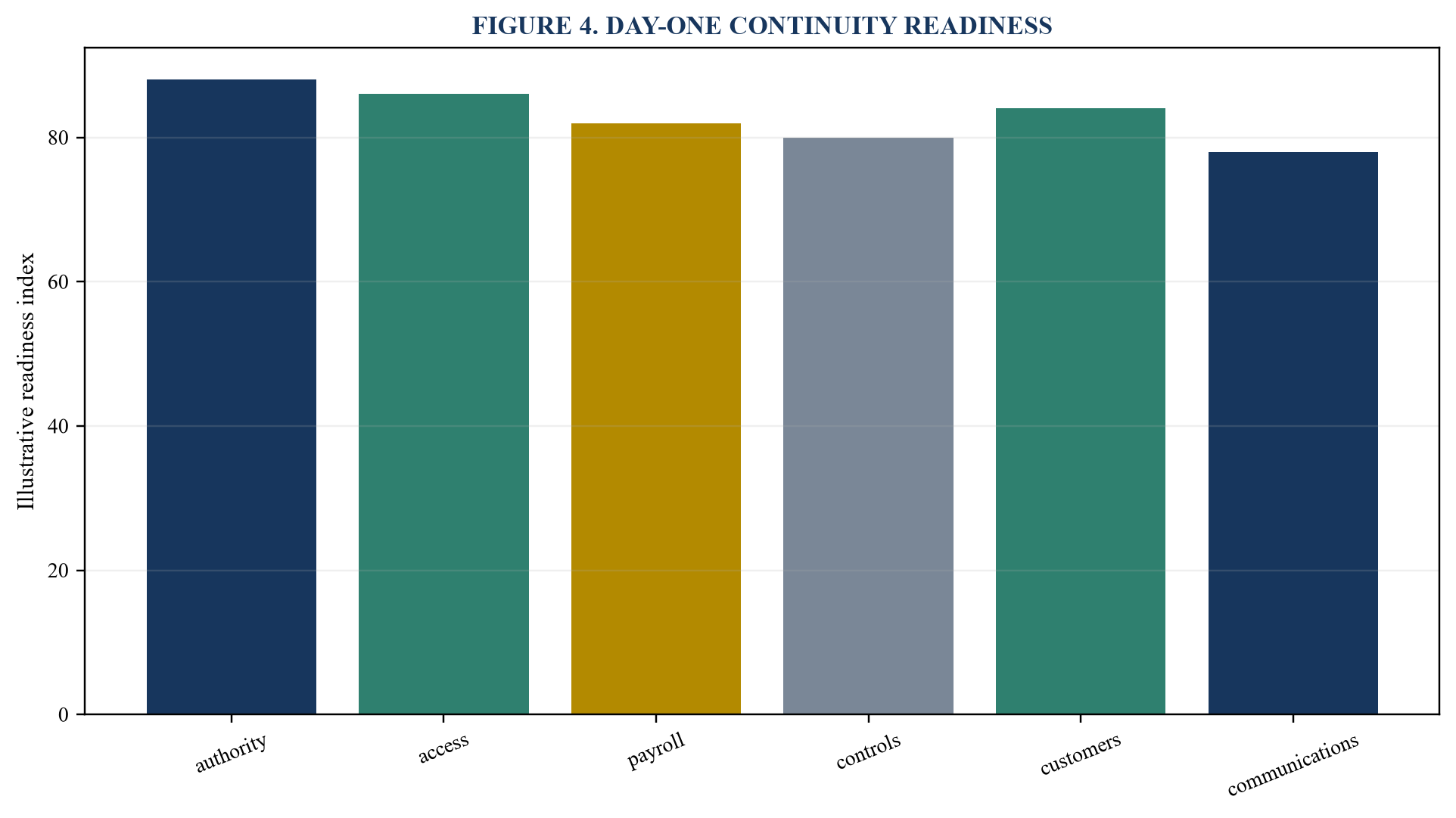
Values are illustrative readiness indices and require company-specific evidence.
33. Plan Day One
Confirm authority, access, reporting lines, payroll, benefits, controls and escalation for critical roles.
The transaction team should reconcile Day-One plan, delegations, systems, employee terms and testing. Each conclusion records the accountable owner, source, assessment date, affected role, evidence, dependency, economic consequence, control and unresolved exception. The immediate output is a Day-One people control plan.
Management continuity must be proved through operating outcomes and role-specific evidence. Reviewers test capability, authority, relationships, motivation, replaceability and downside response against native records and observed performance. The investment case, operating model, employee facts, transaction timetable and governing law control every conclusion.
Material gaps require an owner, corrective action, acceptance test, advice and decision date. Consequences flow through leadership capacity, customer delivery, controls, integration, cash, financing, value, fairness and transaction timing. Residual risk remains visible until critical work is covered, handovers are tested and authorised governing bodies approve the next gate.
34. Plan knowledge transfer
Convert tacit knowledge into documented decisions, playbooks, repositories and trained successors.
The transaction team should reconcile knowledge register, documentation, shadowing, tests and sign-off. Each conclusion records the accountable owner, source, assessment date, affected role, evidence, dependency, economic consequence, control and unresolved exception. The immediate output is a knowledge-transfer programme.
Management continuity must be proved through operating outcomes and role-specific evidence. Reviewers test capability, authority, relationships, motivation, replaceability and downside response against native records and observed performance. The investment case, operating model, employee facts, transaction timetable and governing law control every conclusion.
Material gaps require an owner, corrective action, acceptance test, advice and decision date. Consequences flow through leadership capacity, customer delivery, controls, integration, cash, financing, value, fairness and transaction timing. Residual risk remains visible until critical work is covered, handovers are tested and authorised governing bodies approve the next gate.
35. Plan succession
Develop internal and external successors for every value-critical role and dependency.
The transaction team should reconcile talent reviews, development plans, search strategy and contingency triggers. Each conclusion records the accountable owner, source, assessment date, affected role, evidence, dependency, economic consequence, control and unresolved exception. The immediate output is a succession coverage map.
Management continuity must be proved through operating outcomes and role-specific evidence. Reviewers test capability, authority, relationships, motivation, replaceability and downside response against native records and observed performance. The investment case, operating model, employee facts, transaction timetable and governing law control every conclusion.
Material gaps require an owner, corrective action, acceptance test, advice and decision date. Consequences flow through leadership capacity, customer delivery, controls, integration, cash, financing, value, fairness and transaction timing. Residual risk remains visible until critical work is covered, handovers are tested and authorised governing bodies approve the next gate.
36. Build the one-hundred-day plan
Sequence retention, role decisions, integration, handovers and capability building with owners.
The transaction team should reconcile action portfolio, milestones, budgets, dependencies and reporting. Each conclusion records the accountable owner, source, assessment date, affected role, evidence, dependency, economic consequence, control and unresolved exception. The immediate output is a management-continuity roadmap.
Management continuity must be proved through operating outcomes and role-specific evidence. Reviewers test capability, authority, relationships, motivation, replaceability and downside response against native records and observed performance. The investment case, operating model, employee facts, transaction timetable and governing law control every conclusion.
Material gaps require an owner, corrective action, acceptance test, advice and decision date. Consequences flow through leadership capacity, customer delivery, controls, integration, cash, financing, value, fairness and transaction timing. Residual risk remains visible until critical work is covered, handovers are tested and authorised governing bodies approve the next gate.
37. Monitor leading indicators
Track acceptance, engagement, regretted loss, knowledge transfer, customer continuity and milestone delivery.
The transaction team should reconcile HRIS, surveys, CRM, project data, controls and dashboards. Each conclusion records the accountable owner, source, assessment date, affected role, evidence, dependency, economic consequence, control and unresolved exception. The immediate output is a continuity control dashboard.
Management continuity must be proved through operating outcomes and role-specific evidence. Reviewers test capability, authority, relationships, motivation, replaceability and downside response against native records and observed performance. The investment case, operating model, employee facts, transaction timetable and governing law control every conclusion.
Material gaps require an owner, corrective action, acceptance test, advice and decision date. Consequences flow through leadership capacity, customer delivery, controls, integration, cash, financing, value, fairness and transaction timing. Residual risk remains visible until critical work is covered, handovers are tested and authorised governing bodies approve the next gate.
38. Define intervention triggers
Set thresholds for departure, underperformance, control failure, customer loss and delayed handover.
The transaction team should reconcile risk appetite, scenarios, monitoring data and governing approvals. Each conclusion records the accountable owner, source, assessment date, affected role, evidence, dependency, economic consequence, control and unresolved exception. The immediate output is a management intervention matrix.
Management continuity must be proved through operating outcomes and role-specific evidence. Reviewers test capability, authority, relationships, motivation, replaceability and downside response against native records and observed performance. The investment case, operating model, employee facts, transaction timetable and governing law control every conclusion.
Material gaps require an owner, corrective action, acceptance test, advice and decision date. Consequences flow through leadership capacity, customer delivery, controls, integration, cash, financing, value, fairness and transaction timing. Residual risk remains visible until critical work is covered, handovers are tested and authorised governing bodies approve the next gate.
39. Govern residual risk
Record accepted dependency, compensating controls, time limits, authority and review dates.
The transaction team should reconcile risk register, plans, evidence, advice and approvals. Each conclusion records the accountable owner, source, assessment date, affected role, evidence, dependency, economic consequence, control and unresolved exception. The immediate output is a residual people-risk record.
Management continuity must be proved through operating outcomes and role-specific evidence. Reviewers test capability, authority, relationships, motivation, replaceability and downside response against native records and observed performance. The investment case, operating model, employee facts, transaction timetable and governing law control every conclusion.
Material gaps require an owner, corrective action, acceptance test, advice and decision date. Consequences flow through leadership capacity, customer delivery, controls, integration, cash, financing, value, fairness and transaction timing. Residual risk remains visible until critical work is covered, handovers are tested and authorised governing bodies approve the next gate.
40. Issue the transaction conclusion
State who must stay, for how long, on what terms, at what cost and with which contingencies.
The transaction team should reconcile reconciled evidence, models, agreements, plans and approvals. Each conclusion records the accountable owner, source, assessment date, affected role, evidence, dependency, economic consequence, control and unresolved exception. The immediate output is a management-continuity certificate.
Management continuity must be proved through operating outcomes and role-specific evidence. Reviewers test capability, authority, relationships, motivation, replaceability and downside response against native records and observed performance. The investment case, operating model, employee facts, transaction timetable and governing law control every conclusion.
Material gaps require an owner, corrective action, acceptance test, advice and decision date. Consequences flow through leadership capacity, customer delivery, controls, integration, cash, financing, value, fairness and transaction timing. Residual risk remains visible until critical work is covered, handovers are tested and authorised governing bodies approve the next gate.
Table 5. Management-continuity certificate
| Question | Required conclusion | Evidence |
|---|---|---|
| who | critical role and incumbent | role assessment |
| how long | milestone-linked horizon | dependency plan |
| terms | proportionate alignment | approved agreement |
| contingency | successor and trigger | tested roadmap |
Illustrative programme design; company-specific facts and authorised advice govern.
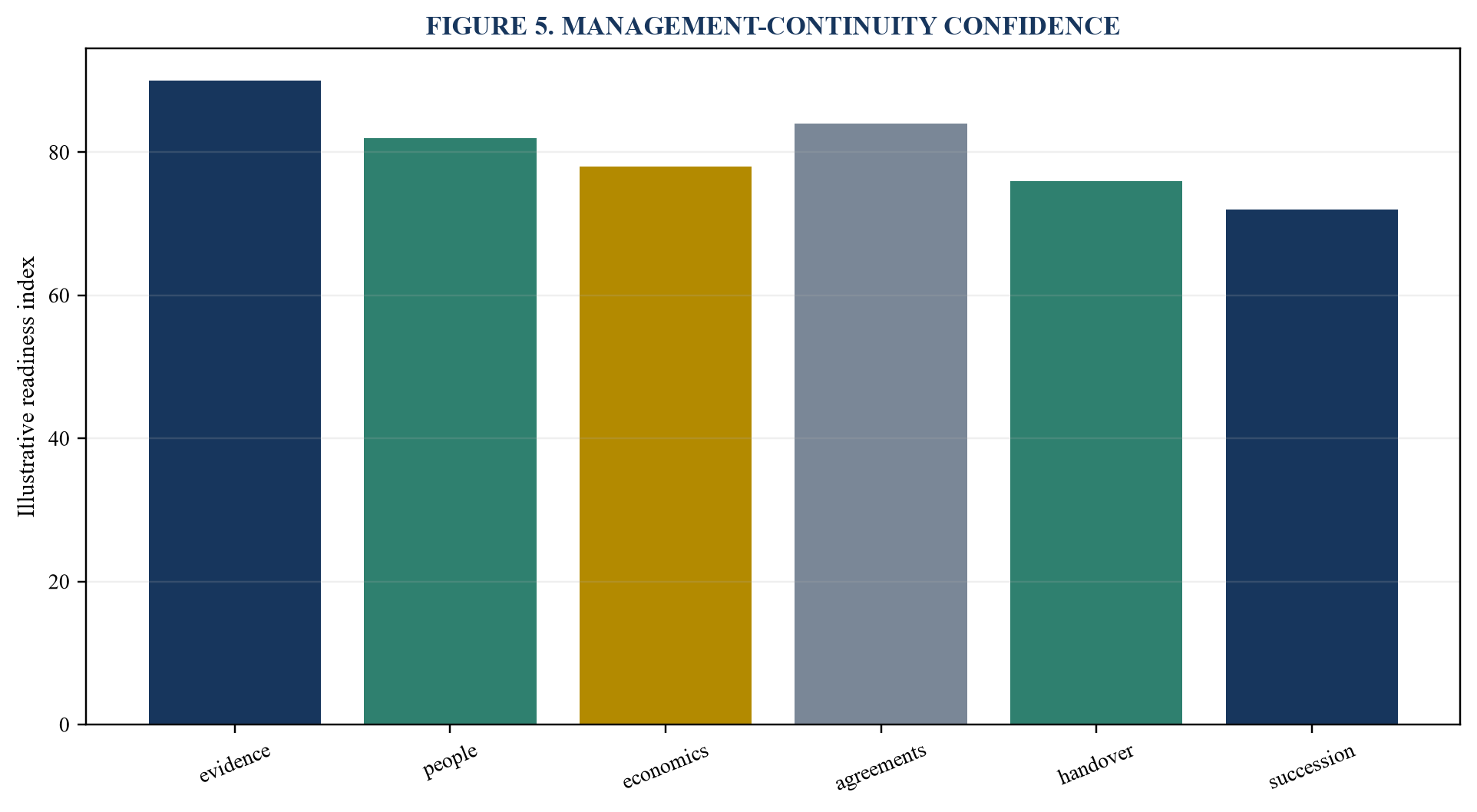
Values are illustrative readiness indices and require company-specific evidence.
References
- David Arnold, Kevin Milligan, Terry Moon and Amirhossein Tavakoli, Job Transitions and Employee Earnings After Acquisitions, NBER Working Paper 31866, https://doi.org/10.3386/w31866
- US Securities and Exchange Commission, Key Business Employee Retention Program disclosed in an acquisition agreement, https://www.sec.gov/Archives/edgar/data/1162194/000110465925061438/tm2518613d1_ex2-1.htm
- US Securities and Exchange Commission, SHF LLC Employee Retention Plan, https://www.sec.gov/Archives/edgar/data/1854963/000149315226039257/ex10-2.htm
- US Securities and Exchange Commission, Emergent BioSolutions Key Employee Retention Program, https://www.sec.gov/Archives/edgar/data/1367644/000136764423000208/formofletteragreementdated.htm
- US Securities and Exchange Commission, Southside Bank Key Employee Retention Agreement, https://www.sec.gov/Archives/edgar/data/705432/000070543217000142/ex101keyemployeeagreement-.htm
- Competition and Markets Authority, Interim measures in merger investigations, https://www.gov.uk/government/publications/mergers-interim-measures
- International Labour Organization, Termination of Employment Convention 1982, https://www.ilo.org/resource/c111-termination-employment-convention-1982-no-158
- International Labour Organization, Protection of Workers Personal Data, https://www.ilo.org/publications/protection-workers-personal-data
- European Union, General Data Protection Regulation, https://eur-lex.europa.eu/eli/reg/2016/679/oj
- European Union, Council Directive 2001/23/EC on safeguarding employees rights on transfers, https://eur-lex.europa.eu/eli/dir/2001/23/oj
- United Kingdom Government, Transfer of Undertakings Protection of Employment guidance, https://www.gov.uk/transfers-takeovers
- United Kingdom Government, Employee shareholder status, https://www.gov.uk/employee-shareholders
- United Kingdom Government, Employment-related securities guidance, https://www.gov.uk/tax-employee-share-schemes
- US Internal Revenue Service, Section 409A nonqualified deferred compensation plans, https://www.irs.gov/retirement-plans/section-409a-nonqualified-deferred-compensation-plans
- US Internal Revenue Service, Golden parachute payments guide, https://www.irs.gov/pub/irs-utl/goldenparachuteatg.pdf
- IFRS Foundation, IFRS 3 Business Combinations, https://www.ifrs.org/issued-standards/list-of-standards/ifrs-3-business-combinations/
- IFRS Foundation, IFRS 2 Share-based Payment, https://www.ifrs.org/issued-standards/list-of-standards/ifrs-2-share-based-payment/
- IFRS Foundation, IAS 19 Employee Benefits, https://www.ifrs.org/issued-standards/list-of-standards/ias-19-employee-benefits/
- IFRS Foundation, IAS 37 Provisions Contingent Liabilities and Contingent Assets, https://www.ifrs.org/issued-standards/list-of-standards/ias-37-provisions-contingent-liabilities-and-contingent-assets/
- Financial Accounting Standards Board, Business Combinations Topic 805, https://asc.fasb.org/topic&trid=2127482
- Financial Accounting Standards Board, Compensation Stock Compensation Topic 718, https://asc.fasb.org/topic&trid=2127487
- International Valuation Standards Council, IVS 200 Businesses and Business Interests, https://www.ivsc.org/standards/
- OECD, Guidelines for Multinational Enterprises on Responsible Business Conduct, https://mneguidelines.oecd.org/
- OECD, Employment Outlook, https://www.oecd.org/employment-outlook/
- US Department of Justice and Federal Trade Commission, Merger Guidelines, https://www.justice.gov/atr/2023-merger-guidelines
- International Organization for Standardization, ISO 30414 Human capital reporting, https://www.iso.org/standard/69338.html
