Introduction
In public equity markets the choice of manager is, for many investors, a question that can be sidestepped: a low-cost index fund captures the market return, and the dispersion between active managers, while real, is modest and rarely persistent. In private markets none of this holds. There is no index to buy, the gap between the best and worst managers in a given vintage can exceed twenty percentage points of annual return, and, crucially, that gap shows genuine persistence, with strong managers tending to remain strong across successive funds. The choice of manager is therefore not a refinement but the single most important decision a private market allocator makes.
This places a heavy burden on the selection process, and it is a burden that many allocators do not meet. The typical selection rests on a headline track record, a referral from a trusted source and a confident presentation by an articulate team. Each of these is informative, but none is reliable on its own. A headline track record can be the product of market beta, leverage and timing rather than skill; a referral reflects another investor’s judgement, which may be no better than one’s own; and presentation skill correlates poorly with investment skill. An allocator who selects on these alone is, in effect, guessing with conviction.
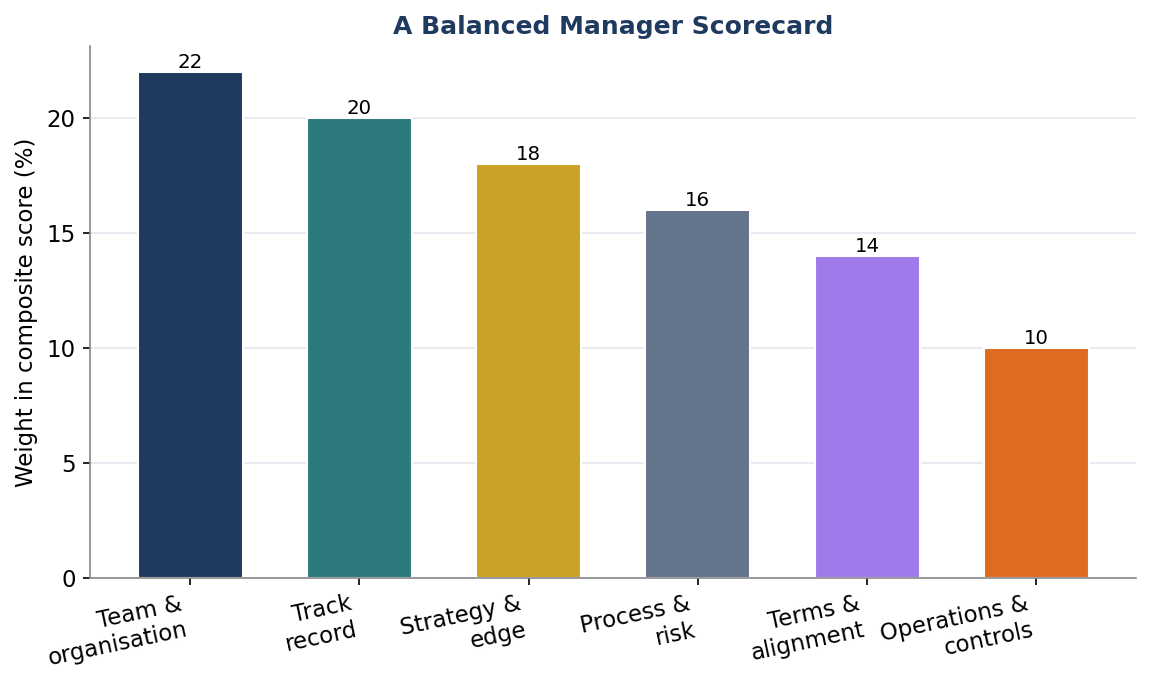
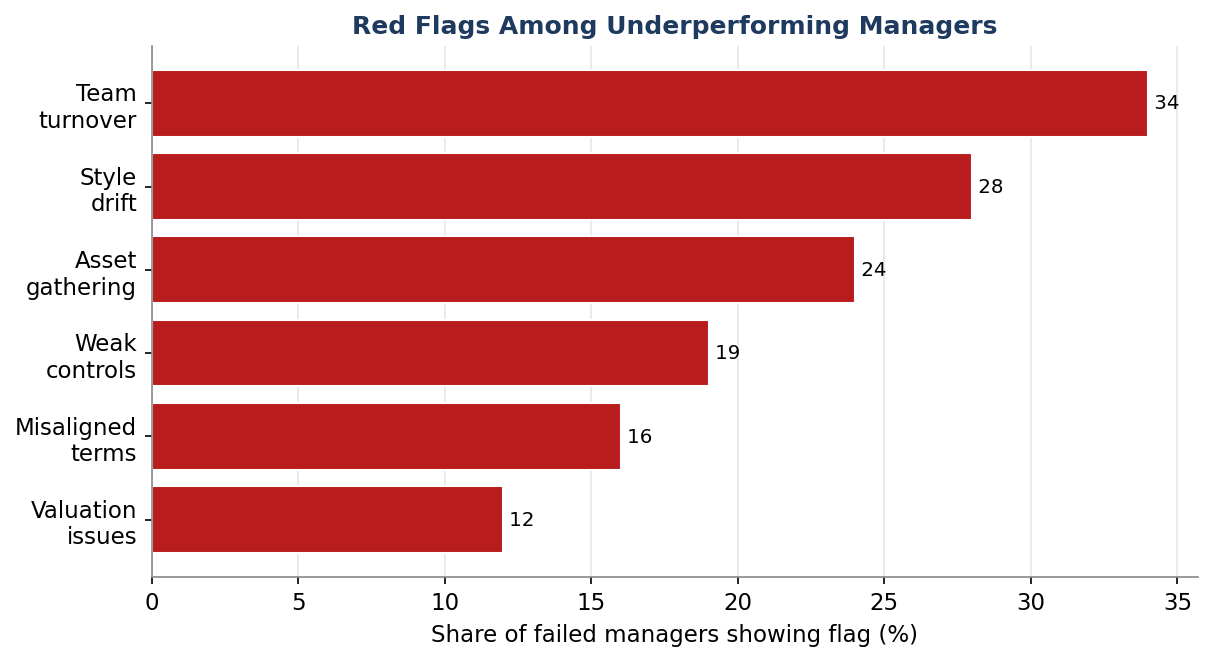
This paper offers a structured alternative: a weighted scorecard that forces the allocator to assess a manager across the dimensions that actually predict future performance, and a process that decomposes the track record, tests for persistence and surfaces the red flags that precede failure. The aim is not to replace judgement with a formula, since judgement remains central, but to discipline judgement so that it is applied consistently, documented defensibly and protected against the cognitive biases that make manager selection so error-prone. The framework is built for the family office and institutional allocator choosing private fund managers across private equity, credit, real estate and venture.
Dimension Two: Decomposing the Track Record
A reported track record is the most cited and least understood piece of evidence in manager selection. A headline internal rate of return tells the allocator what happened, but not why, and the why is what predicts the future. The essential analytical task is to decompose the reported return into its sources, separating the part attributable to the manager’s skill from the part attributable to the market, to leverage and to timing.
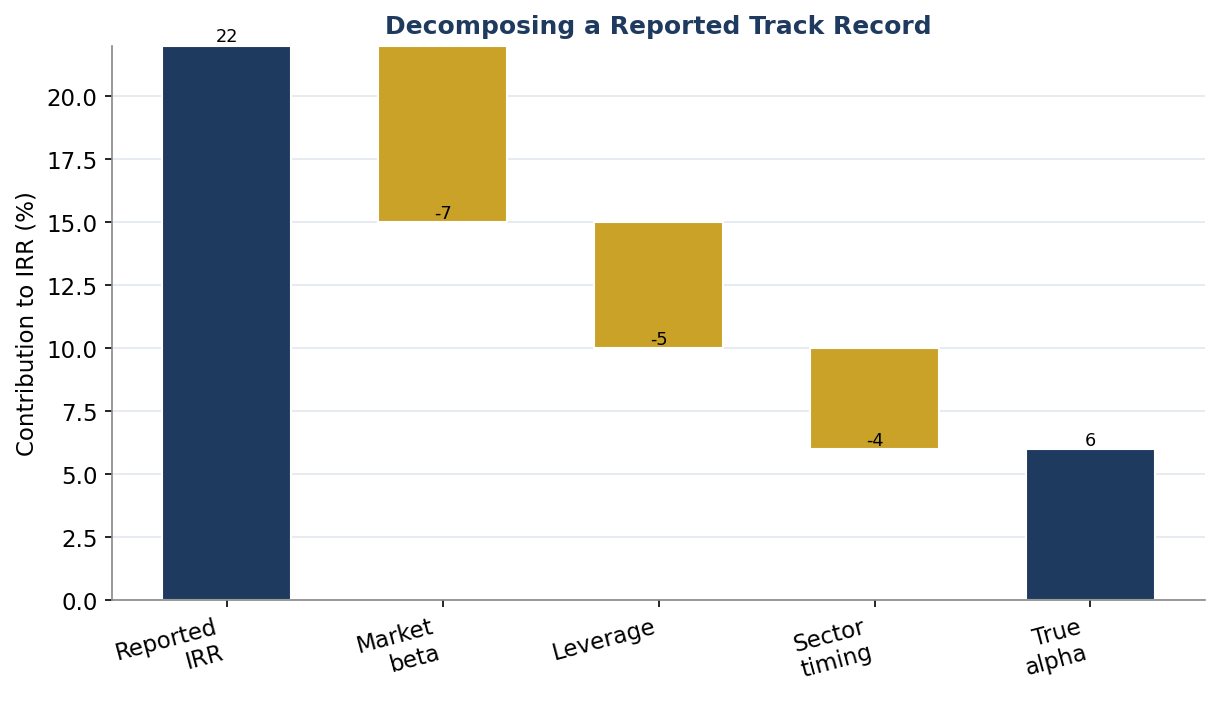
Figure 2. Decomposing a Reported Track Record
A headline return decomposed into market beta, leverage, timing and the residual true skill.
The decomposition often humbles a headline number. A manager reporting an impressive return may, on analysis, owe much of it to a rising market that lifted all assets, to leverage that amplified that market return, and to fortunate timing of entry and exit, leaving a true skill component that is far smaller than the headline suggests. Conversely, a manager with a modest headline return achieved in a difficult market, without excessive leverage, may display more genuine skill. The allocator who takes the headline at face value will systematically prefer the lucky and the leveraged over the skilled.
Doing this properly requires deal-level data, not just fund-level returns. The allocator should examine the dispersion of outcomes across the portfolio, since a return driven by one or two outsized winners is more fragile than one earned consistently across many deals. It should examine the use of leverage and subscription lines, which can flatter the reported internal rate of return without adding value. And it should benchmark against the relevant market over the same period, so that beta is stripped out. Only the residual, the return the manager added through skill, deserves weight in the scorecard.
Dimension Four: Process and Risk
Where the strategy dimension asks what the manager does, the process dimension asks how it does it, and a disciplined, repeatable process is one of the strongest predictors that past performance will continue. The allocator is looking for evidence that returns are produced systematically rather than by inspiration, because a system can be repeated while inspiration cannot. This means examining how opportunities are sourced and screened, how decisions are made and challenged, and how the manager thinks about and controls risk.
Decision-making. A robust investment process has clear stages, genuine debate and a mechanism for challenge, so that decisions are tested rather than rubber-stamped. The allocator should ask to see the investment committee process, understand who can say no, and probe how the manager handles internal disagreement. A process dominated by a single unchallengeable individual is fragile, however talented that individual may be.
Risk control. Strong managers think as hard about avoiding losses as about generating gains. The allocator should understand how the manager sizes positions, manages concentration, uses leverage and monitors its portfolio for deterioration. A manager that cannot articulate how it controls downside, or whose track record shows large losses alongside its wins, carries a risk profile that the headline return conceals.
Process also reveals how a manager will behave in conditions it has not yet faced. A manager whose process is well documented and consistently applied is more likely to navigate a downturn or a strategy stress without panic or drift. The allocator cannot observe the future, but it can observe whether the manager has built the disciplined machinery that handles adversity well, and this is a meaningful part of judging whether good performance will persist into harder times.
Dimension Five: Terms and Alignment
Even a skilled manager is a poor investment if the terms transfer too much of the value to the manager or misalign its incentives with the investor’s. The terms-and-alignment dimension assesses whether the economics are fair and whether they point the manager toward the outcomes the investor wants. This connects manager selection to the broader question of net-to-investor returns, since the most skilled manager on a punitive fee structure can deliver less to the investor than a slightly less skilled manager on fair terms.
The central alignment question is whether the manager makes its money primarily from performance or from fees. A meaningful general partner commitment, funded in cash, ensures the manager loses alongside the investor. A genuine hurdle and a whole-fund waterfall defer the manager’s carry until the investor has been made whole. A management fee sized to run the business rather than to enrich the partners signals that the manager expects to earn through results. The allocator should read these terms as a statement of the manager’s confidence and intent, and should be wary of a manager whose economics are structured to pay handsomely regardless of performance.
Alignment extends beyond the headline economics to the smaller terms that reveal a manager’s posture toward its investors. How are expenses allocated between the fund and the manager? Are transaction and monitoring fees offset against the management fee? Is there a most-favoured-nation clause? How does the manager treat co-investment, and does it allocate the best opportunities fairly? These details, often buried in the fund documents, distinguish managers who see investors as partners from those who see them as a source of fees, and they belong in the scorecard.
The Due Diligence Process
The scorecard is the output of a disciplined process, and the quality of the output depends on the rigour of the process that feeds it. A sound manager due diligence process moves through defined stages, each designed to gather the evidence that a particular part of the scorecard requires, and it separates the people who advocate for a manager from those whose job is to find reasons to decline.
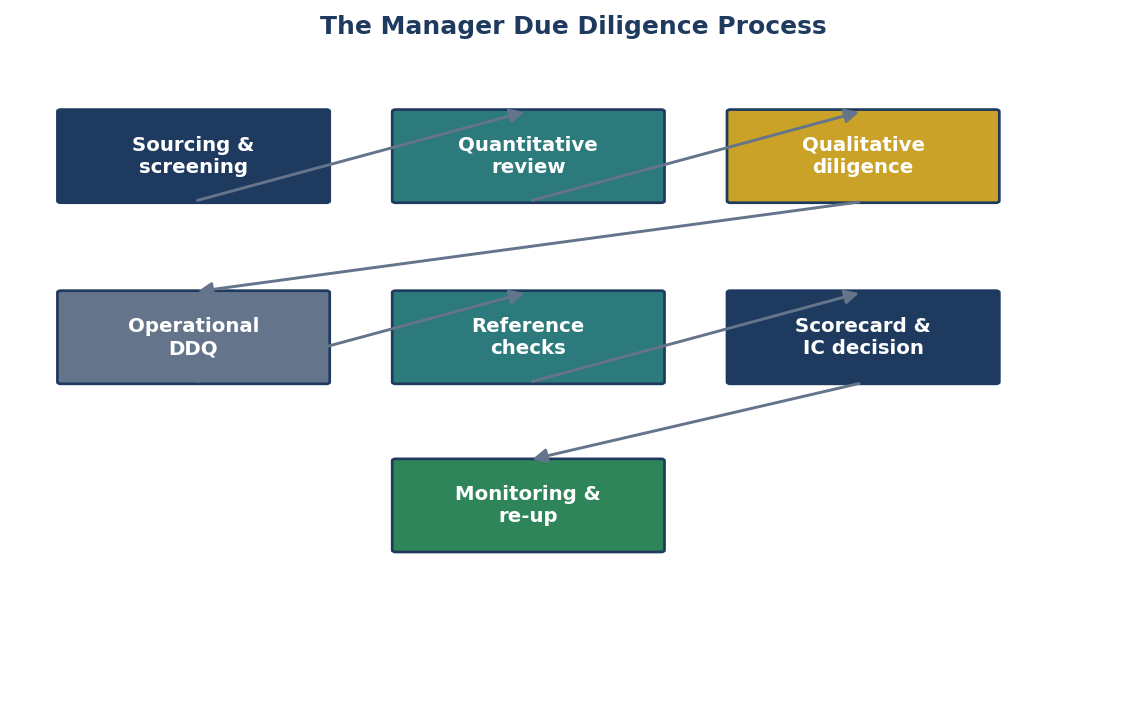
Figure 7. The Manager Due Diligence Process
A staged process feeding the scorecard and the investment committee decision.
The process begins with sourcing and screening, which narrows a wide universe to a manageable shortlist using basic criteria. Quantitative review then decomposes the track record and tests for persistence. Qualitative diligence, the most time-intensive stage, assesses team, strategy and process through meetings, document review and observation. Operational due diligence, conducted independently, addresses the operations-and-controls gate. Reference checks, including off-list references the manager did not provide, test the picture against the views of those who have worked with or invested alongside the manager. The scorecard then synthesises all of this for the investment committee decision, and monitoring continues through the life of the commitment.
A feature of good process is that it is consistent across managers, so that they are evaluated on the same dimensions with the same rigour and the results are genuinely comparable. Allocators that diligence each manager differently, going deep where they are enthusiastic and shallow where they are not, produce scorecards that reflect their own enthusiasm rather than the managers’ quality. Consistency is what makes the composite scores comparable and the ranking meaningful, and it is the discipline that most distinguishes a professional selection process from an ad hoc one.
Monitoring After Commitment
Selection does not end at the commitment; it continues through monitoring, because the conditions that justified the commitment can change, and the decision to re-up into a manager’s next fund is itself a selection decision informed by what monitoring reveals. An allocator that diligences carefully at entry but monitors loosely thereafter forfeits much of the value of its initial work and risks re-upping into a manager that has quietly deteriorated.
Effective monitoring tracks the same dimensions the scorecard assessed, watching for change. Has the team remained stable, or have key people left? Has the strategy held, or has the manager drifted or grown beyond its capacity? Is the process still disciplined, and are the terms of the next fund still aligned? Monitoring also tracks the realisation of the current fund against expectations, distinguishing temporary marks from genuine impairment. The allocator should treat each annual meeting and each re-up as an opportunity to re-score the manager, not as a formality.
The re-up decision deserves particular discipline because it is where relationship and inertia most threaten judgement. An allocator that has committed to a manager, met its team for years and values the relationship is psychologically inclined to re-up even when the evidence has turned. Applying the scorecard afresh at each re-up, with the same rigour as at first commitment, protects against this inertia and ensures that capital continues to flow to managers on the strength of their current quality rather than the comfort of an existing relationship.
Special Cases: First-Time Funds and Emerging Managers
First-time funds and emerging managers pose a particular challenge, because the track record that the scorecard relies on is absent or attached to a prior firm. Yet emerging managers can be among the most attractive opportunities, often hungry, aligned and pursuing strategies before they become crowded, so an allocator that excludes them entirely forfeits real returns. The framework adapts rather than breaks for these cases.
For a first-time fund, the allocator leans more heavily on the dimensions that do not require a fund track record: the team’s individual track records from prior roles, carefully attributed to avoid claiming credit the individual did not earn; the clarity and durability of the strategy and edge; the quality of the process the team has built; and the alignment of the terms. Operational diligence becomes more important, not less, because a new firm’s back office is unproven. Reference checks carry extra weight, since they substitute for the missing fund history. The scorecard accommodates this by allowing the team and strategy dimensions to bear more of the assessment where the track-record dimension is necessarily thin.
An Implementation Roadmap
Define the scorecard dimensions and weights in advance, tailored to the strategy, and commit to them before evaluating any manager.
Build a consistent due diligence process with defined stages, separating investment advocacy from operational scrutiny.
Decompose every track record into skill, beta, leverage and timing using deal-level data, and test for persistence across funds.
Conduct independent operational due diligence as a gate, with the power to override a high investment score.
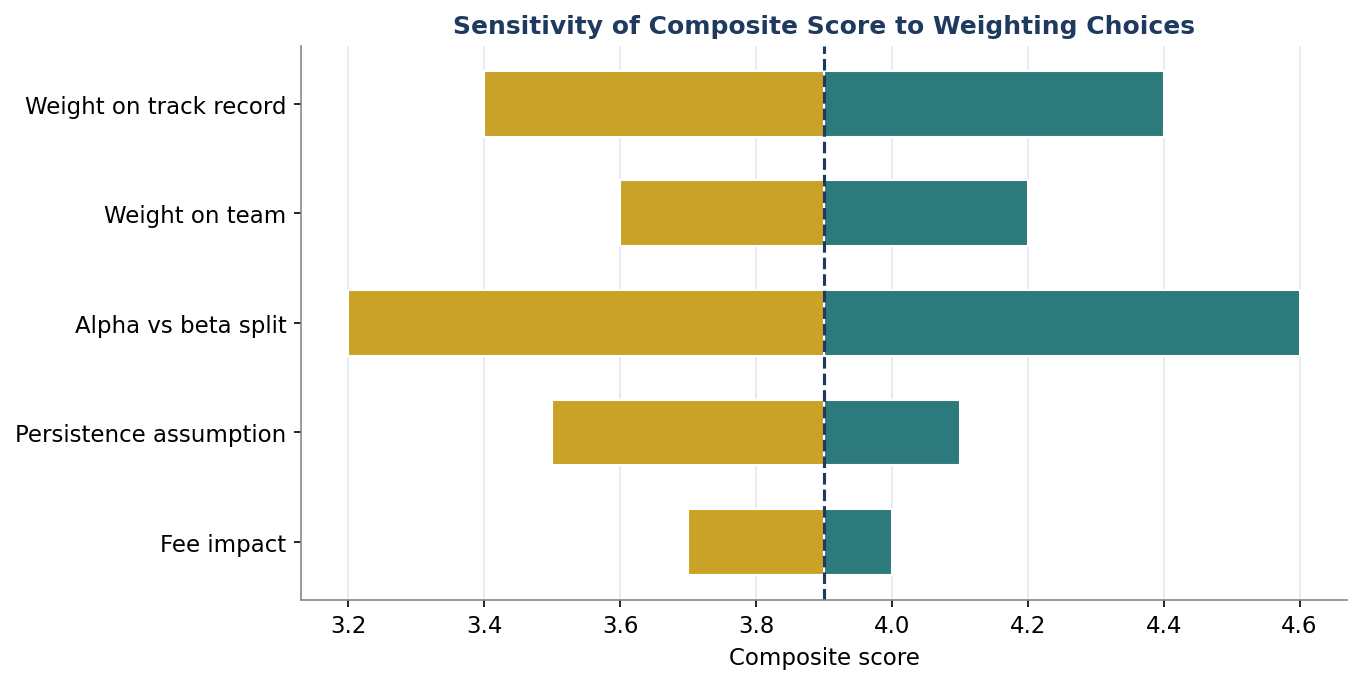
Score each manager explicitly on every dimension, review the written red-flag list, and test the ranking’s sensitivity to weights.
Document the decision and its rationale, so that monitoring and future re-ups can be judged against the original thesis.
Re-score managers at each annual review and re-up with the same rigour as at first commitment.
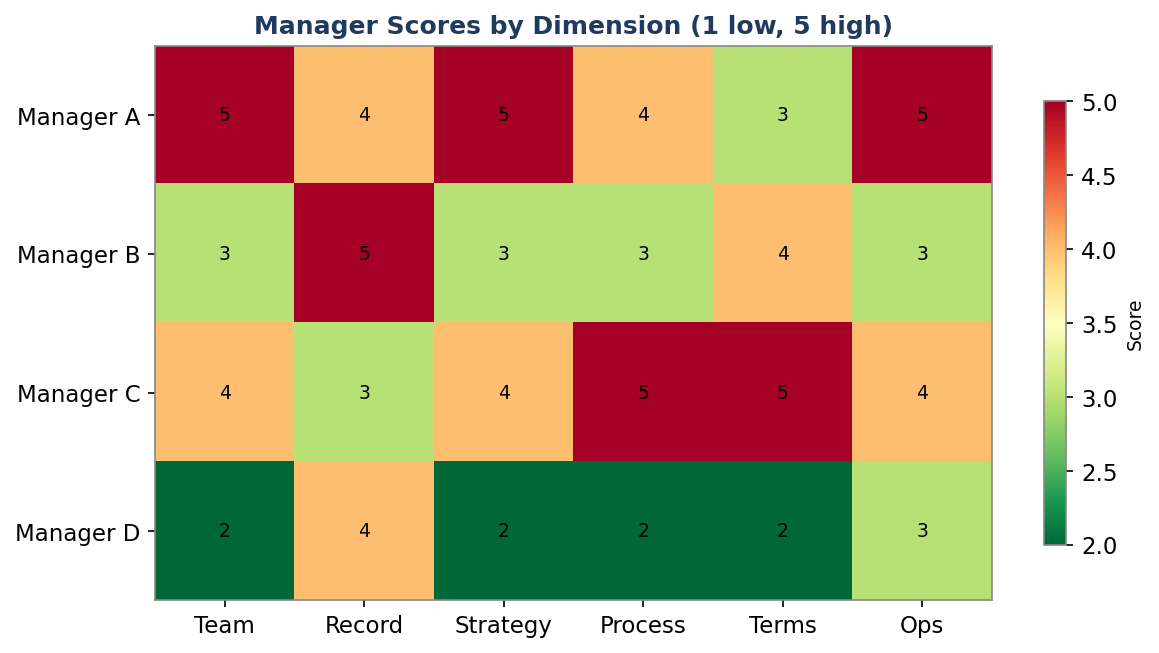
| Manager | Top strengths | Key weaknesses | Composite | Decision |
|---|---|---|---|---|
| A | Team, strategy, operations | Slightly weaker terms | 4.4 | Commit |
| C | Process, terms, strategy | Average team depth | 4.1 | Commit / shortlist |
| B | Track record, terms | Team, process, strategy | 3.5 | Decline or monitor |
| D | Track record | Team, strategy, process | 2.4 | Decline |
Co-Investment and the Selection Question
Co-investment, where an allocator invests directly alongside a manager in a specific deal, usually with reduced or no fees, has become a central feature of private markets and adds a dimension to the selection question. The opportunity is attractive: co-investment lowers the blended cost of a manager relationship and lets the allocator concentrate capital in deals it finds especially compelling. But it also shifts part of the selection burden from the manager to the allocator, because the allocator is now choosing individual deals, not merely a manager, and must have the capability to evaluate them.
The scorecard framework helps here in two ways. First, a manager that offers co-investment generously and fairly, allocating attractive deals to its investors rather than hoarding them, scores well on alignment and signals a partnership posture. A manager that offers co-investment only in its weakest deals, using investors as a dumping ground for risk it does not want, reveals the opposite, and the pattern of what a manager offers for co-investment is itself a diligence signal. Second, the allocator must honestly assess its own capacity to evaluate co-investments quickly, since these opportunities often come with short deadlines, and an allocator without that capacity should be cautious about a programme that assumes it.
The deeper point is that co-investment changes the risk profile of a manager relationship. A diversified fund commitment spreads risk across many deals chosen by the manager; a concentrated co-investment programme adds single-deal risk chosen partly by the allocator. An allocator should size its co-investment activity against its genuine deal-evaluation capability and its tolerance for concentration, and should treat the decision to build a co-investment programme as a strategic choice about how much of the selection burden it wishes to carry itself rather than delegate to its managers.
Conclusion
In private markets the manager is the investment, and the choice of manager dominates outcomes to a degree unmatched elsewhere. Yet the typical selection rests on the least reliable evidence: a headline track record, a referral and a polished presentation. This paper has set out a structured alternative, a weighted scorecard across six dimensions, supported by a decomposition of the track record, a test for persistence, an explicit red-flag list and a disciplined process that guards against the biases manager selection invites. The worked evaluation showed the scorecard reordering managers away from a naive track-record ranking and toward the managers most likely to perform in future.
The framework will not make selection easy, because judgement remains central and the future remains uncertain. But it will make selection better: more consistent, more defensible, more resistant to bias, and more likely to direct capital to genuine and persistent skill. For the family office and institutional allocator, that improvement is among the highest-return uses of effort available, because in private markets, more than anywhere else, choosing well is the whole of the game. The discipline to choose well, applied consistently over time, is what separates the allocators who capture the promise of private markets from those who merely pay its fees.
Limitations
This paper presents a framework and uses modelled figures to illustrate its application rather than to describe any specific manager or fund. The weights and scores are indicative and should be adapted to the strategy, the allocator’s objectives and current evidence. No framework can guarantee that a selected manager will perform, since outcomes depend on future conditions that cannot be known. Nothing here constitutes investment advice. Allocators should conduct their own diligence and obtain advice appropriate to their circumstances before committing capital.