

1 A mandate begins with an information gap
The owner signs an advisory mandate before the adviser has demonstrated how it performs on that owner's asset. A pitch may contain a polished buyer map, a list of completed transactions and a senior partner who conducts the meeting. The engagement letter may then assign day-to-day work to unnamed staff, leave buyer contact to the adviser's discretion and measure success solely by a closing fee. This gap between proposed capability and contracted work is a procurement problem. It becomes a transaction problem when the seller has to determine whether a slow auction reflects the market, the business or a missing advisory workstream.
The appointment decision is made under uncertainty. A seller rarely observes another owner's confidential fee schedule, incomplete auction or abandoned mandate. Completed-deal announcements omit unsuccessful processes and frequently omit the adviser's precise contribution. References offered by an adviser can be informative, but they are selected and permissioned by the adviser. This paper therefore asks which items can be checked before appointment and which events should trigger review during execution. A warning sign is a reason to investigate a causal mechanism. It is not proof that an adviser lacks competence or that a sale will fail.
The emphasis is on three linked mechanisms: conflicts that may alter advice or buyer selection; coverage claims that may fail to produce credible decision-maker access; and process architecture that can allow time, information and bargaining leverage to erode without an explicit decision. A fourth mechanism connects all three: contract economics. Fees, exclusivity and termination terms influence how adviser and owner behave when a process changes. A sound contract can leave flexibility for professional judgment while still stating who produces what, when the owner reviews it and what evidence supports a recommendation.
Regulatory rules depend on the entity, jurisdiction and activity involved. The Dubai Financial Services Authority's thematic review addresses authorised firms in the DIFC; it is not a universal licensing rule for every UAE M&A adviser [1]. Delaware court cases are public examples of adviser conflicts in US corporate transactions; they do not determine duties in a private GCC transaction [2, 3]. The framework uses these sources to define questions. Qualified local counsel and the relevant regulator's public register are needed for transaction-specific conclusions.
2 Define a warning sign by the decision it could change
A useful warning sign has four parts: a fact that the seller can observe, a plausible mechanism by which it could affect a decision, a verification request and a proportionate response. “The adviser is conflicted” is an allegation. “The adviser has proposed arranging financing for a bidder and has not identified the conflict approval and information controls” is a checkable condition. The response could be disclosure, recusal, independent review, a changed financing role or a different adviser. The right choice depends on the actual arrangement and applicable duties.
The distinction matters because ordinary frictions can look like failure. A buyer list may be short because only a few parties can acquire a regulated asset. A senior banker may have limited meeting hours because analysts appropriately run the data room. A long timetable may reflect audited accounts, lender consent or owner indecision. Each item warrants a request for the underlying workplan. A seller should record the adviser's explanation, evidence and proposed remedy before drawing a conclusion. The same evidence should also show where the owner's own preparation is the binding constraint.
The owner can classify issues by stage. Before signing, ask whether the adviser understands the transaction perimeter, conflicts and likely buyers. During preparation, test whether financial and legal dependencies are being resolved. Before outreach, check permissions and the buyer thesis. During bids, require comparable economic terms and conditionality. After exclusivity, track financing, regulatory approval and any material change in adviser incentives. The point of a stage classification is to ask questions while a decision can still be changed.
No stage should be converted into a mechanical risk score. A model that assigns a failure probability to an undisclosed conflict or an empty buyer-map field would need validation on a representative cohort. No such probability is supplied here. The following matrix is an internal decision aid: it identifies evidence and possible responses, while retaining room for judgment and legal review.
Table 1. Adviser comparison and warning-sign enquiry matrix
| Decision field | Observable signal | Evidence to request | Possible decision at appointment |
|---|---|---|---|
| Conflicts | Parallel bidder, financing or referral role is unclear | Current relationship map, compensation and control description | Require disclosure, independent review or revised role |
| Buyer coverage | Logo list has no decision-maker route | Priority buyer thesis, current contact path and permission | Test route before exclusivity or revise outreach scope |
| Assigned team | Pitch leader's execution time is undefined | Named roles, availability, milestone attendance and substitute rule | Contract senior involvement at critical gates |
| Process design | Timeline has no approval or stop points | Deliverables, owner decisions, dependencies and escalation | Add gates and accountable owners |
| Fee economics | Tail, expense and success triggers are ambiguous | Worked fee examples under several outcomes | Resolve fee arithmetic before signature |
| Information control | Data transfer or bidder access lacks protocol | NDA, data-room roles and disclosure permissions | Restrict access until controls are approved |
| Scope and permissions | Activity or contracting entity is unclear | Legal-entity name, relevant register and scoped work | Seek jurisdiction-specific legal or regulatory review |
Author-developed procurement framework. A listed signal prompts evidence gathering; it is not an empirical failure predictor or a finding about any adviser.
3 Make the owner brief comparable across advisers
The seller should issue a common brief to finalists. It should identify the business and sale perimeter, ownership and approval structure, financial reporting status, relevant jurisdictions, desired consideration and constraints on disclosure. It should also state the owner's non-price objectives: retention of key staff, future role, minority liquidity, confidentiality, speed or financing certainty. Each adviser can then propose a different route against the same facts. This enables the owner to distinguish insight from a change in assumptions.
A brief should record open diligence items. If revenue recognition, customer concentration, land title, permits or carve-out accounts remain unresolved, the adviser can say how it would address them before calling buyers. The seller should ask which uncertainties are within advisory scope and which require accountants, lawyers or technical specialists. An adviser can identify a problem yet lack the authority or capacity to solve it. The appointment decision should price the full work architecture, including third-party cost and internal management time.
The brief should also identify who can approve a buyer approach and who can stop it. A family council, board, investment committee or founder may retain final authority. An adviser cannot cure an undisclosed veto right through marketing. The owner can ask finalists to submit a decision-rights map alongside the buyer map. Any proposal to contact a party with a commercial, employment or ownership relationship to the seller should state the needed approvals and safeguards.
The output is a comparison file with dated proposals and written clarifications. It should hold the named team, workplan, buyer thesis, conflicts declaration, legal-entity details, fee schedule and exceptions to the owner's brief. The file makes appointment more defensible later. It also gives the adviser a fair opportunity to explain apparent gaps. A missing page in a proposal may be an oversight; a refusal to identify the accountable team or compensation channels requires a substantive decision.
4 Conflicts require an activity map, not a generic waiver
An adviser can have economic interests that touch different sides of a sale. It may have advised a bidder, provide financing to one, seek a lending or placement fee, hold a relationship with management, receive referral compensation, or pursue future work from a party it recommends. The existence of a relationship does not by itself show that advice is biased. The seller needs the relationship's scope, timing, remuneration and information access to assess whether safeguards are adequate.
The DFSA reported in January 2026 that its review assessed 710 DIFC authorised firms across varied sectors and expected robust, documented and proportionate conflict controls [1]. That fact supports asking a DIFC-regulated candidate how conflicts are identified and recorded. It does not establish the frequency of problematic M&A mandates in the UAE. A firm's public register entry should be checked for the specific entity and permitted activity where relevant; a similar trading name or group affiliation is insufficient [4]. ADGM maintains a separate public register for entities and financial services permissions [5]. Outside those perimeters, the relevant local framework should be identified by counsel.
The Delaware Supreme Court's decision in RBC Capital Markets v Jervis concerns a public-company sale and a particular adviser conflict and disclosure record [2]. The Delaware Chancery Court's Del Monte opinion addresses buy-side financing and sale-process conduct in another specific transaction [3]. They demonstrate that undisclosed incentives and process control can matter when decision-makers rely on an adviser. Their holdings belong to Delaware law and their facts should not be converted into a general rule that every financing role is disqualifying.
An appointment file can contain a conflict schedule: all material current or contemplated roles, the party involved, compensation, access to information, review owner and update trigger. The schedule should be refreshed when a new bidder enters or a financing proposal appears. The seller may seek independent advice for a conflicted decision. The adviser can propose controls, and the board can record why those controls are adequate or why the role should change. A generic statement that conflicts “may arise” gives less decision value than an account of those that actually exist.
5 Buyer coverage is a route to a decision, not a logo count
Coverage is frequently sold through names. A list of global corporates, funds and family offices can suggest breadth without indicating which parties can acquire this asset, who decides, or whether the proposed adviser has permission to approach them. A buyer thesis should state why each priority archetype could own, finance or integrate the business; the likely acquisition structure; constraints such as regulation or competition; and the current route to a decision-maker. The owner can first assess anonymised archetypes, then approve names after conflicts and confidentiality are considered.
The adviser should distinguish a current relationship from a historical contact, a direct decision-maker from a junior introduction, and an existing strategic interest from a speculative fit. Those distinctions can be evidenced without violating a third party's confidentiality. A permissioned reference, an anonymised work example and a senior banker willing to describe the route can each support a proposition. A claimed relationship that cannot be discussed at all remains an uncertainty in the owner's decision file. It should not be silently counted as available distribution.
Buyer coverage also depends on the asset's constraints. A data-centre business may require a buyer with power, land and technical capability; an engineering company may need bonding capacity; a regulated financial business may require ownership approval. The largest brand list may be irrelevant if few parties satisfy those tests. Conversely, a narrow list can signal an incomplete search where plausible international strategic or financial buyers exist. The adviser should explain exclusions as carefully as inclusions.
Before appointment, the owner can ask each finalist for a small “canary” exercise: take two hypothetical buyer archetypes, explain the investment rationale, likely objections, contact route, conflicts and disclosure sequence. The exercise tests reasoning and process without revealing confidential buyer communications or initiating outreach. It also exposes whether a senior pitch team can delegate effectively to its proposed execution colleagues. The result is one piece of evidence, not a performance forecast.
6 The named team must own work across the whole process
A senior pitch leader can add real value through negotiation, judgment and a buyer relationship. The seller still needs to know who produces the information memorandum, builds the valuation bridge, manages questions, compares indications, checks financing and coordinates closing. The staffing proposal should name an accountable person for each workstream and describe when the pitch leader will be present. A photograph on a presentation is not a work commitment.
Availability is a practical variable. An adviser may have simultaneous engagements, travel and internal approvals. A client need not demand a dedicated full-time senior banker. It can require a cadence, a time-sensitive escalation route, presence at defined gates and a replacement process if the core team changes. A current workload description can be discussed at a level that respects other clients' confidentiality. The seller should also meet the day-to-day lead before granting exclusivity.
The team structure should match the transaction. A cross-border carve-out can require tax, separation, regulatory and financing coordination. A simple founder sale may need intense owner communication and a smaller team. Where specialists are external, the adviser should name the interface and clarify whether it is introducing, supervising or relying on them. The workplan should identify responsibilities that stay with the seller. A blank cell on an accountability map is a warning sign because tasks often fail at interfaces.
References should be role-specific. A transaction tombstone shows that a firm participated, while an owner needs to know what the proposed people actually did. A permissioned client reference can address responsiveness, senior engagement and late-stage issue handling. An anonymised sample can show how bids were compared. A candidate unable to share confidential examples can describe its process and a reviewer can test the logic. These checks should remain proportionate to the mandate's size and sensitivity.
7 A timeline should specify gates, evidence and owner decisions
A timetable is useful when it separates tasks controlled by the adviser from dependencies controlled by the seller, buyers and third parties. A calendar that promises a closing month without assessing accounts, permissions, buyer financing and owner authority has limited value. The owner can request an event-based sequence instead: scope approved; information reconciled; buyer list authorised; outreach launched; written indications compared; exclusivity approved; definitive documents negotiated; conditions completed. Each transition has an evidence package and a decision-maker.
Figure 1 shows such a sequence. It includes a diagnostic loop at preparation and bids because a sale may need to return to the owner for a changed perimeter or pricing decision. The diagram has no fixed durations. Transaction-specific time estimates should be supported by a dependency register, not copied from another deal. The adviser should explain what would cause a pause or a revised approach, and who has authority to approve it.
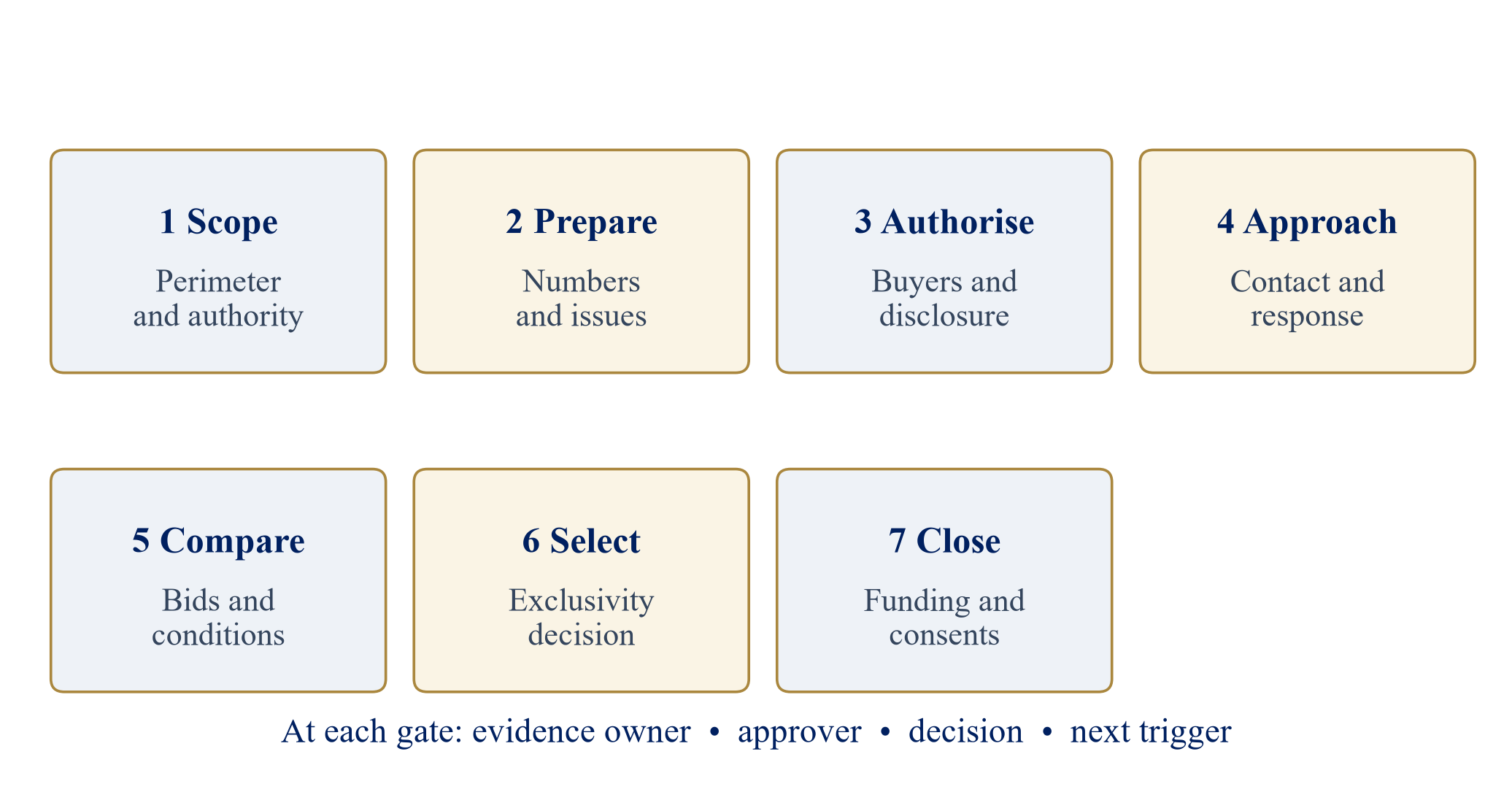
Author-developed process map. Boxes indicate required evidence and decisions, not estimated duration or observed sale outcomes.
At the preparation gate, the package might include a reconciled financial bridge, sale perimeter, management Q&A and a disclosure plan. At the outreach gate, it should include the approved buyer list, conflict recheck and tiered information protocol. At the indication gate, it should distinguish price from evidence of funding, conditions, consideration form and strategic commitments. The owner decides whether to narrow, reopen, pause or stop. An adviser can recommend; the mandate should specify who has the legal and commercial authority to act.
A standing issues log can record an item, its cause, owner, required evidence, due date and escalation path. If an item remains open, the log should show whether the delay arose from management data, a buyer request, legal review or adviser delivery. That separation supports a fair performance discussion. It also provides a factual record for a future study of mandate extensions.
8 Early diligence is a coverage test of the asset itself
The best buyer route cannot compensate for inconsistent information. An adviser should inspect the quality of accounts, customer contracts, permits, debt and working-capital data before promising an auction. An owner should ask which items can be repaired during preparation, which require a deal-structure response and which could make a sale premature. A proposal that promises wide outreach before identifying obvious information gaps may be under-scoped.
This enquiry needs balance. The adviser may reasonably decline to perform audit, legal or engineering work outside its engagement. It should still identify the dependency and proposed responsible professional. A data-room checklist without prioritisation can overwhelm a small seller; a useful readiness map ranks items by their effect on price, execution certainty and timing. It should identify where the seller can give a clear explanation and where an independent report is required.
The owner can request a pre-mandate issue memo limited to public or permissioned information. This tests whether the candidate can reason about the business without using sensitive material prematurely. It might identify a contract assignment risk, a material customer renewal, an earn-out accounting question or a regulatory approval. The adviser should explain how the issue changes buyer segmentation and process design. A generic list of diligence topics reveals little about its judgment.
The issues memo should also state assumptions. If the adviser models a growth rate provided by management, it should identify that assumption. If a comparable transaction is drawn from a different jurisdiction or business model, it should explain the adjustment. A seller can then see which claims are evidence and which are scenarios. This is a more useful early warning than a confident valuation range unsupported by a data bridge.
9 Fees can reward a different outcome from the owner's preferred one
Advisory contracts allocate economic risk. A retainer may pay for preparation and capacity. A success fee may align the adviser with closing. A minimum fee, transaction-value definition, financing fee, expense policy, tail, exclusivity and termination provision can change that alignment. The seller should request worked examples for several outcomes: a clean cash sale, deferred consideration, minority investment, asset sale, recapitalisation, abandoned process and a later deal with a contacted party.
A high success percentage may be affordable if the adviser creates an executable bidder set and manages complex work. A low headline percentage can be expensive if the base includes liabilities, rollovers or contingent value the owner never receives. The contract should define when and how a fee is earned and whether retainers are credited. Tail language should identify covered parties and time periods precisely enough to avoid charging for an unrelated future transaction. The owner should also review whether a change in transaction perimeter changes the fee.
The fee debate should be tied to deliverables. A modest retainer can fund a real preparation phase with defined outputs. An uncapped retainer with vague work may transfer delay risk to the owner. A success-only contract can motivate a close, while creating a reason to test whether the adviser adequately explores alternatives or buyer conditionality. These are possible incentive mechanisms, not claims about a particular firm. The owner can choose an arrangement suited to the transaction after the arithmetic and rights are visible.
Table 2. Fee and deliverables checklist for an M&A mandate
| Contract item | Worked question | Associated work evidence |
|---|---|---|
| Retainer and credit | When is each amount paid and offset? | Preparation deliverables and review dates |
| Success trigger | Which event creates an earned fee? | Executed transaction and consideration record |
| Fee base | Are debt, rollover, earn-out and deferred amounts included? | Calculation examples for each structure |
| Minimum and tiers | How does fee change across value scenarios? | Agreed schedule and calculation owner |
| Expenses | Which third-party costs need advance approval? | Budget and receipts |
| Financing or referral fees | Who pays, and when is it disclosed? | Conflict schedule and separate approval |
| Exclusivity | Which services and parties are covered? | Exceptions and owner approval rights |
| Termination and tail | Which named parties and period survive? | Contact log and written termination process |
Author-developed contract review checklist. Legal effect varies with the agreement and jurisdiction.
The seller's commercial lawyer should review the draft alongside the transaction team. A comparison spreadsheet can show the cash cost under the same scenarios for each finalist. It should also note contractual uncertainties that cannot be reduced to one number. The selected arrangement becomes part of the process-control system: it states what the adviser is paid to do and how a changed course is handled.
10 Separate slow progress from process failure
A mandate can extend for legitimate reasons. The owner may need audited accounts, a shareholder settlement or regulatory approval. A buyer may need lender consent or investment-committee approval. A strategic buyer may pause because of its own results. An adviser may take longer to obtain contact or may have delivered less preparation than promised. The fact of delay does not identify the cause. An event log should record the anticipated dependency, actual event and responsible party at the time, before memories are shaped by a disappointing outcome.
The owner should set thresholds for review rather than automatic blame. A missed deliverable, repeated rescheduling by the assigned senior team, unexplained changes in the approved buyer list or a buyer response left unanswered can trigger a documented meeting. The adviser should be able to explain the cause and corrective plan. The owner should also acknowledge its own late approvals and new conditions. A board can then decide whether to continue, alter scope, bring in a specialist, pause outreach or terminate under the agreement.
The review should assess leading indicators with care. Number of contacted buyers is a workload measure, not a success outcome. Number of signed NDAs can be distorted by broad outreach. Indications of interest can be non-binding and thinly financed. A useful dashboard combines activity with quality: coverage of the approved priority set, decision-maker engagement, reasoned rejections, written bids, funding evidence, conditions and unresolved diligence. The denominator for each measure should be clear.
When the process changes, the adviser can submit a revised plan. It should state the new hypothesis, affected buyers, information needs, owner decisions, cost and milestones. An extension becomes an explicit investment in another route rather than a passive continuation of the original mandate. A later study could compare those recorded choices with outcomes; this paper cannot assign a probability to either continuation or exit.
11 Test the causes of a thin buyer response
Few responses can arise from several mechanisms. The business may be unattractive at the proposed valuation, the buyer universe may have been misidentified, the timing may coincide with financing stress, or the information memorandum may not explain a difficult risk. Some buyers may have been approached through the wrong people. A thin response should therefore trigger a diagnosis before the owner concludes that the adviser lacks reach or that the asset cannot sell.
The adviser can produce a response ledger by buyer archetype. It should record approved contact, decision-maker route, date, information level, response, stated reason and next action. Confidentiality and data-protection rules should determine how much personal detail enters the owner's file. The owner can review the pattern: several buyers declining because of the same customer-concentration risk suggest a product issue; silence at one intermediary layer may suggest contact execution; consistent price objections suggest a valuation expectation gap. None of these patterns alone proves causation, but each supports a targeted next question.
The diagnosis should include buyers excluded before contact. They may be unsuitable because of regulation, competition, information sensitivity or ownership structure. The adviser should document those constraints. A buyer omitted without analysis may expose a coverage gap; a buyer intentionally excluded to protect commercially sensitive data may reflect prudent design. A second adviser or sector specialist can independently challenge the map if the owner has reason to doubt it, subject to confidentiality and contract terms.
The owner can then choose a bounded experiment: revise the investment narrative for one buyer segment, add a targeted financing route, clarify a diligence issue or expand into a previously excluded geography. The experiment needs an expected observable signal and a review date. Repeating the same outreach without a new hypothesis consumes attention and can damage credibility. The decision file should retain the rationale and result, including a choice to stop.
12 Compare bids by deliverable value and completion path
An offer's headline enterprise value is only one element of seller value. Cash at closing, debt treatment, working-capital adjustment, rollover, earn-out, escrow, indemnity, tax treatment and timing can change the proceeds available to owners. Financing commitments, internal approvals and regulatory dependencies affect whether the price is executable. An adviser should prepare a bid bridge that applies the same definitions to every credible offer and identifies assumptions that require legal or accounting review.
The bridge should separate signed commitments from proposed financing and seller expectations. It should show who verified each component and when. A buyer promising a high price subject to broad diligence can be difficult to compare with one offering a lower price and committed funding. A board can consider strategic and employment terms separately from cash economics, then document its chosen trade-off. The adviser can facilitate the comparison without claiming to eliminate uncertainty.
Conditionality is a process warning sign when it becomes less visible as the auction advances. A buyer may add new approvals after exclusivity or request an extended diligence period. The adviser should update the owner promptly and quantify the effect on timing and alternatives. If an adviser has a financing relationship with that buyer, the conflict schedule should be reviewed again. The owner may need independent financing or legal advice. Information about a changed buyer position belongs in the decision record while another path is still available.
The quality of a bid comparison can be tested before mandate signature. A finalist can be asked to show a redacted example or to explain a fictional bid with mixed cash, rollover and contingent consideration. The exercise tests whether the adviser can connect valuation, structure and execution. It does not establish that the team will deliver a higher price in the real sale.
13 Treat confidential information as a transaction asset
Outreach creates an information risk. A strategic buyer could also be a competitor, customer or employer of key people. Financial data, customer contracts, technology architecture and staff information may have different sensitivity. The seller should approve tiered disclosure: an initial anonymised teaser, a non-disclosure agreement where appropriate, a controlled information memorandum, a data room and later access to competitively sensitive materials. Counsel should define the enforceable provisions and applicable law.
The adviser should identify who administers the data room, approves users, records access and answers questions. It should specify how buyer questions are screened, who can upload corrected information and how superseded files are marked. A broad permission in an engagement letter to “market the company” does not resolve these operational controls. The owner's information officer, legal adviser and transaction lead can agree a documented release process.
Coverage and confidentiality interact. A candidate adviser may know a buyer well, yet that buyer's relationship with the seller makes early disclosure risky. A proposal to contact the buyer immediately should explain the intended content, route and approval. The owner may permit a high-level conversation, require a clean team or delay contact. A disciplined route can preserve optionality while still testing interest. A poorly documented introduction can make it difficult to know what the buyer learned and when.
If a mandate is terminated, the parties should preserve a contact log, data-room access history, outstanding confidentiality undertakings and tail list in line with the contract. That record protects the seller's future process and allows any fee claim to be evaluated against agreed terms. It also helps a successor adviser understand what information has entered the market. The purpose is a reliable transaction record, not a presumption of misconduct.
14 Apply one framework to three fictional situations
Consider a founder-led software company with audited accounts and three plausible strategic buyers. One adviser presents a long global buyer list, but the proposed lead cannot describe a current path to the three priority decision-makers. Another names those people and proposes a narrow first wave. The observable issue is buyer-route evidence, not institutional scale. The owner could ask both candidates for a permitted route, a conflict check and a staged contact plan. A broad list could still be valuable if credible additional buyers exist. No price or outcome follows from the scenario.
Consider a family-owned engineering group whose project claims and performance guarantees require specialist diligence. The preferred adviser's senior banker has closed several sector deals, but the team proposal has no owner for contract claims or bonding analysis. The gap may be addressed by a named third-party specialist and a joint preparation gate. The owner should specify who pays for that work and who integrates it into the buyer narrative. A different adviser may offer integrated capacity. The comparison is the complete work architecture and accountability, not the biography on the pitch page.
Consider an infrastructure asset where an adviser offers to arrange funding for bidders as well as run the sale. Financing access may widen the executable buyer universe, while a fee from one bidder may affect perceived neutrality. The owner could require a written relationship and compensation map, independent review of bid comparisons, controlled information flows and approval before any financing assignment. Counsel and the relevant regulatory framework determine the adequacy of the arrangement. The scenario is fictional and reports no observed adviser conduct.
Table 3. Fictional situations and proportionate pre-appointment tests
| Situation | Ambiguous signal | Verification test | Possible contractual response |
|---|---|---|---|
| Software sale | Broad list, unclear priority-buyer route | Named archetypes, permitted contact path, conflicts | Staged outreach and buyer-map gate |
| Engineering group | Sector history, unowned claims analysis | Accountable work owner and external-specialist scope | Preparation deliverable and budget approval |
| Infrastructure sale | Adviser seeks bidder-financing role | Relationship, remuneration and information map | Separate approval and independent bid review |
All three situations are invented to illustrate enquiry paths. They are not Matchpoint mandates, observed failures or estimated outcomes.
These situations show why a warning-sign register should include alternative explanations. A weak proposal can sometimes be repaired; an excellent proposal can fail if the owner's records or decision rights are unresolved. The framework asks what evidence a board needs to choose and monitor a service. It does not rank the fictional advisers or imply a universal remedy.
15 Design a proportionate pre-appointment diligence room
An owner can ask finalists for too much detail, risking delay and confidential disclosure before any appointment. The diligence package should be proportionate. A short common brief, written proposal, named team, conflicts schedule, sample workplan, buyer archetypes, fee examples and permitted references can be sufficient for a straightforward sale. A regulated, cross-border or technically complex asset may require a deeper licence, financing and specialist review.
The owner should decide what information can be given to candidates. Financial summaries can be anonymised or aggregated at the first stage. Sensitive contracts and customer names can wait for a controlled arrangement. The same access level should be offered to finalists where feasible, so that differences in their proposals reflect their work rather than unequal information. Exceptions can be recorded, especially when a candidate's prior knowledge could affect the comparison.
Adviser diligence has a time cost. A board can set a fixed period for questions and a small number of finalist interviews. Each candidate should meet the people who will execute the assignment and answer the same core questions. The interview can focus on one hard transaction problem, one buyer-route problem, one conflict scenario and a bid-comparison exercise. Supplementary questions can follow a candidate's distinctive proposal. The evaluation record should show why the selected team fits the asset's needs.
Where the adviser claims a particular regulated status, verify the exact legal entity and activity in the applicable official register as of the review date [4, 5]. A register search may require interpretation; a name match alone may be insufficient. If the contemplated service crosses jurisdictions, obtain advice about the applicable perimeter. A seller should record the search result and advice in its confidential file rather than use a research paper as a substitute for a permission check.
16 Build a live warning-sign register after appointment
The pre-appointment matrix becomes more useful when it is maintained during the mandate. Each concern can be assigned a factual description, source, date, owner, requested evidence, agreed action and review gate. The register should also record closed items and the reason for closure. This prevents a collection of untested suspicions from hardening into a narrative about adviser performance. It also lets the adviser demonstrate timely delivery and identify client-side blockers.
Figure 2 distinguishes observed event, possible mechanism and response. A statement such as “buyer interest is low” belongs in the event column only after the denominator and response record are clear. A buyer-coverage issue may be one mechanism; price, information quality and market conditions are others. The review team selects a test and records the result. A changed outcome does not automatically validate the first mechanism because several actions can occur at once.
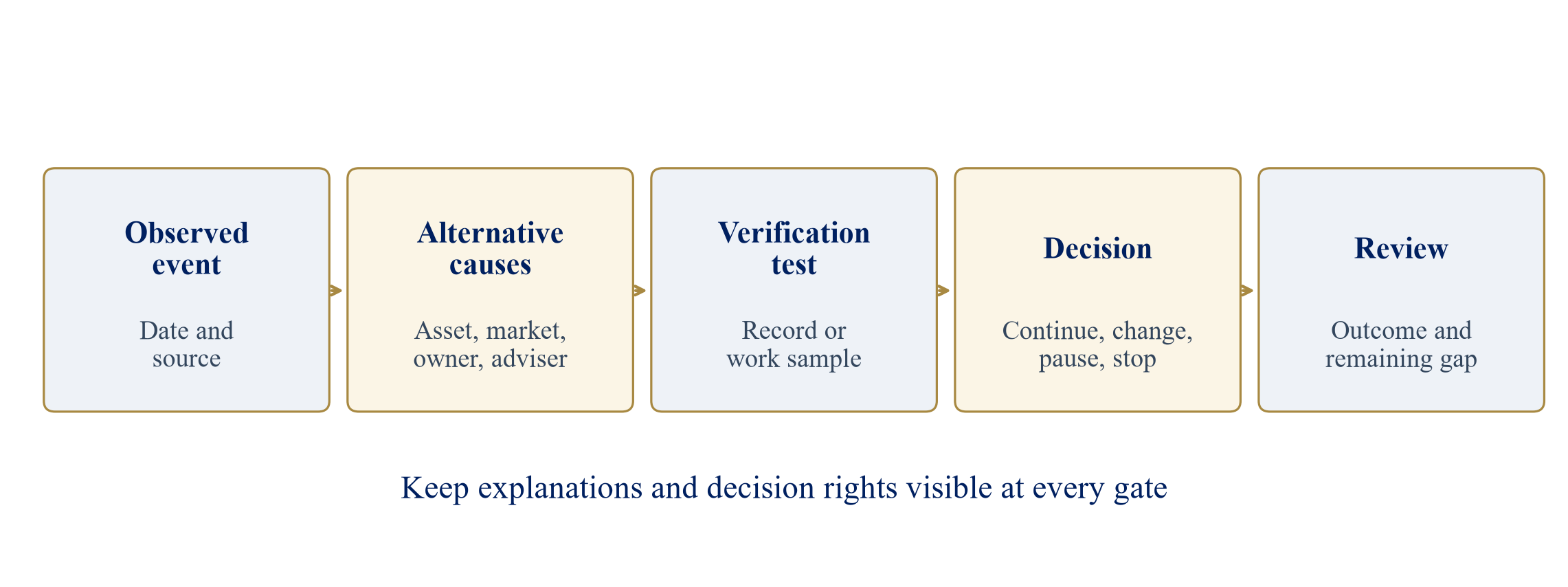
Author-developed diagnostic path. Arrows show review order; they do not estimate causal probabilities or imply that any signal establishes misconduct.
The register needs a meeting cadence that reflects the process. Weekly preparation reviews may be useful when information is being assembled; a live bid period may require rapid escalation. A board need not attend every operational call. It should receive a concise gate report with decisions required, accepted risks and changed economics. The adviser and owner should agree how disagreements are documented without interrupting ordinary judgment calls.
17 Protect the seller's ability to change course
An engagement can require exclusivity because an adviser invests in preparation and buyer relationships. The seller should know the scope, duration, termination mechanism and economic consequences of a change. A contract can also define a review point after a completed preparation stage or specified outreach. The ability to review is valuable when conditions change. It should be drafted with counsel so that fee rights, confidentiality and buyer contacts remain clear.
A decision to bring in a second adviser should specify functions. An independent valuation specialist might review bid economics; a sector expert might validate a technical claim; a financing adviser might assess buyer funding. Overlapping roles can confuse buyers and create conflicting instructions. The original adviser should know how information and decision rights will be coordinated, subject to the contract. An owner should also understand any additional cost or implied change to the mandate.
Termination can be appropriate after a material, unresolved gap in performance or a change in strategic objective, but it is not a costless reset. Prospective buyers may have received information. Fees or tails may survive. Management may have invested substantial time. The owner should record the evidence, contractual process and transition plan. A successor should receive a dated contact and information history. The board can then make an informed choice to continue with controls, renegotiate, add support or exit.
These options depend on the transaction, law and contract. The present framework proposes questions and documentation; it does not interpret any particular engagement letter. A legal review at appointment is usually easier than reconstructing rights after a dispute. The fee-and-deliverables checklist should therefore be finalised alongside the workplan, not after the team has begun contacting buyers.
18 State the empirical question the available evidence cannot answer
The research question is whether identifiable pre-appointment signals are associated with failed auctions or extended mandates after accounting for deal characteristics. This paper has no consented cohort of UAE mid-market private sell-side mandates. It contains no denominator of appointments, no comparable definition of failure, and no observed counterfactual for a different adviser. Public completed transactions and litigated cases cannot provide that denominator. They also select highly visible outcomes and jurisdictions.
A future study would need records created before the outcome is known: owner brief, competing proposals, named teams, disclosed conflicts, buyer-map evidence, engagement terms, process gates and initial transaction data. It would then follow complete, withdrawn and unsuccessful mandates. Outcomes should be defined separately: no bid, no acceptable bid, abandonment, extension, signed agreement without closing, completed sale, fee-adjusted proceeds and owner non-price goals. A mandate can be extended for seller-side reasons; the study would need event codes and narrative evidence rather than treat every extension as an adviser failure.
Sampling and selection require explicit treatment. Owners choose advisers based on asset quality, networks, fee proposals and prior relationships. Advisers choose which mandates to accept. A warning sign such as a thin buyer map might be more common in difficult assets because fewer buyers exist. Deal size, sector, geography, leverage, reporting quality, bidder concentration and macro conditions could affect both the signal and the outcome. A regression on recorded covariates might describe associations; it could still miss unobserved quality and choice. The research plan should pre-specify variables, missing-data treatment and sensitivity tests.
Confidentiality is a barrier and a design constraint. Client permission, secure storage, restricted access and aggregate publication rules are needed. A small cell could identify a private mandate. Independent review of coding and a clear separation between advisory relationships and research participation would improve credibility. Any future finding would need to report sample construction and limitations. This paper leaves the correlation question unanswered.
19 Keep legal examples, research findings and owner data separate
Regulatory publications, judicial opinions, company filings, academic studies and confidential owner files answer different questions. A DFSA thematic review establishes a supervisory concern within its DIFC scope [1]. The Delaware opinions establish holdings about the specific transactions and legal duties before those courts [2, 3]. An official public register helps verify recorded permission for a specific entity at a point in time [4, 5]. None supplies a UAE private-mandate failure rate or a universal conflict remedy.
Academic evidence about adviser choice often studies public, completed transactions and measures bidder returns or closing outcomes [6, 7]. Those studies can suggest mechanisms about incentives, specialization and deal execution. The seller needs a different outcome: the range of credible bids and the net value received after fees and conditions, including processes that never close. The empirical units should be stated whenever a study is used in an appointment discussion. A US bidder-side association should not be quoted as a forecast of UAE seller proceeds.
The owner's private file has direct transaction relevance but may contain unverified management estimates. A claim that a buyer will pay a stated multiple remains a scenario until supported by an offer. A claimed adviser relationship remains a proposal until a permitted route is tested. A financial forecast should identify its source and assumptions. Keeping these evidence classes separate helps an investment committee see what can be decided today and what remains uncertain.
The three fictional situations, figures, matrices and checklists in this paper are original conceptual work. They do not describe Matchpoint clients, adviser misconduct, realised savings or closing-rate improvements. The paper offers a disciplined procurement and monitoring method. Transaction-specific legal, tax, accounting, regulatory and investment questions should be reviewed by qualified professionals with access to the full facts.
20 Choose a mandate that can be reviewed fairly
The appointment memo should identify the seller's objectives and transaction constraints, then compare finalists on named people, buyer routes, conflicts, preparation, decision gates and full fee arithmetic. Material claims should have a source and date. Open items should be assigned to a reviewer before signature or entered as conditions in the mandate. The selected adviser should know which work products and review meetings the owner expects. The owner should also state which data and decisions it must supply on time.
During execution, the team can use an issues log, contact ledger and bid bridge to distinguish work delivered from market response. Escalation should occur while options remain. A delayed buyer, a changed financing condition or a missing specialist can call for a revised plan. The owner can decide with an evidence trail, and the adviser can explain its actions against agreed scope. This is fairer to both parties than judging a mandate solely by whether a sale eventually closes.
The framework has a deliberate limit. It cannot tell an owner that a particular signal causes failed auctions, that an adviser type has a fixed close-rate premium, or that a fee structure guarantees alignment. Those claims would require a consented comparative dataset and careful identification. A board can still make a stronger present decision by making the service, incentives and review rights explicit. The result is a mandate designed for accountable execution under uncertainty.
Figure 3 is the final appointment decision map. It places verified work evidence, contractual rights and remaining uncertainty in separate lanes. An owner can use it at shortlist, signature and each major process gate. The map does not remove commercial judgment; it makes that judgment reviewable.
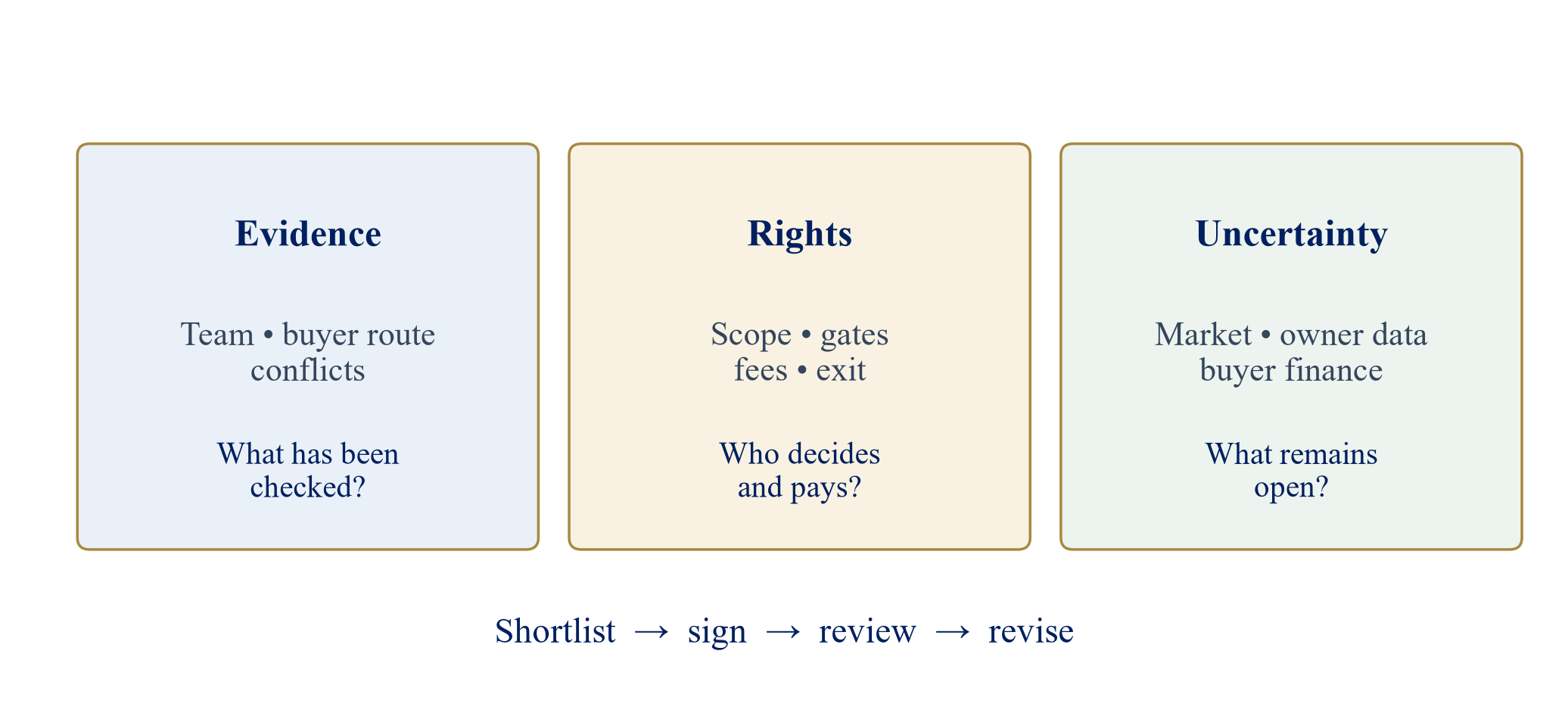
Author-developed governance diagram. It represents a documentation architecture, not a statistical model or legal opinion.
References
- Dubai Financial Services Authority. “New DFSA Thematic Review: Conflicts of Interest across DIFC Firms.” 9 January 2026. https://www.dfsa.ae/news/new-dfsa-thematic-review-conflict-interest-across-difc-firms
- Delaware Supreme Court. RBC Capital Markets, LLC v Jervis, No. 140, 2015, opinion issued 30 November 2015. https://courts.delaware.gov/opinions/download.aspx?ID=232940
- Delaware Court of Chancery. In re Del Monte Foods Company Shareholders Litigation, C.A. No. 6027-VCL, opinion issued 14 February 2011. https://courts.delaware.gov/opinions/download.aspx?ID=150840
- Dubai Financial Services Authority. Public Register of Firms. Accessed 6 October 2026. https://www.dfsa.ae/public-register/firms
- Abu Dhabi Global Market Financial Services Regulatory Authority. Public Registers. Accessed 6 October 2026. https://www.adgm.com/public-registers/fsra
- Song, W., Wei, J. D. and Zhou, L. “The Value of ‘Boutique’ Financial Advisors in Mergers and Acquisitions.” Journal of Corporate Finance 20, 2013, pp. 94–114. https://www.sciencedirect.com/science/article/pii/S0929119912001277
- Alexandridis, G. et al. “Do Boutique Investment Banks Have the Midas Touch? Evidence from M&As.” European Financial Management, 2024. https://onlinelibrary.wiley.com/doi/10.1111/eufm.12425
- U.S. Securities and Exchange Commission. “Staff Bulletin: Standards of Conduct for Broker-Dealers and Investment Advisers Conflicts of Interest.” 3 August 2022. https://www.sec.gov/about/divisions-offices/division-trading-markets/broker-dealers/staff-bulletin-standards-conduct-broker-dealers-investment-advisers-conflicts-interest
- Abu Dhabi Global Market Financial Services Regulatory Authority. “Supervisory Priorities and Expectations 2024–2025.” https://assets.adgm.com/download/assets/Supervisory%2BPriorities%2Band%2BExpectations20242025.pdf/a70de5c68adc11ef8a85861554fc69e0
About the Author
Chennakeshav (CK) is a corporate finance and investment banking executive with 25+ years of global experience in deal origination, structuring and execution across M&A, growth capital and corporate strategy. He has led value-creation mandates for founders, corporates and funds — bridging the boardroom view to hands-on execution and close.
His career spans Morgan Stanley, HSBC, Lloyds Banking Group, EWEC, ADQ portfolio companies and Emirates Growth Fund, across TMT, real estate, fintech, deeptech, cleantech, infrastructure and energy. He has partnered with C-suite leaders, private equity and venture funds, sovereign wealth funds and family offices to finance complex fund raises and scale-up ventures, and has led M&A due diligence, post-merger integration and business-transformation initiatives to create value.
At Matchpoint Partners he is Managing Partner, leading the firm's corporate finance, M&A and capital-raising practice. He holds an MBA from London Business School, an engineering degree from VTU and a Master of Laws (LLM, in progress) from UCL London.
An active start-up mentor, CK mentors at Techstars, DIFC FinTech Hive, Startup Grind, Founder Institute and IN5, serves as Entrepreneur Mentor in Residence (EMiR) at London Business School, and judges the Entrepreneurship World Cup.
