

1. Define the acquired maritime enterprise
A maritime target can be a legal group, a fleet, a contract platform or an integrated corridor business. The acquisition perimeter should identify shares, vessels, leases, charters, customer contracts, port concessions, agencies, terminals, depots, containers, trucks, warehouses, software, licences, employees, debt and contingent obligations. Each element should be mapped to the entity that owns the right or owes the obligation.
The buyer should separate registered ownership, beneficial ownership, commercial control and operational management. A vessel may be owned by a special-purpose company, bareboat-chartered to another entity, technically managed by a third party and commercially employed by the target. Consolidated accounts can hide these distinctions.
The corridor thesis should explain why the platform creates value between GCC and Indian origin, destination and transshipment points. India-UAE trade has developed under the Comprehensive Economic Partnership Agreement, with official Indian trade data showing material bilateral flows and recent growth.[1] Trade volume alone does not prove target value. The target must control customers, schedules, capacity, equipment or service capabilities that convert corridor activity into durable cash.
The perimeter should also identify businesses that depend on the target but remain outside the transaction. Related-party charterers, vessel owners, property companies, agents, IT providers or procurement entities can make reported earnings non-stand-alone. Replacement terms should be costed before price is agreed.
Table 1. Maritime acquisition perimeter and evidence
| Perimeter element | Required evidence | Value question | Transaction response |
|---|---|---|---|
| Owned vessels | registry, class, mortgage and technical files | net dependable asset and cash value | price, debt or specific protection |
| Chartered-in vessels | executed charter, hire and off-hire | economic capacity and lease burden | normalise earnings and liabilities |
| Customer charters | contracts, invoices and collections | duration and quality of revenue | retention plan or earn-out |
| Terminals and depots | concession, lease and throughput | control of route nodes | consent and change-of-control plan |
| Logistics network | customer, supplier and operating data | cross-sell and route-density value | synergy evidence and integration |
| Related parties | agreements and transfer-pricing history | stand-alone cost and dependency | replacement agreement or adjustment |
Legal form and required approvals depend on the target and jurisdictions.
2. Rebuild earnings from vessel and contract records
Reported EBITDA should be reconstructed from voyage, vessel, customer and route data. Revenue should reconcile bookings, bills of lading, charter hire, demurrage, ancillary charges, agency income, invoices and cash. Costs should reconcile bunkers, port charges, canal tolls, crew, technical management, maintenance, insurance, leasing and inland services.
The analysis should distinguish voyage-charter, time-charter, bareboat, slot, service-contract and forwarding economics. Gross revenue and principal-agent presentation can differ across models. A logistics platform may report pass-through freight in revenue while a shipowner reports net charter hire. Comparison requires a consistent economic basis.
UN Trade and Development reports continued freight volatility, rerouting and longer voyages in its 2025 maritime review.[2] A target can benefit temporarily from higher rates or constrained capacity while consuming more fuel and vessel days. Normalisation should separate market windfall, route disruption, customer growth, operational improvement and accounting changes.
Accruals should be tested against settlement. Demurrage, detention, bunker adjustments and claims can remain disputed after revenue recognition. The quality-of-earnings bridge should identify aged receivables, credits, deductions and cash collected after the reporting date.
Owner earnings should also include recurring dry-docking, special surveys, class work, ballast systems, emissions compliance and equipment replacement. EBITDA that excludes the capital required to keep a vessel legally and commercially employable can overstate distributable cash.
The reconstruction should be performed through three reconciled ledgers. The contract ledger records committed capacity, rate, escalation, service obligation and termination. The operational ledger records voyages, days, utilisation, speed, fuel, port time, off-hire and exceptions. The cash ledger records invoicing, deductions, settlement dates, claims and working-capital movements. Differences between the three ledgers should be assigned to an evidence owner and resolved before the buyer relies on the earnings bridge. This prevents a favourable contract summary from masking poor execution or slow cash conversion.
Segment contribution should be tested after the costs required to serve each customer and route. A high-volume customer may consume dedicated equipment, priority capacity, credit support and service recovery. A feeder route may appear unprofitable on a stand-alone basis while protecting the utilisation of a larger network. The diligence model should therefore show direct contribution, avoidable contribution and network contribution separately. Only avoidable cash flows support a simple carve-out decision.
The buyer should also distinguish contracted backlog from forecast pipeline. Contracted backlog requires executable capacity and enforceable customer obligations. Pipeline requires probability, commercial ownership and evidence of conversion. Both should be reconciled against available fleet days and terminal capacity. Revenue that exceeds operational capacity is not a dependable valuation input unless the investment required to deliver it is funded in the acquisition case.
A monthly bridge should then connect reported revenue to dependable owner cash. Start with invoiced revenue, remove taxes and pass-through items, adjust for principal-agent presentation, reverse unsupported accruals, isolate rate and fuel effects, normalise disruption, and deduct recurring fleet capital and working-capital absorption. The bridge should be available by vessel, route, customer and service. A consolidated result can hide a loss-making vessel that is being supported by a temporary charter or a logistics unit whose apparent margin depends on related-party capacity. The investment committee should see the distribution of cash contribution, not only the average.
Evidence quality should affect confidence explicitly. Executed contracts, class records, bank receipts and third-party invoices carry more weight than spreadsheets assembled for the sale. Where a conclusion depends on management data, the model should retain the source, extraction date, reconciliation status and unresolved difference. Sensitivities should show the valuation effect of disputed revenue, delayed collection, off-hire and required capital. This approach converts diligence exceptions into a decision range rather than burying them in a general risk narrative.
3. Score charter quality, not the headline rate
A high charter rate may be short, cancellable, conditional or exposed to off-hire. Charter quality should be assessed at contract and vessel level across counterparty, guarantee, form, governing law, tenor, renewal, termination, utilisation, rate mechanics, payment, deductions, performance and collection.
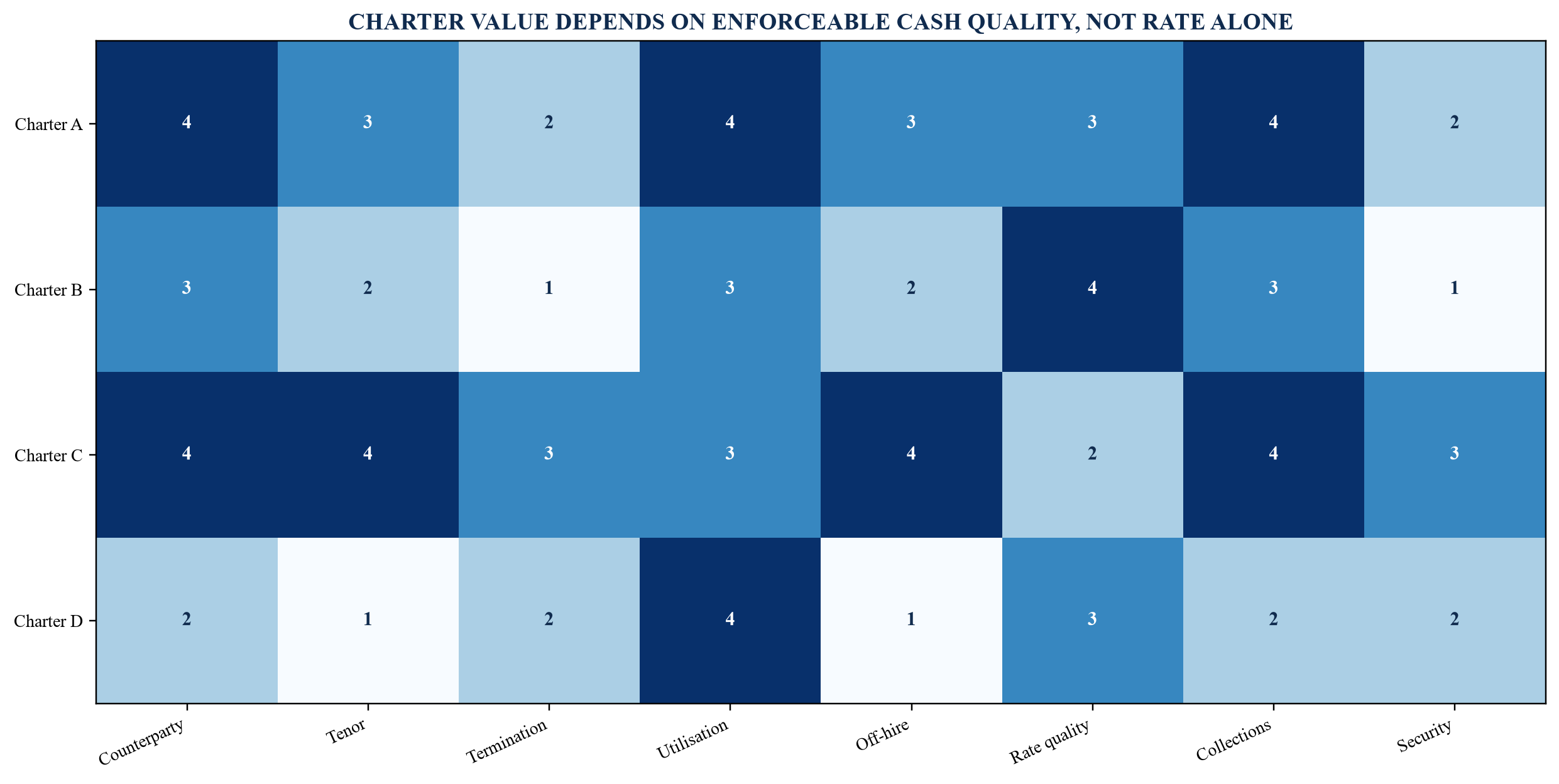
Scores are hypothetical; live scoring should use executed contracts and observed performance.
The contract review should trace amendments, waivers, side letters, notices and disputes. A standard-form charter can be materially changed by riders. Renewal history can evidence customer behaviour while remaining weaker than an enforceable future commitment.
Off-hire should be analysed by cause and contract. Technical failures, crew, detention, port restrictions and owner default may have different consequences. Repeated small off-hire events can reveal condition and management weaknesses that headline availability masks.
The buyer should identify concentration by customer, guarantor, sector, commodity, route and renewal date. Several contracts with related counterparties or common end-customers may represent one economic exposure.
4. Convert fleet age into an obligation curve
Chronological age is a starting point. Commercial age depends on design, class, maintenance, survey cycle, machinery hours, cargo suitability, fuel efficiency, emissions performance, flag, insurance and customer acceptance. Two vessels of the same build year can have different remaining cash lives.
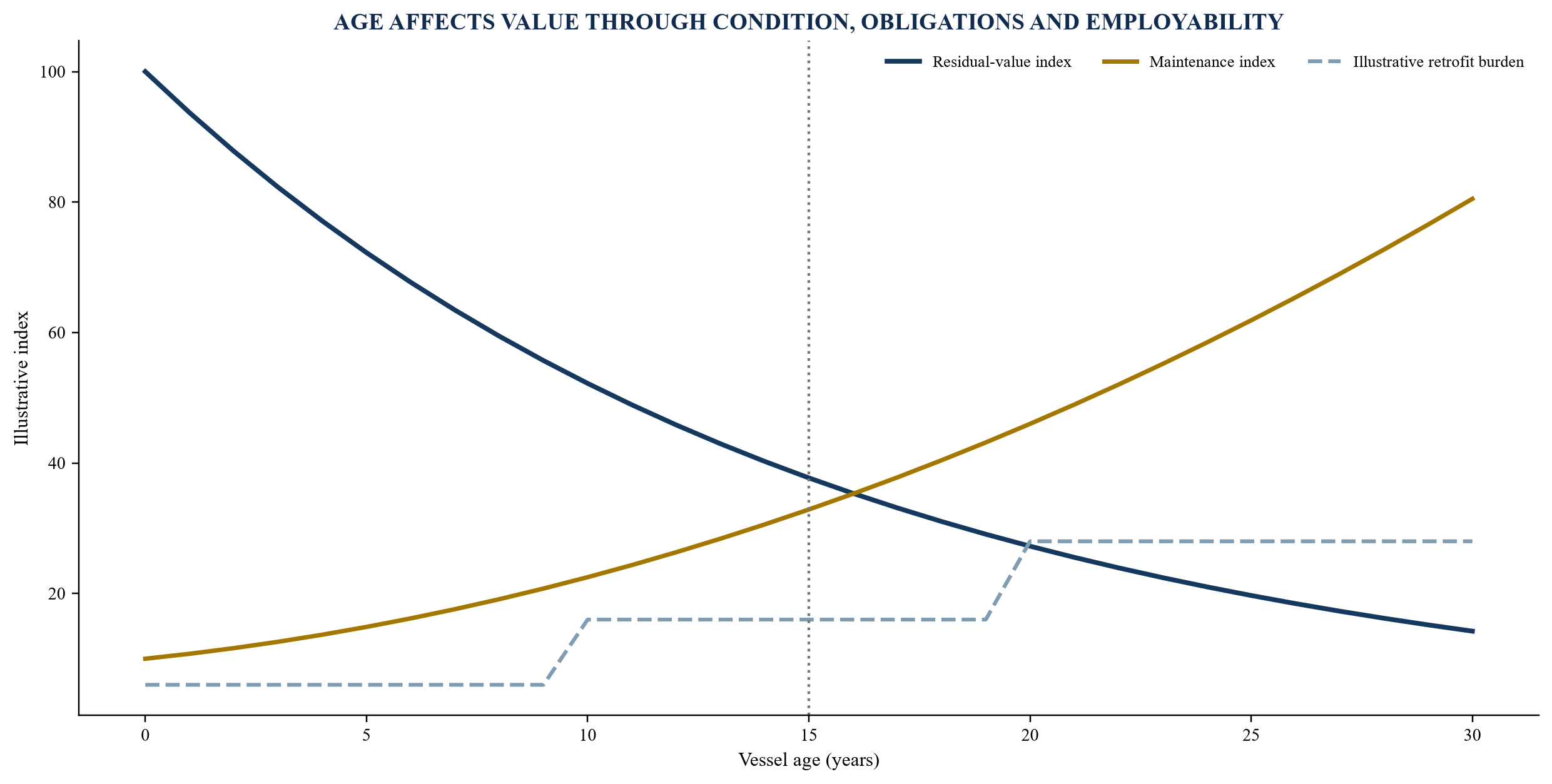
Costs and values are hypothetical indices; live analysis requires vessel-specific technical evidence.
The technical file should include class status, surveys, recommendations, dry-dock reports, thickness measurements, machinery records, failures, spares, insurance surveys and planned maintenance. Missing records create uncertainty that cannot be solved by a desktop age curve.
Upcoming obligations should be timed into the acquisition model. Dry dock, special survey, engine overhaul, cargo-system work, ballast-water compliance, energy-efficiency work and safety equipment can cluster soon after closing. Purchase-price protection may be preferable to assuming the seller completes complex work immediately before transfer.
The Hong Kong Convention entered into force in June 2025 and establishes requirements relevant to safe and environmentally sound ship recycling.[3] End-of-life value should therefore consider inventory, documentation, destination, compliance, transport and liability rather than scrap price alone.
5. Separate maintenance capex from growth capex
Maintenance capital preserves current service and cash flow. Growth capital adds vessels, equipment, capacity or routes. Sellers can classify deferred maintenance as future improvement, causing the buyer to fund an obligation embedded in the purchase price.
The buyer should construct a vessel-by-vessel capital plan covering the next survey and charter cycle. Each item should state trigger, timing, cost range, downtime, responsible party and effect on employment. Vendor quotes and class evidence are stronger than a management percentage of revenue.
Dry-dock expense and capitalisation policies should be reconciled to physical work. Accounting treatment does not determine whether cash is recurring. A normalised free-cash-flow view should include the amount needed to preserve dependable earning capacity.
Growth projects require their own business case. A new vessel or terminal should not be credited to the acquired platform merely because management planned it. Rights, permits, customer demand, funding and execution capacity should be evidenced.
Table 2. Fleet-condition and capital plan
| Workstream | Evidence | Cash-flow treatment | Deal implication |
|---|---|---|---|
| Class and statutory | status, surveys and recommendations | unavoidable maintenance | debt-like item or completion condition |
| Dry dock and overhaul | plan, quote and downtime | recurring lifecycle cash | EBITDA-to-cash normalisation |
| Efficiency retrofit | technical case and regulation | compliance or value investment | scenario and capex reserve |
| Damage and defect | report, claim and repair | specific remediation | indemnity, escrow or price adjustment |
| Fleet expansion | customer case and financing | discretionary growth | exclude from stand-alone value |
Categories should be adapted to vessel type and class requirements.
6. Test regulatory employability and transition exposure
Vessel value depends on the ability to trade the intended routes and serve the intended customers. Flag, class, safety, security, pollution, crew, port-state-control and cargo requirements should be checked for each vessel and operating entity.
The IMO's EEXI and CII framework creates technical and operational energy-efficiency requirements for relevant ships.[4] The buyer should review attained and required indicators, ratings, corrective plans, speed assumptions and charter allocation. Compliance can affect fuel, speed, capacity, customer acceptance and retrofit.
The 2023 IMO greenhouse-gas strategy sets the direction for international shipping decarbonisation.[5] The acquisition model should use scenarios for fuel standards, emissions pricing, alternative fuels, vessel efficiency and customer requirements without representing uncertain future measures as enacted terms.
Alternative-fuel readiness should be evidenced by design, tank, machinery, safety, supply and port infrastructure. A notation or marketing claim does not establish economic conversion. Retrofit may be technically possible while commercially uneconomic.
Sanctions, export controls and trade restrictions can affect cargo, charterers, banks, insurers and ports. Screening should cover beneficial ownership, goods, routes, vessels and payments. Contract rights should support refusal and termination where legally required.
7. Map route density and network control
Route density is the concentration of compatible cargo, sailings, customers, equipment and inland connections across a network. Density can improve frequency, utilisation, backhaul, equipment turns and customer convenience. It can also concentrate disruption and customer exposure.
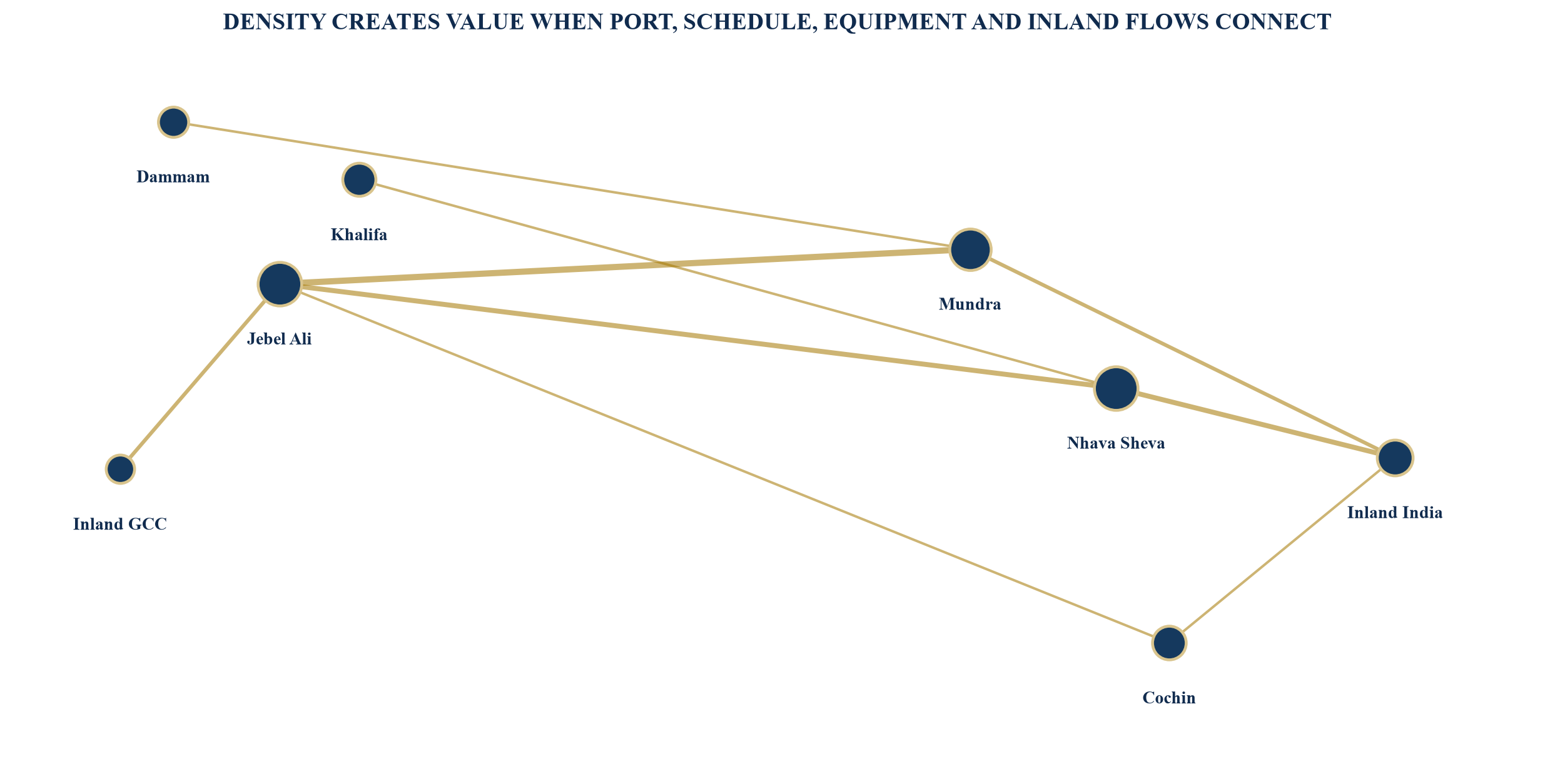
Lines and node sizes are conceptual; they do not represent actual services or volumes.
The route map should use bookings, port calls, vessel schedules, equipment movements and inland legs. Market presentations should be reconciled to actual service frequency and on-time performance. A route announced but operated irregularly should not carry the same value as a stable service.
DP World's Cochin service announcement illustrates a route linking Indian, GCC and Asian ports through a defined rotation.[6] A buyer should use comparable primary schedules and port data to identify where the target actually controls or accesses frequency.
Density value can disappear when networks use incompatible vessel sizes, systems, agency arrangements or equipment. Integration analysis should test operational fit rather than assume that overlapping maps combine automatically.
The map should distinguish owned control, contracted access and market availability. A terminal slot controlled under a durable agreement has different value from capacity purchased voyage by voyage. The same distinction applies to containers, depots, warehouses, trucking, customs capability and digital booking channels. The buyer should document expiry, renewal, exclusivity, change of control and minimum-volume requirements for each critical node.
Directional balance is central to corridor economics. A dense eastbound flow does not by itself create a balanced round trip. The model should compare loaded and empty moves, repositioning cost, detention, port storage and seasonal peaks by direction. A network can show high gross throughput while losing cash through empty equipment and imbalanced capacity. Density benefits should therefore be measured as lower total cost or higher dependable contribution per round trip, rather than aggregate volume alone.
Resilience should be treated as part of network value. Alternative ports, agency coverage, inland routes and equipment pools can reduce disruption when a node is constrained. The value should be based on tested rerouting capacity, incremental cost and customer acceptance. A map with many nodes can still be fragile where all flows depend on one transshipment window, one customs process or one operating system.
Route profitability should be modelled at the sailing level before aggregation. The record should include deployed capacity, loaded units or tonnes, revenue, bunker use, port and canal cost, vessel time, agency, equipment movement, inland contribution, claims and service performance. Shared costs should be shown separately so that the buyer can test alternative allocation rules. A route should not be described as strategic without identifying the cash or network function it protects, the alternatives available and the consequence of withdrawal.
Customer evidence should be superimposed on the operational map. The buyer should identify which customers use multiple nodes, which depend on a single route, and which can switch carrier or mode. Density has greater commercial value when it solves a recurring customer need across origin, port, sailing, destination and inland delivery. It has weaker value where volume is brokered shipment by shipment and the target owns no durable customer relationship. Renewal history, tender results, wallet share and service performance provide stronger support than management descriptions of account importance.
8. Measure customer and cargo complementarity
Customer overlap can create retention risk as well as cross-sell. A shipper may use two providers to preserve competition and resilience. After acquisition, the combined share may trigger rebidding, price pressure or competition review.
The buyer should map revenue and contribution by customer, commodity, origin, destination, service, contract and sales owner. Customer identity should be resolved across subsidiaries and agents. Common beneficial ownership or procurement can reveal hidden concentration.
Cargo complementarity matters for capacity and equipment. Export and import flows with different timing and equipment requirements can improve round-trip utilisation. Apparent backhaul volume may not fit vessel, container, temperature, hazard or service requirements.
Retention evidence includes contract change-of-control clauses, service performance, complaints, price position, tender schedule, switching cost and customer interviews conducted under an approved protocol. Seller confidence alone is insufficient.
The integration plan should assign senior ownership to the largest accounts, protect service continuity and avoid premature pricing or sales-force changes. Revenue synergy should begin after a customer, offer, capacity and accountable seller have been identified.
9. Normalise working capital and claims
Maritime cash flow can move materially with bunker, port, canal, charter hire, freight prepayments, agency balances and customer credit. The completion mechanism should use a working-capital target that reflects the acquired business model and seasonality.
Receivables should be analysed by invoice, service, dispute, customer and subsequent cash. Credits, detention, demurrage and damage claims should be distinguished from ordinary trade receivables. Payables should include accrued voyage and port costs that arrive after revenue.
Cash and debt definitions should address restricted cash, vessel accounts, customer deposits, letters of credit, derivatives, lease liabilities, shareholder balances, unpaid capex and claims. A generic enterprise-value bridge can misclassify operating balances or debt-like obligations.
Insurance receivables should be evaluated by policy, event, deductible, coverage position and recovery evidence. A claim is not equivalent to cash merely because management expects payment.
The locked-box or completion-accounts method should match information quality and timing. Leakage protection, permitted payments and value accrual require clear definitions where a locked box is used.
10. Value vessels, contracts and platform separately
The buyer should triangulate asset value, contract cash flow and platform earnings. Vessel appraisals provide market evidence while depending on specification, condition, employment and sale liquidity. Charter cash flow depends on contract quality and performance. Platform value depends on customers, network, people, systems and licences.
An enterprise multiple applied to consolidated EBITDA can double-count owned-vessel value or overlook lease burdens. The valuation model should state whether vessel capital is embedded in earnings and how replacement capex is treated.
IFRS 3 requires identifiable acquired assets and liabilities to be recognised and measured under the acquisition method for a business combination.[7] Financial reporting purchase-price allocation differs from the commercial price decision, though it can expose contract, lease and intangible items that diligence should address.
IFRS 16 affects recognition of leases and should be reconciled when charter arrangements contain a lease.[8] Accounting classification does not replace commercial analysis of hire, off-hire, renewal and termination.
The valuation should use downside cases for rates, utilisation, bunker recovery, customer loss, downtime, capex and residual value. A corridor growth narrative should not remove cyclicality or execution risk.
11. Prove cost synergies from operational evidence
Cost synergies can arise from vessel deployment, procurement, insurance, crewing, technical management, agencies, terminals, equipment, offices, systems and public-company costs. Each item should have a baseline, action, owner, cost, timing, dependency and risk.
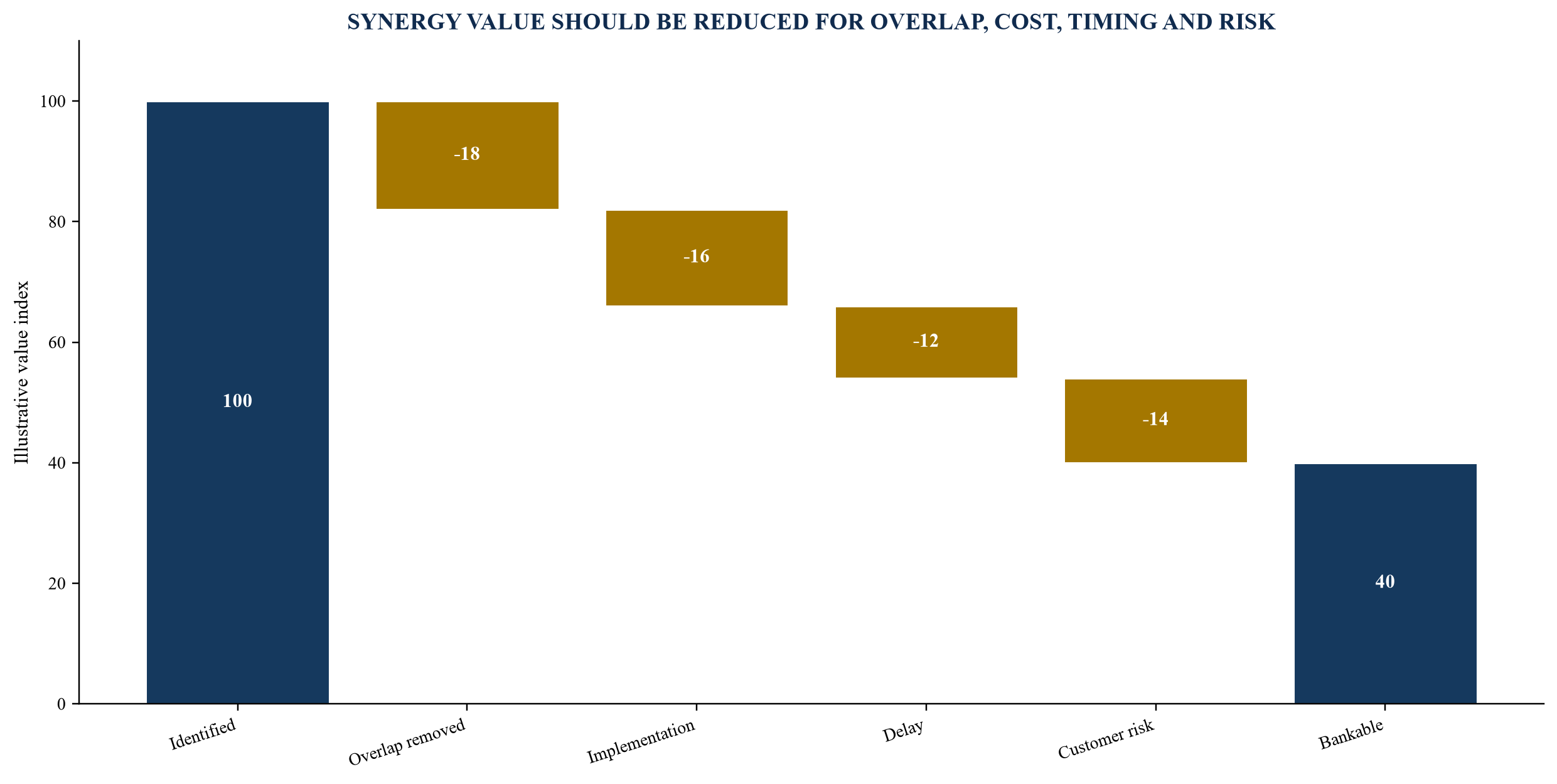
Values are hypothetical indices; deductions represent implementation, timing and risk.
Procurement savings should use addressable spend, comparable specifications and supplier evidence. A percentage applied to total cost ignores contracts, fuel formulas and minimum commitments. Fleet deployment savings should respect charter restrictions, port compatibility and service frequency.
Headcount savings require organisation design, consultation, severance, retention and service coverage. Removing duplicate roles before systems and processes are stable can impair operations.
Synergy should be measured net of implementation cost and lost margin. The buyer should identify which party captures the benefit when customers or suppliers can renegotiate.
Every synergy should be linked to a transaction mechanism. A synergy that the buyer fully controls can support the investment case after implementation cost and timing. A synergy that requires customer consent, contract renewal, supplier repricing, employee consultation or regulatory approval should carry a probability and an explicit decision gate. The purchase agreement can preserve value through conditions, covenants or contingent consideration where the seller controls evidence or performance before closing.
The baseline should be frozen before integration changes reporting definitions. Fuel consumption, port cost, claims, headcount, equipment turns, sailing frequency and service performance should use reconciled historical definitions. The control tower should preserve both the acquired baseline and the combined operating result. Without that dual view, market movements or accounting reclassifications can be reported as synergy.
Dis-synergies require equal prominence. Customer overlap can trigger volume loss; network consolidation can reduce frequency; procurement consolidation can weaken local service; system migration can increase documentation errors; and fleet redeployment can create positioning cost. These effects should sit in the same bridge as benefits. A credible integration case reports gross initiatives, implementation cost, dis-synergy, delay, probability and achieved cash in one traceable record.
Synergy funding should be separated from acquisition funding. Severance, system migration, fleet modification, contract termination, equipment relocation and advisory work can require cash before benefits emerge. The model should show monthly cash deployment, tax treatment, working-capital effects and contingency. Debt service should be tested before synergy and after delayed synergy. This prevents an acquisition from depending on savings that cannot be implemented because liquidity is constrained immediately after closing.
The buyer should define evidence for realisation before signing. Procurement savings require purchase orders and paid invoices; fleet savings require lower days or cost without service deterioration; revenue benefits require retained or incremental contribution collected in cash. A steering committee should approve baseline changes and record external effects such as fuel prices, freight rates, currency and regulation. This protects the integrity of the value case and allows management compensation to reflect controllable results.
12. Underwrite revenue synergies as options
Revenue synergies are typically less controllable than cost synergies. They should be represented as opportunities with evidence gates rather than included fully in the base price.
Cross-sell requires a named customer, unmet need, combined offer, capacity, price and sales owner. Network expansion requires service design, vessel capacity, port slots, equipment and working capital. Price improvement requires service differentiation and customer willingness.
The buyer should distinguish gross revenue from contribution after voyage, agency, terminal and sales cost. A large freight-forwarding win can add substantial revenue with modest margin and working-capital burden.
Earn-outs or contingent value can allocate uncertainty where seller relationships and future performance are central. Metrics should resist accounting choices, route changes and buyer discretion. The instrument should not distort safe operating or customer decisions.
Table 3. Synergy evidence and valuation treatment
| Synergy | Evidence required | Base-case treatment | Protection |
|---|---|---|---|
| Vessel deployment | compatible schedules and charter rights | net controllable savings | integration milestone |
| Procurement | addressable spend and supplier terms | contracted or evidenced portion | re-tender plan |
| Network consolidation | port, equipment and service analysis | after customer and capacity test | phased implementation |
| Customer cross-sell | named pipeline and contribution | option or probability-weighted | earn-out or no upfront price |
| Pricing | differentiated service and customer evidence | downside-tested | retention and volume monitoring |
Treatment should reflect control, confidence, timing and implementation cost.
13. Connect diligence to purchase-price protection
Diligence findings should lead to a defined economic response. A recurring cost belongs in normalised earnings or cash flow. A known liability can become debt-like or a purchase-price adjustment. A specific uncertain exposure can support indemnity, escrow, retention, condition or covenant.
Fleet defects should be linked to repair scope, downtime, insurance and charter consequence. Charter weaknesses should be linked to valuation, customer consent or contingent price. Missing licences or port rights may require a condition precedent.
Representations should be specific enough to allocate risk while remaining enforceable under the governing law. Disclosure should identify the underlying fact rather than merely provide a large data room.
Warranty and indemnity insurance can support recovery for covered breaches while excluding known issues, forward-looking performance and some environmental, sanctions or tax exposures. Policy terms should be reviewed with the acquisition agreement.
The buyer should preserve access to records, personnel and vessels needed to pursue claims. Notice periods, mitigation, conduct and recovery priorities should be operationally workable.
14. Design the value and funding waterfall
The acquisition bridge should begin with stand-alone cash flow after maintenance, then add only bankable synergies, subtract implementation and integration costs, reflect debt and working capital, and reserve for known obligations.
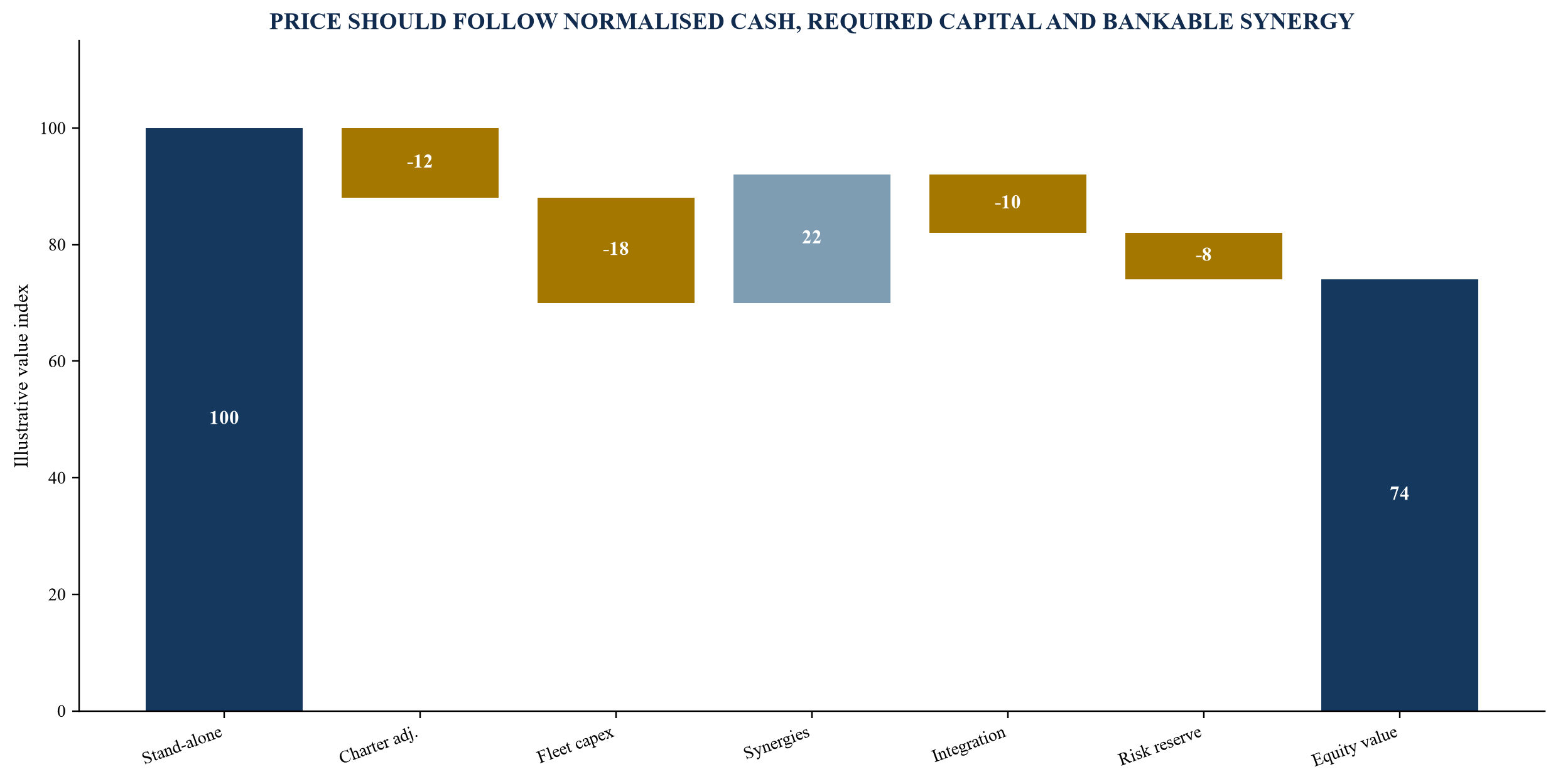
Values are hypothetical and do not represent a transaction recommendation.
Debt capacity should follow charter cash quality, asset cover, maintenance, customer concentration and downside. Acquisition leverage should not consume the liquidity needed for dry docks, fuel and working capital.
Security may include shares, vessels, mortgages, accounts, receivables, insurance and contract assignments where available. Flag, jurisdiction and existing finance determine enforceability and priority.
The buyer should model covenant headroom through rate, utilisation, off-hire, fuel and capex cases. Refinancing should not be assumed before integration and fleet obligations are proven.
15. Review competition and required approvals
The transaction can require merger control, foreign-investment, maritime, port, flag, lender, charterer, concession and landlord approvals. The conditions timetable should reflect information, review and remedy risk.
Competition analysis should define relevant services, routes, customers and alternatives. Corridor share can differ from national or global share. Capacity, frequency, port access, terminal control and customer switching can influence the assessment.
Clean-team protocols can allow necessary commercial analysis while protecting competitively sensitive prices, customers and strategy before clearance. Integration planning should remain separate from implementation until lawful.
Change-of-control clauses should be tracked in a central consent register. The register should identify responsible party, contact protocol, long-stop date, condition and fallback. Informal customer support should not be reported as formal consent.
Remedies or delayed clearance can change synergy and value. The acquisition model should test divestment, access, capacity or conduct commitments where plausible, using current counsel advice.
16. Protect operational continuity at close
Shipping continues through signing, closing and integration. Day-one planning should preserve vessel operations, port access, agency, bunkers, crew, insurance, class, banking, customer service and emergency response.
The transition-services perimeter should identify systems, accounts, payroll, procurement, sanctions screening, documentation and reporting that remain with the seller or related party. Exit dates should match replacement readiness.
Crew and shore personnel hold operational knowledge and customer relationships. Retention should focus on critical roles and handover. Changes must respect employment, seafarer and consultation requirements.
The IMO's safety-management framework places importance on documented responsibilities and safe operation.[9] Integration should not blur the designated authority, emergency response or reporting lines.
Insurance should remain continuous across ownership, management and flag changes. Claims history, deductibles, notices and outstanding casualties should transfer in a controlled manner.
The closing plan should include a vessel-by-vessel and site-by-site readiness certificate. Each certificate should identify operational authority, master and shore contact, class and statutory status, insurance evidence, banking and payment access, bunker and critical-supplier arrangements, port and agency confirmations, crew status, cyber access, customer communication and open incidents. Exceptions should have an owner, interim control and deadline. The deal team should avoid relying on a single group-level statement where the operating facts differ across vessels or jurisdictions.
Cash control deserves a separate cutover. Freight, charter hire, demurrage, port disbursements, bunker payments, payroll and claims can move across multiple currencies and bank accounts. The buyer should map invoice instructions, collection accounts, guarantees, signing authorities, sanctions checks and payment cut-off times. Customers and suppliers should receive independently verified instructions. Reconciliations should cover the last seller-controlled day and the first buyer-controlled day so that revenue and liabilities are neither duplicated nor lost.
Customer continuity should be managed by contract criticality and switching risk. The buyer should identify change-of-control rights, key-person dependencies, service-level commitments, credit limits and pending tenders. Communications should explain operational continuity, escalation paths and any planned service change. A general announcement is insufficient for customers whose cargo, customs documentation or inventory planning depends on specific sailings and port windows.
Operational readiness should be rehearsed. Tabletop exercises can test a missed port window, vessel casualty, cyber outage, sanctions alert, payment failure, crew issue and loss of a key customer contact. The purpose is to verify authority, information flow and fallback arrangements across buyer, target and transition-service providers. Findings should change the cutover plan, resource level or closing condition where the control gap could interrupt safety, service or cash.
Closing should also preserve evidence needed for later claims and accounting. Charter files, technical records, maintenance history, claims correspondence, sanctions screening, customer acceptance, invoices, bank receipts and board approvals should be transferred with an indexed custody record. The buyer should confirm access rights and retention periods before seller systems are withdrawn. Missing historical evidence can weaken purchase-price adjustments, indemnity recovery, insurance claims, tax support and the opening balance sheet.
17. Integrate fleet, network and systems in sequence
Integration should follow risk and dependency. Day one preserves service and control. The first 100 days stabilise customers, cash, safety, class, fuel, systems and people. Later phases optimise network, procurement, fleet and organisation.
Fleet integration should decide technical management, maintenance standards, spares, dry-dock scheduling and performance reporting. Immediate standardisation may be impractical where vessel types and contracts differ.
Network integration should test sailing schedules, port windows, equipment, agency, customer commitments and inland connections. Removing a service can save cost while reducing frequency and customer value.
Systems integration should preserve booking, documentation, customs, sanctions, vessel, maintenance, finance and customer data. Migration should reconcile master data and retain audit trails. Cyber controls should cover access changes and third-party connections.
Table 4. Maritime integration sequence and control
| Phase | Priority | Evidence of control | Escalation trigger |
|---|---|---|---|
| Day one | safety, service, cash and authority | named owners and tested continuity | outage, payment or control gap |
| First 30 days | customers, crew, class and insurance | retention and compliance dashboard | loss of key contract or role |
| First 100 days | fleet plan, systems and procurement | approved baselines and reconciliations | data or maintenance variance |
| Months 4 to 12 | network and organisation optimisation | achieved net synergy | service or customer deterioration |
| Year two | fleet renewal and growth | investment cases and funding | return below approved hurdle |
Sequence should reflect the target's operating model and regulatory obligations.
18. Govern integration value through a control tower
The integration control tower should connect transaction assumptions with actual outcomes. Workstreams should include customers, operations, fleet, network, people, technology, finance, legal, regulatory and communications.
Each synergy should retain baseline, owner, milestone, implementation spend, gross benefit, dis-synergy and cash effect. Finance should validate results and prevent double counting between procurement, route and headcount initiatives.
Operational indicators should include utilisation, off-hire, schedule reliability, port time, equipment turns, claims, incidents, customer retention and cash collection. Financial synergy should not be reported while service deterioration creates future loss.
The control tower should identify decisions that require board, integration leader, safety authority or regulated-entity approval. Commercial urgency should not override maritime safety or legal duties.
Weekly escalation can support the first months, followed by a monthly value review. Issues should be closed with evidence rather than removed from the dashboard when ownership changes.
19. Run post-close impairment and capital reviews
Acquisition value should be reviewed when charter loss, rate decline, vessel damage, regulation, customer departure, route disruption or integration failure changes expected cash. Accounting impairment analysis and management capital allocation should use consistent evidence while following their respective requirements.
The buyer should compare actual charter quality, maintenance, utilisation, synergies and working capital with the deal case. Variance should be attributed to market, diligence, execution and forecasting causes.
Fleet renewal decisions should consider repair, retrofit, redeployment, sale and recycling. Sunk purchase price should not determine future capital. Each vessel should earn its place in the portfolio through forward cash, strategic function and compliance.
The Hong Kong Convention and applicable national rules should inform end-of-life preparation and recycling.[3] Inventory and documentation should be maintained before a disposal decision.
Lessons should update future maritime diligence and integration standards. A failed assumption can improve later decisions when the original evidence and approval remain preserved.
20. Use a gated maritime acquisition sequence
The transaction can begin with a thesis gate defining corridor, services, customers, fleet and value mechanism. Screening should reject targets whose ownership, licences, fleet condition or earnings cannot support the thesis.
Confirmatory diligence should produce the five core records in this paper: charter matrix, fleet obligation curve, route map, synergy bridge and value waterfall. The investment committee should review the downside and specific unresolved evidence.
Table 5. Maritime M&A decision gates
| Gate | Required evidence | Decision | Stop or redesign trigger |
|---|---|---|---|
| Thesis | corridor need and target perimeter | fund screening | no controllable value mechanism |
| Indicative value | normalised earnings and fleet scope | submit conditional offer | price relies on temporary rates |
| Diligence | charter, fleet, route and liability evidence | approve final terms | unresolved material cash or safety issue |
| Signing | approvals, protection and funding | execute agreement | remedy or financing gap |
| Closing | consents, continuity and no prohibited change | transfer control | day-one operational failure |
| Integration | baselines, owners and customer plan | release initiatives | safety, service or retention decline |
Authority and evidence should be adapted to the transaction and law.
Price should reflect stand-alone cash after required fleet capital. Synergy should be added only where ownership, timing, implementation and risk are supported. Known exposures should have specific economic treatment rather than a general valuation discount that cannot be monitored.
The board record should state which assumptions are observed, contracted or management-estimated. It should identify which evidence would change the decision and who monitors it between signing and closing.
The framework creates a traceable acquisition system. Contracts support earnings quality, technical files support fleet cash needs, route data support density, customer evidence supports revenue, and integration ownership supports synergy. That chain allows the buyer to distinguish corridor opportunity from value it can actually acquire and execute.
References
- Government of India, Ministry of Commerce and Industry, Bilateral Trade between India and UAE, 2024, https://www.commerce.gov.in/wp-content/uploads/2024/12/LS-USQ-No.3492-dated.-17.12.2024.pdf
- UN Trade and Development, Review of Maritime Transport 2025, https://unctad.org/publication/review-maritime-transport-2025
- International Maritime Organization, Hong Kong International Convention for the Safe and Environmentally Sound Recycling of Ships, https://www.imo.org/en/about/conventions/pages/the-hong-kong-international-convention-for-the-safe-and-environmentally-sound-recycling-of-ships.aspx
- International Maritime Organization, EEXI and CII Ship Carbon Intensity Rating System, https://www.imo.org/en/mediacentre/hottopics/pages/eexi-cii-faq.aspx
- International Maritime Organization, 2023 IMO Strategy on Reduction of GHG Emissions from Ships, https://www.imo.org/en/OurWork/Environment/Pages/2023-IMO-Strategy-on-Reduction-of-GHG-Emissions-from-Ships.aspx
- DP World, Cochin Launches SIG Service to Expand Connectivity to Southeast Asia and the Middle East, 2023, https://www.dpworld.com/en/news/india/dp-world-cochin-launches-new-sig-service
- IFRS Foundation, IFRS 3 Business Combinations, https://www.ifrs.org/issued-standards/list-of-standards/ifrs-3-business-combinations/
- IFRS Foundation, IFRS 16 Leases, https://www.ifrs.org/issued-standards/list-of-standards/ifrs-16-leases/
- International Maritime Organization, International Safety Management Code, https://www.imo.org/en/ourwork/humanelement/pages/ismcode.aspx
- International Maritime Organization, SOLAS Convention, https://www.imo.org/en/about/conventions/pages/international-convention-for-the-safety-of-life-at-sea-(solas),-1974.aspx
- International Maritime Organization, Maritime Cyber Risk, https://www.imo.org/en/OurWork/Security/Pages/Cyber-security.aspx
- UN Trade and Development, Liner Shipping Connectivity Index, https://unctadstat.unctad.org/datacentre/reportInfo/US.LSCI
- World Bank Group, Logistics Performance Index, https://lpi.worldbank.org/
- Directorate General of Shipping, India, Recycling of Ships Act 2019 and Rules, https://betadgs.dgshipping.gov.in/mercantile-marine-law/Mml-recycling-of-ships-act
- International Maritime Organization, Marine Environment Protection Committee 83, 2025, https://www.imo.org/en/mediacentre/meetingsummaries/pages/mepc-83rd-session.aspx
- International Labour Organization, Maritime Labour Convention 2006, https://www.ilo.org/international-labour-standards/maritime-labour-convention-2006
- IFRS Foundation, IFRS 13 Fair Value Measurement, https://www.ifrs.org/issued-standards/list-of-standards/ifrs-13-fair-value-measurement/
- IFRS Foundation, IAS 36 Impairment of Assets, https://www.ifrs.org/issued-standards/list-of-standards/ias-36-impairment-of-assets/
- World Bank Group, Private Participation in Infrastructure Database, https://ppi.worldbank.org/en/ppi
- UN Trade and Development, Review of Maritime Transport Data and Reports, https://unctad.org/RMT
