

1. Define the marketing problem as controlled disclosure
Marketing a distressed business is an exercise in controlled disclosure under a shrinking cash runway. The seller needs enough market exposure to demonstrate value and generate an executable choice. The same exposure can alert customers, employees, suppliers, competitors and opportunistic counterparties before a buyer can protect the enterprise. A process that reaches many names without controlling what each recipient learns can accelerate the deterioration it was designed to solve. A process that protects confidentiality by approaching too few credible buyers can produce weak price tension, excessive conditionality and no dependable fallback.
The operating objective is therefore to release the minimum information required for each decision at the latest responsible point, while giving qualified buyers enough evidence to act. This requires one integrated design across cash, stakeholder continuity, buyer screening, data-room permissions, communications, regulation and transaction milestones. The UK Government's corporate financial distress guidance recognises accelerated sales and pre-packaged sales as possible responses to distress and notes the potential value of limiting damage caused by public knowledge of the situation [1]. That principle does not remove duties owed to employees, creditors, regulators or data subjects. It places sequencing at the centre of the process.
2. Establish the legal, fiduciary and process perimeter
The board should identify who controls the company, who can authorise disclosure and who may bind the seller before the first buyer contact. The answer may change if a lender exercises rights, a monitor is appointed, an administrator takes office or a formal process begins. Directors should obtain current legal and insolvency advice on duties, creditor interests, wrongful trading exposure, confidentiality, market disclosure, employment consultation, data protection and sector regulation. The transaction team needs a written authority map rather than an assumed mandate.
The perimeter should distinguish shares, assets, intellectual property, contracts, regulated permissions, customer data, employees, properties, guarantees and excluded liabilities. It should also identify encumbrances and third-party consents. A buyer cannot price what the seller cannot describe or transfer. A seller should not disclose information that it lacks authority or lawful basis to share. Where a connected person may acquire substantial assets from a company in administration within the first eight weeks, UK rules may require creditor approval or an independent evaluator's report [2]. The applicability and implications are fact-specific. The marketing plan should surface these questions early enough to preserve viable routes.
3. Reconcile cash runway with the disclosure timetable
The marketing clock must be derived from usable cash and executable support. A thirteen-week forecast should reconcile opening bank balances, receipts, payroll, critical suppliers, taxes, rent, insurance, professional costs, retention payments and transaction funding. Each receipt should carry evidence, timing, owner and downside treatment. Each material payment should show the operational consequence of delay. The forecast should identify the cash floor below which service continuity or transaction execution becomes unreliable.
The timetable then works backwards from the last responsible completion date. It should allow time for buyer screening, non-disclosure agreements, staged information, site access, confirmatory diligence, funding, regulatory review, employee steps, documentation, releases and funds flow. If the timetable does not fit the cash case, the seller needs additional liquidity, a narrower transaction perimeter, a faster route or a formal contingency. Hope is not a source of runway. The FRC's going-concern guidance emphasises company-specific assessment of solvency and liquidity risks and the plans used to navigate them [8]. The sale process should use the same discipline even where the company is private or outside the formal reporting scope.
Table 1. Proposed stakeholder disclosure map
| Stakeholder | Value dependency | Release trigger | Control evidence |
|---|---|---|---|
| Customers | Receipts, renewals and service continuity | Consent need, credible rumour or controlled pre-completion plan | Contract map, account plan and authorised script |
| Employees | Critical knowledge, licences and operating authority | Legal duty, retention need or approved buyer diligence | Role map, consultation plan and access record |
| Suppliers | Inventory, utilities, hosting and delivery | Term change, continuity need or approved support plan | Criticality map, payment authority and communication log |
| Lenders | Liquidity, waivers, security and releases | Agreed reporting cycle and transaction decision gates | Cash reconciliation, covenant record and consent log |
| Regulators | Clearance, licence and public-interest oversight | Applicable filing, notification or supervisory requirement | Perimeter analysis, submission and decision record |
Proposed governance record. Actual notification, consultation and disclosure duties require current advice for the company, transaction and jurisdiction.
4. Map stakeholders by value dependency and disclosure need
The stakeholder map should connect each group to the value it can preserve or destroy. Customers may control receivables, renewals, data access and reputation. Employees may hold licences, code, sales relationships, operational authority and tacit knowledge. Suppliers may control inventory, hosting, utilities, logistics or warranties. Lenders may control cash, waivers and security. Regulators may control approvals. Landlords, insurers, pension trustees, unions and government customers may each create a critical dependency.
For every group, management should record the relationship owner, contractual rights, current exposure, early warning indicators, likely information needs, legal notification duties and a response plan. The plan should separate those who must know early from those who can responsibly be informed later. It should also distinguish a controlled briefing from a general announcement. The decision cannot be reduced to confidentiality preference. UK guidance requires employers to inform and consult employee representatives in specified transfer circumstances and to provide prescribed employee information to a new employer within applicable timeframes [5]. Advice should determine how those obligations apply to the proposed route and workforce.
5. Build a disclosure ladder before contacting buyers
A disclosure ladder divides information into stages. The teaser can describe the proposition, sector, scale, transaction logic and indicative timetable without identifying the company where anonymity is credible. The first information memorandum can provide sufficient commercial and financial evidence for an indicative offer. A controlled data room can then release customer concentration, contracts, employees, technology, debt, disputes and operational evidence to qualified parties. Highly sensitive materials should remain in clean-team, redacted, aggregated or supervised-review channels until the buyer, route and lawful basis justify access.
Every dataset should have a named owner, source, date, sensitivity class, permitted audience and release gate. The team should document who accessed what and when. The ICO states that data sharing in M&A and insolvency situations requires due diligence, a lawful basis, data minimisation, documentation, governance and security [4]. Personal data should therefore be handled as regulated information rather than ordinary deal collateral. The disclosure ladder should allow the seller to answer serious buyers quickly while preventing indiscriminate access to employee, customer or commercially sensitive data.
6. Separate buyer reach from information reach
The seller may contact a broad universe without sending the same information to every name. Buyer reach measures market coverage. Information reach measures the depth and sensitivity of disclosure. Conflating the two creates avoidable leakage. A carefully anonymised teaser can test appetite across strategic, financial, local, international and special-situations buyers. Deeper access should depend on fit, credibility, conflicts, funding evidence, confidentiality execution and the ability to meet the timetable.
The market map should record why each buyer belongs in the process. Strategic buyers may offer synergies and operating continuity but create competition, customer and information risks. Financial sponsors may bring execution experience and funding partners but require a credible management and financing case. Trade competitors may understand the assets quickly but could exploit failed access. Connected parties may preserve continuity yet raise scrutiny and valuation concerns. Distressed specialists may move rapidly but price downside aggressively. The team should deliberately create enough competitive tension while protecting the company from recipients who lack the ability or intention to transact.
Table 2. Proposed buyer qualification scorecard
| Dimension | Evidence requested | Red flag | Progression decision |
|---|---|---|---|
| Strategic fit | Acquisition rationale, perimeter and operating plan | Information interest without transaction logic | Proceed, restrict or decline |
| Funding | Acquiring entity, sources, approvals and conditions | Unfunded proposal or opaque consortium | Require proof before deeper access |
| Execution | Relevant closes, advisers and decision authority | No accountable sponsor or unrealistic timetable | Set cure milestone or remove |
| Regulation | Competition, investment and sector path | Mandatory clearance omitted or remedies ignored | Escalate, reserve or reject |
| Confidentiality | NDA, conflicts, clean team and contact discipline | Unauthorised contact or abnormal downloading | Suspend access and investigate |
Illustrative scorecard. Qualification should be refreshed when the buyer, financing, perimeter, conditions or regulatory route changes.
7. Qualify buyers before sensitive access
Qualification should begin before detailed disclosure and continue throughout the process. The scorecard should test strategic rationale, financial capacity, decision authority, relevant transaction experience, regulatory eligibility, antitrust or national-security exposure, conflicts, funding dependencies, diligence demands, transition requirements and reputational fit. A buyer that offers a high headline price with uncertain funding, broad conditions and an impossible timetable may deliver less protected value than a lower, funded and executable proposal.
Evidence matters. The seller should request the identity of the acquiring entity, ownership chain, source and certainty of funds, internal approvals, adviser appointments, financing status and material conditions. It should understand whether the buyer seeks the whole business, selected assets or only information. Progression gates should require stronger evidence at each stage. A signed non-disclosure agreement is a control, not proof of capacity. The scorecard should be refreshed when the buyer's proposal, financing, consortium, transaction perimeter or regulatory position changes.
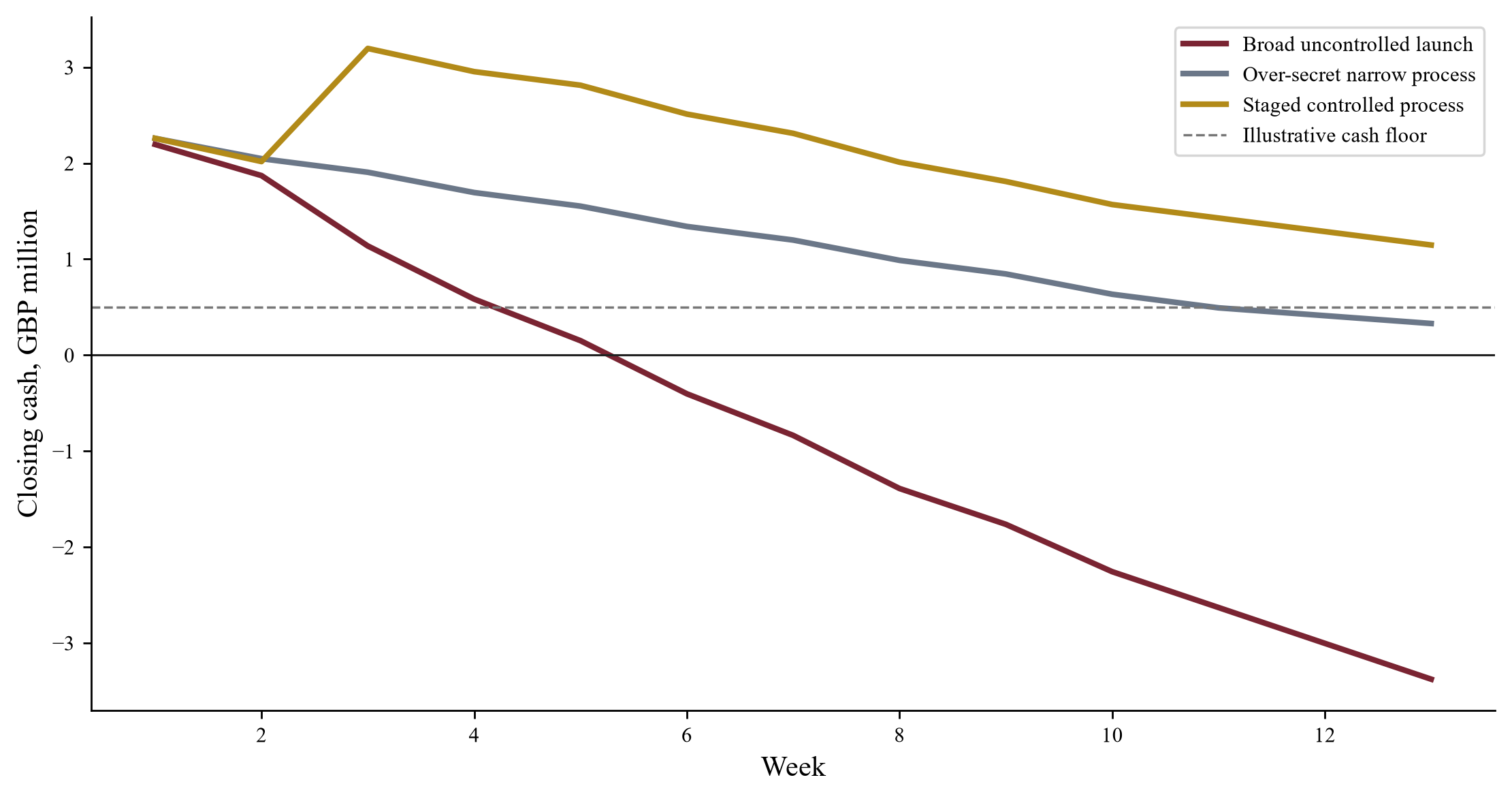
Author assumptions only. The routes have no assigned probability and do not represent financing or transaction forecasts.
8. Design the process around milestone gates
The sale timetable should use objective gates tied to evidence and cash. A launch gate requires an approved perimeter, materials, buyer list, communications plan, data controls and enough funding to run the next stage. An indicative-offer gate requires price, structure, funding outline, conditions, timetable and decision authority. A confirmatory-diligence gate requires qualified demand, approved access, management capacity and a credible completion route. A preferred-bidder gate requires a comparison of net value, recoverability, funding, conditionality, regulatory exposure and operational continuity.
Each gate should state the decision owner, evidence standard, latest date, permitted expenditure, cure path and fallback. The weekly committee should ask whether the process is creating executable options faster than the business is losing cash or confidence. A milestone should not be recorded as achieved merely because a meeting occurred or a document was circulated. Completion readiness requires substantially agreed documents, funds flow, releases, approvals, employee and customer actions, transition plans and a controlled communications sequence.
9. Prepare an evidence-led information memorandum
The information memorandum should explain the business as it can be transferred and operated, not as management once hoped it might become. It should reconcile historical financials, current trading, cash, backlog, pipeline, customers, suppliers, employees, technology, assets, liabilities and the transaction perimeter. It should identify material gaps and explain the process for resolving them. Unsupported projections, adjusted metrics and selective disclosure damage credibility when buyers discover the underlying evidence later.
The document should distinguish facts, management plans and hypothetical scenarios in natural language. Forecasts should state their assumptions and sensitivities. Customer revenue should reconcile to contracts, invoices and collections. Backlog should distinguish binding commitments from opportunities. Employee information should reconcile roles, costs, retention risk and transfer implications. Technology claims should connect to ownership, architecture, security and dependency records. A credible memorandum reduces repetitive questions, enables comparable bids and protects management capacity. It also creates the record needed to explain why the chosen route was reasonable in the circumstances.
10. Create a data room that reveals evidence progressively
The data room should be organised around buyer decisions and value risks. Core folders should cover corporate authority, finance, tax, debt, security, customers, suppliers, employees, pensions, properties, operations, technology, intellectual property, regulation, litigation, insurance, environmental matters and transaction documents. A request log should identify the source owner, review status, sensitivity and release stage for each item. Documents should be current, complete and internally consistent.
Access controls should operate at folder and user level. Download restrictions, watermarks, expiry, two-factor authentication and audit logs can reduce risk, although technology does not cure poor judgement. Redactions should be purposeful and reversible through a controlled process. The seller should avoid uploading duplicates, obsolete drafts, privileged material or personal data without review. Q&A should use a single governed channel with approved answers and a record of what each bidder received. This prevents inconsistent disclosures and gives the board evidence of process integrity.
11. Protect customer confidence before and after disclosure
Customers often react to uncertainty by delaying orders, disputing invoices, demanding security, invoking termination rights or moving critical work. The seller should rank customers by cash, margin, renewal, contractual rights, switching risk and reference value. Account plans should identify who will speak, what can be said, which commitments require authority and what support is affordable. The process should monitor order flow, collections, service levels, complaints and contract notices as leading indicators.
The timing of customer disclosure depends on contractual, regulatory and commercial facts. Some customers may need early engagement because consent, assignment, security or continuity planning is required. Others may be informed after signing or completion. A leaked rumour requires a prepared response that is accurate, calm and consistent with legal obligations. Management should avoid absolute assurances it cannot support. A buyer should receive enough evidence to assess concentration and transferability, while customer identities and detailed terms remain protected until the access gate is satisfied.
12. Preserve employees and critical knowledge
Employees can infer distress from delayed decisions, unusual advisers, restricted access or buyer visits. Silence without preparation may amplify rumours. The seller should identify critical roles, authorised signatories, operational dependencies, sales relationships, licence holders, technical knowledge and people required for completion or transition. Retention measures should be targeted, affordable, documented and linked to deliverables. Broad promises made outside the cash case can create liabilities and distrust.
The communications plan should coordinate employment advice, consultation duties, management briefings, buyer access and announcement timing. Leaders need a factual script, escalation route and answer for what can and cannot yet be shared. Buyer interviews should be sequenced to limit disruption and preserve fairness. Employee data should be minimised and released lawfully. The intended transfer route may affect employment rights and consultation. UK guidance summarises the duty to inform and consult in applicable transfers and the employee-liability information that normally must be provided [5]. Current advice is essential because insolvency and transaction structure can change the analysis.
13. Stabilise suppliers and essential counterparties
Critical suppliers may shorten terms, stop deliveries, retain title, exercise set-off or demand deposits when they perceive distress. The seller should map supplier criticality by substitutability, lead time, contractual rights, arrears, inventory ownership and impact on customer delivery. The weekly cash case should show the cost and value consequence of supporting each relationship. Paying every claimant equally may be impossible and commercially irrational; selective treatment requires legal and governance review.
Supplier communications should be coordinated with lenders and the transaction team. A commitment must be supported by authority and cash. The seller may offer controlled payment schedules, direct-payment arrangements, deposits, buyer support or information under confidentiality. It should avoid creating preferences, misleading statements or obligations that the company cannot perform. The process should monitor supply holds, term changes, quality issues, inventory coverage and contract notices. These indicators can reveal process damage before it appears in financial statements.
14. Control competitive and clean-team information
Competitors may be credible buyers and the recipients most capable of harming the business if a transaction fails. The seller should identify information that could affect pricing, customers, employees, product roadmaps, procurement or market conduct. Aggregation, masking, time delay, external clean teams and supervised review can allow diligence while reducing competitive risk. The appropriate arrangement should be designed with competition and data-protection counsel.
The clean-team protocol should define membership, permitted purpose, information categories, storage, reporting, destruction and escalation. It should prevent operational employees from receiving competitively sensitive information before approval. The seller should track questions that appear directed at commercial intelligence rather than transaction decisions. Access can be limited, paused or withdrawn when conduct departs from the agreed purpose. These controls support a credible process while preserving the ability to approach strategic buyers whose synergies may support value.
15. Anticipate regulatory and national-security dependencies
Regulatory screening can determine whether a buyer is executable within the available runway. The seller should identify merger control, foreign investment, sector licensing, sanctions, beneficial ownership, change-of-control and government-contract requirements before selecting a preferred bidder. A high price that cannot clear before liquidity expires may not be the best route. The process model should include information preparation, filing acceptance, review periods, remedies and long-stop consequences.
In the United Kingdom, certain acquisitions in defined sensitive sectors require notification and clearance under the National Security and Investment regime before completion. The Government's guidance notes that completing a mandatory-notification acquisition without clearance can make it void and can expose the acquirer to penalties [6]. Notification timing requires sufficiently stable terms and a good-faith intention to proceed. Distress can be relevant evidence, but it does not remove the statutory process. The seller should qualify buyers for regulatory readiness and preserve an alternative route where timing or remedies threaten completion.
16. Test the failing-firm and alternative-purchaser evidence
Where competition analysis may rely on an exiting-firm or failing-firm argument, contemporaneous evidence should be assembled early. The CMA's published summary identifies three broad questions: whether the firm would have exited absent the transaction, whether another substantially less anti-competitive purchaser existed and what would have happened to the firm's sales [7]. The authority may examine cash flows, balance sheets, board records, restructuring attempts, adviser work and evidence from finance providers.
The marketing process therefore has evidential consequences beyond price discovery. The buyer universe, approaches, responses, reasons for rejection and feasibility of alternatives should be recorded accurately. A contrived narrow process can weaken the claim that no less anti-competitive purchaser existed. An uncontrolled process can damage the business. The transaction team should design market testing that is proportionate to the runway, sector and regulatory risk, with legal guidance on how the record may be assessed.
17. Prepare communications before rumours emerge
The communications plan should be written before launch and updated at every gate. It should cover employees, customers, suppliers, lenders, regulators, landlords, insurers, media and other stakeholders. For each audience it should define the trigger, owner, approved facts, prohibited speculation, delivery channel, feedback loop and escalation route. The plan should include responses for a rumour, unauthorised press contact, failed bidder, supplier hold, employee departure, customer termination and regulatory inquiry.
Accuracy matters more than reassurance. Statements should reflect the company's current position and the authority of the speaker. The seller should avoid declaring a transaction certain before funding, approvals and documents support that claim. Internal messages should be consistent with external statements and board records. Monitoring should focus on operational signals rather than social-media volume alone. The objective is to preserve trust through credible information and rapid response, while keeping sensitive transaction details within the approved perimeter.
18. Govern advisers, bidders and insiders as one confidentiality system
Confidentiality failures can arise from advisers, directors, employees, lenders, prospective buyers, data-room providers and counterparties. The seller needs one register of insiders and authorised recipients. Engagement letters, non-disclosure agreements, clean-team protocols, access permissions, communications rules and conflicts checks should work together. Each participant should know who can speak, what can be shared and how suspected leakage is escalated.
The NDA should address permitted purpose, recipients, onward disclosure, financing sources, contact restrictions, data security, return or destruction, remedies and announcement controls, subject to legal advice. Boilerplate execution should not substitute for operational enforcement. The deal team should review access logs, unusual download patterns, unapproved contacts and changes in competitor or market behaviour. When a breach is suspected, it should preserve evidence, assess legal and operational consequences, adjust access, activate communications and reconsider the buyer's participation.
19. Compare bids on net protected value
Headline price is only one component of value. The comparison should include cash consideration, assumed liabilities, working-capital mechanism, deferred or contingent amounts, funding certainty, costs, tax, employee treatment, contract continuity, regulatory risk, execution timing, transition support and the value lost while waiting. A bid can become economically weaker when it requires broad exclusivity, extensive conditions, delayed funding or operational concessions.
The board paper should reconcile each bid to estimated proceeds available after transaction-specific deductions and priority claims. It should show sensitivities for completion delay, customer loss, supplier tightening, bridge cost and value erosion. Legal and insolvency advisers should address duties and the relevant decision standard. Where a connected-party transaction or pre-packaged sale is contemplated, the record should address independent scrutiny and creditor information required by the applicable regime [2][3]. The comparison should be capable of explaining why the chosen route protected value in the circumstances known at the time.
20. Preserve competitive tension without destabilising the company
Competitive tension arises from credible alternatives, disciplined milestones and comparable information. It does not require indiscriminate disclosure or artificial deadlines. The seller should maintain enough qualified buyers to protect against withdrawal and renegotiation while avoiding a process so broad that management cannot support diligence. Bid instructions should specify format, funding evidence, conditions, timetable, perimeter and required transition arrangements.
Exclusivity should be granted only when the buyer has earned it through evidence and when the agreement preserves progress. The seller may require confirmatory milestones, deposit or cost protection, financing deliverables, draft comments and a short termination right. A reserve bidder should remain informed within confidentiality constraints. Management should continue operating the business and updating the cash case during exclusivity. The process should not surrender all alternatives at the moment execution risk becomes concentrated.
21. Use a weekly market-and-operations control room
The weekly control room should integrate cash, operations and the transaction rather than run three separate narratives. A concise pack should show bank-confirmed cash, receipts, critical payments, customer and supplier indicators, employee risks, buyer status, data-room progress, regulatory steps, open documents, value sensitivities and decisions required. Each item should carry an owner, evidence status, due date and consequence.
The meeting should determine whether the current route remains fundable and executable. It should approve new disclosures, buyer progression, critical payments, communications and fallback actions. Variances should be reconciled to source evidence. The board, lenders and advisers should receive information appropriate to their rights and roles. The decision log should explain what changed, what options were considered and why the action was taken. This creates a defensible record and reduces the risk that one optimistic workstream masks deterioration elsewhere.
22. Set measurable leakage and stability indicators
The team should monitor indicators that reveal whether the process is harming the enterprise. Customer measures can include order intake, cancellations, collection delay, service incidents and requests for assurance. Employee measures can include critical-role departures, absence, offer acceptance and access anomalies. Supplier measures can include credit-limit changes, holds, deposits and delivery variance. Process measures can include unauthorised contacts, data-room downloads, press inquiries and bidder conduct.
Thresholds should connect to actions. A collection delay may require account-level escalation and a downside cash update. A critical resignation may trigger a retention or transition plan. A supplier hold may require controlled payment or substitution. A suspected leak may require access suspension and a prepared stakeholder response. Indicators should be evidence-led and proportionate; management should avoid surveillance that infringes rights or destroys trust. The purpose is early intervention, not punitive monitoring.
Table 3. Hypothetical controlled-sale assumptions
| Input | Broad uncontrolled | Over-secret narrow | Staged controlled |
|---|---|---|---|
| Opening unrestricted cash | GBP 2.40m | GBP 2.40m | GBP 2.40m |
| Secured debt | GBP 10.80m | GBP 10.80m | GBP 10.80m |
| Completion week | 8 | 11 | 9 |
| Assumed sale proceeds | GBP 9.00m | GBP 9.80m | GBP 12.00m |
| Hypothetical bridge | None | None | GBP 1.50m in week 3 |
| Stakeholder shock | 12% receipts; 8% supplier | None modelled | 3% receipts; 2% supplier |
All values are author assumptions. The cases exclude transaction-specific tax, working-capital, priority, guarantee and legal effects.
23. Define the hypothetical marketing cases
The model in this paper illustrates how disclosure design, process breadth, stakeholder reactions, funding and completion timing can interact. It uses a hypothetical UK industrial-components business with GBP 2.40 million of opening unrestricted cash and GBP 10.80 million of secured debt. Base weekly receipts are GBP 1.58 million before case factors. Payroll, suppliers, fixed costs and preservation spending are modelled separately. The cases run across thirteen weeks, although each sale completes earlier.
The broad uncontrolled launch assumes a customer receipt shock and supplier tightening from week three, a GBP 0.30 million retention payment, higher process costs, completion in week eight and GBP 9.00 million of sale proceeds. The over-secret narrow process assumes limited disruption and lower process cost, but no bridge, completion in week eleven and GBP 9.80 million of proceeds. The staged controlled process assumes a GBP 1.50 million hypothetical bridge in week three, a smaller stakeholder shock from week six, completion in week nine and GBP 12.00 million of proceeds.
Table 4. Hypothetical marketing-case results
| Route | Cash at completion | Gross value | Lender recovery, GBPm / rate |
|---|---|---|---|
| Broad uncontrolled launch | -1.39 | 7.61 | 7.61 / 70.5% |
| Over-secret narrow process | 0.49 | 10.29 | 10.29 / 95.3% |
| Staged controlled process | 1.81 | 13.81 | 12.30 / 100.0% |
GBP million except percentages. Results follow directly from author assumptions; no probability, legal entitlement or recommendation is assigned.
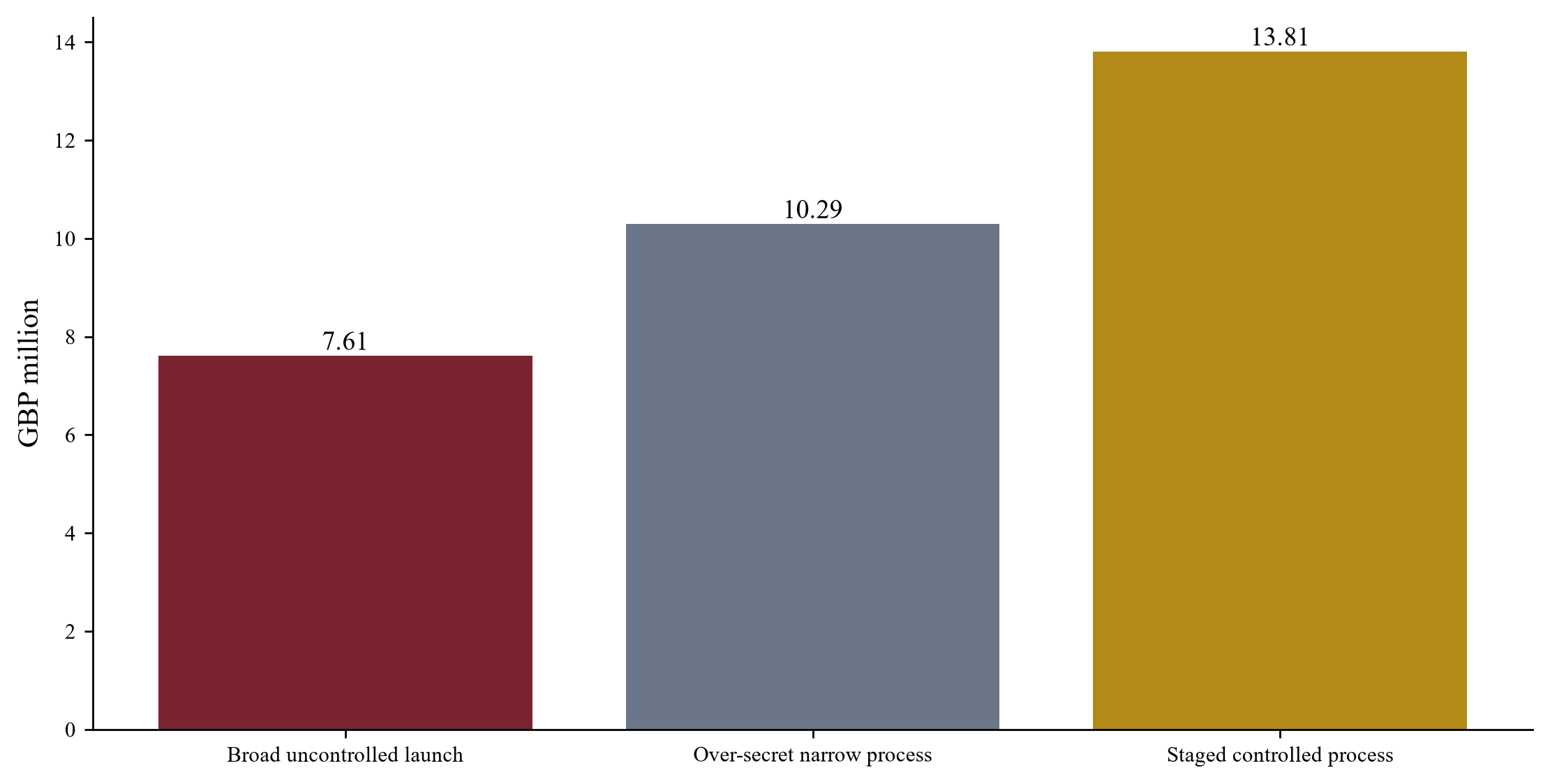
Author assumptions. Gross value equals assumed sale proceeds plus modeled cash at the stated completion week, before transaction-specific distributions.
24. Interpret cash and value across the three routes
The broad process loses receipt performance and pays more to manage employee and transaction disruption. Its cash at completion is negative under the assumptions, and gross value available from assumed sale proceeds plus modelled cash is lower than in the other routes. The narrow process protects confidentiality but allows cash to erode while producing less competitive value. Its later completion reduces the benefit of lower operating disruption.
The staged process uses more deliberate preparation, buyer gating and a hypothetical bridge. It retains more receipt performance, limits supplier tightening and produces the highest assumed sale proceeds. The bridge increases the creditor claim as well as available liquidity, so the model separately reports calculated lender recovery. These results follow mechanically from the assumptions. They do not establish that a staged process always performs better. Decision makers should replace every input with company evidence, transaction terms and applicable priority rules.
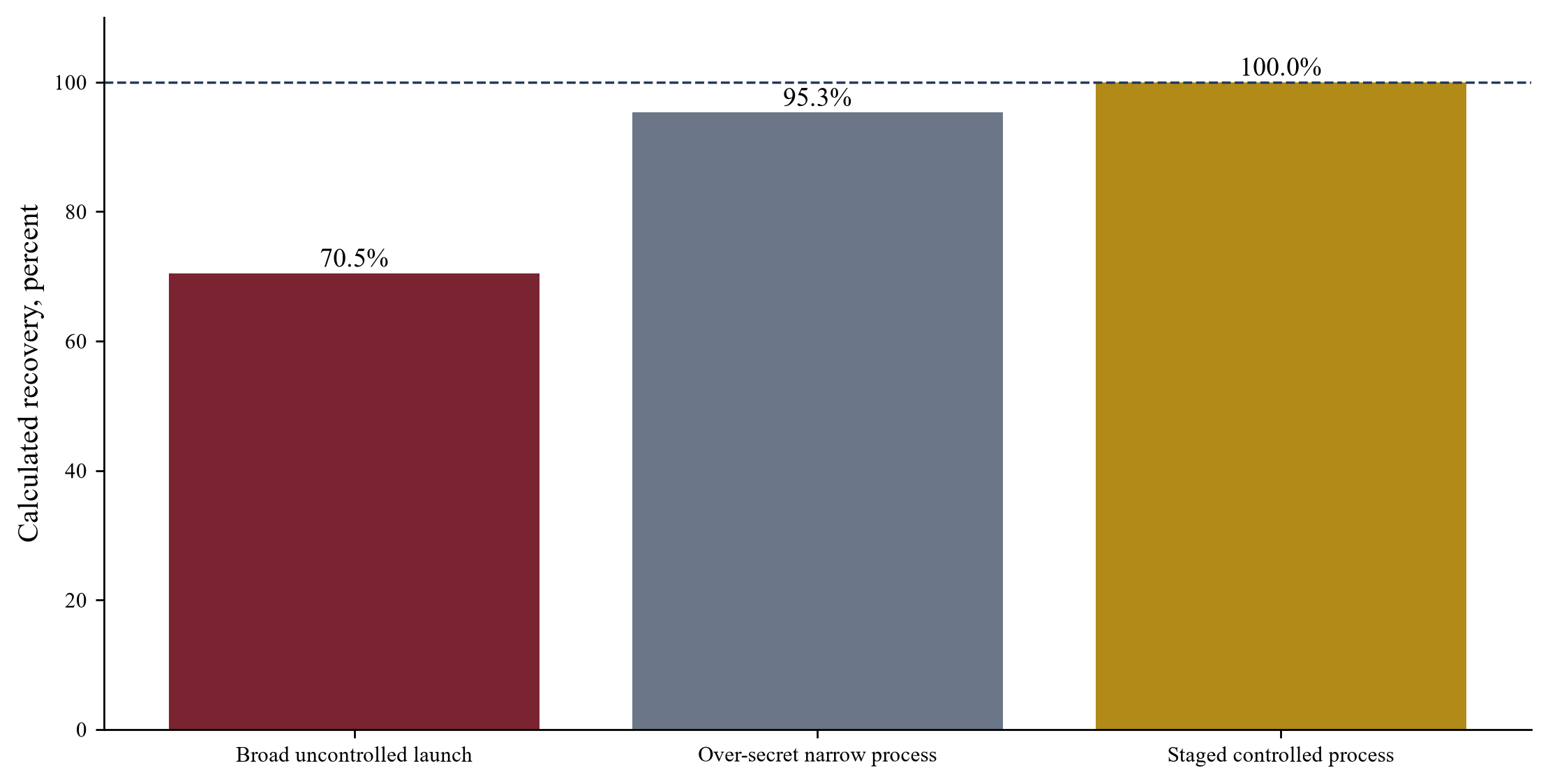
Author assumptions. Recovery is capped at assumed secured debt plus the hypothetical bridge and does not establish legal entitlement or expected outcome.
25. Test the timing and value decision boundary
The sensitivity grid varies the staged process from completion week seven to week eleven and from eighty to one hundred and ten percent of the GBP 12.00 million sale-proceeds assumption. Operating assumptions and the hypothetical bridge remain constant. The grid shows how delay consumes cash and how a lower transaction value reduces gross value and calculated recovery. It assigns no probability to any cell.
The purpose is to identify the evidence required for a decision. If the preferred buyer requests two additional weeks, the board should measure the cash cost, funding need, stakeholder risk and expected value improvement. If a reserve bid offers lower price but earlier completion, the comparison should show net protected value under consistent assumptions. The model can be extended for tax, working capital, pensions, guarantees, priority claims, regulatory delay and different transaction perimeters. It should remain transparent enough for directors, lenders and advisers to challenge each driver.
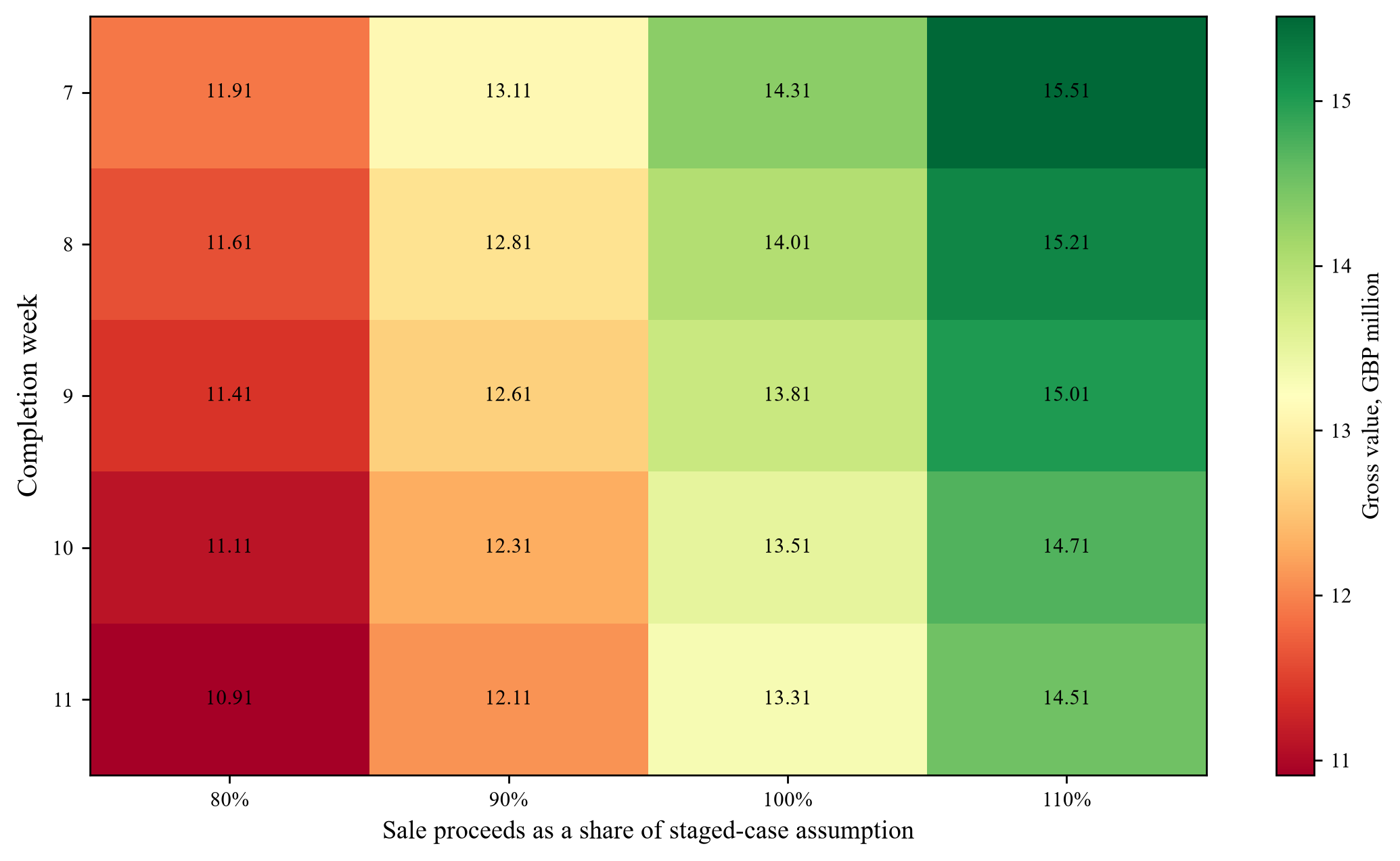
Author assumptions. Each cell varies completion timing and assumed sale proceeds; no probability is assigned.
Table 5. Proposed marketing risk-control matrix
| Failure mode | Early indicator | Control | Decision evidence |
|---|---|---|---|
| Information leak | Rumour, press query or abnormal access | Staged disclosure, access review and response protocol | Access logs, incident record and authorised message |
| Customer loss | Order pause, dispute or termination notice | Tiered account plan and funded service response | Contract, communication and cash effect |
| Critical employee exit | Resignation, absence or access anomaly | Role map, targeted retention and succession | Approved plan, deliverable and transition record |
| Supplier tightening | Credit-limit cut, hold or deposit request | Criticality map and controlled support | Terms, payment authority and continuity evidence |
| Under-marketing | Few qualified bids or weak price tension | Broaden anonymised reach and retain comparability | Universe, response log and bid analysis |
| Preferred bidder fails | Funding, diligence or approval milestone missed | Time-bound exclusivity and funded reserve route | Milestone record and board decision |
Proposed controls. The board and qualified advisers determine actual risk treatment, disclosure duties and legal consequence.
26. Maintain a marketing risk-control matrix
The risk-control matrix should connect each failure mode to an early indicator, preventive control, response and decision evidence. Core risks include information leakage, customer loss, employee departure, supplier tightening, bidder misuse, under-marketing, funding failure, regulatory delay, data breach and exclusivity failure. Owners should be accountable for actions rather than merely named beside risks.
Controls should operate in practice. A data-room policy requires tested permissions and access review. A customer plan requires an authorised relationship owner and cash-linked response. Buyer qualification requires evidence of funds and approvals. A fallback route requires current documents and a decision deadline. The committee should review residual risk and decide whether the process continues, narrows, expands or moves to an alternative. Closed issues should retain their evidence because earlier failures may become relevant to the final decision record.
27. Negotiate transaction protections that preserve the process
The preferred-bidder phase should convert process evidence into contractual progress. Heads of terms should define price mechanics, perimeter, liabilities, funding, conditions, exclusivity, access, employees, regulation, transition and completion. The seller should resist conditions that transfer all market, financing or diligence risk back to a business whose runway cannot absorb delay. The drafting timetable should identify decision owners and unresolved issues.
Exclusivity can include milestones for financing, diligence completion, first drafts, regulatory submissions and signing. Failure should permit termination or engagement with alternatives, subject to the agreement. Deposits, expense contributions or reverse protections may be considered where appropriate and lawful. The seller should preserve confidentiality, customer and employee controls through signing and completion. A signed deal can still fail, and premature disclosure can damage the fallback. The transaction documents should align with the communications and operational handover plan.
28. Execute a thirteen-week controlled-sale roadmap
Week one should establish authority, cash, perimeter, advisers, stakeholder map, buyer universe, disclosure ladder and contingency. Week two should approve anonymised materials, NDAs, bidder scorecards, data-room structure and communications scripts. Weeks three and four should launch controlled outreach, qualify interest, release first-stage information and monitor operational indicators. The committee should reconcile cash and decide whether the buyer universe or funding plan needs adjustment.
Weeks five and six should collect comparable indications, assess funding and regulatory paths, open controlled diligence and protect critical relationships. Weeks seven and eight should select a preferred route while maintaining a reserve, negotiate documents and complete confirmatory work. Weeks nine onward should focus on conditions, approvals, funds flow, releases, employee and customer actions, transition and completion. The sequence is illustrative. The actual timetable should follow liquidity, legal duties, transaction complexity and regulatory requirements. Every week should end with an updated cash case, buyer evidence, risk matrix and fallback decision.
29. Complete through a coordinated stakeholder sequence
Completion communications should be sequenced from legal effectiveness and operational need. Lenders, regulators, employees, customers, suppliers and public audiences may require different timing and content. The plan should identify who confirms funds, who releases security, who controls systems, who informs employees, who contacts critical customers and who handles press or social enquiries. Messages should be accurate and consistent with the executed transaction.
The operational handover should cover bank authority, payroll, customer delivery, supplier orders, licences, insurance, data access, cyber controls, premises, inventory, intellectual property and transition services. Personal data should transfer through a documented lawful process, with appropriate information to data subjects where required [4]. Open risks, unresolved consents and temporary controls should pass to named owners. The final transaction record should reconcile consideration, deductions, debt and bridge repayment, retained liabilities, releases and remaining cash.
30. Judge success by preserved, executable value
A controlled distressed-sale process succeeds when it converts limited time into an executable transaction or a better-supported alternative while preserving the business needed to deliver value. Reach, page views, bidder count and speed are process measures. The board should focus on net proceeds, funding certainty, completion probability only where properly evidenced, continuity, stakeholder outcomes and the cost of delay. It should also consider whether the process created a credible record of market testing and decision making.
The central discipline is proportional disclosure. Buyers receive enough verified information to decide; sensitive evidence is released only when qualification and purpose justify it; stakeholders are informed when law, contract or value protection requires action; and the cash runway governs every stage. The process remains adaptable across jurisdictions, but duties, insolvency regimes, employment rules, data protection, competition review and national-security screening require current local advice. A structured process cannot eliminate distress. It can reduce avoidable damage and give decision makers a clearer path to protect value.
References
- UK Government. Corporate Financial Distress Guidance Note. Updated 15 June 2026; accessed 6 September 2026. https://www.gov.uk/government/publications/the-sourcing-and-consultancy-playbooks/corporate-financial-distress-guidance-note-html
- The Insolvency Service. Requirements for independent scrutiny of the disposal of assets in administration, including pre-pack sales. Published 30 April 2021; accessed 6 September 2026. https://www.gov.uk/government/publications/requirements-for-independent-scrutiny-of-the-disposal-of-assets-in-administration-including-pre-pack-sales/requirements-for-independent-scrutiny-of-the-disposal-of-assets-in-administration-including-pre-pack-sales
- The Insolvency Service. Pre-pack sales in administration report. Published 8 October 2020; accessed 6 September 2026. https://www.gov.uk/government/publications/pre-pack-sales-in-administration/pre-pack-sales-in-administration-report
- Information Commissioner's Office. Due diligence when sharing data following mergers and acquisitions. Accessed 6 September 2026. https://ico.org.uk/for-organisations/uk-gdpr-guidance-and-resources/data-sharing/data-sharing-a-code-of-practice/due-diligence/
- UK Government. Business transfers, takeovers and TUPE: consulting, informing and employee information. Accessed 6 September 2026. https://www.gov.uk/transfers-takeovers/consulting-and-informing
- UK Government. National Security and Investment Act guidance on acquisitions. Updated 15 July 2026; accessed 6 September 2026. https://www.gov.uk/guidance/national-security-and-investment-act-guidance-on-acquisitions
- Competition and Markets Authority. Summary of the CMA's position on mergers involving failing firms. Published 22 April 2020; accessed 6 September 2026. https://www.gov.uk/government/publications/merger-assessments-during-the-coronavirus-covid-19-pandemic/annex-a-summary-of-cmas-position-on-mergers-involving-failing-firms
- Financial Reporting Council. Guidance on the Going Concern Basis of Accounting and Related Reporting, including Solvency and Liquidity Risks. Published 25 February 2025; accessed 6 September 2026. https://www.frc.org.uk/library/standards-codes-policy/accounting-and-reporting/annual-corporate-reporting/guidance-on-going-concern-basis/
