

1. Begin with the product promise
Private credit is normally described through the assets: senior secured loans, unitranche facilities, asset-backed lending, real-estate debt, growth credit, specialty finance or performing special situations. An open-ended product adds another instrument to that description: the redemption promise. The fund is issuing units whose holders may ask for cash while the fund owns loans that are not continuously traded. Product design therefore begins with two linked contracts, the financing provided to borrowers and the liquidity provided to investors.
The Financial Conduct Authority's FUND 3.6 requires a full-scope UK alternative investment fund manager to ensure that investment strategy, liquidity profile and redemption policy are consistent. For relevant funds, the manager must employ a liquidity-management system, monitor liquidity risk, ensure the investment liquidity profile complies with underlying obligations and conduct regular stress tests under normal and exceptional conditions. These requirements turn liquidity into an ongoing management responsibility rather than a disclosure exercise.
The Long-Term Asset Fund provides a specific authorised UK structure for long-term and illiquid assets. Current COLL 15 rules limit redemption determinations to no more than monthly and require at least 90 days' notice. The FCA also explains that the appropriate dealing frequency and notice period depend on the target investor group, investment objectives, policy and strategy. The regulatory minimum is therefore a floor; a portfolio of slowly realisable private loans may require longer notice, lower redemption frequency, a limit on each dealing date or another documented arrangement.
The product team should define the full redemption journey: request date, cut-off, irrevocability, valuation point, determination, any gate or deferral, pricing adjustment, settlement date and communication. Each stage creates operational and conduct risk. A prospectus can be legally detailed and still leave the investment team without a working cash calendar. The operating model should translate every term into data, ownership and a decision deadline.
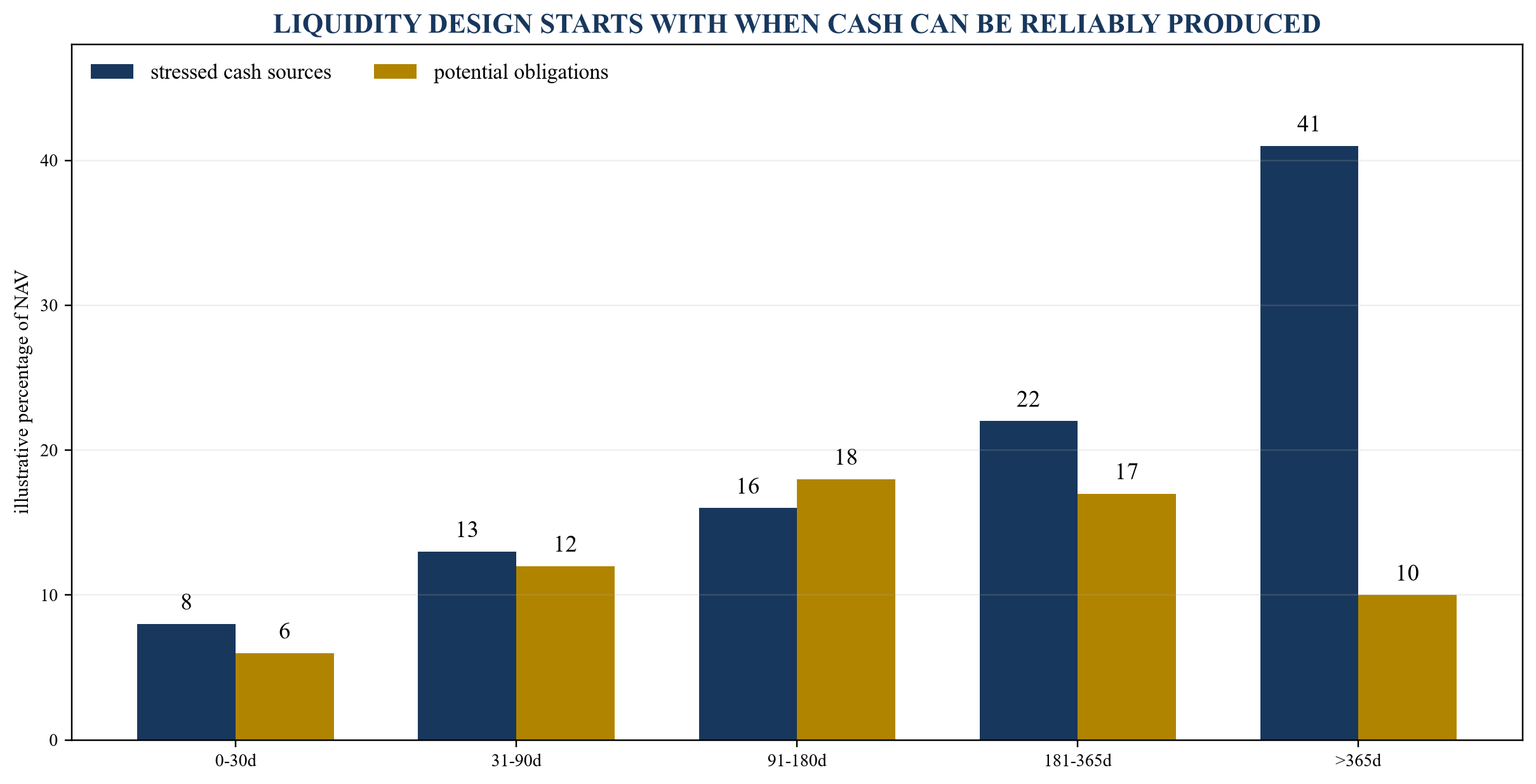
Contractual loan maturity is only one source of liquidity; confidence falls as cash depends on borrower action, refinancing or secondary sale.
Table 1. Product architecture choices and their control implications
| Design choice | Principal question | Evidence required | Control implication |
|---|---|---|---|
| vehicle and permissions | which investors and assets can the product serve? | regulatory perimeter and distribution analysis | approved target market and eligibility tests |
| dealing frequency | how often can requests be determined fairly? | stressed asset-conversion profile | calendar, cut-off and decision owner |
| notice period | how much time is needed to raise cash without avoidable loss? | settlement, maturity and sale-time evidence | minimum notice and extension rules |
| redemption limit | what amount can be paid in one window? | liquidity budget and investor concentration | gate, pro-rata allocation and carry-forward |
| pricing | which costs should a redeeming investor bear? | valuation and transaction-cost framework | dilution adjustment and approval record |
| settlement | when does an accepted amount become payable? | cash-control and operational timetable | payment controls and exception escalation |
| exceptional tools | what happens when normal arrangements fail? | stress triggers and legal authority | deferral, suspension or in-kind process |
| disclosure | what can investors reasonably expect? | approved terms, scenarios and limitations | prospectus, reports and event communication |
The final structure should be confirmed against current law, regulation, fund documents and the target investor base.
2. Classify assets by cash convertibility
A maturity schedule does not measure liquidity. A loan due in 60 days may refinance late, extend by agreement, enter a covenant waiver or default. A loan due in three years may be transferable at a price, yet documentation, confidentiality, lender consent and settlement mechanics can delay a sale. The fund should classify each asset by the time and value at which it can reasonably become cash under current and stressed conditions.
The first dimension is contractual cash. Scheduled interest, amortisation, fees and maturity proceeds should be adjusted for payment performance, covenants, borrower liquidity, refinancing dependence and concentration. The second dimension is discretionary cash, including voluntary prepayment or a sponsor-led refinancing. The third is market cash from assignment, participation, securitisation or another secondary transaction. These sources should not be combined without a confidence adjustment.
Liquidity classification should use evidence that can be updated: executed documents, transfer restrictions, bid indications, comparable trades, agent information, borrower forecasts, covenant compliance, sponsor conduct, collateral coverage and workout status. The classification should identify the cash amount, earliest realistic date, stressed date, estimated discount and confidence grade. This produces a ladder that the investment committee can reconcile to redemption terms.
The fund should also reserve for negative liquidity. Delayed-draw commitments, revolving facilities, follow-on financing, hedging collateral, tax, expenses and workouts can consume cash when credit conditions deteriorate. A stressed portfolio can therefore produce less cash and require more cash at the same time. The liquidity budget should model both directions.
3. Build a cash-source hierarchy
Cash on deposit is immediately available but reduces portfolio yield. Expected interest and amortisation can fund ordinary redemptions when collection performance is stable. Loan sales can raise larger amounts but may expose valuation gaps, information asymmetry and market impact. A subscription facility, NAV facility or overdraft can bridge timing, though it introduces interest, covenants, security, refinancing and counterparty risk. The fund needs a hierarchy that states the permitted use, capacity, cost and replenishment rule for each source.
A practical hierarchy begins with unrestricted cash, then high-confidence contractual receipts, new subscriptions that are legally committed and operationally cleared, prudent short-term borrowing, voluntary asset sales and finally actions that change the redemption outcome. The order can vary by fund. The key is to avoid treating a borrowing limit or an expected subscription as cash before conditions are satisfied.
Borrowing can smooth timing between a known receipt and a settlement date. It becomes structural when the facility repeatedly finances redemptions, when repayment depends on asset sales or when the fund lacks a credible replenishment path. The liquidity committee should monitor utilisation days, peak drawings, interest, headroom, collateral, covenant distance and repayment sources. A loan that hides persistent mismatch weakens remaining investors even if every redemption is paid on time.
The fund should set a minimum operating-liquidity reserve separately from the redemption reserve. Operating cash covers expenses, hedging, committed draws and portfolio protection. Redemption cash supports investor exits. Combining them can create a false surplus and later force the fund to choose between protecting an asset and paying an investor.
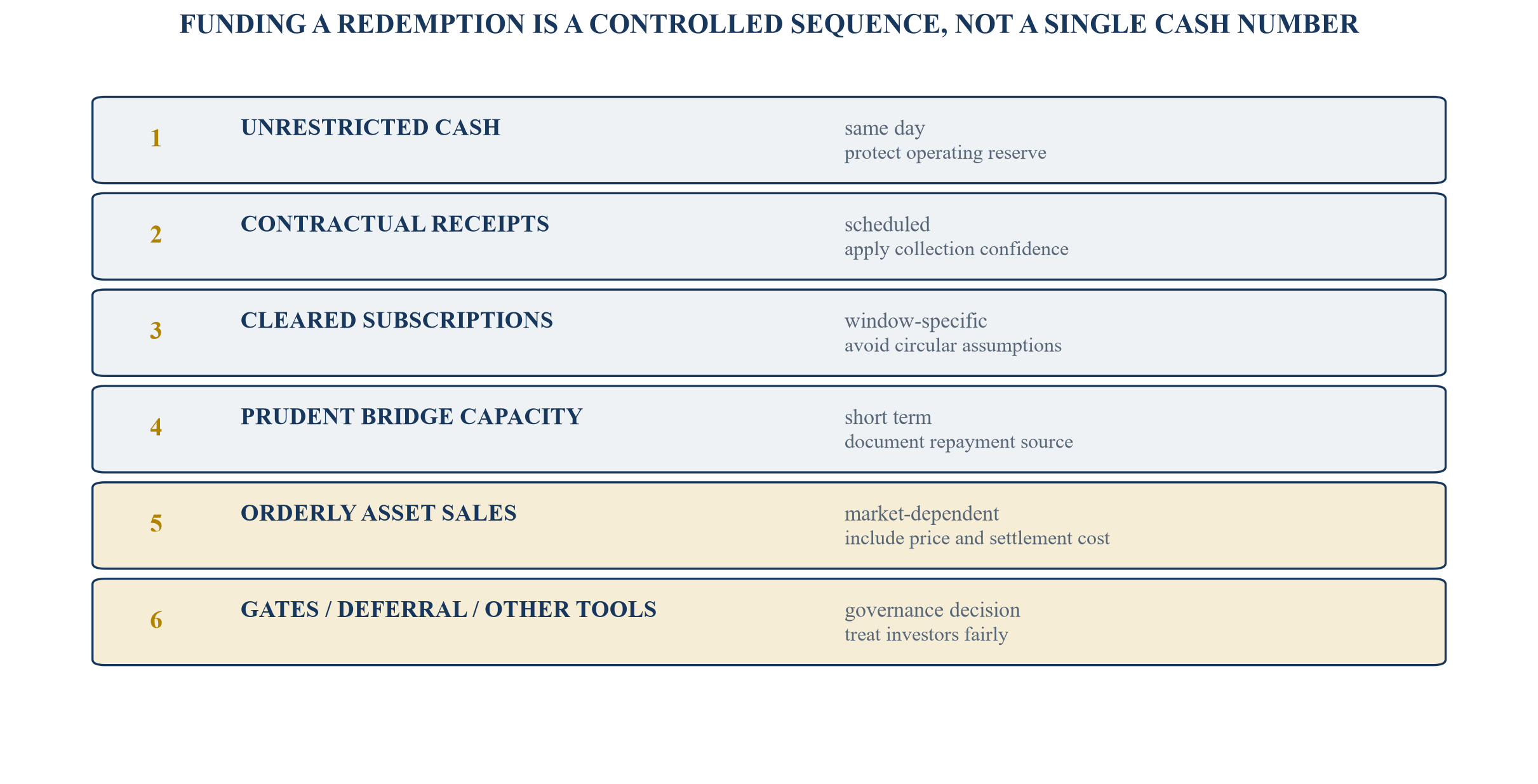
Each layer has a different reliability and cost; governance tools apply before a forced asset sale becomes the default response.
Table 2. Illustrative liquidity budget for a hypothetical fund
| Cash source or use | 0-30 days | 31-90 days | 91-180 days | Confidence treatment |
|---|---|---|---|---|
| unrestricted cash | 6 | 0 | 0 | 100% after operating reserve |
| expected interest and amortisation | 2 | 4 | 6 | borrower-specific collection haircut |
| expected new subscriptions | 1 | 3 | 4 | count only cleared or contractually committed cash |
| prudent bridge capacity | 3 | 4 | 0 | subject to covenants and repayment plan |
| orderly loan sales | 0 | 4 | 8 | stressed price and settlement haircut |
| delayed draws and follow-ons | (2) | (3) | (3) | legally binding and protective funding needs |
| expenses and hedging | (1) | (1) | (1) | retain before redemption allocation |
| net stressed capacity | 9 | 7 | 14 | compare with accepted and potential requests |
Amounts are hypothetical percentages of net asset value and demonstrate a control method rather than an investment forecast.
4. Set redemption terms from stressed capacity
The fund should work backwards from the amount of cash that can be produced without harming continuing investors. If stressed capacity within 90 days is 9% of net asset value, a quarterly 15% redemption promise is not supported merely because historical requests averaged 3%. The terms should reflect a severe but plausible request, correlated investor behaviour and reduced asset liquidity.
Notice provides time; it does not create liquidity. A 90-day period helps the manager forecast receipts, arrange sales and use tools in an orderly manner. It cannot convert a distressed or consent-restricted loan into cash at par. Frequency and notice should therefore be paired with a window limit, settlement convention and authority to defer or scale requests when documented conditions apply.
Investor fairness requires clear allocation. If accepted requests exceed the available amount, a pro-rata rule is generally easier to evidence than manager discretion. Deferred requests need a stated priority and treatment in later windows. The fund should avoid a queue that gives early redeemers an enduring advantage while later investors bear deteriorating assets.
The manager should also model subscriptions during a redemption window. New investors should enter at a current and fair price. Using their cash to satisfy exiting investors can be legitimate within the fund's design, yet the process should not rely on continuous inflows. The product must remain resilient when subscriptions stop at the same time as redemption requests rise.
5. Make valuation part of liquidity management
Private-credit valuations affect subscriptions, redemptions, fees, borrowing and reported performance. A stale or optimistic value can allow an exiting investor to receive more than the economic value transferred from the fund. A severe write-down immediately after settlement then falls on continuing investors. Valuation confidence is therefore a liquidity control.
The FCA's 2025 private-market valuation review identified good practices and areas for improvement across private equity, venture capital, private debt and infrastructure. It highlighted governance, conflicts, functional independence, policies, documentation, ad hoc valuations and investor transparency. The FCA also observed valuation-related conflicts around fees, secured borrowing, transfers, redemptions and subscriptions. These findings are directly relevant to an evergreen private-credit product.
The fund should map each asset's valuation date, methodology, observable evidence, significant assumptions, challenge process and event triggers. A quarterly formal valuation may be supplemented by a monthly monitoring estimate and an ad hoc valuation when a borrower event or market move crosses a defined threshold. The policy should explain which value drives a redemption and how material post-valuation events are handled before settlement.
Private debt commonly uses an income approach, market approach or both. The model should capture contractual cash flows, credit spread, base rate, probability of default, recovery, prepayment, covenant performance and security. The committee should record why an assumption changed and show the value effect. A single carrying value without a confidence range gives the liquidity committee too little information.
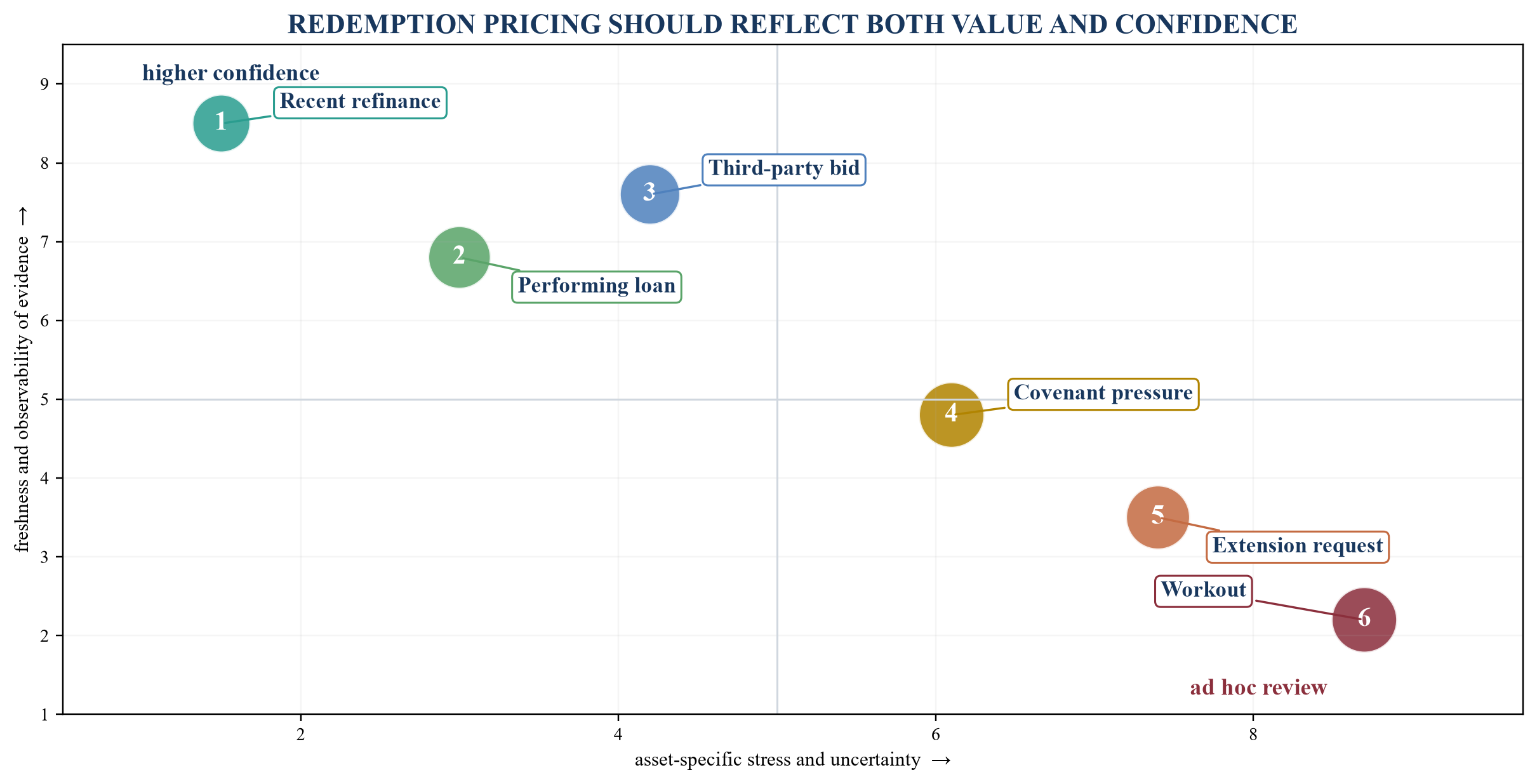
The same reported value can carry different redemption risk depending on evidence freshness and asset condition.
Table 3. Valuation controls connected to liquidity decisions
| Control | Normal operation | Trigger event | Liquidity consequence |
|---|---|---|---|
| valuation frequency | periodic independent or functionally independent process | stale value before dealing point | refresh or defer determination under fund terms |
| borrower monitoring | current financials, covenant and cash data | missed payment, waiver or forecast deterioration | revise cash receipts and sale assumptions |
| market calibration | credit spreads, comparable instruments and transactions | material market repricing | update discount rate and sale haircut |
| ad hoc valuation | documented thresholds and owner | borrower, sector, sponsor or collateral event | reassess NAV before subscription or redemption |
| conflict control | independent challenge and recorded decision | fee, borrowing or redemption conflict | enhanced review and committee approval |
| third-party input | scoped adviser or external valuer | complex or material uncertainty | disclose coverage, limitations and responsibility |
| backtesting | compare realised outcomes with prior marks | persistent bias or model error | recalibrate methodology and stress assumptions |
| investor disclosure | clear method, frequency and limitations | use of exceptional tool | timely explanation of value and liquidity effect |
The evidence standard should be documented before an investor request creates a conflict.
6. Charge liquidity costs to the transaction that creates them
Redemptions can create explicit costs such as legal fees, broker costs, transfer charges, financing interest and hedging close-out. They can also create implicit costs through bid-offer spreads, discounts, market impact and the loss of future income when a high-quality asset is sold. If these costs are borne entirely by the fund, continuing investors subsidise exit and may have an incentive to redeem first.
The FSB's revised recommendations state that redemption terms should be based on asset liquidity in normal and stressed conditions. They also call for anti-dilution liquidity-management tools that make redeeming investors bear explicit and implicit costs, including significant market impact. IOSCO's 2025 revised recommendations and implementation guidance reinforce a holistic assessment of portfolio liquidity and consistency between redemption terms and asset liquidity.
An anti-dilution adjustment should be evidence-based. A fixed fee is simple but may be too small in stress and too large in quiet markets. A variable adjustment can respond to estimated transaction cost, though it requires governance, data and communication. The methodology should avoid false precision; a range and approval threshold can be more defensible than an opaque model output.
Quantity-based tools address capacity rather than price. Gates, deferrals and suspensions can protect the portfolio when cash cannot be raised fairly. These tools have material investor consequences and should have clear legal authority, triggers, decision records, communication and review. They should not substitute for a structurally suitable notice period.
7. Model investor concentration and behaviour
Investor liabilities are not independent. Pension schemes, wealth platforms, insurers, funds of funds and private banks may react to the same market event, denominator effect, liquidity need or policy change. A fund with 100 investors can still have concentrated behaviour when several are advised by the same consultant or serve similar clients.
The liability register should identify investor type, ownership or control where known, commitment, funded amount, concentration, dealing eligibility, notice behaviour, distribution channel, currency, financing dependence and known liquidity constraints. Sensitive data should be governed appropriately. The aim is to model correlated requests, not to predict a specific investor's decision.
Historical redemptions are useful but incomplete. An evergreen private-credit fund may have little stressed history. The manager should test the largest investor, top five investors, a channel-wide event and a broad portfolio rebalancing. It should also model subscriptions falling to zero. A reverse stress test asks what combination of requests, delayed receipts, valuation decline and sale discount exhausts prudent liquidity or forces an exceptional tool.
Concentration also affects communication. A large request can become market-sensitive and influence other investors if handled inconsistently. The manager should control information, apply equal treatment and document any permitted investor-specific terms. Side-letter liquidity provisions should be incorporated into the aggregate obligation model.
8. Stress the asset and liability sides together
A liquidity stress test should combine credit deterioration, delayed cash, valuation decline, investor requests, weaker subscriptions and reduced borrowing headroom. Testing only redemption percentages assumes the assets remain unchanged at the moment when investors are most likely to seek liquidity. The joint scenario is more informative.
The Bank of England's July 2026 Financial Stability Report notes that private markets remain exposed to higher leverage, complexity, opacity, refinancing needs and tighter financing conditions. It also describes the Private Markets System-Wide Exploratory Scenario, which examines how stress could propagate across private credit, private equity, leveraged loans, high-yield bonds and bank financing. The Bank expects final aggregated findings in early 2027. A fund-level framework should therefore avoid treating its secondary-sale and borrowing assumptions as independent of system-wide conditions.
The stress horizon should match the redemption cycle and loan book. A 30-day test can assess cash operations; a 90-day test can assess notice and settlement; a 12-month test can assess repeated windows, borrower refinancing and leverage. Each case should show opening liquidity, receipts, draws, subscriptions, requests, sales, borrowing, valuation changes, tool use and closing headroom.
Management action should be specific and time-bound. Vague assumptions that the fund will sell assets or draw a facility are insufficient. The test should name eligible assets, documentation, sale process, decision owner, expected date, haircut, counterparty and approvals. It should identify where several actions depend on the same market capacity.
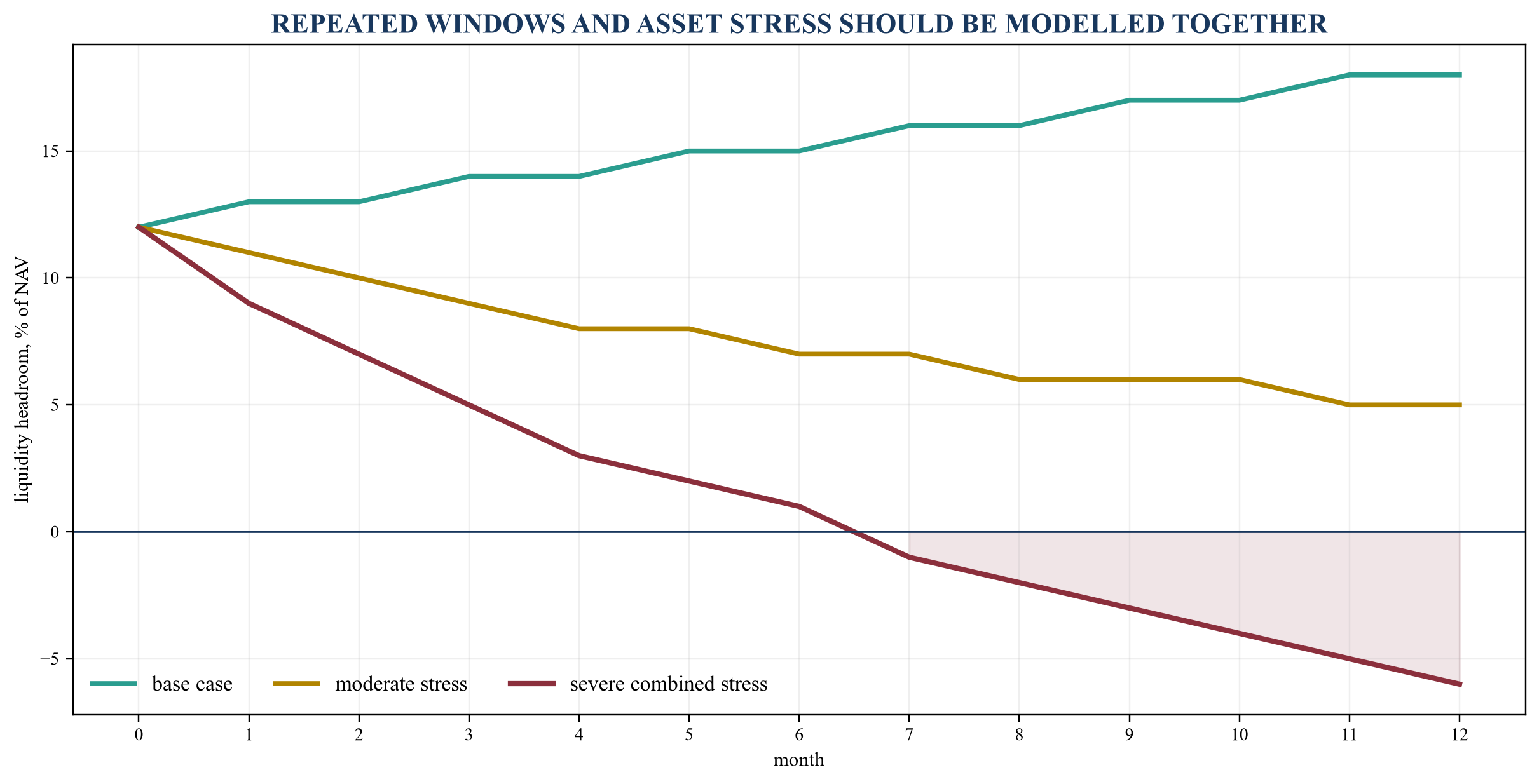
The example illustrates how delayed receipts and repeated requests can exhaust headroom even when the opening cash balance appears adequate.
Table 4. Hypothetical combined liquidity stress scenarios
| Driver | Base | Moderate stress | Severe combined stress |
|---|---|---|---|
| redemption requests over 12 months | 8% | 18% | 30% |
| new subscriptions | 10% | 3% | 0% |
| scheduled loan receipts collected | 95% | 75% | 50% |
| delayed draws and portfolio support | 2% | 4% | 7% |
| executable loan-sale discount | 2% | 8% | 18% |
| borrowing capacity available | 5% | 4% | 2% |
| portfolio valuation movement | 0% | (8%) | (18%) |
| minimum liquidity headroom | 12% | 5% | (6%) |
| indicated response | normal operation | pricing tool and gate review | exceptional-tool decision and recovery plan |
Results are illustrative percentages of net asset value and show a testing structure rather than expected performance.
9. Govern gates, deferrals and suspension before they are needed
Exceptional liquidity decisions combine investment, legal, conduct, valuation, operational and communications judgments. The governance map should identify who recommends, challenges, decides, informs the depositary, contacts the regulator, calculates allocations, approves valuation and communicates with investors. The same executive should not control every input when conflicts are material.
Triggers should be quantitative and qualitative. Examples include projected headroom below reserve, requests above a window limit, a material valuation-confidence decline, facility covenant pressure, settlement failure, a market closure, borrower event or a concentration-driven request. A trigger initiates review; it does not always dictate the decision. The committee should record evidence, alternatives, fairness analysis and the expected route back to normal operation.
Communication should explain what happened, which terms apply, how investors are treated, how values are determined, what portion is accepted or deferred, and when the next update will occur. The language should be consistent with the prospectus and avoid implying certainty about asset sales or settlement that the manager cannot support.
Re-entry conditions matter. After a gate or deferral, the fund should state what evidence permits restoration of normal terms: cash headroom, completed sales, collections, facility availability, updated valuations and reduced request volume. Resuming too quickly can create repeated disruption; delaying without a documented test can unfairly restrict investors.
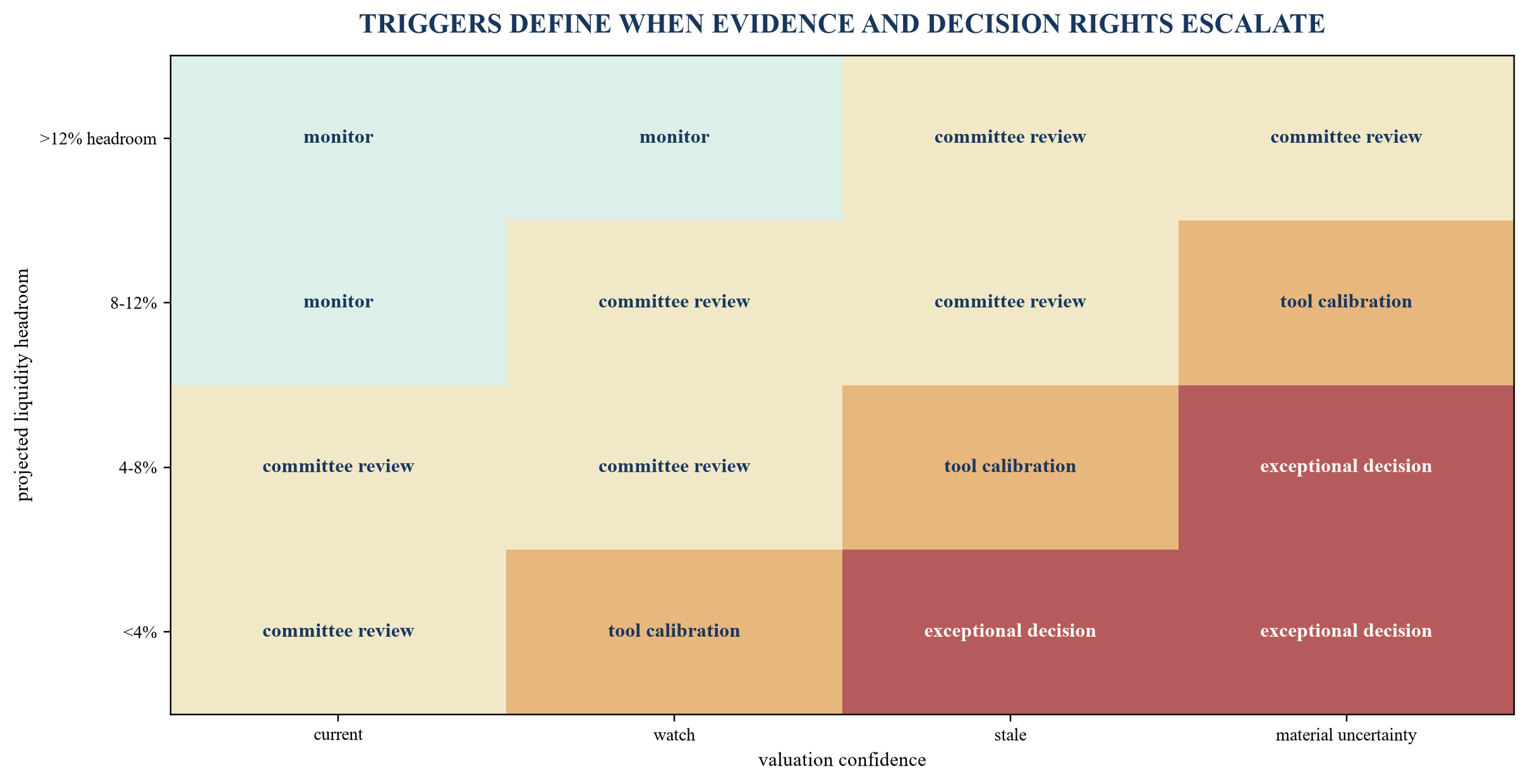
Escalation combines projected cash, valuation confidence and market conditions; exact thresholds should be fund-specific and approved.
Table 5. Liquidity governance decision matrix
| Trigger | Immediate evidence | Decision forum | Potential action | Re-entry evidence |
|---|---|---|---|---|
| headroom below reserve | 13-week cash forecast and obligations | liquidity committee | preserve cash, slow deployment, calibrate price tool | reserve restored with verified receipts |
| requests above window limit | investor register and valid notices | fund governing body | pro-rata gate and carry-forward | request volume and cash capacity realigned |
| material borrower event | current borrower, covenant and security data | valuation and investment committees | ad hoc valuation and receipt haircut | updated performance and approved value |
| facility covenant pressure | lender certificate and downside model | treasury and governing body | reduce reliance, repay or seek amendment | covenant buffer and repayment source verified |
| impaired sale market | current bids, spreads and settlement evidence | investment and liquidity committees | defer sales, adjust pricing or limit redemptions | executable market evidence returns |
| operational failure | administrator, bank and reconciliation record | incident and liquidity governance | delay within authority, correct and communicate | reconciled cash and successful control test |
| severe combined stress | integrated stress pack and fairness analysis | governing body with advisers | exceptional tool under documented authority | approved recovery plan and sustained headroom |
The fund documents, regulatory obligations and facts govern the available action in each case.
10. Connect origination and portfolio construction to liquidity
Liquidity management begins before a loan closes. The investment committee should record contractual maturity, amortisation, prepayment terms, transferability, settlement mechanics, expected refinancing, delayed draws, security, reporting and workout path. A portfolio built entirely around similar bullet maturities and sponsors can create a cash cliff even if each loan appears sound in isolation.
The portfolio should set limits by maturity bucket, borrower group, sector, sponsor, instrument, payment-in-kind exposure, covenant quality, security and transfer restriction. Payment-in-kind income increases reported return and principal without producing current cash. A product that offers regular redemptions should treat PIK concentration as a liquidity exposure.
New origination can be slowed during pressure, though this carries opportunity cost and may affect borrower relationships. The policy should state when projected redemptions reduce new commitments. It should also protect binding delayed draws and essential follow-ons. The investment pipeline and liquidity forecast should therefore use the same cash calendar.
Asset selection can improve optionality. Standardised documentation, clean assignment rights, reliable borrower reporting, diversified maturities and well-understood collateral may improve saleability and valuation confidence. These features should be priced at origination because they affect the fund's ability to honour its unit terms.
11. Separate liquidity forecasting from performance forecasting
A base-case portfolio return model often assumes contractual interest, scheduled repayment and stable valuation. A liquidity model asks whether cash is available on a particular date and at what cost. It applies timing distributions, default paths, delays, haircuts and operational constraints. The two models should reconcile but remain distinguishable.
Collected cash yield should be shown separately from accrued income. A fund may report positive interest income while cash collections fall because more loans switch to PIK or extend. The liquidity dashboard should track contractual, billed, collected, overdue and capitalised amounts. It should also reconcile NAV changes to realised cash and credit events.
The forecast should have an accountable data lineage. Investor requests come from the register and administrator; loan cash comes from servicing and bank data; valuations come from the approved process; borrowing comes from facility documents and lender confirmations. Manual overlays should be recorded with owner, rationale and expiry date.
Forecast accuracy should be backtested. The manager should compare expected and actual receipts, request volumes, settlement, sale proceeds and facility usage. Persistent errors should change assumptions and potentially product terms. A model that repeatedly overstates cash availability is a governance issue.
12. Design reporting for decisions and investor understanding
Internal reporting should show opening cash, operating reserve, expected receipts by confidence, binding outflows, requests, tool capacity, borrowing, sale pipeline and closing headroom. It should provide both the current position and forward windows. A single liquidity ratio can conceal timing and concentration.
The board or governing body should receive exceptions and trends: investor concentration, repeated facility use, ageing of deferred requests, valuation confidence, asset sales, spread between reported and executable value, covenant headroom and stress results. The report should connect every amber or red indicator to an owner and decision date.
Investor reporting should explain the liquidity terms, material risks, tool availability, valuation method and use of tools. It should distinguish redemption frequency, notice, determination and settlement. Examples can help investors understand that a monthly determination does not mean immediate payment and that a gate can allocate available capacity pro rata.
Transparency should remain accurate under stress. The fund should prepare communication templates, data controls and approval routes before an event. Reporting that is technically correct but arrives too late can amplify uncertainty and concentrated requests.
13. Treat service providers as part of the liquidity system
The administrator, depositary, custodian, bank, valuer, transfer agent, facility lender, legal advisers and portfolio servicers all contribute evidence or action. The manager retains responsibility for the product. Delegation does not remove the need to understand capacity, cut-offs, failure modes and data quality.
Operational testing should follow the complete redemption path. It should submit a request, validate eligibility, apply a gate, calculate the price, process a partial amount, carry forward the balance, settle cash, update the register and produce investor communication. Testing should include an ad hoc valuation and a failed payment instruction.
Contracts should support the timetable. Service-level agreements, data fields, escalation, business continuity, cyber controls and audit rights should match the fund terms. A 90-day notice period offers little protection if the manager receives reliable portfolio cash data only after the decision date.
The manager should maintain a liquidity data dictionary. Terms such as available cash, unencumbered cash, expected receipt, accepted redemption, deferred redemption, executable value and facility headroom need precise definitions. Common definitions reduce errors across investment, finance, operations and investor relations.
14. Use a phased implementation programme
The first phase establishes the legal and product perimeter. It maps investor eligibility, fund structure, distribution, assets, redemption terms, tools, borrowing, valuation and governance. Existing products should compare actual practice with the prospectus and operating procedures.
The second phase builds data and models. The team classifies every asset, records investor concentration, creates the cash-source hierarchy, links valuation confidence and runs joint stresses. Assumptions should be approved and traceable to evidence.
The third phase operationalises decisions. It sets thresholds, committees, delegated authority, administrator instructions, facility controls, sale protocols and communications. The team runs a full simulation and corrects control gaps.
The fourth phase embeds monitoring. It backtests forecasts, reviews thresholds, updates scenarios, validates valuation triggers and reports to investors and the governing body. Product terms should be reassessed when the asset mix, investor base, market structure or regulation changes materially.
15. Worked application
Consider a hypothetical GBP 1 billion evergreen UK private-credit fund. It offers quarterly redemption determinations with 120 days' notice and ordinarily limits aggregate redemptions to 5% of NAV per quarter. The portfolio contains senior secured corporate loans, asset-backed facilities and a smaller allocation to growth credit. The terms, amounts and results are illustrative.
The initial ladder shows 7% unrestricted cash, 5% high-confidence receipts within 120 days and 4% prudent bridge capacity. It also shows 4% of delayed draws, operating expenses and portfolio support. Net stressed capacity is therefore 12% before asset sales. A 5% window limit appears supportable under ordinary conditions, though repeated windows and a large investor request require further testing.
A severe scenario assumes 30% cumulative requests over 12 months, no new subscriptions, 50% collection of scheduled receipts, 7% additional portfolio funding, an 18% loan-sale discount and borrowing capacity reduced to 2%. The model reaches negative 6% headroom. The reverse stress identifies the seventh month as the point at which normal tools are insufficient. Governance triggers would therefore escalate earlier, when projected headroom falls below 8% or valuation confidence materially declines.
The response plan preserves the operating reserve, slows new commitments, completes ad hoc valuations, applies the approved anti-dilution method, uses the gate pro rata, draws only against identified near-term receipts and prepares selected assets for an orderly sale. The governing body receives a fairness analysis and a route to restore normal terms. The result is a controlled response rather than an assumption that every request can be paid at the last reported NAV.
16. Compare evergreen liquidity with closed-ended alternatives
An evergreen structure is not the default answer for every private-credit strategy. Closed-ended funds align more naturally with assets that have uncertain realisation dates, concentrated exposures, complex workouts or significant payment-in-kind returns. Investors obtain liquidity through distributions, secondary transfers or a final wind-up rather than a recurring claim on fund cash. The trade-off is that an investor cannot rely on periodic redemption.
The structure decision should follow the use case. A diversified performing-loan strategy with contractual cash yield, strong information rights, staggered maturities and an observable secondary market may support measured evergreen liquidity. A concentrated special-situations strategy with control investments, bespoke collateral and uncertain enforcement may be more suitable for a closed-ended term. A manager should not use an evergreen label solely to attract investors who prefer liquidity if the assets cannot support it.
Hybrid arrangements can separate capital pools or unit classes, though they introduce allocation, conflict and operational questions. A closed-ended sleeve might hold less liquid assets while an open-ended sleeve holds assets with stronger cash conversion. The policy must define origination allocation, transfer pricing, shared expenses, conflicts and treatment when an asset's liquidity changes. Complexity should produce a clear risk benefit rather than conceal mismatch.
The manager should compare structures using a common scorecard: expected cash yield, maturity distribution, transferability, valuation confidence, investor horizon, concentration, regulatory perimeter, distribution, operational capacity and stress behaviour. The board should record why the selected redemption promise is preferable to a simpler closed-ended form for both target investors and the portfolio.
The comparison should also quantify the cost of liquidity. Cash drag, facility fees, asset-sale discounts, additional administration and anti-dilution operations reduce the return available to investors. Presenting these costs alongside the access benefit helps the governing body decide whether the product creates durable value for its intended holders.
17. Build secondary and in-kind options without overstating them
A secondary market can provide another route to investor liquidity. The investor sells units or an interest to a new holder rather than requiring the fund to sell assets. This can protect portfolio cash, but execution depends on transfer restrictions, eligibility, information, consent, price discovery, tax and the availability of buyers. The fund should describe secondary liquidity as conditional unless an executable facility exists.
A manager-facilitated matching process needs controls for information, conflicts and price. The fund should identify who sets or negotiates the price, which information is shared, how buyers are selected, whether the manager receives compensation and how remaining investors are affected. A reported NAV is a reference point; it is not necessarily the executable secondary price.
In-kind redemption transfers assets rather than cash. It may reduce forced sales when investors can receive and manage the relevant loans. It can also create selection, consent, custody, valuation and fairness problems. A pro-rata portfolio slice may be operationally impossible, while a selected-asset transfer can favour one party unless value and quality are carefully governed. The legal authority and asset-transfer mechanics should be tested before the tool is presented as available.
Continuation vehicles, tender offers and periodic liquidity programmes provide further options. Each changes economic exposure, fees, governance or buyer composition. The fund should assess them as transactions with independent valuation, conflicts, consent, financing and disclosure requirements. They do not remove the need for redemption terms that work without a transaction.
The liquidity plan can record these alternatives as contingent capacity with explicit probability, timing and cost. They should enter the base case only when documentation, counterparties and execution evidence support them. This treatment keeps optionality visible while preventing a theoretical exit route from inflating available liquidity.
18. Conclusion
An evergreen private-credit product succeeds when its unit liquidity and asset liquidity form one coherent system. The fund should promise only the cash access that its portfolio can support under normal and stressed conditions. Notice, frequency and settlement need to align with the evidence-based time required to collect, finance or sell assets without transferring avoidable cost to continuing investors.
The operating framework has five connected elements: an asset-liability ladder, a redemption funding waterfall, a valuation confidence map, a joint stress test and a governance trigger matrix. These tools make the product promise measurable. They also expose where a reported value, maturity date, borrowing limit or average historical request gives false comfort.
The most important control is early design. A manager that prices transferability, cash yield, maturity diversity and information quality at origination has more options later. A manager that defines triggers, decision rights and communication before stress can act consistently when conditions change. Investor trust rests on the same foundation: transparent terms, current values, fair allocation and evidence that the fund can deliver what it has promised.
References
- Financial Conduct Authority, FUND 3.6 Liquidity, current FCA Handbook. https://handbook.fca.org.uk/handbook/fund3/fund3s6
- Financial Conduct Authority, COLL 15 Long-term asset funds, current FCA Handbook. https://handbook.fca.org.uk/handbook/coll15
- Financial Conduct Authority, PS21/14: A new authorised fund regime for investing in long term assets, 25 October 2021. https://www.fca.org.uk/publications/policy-statements/ps21-14-new-authorised-fund-regime-investing-long-term-assets
- Financial Conduct Authority, PS23/7: Broadening retail access to the Long-Term Asset Fund, 29 June 2023. https://www.fca.org.uk/publications/policy-statements/ps23-7-broadening-retail-access-long-term-asset-fund
- Financial Conduct Authority, LTAF valuation and pricing requirements, updated 5 August 2026. https://www.fca.org.uk/firms/ltaf-valuation-pricing-requirements
- Financial Conduct Authority, Private market valuation practices, 5 March 2025. https://www.fca.org.uk/publications/multi-firm-reviews/private-market-valuation-practices
- Financial Conduct Authority, Asset Management and Alternatives Supervisory Strategy, 2025. https://www.fca.org.uk/publication/correspondence/asset-management-alternatives-portfolio-letter-2025.pdf
- Financial Conduct Authority, Smaller asset managers and alternatives business model review: our findings, 8 May 2025. https://www.fca.org.uk/publications/good-and-poor-practice/smaller-asset-managers-and-alternatives-business-model-review-our-findings
- Financial Stability Board, Revised Policy Recommendations to Address Structural Vulnerabilities from Liquidity Mismatch in Open-Ended Funds, 20 December 2023. https://www.fsb.org/2023/12/revised-policy-recommendations-to-address-structural-vulnerabilities-from-liquidity-mismatch-in-open-ended-funds/
- International Organization of Securities Commissions, Revised Recommendations for Liquidity Risk Management for Collective Investment Schemes, May 2025. https://www.iosco.org/library/pubdocs/pdf/IOSCOPD798.pdf
- International Organization of Securities Commissions, Guidance for Open-ended Funds for Effective Implementation of the Recommendations for Liquidity Risk Management, May 2025. https://www.iosco.org/library/pubdocs/pdf/IOSCOPD799.pdf
- International Organization of Securities Commissions, Anti-dilution Liquidity Management Tools: Guidance for Effective Implementation of the Recommendations for Liquidity Risk Management for Collective Investment Schemes, December 2023. https://www.iosco.org/library/pubdocs/pdf/IOSCOPD756.pdf
- Bank of England, Financial Stability Report, July 2026. https://www.bankofengland.co.uk/financial-stability-report/2026/july-2026
- Bank of England, Financial Stability Report, December 2025. https://www.bankofengland.co.uk/financial-stability-report/2025/december-2025
- Bank of England, Private Markets System-Wide Exploratory Scenario exercise, current programme page. https://www.bankofengland.co.uk/financial-stability/boe-system-wide-exploratory-scenario-exercise/boe-private-markets-swes
- Bank of England, Launch of the system-wide exploratory scenario exercise focused on private markets, 4 December 2025. https://www.bankofengland.co.uk/news/2025/december/boe-launches-system-wide-exploratory-scenario-exercise-focused-on-private-markets
- Bank of England, The Bank of England's system-wide exploratory scenario exercise: final report, 29 November 2024. https://www.bankofengland.co.uk/financial-stability/boe-system-wide-exploratory-scenario-exercise/boe-swes-final-report
- UK Government, Commission Delegated Regulation (EU) No 231/2013 as assimilated law, including Articles 46 to 49 on liquidity management. https://www.legislation.gov.uk/eur/2013/231/contents
- International Monetary Fund, Global Financial Stability Report: The Last Mile, Chapter 2, The Rise and Risks of Private Credit, April 2024. https://www.imf.org/en/Publications/GFSR/Issues/2024/04/16/global-financial-stability-report-april-2024
- Financial Conduct Authority, Price and Value Outcome: Good and Poor Practice, updated 10 July 2026. https://www.fca.org.uk/publications/good-and-poor-practice/price-value-outcome-good-poor-practice-update
