

1. Treat minority governance as part of the capital structure
The percentage acquired is only one component of a minority investment. Economic rights determine how value is shared. Governance rights determine who may decide, delay or stop the actions that create that value. Information rights determine what the investor can observe. Exit rights determine how and when liquidity can be pursued. These elements should be designed as one system.
The central transaction question is whether the investor receives sufficient protection against value leakage while the company retains enough authority to execute the funded plan. An investor that cannot prevent a dilutive related-party issue or an unplanned change of business may be inadequately protected. A company that needs investor consent for routine pricing, hiring or customer contracts may become too slow to deliver the plan on which the valuation depends.
The G20/OECD Principles recognise basic shareholder rights, equitable treatment and the need to protect minority investors from abusive action by controlling shareholders. They also recognise that responsibility for strategy and operations usually belongs to the board and management rather than to shareholder referendum. [1] This distinction provides the design logic: protect fundamental ownership interests without turning every operating decision into a shareholder consent.
The governance package should therefore be valued alongside price, dilution, liquidation preference and return. A higher valuation can be offset by a restrictive consent system. A lower valuation can be acceptable where the investor brings capital, expertise and access under a governance architecture that accelerates execution. The board should record that trade in explicit terms.
2. Define the funded plan before negotiating rights
Governance cannot be designed in the abstract. The parties need a controlled version of the plan the capital is intended to finance. It should state uses of funds, milestones, acquisition strategy, hiring, geographic expansion, capital expenditure, working capital and the expected route to the next financing or liquidity event.
The plan creates the operating envelope. Actions inside that envelope should ordinarily be delegated to management under board oversight. Actions that alter the agreed risk, ownership or strategic perimeter may justify investor consent. The distinction prevents the reserved-matters schedule from becoming a generic list copied from another transaction.
The company should identify decisions that must remain fast. These may include pricing within a policy, hiring below a defined level, customer contracting within approved risk limits, ordinary-course borrowing under an agreed facility and acquisitions inside a pre-approved programme. It should also identify decisions that can permanently change investor exposure, such as issuing a senior class, selling the company, changing the core business, entering a material related-party transaction or incurring debt beyond an agreed ceiling.
The investment committee and founder group should approve the same base case before the documents are drafted. Different assumptions about acquisitions, capital needs or exit timing will otherwise reappear as governance disputes after closing.
| Plan component | Operating authority | Investor protection question | Evidence before signing |
|---|---|---|---|
| Revenue and pricing | Management within approved policy | Can a pricing change alter the business model or concentration risk? | Customer economics, delegation matrix and downside sensitivity |
| Hiring | Management below defined executive level | Which appointments can materially change control or risk? | Organisation plan, compensation bands and succession map |
| Acquisitions | Board within an approved programme | When does size, leverage or new geography change the agreed thesis? | Pipeline, valuation limits, funding and integration capacity |
| Borrowing | Finance team within facilities and covenants | At what level does debt subordinate or impair the investor's position? | Debt capacity, liquidity headroom and covenant model |
| Capital expenditure | Management within budget | Which commitments create irreversible exposure outside the plan? | Asset schedule, return case and approval limits |
| New equity | Board subject to class and pre-emption rights | Can a new issue dilute economics or alter control? | Cap table, financing scenarios and security terms |
Thresholds are transaction-specific and require current legal, tax, accounting and regulatory advice.
3. Map law documents and actual authority
The operative rights may sit across the constitution, certificate of incorporation, shareholders' agreement, voting agreement, investors' rights agreement, board charter, delegation of authority, employment documents, financing agreements and regulatory approvals. A right that appears clear in one document may be qualified or displaced by another.
The rights map should identify the legal source, holder, threshold, trigger, process, time limit, remedy and sunset for every material right. It should show whether a right belongs to an individual investor, a class, a majority of preferred holders, a nominated director or the board. It should also identify rights that follow the shares and rights that terminate when ownership falls below a threshold.
Current NVCA model documents separate the certificate of incorporation, stock purchase agreement, investors' rights agreement, voting agreement and right of first refusal and co-sale agreement. The models are designed to be internally consistent and were updated recently for legal changes and evolving terms. [2] They remain drafting references rather than substitutes for transaction-specific design.
The UK Companies Act allocates powers and protections across directors, members, articles and statutory provisions. Directors owe duties to the company, members can remove directors under section 168, statutory pre-emption can apply under section 561, and unfair-prejudice relief is available under section 994. [3] Contractual rights need to be reconciled with those statutory structures and with the company's articles.
4. Separate protection influence and control
Governance rights exist on a spectrum. Protection prevents defined harm to the investment. Influence permits participation in important decisions. Joint control requires unanimous consent over relevant activities. Control concerns power over relevant activities, exposure to variable returns and the ability to use power to affect those returns under IFRS 10. [4]
IAS 28 defines significant influence as power to participate in financial and operating policy decisions without control or joint control. A holding of 20 per cent or more of voting power creates a rebuttable presumption of significant influence. Board representation, participation in policy decisions, material transactions and provision of essential technical information can also be relevant. [5]
The accounting analysis does not dictate the commercial answer, yet it reveals why labels are insufficient. Calling a consent a protective right does not establish its effect. The substance of the right, the decisions it covers and whether it is substantive in current circumstances all matter.
The parties should classify each proposed right as ownership protection, strategic influence, operating participation or negative control. Rights should then be tested against consolidation, equity accounting, regulatory, tax, competition, foreign-investment and contractual consequences. The test should be completed before governance terms are announced to lenders, co-investors or employees.
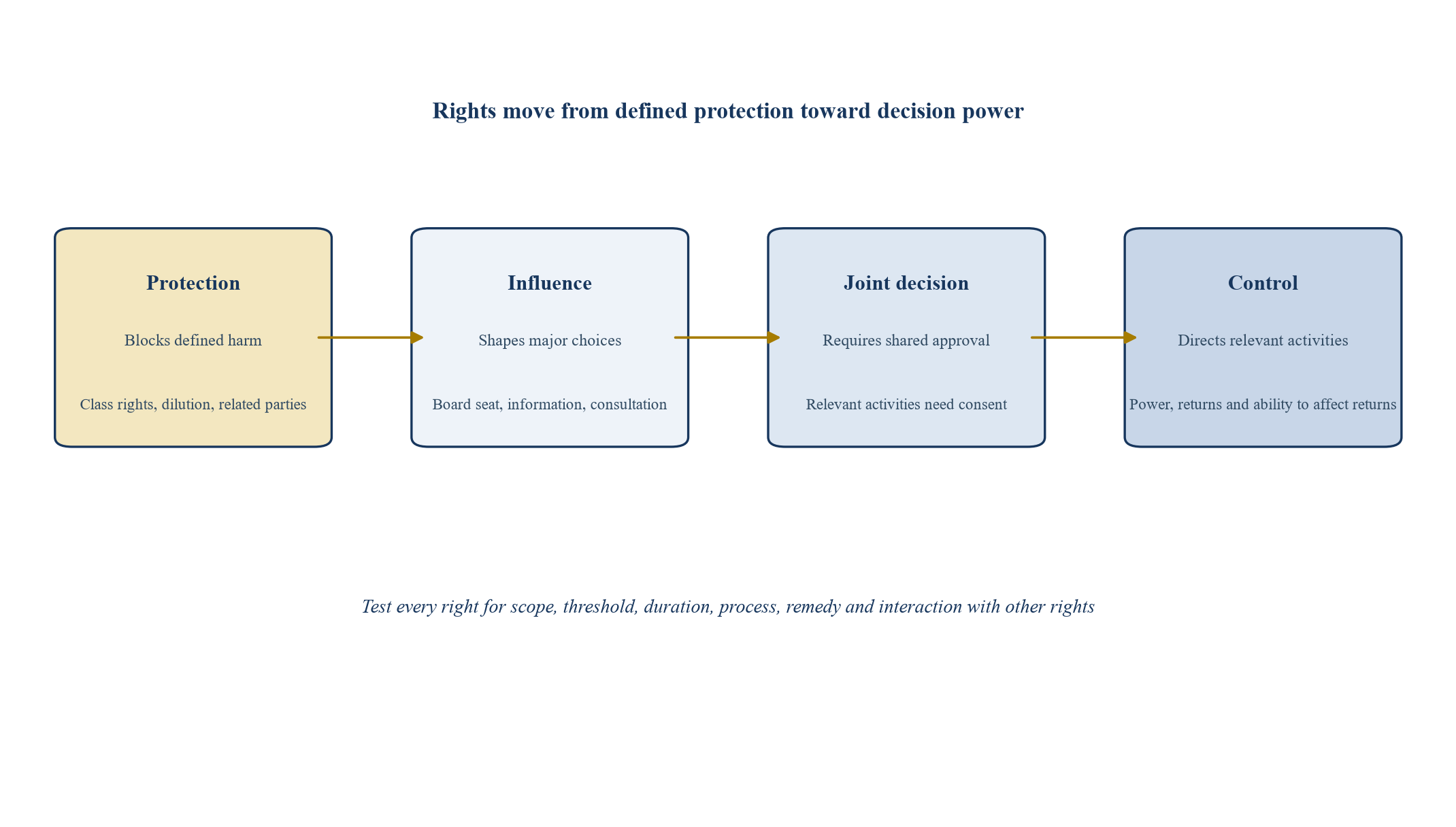
Classification depends on substance, jurisdiction and circumstances. The diagram is a decision aid rather than a legal or accounting conclusion.
5. Design the board around accountability
Board composition determines how information and judgement enter the company. The relevant questions are seat allocation, appointment and removal, chair authority, quorum, committee membership, observer rights, conflicts, confidentiality and the competence required by the plan.
A single investor seat can provide insight and monitoring without determining outcomes. A second seat, a casting vote or a quorum right can change the balance materially. Quorum provisions should prevent deliberate exclusion while avoiding a structure in which absence can stop the company indefinitely. A sensible design uses notice requirements, one adjournment and a reduced quorum for ordinary matters, while preserving separate consent for genuinely protected matters.
Independent directors can add value where related-party transactions, executive pay, valuation, exit or conflict questions are likely. Independence should be operational: relevant experience, access to information, authority to obtain advice and a clear appointment process. A nominal independent selected and removable by one party may not provide effective challenge.
Director duties remain important. Under section 172 of the UK Companies Act, a director must act in the way considered most likely to promote the success of the company for members as a whole, while having regard to specified factors. [3] A director nominated by an investor does not become an agent free to disregard duties owed to the company.
6. Build a reserved-matters schedule from risks
Reserved matters should protect the investor from a defined change in exposure. Each item should answer four questions: what harm is prevented, why board authority is insufficient, what threshold captures materiality, and how the company can act if consent is delayed.
Core protections often concern changes to constitutional rights, issue of securities senior or equal to the investor class, alteration of capital, sale or liquidation, fundamental change of business, material related-party transactions, debt above an agreed ceiling, and distributions inconsistent with the financing plan. The exact list depends on the thesis and jurisdiction.
UK government term-sheet guidance describes investor consents as decisions requiring prior investor approval and gives examples including new shares, share-right changes, significant borrowing, asset sales and constitutional amendments. It states that the purpose is to protect investors from material changes without restricting day-to-day management. [6]
The danger is accretion. Budgets, contracts, hires, litigation, capex, leases, acquisitions, pricing and ordinary-course borrowing can each acquire separate vetoes. The combined package can make the investor a shadow operating authority. The parties should model the cumulative effect rather than assessing clauses individually.
| Proposed consent | Risk protected | Narrowing mechanism | Operating safeguard |
|---|---|---|---|
| New senior securities | Economic subordination and dilution | Limit to senior or pari passu securities and material option-pool changes | Permit approved employee pool and pro-rata funding |
| Borrowing | Leverage and priority risk | Net-debt ceiling, permitted facilities and baskets | Permit refinancings without increased exposure |
| Acquisitions | Perimeter and integration risk | Size, leverage, geography and business-line thresholds | Pre-approved acquisition programme |
| Budget | Departure from investment case | Material variance bands and defined KPIs | Management discretion inside approved envelope |
| Senior appointments | Leadership and control risk | Limit to chief executive and finance leadership | Consultation for other executives |
| Related-party transactions | Transfer of value | Independent approval and arm's-length threshold | Ordinary-course exemptions with reporting |
| Asset sales | Loss of core capability or value | Percentage of assets, revenue or EBITDA | Permit planned disposals and obsolete assets |
| Litigation settlements | Cash and precedent risk | Monetary and non-monetary materiality | Emergency and insurer-controlled exceptions |
A consent should be retained only where the risk and process justify the restriction.
7. Use thresholds baskets and envelopes
Absolute vetoes are blunt. Thresholds, baskets and operating envelopes can protect the investment while preserving execution. A debt consent can use net leverage, absolute amount and security status. An acquisition consent can combine consideration, enterprise value, leverage, geography and departure from the approved business. A contract consent can focus on unusual duration, exclusivity, liability or change-of-control terms rather than revenue alone.
Thresholds should scale as the company grows. A fixed USD 1 million contract threshold may be material at closing and routine after expansion. The package can use percentages, board-approved annual limits or automatic step-ups tied to revenue and capital. Calculation definitions must be controlled to prevent disputes.
Baskets should not create loopholes. A general basket can permit several low-risk actions, while anti-fragmentation language prevents a series of related transactions from avoiding consent. Emergency baskets can preserve safety, cyber, legal and business-continuity action, with prompt notice and retrospective review.
The board should run the prior twelve months of decisions through the proposed schedule. It should also simulate the next twenty-four months. The output reveals how many consents would have been required, who would have prepared them, how long they would have taken and which growth actions might have been delayed.
8. Make the budget a governance instrument
Budget approval is often the point at which investor protection becomes operating control. The budget should be a strategic and financial envelope rather than a line-item permission system. It should contain revenue, margin, cash, hiring, capital expenditure, acquisitions, financing and defined performance indicators.
Management should have authority to operate within the approved budget and variance bands. Material deviations should trigger information, a recovery plan and, only where appropriate, consent. A revenue miss may require corrective action without automatically allowing the investor to direct operations. An unplanned acquisition or debt-funded expansion may warrant approval because it changes risk.
The documents need a rule for an unapproved budget. Carry-forward of the prior budget, adjusted for committed contracts and essential operations, can prevent paralysis. The rule should include a time-limited escalation process and preserve board duties.
The budget process should align with reporting capacity. Requiring detailed monthly forecasts from a company without the finance systems to produce them creates formal rights without reliable evidence. Part of the investment plan may need to fund finance capability, close discipline and data governance.
9. Calibrate information rights to decisions
Information rights should support monitoring, valuation, compliance and decision-making. A practical package distinguishes routine reporting, event-driven notices, inspection, audit and access to management. It defines format, timing, materiality, confidentiality and permitted recipients.
The baseline may include monthly management accounts, quarterly board materials, annual audited statements, budget comparisons, liquidity, covenant compliance and cap-table changes. Event notices can cover material litigation, cyber incidents, regulatory action, loss of a major customer, key-person departure and financing default.
The investor's need for information must be reconciled with legal privilege, competition law, data protection, sanctions, customer confidentiality and market-abuse rules. Clean teams, redaction, aggregation and restricted adviser access can preserve legitimate monitoring without creating improper information flows.
Disclosure should be symmetric across investors of the same class unless differentiated rights were consciously priced and documented. Selective informal access can undermine the agreed system and create confusion over what the board knew when it acted.
10. Control conflicts and related-party value transfer
Founder-led companies often have transactions with founders, family members, affiliates or other portfolio companies. These arrangements may be commercially justified. They require disciplined identification, benchmarking, disclosure, approval and periodic review.
The framework should define related parties and capture direct and indirect interests. It should establish a register, require early disclosure, exclude conflicted decision-makers where appropriate, and route material matters through independent directors or disinterested shareholders. Pricing, service, duration, termination and alternatives should be documented.
OECD principles call for disclosure of material interests and protection against abusive action by controlling shareholders. [1] The process should apply equally to investor affiliates. An investor should not use consent rights to direct business to its portfolio on non-market terms.
The related-party protocol should remain workable. Minor reimbursed expenses and ordinary employment arrangements can follow policy rather than bespoke approval. Materiality can reflect value, duration, strategic importance and non-financial risk.
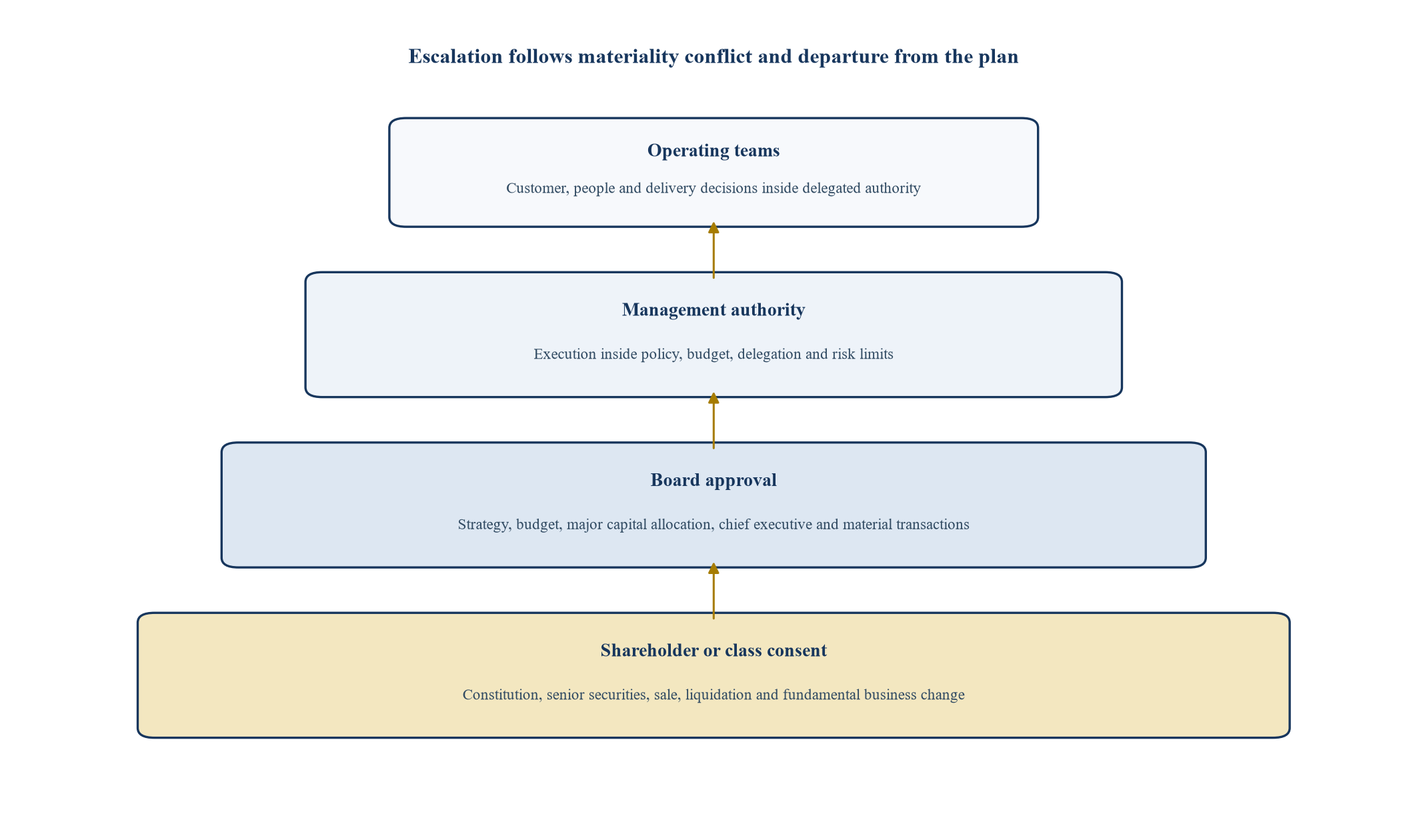
The architecture assigns authority according to materiality and conflict rather than according to a copied list of clauses.
11. Protect future financing without creating a hold-up
The company may need additional capital. Pre-emption, pro-rata rights, pay-to-play provisions, class consent, anti-dilution and option-pool rules determine whether the next financing can proceed and how dilution is shared.
Pre-emption protects existing owners from involuntary dilution, while exceptions may be needed for employee equity, acquisitions, strategic issuances and approved financing. Section 561 of the UK Companies Act provides statutory pre-emption for certain equity issuances, subject to statutory mechanisms and possible exclusions or disapplication. [3] The contractual package must align with the applicable regime.
An investor should receive adequate notice and information to exercise participation rights. The exercise period should match the company's financing timetable. A right that allows prolonged delay can weaken the company in a liquidity event and transfer negotiation leverage unrelated to the underlying protection.
The package should address down rounds, bridge finance and insider-led rescues before they occur. A disinterested approval process, market check where feasible and documented alternatives can protect both parties. Automatic punitive terms may discourage necessary capital or create incentives to manufacture a default.
12. Design transfer and liquidity rights as a system
Restrictions on transfer protect the ownership group from unsuitable counterparties and preserve regulatory or tax status. Rights of first refusal, co-sale, permitted transfers, lock-ups, drag-along and tag-along rights then allocate liquidity and control.
A right of first refusal can preserve ownership control but may chill third-party bids if the process is slow or information-intensive. A right of first offer can create earlier engagement with less certainty. Co-sale rights protect minority holders when founders sell. Drag rights can enable a whole-company sale, yet thresholds, consideration equality, liability allocation and treatment of rollover must be clear.
The exit design should reflect the investment horizon without forcing a value-destructive transaction. Registration rights may be relevant for an eventual public offering. Put rights can create liquidity but may also create an unfinanceable company obligation. Sale-process rights can require review or adviser appointment while preserving board duties and transaction judgement.
The package should model partial founder liquidity. A controlled secondary can align incentives and reduce personal concentration. Excessive liquidity may weaken commitment. The decision should use the founder's continuing ownership, role, vesting, tax and succession context.
13. Build deadlock rules that preserve enterprise value
Deadlock arises when a required decision cannot obtain consent. A good mechanism resolves the issue at the lowest effective level, protects urgent action and avoids turning every disagreement into an exit event.
The process can begin with a written issue statement, supporting evidence and a defined response period. It can escalate from management to investor director, chair, chief executives or designated principals. Mediation or an independent expert can resolve technical questions such as accounting, valuation or milestone achievement. Strategic disagreements generally remain board or shareholder matters.
Buy-sell mechanisms are often unsuitable where ownership, financing capacity and information are asymmetric. A forced sale may reward the party with deeper capital rather than the better position. If used, valuation, funding proof, timing, regulatory approval and minority protections require careful design.
An unresolved budget should not stop payroll, safety, compliance or contracted customer delivery. Emergency authority and a carry-forward rule protect the enterprise while the dispute is escalated. Repeated deadlock can trigger a strategic review rather than an automatic transfer.
| Stage | Time window | Decision owner | Output |
|---|---|---|---|
| Clarify | Two business days | Company secretary and issue owner | Written question, facts, authority and deadline |
| Reconcile | Three business days | Finance, legal or operating leads | Agreed data set and option comparison |
| Board escalation | Five business days | Chair, investor director and independent director | Decision, conditional approval or defined gap |
| Principal escalation | Five business days | Founder and investor principal | Commercial resolution within documented authority |
| Expert route | Defined by appointment | Independent expert for technical matters | Binding or advisory determination as agreed |
| Strategic review | Board timetable | Board with independent advice | Revised plan, financing, sale review or governance amendment |
The appropriate remedy depends on the subject, urgency, jurisdiction and financing capacity.
14. Align incentives and leadership protections
Governance rights interact with founder vesting, good-leaver and bad-leaver terms, restrictive covenants, management incentive plans and change-of-control payments. These arrangements affect both retention and control.
Founder reverse vesting can protect against early departure, yet repurchase price and leaver definitions should distinguish misconduct from illness, role change, constructive dismissal and an agreed succession. A broad bad-leaver definition can transfer substantial value and distort board decisions.
Management incentive pools should be modelled on a fully diluted basis and connected to the post-money cap table. Future expansion of the pool can dilute founders and investors. Approval rights should allow the company to hire while preventing undisclosed economic transfer.
The board should define leadership succession before a crisis. Investor consultation can be valuable for the chief executive and chief financial officer. A unilateral investor veto over a wide group of hires can impede execution. A competency specification, search process, interim authority and decision timetable can align the interests more effectively.
15. Test regulatory and national-security consequences
Minority investments can trigger merger control, foreign-direct-investment, sector, data, sanctions and national-security review even without majority ownership. Rights to appoint directors, access technical information or influence strategy can be relevant to the analysis.
The United States outbound-investment rules distinguish certain standard minority protections from broader rights in determining whether an investment can qualify as an excepted transaction. Rights beyond standard minority protections can remove the exception. [7] The legal test is specific, yet the design lesson is general: governance rights can change regulatory treatment.
The company should map the location of investors, subsidiaries, technology, customers, data, licences and critical infrastructure. It should identify which rights create access to controlled information or participation in sensitive decisions. Clean teams, information barriers, security committees and recusal may be required.
Regulatory conditions should be reflected in the documents. A board seat may need an alternative observer arrangement. Information rights may be limited by law. A transfer may require approval. The parties should agree who bears the risk, cost and delay of review.
16. Construct the economic and governance term sheet together
Negotiating valuation first and governance later obscures the exchange. The term sheet should present price, security, liquidation preference, dilution, board, consents, information, financing, transfers, exit and founder arrangements as one package.
Every governance ask should have a reason. Every restriction should have a scope, threshold, process, clock, remedy and sunset. The founder should identify which authorities are essential to the operating model. The investor should identify which risks would cause it to reject or reprice the investment.
The negotiation can use packages rather than isolated concessions. A narrower reserved-matters list may be combined with stronger monthly reporting and an independent director. A company may accept a board seat while rejecting a budget veto. An investor may accept a higher debt basket where the company agrees to liquidity reporting and a leverage covenant.
The board should record the value of optionality. Rights that allow future capital, acquisitions and management change can be economically material even if no value is assigned in the headline price.
17. Apply the framework to a hypothetical recapitalisation
Consider a technology-services company owned 80 per cent by its founder and 20 per cent by management. It raises USD 45 million for a 30 per cent post-money stake. USD 30 million funds two acquisitions and product development; USD 15 million purchases founder shares. The base plan assumes revenue rises from USD 70 million to USD 128 million over three years.
The first term sheet gives the investor one of five board seats and consent over 28 matters. Consent is required for the budget, any variance above five per cent, debt above USD 2 million, contracts above USD 1 million, all acquisitions, senior hires, litigation settlements and changes to pricing. The investor also receives monthly information and broad inspection rights.
The operating simulation identifies 46 consent events in the first year. Twelve relate to customer contracts, nine to hiring, eight to capex or leases, seven to acquisition steps and ten to financing, budgets or other matters. If each consent takes four business days, cumulative delay affects tenders, hiring and integration.
The redesign gives the investor one seat on a five-member board and supports an independent chair. Nine shareholder matters protect class rights, dilution, sale, liquidation, fundamental business change, material related parties and debt outside an agreed envelope. The board approves the budget and acquisitions inside a USD 35 million programme. Management acts within delegation. Material variances trigger a recovery plan. An escalation clock and emergency exception protect continuity.
| Feature | Initial package | Redesigned package | Intended effect |
|---|---|---|---|
| Reserved matters | 28 broad consents | Nine fundamental protections | Reduce operating vetoes |
| Budget | Investor consent and five per cent line variance | Board approval with aggregate cash and strategic gates | Preserve execution inside plan |
| Acquisitions | Consent for every acquisition | Board authority inside USD 35 million approved programme | Enable negotiated pipeline |
| Contracts | Consent above USD 1 million | Management authority inside risk policy | Protect tender speed |
| Debt | Consent above USD 2 million | Permitted facilities and leverage ceiling | Connect control to exposure |
| Senior hiring | Consent for twelve roles | Board decision for CEO and CFO; consultation for others | Support leadership accountability |
| Deadlock | No response period | Staged escalation with carry-forward and emergency rules | Prevent paralysis |
| Related parties | Founder-only restriction | Symmetric protocol for founder and investor affiliates | Protect all shareholders |
All amounts, thresholds and results are illustrative scenario assumptions.
18. Model value leakage from governance delay
Control leakage can destroy value through delay even when no formal authority changes hands. The hypothetical company expects twelve competitive tenders, two acquisitions and thirty senior hires in the first year. The initial consent architecture adds a scenario-average delay of four business days to affected decisions.
The model assumes two tenders are lost because approvals miss submission windows, one acquisition incurs a higher price after delay, and recruitment slippage defers billable capacity. The combined three-year present-value effect is USD 11.6 million. This is a scenario output rather than a market estimate.
The redesigned package does not assume all delay disappears. It assigns fast decisions to management, strategic capital allocation to the board and fundamental ownership protections to investors. The scenario delay cost falls to USD 3.2 million. The USD 8.4 million difference illustrates why governance design belongs in valuation and transaction structuring.
The model should also capture the value of protection. Avoiding one dilutive financing, conflicted asset transfer or excessive debt decision can preserve more value than the operating delay costs. The objective is an efficient frontier between protection and execution, supported by evidence rather than a maximum or minimum number of rights.
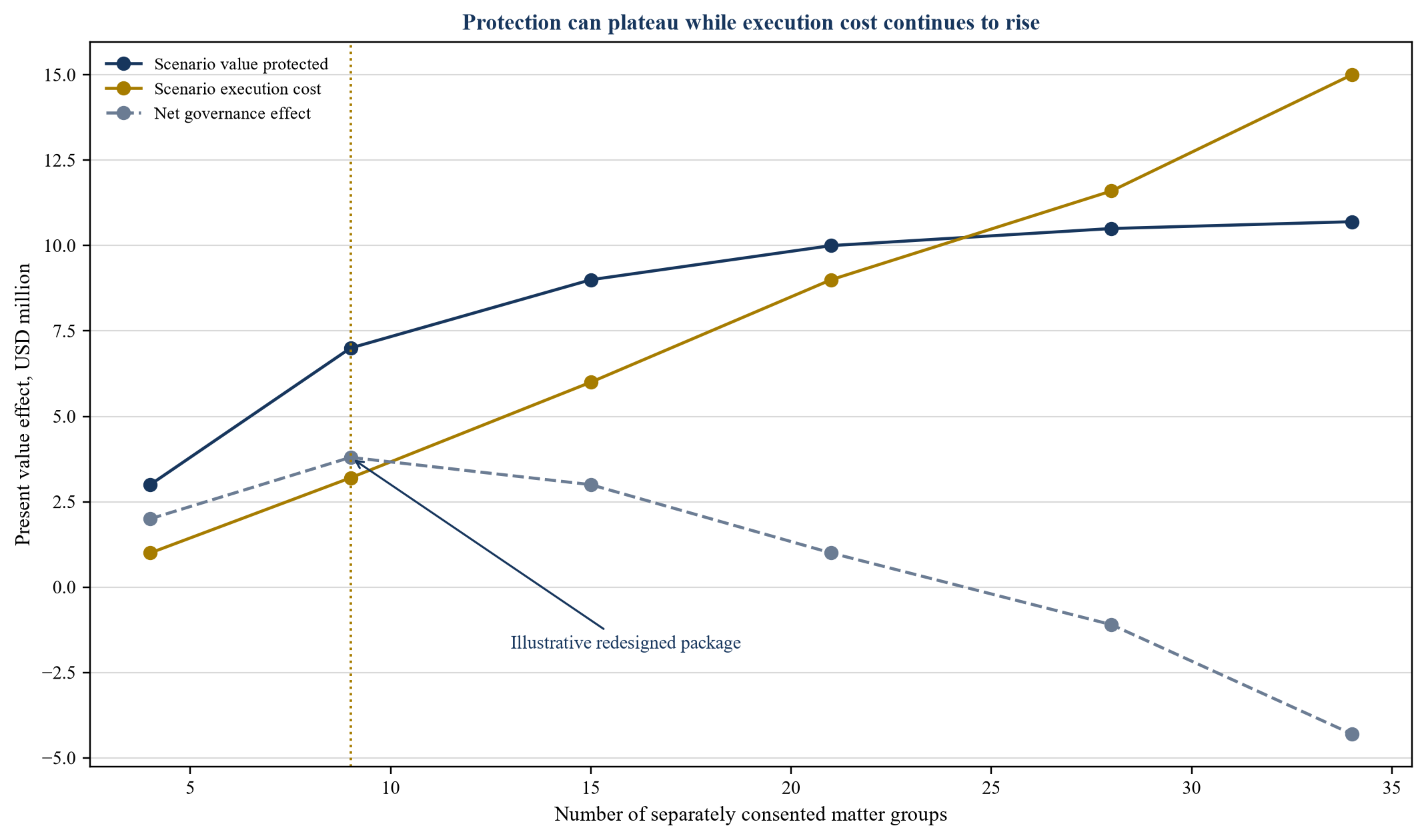
Values are illustrative and show the design method. They are not forecasts or market benchmarks.
19. Run a pre-signing governance simulation
The parties should test the final documents through specific decisions before signing. The simulation should include an acquisition, missed budget, emergency cyber response, down-round financing, chief executive departure, related-party contract, lender default and unsolicited sale proposal.
For each event, the team identifies who receives information, who recommends, who approves, the deadline, the fallback, conflicts and the documentary record. The test exposes circular approvals, inconsistent thresholds, missing emergency authority and rights that survive after the investor has sold most of its stake.
Counsel should reconcile the simulation with every operative document. Accountants should test control and significant influence. Tax advisers should test residence, grouping and incentive effects. Regulatory advisers should test merger, foreign-investment, sector and information-access consequences. Lenders should confirm compatibility with financing covenants.
The final board paper should include the rights map, cap table, scenario results, unresolved items and reasons for material departures from the agreed principles. This creates a record of the bargain and a reference for future directors.
20. Implement the package in ninety days
Closing is the start of governance. During the first thirty days, the company should constitute the board, adopt charters and delegation, establish the reporting calendar, refresh the conflict register and confirm bank and signing authorities. It should translate contractual rights into operating workflows.
Days thirty-one to sixty should test management accounts, budget reporting, acquisition approval and event notices. The board should review data quality and remove reports that do not support a decision. Investor requests outside the documents should be logged and addressed through the agreed channel.
Days sixty-one to ninety should review whether thresholds fit actual operations. Amendments should remain exceptional and properly approved. Administrative clarification can be documented in procedures where it does not alter legal rights.
An annual governance review should assess decision speed, consent volume, information quality, disputes, conflicts, financing capacity and whether any rights have reached a sunset. The review should not reopen economics without cause. It should keep the architecture aligned with company scale and the investment thesis.
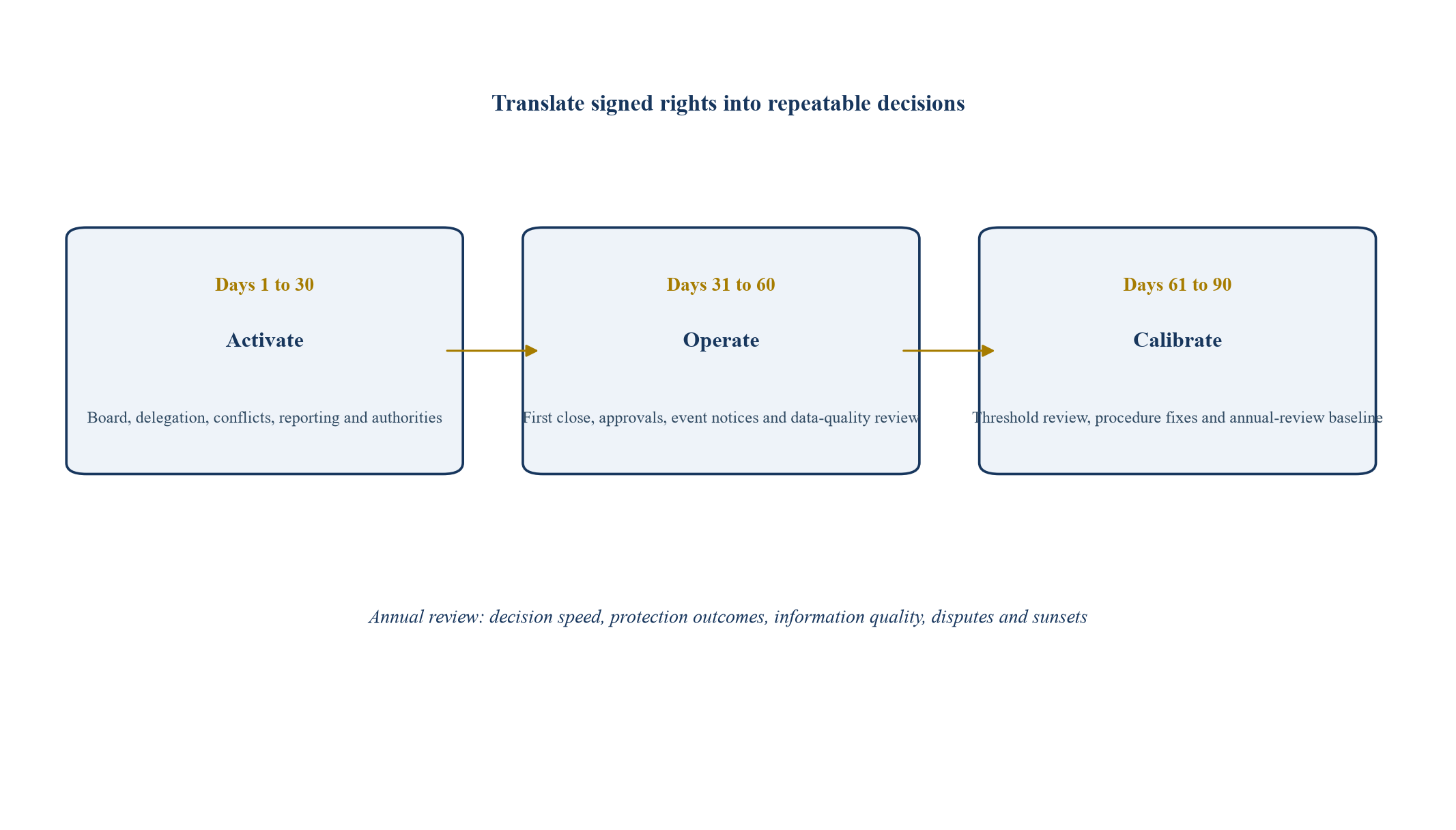
Timing is illustrative and should be adapted to transaction conditions and company readiness.
21. Use a board approval checklist
The board should confirm that the investment finances a defined plan and that the post-money cap table, proceeds and dilution reconcile. It should understand the investor's economic rights, return drivers and expected horizon.
It should confirm that board composition, quorum and removal rules preserve accountability; reserved matters protect defined risks; thresholds scale with the company; budget rules permit ordinary operation; and information rights are deliverable. It should examine future financing, transfer, exit, deadlock, leadership and related-party arrangements as an integrated system.
The board should receive current legal, accounting, tax, regulatory and financial advice for the relevant jurisdictions. It should understand which rights may create control, joint control, significant influence or regulatory consequences. It should confirm that remedies and enforcement are practical.
Finally, it should review the simulation results and the ninety-day implementation plan. Approval should record material judgements, conflicts, alternatives and any item deferred to definitive documentation.
22. Recognise limitations
This framework cannot determine the correct governance package without company-specific facts and current professional advice. Corporate law, director duties, accounting, tax, competition, foreign-investment, employment and securities requirements vary by jurisdiction and can change.
Contractual rights depend on drafting, enforceability and interaction with constitutional documents. Accounting conclusions depend on all facts and circumstances. A stated ownership percentage or label does not establish control or significant influence.
The hypothetical case demonstrates mechanics. Its amounts, thresholds, delay assumptions and present-value effects are not benchmarks or forecasts. Real modelling requires controlled company data, transaction terms and decision histories.
The framework addresses governance design. It does not replace commercial diligence on valuation, management, market, technology, customers, financing or exit. A well-designed package cannot rescue a weak investment thesis.
23. Maintain a governance evidence register
The governance package should be supported by a register that connects each negotiated right to the risk it addresses, the evidence used, the decision owner and the operational process required after closing. This register is different from a legal issues list. It explains how the bargain is expected to work in the company.
The first field identifies the protected interest. Examples include class economics, dilution, debt priority, business perimeter, related-party value transfer, information reliability and exit participation. The second field records the risk event and the measurable trigger. A generic statement that borrowing is material is insufficient; the register should identify the leverage, liquidity, security or ranking condition that changes the investor's exposure.
The third field records the authority path. It identifies the management sponsor, board committee, nominated director, investor consent threshold and fallback if the decision is urgent. The fourth field records the required information and its source. A debt consent may require an updated cash forecast, covenant model, term sheet, security map and finance recommendation. A related-party consent may require pricing evidence, alternatives, conflict disclosures and an independent recommendation.
The fifth field records the response clock. Time begins only when the agreed information package is complete. The company should know when silence has a defined effect and when an issue escalates. Deemed consent can be inappropriate for fundamental ownership matters, while an indefinite response period can be commercially damaging for time-sensitive operations. Different categories can therefore use different rules.
The sixth field records duration. Some rights should survive while any protected securities remain outstanding. Others can fall away below a holding threshold, after a public offering, on transfer to an unapproved holder or when the relevant debt is repaid. Sunset mechanics should address affiliate holdings, temporary transfers and aggregation.
The register should also identify interactions. A proposed acquisition can require board approval, investor consent, lender consent, merger-control clearance and a foreign-investment filing. Treating the investor approval as a separate step can produce incompatible timetables. An integrated conditions map shows the critical path and the party responsible for each submission.
After closing, the company secretary or general counsel should maintain the register. The board should review exceptions, missed clocks and repeated disputes. A high volume of requests in one category may indicate that a threshold is poorly calibrated or that management is operating outside the agreed plan. Repeated informal waivers may indicate that the documents no longer describe practice.
The annual review should preserve a clean distinction between interpretation and amendment. The board can clarify procedures, formats and calendars within existing rights. A change to thresholds, consent holders, remedies or sunsets normally requires the approvals specified in the documents. The record should show who approved the change and why it remains consistent with director duties and the investment thesis.
24. Conclusion
Minority capital works when protection and execution reinforce the same value-creation plan. The governance package should begin with the funded strategy, map actual authority across documents, separate ownership protection from operating control and connect each consent to a defined risk.
Board design, reserved matters, budget, information, conflicts, future financing, transfers and deadlock form one system. Thresholds, baskets, escalation clocks, emergency authority and sunsets keep that system proportionate as the company grows.
The practical test is decision simulation. If the company can execute ordinary operations and agreed growth while the investor can stop fundamental changes and abusive value transfer, the package is likely to support the transaction thesis. If routine decisions repeatedly require shareholder consent, practical control may have leaked even where legal ownership has not.
Sources
- OECD, G20/OECD Principles of Corporate Governance 2023, rights and equitable treatment of shareholders, Read the primary source
- National Venture Capital Association, Model Legal Documents, current page accessed 17 September 2026, Read the primary source
- UK Parliament, Companies Act 2006, including sections 168, 172, 561 and 994, Read the primary source
- IFRS Foundation, IFRS 10 Consolidated Financial Statements and June 2026 IFRIC Update on control, Read the primary source
- IFRS Foundation, IAS 28 Investments in Associates and Joint Ventures, Read the primary source
- UK Government, Unlocking Space for Investment Growth Hub, Term Sheet Key Points and Guardrails, Read the primary source
- US Department of the Treasury, 31 CFR Part 850, Provisions Pertaining to U.S. Investments in Certain National Security Technologies and Products in Countries of Concern, Read the primary source
- Delaware General Assembly, Delaware Code Title 8 section 122, including subsection 18 concerning contracts with stockholders, Read the primary source
- Delaware General Assembly, Delaware Code Title 8 section 141, Board of directors, Read the primary source
- OECD, Disclosure and transparency, G20/OECD Principles of Corporate Governance 2023, Read the primary source
- OECD, The responsibilities of the board, G20/OECD Principles of Corporate Governance 2023, Read the primary source
- National Venture Capital Association, Voting Agreement model document, Read the primary source
- UK Government, Statutory guidance on significant influence or control over companies, 2026, Read the primary source
- UK Government, PF2 Shareholders' Agreement draft consultation, reserved-matters schedule, Read the primary source
- Abu Dhabi Global Market, Companies Regulations 2020 announcement and current commercial-legislation resources, Read the primary source
- Dubai Financial Services Authority, Legislation portal including DIFC Companies Law 2018, Read the primary source
- British Business Bank, Equity finance for growing businesses, Read the primary source
- OECD, Sustainability and resilience, G20/OECD Principles of Corporate Governance 2023, Read the primary source
