

1. Define the staged-entry decision
The board decision is whether a minority position creates a better risk-adjusted route into a market than a full acquisition, joint venture, distribution agreement or greenfield build. The answer depends on the learning that ownership can produce, the capital placed at risk, the authority required to protect that capital, and the conditions under which the investor can increase, hold or exit its position.
A minority-first structure should begin with a clear entry thesis. The thesis may concern customer access, local licences, product-market fit, management capability, supply relationships or a technology platform. Each proposition needs observable evidence and a date by which the investor expects to receive it. A broad intention to learn the market provides a weak basis for pricing rights and future capital.
The structure should distinguish economic ownership, governance influence and legal control. A 20 or 25 per cent shareholding does not describe the full position. Board appointment rights, quorum, vetoes, options, shareholder dispersion and contractual dependencies can change the practical allocation of authority. IFRS 10 requires control to be assessed from power over relevant activities, exposure to variable returns and the ability to use that power to affect returns. Potential voting rights can matter when they are substantive. [2]
The decision paper should answer six questions. What evidence is unavailable today? Which rights are needed while that evidence is gathered? Which milestones justify more capital? What events permit a pause or exit? When could the first step itself trigger regulatory or accounting consequences? What value remains if full acquisition never occurs?
The investment committee should approve a bounded first-step mandate. It should state the maximum initial exposure, governance package, information required, commercial experiments, prohibited conduct, option economics and exit protections. This prevents a small initial cheque from becoming an open-ended commitment.
2. Identify what minority ownership must prove
Minority ownership creates value when it produces evidence that a lighter commercial agreement cannot provide. The investor may need access to board-level budgets, customer-cohort economics, product investment, regulatory engagement or management performance. It may also need influence over the resources allocated to the joint commercial plan.
The diligence team should convert the market-entry thesis into testable questions. A customer-access thesis might require signed contracts, gross retention, collection evidence and repeat orders. A product-localisation thesis might require regulatory clearance, technical acceptance and support economics. A management thesis might require delivery against an agreed operating plan without extraordinary investor intervention.
The evidence plan should define source, owner, frequency and acceptance standard. Management presentations are useful context, but milestone decisions should rely on signed contracts, system extracts, bank receipts, regulatory records, customer confirmations or another source appropriate to the claim. The investor should retain the right to examine underlying records while respecting privacy, competition law and confidentiality.
The company needs clarity about the resources expected from the investor. Introductions, procurement access, brand use, technical support and follow-on capital should be described rather than assumed. A milestone can fail because the investor did not provide an agreed dependency. The structure should allocate responsibility and specify the consequence of an unfulfilled dependency.
The first phase should have a defined learning budget. Transaction cost, management time, market development, product change and integration preparation consume resources before control. These costs belong in the staged-entry case and should be compared with the cost of the principal alternatives.
3. Separate ownership, influence and control
Legal share percentage is one input to the control analysis. The rights attached to the shares and the factual pattern can be equally important. IFRS 10 asks which activities significantly affect returns, how decisions about those activities are made and whether the investor has the current ability to direct them. [2] IAS 28 uses significant influence for associates and includes a rebuttable presumption around 20 per cent of voting power, subject to the evidence. [3]
Competition and investment-screening regimes apply their own tests. The European Union Merger Regulation defines control through rights, contracts or other means that confer the possibility of decisive influence. Rights over board composition, voting or decisions can therefore matter before majority ownership. [6] The United Kingdom can examine material influence under merger control, and its national-security regime can consider a stake below 25 per cent when the surrounding facts provide material influence. [8][9]
The transaction team should maintain a control map for every stage. It should show equity, votes, board seats, quorum, reserved matters, options, funding rights, information access, commercial dependencies and the ownership of other shareholders. Accounting, competition, foreign-investment and takeover analyses should use the same factual map while applying their distinct legal tests.
The parties should avoid labelling rights as merely protective without analysing their substance. A veto over changes to constitutional documents differs from a veto over annual budgets, senior appointments, pricing or market strategy. The latter group may affect relevant activities or competitive conduct.
Control analysis should be refreshed when facts change. Shareholder dispersion, board practice, a funding default, an exercised option or a revised commercial agreement can alter the conclusion even when the initial percentage remains unchanged.
4. Build the governance-rights matrix
The governance package should connect each right to a specific exposure. Constitutional protections preserve the investor's class rights and economic bargain. Value protections address dilution, asset transfers, related-party dealings and exceptional leverage. Operating rights concern budgets, management, products and commercial strategy. Information and assurance rights support monitoring. Exit rights create a route when the relationship or thesis fails.
A useful matrix records the decision, ordinary authority, investor role, threshold, evidence and remedy. It should identify which matters require consent, which require consultation and which require notice. Excessive consent rights can slow ordinary operations and create an unintended control conclusion. Weak rights can leave the investor funding a strategy it cannot monitor or protect.
The OECD's corporate-governance principles support equitable treatment of shareholders, effective redress, disclosure of material related-party transactions and protection against abusive self-dealing. They also recognise devices such as pre-emption rights and qualified majorities where appropriate. [1] These principles provide a useful design baseline, but the exact rights depend on company law and the transaction.
Reserved matters should use materiality thresholds. A veto over every contract or hire invites operational paralysis. A consent right can instead apply to transactions outside the approved budget, debt above a stated limit, disposal of material intellectual property, changes to the core business or related-party dealings above a threshold.
The matrix should include emergency authority. Management may need to act quickly to protect life, comply with law or prevent material loss. The agreement can require prompt notice and retrospective review while preserving lawful operational action.
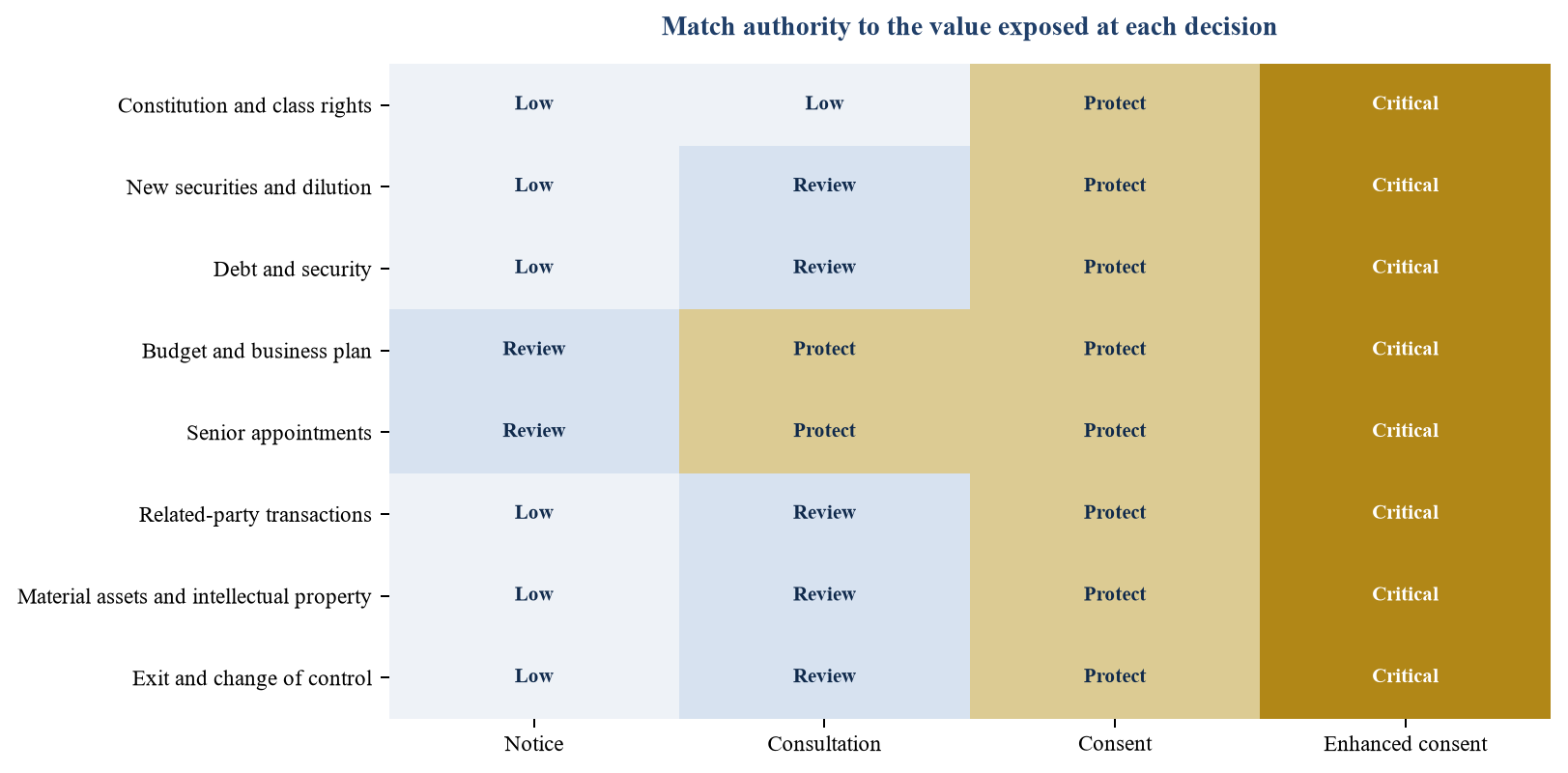
Original framework. Rights and thresholds require transaction-specific legal, accounting and regulatory analysis.
| Decision area | Ordinary authority | Proposed investor protection | Evidence and threshold |
|---|---|---|---|
| Approved budget | Management and board | Consent only for material departure | Variance above agreed amount or change in strategic direction |
| New debt or security | Board within plan | Consent above leverage and security limits | Pro forma liquidity, covenant and ranking analysis |
| New securities | Shareholders under applicable law | Pre-emption and class protection | Fully diluted ownership and use of proceeds |
| Related-party transaction | Disinterested directors | Independent review and consent above threshold | Comparable terms, conflicts register and valuation |
| Material intellectual property | Board within ordinary operations | Consent for disposal, exclusive licence or encumbrance | Rights schedule and effect on the entry thesis |
| Senior leadership | Board | Consultation or consent for defined critical roles | Role, succession and business-plan effect |
Original framework. The examples do not prescribe legal terms.
5. Define board composition and information flow
The board design should provide informed oversight without turning every operating decision into a shareholder negotiation. The investor may appoint one director, nominate an observer or receive committee access. The choice depends on the ownership level, regulatory position, conflicts and information needed.
A director owes duties under the law governing the company. Those duties may differ from the investor's commercial preferences. The appointment process should therefore include a clear mandate, induction, conflicts protocol, access to advice and a route for recusal. An observer may reduce some governance complexity but can still receive sensitive information and influence discussion.
Board materials should follow an agreed calendar and minimum content standard. The package may include financial performance, cash, customer concentration, product delivery, risk, compliance, litigation, financing and progress against market-entry milestones. Information rights should address source systems, audit access, data protection, privilege and permitted use.
Competition law can constrain information exchange between actual or potential competitors. The parties should identify competitively sensitive material and use aggregation, clean teams or external advisers where required. The first investment does not automatically permit unrestricted access to prices, customers, strategy or bids.
The agreement should address late, incomplete or inconsistent reporting. A practical escalation sequence may require correction, finance certification, independent review and a temporary pause on the next investment step. A remedy should correspond to the importance of the missing evidence.
The board should review whether rights operate as intended. Repeated investor intervention in ordinary business may indicate a weak management model or a different control reality from the documented design.
6. Calibrate reserved matters without paralysis
Reserved matters protect the investor against changes that could destroy the basis of its investment. They should focus on exceptional decisions and material deviations. The list needs definitions, thresholds, response times and a consequence when consent is withheld.
The parties should distinguish hard protections from operating preferences. Issuing senior securities, changing class rights, selling the core business or transferring material intellectual property normally affects the investment bargain directly. Product pricing, routine hiring or individual customer contracts may belong within the approved plan and management authority.
Thresholds should scale with the company. A fixed monetary threshold can become obsolete as revenue grows. The agreement can use a percentage of revenue, assets, budget or enterprise value, accompanied by an absolute floor. Aggregation rules should prevent related transactions from avoiding review.
Consent mechanics need a clock. The investor should receive sufficient evidence and a stated number of business days to respond. Silence can mean approval, rejection or no decision; the agreement should choose expressly. Emergency and legal-compliance exceptions require careful drafting.
The board should record why each reserved matter exists. This discipline helps counsel assess control and allows the parties to remove or narrow rights when milestones are achieved. Governance can evolve as evidence improves.
An annual calibration review can compare the list with actual use. Frequent consents may show that thresholds are too low or that the approved plan lacks detail. No use may indicate either good discipline or rights that address remote risks. The review should examine the facts.
7. Design commercial milestones that can be verified
Milestones should measure the market-entry thesis rather than reward activity. A distributor agreement, pilot or regulatory filing may be an input. Evidence of customer adoption, paid revenue, unit economics, regulatory permission or reliable delivery may provide a stronger decision basis.
Each milestone needs a definition, measurement period, data source, verifier and treatment of exceptional items. Revenue should identify whether it is contracted, invoiced, recognised or collected. Customer measures should address related parties, concentration, returns and cancellations. Product measures should identify acceptance authority and material defects.
The investor should model dependencies. A milestone may require capital, introductions, licences or product changes that one party controls. The agreement should state the consequences of delay caused by the investor, company, regulator or force majeure. Automatic extension can be appropriate for a narrow external delay, while a failed commercial result may require a new decision.
Milestones should avoid binary cliffs where evidence is continuous. The parties can use bands that alter price, ownership or timing within agreed limits. A banded structure needs protection against manipulation and a clear calculation example.
The milestone certificate should reconcile source records to the contractual definition. Management can prepare it, finance can verify it and an independent expert can resolve a defined accounting dispute. The expert's remit should distinguish factual calculation from legal interpretation.
The investment committee should retain discretion where the thesis depends on qualitative evidence, but that discretion should be bounded. The parties need to know whether the next step is automatic, optional or subject to fresh approval.
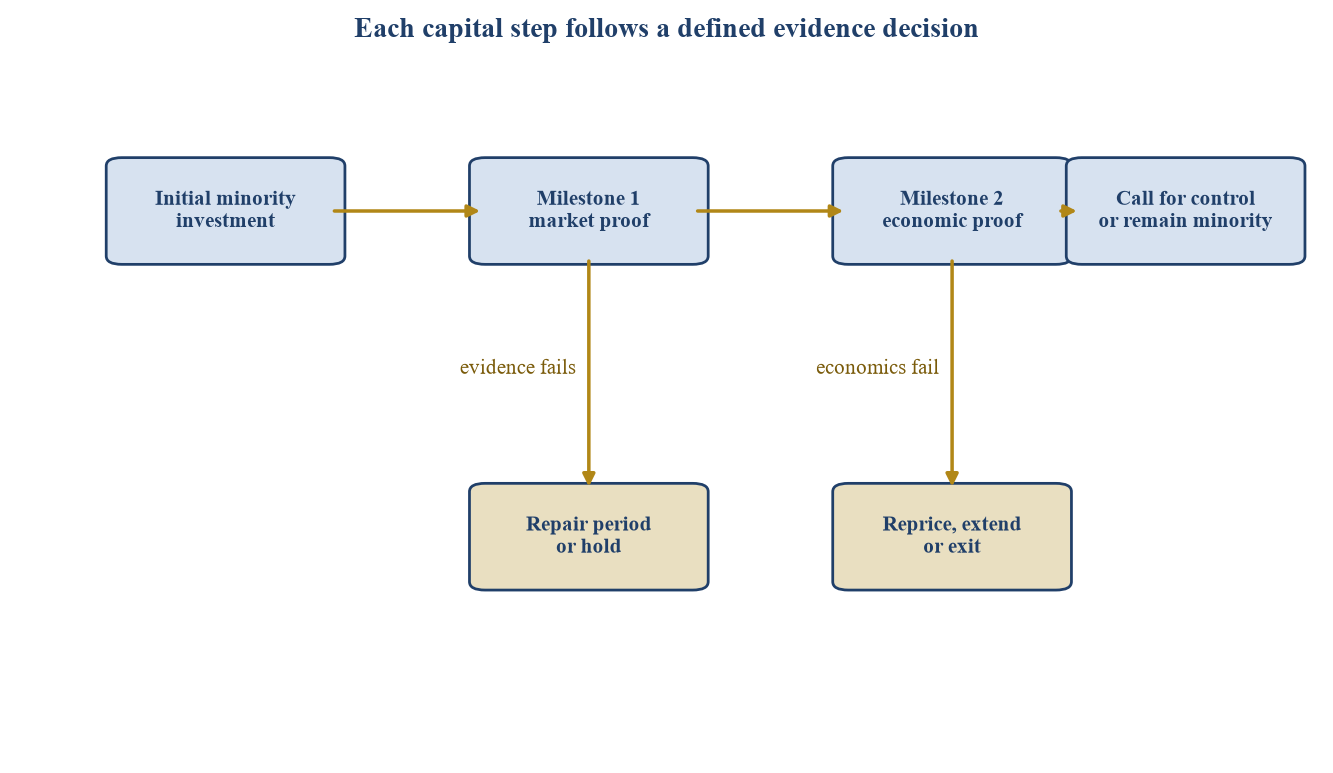
Original framework. A live structure requires negotiated definitions, evidence standards and regulatory conditions.
| Milestone | Measure | Evidence | Decision consequence |
|---|---|---|---|
| Market proof | Paid third-party revenue and repeat customer behaviour | Contracts, invoices, system records and bank receipts | Continue commercial plan or enter repair period |
| Product proof | Regulatory and customer acceptance of defined release | Approval record, acceptance test and defect register | Release localisation budget or defer |
| Economic proof | Contribution after service and support costs | Reconciled revenue and attributable cost ledger | Exercise, reprice, extend or hold |
| Management proof | Delivery within approved resources and controls | Board packs, budget variance and risk record | Confirm operating autonomy and succession depth |
| Control readiness | Required approvals, funding and integration evidence | Regulatory advice, financing commitments and integration plan | Permit call exercise and completion process |
Original framework. Measures require company-specific definitions and assurance.
8. Price the initial stake and future option
The initial price should reflect the rights, risk and information available at signing. A minority interest may have less ability to direct cash, strategy or exit than a controlling position. Its value also includes negotiated rights and the strategic option to increase ownership. The model should keep these components visible.
IFRS 13 defines fair value as an exit price in an orderly transaction between market participants at the measurement date. It requires market-participant assumptions and an appropriate allowance for risk. [5] Transaction price, negotiated strategic value and accounting fair value can differ. The investment committee should understand which measure supports each decision.
The future call price can be fixed, formula-based or determined at exercise. A fixed price gives clarity but can transfer substantial upside or downside between the parties. A multiple formula needs definitions for earnings, debt, cash, exceptional items and accounting changes. A fair-market-value process needs the valuation date, standard of value, information rights, appraiser appointment and dispute procedure.
Milestone adjustments should avoid double counting. If improved revenue raises the exercise multiple and the earnings base, the investor may pay twice for the same result. Conversely, a formula that ignores funded growth can undercompensate the founders. The model should bridge operating performance, capital contributed, dilution, debt and option terms.
The option premium may be embedded in the initial price, a separate payment or the commercial resources committed by the investor. The board should record the consideration for exclusivity and control rights, including opportunity cost to the company.
Tax, accounting and legal advisers should assess the instrument before signing. Classification, measurement and later remeasurement can affect reported earnings, equity and distributable reserves.
9. Make potential voting rights operationally clear
Calls, puts, convertibles and warrants can alter control before exercise when they are substantive. IFRS 10 examines the terms and conditions, exercise timing and whether the holder has a practical ability to exercise. [2] The analysis should consider economic incentives, regulatory conditions, financing and other barriers.
The option agreement should define the security acquired, price mechanics, exercise window, conditions, completion process and consequences of breach. It should also address whether the option can be transferred, pledged, accelerated or terminated.
Conditions should be divided into those within a party's control and external conditions. Regulatory clearance, lender consent and third-party approval may delay completion. A party should not be able to frustrate exercise by withholding an action it agreed to take. Cooperation covenants and long-stop dates should match the expected process.
The option should work with the shareholders' agreement. A call that transfers shares without updating board rights, restrictive covenants, information rights and exit provisions leaves an incomplete control transition. The documents should define which minority rights fall away, which protections continue and how governance changes at completion.
Funding certainty matters. An option that the investor cannot finance may provide limited strategic protection. The board should understand whether financing is committed, conditional or expected from future cash. The exercise price, transaction cost, refinancing and working-capital needs should be modelled together.
The parties should also plan for an option that expires. Governance, commercial agreements, brand use, data access and exclusivity may need to continue, reset or terminate. The residual minority relationship requires its own sustainable terms.
10. Control dilution and future financing
A growing company may need further equity before the control option becomes exercisable. The staged-entry plan should state who funds the business, how new securities are priced and what happens when a party does not participate.
Pre-emption rights can preserve proportionate ownership, subject to agreed exceptions. The agreement should define the fully diluted denominator, employee-option pool, convertibles, warrants and securities issued for acquisitions. It should also address emergency financing and bona fide third-party rounds.
Anti-dilution protection can preserve economic value when shares are issued below a reference price. Broad protections can obstruct necessary financing or shift too much risk to founders and later investors. A weighted-average adjustment may produce a different result from a full-ratchet mechanism. The parties should model both before agreeing terms.
Funding default needs a proportionate consequence. Dilution, shareholder loans, suspension of rights or third-party funding can preserve the business. A punitive transfer may be challenged or create a negotiation crisis. Counsel should align the remedy with applicable law and the commercial purpose.
The option formula should specify how new capital affects price. Cash contributed after the first investment can increase enterprise value and alter net debt. The calculation should distinguish performance value from balance-sheet funding.
The board should maintain a cap-table model through every planned round and option outcome. It should show ownership, voting rights, preference claims, proceeds and control. A single percentage on a headline term sheet is insufficient.
11. Prevent value leakage and conflicts
Minority investors cannot rely on operational control to prevent value leaving the company. The governance design should therefore address dividends, management charges, related-party contracts, asset transfers, loans, guarantees, intellectual-property licences and exceptional remuneration.
The company should maintain a complete related-party register and a process for identifying conflicts before commitment. Material transactions can require disinterested board review, comparable terms, independent valuation or investor consent. The standard should fit the size and recurrence of the transaction.
Ordinary founder remuneration and group services should be documented. Unclear arrangements can turn routine payments into recurring disputes. The agreement should define approved compensation, reimbursable cost, service scope and changes that require review.
Transfer pricing, tax and substance need professional analysis when the staged entry crosses borders. A commercial agreement between the investor and company should allocate functions, assets and risks consistently with actual conduct. Pricing should be supported by evidence appropriate to the jurisdictions.
The investor also creates conflicts. It may own competing businesses, receive sensitive information or direct opportunities elsewhere. The documents should address confidentiality, corporate opportunities, customer allocation, abstention and use of information. Board members need a workable conflicts procedure.
Leakage monitoring should use reconciled financial data. Related-party balances, unusual cash movements, new guarantees and intellectual-property changes belong in the regular board pack. Rights provide protection only when evidence reveals the event in time to act.
12. Protect intellectual property, data and customers
Many market-entry theses depend on technology, data, brand or customer relationships. The diligence should establish ownership, permitted use, territorial rights, employee and contractor assignments, open-source obligations, licences, privacy conditions and encumbrances.
The investor may contribute data, models, distribution or brand. The agreement should identify background rights, newly created rights, improvements, training data, outputs and rights after termination. Broad language that all developments belong to one party can conflict with the actual technical work and local law.
Customer access should follow consent, confidentiality and competition rules. A minority investment does not automatically permit the investor to contact, cross-sell to or analyse every customer. Commercial experiments should identify the permitted audience, offering, data flow, economics and complaint handling.
Exclusivity should be narrow enough to preserve company value if the control step never occurs. Territory, customer segment, product, duration, performance standard and termination should be explicit. An investor that receives exclusivity without delivering agreed resources can constrain the company and depress future value.
Brand use needs quality control and an exit plan. The parties should define approvals, regulated communications, claims, incident response and the time allowed to remove branding after termination.
The board should connect each protected asset to the milestones and option price. A loss of a critical licence or customer contract may alter the thesis, while an ordinary renewal delay may require cure rather than termination.
13. Plan the regulatory path before signing
The first minority step, later option exercise and intermediate governance changes can each produce regulatory consequences. The transaction timeline should map all three stages rather than treating approval as a concern only for the final acquisition.
Under the European Union Merger Regulation, a concentration can arise when rights or contracts confer decisive influence. A transaction with an EU dimension must be notified before implementation. [6] The parties should assess whether the initial rights, option or later exercise creates sole or joint control and whether national regimes also apply.
The European Commission's consolidated jurisdictional notice explains how minority shareholdings, preferential rights and stable voting patterns can support an assessment of de facto control. The analysis depends on the likely voting pattern and the shareholder's position, rather than the registered percentage alone. [7]
The United Kingdom's merger-control guidance addresses material influence as well as legal and de facto control. [8] The National Security and Investment Act applies specified share and voting thresholds and can also cover material influence. Its guidance gives an example in which a 20 per cent stake held by the largest shareholder may confer material influence, depending on the facts. [9]
The United States Hart-Scott-Rodino investment-only exemption is narrow. The Federal Trade Commission explains that an acquisition of 10 per cent or less may qualify only when made solely for investment, and active participation can be inconsistent with that purpose. [11] Current thresholds and exemptions require transaction-specific checking.
Regulatory analysis should also cover sector licences, foreign-ownership limits, data, financial services, telecommunications, defence, health, energy and land where applicable. The agreement should allocate filing responsibility, information, remedies, cost, conduct obligations and long-stop risk.
The board should receive a written stage-by-stage regulatory map before signing. It should identify actions the parties must avoid before clearance, including premature coordination or transfer of competitively sensitive control.
14. Address takeover and disclosure thresholds
Listed or widely held companies create additional constraints. Ownership, acting-in-concert arrangements, derivatives and voting agreements can affect disclosure and mandatory-offer analysis. The parties should identify the applicable market rules before building the stake.
The UK Takeover Code uses a 30 per cent threshold in Rule 9 for mandatory offers in covered circumstances and also addresses acquisitions between 30 and 50 per cent. [10] The exact application depends on the company, concert parties and interests in shares. The Panel should be consulted where required.
In the United States, beneficial ownership above 5 per cent can trigger Schedule 13D or 13G reporting under the Securities Exchange Act, subject to filer status and current rules. The Securities and Exchange Commission amended reporting deadlines and related requirements in 2023. [12] Investors should verify the current regime at the time of the transaction.
Public disclosure can affect price and negotiation. The staged-entry plan should include announcement responsibility, confidentiality, leak response and consistency across regulatory filings, investor communications and accounting disclosures.
Derivatives, options and voting arrangements should be included in the ownership map where relevant. An economic position may differ from registered shares, and several instruments may be aggregated under applicable rules.
The investment committee should set a hard pre-trade control. No stake-building, option, voting commitment or public communication should occur until counsel confirms the applicable thresholds and process.
15. Design deadlock and escalation
Deadlock provisions should preserve the business while the parties resolve a material disagreement. They should identify which decisions can deadlock, who first escalates, the evidence required and what happens during the process.
Operating matters within an approved plan should continue. A deadlock over a new strategy should not automatically stop payroll, customer service or legal compliance. The agreement should define an interim budget and authority when a new plan is not approved.
Escalation can move from management to board representatives and then to identified principals. Mediation or expert determination can help when the issue is technical, accounting or valuation-based. An expert should decide matters within a defined competence rather than rewrite the commercial bargain.
Buy-sell mechanisms can end a relationship but may favour the party with greater liquidity. A Russian-roulette or Texas-shoot-out provision can produce a price, yet its fairness depends on funding capacity, information symmetry and regulatory feasibility. A put, call or third-party sale may be more suitable.
The agreement should treat bad faith, fraud, sanctions, illegality and material breach separately from ordinary disagreement. Cure periods and interim protections should reflect the severity and reversibility of the event.
The board should test the mechanism through scenarios before signing. It should ask who funds the purchase, how value is determined, whether approvals are available, how customers and employees are protected, and what happens if neither party can complete.
16. Build a hypothetical staged-entry model
Consider a hypothetical company with an agreed initial equity value of USD 100 million and no net debt for the simplified calculation. An investor acquires 24 per cent for USD 24 million. The investor also commits USD 4 million of market-development resources under a separately governed commercial plan. Existing shareholders retain 76 per cent.
Milestone 1 requires USD 12 million of collected third-party revenue in the new market over twelve months, gross retention of at least 90 per cent and no single customer above 25 per cent of that revenue. Milestone 2 requires USD 4 million of contribution after directly attributable support and market cost over the following twelve months, together with specified regulatory and management evidence.
If both milestones are met, the investor can acquire another 27 per cent and reach 51 per cent. The hypothetical call price equals 27 per cent of an equity value calculated at eight times verified maintainable EBITDA, less net debt and plus surplus cash, subject to a USD 108 million floor and USD 162 million cap. All definitions would require detailed legal and accounting drafting in a live deal.
Assume verified maintainable EBITDA of USD 16 million and net debt of USD 8 million at exercise. Eight times EBITDA gives enterprise value of USD 128 million. Deducting net debt produces equity value of USD 120 million, within the cap and floor. The 27 per cent call price is therefore USD 32.4 million before transaction cost and any agreed adjustments.
The investor's total share-purchase consideration becomes USD 56.4 million for 51 per cent. The separate USD 4 million commercial commitment remains a programme cost rather than purchase consideration in this simplified investment view. The model should keep both cash demands visible.
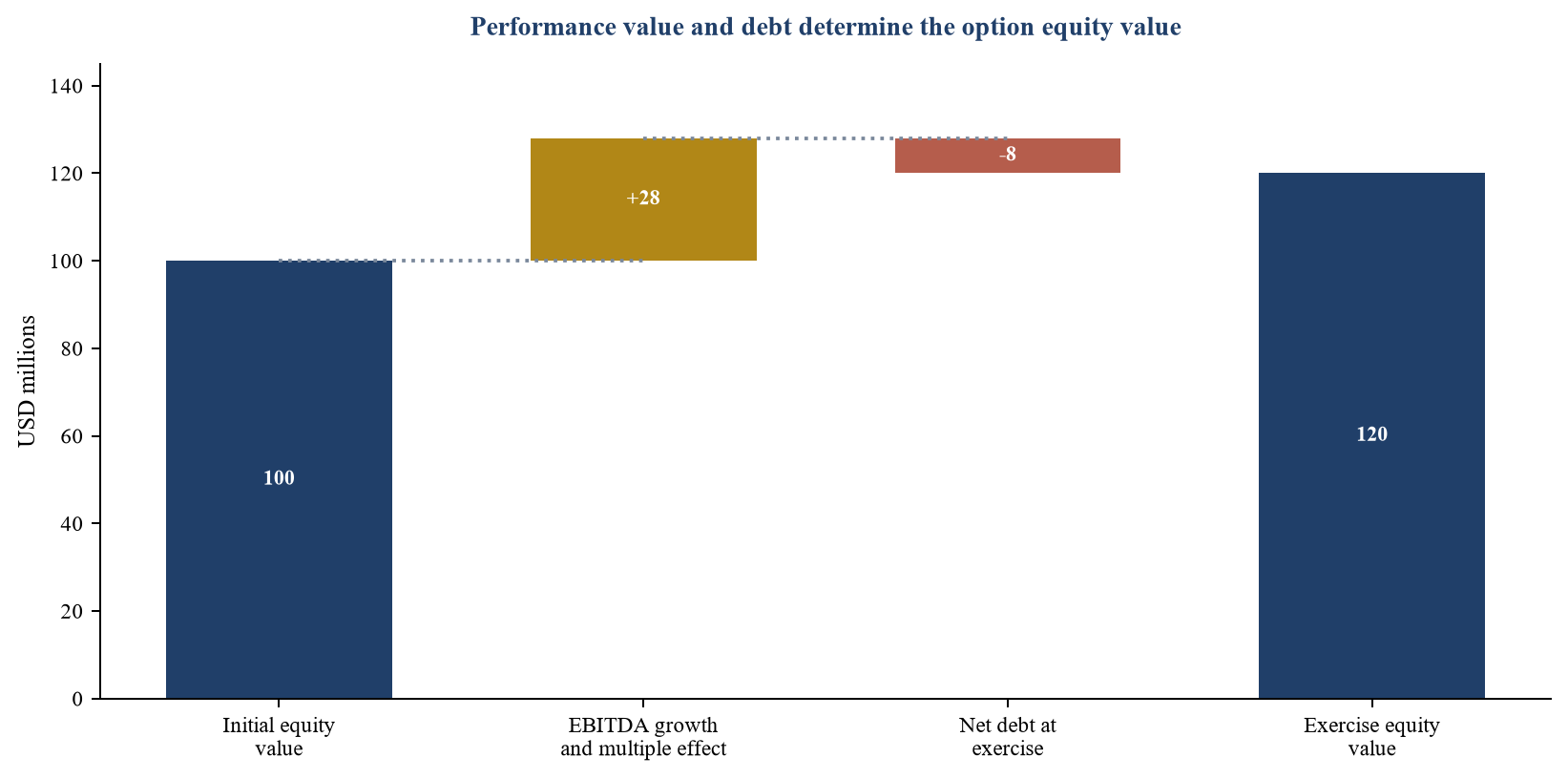
Original illustrative calculation. Amounts are USD millions and describe no company or forecast.
| Measure | Initial step | Call step | Combined position |
|---|---|---|---|
| Equity acquired | 24% | 27% | 51% |
| Reference equity value | USD 100.0 million | USD 120.0 million | Stage-specific values |
| Share-purchase cash | USD 24.0 million | USD 32.4 million | USD 56.4 million |
| Separate commercial commitment | USD 4.0 million | None assumed | USD 4.0 million |
| Investor governance | One board seat and calibrated protections | Control transition | Majority governance subject to law and documents |
| Evidence condition | Closing diligence | Two milestones and control readiness | Continuing integration and performance evidence |
Original illustrative calculations. Amounts and outcomes describe no company and are unsuitable as forecasts.
17. Test valuation and dilution sensitivities
The central illustration should be tested against performance, leverage and new financing. If maintainable EBITDA reaches USD 12 million, the eight-times calculation gives USD 96 million of enterprise value. With USD 10 million of net debt, the formula produces USD 86 million of equity value, so the USD 108 million floor applies and the 27 per cent call costs USD 29.16 million.
If maintainable EBITDA reaches USD 22 million and net debt is USD 4 million, the formula produces USD 172 million of equity value. The USD 162 million cap applies and the call costs USD 43.74 million. The investor pays more when the company performs well, but the cap limits the founders' participation. The parties should understand this transfer of value at signing.
Suppose the company raises USD 20 million of primary equity at a USD 120 million pre-money value before option exercise and the investor does not participate. The original 24 per cent position falls to approximately 20.6 per cent before considering any employee pool expansion. An option for a fixed 27 per cent of the company would then produce only about 47.6 per cent, below control. The option needs a precise basis or a mechanism that delivers the intended post-exercise ownership.
The model should also include preference claims. A later investor may receive a liquidation preference, senior dividend or anti-dilution protection. Ordinary ownership percentages do not show the proceeds waterfall. The control investor could hold 51 per cent of votes while receiving a smaller share of a downside sale.
Sensitivity work should identify the terms that drive value rather than present a single return. EBITDA definition, net debt, cap, floor, dilution, option percentage, timing, tax and transaction cost can each change the result materially.
18. Evaluate hold, exercise, sale and failure outcomes
The structure needs a credible path for every outcome. If the thesis performs and control is attractive, the investor can exercise subject to approvals and funding. If the business performs but control is unattractive, the investor may remain a minority holder under sustainable governance. If the thesis fails, the parties need a repair, sale or exit process. If the relationship fails, conduct and deadlock provisions should protect continuity.
A hold case should specify future governance after the option window. Information, board and protection rights may continue, step down or depend on ownership. Commercial exclusivity and brand arrangements should have their own terms. The company should remain financeable by third parties.
A third-party sale can use tag-along, drag-along and right-of-first-offer provisions. These rights should work with the investor's option and any takeover or foreign-investment constraints. A strategic buyer may value the company differently and require access to sensitive information.
A put can provide liquidity after specified events, but its value depends on the obligor's capacity to pay. Security, instalments or external financing may be required. A company purchase may face legal restrictions on distributions and capital maintenance.
Failure outcomes should separate commercial underperformance from misconduct or permanent regulatory prohibition. Underperformance may support a repriced option or orderly sale. Fraud, sanctions or deliberate leakage may justify stronger remedies, subject to law and evidence.
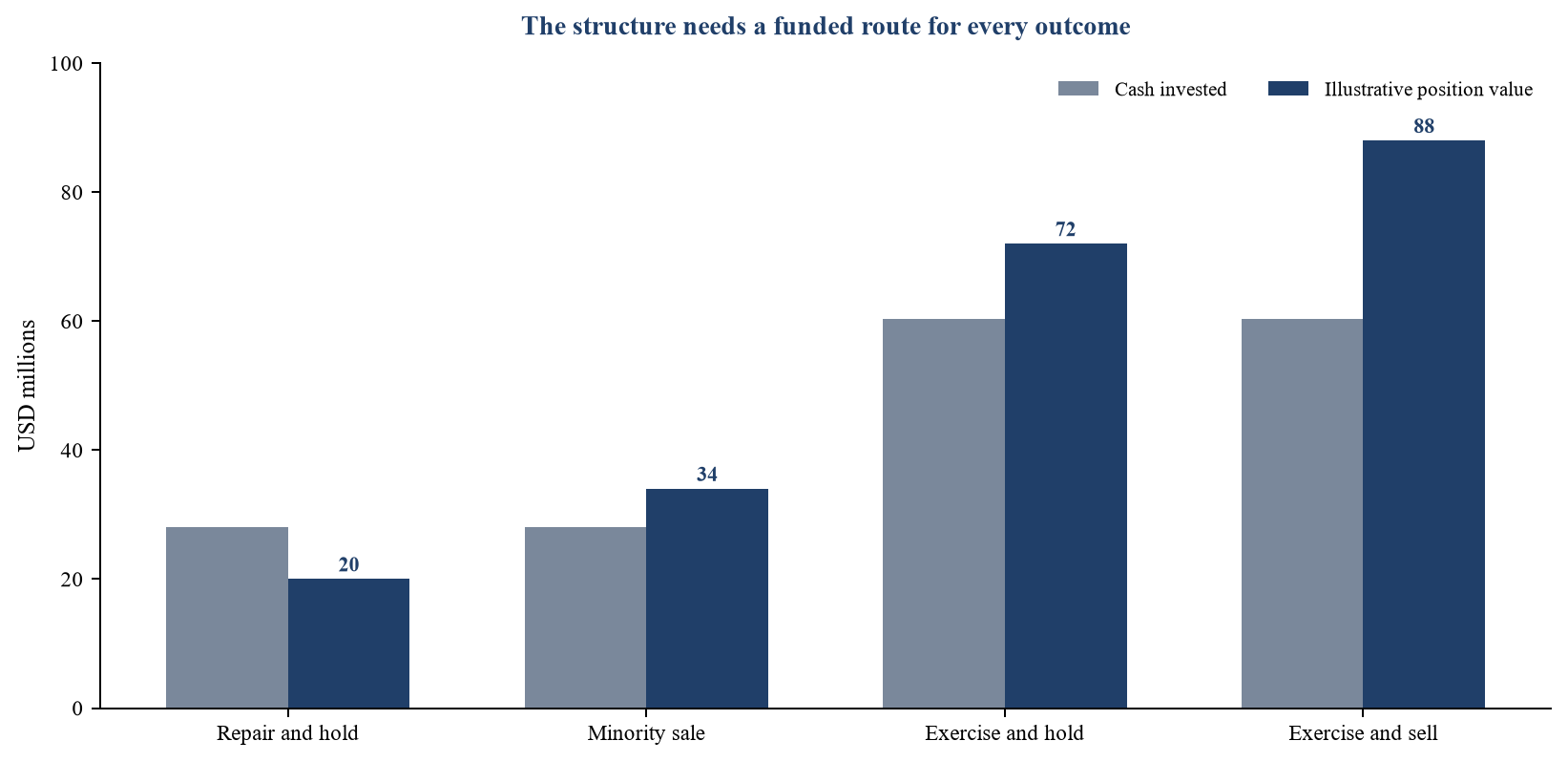
Original illustrative model. Values are USD millions at the stated decision date and exclude tax and transaction costs.
| Outcome | Trigger | Governance state | Required preparation |
|---|---|---|---|
| Repair and hold | Milestone gap can be cured | Minority protections continue with targeted remediation | Funded plan, revised dates and evidence owners |
| Remain minority | Business performs but control case is weak | Sustainable associate or strategic-shareholder model | Long-term information, financing and exit terms |
| Exercise for control | Milestones and approvals are satisfied | Rights transition to majority governance | Financing, step-acquisition accounting and integration plan |
| Third-party sale | Strategic value or relationship exit | Sale process under tag, drag and transfer rights | Data room, confidentiality, approvals and proceeds waterfall |
| Put or structured buyout | Defined breach, deadlock or time event | Interim protections until payment and transfer | Credit support, instalments, valuation and default remedies |
Original framework. Legal feasibility, funding and valuation require transaction-specific review.
19. Account for a step acquisition
When an investor obtains control after previously holding a minority interest, IFRS 3 treats the transaction as a business combination achieved in stages. The acquirer remeasures its previously held interest at acquisition-date fair value and recognises the resulting gain or loss as required by the standard. [4]
The accounting effect can be material. The initial carrying value may differ from fair value at control. The acquisition method also requires identification and measurement of acquired assets and liabilities, goodwill or bargain-purchase treatment, consideration and non-controlling interests. Finance should model the potential effect before option exercise.
The option price does not by itself establish fair value. The contractual formula may contain a floor, cap, strategic premium or penalty. Valuation should use the applicable accounting standard and market-participant assumptions. [5]
The company and investor should preserve evidence from the initial step. Forecasts, board papers, milestone records, financing rounds and option negotiations can help explain changes in value. Accounting teams need access to contracts and regulatory conclusions, not only the final cap table.
Tax consequences can arise at the first investment, option grant, exercise, remeasurement, transfer and later exit. Cross-border withholding, capital gains, stamp duties, transfer pricing and tax residence require advice in the relevant jurisdictions.
The investment committee should include accounting and tax cash effects in the exercise decision. A commercially attractive call can still create earnings volatility, tax cost or disclosure that needs board preparation.
20. Prepare the control transition before the call
The investor should begin integration planning before it decides to exercise, subject to competition-law limits. The plan should identify leadership, governance, systems, customers, people, finance, risk, licences and value initiatives. It should separate permissible planning from implementation that must wait for clearance and completion.
The control-readiness gate should confirm funding, regulatory approvals, transaction documents, purchase accounting, operational continuity and a day-one authority map. It should also show which minority-era commercial arrangements continue, terminate or become internal group arrangements.
Management succession deserves early attention. The founders may remain, change roles or exit. The investor should test decision authority, incentives, restrictive covenants, knowledge transfer and succession depth. A call exercised into a leadership vacuum can destroy the commercial evidence built during the minority phase.
Systems and data access should be sequenced. The investor may have received board information without having operational access. Control completion can therefore create new cyber, privacy and data-transfer requirements. The integration plan should define approved access, ownership and migration gates.
Value initiatives should link back to the model. Revenue, procurement, product, financing and overhead benefits need baselines, owners, cost and timing. Benefits observed during the commercial phase should be distinguished from those requiring control.
The board should retain the option to defer exercise when readiness is incomplete. A contractual right to buy does not compel a poorly prepared completion unless the documents make exercise automatic.
21. Operate an evidence-based governance calendar
The staged investment should run through a defined governance calendar. Monthly management reporting can cover cash, revenue, customer evidence, product delivery, risks and exceptions. Quarterly boards can approve strategy and assess milestones. Formal decision dates can determine whether to continue, repair, exercise or exit.
The evidence room should mirror the decision framework. It should contain constitutional documents, cap tables, board records, financial extracts, customer evidence, commercial-plan resources, regulatory analysis, intellectual-property records, related-party transactions, milestone certificates and valuation models.
Every material extract should identify source, period, owner and reconciliation. Adjustments should show their rationale and approval. This enables finance, legal advisers, regulators and independent experts to reproduce a decision without relying on personal recollection.
The investor should monitor leading and lagging indicators. Pipeline, product usage and regulatory progress can show direction. Collected revenue, contribution, renewals and compliance outcomes confirm realised evidence. The board should avoid treating pipeline or announced partnerships as equivalent to cash performance.
Exceptions need an owner, remedy, date and effect on the next decision. A missed milestone caused by a delayed licence differs from a missed milestone caused by customer churn. The register should preserve that distinction.
Independent assurance can focus on high-value definitions. Customer receipts, maintainable EBITDA, net debt, cap table, intellectual-property ownership and regulatory status often determine option value. Targeted verification can reduce the risk of a later dispute.
22. Use 30, 90 and 180-day execution gates
Before signing, the parties should agree the entry thesis, governance package, milestone definitions, option economics, regulatory map, funding plan and exit routes. Counsel, accountants, tax advisers and valuation specialists should review the integrated term set.
By day 30 after completion, the company should establish the reporting calendar, conflicts register, commercial-plan owners and evidence repository. The board should confirm bank authorities, cap table, approved budget and the first milestone baseline.
By day 90, the investor and company should have tested information flows, customer and product evidence, related-party controls and the resources each party committed. Any regulatory or operational assumption that differs from diligence should enter the exception register.
By day 180, the board should assess whether the market-entry thesis remains credible, whether governance is proportionate and whether funding supports the next period. It should refresh control, dilution, valuation and exit analyses using current facts.
At each formal milestone, the board should receive a decision pack that reconciles evidence to the contractual definition, explains exceptions, updates the financial model and states the available actions. The decision should be recorded with conditions and follow-up owners.
The minority-first strategy succeeds when it produces decision-quality evidence at a controlled capital cost and preserves viable choices. Full acquisition is one possible outcome. A durable minority holding, a third-party sale or an orderly exit can also protect value when supported by the agreed structure.
Sources
- Organisation for Economic Co-operation and Development. G20/OECD Principles of Corporate Governance 2023. 2023. Accessed 15 September 2026. Read the primary source
- IFRS Foundation. IFRS 10 Consolidated Financial Statements. Issued text. Accessed 15 September 2026. Read the primary source
- IFRS Foundation. IAS 28 Investments in Associates and Joint Ventures. Accessed 15 September 2026. Read the primary source
- IFRS Foundation. IFRS 3 Business Combinations. Issued text. Accessed 15 September 2026. Read the primary source
- IFRS Foundation. IFRS 13 Fair Value Measurement. Accessed 15 September 2026. Read the primary source
- Council of the European Union. Council Regulation (EC) No 139/2004 on the Control of Concentrations Between Undertakings. 20 January 2004. Accessed 15 September 2026. Read the primary source
- European Commission. Commission Consolidated Jurisdictional Notice under Council Regulation (EC) No 139/2004. 16 April 2008. Accessed 15 September 2026. Read the primary source
- UK Competition and Markets Authority. Mergers: Guidance on the CMA's Jurisdiction and Procedure. 23 December 2025. Accessed 15 September 2026. Read the primary source
- UK Cabinet Office. National Security and Investment Act: Guidance on Acquisitions. Updated 15 September 2026. Accessed 15 September 2026. Read the primary source
- UK Takeover Panel. The Takeover Code. 3 July 2025 edition. Accessed 15 September 2026. Read the primary source
- US Federal Trade Commission. Section 802.9: Acquisitions Solely for the Purpose of Investment. Accessed 15 September 2026. Read the primary source
- US Securities and Exchange Commission. Modernization of Beneficial Ownership Reporting, Release Nos. 33-11253 and 34-98704. 10 October 2023. Accessed 15 September 2026. Read the primary source
