

Introduction
Electricity, water, gas and district-cooling utilities are capital-intensive businesses with public obligations. Networks require renewal, demand growth requires capacity, decarbonisation requires new generation and flexibility, and digital systems require continued investment. The International Energy Agency estimated global energy investment at USD 3.3 trillion in 2025, including about USD 400 billion for grids. It also identified the financial condition of utilities as a constraint on grid investment in developing economies. Governments and state-owned utility groups therefore face a balance-sheet problem alongside an infrastructure problem.
A minority stake sale can release capital from a mature business while leaving the state as controlling shareholder. The mechanism can be a public offering, a private placement, a strategic investment, a pension or infrastructure-fund partnership, or a sale of shares in a ring-fenced asset company. The choice affects valuation, liquidity, disclosure, governance and execution. Public examples show several structures. The Government of Dubai sold 18 per cent of DEWA in its 2022 initial public offering and retained 82 per cent. ADNOC structured a 49 per cent investment in a gas-pipeline subsidiary while retaining a 51 per cent majority stake and operating control. These examples demonstrate transaction forms; they do not establish a universal model.
The central question is precise: which rights, assets, cash flows and obligations can be shared with private capital, and which controls must remain with the public owner? The answer cannot be reduced to a shareholding percentage. Corporate law, shareholder agreements, board rights, operating contracts, regulation, licences, concessions, public-service obligations and national-security rules can each allocate control. A credible transaction makes those layers visible before valuation and marketing begin.
1. Define the public objective before selecting the structure
The owner should begin with a written objective. Possible objectives include funding new infrastructure, reducing government debt, diversifying the shareholder base, establishing a market valuation, improving disclosure, creating acquisition currency, strengthening governance or introducing specialist operating capability. These objectives are not interchangeable. A public listing may create price discovery and liquidity. A private investor may accept a longer holding period and negotiate more extensive information rights. A strategic partner may bring technical capability while asking for operational influence. A pension or infrastructure fund may prefer stable distributions and a limited set of protective rights.
The transaction mandate should specify the required proceeds, intended use, minimum retained ownership, prohibited transfers, public-service constraints, time horizon and decision rights that cannot be delegated. It should also state whether the owner seeks recurring dividends, near-term proceeds, future sell-down flexibility or all three. A mandate that merely says “monetise the utility” gives advisers no reliable basis for choosing a perimeter or negotiating control.
The objective should be tested against alternatives. A utility may raise debt, issue a project bond, refinance mature assets, establish a joint venture, securitise receivables, use a concession, sell non-core assets or invite project-level equity. A minority sale is most compelling when equity risk should be shared, the business can support external shareholders, and the control architecture can remain coherent after closing.
2. Separate five meanings of control
Control has at least five relevant meanings. Economic ownership determines exposure to dividends and capital value. Corporate control determines the power to appoint directors and direct material company decisions. Operational control determines who runs assets, dispatches plant, maintains networks and responds to incidents. Regulatory control determines tariffs, service standards, licences and market entry. National-security control determines whether ownership, access or influence over critical infrastructure is acceptable.
These layers can be allocated differently. A state can retain a majority of voting shares while an independent regulator sets tariffs. A utility can retain operating responsibility for an asset company in which an investor owns a large minority. A government can retain special statutory intervention powers without using those powers for ordinary commercial decisions. An investor can receive protective vetoes over changes that prejudice its investment while the state retains strategic direction.
The OECD Guidelines on Corporate Governance of State-Owned Enterprises recognise that decisive influence can arise through voting rights, board appointment, legal arrangements or other mechanisms. They also require equitable treatment and access to information for non-state shareholders. The design task is therefore two-sided: preserve legitimate public control and create credible minority protections. Rights that are too weak depress value. Rights that are too extensive can transfer effective control, trigger regulatory review or create deadlock.
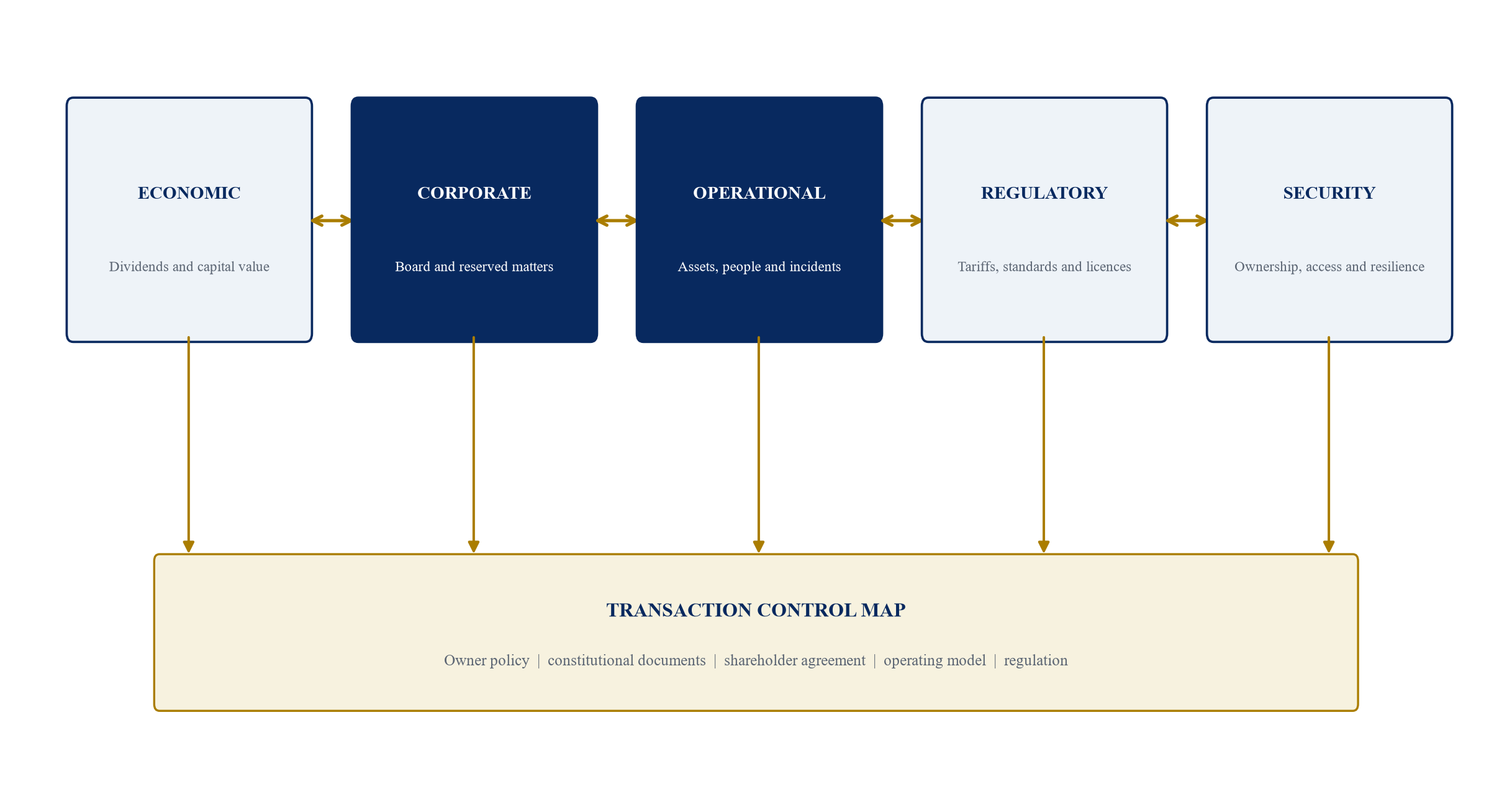
A minority transaction should allocate each layer explicitly. Share percentage alone does not determine the full control outcome.
3. Choose the transaction perimeter before discussing price
The perimeter determines what investors are buying. It can include an integrated utility, a regulated network, a generation portfolio, a water or district-cooling business, a metering platform, a project portfolio, or a holding company with several operating subsidiaries. Each perimeter produces a different risk profile and valuation method.
An integrated utility may offer scale and diversified cash flow, yet it can combine regulated and competitive activities, legacy liabilities and public-policy obligations. A ring-fenced network can offer clearer regulated returns, asset data and debt capacity. A mature generation portfolio may have contracted cash flows, while merchant exposure, fuel supply and maintenance risk still require diligence. A platform sale can preserve operational integration through service agreements while separating economic ownership.
Perimeter diligence should reconcile legal entities, licences, assets, land rights, employees, intellectual property, customer contracts, procurement arrangements, tax attributes, insurance, debt, guarantees, environmental obligations and litigation. It should identify shared systems, services and facilities that require transition or long-term agreements. A perimeter that looks clean in a management presentation can contain dependencies that reduce stand-alone value or undermine operational resilience.
4. Establish the regulatory compact
Utility value depends on the relationship among allowed revenue, required service, capital investment and risk. A regulated network may recover efficient expenditure through a price-control framework. A vertically integrated utility may operate under a government-approved tariff and subsidy arrangement. A concession may define performance obligations, termination rights and asset handback. A power or water purchase agreement may allocate volume, price and change-in-law risk.
The investor needs a clear regulatory compact before it can value the stake. The compact should identify the tariff-setting authority, review period, cost-recovery method, allowed return, inflation and foreign-exchange treatment, service-quality incentives, pass-through items, capital approval process and remedy for regulatory change. Public-service obligations should be stated and funded transparently. Where tariffs do not recover efficient costs, the financing model should identify subsidies, receivables or other support and test their legal reliability.
The World Bank’s privatisation guidance states that utility transactions require a regulatory regime that protects the public interest in pricing and service quality. The OECD guidelines similarly emphasise market-consistent transactions between the state and state-owned enterprises. A minority sale conducted without a clear regulatory compact transfers uncertainty rather than creating an investable security.
5. Build an auditable stand-alone financial model
The model should begin with historical financial statements and bridge them to the proposed perimeter. It should separate regulated revenue, contracted revenue, merchant revenue, subsidies, connection fees and other income. Operating costs should distinguish controllable expenditure, pass-through items, fuel, purchased power, network losses, maintenance, labour and shared services. Capital expenditure should separate maintenance, growth, compliance, resilience and transition investment.
The forecast should link demand, tariffs, availability, losses, collection rates, fuel, dispatch, inflation, foreign exchange and capital additions to financial outcomes. It should model tax, working capital, pension obligations, decommissioning and environmental liabilities. Financing assumptions should reflect existing debt, refinancing, guarantees, security, covenants and dividend restrictions.
The model becomes a control document after closing. Definitions used for valuation should align with the shareholder agreement and reporting pack. If the price uses a regulated-asset-base multiple, the agreement should define the relevant asset base and adjustment date. If the investor values a dividend stream, the policy and legal distribution constraints must be explicit. If service charges between the utility and retained group are material, transfer-pricing and performance mechanisms need durable terms.
6. Value the stake through several lenses
No single valuation method resolves the transaction. A discounted cash-flow analysis captures the perimeter’s forecast cash generation and capital needs. A regulated-asset-base approach can be relevant where the regulatory framework recognises an asset base and allowed return. Trading multiples provide market context, subject to differences in regulation, growth, leverage and business mix. Transaction multiples provide precedent evidence, although control level, asset maturity and contractual terms can differ materially. Dividend-discount analysis can be useful for mature listed utilities.
The valuation should bridge enterprise value to equity value through debt, cash, leases, pension deficits, provisions, minority interests and other adjustments. It should separately value non-core assets, development options and liabilities that are not reflected in steady-state earnings. A minority interest may trade at a discount where governance, liquidity or information rights are weak. It may attract strong demand where the security offers transparent regulation, predictable cash flows, credible governance and liquidity.
The owner should distinguish accounting value, market value, strategic value and fiscal proceeds. A high headline multiple can be offset by retained guarantees, vendor financing, tax leakage, transaction costs or future obligations. Net proceeds and risk transfer are more decision-useful than the announced enterprise value.
Table 1. Valuation lenses for a minority utility stake
| Valuation lens | Primary input | Principal strength | Principal limitation | Control question |
|---|---|---|---|---|
| Discounted cash flow | Forecast free cash flow and discount rate | Connects operations, regulation and capital expenditure | Sensitive to terminal value and regulatory assumptions | Do retained rights change cash-flow timing or risk? |
| Regulated asset base | Recognised asset base and allowed return | Closely linked to regulated network economics | Requires a stable and transparent regulatory framework | Can the regulator change the return or recovery profile? |
| Trading multiples | Listed peer enterprise value, earnings and dividends | Provides observable market reference | Peers may have different regulation, leverage and business mix | Does the stake have comparable liquidity and governance? |
| Transaction multiples | Precedent sale prices and transaction metrics | Reflects real capital deployment | Control premiums and contract terms may differ | Is the precedent a control sale, minority sale or asset partnership? |
| Dividend discount | Sustainable dividends and cost of equity | Useful for mature distributable cash flows | Depends on distribution policy and capital needs | Can the state change dividends or require unfunded investment? |
The methods are complementary. Applicability depends on the regulatory model, asset perimeter, forecast reliability and transaction structure.
7. Design investor rights that protect value without transferring control
Minority investors require rights against value leakage, dilution, related-party transactions and arbitrary changes. Typical protections can include information rights, pre-emption, tag-along rights, consent over changes to capital, related-party transactions, material acquisitions or disposals, amendments to constitutional documents, and entry into businesses outside the agreed scope. Board representation and committee participation may also be requested.
Each right should be tested for purpose, threshold, duration and consequence. A veto over any capital expenditure can obstruct ordinary utility operations. A veto over a material unbudgeted acquisition may be proportionate. A consent right over changes that disproportionately prejudice the minority can protect value. A consent right over tariffs may conflict with the regulator’s authority. Rights should therefore be grouped into investor protection, strategic control, operational management and regulated matters.
The control analysis should be performed under corporate law, competition law, foreign-investment rules, accounting standards and the utility’s regulatory regime. The United Kingdom’s National Security and Investment guidance illustrates that minority rights and board representation can be relevant to control analysis in sensitive infrastructure. Similar rules vary by jurisdiction. Local legal advice is essential.
8. Avoid governance deadlock
Deadlock can arise when the state seeks policy flexibility and the investor seeks protection of the agreed business case. The shareholder agreement should distinguish matters requiring consultation, board approval, supermajority approval and shareholder consent. It should provide escalation, information exchange and time limits. A deadlock process can move from management to board representatives, then to senior shareholders, mediation, expert determination or another agreed mechanism.
Essential-service continuity constrains remedies. A forced sale, winding-up right or operational standstill may be inappropriate for critical infrastructure. Put and call options can create large fiscal or financing exposures. A valuation mechanism for an exit needs clear triggers and funding arrangements. Governance should resolve disagreements without creating a threat to service or an open-ended government obligation.
Board composition should support competence and accountability. Independent directors can contribute sector, audit, safety, technology and capital-markets expertise. Committees should have clear mandates. The state’s ownership function should be separated from the regulator and policy ministry where the institutional framework permits, consistent with OECD guidance on the state’s role as owner.
9. Preserve operational control and resilience
Operational control should be documented through licences, operating agreements, asset-management contracts, dispatch arrangements, cyber and physical-security protocols, emergency powers and service-level agreements. The minority investor may receive monitoring access without direct operating authority. Where a strategic partner provides capability, the parties should specify decision rights, key personnel, intellectual property, procurement and continuity obligations.
Critical systems require access controls. The diligence data room should separate commercially necessary information from restricted operational or security information. Post-closing information rights should use the same principle. Cyber systems, network maps, control-room data, customer information and emergency plans require jurisdiction-specific handling.
Business continuity plans should address a shareholder dispute, investor default, sanctions event, cyber incident, natural disaster, financing failure and termination of shared services. The utility remains responsible for essential service even when ownership changes. Operational-resilience obligations should therefore survive changes in investor, financing and governance.
10. Treat national security as a transaction workstream
Energy and water assets can be critical national infrastructure. Foreign ownership, governance rights, data access, technology supply and proximity to sensitive sites may trigger review. The transaction team should map mandatory filings, voluntary notifications, beneficial-ownership requirements, sector approvals and conditions that may be imposed.
The investor-screening plan should begin before marketing. It should identify acceptable investor categories, restricted jurisdictions, consortium transparency requirements, financing sources and post-closing transfer constraints. Bidders should know the review timetable and information burden. The transaction documents should allocate the risk of mitigation measures and failed approval.
Security conditions can affect value. Restrictions on information, board access, suppliers, data location or resale may reduce investor flexibility. The financial model and bid evaluation should reflect these conditions. A high bid with an unacceptable approval risk may have lower expected value than a lower, executable bid.
11. Structure debt and equity together
A minority sale often occurs alongside refinancing. The utility may refinance existing government-supported debt, raise acquisition or holding-company debt, establish a new capital structure or retain project-level facilities. The equity valuation cannot be separated from leverage, covenant headroom and dividend capacity.
Debt diligence should map guarantees, security, negative pledges, cross-defaults, change-of-control clauses, restricted payments, information undertakings and consent requirements. A minority sale may not trigger legal change of control, yet negotiated provisions can have different thresholds. New shareholder rights can also affect consolidation or covenant definitions.
The post-transaction capital structure should support the investment programme under downside scenarios. A high dividend commitment can conflict with maintenance and growth capital. Excess leverage can transfer risk back to the state through service obligations or implicit support. The investor case should therefore use a distribution policy linked to solvency, covenants, approved investment and regulatory requirements.
12. Quantify fiscal risk alongside proceeds
Sale proceeds are a balance-sheet event. They do not create recurring revenue. The public owner should evaluate the change in dividends, guarantees, debt exposure, contingent liabilities and future capital calls. The IMF’s state-owned-enterprise health-check framework examines liabilities, financial vulnerability and potential fiscal risks. A similar assessment should accompany the transaction.
The fiscal bridge should begin with gross proceeds and deduct transaction costs, tax, debt repayment, retained obligations and required recapitalisation. It should compare the present value of dividends or distributions sold with the risk transferred. It should identify explicit and implicit government support before and after closing. Any put option, minimum return, tariff guarantee, debt guarantee or termination payment should be valued as a contingent exposure.
The owner should publish or retain an auditable rationale for the transaction, consistent with applicable public-finance and confidentiality requirements. The analysis should explain why the selected structure improves the public balance sheet, funds investment or advances another stated objective.
13. Govern the use of proceeds
Capital recycling is credible when released capital funds identified priorities. The proceeds policy should specify permitted uses, decision rights, timing, reporting and treatment of unallocated cash. Possible uses include utility investment, energy transition, network resilience, water security, debt reduction or other infrastructure. The policy should distinguish investment from recurrent expenditure.
The owner can use a proceeds account, board-approved capital plan or sovereign budget process. Each allocation should have a sponsor, business case, funding schedule and outcome measures. Where proceeds are transferred to the general budget, public reporting should identify the approved use where law and policy permit. The governance objective is traceability, rather than physical segregation alone.
The reinvestment hurdle should compare expected public value across projects. It should include financial return, service need, resilience, affordability, emissions, execution risk and fiscal impact. Reinvesting in an uneconomic project can destroy the value released by the minority sale.
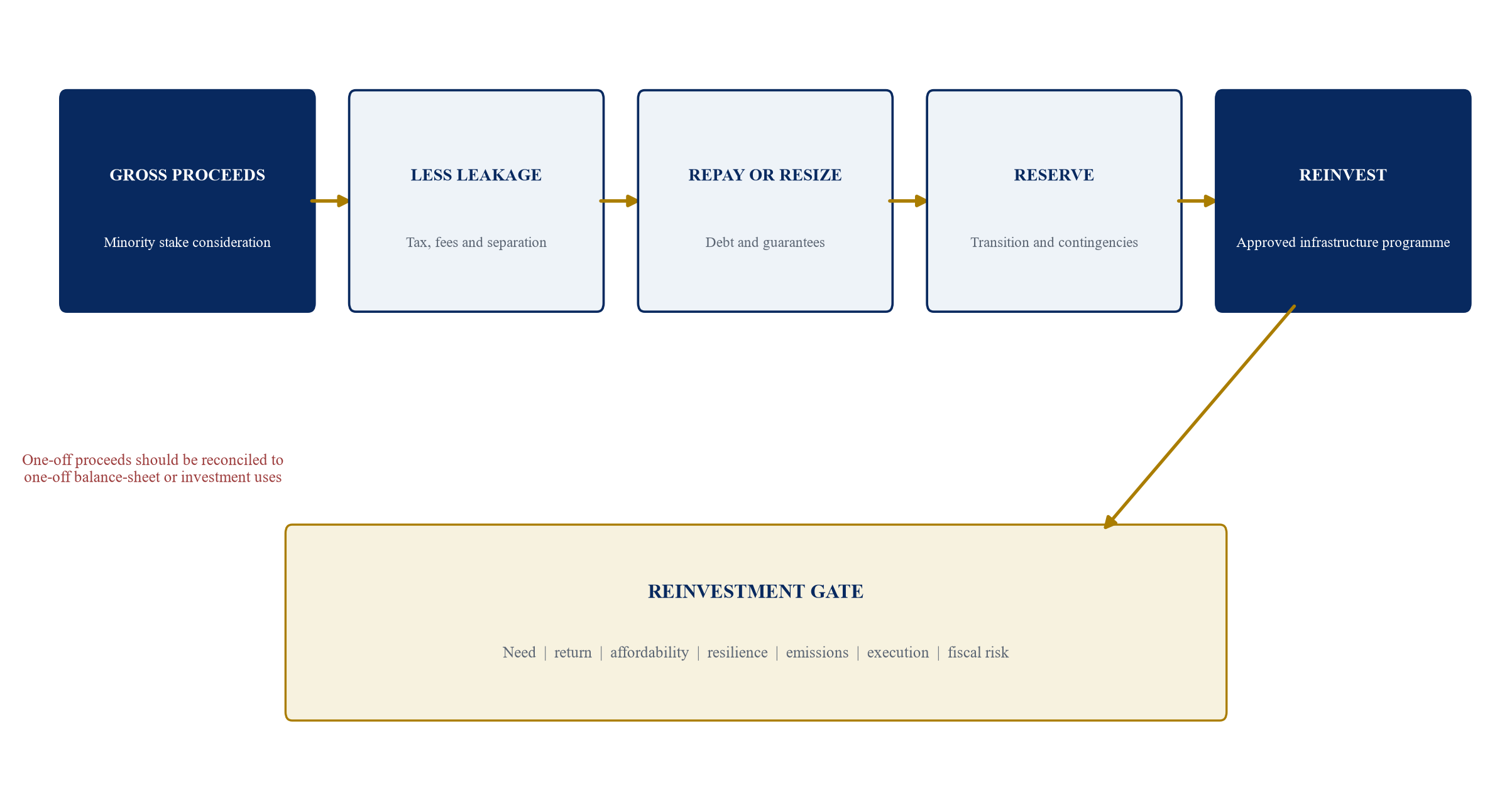
The waterfall is a decision framework. Amounts and priorities must be adapted to the owner, transaction and public-finance rules.
14. Decide between a listing and a private placement
A public listing can create liquidity, price discovery, periodic disclosure and a broad investor base. It also imposes listing rules, continuous disclosure, investor-relations capability, governance expectations and market volatility. A marketed initial public offering requires a clear equity story, prospectus, audited track record, due diligence, research process and allocation strategy.
A private placement can offer greater confidentiality, a focused negotiation and an investor selected for long-term fit. It commonly produces a detailed shareholder agreement and bespoke rights. Liquidity is lower, exit mechanics are more important, and valuation may reflect a concentrated negotiation. A competitive private process can preserve tension among bidders while allowing the owner to test governance terms before selecting a preferred investor.
The choice should reflect the objective, readiness and desired future flexibility. A private placement can precede a later listing. A public offering can be followed by future sell-downs. The owner should assess lock-ups, transfer restrictions, market capacity, index eligibility, free float, research coverage and the cost of maintaining a listed company.
15. Prepare the equity story without overstating certainty
The equity story should explain the regulatory model, demand drivers, asset base, service record, capital programme, transition plan, dividend framework and governance. It should distinguish contracted, regulated and merchant cash flows. It should state dependencies, including tariff decisions, government support, fuel supply, construction, interest rates and foreign exchange.
Operational claims require evidence. Reliability, efficiency, emissions, water losses, collection, safety and customer metrics should use defined methodologies and periods. Forecasts should identify assumptions. Development projects should be separated by stage, approval and funding. The transaction should not present an early-stage option as committed capacity.
Investor materials should reconcile to the model, audited financials and legal disclosure. Management should use one controlled fact book. The due-diligence process should record sources, owners and approval for material claims.
16. Allocate separation and shared-service risk
A ring-fenced stake sale may require legal and operational separation. The carve-out plan should cover systems, employees, procurement, treasury, insurance, tax, licences, property, branding and data. Transitional service agreements can support continuity, yet they should have measurable services, pricing, duration, exit assistance and remedies.
Long-term shared services require governance beyond a transitional arrangement. Network control, billing, customer service, fuel procurement, maintenance and cyber operations may remain integrated. The contract should define service standards, audit rights, change control, cost allocation and termination. Related-party arrangements should be transparent and market consistent.
Separation costs should be reflected in valuation and proceeds. Delayed separation can postpone closing or create stranded cost in the retained group. The transaction plan should assign each dependency to a responsible owner and a completion milestone.
17. Build a diligence heatmap
Diligence should prioritise issues that affect control, service continuity, cash flow and closing. Regulatory matters include licence transfer, tariff review, subsidy, concession and public-service obligations. Financial matters include revenue recognition, receivables, capitalisation, provisions, debt and related parties. Technical matters include asset condition, maintenance, capacity, losses and resilience. Environmental matters include permits, emissions, contamination and decommissioning. Legal matters include title, contracts, disputes, procurement and data.
The heatmap should classify probability, value impact, control impact, required action and deal remedy. A high-impact issue can be resolved through perimeter change, price adjustment, specific indemnity, covenant, condition precedent, insurance or disclosure. Some risks should remain with the utility because transferring them is uneconomic or inconsistent with regulation.
Vendor due diligence can improve process efficiency, provided bidders retain responsibility for their own assessment. Technical and regulatory findings should flow into the model. A diligence report that does not change assumptions, terms or price has limited decision value.
Table 2. Diligence heatmap for a minority utility transaction
| Workstream | High-impact question | Evidence | Potential transaction response | Post-closing control |
|---|---|---|---|---|
| Regulation | Are tariffs and service obligations legally durable and economically coherent? | Law, licence, price control, subsidy and regulator correspondence | Condition, disclosure, valuation scenario or covenant | Regulatory reporting and compliance committee |
| Technical | What maintenance, resilience and replacement capital is required? | Asset register, condition reports, outage and maintenance history | Capital plan, price adjustment or retained obligation | Approved asset-management plan |
| Finance | Are revenue, receivables, debt and provisions complete? | Audits, ledgers, contracts, debt documents and reconciliations | Completion accounts, indemnity or debt repayment | Monthly finance and covenant pack |
| Operations | Can the perimeter operate safely and continuously? | Operating model, licences, systems map and continuity plans | TSA, long-term service agreement or perimeter change | Service levels and incident reporting |
| ESG and environment | Are liabilities, transition commitments and public claims supported? | Permits, emissions, site studies and transition plan | Remediation, covenant, insurance or disclosure | Board metrics and independent assurance |
| Security and data | What access, ownership or supplier conditions apply? | Security classification, cyber architecture and screening analysis | Bidder restriction, mitigation plan or filing condition | Access control and security audit |
The heatmap identifies decision consequences. It does not replace jurisdiction-specific legal, technical, accounting or tax diligence.
18. Negotiate exit and transfer rights at entry
The investor’s exit route affects entry valuation. A listed stake has market liquidity subject to lock-up and trading conditions. A private stake requires transfer rights, permitted transferees, rights of first offer or refusal, tag-along, drag-along, initial public offering cooperation and valuation mechanics. Critical-infrastructure approvals may apply to any later transfer.
The state should protect against an unsuitable successor without giving itself an unfunded obligation to buy the stake. Transfer restrictions should be objective, enforceable and consistent with competition and investment rules. A list of permitted investors can become outdated. A qualification standard based on security, sanctions, financing and capability can be more durable.
Put rights, minimum returns or guaranteed exits can recreate the capital risk the state intended to transfer. Any such obligation should be priced and approved as a contingent liability. Exit design should preserve service continuity and operational control.
19. Use transaction protections proportionately
Representations and warranties should cover authority, title, accounts, contracts, compliance, tax, litigation, assets, employees, environment, data and regulation in a manner suited to the perimeter and disclosure process. A public offering relies heavily on prospectus disclosure and statutory liability. A private sale permits negotiated warranties, indemnities and limitations.
The state seller should avoid unlimited exposure that undermines proceeds certainty. The investor should receive protection for risks it cannot diligence or price. Warranty and indemnity insurance may support risk allocation in suitable markets, subject to scope and exclusions. Specific public-law or regulatory risks may remain uninsurable.
Closing conditions should focus on approvals, consents, reorganisation, financing and material pre-closing actions. Conduct covenants should allow ordinary utility operations while preventing material leakage or perimeter change. The agreement should accommodate emergency actions required for safety and service.
20. Design the post-closing reporting architecture
The reporting pack should serve the board, investor, owner, regulator and lenders without duplicating inconsistent datasets. It should cover financial performance, demand, tariffs, operations, capital expenditure, safety, reliability, losses, collections, emissions, covenants, related parties and material risks. Definitions should match transaction documents and regulatory reporting where possible.
Information rights should specify frequency, format, access, confidentiality and audit. The investor should have enough information to monitor value and exercise rights. Security-sensitive and personal data should remain controlled. The utility should establish a disclosure committee for listed or broadly distributed securities.
Related-party transactions deserve specific oversight because the state may remain both owner and counterparty. Market-consistent pricing, approval thresholds and disclosure reduce value-transfer concerns. The OECD guidelines expressly address equitable treatment and market-consistent transactions involving the state and state-owned enterprises.
21. Stress-test the structure
The base case should be tested against demand weakness, delayed tariff adjustment, higher fuel costs, foreign-exchange depreciation, interest-rate increases, capital-cost inflation, construction delay, lower collections, cyber disruption and major outage. Combined scenarios are more informative than isolated sensitivities because utility risks interact.
The model should show cash flow, debt service, covenants, dividend capacity and required government support. The governance test should ask how the board responds when distributions conflict with investment. The control test should ask whether investor vetoes obstruct an urgent response. The regulatory test should ask whether the compact allocates extraordinary cost.
Stress testing should also cover exit. A fall in valuation, weak capital markets or a restricted transferee pool can delay investor liquidity. The state should understand whether that delay creates a put, refinancing need or governance tension.
22. Apply a hypothetical national-utility case
Consider a hypothetical national electricity and water group that owns regulated networks, generation, desalination and customer operations. The owner needs capital for grid reinforcement, renewable integration and water-security investment. It plans to sell 20 per cent of a ring-fenced utility holding company while retaining 80 per cent, board control and operational authority.
The perimeter includes audited operating subsidiaries, material licences, debt and shared-service agreements. The regulator retains tariff authority. The minority investor receives two board seats, information rights, pre-emption, tag-along protection and consent over actions that could materially prejudice its investment. It does not receive consent over ordinary dispatch, emergency operations, regulated tariffs or approved-budget capital expenditure. Security-sensitive information follows a controlled-access protocol.
The price is determined through discounted cash flow, regulated-asset-base reference and listed-utility comparables. Net proceeds first fund transaction costs and agreed debt resizing. The balance enters an approved infrastructure programme with public-owner oversight. The case is hypothetical and does not indicate a recommended valuation or structure for any identified utility.
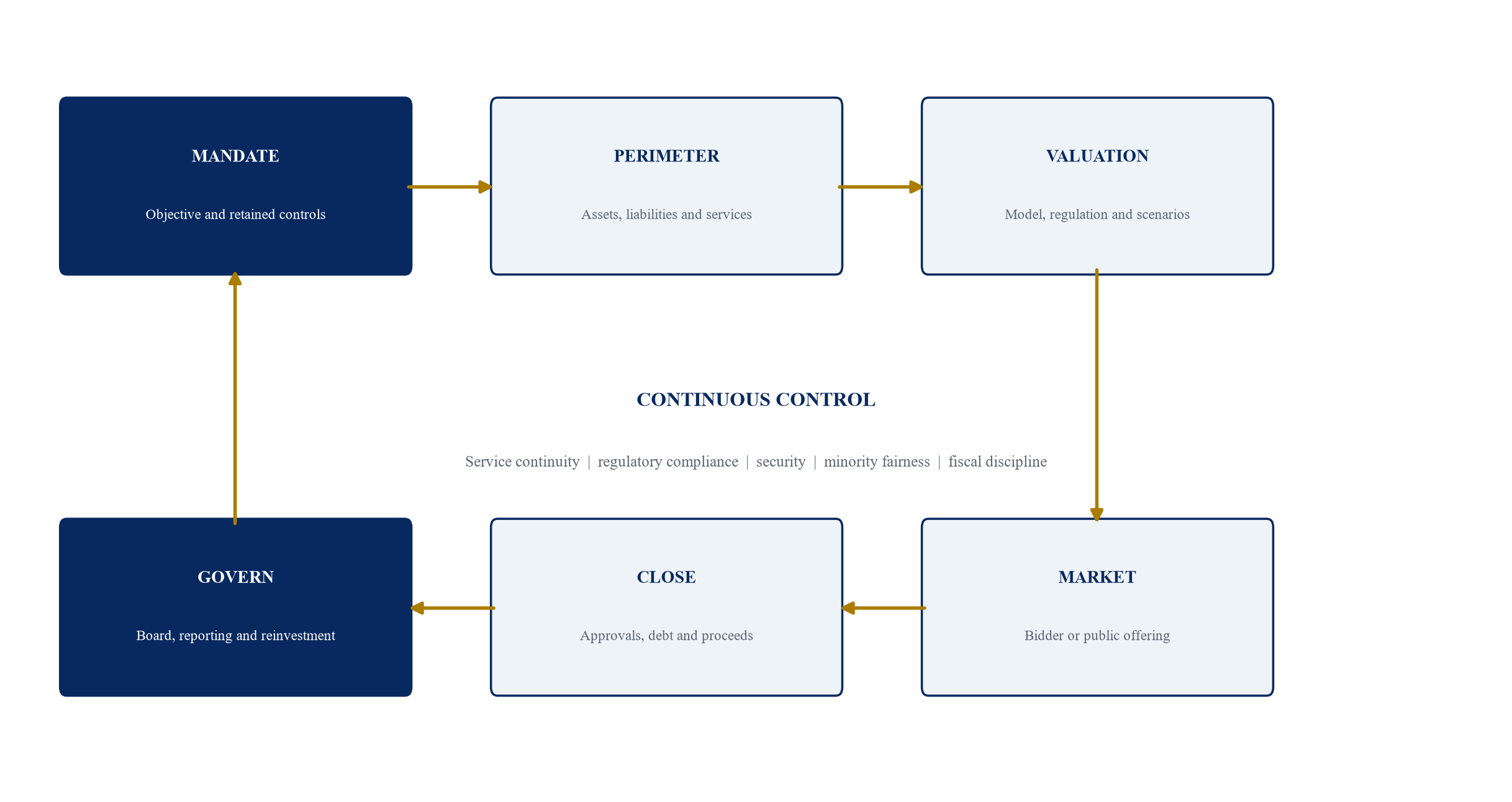
The sequence integrates transaction execution with service, regulatory and reinvestment controls.
23. Translate the hypothetical case into a decision matrix
The owner should score alternatives against proceeds, control, execution, governance, fiscal risk and reinvestment. An integrated-company IPO may maximise liquidity and market visibility but require extensive readiness. A private placement in a ring-fenced utility can permit bespoke controls but create exit complexity. A project-level partnership can isolate risk and preserve group ownership while releasing less capital. Debt refinancing can avoid dilution but increase leverage.
The score should use ranges and evidence. Weighting should reflect the mandate. A government prioritising market development may value listing differently from an owner prioritising speed or confidentiality. The matrix should identify fatal flaws separately from weighted preferences. A national-security prohibition or unresolvable licence restriction cannot be offset by a higher valuation score.
Table 3. Transaction decision matrix for a national utility
| Structure | Capital released | Retained control | Execution burden | Investor protection | Best-use condition |
|---|---|---|---|---|---|
| Public minority offering | Potentially broad market capacity | Majority voting and regulatory control can remain | High readiness, disclosure and market burden | Listing rules, disclosure, voting and market liquidity | Scalable business with audited history and public-market readiness |
| Private minority placement | Negotiated amount and valuation | Bespoke reserved matters and transfer controls | Focused diligence and bilateral negotiation | Detailed shareholder agreement and information rights | Owner seeks a long-term institutional partner and tailored governance |
| Asset-platform partnership | Capital tied to a defined asset perimeter | Operating and majority control can remain | Requires ring-fencing and durable service contracts | Contractual cash-flow and governance rights | Mature assets can be separated without weakening operations |
| Project-level equity | Capital limited to projects | Parent and system control remain | Project development and financing complexity | Project documents, security and lender controls | New investment has separable cash flow and risk allocation |
| Debt or refinancing | No equity sale proceeds | Ownership remains unchanged | Credit and covenant process | Lender protections and repayment priority | Cash flow supports leverage and equity risk need not be shared |
The matrix is illustrative. Weightings, thresholds and evidence should be approved for the specific mandate.
24. Establish a board approval package
The board package should include the objective, alternatives, perimeter, control map, regulatory analysis, valuation range, bid evaluation, debt plan, fiscal-risk assessment, proceeds policy, diligence findings, approvals, governance terms and implementation plan. It should identify assumptions and unresolved matters. The recommendation should explain why the selected structure meets the mandate.
The board should approve thresholds and delegation. Negotiators need authority to manage price and terms without changing protected control matters. Any departure from the mandate should return to the board or designated owner body. Minutes should record the evidence considered and conditions imposed.
The approval package should remain a live execution document. Closing deliverables, conditions and post-closing obligations should be tracked to accountable owners. The investor-relations and reporting capability should be operational before the first required report.
25. Recognise failure modes early
Several failure modes recur. The perimeter may contain hidden liabilities or shared-service dependencies. The tariff framework may be politically or legally uncertain. Investor rights may create effective control or deadlock. The state may retain guarantees that exceed the value of the proceeds. The utility may promise dividends that crowd out investment. Security approval may arrive late. Proceeds may fund recurring expenditure without replacing lost dividends.
Another failure mode is overstated governance reform. A minority investor does not automatically improve performance. Governance improves when roles, information, accountability and incentives are designed and implemented. A listing does not by itself resolve unfunded public-service obligations. A shareholder agreement cannot override statutory regulation or emergency powers.
The transaction should have stop conditions. These can include an inadequate valuation, unacceptable control transfer, unresolved service risk, unfinanceable contingent liability, failed security approval or a reinvestment case that does not justify the sale. An owner preserves value by retaining the option not to transact.
26. Practical execution rules
Seven rules summarise the framework. First, write the public objective and retained-control mandate before appointing a transaction structure. Second, map economic, corporate, operational, regulatory and security control separately. Third, define a stand-alone perimeter with auditable assets, cash flows and obligations. Fourth, value the stake through multiple lenses and focus on net proceeds and risk transfer. Fifth, give minority investors proportionate protection and avoid governance deadlock. Sixth, treat proceeds through a governed reinvestment or balance-sheet policy. Seventh, maintain post-closing reporting that supports the owner, investor, regulator, lenders and public accountability.
These rules support different transaction forms. A utility can list a minority, place shares privately, create an asset partnership or invite project-level equity. The appropriate structure depends on the objective, regulatory compact, investor market, legal environment and operational model.
Conclusion
A minority stake can release capital from a national utility while preserving public control. The outcome depends on the allocation of rights, rather than the share percentage alone. Economic ownership, corporate control, operational authority, regulation and national-security oversight must be designed as a coherent system.
The transaction begins with a precise public objective and a clear perimeter. It requires an auditable model, multiple valuation lenses, proportionate minority protections, durable service and security controls, integrated debt analysis and explicit fiscal-risk assessment. Capital recycling requires equal discipline after closing. Proceeds should flow through an approved policy into investment, resilience, transition or balance-sheet uses that create public value.
The strongest structure gives investors reliable cash-flow visibility and fair protection while leaving public-service strategy, operational resilience and sovereign safeguards where the mandate requires them. It also creates governance arrangements that remain workable during stress. This balance makes the security investable and the public-control claim credible.
Frequently Asked Questions
1. Can a government retain control after selling a substantial minority stake?
Control can be retained through majority voting ownership, board appointment, reserved strategic matters, operating arrangements, regulation and statutory powers. The legal outcome depends on the full rights package and jurisdiction. Share percentage alone is insufficient for the analysis.
2. Is a public offering better than a private placement?
The answer depends on objective and readiness. A public offering can provide liquidity, price discovery and a broad investor base. A private placement can provide a selected long-term investor and bespoke governance. Each route has different disclosure, execution and exit requirements.
3. Which investor vetoes are usually compatible with state control?
Protective rights can cover actions that materially prejudice the minority, such as dilutive capital changes, non-arm’s-length related-party transactions or fundamental amendments. Rights over ordinary operations, tariffs or approved investment can create control or deadlock concerns. Local legal and regulatory analysis is required.
4. How should the utility be valued?
The analysis normally uses several methods, including discounted cash flow, regulated-asset-base reference where applicable, trading comparables, transaction precedents and dividend analysis. The model should reconcile enterprise value to equity value and identify retained guarantees, separation costs and contingent obligations.
5. Should sale proceeds be used to fund the government budget?
Sale proceeds are one-off. A governed policy should assess debt reduction, infrastructure investment, transition, resilience and other approved uses. Using proceeds for recurring expenditure can create a future funding gap after part of the dividend stream has been sold.
6. How can national-security concerns be addressed?
The process should screen investors, beneficial ownership, governance rights, data access, suppliers and future transfers. Mandatory and voluntary approvals should be mapped early. Transaction documents should allocate the risk of conditions or failed approval.
7. Does minority private ownership improve utility performance?
Performance depends on governance, regulation, management, incentives, information and investment. Minority ownership can introduce market discipline and additional oversight where the framework supports them. Ownership change alone does not establish an operational improvement.
8. What is the principal test for a successful capital-recycling transaction?
The owner should test whether net proceeds and transferred risk exceed the value of the economic interest sold and obligations retained, while service, control and reinvestment objectives remain protected. The conclusion requires transaction-specific financial, legal, regulatory and public-policy analysis.
References
- Organisation for Economic Co-operation and Development. OECD Guidelines on Corporate Governance of State-Owned Enterprises 2024. https://doi.org/10.1787/18a24f43-en
- Organisation for Economic Co-operation and Development. G20/OECD Principles of Corporate Governance 2023. https://doi.org/10.1787/ed750b30-en
- International Energy Agency. World Energy Investment 2025. https://www.iea.org/reports/world-energy-investment-2025
- International Energy Agency. Who is investing in energy around the world, and who is financing it? 2024. https://www.iea.org/commentaries/who-is-investing-in-energy-around-the-world-and-who-is-financing-it
- World Bank Group. Infrastructure Asset Recycling: Insights for Governments and Investors. https://ppp.worldbank.org/sites/default/files/2025-06/INFRASTRUCTURE%20ASSET%20RECYCLING%20Insights%20for%20governments%20and%20investors.pdf
- World Bank Group. Privatisation Laws and Public-Private Partnership Guidance. https://ppp.worldbank.org/legislation-regulation/laws/privatization
- World Bank Group. Rethinking Power Sector Reform in the Developing World. https://state-owned-enterprises.worldbank.org/sites/soe/files/reports/Rethinking%20Power%20Sector%20Reform%20in%20the%20Developing%20World.pdf
- World Bank Group. Power Purchase Agreements and Energy Purchase Agreements. https://ppp.worldbank.org/sector/energy/energy-power-agreements/power-purchase-agreements
- International Monetary Fund. State-Owned Enterprise Health Check Tool. https://www.imf.org/en/topics/fiscal-policies/fiscal-risks/fiscal-risks-toolkit/fiscal-risks-toolkit-soe-hct
- International Monetary Fund. Managing Fiscal Risks from State-Owned Enterprises. IMF Working Paper 20/213, 2020. https://www.imf.org/-/media/Files/Publications/WP/2020/English/wpiea2020213-print-pdf.ashx
- International Monetary Fund. State-Owned Enterprises in Middle East, North Africa, and Central Asia: Size, Costs, and Challenges, 2021. https://www.imf.org/en/Publications/Departmental-Papers-Policy-Papers/Issues/2021/09/17/State-Owned-Enterprises-in-Middle-East-North-Africa-and-Central-Asia-Size-Costs-and-464657
- IFRS Foundation. IFRS 14 Regulatory Deferral Accounts. https://www.ifrs.org/issued-standards/list-of-standards/ifrs-14-regulatory-deferral-accounts/
- IFRS Foundation. Rate-regulated Activities project. https://www.ifrs.org/projects/work-plan/rate-regulated-activities/
- Dubai Electricity and Water Authority. Initial Public Offering information and listing announcement, 2022. https://www.dewa.gov.ae/en/about-us/media-publications/latest-news/2022/04/burj-khalifa-celebrates-dewas-listing-on-the-dubai-financial-market
- Dubai Electricity and Water Authority. Financial statements for the second quarter of 2025. https://www.dewa.gov.ae/-/media/Files/Investor-Relations-Files/Financial-statements-for-the-2nd-QTR-of-2025.ashx
- Abu Dhabi National Oil Company. ADNOC Announces USD 20.7 Billion Energy Infrastructure Deal, 2020. https://adnoc.ae/en/news-and-media/press-releases/2020/adnoc-announces-20-billion-energy-infrastructure-deal
- Government of the United Kingdom. National Security and Investment Act 2021: Statement for the purposes of section 3. https://www.gov.uk/government/publications/national-security-and-investment-statement-about-exercise-of-the-call-in-power
- Government of the United Kingdom. Guidance on acquisitions that could harm national security. https://www.gov.uk/guidance/national-security-and-investment-act-guidance-on-acquisitions
- Government of the United Kingdom. Balance Sheet Framework. https://www.gov.uk/government/publications/balance-sheet-framework/balance-sheet-framework
- International Organization of Securities Commissions. Objectives and Principles of Securities Regulation. https://www.iosco.org/library/pubdocs/pdf/IOSCOPD561.pdf
About the Author
Chennakeshav (CK) is a corporate finance and investment banking executive with 25+ years of global experience in deal origination, structuring and execution across M&A, growth capital and corporate strategy. He has led value-creation mandates for founders, corporates and funds — bridging the boardroom view to hands-on execution and close.
His career spans Morgan Stanley, HSBC, Lloyds Banking Group, EWEC, ADQ portfolio companies and Emirates Growth Fund, across TMT, real estate, fintech, deeptech, cleantech, infrastructure and energy. He has partnered with C-suite leaders, private equity and venture funds, sovereign wealth funds and family offices to finance complex fund raises and scale-up ventures, and has led M&A due diligence, post-merger integration and business-transformation initiatives to create value.
At Matchpoint Partners he is Managing Partner, leading the firm's corporate finance, M&A and capital-raising practice. He holds an MBA from London Business School, an engineering degree from VTU and a Master of Laws (LLM, in progress) from UCL London.
An active start-up mentor, CK mentors at Techstars, DIFC FinTech Hive, Startup Grind, Founder Institute and IN5, serves as Entrepreneur Mentor in Residence (EMiR) at London Business School, and judges the Entrepreneurship World Cup.
