

1. Frame the business service
Define the user journey, decision consequence, service boundary, availability objective and financial exposure.
The controlled record includes business service; decision tier; provider; model version; region; data class; control; evidence; owner; threshold. The immediate deliverable is a business-service resilience charter. Record the service, route, version, region, evidence, owner, approval, exception and outcome.
The principal failure occurs when resilience is discussed at model level without identifying the business service that must continue. Reviewers should reproduce the tested condition, distinguish transport health from semantic performance, reconcile technical and commercial units and identify who may reroute, degrade, pause, communicate, remediate or accept residual exposure.
Resilience should be assessed at the business-service layer because model availability, application availability and decision continuity are different measures.
The decision pack for frame the business service should show the prior claim, production requirement, tested evidence, trigger, primary and alternate route, quality and latency consequence, cost and data effect, control owner, recovery step, customer impact and post-incident learning. Material exceptions flow into capacity, contracts, product design, reserves, customer commitments, transaction diligence and enterprise-value analysis.
2. Map the dependency chain
Inventory model endpoints, clouds, regions, gateways, prompts, retrieval, tools, data stores, identity and human operations.
The controlled record includes business service; decision tier; provider; model version; region; data class; control; evidence; owner; threshold. The immediate deliverable is an end-to-end dependency map. Record the service, route, version, region, evidence, owner, approval, exception and outcome.
The principal failure occurs when an upstream or adjacent dependency can stop the service while the model endpoint remains healthy. Reviewers should reproduce the tested condition, distinguish transport health from semantic performance, reconcile technical and commercial units and identify who may reroute, degrade, pause, communicate, remediate or accept residual exposure.
Each route needs task-specific evidence for quality, latency, safety, privacy, cost and recovery under the exact production configuration.
The decision pack for map the dependency chain should show the prior claim, production requirement, tested evidence, trigger, primary and alternate route, quality and latency consequence, cost and data effect, control owner, recovery step, customer impact and post-incident learning. Material exceptions flow into capacity, contracts, product design, reserves, customer commitments, transaction diligence and enterprise-value analysis.
3. Classify decision criticality
Segment use cases by consequence, reversibility, human review, time sensitivity and regulatory exposure.
The controlled record includes business service; decision tier; provider; model version; region; data class; control; evidence; owner; threshold. The immediate deliverable is a decision-criticality schedule. Record the service, route, version, region, evidence, owner, approval, exception and outcome.
The principal failure occurs when a low-consequence fallback is applied to a high-consequence decision. Reviewers should reproduce the tested condition, distinguish transport health from semantic performance, reconcile technical and commercial units and identify who may reroute, degrade, pause, communicate, remediate or accept residual exposure.
Provider diversity creates value only when failure domains, commercial rights, data controls, capacity and operating authority are genuinely independent.
The decision pack for classify decision criticality should show the prior claim, production requirement, tested evidence, trigger, primary and alternate route, quality and latency consequence, cost and data effect, control owner, recovery step, customer impact and post-incident learning. Material exceptions flow into capacity, contracts, product design, reserves, customer commitments, transaction diligence and enterprise-value analysis.
4. Set recovery objectives
Define tolerated interruption, recovery time, recovery point, degraded mode and manual continuity for each journey.
The controlled record includes business service; decision tier; provider; model version; region; data class; control; evidence; owner; threshold. The immediate deliverable is a service-level recovery matrix. Record the service, route, version, region, evidence, owner, approval, exception and outcome.
The principal failure occurs when teams promise availability without a measurable recovery design. Reviewers should reproduce the tested condition, distinguish transport health from semantic performance, reconcile technical and commercial units and identify who may reroute, degrade, pause, communicate, remediate or accept residual exposure.
The operating model should preserve an auditable path from trigger through routing decision, customer outcome, recovery and board-level learning.
The decision pack for set recovery objectives should show the prior claim, production requirement, tested evidence, trigger, primary and alternate route, quality and latency consequence, cost and data effect, control owner, recovery step, customer impact and post-incident learning. Material exceptions flow into capacity, contracts, product design, reserves, customer commitments, transaction diligence and enterprise-value analysis.
5. Identify provider failure modes
Test outages, throttling, quota exhaustion, regional unavailability, authentication failure and content-filter changes.
The controlled record includes business service; decision tier; provider; model version; region; data class; control; evidence; owner; threshold. The immediate deliverable is a provider failure-mode register. Record the service, route, version, region, evidence, owner, approval, exception and outcome.
The principal failure occurs when the fallback plan covers a complete outage and misses partial degradation. Reviewers should reproduce the tested condition, distinguish transport health from semantic performance, reconcile technical and commercial units and identify who may reroute, degrade, pause, communicate, remediate or accept residual exposure.
Resilience should be assessed at the business-service layer because model availability, application availability and decision continuity are different measures.
The decision pack for identify provider failure modes should show the prior claim, production requirement, tested evidence, trigger, primary and alternate route, quality and latency consequence, cost and data effect, control owner, recovery step, customer impact and post-incident learning. Material exceptions flow into capacity, contracts, product design, reserves, customer commitments, transaction diligence and enterprise-value analysis.
6. Identify model-change risk
Track behaviour, instruction following, safety policy, context, tool calling, output schema and price across versions.
The controlled record includes business service; decision tier; provider; model version; region; data class; control; evidence; owner; threshold. The immediate deliverable is a model-change risk register. Record the service, route, version, region, evidence, owner, approval, exception and outcome.
The principal failure occurs when a nominal upgrade changes production outcomes without a code failure. Reviewers should reproduce the tested condition, distinguish transport health from semantic performance, reconcile technical and commercial units and identify who may reroute, degrade, pause, communicate, remediate or accept residual exposure.
Each route needs task-specific evidence for quality, latency, safety, privacy, cost and recovery under the exact production configuration.
The decision pack for identify model-change risk should show the prior claim, production requirement, tested evidence, trigger, primary and alternate route, quality and latency consequence, cost and data effect, control owner, recovery step, customer impact and post-incident learning. Material exceptions flow into capacity, contracts, product design, reserves, customer commitments, transaction diligence and enterprise-value analysis.
7. Govern model lifecycle
Record preview, active, legacy, deprecated and retired states, notices, owners and migration dates.
The controlled record includes business service; decision tier; provider; model version; region; data class; control; evidence; owner; threshold. The immediate deliverable is a model lifecycle calendar. Record the service, route, version, region, evidence, owner, approval, exception and outcome.
The principal failure occurs when a retired endpoint produces hard failures before the replacement is validated. Reviewers should reproduce the tested condition, distinguish transport health from semantic performance, reconcile technical and commercial units and identify who may reroute, degrade, pause, communicate, remediate or accept residual exposure.
Provider diversity creates value only when failure domains, commercial rights, data controls, capacity and operating authority are genuinely independent.
The decision pack for govern model lifecycle should show the prior claim, production requirement, tested evidence, trigger, primary and alternate route, quality and latency consequence, cost and data effect, control owner, recovery step, customer impact and post-incident learning. Material exceptions flow into capacity, contracts, product design, reserves, customer commitments, transaction diligence and enterprise-value analysis.
8. Define the portability envelope
Separate portable application logic from provider-specific features, schemas, tools, caching and identity.
The controlled record includes business service; decision tier; provider; model version; region; data class; control; evidence; owner; threshold. The immediate deliverable is a portability boundary assessment. Record the service, route, version, region, evidence, owner, approval, exception and outcome.
The principal failure occurs when the application is described as multi-provider while critical features remain proprietary. Reviewers should reproduce the tested condition, distinguish transport health from semantic performance, reconcile technical and commercial units and identify who may reroute, degrade, pause, communicate, remediate or accept residual exposure.
The operating model should preserve an auditable path from trigger through routing decision, customer outcome, recovery and board-level learning.
The decision pack for define the portability envelope should show the prior claim, production requirement, tested evidence, trigger, primary and alternate route, quality and latency consequence, cost and data effect, control owner, recovery step, customer impact and post-incident learning. Material exceptions flow into capacity, contracts, product design, reserves, customer commitments, transaction diligence and enterprise-value analysis.
Table 1. LLM dependency and failure domains
| Layer | Failure question | Continuity response |
|---|---|---|
| model | behaviour or retirement | validated alternate |
| provider | outage or policy | independent route |
| region | capacity or location | permitted failover |
| application | schema or tool | degraded mode |
Illustrative controls require service-, provider-, model-, region-, firm- and period-specific approval.
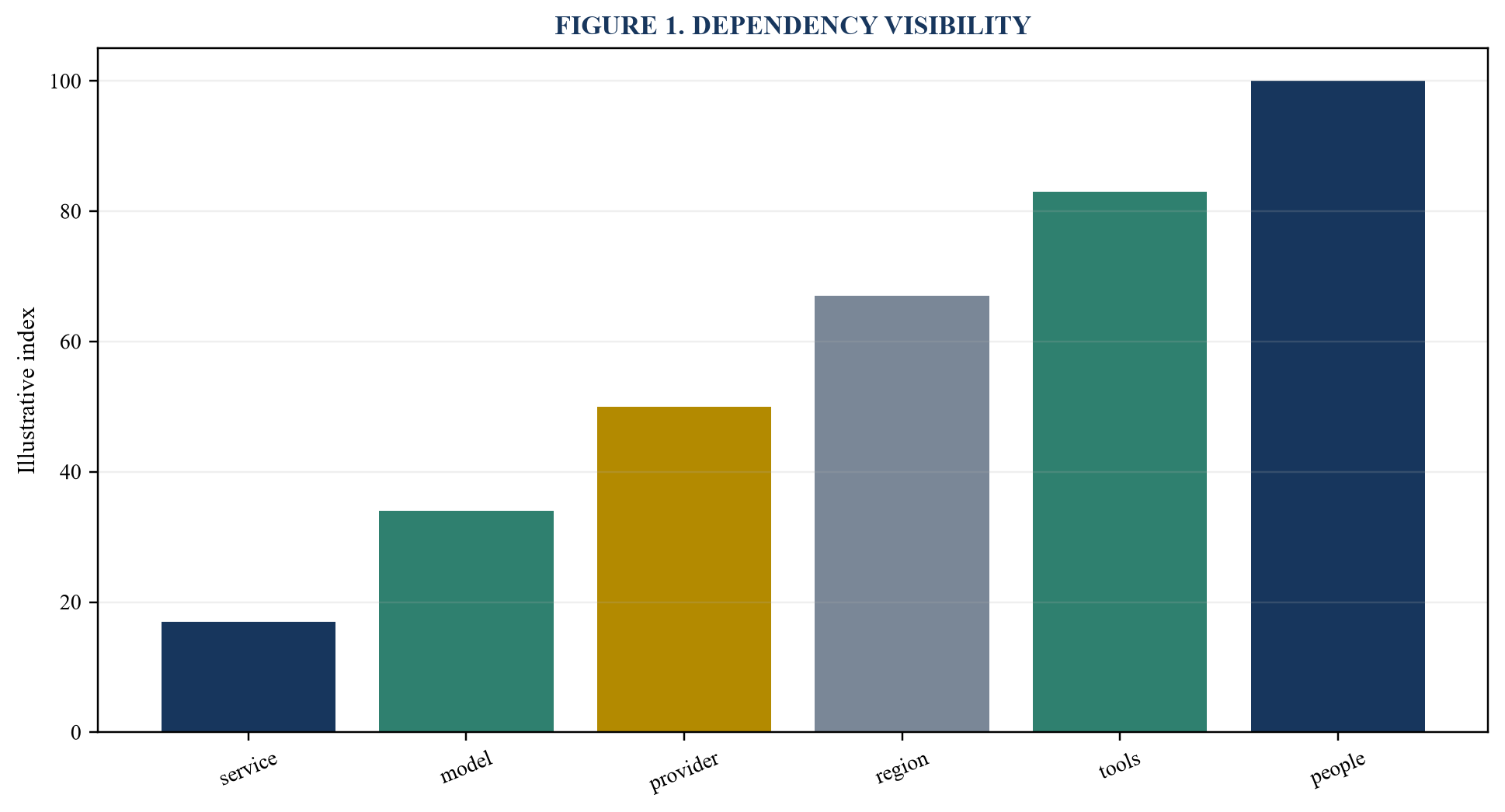
Values are illustrative indices and require replacement with approved production and financial evidence.
9. Design routing policy
Route by task, consequence, geography, data class, latency, quality, capacity, price and provider health.
The controlled record includes business service; decision tier; provider; model version; region; data class; control; evidence; owner; threshold. The immediate deliverable is an approved routing decision tree. Record the service, route, version, region, evidence, owner, approval, exception and outcome.
The principal failure occurs when the cheapest available model receives work it cannot safely perform. Reviewers should reproduce the tested condition, distinguish transport health from semantic performance, reconcile technical and commercial units and identify who may reroute, degrade, pause, communicate, remediate or accept residual exposure.
Resilience should be assessed at the business-service layer because model availability, application availability and decision continuity are different measures.
The decision pack for design routing policy should show the prior claim, production requirement, tested evidence, trigger, primary and alternate route, quality and latency consequence, cost and data effect, control owner, recovery step, customer impact and post-incident learning. Material exceptions flow into capacity, contracts, product design, reserves, customer commitments, transaction diligence and enterprise-value analysis.
10. Build health signals
Measure transport success, throttling, time to first token, completion latency, malformed output and semantic quality.
The controlled record includes business service; decision tier; provider; model version; region; data class; control; evidence; owner; threshold. The immediate deliverable is a real-time health model. Record the service, route, version, region, evidence, owner, approval, exception and outcome.
The principal failure occurs when routing decisions depend on provider status pages after customers already experience failure. Reviewers should reproduce the tested condition, distinguish transport health from semantic performance, reconcile technical and commercial units and identify who may reroute, degrade, pause, communicate, remediate or accept residual exposure.
Each route needs task-specific evidence for quality, latency, safety, privacy, cost and recovery under the exact production configuration.
The decision pack for build health signals should show the prior claim, production requirement, tested evidence, trigger, primary and alternate route, quality and latency consequence, cost and data effect, control owner, recovery step, customer impact and post-incident learning. Material exceptions flow into capacity, contracts, product design, reserves, customer commitments, transaction diligence and enterprise-value analysis.
11. Set latency objectives
Define percentile latency, streaming start, timeout, queue time and maximum acceptable degradation by journey.
The controlled record includes business service; decision tier; provider; model version; region; data class; control; evidence; owner; threshold. The immediate deliverable is a latency service-level objective. Record the service, route, version, region, evidence, owner, approval, exception and outcome.
The principal failure occurs when average latency hides tail performance that breaks interactive workflows. Reviewers should reproduce the tested condition, distinguish transport health from semantic performance, reconcile technical and commercial units and identify who may reroute, degrade, pause, communicate, remediate or accept residual exposure.
Provider diversity creates value only when failure domains, commercial rights, data controls, capacity and operating authority are genuinely independent.
The decision pack for set latency objectives should show the prior claim, production requirement, tested evidence, trigger, primary and alternate route, quality and latency consequence, cost and data effect, control owner, recovery step, customer impact and post-incident learning. Material exceptions flow into capacity, contracts, product design, reserves, customer commitments, transaction diligence and enterprise-value analysis.
12. Set quality objectives
Define task-specific correctness, completeness, groundedness, calibration and abstention criteria.
The controlled record includes business service; decision tier; provider; model version; region; data class; control; evidence; owner; threshold. The immediate deliverable is a quality service-level objective. Record the service, route, version, region, evidence, owner, approval, exception and outcome.
The principal failure occurs when availability is restored by a fallback that silently damages decision quality. Reviewers should reproduce the tested condition, distinguish transport health from semantic performance, reconcile technical and commercial units and identify who may reroute, degrade, pause, communicate, remediate or accept residual exposure.
The operating model should preserve an auditable path from trigger through routing decision, customer outcome, recovery and board-level learning.
The decision pack for set quality objectives should show the prior claim, production requirement, tested evidence, trigger, primary and alternate route, quality and latency consequence, cost and data effect, control owner, recovery step, customer impact and post-incident learning. Material exceptions flow into capacity, contracts, product design, reserves, customer commitments, transaction diligence and enterprise-value analysis.
13. Set safety and compliance objectives
Preserve policy controls, content handling, human oversight, auditability and required restrictions across routes.
The controlled record includes business service; decision tier; provider; model version; region; data class; control; evidence; owner; threshold. The immediate deliverable is a route-equivalent control matrix. Record the service, route, version, region, evidence, owner, approval, exception and outcome.
The principal failure occurs when failover bypasses the controls attached to the primary provider. Reviewers should reproduce the tested condition, distinguish transport health from semantic performance, reconcile technical and commercial units and identify who may reroute, degrade, pause, communicate, remediate or accept residual exposure.
Resilience should be assessed at the business-service layer because model availability, application availability and decision continuity are different measures.
The decision pack for set safety and compliance objectives should show the prior claim, production requirement, tested evidence, trigger, primary and alternate route, quality and latency consequence, cost and data effect, control owner, recovery step, customer impact and post-incident learning. Material exceptions flow into capacity, contracts, product design, reserves, customer commitments, transaction diligence and enterprise-value analysis.
14. Set cost objectives
Define input, output, cache, tool, retry, reservation and human-review cost limits.
The controlled record includes business service; decision tier; provider; model version; region; data class; control; evidence; owner; threshold. The immediate deliverable is a cost service-level objective. Record the service, route, version, region, evidence, owner, approval, exception and outcome.
The principal failure occurs when automated routing protects uptime while producing an uncontrolled cost spike. Reviewers should reproduce the tested condition, distinguish transport health from semantic performance, reconcile technical and commercial units and identify who may reroute, degrade, pause, communicate, remediate or accept residual exposure.
Each route needs task-specific evidence for quality, latency, safety, privacy, cost and recovery under the exact production configuration.
The decision pack for set cost objectives should show the prior claim, production requirement, tested evidence, trigger, primary and alternate route, quality and latency consequence, cost and data effect, control owner, recovery step, customer impact and post-incident learning. Material exceptions flow into capacity, contracts, product design, reserves, customer commitments, transaction diligence and enterprise-value analysis.
15. Set residency and privacy constraints
Map permitted processing locations, storage, retention, training use, logging and cross-border transfer.
The controlled record includes business service; decision tier; provider; model version; region; data class; control; evidence; owner; threshold. The immediate deliverable is a data-location routing policy. Record the service, route, version, region, evidence, owner, approval, exception and outcome.
The principal failure occurs when a global fallback violates an approved data-residency boundary. Reviewers should reproduce the tested condition, distinguish transport health from semantic performance, reconcile technical and commercial units and identify who may reroute, degrade, pause, communicate, remediate or accept residual exposure.
Provider diversity creates value only when failure domains, commercial rights, data controls, capacity and operating authority are genuinely independent.
The decision pack for set residency and privacy constraints should show the prior claim, production requirement, tested evidence, trigger, primary and alternate route, quality and latency consequence, cost and data effect, control owner, recovery step, customer impact and post-incident learning. Material exceptions flow into capacity, contracts, product design, reserves, customer commitments, transaction diligence and enterprise-value analysis.
16. Create canonical request and response schemas
Normalise messages, roles, attachments, tools, constraints, content, citations, refusals, finish reasons, usage and errors.
The controlled record includes business service; decision tier; provider; model version; region; data class; control; evidence; owner; threshold. The immediate deliverable is a canonical inference contract. Record the service, route, version, region, evidence, owner, approval, exception and outcome.
The principal failure occurs when provider-specific objects spread through product code and downstream systems misread completion states. Reviewers should reproduce the tested condition, distinguish transport health from semantic performance, reconcile technical and commercial units and identify who may reroute, degrade, pause, communicate, remediate or accept residual exposure.
The operating model should preserve an auditable path from trigger through routing decision, customer outcome, recovery and board-level learning.
The decision pack for create canonical request and response schemas should show the prior claim, production requirement, tested evidence, trigger, primary and alternate route, quality and latency consequence, cost and data effect, control owner, recovery step, customer impact and post-incident learning. Material exceptions flow into capacity, contracts, product design, reserves, customer commitments, transaction diligence and enterprise-value analysis.
Table 2. Route acceptance matrix
| Dimension | Required evidence | Release gate |
|---|---|---|
| quality | task evaluation | minimum threshold |
| latency | tail distribution | journey objective |
| control | policy equivalence | no bypass |
| cost | unit economics | approved ceiling |
Illustrative controls require service-, provider-, model-, region-, firm- and period-specific approval.
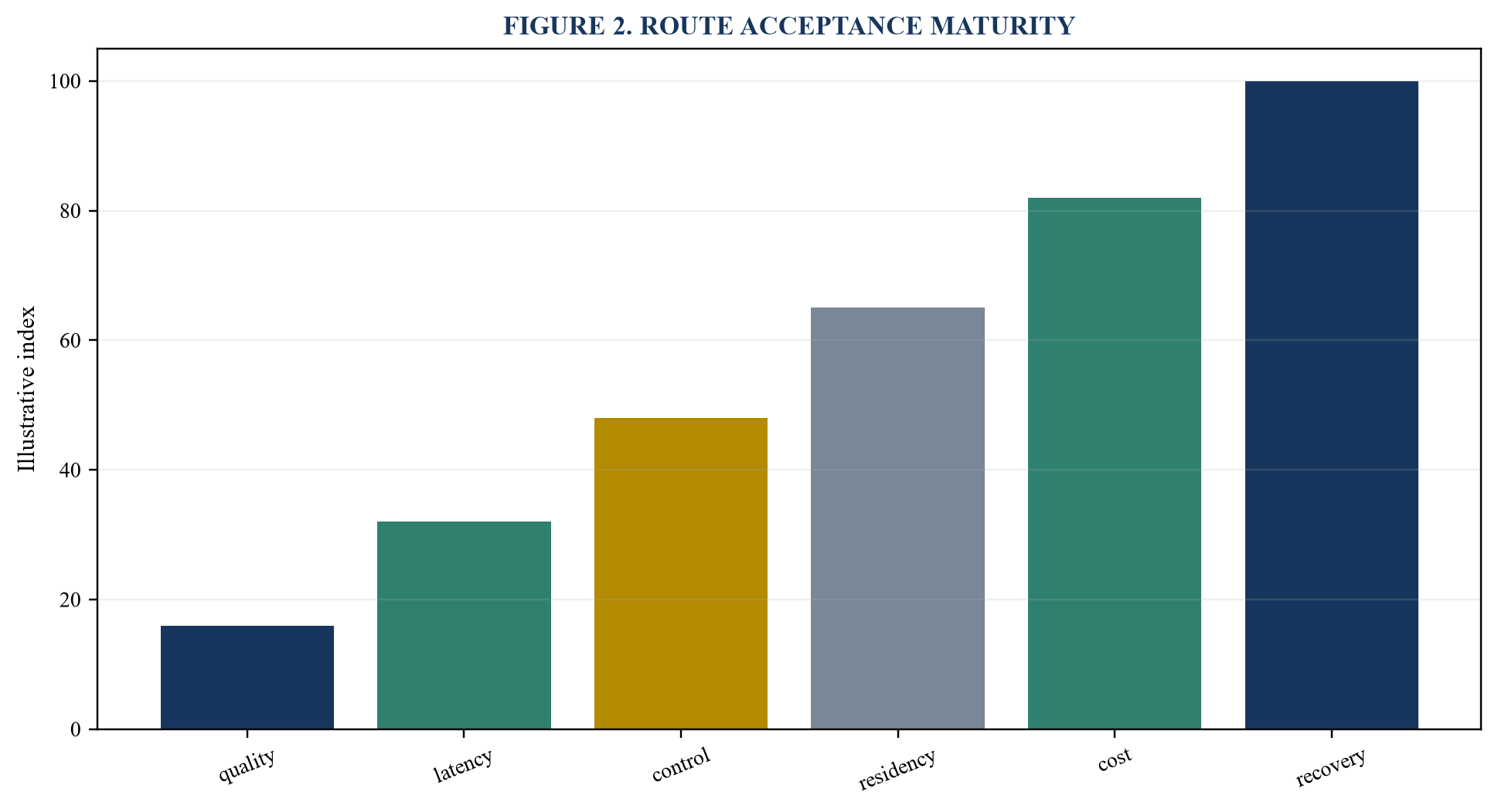
Values are illustrative indices and require replacement with approved production and financial evidence.
17. Engineer portable prompts
Separate business instruction, provider adaptation, tool guidance and output specification with version control.
The controlled record includes business service; decision tier; provider; model version; region; data class; control; evidence; owner; threshold. The immediate deliverable is a prompt portability pack. Record the service, route, version, region, evidence, owner, approval, exception and outcome.
The principal failure occurs when a prompt tuned for one provider fails materially on another. Reviewers should reproduce the tested condition, distinguish transport health from semantic performance, reconcile technical and commercial units and identify who may reroute, degrade, pause, communicate, remediate or accept residual exposure.
Resilience should be assessed at the business-service layer because model availability, application availability and decision continuity are different measures.
The decision pack for engineer portable prompts should show the prior claim, production requirement, tested evidence, trigger, primary and alternate route, quality and latency consequence, cost and data effect, control owner, recovery step, customer impact and post-incident learning. Material exceptions flow into capacity, contracts, product design, reserves, customer commitments, transaction diligence and enterprise-value analysis.
18. Normalise tool semantics
Define names, arguments, permissions, side effects, confirmation and idempotency across providers.
The controlled record includes business service; decision tier; provider; model version; region; data class; control; evidence; owner; threshold. The immediate deliverable is a provider-neutral tool registry. Record the service, route, version, region, evidence, owner, approval, exception and outcome.
The principal failure occurs when fallback invokes tools with different semantics or authority. Reviewers should reproduce the tested condition, distinguish transport health from semantic performance, reconcile technical and commercial units and identify who may reroute, degrade, pause, communicate, remediate or accept residual exposure.
Each route needs task-specific evidence for quality, latency, safety, privacy, cost and recovery under the exact production configuration.
The decision pack for normalise tool semantics should show the prior claim, production requirement, tested evidence, trigger, primary and alternate route, quality and latency consequence, cost and data effect, control owner, recovery step, customer impact and post-incident learning. Material exceptions flow into capacity, contracts, product design, reserves, customer commitments, transaction diligence and enterprise-value analysis.
19. Validate structured outputs
Test schema support, coercion, repair, refusal, truncation and version changes.
The controlled record includes business service; decision tier; provider; model version; region; data class; control; evidence; owner; threshold. The immediate deliverable is a structured-output conformance suite. Record the service, route, version, region, evidence, owner, approval, exception and outcome.
The principal failure occurs when syntactically valid fallback output carries semantically missing fields. Reviewers should reproduce the tested condition, distinguish transport health from semantic performance, reconcile technical and commercial units and identify who may reroute, degrade, pause, communicate, remediate or accept residual exposure.
Provider diversity creates value only when failure domains, commercial rights, data controls, capacity and operating authority are genuinely independent.
The decision pack for validate structured outputs should show the prior claim, production requirement, tested evidence, trigger, primary and alternate route, quality and latency consequence, cost and data effect, control owner, recovery step, customer impact and post-incident learning. Material exceptions flow into capacity, contracts, product design, reserves, customer commitments, transaction diligence and enterprise-value analysis.
20. Control retrieval dependencies
Test embedding compatibility, chunking, ranking, citations, access control, freshness and fallback retrieval.
The controlled record includes business service; decision tier; provider; model version; region; data class; control; evidence; owner; threshold. The immediate deliverable is a retrieval resilience design. Record the service, route, version, region, evidence, owner, approval, exception and outcome.
The principal failure occurs when model diversity masks a single retrieval or vector-store dependency. Reviewers should reproduce the tested condition, distinguish transport health from semantic performance, reconcile technical and commercial units and identify who may reroute, degrade, pause, communicate, remediate or accept residual exposure.
The operating model should preserve an auditable path from trigger through routing decision, customer outcome, recovery and board-level learning.
The decision pack for control retrieval dependencies should show the prior claim, production requirement, tested evidence, trigger, primary and alternate route, quality and latency consequence, cost and data effect, control owner, recovery step, customer impact and post-incident learning. Material exceptions flow into capacity, contracts, product design, reserves, customer commitments, transaction diligence and enterprise-value analysis.
21. Build the evaluation corpus
Create representative, adverse, multilingual, long-context, tool-use and policy cases from approved evidence.
The controlled record includes business service; decision tier; provider; model version; region; data class; control; evidence; owner; threshold. The immediate deliverable is a versioned production evaluation set. Record the service, route, version, region, evidence, owner, approval, exception and outcome.
The principal failure occurs when routing decisions rely on public benchmarks unrelated to production tasks. Reviewers should reproduce the tested condition, distinguish transport health from semantic performance, reconcile technical and commercial units and identify who may reroute, degrade, pause, communicate, remediate or accept residual exposure.
Resilience should be assessed at the business-service layer because model availability, application availability and decision continuity are different measures.
The decision pack for build the evaluation corpus should show the prior claim, production requirement, tested evidence, trigger, primary and alternate route, quality and latency consequence, cost and data effect, control owner, recovery step, customer impact and post-incident learning. Material exceptions flow into capacity, contracts, product design, reserves, customer commitments, transaction diligence and enterprise-value analysis.
22. Run shadow comparisons
Replay approved traffic against candidate routes without customer impact and reconcile quality, latency and cost.
The controlled record includes business service; decision tier; provider; model version; region; data class; control; evidence; owner; threshold. The immediate deliverable is a shadow-evaluation report. Record the service, route, version, region, evidence, owner, approval, exception and outcome.
The principal failure occurs when a provider is promoted from laboratory tests that omit live distribution shift. Reviewers should reproduce the tested condition, distinguish transport health from semantic performance, reconcile technical and commercial units and identify who may reroute, degrade, pause, communicate, remediate or accept residual exposure.
Each route needs task-specific evidence for quality, latency, safety, privacy, cost and recovery under the exact production configuration.
The decision pack for run shadow comparisons should show the prior claim, production requirement, tested evidence, trigger, primary and alternate route, quality and latency consequence, cost and data effect, control owner, recovery step, customer impact and post-incident learning. Material exceptions flow into capacity, contracts, product design, reserves, customer commitments, transaction diligence and enterprise-value analysis.
23. Test route equivalence
Compare outputs, decisions, refusals, citations, tools and human overrides across primary and fallback paths.
The controlled record includes business service; decision tier; provider; model version; region; data class; control; evidence; owner; threshold. The immediate deliverable is a route-equivalence decision pack. Record the service, route, version, region, evidence, owner, approval, exception and outcome.
The principal failure occurs when technical failover succeeds while business outcomes diverge. Reviewers should reproduce the tested condition, distinguish transport health from semantic performance, reconcile technical and commercial units and identify who may reroute, degrade, pause, communicate, remediate or accept residual exposure.
Provider diversity creates value only when failure domains, commercial rights, data controls, capacity and operating authority are genuinely independent.
The decision pack for test route equivalence should show the prior claim, production requirement, tested evidence, trigger, primary and alternate route, quality and latency consequence, cost and data effect, control owner, recovery step, customer impact and post-incident learning. Material exceptions flow into capacity, contracts, product design, reserves, customer commitments, transaction diligence and enterprise-value analysis.
24. Design fallback tiers
Define retry, same-model region, alternate model, alternate provider, degraded workflow and manual mode.
The controlled record includes business service; decision tier; provider; model version; region; data class; control; evidence; owner; threshold. The immediate deliverable is a tiered continuity playbook. Record the service, route, version, region, evidence, owner, approval, exception and outcome.
The principal failure occurs when all failures trigger the most disruptive fallback. Reviewers should reproduce the tested condition, distinguish transport health from semantic performance, reconcile technical and commercial units and identify who may reroute, degrade, pause, communicate, remediate or accept residual exposure.
The operating model should preserve an auditable path from trigger through routing decision, customer outcome, recovery and board-level learning.
The decision pack for design fallback tiers should show the prior claim, production requirement, tested evidence, trigger, primary and alternate route, quality and latency consequence, cost and data effect, control owner, recovery step, customer impact and post-incident learning. Material exceptions flow into capacity, contracts, product design, reserves, customer commitments, transaction diligence and enterprise-value analysis.
Table 3. Fallback decision ladder
| Tier | Trigger | Response |
|---|---|---|
| one | transient error | bounded retry |
| two | regional stress | same model alternate region |
| three | model degradation | validated alternate model |
| four | control uncertainty | degraded or manual mode |
Illustrative controls require service-, provider-, model-, region-, firm- and period-specific approval.
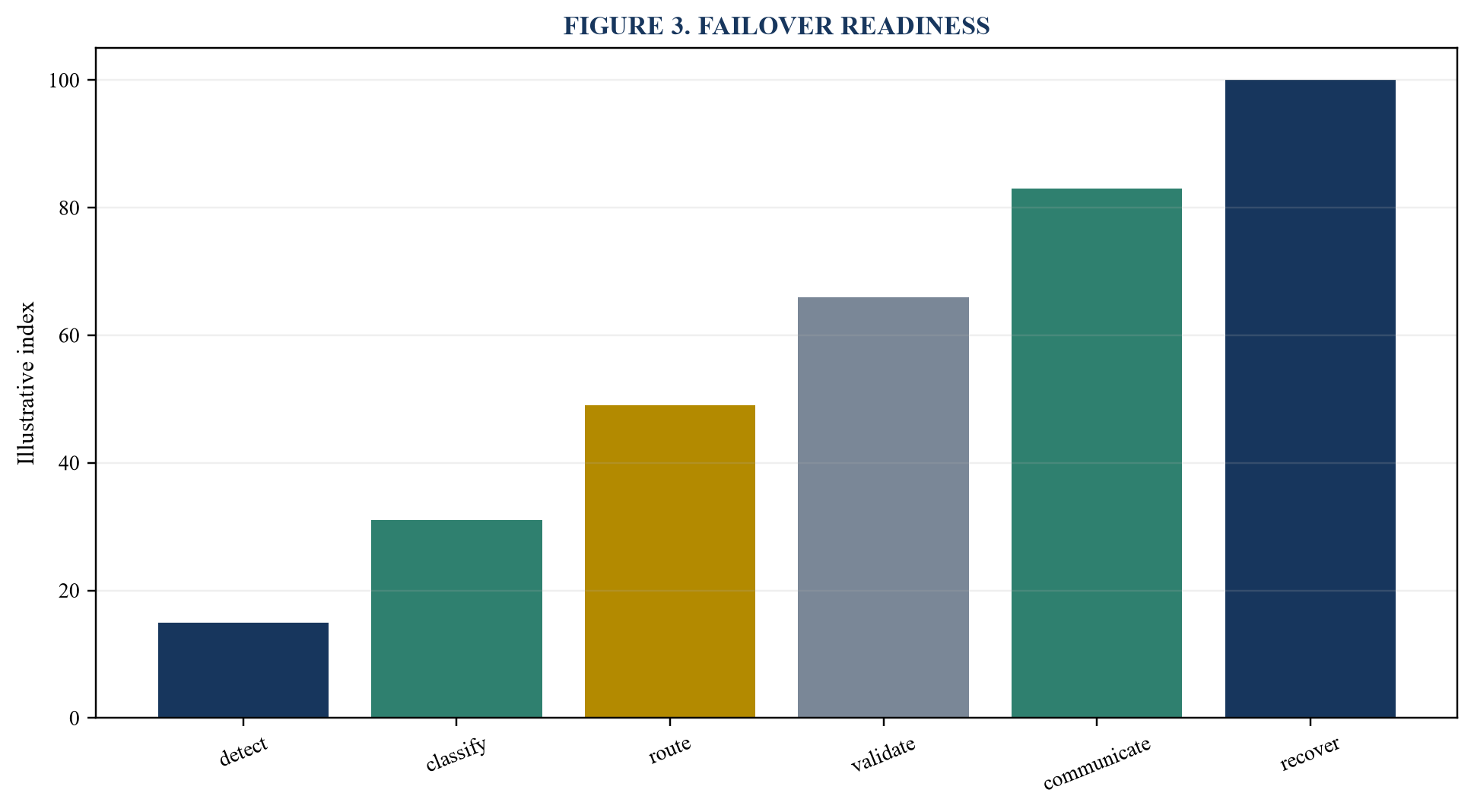
Values are illustrative indices and require replacement with approved production and financial evidence.
25. Control retries and circuit breaking
Set retryable errors, budgets, backoff, timeouts, circuit thresholds, probe recovery and request idempotency.
The controlled record includes business service; decision tier; provider; model version; region; data class; control; evidence; owner; threshold. The immediate deliverable is a retry and circuit-breaker specification. Record the service, route, version, region, evidence, owner, approval, exception and outcome.
The principal failure occurs when retry storms amplify provider stress and duplicate downstream actions. Reviewers should reproduce the tested condition, distinguish transport health from semantic performance, reconcile technical and commercial units and identify who may reroute, degrade, pause, communicate, remediate or accept residual exposure.
Resilience should be assessed at the business-service layer because model availability, application availability and decision continuity are different measures.
The decision pack for control retries and circuit breaking should show the prior claim, production requirement, tested evidence, trigger, primary and alternate route, quality and latency consequence, cost and data effect, control owner, recovery step, customer impact and post-incident learning. Material exceptions flow into capacity, contracts, product design, reserves, customer commitments, transaction diligence and enterprise-value analysis.
26. Secure capacity and quota
Map rate limits, token limits, reserved capacity, burst behaviour, quota increases and priority tiers.
The controlled record includes business service; decision tier; provider; model version; region; data class; control; evidence; owner; threshold. The immediate deliverable is a capacity assurance plan. Record the service, route, version, region, evidence, owner, approval, exception and outcome.
The principal failure occurs when the secondary route has never carried production volume and throttles during the incident. Reviewers should reproduce the tested condition, distinguish transport health from semantic performance, reconcile technical and commercial units and identify who may reroute, degrade, pause, communicate, remediate or accept residual exposure.
Each route needs task-specific evidence for quality, latency, safety, privacy, cost and recovery under the exact production configuration.
The decision pack for secure capacity and quota should show the prior claim, production requirement, tested evidence, trigger, primary and alternate route, quality and latency consequence, cost and data effect, control owner, recovery step, customer impact and post-incident learning. Material exceptions flow into capacity, contracts, product design, reserves, customer commitments, transaction diligence and enterprise-value analysis.
27. Design regional resilience
Select zones, regions and geographies consistent with latency, regulation, provider availability and correlated failure.
The controlled record includes business service; decision tier; provider; model version; region; data class; control; evidence; owner; threshold. The immediate deliverable is a regional failure-domain map. Record the service, route, version, region, evidence, owner, approval, exception and outcome.
The principal failure occurs when two endpoints share the same regional or infrastructure failure domain. Reviewers should reproduce the tested condition, distinguish transport health from semantic performance, reconcile technical and commercial units and identify who may reroute, degrade, pause, communicate, remediate or accept residual exposure.
Provider diversity creates value only when failure domains, commercial rights, data controls, capacity and operating authority are genuinely independent.
The decision pack for design regional resilience should show the prior claim, production requirement, tested evidence, trigger, primary and alternate route, quality and latency consequence, cost and data effect, control owner, recovery step, customer impact and post-incident learning. Material exceptions flow into capacity, contracts, product design, reserves, customer commitments, transaction diligence and enterprise-value analysis.
28. Protect confidential data
Apply classification, redaction, encryption, secrets, least privilege, retention and audit controls on every route.
The controlled record includes business service; decision tier; provider; model version; region; data class; control; evidence; owner; threshold. The immediate deliverable is a cross-provider data-control matrix. Record the service, route, version, region, evidence, owner, approval, exception and outcome.
The principal failure occurs when fallback expands data access or retention beyond approved terms. Reviewers should reproduce the tested condition, distinguish transport health from semantic performance, reconcile technical and commercial units and identify who may reroute, degrade, pause, communicate, remediate or accept residual exposure.
The operating model should preserve an auditable path from trigger through routing decision, customer outcome, recovery and board-level learning.
The decision pack for protect confidential data should show the prior claim, production requirement, tested evidence, trigger, primary and alternate route, quality and latency consequence, cost and data effect, control owner, recovery step, customer impact and post-incident learning. Material exceptions flow into capacity, contracts, product design, reserves, customer commitments, transaction diligence and enterprise-value analysis.
29. Measure concentration risk
Quantify provider, cloud, region, model family, gateway and specialist dependency by critical journey.
The controlled record includes business service; decision tier; provider; model version; region; data class; control; evidence; owner; threshold. The immediate deliverable is a concentration exposure dashboard. Record the service, route, version, region, evidence, owner, approval, exception and outcome.
The principal failure occurs when apparent provider diversity rests on common infrastructure or model supply. Reviewers should reproduce the tested condition, distinguish transport health from semantic performance, reconcile technical and commercial units and identify who may reroute, degrade, pause, communicate, remediate or accept residual exposure.
Resilience should be assessed at the business-service layer because model availability, application availability and decision continuity are different measures.
The decision pack for measure concentration risk should show the prior claim, production requirement, tested evidence, trigger, primary and alternate route, quality and latency consequence, cost and data effect, control owner, recovery step, customer impact and post-incident learning. Material exceptions flow into capacity, contracts, product design, reserves, customer commitments, transaction diligence and enterprise-value analysis.
30. Negotiate service commitments
Test availability definitions, exclusions, credits, support, incident notice, capacity, change notice and audit evidence.
The controlled record includes business service; decision tier; provider; model version; region; data class; control; evidence; owner; threshold. The immediate deliverable is an operational service-commitment schedule. Record the service, route, version, region, evidence, owner, approval, exception and outcome.
The principal failure occurs when headline service levels offer little recovery or financial protection. Reviewers should reproduce the tested condition, distinguish transport health from semantic performance, reconcile technical and commercial units and identify who may reroute, degrade, pause, communicate, remediate or accept residual exposure.
Each route needs task-specific evidence for quality, latency, safety, privacy, cost and recovery under the exact production configuration.
The decision pack for negotiate service commitments should show the prior claim, production requirement, tested evidence, trigger, primary and alternate route, quality and latency consequence, cost and data effect, control owner, recovery step, customer impact and post-incident learning. Material exceptions flow into capacity, contracts, product design, reserves, customer commitments, transaction diligence and enterprise-value analysis.
31. Secure commercial and IP rights
Review input and output rights, training use, indemnities, confidentiality, termination, export and migration assistance.
The controlled record includes business service; decision tier; provider; model version; region; data class; control; evidence; owner; threshold. The immediate deliverable is a cross-provider rights matrix. Record the service, route, version, region, evidence, owner, approval, exception and outcome.
The principal failure occurs when the fallback route cannot lawfully process the same content or support the same product. Reviewers should reproduce the tested condition, distinguish transport health from semantic performance, reconcile technical and commercial units and identify who may reroute, degrade, pause, communicate, remediate or accept residual exposure.
Provider diversity creates value only when failure domains, commercial rights, data controls, capacity and operating authority are genuinely independent.
The decision pack for secure commercial and ip rights should show the prior claim, production requirement, tested evidence, trigger, primary and alternate route, quality and latency consequence, cost and data effect, control owner, recovery step, customer impact and post-incident learning. Material exceptions flow into capacity, contracts, product design, reserves, customer commitments, transaction diligence and enterprise-value analysis.
32. Build the incident playbook
Define detection, commander, severity, routing authority, customer communication, evidence capture and recovery.
The controlled record includes business service; decision tier; provider; model version; region; data class; control; evidence; owner; threshold. The immediate deliverable is an LLM incident response plan. Record the service, route, version, region, evidence, owner, approval, exception and outcome.
The principal failure occurs when engineers improvise provider switching during a high-consequence incident. Reviewers should reproduce the tested condition, distinguish transport health from semantic performance, reconcile technical and commercial units and identify who may reroute, degrade, pause, communicate, remediate or accept residual exposure.
The operating model should preserve an auditable path from trigger through routing decision, customer outcome, recovery and board-level learning.
The decision pack for build the incident playbook should show the prior claim, production requirement, tested evidence, trigger, primary and alternate route, quality and latency consequence, cost and data effect, control owner, recovery step, customer impact and post-incident learning. Material exceptions flow into capacity, contracts, product design, reserves, customer commitments, transaction diligence and enterprise-value analysis.
Table 4. Contract resilience controls
| Control | Evidence | Value protected |
|---|---|---|
| change notice | version calendar | migration time |
| capacity | quota and reservation | revenue continuity |
| data rights | route permissions | lawful operation |
| exit | portability support | switching option |
Illustrative controls require service-, provider-, model-, region-, firm- and period-specific approval.
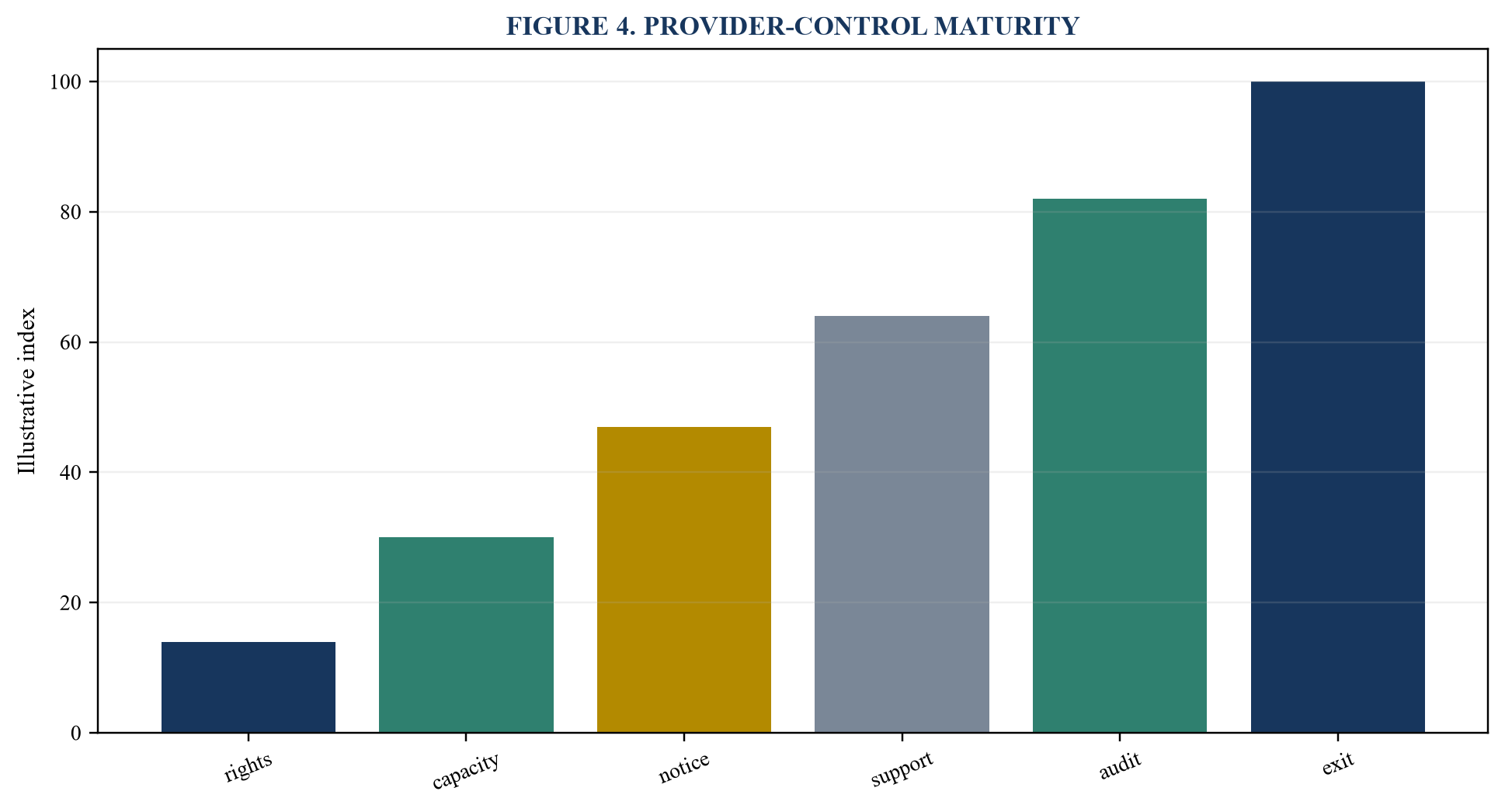
Values are illustrative indices and require replacement with approved production and financial evidence.
33. Govern production changes
Require evaluation, security, compliance, cost and owner approvals for prompt, model, provider, route and threshold changes.
The controlled record includes business service; decision tier; provider; model version; region; data class; control; evidence; owner; threshold. The immediate deliverable is a controlled change-and-release process. Record the service, route, version, region, evidence, owner, approval, exception and outcome.
The principal failure occurs when silent configuration drift invalidates prior assurance. Reviewers should reproduce the tested condition, distinguish transport health from semantic performance, reconcile technical and commercial units and identify who may reroute, degrade, pause, communicate, remediate or accept residual exposure.
Resilience should be assessed at the business-service layer because model availability, application availability and decision continuity are different measures.
The decision pack for govern production changes should show the prior claim, production requirement, tested evidence, trigger, primary and alternate route, quality and latency consequence, cost and data effect, control owner, recovery step, customer impact and post-incident learning. Material exceptions flow into capacity, contracts, product design, reserves, customer commitments, transaction diligence and enterprise-value analysis.
34. Create operating accountability
Assign board oversight, executive ownership, product, risk, engineering, procurement, legal and operations decisions.
The controlled record includes business service; decision tier; provider; model version; region; data class; control; evidence; owner; threshold. The immediate deliverable is a multi-provider governance RACI. Record the service, route, version, region, evidence, owner, approval, exception and outcome.
The principal failure occurs when multiple functions can object while nobody owns continuity. Reviewers should reproduce the tested condition, distinguish transport health from semantic performance, reconcile technical and commercial units and identify who may reroute, degrade, pause, communicate, remediate or accept residual exposure.
Each route needs task-specific evidence for quality, latency, safety, privacy, cost and recovery under the exact production configuration.
The decision pack for create operating accountability should show the prior claim, production requirement, tested evidence, trigger, primary and alternate route, quality and latency consequence, cost and data effect, control owner, recovery step, customer impact and post-incident learning. Material exceptions flow into capacity, contracts, product design, reserves, customer commitments, transaction diligence and enterprise-value analysis.
35. Build observability and evidence
Join request IDs, route, version, region, prompt, retrieval, tools, quality, cost, incident and customer outcome.
The controlled record includes business service; decision tier; provider; model version; region; data class; control; evidence; owner; threshold. The immediate deliverable is an inference evidence ledger. Record the service, route, version, region, evidence, owner, approval, exception and outcome.
The principal failure occurs when teams cannot reconstruct which dependency produced a material result. Reviewers should reproduce the tested condition, distinguish transport health from semantic performance, reconcile technical and commercial units and identify who may reroute, degrade, pause, communicate, remediate or accept residual exposure.
Provider diversity creates value only when failure domains, commercial rights, data controls, capacity and operating authority are genuinely independent.
The decision pack for build observability and evidence should show the prior claim, production requirement, tested evidence, trigger, primary and alternate route, quality and latency consequence, cost and data effect, control owner, recovery step, customer impact and post-incident learning. Material exceptions flow into capacity, contracts, product design, reserves, customer commitments, transaction diligence and enterprise-value analysis.
36. Model resilience economics
Compare engineering, duplicate capacity, evaluations and operating cost with outage loss, churn, remediation and avoided concentration.
The controlled record includes business service; decision tier; provider; model version; region; data class; control; evidence; owner; threshold. The immediate deliverable is a resilience investment case. Record the service, route, version, region, evidence, owner, approval, exception and outcome.
The principal failure occurs when redundancy is purchased without testing whether it protects an economic exposure. Reviewers should reproduce the tested condition, distinguish transport health from semantic performance, reconcile technical and commercial units and identify who may reroute, degrade, pause, communicate, remediate or accept residual exposure.
The operating model should preserve an auditable path from trigger through routing decision, customer outcome, recovery and board-level learning.
The decision pack for model resilience economics should show the prior claim, production requirement, tested evidence, trigger, primary and alternate route, quality and latency consequence, cost and data effect, control owner, recovery step, customer impact and post-incident learning. Material exceptions flow into capacity, contracts, product design, reserves, customer commitments, transaction diligence and enterprise-value analysis.
37. Model commitments and working capital
Stress minimum spend, reservations, currency, prepayment, volume variability and duplicated capacity.
The controlled record includes business service; decision tier; provider; model version; region; data class; control; evidence; owner; threshold. The immediate deliverable is a provider-commitment cash model. Record the service, route, version, region, evidence, owner, approval, exception and outcome.
The principal failure occurs when contracted capacity creates stranded cost while protecting only nominal throughput. Reviewers should reproduce the tested condition, distinguish transport health from semantic performance, reconcile technical and commercial units and identify who may reroute, degrade, pause, communicate, remediate or accept residual exposure.
Resilience should be assessed at the business-service layer because model availability, application availability and decision continuity are different measures.
The decision pack for model commitments and working capital should show the prior claim, production requirement, tested evidence, trigger, primary and alternate route, quality and latency consequence, cost and data effect, control owner, recovery step, customer impact and post-incident learning. Material exceptions flow into capacity, contracts, product design, reserves, customer commitments, transaction diligence and enterprise-value analysis.
38. Translate resilience into enterprise value
Connect customer retention, revenue continuity, gross margin, remediation, liability, concentration and terminal value.
The controlled record includes business service; decision tier; provider; model version; region; data class; control; evidence; owner; threshold. The immediate deliverable is a resilience-adjusted value bridge. Record the service, route, version, region, evidence, owner, approval, exception and outcome.
The principal failure occurs when model dependency remains outside diligence and valuation. Reviewers should reproduce the tested condition, distinguish transport health from semantic performance, reconcile technical and commercial units and identify who may reroute, degrade, pause, communicate, remediate or accept residual exposure.
Each route needs task-specific evidence for quality, latency, safety, privacy, cost and recovery under the exact production configuration.
The decision pack for translate resilience into enterprise value should show the prior claim, production requirement, tested evidence, trigger, primary and alternate route, quality and latency consequence, cost and data effect, control owner, recovery step, customer impact and post-incident learning. Material exceptions flow into capacity, contracts, product design, reserves, customer commitments, transaction diligence and enterprise-value analysis.
39. Execute the first ninety days
Sequence inventory, service tiers, schemas, evaluations, routing, contracts, exercises and board reporting.
The controlled record includes business service; decision tier; provider; model version; region; data class; control; evidence; owner; threshold. The immediate deliverable is a 30-60-90-day resilience roadmap. Record the service, route, version, region, evidence, owner, approval, exception and outcome.
The principal failure occurs when a broad architecture programme delays the controls needed for critical journeys. Reviewers should reproduce the tested condition, distinguish transport health from semantic performance, reconcile technical and commercial units and identify who may reroute, degrade, pause, communicate, remediate or accept residual exposure.
Provider diversity creates value only when failure domains, commercial rights, data controls, capacity and operating authority are genuinely independent.
The decision pack for execute the first ninety days should show the prior claim, production requirement, tested evidence, trigger, primary and alternate route, quality and latency consequence, cost and data effect, control owner, recovery step, customer impact and post-incident learning. Material exceptions flow into capacity, contracts, product design, reserves, customer commitments, transaction diligence and enterprise-value analysis.
40. Close through evidence gates
Require tested continuity, route equivalence, capacity, control parity, accountable ownership and costed residual risk.
The controlled record includes business service; decision tier; provider; model version; region; data class; control; evidence; owner; threshold. The immediate deliverable is an accountable resilience decision. Record the service, route, version, region, evidence, owner, approval, exception and outcome.
The principal failure occurs when multi-provider claims are accepted without a production exercise. Reviewers should reproduce the tested condition, distinguish transport health from semantic performance, reconcile technical and commercial units and identify who may reroute, degrade, pause, communicate, remediate or accept residual exposure.
The operating model should preserve an auditable path from trigger through routing decision, customer outcome, recovery and board-level learning.
The decision pack for close through evidence gates should show the prior claim, production requirement, tested evidence, trigger, primary and alternate route, quality and latency consequence, cost and data effect, control owner, recovery step, customer impact and post-incident learning. Material exceptions flow into capacity, contracts, product design, reserves, customer commitments, transaction diligence and enterprise-value analysis.
Table 5. Resilience close gates
| Gate | Required proof | Decision output |
|---|---|---|
| perimeter | critical journeys | scope approved |
| equivalence | production evaluations | routes accepted |
| operations | exercise and owners | recovery credible |
| economics | cost and exposure | investment signed |
Illustrative controls require service-, provider-, model-, region-, firm- and period-specific approval.
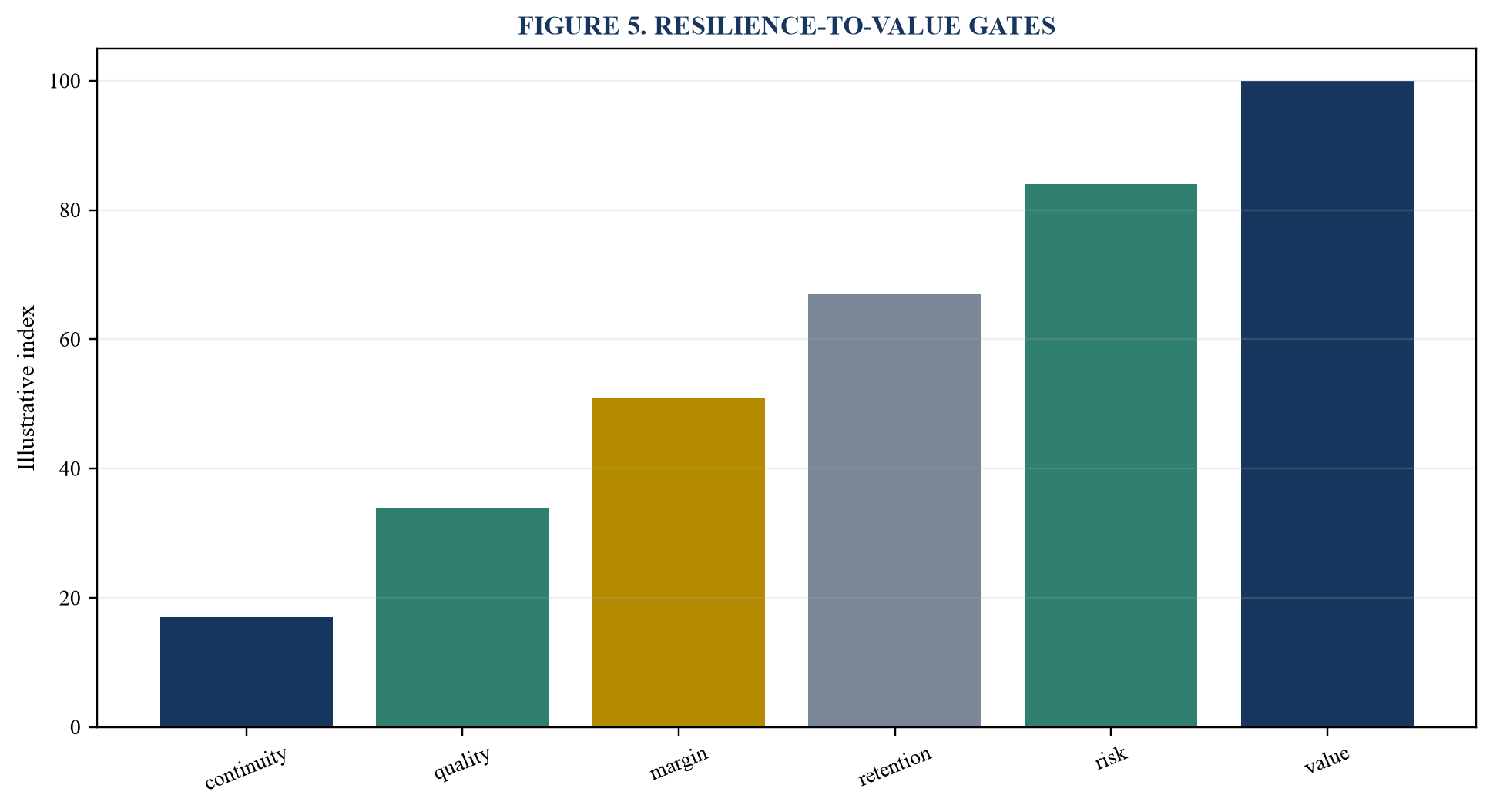
Values are illustrative indices and require replacement with approved production and financial evidence.
References
- National Institute of Standards and Technology, AI Risk Management Framework, https://www.nist.gov/itl/ai-risk-management-framework
- National Institute of Standards and Technology, Generative Artificial Intelligence Profile NIST AI 600-1, https://nvlpubs.nist.gov/nistpubs/ai/NIST.AI.600-1.pdf
- National Institute of Standards and Technology, AI RMF Core, https://airc.nist.gov/airmf-resources/airmf/5-sec-core/
- National Institute of Standards and Technology, AI RMF Playbook, https://www.nist.gov/itl/ai-risk-management-framework/nist-ai-rmf-playbook
- OpenAI, API Backward Compatibility, https://platform.openai.com/docs/api-reference/backward-compatibility
- OpenAI, Data Controls in the OpenAI Platform, https://platform.openai.com/docs/models/default-usage-policies-by-endpoint
- OpenAI, Service Status, https://status.openai.com/
- Anthropic, Model Deprecations, https://docs.anthropic.com/en/docs/about-claude/model-deprecations
- Anthropic, Service Status, https://status.anthropic.com/
- Google Cloud, AI and ML Reliability Perspective, https://docs.cloud.google.com/architecture/framework/perspectives/ai-ml/reliability
- Google Cloud, Deploy and Operate Generative AI Applications, https://docs.cloud.google.com/architecture/deploy-operate-generative-ai-applications
- Google Cloud, Generative AI on Vertex AI Release Notes, https://docs.cloud.google.com/vertex-ai/generative-ai/docs/release-notes
- Google Cloud, Vertex AI Model Versions and Lifecycle, https://cloud.google.com/vertex-ai/generative-ai/docs/learn/model-versions
- Amazon Web Services, Amazon Bedrock Cross-Region Inference, https://docs.aws.amazon.com/bedrock/latest/userguide/cross-region-inference.html
- Amazon Web Services, Amazon Bedrock Capacity and Performance, https://docs.aws.amazon.com/bedrock/latest/userguide/capacity-limits-cost-optimization.html
- Amazon Web Services, Generative AI Lens Well-Architected Framework, https://docs.aws.amazon.com/pdfs/wellarchitected/latest/generative-ai-lens/generative-ai-lens.pdf
- Microsoft, Design to Support Foundation Model Life Cycles, https://learn.microsoft.com/en-us/azure/architecture/ai-ml/guide/manage-foundation-models-lifecycle
- Microsoft, Working with Azure OpenAI Models, https://learn.microsoft.com/en-us/azure/ai-services/openai/how-to/working-with-models
- Microsoft, Azure Availability Zones Overview, https://learn.microsoft.com/en-us/azure/reliability/availability-zones-overview
- Microsoft, Enable Zone Resiliency for Azure Workloads, https://learn.microsoft.com/en-us/azure/reliability/availability-zones-enable-zone-resiliency
- European Union, Regulation 2024/1689 Artificial Intelligence Act, https://eur-lex.europa.eu/eli/reg/2024/1689
- European Union Agency for Cybersecurity, Multilayer Framework for Good Cybersecurity Practices for AI, https://www.enisa.europa.eu/publications/multilayer-framework-for-good-cybersecurity-practices-for-ai
- UK National Cyber Security Centre, Supply Chain Security Guidance, https://www.ncsc.gov.uk/collection/supply-chain-security
- Cloud Native Computing Foundation, OpenTelemetry Documentation, https://opentelemetry.io/docs/
- Google, Site Reliability Engineering Workbook, https://sre.google/workbook/table-of-contents/
- OWASP Foundation, Top 10 for Large Language Model Applications, https://genai.owasp.org/llm-top-10/
