

Introduction
A family office that has built a substantial private equity portfolio holds considerable value in its fund interests, but that value is illiquid. Private equity funds draw capital over years, invest it, and distribute the returns over a decade or more, and the family office interests in them cannot be readily sold or accessed in the interim. A family office with a large private equity portfolio is therefore, like the concentrated principal of a companion paper, wealthy in its holdings but potentially short of liquid capital, unable to access the value locked in its fund interests without selling them at a discount.
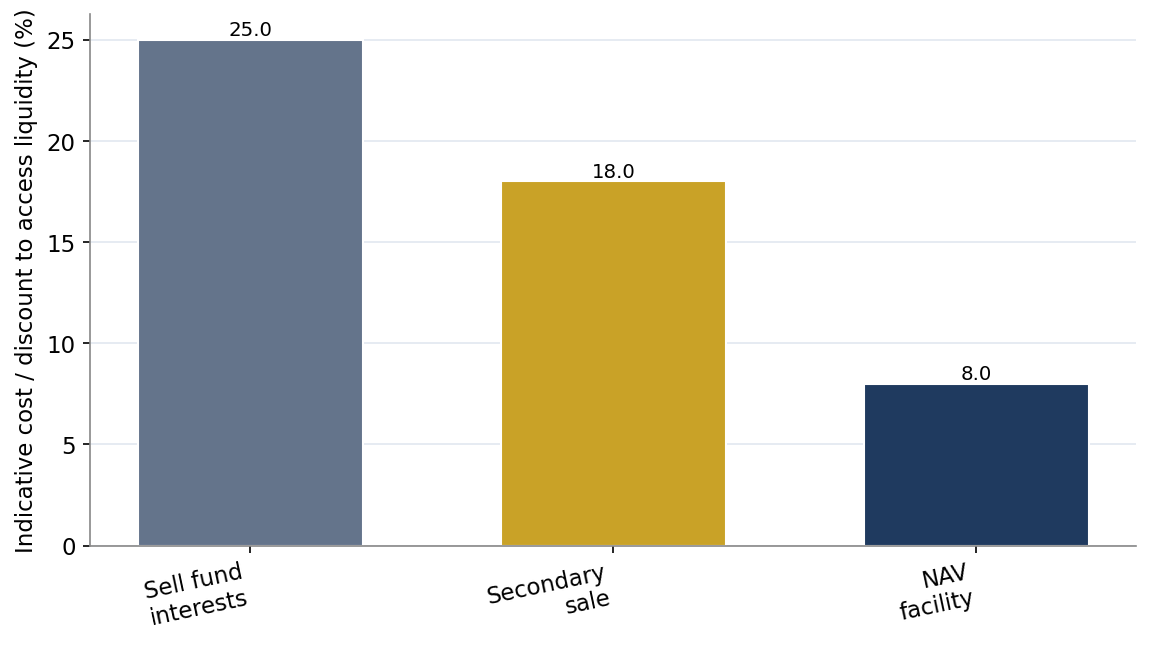
Net-asset-value based facilities resolve this. By lending against the family office private equity portfolio as a whole, secured by the aggregate value of the fund interests at a conservative loan-to-value, a NAV facility releases liquidity to the family office without requiring it to sell its fund interests. The family office accesses the value locked in its portfolio, while retaining the interests and their future distributions, at a cost far below the discount it would incur by selling the interests in the secondary market. This paper examines these facilities for GCC family offices.
The central argument is that NAV facilities release liquidity at a far lower cost than selling fund interests at a secondary discount, that the conservative loan-to-value provides a comfortable cushion against a decline in the portfolio value, and that they are a valuable liquidity and portfolio-management tool for family offices with substantial private equity portfolios. A family office that uses a NAV facility prudently can fund new commitments, bridge capital calls, diversify, or manage its liquidity, while retaining its portfolio, at a modest cost. The paper develops the framework for using these facilities well.
The figures used throughout are indicative, calibrated to observable GCC conditions in early 2026 but not drawn from any specific transaction. The paper proceeds from the structure of NAV facilities (Section 2), through the conservative LTV (Section 3), the uses of proceeds (Section 4), the comparison with selling (Section 5), the framework (Section 6), the protections (Section 7), the lender perspective (Section 8), risk (Section 9), GCC-specific considerations (Section 10), three case studies (Section 11), sensitivity analysis (Section 12), an international comparison (Section 13), common errors (Section 14), an implementation roadmap (Section 15), a strategic perspective (Section 16), a conclusion (Section 17) and limitations (Section 18).
The Structure of NAV-Based Facilities
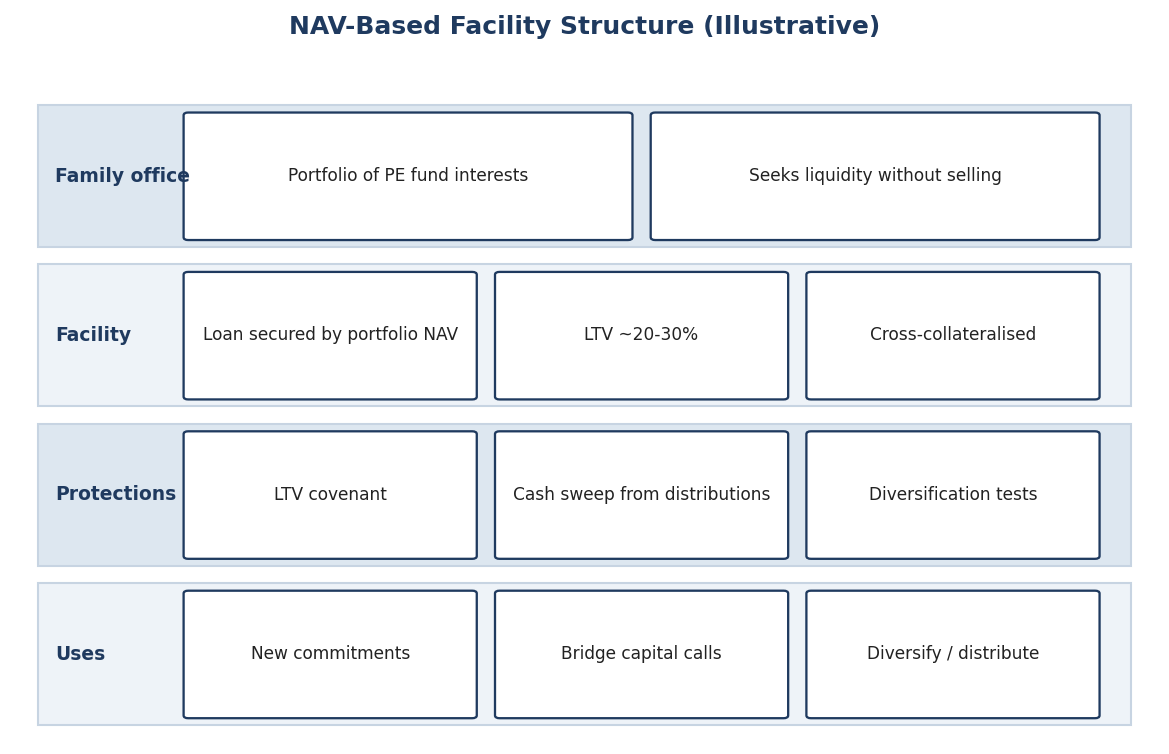
A NAV-based facility is a loan secured by the net asset value of a family office private equity portfolio as a whole, illustrated in Figure 1. The family office pledges its portfolio of fund interests, and the lender advances a loan against the aggregate net asset value of the portfolio, at a conservative loan-to-value, typically around twenty to thirty percent. The loan is repaid from the distributions the portfolio generates, swept to the lender, or refinanced or repaid from other resources, and it is secured by the portfolio and supported by the diversification of the fund interests within it.
Figure 1. NAV-Based Facility Structure
Indicative structure. The loan is secured by the portfolio NAV at a conservative LTV. Not transaction-specific.
The defining feature of the structure is that it lends against the portfolio as a whole, rather than against individual fund interests, relying on the diversification of the portfolio to reduce the risk. A portfolio of many fund interests, diversified across funds, managers, vintages and strategies, has a more stable and predictable value than any single interest, and the lender lends against this diversified, more stable value, which is part of why it can lend at a reasonable cost. The portfolio-level, diversified nature of the security is central to the structure and to the conservative loan-to-value it supports.
The structure releases liquidity without requiring the family office to sell its fund interests, preserving the portfolio and its future distributions, much as promoter financing releases liquidity against a stake without a sale. The family office continues to own its fund interests, to receive their distributions, and to benefit from their future returns, while accessing the liquidity the facility provides. This preservation of the portfolio, while accessing its locked value, is the principal attraction of the structure, allowing the family office to have both the liquidity and the portfolio, which selling the interests would not permit.
The Uses of Proceeds
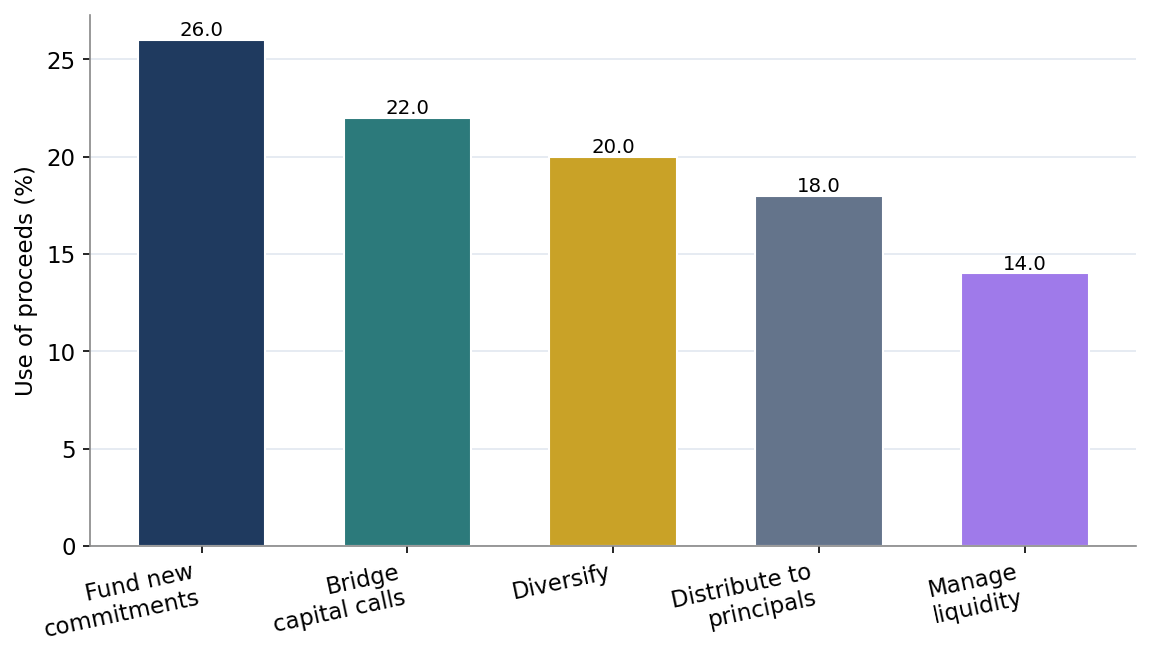
The liquidity released by a NAV facility is put to several uses, illustrated in Figure 3, that are central to a family office private equity programme. The foremost is funding new commitments: a family office that wishes to make new private equity commitments, to maintain its programme and its vintage diversification, can use the released liquidity to fund them, rather than waiting for distributions or selling existing interests. This use sustains the family office private equity programme, allowing it to keep committing across vintages.
Figure 3. Uses of NAV Facility Proceeds (Indicative Weights)
A second key use is bridging capital calls: private equity funds call capital from their investors over time, often unpredictably, and a family office must have liquidity available to meet these calls. A NAV facility can bridge the capital calls, providing the liquidity to meet them without the family office holding large idle cash balances or selling assets, smoothing the liquidity management of the private equity programme. Other uses include diversifying the family office wealth beyond the private equity portfolio, distributing to the principals, and managing the family office overall liquidity.
The uses are central to managing a private equity programme, which has a distinctive liquidity profile of capital calls and distributions over time. A family office running a private equity programme must manage the liquidity to fund new commitments, meet capital calls, and provide for its needs, all while its capital is locked in the funds. The NAV facility is a tool for managing this liquidity, releasing the locked value to fund the commitments, bridge the calls, and meet the needs, smoothing the liquidity profile of the programme. This portfolio-liquidity-management use is the principal value of the facility, beyond simple liquidity access.
The Framework
The framework for a family office considering a NAV facility is to use it for temporary liquidity and value-creating redeployment while retaining the portfolio, at a conservative loan-to-value that provides a comfortable cushion. A family office that needs liquidity to fund new commitments, bridge capital calls, diversify, or meet a need, and that wishes to retain its portfolio and its future returns, should use a NAV facility at a conservative loan-to-value, accessing the liquidity at a modest cost while retaining the portfolio. The framework directs the family office to the facility for these uses, in preference to selling.
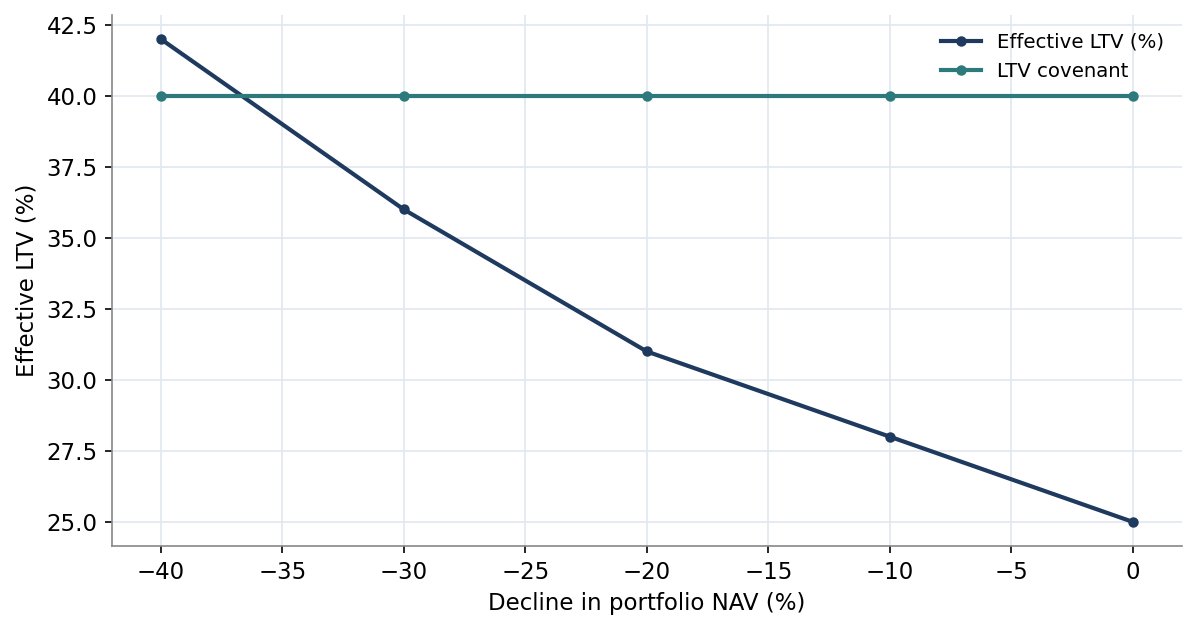
The framework requires the loan-to-value to be conservative, providing a cushion against a decline in the portfolio value. A family office should borrow conservatively, around twenty to thirty percent of the portfolio value, leaving a comfortable cushion that absorbs a decline before any covenant breach, rather than borrowing aggressively against the portfolio. The conservative loan-to-value is central to the framework, providing the safety that makes the facility prudent, and a family office that borrows conservatively can use the facility safely, while one that borrows aggressively risks a covenant breach in a decline.
The framework also weighs the facility cost against the use, requiring the released liquidity to be deployed at a return exceeding the cost, or to meet a need that justifies the cost. A family office using the facility to fund new commitments or to diversify should ensure the commitments or the diversified assets earn above the facility cost; one using it to meet a need should weigh the cost against the value of meeting the need. For the common uses, funding commitments, bridging calls, diversifying, the facility cost is modest relative to the value, making the facility clearly worthwhile, but the family office should confirm this for its specific use. The framework, using the facility for the right purposes at a conservative loan-to-value, guides its prudent use.
The Protections
A NAV facility includes protections that the lender requires, illustrated in the structure, principally a loan-to-value covenant, a cash sweep, and diversification tests. The loan-to-value covenant requires the loan-to-value to remain below a level, typically well above the conservative starting level, so that a decline in the portfolio value that raised the loan-to-value toward the covenant would require the family office to repay part of the loan or post additional security. The cash sweep directs a portion of the portfolio distributions to repay the loan, deleveraging the facility over time as the portfolio distributes.
The diversification tests require the portfolio to remain diversified, across funds, managers, vintages and strategies, so that the lender security remains the diversified, stable portfolio it underwrote rather than becoming concentrated. These protections, the loan-to-value covenant, the cash sweep, and the diversification tests, protect the lender by ensuring the loan-to-value remains conservative, the loan deleverages over time, and the security remains diversified. They are the lender principal protections, alongside the conservative starting loan-to-value, and they make the facility safe for the lender.
The protections also shape the family office use of the facility. The cash sweep means the facility deleverages over time as the portfolio distributes, so it is a self-amortising facility rather than a permanent loan, suiting a temporary or bridging use. The loan-to-value covenant and the conservative starting level mean the family office must maintain a cushion and avoid over-borrowing. The diversification tests mean the family office must maintain a diversified portfolio. A family office using the facility must operate within these protections, which align with prudent use, borrowing conservatively against a diversified portfolio for a temporary or redeployment purpose, and a family office that uses the facility prudently operates comfortably within them.
Risk Considerations
NAV facilities carry risks that the family office must manage. The principal risk is a decline in the portfolio value that raises the loan-to-value toward the covenant, which a conservative starting loan-to-value mitigates by providing a cushion. A family office that borrows conservatively has a comfortable cushion against a decline, while one that borrows aggressively risks a covenant breach in a downturn, which could require it to repay part of the loan or post additional security at a difficult moment. The conservative loan-to-value is the principal protection against this risk, which is why the framework emphasises it.
A second risk is the valuation risk: private equity net asset values are estimates that can be revised downward, particularly in a downturn, which would raise the effective loan-to-value even without a sale. A family office should recognise that the net asset values securing the facility are estimates that can decline, and that a downward revision could raise the loan-to-value, which is a further reason for a conservative starting level. A third risk is the distribution risk: if the portfolio distributions slow, the cash sweep that repays the facility slows, extending the facility, though this is mitigated by the facility structure and the conservative loan-to-value.
A broader risk is the over-leverage risk, where a family office uses the NAV facility to fund new commitments, increasing its private equity exposure while borrowing against it, building leverage on an illiquid portfolio. If the portfolio then declines, the family office faces both the decline and the leverage, which could strain its position. A family office should maintain prudent overall leverage, using the NAV facility to manage liquidity and fund a sensible programme rather than to over-extend its private equity exposure. The risk is at the level of the family office overall leverage and exposure, not just the individual facility, and managing it requires a prudent view of the whole.
Indicative Case Studies
Three indicative cases show NAV facilities in action. The figures are synthetic and constructed for analytical clarity, not drawn from any specific transaction.
Case A: funding new commitments
Case A is a family office that wishes to make new private equity commitments to maintain its programme and its vintage diversification, which uses a NAV facility at a conservative loan-to-value to fund the commitments, rather than waiting for distributions or selling interests. The facility releases the liquidity to fund the new commitments, sustaining the programme, and it is repaid from the portfolio distributions over time through the cash sweep. The case illustrates the principal use, funding new commitments to sustain the programme, at a conservative loan-to-value.
Case B: bridging capital calls
Case B is a family office facing capital calls from its private equity funds, which uses a NAV facility to bridge the calls, providing the liquidity to meet them without holding large idle cash balances or selling assets. The facility bridges the calls, smoothing the family office liquidity management, and it is repaid as the portfolio distributes. The case illustrates the liquidity-management use, bridging capital calls to smooth the programme, avoiding the need for idle cash or asset sales.
Case C: diversification
Case C is a family office whose wealth has become concentrated in its private equity portfolio, which uses a NAV facility to release liquidity to diversify into other assets, reducing its concentration while retaining the portfolio. The facility releases the liquidity to diversify, reducing the concentration risk, while the family office retains its private equity portfolio and its future returns. The case illustrates the diversification use, reducing concentration risk while retaining the portfolio, at a conservative loan-to-value.
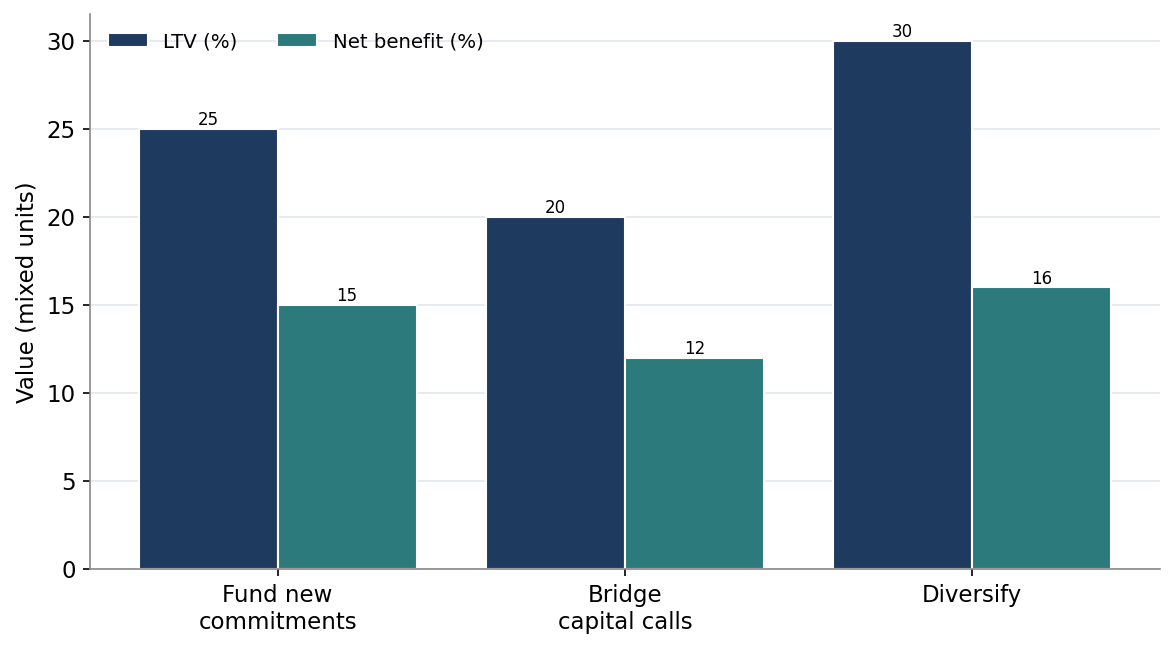
Figure 5. LTV and Net Benefit by Use
Synthetic figures for analytical comparison. Not a forecast.
Figure 5 compares the three cases on the loan-to-value and the net benefit. Each uses a conservative loan-to-value and achieves a meaningful net benefit, releasing liquidity for a valuable use at a modest cost while retaining the portfolio. The comparison illustrates the framework in action, using the facility for the valuable uses, funding commitments, bridging calls, diversifying, at a conservative loan-to-value, and the consistent net benefit the facility provides relative to the alternative of selling at a discount or holding idle cash.
Sensitivity and Scenario Analysis
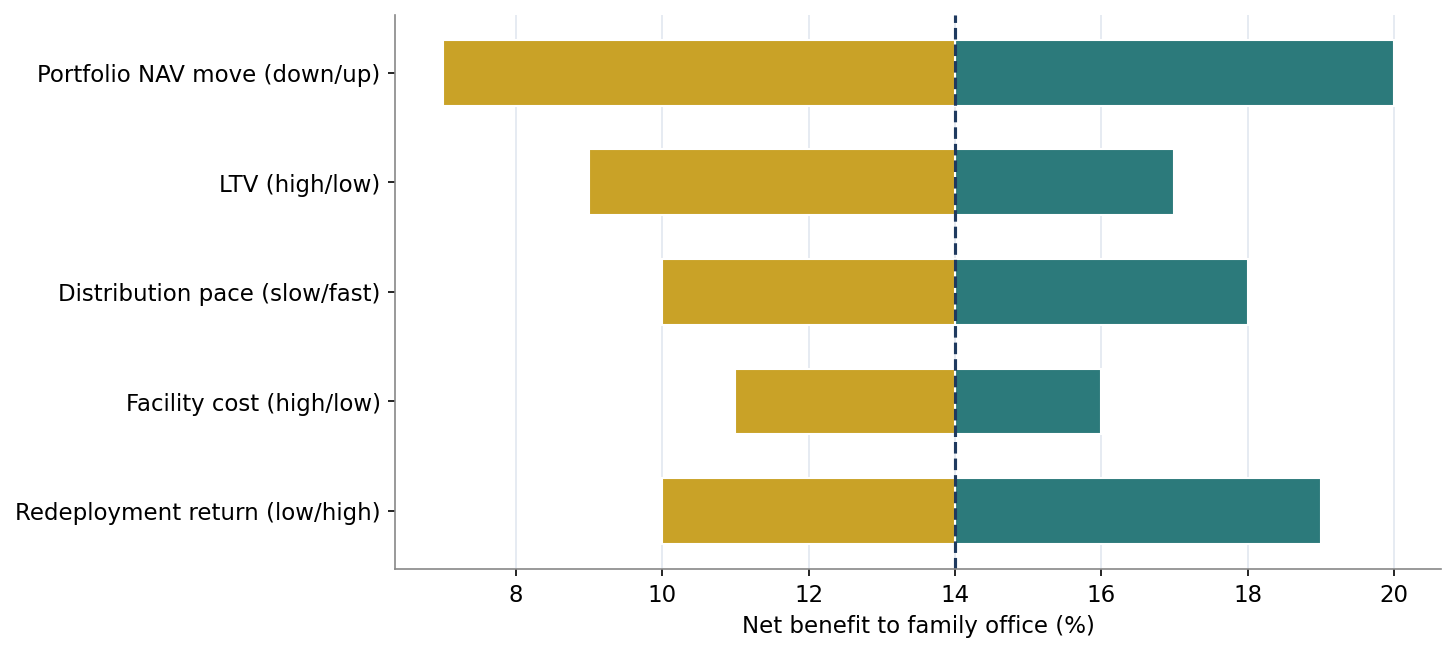
A tornado analysis identifies the variables that most influence the net benefit of a NAV facility. Figure 6 presents the result.
Figure 6. Sensitivity of Net Benefit to Key Variables
Each bar shows the net benefit when the labelled variable moves to its low or high case. Dashed line is the base case. Indicative.
The analysis shows that the portfolio NAV move and the loan-to-value dominate the net benefit, with the distribution pace, the facility cost, and the redeployment return also significant. The prominence of the portfolio NAV move reflects the central risk: a decline in the portfolio value raises the loan-to-value and can threaten the covenant, reducing the benefit, while an increase enhances it. The loan-to-value matters because it determines the cushion against a decline. The sensitivity confirms that managing the loan-to-value conservatively, to provide a cushion against a NAV decline, is the central discipline, as the framework emphasises.
Table 2. Scenario Matrix for NAV Facility
Indicative scenarios. Not a forecast.
The scenario matrix shows that a conservative loan-to-value allows the facility to weather a decline in the portfolio value comfortably, with the cushion absorbing the decline, while an aggressive loan-to-value risks covenant pressure in a sharp decline. The difference between the comfortable and the pressured outcomes depends on the loan-to-value, the variable the family office controls. The matrix underlines that the conservative loan-to-value is the key to using the facility safely, providing the cushion that allows it to weather a decline, and that a family office that borrows conservatively can use the facility through a downturn while one that borrows aggressively risks covenant pressure.
Implementation Roadmap
Assess the private equity portfolio, its quality, diversification and value, to determine the loan-to-value and the facility it supports.
Determine the use of the liquidity, funding commitments, bridging calls, diversifying, or managing liquidity, and confirm it justifies the facility cost.
Set a conservative loan-to-value, around twenty to thirty percent, to provide a comfortable cushion against a NAV decline and a downward revision.
Prefer the NAV facility to selling fund interests for temporary liquidity and redeployment, retaining the portfolio and its future returns.
Maintain a diversified portfolio to satisfy the diversification tests and support the facility, and operate within the protections.
Maintain prudent overall leverage and private equity exposure, using the facility to manage liquidity rather than over-extend.
Present a high-quality, diversified portfolio and a conservative request to the lender to access the facility on good terms.
Conclusion
NAV-based facilities release liquidity against a family office private equity portfolio as a whole, at a conservative loan-to-value, without requiring the family office to sell its fund interests. This paper has argued that the facilities release liquidity at a far lower cost than selling fund interests at a secondary discount, that the conservative loan-to-value provides a comfortable cushion against a decline in the portfolio value, and that they are a valuable liquidity and portfolio-management tool for family offices with substantial private equity portfolios, used to fund commitments, bridge capital calls, diversify, and manage liquidity.
The facilities enable a family office to manage the distinctive liquidity profile of a private equity programme efficiently, without idle cash or discounted sales, and building the capability to use them is part of building a sophisticated private markets programme. For the region growing population of private-equity-investing family offices, the NAV facility is an increasingly important tool, and using it prudently, at a conservative loan-to-value for the right purposes, allows a family office to run a larger, more efficient programme. The frameworks in this paper are intended to help GCC family offices use NAV facilities prudently to manage their private equity portfolios.
Limitations and Directions for Further Research
This paper is framework-oriented and relies on indicative data, and its conclusions are directional rather than precise. The loan-to-value, cost and discount figures are calibrated to observable conditions but are not empirical estimates, and they vary with the portfolio and the lender. The net asset values that secure the facilities are estimates subject to revision, which the analysis treats indicatively.
Several extensions would strengthen the analysis. An empirical study of NAV facility terms and use among GCC family offices would replace the indicative figures with data. An analysis of secondary market discounts for fund interests would sharpen the comparison with selling. And a study of how NAV facilities perform through a private equity downturn, when net asset values decline, would illuminate the central risk. Each is a natural subject for a later paper in this series.
| Scenario | Portfolio NAV | LTV | Outcome |
|---|---|---|---|
| Favourable | Rising | Conservative | Liquidity released, comfortable |
| Base | Stable | Conservative | Liquidity released, managed |
| Mild stress | Declining | Conservative | Cushion absorbs decline |
| Severe stress | Falling sharply | Aggressive | Covenant pressure |
