

1. Start with the legal and economic perimeter
Fund formation begins by identifying what the vehicle will do, where it will do it and which risks it will retain. A private-credit label can cover senior secured loans, structured credit, acquisition finance, growth debt, asset-backed facilities, performing special situations, subordinated capital or a combination. These strategies produce different borrower profiles, documentation, cash yields, duration, recovery paths and monitoring demands. The scheme documents should state the intended instruments, borrower universe, security approach, return sources and exclusions with enough precision for investors and the investment team to test compliance.
The SEBI Alternative Investment Funds Regulations define Category II AIFs to include private-equity funds and debt funds that are not classified as Category I or Category III. Category II schemes are close ended. The current regulations require a minimum three-year tenure, establish scheme corpus and investor thresholds, require continuing interest from the manager or sponsor, restrict leverage and set investment concentration limits. These provisions create the outer boundary. A prudent manager should adopt narrower internal controls where the strategy, team or investor base requires them.
The economic perimeter should identify the fund, trustee or company, manager, sponsor, investors, custodian, administrator, valuer, legal advisers, lenders, borrowers and security trustees. It should show which entity approves investments, holds assets, receives cash, incurs expenses and carries liabilities. A map of contractual and cash relationships exposes gaps that a short term sheet may conceal, including reliance on an affiliate for origination, borrower servicing, sector expertise or workout capability.
Foreign participation requires a separate legal and tax workstream. Investor eligibility, beneficial ownership, know-your-customer controls, foreign-exchange rules, treaty position, withholding and downstream investment conditions can affect subscriptions and portfolio transactions. These matters should be assessed for the intended investor base before the manager markets a return profile. The fund model should carry applicable taxes and transaction costs rather than assume a frictionless structure.
The formation team should prepare a regulatory design memorandum that links each fund term to an authoritative source, the placement memorandum and an operating control. This creates one accountable interpretation across legal drafting, the financial model, investment committee papers and investor reporting. It also records matters that require counsel confirmation before launch.
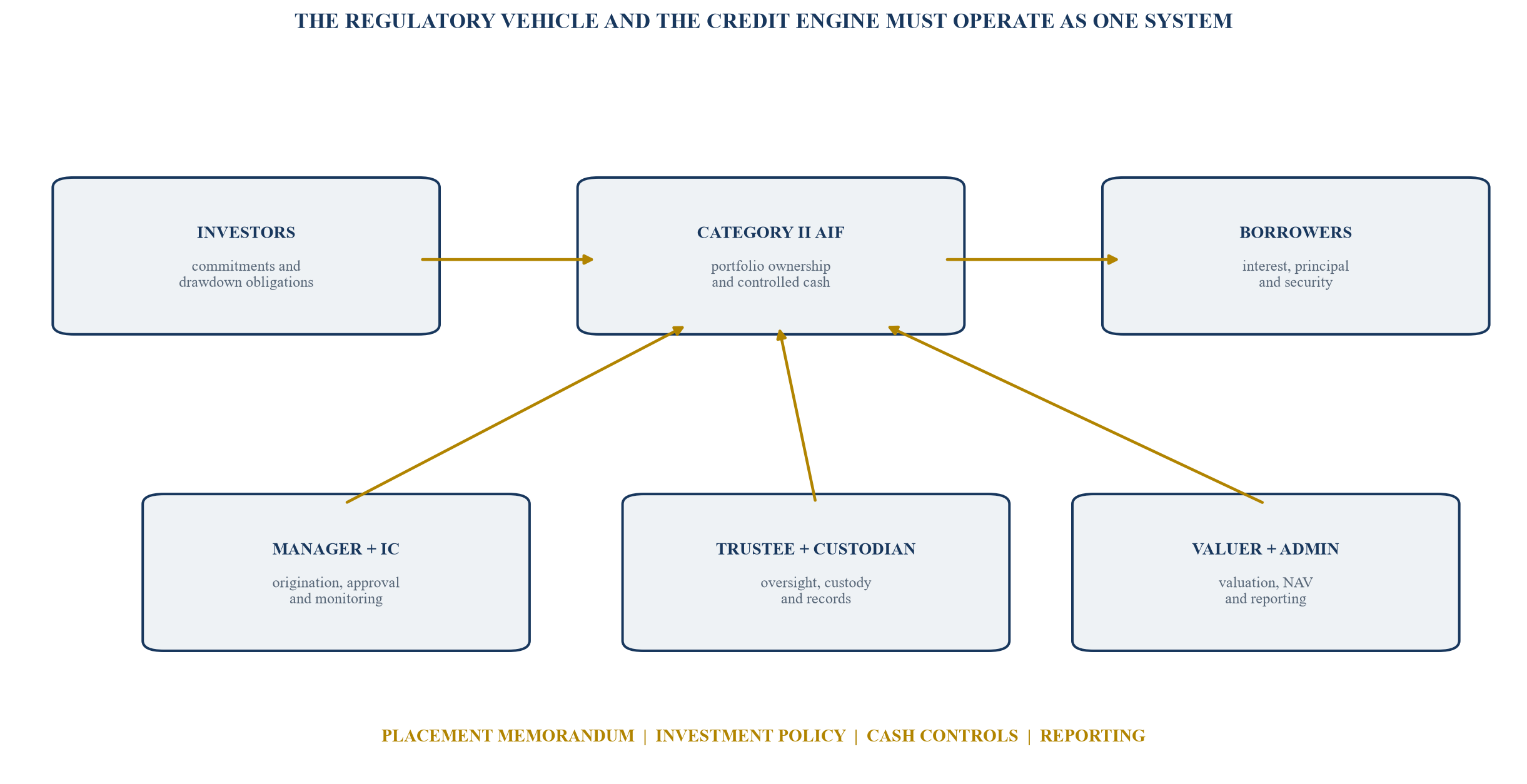
The scheme should connect investor commitments, investment decisions, borrower cash and control functions through documented relationships.
Table 1. Regulatory design questions for a private-credit scheme
| Design area | Regulatory anchor | Fund decision | Operating evidence |
|---|---|---|---|
| category and strategy | Category II definition and conditions | permitted credit instruments and exclusions | investment-policy matrix |
| corpus and subscriptions | scheme corpus and investor eligibility | target size, closings and drawdowns | subscription register |
| sponsor commitment | continuing-interest requirement | funding source and timing | bank and unit records |
| tenure | close-ended minimum and extension rules | investment period, harvest and buffers | maturity calendar |
| concentration | investable-funds issuer limit | tighter issuer and group caps | pre-trade compliance test |
| borrowing | temporary funding restrictions | permitted bridge use and approvals | borrowing register |
| valuation and custody | manager duties and current circulars | valuer, policy and asset records | valuation pack and custody report |
| conflicts and disclosure | fiduciary, conflict and transparency duties | related-party and allocation controls | conflict register and investor notice |
Live formation requires current professional advice and exact confirmation against the final fund documents.
2. Convert corpus into an investable portfolio budget
Headline corpus is not the amount available for loans. The regulations define investable funds by deducting estimated administration and management expenditure over the fund tenure from scheme corpus. Formation therefore requires a bridge from commitments to fee-paying capital, called capital, investable funds, deployed principal, reserves and distributed cash. Each step should use the definitions in the fund documents and financial model.
The budget should include management fees, organisational expenses, broken-deal costs, trustee, custodian, administration, valuation, audit, legal, tax, technology, insurance and regulatory reporting. Some costs may be charged to the manager, some to the scheme and some to portfolio companies subject to disclosure and allocation policies. The model should avoid counting a borrower fee as both fund income and an offset to an expense unless the fund documents support that treatment.
Capital calls create another distinction. Commitments provide contractual funding capacity, while cash arrives according to drawdowns and investor performance. The liquidity plan should include notice periods, late funding, default remedies and the manager's response to a delayed investor contribution. Overcalling cash too early increases cash drag; calling too late can jeopardise a closing. A staged process can call operating capital at launch, deal capital near closing and reserves according to a transparent schedule.
A hypothetical INR 10 billion scheme may deduct INR 0.8 billion of estimated life-of-fund expenses to produce INR 9.2 billion of investable funds. The manager could then reserve INR 0.9 billion for follow-ons, delayed draw facilities, expenses and workouts, leaving INR 8.3 billion for initial positions. This internal budget sits below the regulatory issuer maximum and should reconcile to every allocation limit.
The portfolio model needs separate controls for committed but undrawn loans. A facility can consume concentration capacity before cash is advanced. The fund should reserve capital and issuer headroom for legally binding draw obligations, then monitor conditions precedent and expected utilisation. Otherwise, a later draw can force the fund to exceed an internal limit or retain cash that was assumed to be deployable elsewhere.
3. Size the fund to verified origination capacity
The fund target should follow a repeatable flow of financeable loans. An opportunity list often includes introductions, preliminary discussions, adviser processes and speculative transactions. These are not equivalent. The manager should classify each opportunity by evidence stage: sourced, qualified, diligence accepted, indicative terms, credit screened, investment-committee approved, documentation, closing and funded. Only the later stages support a high-confidence deployment plan.
Origination capacity depends on team coverage, sector access, borrower needs, competition, ticket size and time to close. It also depends on the manager's ability to reject deals. A narrow pipeline can pressure the team to relax covenants, accept weak security or overconcentrate when fundraising outpaces originations. The model should therefore use historical or demonstrable conversion rates and explicitly state where a new manager lacks an operating record.
Each funnel stage should have an owner, ageing limit and disqualification reason. Qualification should test borrower jurisdiction, instrument, use of proceeds, minimum ticket, business quality, debt capacity, sponsor support, security, information availability and regulatory fit. A deal that fails a core criterion should be removed from the deployable pipeline rather than retained as marketing volume.
Pipeline diversity matters alongside volume. Ten opportunities from one sponsor, sector or adviser can share a common source of failure. The manager should view the funnel by borrower group, industry, geography, maturity, security type and transaction purpose. It should also distinguish refinancings that depend on capital markets from amortising loans supported by operating cash.
Fund sizing can use a capacity equation. Expected annual deployment equals qualified opportunities multiplied by expected ticket and stage-adjusted closing probability, subject to team capacity and portfolio limits. The model should then reduce the result for timing slippage and failed diligence. A credible target is the amount that can be deployed without breaching guardrails during the investment period, supported by a visible replenishment pipeline.
4. Set portfolio guardrails inside the regulatory maximum
The current AIF regulations limit a Category I or II scheme to twenty-five per cent of investable funds in an investee company, with a higher limit for qualifying large value funds for accredited investors. This is an outer limit. A private-credit fund can experience material loss well before that threshold if several positions share a sponsor, sector, customer, collateral pool or refinancing route. Internal limits should therefore address economic concentration as well as legal-entity concentration.
Issuer limits can be expressed at commitment, funded principal, cost, fair value and stressed exposure. Group limits aggregate borrowers under common control or material economic dependence. Sector limits address correlated demand, regulation, commodity inputs and refinancing windows. Sponsor limits capture repeated reliance on one equity provider. Security limits prevent the portfolio from depending on a single collateral type or enforcement forum.
The manager should also control risk-grade concentration. A fund can satisfy issuer and sector limits while holding too much exposure to bullet maturities, covenant-lite structures or borrowers with limited interest coverage. Limits for cash interest, payment-in-kind income, subordinated exposure, unsecured positions and foreign-currency risk make the return composition visible.
Diversification can conflict with ticket economics. Very small loans increase diligence, documentation and monitoring cost per rupee invested. Very large loans increase loss severity and reduce flexibility. The portfolio should therefore define a target ticket range, a maximum position and an efficient minimum. Club deals, syndication and co-investment can manage ticket size, subject to allocation and conflict controls.
The pre-trade compliance model should calculate headroom before approval and again before funding. It should include committed undrawn exposure, accrued capitalised interest, planned follow-ons and foreseeable restructuring capital. An investment committee should see the exposure after the proposed transaction under both current and stressed values.
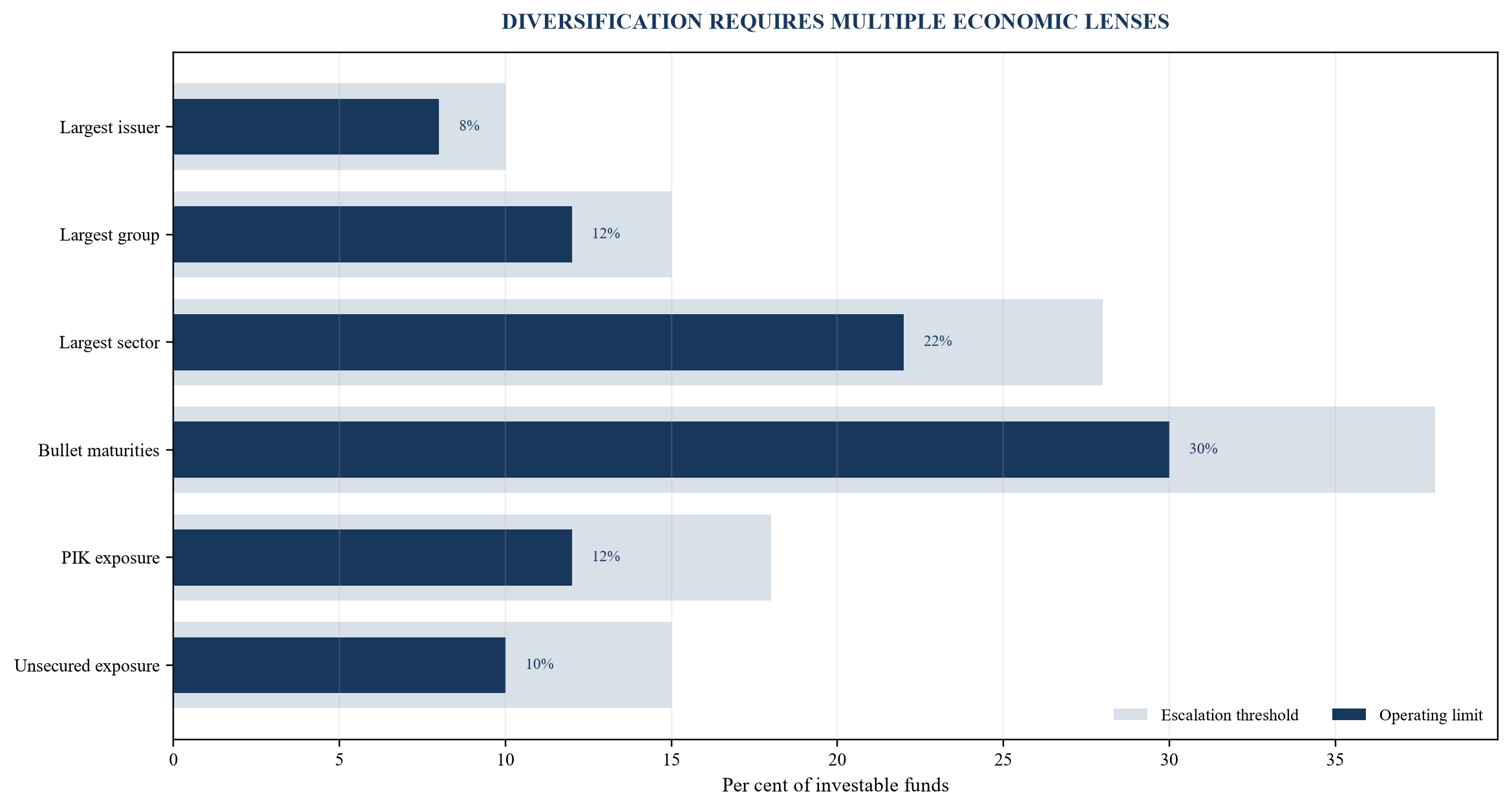
Values are hypothetical percentages of investable funds; internal limits sit below the applicable regulatory maximum.
Table 2. Illustrative portfolio-construction guardrails
| Risk dimension | Illustrative operating limit | Escalation trigger | Evidence |
|---|---|---|---|
| single issuer | 8% of investable funds | 10% including undrawn exposure | compliance certificate |
| borrower group | 12% | shared control or cross-collateral | group map |
| sector | 22% | correlated stress above 28% | sector classification |
| cash-pay yield | at least 70% of gross yield | PIK or deferred fees increase | cash-yield bridge |
| bullet maturity | no more than 30% | maturity wall within twelve months | maturity ladder |
| unsecured credit | no more than 10% | collateral waiver or release | security register |
| follow-on reserve | at least 10% initially | binding draw or workout need | reserve schedule |
| top-five exposure | no more than 35% | stressed value or capitalised interest | portfolio dashboard |
Values are hypothetical and require calibration to the final strategy, investor terms and applicable law.
5. Build underwriting around collected cash
Private-credit underwriting should begin with the borrower's ability to produce and retain cash. Earnings before interest, tax, depreciation and amortisation can support analysis, yet it does not pay interest directly. The model should reconcile reported earnings to cash from operations, working capital, maintenance capital expenditure, taxes, lease payments, debt service and restricted cash. Industry-specific adjustments should be documented and consistently applied.
The base case should use observable drivers: volume, price, contracted revenue, gross margin, operating cost, working capital and capital expenditure. The downside should reflect the risks identified in diligence rather than apply one uniform haircut. A project business may face order delay and cost overruns; a consumer business may face volume decline and inventory build; a regulated asset may face tariff or availability stress.
Interest coverage, fixed-charge coverage, free-cash-flow debt service and leverage should be tested together. A borrower with low leverage can still face liquidity stress from bullet principal or volatile working capital. A borrower with acceptable interest coverage may rely on capitalised costs or delayed creditors. The credit memo should reconcile each metric to audited statements, management accounts, bank data and forecast assumptions.
Contractual yield should be separated into cash coupon, capitalised interest, original-issue discount, arrangement fees, exit fees and contingent upside. Each component has a different collection date and loss sensitivity. The fund should avoid treating an exit fee as current cash yield or assuming payment-in-kind income compounds without increasing refinancing risk.
Debt capacity should be constrained by both cash flow and recoverability. The lower of sustainable cash-flow debt and collateral-supported debt usually provides a more defensible sizing anchor. The investment committee should see the repayment source, secondary source, enforcement path and time to cash. Recovery analysis should deduct prior-ranking claims, enforcement cost, tax, delay and asset deterioration.
6. Choose instruments that fit the repayment source
Instrument design should follow the borrower's cash cycle and transaction purpose. A working-capital facility can revolve against eligible receivables or inventory. An acquisition loan can amortise from combined cash flow and sponsor equity. Growth debt may include an interest-only period followed by amortisation. Asset-backed finance can use a borrowing base and controlled collections. Each structure requires a different monitoring system.
Senior secured debt usually prioritises cash yield, covenants, collateral and amortisation. Subordinated debt accepts lower ranking in exchange for price and controls. Convertible or warrant-linked instruments introduce valuation and equity complexity. The fund should state which return sources are core and which are incidental, then ensure the team has the competence and systems to manage them.
The repayment schedule should match the cash-generating asset. Short-dated receivables can support frequent borrowing-base tests and rapid amortisation. Long-lived infrastructure can support longer tenor when contracts and asset rights remain durable. A loan that finances operating losses needs a credible bridge to positive cash or committed equity; a distant valuation milestone is not a repayment source.
Covenants should be measurable, timely and connected to remedies. Financial covenants can include leverage, coverage, net worth, liquidity and borrowing-base ratios. Information covenants should require management accounts, compliance certificates, bank statements, tax filings and operating data. Negative covenants can restrict additional debt, security, distributions, acquisitions, asset sales and related-party transactions.
Documentation should define calculation principles before closing. Ambiguous add-backs, permitted debt, unrestricted subsidiaries and asset-sale proceeds can erode protection. The investment team, legal counsel and portfolio-monitoring team should agree the model definitions and reporting template while documents are negotiated.
7. Design security for control and recovery
Collateral is useful when the fund can identify, perfect, monitor and enforce it. A broad security description has limited value if title is unclear, prior claims exist, assets move, receivables are disputed or cash bypasses controlled accounts. The diligence plan should create an asset and lien register with ownership, location, value, seniority and enforcement steps.
Security can include shares, receivables, bank accounts, movable assets, immovable property, contracts, intellectual property and guarantees, subject to applicable law and consent. Each class requires a realistic recovery method. Receivables may need eligibility rules and concentration tests. Inventory may require audits and advance rates. Property value requires title and marketability. Shares depend on enterprise value after creditor claims.
Cash control can be more valuable than a high appraised collateral value. Escrow, lockbox, trust and account-control arrangements can direct collections through an agreed waterfall. The lender should test customer payment instructions, bank rights, set-off, permitted withdrawals and the operational continuity of the collection mechanism.
Intercreditor terms matter when banks, non-banking financial companies, bondholders, vendors or asset financiers share the capital structure. Priority, standstill, enforcement control, turnover, release and voting provisions determine what the fund can do after default. The underwriting model should reflect the actual ranking and enforcement timetable.
Recovery estimates should be scenario-based. A going-concern sale, consensual refinancing, collateral sale and insolvency process can produce different values and timing. The model should apply costs and time-value discounts. It should avoid assuming that a financial covenant breach immediately produces cash recovery.
8. Price risk through a transparent yield bridge
Pricing should compensate for expected loss, operating cost, illiquidity, complexity, capital duration and the return required by investors. The starting point can be a base rate or fixed benchmark, followed by a credit spread, structuring fee and other disclosed economics. A risk-adjusted bridge then deducts expected loss, cash drag, expenses and uncollected income.
Expected loss combines probability of default, loss given default and exposure at default. These inputs should reflect borrower risk, structure, seniority and recovery evidence. A low historical default rate from a different market or seniority class should not be imported without adjustment. The model should show how a higher default correlation affects the portfolio.
Fees require careful timing. An upfront fee may be amortised for accounting purposes while cash arrives at closing. An exit fee may be recognised over time but collected only at repayment. A commitment fee depends on undrawn availability. The portfolio dashboard should show contractual accrual, accounting income and collected cash separately.
Illiquidity is both a pricing issue and a portfolio constraint. A higher coupon does not create liquidity when a borrower cannot refinance. The fund should price extension risk, amendment effort and workout cost, then control them through maturity staggering and reserves. Pricing cannot repair a structurally weak repayment source.
The investment committee should receive a standard yield bridge for every transaction. It should compare gross return, cash yield, expected loss, expense allocation and stressed return. This makes transactions with different fee structures and payment profiles comparable and reduces the chance that a high headline internal rate of return conceals weak cash economics.
9. Stage deployment and preserve optionality
Deployment planning should connect closings, capital calls, pipeline conversion and portfolio limits. A fund that deploys too slowly incurs cash drag and management cost. A fund that deploys too quickly can accept weak credits and lose reserve capacity. The manager should define a target curve, a slower case and a faster case before final close.
The curve can be built by quarter. Each period shows beginning cash, capital calls, new loans, delayed draws, fees, interest, repayments, expenses, reserves and distributions. Transactions enter only when their evidence stage supports the assumed closing probability. The model should show which team members and external advisers can execute the planned volume.
Staged closings create vintage effects. Early investors can fund operating expenses and initial deals while later investors enter at equalisation terms set in the documents. The manager should model fee treatment, interest or equalisation and allocation across closings. The administrator should be able to reproduce the calculation.
The plan should maintain optionality for high-quality deals without retaining excessive idle cash. Subscription facilities or temporary borrowing may be subject to the current AIF rules and final documents; any permitted use should remain operational rather than a source of investment leverage. The fund should plan capital-call timing as the primary funding mechanism.
A deployment review can occur monthly during the investment period. It compares the target curve with actual deployment, pipeline quality, rejected deals, concentration, reserves and investor cash. Material deviation should trigger a decision on fund size, final close, staffing, co-investment, syndication or investment-period use.
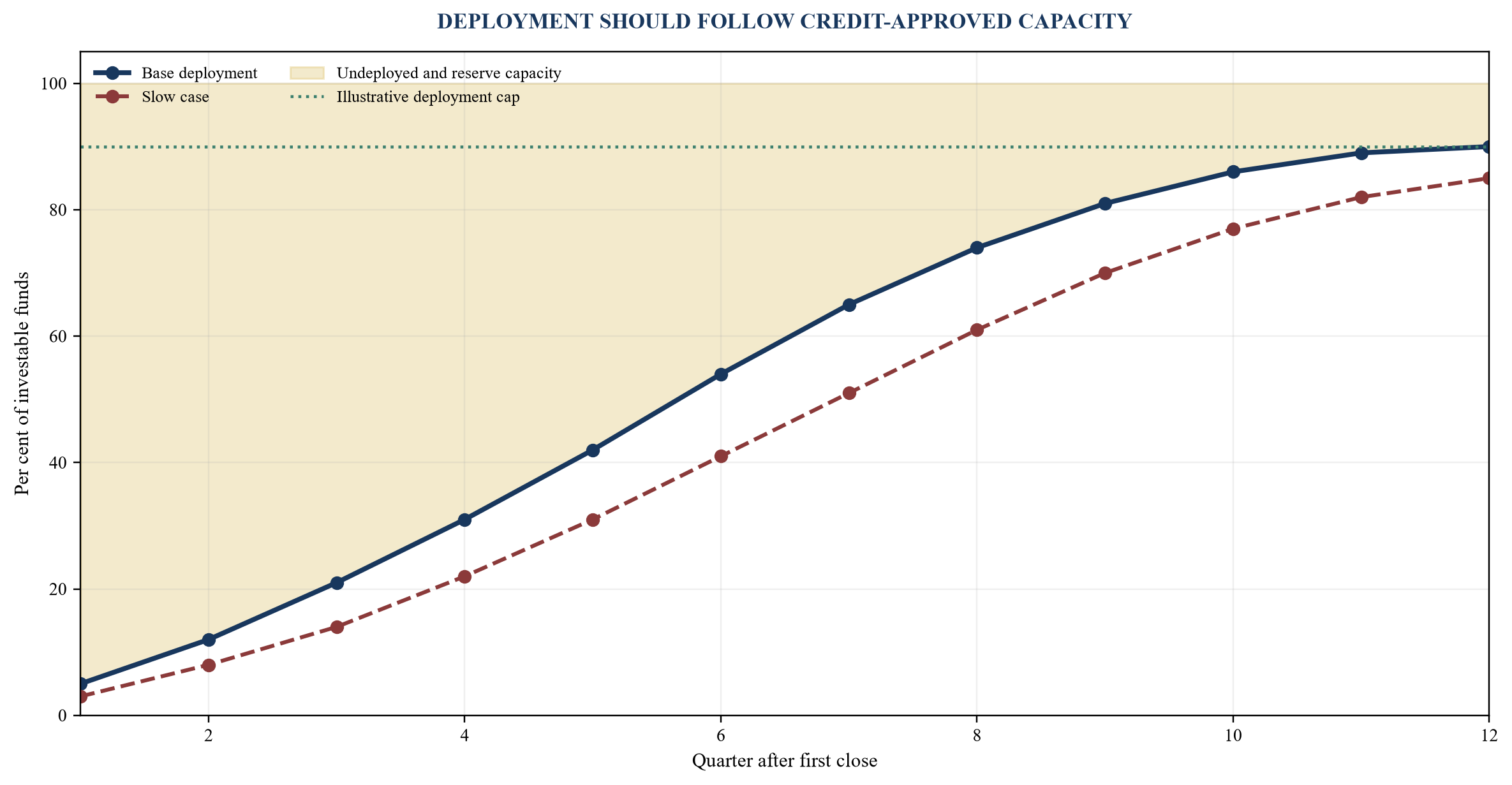
Values are hypothetical percentages of investable funds and do not represent a forecast.
Table 3. Illustrative quarterly deployment schedule
| Quarter | Opening deployed | New initial loans | Follow-ons and delayed draws | Repayments | Closing deployed |
|---|---|---|---|---|---|
| Q1 | 0.00 | 0.46 | 0.00 | 0.00 | 0.46 |
| Q2 | 0.46 | 0.62 | 0.10 | 0.00 | 1.18 |
| Q3 | 1.18 | 0.70 | 0.18 | 0.12 | 1.94 |
| Q4 | 1.94 | 0.82 | 0.22 | 0.16 | 2.82 |
| Q5 | 2.82 | 0.88 | 0.26 | 0.18 | 3.78 |
| Q6 | 3.78 | 0.94 | 0.28 | 0.22 | 4.78 |
| Q7 | 4.78 | 0.82 | 0.30 | 0.26 | 5.64 |
| Q8 | 5.64 | 0.74 | 0.28 | 0.30 | 6.36 |
Amounts are hypothetical INR billions; commitments and drawn cash require separate records.
10. Align the loan maturity ladder with fund tenure
Category II AIF schemes are close ended and have a stated tenure. Portfolio loans should mature early enough to permit collection, enforcement, follow-on funding and distribution before the end of the fund. A legal final maturity close to the fund's expiry provides little room for delay. The manager should define a latest contractual maturity and a separate concentration limit for loans maturing near the harvest period.
The maturity ladder should show scheduled amortisation, bullet principal, expected prepayments, extension options and legally binding delayed draws. It should aggregate by quarter and borrower group. A concentration of bullet maturities during a tight refinancing market can turn diversified credits into one portfolio liquidity event.
Extension options need control. A borrower option to extend can move cash beyond the fund's planned term. A lender option may still require a commercial decision under stress. Extension pricing and conditions should be documented, and the fund model should assume exercise where it is adverse to the fund.
The regulations permit specified tenure extensions with investor approval, and current frameworks address winding up, liquidation and inoperative status. These mechanisms provide process; they should not become the base portfolio plan. The manager should aim to collect ordinary-course principal within the original term and maintain enough time for workouts.
A maturity buffer can be expressed as months between the latest expected loan cash and the fund end date. Higher-risk, illiquid or cross-border credits may require a longer buffer. The investment committee should approve any position that reduces the portfolio buffer below policy and explain the exit path.
11. Build a liquidity ladder for a closed-ended fund
A closed-ended fund does not promise routine redemptions, yet it still has liquidity obligations. These include management and service-provider expenses, binding loan draws, follow-ons, taxes, hedging costs, litigation, workouts and distributions. The liquidity ladder should show expected and stressed cash by month or quarter.
The current AIF regulations permit uninvested portions of investable funds and divestment proceeds pending distribution to be held in specified liquid assets. The investment policy should identify eligible instruments, credit quality, maturity and counterparty limits. Treasury management should prioritise capital preservation and availability for portfolio obligations.
Reserves should be purpose-based. An operating reserve covers known fund costs. An undrawn reserve funds committed facilities. A follow-on reserve supports agreed opportunities. A workout reserve funds legal, technical and restructuring costs or defensive capital. Pooling these amounts into one cash balance can hide whether the fund can meet each obligation.
The ladder should distinguish contractual inflows from expected inflows. Interest due under a stressed credit should not fund a binding draw elsewhere. Expected refinancing proceeds should be excluded from minimum liquidity until committed and conditions are satisfied. Distributions should occur after testing near-term obligations and portfolio stress.
Investor reporting should explain material changes in liquidity, delayed repayments, extensions and reserve use. A transparent ladder gives the manager a basis for retaining cash when necessary and releasing it when risks fall. It also supports fair allocation across investors and closings.
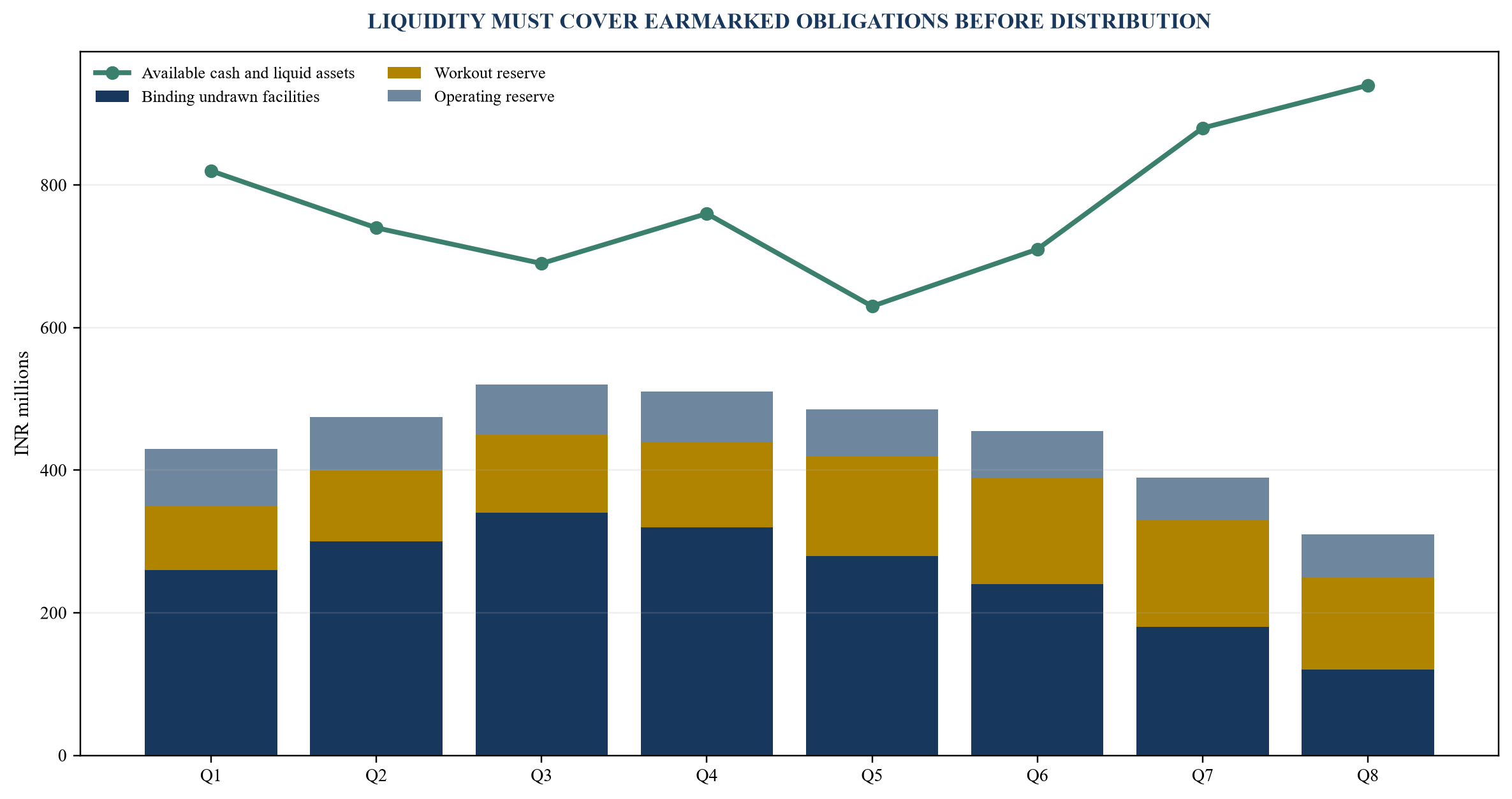
Values are hypothetical INR millions and show the separation of available cash from earmarked reserves.
Table 4. Liquidity and maturity controls
| Control | Calculation | Evidence | Escalation |
|---|---|---|---|
| minimum liquidity | liquid assets less restricted cash | bank and custody report | below ninety-day obligations |
| undrawn coverage | liquid resources divided by binding draws | facility register | below 1.25 times |
| maturity buffer | months from latest expected loan cash to fund end | maturity calendar | below policy minimum |
| bullet wall | principal due in any rolling twelve months | loan schedules | above portfolio limit |
| stressed collections | contractual cash after credit haircuts | borrower model | reserve deficit |
| distribution capacity | cash after obligations and reserves | approved waterfall | negative headroom |
The fund should reconcile each control to source documents and current bank balances.
12. Establish a disciplined investment-committee process
The investment committee should make a documented decision from a complete evidence package. The paper should state the borrower, transaction, use of proceeds, instrument, repayment sources, downside, security, covenants, valuation, conflicts, portfolio impact and conditions to close. It should also record matters that remain open and who can waive them.
Decision rights should be clear. Origination teams can sponsor an opportunity; independent credit or risk personnel should challenge assumptions; legal and operations teams should confirm enforceability and monitoring. The manager's governance should avoid a structure where the same individual originates, approves, values and monitors a loan without effective challenge.
The committee should see the deal's effect on issuer, group, sector, risk grade, maturity, cash yield, PIK, security and reserve limits. An attractive standalone credit may be unsuitable when it creates a portfolio breach. The compliance calculation should include undrawn and follow-on exposure.
Conditions precedent should be specific and evidenced. Corporate authority, executed documents, perfection, insurance, equity funding, bank accounts, financial information and regulatory approvals should be closed through a checklist. Material departures from approved terms should return to the committee or a defined delegated authority.
Minutes should capture the decision, dissent, conditions and conflicts. This record supports fiduciary accountability and future monitoring. It also lets the team compare the approved thesis with actual performance and improve its underwriting standards.
13. Treat monitoring as continuous underwriting
Monitoring begins at closing. The fund should load every reporting date, covenant, payment, security requirement and consent into a portfolio system. The owner and escalation path should be clear. A missing management account is itself a risk signal when information rights were part of the credit case.
Monthly or quarterly reporting should reconcile borrower performance with the approved model. Revenue, margin, working capital, cash, debt, liquidity, covenant headroom and operating indicators should be compared with budget and prior periods. The analyst should explain variance and assess whether the repayment source has changed.
Early-warning indicators can include late reporting, delayed interest, tax arrears, creditor stretch, customer loss, management turnover, adverse audit matters, regulatory action, litigation, declining bank balances, covenant headroom erosion and requests for additional debt. The watchlist process should define entry, action plan, frequency and exit.
Security monitoring should update receivable eligibility, inventory, property insurance, asset location, liens, guarantees and controlled accounts as relevant. A perfected security package at closing can weaken through releases, asset sales, new claims or operational change. Consent processes should protect lender rights.
The manager should report portfolio quality to investors using consistent definitions. Performing, watchlist, restructured, non-accrual and default categories should connect to valuation and cash reporting. Narrative should explain material concentration, amendments, extensions and recoveries without disclosing confidential information beyond permitted terms.
14. Use valuation as a control, not a substitute for cash analysis
SEBI's current framework places responsibility on the manager for true and fair valuation and contains operational requirements for valuation and reporting. A private-credit valuation policy should specify methodology, data, frequency, independence, overrides, governance and documentation. It should address performing loans, amendments, distressed credits, equity-linked components and collateral.
Amortised cost or a discounted cash-flow method can produce a stable value when credit expectations remain stable. Stability should not suppress information. Changes in probability of default, recovery, timing, interest accrual, covenant status and market spread can affect value. Capitalised interest that is unlikely to be collected should not create an automatic increase.
Valuation inputs should reconcile to monitoring. Contractual cash flows come from executed documents; performance comes from current borrower evidence; discount rates and recovery assumptions require support. The valuer and manager should identify missing information and the adjustment made for uncertainty.
The fund should separate valuation from liquidity. A fair value estimate does not mean the position can be sold at that amount or within the fund's required time. The liquidity ladder and stress test should use cash timing and recovery scenarios independently.
Override governance is important. When the manager departs from a standard methodology, the rationale, evidence, approval and investor disclosure should follow the applicable framework. The audit trail should allow an independent reviewer to reproduce the decision.
15. Manage conflicts and allocation before they arise
Private-credit platforms can manage multiple funds, separate accounts, co-investments and affiliates. The same opportunity may fit several mandates. A written allocation policy should define eligibility, priority, capacity, pro rata treatment, exceptions and documentation before the pipeline becomes competitive.
Conflicts can arise from affiliate origination, borrower fees, cross-fund trades, restructurings, continuation vehicles, co-investment, valuation and service providers. The current AIF regulations require fiduciary conduct, disclosure and written policies to identify, monitor and mitigate conflicts. The fund should maintain a live register and a process for investor consent where required.
Fees should be allocated according to disclosed policy. Arrangement, monitoring, amendment, syndication, director and break fees may belong to the fund, manager or an offset mechanism depending on the documents. The administrator should reconcile cash received with the approved treatment.
Restructuring creates difficult allocation decisions. A new fund may provide rescue capital to a borrower held by an older fund. One vehicle may benefit from another's support. The manager should use independent analysis, information barriers or investor approvals where appropriate and document fairness across vehicles.
The placement memorandum should describe material conflicts and procedures in plain language. Generic disclosure that conflicts may arise is less useful than an operating policy with examples, approvals and reporting. Investors should understand how the manager resolves competing interests.
16. Stress the portfolio as a system
Transaction underwriting usually tests one borrower. Fund construction requires a correlated portfolio view. A common shock can reduce revenue across a sector, raise interest cost, lengthen working capital and close refinancing markets. Sponsor support may weaken at the same time. The stress model should aggregate these effects by quarter.
The model can begin with borrower-level probability of default, loss given default, cash interest and principal timing. It then applies sector and macro shocks, migration between risk grades, delayed recovery and lower refinancing. It should calculate cash yield, realised loss, liquidity, net asset value and distribution capacity.
Concentration makes nonlinear outcomes. A single large default can use the workout reserve and defer distributions. Several smaller correlated defaults can overwhelm monitoring capacity and reduce recoveries. The stress should therefore test both severity and operational workload.
The manager should compare base, adverse and severe cases. Each case needs named assumptions and a management response. Responses can include stopping new deployment, retaining cash, increasing monitoring, enforcing covenants, syndicating exposure, raising defensive capital or commencing a workout. A response that requires unavailable investor capital should be identified as a gap.
Stress results should influence fund size and terms before launch. If the severe case produces a liquidity deficit, the fund may need smaller tickets, more amortisation, lower bullet exposure, higher reserves or a longer maturity buffer. This feedback loop turns stress testing into portfolio design.
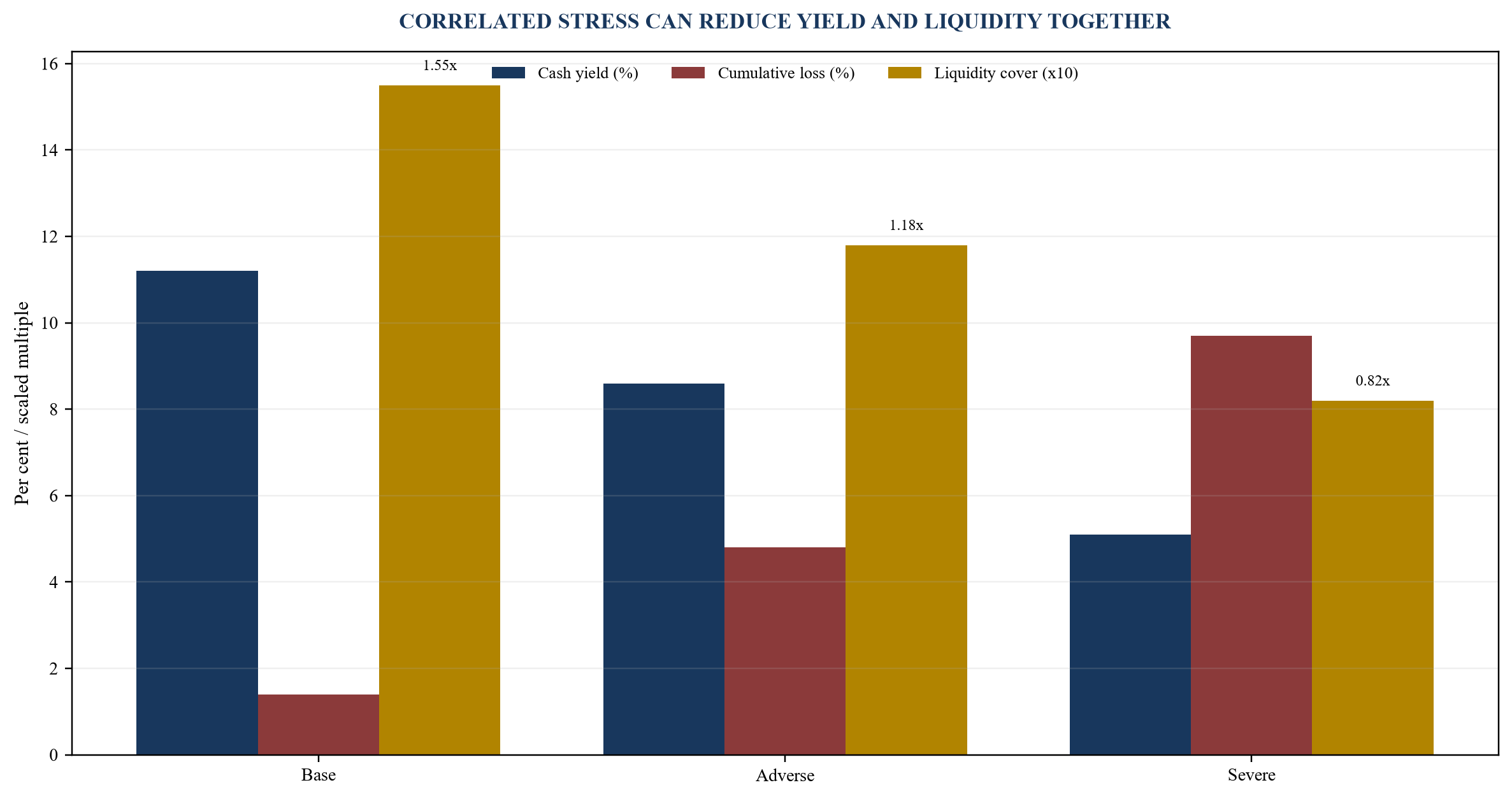
Values are hypothetical; loss and cash-yield assumptions are modelling inputs rather than forecasts.
Table 5. Illustrative portfolio stress results
| Metric | Base | Adverse | Severe | Management implication |
|---|---|---|---|---|
| annual cash yield | 11.2% | 8.6% | 5.1% | retain cash when collection weakens |
| cumulative credit loss | 1.4% | 4.8% | 9.7% | review issuer and sector limits |
| average recovery delay | 9 months | 18 months | 30 months | lengthen maturity buffer |
| liquidity coverage | 1.55x | 1.18x | 0.82x | severe case requires redesign |
| bullet principal delayed | 5% | 18% | 34% | reduce refinancing dependence |
| workout reserve used | 22% | 68% | 124% | increase or ring-fence reserve |
| distributions delayed | 0 quarters | 2 quarters | 5 quarters | disclose cash timing sensitivity |
The hypothetical model assumes an INR 9.2 billion investable-funds base.
17. Implement a formation and operating roadmap
The formation process should move through defined gates. The first gate confirms strategy, category, target investors, fund size, team, economics and regulatory route. The second builds the model, portfolio policy, underwriting manual, conflicts policy, valuation policy and service-provider plan. The third completes documents, regulatory filing, investor diligence and operating readiness.
GARUDA and other current SEBI mechanisms may affect processing of placement memoranda when eligibility, declarations and due diligence requirements are satisfied. The manager and merchant banker should confirm the applicable route and current conditions. A faster filing process does not reduce the need for accurate disclosures or an operationally complete fund.
Operating readiness should be tested before the first investment. The administrator should process commitments, calls, equalisation, fees and allocations. The custodian and depository workflows should support the intended assets. The portfolio system should record limits, cash flows, covenants, valuations and investor reports. Bank accounts and approval matrices should be live.
The manager should conduct a dry run using one hypothetical transaction from sourcing to investor report. This reveals whether the investment memo, legal checklist, compliance test, capital call, settlement, custody, valuation, monitoring and reporting processes connect. Exceptions should be resolved before live capital is exposed.
After launch, governance should include periodic reviews of policy, valuation, conflicts, service providers, cyber controls, business continuity and regulatory change. Material changes to strategy or terms should follow the fund documents and applicable rules. The formation record should remain available for audits and investor diligence.
18. Conclusion
An India private-credit fund becomes credible when its fund architecture, origination engine and portfolio controls form one operating system. The Category II AIF framework supplies the regulatory perimeter. The manager's task is to build a disciplined strategy within it, supported by current legal advice and documents that accurately describe what the fund will do.
The portfolio should be sized to verified origination capacity, not a fundraising ambition. Investable funds should be calculated after life-of-fund expenses; issuer, group, sector, maturity, PIK, security and sponsor limits should operate below applicable maxima where risk requires it. Binding undrawn commitments and follow-on needs should consume capital and headroom before cash is advanced.
Underwriting should reconcile earnings to collected cash, size debt to repayment and recovery, separate cash yield from capitalised or contingent return and document control rights. Deployment and maturity calendars should leave space for diligence, delayed closings, amendments and workouts. A liquidity ladder should protect operating, draw and restructuring obligations before distributions.
Governance completes the design. Investment decisions need an evidence standard, conflicts and allocation require operating policies, valuation should reflect current credit evidence, and monitoring should function as continuous underwriting. Portfolio stress should feed back into fund size, ticket limits, reserves and term.
The result is a fund that can explain its strategy in the placement memorandum, apply it in the investment committee, monitor it in the portfolio system and report it to investors using consistent definitions. That alignment is the foundation of deployable private credit under the AIF framework.
References
- Securities and Exchange Board of India, Securities and Exchange Board of India (Alternative Investment Funds) Regulations, 2012, last amended 14 July 2026. https://www.sebi.gov.in/legal/regulations/jul-2026/securities-and-exchange-board-of-india-alternative-investment-funds-regulations-2012-last-amended-on-july-14-2026-_102975.html
- Securities and Exchange Board of India, Master Circular for Alternative Investment Funds, 3 June 2026. https://www.sebi.gov.in/legal/master-circulars/jun-2026/master-circular-for-alternative-investment-funds-aifs-_101817.html
- Securities and Exchange Board of India, Green-Channel: AIF Rollout Upon Document Acknowledgement mechanism, 30 July 2026. https://www.sebi.gov.in/legal/circulars/jul-2026/-green-channel-aif-rollout-upon-document-acknowledgement-garuda-mechanism-for-processing-of-placement-memorandum-of-alternative-investment-funds-aifs-filed-with-sebi_103241.html
- Securities and Exchange Board of India, Guidelines for winding up of AIFs with respect to retention of proceeds and Inoperative Fund status, 16 June 2026. https://www.sebi.gov.in/sebiweb/home/HomeAction.do?doListingAll=yes&search=AIFs
- Securities and Exchange Board of India, Regulatory Reporting by AIFs, 4 March 2026. https://www.sebi.gov.in/sebiweb/home/HomeAction.do?doListingAll=yes&search=AIFs
- Securities and Exchange Board of India, Reporting of value of units of Alternative Investment Funds to Depositories, 6 February 2026. https://www.sebi.gov.in/sebiweb/home/HomeAction.do?doListingAll=yes&search=AIFs
- Securities and Exchange Board of India, Modalities for migration to Accredited Investors only schemes and relaxations to Large Value Funds for Accredited Investors, 8 December 2025. https://www.sebi.gov.in/sebiweb/home/HomeAction.do?doListingAll=yes&search=Alternative+Investment+Funds
- Securities and Exchange Board of India, Framework for AIFs to make co-investment within the AIF structure, 9 September 2025. https://www.sebi.gov.in/sebiweb/home/HomeAction.do?doListingAll=yes&search=Alternative+Investment+Funds
- Securities and Exchange Board of India, Certification requirement for Compliance Officers of Managers of AIFs, 30 December 2025. https://www.sebi.gov.in/sebiweb/home/HomeAction.do?doListingAll=yes&search=AIFs
- Securities and Exchange Board of India, Standardised approach to valuation of investment portfolio of Alternative Investment Funds, 21 June 2023. https://www.sebi.gov.in/legal/circulars/jun-2023/standardised-approach-to-valuation-of-investment-portfolio-of-alternative-investment-funds-aifs-_72870.html
- Securities and Exchange Board of India, Dematerialisation of units of Alternative Investment Funds, 21 June 2023. https://www.sebi.gov.in/legal/circulars/jun-2023/dematerialisation-of-units-of-alternative-investment-funds-aifs-_72869.html
- Securities and Exchange Board of India, Guidelines with respect to excusing or excluding an investor from an investment of AIF, 10 April 2023. https://www.sebi.gov.in/legal/circulars/apr-2023/guidelines-with-respect-to-excusing-or-excluding-an-investor-from-an-investment-of-aif_69907.html
- Securities and Exchange Board of India, Foreign investment in Alternative Investment Funds, 9 December 2022. https://www.sebi.gov.in/legal/circulars/dec-2022/foreign-investment-in-alternative-investment-funds-aifs-_65839.html
- Reserve Bank of India, Financial Stability Report, June 2026. https://www.rbi.org.in/Scripts/FsReports.aspx
- Reserve Bank of India, Data Releases: Sectoral Deployment of Bank Credit and NBFC Credit, 2026. https://statistics.rbi.org.in/
- Reserve Bank of India, Master Direction: Credit Derivatives Directions, 2026. https://www.rbi.org.in/
- Insolvency and Bankruptcy Board of India, Insolvency and Bankruptcy Code, 2016 and current regulations. https://ibbi.gov.in/legal-framework/act
- Ministry of Corporate Affairs, Companies Act, 2013 and subordinate legislation. https://www.mca.gov.in/content/mca/global/en/acts-rules/ebooks/acts.html
- Department for Promotion of Industry and Internal Trade, Consolidated Foreign Direct Investment Policy and related instruments. https://dpiit.gov.in/foreign-direct-investment/foreign-direct-investment-policy
- International Monetary Fund, India: 2025 Article IV Consultation, 2026. https://www.imf.org/en/Countries/IND
