

1. Define the open-finance value boundary
Open finance is a controlled system for permissioned access to financial data and, where permitted, service initiation. Its investible boundary begins with regulation and infrastructure and ends with a customer outcome for which someone pays.
The commercial chain has seven layers: regulated data holders, common standards, consent and identity, accredited or licensed recipients, analytics and decisioning, workflow delivery, and the customer or enterprise buyer. A company can operate in one layer or coordinate several. Each additional layer can improve control while increasing regulatory, operational and capital requirements.
Data access should be separated from the right to hold money, execute payments, arrange credit, provide insurance, recommend investments or receive product commission. A licence for one role does not imply permission for another. The proposed service should therefore be decomposed into regulated actions before the revenue model is accepted.
The economic boundary is equally important. A bank may be required to expose specified data, while a fintech still pays for engineering, certification, monitoring, fraud control, customer support, security, insurance and distribution. Revenue must exceed the complete cost of delivering a reliable and compliant outcome.
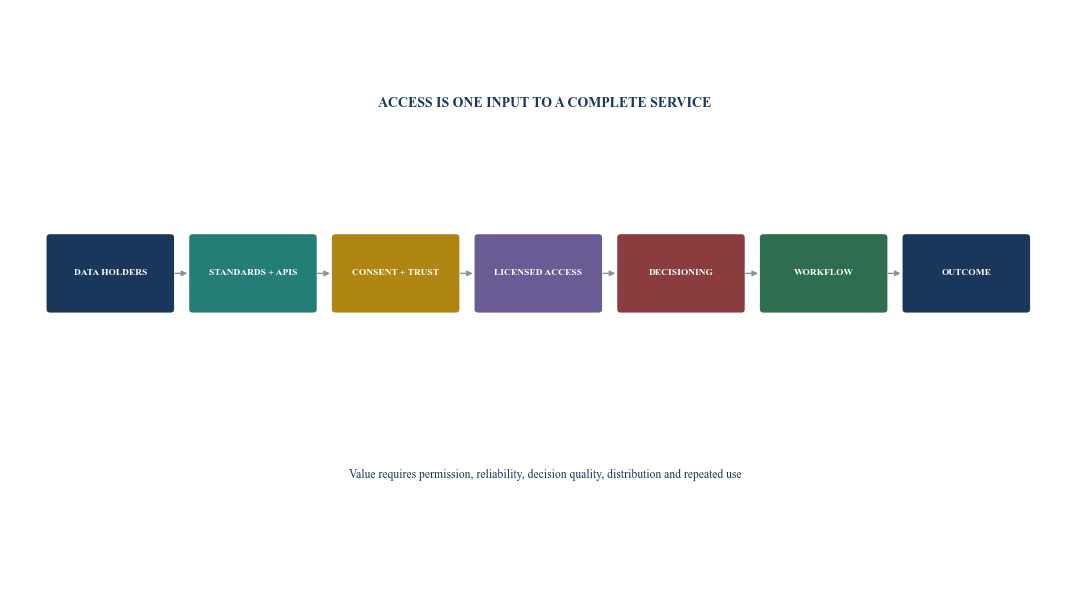
Author framework. Regulatory access becomes commercial value only through a complete customer workflow.
2. Read the UAE regulatory perimeter precisely
The CBUAE describes open finance as a secure way for financial institutions to open systems to accredited third-party providers using customer-consented data.[1] Its stated vision emphasises data-rich, collaborative, secure and customer-centric services.
The CBUAE Open Finance Regulation applies mandatory participation to specified licensees through phased implementation. Banks and insurers form the first phase, and the product scope includes deposits, payments, cards, foreign exchange, credit, mortgages and insurance.[2]
An Open Finance Provider requires the applicable permission. The regulation establishes capital, governance, conduct, record-keeping, technology-risk, data, consent, authentication, anti-money-laundering and fraud obligations. The licence should be reviewed against the proposed legal entity, service and customer segment.
The perimeter limits business-model design. An Open Finance Provider cannot assume the right to receive or hold customer funds, transfer funds, provide product advice or accept product-provider commission unless it holds any additional permission required for that activity.[2] A founder can therefore have technical access and still lack the regulatory basis for the proposed revenue flow.
The CBUAE's 2025 annual report states that Al Tareq's central infrastructure launched during the year and Nebras Open Finance began operations. It records that two banks and two third-party providers met operational requirements and describes payment initiation, e-KYC, payment-token services, standardised consent, confirmation of payee, data sharing and insurance quotations.[3] These are operating milestones. They do not establish adoption or profitability for any individual company.
3. Use international regimes as operating benchmarks
Open-finance regimes differ in maturity, scope and commercial design. Comparisons should identify the specific right, obligation and evidence relevant to a business model.
The United Kingdom has an established open-banking base and published an open-finance roadmap in April 2026. The Financial Conduct Authority plans evidence-building and experiments during 2026, framework design during 2027, and scaling between 2028 and 2030. It has prioritised SME lending and consumer mortgage access as early use cases.[4]
Brazil has broadened open banking into data and service sharing across regulated financial products. Banco Central do Brasil describes mandatory consent, authentication and confirmation, reciprocity, interoperability and phased implementation. In its 2025 and 2026 regulatory-priorities communication, the central bank reported 52 million clients and 3.3 billion data requests per week.[5]
India's Account Aggregator framework licenses non-bank account aggregators to retrieve, organise and present customer financial information with explicit consent. The aggregator cannot support transactions, use the information for another purpose or allow the financial information to reside with it. The framework requires secure data flows and technical standards.[6]
Australia's Consumer Data Right began with banking in 2020 and expanded to energy. In July 2026, product-data obligations began for non-bank lenders, with consumer-data sharing scheduled in phases from November 2026. The Australian Competition and Consumer Commission reported more than 1.3 million users and identified data quality and timetable compliance as continuing priorities.[7]
The Council of the European Union agreed its negotiating position on a proposed Financial Data Access framework in December 2024. The proposal covers harmonised access, customer control, schemes for sharing and appropriate compensation for data holders.[8] The final legal and operating position should be checked before any European investment decision.
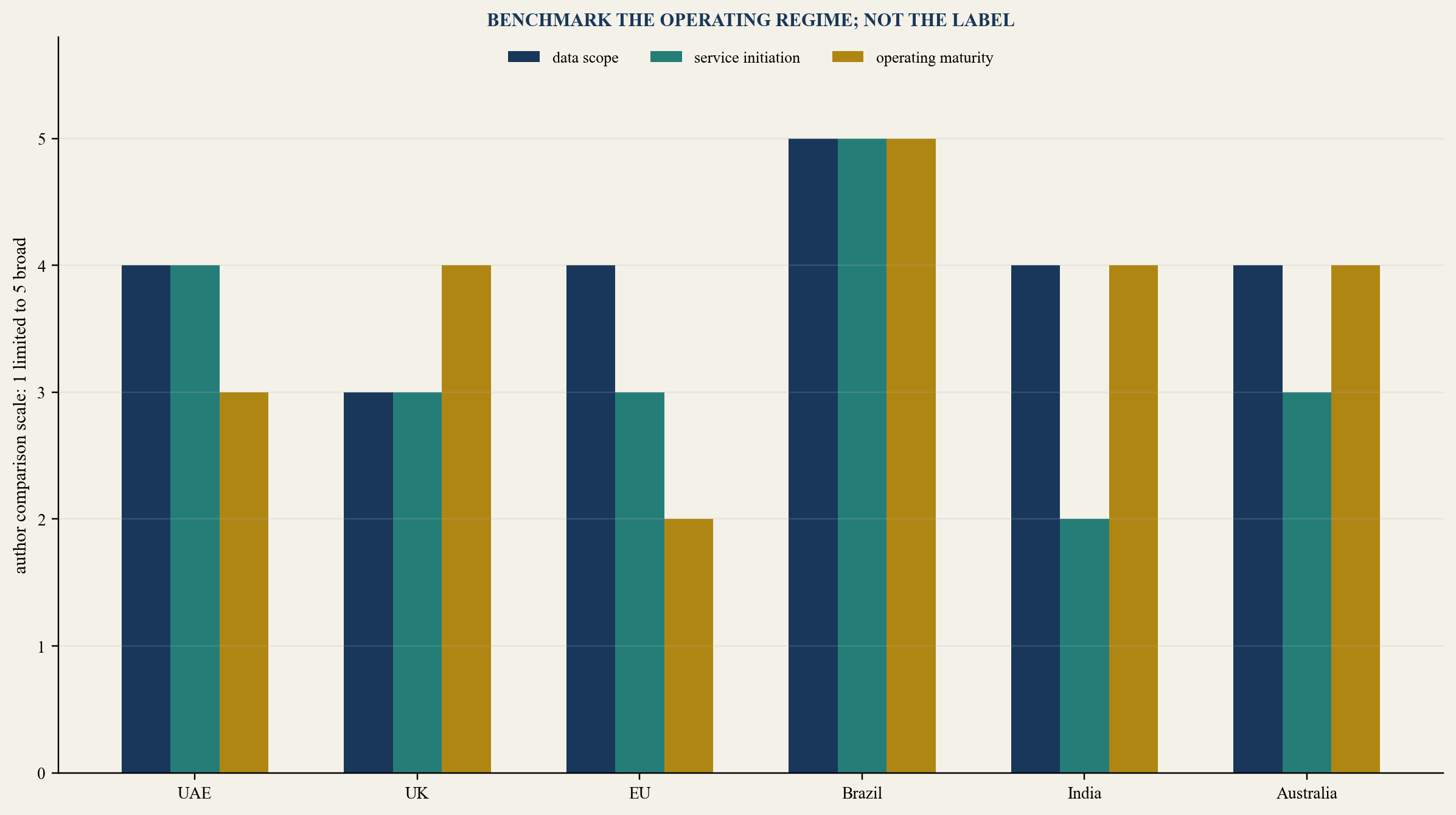
Author synthesis of cited official materials. Regulatory scope and implementation continue to evolve.
Table 1. Jurisdiction comparison for open-finance underwriting
| Market | Operating anchor | Relevant scope | Commercial implication | Verification required |
|---|---|---|---|---|
| UAE | CBUAE Open Finance Regulation and Al Tareq | banking, payments, credit, mortgage, foreign exchange and insurance in phased scope | licensed access and common infrastructure can support regional models | exact permission, participant readiness, data product and launch timetable |
| UK | open banking plus FCA open-finance roadmap | established payment-account data with planned expansion | proven open-banking base and staged open-finance opportunity | scheme design, commercial access, liability and implementation date |
| European Union | proposed Financial Data Access framework | broader customer financial data contemplated | cross-market opportunity with scheme and compensation design | final legislation, national implementation and permitted use |
| Brazil | regulated Open Finance ecosystem | accounts, credit, payments, investments, foreign exchange, insurance and pensions | broad live environment provides operating benchmarks | participant status, API performance, consent and local economics |
| India | RBI Account Aggregator framework | consented financial-information transfer across providers | specialised consent and data-transport layer with strict activity limits | licence, information-provider coverage, storage and use controls |
| Australia | economy-wide Consumer Data Right | banking, energy and phased non-bank lending | accredited data-recipient opportunities across sectors | accreditation, product scope, data quality and staged obligations |
Summary of cited official materials as at 13 August 2026. Current legal advice is required.
4. Separate access, availability and usability
Three different questions govern data value. Is the company legally permitted to request the data? Is the relevant provider operationally able to supply it? Is the returned information sufficiently complete, timely and structured for the intended decision?
Regulatory scope can include a product before all providers, fields and customer journeys work consistently. A data connection can pass certification and still suffer outages, latency, incomplete records, duplicated transactions or inconsistent categorisation.
The diligence file should therefore measure institution coverage, product coverage, successful response, field completeness, timeliness and reconciliation. Results should be segmented by market, institution, customer type and use case.
Decisioning requires an explicit fallback. A lender may request bank-transaction data and still need statements or bureau data when permission fails. A treasury platform may show a partial cash position when one bank is unavailable. The product should tell the customer what is complete and what remains missing.
5. Design a consent funnel that customers complete
Consent is a regulated control and a commercial conversion event. The journey can fail at proposition, selection, redirection, authentication, confirmation, return, data retrieval or first useful output.
The company should measure every stage. A top-line number of registered users can conceal low institution selection, failed authentication or a completed consent that never produces usable data. Renewal and revocation matter because a model based on recurring insight requires recurring permission.
The request should be proportionate to the service. Broad or indefinite access can reduce trust and create regulatory risk. The customer should understand the data, purpose, recipient, duration and withdrawal path.
Consent performance also depends on data-holder interfaces that the fintech does not control. Operational agreements, incident escalation, common standards and transparent status can reduce friction. Product design should accommodate the weakest material hand-off.
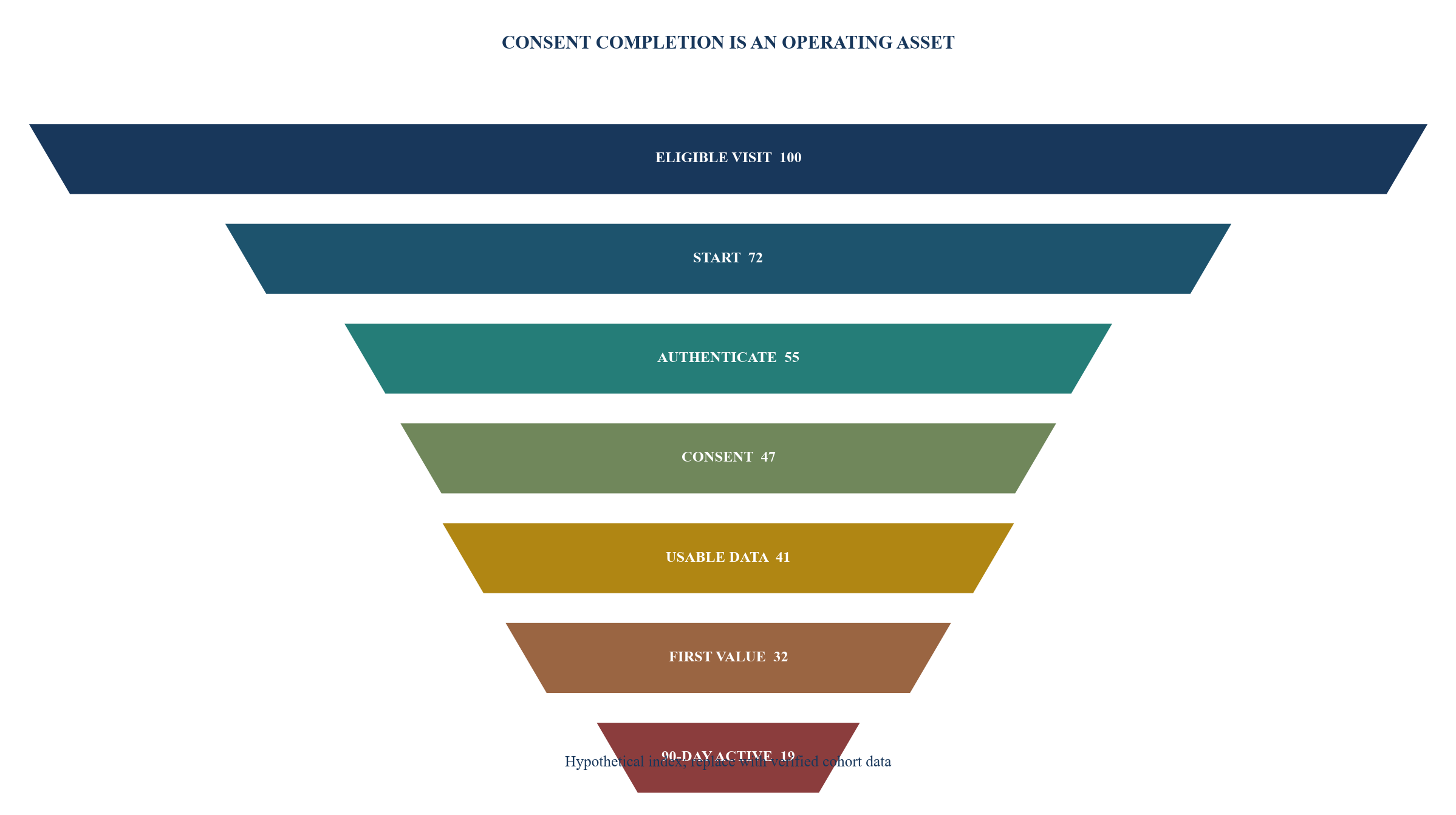
Author framework. Each rate should be measured by institution, channel, customer and use case.
6. Identify the payer before the product
The end user, financial institution, employer, merchant, platform and adviser can each receive value from open finance. The investible model states who pays, why, when and under which permission.
A consumer may value aggregation and budgeting but resist subscription fees. A lender may pay for verified cash-flow analysis that improves conversion or reduces manual review. A corporate treasury team may pay recurring software fees for multi-bank visibility and controls. A bank may purchase connectivity, consent or compliance infrastructure.
Payment by a product provider can create conflicts or fall within restrictions on commissions, distribution or advice. The commercial agreement should be reconciled to the permitted activity and customer disclosure.
The payer should have an observable economic outcome: reduced processing cost, faster decision, lower fraud, higher conversion, improved liquidity control, safer payment, lower churn or increased compliant distribution. A general promise of personalisation is insufficient for underwriting.
7. Map the investible business-model families
Eight model families cover most open-finance opportunities. Infrastructure vendors connect regulated entities and maintain standards. Consent and trust providers manage identity, permissions and audit. Data platforms aggregate and normalise financial records. Decisioning tools transform data into underwriting, affordability, fraud or cash-flow outputs.
Workflow companies embed those outputs in lending, treasury, accounting, insurance, wealth or payments. Comparison and marketplace models support discovery and switching. Service-initiation companies execute permitted actions. Compliance and assurance vendors monitor access, performance, consent, data and controls.
The categories overlap. A vertical lender may own data connections, underwriting and origination. A treasury platform may acquire connectivity and build proprietary workflow. An infrastructure provider can sell to both banks and fintechs.
Defensibility should be identified at the layer where the company has evidence. Common APIs can reduce technical scarcity. Durable advantage may come from distribution, regulated permissions, workflow depth, decision performance, multi-market execution, service reliability, proprietary labels or switching costs.
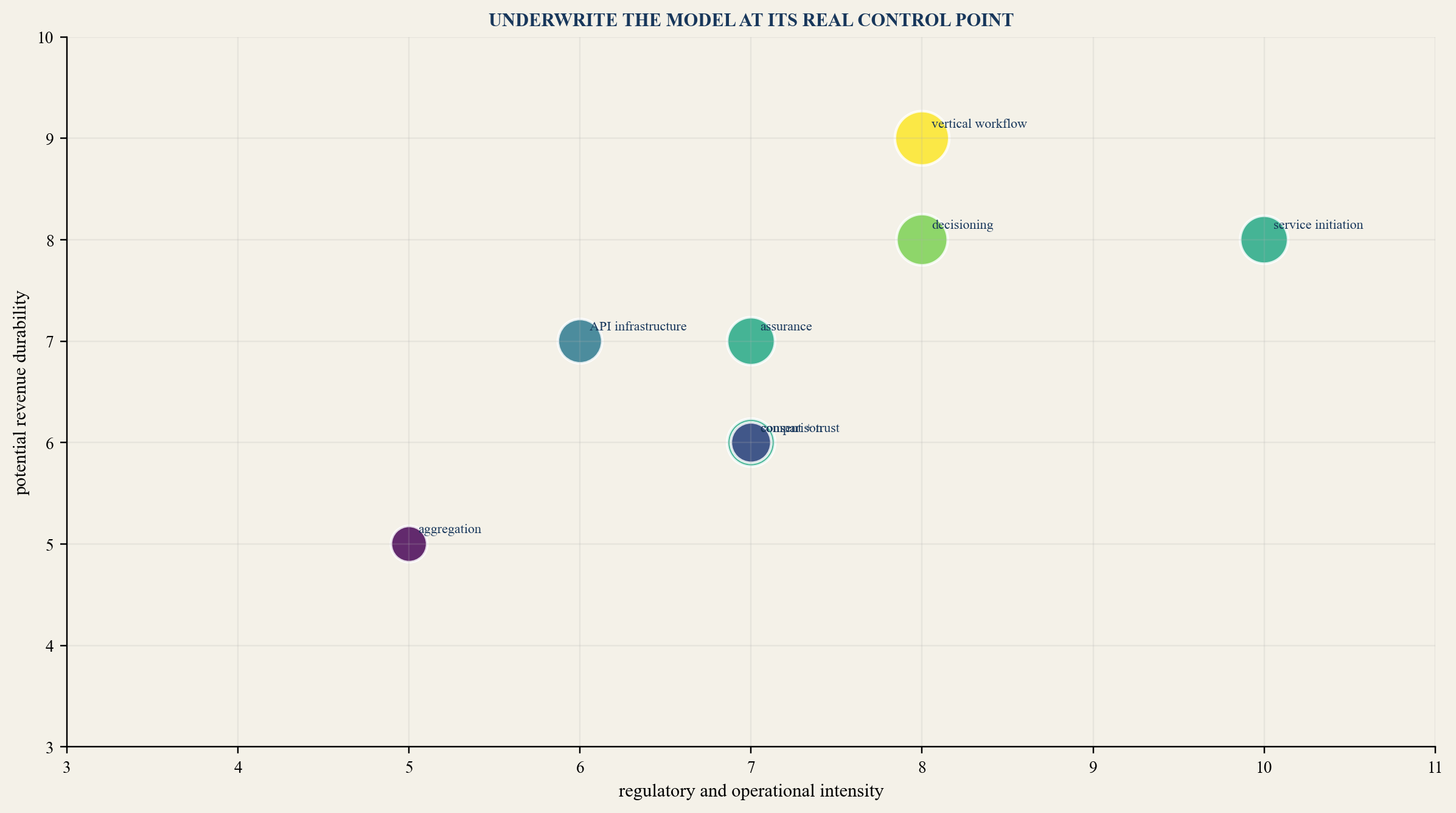
Author framework. Revenue quality and regulatory intensity differ across model families.
8. Test infrastructure and connectivity models
Connectivity vendors can earn recurring platform, connection, usage and support fees. Their customers value faster implementation, common monitoring, standards updates and one operational relationship across data holders.
The key diligence questions concern connector ownership, pass-through dependence, institution coverage, service levels, change management, incident response, certification, gross margin and concentration. A reseller of another aggregator can have limited control and compressed margin.
Common standards can lower the cost of new connections and reduce differentiation. The provider's advantage can persist through reliability, multi-market reach, compliance tooling, monitoring, enterprise integration and customer trust.
Pricing should reflect cost drivers. Per-connection fees can be attractive for stable enterprise usage. Per-call pricing exposes the customer to volume and retry costs. Minimum commitments support capacity while increasing sales friction.
9. Underwrite consent, identity and trust services
Consent infrastructure records the customer, purpose, data, recipient, duration, authentication and revocation. It can support a common audit trail across banks, insurers and third-party providers.
Trust services may include digital identity, confirmation of payee, fraud signals, credential validation, certificate management and permissions dashboards. The revenue case depends on whether these are mandated common services, competitive services or functions provided by central infrastructure.
The company should demonstrate accuracy, uptime, latency, dispute management and liability allocation. A false identity match or incorrect payee confirmation can create direct customer harm. Insurance and contractual caps should be reviewed against realistic loss paths.
Trust data can become valuable for fraud models, subject to lawful use and purpose limitation. Proprietary outcomes can improve decisioning when the company has sufficient verified labels and governance.
10. Evaluate aggregation and personal-finance tools
Aggregation provides a consolidated view of accounts, cards, loans, investments or insurance. The customer value lies in the decision or action enabled by that view.
Consumer financial-management applications often face difficult willingness to pay. Engagement can decline after the initial insight unless the product supports recurring cash-flow control, alerts, goals, switching, tax, debt or advice.
Enterprise aggregation can have clearer value. Accountants, wealth managers, lenders and treasury teams can reduce manual collection and reconciliation. The product must fit the professional workflow and preserve data lineage.
The investment case should measure active linked accounts, successful refresh, categorisation accuracy, weekly or monthly use, renewal, support cost and revenue per active consent. Downloads and account registrations are weak substitutes.
11. Finance cash-flow underwriting carefully
Permissioned transaction data can support income verification, affordability, small-business cash-flow analysis, fraud detection and credit monitoring. It can reduce document collection and provide a more current view than static statements.
The decision model should show which data creates incremental predictive value and how performance is validated. Correlation with historic repayment in one cohort does not establish performance in another market, product or economic period.
The lender remains responsible for applicable credit, affordability, fair-treatment and model-governance duties. Missing accounts, selective consent, cash activity and informal finance can create incomplete views.
A data or decisioning vendor can earn per-assessment or platform revenue without carrying credit risk. A lender earns interest and fee revenue while adding funding, capital, liquidity, collections and loss exposure. These are materially different businesses.
12. Build SME treasury and accounting workflows
SME open-finance services can consolidate balances, forecast cash, reconcile invoices, identify working-capital needs and initiate permitted payments. The recurring operational workflow supports subscription revenue when the product saves measurable time or financing cost.
Bank feeds alone are replaceable. Defensibility can come from accounting integration, permissions, entity-level controls, approval workflows, receivables, forecasting, lending access and adviser collaboration.
The platform should distinguish observed cash from forecast cash. Forecasts depend on invoices, payroll, tax, debt and commercial assumptions outside bank-transaction data.
Customer acquisition can flow through accountants, banks, enterprise software, payroll or direct sales. Channel economics and ownership of the customer relationship determine long-term margin.
13. Test payment and service-initiation models
Service initiation can reduce checkout steps, automate transfers, support account funding or allow a user to act from a preferred interface. The permitted service and safeguarding model require precise regulatory analysis.
Revenue can come from merchants, platforms or enterprises that benefit from lower processing cost, faster settlement, reconciliation or higher conversion. The company should show net economics after scheme, bank, fraud, refund, support and infrastructure costs.
Payment volume is not revenue. Gross payment value should be reconciled to successful transactions, net take rate, reversals, fraud, variable cost and gross profit.
Reliability and liability are central. Failed or duplicated initiation, incorrect destination, service outage and account takeover can cause direct loss. Confirmation, authentication, limits, monitoring and exception handling belong in the product and the model.
14. Approach insurance, wealth and pensions with licence discipline
Broader financial data can support needs analysis, policy comparison, premium finance, portfolio aggregation and retirement planning. The boundary between information, comparison, arranging and advice varies by jurisdiction.
The UAE framework includes insurance data and quotation services in its open-finance architecture. Commercial execution still requires the relevant permissions and insurer participation.[2][3]
An application can help a customer see overlapping cover or fragmented assets. Recommending a product or earning provider commission can trigger additional duties. The business model should show how conflicts are managed and what the customer understands.
These models can have attractive lifetime value when integrated into a trusted adviser relationship. They can also inherit long sales cycles, suitability obligations, product dependence and high support costs.
15. Build an investibility scorecard
An investment committee should score the company on permission, access, data quality, customer outcome, distribution, revenue, retention, gross margin, liability, security and control.
The score should be evidenced by cohort and customer. A pilot letter is different from a recurring contract. A successful bank connection is different from a complete multi-bank product. A gross-margin calculation should include third-party data, cloud, support and incident costs.
Table 2. Open-finance investibility scorecard
| Dimension | Strong evidence | Warning signal | Investment test |
|---|---|---|---|
| Permission | current licence analysis and approved activity map | revenue depends on an unlicensed action | counsel and regulator-ready perimeter memorandum |
| Access | contracted or mandated access across material providers | one connection or uncertain launch date | weighted institution and product coverage |
| Data | complete, timely and reconciled fields | nominal API availability with missing values | usable-data rate by use case |
| Customer outcome | measured cost, speed, risk or conversion improvement | broad personalisation claim | controlled comparison or verified operational baseline |
| Distribution | repeatable channel with owned economics | dependence on one unpaid pilot partner | acquisition cost, cycle, conversion and concentration |
| Revenue | contracted recurring or repeated transaction revenue | gross volume presented as sales | recognised revenue and collection by cohort |
| Retention | renewed customer and active-consent cohorts | registrations without repeated use | gross and net retention plus consent renewal |
| Margin | complete delivery cost and operating leverage | API and support costs excluded | contribution and gross margin at scale |
| Liability | mapped harm, contracts, controls and insurance | unclear responsibility for data or payment failure | loss scenarios and capital sufficiency |
| Defensibility | workflow, decisioning, trust, distribution or multi-market advantage | generic interface over common APIs | replacement time and customer switching evidence |
Each score requires evidence for the relevant market, use case and legal entity.
16. Assemble the diligence file
The data room should reconcile corporate, regulatory, technical, customer and financial evidence. Version control matters because standards, licences and participant readiness change.
Customer contracts should identify the payer, service, minimums, pricing, service levels, liability, termination, data use and renewal. Pipeline should remain separate from contracted revenue.
Technical diligence should follow an actual data journey from consent through holder, infrastructure, normalisation, decision and customer output. Logs should demonstrate performance without exposing personal data to the diligence team.
Table 3. Open-finance venture diligence file
| File | Minimum evidence | Key reconciliation | Decision use |
|---|---|---|---|
| Corporate | ownership, options, board, subsidiaries and related parties | cap table to filings and employee grants | governance and dilution |
| Regulatory | permissions, counsel memoranda, applications, correspondence and compliance plan | activity map to each revenue stream | legal ability to operate and scale |
| Data access | participant list, agreements, certifications, scope and service levels | claimed coverage to successful production traffic | availability and dependence |
| Consent | journey, artefact, disclosure, revocation, renewal and audit | registrations to completed and active consents | conversion, trust and compliance |
| Technology | architecture, security, resilience, vendors, incidents and recovery | product claim to production performance | scalability and operational risk |
| Models | features, labels, validation, monitoring, overrides and fairness | decision claim to observed outcomes | predictive value and governance |
| Customers | contracts, invoices, collections, usage, renewals and support | recurring revenue to bank receipts and cohorts | demand, retention and concentration |
| Financial | recognised revenue, costs, payroll, cash, tax, forecast and financing | management accounts to contracts and bank | runway, margin and funding need |
Sensitive personal data should be minimised and reviewed through controlled procedures.
17. Reconstruct unit economics from first principles
Unit economics should begin with a paying customer or completed transaction. Revenue is reduced by connectivity, data, cloud, identity, fraud, support, dispute, compliance and channel costs that vary with delivery.
Sales and onboarding costs belong in acquisition cost. Enterprise implementation can consume product and engineering time that is absent from sales commissions. Free pilots should be priced at their real delivery cost.
Retention should use an appropriate denominator. Annual enterprise renewal differs from monthly consumer activity. Revenue expansion can arise from more entities, accounts, transactions or modules.
The contribution model should incorporate consent failure and refresh. A nominal user base produces limited value when few users maintain usable permissions.
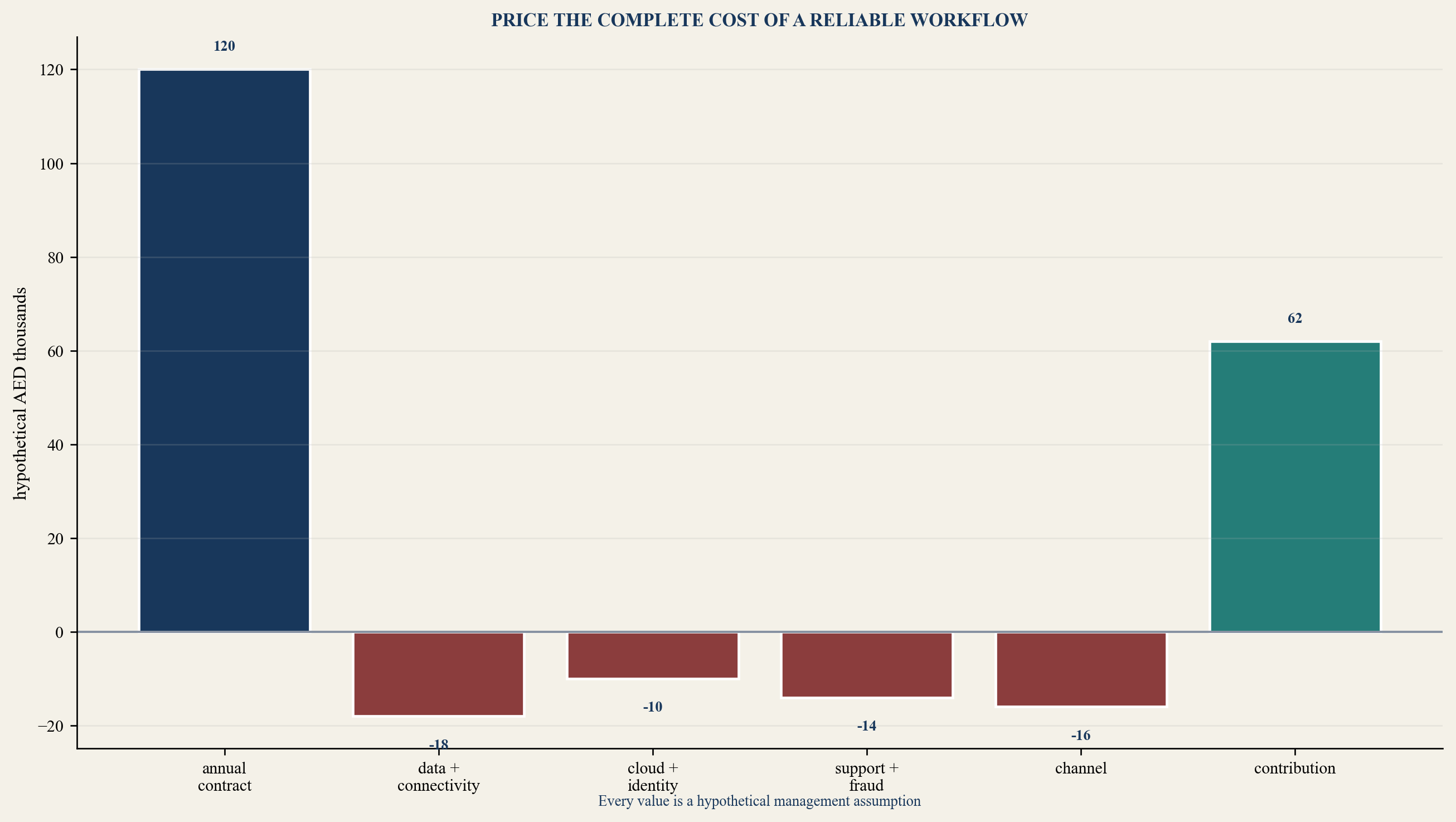
Hypothetical management values demonstrate the calculation and do not represent an actual company.
18. Test a hypothetical B2B platform
The following example demonstrates the method. Every number is a hypothetical management assumption. It does not describe an actual company, licence, contract, customer, transaction or investment return.
Assume a UAE-based platform provides permissioned multi-bank cash visibility, automated reconciliation and working-capital alerts to medium-sized companies through accountants and direct enterprise sales. Payment initiation is excluded from the initial service unless separately permitted.
Assume the company charges a platform fee by legal entity and linked account. It purchases connectivity and identity services, operates its own normalisation and forecasting layer, and integrates with accounting systems.
Table 4. Hypothetical open-finance B2B operating case
| Metric | Year 1 | Year 2 | Year 3 |
|---|---|---|---|
| Paying enterprise customers at year end | 120 | 360 | 780 |
| Average annual recurring revenue per customer | AED 72,000 | AED 78,000 | AED 84,000 |
| Reported annual recurring revenue at year end | AED 8.6 million | AED 28.1 million | AED 65.5 million |
| Recognised revenue | AED 5.2 million | AED 20.4 million | AED 49.7 million |
| Gross margin after data, cloud and support | 54% | 63% | 69% |
| Gross annual revenue retention | 82% | 88% | 91% |
| Net annual revenue retention | 96% | 108% | 116% |
| Blended customer acquisition cost | AED 68,000 | AED 62,000 | AED 55,000 |
| Months to contribution payback | 24 | 17 | 12 |
| Cash operating expense | AED 15.0 million | AED 23.5 million | AED 35.5 million |
| Year-end cash burn or generation | AED 12.2 million burn | AED 10.6 million burn | AED 1.2 million burn |
| External capital required including reserve | AED 28.0 million | included | included |
Every number is a hypothetical management assumption created solely to demonstrate the method.
The example shows why annual recurring revenue is insufficient by itself. Recognised revenue lags year-end contracts, gross margin improves only as connectivity and support scale, and acquisition payback depends on retention.
The initial capital should fund product completion, permissions, security, institution coverage, distribution and working capital through a defined evidence milestone. Follow-on funding should depend on active-consent performance, enterprise renewal and contribution margin.
19. Stress the connected assumptions
Open-finance risks can move together. A bank integration delay can reduce available coverage, weaken customer conversion and extend sales cycles. A consent problem can lower usage and renewal while fixed compliance costs continue.
Regulatory expansion can increase addressable scope and require new capital, controls and insurance. A product-provider partnership can accelerate distribution and create concentration or conflict.
Downside analysis should change revenue, margin, timing and funding together. The board should define cash and operational triggers before the downside occurs.
Table 5. Open-finance venture sensitivity matrix
| Stress | Hypothetical change | Economic transmission | Required response |
|---|---|---|---|
| Institution delay | two major providers slip nine months | lower coverage, slower sales and custom connector cost | narrow target segment, milestone funding and alternate provider plan |
| Consent conversion | usable-data completion falls from 57% to 35% | fewer activated customers and higher acquisition cost | journey diagnosis, institution-level fixes and revised forecast |
| Data-quality failure | 12% of active feeds lack required fields | manual review, weak decisioning and support cost | quality score, fallback evidence and service disclosure |
| Gross retention | annual retention falls from 88% to 72% | lower lifetime value and longer payback | cohort review, workflow depth and renewal intervention |
| Price compression | annual contract value falls 20% | lower gross profit and funding capacity | packaging, channel terms and cost reset |
| Connectivity cost | variable data cost rises 60% | gross-margin reduction | minimum commitments, routing and price adjustment |
| Security incident | material access or identity event | remediation, downtime, customer loss and liability | incident plan, reserves, insurance and independent review |
| Regulatory perimeter | planned commission revenue is unavailable | revenue shortfall and redesign | licensed partner, customer-paid model or scope change |
Every scenario is a hypothetical management assumption and should be replaced with verified company evidence.
20. Structure funding around evidence
Early funding should buy defined evidence: permission clarity, production access, usable data, completed consent, paying customer, renewal, gross margin and reliable operations.
Milestones should be within management control where possible. A financing condition based solely on regulator approval or bank launch can leave the company underfunded through external delay.
The capital structure should match risk. Equity can fund product, market and regulatory uncertainty. Venture debt generally becomes more suitable after recurring revenue, retention and cash visibility improve. Strategic capital can add access or distribution and may impose exclusivity or competitive restrictions.
Runway should include regulatory, audit, security, insurance and integration costs. A launch date should not be treated as an immediate revenue date.
21. Plan credible exit pathways
Potential buyers can include banks, insurers, payment companies, enterprise-software vendors, credit bureaus, data infrastructure providers, accounting platforms and international fintech groups. The strategic logic depends on the layer owned by the target.
An infrastructure buyer may value connections, certifications and reliability. A software buyer may value workflow, recurring revenue and customer distribution. A financial institution may value origination, data insight or faster product delivery.
Regulated permissions, customer consent and data cannot be assumed to transfer automatically in a change of control. The exit plan should identify consent, notification, approval, contract and data-migration requirements.
Exit readiness requires clean ownership, documented software rights, current security evidence, auditable consent, reconciled revenue and low dependence on founders or one provider. Valuation should use verified revenue quality and strategic value rather than gross data calls or payment volume.
22. Execute through 180 days
An investor or strategic acquirer can move from regulatory perimeter through product, operating, customer and financial evidence in six months. Workstreams should run together and converge at formal gates.
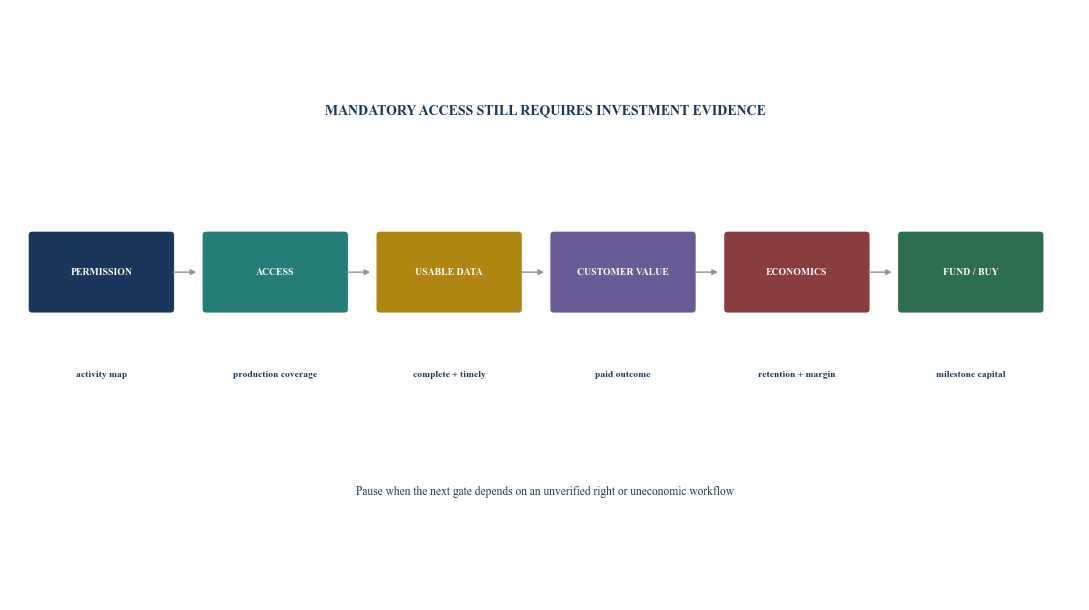
Author framework. Capital advances against verified permission, access, value and economics.
Table 6. 180-day open-finance investment plan
| Days | Workstream | Principal output | Gate |
|---|---|---|---|
| 1 to 20 | perimeter and market | activity map, jurisdiction comparison, payer and use case | permitted opportunity defined |
| 21 to 45 | access and data | participant coverage, production tests, data quality and fallback | usable access demonstrated |
| 46 to 75 | product and consent | complete journey, value event, support and renewal design | customer workflow accepted |
| 76 to 105 | customer evidence | contracts, usage, cohorts, outcomes, invoices and collection | paid demand verified |
| 106 to 130 | technology and risk | architecture, security, resilience, model governance and liability | operating controls accepted |
| 131 to 150 | economics | recognised revenue, full delivery cost, retention, acquisition and cash | fundable base case approved |
| 151 to 170 | transaction | valuation, terms, conditions, governance, approvals and financing | executable package established |
| 171 to 180 | committee | evidence record, downside, milestones, reserves and ownership | invest, acquire, defer or decline |
Sequencing is indicative and should reflect permissions, participant readiness and transaction timetable.
23. Set the decision and governance model
The investment committee should approve the legal entity, jurisdiction, permitted activity, target customer, payer, data scope, provider coverage, consent journey, output, pricing, distribution, liability, security, capital and milestones.
Board reporting should include successful access, usable-data rate, consent completion, active permissions, value events, service incidents, fraud, customer concentration, recognised revenue, gross margin, retention, acquisition payback, cash and regulatory matters.
The decision should pause when revenue relies on an unavailable permission, access is nominal rather than operational, data cannot support the promised output, a free pilot is presented as demand, gross margin excludes material delivery cost, or liability exceeds capital and control.
A narrower use case can be investible earlier than a broad financial super-app. Depth in one repeated workflow can establish revenue, data quality and distribution before expansion.
24. Limitations and conclusion
Open-finance regulation, participant readiness, technical standards, commercial terms, data quality, consumer behaviour, security threats and capital markets continue to evolve. Decisions require current evidence from regulators, participants, counsel, compliance specialists, cyber-security teams, customers, auditors and investors.
The cited international frameworks have different legal purposes and market structures. A successful model in one country does not establish permission, adoption or economics in another.
Publicly reported ecosystem volumes do not establish company revenue, customer outcomes or investibility. Every value in the worked example and sensitivity analysis is a hypothetical management assumption.
Mandatory data sharing can create a valuable platform for competition and innovation. The investible opportunity resides in a permitted, trusted and repeated workflow that turns usable data into a measurable customer outcome.
Capital should follow evidence across the full chain: permission, operational access, complete data, consent conversion, product value, retained revenue, contribution margin and controlled liability. That discipline converts a regulatory opening into a financeable business.
References
- [1] Central Bank of the UAE, Open Finance, official programme page, accessed 13 August 2026. https://www.centralbank.ae/en/our-operations/fintech-digital-transformation/open-finance/
- [2] Central Bank of the UAE, Open Finance Regulation and Introduction and Scope, Circular C 03/2025, official Rulebook, accessed 13 August 2026. https://rulebook.centralbank.ae/en/rulebook/open-finance-regulation
- [3] Central Bank of the UAE, Annual Report 2025, open-finance implementation discussion. https://www.centralbank.ae/media/4qbn11cl/annual-report-2025-en.pdf
- [4] Financial Conduct Authority, Open Finance Roadmap: Our Vision for a Smart Data Future, 14 April 2026. https://www.fca.org.uk/publications/corporate-documents/open-finance-roadmap
- [5] Banco Central do Brasil, Open Finance and Regulatory Priorities for 2025/2026, official pages accessed 13 August 2026. https://www.bcb.gov.br/en/financialstability/open_finance and https://www.bcb.gov.br/en/pressdetail/2612/nota
- [6] Reserve Bank of India, Non-Banking Financial Company - Account Aggregator Directions, 2016, updated 6 September 2024. https://www.rbi.org.in/Scripts/BS_ViewMasDirections.aspx?id=10598
- [7] Australian Competition and Consumer Commission, Non-bank lenders join Consumer Data Right as next stage commences, 13 July 2026. https://www.accc.gov.au/media-release/non-bank-lenders-join-consumer-data-right-as-next-stage-commences
- [8] Council of the European Union, Capital Markets Union: Council agrees to make consumers' financial data more accessible, 4 December 2024. https://www.consilium.europa.eu/en/press/press-releases/2024/12/04/capital-markets-union-council-agrees-to-make-consumers-financial-data-more-accessible/
- [9] Financial Conduct Authority, Open Banking and Open Finance in the UK, research note, 6 October 2025. https://www.fca.org.uk/publications/research-notes/open-banking-open-finance-uk
- [10] Australian Competition and Consumer Commission, Consumer Data Right, official overview accessed 13 August 2026. https://www.accc.gov.au/by-industry/banking-and-finance/the-consumer-data-right
- [11] Reserve Bank of India, Framework for Recognising Self-Regulatory Organisations for the Account Aggregator Ecosystem, March 2025. https://www.rbi.org.in/Scripts/PublicationReportDetails.aspx?ID=1278
- [12] Banco Central do Brasil, Open Finance customer information, official page accessed 13 August 2026. https://www.bcb.gov.br/estabilidadefinanceira/cliente-open-finance
About the Author
Chennakeshav Adya is an independent researcher and Managing Partner of Matchpoint Partners. His research focuses on investment strategy, capital formation, transaction execution, governance and operating-model design across international markets.
