

1. Define the advice problem before requesting data
A wealth manager should begin with the client decision that additional data is expected to improve. Possible decisions include establishing an investment policy, consolidating fragmented portfolios, sizing liquidity, planning a business sale, funding retirement, managing debt, reviewing insurance, preparing succession, assessing a concentrated position or coordinating several advisers. Each decision requires a different evidence set and review frequency.
Broad access without a defined purpose creates cost and risk. The institution may collect data that relationship teams cannot interpret, that systems cannot reconcile or that the advice process does not use. The consent request should therefore follow the advice scope. A cash-flow review may require bank transactions, recurring commitments and debt payments. A total-wealth allocation review may require custody positions, fund look-through, pensions, private assets, liabilities, currency and legal ownership. An insurance review needs policy terms and coverage rather than a premium amount alone.
The business case should identify a measurable client outcome. Possible outcomes include fewer manual statements, earlier identification of a liquidity shortfall, clearer concentration analysis, faster annual review, a complete fee comparison or more timely detection of a material life event. The measure should include quality and client understanding as well as speed.
Open-finance data should enter an existing accountable advice process. The product owner defines the use case. Legal, privacy and compliance teams establish the permitted data and processing basis. Data and technology teams control ingestion and lineage. Investment and planning teams define calculations. The adviser interprets evidence and owns the client conversation within the approved mandate. Independent risk and audit functions test the control environment.
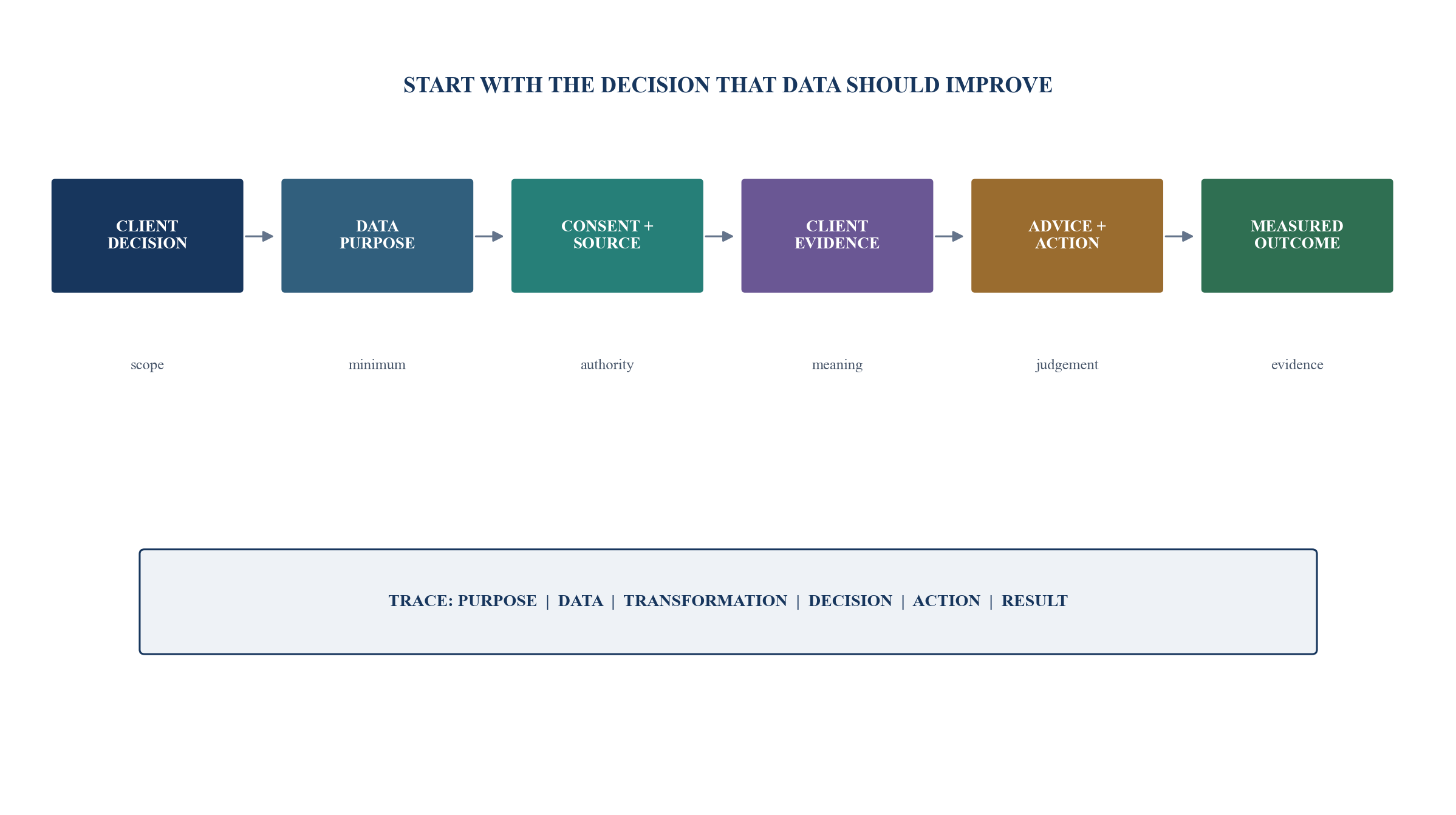
Author framework. Every transition requires a defined owner, evidence source, review date and exception route.
2. Use international regimes as design evidence
Open finance does not describe one legal or technical model. Jurisdictions differ in data scope, mandatory participation, accreditation, consent, charging, liability, service initiation and the boundary between information and regulated advice. A global wealth manager should treat these differences as design evidence and maintain a jurisdiction-specific perimeter.
The FCA's April 2026 roadmap moves the United Kingdom from exploratory work toward delivery between 2026 and 2030. The initial priority use cases concern SME finance and mortgages. Wealth firms can still use the roadmap's core building blocks: customer control, trusted data, interoperability, proportionate governance and evidence-led use-case testing. The FCA states that firms may introduce products earlier where data access and required permissions already exist. This statement does not create a general right to every dataset.
The European Commission's Financial Data Access proposal covers selected financial data with customer permission and aims to enable data-driven business models. The Council adopted a negotiating position in December 2024. The final obligations, exclusions, timing and scheme design require verification against the enacted text when the legislative process concludes. A wealth manager should therefore avoid treating the proposal as an in-force uniform API entitlement.
Australia's Consumer Data Right provides live banking-data sharing through accredited recipients and regulated consent, privacy, security and technical standards. The government announced an expansion to non-bank lending from mid-2026 while narrowing some data obligations and emphasizing high-value use cases and cost. Brazil provides a broader operational example in which consented sharing can include accounts, cards, credit, foreign exchange and specified investments. Banco Central do Brasil's 2025 integrated report recorded 96 million connected customer relationships at year-end.
India's Account Aggregator directions define financial-information providers and users, explicit standardized consent and secure transfer. The Account Aggregator does not store the financial information and does not support client transactions. Singapore's SGFinDex connects selected financial information through encrypted transmission to support consolidated planning. The UAE's in-force framework includes a Trust Framework, API Hub and common infrastructure, and the central bank reported that Al Tareq went live in 2025. The UAE rules also preserve a boundary: an open-finance licence alone does not authorize personal advice or mediation of transactions.
Table 1. International open-finance evidence and wealth-design implications
| Market | Official position used in this paper | Wealth-management design implication |
|---|---|---|
| United Kingdom | 2026 roadmap, use-case testing and framework work through 2030 | build use cases and evidence before assuming mandatory data coverage |
| European Union | proposed Financial Data Access framework remains within the legislative process | maintain proposal and enacted-rule status separately; map scheme and jurisdiction requirements |
| Australia | live banking CDR with accredited recipients; non-bank lending expansion announced for mid-2026 | design consent, accreditation, privacy safeguards and high-value use cases together |
| Brazil | regulated sharing includes accounts, credit, foreign exchange and specified investments | test investment aggregation, consent renewal, participant coverage and data-quality operations at scale |
| India | Account Aggregator model uses standardized consent and regulated provider-user roles | connect the consent artefact to purpose, data, frequency, retention and advice workflow |
| Singapore | SGFinDex provides encrypted aggregation for financial planning | examine a public-infrastructure route for consolidated planning and client access |
| United Arab Emirates | in-force framework distinguishes data sharing, service initiation and advice permissions | prove licence perimeter, participation phase, product scope and additional advice authority |
The regimes differ in legal status, scope and implementation. Current primary sources and local advice are required before launch.
3. Segment clients by decision complexity and data fragmentation
Wealth segmentation based only on assets under management misses the conditions that make open finance valuable. Relevant dimensions include the number of providers, legal structures, currencies, countries, asset types, liabilities, operating businesses, family members, advisers and decision events. A client with two liquid accounts may gain little from a complex aggregation service. A family with banks, pensions, trusts, private companies, property, insurance and debt across jurisdictions can benefit substantially if the data can be interpreted and governed.
The institution should classify decision complexity separately from data fragmentation. A client can have many accounts with a simple objective. Another can have few accounts and a difficult succession, tax-residence or concentrated-equity problem. The service model should reflect both dimensions.
Four broad segments help with initial design. Consolidation clients need a current view across liquid accounts and investments. Planning clients need cash flows, pensions, liabilities and life-event assumptions. Complex-wealth clients need legal ownership, private assets, business interests, tax wrappers and cross-border coordination. Delegated-family clients need roles, permissions, family governance and adviser access as well as financial data.
Client capability also matters. Consent journeys, digital identity, authentication, data correction and revocation can create friction. Some clients want self-service aggregation. Others expect the relationship manager or family-office team to coordinate documents and exceptions. Accessibility, language, vulnerability and delegated authority should enter journey design.
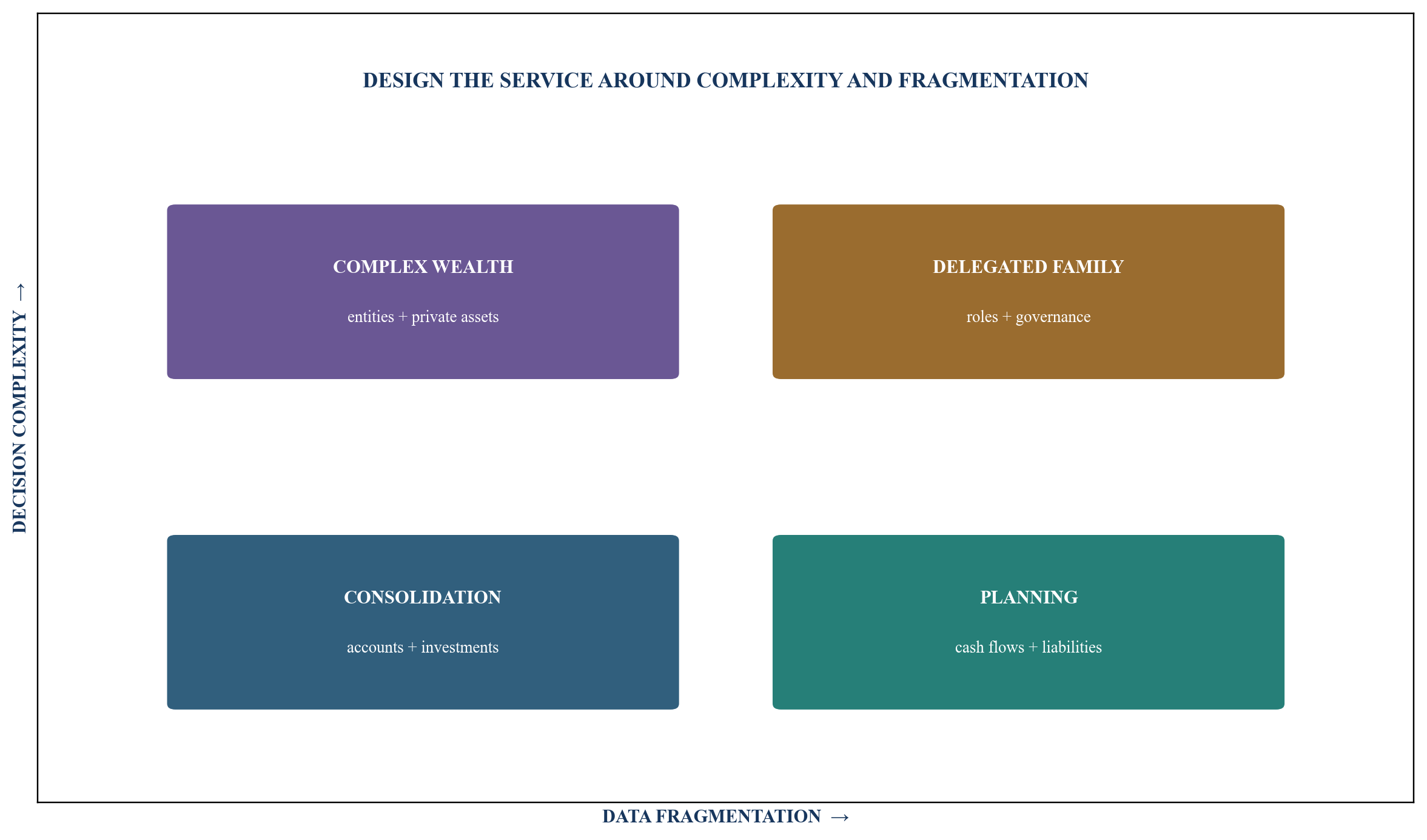
Author framework. Segment positions are qualitative and require client-specific assessment.
4. Build a financial-data map before building an API map
The advice team should define the required financial facts before technology teams select interfaces. A useful map begins with decision domains: identity and household, legal ownership, income and expenditure, cash, credit, investments, pensions, insurance, property, private assets, tax wrappers, commitments and goals. Each domain should identify data elements, authoritative source, refresh frequency, valuation method, permitted purpose and decision use.
Source systems are uneven. A current account can provide detailed transactions. An investment account can provide positions, trades, cost and cash, yet may lack look-through or complete fee data. A pension record can show balance and contributions while future benefits require scheme terms and assumptions. A private-company valuation is rarely available through a standardized feed. Property values, trusts, carried interests and contingent liabilities often require documents and professional review.
The map should preserve ownership and control. The account holder, beneficial owner, policy owner, borrower, guarantor and economic beneficiary may differ. Household aggregation should not merge assets merely because one person can view them. Delegated access should be evidenced and limited.
Historical depth and frequency should match the decision. Twelve months of transactions may support ordinary cash-flow classification but miss annual taxes, school fees, insurance, bonuses or capital calls. Daily valuation can appear precise while private funds update quarterly. The client record should show time and source rather than forcing all facts into one false timestamp.
5. Treat consent as a living mandate
Consent should be understandable, specific and operational. The record needs the client or authorized person, receiving entity, data holder, data types, purpose, frequency, start, expiry, revocation, onward sharing, retention and consequences of withdrawal. These elements should match the legal regime and the institution's role.
The advice mandate and the data consent are connected and distinct. A client can authorize data sharing without requesting a recommendation. A regulated advice agreement can exist without API access. The institution should record which authority supports data access and which authority supports analysis, advice, execution or service initiation.
Purpose limitation should enter systems. Data requested for a consolidated view should not automatically feed marketing, pricing, credit or unrelated product selection. A new purpose may require a new instruction or another lawful basis. Sensitive or specially protected information requires the treatment applicable in the relevant jurisdiction.
Revocation must work across the chain. The institution needs to stop future collection, update dependent calculations, restrict further use where required, apply retention obligations and tell the client what the service can no longer do. A model trained or calibrated on client data creates an additional governance question that should be answered before collection.
Table 2. Consent and authority register
| Field | Required evidence | Advice-control use |
|---|---|---|
| person and authority | identity, capacity, ownership or delegation | establish who may instruct access and for which accounts |
| recipient and role | regulated entity, service provider and licence status | establish accountability and permitted activity |
| data and source | named categories, holders and accounts | limit collection and identify missing coverage |
| purpose and processing | specific client service and approved transformations | prevent unrelated use and control analytics |
| frequency and duration | one-off or recurring access, start and expiry | manage freshness, renewal and stale records |
| onward sharing | named parties, functions and jurisdictions | control processors, advisers and cross-border flows |
| revocation and retention | cancellation route, deletion and legal retention | stop access and update dependent advice records |
| incident and complaint route | notifications, support and liability process | provide client redress and accountable response |
Required fields vary by regime. The register should be validated by responsible legal, privacy and compliance teams.
6. Create an evidence-quality layer between raw data and advice
Open-finance feeds can reduce manual transcription while preserving the limitations of their source. A position can be current and still be misclassified. A transaction description can be complete and difficult to interpret. A market value can omit accrued income, currency, tax, exit cost or a pending trade. The advice system should therefore evaluate evidence rather than treating every returned field as equally reliable.
Five dimensions are useful. Provenance identifies the authoritative holder and retrieval path. Completeness compares returned fields and accounts with the required scope. Timeliness records the valuation or transaction time and refresh status. Consistency tests identifiers, balances, currencies and classifications across sources. Decision fitness assesses whether the field answers the specific advice question.
Each material fact should carry a confidence state. A verified source value can be used within its meaning. A derived value should retain the source fields and calculation. A client-provided value should be identified as such. A management assumption should show its owner and sensitivity. Missing data should remain missing rather than becoming zero.
Corrections need a governed path. The wealth manager may find a duplicate account, wrong currency, stale price or broken ownership mapping. The client record should preserve the original source, correction, reason, evidence, approver and effect on prior advice. Where the source institution must correct its record, the advice firm should avoid presenting its local override as the source truth.
7. Normalize the portfolio without losing meaning
Portfolio aggregation requires a stable taxonomy across providers. The institution should normalize identifiers, currencies, asset classes, sectors, countries, liquidity, wrappers, account types and ownership while preserving source labels. Mapping rules should be versioned and independently reviewed.
Valuation needs a hierarchy. Listed instruments can use approved market sources and timestamps. Funds may use official NAVs with different publication cycles. Bonds require clean or dirty price treatment and accrued income. Derivatives require exposure and collateral, not market value alone. Private assets require the last valuation date, method, manager, currency, capital calls and distributions. Property and businesses need source, appraisal date and ownership.
Look-through changes risk conclusions. A client can hold the same issuer through an ETF, mutual fund, structured product, discretionary mandate and direct security. Aggregation at account level will miss the concentration. Complete look-through may be unavailable or stale, so coverage should be visible.
Cash and liabilities belong in the same view. Bank balances, money-market funds, credit cards, mortgages, margin loans, guarantees, capital commitments and recurring obligations affect investible capacity. A wealth dashboard focused only on assets can support an unsuitable recommendation.
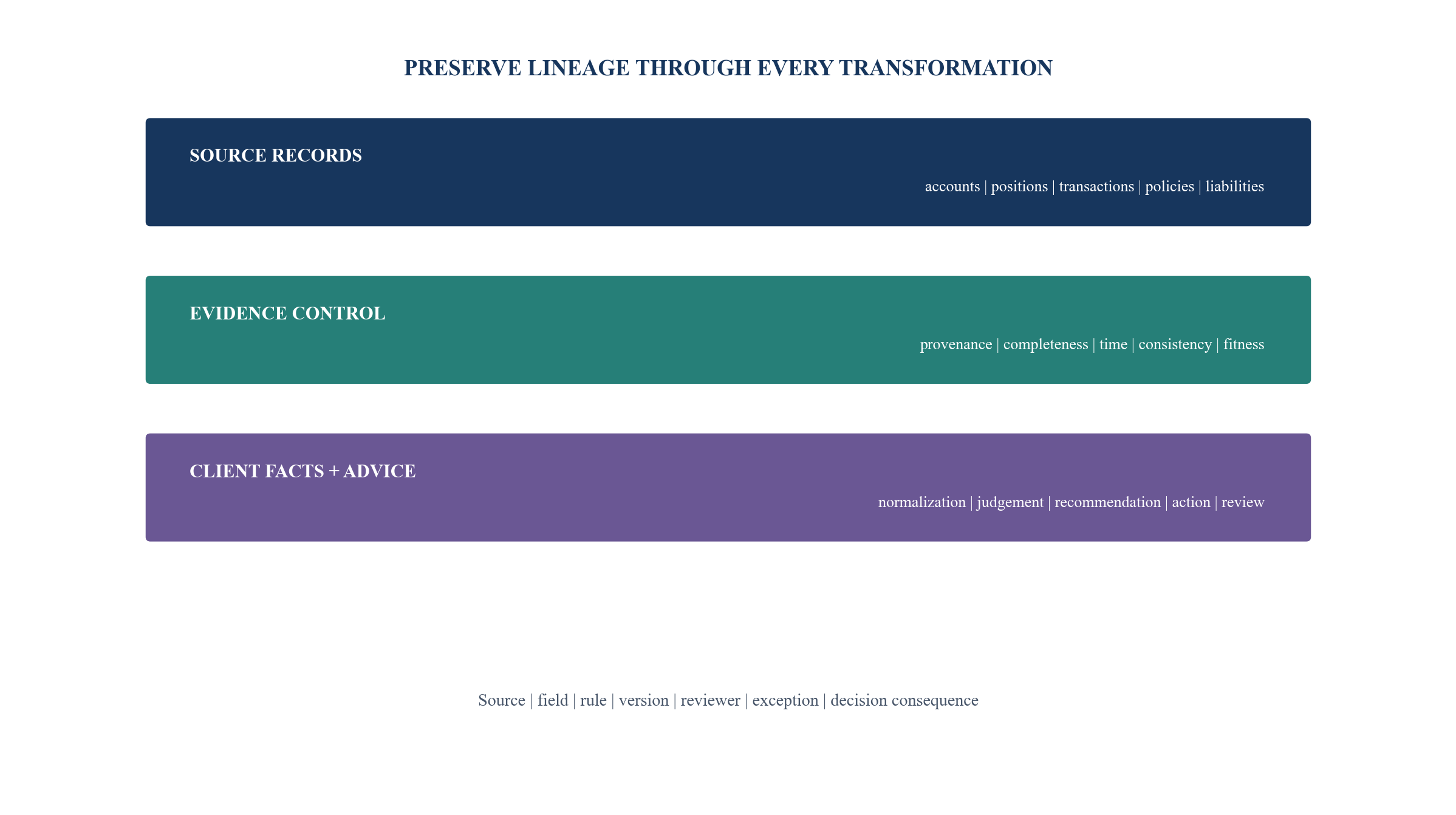
Author framework. Derived and corrected values retain lineage to the original source.
8. Convert transactions into cash-flow evidence carefully
Transaction data can improve financial planning when classifications are transparent and correctable. The system can identify recurring income, ordinary spending, debt service, taxes, school fees, insurance, transfers and exceptional items. It should distinguish a transfer between the client's own accounts from consumption, and an investment subscription from an expense.
Classification should combine deterministic rules, verified counterparties, client confirmation and controlled analytics. The institution should retain confidence and allow corrections. A category model trained on one market or language can perform poorly across merchants, scripts, currencies and account types.
Cash-flow analysis should address seasonality and events. A monthly average can conceal annual payments, bonuses, distributions, capital calls, property expenses or irregular business income. The planning horizon should include known commitments and client-confirmed future changes.
The adviser should explain uncertainty. A projected surplus based on twelve months of incomplete accounts is different from a verified household budget. Planning outputs should state account coverage, period, exclusions, one-off treatment, inflation, tax and scenario assumptions.
9. Redesign suitability around a traceable evidence chain
Open finance can improve the factual basis for suitability. It can reveal assets, liabilities, losses, cash needs, concentration and actual behavior that a questionnaire misses. The institution still needs client objectives, knowledge, experience, preferences, legal capacity, horizon and loss tolerance that may not appear in account data.
The workflow should separate source facts, derived facts, client statements and professional judgement. Source facts include account balances and transactions. Derived facts include concentration, liquidity coverage and projected cash flow. Client statements include goals and preferences. Judgement connects this evidence to a recommendation within the applicable rules and mandate.
Conflicts should be visible. A data recipient may also manufacture products, price advice, extend credit or receive distribution income. The recommendation process should identify how product economics, data access and platform design affect the presented universe. An aggregated view should not become a route for steering assets without a fair comparison.
Material missing information should stop or narrow the recommendation. A total-portfolio allocation cannot be described as complete when a major pension, business or liability is absent. The adviser can provide a limited analysis if the scope and consequences are clear.
Table 3. Evidence-led suitability workflow
| Stage | Evidence | Decision output |
|---|---|---|
| mandate and client authority | advice agreement, identity, capacity and data consent | approved scope, participants and permitted activity |
| client facts | source data, client statements, documents and corrections | dated client evidence record with coverage and confidence |
| objectives and constraints | goals, horizon, liabilities, liquidity, loss capacity and preferences | prioritized decision criteria and stop conditions |
| portfolio diagnosis | exposures, look-through, concentration, risk, liquidity and fees | evidenced gaps, alternatives and limitations |
| recommendation | product and strategy evidence, scenarios and conflicts | reasoned advice linked to client facts and alternatives |
| client decision | explanation, questions, choices and consent to act | accepted, declined or deferred actions with rationale |
| execution and review | orders, confirmations, portfolio changes and new data | implementation evidence, outcome measures and review triggers |
Specific obligations depend on jurisdiction, licence, client and product. The workflow requires local legal and compliance validation.
10. Separate analysis, advice and service initiation
An open-finance service can aggregate data, calculate indicators, display comparisons, provide generic information, deliver regulated advice or initiate an action. These functions may require different permissions and controls. The product design should state which entity performs each step.
The UAE framework provides a clear example. An open-finance provider can hold a data-sharing or service-initiation licence, while personal advice and transaction mediation require appropriate additional authority. Other jurisdictions draw different boundaries. A global platform should not assume that the technical ability to recommend or initiate creates legal permission.
Automated analysis needs a human-accountability design. Rules can flag excess cash, concentration, expiring insurance or debt cost. A recommendation affects a client's financial position and should follow the approved advice pathway. If an adviser changes a system suggestion, the record should preserve both the suggestion and the reasoned decision.
Service initiation raises another control layer. The institution needs authentication, transaction scope, limits, confirmation, fraud controls, cancellation, error handling and liability. Data used to suggest an action should be current enough for the instruction and should be reconciled after execution.
11. Build a product-shelf map from client need and verified exposure
Aggregated client data can help identify gaps in liquidity, protection, diversification, currency, duration or tax wrappers. Product selection should then begin with the portfolio function rather than the products that happen to be easiest to distribute.
The shelf map should include deposits and cash management, credit and mortgages, insurance, pensions, public investments, private markets, foreign exchange and planning services. For each segment, the system needs comparable product data, eligibility, risk, liquidity, cost, tax treatment, provider and execution route. Open-finance customer data alone does not provide this product evidence.
The available universe should be disclosed. A bank may compare proprietary and third-party products, a platform may have selected providers, and an external asset manager may execute through custodians. The recommendation should state the considered universe and relevant limitations.
Switching and consolidation require full economics. Exit fees, market spreads, tax, loss of benefits, financing break costs, transfer time and operational risk can outweigh a headline fee reduction. The client may also value custody diversification or jurisdictional separation that an automated consolidation prompt treats as inefficiency.
12. Construct the complete fee waterfall
Open finance can improve fee discovery by combining transactions, holdings and product terms. It can also create new charges for aggregation, advice, planning, platform, data services or execution. The institution should reconcile complete client cost before claiming savings.
The waterfall can include advice and planning fees, discretionary management, platform, custody, fund management, performance fees, product expenses, transaction costs, spreads, financing, foreign exchange, insurance charges, data or technology fees, tax and exit costs. Some costs appear in statements. Others are embedded in returns or require product documents.
Fee comparisons need a consistent base and period. Percentage charges can apply to different assets, commitments, NAV or performance. Fixed fees can be marginal for a large portfolio and significant for a smaller one. Private assets and structured products may require scenario-based economics.
Commercial arrangements and inducements should enter the conflict register. If an open-finance service is free to the client, the firm should understand who pays, what data rights exist and whether product placement or lead generation supports the model.
Table 4. Complete advice and portfolio fee waterfall
| Layer | Possible cost | Evidence and control |
|---|---|---|
| client service | planning, advisory, discretionary or subscription fee | signed mandate, billing basis, scope and exclusions |
| aggregation and platform | data, account aggregation, platform and custody | terms, provider contracts, allocation and client disclosure |
| products and funds | management, administration, performance and expenses | current product documents, NAV treatment and fee model |
| transactions | brokerage, spread, market impact, transfer and exit | executed trades, quotes, transfer terms and assumptions |
| financing and currency | interest, arrangement, break and hedging cost | loan agreements, approved rates, counterparties and attribution |
| insurance and pensions | premiums, policy charges, surrender and advice cost | policy terms, benefits, illustrations and cancellation rights |
| tax and legal structure | tax, filing, trust, company and professional fees | adviser inputs, entity records and client-approved scope |
Amounts and rates require verification from current agreements, statements, product documents and execution evidence.
13. Give relationship managers an evidence card
The relationship manager needs a concise view that explains what is known, what is derived, what is missing and which decisions are due. A dashboard with a large net-worth number and colorful allocation chart is insufficient.
The evidence card should state the client and household scope, legal entities, consent status, data sources, last refresh, account coverage, missing providers, valuation ages, currency basis, liability coverage, look-through, fee coverage, client goals, advice status and required actions. Every field should link to evidence or a documented calculation.
The card should support a client conversation rather than replace it. It can show that cash appears high relative to ordinary spending while a pending capital call is missing. It can show a concentrated technology exposure while a private business has no current valuation. These limitations guide questions.
Training should cover consent, source limitations, corrections, privacy, conflicts, advice boundaries, system overrides, incident handling and client explanations. Competence should be tested through ordinary and failure scenarios.
14. Design the management dashboard around outcomes and exceptions
Management information should combine adoption, data, advice, operations, risk and client outcomes. Adoption measures include eligible clients, invited clients, active consents and renewal. They do not establish value on their own.
Data measures include provider coverage, successful refresh, field completeness, reconciliation breaks, stale values, corrections and unknown classifications. Advice measures include review completion, identified gaps, recommendations, implementation, overrides and quality-review findings. Client measures include time saved, understanding, complaints, outcomes and attrition.
Risk measures should include unauthorized access, excessive data requests, consent failures, cyber incidents, third-party outages, model exceptions and processing outside the approved purpose. Economics should reconcile implementation and operating cost with fee revenue, adviser capacity and documented client benefits.
The dashboard should show cohorts and trends. A high average refresh rate can conceal poor coverage for pensions or investments. Faster review times can accompany lower advice quality. The committee should receive the decision consequence of each indicator and an accountable owner.
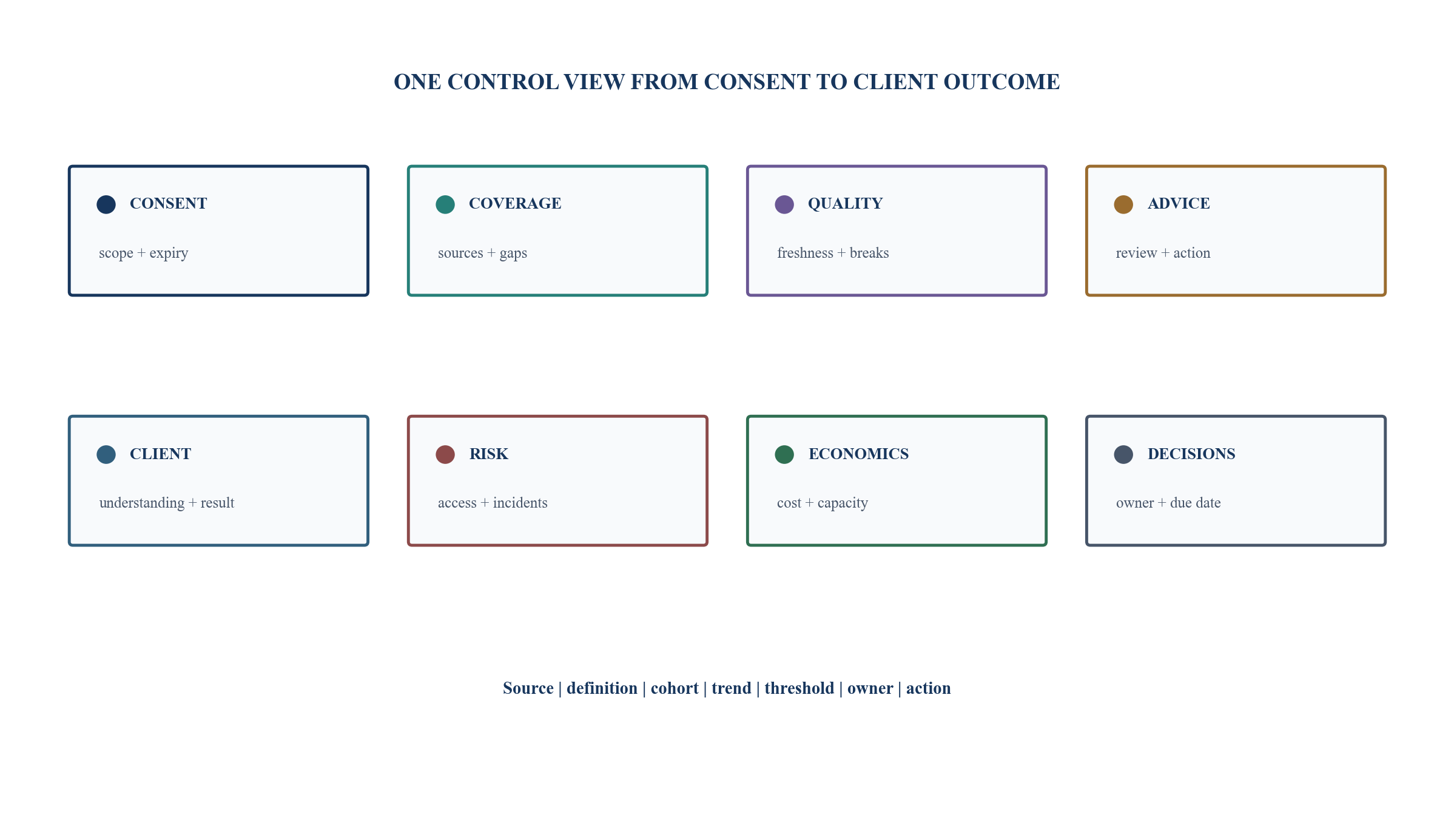
Author framework. Status indicators require current production data, approved definitions and documented thresholds.
15. Govern third parties and the technology chain
Open-finance wealth services can depend on directories, identity providers, consent managers, API gateways, aggregators, cloud platforms, analytics, market data, client portals, advisers and custodians. The client experience may appear unified while accountability is distributed.
Due diligence should cover authorization, ownership, financial condition, security, privacy, resilience, subcontractors, data location, incident response, service levels, audit rights, model governance, termination and data return or deletion. Concentration should be assessed across clients and use cases.
The operating map should identify the system of record for consent, raw data, normalized facts, advice, order and client communication. Reconciliation between systems is essential. A consent dashboard that shows revocation while a downstream data warehouse continues processing creates a serious control failure.
Exit planning should be tested. The institution needs to know how it can migrate consents, retrieve records, preserve advice evidence and continue critical reviews if a provider fails or is replaced. Proprietary transformations and undocumented mappings can create lock-in even when raw APIs are standardized.
16. Test cyber security, fraud and data minimization together
Open finance expands connected surfaces and the value of aggregated data. Security design should cover authentication, authorization, encryption, certificates, secrets, API protection, monitoring, vulnerability management, privileged access, software supply chain, incident response and recovery. Requirements should follow the applicable regime and institutional standards.
Data minimization reduces exposure. The institution should collect the fields and history required for the approved decision. A more complete dataset can increase harm during unauthorized access and can create uses that the client did not understand.
Fraud controls should address account takeover, manipulated consent, social engineering, malicious recipients, data poisoning and unauthorized service initiation. A consolidated view can help identify anomalies while giving an attacker a map of the client's wealth. High-risk actions require proportionate verification and limits.
Incident exercises should include corrupted balances, wrong client mapping, revoked certificates, provider outage, compromised credentials, unauthorized onward sharing and a recommendation based on stale data. The response should identify containment, client communication, correction, advice reassessment, regulatory reporting and evidence preservation.
17. Use a seven-gate approval process
Gate one validates the client decision, target segment and measurable outcome. Gate two establishes legal roles, licences, privacy basis and consent design. Gate three completes the data map, source coverage, taxonomy and evidence-quality rules. Gate four validates calculations, suitability, adviser judgement and product evidence. Gate five completes architecture, security, resilience and third-party due diligence. Gate six tests the client journey, RM materials, fees, complaints and operating readiness. Gate seven authorizes a limited launch with thresholds and monitoring.
Each gate needs evidence and stop conditions. Possible stop conditions include unclear advice authority, excessive data collection, untested revocation, unknown source ownership, low portfolio coverage, misleading precision, weak fee evidence, inability to reconcile, unavailable provider exit or a client journey that obscures consent.
A limited launch can restrict clients, jurisdictions, providers, data types, advice use cases and transaction functions. Expansion should follow verified client outcomes, data performance, quality reviews and successful incident tests.
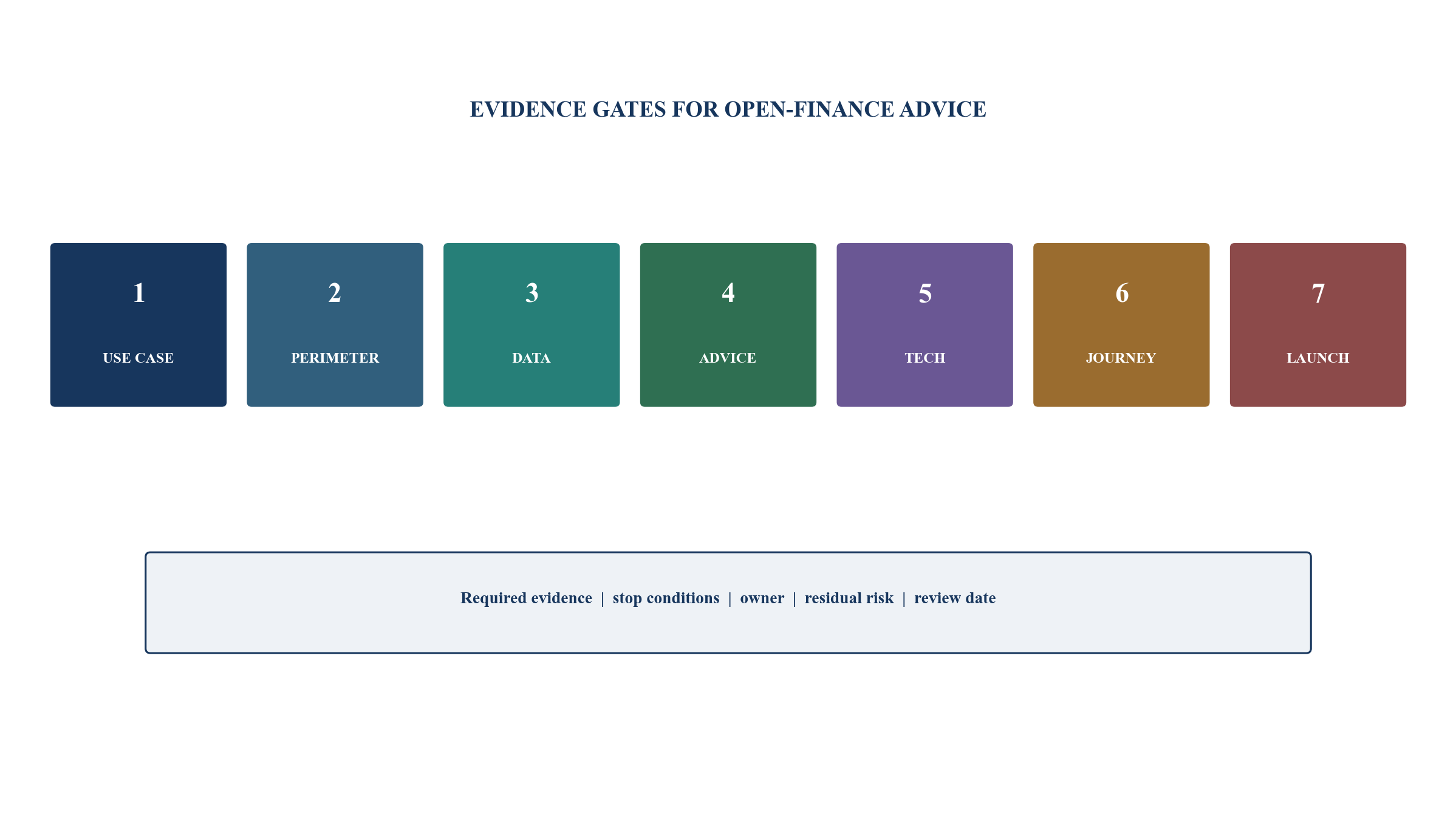
Author framework. Gate approval depends on documented evidence and does not cure a failure elsewhere.
18. Test the framework through client cases
Worked cases expose data and judgement gaps. Table 5 contains three hypothetical clients. Every value, account, outcome and proposed action is a management assumption for method demonstration and does not describe a real client or recommendation.
The first client has investments across four custodians and seeks a consolidated allocation review. The main challenge is look-through, duplicate exposures, currency, cost and stale private-fund valuations. The appropriate output is an evidence-graded portfolio rather than one precise allocation chart.
The second client owns a business and has irregular income, debt and family commitments. Transaction data can help establish historical cash flows while sale proceeds, taxes, capital calls and future spending require explicit scenarios. The recommendation should distinguish observed history from planned events.
The third client has cross-border family structures and delegated advisers. Data access depends on legal authority, account ownership and role. Household aggregation should preserve entity boundaries, privacy and decision rights.
Table 5. Hypothetical open-finance advice cases
| Case | Decision purpose | Principal evidence gap | Illustrative process |
|---|---|---|---|
| investor with four custodians and private funds | consolidated allocation and fee review | look-through, duplicates, valuation dates, currency and complete fees | grade coverage; reconcile holdings; show ranges and limitations; compare current and target portfolios |
| entrepreneur with business income, debt and family commitments | liquidity and post-sale planning | irregular cash flows, transaction classification, tax, sale timing and capital calls | separate observed history from scenarios; verify obligations; stress liquidity; stage recommendations |
| cross-border family with trusts and delegated advisers | family balance sheet and governance | ownership, authority, privacy, entity boundaries and inconsistent sources | map people and entities; approve access by role; preserve separate records; govern shared decisions |
All facts and actions are hypothetical management assumptions; the cases demonstrate the method and are not recommendations.
19. Implement through a 180-day sequence
Days 0 to 30 should select one high-value advice decision and a defined client segment. The institution should document the current journey, evidence gaps, permissions, data scope, baseline time, error and client-outcome measures. It should appoint accountable business, advice, data, privacy, risk and technology owners.
Days 31 to 60 should build the jurisdiction and licence perimeter, consent register, financial-data map, taxonomy, source hierarchy and provider architecture. The team should define correction, revocation, retention, complaints and incident procedures.
Days 61 to 90 should develop the evidence-quality layer, portfolio normalization, cash-flow classification, suitability workflow, fee waterfall and adviser evidence card. All calculations and mappings should have test cases, source lineage and version control.
Days 91 to 120 should complete integrations in a controlled environment and test ordinary, incomplete and failure journeys. The programme should use synthetic or appropriately controlled data during development and should validate accessibility, language, client understanding and adviser competence.
Days 121 to 150 should run a limited production launch with approved clients, data providers and use cases. Every consent, exception, correction, recommendation and complaint should receive enhanced review. The institution should compare observed coverage and data quality with the decision case.
Days 151 to 180 should assess client outcomes, advice quality, risk, cost and capacity. Management can expand, remediate, narrow or stop the use case based on evidence. New jurisdictions, datasets or service initiation should return through the approval gates.
20. Measure durable advice value
Open finance creates durable value when it improves a client decision and the institution can demonstrate the improvement. Relevant client outcomes include a more complete balance sheet, a corrected concentration, sufficient liquidity, reduced avoidable cost, improved protection, timely action and clearer understanding. The selected measure should match the use case.
Advice quality should remain the central control. A complete data feed can support a poor recommendation. A partly complete record can support a sound limited recommendation when scope and uncertainty are explicit. Quality review should examine the evidence chain, judgement, alternatives, conflicts, explanation and implementation.
Operating benefits matter when they preserve quality. Time saved in document collection can increase adviser capacity. Automated reconciliation can reduce errors. Faster reviews can respond to life events. These benefits should be measured after implementation and reconciled with provider, technology, control and training costs.
The global evidence supports a practical conclusion. Open finance is becoming an operating layer across different regulatory models. Wealth managers should treat it as a governed source of client evidence. The decisive capability is the chain from consent to source, meaning, judgement, recommendation, client decision, execution and outcome.
The board question is concise: can the institution show which client decision the data improves, who authorized every use, where each fact came from, how uncertainty was handled, who made the recommendation, what the client chose and whether the outcome improved? A traceable answer supports scale. Missing links require further work before broader deployment.
Table 6. Board scorecard for durable open-finance value
| Domain | Core question | Evidence |
|---|---|---|
| client value | which documented decision or outcome improved? | baseline, client record, outcome measure and review |
| consent | was every use authorized, current and revocable? | consent register, purpose map, revocation and audit trail |
| data | were coverage, provenance, freshness and corrections controlled? | source inventory, quality metrics, lineage and exceptions |
| advice | did accountable judgement connect evidence to a suitable recommendation? | suitability file, alternatives, conflicts, approval and client explanation |
| operations | did the service perform through normal and failure events? | service levels, reconciliation, incidents, recovery and complaints |
| economics | did benefits justify complete delivery and control cost? | adviser capacity, revenue, provider cost, control cost and client benefit |
| governance | did owners act on thresholds and changing facts? | committee decisions, actions, due dates, assurance and lessons |
Thresholds require institution-specific approval. No numerical target is assumed in this framework.
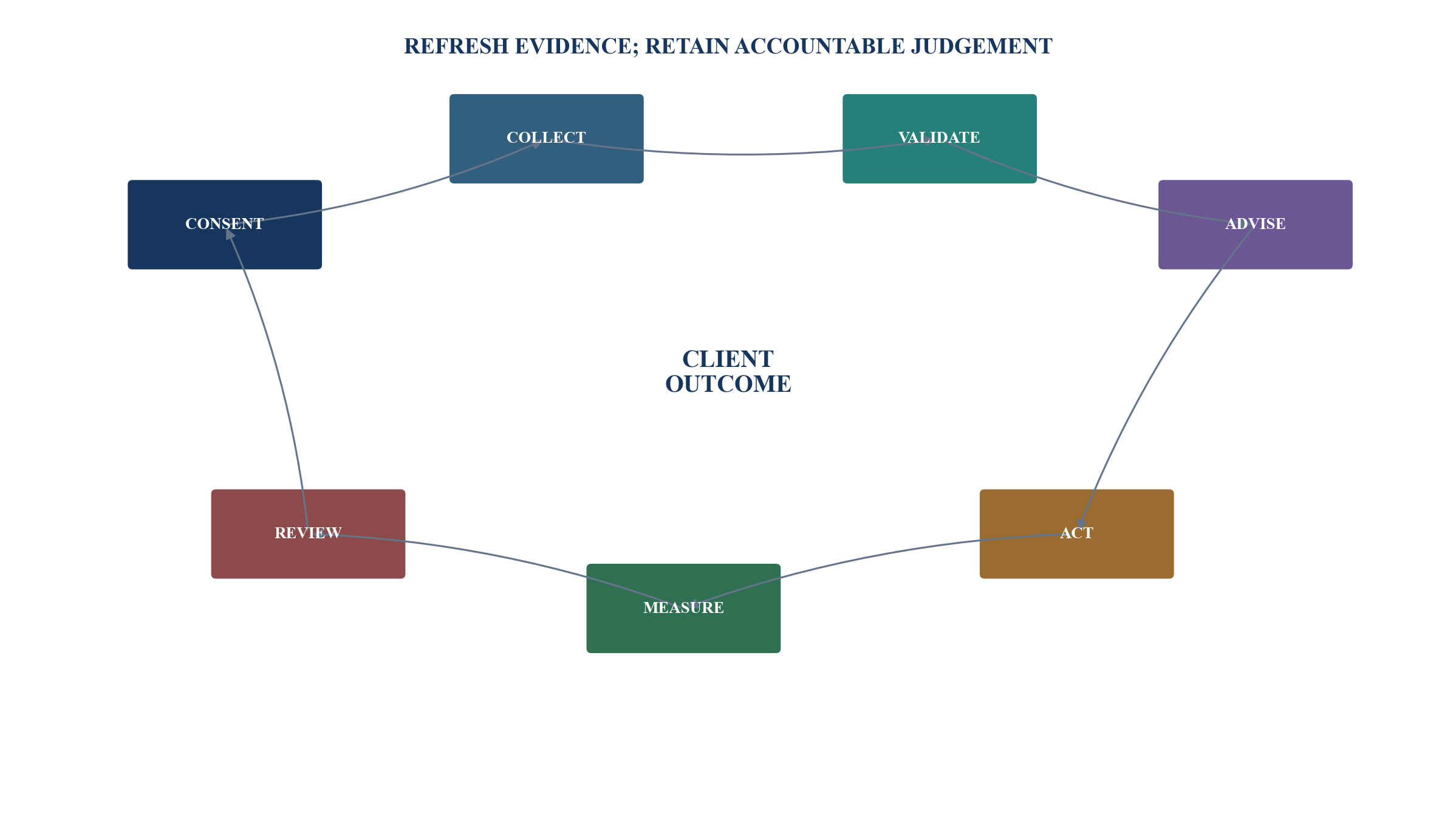
Author framework. New data does not automatically change advice; it triggers governed review against materiality rules.
References
- Financial Conduct Authority, Open finance roadmap: our vision for a smart data future, 14 April 2026, https://www.fca.org.uk/publications/corporate-documents/open-finance-roadmap
- Financial Conduct Authority, Open finance TechSprints: mortgages and SME finance, 16 April 2026, https://www.fca.org.uk/publications/techsprints/open-finance-mortgages-sme-finance
- Financial Conduct Authority, Open Finance Sprint 2025, published 15 December 2025, https://www.fca.org.uk/publications/techsprints/open-finance-sprint-2025
- Financial Conduct Authority, Research Note: Open banking and open finance in the UK, updated 3 June 2026, https://www.fca.org.uk/publications/research-notes/open-banking-open-finance-uk
- European Commission, Proposal for a regulation on a framework for financial data access and related presentation, 28 June 2023, https://finance.ec.europa.eu/events/webinar-financial-data-access-fida-proposal-2023-09-05_en
- Council of the European Union, Capital markets union: Council agrees to make consumers' financial data more accessible, 4 December 2024, https://www.consilium.europa.eu/en/press/press-releases/2024/12/04/capital-markets-union-council-agrees-to-make-consumers-financial-data-more-accessible/
- Australian Competition and Consumer Commission, The Consumer Data Right, https://www.accc.gov.au/by-industry/banking-and-finance/the-consumer-data-right
- Australian Treasury Ministers, Consumer Data Right expansion to deliver a better deal for consumers, 3 March 2025, https://ministers.treasury.gov.au/ministers/stephen-jones-2022/media-releases/consumer-data-right-expansion-deliver-better-deal
- Banco Central do Brasil, Open Finance regulation overview, https://www.bcb.gov.br/en/financialstability/open_finance
- Banco Central do Brasil, Open Finance FAQ, updated 17 September 2025, https://www.bcb.gov.br/meubc/faqs/s/open-finance
- Banco Central do Brasil, Relatorio Integrado 2025, https://www.bcb.gov.br/content/publicacoes/rig/RIG-2025.pdf
- Reserve Bank of India, Master Direction: Non-Banking Financial Company - Account Aggregator Directions, updated 6 September 2024, https://www.rbi.org.in/Scripts/BS_ViewMasDirections.aspx?id=10598
- Reserve Bank of India, Financial Awareness Messages: Account Aggregator, 2024, https://www.rbi.org.in/commonperson/images/FAME202426022024.pdf
- Monetary Authority of Singapore, Singapore Financial Data Exchange infographic, https://www.mas.gov.sg/-/media/mas/fintech/sgfindex/sgfindex-infographic-2022.pdf
- Central Bank of the UAE, Open Finance Regulation, https://rulebook.centralbank.ae/en/rulebook/open-finance-regulation
- Central Bank of the UAE, Open Finance Framework, in force from 10 July 2025, https://rulebook.centralbank.ae/en/rulebook/open-finance-framework-0
- Central Bank of the UAE, Annual Report 2025, https://www.centralbank.ae/media/4qbn11cl/annual-report-2025-en.pdf
- Bank for International Settlements, Opening doors to open finance: evidence from the international experience, BIS Papers No 168, 30 March 2026, https://www.bis.org/publ/bppdf/bispap168.htm
- Bank for International Settlements Financial Stability Institute, Key Considerations for Open Finance, 26 June 2025, https://www.bis.org/fsi/fsisummaries/exsum_23903.htm
- Bank for International Settlements, API standards for data-sharing (account aggregator), 18 October 2022, https://www.bis.org/publ/othp56.htm
- Basel Committee on Banking Supervision, Report on open banking and application programming interfaces, November 2019, https://www.bis.org/bcbs/publ/d486.htm
About the Author
Chennakeshav Adya is an independent researcher and Managing Partner of Matchpoint Partners. His work examines strategy, capital formation, valuation, transactions and operating execution across private and public markets.
