

1. Define the customer-continuity decision
The board decision is how to preserve customer service, contractual value and cash while ownership, authority, systems and operating processes change. Completion transfers the acquired business under the transaction documents. It does not establish that customers will renew, consent to required changes, accept revised service arrangements or continue paying on the expected timetable.
The integration case should identify the customer value that underpins the acquisition price. This value may sit in subscriptions, maintenance, repeat orders, framework agreements, installed equipment, regulated permissions, data integrations, channel relationships or trusted individuals. Each source of value needs an evidence owner and a continuity requirement. A broad instruction to retain customers cannot allocate action or measure risk.
The Customer Continuity Office should operate as a time-bound control function with authority from the integration steering committee. Its remit covers the period from permitted pre-close planning through stabilisation. The office maintains the customer master, directs risk triage, coordinates consent and communication, protects service obligations, reconciles revenue and cash, and escalates decisions that could affect the acquisition thesis.
The office is not a substitute for account management. Account owners retain the relationship. Legal, privacy, finance, product, operations and technology teams retain their professional responsibilities. The office connects their decisions at customer level and makes unresolved dependencies visible to the executive team.
The board should approve a continuity mandate before closing where law permits. The mandate should state the protected revenue perimeter, decision rights, escalation thresholds, data-access controls, customer-contact rules and reporting cadence. Competition or interim-measures constraints may require separation between planning and implementation. The Federal Trade Commission advises that competitively sensitive information used for diligence or integration planning should be narrowly tailored and protected through measures such as clean teams, aggregation and redaction. [4]
The central operating question is specific: for each material customer, what could interrupt lawful service, contractual value, billing or collection during the integration, who owns the risk, and what evidence establishes that continuity has been secured?
2. Establish the revenue perimeter
The continuity office begins with a defined perimeter. Finance should reconcile the transaction model to the legal entities, products, customers and contracts that generated the relevant historical and forecast revenue. The perimeter should distinguish recurring, repeat, project, usage-based, transactional and one-off revenue. These categories behave differently during integration.
A subscription may renew automatically but remain cancellable. A maintenance agreement may depend on installed equipment and qualified engineers. A framework agreement may contain no committed volume. A usage contract may produce recurring invoices without committed spend. Repeat purchases may reflect habit and service quality rather than a contractual obligation. The office should preserve these distinctions in its reporting.
Each customer record should identify legal customer, parent group, contracting entity, billing entity, service location, product, contract, start date, renewal date, notice period, committed amount, usage basis, pricing, currency, tax, service level, data-processing role, assignment or change-of-control requirement, termination rights, open claims, receivables, executive sponsor and operational owner.
The perimeter should reconcile three views. The commercial view shows relationships and opportunities. The accounting view shows recognised revenue, contract assets, contract liabilities and performance obligations. The cash view shows invoices, disputes, deductions and receipts. IFRS 15 requires an entity to identify the contract and performance obligations, determine and allocate transaction price, and recognise revenue when the promised goods or services transfer. [1] Integration reporting should respect those principles rather than treating bookings, invoicing, revenue and cash as interchangeable.
Finance should freeze an opening customer population at a stated date. Subsequent changes need stable identifiers and reasons. Acquired contracts, novations, consolidations, migrations and customer legal-entity changes can otherwise make a bridge appear favourable or adverse without an underlying economic change.
The perimeter must also identify material indirect relationships. A reseller, distributor, marketplace, prime contractor or procurement platform may control access to the end customer. The acquired company can retain the end user's activity while losing the legal route to invoice. Continuity therefore follows both economic demand and the enforceable channel.
3. Build a customer-by-customer continuity record
The office should create one authoritative continuity record for every customer in scope. It can link to specialist systems, but its critical fields require controlled definitions, source references and named owners. A spreadsheet may work for a small perimeter. A large portfolio may require a governed data layer with role-based access and version history.
The record should answer five questions. What has the customer bought? What must the business deliver? What changes because of the acquisition? What permission or communication is required? What evidence shows that revenue and cash remain protected?
Source hierarchy matters. Executed contracts and amendments establish documented terms. Billing, service, support and bank systems show performance. Customer communications can establish acceptance, objection or open questions. Account-team memory supplies useful context, but consequential conclusions should be traced to evidence.
The office should record confidence separately from risk. A customer can appear low risk because no issue is known while the contract is missing and the account owner has left. That is low evidence confidence, not demonstrated continuity. Conversely, a high-value consent requirement can be well understood and actively managed.
Every material field needs a last-verified date. Renewal terms, authorised contacts, data-processing arrangements and pricing can change. A static diligence extract loses value quickly during integration.
The record should also preserve confidentiality and purpose limitation. Customer-specific prices, strategy and demand may be competitively sensitive. Personal data about contacts requires a lawful basis, appropriate notice, access controls and retention. The office should provide the minimum information required for each decision rather than distributing the full customer file across the integration programme.
| Domain | Minimum controlled fields | Primary evidence | Escalation trigger |
|---|---|---|---|
| Customer and contract | Legal entities, contract, term, renewal, notice and change provisions | Executed agreement and amendments | Missing contract, near-term notice or disputed authority |
| Service | Product, locations, service level, dependencies and incidents | Service system and operating records | Critical dependency or repeated service failure |
| Commercial | Price, volume, discounts, pipeline and cross-sell | Price book, orders and approvals | Unapproved discount or simultaneous material change |
| Data and consent | Controller roles, processing, transfer, notice and consent | Privacy records and legal assessment | Required action incomplete before data or system change |
| Finance | Invoice, revenue, receivable, dispute and cash | Ledger, billing system and bank receipt | Reconciliation gap, overdue balance or revenue reversal |
| Relationship | Sponsor, users, procurement, detractor and owner | Verified contact map and interactions | Sponsor departure or absence of an accountable owner |
Original framework. Exact fields should reflect the business model, contract and applicable law.
4. Separate legal transfer from commercial acceptance
The transaction documents establish the acquired perimeter and closing mechanics. Customer contracts may still require analysis of assignment, novation, change of control, subcontracting, data transfer, licence, security, insurance and regulatory conditions. The effect can vary by contract and jurisdiction.
The office should classify each contract into an action path: no customer action identified; notice required; consent required; novation required; customer confirmation advisable; legal conclusion unresolved; or remediation required. The classification needs an evidence link and counsel owner. A generic contract summary should not replace review of the operative agreement and amendments.
Commercial acceptance is broader. A customer may have no contractual consent right and still reduce usage, delay renewal or open a competitive tender. The account plan should therefore consider perceived service risk, relationship disruption, procurement policy, vendor concentration, product strategy and the customer's own transformation calendar.
Timing is important. Contacting every customer before the message, service model and account ownership are ready can create concern. Waiting until a change becomes visible can erode trust. The office should sequence communication by legal requirement, revenue materiality, relationship sensitivity, service change and readiness.
Legal and commercial messages should agree. A notice describing an administrative ownership change can conflict with a sales presentation promising a transformed combined platform. The office should maintain approved message components, customer-specific facts, authorised speakers and a log of commitments.
Customer confirmation should be recorded precisely. Attendance at a meeting does not establish consent. Continued use does not necessarily waive a contractual requirement. A signed novation does not prove willingness to renew. The record should state what the evidence establishes and what remains open.
5. Design the customer risk heat map
The heat map should rank customers by consequence, likelihood and evidence confidence. Consequence includes annualised revenue, gross margin, cash, strategic reference value, network effects, concentration, installed-base dependency and cost to replace. Likelihood considers contractual events, service risk, relationship health, competitive pressure, pricing, product fit and integration change.
The office should keep component scores visible. A single red-amber-green label can conceal the cause of risk. A high score driven by a consent deadline needs a different intervention from one driven by product dissatisfaction or overdue receivables.
Evidence confidence should affect prioritisation. An unverified green account can deserve earlier review than a documented amber account with a funded action plan. The heat map should therefore display both exposure and uncertainty.
Risk should be assessed at the right level. A global customer may have one master agreement, several buying entities and different service experiences. Group-level reporting can hide a troubled country or product. Transaction-level detail can hide the strategic significance of the parent relationship. The office needs both views linked through stable identifiers.
The heat map should be refreshed from events, not only monthly meetings. Triggers can include executive-sponsor departure, support escalation, service-level breach, delayed invoice, security incident, pricing exception, renewal notice, procurement request, competitor engagement, product end-of-life or proposed migration.
Each high-risk customer needs an intervention plan with owner, action, due date, customer contact, dependency and expected evidence. The plan should avoid over-contact. Multiple executives approaching the same customer with inconsistent offers can increase risk.
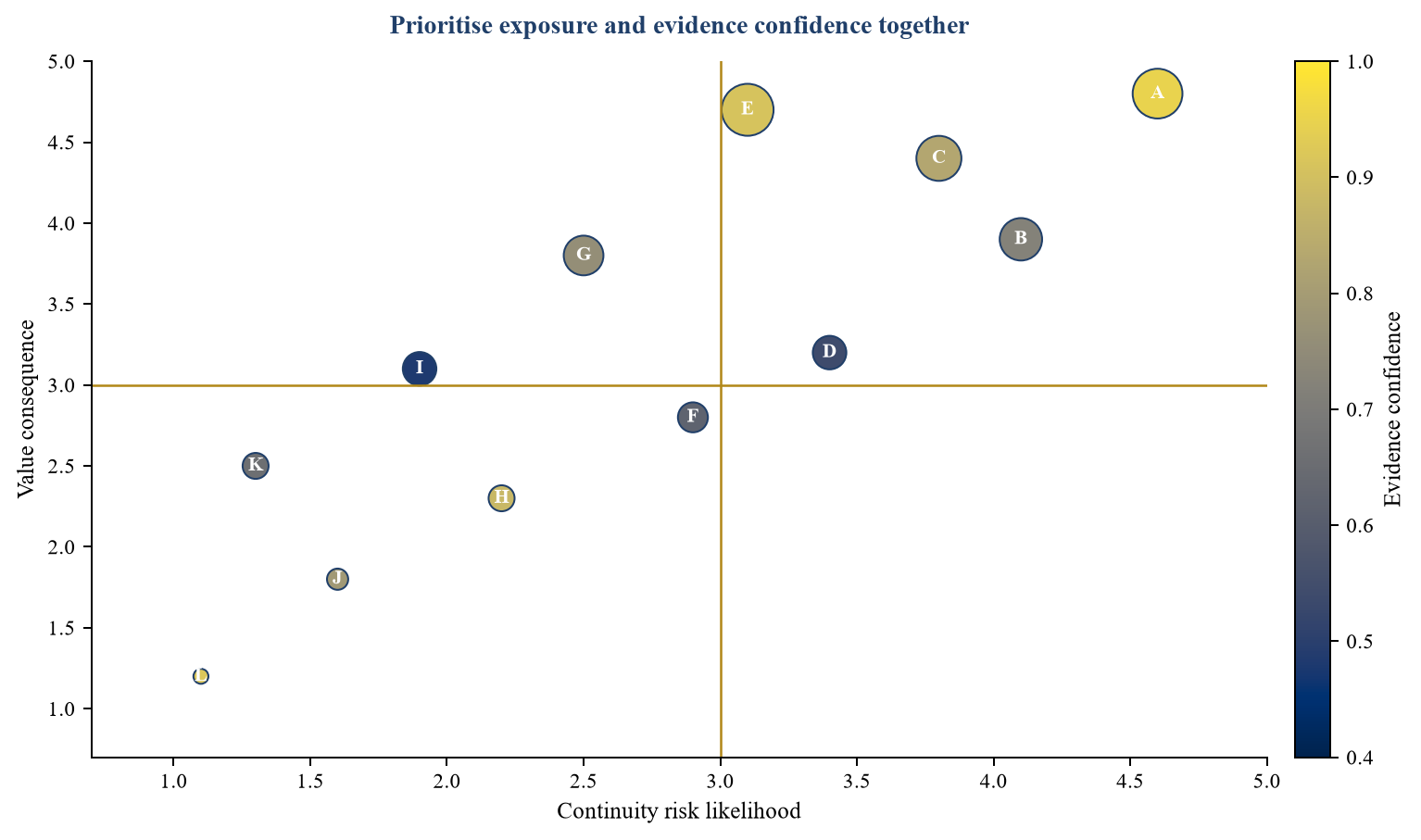
Original framework. The positions are hypothetical and illustrate prioritisation rather than observed customer behaviour.
6. Create the consent and notice calendar
The consent calendar converts contract analysis into dated execution. For each required action, it should record the trigger, deadline, permitted sender, required form, conditions, attachments, customer approver, internal approver, delivery evidence, response and consequence of delay or refusal.
The calendar should distinguish closing conditions from post-close obligations and integration prerequisites. A consent needed to transfer a contract affects deal mechanics. A notice due after completion may affect compliance. A customer approval required before system migration affects the integration sequence. Combining them under one status can conceal a critical dependency.
Long-lead customers need early preparation. Government entities, regulated institutions and large procurement organisations may require vendor onboarding, security assessment, tax documentation, insurance, sanctions screening or new purchase orders. The office should verify the customer's process rather than assume the contract clause describes every operational requirement.
The calendar should identify linked actions. A novation may require a new billing vendor, bank account, tax registration, security review and data-processing agreement. The signature alone does not enable cash collection.
Refusal paths need an agreed response. Options can include maintaining the existing contracting entity, transitional services, subcontracting where permitted, revised commercial terms, limited product scope, delayed migration or termination. Counsel should assess enforceability and regulatory consequences. Finance should model the revenue and cash effect.
Completion should not erase the calendar. Some obligations arise only after a legal transfer or after the combined business decides its operating model. The office should retain open actions until the required evidence is received and linked to the customer record.
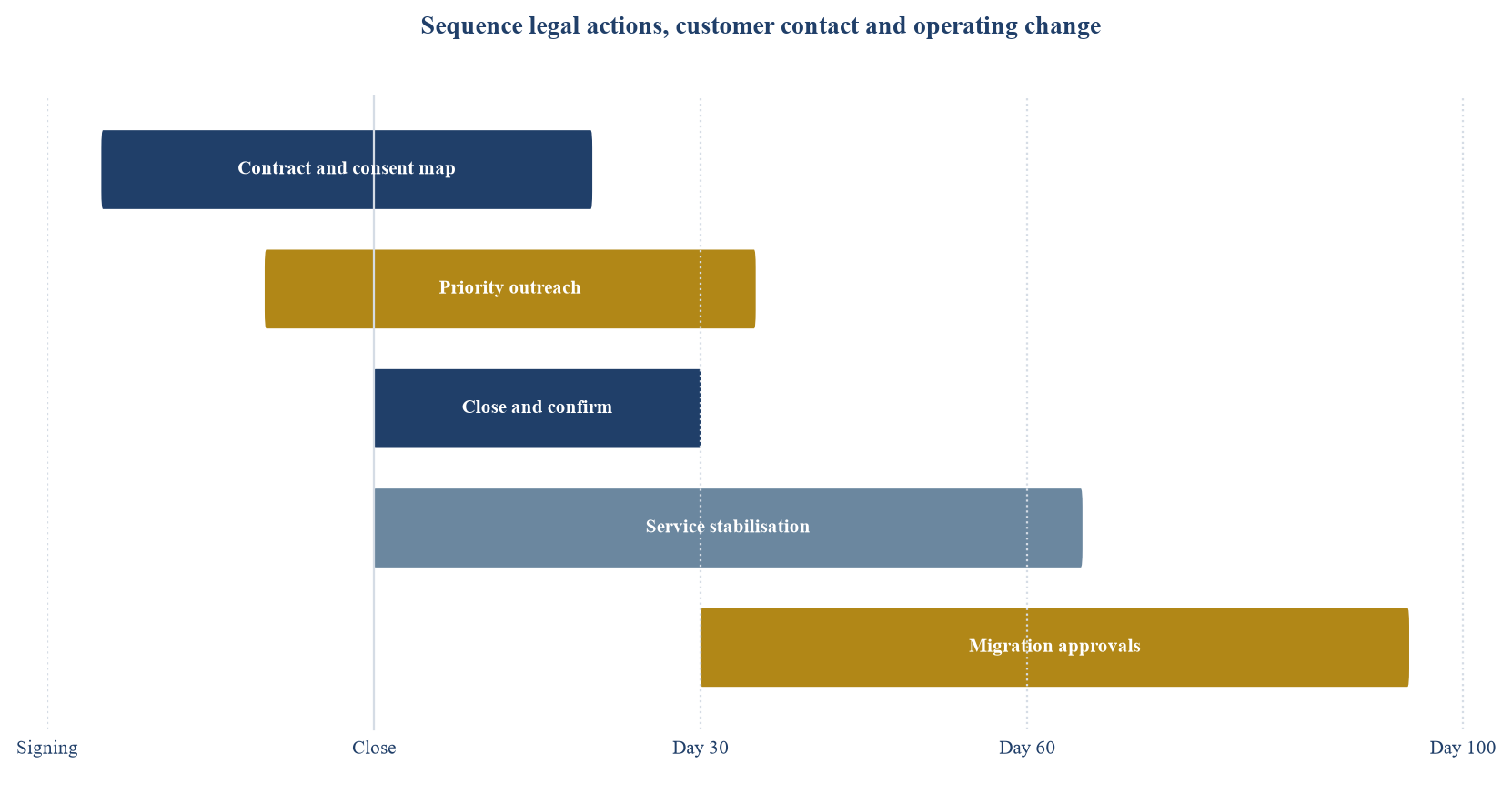
Original framework. Timing is illustrative and must be replaced by verified contractual and regulatory dates.
7. Protect lawful customer-data use
An acquisition can change who determines the purposes and means of processing customer and contact data, where data is stored, which vendors receive it and how it is used. The continuity office should maintain a data-transition record alongside the contract record.
The record should identify the current and proposed controller or processor roles, lawful basis, purposes, categories, systems, recipients, international transfers, retention, security controls and required notice or consent. Labels in transaction documents should be tested against actual activities.
The UK Information Commissioner's Office data-sharing code states that when a takeover or merger is proceeding, organisations should consider data protection as part of due diligence and may need to publicise the change, including through privacy information where a customer relationship exists. [6] The EU General Data Protection Regulation also establishes transparency obligations when personal data is collected from the individual or obtained elsewhere. [7] Applicable duties depend on the facts and jurisdiction.
The business should avoid loading acquired contacts into a group-wide marketing system before the purpose, lawful basis, notice, suppression lists and permissions are verified. A technically available database is not automatically available for every proposed use.
Security continuity matters. Identity, access, encryption, logging, incident response and vendor connections can change during migration. A customer may have contractual approval rights for hosting location, sub-processors or security controls. The office should link those commitments to the technical plan.
The customer message should state material changes accurately and provide the required contact and rights information. It should avoid implying that every legal entity in the buyer's group can use the data for unrestricted purposes.
8. Stabilise service before pursuing synergy
Customers experience integration through service. The office should identify the people, systems, facilities, vendors, licences and processes required to fulfil each material obligation. These dependencies should be mapped before teams, platforms or suppliers are changed.
The service map should connect customer promise to delivery evidence. For a software service, this may include infrastructure, identity, support, security, third-party components and product release. For maintenance, it may include installed assets, parts, engineers, certifications, dispatch and acceptance. For professional services, it may include named personnel, scope, deliverables, client approvals and time records.
The integration steering committee should define a change threshold. Routine improvements can proceed under operating authority. Changes that affect a material customer obligation, recovery route, regulated activity or contractual control should pass a continuity gate.
Service incidents during integration need a single response path. The office should know which entity communicates, which contract governs, who can offer remediation and how the event affects revenue, service credits and renewal risk. Customer communication should be timely and factual.
Synergy plans should include the cost of continuity. Dual running, retention, vendor extensions, temporary licences, migration support and additional assurance can be necessary. Omitting these costs can make an accelerated integration appear more valuable than a safer sequence.
The office should use customer evidence to release change. A successful internal test does not establish customer acceptance. For a material migration, evidence may include customer testing, written approval, stable service, reconciled billing and absence of unresolved critical incidents over a defined period.
9. Control product, roadmap and end-of-life decisions
Product consolidation can create value and customer anxiety. The buyer may see overlapping platforms and support cost. Customers may see embedded workflows, retraining, migration cost, lost features, security review and commercial leverage.
The continuity office should maintain a product-obligation map. It should identify contracted functionality, roadmap commitments, support periods, service levels, customisations, integrations, data portability, regulatory approvals and end-of-life provisions. Sales presentations and side letters may create expectations that need legal and commercial review.
The combined business should distinguish roadmap intent from contractual obligation. It should also distinguish technical capability from a supported product. A proposed cross-sell may require integration, customer security approval, pricing and service ownership before it can enter the forecast.
End-of-life decisions should quantify customer exposure, migration readiness, support capacity, notice requirements, credits, refunds and churn risk. The plan should identify vulnerable customer groups and exceptions. High-value exceptions can preserve revenue while creating a long-lived legacy burden; the cost belongs in the decision.
Customer councils or structured interviews can supply evidence, subject to confidentiality and contact rules. The office should record the sample, questions, participant roles and limitations. Anecdotes should not become unsupported retention statistics.
The product decision should include a reversible stage where feasible. Pilot migrations, parallel access or bounded cohorts can expose problems before the entire base is committed. Exit and rollback conditions need owners and evidence.
10. Preserve account ownership and relationship memory
Every customer should have one accountable commercial owner and one operational owner. The office should record transition dates, introductions, decision authority and coverage during leave or departure. Shared ownership without a lead can produce duplicated contact and missed commitments.
Relationship maps should extend beyond the executive sponsor. Procurement, finance, users, security, legal, operations and detractors can influence continuity. The map should identify role and evidence source while respecting personal-data rules.
Acquired account teams hold context about preferences, informal escalation paths, product history and competitor activity. The integration should capture material knowledge through structured handovers and system records. Retention payments alone do not transfer knowledge.
Founder or executive relationships require specific succession. A customer may associate trust with one individual. The transition plan should introduce the durable team, demonstrate delivery capability and avoid promises of indefinite personal availability.
Compensation changes can distort behaviour. If one team is rewarded for retention and another for migration or cross-sell, customers may receive conflicting pressure. The office should review incentives, crediting and account-assignment rules against the continuity mandate.
The customer owner should certify major changes in the continuity record. Legal and finance evidence remain necessary, but commercial accountability prevents the record from becoming an administrative exercise detached from the relationship.
| Event | Accountable owner | Required contributors | Escalation evidence |
|---|---|---|---|
| Contract action | Legal workstream lead | Account owner, finance and operations | Clause, action path, deadline and customer response |
| Service instability | Operating owner | Product, technology, support and account owner | Incident record, customer effect and recovery status |
| Price or term change | Commercial leader | Finance, legal and account owner | Approved economics, contract route and customer acceptance |
| Data migration | Privacy or data owner | Security, technology, legal and account owner | Role assessment, notice, controls, approval and test |
| Revenue variance | Finance owner | Billing, account owner and operations | Customer-level bridge from contract through cash |
| Relationship deterioration | Account owner | Executive sponsor and continuity office | Verified signals, intervention plan and decision date |
Original framework. Role titles should be adapted to the combined organisation.
11. Govern customer communication
Communication should be designed around the customer's decision. The customer needs to understand ownership, continuity, contacts, required actions and any planned change. Promotional language should follow verified operating readiness.
The office should segment messages. A no-change administrative notice differs from a consent request, security update, billing change, product migration or strategic meeting. Combining every message into a launch announcement can obscure mandatory action.
Each communication should have an approved factual core and customer-specific additions. The record should identify sender, recipients, date, channel, attachments, commitments, questions and follow-up. Material oral commitments should be confirmed through the authorised process.
The sequencing should consider securities, competition and confidentiality rules. Employees should not promise changes that remain subject to regulatory clearance or board approval. Where interim measures apply, the parties may need to preserve separate decision-making and customer operations. UK Competition and Markets Authority guidance describes the use of interim measures and circumstances in which integration, customer information or combined functions may need to be prevented or unwound. [5]
Executives should focus on relationships where their involvement changes the outcome. A mass executive-contact programme can create delay and inconsistent commitments. The heat map should determine priority and briefing.
The office should test whether communication worked. Receipt, attendance or positive sentiment can be useful evidence. Contract completion, maintained usage, accepted service and paid invoices provide stronger confirmation of continuity.
12. Control pricing and commercial changes
Integration creates opportunities to harmonise prices, remove discounts, bundle products and change terms. Each change can affect retention, margin, revenue recognition, billing and customer trust. The office should prevent simultaneous uncoordinated changes.
The opening price baseline should reconcile contract, approved price, invoice and realised unit revenue. It should identify rebates, credits, service penalties, free periods, reseller shares and side agreements. A headline price increase can produce lower cash if it causes contraction, dispute or delayed payment.
The pricing decision should state the objective, affected customers, contractual route, willingness-to-pay evidence, competitive alternatives, service change, expected volume response, implementation cost and downside limits. Management estimates should be identified as estimates until tested.
Customers facing a new owner may interpret an immediate increase as extraction. The combined business may prefer to secure service and relationship continuity before changing economics. In other cases, an expiring contract or cost shock can create a genuine decision window. The office should document timing rather than apply a universal rule.
Cross-sell should meet the same discipline. It should identify a customer problem, qualified need, delivery owner, price, cost and required permissions. Adding every acquired customer to the buyer's pipeline can inflate the integration case without evidence.
The office should monitor realised outcomes by cohort. Price, volume, churn, contraction, expansion, credit and cash should be separated. This allows the board to distinguish economic gain from revenue shifted between labels.
13. Reconcile the recurring-revenue bridge
The revenue bridge should begin with a frozen opening annualised run-rate and reconcile every change to a customer, contract and source event. Categories can include renewal, churn, contraction, expansion, price, volume, currency, acquisition, disposal, migration and correction.
Definitions require care. Annual recurring revenue is an operating measure and may differ from recognised revenue. A month-end subscription multiplied by twelve does not capture non-cancellable term, usage variability, future performance or collectability. The bridge should state its definition and reconcile to IFRS 15 or applicable accounting records without claiming equivalence. [1]
The opening and closing populations should use stable identifiers. A customer consolidated into the buyer's master can appear as acquired churn and buyer expansion. The economic group and contracting entity need linked views.
Finance should preserve gross movements. Netting USD 4 million of churn against USD 4 million of expansion produces zero net change while concealing integration risk and sales effort. The bridge should show customer count, revenue, margin and cash where material.
Foreign exchange and acquisitions should be separated from underlying continuity. Constant-currency views can help, but the actual cash exposure remains relevant. Corrections to the opening baseline should be visible rather than buried in expansion.
The bridge should reconcile to billing and cash. A retained contract with delayed invoicing can protect accounting value while creating liquidity pressure. A paid invoice can include amounts relating to earlier service. The office should track each stage.
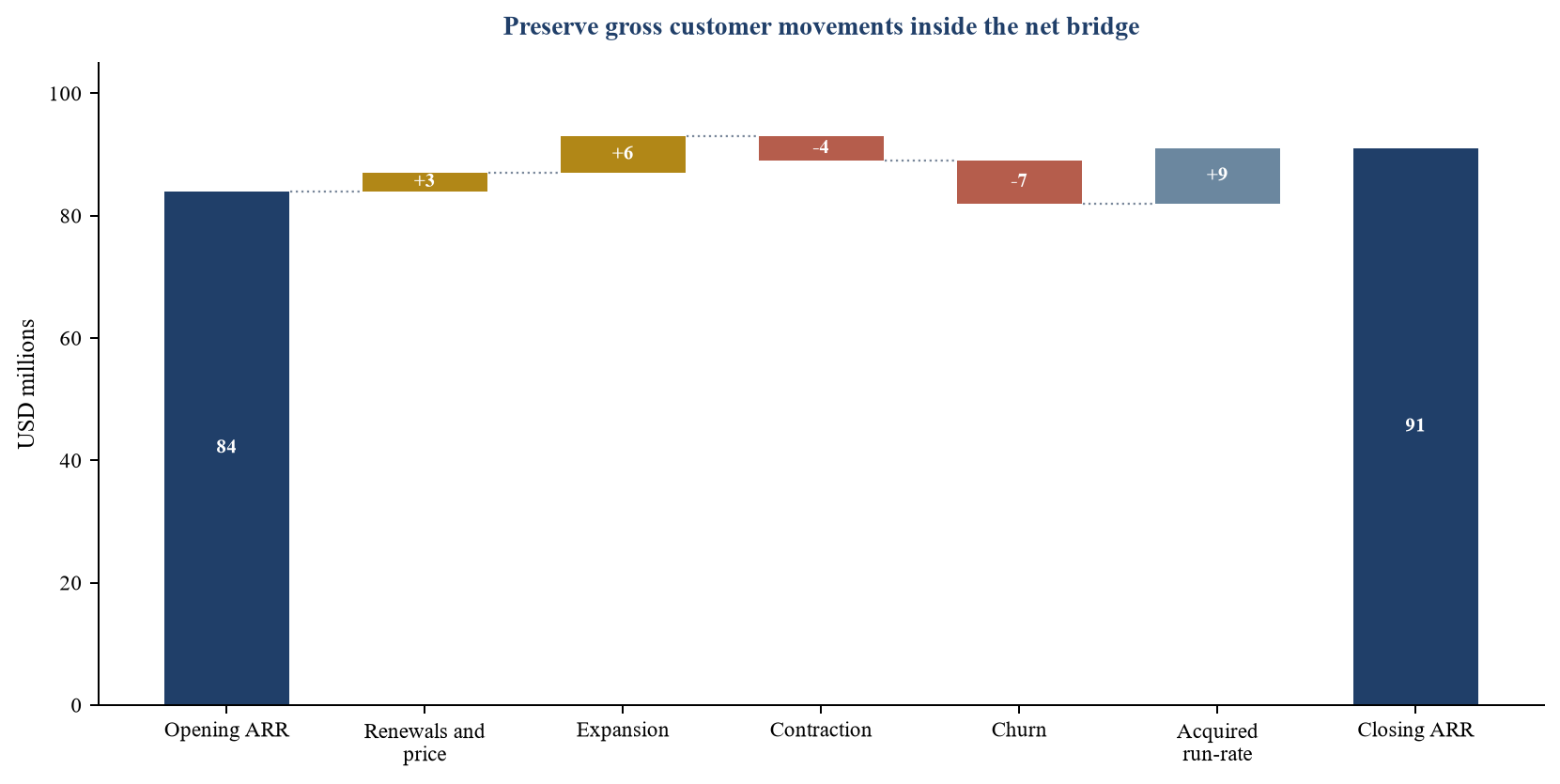
Original illustrative calculations. Amounts are USD millions and describe no company or forecast.
14. Connect revenue continuity to cash
The acquisition model should trace customer continuity through invoice and bank receipt. A retained customer can still create a cash shortfall when vendor onboarding, purchase orders, tax invoices or bank details change.
The office should identify billing-transition requirements by customer. These can include new legal entity, tax registration, electronic-invoicing format, portal access, supplier code, purchase order, bank verification, sanctions screening and authorised signatory. Each requirement needs a completion date and evidence.
Changes to bank details require fraud controls. Customer verification should use an independently authenticated route. Internal authority, dual approval and reconciled receipt should be documented. The office should coordinate communication without exposing sensitive details broadly.
Receivables should be separated into current, overdue, disputed, unapplied and dependent on integration action. A dispute may concern service before acquisition while payment responsibility transfers under the deal. The commercial, accounting and purchase-agreement treatment need reconciliation.
Cash forecasting should model the lag from operational continuity to collection. A 30-day delay across a material customer cohort can create funding need even if no customer is lost. The model should identify available cash, facilities, covenant headroom and restricted amounts.
The office should report customer-level exceptions rather than only aggregate days-sales-outstanding. A stable average can conceal one large consent or invoice failure. Material concentration needs direct review. SEC financial-reporting guidance notes disclosure considerations for major-customer concentrations and material trends or uncertainties involving customers. [8]
15. Define early-warning signals
Early-warning signals should combine behaviour, service, commercial and cash evidence. No single indicator establishes churn. The office should use signals to trigger review and record the verified conclusion.
Behavioural signals can include reduced usage, fewer active users, lower order frequency, data-export activity or declining engagement. Service signals can include incidents, response delays, repeated complaints and missed service levels. Commercial signals can include procurement review, new security questions, pricing resistance, competitor engagement and delayed renewal. Cash signals include invoice rejection, ageing and unexplained deductions.
Signals should be normalised for seasonality, contract cycle and customer context. A low-usage month may be expected. A government customer may pay slowly under established terms. A model trained on the buyer's customers may misclassify the acquired base.
Automated scoring can support prioritisation if the inputs, purpose, validation, access and human review are documented. The office should avoid opaque scores that cannot explain the intervention. Customer-facing decisions may also engage data-protection, consumer, sector or AI requirements depending on the jurisdiction and use.
The intervention log should record signal, evidence, owner, action and outcome. This creates a feedback loop. Signals that repeatedly create false alarms can be recalibrated. New patterns can be added after review.
The board should see trend and concentration. A rising number of small service complaints across one migrated platform can be more important than an isolated major account issue. Root-cause analysis should connect customer events to the integration workstream.
16. Model a hypothetical customer portfolio
Consider a wholly hypothetical business with 420 customers and USD 84.0 million of opening annualised recurring revenue. The top 20 customers represent USD 31.0 million. No amount or pattern refers to an actual company.
During the first year, renewals and price changes add USD 3.0 million, expansion adds USD 6.0 million, contraction removes USD 4.0 million, churn removes USD 7.0 million and an acquired in-period cohort adds USD 9.0 million. Closing annualised recurring revenue is therefore USD 91.0 million.
The net increase of USD 7.0 million can appear healthy. The gross bridge shows USD 11.0 million of contraction and churn. If those losses are concentrated in customers exposed to service migration or ownership change, the office should investigate causation rather than attribute the entire movement to integration.
Assume USD 18.0 million of revenue sits in 34 customers with an identified consent, novation or vendor-onboarding action. After review, USD 12.0 million is completed, USD 4.0 million remains on time but open, and USD 2.0 million is overdue or disputed. These statuses are operational facts in the illustration, not probabilities.
Assume the USD 2.0 million overdue cohort has a 70 per cent gross margin and an average four-month resolution period. The annualised revenue exposure is USD 2.0 million, the four-month gross contribution exposed is approximately USD 0.47 million, and cash timing depends on invoicing and collection terms. This is a decision exposure, not a forecast loss.
The office should model discrete outcomes. If all open actions complete, the company preserves the contractual route. If a customer requires price relief, the bridge should show the approved concession. If service scope reduces, contraction should be recorded. If the contract terminates, the model should include unwind cost, receivables and replacement actions.
| Measure | Opening or scope | Current status | Decision implication |
|---|---|---|---|
| Customers | 420 | 420 before in-period movements | Maintain stable group and legal-entity identifiers |
| Annualised recurring revenue | USD 84.0 million | USD 91.0 million closing bridge | Reconcile gross movements and accounting records |
| Top 20 concentration | USD 31.0 million | Reviewed individually | Executive and service coverage required |
| Consent or onboarding perimeter | 34 customers; USD 18.0 million | USD 12.0 million complete; USD 4.0 million open on time; USD 2.0 million overdue or disputed | Escalate dated actions and alternative routes |
| Gross contraction and churn | None at opening | USD 11.0 million in-year | Test causes, cohorts, margin and cash effect |
| Expansion and price | None at opening | USD 9.0 million in-year | Confirm delivery, contract, invoice and cash evidence |
Original illustrative calculations. Amounts and counts describe no company and are unsuitable as forecasts.
17. Quantify revenue-at-risk without claiming forecast loss
Revenue-at-risk should represent exposure requiring action. It should not be reported as expected loss unless a documented probability model supports that conclusion and its limitations are disclosed. A useful exposure measure can combine revenue, margin, cash, concentration and time.
The office can calculate customer revenue affected by unresolved contract action, service dependency, relationship deterioration or migration. It should preserve overlaps. One customer may appear in several categories, and summing them can double count exposure.
Scenario analysis can show decision consequences. The hypothetical USD 18.0 million action perimeter can be tested at zero, ten, twenty and thirty per cent contraction. The corresponding annualised revenue reductions are USD 0, USD 1.8 million, USD 3.6 million and USD 5.4 million. These are arithmetic scenarios, not assigned probabilities.
Margin effects should use customer or product evidence where available. Applying a corporate average can misstate exposure. Replacement revenue also has acquisition cost, implementation time and delivery capacity requirements.
The valuation model should distinguish a temporary cash delay from permanent churn. A delayed invoice affects liquidity and possibly working capital. A price concession affects future revenue and margin. A lost contract can affect revenue, contribution, reference value and growth assumptions.
The office should also model intervention cost. Retained specialists, dual systems, service credits, migration support and executive time can preserve revenue while reducing integration benefit. The board needs both sides of the value equation.
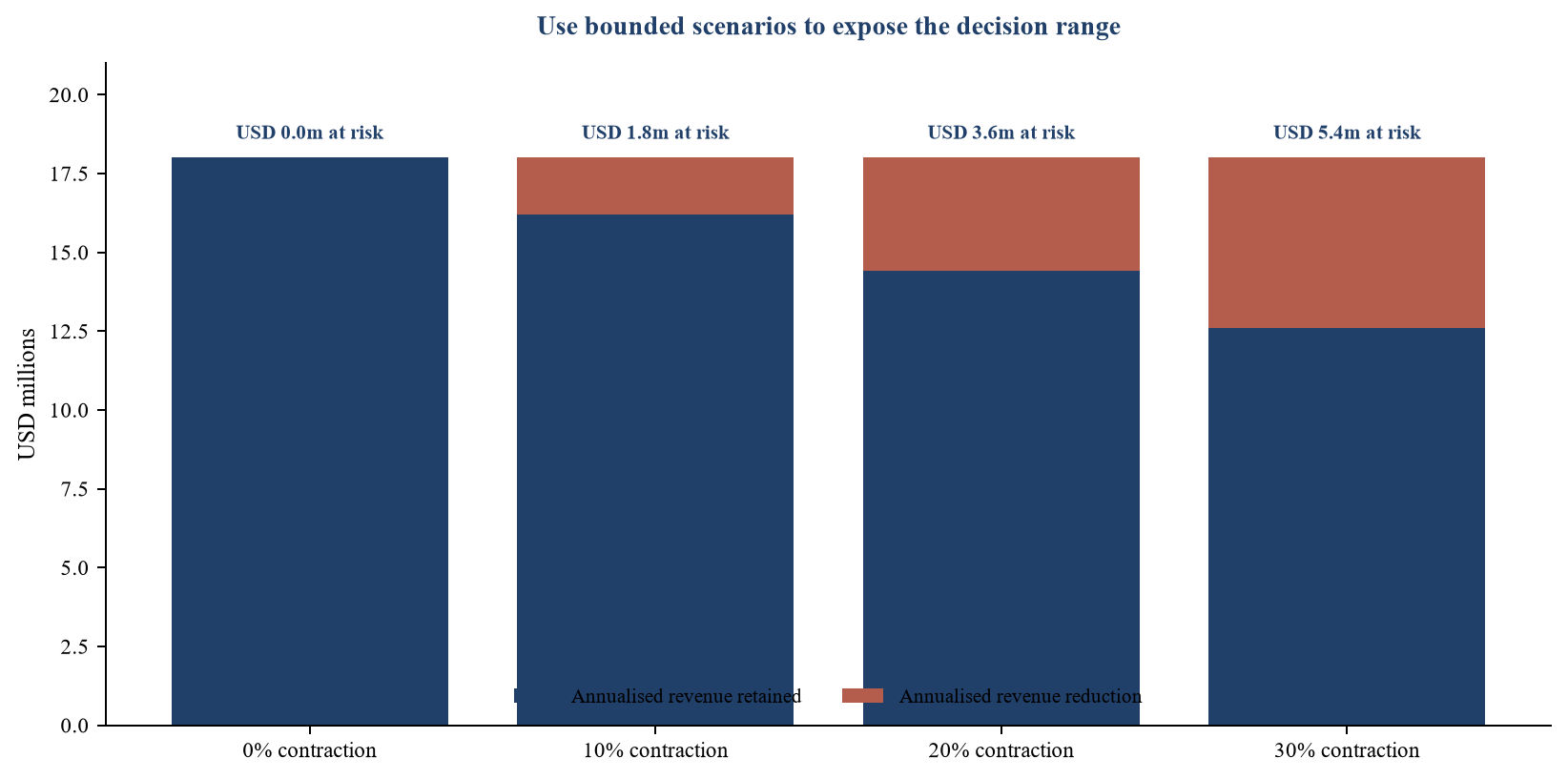
Original illustrative calculation. Scenarios have no assigned probability and describe no company.
18. Govern cross-sell as a controlled option
Cross-sell can be a legitimate acquisition thesis, but it should begin as a qualified option. The office should protect continuity from a volume-driven campaign that reaches customers before account, product and data readiness.
Each proposed cross-sell should identify the customer problem, evidence of demand, offering, delivery capacity, contractual route, data permission, pricing, cost, sales credit and service owner. The opportunity should remain outside committed synergy until the required evidence exists.
The account owner should coordinate timing. A customer managing a consent, service issue or billing change may not welcome a simultaneous expansion pitch. The continuity heat map can set contact rules and release conditions.
Product teams should verify integration dependencies. A bundled proposition may require identity, data exchange, support and consolidated invoicing. A sales commitment made before those elements are ready can convert synergy into a service problem.
Finance should measure gross and net economics. Cross-sell revenue can require implementation cost, sales commission, cloud or service cost and price concessions. IFRS 15 considerations can arise where contracts are modified, products are bundled or transaction price changes. [1]
The office should record customer acceptance through signed order, verified usage, delivery and cash. Pipeline and announced opportunities remain leading indicators. They should not be treated as realised value.
19. Integrate customer continuity with purchase accounting and valuation
IFRS 3 requires the acquisition method for business combinations within its scope, including recognition and measurement of identifiable assets acquired and liabilities assumed and recognition of goodwill or a bargain purchase. [2] Customer contracts, relationships and related liabilities can therefore affect purchase accounting and subsequent performance analysis.
The continuity office does not perform valuation, but its evidence can inform the relevant specialists. Contract populations, renewal terms, attrition, pricing, margins and remaining useful life need controlled sources. The office should preserve the acquisition-date baseline separately from later integration outcomes.
The model should distinguish contractual customer relationships from broader relationship value and other identifiable assets. Valuation methods, assumptions and accounting conclusions require qualified professional analysis. The operating team should avoid presenting an internal annualised-revenue metric as fair value.
Subsequent underperformance can have several causes. The acquisition-date forecast may have been optimistic, market conditions may have changed, integration may have disrupted service, or customers may have exercised existing rights. Root-cause evidence helps management assess value creation and supports accounting review.
IFRS 13 defines a framework for fair-value measurement and emphasises market-participant assumptions where another standard requires or permits fair value. [3] Customer-specific operating evidence can inform inputs, but management intent alone does not determine fair value.
The board should reconcile continuity outcomes to the acquisition case. Revenue retained through costly dual running may protect value while delaying synergy. Cross-sell may exceed plan while churn also rises. The bridge should show both gross movements and the cost required to achieve them.
20. Apply a first-100-days cadence
Before close, the parties should establish the permitted customer-data perimeter, opening revenue bridge, top-customer map, contract action register, service dependencies and communication rules. Clean-team or hold-separate arrangements should be documented where required.
On day one, the combined leadership should confirm accountable owners, incident routes, authorised messages, billing instructions and open closing conditions. It should avoid discretionary system, price or product changes that have not passed the continuity gate.
By day 10, the office should have verified the top-value customers, near-term renewals, overdue consents, critical service dependencies, sponsor departures and material receivables. Each exception needs an owner, action and date.
By day 30, the customer master should reconcile commercial, legal, service, accounting and cash records for the priority perimeter. The steering committee should approve migration cohorts, communication and any pricing or cross-sell release.
By day 60, the office should test early-warning trends, customer feedback, service stability, gross revenue movements and billing transition. It should refresh intervention plans and quantify continuity cost.
By day 100, the board should review a customer value-creation pack. It should contain the recurring-revenue bridge, cash reconciliation, consent completion, service performance, retention and expansion evidence, unresolved exposures, synergy cost and decisions for the next phase.
The office can then transition enduring controls to permanent functions. Customer master governance, contract obligations, revenue assurance, privacy, service ownership and executive escalation should have named homes. Temporary programme closure should not remove the operating evidence chain.
| Gate | Required output | Evidence standard | Board or steering decision |
|---|---|---|---|
| Pre-close planning | Perimeter, restrictions, heat map and action calendar | Verified contracts, source extracts and legal instructions | Approve permitted plan and unresolved closing risks |
| Day 1 | Ownership, incident, communication and billing controls | Named authority and tested contact routes | Release essential continuity actions |
| Day 10 | Priority-customer exception register | Customer-level evidence and dated interventions | Allocate executive and specialist resources |
| Day 30 | Reconciled customer master and migration cohorts | Commercial, legal, service, finance and cash linkage | Approve bounded changes and alternatives |
| Day 60 | Early-warning and outcome review | Gross movements, service, actions and customer evidence | Recalibrate interventions and synergy pace |
| Day 100 | Customer value-creation pack | Revenue and cash bridge, cost, exposure and source links | Continue, repair, accelerate or stop defined initiatives |
Original framework. Timing should reflect transaction conditions and regulatory constraints.
21. Design governance, assurance and escalation
The executive sponsor should chair a weekly continuity review during the highest-risk period. Membership can include commercial, operations, product, finance, legal, privacy, technology and integration leads. The meeting should decide exceptions rather than collect narrative updates.
The office should define materiality thresholds for revenue, cash, service, privacy, regulation and reputation. A smaller customer can still require immediate escalation where safety, regulated service or sensitive data is affected.
Finance should challenge the revenue and cash bridge. Legal and privacy teams should own their conclusions. Operations should certify service dependencies. Account owners should certify customer facts and commitments. Internal audit or an independent reviewer can test selected high-value records and definitions.
Cyber and third-party risk should enter customer continuity when service depends on acquired suppliers or systems. NIST's cybersecurity supply-chain guidance supports structured due diligence and risk-management practices for suppliers and technology dependencies. [9] The office should adapt relevant controls to the actual service chain.
Business-continuity disciplines can support the operating model. ISO 22301 describes requirements for a management system to protect against, reduce the likelihood of and support recovery from disruptive incidents. [10] Certification is a separate decision; the office can still use documented dependencies, response roles and recovery evidence.
The escalation record should state the fact pattern, value exposed, options, legal or regulatory constraints, recommendation, authority and deadline. Decisions should be preserved. This creates an evidence base for later value-creation review and reduces reliance on retrospective recollection.
22. Convert continuity evidence into durable value creation
Customer continuity should become a permanent capability after the integration programme. The combined business can retain a governed customer master, contract-obligation register, service-to-cash evidence chain and executive escalation model.
The first use is protection. The company can detect renewal, consent, service, billing and concentration risks earlier. The second use is disciplined growth. Verified customer needs and delivery capacity can guide product and cross-sell investment. The third use is transaction readiness. A future buyer, lender or investor can examine a traceable customer franchise rather than reconstruct it under deadline.
The board should review measures that connect action to value. These can include gross renewal, contraction, expansion, service stability, consent completion, billing transition, cash collection, intervention cost and evidence confidence. Definitions should remain stable and reconciled.
Management should examine customer outcomes alongside employee, product, technology and financial integration. A continuity failure can originate outside the commercial function. Shared root-cause analysis helps prevent repeated disruption.
The office should archive assumptions and scenario limitations. A risk score is a decision aid. A management estimate is not an observed outcome. A positive customer meeting is not a renewal. This discipline keeps integration reporting credible.
The acquisition creates value when customers continue receiving the promised service, contracts and permissions remain workable, revenue becomes cash, and new propositions are released with evidence. The Customer Continuity Office gives the board a practical system for governing that sequence customer by customer.
Sources
- IFRS Foundation. IFRS 15 Revenue from Contracts with Customers. Accessed 15 September 2026. Read the primary source
- IFRS Foundation. IFRS 3 Business Combinations. Accessed 15 September 2026. Read the primary source
- IFRS Foundation. IFRS 13 Fair Value Measurement. Accessed 15 September 2026. Read the primary source
- US Federal Trade Commission. Avoiding Antitrust Pitfalls during Pre-Merger Negotiations and Due Diligence. 20 March 2018. Accessed 15 September 2026. Read the primary source
- UK Competition and Markets Authority. Interim Measures in Merger Investigations, CMA108. 2021. Accessed 15 September 2026. Read the primary source
- UK Information Commissioner's Office. Data Sharing: A Code of Practice. Accessed 15 September 2026. Read the primary source
- European Union. Regulation (EU) 2016/679, General Data Protection Regulation, Articles 13 and 14. 27 April 2016. Accessed 15 September 2026. Read the primary source
- US Securities and Exchange Commission. Division of Corporation Finance Financial Reporting Manual, Topic 2, customer concentrations and related trends. Accessed 15 September 2026. Read the primary source
- National Institute of Standards and Technology. Cybersecurity Supply Chain Risk Management: Due Diligence Assessment Quick-Start Guide, SP 1326. July 2026. Accessed 15 September 2026. Read the primary source
- International Organization for Standardization. ISO 22301:2019 Security and Resilience, Business Continuity Management Systems. Accessed 15 September 2026. Read the primary source
