

1. Define the re-rating decision
The board's decision is whether the separation can create two companies whose strategies, economics and capital policies are easier to understand and govern than those of the combined group. The relevant output is not a promotional valuation uplift. It is an evidence-based explanation of what each company will control, how it will perform, how it will fund itself, and how investors can test management's claims after completion.
The proposed equity story should answer four questions. First, what economic engine is being separated and what evidence proves its revenue, margin, cash conversion and reinvestment needs? Second, which recurring costs, liabilities and dependencies alter the historical segment result? Third, what capital-allocation policy suits the standalone risk and opportunity set? Fourth, which milestones will show whether management has delivered the separation thesis?
The answers must work for both NewCo and RemainCo. NewCo may receive the market's attention, yet RemainCo can carry stranded cost, diluted growth or a more complex portfolio. If the communications programme presents one business as the winner and the other as a financing residual, investors may apply a higher risk discount to both.
The board should approve a paired proposition: two operating models, two capital policies, two management scorecards and one reconciled transaction bridge. Approval should record assumptions, evidence, sensitivities and items that remain conditional. This gives directors a basis for judging whether value depends on controllable execution or on an unsupported change in market multiples.
The approval should also identify the counterfactual. Management should compare the separation with retaining the group, selling a business, introducing divisional capital accountability or pursuing a joint venture. Transaction cost and management distraction belong in that comparison. A demerger should proceed because the standalone operating and ownership structures offer a superior risk-adjusted path under stated assumptions, rather than because separation is the only strategic option presented.
2. Establish the pre-separation valuation baseline
A claimed re-rating needs a reproducible starting point. The baseline should show the combined group's reported earnings, cash flow, net debt, pension and lease obligations, central costs, minority interests, tax attributes and material non-operating assets. It should also identify the valuation method and date. A current market capitalisation, an enterprise-value multiple and a discounted cash-flow value can answer different questions.
The baseline should separate observed facts from analytical choices. Reported revenue, debt and cash can be traced to financial statements. Normalised EBITDA, target multiples and the classification of surplus assets require judgement. Each adjustment should have a definition, source, owner and sensitivity. The board should be able to reconstruct the value bridge without relying on a single spreadsheet cell labelled conglomerate discount.
The comparison should use consistent units. If the pre-separation group is valued on reported EBITDA while the separated companies are valued on adjusted EBITDA after removing recurring costs, the apparent uplift may be a measurement artefact. Net debt, pension obligations, leases and minority interests should also be treated consistently across the baseline and sum-of-the-parts cases.
The baseline is a decision reference, not a promise about trading performance. Share prices after separation will reflect operating results, liquidity, index eligibility, shareholder rotation, market conditions and information quality. The board should therefore approve a range of values and a set of operating conditions that would support each range.
The analysis should retain a dated evidence archive. Market prices, peer multiples, exchange rates and financing terms can move between announcement and completion. Updating those inputs should not rewrite the historical decision. A preserved baseline allows directors to see whether value changes arose from operating evidence, transaction design or external markets and to reconsider the structure when the original margin of advantage disappears.
3. Reconstruct segment economics from controlled information
IFRS 8 uses the management approach to operating segments and requires information about segment profit or loss, assets and liabilities together with reconciliations to entity totals. [1] This provides an essential starting point because it connects external segment reporting to the information reviewed by the chief operating decision maker. It does not by itself produce a complete standalone income statement or cash-flow profile.
The finance team should create a segment-economic ledger that links revenue, direct cost, allocated cost, assets, liabilities, capital expenditure and working capital to the legal and operating perimeter of each future company. Allocations should be replaced with transaction-level or operational evidence where material. Shared procurement, captive distribution, transfer pricing and pooled working capital can obscure the economics that will exist after separation.
The ledger should identify intercompany transactions and the terms that will apply when the companies become independent. A profitable segment may depend on below-market services or group purchasing power. A business that appears capital-light may use assets owned by another entity. Those dependencies need a contract, a transition plan or a standalone cost.
Management should reconcile the ledger to audited financial statements and the separation perimeter. Unreconciled differences should be treated as decision risks. The purpose is to produce a controlled economic history that supports valuation, financing, incentives and public communication from the same source data.
Data lineage is part of the investment case. Each reported measure should trace through source systems, allocation rules, consolidation entries and review controls. Where historical systems cannot reproduce a standalone value, management should state the estimation method and establish a remediation timetable. The finance function should also test whether the same measure can be closed within the timetable expected of a listed standalone company.
| Equity-story claim | Minimum supporting evidence | NewCo question | RemainCo question | Board test |
|---|---|---|---|---|
| Revenue quality | Customer, contract and cohort analysis | Is growth repeatable without group channels? | Does the retained portfolio preserve pricing power? | Can the claim be reconciled to reported revenue? |
| Margin potential | Cost ledger and standalone bridge | Which efficiencies are controllable? | Which costs become stranded? | Are recurring and one-time effects separated? |
| Cash conversion | Working-capital and capital-expenditure history | Can growth be funded internally? | Can restructuring and distributions coexist? | Does the cash profile survive downside? |
| Capital allocation | Policy, leverage and hurdle rates | Is reinvestment disciplined? | Is portfolio repair funded? | Are priorities measurable and sequenced? |
| Management alignment | Scorecards and award mechanics | Do incentives reflect value creation? | Do targets avoid short-term extraction? | Can outcomes be independently verified? |
Original framework. Evidence requirements should be tailored to the transaction and applicable reporting regime.
4. Build the autonomous-entity bridge
Historical segment results omit some costs of independence and include some allocations that will disappear. The autonomous-entity bridge should begin with the controlled segment history and move through recurring standalone cost, stranded cost, replacement services, commercial dis-synergies, transition-service pricing and accounting adjustments. Each line should state whether it is historical, contractual, estimated or management-controlled.
The SEC's amended Article 11 framework distinguishes transaction accounting adjustments, autonomous-entity adjustments and optional management adjustments. Autonomous-entity adjustments are required when the registrant was previously part of another entity. [2] This classification is useful beyond a United States filing because it forces management to distinguish what is necessary for independence from what it hopes to achieve later.
Autonomous costs typically include board and listing expenses, audit, tax, treasury, insurance, public-company reporting, standalone technology, cyber security and executive functions. They can also include lost scale in procurement, financing or benefits. The bridge should avoid using a percentage of revenue where contracts, headcount or system architecture provide a stronger basis.
Every bridge line should flow into a monthly cash model. Accounting expense and cash timing can differ materially. Capitalised system expenditure, prepaid insurance, transaction fees and employee awards may affect cash before they affect adjusted earnings. The equity story should explain both earnings and cash consequences.
The bridge should be version controlled across valuation dates. Contract negotiations, employee transfers and system choices can change the opening cost base. A movement log should show the previous assumption, new evidence, financial effect and approving authority. This prevents the transaction model, lender model and investor materials from developing different versions of standalone economics.
5. Separate one-time cost from recurring dis-synergy
Separation programmes often contain restructuring, duplicated systems, advisory fees, contract exits, employee retention, site moves and data remediation. These costs should be identified by programme, timing and cash status. A broad one-time label can conceal recurring weakness or make the post-separation margin target impossible to audit.
Recurring dis-synergies should be built into the standalone earnings base. Examples include lost purchasing discounts, separate insurance towers, duplicated governance and lower utilisation of shared assets. The board should require an owner and mitigation plan for every material recurring item. Mitigation should not be netted automatically because timing, execution risk and cash investment differ.
IFRS 5 requires separate presentation of discontinued operations when its criteria are met and specifies related disclosure of profit or loss and cash flows. [3] The classification can improve visibility, yet it does not replace management's explanation of continuing-cost migration, stranded cost and intercompany dependencies.
The investor bridge should use three columns: reported history, mandatory standalone adjustments and future management actions. This allows investors to distinguish the opening economic base from a target case. It also prevents future savings from being presented as though they existed at completion.
Cash cost should be shown separately from income-statement treatment. A system replacement may require a large early payment and be depreciated later; a restructuring provision may affect earnings before cash settlement; a transition service may contain minimum commitments. The board should see the timing, funding source and execution dependency for each material item before approving targets or distributions.
6. Define two complete business models
An equity story should describe the customer problem, revenue model, competitive position, operating system and capital requirements of each company. A list of assets and market growth rates is insufficient. Investors need to understand the mechanisms through which management converts strategic focus into revenue, margin and cash.
NewCo's story may emphasise specialist growth, faster product decisions or a different investment horizon. The supporting evidence should identify customer concentration, contract duration, sales cycle, retention, pricing, research and development intensity, unit economics and capacity constraints. The story should also disclose vulnerabilities created by the loss of group scale or brand support.
RemainCo's story should show the value of the retained portfolio, the treatment of stranded cost, the role of cash generation and the conditions for portfolio action. It should not depend solely on a distribution, buyback or disposal. A credible plan links operating improvement and capital discipline to measurable outcomes.
The two models should use comparable definitions where economics are comparable and distinct metrics where they are not. Forced symmetry can obscure real differences. The objective is consistency of evidence and governance, rather than identical strategic language.
The operating models should also identify decisions that become possible only after separation. These may include entering a customer channel previously constrained by conflict, accepting a different risk horizon, divesting a non-core asset or adopting a different partnership model. Each claimed option should have a practical path, a responsible executive and a value test. Otherwise optionality remains a slogan rather than a strategic asset.
7. Translate strategy into a capital-allocation policy
The equity story becomes credible when strategy is reflected in the uses of cash. Each company should publish or approve a hierarchy covering maintenance investment, regulatory and safety expenditure, organic growth, pensions, debt service, acquisitions and shareholder distributions. The hierarchy should state leverage and liquidity boundaries and the conditions for moving between priorities.
A growth company can destroy value by investing without evidence of returns. A cash-generative company can destroy resilience through distributions that leave insufficient capacity for maintenance or downturns. Capital policy should therefore include hurdle rates, post-investment reviews and downside constraints. It should also specify whether management targets leverage, ratings, fixed-charge coverage or minimum liquidity.
The G20/OECD Principles assign boards responsibility for guiding strategy, budgets, performance objectives, major capital expenditure, acquisitions and divestitures. They also state that boards should assess whether capital structure is compatible with strategy and risk appetite under different scenarios. [4] The separation programme should turn those responsibilities into explicit decision rules.
Capital-allocation communication should include the order of priorities, the evidence used, the decision authority and the reporting cadence. Investors can then judge actions against a stable policy instead of interpreting each transaction in isolation.
The policy should address exceptions. An acquisition opportunity, regulatory investment or market dislocation may justify departing from the normal hierarchy. The decision record should show the constraint, expected return, funding effect and route back to target leverage and liquidity. Transparent exception governance supports flexibility while preserving accountability.
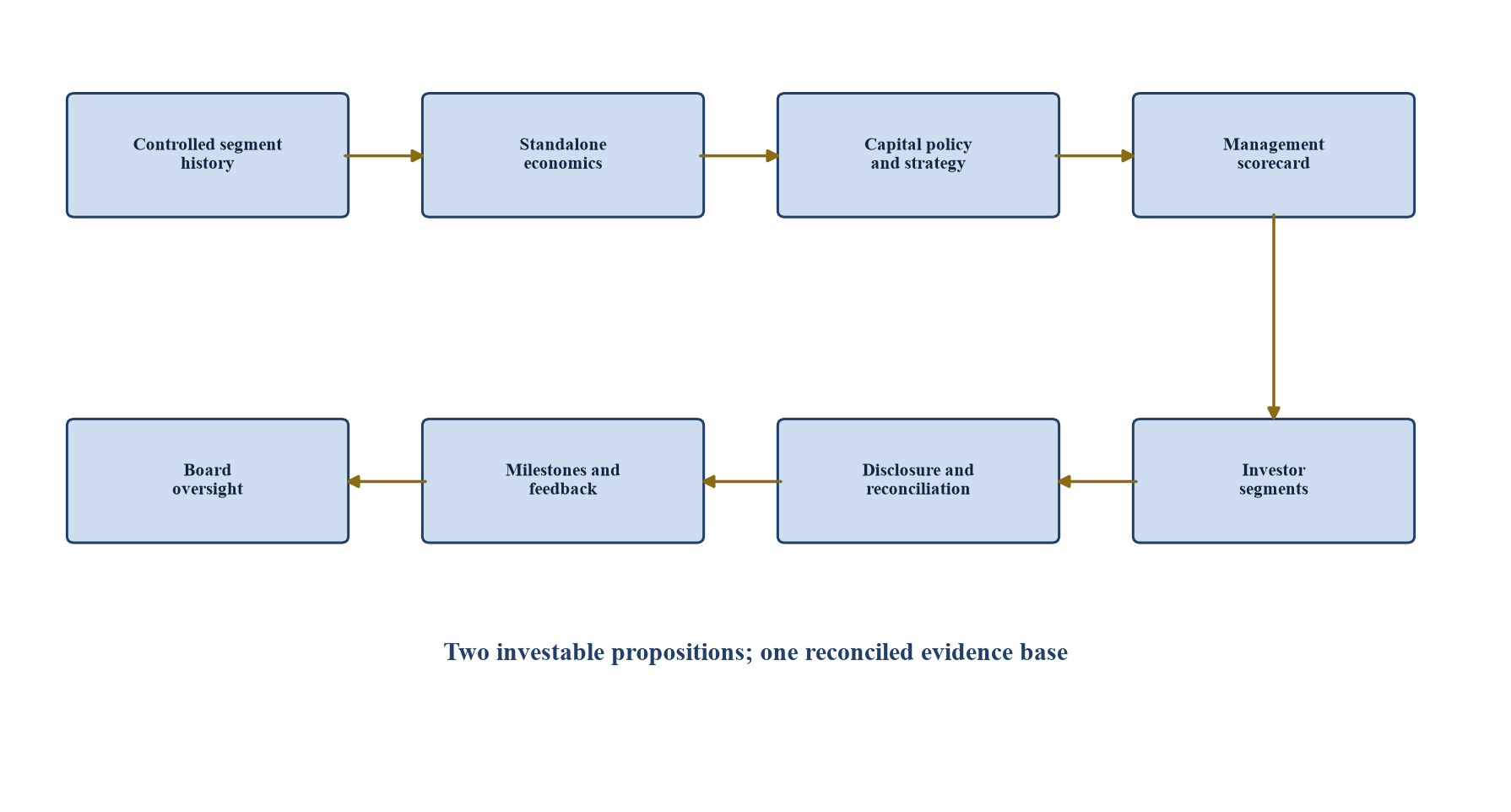
Original framework. Every public claim should trace to controlled evidence and a board-approved operating or capital decision.
8. Select the metrics that explain value creation
Metrics should connect operating activity to cash and valuation. NewCo may need measures of recurring revenue, backlog quality, retention, pricing, development productivity or return on growth investment. RemainCo may need measures of portfolio margin, cash conversion, stranded-cost removal, maintenance capital and return of capital. The chosen measures should follow how management runs each business.
IFRS 18 introduces management-defined performance measures for specified subtotals used in public communications and requires explanations, calculation methods, reconciliation and tax and non-controlling-interest effects. [5] ESMA's February 2026 Q&A explains the interaction between IFRS 18 management-defined performance measures and its alternative-performance-measure guidelines. [6] Companies preparing for separation should map every planned public measure across financial statements, presentations and websites.
The metric dictionary should define the numerator, denominator, perimeter, frequency, data owner and control. It should also identify acquisitions, disposals, currency effects and changes in calculation. A metric that cannot be reproduced consistently during transition may create more confusion than insight.
Targets should be stated as ranges or milestones when uncertainty is material. The board should resist a large collection of key performance indicators. A short causal chain from customer behaviour to margin, cash and return on invested capital provides a clearer basis for accountability.
Metric continuity matters through the legal separation date. If a historical segment measure cannot be reproduced after systems divide, management should create a controlled bridge or choose a replacement before publication. Parallel runs can identify breaks in data, perimeter and calculation. Any restatement policy should be agreed with accounting and legal advisers and described consistently to investors.
9. Build the valuation architecture
The valuation framework should reflect how comparable companies earn returns. Enterprise-value-to-EBITDA can be useful for capital-intensive businesses with comparable accounting and leverage. Revenue multiples may be relevant where margins are immature, but they can hide poor unit economics. Discounted cash flow makes assumptions explicit, although terminal value and discount rates can dominate the result.
Each company should be valued under at least two methods and three scenarios. The analysis should show the relationship between operating assumptions, capital structure and equity value. Multiple selection should be supported by growth, margin, cash conversion, capital intensity, cyclicality, customer concentration and governance, rather than by a preferred peer median.
The sum-of-the-parts value should include central-cost treatment, net debt, pensions, leases, minority interests, tax leakage and separation cost. If a business has surplus cash or a valuable non-operating asset, it should be identified separately. The bridge should also consider share-count changes, employee awards and any distribution mechanics.
The board should focus on the conditions required for a re-rating. A higher multiple may require demonstrated standalone reporting, delivery of margin improvements, disciplined capital allocation and stable ownership. The transaction can still be strategically sound when those conditions take several reporting periods to prove.
Valuation should also distinguish option value from base value. A future disposal, new product or acquisition platform may have strategic relevance, but its value should be limited by cost, timing, probability and management capacity. Presenting optionality separately reduces pressure to embed uncertain outcomes in the operating base and allows the board to compare alternatives on a common foundation.
10. Avoid mechanical multiple arbitrage
A conglomerate discount is not an accounting balance available for distribution. It may reflect complexity, capital allocation, governance, cyclicality, cross-subsidy, poor disclosure, low liquidity or operating performance. Separation can remove some causes while creating listing cost, dis-synergy, leverage, shareholder rotation and execution risk.
Mechanical multiple arbitrage applies a high peer multiple to NewCo and leaves the existing multiple unchanged for RemainCo. This can overstate value because the combined group's debt, costs and risk have changed. It can also ignore the fact that peer multiples contain different growth, margin, capital intensity and market expectations.
The board should require a causal re-rating bridge. Each proposed increment should be tied to an observable change such as higher organic growth, improved return on invested capital, lower earnings volatility, clearer capital policy or better disclosure. Where the value depends only on a multiple assumption, it should be shown as market sensitivity.
The severe case is especially important. If both earnings and multiples decline during the separation period, equity value can fall sharply because debt remains fixed. This convexity should inform capital structure, liquidity and communications.
The analysis should also test asynchronous outcomes. NewCo may execute well while RemainCo underperforms, or the reverse. Shared tax, indemnity, pension, guarantee or transition-service arrangements can transmit stress between them. The paired model should show whether the success of one equity story depends on continuing support from the other and whether that dependency is priced, limited and capable of termination.
11. Construct the hypothetical central case
The hypothetical combined group has USD 5.2 billion of revenue and USD 780 million of historical consolidated EBITDA. NewCo contributes USD 1.9 billion of revenue and USD 285 million of segment EBITDA. RemainCo contributes USD 3.3 billion and USD 495 million. Net debt is USD 1.75 billion.
NewCo incurs USD 22 million of recurring standalone dis-synergy, producing USD 263 million of central-case EBITDA. RemainCo incurs USD 30 million of stranded cost and delivers USD 18 million of evidenced mitigation, producing USD 483 million. These adjustments are modelling assumptions. In a live case they would require contracts, headcount plans, system costs and a controlled accounting bridge.
The central valuation applies 10.0 times EBITDA to NewCo and 7.25 times to RemainCo. Net debt is allocated as USD 650 million and USD 1.10 billion. The resulting hypothetical equity values are USD 1.98 billion for NewCo and approximately USD 2.40 billion for RemainCo, or USD 4.38 billion combined.
An illustrative pre-separation value applies 7.5 times historical consolidated EBITDA and deducts the same USD 1.75 billion of net debt, producing USD 4.10 billion. The central case therefore shows approximately USD 282 million, or 6.9 per cent, of hypothetical uplift. The comparison is sensitive to earnings definitions and multiples and should not be treated as a forecast.
The central case should be decomposed into value created by operating change, capital change and market assumption. In this illustration, the multiple differential contributes materially to the result while recurring cost reduces aggregate EBITDA. A board could therefore approve the strategic separation and still conclude that the quantified uplift offers insufficient protection against execution risk. The decision should be based on the whole distribution of outcomes and the strategic alternatives available.
| Metric | NewCo | RemainCo | Combined separated | Pre-separation reference |
|---|---|---|---|---|
| Revenue | 1,900 | 3,300 | 5,200 | 5,200 |
| Historical EBITDA | 285 | 495 | 780 | 780 |
| Recurring standalone or stranded cost | (22) | (30) | (52) | 0 |
| Evidenced mitigation | 0 | 18 | 18 | 0 |
| Central-case EBITDA | 263 | 483 | 746 | 780 |
| EV / EBITDA | 10.00x | 7.25x | n.a. | 7.50x |
| Enterprise value | 2,630 | 3,501.8 | 6,131.8 | 5,850 |
| Net debt | (650) | (1,100) | (1,750) | (1,750) |
| Equity value | 1,980 | 2,401.8 | 4,381.8 | 4,100 |
| Hypothetical uplift | n.a. | n.a. | 281.8 | 6.9% |
All amounts are hypothetical USD millions except multiples and percentages. Values are analytical scenarios, not forecasts or fairness opinions.
12. Apply a severe execution scenario
The severe scenario tests simultaneous operating and market pressure. NewCo EBITDA declines by 15 per cent from its central standalone level to USD 223.6 million. RemainCo EBITDA declines by 10 per cent to USD 434.7 million. Valuation multiples compress to 8.0 times and 6.5 times. Cash absorption increases net debt to USD 750 million for NewCo and USD 1.20 billion for RemainCo.
The resulting hypothetical equity values are approximately USD 1.04 billion and USD 1.63 billion, or USD 2.66 billion combined. This is approximately 35 per cent below the illustrative pre-separation equity value. The scenario shows the interaction between operating underperformance, multiple compression and fixed debt.
The severe case should be converted into management triggers. If revenue, margin, working capital or separation cost reaches defined thresholds, the company may defer distributions, reduce discretionary investment, accelerate cost action or revise guidance. The triggers should be approved before pressure emerges.
The scenario is intentionally demanding and is not assigned a probability. A company-specific analysis should include risks such as customer loss, regulatory delay, commodity exposure, product failure, refinancing or litigation where relevant. The objective is to test whether the capital policies and communications remain credible under stress.
Reverse stress testing can complement the severe case. Management should calculate the combinations of EBITDA, multiple and net debt that reduce equity value below specified thresholds or place financing at risk. The exercise identifies which variables require the strongest controls and earliest indicators. It can also expose situations in which modest operating variance produces disproportionate equity loss because leverage or market expectations are too aggressive.
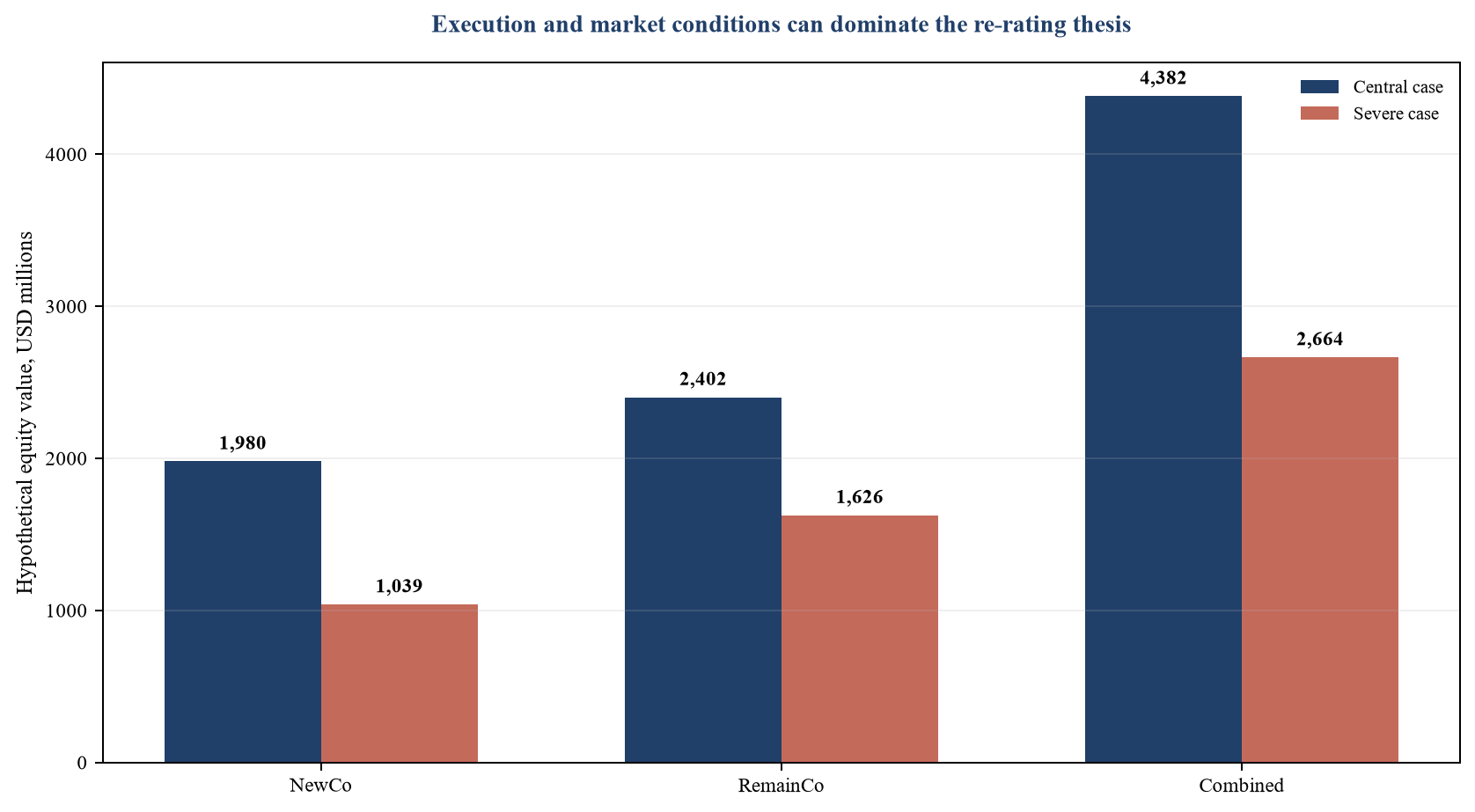
Original analysis. All values, earnings changes, multiple changes and debt movements are hypothetical scenario assumptions.
| Metric | NewCo central | NewCo severe | RemainCo central | RemainCo severe |
|---|---|---|---|---|
| EBITDA | 263.0 | 223.6 | 483.0 | 434.7 |
| EV / EBITDA | 10.00x | 8.00x | 7.25x | 6.50x |
| Enterprise value | 2,630.0 | 1,788.8 | 3,501.8 | 2,825.6 |
| Net debt | (650.0) | (750.0) | (1,100.0) | (1,200.0) |
| Equity value | 1,980.0 | 1,038.8 | 2,401.8 | 1,625.6 |
| Change from central | n.a. | (47.5%) | n.a. | (32.3%) |
All amounts are hypothetical USD millions except multiples. Net debt includes assumed cash absorption during separation.
13. Map value drivers to a KPI tree
The KPI tree should connect leading operating indicators to financial outcomes. NewCo might link sales pipeline quality, conversion, retention and pricing to revenue; utilisation, product mix and delivery efficiency to margin; and working capital and development expenditure to free cash flow. RemainCo may link portfolio volume, price, procurement and cost removal to margin and cash.
Each link should be supported by historical data and reviewed for causality. A metric can correlate with revenue without causing it. Management should test whether changes in the leading indicator precede and explain changes in financial performance. Weak links should be described as monitoring indicators rather than value drivers.
The tree should include capital employed. Revenue growth that consumes disproportionate working capital or fixed investment can reduce value. Return on invested capital, incremental return and cash payback can expose this problem earlier than EBITDA growth alone.
The board should approve a compact scorecard with thresholds, owners and reporting frequency. The investor version can be shorter, but it should use the same definitions. This aligns internal decisions, remuneration and external accountability.
The scorecard should include evidence quality and delivery confidence. A target supported by signed contracts and tested systems differs from one supported by a management estimate. Showing that distinction internally helps directors challenge timing and resource allocation. Public disclosure can remain concise while the underlying governance recognises the strength of evidence behind each milestone.
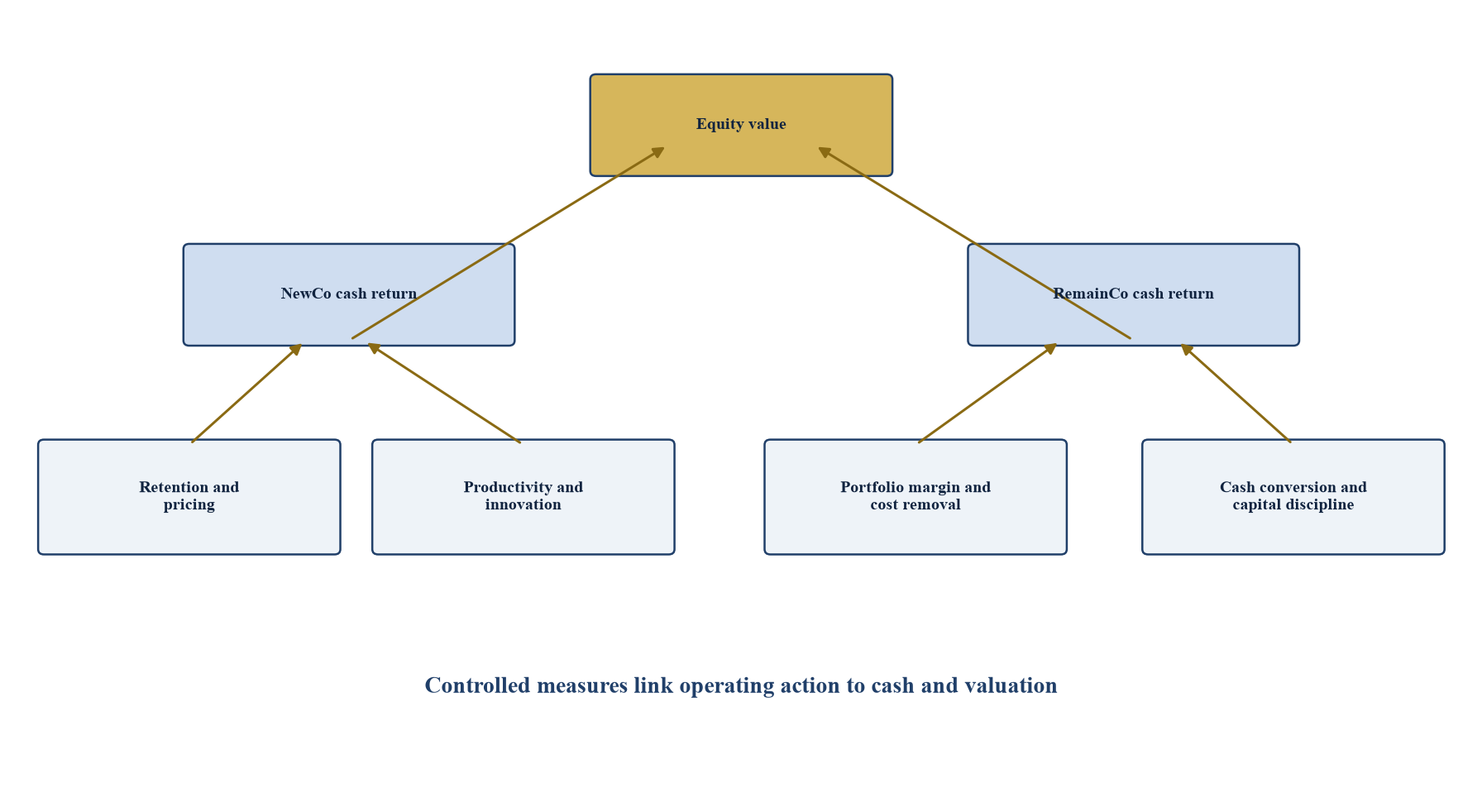
Original framework. Metric selection should follow the economics and controlled data of each actual company.
14. Design management incentives for standalone value
Separation changes the relationship between managers and the assets they control. Awards tied to group performance may no longer reflect an executive's decisions. Existing options and performance shares may require adjustment, conversion or replacement. The design should preserve economic fairness while creating forward-looking accountability.
The UK Corporate Governance Code states that remuneration should support strategy and long-term sustainable success and should be clearly linked to delivery of long-term strategy. [7] Its provisions also address independent remuneration committees, discretion, malus and clawback. These principles provide a useful discipline for separation even where another jurisdiction applies.
The scorecard should balance operating delivery, cash, return on capital and separation milestones. A pure relative-total-shareholder-return metric can be distorted by shareholder rotation and short trading history. A pure EBITDA target can reward growth that consumes cash or increases risk. Measures should reflect the outcomes management can control while retaining safeguards for conduct, controls and balance-sheet resilience.
Treatment of pre-separation awards should be explained to affected employees and, where required, shareholders. The compensation cost, dilution and accounting treatment should reconcile to the transaction model. Boards should retain discretion to prevent mechanical outcomes that are inconsistent with underlying performance.
Award conversion should be tested across employee groups and share-price scenarios. Relative values can change between announcement, record date and vesting; exchange mechanics can therefore create unintended gains or losses. The remuneration committee should review retention, dilution, accounting cost, tax and shareholder treatment together and document why the selected method supports long-term value in each company.
15. Identify the natural investor base
The shareholder register before separation may not represent the natural owners of either future company. Mandates can restrict market capitalisation, geography, sector, dividends, leverage, credit quality or index membership. Some investors may be forced or inclined to sell one security regardless of its fundamentals.
Investor segmentation should use observable mandate characteristics and engagement evidence. NewCo may appeal to growth, sector-specialist or thematic investors. RemainCo may appeal to value, income or cash-flow investors. These categories should guide the depth and emphasis of communication, not determine valuation assumptions.
Management should plan for technical flows around record date, distribution, index changes, fractional shares and employee holdings. Liquidity support, market-making and analyst education may be relevant within legal boundaries. The programme should avoid selective disclosure and should coordinate communications across both companies.
Early trading volatility should not be confused with proof of success or failure. The board should monitor ownership change, volume, research coverage and valuation alongside operational delivery over several reporting periods.
16. Build one disclosure architecture
The investor presentation, listing document, lender materials, website, financial statements and management scorecards should draw from one controlled set of definitions and reconciliations. Differences in purpose may change emphasis, but factual values should remain consistent.
The SEC's non-GAAP guidance addresses prominence, reconciliation, tax effects and potentially misleading adjustments. [8] ESMA's alternative-performance-measure guidelines similarly emphasise definitions, labels, reconciliations and consistency. [6] These requirements should be translated into a measure inventory and approval workflow.
Each public measure should have a calculation file, evidence source, control owner and cross-document map. Changes should require documented approval. If management uses a target or adjusted result that cannot be reconciled to regulated information, the claim should be reconsidered or clearly bounded.
The disclosure committee should review both companies' materials together during separation. A cost shown as recurring by one company cannot be presented as temporary by the other without explanation. The same applies to shared revenue, liabilities, tax and transition services.
17. Explain capital allocation through concrete decisions
Capital policy becomes meaningful when applied to a small set of realistic choices. NewCo should show how it would choose between product investment, capacity, acquisition, debt reduction and distribution. RemainCo should show how it would choose between stranded-cost removal, maintenance investment, portfolio action, pension support and shareholder returns.
The framework should use after-tax cash flows, risk-adjusted return thresholds and capacity constraints. It should include the effect on leverage, liquidity, covenants, ratings and strategic optionality. A project that exceeds the hurdle rate can still be rejected if it creates unacceptable liquidity concentration.
Post-investment review is essential. Management should compare approved assumptions with realised revenue, margin, cash and strategic outcomes. Findings should inform future hurdle rates and executive scorecards. This creates evidence that the new capital allocation system is functioning.
Investor communication should report policy application without disclosing competitively sensitive detail. A consistent record of decisions and outcomes can support confidence more effectively than a broad promise of disciplined capital allocation.
18. Sequence the investor narrative
The narrative should develop as evidence matures. Announcement materials can explain strategic rationale, perimeter and intended transaction form. Later materials can provide controlled segment history, pro forma financials, capital structure, governance, targets and risks. The final pre-completion package should make the opening investment cases independently assessable.
The SEC Financial Reporting Manual discusses pro forma information and autonomous-entity circumstances, including the treatment of arrangements that change when a business leaves its parent. [9] The FCA requires specified prospectuses and circulars to be submitted for approval and publishes current circular checklists. [10] The applicable regime should drive the formal timetable and review path.
Management should maintain a claims register from announcement through completion. Each claim should have supporting evidence, a permitted-use decision, an owner and an expiry or update date. This reduces the risk that an early strategic phrase survives after the underlying model changes.
The sequence should leave time for investor feedback without allowing feedback to rewrite the operating plan opportunistically. Management can clarify definitions, improve disclosure and address misunderstandings while preserving the board-approved strategy.
19. Govern forward-looking information
Targets, guidance and scenario ranges can help investors understand the thesis. They also create liability and credibility risk when assumptions, time horizons or dependencies are unclear. The board should approve which forward-looking measures are necessary and how they will be monitored.
Targets should identify the base period, perimeter, currency treatment, acquisition assumptions and material dependencies. A margin target should explain whether it includes standalone cost, mitigation and transition-service pricing. A free-cash-flow target should define working capital, capital expenditure, tax, interest and one-time cash cost.
The programme should distinguish a target from a forecast and a scenario from guidance. The disclosure should be reviewed under applicable securities law and include appropriate risk information. Internal forecasts used for financing, valuation and remuneration should be reconciled where their differences could create inconsistent decisions.
Management should establish conditions for reaffirming, revising or withdrawing guidance. The first standalone reporting periods are likely to contain estimation uncertainty and operational noise. A predetermined review process supports consistency.
20. Prepare for price discovery after completion
Price discovery begins with shareholder allocation and continues through research coverage, results, capital decisions and ownership change. Management cannot control the market price. It can improve the quality, consistency and timeliness of information and deliver the operating plan.
The first results package should reconcile actual performance to the pro forma base. It should explain revenue, margin, working capital, separation cost, stranded cost, transition services, capital expenditure and net debt. Changes in definitions should be avoided; unavoidable changes should be fully reconciled.
Boards should monitor market feedback alongside fundamental evidence. A low multiple can reflect technical selling, information gaps or weak performance. Management should test these explanations rather than selecting the most convenient one. Investor relations should record recurring questions and unresolved misunderstandings.
Capital actions immediately after separation should be consistent with the stated policy. An unexpected acquisition, distribution or guidance change can undermine credibility before the standalone record is established.
21. Use a paired risk register
The risk register should show how an event affects both companies. Customer disruption can reduce NewCo revenue and leave RemainCo with unrecovered shared cost. A delayed system exit can increase transition-service cost and constrain data. A capital-market disruption can affect refinancing, valuation and the timing of the separation.
Risks should be quantified where possible and linked to disclosure. The board should distinguish transaction completion risk, opening-balance-sheet risk, operating risk, reporting risk and market risk. It should also record the evidence confidence and the earliest observable indicator.
The highest priority is often a risk with material value consequence and weak evidence. Management can reduce uncertainty by obtaining contracts, performing data reconciliation, testing systems or changing structure. Where uncertainty cannot be removed, the valuation range and public wording should reflect it.
The paired register prevents risk migration. A mitigation that protects NewCo by leaving a liability, guarantee or stranded cost with RemainCo should be visible in both cases and in the combined value bridge.
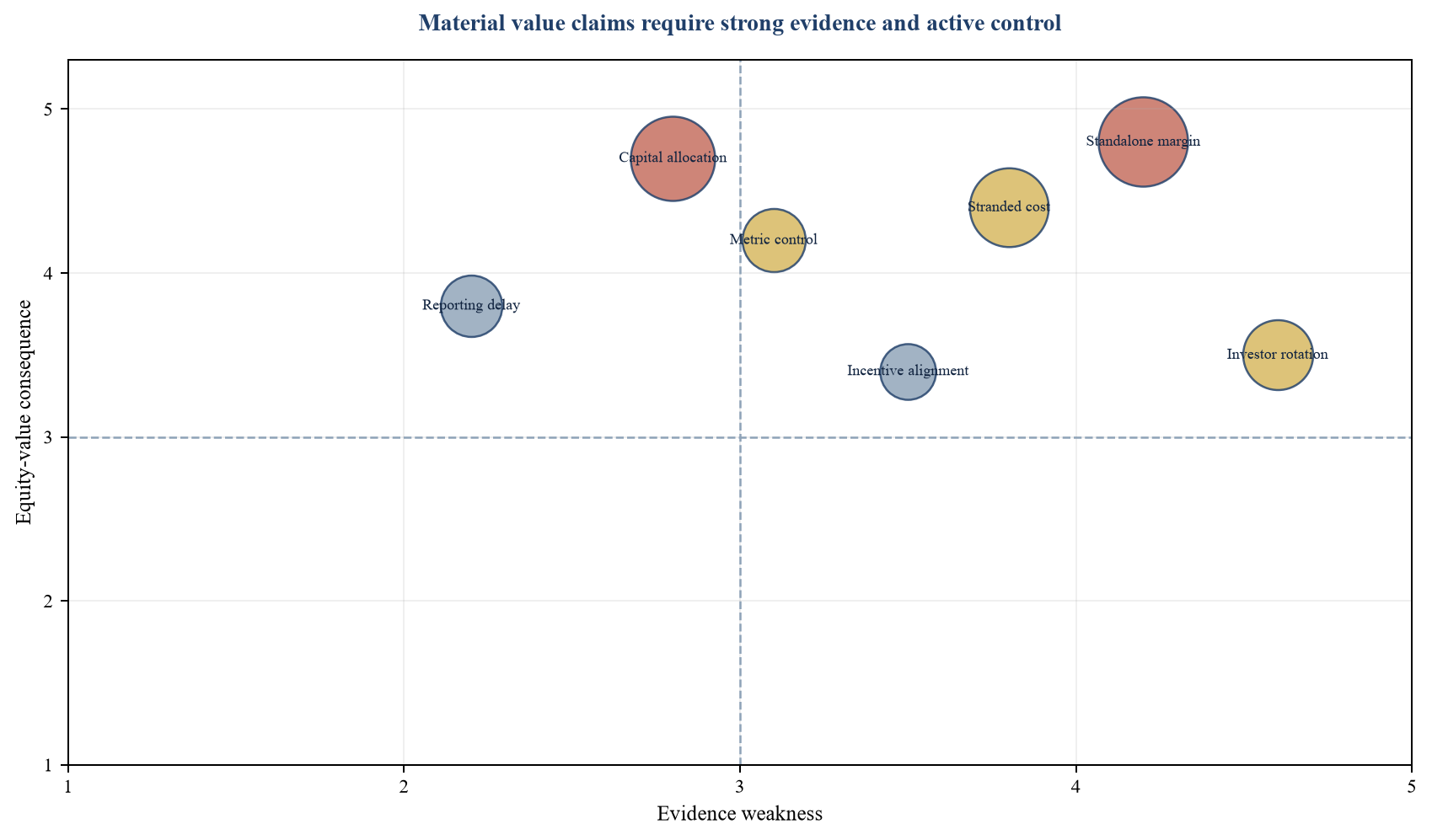
Original framework. Scores and hypothetical value exposures are illustrative design inputs and do not assess an actual transaction.
22. Govern the first four reporting cycles
The first four cycles should be planned before completion. The reporting calendar should cover close, consolidation, segment reporting, key performance indicators, board review, disclosure committee, results preparation, audit or review and investor engagement. Transitional manual controls should have owners and expiry dates.
Cycle one should validate opening balances and definitions. Cycle two should test repeatability and explain early variances. Cycle three should provide evidence on cost migration, capital allocation and strategic milestones. Cycle four should support a fuller assessment of standalone performance across seasonal effects.
The FRC's 2024 Code applies an outcomes-based orientation and, from 2026, Provision 29 asks boards for a declaration concerning the effectiveness of material internal controls. [7] A separation should identify material reporting controls early and test them before public-company deadlines.
The board should receive the same core bridge presented externally, with additional operational detail. Any correction, definition change or control weakness should be escalated promptly. Credibility is built through accurate repetition and transparent explanation of variance.
23. Apply decision gates and a phased roadmap
The programme should move through explicit gates. Gate one confirms perimeter and controlled history. Gate two approves autonomous-entity economics and cash. Gate three approves capital structure, capital policy and valuation range. Gate four approves governance, incentives and disclosure. Gate five confirms market readiness. Gate six validates opening performance and the first reporting cycle.
Each gate should require evidence. A completed presentation is not evidence that the segment history reconciles. An approved incentive plan is not evidence that its measures can be calculated. A valuation is not evidence that the market will apply its multiples. Gate materials should distinguish completion, confidence and residual dependency.
The roadmap should integrate finance, legal, tax, people, treasury, investor relations, communications, controls and technology. A central change log should record any adjustment to perimeter, earnings, debt, policy, target or public claim. Material changes should return through governance.
The board can delegate execution while retaining approval of the paired equity stories and material assumptions. The process should continue through the early reporting cycles because the market proposition remains unproven until supported by standalone evidence.
| Gate | Required output | Minimum evidence | Board decision |
|---|---|---|---|
| 1. Perimeter | Two operating and legal maps | Reconciled assets, liabilities, customers and dependencies | Approve economic baseline |
| 2. Standalone economics | Controlled histories and cash bridges | Reported-to-pro-forma reconciliation and cost evidence | Approve opening earnings bases |
| 3. Value and capital | Valuation ranges and capital policies | Scenario model, debt allocation and downside capacity | Approve transaction economics |
| 4. Governance | Boards, incentives, metrics and controls | Measure dictionary, award mechanics and control testing | Approve accountability system |
| 5. Market readiness | Paired investor materials and formal filings | Cross-document reconciliation and regulatory review | Authorise publication and completion |
| 6. Validation | Opening balances and first-cycle results | Actual-to-pro-forma bridge and control evidence | Confirm or remediate the thesis |
Original framework. Timing and evidence should be adapted to the transaction and applicable law.
24. Conclusion
A post-demerger equity story is a controlled operating and capital proposition. It should explain how each company earns, converts and reinvests cash; how recurring costs and dependencies have been treated; how management will be rewarded; and which evidence will show whether the thesis is working.
The hypothetical case illustrates the discipline. Central assumptions produce USD 4.38 billion of combined equity value and a 6.9 per cent uplift over an illustrative pre-separation reference. A severe combination of lower earnings, multiple compression and higher net debt produces USD 2.66 billion. The range makes execution, disclosure and capital structure central to the decision.
Boards should approve the separation on a paired basis. NewCo and RemainCo require complete business models, capital policies, scorecards and reporting systems. The combined value bridge should reconcile every material change, and public measures should be controlled under the applicable accounting and securities framework.
The market may eventually reward clearer strategy and stronger accountability. The company can create the conditions for that outcome through evidence, resilient capital, disciplined decisions and reliable reporting. Those conditions provide a defensible basis for proceeding and for judging performance after the split.
Sources
- IFRS Foundation, IFRS 8 Operating Segments and supporting implementation material, updated 2026, Read the primary source
- U.S. Securities and Exchange Commission, Financial Disclosures about Acquired and Disposed Businesses, 2020, Read the primary source
- IFRS Foundation, IFRS 5 Non-current Assets Held for Sale and Discontinued Operations, Read the primary source
- OECD, G20/OECD Principles of Corporate Governance 2023, Read the primary source
- IFRS Foundation, IFRS 18 Presentation and Disclosure in Financial Statements, issued 2026, Read the primary source
- European Securities and Markets Authority, Interaction of APM Guidelines with IFRS 18, 2026, Read the primary source
- Financial Reporting Council, UK Corporate Governance Code 2024, Read the primary source
- U.S. Securities and Exchange Commission, Non-GAAP Financial Measures Compliance and Disclosure Interpretations, Read the primary source
- U.S. Securities and Exchange Commission, Financial Reporting Manual, updated 29 June 2026, Read the primary source
- Financial Conduct Authority, UK Listing Rules checklists, updated 28 April 2026, Read the primary source
- Internal Revenue Service, Revenue Procedure 2024-24, procedures for Section 355 transactions, Read the primary source
- U.S. Securities and Exchange Commission, Solstice Advanced Materials information statement on Form 10, 2025, Read the primary source
