
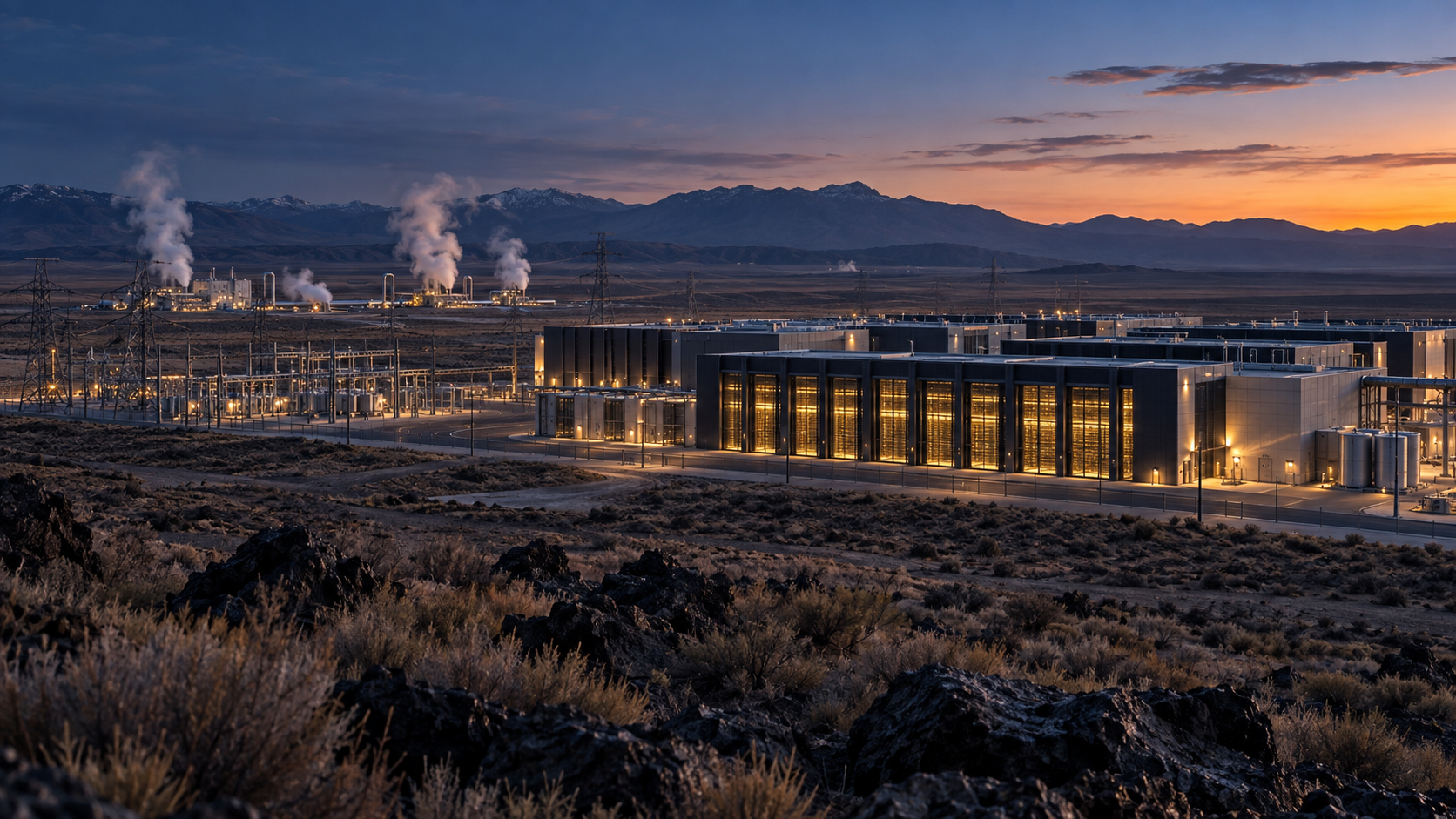
1. The decision is usable power, not headline megawatts
A data-centre site creates value only when servers can be energised, cooled and connected to customers. The relevant power metric is usable capacity at the required bus, date and reliability standard. Nameplate generation, contracted renewable energy and a queue position are inputs. None proves that a data hall can accept commercial workload.
The investment committee should therefore ask a combined question: which power architecture delivers the required compute capacity, on time, at an acceptable risk-adjusted cost? Geothermal can answer part of that question because it can produce firm output with a small land footprint. Its commercial case still depends on resource evidence, construction, transmission, utility arrangements, outage support and the interaction between generation and data-centre commissioning.
2. Demand growth sharpens the timing problem
The United States Department of Energy reported that data centres used about 176 TWh in 2023, or 4.4% of United States electricity consumption. Its 2024 analysis projected 325 to 580 TWh by 2028, equivalent to approximately 6.7% to 12% of national consumption [1]. The range itself matters: utilities, developers and regulators are planning under considerable uncertainty.
Large load requests can arrive faster than generation, substations and transmission can be permitted and built. A developer may secure land and fibre while waiting years for firm service. Another may obtain a partial connection whose ramp does not match phased compute demand. The cost of power delay can exceed the apparent premium in a long-term clean-firm contract.
3. Why geothermal belongs in the site-power conversation
Geothermal can supply electricity continuously and can complement variable solar and wind. The International Energy Agency identifies technological progress, oil-and-gas capability transfer and long-term offtake as important to broader deployment [2]. DOE specifically identifies geothermal generation and subsurface thermal storage as potential contributors to data-centre power and cooling [3].
The attribute is valuable because a data centre consumes power across every hour. Annual renewable-energy matching can leave substantial hourly exposure to market purchases and grid emissions. A high-capacity-factor resource reduces the residual profile. It can also support a utility portfolio that must serve rapid load growth without relying entirely on new gas, storage or transmission.
4. Geothermal does not remove infrastructure constraints
A geothermal plant still needs wells, gathering systems, a power block, permits and electrical equipment. A grid-delivered project needs an interconnection agreement and transmission path. A behind-the-meter configuration needs protection, control, islanding and standby arrangements. The data centre still needs redundant feeds, uninterruptible power systems and backup capability.
The decision should avoid treating geothermal as a bypass around every grid problem. The resource may be physically remote from the data hall. The utility may require the load and generator to be studied separately. Network upgrades may remain necessary. Commercial value arises when the complete architecture advances energisation or improves the delivered portfolio relative to feasible alternatives.
5. Four commercial architectures
The first route is a utility-sleeved arrangement: the utility contracts with the geothermal project and supplies the customer under an approved tariff or energy-supply agreement. The second is a grid-delivered corporate PPA with financial or physical settlement. The third is behind-the-meter or adjacent generation connected directly to the campus. The fourth is a hybrid portfolio combining geothermal, grid supply, solar, storage, flexible load and backup.
Each route allocates risk differently. Utility sleeves can simplify retail service and credit but depend on regulatory approval. Corporate PPAs give the buyer procurement control while retaining basis and settlement risks. Behind-the-meter supply can reduce network dependence but concentrates development and outage risk. Hybrids can improve resilience and cost, with greater operational complexity.
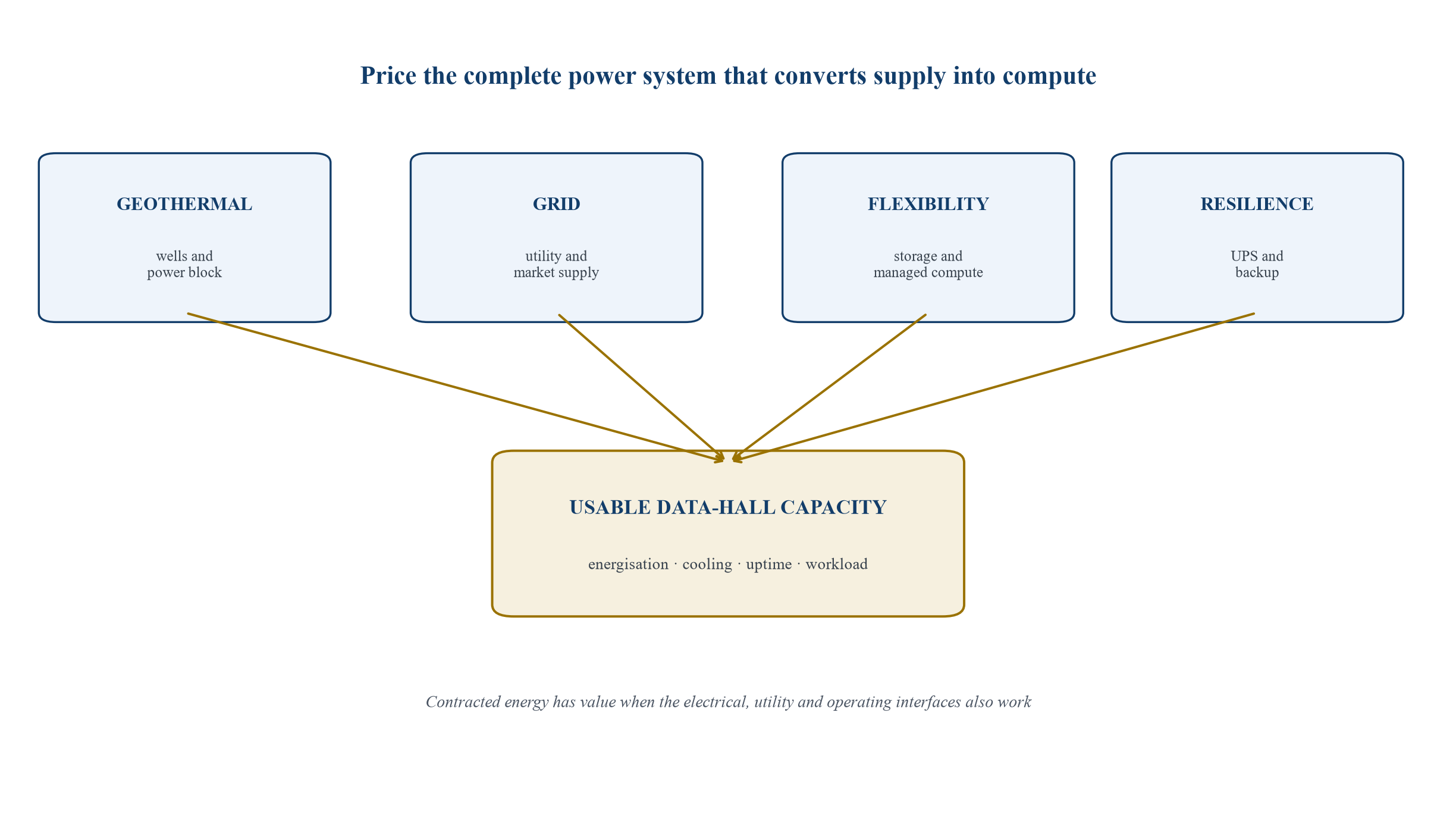
Generic architecture; actual electrical design, market participation and regulatory treatment are jurisdiction-specific.
6. Utility-sleeved supply
The Google, NV Energy and Fervo structure in Nevada illustrates a utility-sleeved model. Google reported regulatory approval for an agreement supporting 115 MW of new enhanced geothermal power under NV Energy's Clean Transition Tariff [4]. NV Energy filings describe a 115 MW geothermal PPA linked to an energy-supply agreement, with commercial operation scheduled for 2030 [5].
The structure is relevant because the utility remains the retail supplier and integrates the resource into its system. The customer can support a new technology while relying on utility delivery and balancing. The economics should include the underlying PPA, utility administration, network costs, residual supply, losses, regulatory adjustments and the customer's standard tariff comparison.
7. Grid-delivered corporate PPA
A corporate PPA can be physical, sleeved or financial. The buyer may contract for energy, environmental attributes and capacity while the utility or market delivers actual electricity. The contract can support project finance through a long tenor and creditworthy offtaker. It can also expose the buyer to settlement, congestion, shape, basis and curtailment risk.
For geothermal, the relatively flat output profile reduces shape mismatch compared with variable generation. Forced outages, resource decline and station use still matter. The buyer should model the project's delivery point against the data centre's pricing node and hourly load. A low busbar price can become expensive after congestion and replacement power.
8. Behind-the-meter and adjacent supply
An adjacent plant can reduce dependence on long-distance transmission and may provide a more direct path to energisation. The arrangement needs careful legal and engineering design. Retail-franchise rules, utility standby tariffs, self-generation permissions, interconnection standards and market-participation rules can determine feasibility.
The campus must decide whether the generator operates in parallel with the grid, islands during disturbances or serves only part of the load. Geothermal maintenance or well intervention can reduce output for extended periods. The grid or another resource must cover those events. Direct supply therefore changes the risk allocation; it does not remove the need for resilience.
9. Hybrid portfolio
A hybrid combines firm geothermal with solar, storage, grid purchases, demand response and workload management. Geothermal covers a stable block. Solar can reduce daytime marginal cost. Batteries manage short-duration ramps and contingencies. Flexible compute can move non-latency-sensitive work across hours or locations. Grid supply covers residual demand and planned outages.
Portfolio design should follow the hourly load and reliability standard. Overbuilding one resource can increase cost without improving usable capacity. The optimisation should include network limits, maintenance, fuel or market exposure, emissions objectives and the value of deferred capacity. Contract and control systems must allow the assets to operate as one portfolio.
10. Start with the compute ramp
The data-centre programme should translate buildings and server deployments into a monthly power ramp. The model should distinguish construction load, commissioning load, critical IT load, cooling and auxiliary consumption. It should also identify which capacity is firm, interruptible or movable.
The geothermal programme has a different ramp: exploration, appraisal, drilling, stimulation where applicable, power-block construction, interconnection, testing and commercial operation. A comparison of headline completion dates hides interface risk. The project needs milestone definitions that connect generator acceptance with data-hall energisation. Early geothermal modules may support phased halls if the plant and electrical architecture are modular.
11. Connection timelines are economic variables
Berkeley Lab reported nearly 2,600 GW of generation and storage capacity seeking United States grid interconnection at the end of 2023. Projects completed in 2023 had a median request-to-operation duration of about five years [6]. The dataset concerns generation queues, while large-load interconnection follows different utility and regional processes. It still demonstrates the scale and timing of network studies.
A board should treat connection time as a distribution rather than a date. Study completion, upgrade scope, equipment procurement, land rights and construction can each move. The valuation should assign probabilities to energisation windows and calculate the cost of unused land, delayed compute revenue and interim supply.
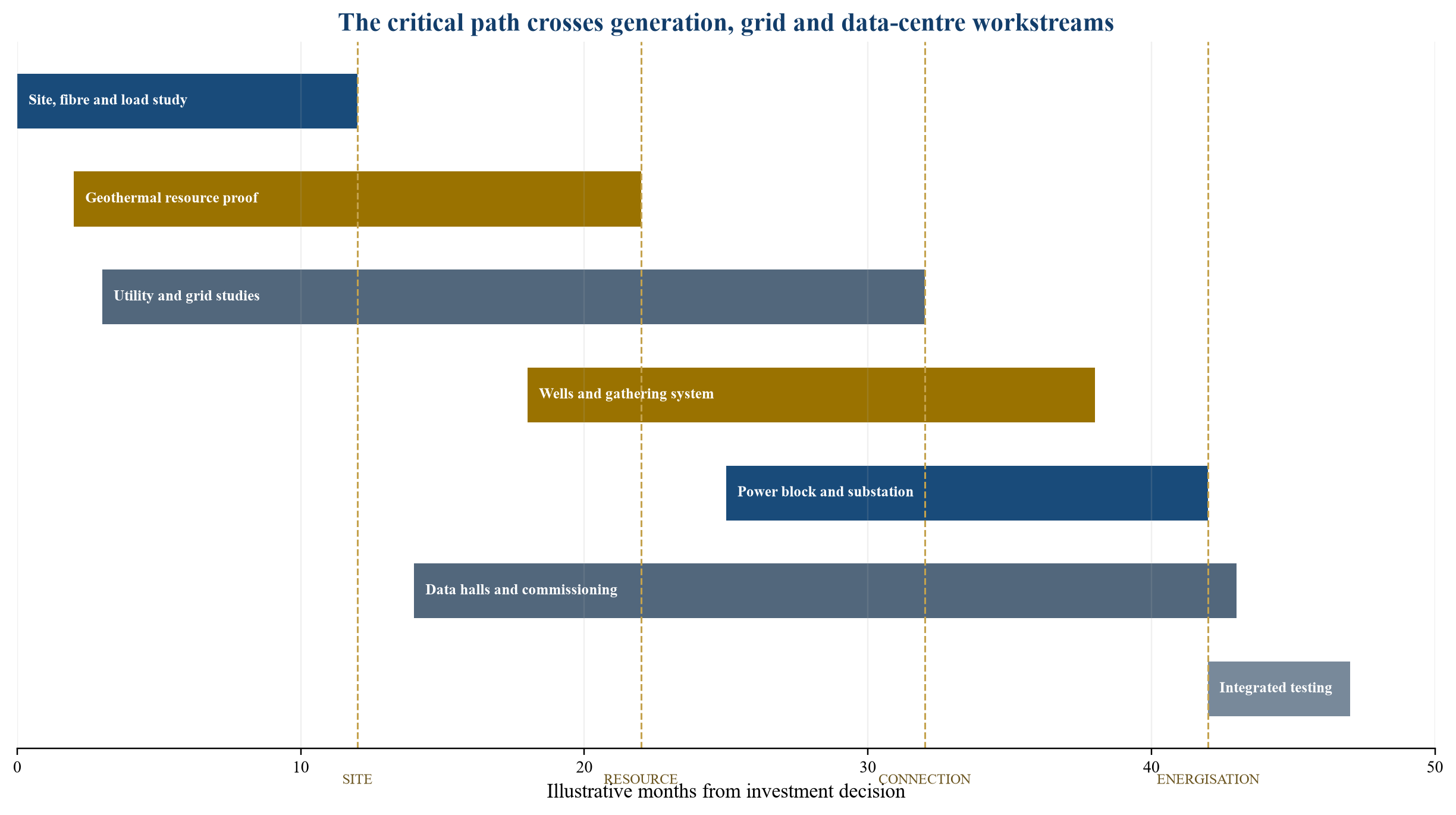
Hypothetical sequence; durations are illustrative and are not a forecast for any jurisdiction or project.
12. FERC reforms improve process discipline
FERC Order No. 2023 introduced cluster studies, stronger readiness requirements, deposits, site-control provisions and study-delay penalties for generator interconnection [7]. These reforms are intended to reduce speculative queues and improve study discipline. Their application depends on regional tariffs and implementation.
The commercial lesson is that queue entry consumes capital and requires credible project readiness. A geothermal developer should budget study deposits, security, network upgrades and withdrawal exposure. The data-centre buyer should verify the generator's queue status, milestones, deposits and ability to fund assigned upgrades. A PPA commercial-operation date without this evidence is weak schedule support.
13. The price stack
The delivered geothermal price contains several layers. The first is project revenue needed to recover development, wells, plant, operating cost and capital. The second is grid and utility delivery, including losses, transmission, distribution and administration. The third is residual energy and capacity when the plant is unavailable or smaller than the load. The fourth is risk transfer, such as delay guarantees or performance protection.
Comparisons should use a consistent boundary. A geothermal PPA at the project bus cannot be compared directly with an all-in retail tariff. A behind-the-meter cost cannot omit standby service, backup generation and network access. The board should see both the component stack and the total expected cost.
14. Firm capacity has a separate value
Energy price measures dollars per megawatt-hour. Capacity value measures the ability to meet load during required periods. A geothermal plant with high availability can contribute more dependable capacity than the same annual energy from a variable resource. The recognised capacity credit depends on market and utility rules.
The buyer should model accredited capacity, outage coincidence and the amount of grid or backup capacity still required. Paying twice can occur when the geothermal contract includes a capacity premium while the utility tariff still charges the full demand or standby amount. Contract design should establish which capacity benefit reaches the customer and how regulatory changes are handled.
15. The avoided-delay value
An earlier energisation can create economic value through earlier compute revenue, customer commitments, asset utilisation and strategic market entry. It can also avoid land carry, construction remobilisation and equipment storage. This value belongs in the comparison when geothermal or a utility-backed clean tariff advances the feasible connection date.
The analysis should use probability-weighted timing. A claimed twelve-month acceleration has limited value if the geothermal project itself has an uncertain resource or interconnection path. The board should calculate the value of each month under low, base and high workload-demand cases, then discount it by the probability that the complete architecture reaches service.
16. Pricing development risk
Conventional geothermal faces exploration and resource risks. Next-generation systems add drilling, completion, stimulation and repeatability questions. DOE's 2025 Liftoff analysis describes the need for multiple deployments, high-value PPAs and cost reduction before broad commercial scale, with early projects proving sufficient consistency for construction debt [8].
The buyer should identify which risks are reflected in price and which remain with the offtaker. A high fixed price can transfer cost overrun while leaving delay exposure unresolved. Development support, milestone payments or prepayments can reduce the project price but increase buyer capital at risk. The contract should connect each concession to a defined protection.
17. Resource evidence
Resource evidence should cover temperature, permeability or engineered flow, pressure, chemistry, well productivity, interference, decline and reinjection. The standard differs between established hydrothermal fields and next-generation designs. Independent review should assess data provenance, test duration, model calibration and the range of recoverable output.
The offtaker does not need to become the reservoir engineer. It needs enough evidence to price volume, schedule and replacement-power exposure. Minimum delivery guarantees should be consistent with demonstrated capability. A contract that assumes full output before the resource is proven effectively asks the buyer or lender to finance exploration risk.
18. Well and drilling cost
Wells can dominate geothermal capital expenditure. Cost depends on depth, geology, diameter, temperature, rig market, materials, drilling speed, loss zones and completion design. Learning can reduce cost across repeated wells, while difficult first wells can exhaust contingency.
The model should separate the first-of-a-kind learning programme from steady-state drilling. It should show cost per completed well, expected net megawatts per well, failure or sidetrack allowance and rig utilisation. Fixed-price EPC coverage may exclude subsurface conditions. The buyer should avoid interpreting an EPC cap as complete protection unless the well scope and relief events are clear.
19. Power-block and station-use assumptions
Gross generation is not the quantity delivered. Pumps, cooling, controls and other auxiliary systems consume power. NV Energy filings for the 115 MW Corsac Generating Station 2 describe expected average capacity net of station use below the nameplate figure [5]. This distinction is material for contracted supply.
The PPA should define gross capacity, net dependable capacity, metering point and station service. Temperature and ambient conditions can affect output. The model should include seasonal variation, planned maintenance and degradation assumptions. Guaranteed net delivery should align with the data centre's actual settlement point.
20. Capacity factor and availability
NREL notes that geothermal capacity factor depends on technology, ambient temperature, downtime and internal plant losses [9]. A planning assumption should therefore distinguish resource availability, mechanical availability and dispatched output. Curtailment can reduce delivered energy even when the plant is capable of operating.
Availability guarantees need exclusions for grid outages, force majeure and buyer curtailment. The remedy can be liquidated damages, replacement energy or price adjustment. Very strong guarantees raise contract price or require credit support. The commercial objective is an enforceable protection proportionate to the compute value at risk.
21. Market and basis risk
A project and data centre at different nodes can experience different prices. Congestion may cause the generator to settle low while the data centre buys high. A contract-for-differences does not eliminate this basis exposure. Transmission losses and marginal-loss factors can add further variance.
The buyer should model historical and forward basis with caution because rapid load and network changes can invalidate past patterns. Physical delivery rights, utility sleeves or transmission hedges may reduce exposure. The contract should define congestion allocation, negative prices, curtailment and change in settlement point.
22. Curtailment risk
Geothermal plants can be curtailed because of transmission limits, system conditions or negative prices. The economic result depends on whether the project is paid, whether environmental attributes transfer and whether the customer buys replacement power. A take-or-pay structure can leave the data centre paying for energy it does not receive.
Curtailment analysis should distinguish project-caused, grid-caused and buyer-directed events. Each category needs a volume and payment rule. Where the utility integrates the resource, the tariff may socialise or separately allocate some effects. The buyer should understand the regulatory treatment rather than assume physical firmness equals contractual delivery.
23. Reliability architecture
Data centres often require high availability and power quality. Geothermal provides a stable energy block, while the campus electrical design delivers ride-through and redundancy. Utility feeders, substations, transformers, UPS systems, batteries and backup generators each address different failure durations.
The design should use credible contingencies: loss of one well, turbine trip, substation fault, transmission outage and extended plant maintenance. The cost comparison should include enough reserve to meet the required service level. A single adjacent plant can create common-mode risk if the generation and data-centre connection share one substation or corridor.
24. Cooling and geothermal integration
DOE identifies geothermal cooling and underground thermal storage as additional options for data centres [3]. These technologies can reduce peak electrical demand or shift cooling energy. Their economics depend on ground conditions, climate, cooling architecture and campus design.
The investment case should value cooling separately from generation. A geothermal power PPA does not automatically reduce cooling load. Ground-source or thermal-storage systems require their own borefields, heat exchangers, pumps and controls. Where both are feasible, integrated planning can reduce the required electrical connection and improve utilisation of site infrastructure.
25. Workload flexibility
Some compute tasks can move across time or geography. Latency-sensitive applications, safety functions and customer commitments may remain fixed. Batch training, software testing and selected analytics can be more flexible. Google has described carbon-intelligent load shifting across time and place [10].
Flexibility can reduce the size of expensive firm supply, absorb geothermal outages or improve hourly clean-energy matching. The valuation should use actual workload constraints and service-level agreements. Treating all compute as interruptible overstates flexibility. The operating system, commercial contracts and cybersecurity controls must support any proposed movement.
26. A capacity-economics bridge
The decision model should begin with the geothermal project price and add delivery, residual supply and reliability costs. It should then subtract benefits that are genuinely incremental: avoided delay, reduced market exposure, recognised capacity, environmental attributes and possible network deferral. The result is an adjusted cost of usable power.
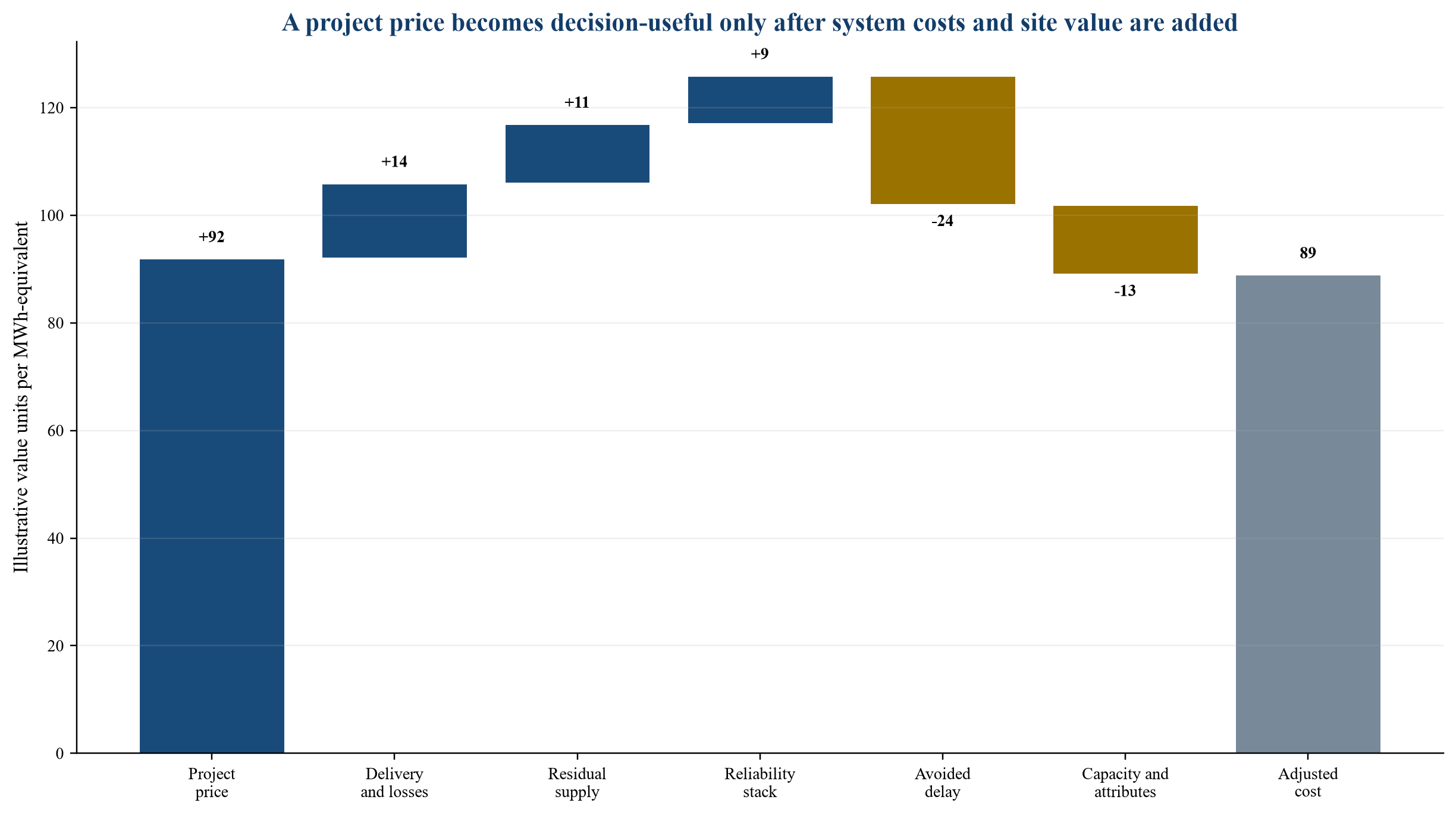
Hypothetical values for structural illustration only; not a tariff, forecast, valuation or named-project price.
The bridge should not monetise the same benefit twice. An avoided network upgrade may already appear in the utility rate. An environmental attribute may already be embedded in the PPA. Avoided delay is relevant only where the geothermal architecture changes the energisation distribution.
27. Hypothetical site case
Consider a campus targeting 120 MW of critical IT load in three phases. Grid service can provide 40 MW on the initial date, with a possible increase after network reinforcement. A geothermal project offers an 80 MW net block through a utility sleeve. The figures are hypothetical and are used solely to demonstrate the method.
The evaluation should combine the 40 MW grid block, geothermal delivery, losses, reserve, cooling and redundancy. If the geothermal plant reaches operation six months after the first hall, interim capacity is required. If it arrives early, the utility agreement must permit delivery before the customer ramp. The economics depend on sequencing, not simply on annual energy.
Table 1. Hypothetical delivered-capacity comparison
| Route | Initial usable capacity | Timing exposure | Principal cost layers | Main residual risk |
|---|---|---|---|---|
| Utility service only | 40 MW | Upgrade date uncertain | Tariff, demand, network and market adjustments | Expansion delay |
| Utility-sleeved geothermal | 105 MW after reserves | Resource, plant and approval milestones | PPA, sleeve, delivery, residual energy and standby | Project delay and tariff change |
| Behind-the-meter geothermal | 100 MW after reserves | Resource and campus integration | Wells, plant, private wires, backup and operations | Concentrated outage and development risk |
| Hybrid portfolio | 110 MW after reserves | Multiple coordinated milestones | Geothermal, grid, storage, controls and flexible load | Interface and optimisation risk |
Illustrative assumptions only; values are not market quotations or forecasts.
28. Levelised cost is an incomplete measure
Levelised cost of electricity is useful for comparing generation technologies under consistent assumptions. It does not capture site-specific delivery, connection date, residual purchases, reliability or compute revenue. DOE's Liftoff analysis points to potential next-generation geothermal cost reductions and the importance of high-value offtake [8]. IEA has observed early contract prices above those historically available to variable renewables [11].
A data-centre buyer can rationally pay above a generic LCOE benchmark when the contract provides valuable location, timing or firmness. The premium should be traced to measurable benefits. Strategic urgency alone is not a pricing method.
29. Contract tenor
Geothermal projects often require long contracts because wells and power plants are capital intensive. Long tenor supports debt and spreads cost. It also creates technology, demand, credit and market-price exposure for the buyer.
The contract should align with the expected life of the data-centre campus and the buyer's confidence in load. Expansion options can match phased demand. Extension rights can preserve value after debt amortisation. Termination rights, buyout formulas and assignment provisions should address campus sale, project failure and corporate reorganisation. Shorter contracts may need higher prices or residual-value support.
30. Volume and shape
The buyer should decide whether it purchases as-generated energy, a fixed hourly block, minimum annual volume or a shaped product. A flat geothermal profile can match base load, while data-centre demand can ramp over years and vary with cooling. Excess early output needs a sale path. Shortfalls need replacement.
Take-or-pay obligations should track the buyer's commissioning plan. Project lenders prefer stable volume, while the buyer needs flexibility. A phased contracted capacity with clear notice and pricing can balance both. Metering and settlement should identify net output, losses, auxiliary load and curtailment.
31. Performance guarantees
Key guarantees include commercial-operation date, net dependable capacity, annual availability, heat rate or auxiliary consumption where relevant, environmental attributes and resource sustainability. Remedies can include delay damages, capacity damages, replacement energy and termination.
Guarantees require creditworthy support. A special-purpose project company may have limited assets before operation. Parent guarantees, letters of credit, performance bonds, reserve accounts and lender cure rights can strengthen protection. The remedy cap should reflect the buyer's exposure and the price the project can finance.
32. Milestone governance
The buyer should receive evidence at resource, drilling, financing, interconnection, construction and commissioning gates. Each gate needs objective deliverables and review rights. Information covenants should include well results, cost-to-complete, schedule, permits, queue milestones and contractor status.
Governance should preserve project execution responsibility. The buyer's review should not make it the operator or dilute contractor accountability. Material deviations need escalation and a defined response. Early transparency allows the buyer to procure interim supply or adjust the data-centre ramp before a delay becomes irreversible.
33. Credit and security
The project's credit package changes across development, construction and operation. Early phases may rely on sponsor equity. Construction debt introduces lender controls and step-in rights. After operation, cash flow and reserves support obligations.
The buyer should assess sponsor capacity, committed equity, debt conditions, contractor security and insurance. Prepayments or development contributions require ring-fencing, milestone release and refund protection. The project should also evaluate buyer credit, because a long-term data-centre commitment may underpin financing. Mutual collateral design can reduce cost while preserving essential protection.
34. Change in law and tariff risk
Tax credits, environmental rules, retail tariffs, market design and interconnection requirements can change over a long contract. The agreement should define which changes adjust price, excuse performance or trigger renegotiation. Broad change-in-law clauses can transfer ordinary business risk to the customer.
Utility-sleeved structures add regulatory review. Approval may set cost allocation and customer protections. The data centre should distinguish the private agreement from the filed tariff. Public filings can contain different effective terms, prudence standards or exit charges. Regulatory counsel should confirm the enforceable structure.
35. Environmental attributes and hourly matching
Renewable-energy certificates or equivalent attributes establish contractual claims under applicable systems. Annual matching does not prove that clean supply coincides with every hour of consumption. Geothermal's stable profile can improve hourly matching when generation and load are in the same market and attributes are transferred correctly.
The buyer should define which claims it intends to make and which evidence supports them. Metering interval, location, deliverability and attribute ownership matter. Marketing language should follow recognised reporting rules. A premium for hourly matching should correspond to verified delivery rather than a generic renewable label.
36. Water, land and community
Geothermal and data-centre projects both interact with land and water. Technology and site conditions determine water use. Air-cooled geothermal plants can reduce water demand while affecting cost and ambient-temperature performance. Data-centre cooling design can create separate water requirements.
The site assessment should consider competing uses, rights, discharge, induced seismicity, traffic, noise, habitat and community benefits. Local acceptance can affect schedule and operating conditions. Engagement should begin before design is fixed. A commercial model that advances compute capacity while externalising local costs is unlikely to remain durable.
37. Financing the geothermal project
Project finance requires a credible resource, permits, construction plan, interconnection, offtake, sponsor and risk allocation. Debt sizing should use contracted cash flow after operating cost, reserves and downside production. Exploration and early drilling may require equity, grants or risk-sharing capital before senior debt is available.
The data-centre offtaker can improve bankability through tenor, credit and clear performance obligations. It should avoid assuming development risks that specialist capital is better placed to bear. If the buyer invests equity, the investment return should be analysed separately from the power procurement decision.
38. Data-centre capital structure
The campus may be financed through corporate capital, project debt, real-estate structures or joint ventures. Power commitments can affect debt capacity, operating covenants and asset valuation. Long take-or-pay obligations may be treated as fixed commitments even when accounting classification differs.
Lenders should see the power ramp, contract tenor, termination rights, credit support and backup plan. A power contract that secures energisation can improve the asset case. A contract with uncapped tariff pass-through or weak delay protection can impair it. Financing documents and energy agreements should be negotiated as one system.
39. Downside sensitivities
The model should test commercial-operation delay, lower net output, higher network upgrades, resource decline, prolonged outage, basis widening, slower compute ramp and lower residual power prices. Correlations matter. A difficult drilling programme can cause both delay and cost overrun. A slower compute ramp can coincide with lower market demand and excess contracted energy.
Table 2. Downside sensitivity framework
| Sensitivity | Direct effect | Secondary effect | Mitigation |
|---|---|---|---|
| Twelve-month project delay | Interim power and deferred halls | Contractor and financing cost | Delay security, phased load and bridge supply |
| Ten-percent lower net output | More residual purchases | Lower capacity contribution | Net-output guarantee and reserve margin |
| Higher network upgrade | Increased delivered cost | Schedule and security requirement | Cost cap, utility allocation and exit right |
| Resource decline | Falling annual delivery | Re-drill capital and outage | Make-up wells, reserves and performance tests |
| Wider node basis | Higher settlement cost | Hedge ineffectiveness | Sleeve, location match and basis limit |
| Slower compute ramp | Excess contracted energy | Take-or-pay loss | Capacity options, resale and staged volume |
| Regulatory change | Tariff or attribute adjustment | Financing re-open | Defined allocation and renegotiation threshold |
Generic framework; project-specific probabilities and values require technical, market and legal diligence.
40. Real-options design
Uncertainty can be managed through options rather than a single irreversible commitment. The buyer can contract an initial block with expansion rights, reserve adjacent land, fund appraisal in stages or take a minority interest with a purchase option. The developer can secure a floor volume and sell incremental output elsewhere.
Options have cost and should be valued against the flexibility they create. An expansion right without resource, interconnection or pricing mechanics may have little value. A termination right may be constrained by lender requirements. Each option needs objective exercise conditions, notice, price and capacity reservation.
41. Portfolio comparison
The board should compare alternatives using a common matrix: usable capacity by date, expected delivered cost, downside cost, carbon attributes, reliability, capital at risk, reversibility and execution burden. A weighted score can support discussion, while the underlying cash flow and risk evidence should remain visible.
Table 3. Board comparison of power architectures
| Criterion | Utility sleeve | Grid-delivered PPA | Behind-the-meter | Hybrid portfolio |
|---|---|---|---|---|
| Schedule integration | Utility-led | Generator and market-led | Campus-led | Multi-party |
| Basis exposure | Usually lower | Potentially material | Limited for direct supply | Managed across portfolio |
| Development capital | Mostly project/utility | Mostly project | Buyer or joint vehicle may fund | Distributed across assets |
| Reliability support | Utility system | Utility system | Buyer-designed | Layered resources |
| Regulatory dependency | Tariff approval | Market and retail rules | Self-generation and standby rules | Multiple regimes |
| Flexibility | Contract-defined | Settlement-defined | Physical and operational | Highest with greater complexity |
Qualitative decision guide; ratings require site-specific evidence.
42. Diligence workstreams
Technical diligence should cover resource, wells, plant, net output, grid design and operating plan. Commercial diligence should cover load, route to market, price stack, curtailment and resale. Legal and regulatory diligence should cover rights, permits, tariffs, attributes and contract enforceability. Financial diligence should cover capital cost, funding, tax, downside and credit.
The workstreams should meet at interface questions. A resource model affects debt sizing and performance guarantees. An interconnection milestone affects the data-centre schedule. A tariff changes delivered cost and termination rights. Separate reports without reconciliation can leave the central investment risk unanswered.
43. Red flags
Red flags include a PPA price compared with retail power without delivery costs, a commercial-operation date unsupported by queue evidence, capacity quoted gross of station use, resource performance extrapolated from short tests, network upgrades outside the budget, take-or-pay volume ahead of the compute ramp and environmental attributes without clear ownership.
Other warnings include a single electrical point of failure, no replacement-power plan, development prepayments without security, availability guarantees from an undercapitalised project company and avoided-delay value based on an unapproved utility connection. Several red flags together can invalidate the architecture even when geothermal technology is credible.
44. Investment-committee paper
The approval paper should state the required compute ramp, feasible grid service, selected power architecture, geothermal evidence, delivered-price stack, schedule distribution, downside cases, credit package, regulatory pathway and exit options. It should identify which information is observed, independently reviewed or assumed.
The committee should approve both the commercial contract and the implementation budget. Connection studies, owner engineering, interim supply, integration controls and contingency require funding. Conditions should include resource, interconnection, financing, permit and security milestones. A single headline price should never substitute for this evidence.
45. Negotiation priorities
Negotiation should begin with the risks that can destroy compute value: delay, insufficient net capacity, loss of delivery path and prolonged outage. Price follows the agreed boundary. The buyer can accept a higher price in exchange for schedule and performance protection. The developer can accept stronger remedies if milestone evidence, cure rights and liability caps remain financeable.
Key definitions include commercial operation, dependable capacity, available energy, curtailment, replacement energy, force majeure, change in law and buyer delay. Ambiguity in these terms can outweigh small changes in the quoted energy price.
46. Operating governance
After operation, governance should review resource performance, well availability, net output, maintenance, curtailment, settlements, environmental attributes and forecast outages. The data centre needs enough notice to schedule maintenance or procure replacements. The project needs coordinated access and dispatch instructions.
A joint operating committee can manage interfaces without replacing contractual accountability. Data should come from agreed meters and operating systems. Disputes over performance need a technical-expert process distinct from broader arbitration. Annual planning should connect well work and plant outages to the campus load profile.
47. Performance scorecard
The scorecard should measure delivered megawatts, availability, price variance, replacement purchases, curtailed energy, hourly clean-energy match, outage notice, connection milestones and compute capacity enabled. Financial reporting should reconcile contract invoices to metered delivery and the approved model.
Leading indicators include drilling progress, cost to complete, permit status, equipment delivery and queue milestones. Lagging indicators include cash cost, downtime and realised capacity. A scorecard that reports renewable megawatt-hours while omitting data-hall energisation misses the investment objective.
48. Strategic implications
Data-centre demand can provide the long-term, creditworthy offtake needed to scale next-generation geothermal. IEA has identified data-centre demand as a source of momentum and reported geothermal contract prices in some cases around USD 130/MWh, above older guarantees available to variable renewables [11]. The cited level is a market observation, not a benchmark for a specific transaction.
The strategic opportunity is reciprocal. Developers gain a bankable customer and a learning pipeline. Data-centre operators gain access to a firm clean resource whose value can exceed its energy component. Durable contracts share learning while preserving clear performance accountability.
49. Limits of the framework
This paper does not estimate the resource, price or connection date for any site. Public announcements provide limited contract detail, and regulatory filings may contain confidential schedules. Technology performance varies by geology and design. Electricity-market rules differ across jurisdictions.
The framework is a diligence and valuation structure. A specific decision requires site studies, utility confirmation, independent engineering, market modelling, legal review and financing terms. Scenario values should be updated as evidence improves. The method is useful because it makes uncertainty visible and connects it to contract and capital decisions.
50. Conclusion
Geothermal should be priced for the service it delivers to the data hall: usable power at the required location, date and reliability standard. The project price is only the first component. Delivery, residual purchases, standby, connection risk, curtailment, capacity value, environmental attributes and avoided delay determine the commercial result.
The recommended sequence is clear. Build the compute ramp; establish the feasible grid path; compare utility-sleeved, grid-delivered, behind-the-meter and hybrid architectures; verify the resource and interconnection; construct the delivered-price stack; test downside; and negotiate protections around the risks that impair energisation. This turns geothermal procurement into an integrated digital-infrastructure investment decision.
References
- [1] United States Department of Energy. DOE Releases New Report Evaluating Increase in Electricity Demand from Data Centers. 20 December 2024. https://www.energy.gov/articles/doe-releases-new-report-evaluating-increase-electricity-demand-data-centers
- [2] International Energy Agency. The Future of Geothermal Energy. 13 December 2024. https://www.iea.org/reports/the-future-of-geothermal-energy
- [3] United States Department of Energy. Geothermal and Data Centers. https://www.energy.gov/hgeo/geothermal/geothermal-and-data-centers
- [4] Google. Our first-of-its-kind partnership for clean energy has been approved in Nevada. 13 May 2025. https://blog.google/feed/nevada-clean-energy/
- [5] NV Energy. 2024 Integrated Resource Plan, Volume 8 and Volume 26; Corsac Generating Station 2 materials. https://es.nvenergy.com/publish/content/dam/nvenergy/brochures_arch/about-nvenergy/rates-regulatory/recent-regulatory-filings/irp/IRP-Volume-8.pdf and https://es.nvenergy.com/publish/content/dam/nvenergy/brochures_arch/about-nvenergy/rates-regulatory/recent-regulatory-filings/irp/IRP-Volume-26.pdf
- [6] Lawrence Berkeley National Laboratory. Queued Up: 2024 Edition, Characteristics of Power Plants Seeking Transmission Interconnection as of the End of 2023. April 2024. https://emp.lbl.gov/publications/queued-2024-edition-characteristics
- [7] Federal Energy Regulatory Commission. Fact Sheet: Improvements to Generator Interconnection Procedures and Agreements, Order No. 2023. 27 July 2023. https://www.ferc.gov/news-events/news/fact-sheet-improvements-generator-interconnection-procedures-and-agreements
- [8] United States Department of Energy. Pathways to Commercial Liftoff: Next-Generation Geothermal Power. July 2025. https://www.energy.gov/sites/default/files/2025-07/LIFTOFF_DOE_Next-Generation-Geothermal%20Power.pdf
- [9] National Renewable Energy Laboratory. Annual Technology Baseline 2024: Geothermal. https://atb.nrel.gov/electricity/2024b/geothermal
- [10] Google. Google I/O 2021: Being helpful in moments that matter. 18 May 2021. https://blog.google/innovation-and-ai/technology/developers-tools/io21-helpful-google/
- [11] International Energy Agency. Investment in next-generation geothermal is surging. Policies are key to further growth. 23 January 2026. https://www.iea.org/commentaries/investment-in-next-generation-geothermal-is-surging-policies-are-key-to-further-growth
- [12] Meta. New Geothermal Energy Project to Support Our Data Centers. 26 August 2024. https://about.fb.com/news/2024/08/new-geothermal-energy-project-to-support-our-data-centers/
- [13] Google. Google and Fervo launch first-of-its-kind geothermal project. 28 November 2023. https://blog.google/company-news/outreach-and-initiatives/sustainability/google-fervo-geothermal-energy-partnership/
About the Author
Chennakeshav (CK) is a corporate finance and investment banking executive with 25+ years of global experience in deal origination, structuring and execution across M&A, growth capital and corporate strategy. He has led value-creation mandates for founders, corporates and funds — bridging the boardroom view to hands-on execution and close.
His career spans Morgan Stanley, HSBC, Lloyds Banking Group, EWEC, ADQ portfolio companies and Emirates Growth Fund, across TMT, real estate, fintech, deeptech, cleantech, infrastructure and energy. He has partnered with C-suite leaders, private equity and venture funds, sovereign wealth funds and family offices to finance complex fund raises and scale-up ventures, and has led M&A due diligence, post-merger integration and business-transformation initiatives to create value.
At Matchpoint Partners he is Managing Partner, leading the firm's corporate finance, M&A and capital-raising practice. He holds an MBA from London Business School, an engineering degree from VTU and a Master of Laws (LLM, in progress) from UCL London.
An active start-up mentor, CK mentors at Techstars, DIFC FinTech Hive, Startup Grind, Founder Institute and IN5, serves as Entrepreneur Mentor in Residence (EMiR) at London Business School, and judges the Entrepreneurship World Cup.
LinkedIn: https://www.linkedin.com/in/ckadya/
Profile: https://www.matchpoint-partners.com/team/ck-adya.html
