

1. Define the financed transaction before analysing the borrower
Agribusiness credit should begin with the financed transaction. A borrower may procure crops, import inputs, operate warehouses, process commodities, distribute products, export produce, provide farmer advances or combine several activities. Each activity creates a different asset, cash cycle and enforcement route. A corporate description such as trader, aggregator or processor is too broad to establish the lender's repayment source.
The transaction map should identify the farmer or supplier, purchasing entity, warehouse operator, collateral manager, processor, transporter, buyer, insurer, account bank and secured creditor. It should also identify where title transfers, where risk of loss passes, which entity invoices the buyer, which entity collects cash and which liabilities rank ahead of the lender. The same group may use different entities for local procurement, export contracting, warehousing and borrowing. Consolidated accounts can conceal that the collateral and cash sit outside the obligor.
The lender should classify each use of proceeds. Seasonal crop purchases, imported inputs, processing inventory, buyer receivables and permanent operating expenditure should not share one undifferentiated limit. A self-liquidating crop-finance tranche may be appropriate for controlled commodity that has a defined sale route. A receivables tranche may fund accepted invoices to approved buyers. Equipment, warehouse construction and recurring operating losses require separate analysis and usually a different tenor.
The repayment thesis should be stated in operational terms. It should explain how each financed currency unit becomes eligible stock, how stock becomes an accepted sale, how the sale becomes controlled cash and how cash repays debt. Enterprise value, sponsor support and future refinancing may provide secondary protection. They should not replace a demonstrable primary repayment route for a borrowing-base facility.
Table 1. Agribusiness transaction and credit perimeter
| Financed activity | Primary repayment source | Principal controlled asset | Critical evidence |
|---|---|---|---|
| crop procurement | sale of stored or delivered crop | eligible inventory and sale receivable | title, quantity, grade, custody and buyer |
| input distribution | dealer or farmer collections | eligible receivables and controlled stock | delivery, acceptance, ageing and collection |
| processing | sale of finished or intermediate product | raw material, work in progress and finished goods | yield, conversion, inventory and offtake |
| pre-export finance | export proceeds | controlled commodity and export documents | licence, bill of lading, buyer and account control |
| domestic trade | buyer payment | warehouse stock and accepted invoice | marketability, delivery and buyer credit |
| production advance | contracted crop delivery or settlement | verified production and contractual rights | farmer, acreage, crop progress and offtake |
The legal obligor, asset owner and cash recipient should be identified separately for every financed activity.
2. Reconstruct the crop-to-cash cycle
Annual financial statements compress the seasonality that creates the borrowing requirement. Credit diligence should reconstruct the cycle by commodity, geography, season and channel. The map begins with production or procurement commitments and continues through harvest, intake, quality testing, storage, processing, sale, dispatch, buyer acceptance, invoicing, collection and debt repayment. It should capture the time and cash movement at every stage.
The cash requirement often peaks before reported revenue. An aggregator may pay farmers soon after delivery, hold stock while building a commercial parcel, process part of the crop, sell to a buyer on credit and collect after acceptance. A price increase can raise both margin opportunity and funding need. A delayed harvest can compress procurement into fewer weeks. A logistics disruption can extend holding periods and increase storage, insurance and interest expense. The facility should therefore be sized against a weekly or monthly cash model rather than annual turnover.
The lender should reconcile physical and financial events. Purchase contracts, intake records, weighbridge tickets, quality certificates, warehouse receipts, stock ledgers, sales contracts, dispatch documents, buyer acceptances, invoices, bank statements and debt movements should share stable transaction identifiers. Sampling should cover peak procurement, ordinary periods, reporting dates and adverse events. Exceptions reveal whether the system can support borrowing-base reporting under stress.
The cycle map also determines tenor. Debt maturity should extend beyond expected cash conversion with a controlled buffer for ordinary delay. Excessive tenor weakens the self-liquidating discipline and allows one season's shortfall to roll into the next. Insufficient tenor creates refinancing pressure before the collateral can be sold efficiently. The renewal process should use observed conversion from completed cycles rather than forecast turnover alone.
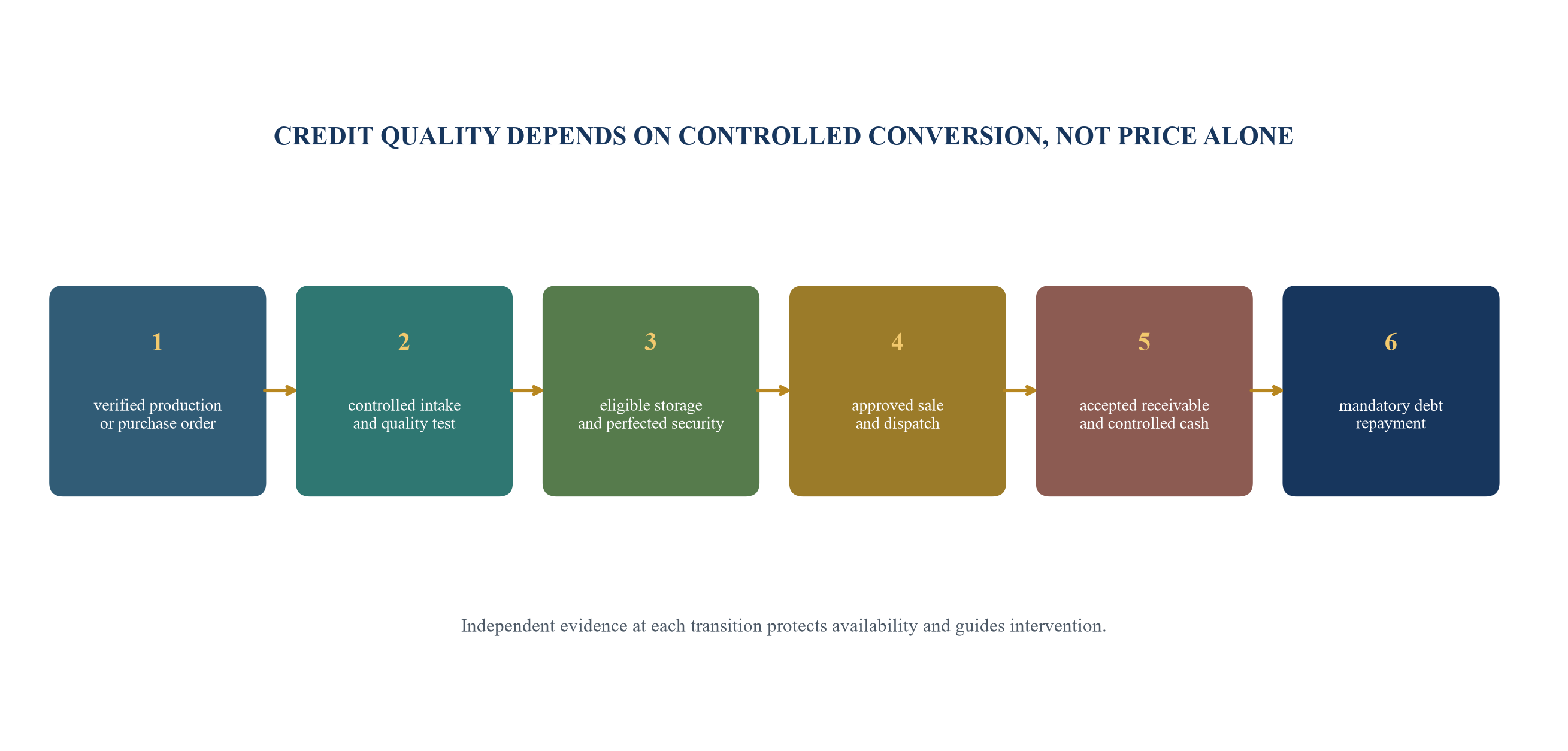
The diagram shows the evidence and control points that connect funding to repayment.
3. Build a jurisdiction-by-jurisdiction enforceability matrix
Africa is not one secured-credit jurisdiction. The lender should analyse the law of the obligor, collateral location, warehouse receipt, sales contract, collection account, guarantee and enforcement forum. A structure that works in one country may fail in another because rules differ for creation, perfection, priority, registration, possession, proceeds, insolvency, foreign lenders, exchange control and enforcement.
The legal review should answer asset-specific questions. Can present and future inventory be charged? Can receivables and their proceeds be assigned? Can crops in the field or future production support security? Does a warehouse receipt constitute title, collateral or evidence only? Is registration required in a company registry, collateral registry, warehouse registry or more than one place? How is priority determined against tax, employee, warehouse, landlord, maritime or statutory claims? How quickly can collateral be realised after default?
Kenya's Warehouse Receipt System Act provides an example of a statutory system with licensed warehouses, a central registry and receipt requirements including commodity description and insurance.[7] Nigeria's National Collateral Registry describes a centralised system under the Secured Transactions in Movable Assets Act and expressly includes inventory, receivables, crops and harvested produce.[9] OHADA's security framework widens the range of collateral and recognises a security agent, while the 2023 enforcement reforms affect recovery procedures across member states.[10][11] These examples demonstrate why a regional term sheet requires local legal schedules.
Legal opinions should cover capacity, authority, enforceability, perfection, priority, account control, foreign-law recognition, withholding, licensing, sanctions, environmental obligations and insolvency. Conditions precedent should require completed registrations and evidence that all material entities and assets fall inside the agreed security perimeter. Periodic bring-down checks should address changes in assets, warehouses, buyers, law and corporate structure.
4. Underwrite the borrower as an operating control system
Collateral cannot compensate for a borrower that cannot produce reliable records or preserve asset value. The lender should assess governance, management competence, segregation of duties, treasury control, accounting, stock systems, procurement, quality, credit approval, collections, related parties and internal audit. The question is whether the borrower can operate the borrowing base accurately every day, including during a stressed season.
Management accounts should reconcile to statutory accounts, tax filings, inventory ledgers and bank statements. Commodity-level profitability should separate trading margin, processing yield, transport, storage, finance cost, claims, quality deductions and realised losses. Reported EBITDA can appear positive while cash is consumed by slow inventory, extended buyers or advances that never convert into delivery.
The lender should test who can create a supplier, approve a purchase, change a grade, move stock, issue an invoice, amend a buyer limit, release goods and alter bank instructions. Concentrated authority increases error and fraud risk. Dual control, system permissions, immutable logs, independent reconciliations and escalation thresholds should match the facility's size and geographic spread.
Operational resilience matters because agriculture is event-driven. Power failure, transport disruption, flood, drought, pest, civil disturbance, cyber incident, border delay or a sudden export restriction can interrupt conversion. Business-continuity plans should identify alternative warehouses, laboratories, transporters, buyers, communication channels and payment routes. The credit case should quantify the time and cost required to use them.
5. Convert warehouse stock into an eligible collateral pool
Warehouse stock enters the borrowing base only after passing eligibility tests. The lender should require evidence of ownership, unencumbered title, physical location, quantity, grade, moisture or condition, age, insurance, storage compliance and saleability. A system balance without independent physical and documentary support is not sufficient.
Eligibility should be commodity-specific. Standardised, durable and actively traded crops may support higher advance rates than perishable, thinly traded or highly location-dependent products. A warehouse may be suitable for one commodity and unsuitable for another. The facility should define permitted commodities, grades, crop years, locations, warehouse operators, collateral managers, inspection frequency, maximum age and concentration limits.
IFC's Global Warehouse Finance Program describes warehouse receipts and, where statutory systems are unavailable, collateral-management or stock-monitoring agreements as operational tools.[1] The legal effect still depends on the jurisdiction and contract. A collateral-management agreement may strengthen custody and release control, while a stock-monitoring agreement may provide observation without equivalent possession. The lender should understand the difference before assigning availability.
The eligibility calculation should deduct disputed title, commingled or unidentified stock, goods subject to retention-of-title claims, overdue storage charges, quality failures, uninsured exposures, stale inventory, buyer-specific goods without a buyer, locations outside control and amounts above concentration limits. The resulting pool represents controlled liquidation value, not management's gross stock figure.
Table 2. Inventory eligibility and exclusion tests
| Test | Eligibility requirement | Exclusion or haircut trigger | Verification source |
|---|---|---|---|
| title | borrower owns stock free of conflicting claim | unclear seller title, retention claim or duplicate pledge | contract, payment, registry and confirmation |
| quantity | reconciled physical quantity exists | unexplained shortage, commingling or stale count | independent count, weighment and ledger |
| quality | grade and condition meet approved market | failed test, moisture, infestation or deterioration | certificate, sample and inspection |
| ageing | holding period remains within approved limit | slow movement or crop-year obsolescence | receipt date and movement history |
| insurance | commodity, location and peril are covered | exclusion, lapse, underinsurance or unpaid premium | policy, endorsement and broker confirmation |
| saleability | executable market and logistics route exist | buyer-specific, remote or uneconomic stock | bids, contracts, market depth and transport quote |
Each test should be evidenced at lot and warehouse level before availability is granted.
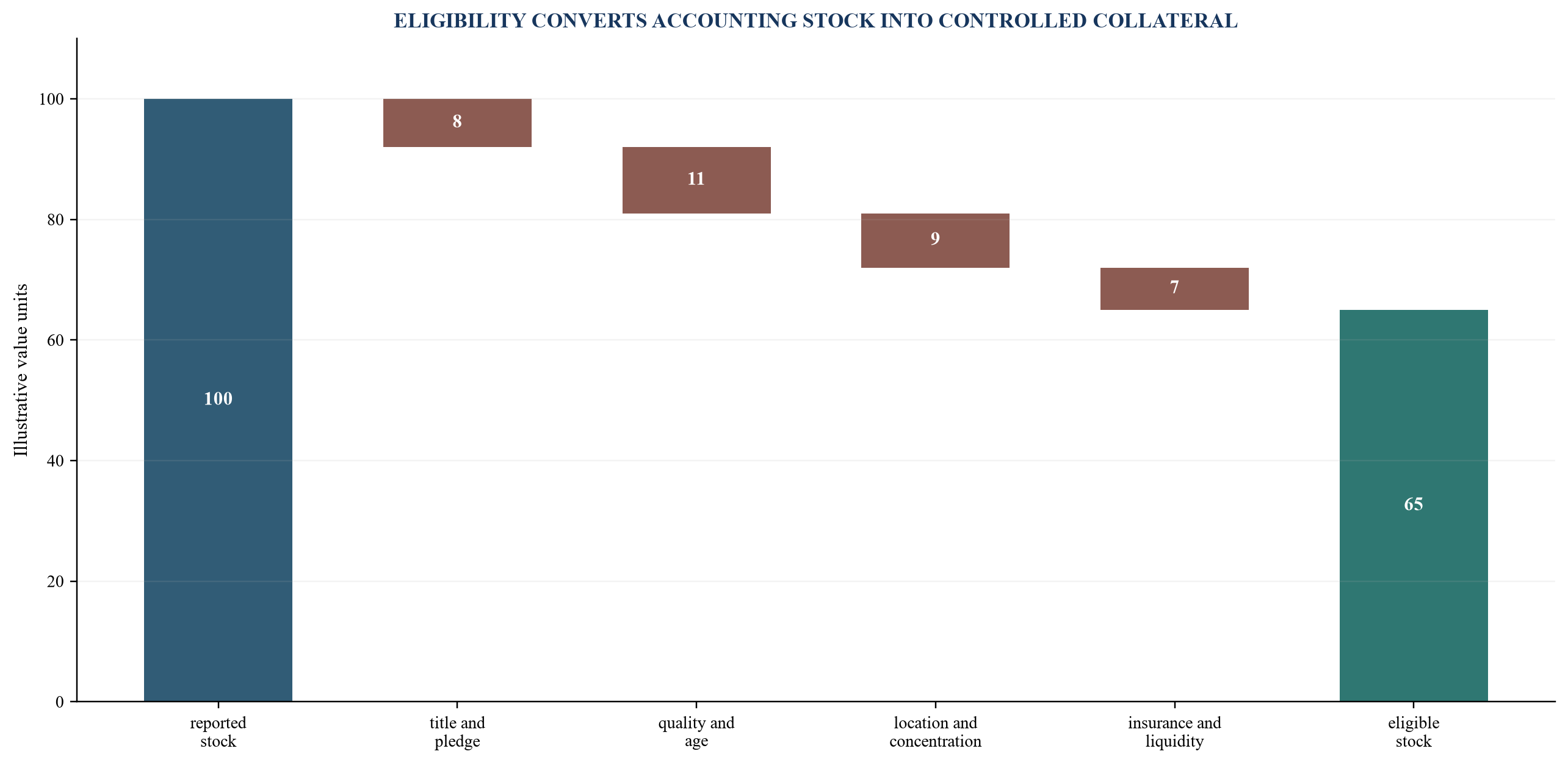
Amounts are hypothetical and show how gross reported stock may reduce to an eligible lending value.
6. Design collateral management and release authority
The collateral manager's mandate should specify custody, inspection, recordkeeping, reporting, access, substitution, processing, release and incident response. Independence, competence, insurance, financial capacity, local presence and conflicts should be diligenced. The contract should state the standard of care, liability, limitations, termination rights and consequences of conflicting instructions.
Release control is the central protection. Goods should leave an eligible location only after a permitted event such as cash prepayment, delivery into an approved receivable, substitution with eligible collateral or repayment. The calculation should consider the borrowing-base effect after release, not only before it. Emergency releases, processing transfers and movements between warehouses require documented authority and real-time updates.
Field warehousing and stock monitoring require additional care where goods remain at borrower premises. Physical segregation, signage, access control, keys, surveillance, daily movement records and unannounced inspections can reduce risk. They do not create legal priority by themselves. The operational and legal control packages should be designed together.
Collateral reports should reconcile opening stock, purchases, movements, processing, sales, losses, releases and closing stock. The lender should receive exceptions promptly rather than only in a monthly certificate. Quantity shortage, quality deterioration, warehouse access denial, insurance lapse, system outage, duplicate receipt, unauthorised movement or loss of licence should trigger immediate escalation and possible suspension of availability.
7. Separate commodity price from collateral value
Commodity price is one input to collateral value. The lender should define an observable reference price, quality basis, delivery point, currency, source hierarchy and frequency. The reference should be adjusted for local basis, grade, location, transport, taxes, processing, handling, broker fees and liquidation time. A headline international price can overstate cash recovery for stock held inland or outside export specification.
The stress framework should distinguish price volatility from liquidity. A price can be observable while market depth is weak. Forced sale volume may move the price or require a discount. Export restrictions, border closure, buyer concentration, currency controls or port disruption can widen basis and delay sale. The haircut should therefore include a price component, basis component, liquidation-cost component and time-to-cash component.
World Bank's April 2026 Commodity Markets Outlook reports differentiated paths across food, beverages, raw materials, energy and fertiliser, with geopolitical and extreme-weather risks.[15] A facility spanning several commodities should use commodity-specific stresses rather than a single percentage. Correlation also matters. Energy, fertiliser, transport, currency and food prices can move together and affect both collateral and borrower liquidity.
Hedging should be credited only where contracts, counterparties, margining, basis and settlement are verified. A futures position may not fully protect local grade or location. Options may cap downside while preserving upside, but premium and liquidity must be funded. Management's informal intention to hedge does not support an advance rate.
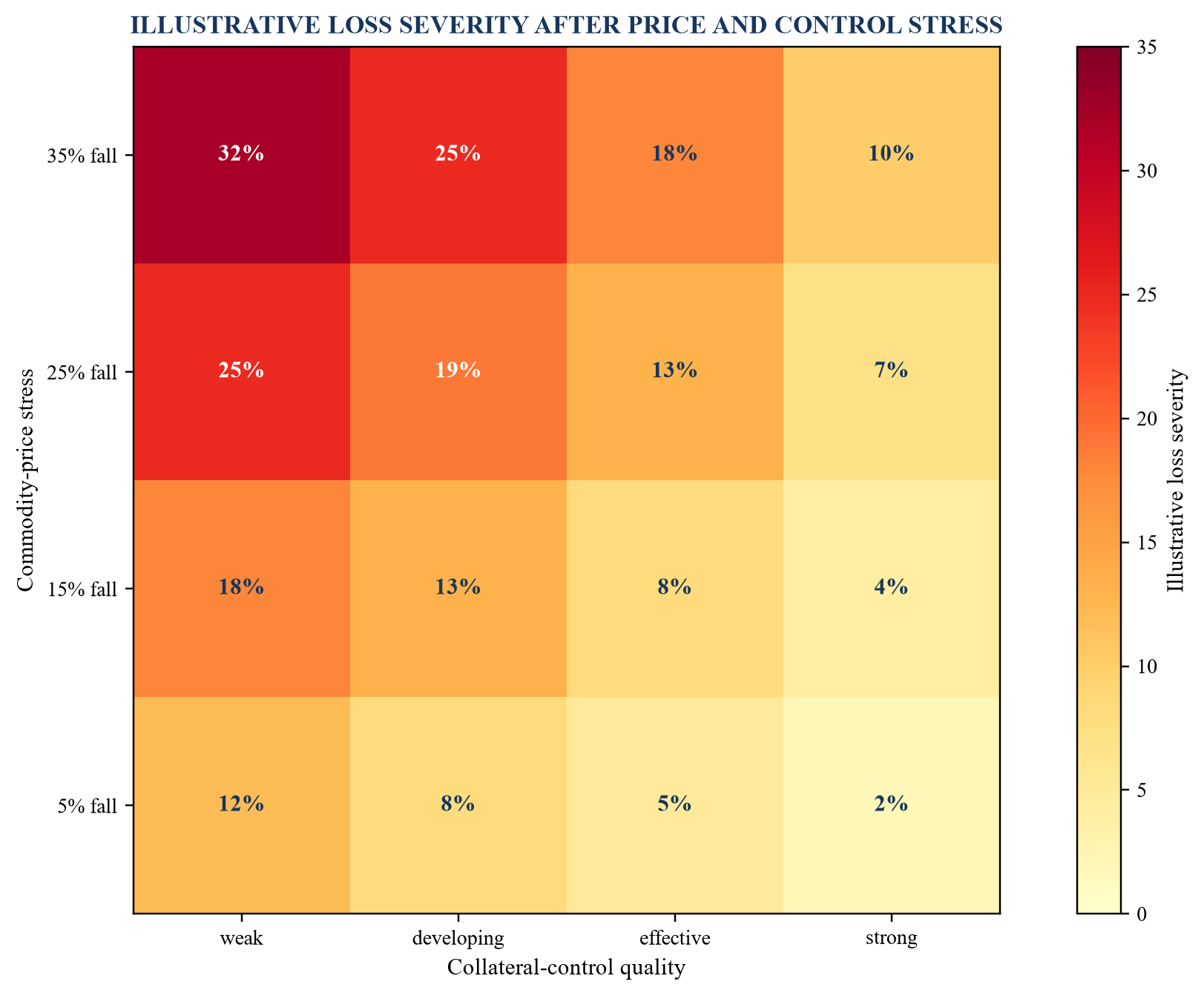
Scores are hypothetical. Strong operational control can reduce loss severity but cannot remove market risk.
8. Measure quantity, quality, ageing and shrinkage independently
Quantity controls should begin at intake. Calibrated weighbridges, ticket sequencing, supplier identity, vehicle records, timestamps and warehouse acceptance should reconcile to purchase and payment. Independent cycle counts and full counts should be risk-based. Remote reports cannot replace physical verification where shortage would materially affect availability.
Quality determines both price and saleability. The facility should define approved grades, testing method, sample custody, laboratory standards, dispute process and retesting. Moisture, foreign matter, infestation, contamination, disease, pesticide residue and storage conditions can affect different commodities. Quality should be monitored during holding, not fixed permanently at intake.
Ageing changes risk. Storage cost accumulates, commodity condition can deteriorate, crop-year preference can change and documentation becomes harder to reconcile. Maximum-age limits should reflect the product, warehouse, packaging, climate, market and buyer. Aged stock should attract progressive haircuts before it becomes ineligible.
Shrinkage should be measured by location, commodity, season and process. Approved technical loss should be based on evidence and reconciled to actual history. Unexplained loss, repeated manual adjustment or persistent variance above tolerance may signal weak controls or diversion. The lender should deduct unverified variance immediately and investigate root cause before restoring availability.
9. Add receivables only when sale and collection are evidenced
Receivables can extend the borrowing base after eligible stock is sold, preserving continuity from physical collateral to cash. Eligibility requires a completed sale, approved buyer, enforceable invoice, evidence of delivery and acceptance, absence of material dispute, ageing within limit and payment into a controlled account. Related-party and circular transactions should be excluded unless separately approved and independently substantiated.
Buyer underwriting should include financial strength, payment behaviour, industry position, country and transfer risk, concentration, contractual rights, deductions and set-off. A recognised multinational buyer may still have local-entity, acceptance or currency risks. A government or state-linked buyer may have delayed budget or administrative processes. The facility should use buyer-specific limits and advance rates.
The lender should verify invoices directly with buyers on a risk-based basis. Data should reconcile sale order, dispatch, delivery, acceptance, invoice, credit note and collection. Sales near reporting dates, repeated invoice cancellation, unusual round amounts, delivery to non-standard locations or rapid growth in one buyer require additional testing.
IFC's disclosed AgroComp II structure combines stock monitoring with receivables covered by prime insurers, illustrating how different asset and risk controls can coexist in one trade facility.[2] Insurance does not replace buyer verification. Policy wording, limits, deductibles, waiting periods, exclusions, claims procedure and assignment of proceeds determine whether insured value is available to the lender.
Table 3. Receivables eligibility and concentration controls
| Control | Eligible condition | Typical exclusion | Monitoring evidence |
|---|---|---|---|
| sale completion | goods delivered and accepted | consignment, return right or unperformed obligation | delivery and acceptance record |
| buyer approval | buyer within approved credit limit | unapproved, sanctioned or related party | credit file and confirmation |
| ageing | invoice within contractual and facility limit | overdue, repeatedly extended or disputed | ageing and collection history |
| dilution | expected deductions remain within reserve | high credit notes, rebates or quality claims | invoice-to-cash bridge |
| concentration | buyer and country below cap | amount above approved concentration | borrowing-base certificate |
| cash control | payment directed to controlled account | collection outside agreed account | bank confirmation and daily sweep |
Advance rates and limits should reflect evidence quality, buyer risk and expected time to cash.
10. Use production evidence carefully before harvest
Pre-harvest finance has no stored commodity at the outset. The lender depends on future production, contractual rights and operating execution. Production evidence can improve underwriting, but it should not be treated as equivalent to controlled inventory. Weather, yield, side-selling, input diversion, disease, farmer default and buyer performance remain material.
The production file should identify farmers or producer organisations, verified acreage, crop, location, planting date, inputs, extension support, expected yield, historical delivery, offtake, pricing and settlement. Remote sensing, field visits, input records and crop-progress observations can corroborate production. Each source has limitations. Satellite imagery may indicate vegetation but not title, contractual commitment, quality or deliverability.
FAO and IFC's crop-receipt work describes a financing instrument linked to future production and emphasises the need for enabling law, structured value chains and pilots.[19] The lender should analyse whether the contractual claim can be created, registered, transferred and enforced, and how it ranks against land, input, labour, tax and competing finance claims. Where enforceability is weak, production evidence may support a conservative cash-flow decision without becoming collateral value.
Disbursement should follow production milestones such as verified input delivery, planting, crop establishment, inspection, contracted offtake and harvest delivery. Direct payment to approved suppliers, farmer registries, controlled purchase accounts and set-off from sale proceeds can reduce diversion. Exposure should migrate from production evidence into eligible inventory only after controlled intake and quality confirmation.
11. Design insurance around the lender's actual loss pathways
Insurance should be mapped to named assets, locations, perils, parties and cash proceeds. Stock cover may address fire, flood, theft or other insured damage. Marine or transit cover may protect goods in movement. Trade-credit insurance may cover buyer non-payment. Crop or index products may address defined production risks. Political-risk insurance may cover specified government or transfer events. Each policy responds to a different loss pathway.
The lender should review insured party, loss payee, assignment, sum insured, valuation basis, deductible, exclusions, warranties, aggregation, waiting period, notification, claims documentation, insurer strength and reinstatement. Policies should match the actual commodity, warehouse, route and contract. Underinsurance and average clauses can reduce recoveries. A policy can lapse because of unpaid premium or breach of a storage warranty.
Parametric or index insurance pays according to a defined trigger rather than measured asset loss. African Risk Capacity's drought model uses rainfall and crop-model information to estimate impact, while recent payouts show the mechanism in operation at sovereign level.[16][17] Basis risk remains: the trigger and the borrower's actual loss may differ. Credit modelling should therefore treat expected insurance proceeds according to trigger design, attachment, payout timing and assignment rather than assuming full indemnity.
Claims capability matters. The borrower and collateral manager should know who reports an incident, preserves evidence, mitigates loss, appoints surveyors and communicates with insurers. The lender should receive prompt notice and control material settlement decisions where permitted. Insurance proceeds should enter the controlled waterfall and first restore collateral or repay exposure.
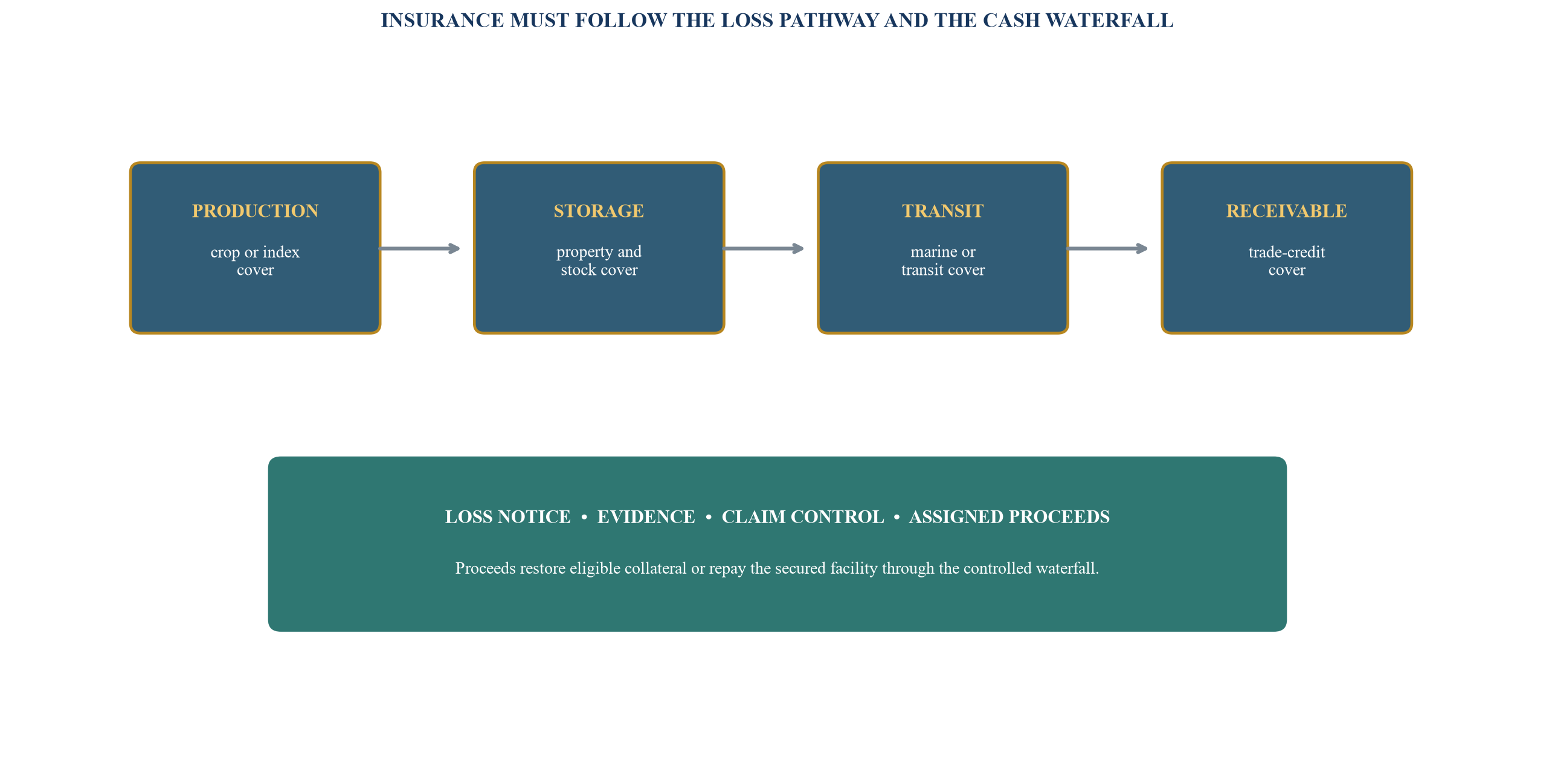
Coverage categories are illustrative and require policy-specific legal and technical review.
12. Control currency, cross-border and trade-document risk
Agribusiness facilities often combine local-currency procurement with hard-currency imports, exports or debt. Currency mismatch can weaken both collateral value and repayment capacity. The model should show the currency of purchases, inventory reference price, sales, receivables, operating costs, taxes, insurance, debt service and cash accounts. Natural hedges should be demonstrated through matched flows and timing.
Foreign-exchange availability and convertibility may matter even when the borrower earns local cash sufficient in nominal terms. African Development Bank's 2025 Trade Finance Report identifies foreign-exchange liquidity as a major constraint reported by banks.[14] The facility should consider central-bank rules, export-proceeds repatriation, conversion documentation, transfer restrictions and the ability to service an offshore lender.
Trade documents should be integrated into control. Bills of lading, warehouse receipts, inspection certificates, certificates of origin, export licences, letters of credit, guarantees and insurance documents can support financing when their authenticity, transfer, consistency and custody are verified. Documentary compliance does not prove physical or commercial performance by itself. Documents should reconcile to the underlying goods, buyer and cash.
The structure should allocate country, buyer, bank, transport and political risks. Confirmed letters of credit, risk participation, export-credit or DFI support may mitigate specific exposures. They should be analysed according to the actual obligor, conditions and claims path. A lender should not treat a development institution's involvement elsewhere in a value chain as transaction protection.
13. Calculate availability through separate collateral components
A borrowing base should calculate each asset category separately. Eligible inventory is multiplied by the lower of cost and stressed net realisable value, then by an advance rate. Eligible receivables are reduced for dilution, concentration and insurance limitations before their advance rate. Verified production evidence may support a smaller milestone-based sublimit where legally and commercially justified. Cash and approved documentary instruments may receive distinct treatment.
Reserves should be explicit. They may cover storage and collateral-manager charges, taxes, prior-ranking claims, insurance deductibles, processing cost, transport to market, liquidation expense, currency mismatch, hedging margin, buyer deductions, quality risk and accrued interest. A reserve should represent a measurable loss pathway rather than a discretionary plug.
Availability equals total eligible collateral value after advance rates and reserves, subject to facility and concentration limits. Outstanding loans, letters of credit, guarantees, accrued interest and other secured obligations are then deducted. A deficiency should require cash repayment, additional eligible collateral or an agreed suspension of releases. Cure periods should reflect how quickly the risk can deteriorate.
The certificate should be produced at a frequency aligned to collateral movement. Daily or weekly reporting may be appropriate during peak procurement, while monthly reporting may suffice in quieter periods. The lender should have direct data access or independent confirmation for critical fields. Management certification remains useful but should not be the sole evidence.
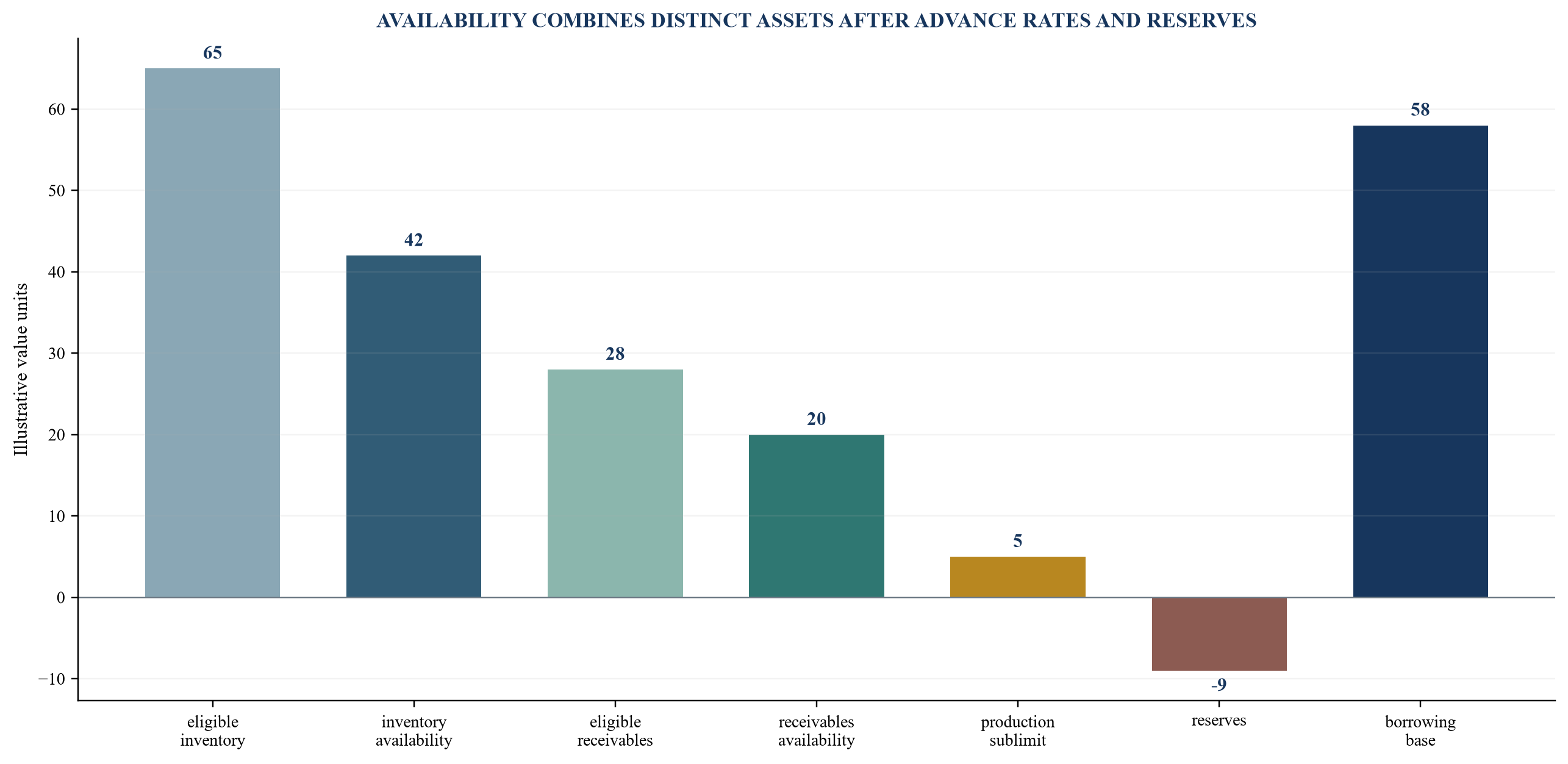
Values and advance rates are hypothetical and demonstrate the separation of asset categories and reserves.
14. Link advance rates to evidence quality and loss severity
Advance rates should be derived from stressed recovery rather than copied from another market. The analysis should begin with the lower of verifiable cost and net realisable value. It should then model price decline, basis widening, grade discount, shortage, ageing, buyer delay, currency movement, enforcement time, sale cost, taxes and senior claims. The result is a recovery distribution, not a single optimistic case.
Control quality affects the probability and size of loss. Strong title evidence, licensed or approved warehouses, independent custody, frequent inspection, controlled release and transparent markets can support a higher rate than borrower-controlled stock with weak records. Receivables to diversified, approved buyers with direct confirmation and cash dominion differ from invoices exposed to dispute, set-off and collection outside the facility.
Advance rates should also reflect concentration. A large position in one commodity, warehouse, buyer, country or season may be difficult to liquidate even when each individual asset is eligible. Sublimits and concentration haircuts keep the borrowing base inside realistic sale capacity. Correlated exposures should be aggregated, including buyers dependent on the same end market or warehouses exposed to the same flood or transport corridor.
The credit agreement should allow rates and reserves to change according to objective triggers such as volatility, market closure, insurance change, control breach, ageing or weaker collections. Discretion should be governed through an agreed process to avoid sudden, unexplained liquidity withdrawal. The borrower's treasury plan should maintain headroom for predictable variation.
15. Establish cash dominion and a repayment waterfall
Collateral conversion protects the lender only when proceeds enter controlled accounts. Buyers should receive authenticated payment instructions directing funds to designated collection accounts. Account-control agreements, bank acknowledgements, daily reporting and sweeps should reflect local law and bank capability. Collections received elsewhere should be transferred promptly and treated as an exception.
The waterfall should prioritise taxes or statutory amounts that must lawfully be paid, essential collateral preservation costs, secured interest and principal, agreed operating releases and distributions. The precise order depends on law and transaction design. The facility should limit payments to shareholders, affiliates and junior creditors while a borrowing-base deficiency or default exists.
Multi-country structures may require local accounts that sweep to a regional or offshore account. Exchange-control, export-proceeds and withholding rules can constrain movement. The lender should test the end-to-end process before first utilisation, including weekends, system outages and local bank cut-offs. A theoretical account pledge without operational ability to monitor and sweep cash provides limited protection.
Daily cash visibility can identify stress before financial statements. Falling collections, buyer deductions, transfers to unknown accounts, cash retained by agents or unexpected tax payments should trigger investigation. Treasury forecasting should connect expected receipts to mandatory repayment and upcoming procurement so that the next crop cycle does not depend on rolling an unresolved shortfall.
16. Use covenants as operating thresholds
Borrowing-base lending requires covenants tied to asset conversion. Financial covenants remain relevant, including leverage, interest cover, tangible net worth, liquidity and capital expenditure. Operational covenants provide earlier warning: stock shortage, ageing, quality failures, buyer concentration, receivable days, collection variance, insurance lapse, warehouse licence, collateral-manager breach and unauthorised release.
Information covenants should specify daily, weekly, monthly and event-driven reporting. Peak-season reporting may include stock movements, price marks, headroom, receivable ageing, collections and exceptions. Monthly reporting should reconcile borrowing-base certificates to ledgers, accounts and independent reports. Annual requirements include audited accounts, insurance review, legal confirmations and environmental or social compliance where applicable.
Events of default should distinguish remediable reporting failures from threats to collateral. Fraud, duplicate pledge, loss of title, unauthorised movement, false certificate, account diversion, warehouse access denial or material insurance failure may require immediate suspension. A minor administrative delay may support a short cure. Clear grading supports proportionate action.
Table 4. Covenant and intervention ladder
| Signal | Early-warning response | Availability response | Enforcement preparation |
|---|---|---|---|
| headroom decline | increase reporting and review cash plan | reduce discretionary release | confirm collateral and accounts |
| ageing or quality drift | require sale or remediation plan | increase haircut or exclude lot | obtain bids and inspection |
| buyer collection delay | verify invoice and dispute | reserve or exclude receivable | notify insurer and assess set-off |
| stock variance | freeze movement and recount | deduct shortage immediately | secure site and preserve evidence |
| insurance or licence breach | cure, replace or relocate | suspend affected collateral | notify stakeholders and legal counsel |
| diversion or false reporting | investigate and control cash | suspend all availability | activate recovery and enforcement plan |
Thresholds should be calibrated to commodity, season, jurisdiction and verified borrower history.
17. Use data and AI as verification tools with human accountability
Digital systems can improve transaction identity, stock reconciliation, price monitoring, buyer ageing, route tracking and exception detection. Remote sensing can support crop-progress review. Computer vision may assist grade or condition assessment. Machine-learning models may flag abnormal yields, duplicate invoices, unusual stock movement or collection patterns. These tools can strengthen coverage across dispersed locations.
Model output should not be treated as collateral. Diligence should establish data rights, source quality, completeness, timestamp integrity, location accuracy, version control, override authority, false-positive and false-negative rates, drift and escalation. The lender should know which decisions remain human, how exceptions are resolved and whether source records can be reconstructed after a dispute.
The data architecture should preserve a stable transaction identity across procurement, storage, sale and cash. Interfaces among borrower systems, warehouse operators, collateral managers, banks, insurers and buyers should be tested. Manual spreadsheets may remain necessary in some markets, but controlled templates, access limits, version history and independent reconciliation are required.
AI can also create new risks. Synthetic documents, manipulated images, duplicated identities and coordinated transactions can make weak evidence appear complete. Verification should combine system tests, direct third-party confirmation, physical inspection and bank evidence. Technology changes the cost and speed of control; it does not transfer accountability from the lender or collateral parties.
18. Detect diversion, duplicate finance and related-party risk
Agribusiness facilities are exposed to diversion because commodities are movable, fungible and traded across multiple channels. Duplicate financing can occur through multiple receipts, conflicting registry filings, off-system stock, receivables sold to more than one financier or proceeds redirected outside controlled accounts. Controls should search across legal, physical, system and cash records.
Related parties require complete mapping. Farmers, agents, transporters, warehouses, buyers and service companies may share ownership or management links with the borrower. Transactions can still be genuine, but pricing, delivery, credit and cash should be independently supportable. Unexplained margins or losses at affiliate entities may remove value from the secured perimeter.
Fraud indicators include round-number trades, repeated manual adjustments, inventory growth without matching purchases, receipts issued outside sequence, implausible yield, identical photographs, buyer confirmations from borrower-controlled domains, rapid invoice reversal, payments from unrelated parties and collection into personal or unapproved accounts. No single indicator proves misconduct. Clusters require investigation and temporary protection of availability.
Whistleblowing, staff rotation, mandatory leave, access review, audit trails and independent surprise inspections can improve detection. The lender should agree evidence-preservation and investigation procedures in advance. Recovery may depend on quickly securing warehouses, accounts, documents and digital records before assets move.
19. Combine private credit with guarantees and catalytic risk sharing carefully
Development institutions and public programmes may provide guarantees, first-loss support, risk participation, concessional capital or technical assistance. African Development Bank materials describe current efforts to expand smallholder and agri-SME finance, including risk-sharing and blended instruments.[12][13] IFC's warehouse and trade programmes demonstrate risk participation alongside commercial lenders.[1][3]
Risk sharing should address an identified constraint. A guarantee may absorb part of borrower default. Political-risk cover may address specified government events. A first-loss tranche may improve senior protection. Technical assistance may strengthen systems or producer capacity. None of these instruments substitutes for title, custody, reporting or collection control.
The lender should analyse eligibility, covered percentage, first-loss or pari passu allocation, claim conditions, exclusions, currency, tenor, cancellation, recovery sharing and payout timing. A facility can face a liquidity shortfall even when a claim is ultimately valid. Capital and reserves should reflect the delay and residual exposure.
Pricing should recognise both risk and operating intensity. Agribusiness borrowing-base facilities require legal work, collateral management, inspection, technology, insurance, treasury and monitoring. Fees and margins should be transparent and compatible with borrower economics. Excessive cost can encourage off-book transactions or make productive use of the facility uneconomic.
20. Make the investment decision through a recovery-first credit memorandum
The credit memorandum should begin with the repayment and recovery routes. It should identify the transaction, use of proceeds, obligors, security, warehouses, collateral parties, buyers, accounts, insurers, jurisdictions and control responsibilities. It should quantify the borrowing base under base and downside cases, showing which assets remain realisable after price, quality, quantity, buyer, currency and enforcement stress.
The committee should receive a legal and operational conditions-precedent list. Legal items include capacity, security documents, perfection, priority, registrations, account control and opinions. Operational items include approved warehouses, collateral-manager appointment, opening stock count, buyer confirmations, insurance endorsements, system access, reporting tests and a successful dry run of the cash waterfall.
Monitoring should be designed before closing. The committee should approve reporting frequency, exception thresholds, inspection rights, advance-rate change process, reserve methodology, concentration limits, hedging rules, cure periods and authority to suspend releases. Named owners should be accountable across the lender, borrower, collateral manager, account bank and advisers.
The recovery plan should identify how the lender would control sites, preserve goods, replace a collateral manager, notify buyers, collect receivables, claim insurance, obtain bids, sell stock and apply proceeds. It should consider local insolvency, enforcement and practical access. A facility should not be approved when recovery depends on an untested legal theory, an unavailable buyer or a price that assumes an orderly market after default.
Table 5. Credit-committee evidence and decision gates
| Gate | Evidence required | Approval question | Failure response |
|---|---|---|---|
| transaction | crop-to-cash map and entity perimeter | is the primary repayment route observable? | narrow use, tenor or obligor set |
| enforceability | local opinions, registrations and priority analysis | can security and proceeds be controlled and realised? | restructure or exclude jurisdiction |
| collateral | opening count, eligibility and independent reports | does the borrowing base reflect recoverable assets? | haircut, reserve or reject assets |
| cash | account control and waterfall test | will conversion repay debt automatically? | redesign collections before funding |
| downside | combined price, loss, buyer and currency cases | is exposure covered under coherent stress? | reduce limit or add protection |
| recovery | sale route, insurer, counsel and action plan | can intervention begin before value erodes? | require readiness or decline facility |
Approval should remain conditional until documentary, operational and live-control tests are complete.
The core principle is disciplined conversion. Private credit can finance African agribusiness effectively when availability follows assets that are identifiable, enforceable, controlled, insured where appropriate, saleable and connected to cash. Commodity price remains important. Credit resilience comes from the complete system that carries value from production and procurement to repayment.
References
- International Finance Corporation. "Improving Working Capital Finance for Agricultural Producers and Traders: Global Warehouse Finance Program." Updated July 2026. https://www.ifc.org/en/what-we-do/sector-expertise/trade-and-supply-chain-finance/global-warehouse-finance-program
- International Finance Corporation. "GWFP AgroComp II: Summary of Investment Information." Updated 2 March 2026. https://disclosures.ifc.org/project-detail/SII/51039/gwfp-agrocomp-ii
- International Finance Corporation. "IFC and Absa Provide Trade Facility to Valency to Support Thousands of Farmers in Africa." 9 October 2024. https://www.ifc.org/en/pressroom/2024/ifc-and-absa-provide-trade-facility-to-valency-to-support-thousands-of-farmers-in-africa
- World Bank. "Can Warehouse Receipts Unlock Farmer Finance?" 29 January 2025. https://blogs.worldbank.org/en/psd/can-warehouse-receipts-unlock-farmer-finance-
- World Bank. "Secured Transactions and Collateral Registries." https://www.worldbank.org/en/topic/financialsector/brief/collateral-registries
- World Bank. "Business Ready FAQ: Financial Services and Collateral Registries." https://www.worldbank.org/en/businessready/about-us/faq
- Kenya Law. Warehouse Receipt System Act, Cap. 350, revised 31 December 2022. https://new.kenyalaw.org/akn/ke/act/2019/8/eng@2022-12-31
- Warehouse Receipt System Council of Kenya. Warehouse Receipt System Regulations, 2021. https://wrsc.go.ke/wp-content/uploads/2025/05/WRS-REGULATION-2021-1.pdf
- Central Bank of Nigeria. "National Collateral Registry." https://www.cbn.gov.ng/DFD/ncr.html
- Organisation for the Harmonisation of Business Law in Africa. "Organizing Securities Law." https://www.ohada.org/en/organizing-securities-law/
- Organisation for the Harmonisation of Business Law in Africa. "Availability of the English Version of the New Uniform Act Organizing Simplified Recovery Procedures and Enforcement Measures." 7 February 2024. https://www.ohada.org/en/availability-of-the-english-version-of-the-new-uniform-act-organizing-simplified-recovery-procedures-and-enforcement-measures/
- African Development Bank. "Agri-Food SME Catalytic Financing Mechanism." 2025. https://www.afdb.org/en/topics-and-sectors/initiatives-and-partnerships/agri-food-sme-catalytic-financing-mechanism-acfm
- African Development Bank. "African Development Bank Mulls $500 Million Facility to Mobilize Financing for Smallholder Farmers." 19 March 2025. https://www.afdb.org/en/news-and-events/press-releases/african-development-bank-mulls-500-million-facility-mobilize-financing-smallholder-farmers-81927
- African Development Bank. "2025 Trade Finance Report Highlights Resilience of African Financial Institutions after Covid-19." 28 May 2026. https://www.afdb.org/en/news-and-events/press-releases/am2026-afdb-2025-trade-finance-report-highlights-resilience-african-financial-institutions-after-covid-19-93697
- World Bank. Commodity Markets Outlook, April 2026. https://thedocs.worldbank.org/en/doc/f3138644a1e8e2bb631399ae11d6c408-0050012026/original/CMO-April-2026.pdf
- African Risk Capacity Group. "Drought Models." https://arc.int/drought
- African Risk Capacity Group. "Government of Malawi Receives an Insurance Payout Following the 2024 Drought." 25 July 2025. https://www.arc.int/index.php/news/government-malawi-receives-insurance-payout-arc-group-following-2024-drought
- World Bank. "Does Index Insurance Really Work for Smallholder Farmers?" 8 July 2025. https://blogs.worldbank.org/en/developmenttalk/does-index-insurance-really-work-for-smallholder-farmers-
- Food and Agriculture Organization of the United Nations and International Finance Corporation. Crops Receipts: A New Financing Instrument for Africa. 2018. https://documents1.worldbank.org/curated/en/810431548672038875/pdf/134069-PUB-AFR-Crop-Receipts-PUBLIC.pdf
- Food and Agriculture Organization of the United Nations. "Warehouse Receipt Systems: Lessons from Niger." 2020. https://www.fao.org/family-farming/detail/en/c/1618283/
