

1. Begin with cash behaviour at borrower-account level
A microfinance lender can report strong disbursement and portfolio growth while the newest borrowers pay more slowly than earlier cohorts. Period-end collection efficiency may also blend current instalments, arrears recoveries, prepayments and rescheduled amounts. A wholesale lender should begin with the contractual cash expected from each borrower account and reconcile it to cash actually received by date and channel.
The minimum analytical unit is a loan schedule with borrower, household, branch, product, disbursement, principal, rate, fees, instalment dates, amounts due, amounts paid, arrears, days past due, restructuring, settlement, write-off and closure. The tape should reconcile to the loan-management system, collection system, bank accounts, general ledger and credit-bureau submissions. Exceptions should remain visible rather than being netted into a balancing item.
Cash behaviour should be observed through time. A payment collected after its due date may restore a headline collection ratio but still signal liquidity stress. Repeated partial payments, skipped cycles and payment after field escalation can precede default. Conversely, a short disruption followed by durable cure has a different risk profile from an account that repeatedly moves between delinquency bands.
The credit case should therefore state the cash evidence on which it relies. Reported portfolio outstanding is an exposure measure, while lender repayment depends on timing, recoverability and available liquidity. Underwriting starts by rebuilding this connection.
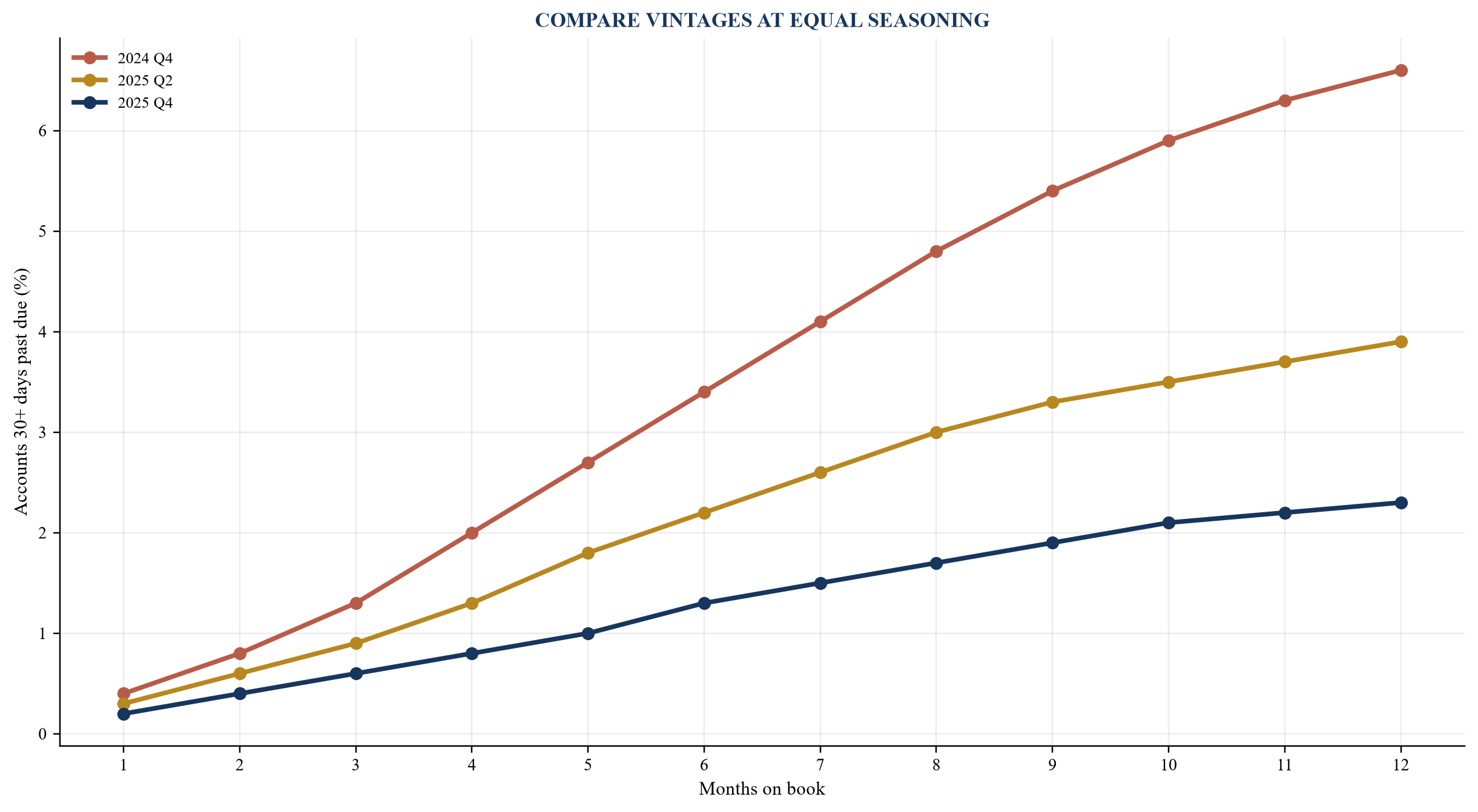
All percentages are hypothetical analytical assumptions used to demonstrate vintage comparison at the same months-on-book.
2. Define the regulated entity and funding perimeter
The borrowing entity, originating entity, servicing entity and receivables owner may differ. A financing perimeter should map regulated status, licences, subsidiaries, branches, bank accounts, technology, employees, customer contracts, security interests and existing debt. The lender should know which legal entity creates each receivable, receives each payment and bears each operating obligation.
The Reserve Bank of India's microfinance framework applies a common definition to collateral-free loans given to households with annual income up to ₹300,000.[1] NBFC-MFIs also have a qualifying-assets test. RBI reduced the minimum qualifying-assets ratio to 60 per cent of total assets net of intangible assets in June 2025 and requires remediation planning where the ratio is breached for four consecutive quarters.[3] The lender should test current classification from source data and monitor migration between qualifying and other assets.
Existing facilities can constrain new debt through negative pledges, borrowing limits, security, cash controls, cross-defaults and pari passu provisions. The debt schedule should reconcile lender confirmations, sanction letters, security filings, trustee records, bank statements and accounting balances. Undrawn amounts, guarantees and securitisation or assignment exposures should be included where they affect liquidity or recourse.
The perimeter work should conclude with a legal-and-cash map. Any receivable attributed to a different entity, subject to an existing transfer, unsupported by enforceable documentation or collected outside controlled accounts should be excluded until resolved.
Table 1. Funding-perimeter evidence map
| Perimeter item | Primary evidence | Lender question | Credit response |
|---|---|---|---|
| regulated status and activities | RBI records, certificates, returns and board papers | may the borrower originate, hold and service the proposed assets? | condition precedent and ongoing representation |
| receivables ownership | loan agreements, ledgers, prior assignments and security filings | are eligible receivables legally owned and unencumbered? | eligibility rule, legal opinion and release evidence |
| collection accounts | bank mandates, statements and payment-channel reports | does cash enter controlled accounts promptly and completely? | account control, sweep and reconciliation covenant |
| existing debt | facility documents, confirmations, charges and repayment history | what ranks ahead, shares security or accelerates with this debt? | intercreditor terms, permitted debt and headroom test |
| servicing platform | contracts, access rights, continuity plans and audit logs | can servicing continue through disruption or enforcement? | service standard, backup servicer and data escrow |
The table is a diligence framework; exact requirements depend on the regulated entity and transaction.
3. Build an auditable portfolio tape
The portfolio tape should be a controlled data product rather than an ad hoc spreadsheet. Each field needs a definition, system source, owner, refresh frequency, validation rule and change history. Stable loan and borrower identifiers should link origination, collections, bureau checks, complaints and accounting without exposing unnecessary personal data to financing parties.
Key financial fields include sanctioned and disbursed amount, principal outstanding, accrued interest, fees, contractual yield, remaining tenor and next due date. Behaviour fields include scheduled and actual payments, delinquency start, maximum arrears, cure, restructure, settlement and write-off. Context fields include branch, district, state, loan purpose, borrower occupation, household income, household obligations and bureau enquiry date.
Validation should test uniqueness, completeness, chronology and arithmetic. Disbursement should precede instalments; outstanding principal should reconcile movements; closure should agree to payment or write-off; delinquency should follow contractual due dates; and totals should reconcile to the general ledger. Changes to due dates, arrears status or borrower identifiers require an audit trail.
A lender should receive aggregated analytical data for underwriting and the minimum personal data necessary for verification and enforcement. Access, encryption, retention, incident response and permitted use should be documented. Data quality is part of credit quality because eligibility, reserves and triggers depend on it.
Table 2. Minimum portfolio-tape data dictionary
| Data domain | Core fields | Validation | Credit use |
|---|---|---|---|
| identity and household | stable IDs, household link, income band and bureau date | duplicate, link and recency tests | leverage, overlap and eligibility |
| contract | product, principal, price, term, dates and schedule | contract-to-system reconciliation | yield, tenor and enforceability |
| payment | amount due, amount paid, date, channel and reversal | bank and collection-system reconciliation | collection timing and roll rates |
| status | days past due, cure, restructure, settlement and write-off | rule consistency and audit trail | reserves, exclusions and triggers |
| geography and operations | branch, district, state, officer and group | master-data and boundary checks | concentration and field controls |
Fields should be linked to named systems, validation rules and responsible owners.
4. Compare vintages at the same months-on-book
A vintage groups loans by a common origination period and follows them through equal seasoning. This avoids comparing a young portfolio, which has had little time to default, with an older portfolio whose risk has emerged. Monthly or quarterly vintages should show account and balance delinquency, cumulative loss, prepayment, restructuring and recovery.
The denominator should be defined consistently. Original balance supports cumulative-loss analysis, while current balance supports exposure analysis. Closed and prepaid loans should remain traceable so that a shrinking denominator does not make residual arrears appear artificially large. Acquisitions, migrations and product changes should be identified rather than blended.
Vintages should be split by product, branch, state, ticket size, borrower cycle, household leverage, officer and acquisition channel. A recent improvement may reflect tighter underwriting, lower growth, geographic mix, write-offs or limited seasoning. Management should explain the mechanism and produce evidence before the lender treats the change as durable.
The lender can convert vintage curves into an early-warning rule. If a new cohort exceeds the approved path at a specified month, growth can slow, eligibility haircuts can rise or enhanced review can begin. The response should be proportional and documented.
5. Map delinquency transitions rather than a single arrears ratio
A period-end portfolio-at-risk measure shows stock in delinquency bands. It does not show the movement that created the stock. A transition matrix records how balances move from current to early arrears, deeper arrears, cure, closure or write-off over a defined interval. The matrix separates new slippage from persistent delinquency and recoveries.
Transitions should be calculated on opening balances with explicit treatment of disbursement, scheduled principal, prepayment and write-off. Current-to-early-arrears movement is an origination and collection signal. Early-arrears-to-current movement measures cure. Deep-arrears persistence informs loss severity and recovery timing. Write-offs should remain connected to earlier delinquency paths.
Roll rates can be compared across branches and vintages. A high reported collection rate alongside rising current-to-arrears movement may indicate collection of old balances while fresh stress emerges. A rapid cure followed by relapse can indicate temporary payment or status manipulation. Account and balance views should be read together.
Transaction triggers can reference rolling averages and material deviations rather than one volatile observation. The lender should preserve discretion for operational events, data errors and regulatory relief measures, supported by documented analysis.
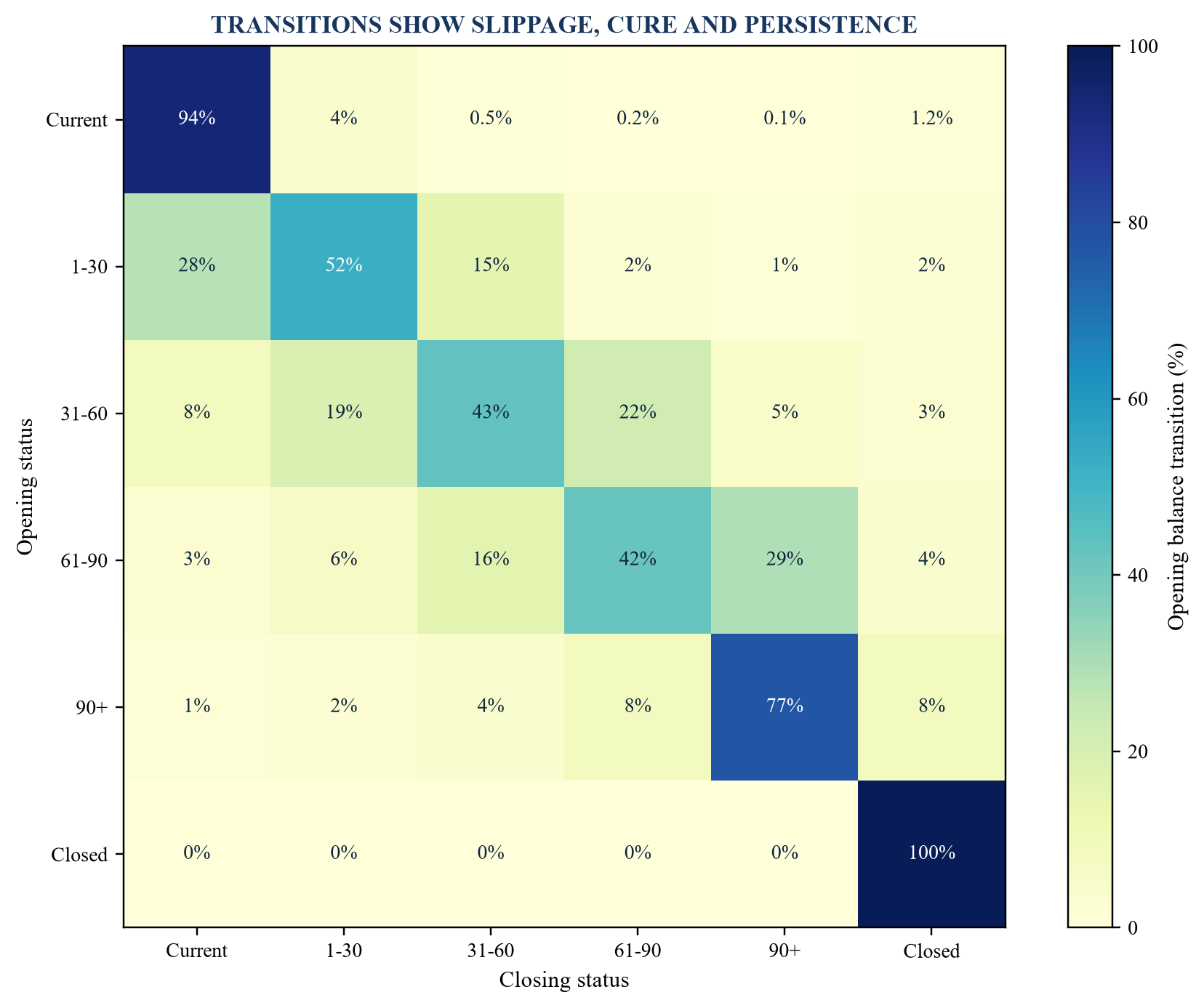
All transition percentages are hypothetical analytical assumptions and rows sum to approximately 100 per cent.
6. Separate cures, restructures, settlements and write-offs
An account returning to current status can represent full contractual cure, a due-date change, capitalised arrears, refinancing, settlement or a temporary payment. These outcomes have different economics. The portfolio tape should preserve the original schedule, revised schedule, cash received and approval reason.
Restructuring policy should define permitted circumstances, authority, affordability reassessment, borrower consent, bureau reporting and subsequent classification. Repeated extensions can postpone recognition without restoring household repayment capacity. The lender should review frequency, concentration and performance after modification.
Settlements and write-offs need a complete trail from delinquency through approval and recovery. Gross and net write-offs should be reported separately. Recoveries after write-off should not erase the original loss cohort. Sale, assignment or collection-agency proceeds should identify costs and recourse.
The credit model should use observed cure and recovery by delinquency age, vintage and segment. Management estimates can be shown separately with sensitivity. Cash recovery timing matters because delayed recovery consumes liquidity even where ultimate loss is limited.
7. Test household obligations and borrower overlap
RBI's framework limits monthly household loan repayments to 50 per cent of monthly household income and includes both microfinance and non-microfinance loans in the calculation.[1][2] Expected income from the proposed financed activity is excluded from household-income assessment.[2] The lender should verify how the borrower applies these requirements at origination and renewal.
The control should use household linkage, current bureau data, declared obligations, repayment schedules and documented exceptions. Bureau latency, mismatched identifiers and informal obligations can create gaps. The process should record enquiry date, data sources, disputed entries and the treatment of joint or household borrowing.
MFIN's Guardrails 2.0 reduced the maximum number of microfinance lenders for a client to three, retained a ₹2 lakh indebtedness cap while including unsecured retail loans, and restricted lending to a client with more than 60 days past due and outstanding above ₹3,000. The stated implementation dates were 1 January or 1 April 2025, depending on the control.[7] These industry controls apply within the MFIN framework and do not replace the RBI requirements or a lender's own underwriting. The financing diligence should identify which standards apply and test their operational implementation.
Overlap analysis should compare unique borrowers and households across lenders, products and cycles. SIDBI's March 2026 report noted retail-loan overlap in a sample of microfinance borrowers.[6] A borrower with multiple facilities may remain current until a local income shock or one lender tightens collections. Stress testing should therefore increase correlated default and slow recovery for high-overlap segments.
8. Measure concentration as correlated loss and liquidity risk
Granular loan counts do not guarantee diversification. Borrowers can share weather, employer, commodity, political, infrastructure or collection-channel exposure. Concentration should be measured by state, district, branch, officer, product, ticket, borrower cycle, occupation and payment method, with linked stress assumptions.
State and district shares should be calculated on outstanding, disbursement, arrears and loss. A region with modest outstanding but a high share of new disbursement can drive future risk. Branch clusters should reflect operating catchments rather than administrative labels alone. Border areas and common market routes can transmit shocks across districts.
The lender should test simultaneous effects on collection, disbursement, operating cost and refinancing. A local disruption can reduce cash receipts while increasing field expense and slowing the lender's ability to replace runoff. Correlation matters for both credit loss and liquidity.
Limits should be set with headroom for planned growth. A breach response can restrict eligible assets, require additional credit enhancement, slow origination or trigger a remediation plan. Geographic strategy remains a management decision, supported by observable risk and funding consequences.
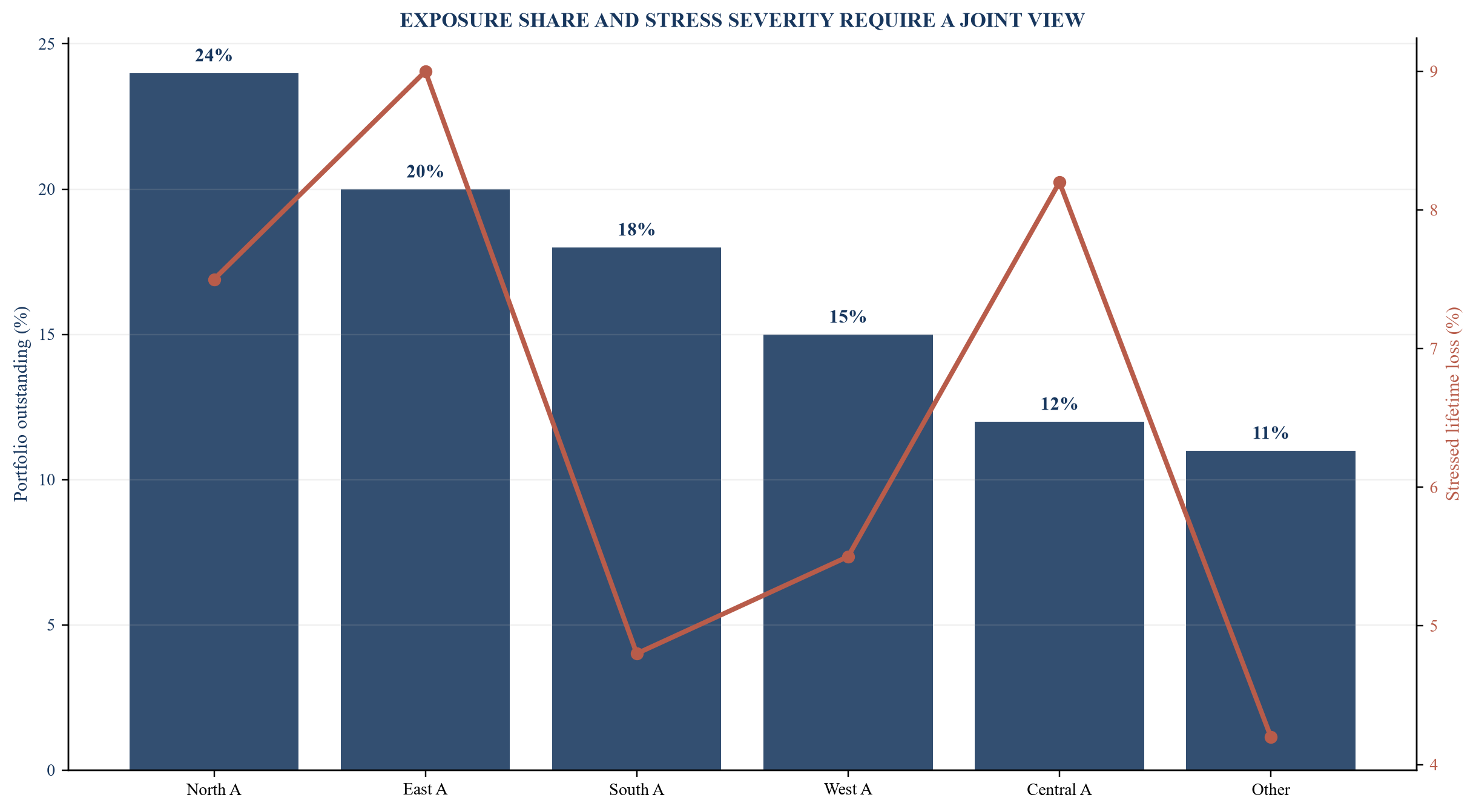
Portfolio shares and stressed loss rates are hypothetical analytical assumptions and do not describe any named lender or market forecast.
9. Assess branch and field operations as credit infrastructure
Microfinance repayment depends on local execution. Branch opening, staffing, officer caseload, route design, borrower meetings, cash handling, digital payment support and complaint resolution can influence payment timing and customer trust. Financial diligence should therefore include operational evidence at branch and officer level.
The lender should compare caseload, travel time, collection schedule, vacancy, turnover, training, supervision and exception rates. Rapid expansion can dilute experience and span of control. High productivity can reflect disciplined routing or excessive caseload. Branch economics should include credit losses, field expense, cash differences, fraud incidents and central support rather than disbursement volume alone.
Site sampling should be risk-based. New, fast-growing, high-arrears, high-cash and high-complaint branches deserve attention alongside representative locations. The review should trace selected accounts from application and bureau check through disbursement, meeting, payment, complaint and ledger. Differences between policy and practice should enter the remediation plan.
Operating indicators can become information covenants. Material staff turnover, system outages, payment-channel failures and branch closure can warn of future collections weakness. The purpose is to connect field capacity to the cash available for debt service.
10. Put borrower protection inside the credit architecture
Borrower protection affects enforceability, reputation, regulatory standing and cash performance. Product suitability, transparent pricing, key-fact disclosure, privacy, grievance handling and fair recovery practices should be assessed as core controls. A lender should avoid relying on collections generated by practices that cannot be sustained.
RBI issued amendments in August 2026 strengthening fair-treatment requirements for recovery and making regulated entities responsible for employees and recovery agents, with effect from 1 January 2027.[8] The borrower should map current practices to the applicable requirements, identify gaps and fund implementation. Training, call records, visit logs, agent due diligence, complaint data and disciplinary action provide evidence.
Complaints should be analysed by product, branch, officer, allegation, age, outcome and repeat occurrence. Low complaint counts can reflect strong practice or inaccessible channels. Mystery testing and borrower sampling can test awareness of terms, payment records and escalation routes. Serious allegations require independent review.
Financing documents can require compliance representations, incident notification, complaint reporting and remediation. A conduct breach should lead to proportionate investigation and protection. Automatic acceleration may worsen outcomes where an orderly cure is available, so enforcement design should consider borrowers and portfolio value.
11. Define eligible receivables before calculating availability
A borrowing base converts a portfolio into permitted secured exposure. Eligibility should be objective, reproducible and linked to data available at each reporting date. Typical tests cover legal ownership, enforceability, documentation, currency, jurisdiction, product, tenor, payment status, restructuring, fraud, dispute, concentration and prior encumbrance.
Eligibility is binary only at the first layer. A loan can satisfy minimum conditions while still warranting a haircut for seasoning, location, ticket size, borrower cycle or data quality. The lender should avoid a rule set so broad that weak receivables enter at full value, and avoid complexity that the borrower cannot calculate reliably.
The base should start from verified principal outstanding rather than sanctioned amounts or expected future disbursement. Accrued interest, fees, penalties, capitalised arrears and unsupported balances should be treated explicitly. Duplicate, closed, prepaid and written-off accounts should be excluded.
Eligibility testing should be automated with version-controlled rules and exception output. Independent sample testing should compare system results to original contracts, payment records and bureau evidence. A material error rate should reduce reliance and may justify a temporary reserve.
12. Apply haircuts for risk that eligibility alone does not capture
Haircuts reduce the collateral value attributed to receivables that remain eligible but carry greater uncertainty. They can address unseasoned vintages, long remaining tenor, high ticket size, repeat restructuring, geographic concentration, weak documentation, payment-channel dependency and slower recovery.
The haircut schedule should follow observed performance and stress analysis. A new vintage may receive a higher haircut until it passes defined months-on-book tests. A concentrated state cluster can receive an incremental haircut above a limit. A data-quality haircut can remain until specified reconciliation failures are cured and independently tested.
Haircuts should avoid double counting with reserves. The calculation methodology should show which risk each adjustment covers and in what order it applies. Concentration excess can be removed before applying advance rates, while expected-loss and dilution reserves can reduce the resulting base. Worked examples should appear in the facility schedule.
Governance matters because a small rule change can materially increase availability. Rule amendments, overrides and waivers should require named approval, impact analysis and audit history. The lender should recalculate historical borrowing bases under the proposed rules to identify sensitivity and hidden reliance on exceptions.
13. Calculate a borrowing base from verified net value
The borrowing-base certificate should reconcile gross principal to eligible collateral, concentration exclusions, haircuts, reserves and the permitted advance rate. It should then compare availability with funded exposure, interest, fees and any other amounts included in the coverage test. The lowest headroom in the reporting period can be more informative than month-end headroom.
The advance rate should reflect expected cash conversion, loss, timing, servicing continuity and enforcement. A high-quality granular pool may support a higher rate than a new or concentrated pool, subject to regulation and legal structure. The rate is a transaction term rather than a substitute for eligibility and monitoring.
Availability should be capped by facility commitments and other structural limits. The borrower should report assets added, removed, cured, prepaid, written off and substituted. Cash collections on financed receivables should flow through agreed accounts and reduce exposure or fund permitted redraws under the waterfall.
Independent verification can be periodic and risk-triggered. The verifier should reproduce the certificate from source data, sample legal and payment evidence, and report exceptions. The lender should retain the right to increase reserves or exclude assets where data reliability deteriorates.
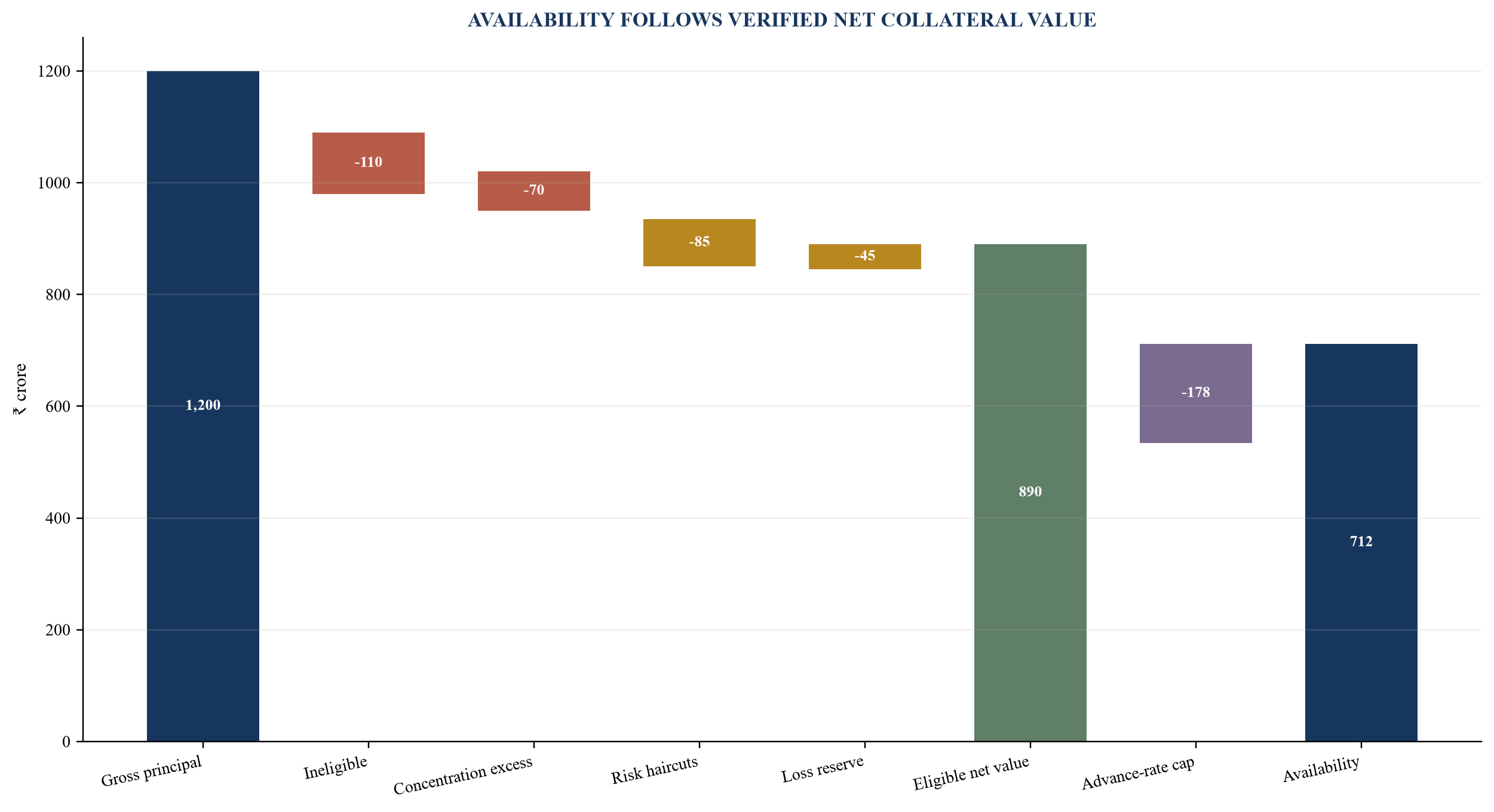
Values are hypothetical ₹ crore amounts and demonstrate calculation architecture only.
14. Size delinquency and dilution reserves separately
A delinquency reserve protects against expected principal loss and delayed recovery in the financed pool. It can be derived from vintage loss, roll rates, cure, recovery timing and stress. Recent benign performance should be balanced against older cohorts and the possibility that write-offs reduce reported arrears.
Dilution covers reductions in receivable value unrelated to credit default, including waivers, refunds, system corrections, disputed charges, unauthorised fees and documentation defects. Mixing dilution with credit loss can hide the control responsible for erosion. Separate measurement supports targeted remediation.
Reserves can include a dynamic component. If current-to-arrears roll rates, write-offs, restructures, complaints or data exceptions exceed approved paths, the reserve can rise before realised loss appears. The mechanism should use rolling windows, minimum observations and governance for exceptional events.
The lender should compare reserve coverage with stressed cash loss and time to recovery. Accounting provisions may provide useful evidence but serve a different purpose and methodology. Facility reserves should be defined directly in transaction documents and reconciled to source data.
15. Control collections through a transparent cash waterfall
Collections are the primary repayment source. The financing should identify all payment channels, settlement times, reversals, cash handling and reconciliation. Controlled accounts should receive financed-pool collections directly or through a short, monitored transfer path. Leakage and unidentified receipts should be reported.
The waterfall can allocate taxes and permitted collection costs, interest, scheduled principal, reserve top-ups and excess cash. The order should align borrower continuity with lender protection. During a trigger event, cash can amortise exposure or build liquidity while preserving essential servicing expense under agreed limits.
Daily or frequent reconciliation should connect borrower payment, channel report, bank credit, loan ledger and borrowing-base movement. Cash collected in the field requires receipt controls, deposit timing, surprise checks and variance investigation. Digital channels reduce some handling risks while introducing vendor, outage, fraud and reconciliation dependencies.
The lender should test the waterfall under low collections and system disruption. Access rights, signatories, bank set-off, account location and insolvency treatment require legal review. Operational runbooks should define who acts when an expected sweep fails.
16. Match maturity and liquidity to portfolio runoff
Portfolio receivables amortise through frequent instalments, while wholesale facilities may have bullet, revolving or scheduled repayment. The liquidity model should connect contractual collections, expected collections, disbursement plans, operating costs, debt service, margin calls and facility maturity by week and month.
Growth can consume cash because new disbursements precede future collections. A lender should distinguish liquidity needed to refinance the existing portfolio from liquidity needed to fund new origination. The base case, slowdown case and stop-origination case should show the lowest cash point and available sources.
Refinancing concentration deserves explicit limits. Multiple facilities maturing in the same quarter can create pressure even if asset quality remains sound. Committed and uncommitted lines, securitisation, assignment, deposits and equity should be listed with conditions, draw status and counterparty concentration.
Liquidity triggers can reference unrestricted cash, near-term debt service, collection coverage and committed undrawn facilities. The response plan should identify controlled amortisation, origination reduction, cost actions, equity support and lender communication. Forecast accuracy should be tracked against actual cash.
17. Test capital buffers after portfolio and funding stress
RBI's regulatory overview states a minimum capital-to-risk-weighted-assets ratio of 15 per cent for NBFC-MFIs, with minimum Tier 1 capital of 7.5 per cent.[4] A private-credit decision should examine both regulatory compliance and economic headroom after stress. A borrower can remain above the minimum while lacking capacity for growth, loss or funding volatility.
The capital bridge should start from verified regulatory capital and risk-weighted assets, then reflect expected profit, distributions, growth, credit loss, operational loss, valuation effects and any regulatory adjustments. The timing of loss recognition matters because rapid growth increases risk-weighted assets before retained earnings accumulate.
Stress tests should combine higher slippage, lower cure, greater write-off, slower collections, concentration shocks and higher funding cost. Management actions such as slowing growth or raising equity should have feasibility, timing and governance. Uncommitted shareholder support should be shown separately from available capital.
Facility covenants can maintain a buffer above regulatory minimums and restrict distributions where headroom narrows. The chosen level should reflect portfolio volatility, data quality, growth and refinancing. Breach response should prioritise a credible capital and liquidity plan.
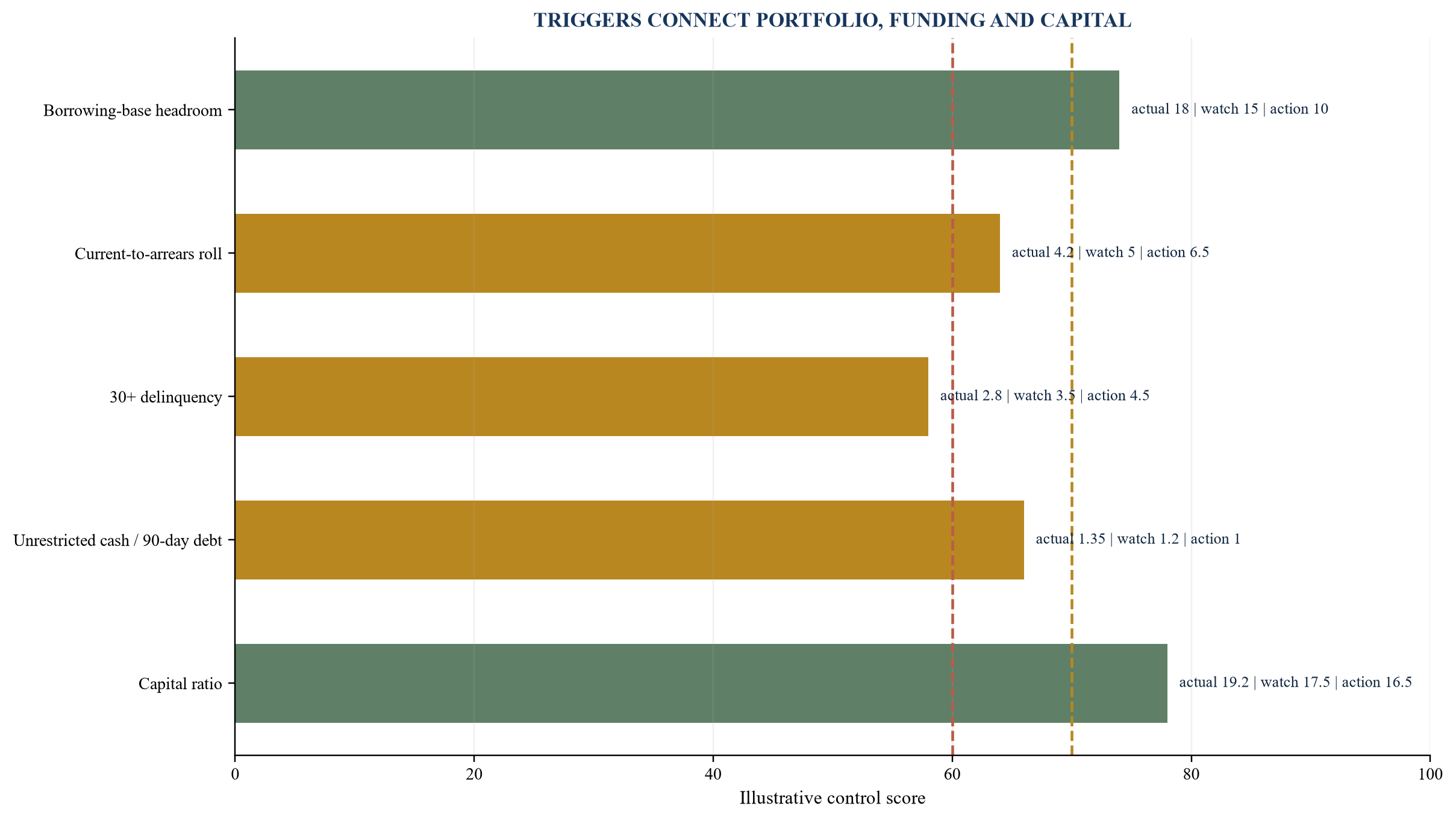
Thresholds and observations are hypothetical analytical assumptions for framework demonstration.
18. Design covenants around the path to loss
Covenants should detect deterioration while management still has options. Portfolio tests can include vintage performance, delinquency transitions, write-offs, restructures, collection shortfall, concentration, borrower overlap and data exceptions. Financial tests can include capital, leverage, liquidity, interest coverage and borrowing-base headroom.
Definitions should be reproducible from named data. The parties should agree numerator, denominator, observation date, cure treatment, write-offs, acquisitions and regulatory relief. Historical back-testing shows how often proposed thresholds would have triggered and whether seasonality or system changes create noise.
The framework can use an information level, watch level and action level. Information triggers increase reporting and analysis. Watch triggers restrict growth, distributions, concentration or eligibility. Action triggers can sweep cash, amortise debt, require equity or stop new utilisation. Each response should have clear timing and waiver authority.
Covenants should operate as a shared control system. A lender needs timely protection, while the borrower needs predictable rules that support orderly remediation. Ambiguous or excessively numerous tests can weaken governance because breaches become routine and waivers replace analysis.
Table 3. Illustrative covenant and trigger architecture
| Indicator | Information response | Watch response | Action response |
|---|---|---|---|
| new-vintage delinquency | cohort commentary and branch split | slower origination and higher haircut | stop affected segment and amortise |
| current-to-arrears roll rate | weekly transition report | enhanced reserve and field review | availability reduction and remediation plan |
| geographic concentration | exposure and disbursement map | no growth above approved limit | exclude excess and require deleveraging |
| liquidity coverage | updated 13-week forecast | distributions restricted | cash sweep, utilisation stop and equity plan |
| capital headroom | regulatory bridge and stress refresh | growth cap and capital plan | mandatory support or controlled runoff |
All thresholds require calibration to verified historical performance, regulation and facility structure.
19. Price for expected loss, liquidity and operating intensity
Facility pricing should cover funding cost, expected credit loss, capital usage, operational monitoring, liquidity, legal structure and target return. A single margin applied to gross portfolio size can underprice weak vintages or overprice a strong seasoned pool. The lender should connect price to the financed risk and structural protections.
Expected loss requires probability, exposure and recovery timing by segment. Tail loss and liquidity should be analysed separately. Commitment fees should reflect undrawn capacity and the cost of maintaining it. Verification, trustee, account-control and backup-servicing costs should be allocated transparently.
Risk-based pricing can include margin grids linked to capital, delinquency, concentration or advance rate. A grid should reinforce desired behaviour without creating sudden cash pressure that accelerates deterioration. Step-ups, reserve increases and amortisation should be modelled together.
The borrower should assess all-in cost against return on deployed assets after credit, operating expense and capital. Growth that appears profitable before field cost, write-offs and funding liquidity can destroy value. Pricing discipline benefits both sides when it makes the economics explicit before disbursement.
20. Govern data, models and reporting as lender controls
Portfolio reporting should follow a controlled close calendar. Source systems, extraction logic, transformations, reconciliations, approvals and delivery should be documented. Material manual adjustments should carry owner, reason, evidence and review. Prior-period restatements should remain visible.
Models for vintage curves, roll rates, borrowing bases and stress should have version control, input lineage, independent review and change approval. The lender should be able to reproduce results from archived data. Overrides should be rare, documented and reported with their financial effect.
RBI required credit institutions and credit information companies to update credit information on a fortnightly basis, effective 1 January 2025.[5] More frequent external reporting increases the importance of consistent borrower identifiers, arrears treatment and correction processes. The facility information package should reconcile material portfolio totals to regulatory and bureau submissions.
Cybersecurity, access control and vendor continuity belong in monitoring because collections and reporting depend on technology. Incident notification should cover data compromise, payment disruption and material model or ledger error. Recovery testing should demonstrate that borrower accounts and collection authority can be restored.
21. Structure security, transfer and enforcement around continuity
Security may include receivables, collection accounts, cash, investments, contractual rights and shares, subject to applicable law and regulation. The lender should obtain current legal advice on creation, perfection, priority, registration, transfer restrictions and enforcement. Existing assignments and pari passu facilities require precise intercreditor treatment.
RBI directions govern transfer and securitisation of loan exposures by regulated entities.[9][10] The proposed structure should be tested against the rules applicable to originator, transferee and assets. True-sale, participation, assignment and secured-loan structures have different accounting, regulatory, tax, servicing and insolvency consequences.
Enforcement planning should address servicing continuity and borrower treatment. A security interest has limited value if data, staff, payment channels and borrower communication fail. Backup servicing can range from documented transition support to a warm standby, calibrated to scale and risk. Data escrow and step-in rights should be operationally testable.
The transaction should preserve lawful borrower-facing terms and payment records through any transfer. Communication authority, grievance handling, recoveries and data use should be planned before an event. Enforcement value depends on orderly cash continuity rather than legal rights alone.
22. Stress the portfolio, balance sheet and cash together
A useful stress test links borrower payment behaviour to collections, losses, liquidity, capital and covenant headroom. Independent shocks applied to each line can miss feedback loops. Higher arrears can reduce eligible collateral, increase reserves, lower availability, raise funding cost and constrain new disbursement simultaneously.
Scenarios can include a state-level disruption, multi-state correlated event, branch-control failure, payment-system outage, policy change, refinancing closure and rapid growth followed by cohort deterioration. Each scenario should state onset, duration, affected exposures, roll-rate changes, cure, recovery, operating cost and management action.
The model should show monthly collections, write-offs, borrowing base, debt service, unrestricted cash, capital ratio and covenant status. The lowest cash and capital points should be identified with dates. Sensitivities should test delayed equity, slower portfolio runoff and weaker recovery.
Scenario values remain analytical assumptions. Governance should focus on relationships, thresholds and available actions rather than apparent precision. Results should feed facility size, tenor, reserves, concentration limits and contingency plans.
23. Run diligence from source evidence to credit decision
The diligence plan should cover regulation, ownership, governance, portfolio, finance, tax, technology, operations, conduct, security and funding. One request list should connect each question to evidence, responsible reviewer, exception, financial effect and closing response. Material inconsistencies should remain open until resolved.
Portfolio testing should reproduce balances and status from raw transactions, sample contracts, bureau evidence, income assessment and bank receipts. Finance work should reconcile portfolio, interest, impairment, borrowing, cash and regulatory capital. Operations work should test branch practice, staffing, cash control, complaints and recovery conduct.
Management interviews should follow data analysis. Questions can then focus on observed vintage changes, roll-rate breaks, concentration, write-offs, restructures and liquidity forecast errors. Explanations should be supported by records and subsequent performance.
The output should separate verified findings, unresolved matters and modelled consequences. Conditions precedent, pricing, exclusions, reserves, covenants and reporting should each trace to a finding. This creates an auditable path from diligence to facility terms.
Table 4. Private-credit diligence workplan
| Workstream | Core test | Evidence output | Financing consequence |
|---|---|---|---|
| portfolio | reconcile tape, vintages, transitions, loss and recovery | tested data set and exception log | eligibility, haircut, reserve and covenant |
| household and conduct | test income, obligations, bureau, disclosure and recovery | sample results and remediation plan | exclusion, representation and monitoring |
| finance and capital | reconcile accounts, debt, cash, provisions and regulatory returns | capital and liquidity bridge | size, tenor, distribution lock and support |
| operations and technology | test branches, channels, systems, access and continuity | control assessment and incident history | account control, backup servicing and reporting |
| legal and regulatory | confirm authority, ownership, security and transfer | opinions, filings and condition list | structure, perfection and enforcement plan |
Scope should be adapted to the borrower, facility and applicable legal framework.
24. Convert closing into a controlled first hundred days
Closing should activate data delivery, account control, borrowing-base calculation, covenant reporting and incident escalation. Named owners on both sides should test access and acceptance before the first utilisation. Any manual bridge should have an expiry and replacement plan.
During the first thirty days, the parties should reconcile the financed pool to contracts, banks, ledger and bureau data; verify security and account flows; and close critical data exceptions. Branch and conduct sampling should target the highest-risk segments identified in diligence. The baseline covenant certificate should be independently reproduced.
By day sixty, management should implement vintage and transition dashboards, concentration limits, liquidity forecasting and remediation tracking. Haircuts and reserves should be recalibrated only where evidence supports change. Technology and backup procedures should be exercised.
By day one hundred, the credit committee should review performance against underwriting. The review should address new vintage paths, cash conversion, complaints, restructures, write-offs, capital, liquidity, reporting accuracy and the status of each closing commitment. Expansion should follow demonstrated control and headroom.
Table 5. First hundred days after facility closing
| Period | Portfolio and cash | Control and conduct | Credit governance |
|---|---|---|---|
| Day 1-10 | confirm eligible pool, accounts and first sweep | activate authority, incident and complaint channels | baseline certificate and issue register |
| Day 11-30 | reconcile tape, bank, ledger and bureau totals | sample branches, contracts and recovery practice | close conditions and set remediation owners |
| Day 31-60 | launch vintages, roll rates and liquidity forecast | test data lineage, access and backup | review thresholds, reserves and concentration |
| Day 61-100 | compare actual cash and loss with underwriting | evidence sustained remediation | approve growth, hold or controlled amortisation |
| ongoing | monthly base and weekly early warning | continuous conduct and incident reporting | documented waivers, actions and audit trail |
The timetable is an implementation framework and should reflect transaction-specific conditions.
25. Make the credit decision on transparent cohort economics
The final credit paper should connect borrower-level cash to pool availability, facility debt service, liquidity and capital. It should identify which cohorts create confidence, which segments require haircuts or exclusions, and which uncertainties remain. Aggregate portfolio growth should appear alongside equal-seasoning performance and cash conversion.
The committee should see a base case, deterioration case and controlled-runoff case. Each should show collections, eligible assets, reserves, availability, debt, cash, capital and covenant status. Proposed management actions should have owners, timing and credible funding. Uncommitted support should remain outside available liquidity.
Approval can be conditional on data remediation, equity, account control, security, concentration reduction, revised collection practice or independent verification. The conditions should be measurable and tied to utilisation. The lender should decline or defer where legal ownership, borrower protection, portfolio data or liquidity cannot be verified.
The disciplined conclusion is direct. Fund verified receivables and observable cash behaviour. Compare cohorts at equal seasoning. Treat write-offs, restructures and concentration transparently. Size availability from eligible net value. Maintain capital and liquidity headroom under correlated stress. This architecture supports responsible growth while preserving early warning and a workable path to repayment.
References
- Reserve Bank of India, Regulatory Framework for Microfinance Loans, 14 March 2022. https://www.rbi.org.in/commonperson/English/Scripts/Notification.aspx?Id=3325
- Reserve Bank of India, Frequently Asked Questions on Regulatory Framework for Microfinance Loans, updated 30 January 2025. https://www.rbi.org.in/commonperson/English/Scripts/FAQs.aspx?Id=3366
- Reserve Bank of India, Review of Qualifying Assets Criteria for NBFC-MFIs, 6 June 2025. https://www.rbi.org.in/Scripts/NotificationUser.aspx?Id=12874&Mode=0
- Reserve Bank of India, Handbook on Regulations at a Glance, February 2025. https://www.rbi.org.in/Scripts/PublicationsView.aspx?id=22958
- Reserve Bank of India, Frequency of reporting of credit information by credit institutions to credit information companies, 8 August 2024. https://www.rbi.org.in/Scripts/NotificationUser.aspx?Id=12720&Mode=0
- SIDBI and Equifax, Microfinance Pulse, 27th Edition, March 2026. https://www.sidbi.in/head/uploads/microfinancepulse_documents/MFI-Pulse-Report-27th-Edition.pdf
- Microfinance Institutions Network, Guardrails 2.0 and industry standards, reported in the MFIN Annual Report 2024-25. https://mfinindia.org/assets/upload_image/publications/AnnualReports/mifinlatest2025.pdf
- Reserve Bank of India, Responsible Business Conduct amendments concerning recovery practices, press release, 6 August 2026. https://www.rbi.org.in/Scripts/BS_PressReleaseDisplay.aspx?prid=60973
- Reserve Bank of India, Reserve Bank of India Transfer of Loan Exposures Directions, 2021. https://www.rbi.org.in/Scripts/NotificationUser.aspx?Id=12166&Mode=0
- Reserve Bank of India, Reserve Bank of India Securitisation of Standard Assets Directions, 2021. https://www.rbi.org.in/Scripts/NotificationUser.aspx?Id=12165&Mode=0
- Reserve Bank of India, Bank Finance to Non-Banking Financial Companies, Master Circular. https://www.rbi.org.in/Scripts/BS_ViewMasCirculardetails.aspx?id=12360
- NABARD, Status of Microfinance in India 2024-25. https://www.nabard.org/auth/writereaddata/tender/1710250344status-of-microfinance-in-india-2024-25.pdf
- Reserve Bank of India, Digital Lending Directions, 2025. https://www.rbi.org.in/Scripts/NotificationUser.aspx?Id=12848&Mode=0
- Reserve Bank of India, Key Facts Statement for Loans and Advances, 15 April 2024. https://www.rbi.org.in/Scripts/NotificationUser.aspx?Id=12663&Mode=0
- Reserve Bank of India, Master Direction on Fraud Risk Management in Non-Banking Financial Companies, 15 July 2024. https://www.rbi.org.in/Scripts/NotificationUser.aspx?Id=12707&Mode=0
- Reserve Bank of India, Managing Risks and Code of Conduct in Outsourcing of Financial Services by NBFCs, Master Direction. https://www.rbi.org.in/Scripts/NotificationUser.aspx?Id=10554&Mode=0
- Reserve Bank of India, Scale Based Regulation for Non-Banking Financial Companies, Master Direction. https://www.rbi.org.in/Scripts/NotificationUser.aspx?Id=12179&Mode=0
- Reserve Bank of India, Guidelines on Digital Lending, 2 September 2022. https://www.rbi.org.in/Scripts/NotificationUser.aspx?Id=12382&Mode=0
- Reserve Bank of India, Credit Information Reporting Directions, 2025. https://www.rbi.org.in/Scripts/NotificationUser.aspx?Id=12881&Mode=0
- Reserve Bank of India, Non-Banking Financial Company Returns Directions, 2024. https://www.rbi.org.in/Scripts/NotificationUser.aspx?Id=12683&Mode=0
- Securities and Exchange Board of India, Alternative Investment Funds Regulations, consolidated through 18 April 2026. https://www.sebi.gov.in/legal/regulations/apr-2026/securities-and-exchange-board-of-india-alternative-investment-funds-regulations-2012-last-amended-on-april-18-2026-_101019.html
- International Finance Corporation, Responsible Microfinance: Advancing Consumer Protection, Growing Economies. https://www.ifc.org/en/what-we-do/sector-expertise/financial-institutions/msme-finance/responsible-microfinance-advancing-consumer-protection-growing-economies
