

1. Mixed-revenue businesses require several underwriting clocks
Industrial automation is rarely one product. A supplier can distribute drives and sensors, manufacture panels, design a control system, integrate robotics, commission a line and then maintain or optimise the installed equipment. The customer may pay a deposit, milestone invoices, a software licence, a subscription and call-out charges. Each stream has a different performance obligation, margin, cash profile and cancellation risk. A lender that relies on consolidated revenue or EBITDA can miss the working-capital peaks and recovery constraints beneath the total.
The first underwriting decision is therefore classification. Product revenue should identify title transfer, acceptance, returns and warranty. Project revenue should show milestones, cost-to-complete, change control and liquidated-damages exposure. Software should distinguish perpetual licences, subscriptions, implementation and support. Service should distinguish contracted recurring maintenance from variable field work. These classifications should reconcile to the general ledger, customer contracts and bank receipts.
The Bank of England has highlighted opacity, leverage and refinancing risks in private markets, including vulnerability among smaller leveraged companies.[1] The FCA's review of private-market valuation practices stresses governance, methodology, conflicts and ad hoc valuation triggers.[3] For a lender, those concerns translate into traceable operating evidence. The credit file should explain which cash flows support availability, which support term-debt service and which remain dependent on future delivery.
The financing structure should follow the clocks. Inventory and receivables can support a revolving line if eligibility and control are dependable. Owned equipment can support asset finance where title and residual value are evidenced. Recurring service cash can support a term loan when retention, concentration, margins and collection are durable. Development expenditure and growth projects may require equity or subordinated capital when recovery value is uncertain.
2. Fix the legal, operating and cash perimeter
The borrower group may contain a trading company, an engineering entity, an intellectual-property owner, a property company and service subsidiaries. Contracts, employees, inventory, bank accounts, software rights and equipment can sit in different entities. Intercompany trading can create revenue and receivables that disappear on consolidation. A lender should establish the financing perimeter before calculating leverage or collateral.
The legal perimeter records borrowers, guarantors, shareholders, subsidiaries, branches, joint ventures and excluded entities. The operating perimeter records the people, systems, warehouses, test facilities, intellectual property, supplier approvals, customer contracts and field-service capability needed to generate cash. The cash perimeter records collection accounts, restricted cash, lease obligations, tax payments, intercompany balances and funds that cannot move freely.
The review should identify where title sits at every stage. Components may be held by a contract manufacturer or customer site. Finished panels may contain customer-owned free-issue materials. Software may include third-party code with licence restrictions. Demonstration equipment can be consigned. Service delivery may depend on subcontractors or named engineers. These facts determine whether an asset can enter a borrowing base and whether the business remains operable after enforcement.
The Companies House charge-registration process requires a company charge to be registered within the applicable period, generally 21 days after creation, subject to the legal rules and available court relief.[12] Registration is only one part of enforceability. The lender also needs execution authority, asset descriptions, priority, negative-pledge compliance, control arrangements and any required consents. Counsel should map the actual structure and transaction documents.
3. Build a revenue stack before applying leverage
The revenue stack is a contract-level bridge from reported sales to cash-generating categories. It should identify customer, legal entity, contract, product family, performance obligation, billing basis, gross margin, collection terms, warranty, renewal and cancellation. A single invoice can contain hardware, implementation and support; allocation should follow the accounting policy and contract evidence.
IFRS 15 requires revenue to depict the transfer of promised goods or services and addresses contract identification, performance obligations, transaction price, allocation and recognition.[7] The accounting conclusion matters to credit because recognised revenue may precede an unconditional right to payment. A contract asset can represent performed work whose payment remains conditional on another event. A receivable is an unconditional right subject only to the passage of time.
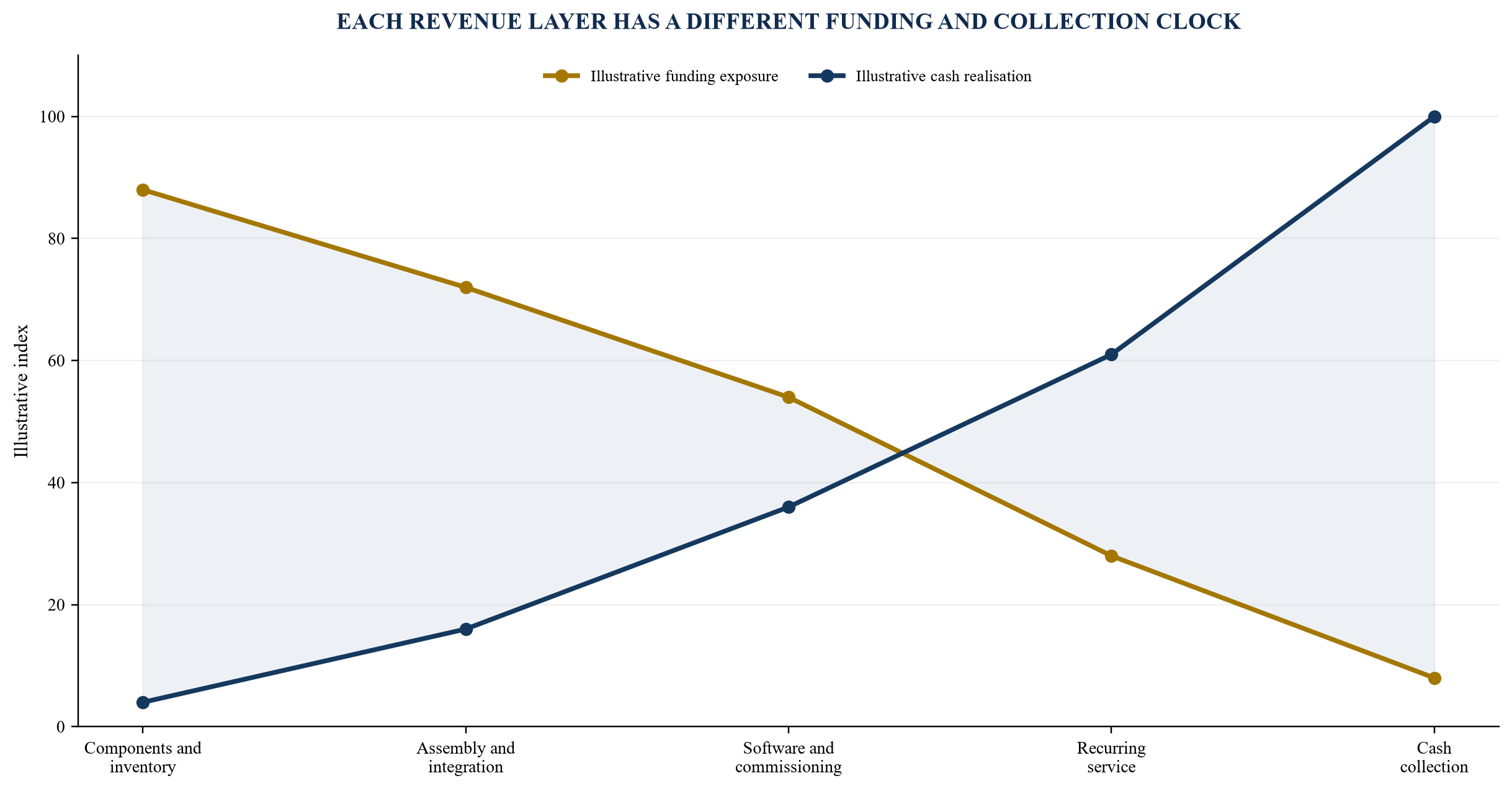
Hypothetical indices illustrate different funding and collection clocks; they do not describe a market benchmark.
The lender should reconcile the revenue stack to audited accounts, management accounts, VAT records, invoices, contract assets, deferred revenue and bank receipts. Gross margin should be measured consistently by category. Hardware pass-through can inflate revenue while contributing little cash. Service contracts can appear small in revenue but support customer retention and installed-base access. The stack should preserve both effects.
Table 1. Revenue, accounting and cash evidence map
| Revenue layer | Primary performance evidence | Cash timing risk | Credit use |
|---|---|---|---|
| Distributed hardware | purchase order, delivery and acceptance | returns, rebate and customer dispute | eligible receivable or controlled inventory |
| Engineered system | contract, milestone, cost-to-complete and certificate | delay, variation and acceptance | selectively eligible receivable; project cash analysis |
| Software licence | licence grant, activation and customer right | termination, implementation dependency | cash-flow support after collectability testing |
| Subscription or monitoring | active contract, service availability and usage | churn, contraction and concentration | recurring-cash term-debt support |
| Maintenance and field service | installed-base contract and completed service | engineer capacity and renewal | recurring or variable cash-flow support |
Actual recognition and security treatment depend on contract terms, accounting policy and legal advice.
4. Reconcile accounting revenue to cash evidence
Revenue quality begins with a three-way reconciliation: contract performance, accounting recognition and cash. The lender should select material and representative contracts across each revenue layer, trace performance obligations to delivery or service evidence, trace accounting entries to invoices and trace invoices to receipts. Exceptions should be quantified across the population rather than left as isolated audit observations.
Contract modifications are particularly important in automation projects. A customer can add scope, delay access or change specifications. IFRS 15 contains requirements for modifications and variable consideration.[7] The credit model should show approved variation value, unapproved claims, cost incurred, remaining work and expected cash separately. A favourable accounting estimate does not create borrowing-base eligibility when the right to payment remains conditional or disputed.
Deferred revenue and customer advances require separate treatment. They can provide liquidity while creating a delivery obligation and possible refund exposure. Advance-payment guarantees may use bank lines or cash collateral. The lender should avoid counting the same advance as both available cash and unencumbered support without recognising the related obligation.
Dilution analysis should measure credit notes, rebates, returns, warranty offsets, contra balances, disputed invoices and bad debt by customer and revenue type. A low historical loss rate can coexist with high dilution if suppliers regularly issue commercial credits. Borrowing-base reserves should respond to the actual causes and timing.
The output is an evidence hierarchy. Unconditional, accepted and collected items carry the greatest weight. Performed but uncertified work, forecast renewals and pipeline remain visible but should not receive the same availability. This hierarchy enables management and lenders to discuss evidence without conflating accounting compliance with collateral value.
5. Classify inventory by ownership, use and exit route
Automation inventory can include standard sensors, programmable controllers, drives, safety equipment, robotic components, control cabinets, cables, work in progress and finished engineered systems. The same general-ledger account can mix liquid standard components with customer-specific assemblies that have limited alternative use. A borrowing base should classify each item by the evidence available on a downside exit.
IAS 2 measures inventories at the lower of cost and net realisable value and defines cost to include purchase, conversion and other costs incurred to bring inventory to its present location and condition.[10] The accounting carrying amount is a starting point. Credit eligibility also requires ownership, location, identification, condition, aging, insurance, prior security, supplier terms and a practical sale route.
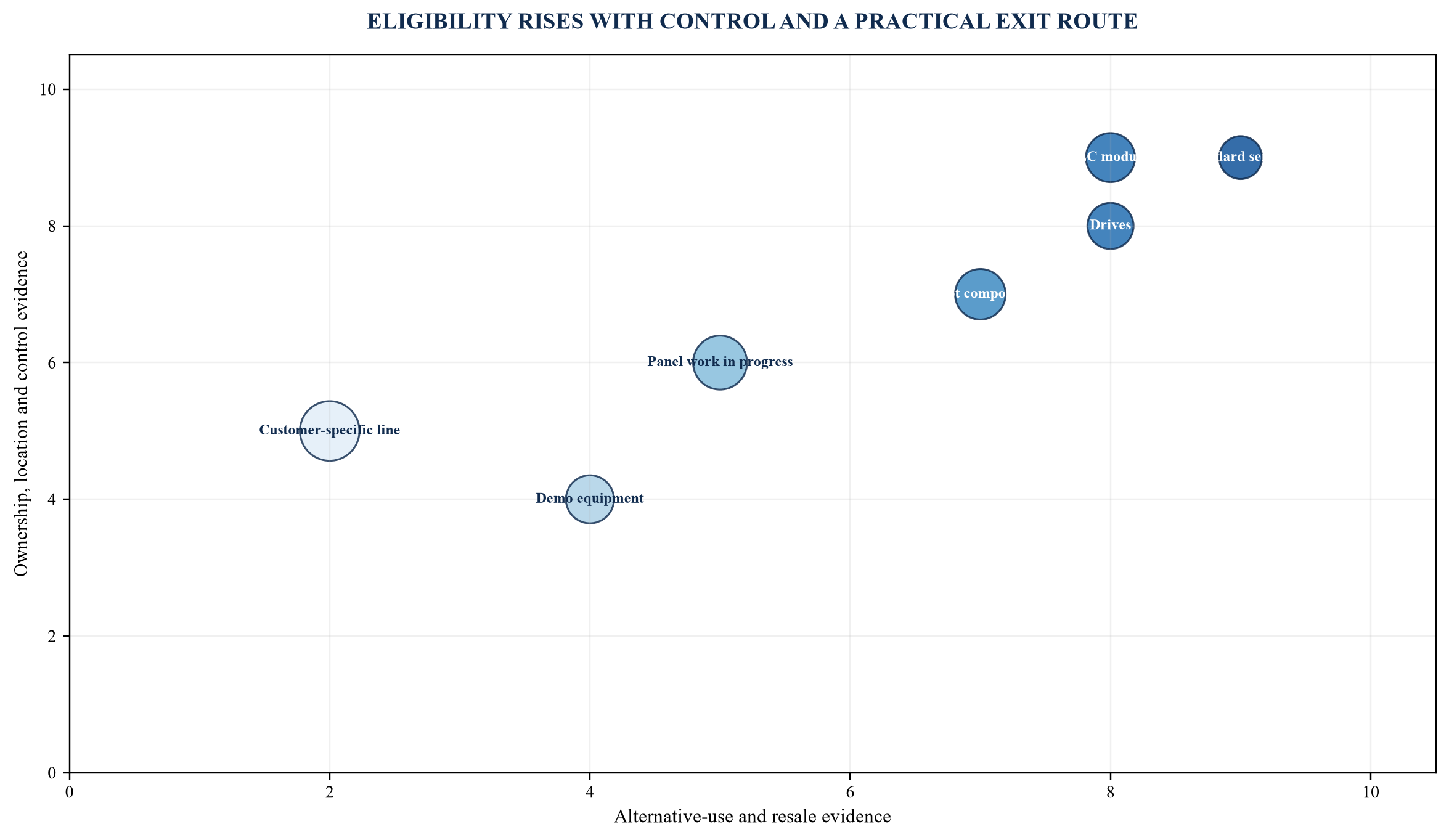
Hypothetical scores show the relationship between alternative use and control evidence.
The inventory register should carry part number, description, serial number where relevant, supplier, purchase date, cost, location, stage, customer allocation, contract link, ownership, aging, test status and expected use. Negative stock, duplicate serials, slow movement and manual adjustments should be investigated. Physical counts should reconcile to the ledger and warehouse-management system.
Customer-specific work in progress can have value when the customer contract provides payment rights, title arrangements and termination compensation. It can also be costly to dismantle and difficult to sell. Eligibility should follow contract and recovery evidence rather than physical completion alone. Standard components with active secondary markets may justify a different advance rate, subject to volatility and obsolescence.
6. Set eligibility, reserves and advance rates from evidence
A borrowing base converts eligible collateral into availability after exclusions, advance rates and reserves. The arithmetic should be simple enough to reproduce and detailed enough to prevent unsupported value entering the line. Eligibility definitions should address affiliates, concentration, aging, disputes, foreign jurisdictions, contra accounts, progress billing, customer dependency and prior security.
For receivables, exclusions commonly focus on overdue, disputed, conditional, contra, intercompany or concentrated balances. For inventory, exclusions can include obsolete, damaged, customer-owned, consigned, unidentified, off-site, slow-moving or highly specific items. Advance rates should reflect expected recovery costs and volatility, not a target facility amount.
Table 2. Illustrative mixed borrowing-base eligibility schedule
| Collateral class | Entry evidence | Principal exclusion | Illustrative control |
|---|---|---|---|
| Eligible trade receivables | invoice, acceptance and unconditional right | overdue, disputed, affiliate or concentrated balance | aging, dilution and customer confirmation |
| Standard component inventory | title, location, count and alternative use | obsolete, consigned, damaged or slow-moving stock | periodic count and appraisal |
| Work in progress | identifiable build, contract and cost record | customer-specific or uncertified value | contract-level cap and reserve |
| Finished engineered equipment | test evidence, title and delivery route | acceptance or removal uncertainty | serial register and saleability review |
| Recurring service receivables | active contract, invoice and collection | churned, prepaid or disputed customer | contract and cash reconciliation |
Values and advance rates are hypothetical modelling inputs and require transaction-specific appraisal and legal analysis.
Reserves should address risks that an advance rate alone cannot capture. Examples include customer concentration, returns, warranty, unpaid suppliers with title claims, storage cost, removal cost, currency mismatch and tax. Reserves should have a calculation, evidence owner and release test. A discretionary reserve regime without transparency can create avoidable liquidity uncertainty; a rigid regime can fail to respond to emerging facts.
Availability should be tested historically. The lender should recalculate at several month-ends, compare reported and verified collateral and identify seasonal peaks. Forecast availability should be linked to procurement, project milestones, invoicing and collection. A facility that looks adequate on an average balance can fail at the precise point when inventory and work in progress peak.
7. Test receivables, contract assets and customer concentration
Receivables can be attractive collateral when the borrower has completed performance, the customer has accepted the obligation and collection is predictable. Automation projects complicate that position because commissioning, site acceptance, documentation, training or performance tests may remain outstanding. The lender should identify the event that turns a contract asset or conditional invoice into an unconditional receivable.
The customer ledger should aggregate legal entities into economic groups and link revenue, receivables, contract assets, deferred revenue, warranty claims and pipeline. Concentration should be measured across both collateral and cash flow. A customer can be a small share of annual revenue while representing a large share of current availability or service renewals.
Customer confirmations and subsequent receipts provide useful evidence. They do not replace review of set-off, recoupment, return, warranty and cross-contract rights. A customer may offset a project dispute against otherwise valid invoices. The contract map should identify these rights and the borrowing base should reflect their enforceability and practical use.
Expected credit losses under IFRS 9 affect accounting measurement.[8] Credit eligibility adds a recovery and timing lens. Public-sector, investment-grade and smaller private customers can each create different administrative, legal and concentration risks. The analysis should use actual payment behaviour, disputes and contract terms rather than category labels alone.
The lender should monitor top-customer exposure, days past due, dilution, contract-asset conversion and collections. A breach should trigger a defined response: information, reserve, reduced advance, cash control, remediation plan or event review. The objective is early action before a collection issue becomes a liquidity failure.
8. Reconstruct service ARR from contracts and cash
Annual recurring revenue can help explain durable service cash, but the label must be reconstructed. The lender should define included contracts, recurring period, currency, price, service scope, renewal, cancellation, indexation and collection. One-off installation, call-outs, hardware replacement and professional services should remain separate unless the contract creates a recurring commitment.
The bridge starts with opening contracted recurring revenue. It adds new customers and expansion, then subtracts contraction and churn. Price changes should be separated from volume and scope. Foreign-currency translation should not disguise operating movement. Ending ARR should reconcile to the active contract population and subsequent invoices.
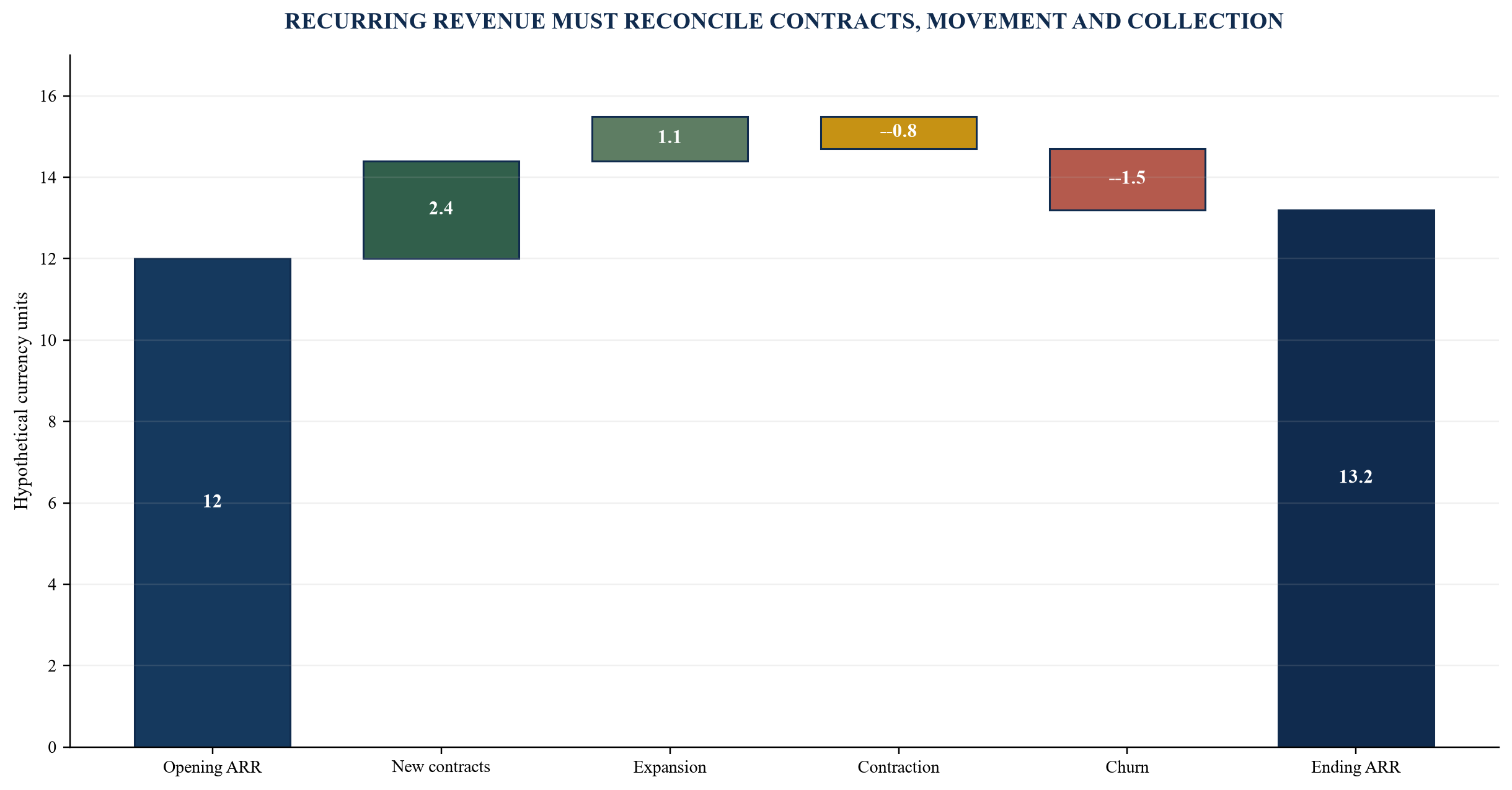
Hypothetical values illustrate bridge mechanics; they do not represent an identified business.
Gross revenue retention and net revenue retention answer different questions. Gross retention tests the recurring base retained before expansion. Net retention includes expansion. Both should be calculated consistently by customer cohort and service line. Logo retention, margin retention and cash retention add further evidence. A high net rate driven by one expanding customer can coexist with broad churn.
Installed-base coverage helps test causality. The lender should link each service contract to equipment, site, commissioning date, criticality and renewal history. A maintenance contract tied to proprietary installed equipment may have stronger continuity than a general engineering retainer, subject to service performance and customer alternatives. Engineer capacity, spare-parts access and response obligations should be tested because operational failure can convert apparent recurrence into churn.
9. Connect retention to installed-base economics
Recurring service value depends on why customers renew. The lender should identify whether renewal follows equipment criticality, safety compliance, software access, warranty preservation, response time, data history, specialist know-how or switching cost. These drivers should be supported by contracts, service records and customer evidence.
The installed-base register should record customer, site, asset, commissioning date, original equipment value, current service plan, annual price, renewal date, service-level obligation, parts coverage, engineer hours, gross margin and incident history. It should reconcile to the service contract population and scheduling system. Missing assets or inactive sites can indicate overstated recurrence.
Maintenance margins should include field labour, travel, standby, spare parts, software hosting, third-party licences and warranty overlap. A fixed-price service contract can lose money when aging equipment consumes more engineer time. Price indexation, exclusions and parts pass-through determine whether margin is protected.
Renewal cohorts should show age, customer type, equipment family and service level. Churn reasons should distinguish customer closure, equipment replacement, insourcing, competitor loss, poor service and pricing. This evidence can change both the forecast and lender monitoring. A transition from reactive maintenance to remote monitoring may improve margin while increasing cyber, connectivity and platform dependency.
Recurring service should support debt only after recurring investment is deducted. The company may need engineers, spares, monitoring infrastructure, certifications and software development to retain the contracts. The debt-service model should therefore use recurring cash contribution after these costs, not ARR multiplied by an assumed margin.
10. Separate software, intellectual property and development expenditure
Automation software can range from configuration files and project code to reusable control libraries, analytics platforms and subscription products. The accounting and recovery questions differ. Project-specific engineering may be embedded in contract delivery, while a controlled platform can support recurring value. Third-party licences can restrict transfer, hosting, modification or use after enforcement.
IAS 38 distinguishes research from development and sets recognition requirements for intangible assets.[11] The accounting treatment should be tested against project records, technical feasibility, intended use, resources and expected benefits. For credit, capitalisation does not establish liquidation value. The lender needs ownership, source-code control, employee and contractor assignments, open-source compliance, third-party licences, customer rights and a funded maintenance path.
Development expenditure should be bridged from cash to accounting. The schedule should identify team, product, stage, capitalised amount, amortisation, impairment indicators, committed spend and maintenance requirement. Growth projects and essential maintenance should be separate. Debt-service cash should deduct the recurring investment required to retain customers and keep the platform secure.
Software can enhance enterprise value without entering a borrowing base. A lender may rely on cash-flow covenants and negative pledges while treating intellectual property as secondary security. Where IP is central, enforcement planning should consider access credentials, documentation, hosting, data rights and key personnel. Security that cannot preserve operation may deliver limited recovery.
The UK Industrial Strategy and Advanced Manufacturing Sector Plan identify digital adoption, robotics, artificial intelligence and related capability as strategic priorities.[5][6] Policy context can support market development. It does not validate an individual product, forecast or recovery value. Transaction underwriting still requires customer, product and cash evidence.
11. Model equipment and capital expenditure separately
Industrial-automation businesses can own test rigs, machine tools, demonstration robots, vehicles, servers and workshop equipment. They may also finance equipment through leases or hire purchase. The capital-expenditure schedule should show ownership, location, use, age, maintenance, insurance, financing and replacement date. Assets essential to service delivery should be distinguished from surplus or demonstrator equipment.
IFRS 16 requires lessees to recognise right-of-use assets and lease liabilities for most leases, subject to its requirements and exemptions.[9] Credit analysis should identify cash lease payments, termination rights, security deposits, cross-defaults and change-of-control provisions. A lease liability can affect fixed-charge coverage even when management presents an EBITDA measure before lease cost.
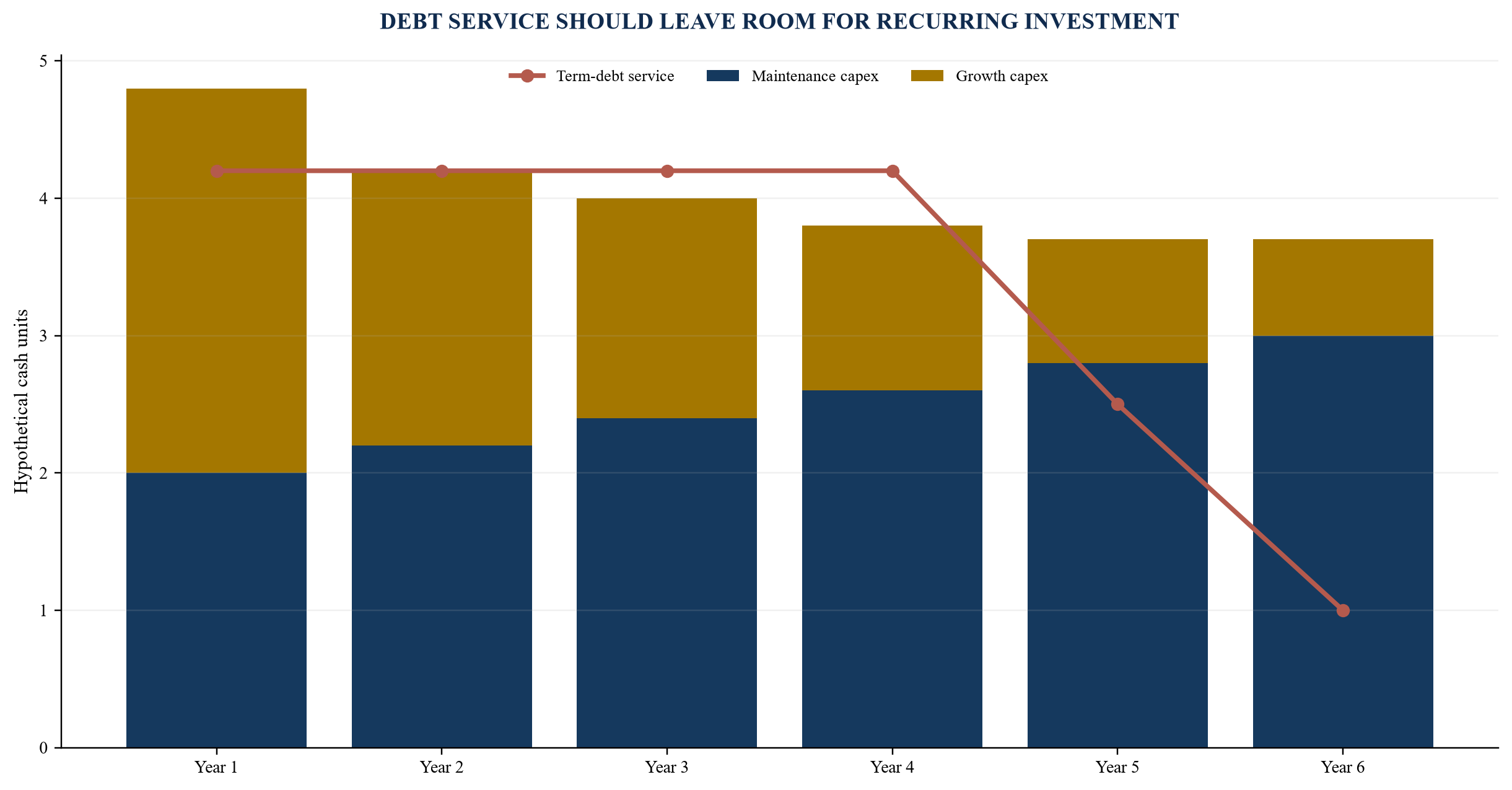
Hypothetical cash needs illustrate the importance of matching amortisation to recurring investment.
Equipment finance should match asset life, utilisation and residual value. An asset used across customers may support a stronger recovery route than equipment permanently installed at a customer site. Removal rights, site access, decommissioning cost and customer consent should be reviewed. Serial-number and fixed-asset registers should reconcile to physical inspection.
The forecast should separate maintenance, compliance, capacity and growth capex. Maintenance and compliance belong ahead of debt service when they are needed to preserve cash flows. Growth capex can be conditional on liquidity and covenant headroom. This distinction supports disciplined financing and prevents a term loan from relying on cash that must be reinvested.
12. Design a facility architecture around the cash cycle
The business may need several instruments. A revolving line can fund eligible receivables and inventory. Asset finance can fund identifiable equipment. A term loan can refinance existing debt, fund acquisition or support a defined investment programme when recurring cash supports amortisation. Equity or subordinated capital can absorb development and expansion risks that do not create reliable senior recovery.
Table 3. Facility architecture for a mixed-revenue automation business
| Funding need | Potential instrument | Principal sizing basis | Primary monitoring |
|---|---|---|---|
| Components and work in progress | inventory-backed revolver | verified eligibility, appraisal and peak cycle | aging, counts, concentration and reserves |
| Invoiced customer balances | receivables revolver | eligible invoices, dilution and collection | aging, disputes and cash receipts |
| Test and production equipment | asset finance or lease | title, use, life and residual value | asset register, insurance and maintenance |
| Recurring service cash | amortising term loan | cash after tax, working capital and maintenance investment | retention, margin, liquidity and leverage |
| Software development and expansion | equity or subordinated capital | milestone value and risk capacity | product, customer and funding gates |
Instrument choice, availability and pricing require lender approval and transaction-specific advice.
Intercreditor arrangements matter when different lenders finance different assets. Priority over receivables, inventory, bank accounts, equipment, intellectual property and shares should be explicit. Permitted liens, purchase-money security, retention-of-title claims and lease interests should be mapped. Availability under one line should not depend on collateral pledged elsewhere.
The facility should preserve operating flexibility. Inventory substitutions, ordinary-course disposals, new leases, acquisitions, distributions and development spend need clear permissions and thresholds. Excessive restrictions can make normal delivery impractical; vague permissions can erode collateral. The credit agreement should translate the underwritten operating model into measurable controls.
Maturity should match the business plan. A short maturity can create refinancing dependency before service cash and operational improvements mature. A long maturity without amortisation can defer risk. Base and downside cases should show availability, debt service, liquidity and exit options through maturity.
13. Size term debt to cash after recurring investment
Term-debt capacity begins with recurring operating cash rather than adjusted EBITDA alone. The bridge should deduct cash tax, lease payments where relevant, maintenance capex, normal working-capital need and other fixed charges. It should then stress customer delay, lower hardware margin, service churn, project overruns and reduced borrowing-base availability.
The Bank of England's financial-stability work and system-wide exploratory analysis emphasise the interaction among leverage, liquidity and market shocks.[1] At company level, a lender should identify correlated events. A customer slowdown can reduce new orders, delay receivables and lower service expansion at the same time. A component shortage can increase inventory days and delay commissioning, which postpones both final invoices and service start dates.
Debt-service coverage should be calculated using definitions that reconcile to management accounts and cash. Adjustments should have source evidence and a continuing treatment. Run-rate savings, future contracts and uncommitted price increases should remain outside the base case until achieved or contracted. One-off costs should be included when the financed plan requires them.
The model should retain minimum liquidity and borrowing-base headroom. A company can meet a coverage ratio while exhausting availability because cash is trapped in inventory or conditional assets. The lender should test a 13-week forecast for near-term control and a monthly model through maturity for structural capacity.
Amortisation can follow expected cash generation, with cash sweeps for excess performance and flexibility for seasonal peaks. A bullet component increases exit risk and should have a credible refinancing or repayment route. The structure should identify what evidence would justify increased leverage and what events require deleveraging.
14. Treat leases, supplier credit and customer funding explicitly
Mixed-revenue businesses use financing embedded in operations. Supplier terms fund components. Retention-of-title clauses may preserve supplier ownership until payment. Customer deposits fund delivery while creating obligations. Leases fund equipment. Invoice-discounting arrangements can transfer or encumber receivables. Each source affects cash, priority and covenant calculations.
The lender should create a complete financing schedule covering bank debt, asset finance, leases, invoice finance, supplier programmes, shareholder loans, guarantees, letters of credit and customer advances. The schedule should identify borrower, counterparty, amount, security, maturity, covenants, default linkage and change-of-control requirements.
Supplier concentration and terms should be tied to inventory eligibility. Unpaid suppliers can assert contractual or statutory rights depending on the facts and governing law. A reserve may be required where title or access is uncertain. Extending supplier days beyond sustainable practice can improve short-term cash while weakening continuity.
Customer advances should reconcile to the contracts and remaining cost to complete. Cash may be unrestricted in the bank but economically required to deliver the project. A downside case should test refund, guarantee call and replacement cost. The facility should avoid distributing or sweeping cash needed for funded obligations.
Lease-adjusted fixed charges and cash debt service should be shown together. This provides a coherent view of commitments and prevents funding choices from changing the apparent capacity without changing the underlying cash burden.
15. Map security, perfection and recovery operations
Security should be designed around assets the lender can identify, control and realise while preserving enterprise value. A debenture may cover present and future assets, but practical recovery differs across receivables, inventory, equipment, intellectual property, bank accounts and shares. The security map should record ownership, location, existing charges, restrictions, perfection action and enforcement dependency.
Companies House registration is time-sensitive and public.[12] Counsel should also review priority, notices, account control, insurance, landlord waivers, third-party sites and contractual restrictions. The Insolvency Service's guidance explains the statutory distribution framework, including the treatment of fixed and floating charges and prescribed-part considerations.[13] Recovery modelling should use current legal advice and actual security documents.
Table 4. Security, perfection and operational recovery map
| Asset or right | Evidence | Perfection or control question | Operational recovery dependency |
|---|---|---|---|
| Receivables | contract, invoice, acceptance and ledger | assignment, notice, set-off and account control | customer continuity and collection records |
| Inventory | title, count, location and serial or part data | floating charge, third-party site and supplier rights | access, removal, testing and resale channel |
| Equipment | asset register, invoice and inspection | fixed charge, lease interest and serial identification | maintenance, site access and specialist removal |
| Intellectual property | registrations, assignments and source control | charge scope, licences and territorial rights | engineers, documentation, hosting and data |
| Shares and bank accounts | ownership and bank records | share security and account-control mechanics | group structure, permissions and operating cash |
Legal effect depends on the transaction documents, asset location and applicable law.
An enforcement plan should identify who can keep the business operating. Control systems require engineers, credentials, documentation, spare parts and customer access. Software platforms require hosting, security and support. Inventory value can fall quickly if warranty, testing or certification lapses. The lender should therefore assess going-concern recovery alongside asset liquidation.
Operational separability matters. Shared systems, premises or staff outside the security group can reduce recovery. Transition arrangements should be documented before funding where a group carve-out exists. Security cannot substitute for a viable operating perimeter.
16. Stress operational-technology cyber and product obligations
Industrial automation connects information technology with operational technology. A cyber incident can interrupt customer operations, compromise safety, delay acceptance and create liability. Remote access, vendor credentials, unmanaged devices and legacy protocols can expand exposure. Credit diligence should treat cyber resilience as a cash-flow and collateral issue.
The National Cyber Security Centre's Cyber Assessment Framework provides a structured approach to managing security risk, protecting against attack, detecting events and minimising impact.[18] Its operational-technology guidance addresses architecture, integrity and secure connectivity.[19][20] The lender should use qualified technical assessment rather than convert these principles into a superficial checklist.
The borrower should maintain an asset inventory, architecture view, privileged-access controls, remote-access policy, backup and recovery tests, vulnerability process, incident response and customer-notification plan. Third-party software, cloud services and subcontractors should be included. Insurance scope, exclusions and limits should reconcile to the exposure.
Product obligations can affect inventory and receivables. A security defect or compliance issue can delay shipment, require remediation or create returns. Contract warranties, service levels, indemnities and liability caps should be mapped by product and customer. The scope of any product-security obligation should be assessed from the actual product, customer use and applicable law.
Cyber triggers in the credit agreement should focus on timely notification, access to evidence and remediation. An incident should not automatically force value-destructive action. The lender needs a graduated response linked to severity, business interruption, customer effect, insurance and liquidity.
17. Connect covenants to operational evidence
Covenants should reveal deterioration early enough for action. Financial ratios remain useful, but mixed-revenue businesses also need controls over borrowing-base quality, customer concentration, service retention, inventory aging and information reliability. Each covenant should have a clear definition, calculation source, testing frequency, cure or response and relationship to liquidity.
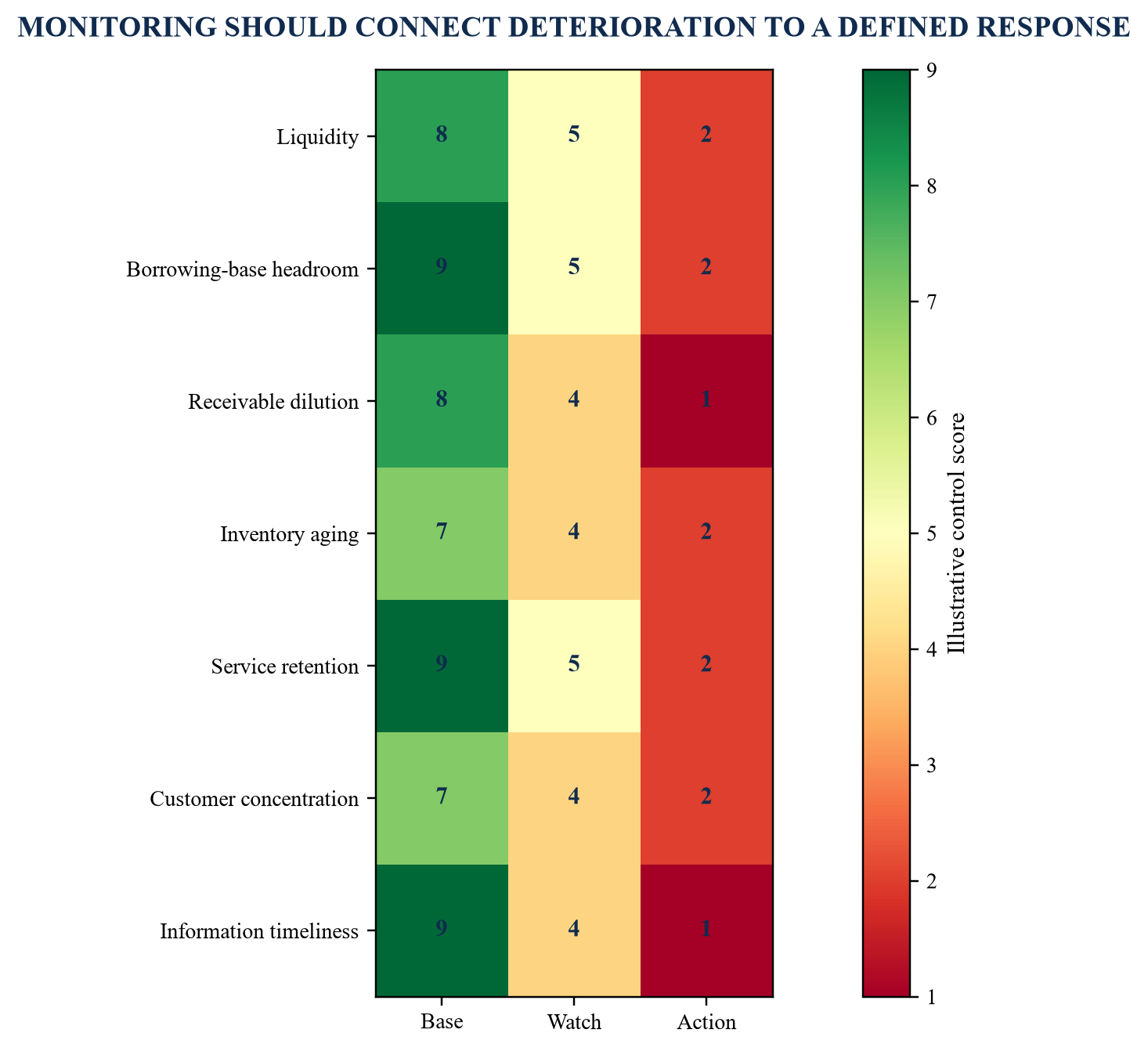
Hypothetical scores illustrate monitoring domains; thresholds require transaction-specific calibration.
Liquidity and availability are primary. Minimum cash, undrawn eligible availability and a 13-week forecast can reveal pressure before a leverage ratio. Receivable controls can include overdue and dilution thresholds. Inventory controls can include aging, count variance and concentration. Service controls can include gross retention, recurring margin and top-customer exposure.
Financial covenants should use tested accounting definitions. Leverage, fixed-charge coverage and interest coverage should address leases, capitalised development, permitted adjustments and acquisitions. Headroom should be modelled under base and downside cases. Equity cures, if permitted, should specify use and frequency.
Table 5. Covenant and action matrix
| Monitoring domain | Evidence source | Watch response | Action response |
|---|---|---|---|
| Liquidity and availability | bank data, borrowing base and 13-week cash | weekly reporting and spend review | reserve, cash control or remediation plan |
| Receivable quality | aging, disputes, dilution and receipts | customer-level review | exclusion, concentration reserve or reduced advance |
| Inventory quality | count, aging, appraisal and usage | targeted verification | write-down, reserve or field audit |
| Service retention | contract bridge, churn and collection | cohort review and customer plan | forecast reset and leverage action |
| Information quality | delivery timetable and reconciliation | enhanced reporting | independent review or default process |
Thresholds are hypothetical; live facilities require negotiated definitions and legal documentation.
Information covenants are critical. Monthly management accounts, borrowing-base certificates, contract-level exceptions, service bridge, capex schedule and compliance certificates should use stable definitions. Late or repeatedly corrected information can itself indicate control risk and justify enhanced review.
18. Plan liquidity, reporting and lender governance
The borrower should produce a 13-week cash forecast that connects procurement, payroll, leases, tax, project milestones, collections, customer advances and debt service. Forecast accuracy should be measured by week and driver. Material variance should produce an action, not a retrospective explanation alone.
The monthly lender pack should reconcile revenue stack, receivables, contract assets, inventory, recurring service, capex, debt and covenant calculations to the general ledger. The reconciliation should identify manual adjustments, prior-period changes and data owners. A concise exception report is more useful than a large pack without control linkage.
Governance should assign responsibility across finance, operations, commercial and technology teams. The chief financial officer should own facility compliance; operational leaders should own inventory and contract evidence; service leaders should own retention and capacity; technology leaders should own cyber and platform continuity. The board should receive the same core bridge used by the lender, with appropriate detail.
Independent appraisal, field examination, financial review and cyber assessment can be scheduled based on risk and performance. Scope should focus on evidence that affects availability, cash and recovery. Repeated broad diligence can consume management time without improving decisions; targeted verification should respond to material changes.
The facility should include a route for growth. Additional availability can follow verified collateral, service retention, profitability and reporting maturity. Acquisitions, new products and foreign expansion should be assessed for cash, security and information compatibility before they enter the financed perimeter.
19. Model downside, workout and recovery as one system
Downside should connect operational events to liquidity, covenant and recovery. A hardware-margin decline affects earnings. A component shortage can also increase inventory days, delay project acceptance and postpone service commencement. Customer failure can reduce receivables and recurring revenue together. Cyber disruption can create remediation cost, project delay and customer claims.
The model should include a base case, independently adjusted case and defined downside. It should test lower order intake, slower collection, inventory write-down, project overrun, service churn, supplier tightening, interest increase and loss of availability. Correlated stresses should be explicit. Probability weights can support comparison but should not hide a liquidity failure in one scenario.
Workout actions should be staged. Enhanced reporting and inventory controls can precede a reserve. A reserve can precede a drawstop. Equity support, asset sale, cost action, pricing, customer collection and refinancing can be evaluated against cash and enterprise value. The objective is to preserve recoverable value while protecting the lender's position.
Recovery analysis should compare going-concern and asset outcomes. A functioning service operation may preserve customer contracts and installed-base value. A rapid shutdown can cause engineers to leave, licences to lapse and customers to switch. Conversely, continued funding without a viable path can increase loss. The decision requires current evidence and professional advice.
The FCA's valuation review emphasises ad hoc valuations after material events.[3] A credit process should similarly identify triggers for revised collateral, enterprise and recovery analysis. Examples include major customer loss, cyber incident, covenant breach, fraud indication, refinancing failure or a material change in regulation.
20. Underwrite the cash-conversion system
Private credit for industrial automation should finance an evidenced cash-conversion system. Hardware, software, projects and service can reinforce one another, but they do not create the same collateral or debt capacity. The financing structure should preserve their differences and then connect them through liquidity, covenants and governance.
The five records provide the operating architecture. The revenue stack identifies performance and cash clocks. The inventory map tests ownership, control and alternative use. The service ARR bridge tests contracted recurrence and collection. The capex schedule protects recurring investment and asset-finance matching. The covenant dashboard connects deterioration to action.
This architecture supports several instruments without double counting. Receivables and inventory can support revolving availability. Equipment can support asset finance. Recurring cash after tax, working capital and maintenance investment can support amortising term debt. Development and expansion risk can be funded with capital capable of absorbing uncertainty.
The evidence should remain traceable after closing. Contracts, invoices, receipts, inventory counts, service renewals, capex and covenant calculations should reconcile to controlled records. When evidence changes, availability and forecasts should change in the correct place. This discipline supports borrower decisions as much as lender protection.
A strong facility is therefore a monitored operating agreement. It gives the company adequate liquidity for delivery, protects essential investment, identifies deterioration early and preserves a practical recovery route. The result can support growth without asking one leverage multiple to explain several different businesses.
References
- Bank of England, “Financial Stability Report, July 2026.” https://www.bankofengland.co.uk/financial-stability-report/2026/july-2026
- Bank for International Settlements, “Annual Economic Report 2026.” https://www.bis.org/publ/arpdf/ar2026e.pdf
- Financial Conduct Authority, “Private market valuation practices,” 5 March 2025. https://www.fca.org.uk/publications/multi-firm-reviews/private-market-valuation-practices
- British Business Bank, “Small Business Finance Markets 2025/26.” https://www.british-business-bank.co.uk/sites/g/files/sovrnj166/files/2026-03/report-small-business-finance-markets-2026.pdf?attachment=
- Department for Business and Trade, “The UK's Modern Industrial Strategy.” https://www.gov.uk/government/publications/industrial-strategy
- Department for Business and Trade, “Advanced Manufacturing Sector Plan.” https://assets.publishing.service.gov.uk/media/68920a3366bdd4490c61098f/industrial_strategy_advanced_manufacturing_sector_plan_accessible.pdf
- IFRS Foundation, “IFRS 15 Revenue from Contracts with Customers.” https://www.ifrs.org/content/dam/ifrs/publications/pdf-standards/english/2022/issued/part-a/ifrs-15-revenue-from-contracts-with-customers.pdf?bypass=on
- IFRS Foundation, “IFRS 9 Financial Instruments.” https://www.ifrs.org/content/dam/ifrs/publications/pdf-standards/english/2022/issued/part-a/ifrs-9-financial-instruments.pdf?bypass=on
- IFRS Foundation, “IFRS 16 Leases.” https://www.ifrs.org/issued-standards/list-of-standards/ifrs-16-leases/
- IFRS Foundation, “IAS 2 Inventories.” https://www.ifrs.org/content/dam/ifrs/publications/pdf-standards/english/2022/issued/part-a/ias-2-inventories.pdf?bypass=on
- IFRS Foundation, “IAS 38 Intangible Assets.” https://www.ifrs.org/issued-standards/list-of-standards/ias-38-intangible-assets/
- Companies House, “Register a charge (mortgage) for a limited company.” https://www.gov.uk/guidance/register-a-charge-mortgage-for-a-limited-company
- Insolvency Service, “Distributions.” https://www.gov.uk/guidance/technical-guidance-for-official-receivers/49-distributions
- Cabinet Office, “National Security and Investment Act: guidance on notifiable acquisitions.” https://www.gov.uk/government/publications/national-security-and-investment-act-guidance-on-notifiable-acquisitions/national-security-and-investment-act-guidance-on-notifiable-acquisitions
- Competition and Markets Authority, “Merger assessment guidelines,” updated 3 June 2026. https://www.gov.uk/government/publications/merger-assessment-guidelines/merger-assessment-guidelines-html-version
- Competition and Markets Authority, “Mergers: guidance on the CMA's jurisdiction and procedure,” updated December 2025. https://www.gov.uk/government/publications/mergers-guidance-on-the-cmas-jurisdiction-and-procedure
- Office for National Statistics, “Business investment in the UK: October to December 2025 revised results.” https://www.ons.gov.uk/economy/grossdomesticproductgdp/bulletins/businessinvestment/octobertodecember2025revisedresults/pdf
- National Cyber Security Centre, “Cyber Assessment Framework.” https://www.ncsc.gov.uk/collection/cyber-assessment-framework/introduction-caf-collection
- National Cyber Security Centre, “Operational technology: create a definitive architecture view.” https://www.ncsc.gov.uk/collection/operational-technology/definitive-architecture-view/principle-2
- National Cyber Security Centre, “Operational technology: secure connectivity,” January 2026. https://www.ncsc.gov.uk/collection/operational-technology/secure-connectivity/principle-4
