

1. Define the financed logistics enterprise
A logistics platform can include freehold and leasehold warehouses, fulfilment centres, depots, vehicles, trailers, material-handling equipment, charging infrastructure, software, customer contracts, receivables and employees. The financing perimeter should identify which legal entity owns each asset, contracts with each customer, employs each person and receives each cash flow. Consolidated accounts alone do not provide that map.
The lender and borrower should distinguish operating companies from property companies, fleet companies, special-purpose vehicles and holding companies. A warehouse may sit in a property subsidiary and be leased to the operating business. Vehicles may be owned, hired, leased or financed under retention-of-title arrangements. Customer contracts may be held by an entity that owns few assets. Guarantees and security should follow these facts rather than a generic group chart.
The operating model also matters. Contract logistics, road haulage, parcel, cold storage, freight forwarding and e-commerce fulfilment have different capital intensity, margins, claims and working-capital cycles. Revenue can include pass-through fuel, customs, carrier and labour costs. Reported sales therefore need to be translated into dependable contribution and cash.
The Department for Transport reported that GB-registered heavy goods vehicles moved 1.53 billion tonnes and 162 billion tonne kilometres in the UK during 2025.[1] Those aggregate volumes establish the scale of activity, not the credit quality of a borrower. Underwriting should establish customer retention, route economics, warehouse utilisation, fleet availability, cash conversion and the cost of maintaining service.
Table 1. Financing perimeter and evidence map
| Economic element | Core evidence | Primary repayment source | Financing question |
|---|---|---|---|
| Warehouse property | title, lease, valuation, condition and EPC | rent-equivalent operating cash or disposal | suitable leverage, tenor and capex reserve |
| Vehicles and equipment | ownership, finance, age, condition and utilisation | route and contract contribution | asset life, amortisation and residual value |
| Receivables | invoices, proof of service, disputes and collections | customer payment | eligibility, concentration and dilution |
| Customer contracts | executed terms, performance and renewal | recurring operating cash | duration, termination and price risk |
| Technology and data | licences, access, resilience and integration | operating productivity | continuity and replacement cost |
| Group support | guarantees, cash access and intercompany balances | broader group cash | structural subordination and leakage |
Security and legal form depend on ownership, jurisdiction and current advice.
2. Reconstruct dependable logistics cash flow
Debt capacity should be based on cash that survives normal operations, maintenance and working-capital needs. The model should reconcile bookings, warehouse activity, vehicle movements, proof of delivery, invoices, credits and bank receipts. Monthly financial statements should connect to operational data by customer, site, route and service.
Revenue recognition can precede cash collection and can be affected by principal-agent presentation, unbilled work, accruals, volume rebates, fuel surcharges, service credits and claims. The lender should trace a sample from contract to job record, invoice and receipt. A reconciliation exception should remain visible until resolved rather than be absorbed into an EBITDA adjustment.
Contribution should be calculated after labour, subcontractor, fuel, toll, vehicle, warehouse, insurance, damage and service-recovery costs. A customer with high revenue can produce weak cash when it requires dedicated capacity, delayed billing, disputed key performance indicators or frequent peak labour. Site and route economics should therefore be shown before central allocations and after the costs required to continue service.
Working capital deserves separate treatment. Logistics businesses may pay wages, fuel, rents and subcontractors before customers settle invoices. Peak seasons can increase receivables and labour at the same time. The cash forecast should show the lowest liquidity point, not merely the year-end balance. Invoice-finance availability should be modelled using eligible invoices rather than gross receivables.
The quality-of-earnings bridge should then deduct recurring fleet replacement, warehouse maintenance, technology licences and compliance expenditure. EBITDA is useful for comparison but does not represent cash available for debt service. A lender should see both EBITDA-based leverage and fixed-charge coverage after recurring capital, leases, interest and tax.
Evidence should be graded. Executed contracts, third-party invoices, telematics, warehouse-management data, proof of delivery and bank receipts are stronger than a seller-prepared schedule. The underwriting file should record source, extraction date, reconciliation status and material differences. That discipline also makes future covenant reporting more reliable.
3. Build the asset-and-cash map
The asset-and-cash map links each funding need to an identifiable asset, operating use, cash cycle, legal owner and enforcement route. It prevents permanent debt from funding temporary receivables and prevents a short revolving line from carrying a warehouse or fleet investment that needs several years to repay.
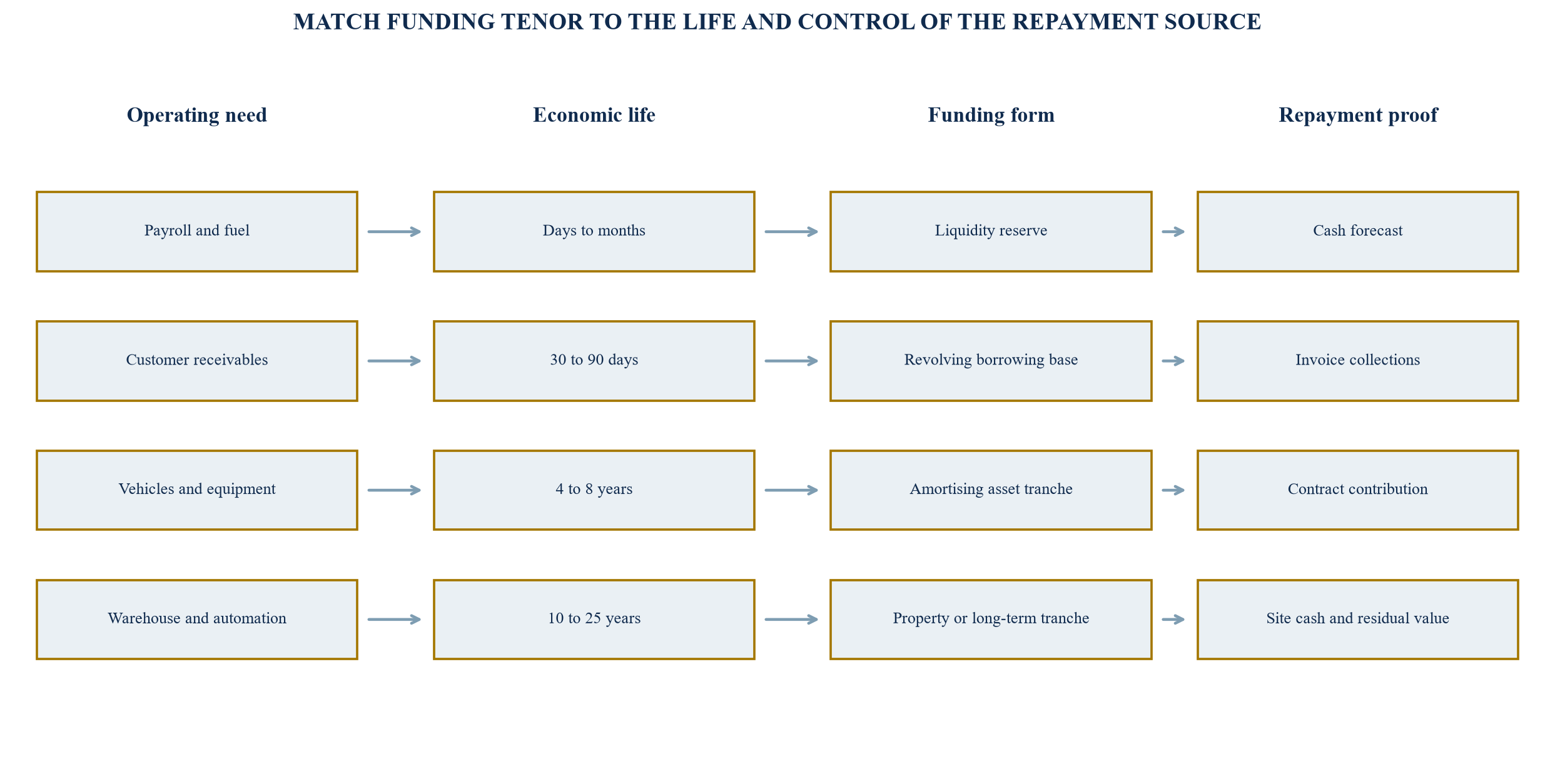
The structure is conceptual; live facilities require entity-level legal and cash-flow analysis.
The map should list freehold value, lease obligations, vehicle ownership, equipment liens, receivables, inventory under custody, customer deposits and restricted cash. Assets owned by customers or suppliers should be excluded from collateral. Goods handled by a logistics operator may create custody and claims exposure without belonging to the borrower.
Each financing tranche should have one primary repayment source and a documented secondary recovery route. An invoice facility is repaid by debtor collections. Asset finance is repaid by cash generated while the vehicle or equipment remains productive, with residual value as secondary support. Property debt is repaid by site cash or group cash and supported by the property. A cash-flow term loan depends on enterprise cash and contract durability.
The map should also show cash barriers. Collections may sit in multiple accounts, payment-service arrangements or customer portals. Intercompany service charges and cash pooling can move value away from the obligor. Dominion, blocked accounts, permitted transfers and reporting should reflect actual collection mechanics.
4. Segment facilities by purpose and asset life
A layered capital structure can improve fit and transparency. The revolving tranche funds eligible receivables and seasonal working capital. The fleet tranche funds vehicles and material-handling equipment with amortisation linked to useful life. The property tranche funds warehouse acquisition or refinance. A term loan can finance acquisition, automation or growth where dependable cash exceeds asset-specific debt capacity.
The borrower should define the use of proceeds before selecting the instrument. Refinancing existing debt, buying a warehouse, replacing vehicles, funding peak working capital and acquiring a competitor have different draw conditions and risks. A single blended facility may appear simple while hiding cross-default, maturity and collateral conflicts.
Asset finance can preserve working capital by spreading the cost of business-critical equipment.[2] Invoice finance can accelerate access to a portion of eligible unpaid invoices, subject to provider criteria.[3] These products should be integrated with the private-credit term facility so that security, collections and headroom are coherent.
Maturity should follow the conservative life of the repayment source. Receivables turn within months. Vehicles and automation wear over years. Warehouses can support longer tenor but require maintenance and energy investment. Contract cash flow should not be financed beyond the period for which renewal and replacement have credible evidence.
The capital structure should preserve a liquidity buffer after draw. A borrower that uses every available pound at closing may breach availability or fixed-charge cover when invoices become ineligible, fuel costs rise or a customer delays acceptance. Minimum liquidity, unused revolver capacity and equity support should be sized against an operating stress.
Fees, hedging, amortisation, excess-cash sweep and prepayment terms should be modelled as cash. Flexible documentation can still create heavy cash drag. The base case and downside should show quarterly debt service by tranche, facility availability, covenant headroom and refinancing need.
5. Design a reliable receivables borrowing base
The borrowing base converts an accounting receivable ledger into financeable collateral. Eligibility should require a valid customer obligation, completed service, accurate invoice, enforceable assignment where applicable, acceptable jurisdiction, absence of material dispute and payment within an agreed ageing period.
Common exclusions include overdue balances, related parties, contra accounts, unbilled revenue, retention, disputed invoices, credit notes not applied, concentration above a cap, foreign receivables without approval and invoices subject to broad set-off or pay-when-paid clauses. The lender should also reserve for dilution, returns, service credits, claims and taxes.
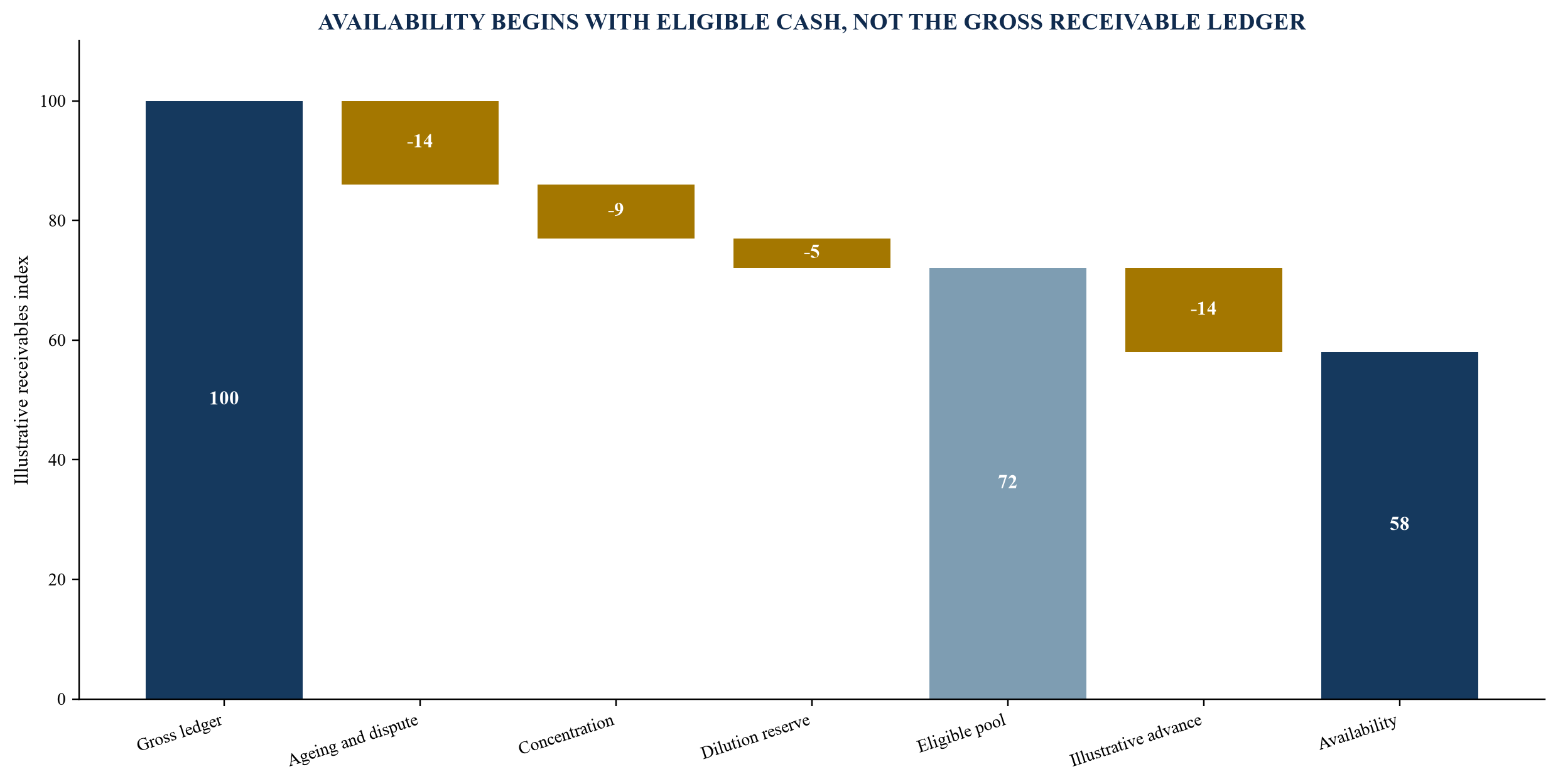
Advance rates and exclusions are hypothetical and do not represent market terms.
The certificate should reconcile the receivables ledger to the general ledger and prior certificate. It should show additions, collections, credits, write-offs, ageing changes, concentrations and reserves. Exceptions should be traceable to invoice level. Automated extraction can improve speed, though accountable review remains necessary for unusual terms and disputes.
Cash control should match risk. A low-risk structure may use daily reporting and a springing blocked-account mechanism. A higher-risk or stressed structure may require direct collection to controlled accounts. Customer notification, confidentiality, assignment restrictions and service continuity require legal and commercial planning.
The base should be tested for false availability. Duplicate invoices, unapplied cash, post-period credits, related-party sales, invoice splitting and extended terms can inflate the pool. Independent field examination and periodic customer confirmation can support confidence where proportionate.
6. Underwrite warehouse property and lease exposure
Warehouse finance requires property, operational and cash-flow analysis. Title, tenure, planning use, access, utilities, condition, contamination, flood exposure, valuation, insurance and tenant or operator rights should be reviewed. A property may have strong vacant-possession value while being operationally unsuitable for the borrower, or it may be strategically critical while carrying limited alternative-use liquidity.
Freehold and long leasehold value should be separated from fit-out, racking, automation and customer-specific improvements. Fixed plant may attach to the property or sit under separate finance. The security package should identify which assets can be charged and which require third-party consent.
Lease obligations affect fixed-charge capacity. IFRS 16 establishes recognition requirements for leases in financial statements, though legal and economic review remains necessary for rent, break, renewal, service charge, dilapidation and assignment.[4] Covenant definitions should avoid accidental double counting or exclusion of material lease cash.
Energy performance can affect lettability, capex and value. Current government guidance states that relevant privately rented non-domestic property in England and Wales generally requires at least EPC E unless a valid exemption applies.[5] The lender should verify the current certificate, exemptions, improvement plan and expected rule changes with qualified advisers.
Warehouse cash should be stressed for utilisation, customer loss, labour availability, power cost, business rates, repair and transition capex. Automation can improve throughput but may have limited secondary value outside the installed building. The debt model should distinguish property value, equipment recovery and enterprise value.
A property tranche should include valuation cadence, loan-to-value, interest cover, capex reserve, insurance, disposal and leasing controls. The borrower should retain enough flexibility to optimise the network while the lender protects critical collateral.
7. Finance fleets against useful cash life
Fleet finance should start with an asset register reconciled to ownership, registration, location, mileage, age, condition, maintenance, utilisation, insurance, encumbrance and contract assignment. The register should include trailers, refrigerated units, forklifts and charging equipment where material.
Amortisation should follow expected useful cash life rather than accounting depreciation alone. High-mileage vehicles may require faster repayment. Specialist equipment can have strong contracted use and weak resale liquidity. Residual-value assumptions should use current third-party evidence and downside haircuts.
Vehicle availability drives customer service and cash. Maintenance compliance, inspections, defects, tyre, fuel, accident, driver and downtime data should be linked to each asset. A low average fleet age does not compensate for poor maintenance or concentrated failures in critical vehicles.
The transition to zero-emission freight adds capital and infrastructure decisions. UK government programmes have supported eligible zero-emission trucks and depot charging, with terms subject to change.[6] Financing analysis should include purchase cost, grant eligibility, charger and grid expenditure, route suitability, payload, range, energy price, residual value and technology risk.
The lender should avoid assuming a policy announcement equals borrower cash. Grant eligibility, timing and evidence should be confirmed. Vehicle and charger assets may have different owners, useful lives and security. Grid connection and site tenure can determine whether infrastructure remains useful.
Fleet covenants can include minimum maintenance compliance, insurance, title perfection, permitted disposals, replacement, utilisation reporting and concentration limits by asset type. Proceeds from disposals should be applied or reinvested under defined conditions.
8. Score contract quality and customer durability
Contracted revenue supports debt only when the contract produces collectible contribution. The lender should review customer credit, guarantor, service scope, minimum volume, committed capacity, price indexation, fuel adjustment, service levels, credits, liability, termination, change of control, assignment, renewal and payment.
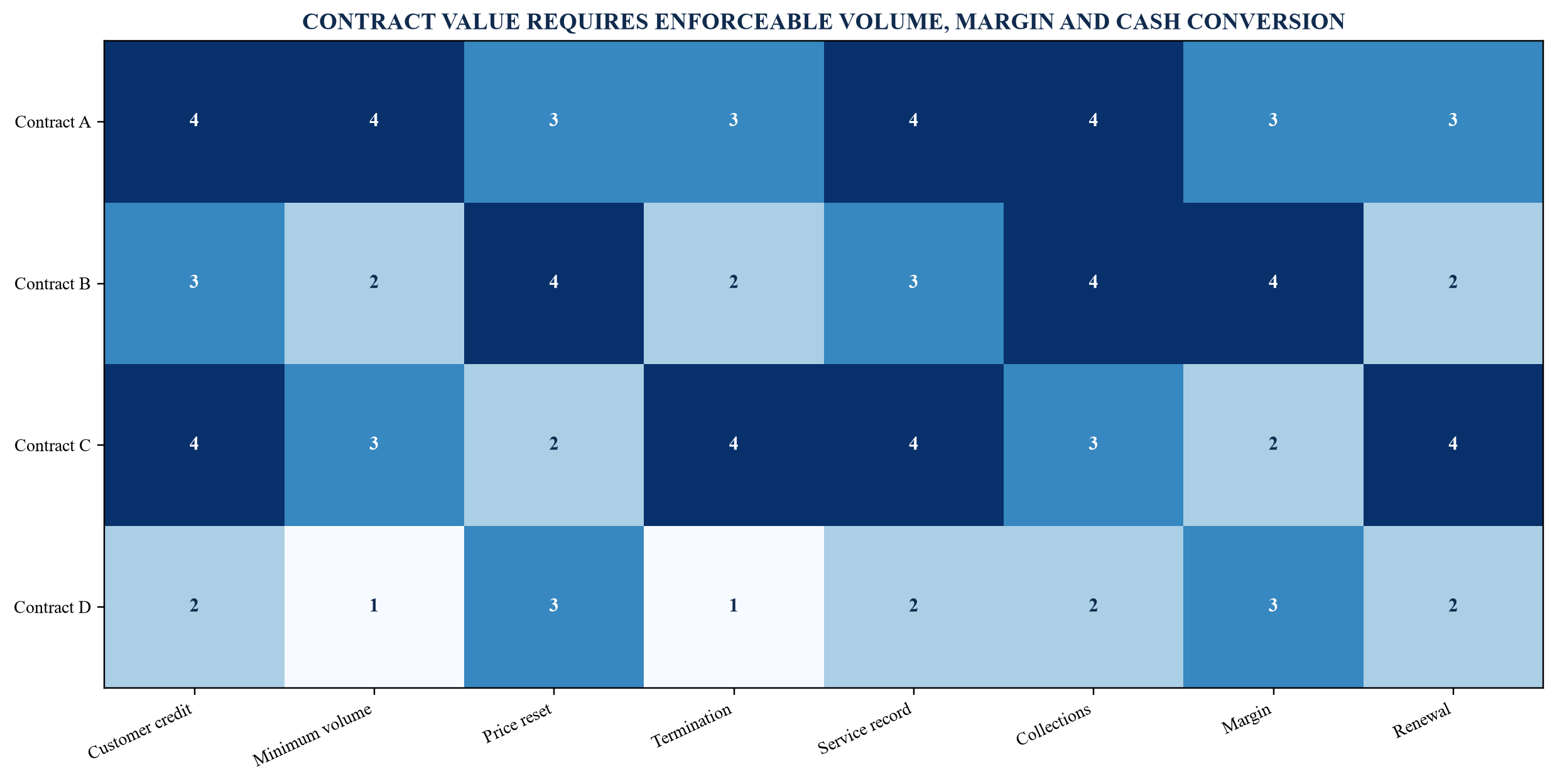
Scores are hypothetical; live scoring should use executed terms and observed performance.
Minimum volume should be distinguished from forecast volume. A customer may have flexibility to reduce activity, change sites or terminate for convenience. Price indexation may lag labour or fuel costs. Service credits and liability can erase margin when performance falls.
The score should combine executed terms with observed behaviour. Renewal history, tender results, payment timing, deductions, complaints, service levels and share of customer spend provide evidence. The borrower should explain how critical the service is to the customer and how easily it can be switched.
Concentration should be measured by revenue, contribution, receivables, site capacity and contract renewal date. Several legal customers may share one procurement decision or end-market exposure. A warehouse dedicated to one customer can create property and equipment concentration beyond the invoice ledger.
The debt case should use probability-weighted renewal only where evidence supports it. A contract maturing before debt may require amortisation, cash sweep, renewal milestone or additional liquidity. Revenue growth from unsigned pipeline should not support committed leverage.
9. Model seasonal and operational liquidity
Annual cash flow can conceal severe intra-year requirements. Peak retail periods, agricultural flows, construction cycles, customer launches and contract mobilisation can increase labour, subcontractor, fuel, packaging and inventory-handling expense before invoice collection.
A 13-week cash forecast should connect opening cash, receipts, payroll, rent, fuel, subcontractor, tax, capex, interest and principal. It should reconcile weekly to actual cash and update facility availability. Variances should be explained by volume, price, timing and error.
The forecast should model invoice ineligibility. A delayed customer acceptance can reduce borrowing-base availability precisely when the borrower has already paid operating costs. Availability headroom should therefore be included alongside cash. A minimum-liquidity covenant can trigger early discussion before a payment default.
Fuel and wage surcharges need contract-level analysis. A surcharge may recover cost with a lag, use a different index or exclude subcontracted services. The lender should compare actual recovery with cost movement rather than assume contractual wording fully protects margin.
Mobilisation deserves a separate reserve. New contracts can require recruitment, training, vehicles, racking, systems, stock count and parallel operations. Revenue may begin after expenditure and may be subject to acceptance. Growth capex and mobilisation working capital should have approved budgets, milestones and contingency.
The liquidity plan should identify actions in order: reduce discretionary spend, slow capex, draw available revolver, collect receivables, use sponsor support and negotiate waivers. Asset sales or distressed customer renegotiation are slower and should not be the first line of defence.
10. Match capex and debt maturities
The capital plan should combine warehouse maintenance, roof and yard work, racking, automation, vehicles, charging, IT, compliance and customer mobilisation. Each item should state purpose, owner, timing, cost range, downtime, useful life, funding source and consequence of delay.
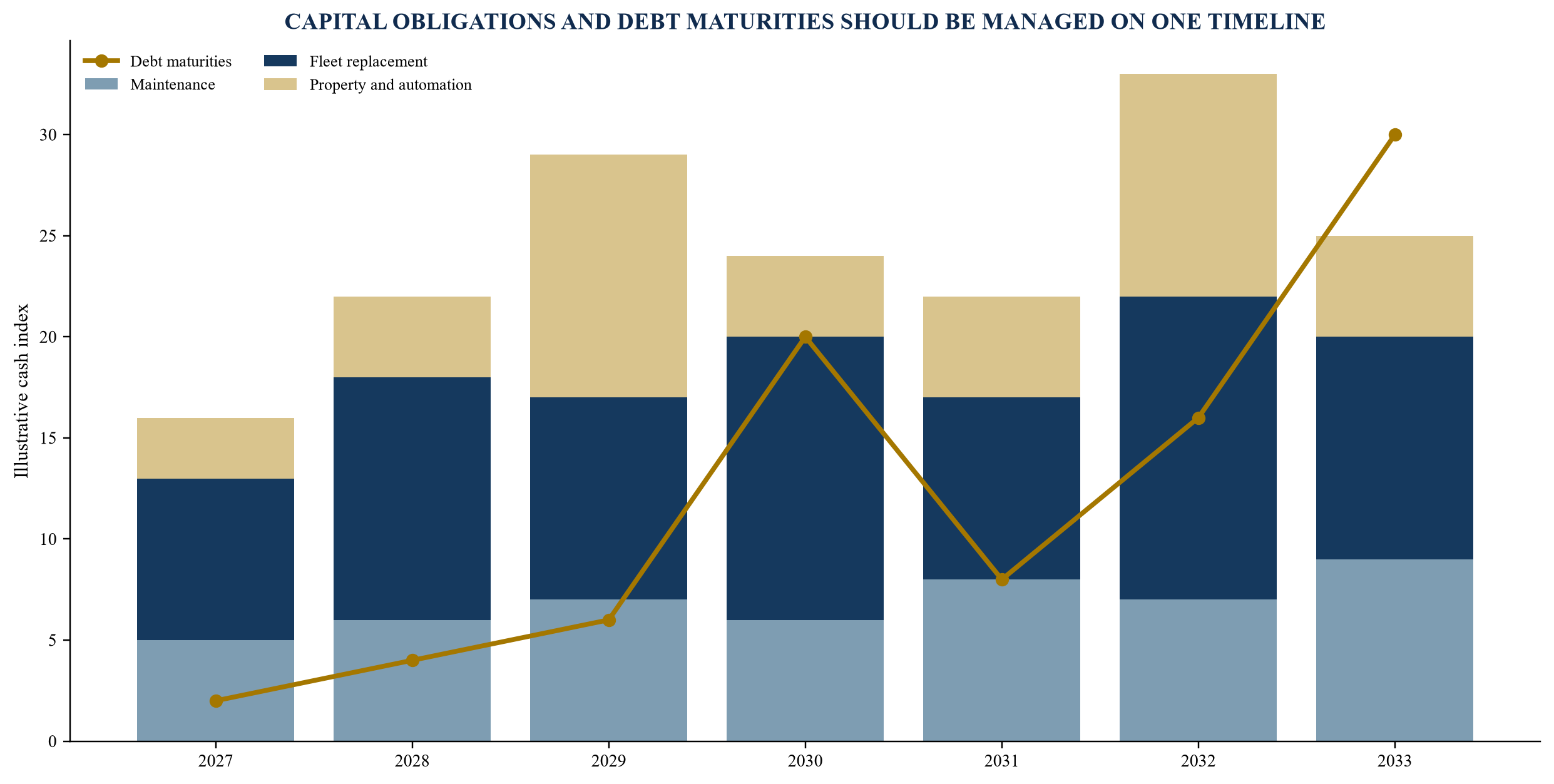
Amounts and timing are hypothetical; live schedules should use approved budgets and facility terms.
Maintenance capex preserves current cash. Growth capex adds capacity, productivity or service. Customer-funded or landlord-funded items should be shown with contractual evidence and timing. Accounting capitalisation does not determine whether cash is recurring.
Debt maturity should be overlaid with contract expiries, lease breaks, fleet replacements, property works and refinancing windows. A facility maturing during a major renewal or capex programme can transfer operational risk into refinancing risk.
The borrower should maintain a rolling three-year capital plan and a longer asset-life view. Quarterly governance should compare approved, committed and paid amounts. Underspend can represent efficiency or deferred maintenance; the operating evidence determines which.
Excess cash can amortise debt, though an aggressive sweep may starve replacement expenditure. The waterfall should fund taxes, maintenance, minimum liquidity and approved critical capex before discretionary distributions. Growth capex can require separate lender consent or equity contribution.
11. Set leverage from downside cash and asset cover
Leverage should be sized using multiple views: EBITDA, fixed-charge coverage, free cash after maintenance, borrowing-base availability, property loan-to-value and fleet asset cover. No single metric captures the combined platform.
The base case should exclude unsigned growth and use observed operating performance. The downside should test customer loss, lower warehouse utilisation, weaker volumes, delayed collections, fuel and wage pressure, vehicle downtime, capex overrun and higher interest. A severe case should test simultaneous shocks and restricted refinancing.
Bank of England reporting in July 2026 highlighted vulnerabilities in risky credit markets, including private credit, and refinancing exposure for some UK corporates.[7] The borrower-level response is to preserve headroom, transparency and options rather than depend on a supportive refinancing market.
Interest should be modelled using the actual reference rate, margin, floor, fees, hedging and unused commitment. Payment-in-kind interest can defer cash while increasing leverage. A cash-flow covenant should show the effect of both cash and capitalised interest.
Asset cover should use conservative net recovery after time, costs, prior claims and operational separation. Enterprise value should remain a distinct support because it can fall quickly when a major customer or operating licence is lost. Recovery should not double count property, fleet and enterprise value.
The capital structure should retain an equity cushion and a practical cure mechanism. Equity cure rights, additional sponsor support and permitted subordinated debt should be defined. Repeated cures can mask operating deterioration, so cure frequency and treatment require limits.
12. Construct operational covenants and early warnings
Financial covenants identify leverage and coverage deterioration after it appears in accounts. Operational indicators can provide earlier warning. The dashboard should combine liquidity, borrowing-base headroom, customer, site, fleet, service, labour, claims and capex information.
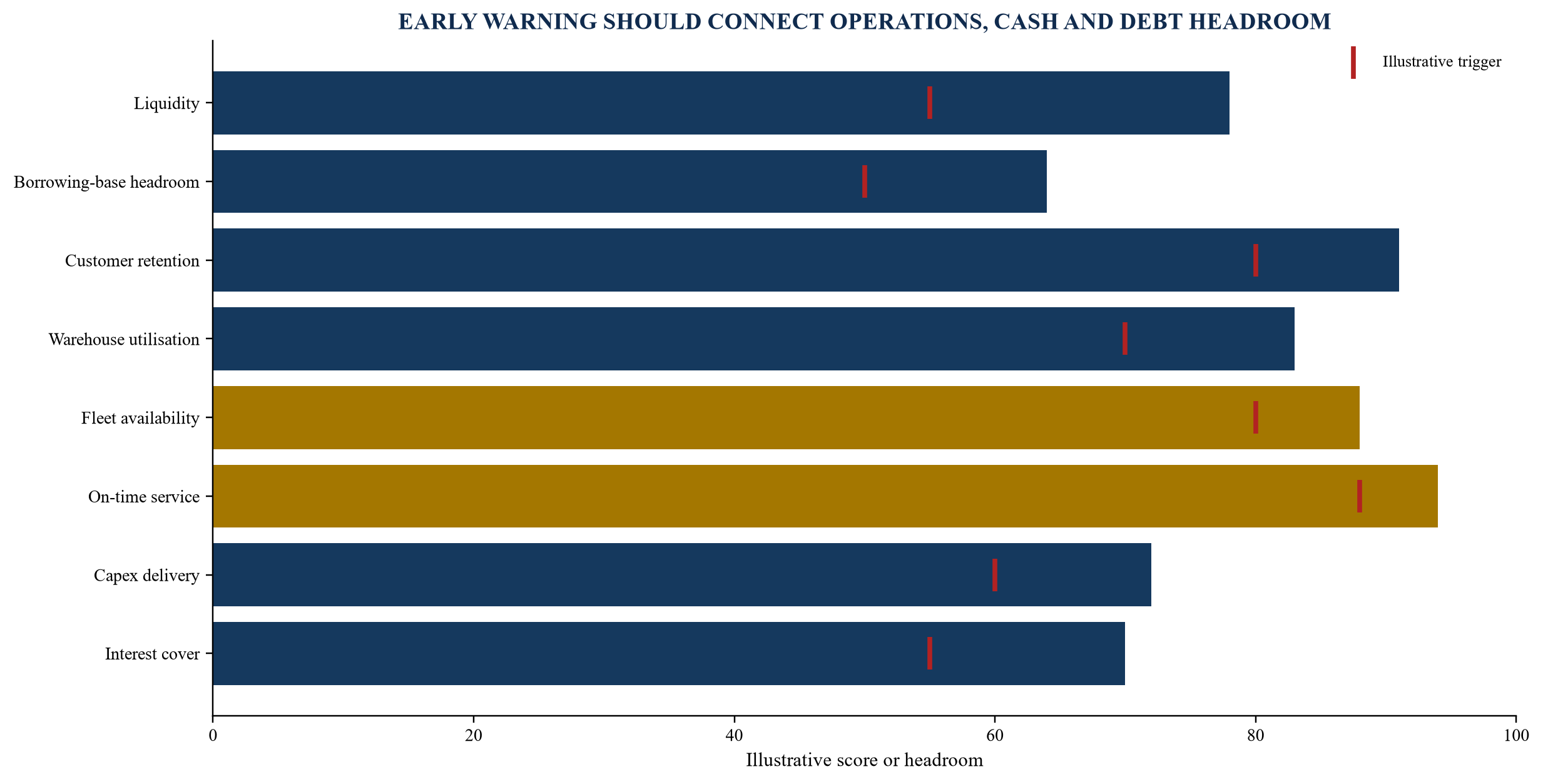
Thresholds and readings are hypothetical; actual covenants should be negotiated from verified baselines.
Core financial tests can include leverage, fixed-charge cover, interest cover, minimum liquidity, borrowing-base availability and property loan-to-value. Definitions should reconcile leases, exceptional items, acquisitions, disposals, grants, hedging and capitalised costs.
Operational reporting can include customer retention, top-customer revenue, warehouse utilisation, fleet availability, maintenance compliance, on-time service, claims, driver vacancies and technology incidents. The Department for Transport reported that 26 per cent of surveyed HGV businesses had driver vacancies in the fourth quarter of 2025.[1] A borrower should use its own verified workforce data for covenants.
Triggers can create information, action plans, cash control, draw stops or amortisation before an event of default. The response should be proportionate. A temporary service exception differs from sustained customer loss, yet both need a documented owner and remediation.
Reporting should use consistent definitions and source systems. Manual adjustments should be approved and retained. The lender should have audit and field-examination rights, with frequency increasing after a trigger.
13. Perfect security and manage priority
Security may include shares, property, vehicles, equipment, receivables, bank accounts, insurance, material contracts and a floating charge over other assets. The legal package should reflect title, existing finance, negative pledges, assignments and third-party consents.
Companies House guidance describes a charge as security given by a company for a loan and states that filing normally has a 21-day deadline.[8] Registration, priority and enforcement require qualified legal advice for the relevant entities and assets. HM Land Registry requirements may also apply to company charges over registered land.[9]
The lender should reconcile the public charges register, finance agreements and asset register. A satisfied facility can remain shown as outstanding if filings are not updated, while an unregistered interest may still create contractual and practical complications. The diligence record should state what is verified and what requires discharge or consent.
Where several lenders finance receivables, vehicles, property and term debt, an intercreditor agreement should allocate priority, enforcement control, turnover, release, proceeds and standstill. Shared collateral and cash accounts should not rely on informal expectations.
Customer contracts can restrict assignment or change of control. Confidentiality and commercial relationships may limit notification. The security plan should identify alternative controls, conditions subsequent and the effect on advance rates.
Insolvency recoveries depend on legal rights, priority, asset condition, continuity and costs. A warehouse may require an operator to preserve value. Fleet and customer contracts may lose value if employees, licences, insurance or systems fail. The lender's downside plan should therefore address operational continuity as well as documentation.
14. Govern cash, distributions and leakage
Cash governance should identify every collection, payment and reserve account. The borrower should document who can change customer instructions, approve suppliers, move intercompany cash and release restricted amounts. Dual control and independent verification reduce payment-diversion risk.
The facility should define permitted payments, distributions, management fees, acquisitions, investments, intercompany loans and related-party transactions. A growing logistics group can move value through property rent, vehicle hire, technology licences and procurement. Arm's-length evidence and lender limits help preserve the obligor's cash.
The cash waterfall can apply collections first to taxes and essential operations, then interest, scheduled principal, required reserves and approved capex. Excess cash can reduce debt or fund agreed growth. The order should support continuity because service failure can destroy receivable and contract value.
Customer deposits, customs funds, driver or employee amounts and third-party cargo proceeds should be distinguished from unrestricted cash. Legal ownership and trust treatment require advice. The borrower should avoid presenting restricted balances as liquidity.
Cash leakage can also occur through slow billing, missed fuel surcharges, unclaimed credits, excess subcontractor cost and unapproved service recovery. Operational cash improvement should be measured separately from delaying suppliers or reducing necessary maintenance.
Monthly lender reporting should reconcile opening cash, operating movement, debt service, capex, distributions and closing cash. The board should review the same record so that financing controls support management rather than create a parallel version of performance.
15. Address leases, accounting and valuation consistently
Financial reporting, covenant calculation and credit recovery answer different questions. The financing model should bridge them explicitly. IFRS 16 lease liabilities, EBITDA add-backs and rent cash should be reconciled so that leverage and coverage are internally consistent.[4]
IFRS 9 provides requirements for classification, measurement and impairment of financial instruments.[10] The lender should understand how the borrower measures expected credit losses on receivables, while making its own eligibility and reserve decisions. An accounting provision is not automatically the appropriate borrowing-base reserve.
IFRS 13 defines fair value using an exit-price framework.[11] Property, fleet and equipment values used for lending should state valuation basis, date, market, condition, costs and forced-sale assumptions. A book value or replacement cost can differ materially from orderly or distressed recovery.
IAS 36 addresses impairment of non-financial assets.[12] Customer loss, site underutilisation, technology obsolescence or cost inflation can trigger both accounting and credit review. The lender should understand management's cash-generating units and assumptions while retaining an independent downside.
Adjusted EBITDA should have a closed definition. Permitted add-backs can include documented one-off costs or run-rate savings subject to caps and evidence. Repeated, prospective or unexecuted adjustments weaken covenant meaning. The borrower should provide reported-to-adjusted bridges for every period.
Valuation cadence should reflect volatility and collateral. Receivables are monitored frequently, vehicles periodically, and property at agreed intervals or trigger events. Contract cash and enterprise value require review after major customer, margin or forecast changes.
16. Finance acquisitions and network expansion carefully
Private credit can fund acquisitions, new sites and fleet expansion, but the existing collateral should not silently absorb unpriced risk. Each investment should have a purpose, diligence record, sources and uses, integration plan and downside.
Acquisition analysis should separate target earnings, working capital, fleet and property obligations, customer retention, synergies, integration cost and purchase-price adjustments. Debt capacity should begin with stand-alone dependable cash. Synergy can support later deleveraging after ownership, timing and cost are evidenced.
An incremental facility can require pro forma covenant compliance, minimum equity contribution, permitted leverage, no default and delivery of security. Delayed-draw commitments can align funding with site or fleet milestones. Availability should expire if conditions are not met.
New warehouses require planning, lease or title, grid and utilities, fit-out, automation, customer mobilisation and workforce evidence. Construction and commissioning risk should not be treated as stabilised property debt. A staged facility can move from development controls to operating covenants after completion and acceptance.
Fleet growth should be linked to contracted demand, route economics, delivery timing, driver availability and disposal of replaced assets. A vehicle order without service demand can increase leverage and idle capacity.
Integration should preserve billing, customer service, cash, maintenance, safety, systems and employees. The lender should receive milestone reporting and escalation for customer loss, delayed systems, capex overrun or failure to realise cost actions.
17. Build resilience around technology and operations
Logistics cash depends on warehouse-management, transport-management, telematics, routing, customer portals, electronic proof of delivery, finance and payroll systems. Technology diligence should identify ownership, licences, interfaces, data quality, cyber controls, backup, recovery and third-party dependency.
A system outage can stop picking, routing, proof of delivery and invoicing. The borrower should test recovery objectives against the time before service and liquidity deteriorate. Manual fallback, customer communication and data reconciliation should be documented.
Cyber risk can create payment diversion, operational shutdown, data loss, regulatory exposure and customer claims. Access control, privileged accounts, vendor connections, patching, monitoring, incident response and insurance should be reviewed. Material incidents should trigger prompt lender notice.
Operational resilience also includes utilities, labour, fuel, subcontractors, roads and key equipment. Each critical site should identify single points of failure and tested alternatives. A business-continuity plan gains credit value when it is exercised and linked to customer commitments.
Data quality underpins the borrowing base and covenants. Master customer records, invoice status, proof of delivery, vehicle identity and site utilisation should reconcile across systems. Automation can detect duplicates and anomalies, but management remains accountable for definitions and exceptions.
Technology investment should have a measurable cash case. Expected labour, utilisation, error and service benefits should be tracked against implementation cost and disruption. Debt should not be sized to projected productivity before deployment and acceptance evidence exists.
18. Prepare a controlled downside and restructuring path
Downside planning should begin before distress. The lender and borrower should identify the sequence of customer, site, fleet, liquidity and covenant deterioration that would require action. Early options preserve more value than emergency enforcement.
The first response can include enhanced reporting, a 13-week cash forecast, independent review, capex controls, sponsor support, customer action and management changes. A waiver should state the problem, information, consideration, milestones and expiry. Repeated short waivers can consume time without repairing the operating cause.
Asset sales require operational analysis. Selling spare property or idle vehicles can reduce debt. Selling a critical depot, charging site or fleet class can damage contracts and cash. Proceeds should be assessed against lost contribution, replacement cost and security release.
A restructuring can resize maturities, amortisation, interest, covenants and liquidity. New money needs priority and a credible business plan. Payment-in-kind interest can preserve cash temporarily while increasing the claim. The plan should show when cash interest resumes and how leverage falls.
Enforcement value depends on continuity. Receivables require valid service and collection. Warehouses require access, utilities and sometimes an operator. Vehicles require maintenance, insurance and recoverable title. Customer contracts may terminate or restrict assignment. The lender should map insolvency and operational dependencies with current legal advice.
The board record should distinguish temporary liquidity stress from an unsustainable capital structure. Forecasts, options and stakeholder decisions should be documented. The objective is a timely decision based on cash, collateral and enterprise viability.
19. Establish a lender-borrower operating rhythm
A financing performs better when reporting supports decisions. Before closing, the parties should agree definitions, systems, templates, owners and delivery dates. The first certificate should be dry-run against historical data.
Weekly reporting can cover cash, borrowing-base availability, top collections, customer exceptions and fleet or site incidents during mobilisation or stress. Monthly reporting can include management accounts, covenant calculations, customer and site performance, capex, contracts and headroom. Quarterly review can address strategy, forecasts, valuation and refinancing.
Table 2. Lender-borrower control rhythm
| Frequency | Core record | Management purpose | Lender response |
|---|---|---|---|
| Daily or weekly | cash and availability | protect payroll, fuel and service | monitor headroom and exceptions |
| Monthly | accounts and operating dashboard | explain performance and corrective action | test covenants and trends |
| Quarterly | forecast, contracts and capex | allocate capital and update risks | review leverage, collateral and waivers |
| Annual | strategy, valuations and refinancing | set funding plan | approve limits and maturity actions |
Frequency should reflect facility risk, data capability and negotiated terms.
The lender should challenge trends, not merely breaches. Slower collections, rising credits, declining fleet availability or contract margin can signal future stress while financial covenants still pass. Management should own the remedy and deadline.
Information rights should respect confidentiality and data protection. Customer-level data can be delivered through secure channels and limited access. The borrower should know which information can be shared under its contracts and law.
Field examinations, property valuations, fleet inspections and technology reviews should be planned. Their scope should respond to risk and avoid duplicating reliable controls. Findings should feed the same action register used by management and the lender.
20. Use a gated UK logistics financing sequence
The financing can proceed through six gates. The purpose gate defines use of proceeds, enterprise perimeter and required liquidity. The evidence gate reconstructs cash, ownership, contracts and asset condition. The structure gate assigns each need to a suitable tranche. The documentation gate perfects controls and security. The funding gate verifies conditions and cash readiness. The monitoring gate maintains headroom and response options.
Table 3. UK logistics private-credit decision gates
| Gate | Required evidence | Decision | Redesign trigger |
|---|---|---|---|
| Purpose | sources, uses and liquidity need | select funding architecture | proceeds or repayment source unclear |
| Evidence | cash, assets, contracts and liabilities | size preliminary debt | unreconciled earnings or ownership |
| Structure | tranche, tenor, collateral and headroom | approve credit terms | maturity mismatch or weak downside |
| Documentation | security, priority, covenants and accounts | sign facilities | consent or perfection gap |
| Funding | conditions, availability and day-one cash | release draw | unresolved critical operational issue |
| Monitoring | reporting, triggers and capital plan | maintain or adjust facilities | declining cash, collateral or service |
Authority, documentation and advice should be adapted to the borrower and facility.
The credit paper should retain the asset-and-cash map, borrowing-base grid, contract-quality score, capital and maturity schedule and covenant dashboard developed in this paper. Each record should state source, date, owner, limitations and change since approval.
Known obligations should receive explicit treatment through reduced debt, reserves, amortisation, pricing, conditions or equity. A general risk paragraph does not fund deferred capex or protect liquidity. Assumptions should be labelled as observed, contracted or management-estimated in the internal credit file.
The financing architecture becomes coherent when working capital turns through the revolving base, fleet debt amortises with useful cash life, property debt reflects site value and capex, and term debt depends on dependable enterprise cash. That structure gives management room to operate while giving lenders a traceable path from collateral and contracts to cash, controls and downside action.
Table 4. Illustrative tranche architecture
| Tranche | Primary use | Repayment source | Core controls |
|---|---|---|---|
| Receivables revolver | working capital and seasonality | eligible customer collections | borrowing base, reserves and cash control |
| Fleet facility | vehicles and handling equipment | contract and route contribution | asset register, amortisation and maintenance |
| Property facility | warehouse acquisition or refinance | site and group cash | valuation, LTV, insurance and capex |
| Cash-flow term loan | acquisition, automation or growth | diversified enterprise free cash | leverage, coverage, liquidity and restrictions |
Terms are conceptual and do not represent a financing offer.
Table 5. Core downside responses
| Signal | Immediate evidence | Stabilisation action | Structural decision |
|---|---|---|---|
| Availability shortfall | invoice eligibility and collections | reserve, collection and liquidity plan | resize revolver or inject equity |
| Customer loss | contract, capacity and margin | redeploy assets and reduce cost | amortise debt or sell surplus assets |
| Fleet disruption | maintenance, insurance and utilisation | repair, hire and service recovery | replace or restructure fleet debt |
| Site underutilisation | contract pipeline and property options | consolidate or sublet where permitted | property sale, lease reset or debt paydown |
| Covenant pressure | cash forecast and downside | waiver with milestones | reprice, extend, equitise or refinance |
Responses require current legal, financial and operational advice.
References
- UK Department for Transport, Road Freight Statistics: 2025, 2026, https://www.gov.uk/government/statistics/road-freight-statistics-2025
- British Business Bank, What is Asset Finance?, https://www.british-business-bank.co.uk/business-guidance/guidance-articles/finance/what-is-asset-finance
- British Business Bank, Invoice Finance, https://www.british-business-bank.co.uk/business-guidance/guidance-articles/finance/invoice-finance
- IFRS Foundation, IFRS 16 Leases, https://www.ifrs.org/issued-standards/list-of-standards/ifrs-16-leases/
- UK Department for Energy Security and Net Zero, Non-domestic Private Rented Property Minimum Energy Efficiency Standard: Landlord Guidance, updated 2026, https://www.gov.uk/guidance/non-domestic-private-rented-property-minimum-energy-efficiency-standard-landlord-guidance
- UK Department for Transport and Office for Zero Emission Vehicles, Zero Emission Van and Truck Grant: Eligibility and Applications, updated 2026, https://www.gov.uk/government/publications/plug-in-van-grant/plug-in-van-and-truck-grant-eligibility-and-applications
- Bank of England, Financial Stability Report: July 2026, https://www.bankofengland.co.uk/financial-stability-report/2026/july-2026
- Companies House, Register a Charge for a Limited Company, updated 2026, https://www.gov.uk/guidance/register-a-charge-mortgage-for-a-limited-company
- HM Land Registry, Avoid HM Land Registry Requisitions: Company Charges, https://www.gov.uk/guidance/avoid-hm-land-registry-requisitions-company-charges
- IFRS Foundation, IFRS 9 Financial Instruments, https://www.ifrs.org/issued-standards/list-of-standards/ifrs-9-financial-instruments/
- IFRS Foundation, IFRS 13 Fair Value Measurement, https://www.ifrs.org/issued-standards/list-of-standards/ifrs-13-fair-value-measurement/
- IFRS Foundation, IAS 36 Impairment of Assets, https://www.ifrs.org/issued-standards/list-of-standards/ias-36-impairment-of-assets/
- Office for National Statistics, Business Investment within Transportation and Storage by Industry, 2026, https://www.ons.gov.uk/economy/grossdomesticproductgdp/datasets/businessinvestmentwithintransportationandstoragebyindustry/current
- UK Finance, Business Finance Review, 2026, https://www.ukfinance.org.uk/data-and-research/data/business-finance-review
- UK Finance, Standards Framework for Invoice Finance and Asset-Based Lending, 2025, https://www.ukfinance.org.uk/system/files/2025-02/IFABL%20Standards%20Framework.pdf
- British Business Bank, Small Business Finance Markets 2024/25, 2025, https://www.british-business-bank.co.uk/sites/g/files/sovrnj166/files/2025-02/small-business-finance-market-report-2025.pdf
- UK Department for Transport, Infrastructure for Zero Emission Heavy Goods Vehicles and Coaches, https://www.gov.uk/government/calls-for-evidence/infrastructure-for-zero-emission-heavy-goods-vehicles-and-coaches/infrastructure-for-zero-emission-heavy-goods-vehicles-and-coaches
- UK Department for Transport, Domestic Road Freight Activity Data Tables, https://www.gov.uk/government/statistical-data-sets/domestic-road-freight-activity-rfs01
- UK Insolvency Service, Technical Guidance for Official Receivers: Creditors and Liabilities, https://www.gov.uk/guidance/technical-guidance-for-official-receivers/43-creditors-and-liabilities
- Office for National Statistics, GDP Monthly Estimate, UK: December 2025, https://www.ons.gov.uk/economy/grossdomesticproductgdp/bulletins/gdpmonthlyestimateuk/december2025
