

1. Treat procurement as an operating-value system
Procurement creates value through the operating system that converts external inputs into products, services and cash. Price is one component. Availability, specification, quality, lead time, yield, warranty, data security, payment, inventory, switching cost and supplier behaviour can matter as much as the invoice amount. A board that asks only for a percentage reduction in spend can encourage actions that improve a savings report while weakening the business.
The ownership case should begin with a value chain. A sourcing decision changes unit price and commercial terms. Those terms affect purchase cost, inventory, payment timing and supplier economics. Supplier economics influence capacity, service, quality and resilience. Operating outcomes affect revenue, margin, cash, capital requirements and risk. The programme should preserve that chain from decision to observed financial result.
The programme also needs an explicit boundary. Some expenditure may be addressable through competition or specification change. Some is committed under contract, regulated, technically locked, customer-nominated or dependent on scarce capacity. Some can be reduced only by changing demand or the operating model. Calling the full general-ledger population addressable creates an unrealistic target and weakens accountability.
The board should approve four outcomes: durable run-rate benefit, realised cash benefit, continuity within agreed tolerances and a controlled supplier base. Finance should validate the first two. Operations and the relevant control functions should validate continuity and risk. Procurement should own the commercial process and supplier relationship. Business owners should own demand and performance.
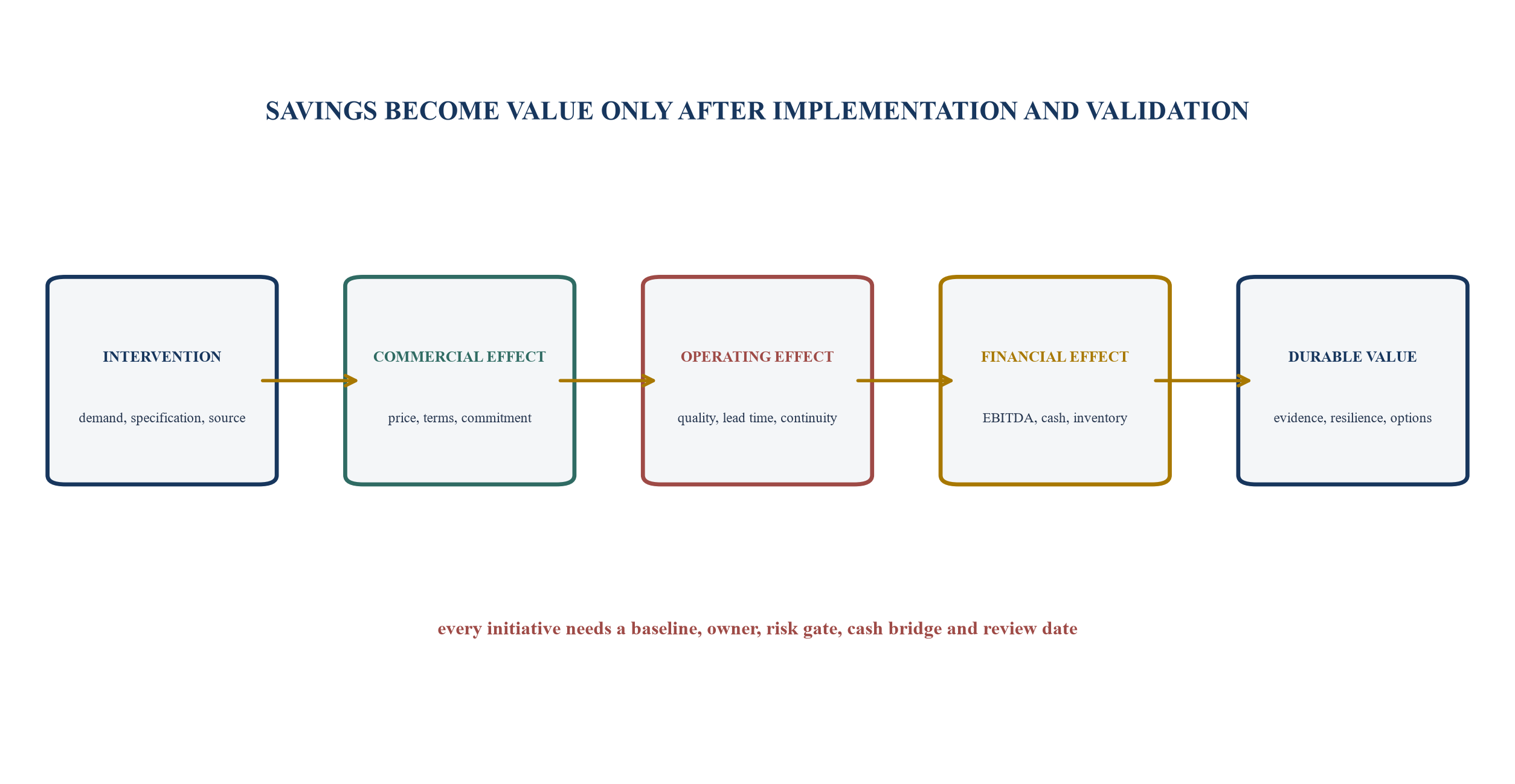
The programme follows the full chain from spend decision to financial result and operating resilience.
2. Establish a baseline that finance can reconcile
The first operating challenge is data completeness. General-ledger accounts, purchase orders, invoices, contracts, supplier masters, bank payments, inventory records, bills of material, work orders and expense systems can describe different parts of the same economic population. The programme should create a spend cube that reconciles those sources without assuming that any single system is complete.
The baseline should identify legal entity, site, category, supplier, currency, quantity, unit of measure, purchase price, rebates, freight, tax, payment terms, contract, purchase-order status and business owner. Where line detail is absent, the record should state the limitation. Unclassified spend should remain visible. A high percentage of coded spend can still be misleading when supplier names are duplicated, units differ or credits are omitted.
Finance should reconcile the cube to the general ledger and cash records for a defined period. Procurement should reconcile suppliers and contracts. Operations should confirm quantities, specifications and consumption. The controller should document timing differences, capital expenditure, intercompany transactions, taxes, pass-through costs and one-time items. This creates a shared population before targets are assigned.
The baseline must also normalise price, volume, mix and foreign exchange. A lower total spend caused by reduced production is not a procurement saving. A higher unit price caused by a richer specification may be economically justified. An unchanged invoice price may represent a benefit when an indexed input increased, although that benefit should be labelled as cost avoidance until the validation policy permits another treatment.
Data quality affects programme design. Categories with reliable line-level data can move quickly into analysis and sourcing. Categories with weak data may need supplier statements, contract abstraction, inventory counts or operational sampling. The board should see data confidence beside the savings target.
Table 1. Minimum evidence for the procurement baseline
| population | minimum fields | reconciliation | decision supported | common failure |
|---|---|---|---|---|
| ledger and cash | account, entity, period, amount, currency, payment | trial balance and bank | total economic population | invoice total treated as cash |
| purchase orders | supplier, line, quantity, unit, price, date, owner | PO to invoice and receipt | price, demand and compliance | open orders omitted |
| contracts | term, scope, price, index, volume, notice, liability | contract to supplier and spend | renegotiation and exit timing | renewal dates unknown |
| inventory | item, site, age, demand class, safety stock | subledger to count and ledger | working capital and resilience | stock removed without service test |
| quality and service | defect, downtime, lead time, incident, warranty | event to supplier and category | total cost and supplier action | failures held outside spend data |
| supplier master | entity, parent, bank, tax, geography, criticality | duplicate and ownership review | concentration and control | fragmented suppliers appear diverse |
The baseline joins financial, commercial and operational populations before benefits are claimed.
3. Segment categories by economics and business impact
A category strategy should reflect both economic opportunity and business criticality. High spend does not always mean high opportunity. A low-spend component can stop production, invalidate a licence or interrupt a customer service. A high-spend commodity with many qualified sources may be easier to compete without changing operating risk.
The segmentation can use four dimensions. Economic scale includes current spend, forecast demand and cost volatility. Supply-market structure includes capacity, concentration, substitutes and switching time. Business impact includes revenue dependency, safety, quality, customer commitment and recovery tolerance. Control exposure includes data, cyber, human rights, sanctions, environmental and regulatory requirements.
Categories can then be placed into practical playbooks. Leverage categories may support competitive sourcing and demand aggregation. Bottleneck categories need continuity, alternative qualification and careful inventory policy. Strategic categories need joint planning, governance and transparent economics. Routine categories need catalogue, workflow and compliance automation.
Segmentation must reach the item or service level when category averages conceal critical dependencies. A facilities category can include easily substituted cleaning supplies and a specialist maintenance service that supports a regulated asset. A technology category can include commodity devices and a cloud platform holding essential data. The programme should map the critical element, not rely on the category label.
The category owner should state the approved intervention boundary. The board may accept a sourcing event for one part of a strategic relationship while protecting another. It may approve dual qualification before reducing incumbent volume. It may preserve a supplier because its continuity value exceeds a narrow price difference. These are economic choices requiring evidence.
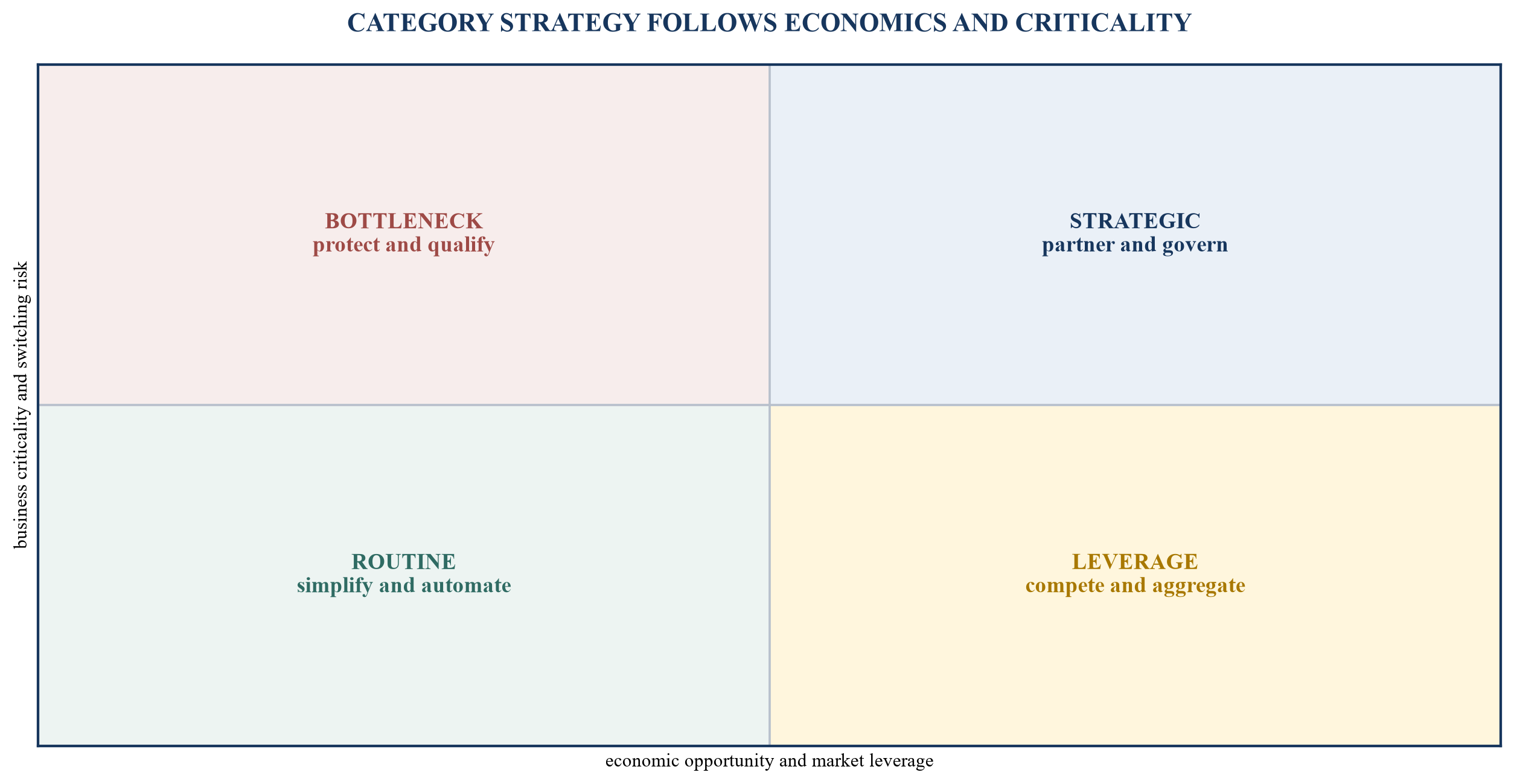
The map determines the sequence and control intensity of procurement interventions.
Table 2. Category playbooks
| segment | primary objective | permitted early actions | required protection | board evidence |
|---|---|---|---|---|
| routine | reduce process cost and leakage | catalogue, cards, approval automation | access, fraud and service controls | compliance and transaction cost |
| leverage | improve price and commercial terms | competition, aggregation, index reset | capacity and transition confirmation | bid comparison and implementation |
| bottleneck | secure supply and optionality | forecast sharing, safety stock, qualification | continuity plan and technical approval | tolerance, alternate source and inventory |
| strategic | improve total economics and capability | open-book analysis, joint design, governance | relationship, IP, data and exit plan | total cost, roadmap and risk |
Each playbook combines a value lever with continuity and evidence requirements.
4. Define savings before negotiating
A procurement programme needs a written benefit policy. Without one, workstreams can report the same economic effect through price, productivity, working capital and budget reduction. The policy should define baseline, counterfactual, measurement period, volume, mix, currency, inflation, implementation cost, accounting location, cash timing and approval authority.
The savings taxonomy should separate purchase-price reduction, demand reduction, specification change, process efficiency, working-capital release, capital avoidance and risk mitigation. Purchase-price reduction can affect cost of sales or operating expense. Demand reduction removes units or services. Specification change alters the requirement. Process efficiency reduces internal effort. Working-capital release changes cash timing and balance-sheet investment. Each has a different path to EBITDA and cash.
Cost avoidance should remain distinct from realised savings. Preventing a proposed increase can be commercially valuable, yet it does not necessarily reduce the current cost base. A negotiated cap, index formula or protected capacity may reduce downside without creating an immediate accounting variance. The board should see both outcomes under separate definitions.
Run-rate benefit also differs from realised benefit. A new price effective late in the period may create a full-year run rate with limited current-period impact. Implementation delays, minimum commitments, termination charges, inventory burn-off and supplier credits can change the timing. Finance should validate actual volume at the new economics and reconcile the result to the accounts.
The programme should show gross and net benefit. Gross benefit is the favourable effect before implementation cost, transition loss, required inventory, quality cost, supplier support, systems or internal capacity. Net benefit deducts those elements and shows the timing of cash. A board that approves only gross targets can underfund implementation.
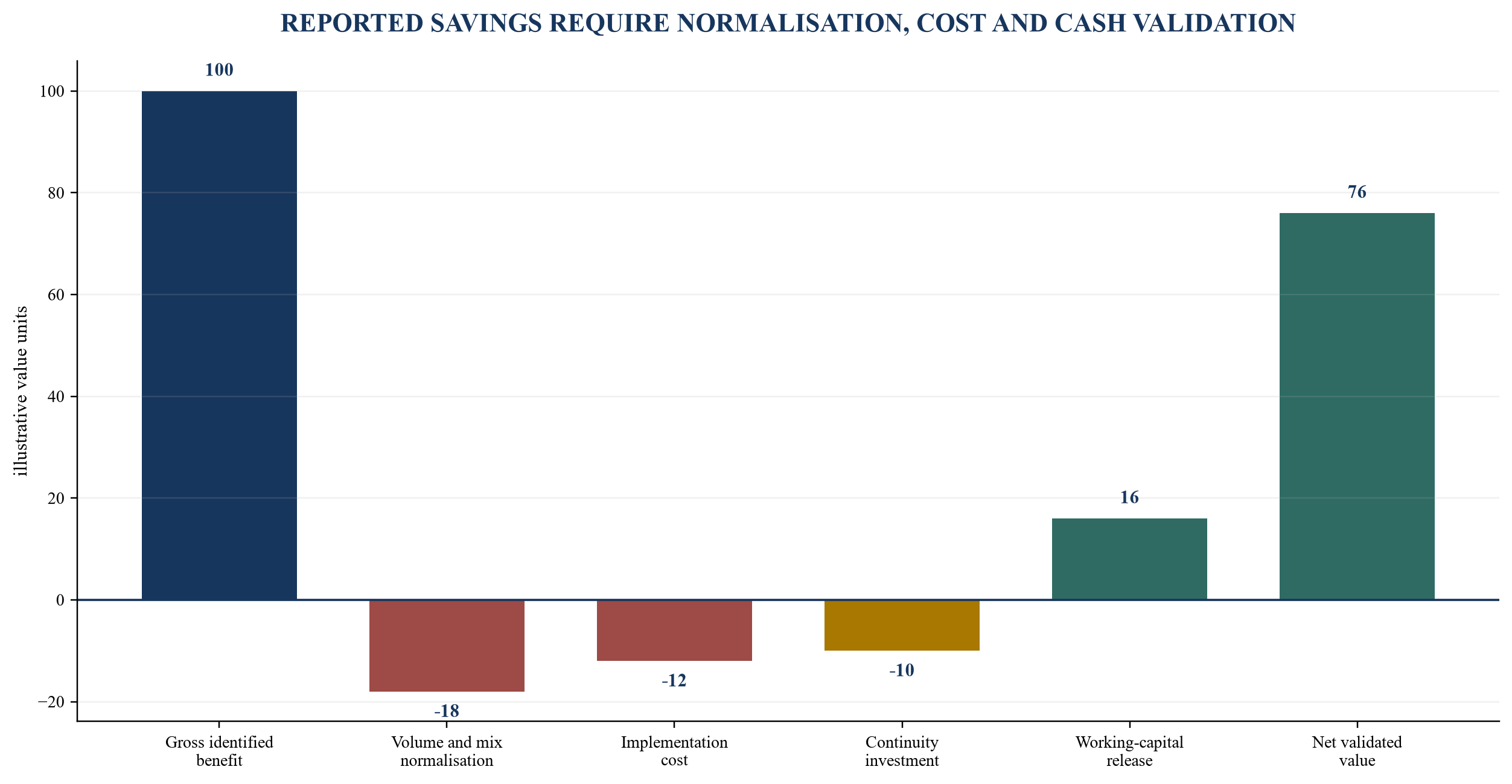
Values are hypothetical management assumptions and do not represent an expected programme outcome.
Table 3. Finance-controlled savings register
| field | required record | finance test | operating test | approval state |
|---|---|---|---|---|
| baseline | period, quantity, price, mix, currency and source | ledger reconciliation | consumption confirmation | baseline approved |
| intervention | demand, specification, source, price, term or process | accounting location | implementation owner | decision approved |
| counterfactual | prior price, index, bid or approved forecast | policy consistency | market and capacity support | method approved |
| gross benefit | rate multiplied by normalised activity | arithmetic and duplicate check | operating population | identified |
| deductions | transition, quality, inventory, systems and support | cash and expense treatment | risk-gate completion | implementable |
| realised result | actual activity at controlled economics | ledger and cash evidence | service and quality evidence | validated |
Every initiative moves through the same evidence and validation states.
5. Use should-cost and whole-life-cost analysis
Competitive bids show market offers under a defined requirement. They do not by themselves reveal the efficient cost of the requirement or the costs transferred elsewhere in the system. A should-cost model decomposes materials, labour, equipment, overhead, logistics, risk and an appropriate return. A whole-life-cost model adds implementation, operation, maintenance, licences, consumables, transition, decommissioning and disposal.
The United Kingdom Sourcing Playbook places should-cost modelling inside delivery-model and commercial decisions, including the need to understand cost drivers, risk and whole-life value. Australia's Commonwealth Procurement Rules similarly require financial and non-financial benefits, supplier capability, flexibility, sustainability and whole-of-life costs to be considered in value-for-money analysis. These public frameworks are not private-company mandates; their cost logic is useful for ownership decisions.
The model should state its source hierarchy. Contracted indices, engineering quantities, verified labour rates and observed yields may carry more weight than a broad benchmark. Supplier input can improve accuracy when incentives and confidentiality are managed. A sensitivity should show which variables drive the result and which remain uncertain.
Should-cost is also a negotiation tool. It can identify design complexity, low yield, expedite cost, fragmented volume, forecast volatility or payment risk that the buyer can change. A demand commitment may lower price while increasing inventory and take-or-pay exposure. A longer contract may support investment while reducing future competition. The programme should price these exchanges.
The model must avoid false precision. It should use ranges where input uncertainty is material and retain the supplier's actual commercial context. A financially unsustainable target can produce service failure, claims, quality shortcuts or insolvency. The board should evaluate the buyer's value and the supplier's ability to perform.
6. Remove demand and specification cost at the source
Demand management can create durable benefit because it removes the requirement rather than transferring margin to another supplier. The opportunity can include stopping unused services, reducing variants, consolidating specifications, changing service levels, redesigning packaging, repairing instead of replacing, standardising components or improving forecast accuracy.
The business owner must approve the change. Procurement can surface consumption and price, but it may not understand why a feature, test, material, delivery window or staffing level exists. Engineering, operations, product, quality, customer, regulatory and safety owners should distinguish essential requirements from inherited practice.
Specification changes need controlled testing. A lower-cost material can affect yield, warranty, customer acceptance or certification. A reduced service level can create internal labour or customer loss. A software licence reduction can impair access or resilience. The programme should define the test population, acceptance criteria, rollback, evidence and decision authority.
The demand baseline should also preserve seasonality and growth. Removing unused capacity from a declining location differs from eliminating strategic capacity before a ramp. The owner should explain the forecast, peak requirement, lead time and recovery option. Savings should reflect the capacity that can actually be removed or redeployed.
Standardisation can increase bargaining power and reduce inventory, yet it can create concentration. A common component across many products may simplify procurement while making one failure more consequential. The category plan should balance design reuse with alternate qualification, modularity and recovery.
7. Design sourcing events around outcomes and transition
A sourcing event begins with a defined requirement, market assessment and transition plan. A request for quotation issued before those elements are ready can compare bids that reflect different assumptions. The programme should state volume, forecast range, specifications, locations, service levels, quality, data, sustainability, implementation, pricing mechanism and contract term.
Market engagement should test capacity, competition, innovation and constraints before the final structure is fixed. The World Bank Procurement Framework emphasises tailoring market approach to needs, risks and opportunities while pursuing value for money. The same logic supports private sourcing: the process should fit the category and operating consequence.
Evaluation should use a documented model. Price, whole-life cost, capacity, quality, service, technical capability, financial standing, cyber, compliance, responsible business and transition should carry weights appropriate to the category. A threshold can prevent a low price from offsetting a material safety or continuity failure.
Negotiation should record exchanges rather than celebrate a headline discount. Price may depend on term, volume, payment, forecast, exclusivity, liability, indexation, intellectual property or termination. The decision record should show the economic value and risk of each concession. Where a supplier funds tooling or transition, the contract should address ownership, recovery and exit.
Award is an implementation gate. The company should confirm contract, purchase orders, item masters, price files, inventory, technical approval, quality plan, data access, supplier onboarding and communications before volume moves. A transition dashboard should track service, defects, lead time, cash and open risks until stabilisation.
8. Recover contract leakage without damaging service
Many programmes can create early value by applying existing contracts. Leakage can arise through off-contract buying, incorrect price files, missed rebates, duplicate suppliers, unclaimed credits, auto-renewal, unnecessary premium service, incorrect freight or invoices that do not match purchase orders and receipts.
The control begins with a contract-to-transaction map. Each material supplier should have an executed agreement or an approved exception, a current price schedule, a purchase-order rule, an invoice match and a named owner. Changes should be authorised and retained. The programme should distinguish a genuine contractual entitlement from a commercial interpretation requiring legal review.
Recovery should preserve the relationship and supply. A retrospective claim may be valid and still require a structured resolution because the supplier disputes scope, quantity, index or acceptance. The owner should assess evidence, limitation periods, counterclaims, future capacity and negotiation sequence with qualified counsel where appropriate.
Compliance should not become a blunt centralisation metric. Emergency and local buying can be legitimate when the catalogue lacks the required item or the approved supplier cannot perform. The exception log should identify root cause: specification, access, price, lead time, approval delay or behaviour. Fixing the cause creates more durable compliance than blocking the transaction.
Process automation can reduce transaction cost and fraud exposure when master data, access, segregation and monitoring are designed properly. It can also scale an incorrect rule quickly. The programme should test approval thresholds, supplier-bank changes, duplicate invoices, tax, sanctions screening and exception routes before automating.
9. Monitor supplier economics and financial health
A supplier can accept a price it cannot sustain. The risk is greater when the category requires dedicated capacity, scarce labour, regulated quality, long lead-time inputs or buyer-specific investment. The programme should therefore examine financial standing, cash conversion, leverage, profitability, customer concentration, insurance, ownership and access to funding for critical suppliers.
Financial analysis should connect to the contract. A supplier with thin liquidity may be exposed to long payment terms, volatile materials, fixed-price commitments or unbilled implementation. A favourable buyer term can transfer a financing requirement that later returns through higher price, reduced capacity or failure. The company should assess the combined economics.
Early-warning indicators can include late delivery, expedited freight, quality deterioration, requests for advance payment, staff loss, facility changes, covenant stress, tax or legal notices and deterioration in communication. None proves distress alone. The owner should investigate facts, document the response and protect confidential information.
Mitigation can include staged volume, direct payment for critical materials, inventory ownership, parent support, performance security, alternate qualification, technical assistance, renegotiated indexation or an orderly transition. Each action has cost and legal implications. The board should see the continuity effect and the residual exposure.
Supplier monitoring should remain proportionate. Routine low-impact suppliers do not require the same information as a sole-source provider supporting a critical service. The criticality map should determine review frequency, evidence, escalation and contingency.
10. Define continuity tolerances before taking cost out
Supply resilience becomes governable when the company identifies the product or service that must continue, the minimum acceptable capacity, the maximum tolerable disruption, the recovery sequence and the dependencies that support it. ISO 22301 provides a management-system framework for preparing for, responding to and recovering from disruption. The company's tolerances should reflect its own customers, assets, regulation and risk appetite.
The map should reach beyond the direct supplier where concentration lies upstream. A company may have three distributors that depend on the same manufacturer, port, cloud region or raw material. NIST's supply-chain risk guidance emphasises visibility, assessment, mitigation and lifecycle management for technology products and services. The same dependency logic is useful in broader categories.
Continuity options include alternate suppliers, alternate specifications, dual tooling, reserved capacity, inventory, geographic diversification, repair capability, data portability and contractual assistance. Each option has cost and activation time. A second supplier that has never produced the item is an untested option rather than active resilience.
The savings case should deduct the cost of required resilience. Reducing safety stock can release cash, yet a longer lead time or more volatile source may require additional stock. Consolidating volume can improve price, yet it may increase dependency. The programme should optimise the combined cost of supply and interruption within the board's tolerance.
Testing turns plans into evidence. The company can run a supplier failure tabletop, alternate-order test, data restoration, transport diversion or limited production batch. Findings should have owners and due dates. A successful sourcing event should close only after the agreed continuity controls are operating.
Table 4. Supplier resilience heat map
| dimension | evidence | low exposure | elevated exposure | management action |
|---|---|---|---|---|
| source concentration | parent, site and upstream map | qualified independent capacity | common upstream dependency | qualify or reserve alternate |
| switching time | technical and operational plan | proven short transition | long or untested transition | stage volume and test |
| inventory cover | demand, lead time and variability | aligned to tolerance | below recovery requirement | rebuild or redesign policy |
| financial capacity | accounts, liquidity and commitments | capacity funded | buyer terms create stress | support, security or transition |
| quality and safety | defect, audit and approval history | controlled performance | adverse trend or open finding | containment and corrective action |
| cyber and data | access, control and exit evidence | tested control and portability | privileged or opaque dependency | restrict, remediate and recover |
Ratings require company-specific evidence and approved tolerances.
11. Manage inventory and payment as operating choices
Procurement affects cash through price, payment terms, deposits, minimum order quantities, rebates, consignment, inventory ownership and lead time. These mechanisms should appear in one cash bridge. A lower unit price can consume cash when it requires a larger batch or advance payment. A longer payment term can improve cash while weakening a critical supplier.
IAS 2 includes purchase, conversion and other costs required to bring inventory to its present location and condition, and requires measurement at the lower of cost and net realisable value. The programme should therefore connect sourcing changes to freight, duties, yield, handling, obsolescence and write-down risk rather than comparing invoice price alone.
Inventory policy should be item-specific. Cycle stock reflects order economics. Safety stock reflects demand and lead-time variability. Strategic stock can protect an identified disruption. Obsolete and excess stock require separate disposition. A blanket reduction can remove the stock that protects revenue while leaving slow-moving items untouched.
Payment-term initiatives need a supplier and jurisdiction view. Standardising terms can simplify working capital, yet statutory payment rules, small-supplier policies, construction requirements or contract commitments may apply. The company should verify the governing terms and the supplier's capacity. Delayed approval or invoice disputes should not be presented as negotiated working-capital improvement.
Finance should distinguish recurring cash release from timing. Inventory released through a durable planning change can reduce invested capital. A one-time destock followed by replenishment has a different value. The dashboard should show service, backorders, expedites, defects and supplier behaviour beside cash.
12. Protect quality, safety and regulatory approval
Quality cost includes inspection, testing, scrap, rework, returns, warranty, field service, customer credits, recalls and lost capacity. These costs may sit in different accounts and functions. A sourcing decision that reduces invoice price while increasing failure cost can destroy margin and customer trust. The category model should therefore include cost of poor quality and the time required to detect it.
The specification and supplier approval process should reflect the product and industry. A regulated component, clinical service, food input, engineering material or critical infrastructure contractor may require licences, validated processes, traceability or customer consent. A private-company savings timetable does not override those requirements. The technical owner should define the evidence gate and retain authority to stop transition.
Incoming inspection is not a complete substitute for supplier process capability. A defect may be latent, intermittent or visible only in field conditions. The company should review process controls, change notification, sub-tier suppliers, calibration, test methods, corrective action and record retention according to risk. Contractual warranties allocate some consequences but do not restore interrupted service.
The programme should establish a controlled trial when qualification is feasible. The trial should define sample, operating conditions, acceptance criteria, duration, data, responsible reviewers and rollback. Volume should move in stages where failure would be material. Supplier scorecards should compare like populations and record changes in specification, mix and inspection intensity.
Quality issues require transparent economics. A supplier credit can offset an invoice while leaving labour, downtime or customer loss unresolved. The benefit register should include those consequential costs where they can be evidenced and avoid unsupported assumptions. The board should see the observed financial effect and the remaining technical uncertainty.
13. Govern technology, cyber and data suppliers
Technology procurement can create concentrated operational dependency through cloud platforms, managed services, software, models, data providers, telecommunications and embedded components. The commercial owner should identify privileged access, sensitive data, integration, recovery, subcontracting, model or software provenance, service location, concentration and exit requirements.
NIST SP 800-161 integrates cybersecurity supply-chain risk management into enterprise risk activities and addresses strategy, policy, plans and assessments over the product and service lifecycle. NIST SP 1326, published in July 2026, provides a due-diligence assessment guide for technology suppliers and products. These sources support a structured record of ownership, control, provenance, resilience, foundational practices and supply tiers.
The UK National Cyber Security Centre's supply-chain guidance similarly emphasises understanding suppliers, communicating requirements, building security into contracting, assurance and continuous improvement. A contract should translate the company's requirements into access control, incident notification, vulnerability management, audit evidence, data location, subcontractor obligations, recovery and exit support.
Price negotiation should include consumption and architecture. Cloud and software spend can rise through unused licences, poor tier selection, data transfer, overprovisioning or duplicated tools. A lower unit rate may be less valuable than removal of waste or a redesign that improves portability. Engineering, security, finance and business owners should approve changes together.
Exit planning should start at entry. The company should know how it will retrieve data, replace interfaces, preserve records, transfer licences and operate during transition. Where a service supports a critical process, recovery and portability should be tested. A nominal termination right without practical migration capability provides limited optionality.
14. Integrate responsible-business and sustainability due diligence
Procurement decisions can affect workers, communities, the environment and the company's licence to operate. The OECD Due Diligence Guidance for Responsible Business Conduct provides a risk-based process for embedding policy, identifying and assessing adverse impacts, preventing or mitigating them, tracking results, communicating and enabling remediation. The process prioritises severity and likelihood rather than supplier spend alone.
The European Union's corporate sustainability due-diligence framework has evolved. The Commission states that Directive (EU) 2024/1760 entered into force in July 2024 and was subsequently amended, with transposition and application dates extended. Companies should verify current scope and national implementation with qualified counsel. Suppliers outside the direct legal scope can still receive information and contractual requests from customers within a regulated value chain.
Forced-labour requirements can affect admissibility of goods and evidence. U.S. Customs and Border Protection states that importers must exercise reasonable care, understand where and how products are made and maintain sufficient documentation. Australia's Modern Slavery Act requires in-scope entities to report actions addressing risks in operations and supply chains, while the Australian Government was consulting in August 2026 on further reforms. These requirements should be assessed by jurisdiction and product.
The programme should avoid treating a supplier questionnaire as complete due diligence. It should use risk-based mapping, credible information, worker or stakeholder channels where appropriate, contractual requirements, monitoring and remediation. Abrupt termination can sometimes worsen harm or remove leverage. The responsible function should guide decisions and preserve affected-person considerations.
Sustainability can also change whole-life economics. Energy, water, material efficiency, waste, circularity, repairability, emissions, climate exposure and end-of-life obligations can affect cost, customer eligibility and resilience. ISO 20400 provides guidance on integrating sustainability into procurement. The category strategy should connect relevant impacts to evidence and commercial decisions.
15. Manage cross-border, geopolitical and logistics exposure
Cross-border sourcing adds currency, tariffs, customs, sanctions, export controls, transport, insurance, tax, legal enforcement, local content and political risk. The invoice currency may differ from the supplier's cost currency. An indexed contract may pass through material or energy changes. A nominally local supplier may depend on a concentrated imported input.
The programme should build a landed-cost bridge. It should include purchase price, freight, duty, brokerage, insurance, inspection, financing, inventory, tax where relevant, quality and expected disruption cost under documented scenarios. It should show which variables are fixed, indexed, hedged, passed through or retained by the company.
Geographic diversification can create resilience when sources are genuinely independent and qualified. It can also increase complexity, lead time and inventory. The United Arab Emirates' National Programme to Strengthen Supply Chain Resilience focuses on priority products, import exposure, strategic sources, local capacity and partnerships. The logic is useful for a company map: identify the critical item, exposure, feasible source and economic response.
India's National Logistics Policy and PM Gati Shakti programme seek to improve logistics efficiency and integrated planning. India's procurement framework also contains policies supporting micro and small enterprises. A portfolio company operating in India should understand how infrastructure, supplier development, local content, tax and contracting interact with the category strategy.
The board should review scenarios rather than assume one geographic answer. A lower-cost source can be preferred for normal demand while another source preserves surge or recovery. Regional inventory can protect customer service. Nearshoring can reduce lead time while increasing unit price. The decision should use total economics, tolerance and strategic optionality.
Table 5. Selected jurisdiction and standards overlays
| geography or framework | procurement issue | programme evidence | decision implication |
|---|---|---|---|
| United Kingdom | should-cost, market health, transition and supply-chain cyber | cost model, supplier assessment and exit plan | avoid low-cost bid bias and unmanaged dependency |
| European Union | value-chain due diligence and evolving implementation | scope analysis, risk map and remediation record | preserve legal review and supplier engagement |
| United States | technology supply-chain risk and forced-labour import evidence | provenance, tier map and admissibility records | gate source and shipment decisions |
| United Arab Emirates | supplier governance, continuity and strategic import exposure | supplier qualification, contingency and source map | connect local capability with resilience |
| India | procurement, MSME participation and logistics development | supplier status, lead-time and infrastructure map | include policy, capacity and payment context |
| Australia | whole-life value and modern-slavery reporting | total-cost model and supply-chain risk evidence | combine price, capability, ethics and lifecycle |
The table is a planning prompt; qualified advisers should determine current applicability.
16. Use governance that separates value, control and ownership
The procurement programme needs an operating cadence with clear decision rights. The chief executive or operating sponsor owns the overall outcome. The chief financial officer owns benefit policy and validation. Procurement owns category process, market engagement and commercial records. Business owners own demand, specification and supplier performance. Quality, legal, risk, cybersecurity, compliance, sustainability and other functions retain their control mandates.
The weekly value office should review the initiative register, implementation, service, quality, cash and blockers. It should focus on decisions and exceptions. A monthly steering committee should validate realised benefits, approve material sourcing choices and review supplier and continuity risks. The board should review programme value, risk appetite, strategic suppliers, major transitions and unresolved exceptions.
Decision gates can prevent speed from outrunning evidence. Gate one approves the baseline and category boundary. Gate two approves the sourcing or intervention strategy. Gate three approves award and transition. Gate four confirms stabilisation. Gate five validates benefit. A failed control at one gate should create a documented remediation, exception or stop decision.
Conflicts and integrity require specific controls. Supplier selection, gifts, hospitality, related parties, confidential bids, bank changes and approval overrides should follow policy and applicable law. Competitive information should be handled lawfully. Negotiation records should distinguish legitimate market intelligence from inappropriate coordination.
The board pack should show gross identified opportunity, approved initiatives, implemented run rate, finance-validated result, cash effect, implementation cost, continuity status and open control matters. These categories should not be collapsed into one savings number.
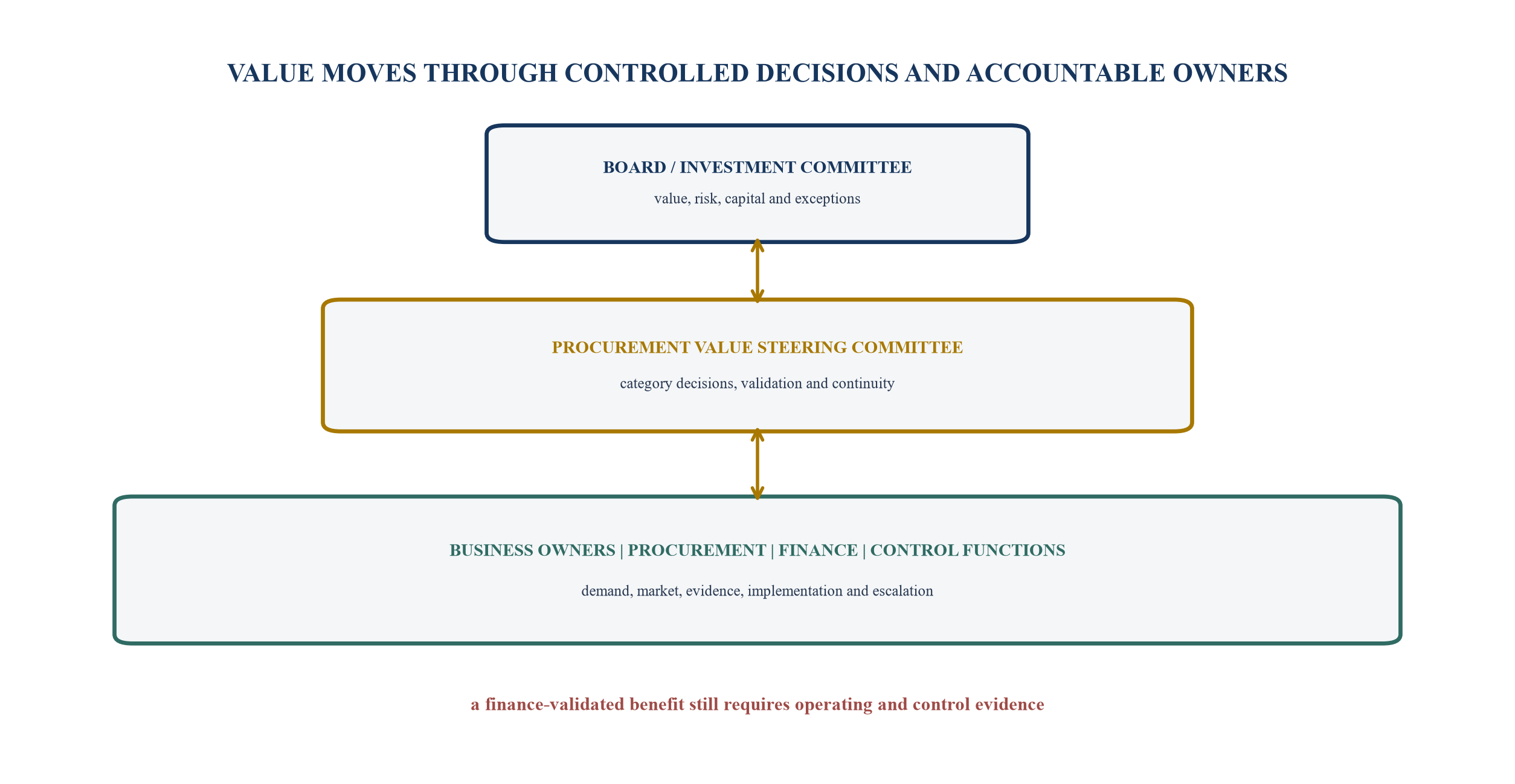
Commercial ownership, operating accountability, finance validation and control authority remain connected and distinct.
17. Align incentives with durable value
Incentives can accelerate a programme or distort it. A buyer rewarded only for negotiated price may prefer a large headline discount with unrealistic volume assumptions. A business owner measured only on service may resist economically sound change. A finance team measured only on budget can delay essential investment. The scorecard should combine value, implementation, cash, service, quality and control.
Targets should follow authority. Procurement can own sourcing process, coverage, competition and commercial implementation. Business owners can own demand and adoption. Operations can own continuity and quality. Finance can own validation. Shared outcomes should identify the specific contribution and decision each role controls.
The benefit policy should prevent duplicate credit. A specification change initiated by engineering and negotiated by procurement can be one initiative with shared accountability. A working-capital release should not also appear as EBITDA. A price benefit caused by lower market indices should be separated from negotiated performance according to policy.
Incentive measures need quality gates. A material safety, compliance, fraud, human-rights, cyber or customer failure can require review under applicable agreements and law. The board should define the gate before results are known and retain documented judgement.
Behavioural review is part of the programme. If teams split orders, delay invoices, pressure suppliers outside approved terms, defer maintenance or lower quality to protect a target, the metric is producing risk. The steering committee should investigate the underlying incentive and correct the system.
18. Apply the framework to a hypothetical portfolio company
Consider a hypothetical multi-site industrial-services company with annual third-party spend of 240 value units. The initial ledger suggests a 12 percent target. The baseline review identifies 30 units of taxes, pass-through costs and customer-nominated items, 28 units committed under long-term agreements, and 22 units lacking sufficient line-level data. The initial addressable population is therefore smaller than the headline spend.
The company segments categories. Fleet, telecommunications and standard consumables have competitive capacity. Specialist maintenance, safety equipment and a data platform are operationally critical. Several local suppliers share the same upstream manufacturer. Inventory data shows excess in routine items and limited cover for two critical components.
The first initiatives address contract leakage, unused software, fragmented courier buying and specification variants. A fleet event includes whole-life maintenance and transition. A critical-equipment strategy qualifies an alternate source before volume moves. The company negotiates price and indexation with its incumbent while funding a limited technical trial.
The gross opportunity register shows 24 value units. Finance normalises 5 units for lower expected volume and market movement. Implementation, termination and systems cost require 3 units. Required continuity inventory consumes 2 units of cash. A separate inventory redesign releases 4 units without reducing critical cover. The illustrative net validated value is therefore different from the gross headline.
Service remains within the approved tolerance during transition. Quality incidents are tracked by supplier and item. A delayed qualification shifts some benefit beyond day 100, and the steering committee retains it as approved run rate rather than current-period realised savings. The board sees the timing and does not force premature volume movement.
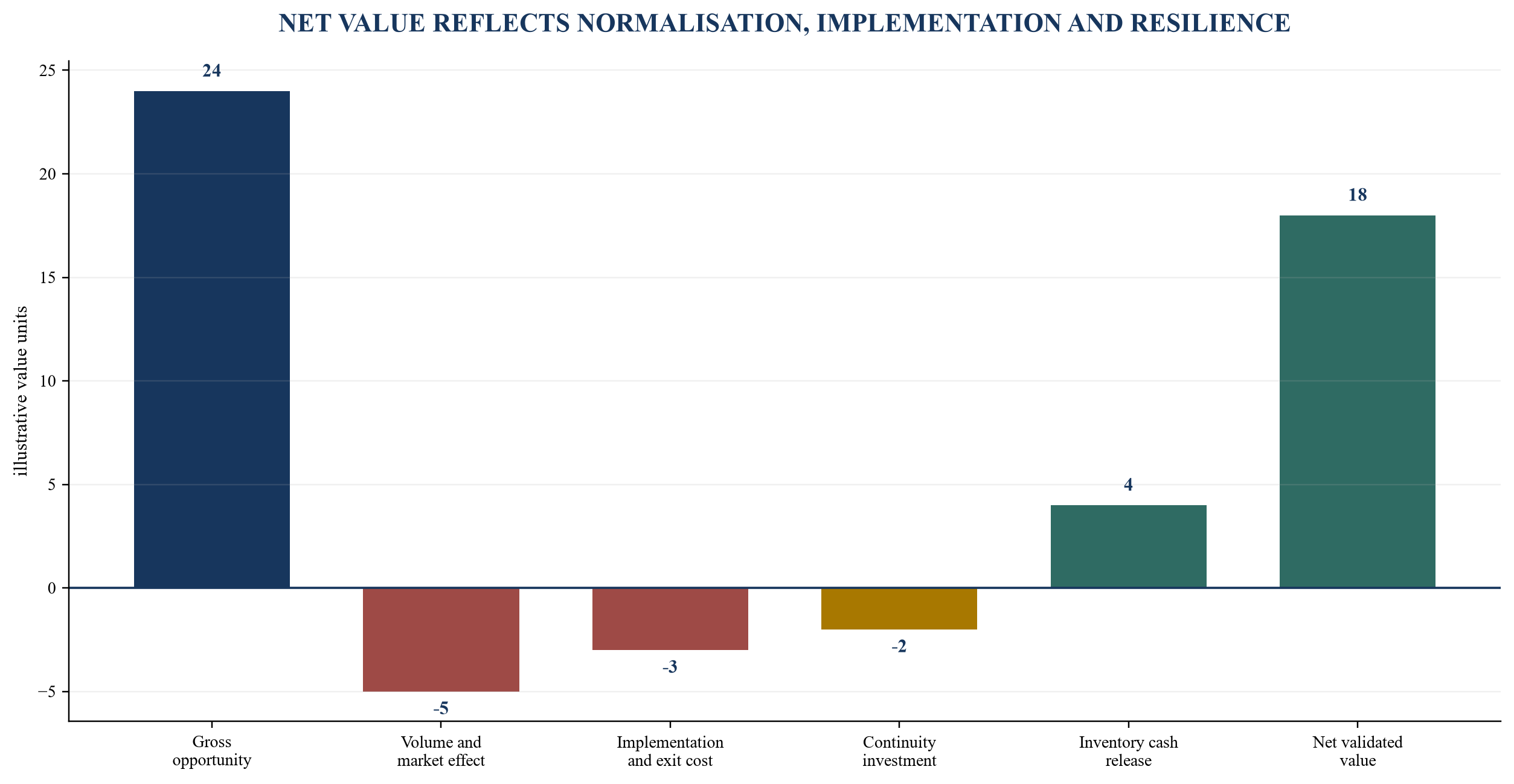
Values are illustrative management assumptions and do not describe a client or expected outcome.
19. Use a board scorecard that preserves cause and evidence
The board scorecard should connect each category to an observed baseline, approved intervention, financial effect, operating consequence and evidence state. It should avoid a single traffic light that hides whether the issue is value, timing, service or control.
The evidence states can be defined as identified, approved, implemented, stabilised and validated. Identified means the opportunity has a source-backed baseline. Approved means the intervention and risk treatment have authority. Implemented means the new demand, specification, source, price or process is operating. Stabilised means service and quality meet the agreed criteria for the required period. Validated means finance confirms the economic result.
The pack should show leading and lagging measures. Sourcing coverage, bids, contracts, alternate qualification and catalogue adoption indicate progress. Purchase-price variance, consumption, inventory, payment, defects, expedites, service interruption and supplier distress show outcomes. The board should see the connection between them.
Forecast accuracy is also useful. The programme can compare expected and realised timing, volume, implementation cost and benefit. Persistent variance may reveal weak baseline data, optimistic transition, supplier capacity issues or resistance in the business. The response should address the cause rather than reclassify the target.
Table 6. Board scorecard for procurement under ownership
| dimension | leading evidence | realised evidence | control gate | board decision |
|---|---|---|---|---|
| addressable spend | reconciled cube and category boundary | stable population and forecast | finance baseline | approve target and sequence |
| commercial value | bid, should-cost and negotiated terms | controlled price and terms | award approval | accept economics and trade-offs |
| implementation | contract, master data and transition tasks | volume at new source or specification | stabilisation review | continue, stage or pause |
| cash and EBITDA | benefit bridge and timing | ledger, bank and inventory result | finance validation | recognise or reforecast |
| continuity and quality | alternate, stock, trial and tolerance | service, defect and incident history | operating and control sign-off | protect, remediate or exit |
| supplier conduct | due diligence, obligations and monitoring | findings, remediation and engagement | legal and responsible-business review | continue, improve or disengage |
Targets and tolerances are company-specific management and board decisions.
20. Implement the programme in one hundred days
Days 1 to 10 establish control. Management confirms the sponsor, decision rights, benefit policy, data perimeter and continuity principles. Finance reconciles the initial spend population. Procurement maps suppliers and contracts. Operations identifies critical products, services and tolerances. Control functions define the gates that apply to priority categories.
Days 11 to 30 create the portfolio. Teams classify spend, correct supplier and contract data, identify leakage, map demand and segment categories. Quick actions can address unused services, duplicate suppliers, price-file errors and approved contract compliance. Each action still requires baseline, implementation and validation.
Days 31 to 60 execute priority strategies. Leverage categories move through market engagement, should-cost analysis, competition and negotiation. Bottleneck and strategic categories focus on transparency, indexation, specification, capacity, alternate qualification and joint improvement. The steering committee approves awards and transition funding.
Days 61 to 90 implement and stabilise. Contracts, purchase orders, item masters, systems, inventory and operating procedures change. Volume moves according to technical and continuity gates. Service, quality, supplier health, cash and realised economics are monitored. Exceptions remain visible.
Days 91 to 100 institutionalise the system. Finance validates the first results and reforecasts timing. The board reviews value, risk, unresolved decisions and the next wave. Category strategies, supplier governance, contract calendars, data controls and the evidence register transfer into the recurring operating model.
The sequence is illustrative. A smaller services business may move faster in low-risk categories. A regulated manufacturer, healthcare provider, utility or technology platform may require longer qualification and assurance. Day 100 should represent a controlled operating system and an evidence-based pipeline, not forced completion of every initiative.
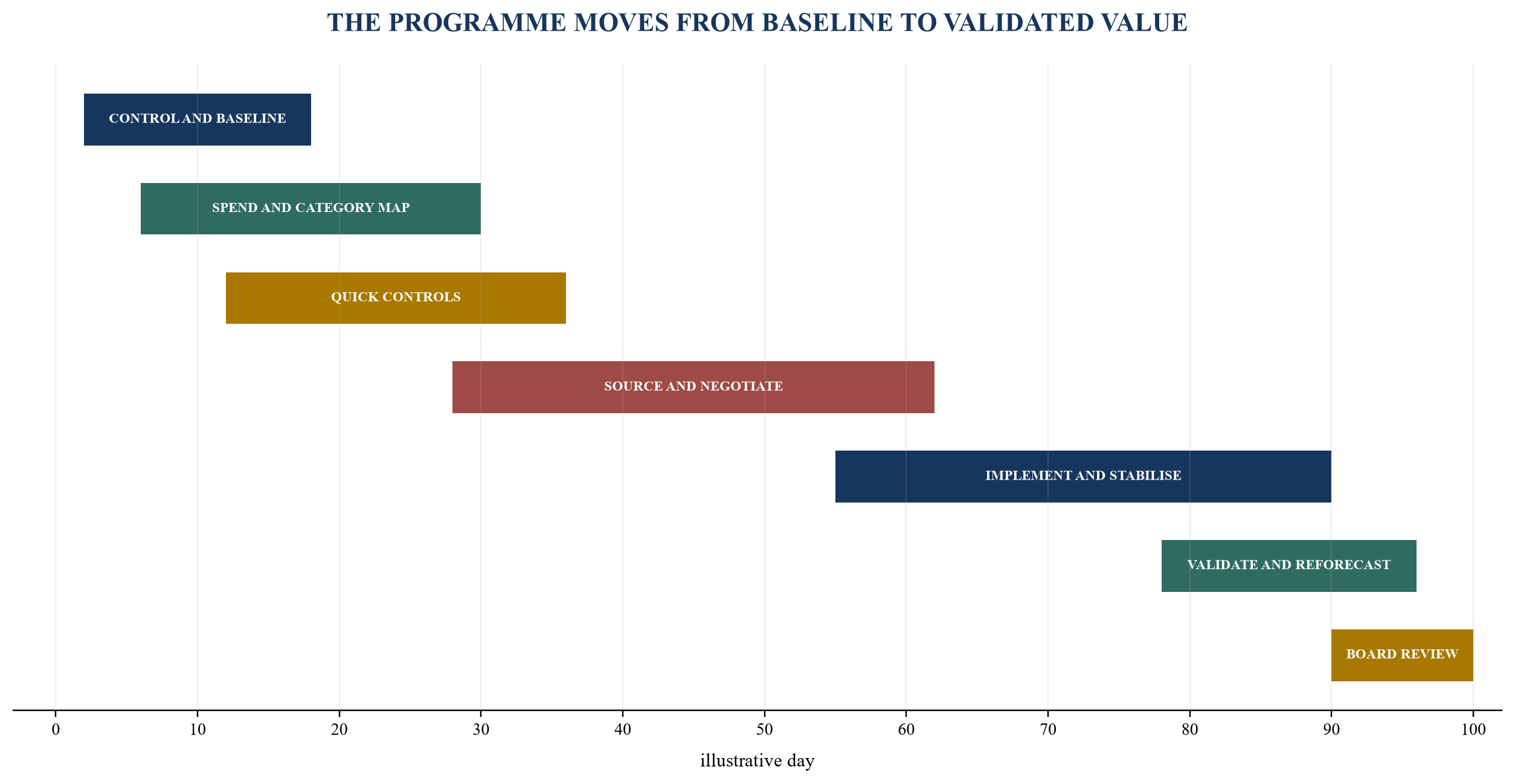
The sequence is illustrative and should be adapted to company facts, category risk and required approvals.
21. Recognise the limits of the framework
The framework organises procurement decisions, implementation and evidence. It does not determine the correct supplier, contract, price, inventory level or legal treatment for a company. Those decisions depend on facts, market capacity, technology, regulation, customer commitments, risk appetite and qualified professional judgement.
Reported savings can remain uncertain. Baselines can contain error. Volume, mix, currency, indices, operational performance and accounting classification can change. A controlled policy improves comparability without removing judgement. Finance validation confirms evidence under the policy; it does not guarantee future recurrence.
Resilience cannot remove every disruption. Alternate suppliers can share upstream dependencies. Inventory can be unavailable, obsolete or inaccessible. Contracts can fail in severe events. Tests can cover only defined scenarios. The board should preserve uncertainty, review changing exposure and maintain response authority.
Regulatory and responsible-business requirements are evolving across jurisdictions. Public-sector procurement frameworks cited in this paper are sources of useful control logic and do not automatically apply to private companies. The legal scope of sustainability, forced-labour, sanctions, customs, payment, data and sector requirements should be assessed for the specific company and transaction.
The programme can also fail through behaviour. Unrealistic targets may encourage aggressive supplier pressure, premature transition, deferred maintenance, unsafe substitution or misclassification of results. Governance must have authority to revise timing, fund resilience, stop an initiative and report a lower benefit when evidence requires it.
Its practical value lies in disciplined choices. The board can distinguish price from total economics, identified opportunity from validated result, supplier competition from supply resilience and working-capital timing from durable cash. Management can pursue value while protecting the system that earns revenue.
22. Conclusion
Procurement under ownership should operate as a value-creation and resilience system. The programme begins with a reconciled spend population, category economics and explicit business tolerances. It converts that evidence into demand, specification, sourcing, commercial, process, inventory and supplier actions.
The 100-day framework places finance validation, operating accountability and control gates inside the programme. It uses should-cost and whole-life-cost analysis, protects critical supply, qualifies transition, monitors supplier economics, integrates responsible-business risks and connects each initiative to EBITDA and cash.
The governing test is straightforward: every claimed benefit should connect to a controlled baseline, an authorised intervention, observed implementation, stable service and quality, a reconciled financial result and a review date. When that chain is present, the board can accelerate value with a clearer view of the cost, risk and evidence.
References
- United Kingdom Cabinet Office, The Sourcing Playbook, https://www.gov.uk/government/publications/the-sourcing-and-consultancy-playbooks/the-sourcing-playbook-html
- United Kingdom Civil Service, Should Cost Modelling Guidance Note, https://www.procurementpathway.civilservice.gov.uk/documents/best-practice/should-cost-modelling-sourcing-playbook
- United Kingdom National Cyber Security Centre, Supply Chain Guidance, https://www.ncsc.gov.uk/collection/supply-chain/guidance
- United Kingdom National Cyber Security Centre, Principle Supply Chain, https://www.ncsc.gov.uk/collection/cyber-assessment-framework/caf-objective-a-managing-security-risk/principle-a4-supply-chain
- National Institute of Standards and Technology, SP 800-161 Rev. 1 Cybersecurity Supply Chain Risk Management Practices, https://csrc.nist.gov/pubs/sp/800/161/r1/upd1/final
- National Institute of Standards and Technology, SP 1326 Cybersecurity Supply Chain Risk Management Due Diligence Assessment Quick-Start Guide, https://csrc.nist.gov/pubs/sp/1326/final
- United States Customs and Border Protection, Forced Labor Frequently Asked Questions, https://www.cbp.gov/trade/forced-labor/frequently-asked-questions
- United States Department of Homeland Security, Uyghur Forced Labor Prevention Act Strategy, https://www.dhs.gov/uflpa-strategy
- European Commission, Corporate Sustainability Due Diligence, https://commission.europa.eu/topics/business-and-industry/company-law-and-corporate-governance_en
- European Commission, Corporate Sustainability Due Diligence Directive Information, https://commission.europa.eu/business-economy-euro/doing-business-eu/sustainability-due-diligence-responsible-business/corporate-sustainability-due-diligence_en
- Organisation for Economic Co-operation and Development, Due Diligence Guidance for Responsible Business Conduct, https://www.oecd.org/en/topics/sub-issues/due-diligence-guidance-for-responsible-business-conduct.html
- Organisation for Economic Co-operation and Development, Responsible Business Due Diligence and Government Procurement, https://www.oecd.org/en/publications/responsible-business-due-diligence-and-government-procurement_e30b4f38-en.html
- World Bank Group, Project Procurement Framework, https://www.worldbank.org/ext/en/what-we-do/project-procurement/framework
- International Organization for Standardization, ISO 20400 Sustainable Procurement Guidance, https://www.iso.org/standard/63026.html
- International Organization for Standardization, ISO 22301 Business Continuity Management Systems, https://www.iso.org/standard/75106.html
- International Organization for Standardization, ISO 28000 Security Management Systems for the Supply Chain, https://www.iso.org/standard/79612.html
- IFRS Foundation, IAS 2 Inventories, https://www.ifrs.org/issued-standards/list-of-standards/ias-2-inventories/
- IFRS Foundation, IAS 37 Provisions Contingent Liabilities and Contingent Assets, https://www.ifrs.org/issued-standards/list-of-standards/ias-37-provisions-contingent-liabilities-and-contingent-assets/
- IFRS Foundation, IFRS S1 General Requirements for Disclosure of Sustainability-related Financial Information, https://www.ifrs.org/issued-standards/ifrs-sustainability-standards-navigator/ifrs-s1-general-requirements/
- Dubai Department of Finance, Suppliers Charter, https://www.dof.gov.ae/en-us/profile/Pages/SuppliersCharter.aspx
- United Arab Emirates Ministry of Finance, Federal Supplier Register, https://mof.gov.ae/en/services/register-suppliers-in-the-federal-supplier-register/
- Dubai Media Incorporated, UAE National Programme to Strengthen Supply Chain Resilience, https://www.dmi.gov.ae/content/dubaione/en-ae/programs/181/NationalProgramme.html
- Government of India Department of Expenditure, Manual for Procurement of Goods Second Edition 2024, https://doe.gov.in/files/circulars_document/Manual_Goods_2024.pdf
- Government of India Ministry of Micro Small and Medium Enterprises, Public Procurement Policy for Micro and Small Enterprises, https://www.pib.gov.in/PressReleasePage.aspx?PRID=2040253&lang=2®=48
- Government of India Ministry of Commerce and Industry, Measures to Strengthen Supply Chains and Logistics, https://www.pib.gov.in/Pressreleaseshare.aspx?PRID=2003547
- Australian Government Department of Finance, Commonwealth Procurement Rules Value for Money, https://www.finance.gov.au/government/procurement/commonwealth-procurement-rules/value-money
- Australian Government Department of Finance, Commonwealth Procurement Rules, https://www.finance.gov.au/government/procurement/commonwealth-procurement-rules
- Australian Government Attorney-General's Department, Modern Slavery Act, https://www.ag.gov.au/crime/modern-slavery/modern-slavery-act
- Australian Government Attorney-General's Department, Strengthening the Modern Slavery Act 2018 Consultation, https://consultations.ag.gov.au/crime/modern-slavery-act/
- Organisation for Economic Co-operation and Development, G20 OECD Principles of Corporate Governance 2023, https://www.oecd.org/en/publications/2023/09/g20-oecd-principles-of-corporate-governance-2023_60836fcb.html
Sources and further reading
- United Kingdom Cabinet Office, The Sourcing Playbook, Official source
- United Kingdom Civil Service, Should Cost Modelling Guidance Note, Official source
- United Kingdom National Cyber Security Centre, Supply Chain Guidance, Official source
- United Kingdom National Cyber Security Centre, Principle Supply Chain, Official source
- National Institute of Standards and Technology, SP 800-161 Rev. 1 Cybersecurity Supply Chain Risk Management Practices, Official source
- National Institute of Standards and Technology, SP 1326 Cybersecurity Supply Chain Risk Management Due Diligence Assessment Quick-Start Guide, Official source
- United States Customs and Border Protection, Forced Labor Frequently Asked Questions, Official source
- United States Department of Homeland Security, Uyghur Forced Labor Prevention Act Strategy, Official source
- European Commission, Corporate Sustainability Due Diligence, Official source
- European Commission, Corporate Sustainability Due Diligence Directive Information, Official source
- Organisation for Economic Co-operation and Development, Due Diligence Guidance for Responsible Business Conduct, Official source
- Organisation for Economic Co-operation and Development, Responsible Business Due Diligence and Government Procurement, Official source
- World Bank Group, Project Procurement Framework, Official source
- International Organization for Standardization, ISO 20400 Sustainable Procurement Guidance, Official source
- International Organization for Standardization, ISO 22301 Business Continuity Management Systems, Official source
- International Organization for Standardization, ISO 28000 Security Management Systems for the Supply Chain, Official source
- IFRS Foundation, IAS 2 Inventories, Official source
- IFRS Foundation, IAS 37 Provisions Contingent Liabilities and Contingent Assets, Official source
- IFRS Foundation, IFRS S1 General Requirements for Disclosure of Sustainability-related Financial Information, Official source
- Dubai Department of Finance, Suppliers Charter, Official source
- United Arab Emirates Ministry of Finance, Federal Supplier Register, Official source
- Dubai Media Incorporated, UAE National Programme to Strengthen Supply Chain Resilience, Official source
- Government of India Department of Expenditure, Manual for Procurement of Goods Second Edition 2024, Official source
- Government of India Ministry of Micro Small and Medium Enterprises, Public Procurement Policy for Micro and Small Enterprises, Official source
- Government of India Ministry of Commerce and Industry, Measures to Strengthen Supply Chains and Logistics, Official source
- Australian Government Department of Finance, Commonwealth Procurement Rules Value for Money, Official source
- Australian Government Department of Finance, Commonwealth Procurement Rules, Official source
- Australian Government Attorney-General's Department, Modern Slavery Act, Official source
- Australian Government Attorney-General's Department, Strengthening the Modern Slavery Act 2018 Consultation, Official source
- Organisation for Economic Co-operation and Development, G20 OECD Principles of Corporate Governance 2023, Official source
