

1. Treat cash conversion as an operating-value system
Working capital connects the operating cycle to the balance sheet. A customer order becomes a shipment, invoice, receivable and cash receipt. A demand forecast becomes a purchase order, inventory position, production plan, sale and collection. Supplier terms become a payable, but the economic consequence also depends on continuity, price, capacity, quality and the supplier's own access to finance. Each balance therefore carries an operating story.
The board should govern the story rather than a single ratio. Days sales outstanding can fall because collections improve, disputes are prevented or billing is accelerated. It can also fall because low-quality receivables are sold, revenue declines, invoices are written off or the measurement date captures an unusual customer-payment pattern. Days inventory outstanding can improve through better planning and slower-moving-stock disposal; it can also improve through under-stocking that later reduces service. Days payable outstanding can rise through negotiated terms; it can also rise through overdue invoices and damaged supplier economics.
The value chain begins with an authorised management action. The action changes an operating balance or timing. The balance movement changes cash, funding need, interest, covenant headroom or strategic flexibility. The result may affect enterprise risk and equity value. Every link needs evidence. A cash release that merely moves a payment across period end belongs in a different category from a redesign that permanently lowers safety stock while preserving service.
The programme should pursue four outcomes together: durable cash release, lower recurring working investment, protected operating performance and stronger evidence. Finance owns reconciliation. Commercial and operating teams own the causes. Treasury owns liquidity and financing consequences. Control functions retain their legal, accounting, tax, regulatory and risk mandates. The board approves boundaries and material trade-offs.
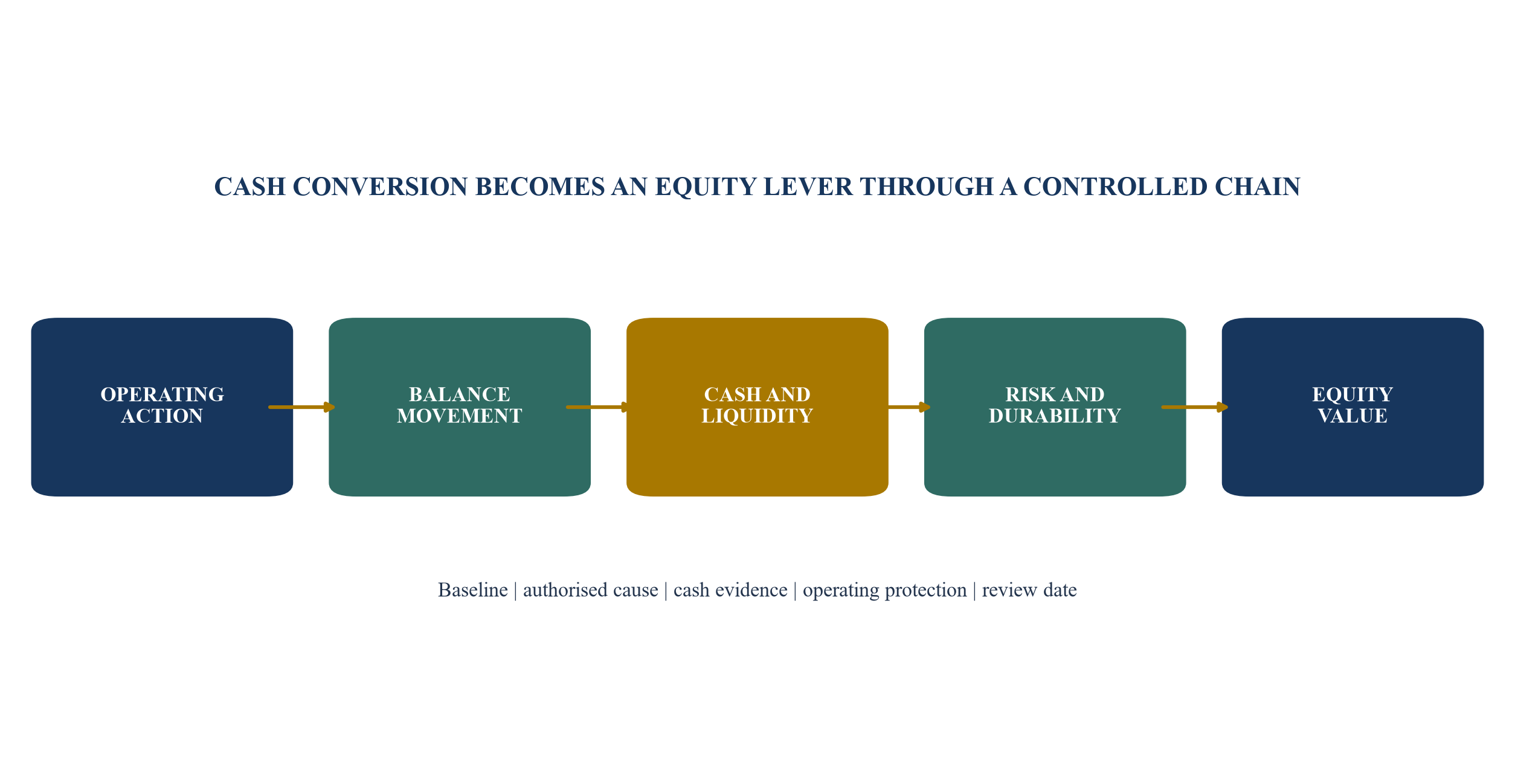
Cash conversion creates decision-grade value when the operating cause, financial bridge and durability are explicit.
2. Define the equity bridge before setting targets
A cash conversion programme should begin with an explicit equity bridge. An operating working-capital release can reduce drawn debt, increase cash, fund investment, support a distribution or provide headroom against downside. The equity consequence depends on where the cash goes, the financing documents, cash classification, debt-like and working-capital mechanisms in a transaction, tax, leakage, fees and the sustainability of the operating change.
Management should therefore distinguish five value categories. Structural release lowers the normal working investment required for a given scale and service level. Growth avoidance prevents working capital from rising as quickly as revenue or output. Timing release advances a receipt or defers a payment within a cycle. Financing release converts an operating asset into funded cash through factoring, receivables purchase, inventory finance or supply-chain finance. Accounting or perimeter movement changes the reported balance without necessarily changing underlying economics.
The categories are not interchangeable. Structural release may support a lower steady-state funding need. Growth avoidance matters only relative to a documented counterfactual. Timing release can be useful for liquidity, yet it may reverse. Financing can provide capacity while adding fees, recourse, concentration, disclosure, covenant and counterparty considerations. Accounting movements require treatment under the applicable standards and transaction documents.
The board should approve a use-of-cash hierarchy. A business facing covenant pressure may direct release to debt reduction and liquidity reserves. A growth platform may fund capacity, product development or acquisitions. A mature asset may prepare for a distribution or exit. The decision should incorporate forecast volatility, financing headroom, operational risk and upcoming obligations. Cash released from operations has strategic value because it expands choices; the programme should avoid promising a predetermined equity outcome.
3. Build a baseline that reconciles operations, accounts and cash
The baseline must join general ledger, subledger, operational and bank evidence. A balance-sheet snapshot is insufficient. It does not show ageing, dispute status, customer behaviour, inventory movement, supplier terms, cut-off, seasonality or the cash events that created the balance. A twelve-to-twenty-four-month monthly history is usually more informative, with longer histories where cycles, contracts or commodities require them.
Receivables need invoice, due date, payment, customer, entity, currency, dispute, credit note and collection fields. Inventory needs item, site, unit, quantity, standard or actual cost, movement, age, demand class, lead time, shelf life, reservation and obsolescence fields. Payables need invoice, receipt, approval, due date, payment, supplier, entity, terms, dispute and financing fields. The populations should reconcile to the ledger and, where relevant, cash records and financial statements.
The baseline should also state perimeter and policy. Acquisitions, divestments, discontinued activities, related parties, consignment, contract assets, customer advances, supplier finance, receivables sales and securitisation can distort comparison if included inconsistently. Foreign-currency balances need a defined translation method. Tax balances, provisions and payroll may be monitored separately because their drivers and legal constraints differ from trade working capital.
Data confidence should appear beside every target. A category with invoice-level reconciliation and stable policy can support precise action. A category with missing due dates, manual overrides or unreconciled subledgers requires control repair before aggressive intervention. The board should see how much of the cash target rests on verified balances, modelled assumptions or unresolved data.
Table 1. Minimum evidence for the working-capital baseline
| population | minimum fields | reconciliation | decision supported | common failure |
|---|---|---|---|---|
| receivables | invoice, due date, payment, customer, dispute, currency | subledger to ledger and bank | billing, collections and credit action | ageing based on invoice date only |
| inventory | item, site, quantity, cost, movement, demand and lead time | subledger to count and ledger | stock policy and disposition | obsolete stock treated as available cash |
| payables | invoice, receipt, approval, due date, payment, supplier | subledger to ledger and bank | terms, process and financing | overdue invoices reported as negotiated terms |
| contracts and orders | price, volume, term, milestone, acceptance, liability | contract to order and invoice | commercial and process change | written terms differ from system master data |
| cash and facilities | account, value date, availability, draw, covenant, fee | bank to ledger and treasury forecast | liquidity and use of release | gross cash reported without restrictions |
| operating performance | service, backlog, yield, returns, cancellations, downtime | event to customer, item and supplier | protection and durability | cash action separated from service outcome |
The evidence chain connects each operating population to the ledger, cash and responsible owner.
4. Translate days metrics into a driver tree
The cash conversion cycle is commonly expressed as days sales outstanding plus days inventory outstanding minus days payable outstanding. The identity is useful for orientation; the calculation is sensitive to definitions. Average or period-end balances, revenue or credit sales, cost of sales or purchases, value-added tax, acquisitions, foreign exchange and seasonality can materially change the reported days.
The programme should publish a metric dictionary. Days sales outstanding should define the receivable perimeter and sales denominator. Days inventory outstanding should define inventory categories and cost denominator. Days payable outstanding should define trade payables, purchases or cost denominator and the treatment of supplier finance. Alternative metrics may be required for subscription, project, healthcare, construction, regulated or milestone-based models.
Every top-line metric then needs a causal tree. Receivables can be decomposed into unbilled work, billing delay, contractual term, current invoices, disputes, credits, deductions, overdue debt and credit loss. Inventory can be decomposed into cycle stock, safety stock, pipeline, work in progress, launch stock, quality hold, returns, spare parts and obsolete items. Payables can be decomposed into contracted terms, invoice receipt, matching, approval, dispute, scheduled payment, overdue status and financed arrangements.
The causal tree prevents generic targets. A collection campaign cannot resolve missing proof of delivery. A term renegotiation cannot fix invoices trapped in an approval queue. A stock reduction target cannot distinguish safety stock from obsolete material. Each cause needs a distinct owner, intervention, control and evidence test.
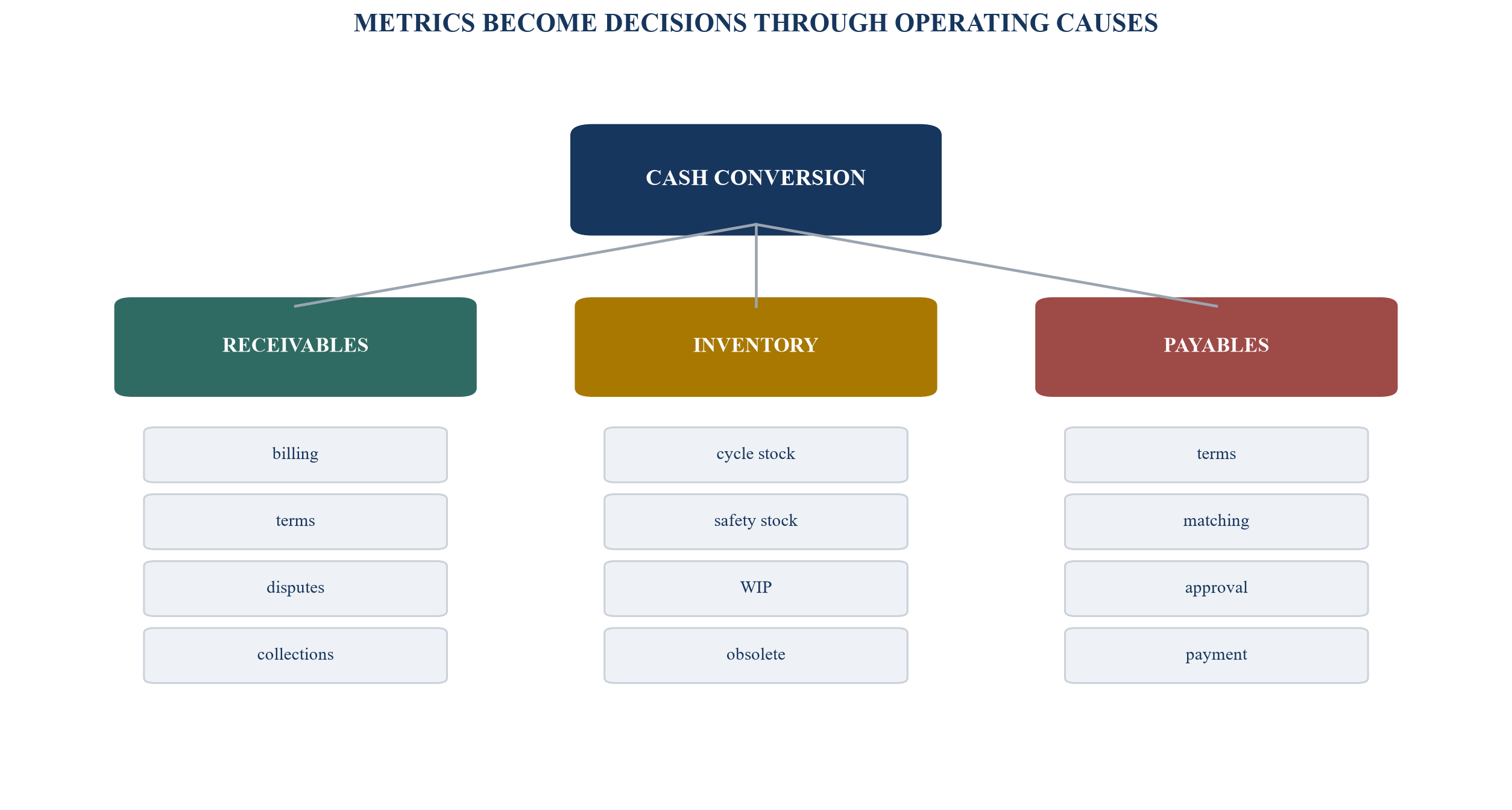
Top-line days metrics become actionable only after separation into operating causes.
5. Segment opportunity by durability, control and operating risk
An opportunity register should classify each action before assigning cash. The first dimension is economic mechanism: balance reduction, timing shift, growth avoidance, financing or accounting movement. The second is recurrence: one-time, seasonal, recurring or contingent. The third is control state: identified, approved, implemented, cash-observed, finance-validated or withdrawn. The fourth is operating risk: customer, supply, service, quality, regulatory, tax, accounting or fraud exposure.
The cash value should use the relevant balance rather than a broad percentage applied to revenue. A days-based estimate can translate a verified denominator into a provisional opportunity. The estimate then requires item, customer or supplier-level validation. Where the action changes volume, price, mix, tax or foreign currency, the bridge should normalise those effects.
Actions should carry a reversal profile. A delayed supplier payment may reverse in the following month. Seasonal inventory liquidation may rebuild before peak demand. A disputed receivable collected after commercial settlement may include margin leakage. A supplier-finance arrangement can produce cash while creating continuing fees and disclosure requirements. The forecast should show gross release, costs, leakage, expected reversal and sustainable closing position.
Management should also identify the value at risk. A lower safety-stock level can release cash, but the decision requires a service and continuity tolerance. Tighter customer credit can lower receivables, but it may constrain revenue or channel relationships. Extended supplier terms can increase cash, but they may trigger price increases, weaken capacity or conflict with payment requirements. The board needs the net economic case.
Table 2. Working-capital intervention classes
| intervention | cash mechanism | durability test | required protection | board treatment |
|---|---|---|---|---|
| structural process change | permanently lower normal balance | repeated cycle at stable service | control and performance evidence | recurring operating release |
| growth avoidance | slower balance growth than controlled forecast | scale rises without equivalent investment | capacity and customer protection | counterfactual with sensitivity |
| timing action | receipt or payment moved within cycle | reversal date and repeatability visible | legal, supplier and customer impact | liquidity timing, not permanent release |
| external financing | asset converted into funded cash | cost, recourse, capacity and renewal | covenant, disclosure and counterparty review | financing bridge shown separately |
| accounting or perimeter change | reported balance reclassified or removed | underlying economics reconciled | accounting and transaction treatment | excluded from operating benefit unless justified |
The classification keeps durable release separate from timing, financing and accounting effects.
6. Prevent receivables before collecting them
The strongest receivables programme begins before the invoice. Customer selection, credit approval, contracting, order acceptance, milestone definition, proof of delivery, billing data and dispute prevention determine the collectability of revenue. A collection team inherits failures created elsewhere. The operating model should move accountability upstream.
Customer master data should connect legal entity, tax registration, billing address, payment portal, purchase-order requirement, credit limit, security, currency, bank detail and escalation path. Contract terms should be translated into system rules. Orders that lack required information should enter an exception workflow before delivery where commercially feasible. Milestones need objective acceptance evidence and responsible customer contacts.
Billing should have a service-level clock from the underlying event to a valid invoice. The clock may begin at shipment, delivery, customer acceptance, time approval, certification or another contractual event. Management should measure event-to-evidence, evidence-to-invoice and invoice-to-customer-receipt separately. Combining them into one delay hides the cause.
Disputes need a taxonomy. Price, quantity, quality, tax, proof, purchase-order, contract, duplicate, credit note and customer-process disputes require different owners. The register should state amount, cause, age, next action, commercial authority and expected resolution. Root-cause elimination can create more durable cash conversion than end-of-month collection pressure.
Table 3. Receivables control and action matrix
| stage | principal control | operating owner | cash evidence | escalation trigger |
|---|---|---|---|---|
| customer and contract | credit, legal entity, terms and billing requirements | sales and credit | approved exposure and executable terms | exposure or exception above authority |
| fulfilment | delivery, acceptance and milestone evidence | operations or project owner | accepted performance record | missing or contested evidence |
| billing | complete and accurate invoice issued promptly | billing and tax | customer receipt and ledger posting | clock breach or rejection |
| dispute | coded cause, owner, reserve and resolution date | commercial owner | signed resolution and adjusted balance | age, value or recurrence threshold |
| collection | segmented cadence and authorised settlement | credit and collections | bank receipt matched to invoice | promise broken or credit deterioration |
Ownership follows the cause of delay rather than remaining solely with collections.
7. Build collections around risk, relationship and evidence
Collections should segment customers by value, behaviour, credit risk, dispute state, strategic relationship and practical collection route. A high-value current customer may need a relationship-led reminder before due date. A repeat late payer may need senior escalation, credit restriction or security. A disputed account requires commercial resolution. A distressed customer requires legal and credit judgement rather than a standard call cadence.
The collection promise should be a controlled record. It states payer, invoices, amount, promised date, condition, contact, owner and outcome. Broken promises feed the credit decision. Cash application should occur quickly enough to prevent valid customers being chased for paid invoices and to reveal short payments, deductions or unidentified cash.
Settlement authority needs boundaries. Discounts, credits, extended plans, returns, write-offs and legal action affect margin, tax, revenue, customer economics and expected credit loss. The programme should not count a gross receivable collection as full benefit when value was surrendered to obtain it. Finance should reconcile cash received, concessions, tax, fees and write-offs.
Receivables sale or factoring can be appropriate where it fits the financing strategy and customer relationships. The decision should address eligibility, advance rate, dilution, concentration, recourse, notification, servicing, reserves, fees, termination, data and accounting. The OCC's supervisory material illustrates why collateral controls and administration matter in receivables-based financing. The framework should present financing proceeds separately from operating collection improvement.
8. Optimise inventory through service and risk economics
Inventory is a portfolio of distinct purposes. Cycle stock supports normal demand. Safety stock covers uncertainty. Pipeline stock reflects transport and production time. Work in progress sits inside conversion. Launch or seasonal stock supports a defined event. Spare parts protect asset availability. Quality-hold, returns and obsolete stock may have limited economic utility. One days-inventory target cannot govern all categories.
The inventory policy should connect demand variability, forecast error, lead time, order constraints, yield, shelf life, service level, criticality and recovery tolerance. A statistically calculated safety-stock quantity is still a management choice because the service target, risk horizon and data assumptions are choices. Critical items may require redundancy or strategic stock even when carrying cost is high.
The item-site register should classify active, excess, slow-moving, obsolete, reserved, consigned, customer-owned and quality-hold quantities. Disposition options include consumption, transfer, supplier return, customer sale, redesign, substitution, repair, donation, recycling or write-off. Each option requires evidence of economic value, cost, tax, regulatory, safety and accounting treatment.
Inventory reduction should be paired with operating protection. Management can monitor fill rate, backlog, forecast accuracy, schedule adherence, supplier on-time performance, yield, downtime, expedite cost, lost sales and customer complaints. If cash improves while these indicators deteriorate, the programme may be transferring cost or risk rather than creating value.
Table 4. Inventory decision framework
| inventory class | decision question | cash lever | protection | evidence |
|---|---|---|---|---|
| cycle stock | can lot size or cadence change? | order frequency and batch policy | capacity, setup and transport economics | stable service through repeated cycles |
| safety stock | is uncertainty measured at the right level? | forecast, lead time and service policy | criticality and recovery tolerance | approved model and stress test |
| pipeline and WIP | can throughput or lead time improve? | flow, queue and transport redesign | quality and production stability | cycle-time and yield evidence |
| excess and obsolete | is future use economically credible? | disposition or provision | safety, tax and regulatory review | realised proceeds or approved accounting |
| strategic and spare stock | what failure does the stock protect? | risk-based quantity and pooling | continuity and asset availability | tolerance, test and replenishment plan |
Every stock action links cash potential to service, resilience and evidence.
9. Manage payables as a commercial and resilience decision
Payables create cash through negotiated terms, efficient processing and disciplined payment scheduling. Overdue invoices are not a durable terms strategy. The programme should separate contractual due dates, operational processing time, disputed balances, deliberate holds, supplier finance and late payment.
The end-to-end process begins with a valid supplier and purchase order. Receipt and acceptance should be recorded promptly. Invoices should be matched, exceptions routed to accountable owners and approved before the scheduled payment date. A late invoice caused by internal workflow is a process failure even when it temporarily increases cash.
Term strategy should segment suppliers by bargaining position, criticality, size, financing access, jurisdiction and economic impact. A large supplier may absorb a term extension more easily than a small or specialist supplier, yet market structure and contract facts control. A critical supplier facing liquidity pressure can transmit failure into the portfolio company. Price, capacity, quality, continuity and relationship effects belong in the decision.
Payment practices also create public, contractual and legal exposure. The United Kingdom requires certain large businesses to report payment practices and performance. Its Fair Payment Code recognises specified payment standards. Australia requires reporting entities to disclose terms and practices for small-business suppliers. India provides delayed-payment mechanisms for micro and small enterprises. The European Union maintains a late-payment framework and has considered further reform. The specific scope and current law require jurisdictional advice.
Supply-chain finance can align buyer terms with earlier supplier cash when structured responsibly. The programme should test supplier choice, financing cost, buyer influence, concentration, accounting, disclosure, covenant treatment, data, provider continuity and exit. A structure that obscures overdue payables or creates dependency can weaken transparency.
10. Govern other operating balances and cash traps
Trade receivables, inventory and trade payables are central, but other operating balances can contain meaningful cash. Contract assets, unbilled work, customer advances, deferred revenue, prepayments, deposits, rebates, tax receivables, duties, payroll accruals, warranty provisions and intercompany accounts may require distinct workstreams.
Contract assets and unbilled work need milestone, performance and documentation analysis. The action may be operational completion, customer acceptance, certification or contract amendment rather than billing acceleration. Customer advances can improve cash where commercially and legally appropriate, but the business incurs a performance obligation and potential refund exposure.
Prepayments should be tied to a contract, service period, owner and renewal decision. Deposits need recovery rights and trigger dates. Rebates need entitlement, evidence, accrual and collection. Tax receivables require filing, documentation and authority processes. Accrual release requires accounting support and should not be presented as operating cash if it does not change payment.
Intercompany balances need special care. Settlement may move cash inside a group without changing consolidated liquidity. Transfer-pricing, tax, legal, minority, exchange-control, distributable-reserve and financing constraints may govern movement across entities. The board should view cash by legal entity, currency, restriction and availability, alongside the consolidated balance.
11. Protect accounting, cut-off and transaction integrity
A cash target can create pressure around revenue recognition, shipment cut-off, bill-and-hold arrangements, channel loading, customer acceptance, credit notes, inventory ownership, supplier accruals and payment timing. Governance should state that accounting and contractual treatment cannot be changed to meet the programme target.
IAS 7 identifies changes in inventories and operating receivables and payables as adjustments in the indirect presentation of operating cash flow. IAS 2 governs inventory measurement. IFRS 9 addresses financial instruments and expected credit losses. IFRS 15 governs revenue from customer contracts. IAS 37 addresses provisions and contingencies. The applicable reporting framework and facts determine treatment.
The company should maintain a cut-off calendar and evidence standard. Material shipments, receipts, invoices, credits, returns, provisions and manual entries near period end receive targeted review. A working-capital action register should link the operational event to accounting entries and cash. Finance, internal audit or another independent control function can test selected items based on risk.
Transaction mechanisms add another layer. A sale agreement may define a normalised working-capital target, permitted accounting policies, exclusions, debt-like items and post-closing adjustment process. A period-end cash action can affect the purchase-price mechanism differently from the operating accounts. Management should not assume that improving a reported balance creates equal transaction value.
12. Integrate treasury, liquidity and covenant management
Cash release matters when treasury can use it. The programme should connect expected receipts and payments to a rolling short-term cash forecast, facility availability, interest, currency, restricted cash, minimum liquidity, collateral, guarantees and covenant headroom. The bridge should avoid counting cash that is trapped, pledged, required for operations or already assumed in the base forecast.
Forecast design should use direct cash events for the near term and reconcile to the financial forecast. Receipts need customer-level probability and dispute information. Payments need due date, approval, priority and legal constraints. Payroll, tax, debt service, capital expenditure and one-off transaction costs should be visible. Scenarios should show base, downside and severe but plausible operating conditions.
Working-capital facilities can provide flexible capacity. Accounts receivable and inventory financing depends on eligible collateral, advance rates, reserves, concentration limits, reporting, audits and control. Receivables purchase, supply-chain finance and warehouse finance have different legal and economic characteristics. The board should compare the full cost and operational requirements with the internal cash programme.
Covenant treatment requires the financing documents. Cash, debt, receivables sale, supplier finance, inventory write-downs, customer advances and exceptional costs may affect definitions differently. Treasury and counsel should validate the consequence before management commits to a use of proceeds or headroom claim.
13. Manage growth, seasonality and shocks explicitly
Growth can consume cash even when margins are attractive. Receivables rise before collection, inventory rises before sale and suppliers may not fund the entire operating cycle. A value-creation plan should model incremental working capital by product, channel, customer, geography and capacity stage. The objective is to fund profitable growth deliberately, not to suppress every increase in working capital.
Seasonality requires a monthly or weekly curve. A period-end balance may sit at the low or high point of the cycle. The programme should compare equivalent dates, peak funding, average investment and minimum operating stock. Temporary actions near a reporting date should be identified and their reversal forecast.
Shocks can change the economic optimum. Supply disruption may justify inventory buffers or alternate sourcing. Customer distress may require tighter credit or security. Commodity inflation can increase the cash tied in the same physical quantity. Currency moves can change translated balances. Interest rates change the cost of funding. Regulation or sanctions can alter routes and settlement.
The board should approve trigger-based responses. If forecast error exceeds a threshold, service deteriorates or a supplier becomes distressed, inventory policy may change. If customer risk worsens, limits and collection intensity may change. The programme remains dynamic because working capital is a consequence of the operating system.
14. Design financing as a complement to operating improvement
External working-capital finance can bridge timing, support growth and diversify liquidity. It should be compared with operating improvement on a transparent basis. Financing creates cash today and an obligation, fee, asset transfer or structural dependency tomorrow. Operating improvement changes the underlying cycle when it is real and durable.
Receivables finance can include secured borrowing, factoring, receivables purchase or securitisation. Inventory finance can include borrowing-base facilities, warehouse receipts and commodity structures. Supply-chain finance can allow suppliers to receive early payment based on the buyer's approved invoice. Customer prepayment, deposits and milestone billing can also finance the cycle through commercial design.
The decision matrix should cover eligibility, advance rate, dilution, reserves, recourse, concentration, control, notice, data, fraud, legal enforceability, currency, tax, accounting, disclosure, covenant, provider continuity, termination and total cost. The company should model availability under stress, not only at launch. A facility can contract when receivables age, disputes rise, inventory becomes ineligible or concentrations breach limits.
The International Finance Corporation's programmes show how supply-chain and warehouse finance can expand working-capital access in emerging markets. The Reserve Bank of India's TReDS framework supports electronic financing of MSME trade receivables through multiple financiers. These examples demonstrate financing mechanisms; transaction suitability depends on company and jurisdiction facts.
15. Apply jurisdiction overlays before executing
The operating framework is portable; legal, payment, tax, accounting and financing rules are local. The programme should maintain a jurisdiction register covering entities, customer and supplier contracts, payment requirements, interest, tax invoices, bad-debt relief, assignment, security, factoring, insolvency, data, sanctions and exchange controls.
In the United Kingdom, payment-practice reporting and public procurement payment policy can affect disclosure and commercial eligibility. The Fair Payment Code adds a voluntary standard. In the European Union, the Late Payment Directive remains an important framework while legislative proposals and negotiations require current legal confirmation.
In the United States, SEC disclosure requirements can affect liquidity and capital-resources discussion for registrants. OCC material provides supervisory guidance for banks financing receivables and inventory. Contract, secured-transactions, bankruptcy and state law require transaction-specific advice.
In the United Arab Emirates, the Commercial Transactions Law and VAT rules affect commercial and tax processes. The Federal Tax Authority's bad-debt clarification illustrates conditions that may apply when consideration remains unpaid. Free-zone, financial-centre and sector rules may create additional layers.
India's MSMED framework, Samadhaan and ODR mechanisms address delayed payments to eligible micro and small enterprises. RBI's TReDS framework supports receivables financing. Australia operates a payment-times reporting scheme for defined entities. The overlay should be owned by qualified advisers and embedded in system rules where reliable.
Table 5. Illustrative jurisdiction-control overlays
| jurisdiction | official framework examined | working-capital relevance | management control | validation required |
|---|---|---|---|---|
| United Kingdom | payment-practice reporting and Fair Payment Code | supplier terms, performance and disclosure | entity scope, invoice data and approval | current legal and procurement advice |
| European Union | late-payment framework and reform proposal | commercial terms, interest and enforcement | contract and country register | member-state and current legislative status |
| United States | SEC liquidity disclosure and OCC lending guidance | liquidity narrative and collateral finance | disclosure bridge and borrowing-base controls | securities, lending and state-law advice |
| United Arab Emirates | commercial transactions and VAT bad-debt rules | contracting, collection and tax cash | entity, invoice, ageing and evidence register | federal, free-zone and sector advice |
| India | MSMED delayed-payment mechanisms and TReDS | supplier payment and receivables finance | supplier eligibility, due dates and platform records | current statutory and RBI requirements |
| Australia | Payment Times Reporting Scheme | small-supplier terms and reporting | entity scope, supplier identification and datasets | current regulator guidance |
The table identifies decision areas for local validation; it is not a statement of legal applicability.
16. Establish an operating model with clear decision rights
The programme needs one accountable executive, usually the chief financial officer or a delegated leader with operating authority. Finance controls definitions, reconciliation and validation. Treasury controls liquidity and financing. Sales, operations, supply chain, procurement and shared services own operating causes. Legal, tax, accounting, risk, compliance and internal audit retain independent mandates.
Workstreams should not compete for the same cash. A procurement term extension may appear in the payables initiative and the sourcing initiative. Inventory reduction may affect forecast, production and supplier plans. Receivables collection may overlap with a commercial settlement. The central register assigns one benefit owner and records dependencies.
Decision forums should operate at different cadences. Daily control rooms resolve invoices, disputes, receipts, approvals and exceptions. Weekly operating reviews decide customer, item, supplier and process actions. Monthly finance validation confirms cash, accounting and forecast. The board or delegated committee reviews material performance, trade-offs, risks and use of cash.
The data model should preserve lineage from source transaction to management metric and claimed benefit. Manual adjustments require owner, rationale, evidence and approval. Access, master-data changes, bank details, credits, write-offs and payment overrides need fraud controls. Automation can improve speed; accountable owners remain responsible for policy and exceptions.
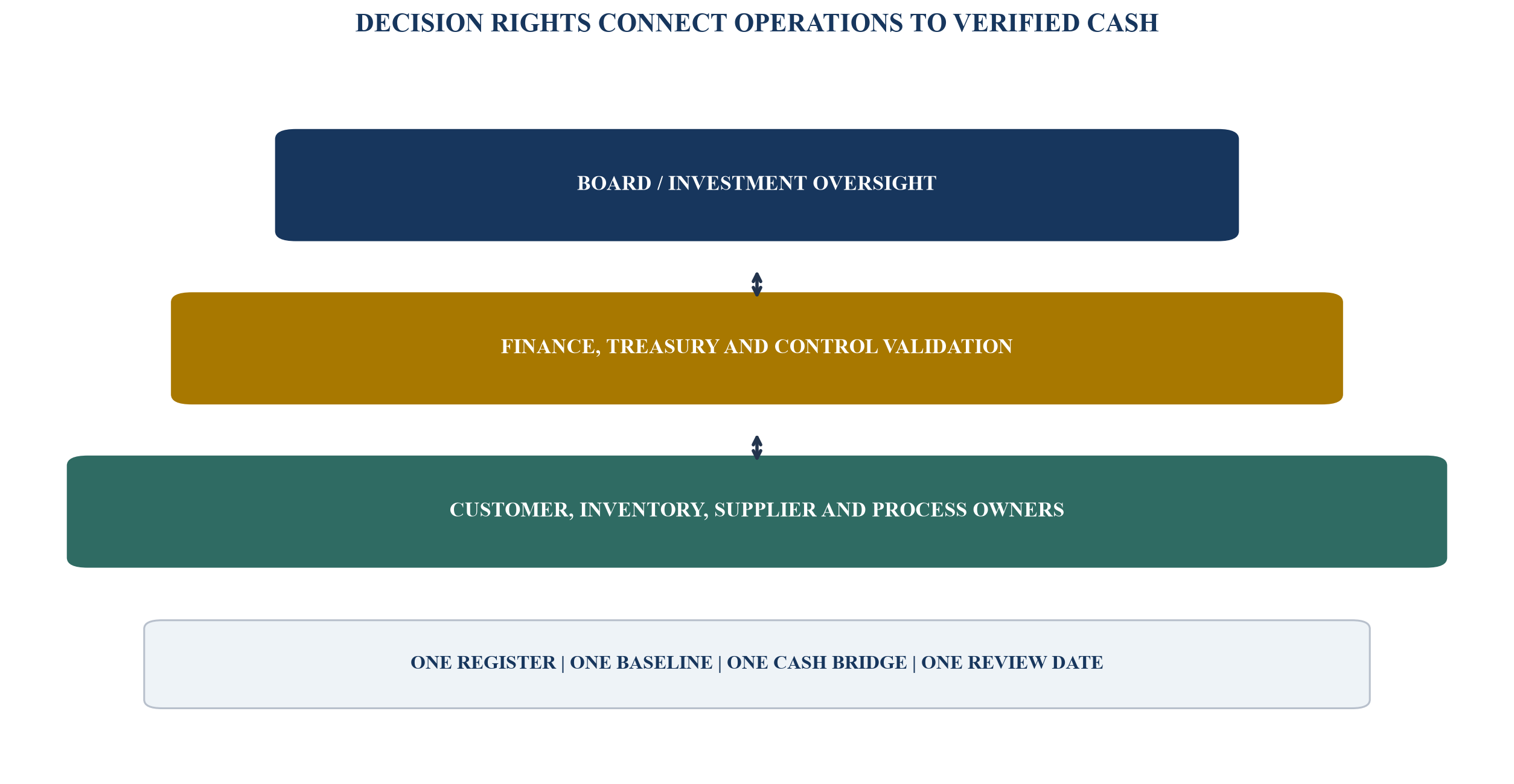
Operating ownership, finance validation and board oversight remain separate but connected.
17. Align incentives with durable cash and operating performance
An incentive based only on period-end cash can encourage harmful timing actions. Management may delay valid supplier payments, under-buy inventory, accelerate customer receipts with margin concessions or push transactions across cut-off. The scorecard should balance cash, durability, service, risk and control.
The benefit policy should define when credit is earned. Identified opportunity is not an outcome. Approved action is not cash. Ledger movement is not necessarily durable. A material initiative can progress through implemented, cash-observed, finance-validated and sustained states. Incentive credit can vest in stages or remain subject to a review period.
Operating guardrails should be measurable. Receivables actions can be paired with revenue retention, complaints and concessions. Inventory actions can be paired with fill rate, backlog, expedite cost and downtime. Payables actions can be paired with overdue invoices, supplier continuity, quality and price effects. Control actions can include reconciliation, data quality and exception closure.
The remuneration committee or board should understand how working-capital metrics interact with EBITDA, free cash flow, leverage, transaction targets and equity awards. Double counting is possible when the same cash is rewarded in multiple measures. Adjustments require a documented policy and independent validation. The programme should reward durable improvement and truthful reporting.
18. Apply the framework to a hypothetical portfolio company
Consider a hypothetical multi-country industrial-services company with annual revenue of 420 currency units and cost of sales of 275. The company has 82 of trade receivables, 61 of inventory and 46 of trade payables at the baseline date. It has seasonal demand, project milestones, field-service spares and a mix of large and small suppliers. All figures in this section are illustrative assumptions.
The baseline review identifies 9 of invoices delayed by missing acceptance evidence, 7 of recurring disputes, 12 of excess or slow-moving inventory, 6 of obsolete inventory requiring disposition assessment, 8 of payable process delay and 11 of supplier terms that may be commercially reviewed. The full amounts are not treated as cash opportunities.
Management approves a programme with five actions. Billing controls and milestone evidence are assumed to release 4.5. Dispute prevention and resolution release 2.0 after 0.5 of credits and concessions. Inventory planning and transfer release 5.0 while preserving approved service levels. Obsolete-stock disposition produces 1.0 of cash and 1.5 of accounting cost. Payables process repair and negotiated terms release 3.5 without counting overdue invoices.
Gross cash is therefore 16.0. Concessions, disposition cost, implementation cost and tax or fee assumptions reduce net near-term cash to 12.0. Management classifies 8.5 as potentially structural, 2.0 as seasonal and 1.5 as timing pending repeated-cycle evidence. The released cash is assumed to reduce revolving debt. Interest and equity effects depend on actual rates, facility terms, closing cash definitions and durability.
The scenario also includes guardrails. Customer retention, service, backlog, supplier continuity, quality, overdue invoices and control exceptions must remain within approved limits. Any breach triggers review and may reduce the benefit. The example demonstrates governance rather than a forecast.
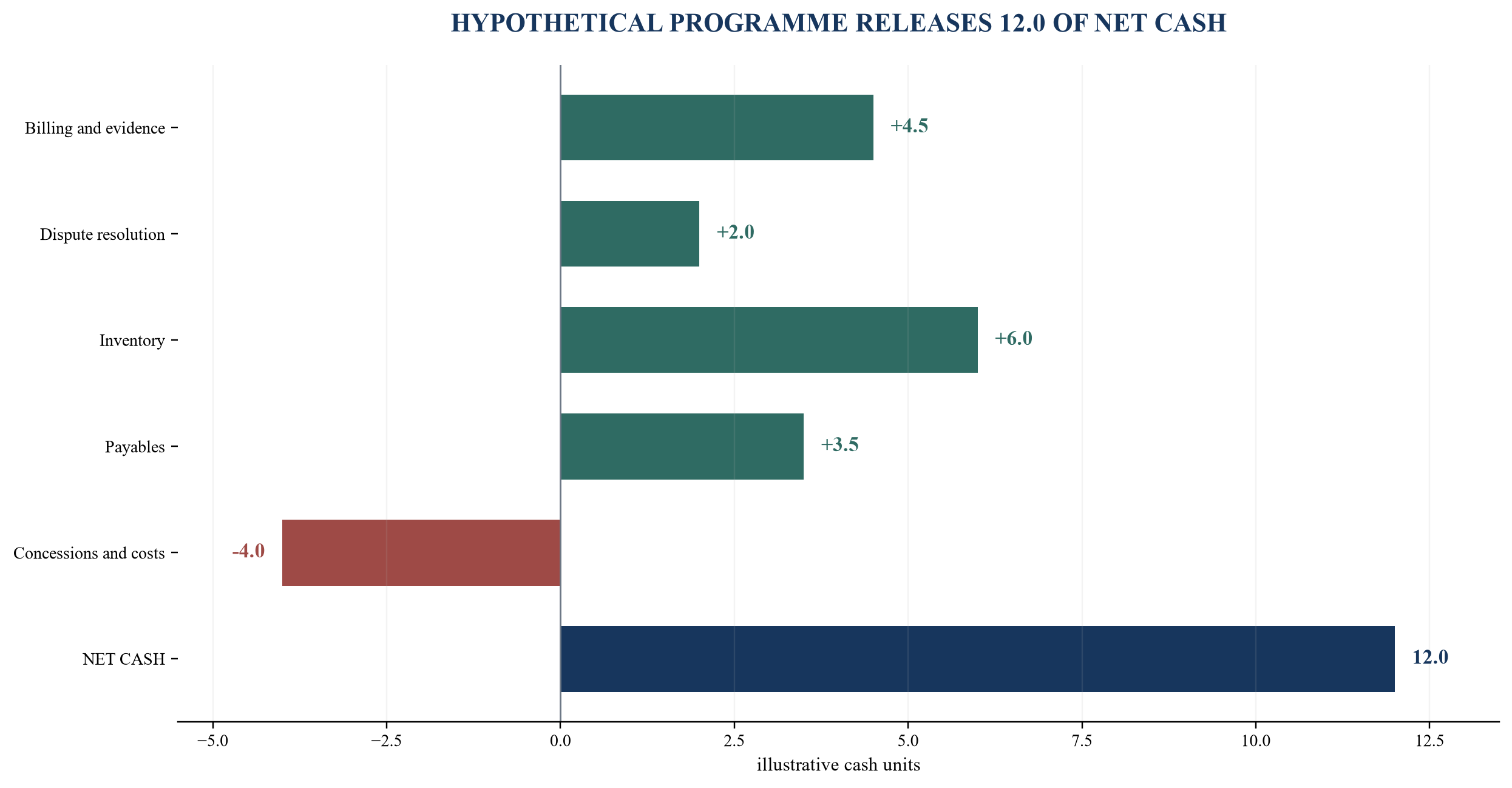
Illustrative values separate operating releases from concessions, costs and reversals.
19. Use an equity bridge that preserves uncertainty
The hypothetical cash release can be connected to equity through scenarios. If 12.0 reduces drawn debt, net debt may fall by that amount before fees, restricted cash, leakage and subsequent operating use. The result does not automatically increase enterprise value. It changes the allocation between debt and equity under a chosen valuation and transaction framework.
Durability affects the interpretation. Structural working-capital release can lower the normal funding requirement. Timing release may reverse and should be shown in the forecast. Financing proceeds create a corresponding obligation or asset transfer. Costs, concessions, write-offs, taxes and service effects reduce net value. A buyer may test the closing working-capital position against a normalised target.
Management can present three cases. The verified case includes cash observed and supported by repeated-cycle evidence. The forecast case includes implemented actions with expected cash and explicit probability. The contingent case includes opportunities requiring commercial, operational or legal decisions. The board should see each case without collapsing them into one number.
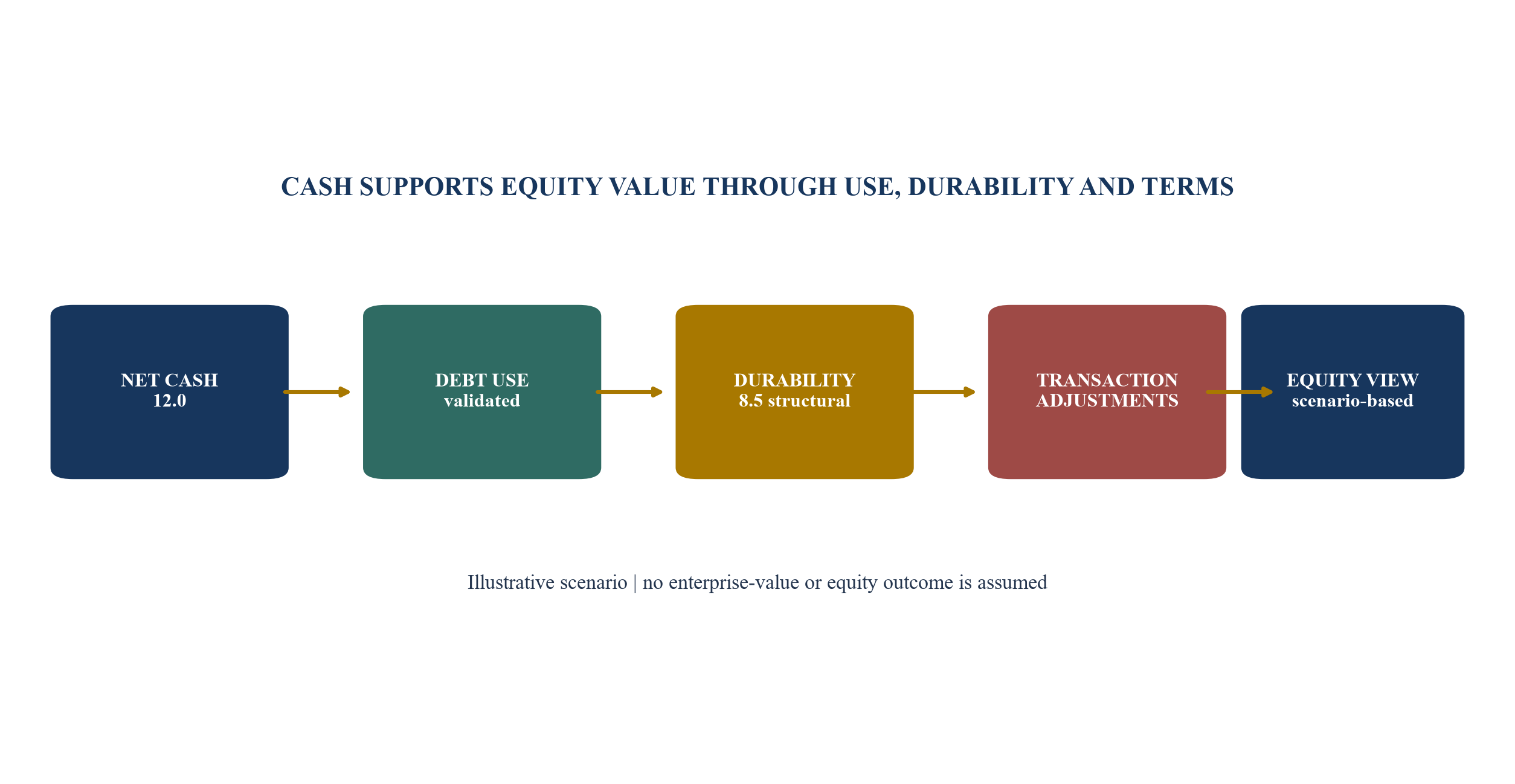
The bridge separates cash release, debt reduction, durability and transaction adjustments.
20. Use a board scorecard that joins cash and operations
The board pack should show a bridge from opening working capital to current balance, cash movement and forecast. It should separate volume, mix, currency, price, acquisition, disposal, accounting, financing and management action. The same pack should show operating guardrails and data confidence.
Headline days metrics remain useful when definitions are stable. They should be supported by absolute cash, ageing, item or customer concentration, overdue status, dispute and service measures. Forecast variance should identify whether the cause is volume, timing, execution, assumption or control.
The board should receive decisions rather than a long activity list. A decision may approve a customer settlement, inventory policy, supplier term, financing facility, system investment or revised target. Each decision states value, cash timing, risk, evidence, owner and deadline. Exceptions remain visible until resolved.
The scorecard should also reconcile the programme to the ownership plan. Opening assumptions about revenue growth, margin, capital expenditure, leverage and exit timing establish an expected working-capital path. Actual performance can then be separated into business volume, price, mix, currency, acquisition or disposal effects and management action. This prevents a favourable cash result caused by weaker trading from being credited as execution, and it prevents a growing business from appearing to underperform merely because the absolute balance increased.
Cash conversion should be viewed across legal entities and currencies. A consolidated release may sit in an entity that cannot readily upstream cash, while another entity continues to draw a facility. Restricted cash, tax, minority interests, exchange control, guarantees and local operating needs affect availability. The board pack should therefore show gross group cash, immediately available cash, committed liquidity and the entity-level actions required to use the release.
Finally, the board needs a benefit maturity profile. Newly implemented actions carry more uncertainty than results sustained through several operating cycles. Management can show identified, approved, implemented, cash-observed, finance-validated and sustained amounts in separate columns. The progression makes execution visible without converting early estimates into facts. It also allows the board to withdraw or revise benefits when customer, supplier, service or accounting evidence changes.
Table 6. Board scorecard for cash conversion
| dimension | leading evidence | financial evidence | control gate | board decision |
|---|---|---|---|---|
| receivables | billing clock, dispute inflow, promises kept | collections, overdue value and net concessions | credit, tax, revenue and write-off authority | customer escalation or settlement |
| inventory | forecast error, lead time, ageing and service | balance, release, provision and disposal cash | quality, safety, ownership and continuity | policy, disposition or strategic stock |
| payables | receipt, matching, approval and due-date compliance | paid-on-time profile and negotiated release | supplier, legal and financing review | term strategy or process investment |
| liquidity | forecast accuracy, facility eligibility and headroom | cash, debt, interest, fees and restrictions | covenant and use-of-cash validation | debt reduction, reserve or investment |
| programme | implemented actions, data confidence and exceptions | gross, net, structural, timing and reversal | finance validation and independent test | target, resource or stop decision |
The scorecard combines financial progress, operating guardrails and decision accountability.
21. Implement the programme in one hundred days
Days 1 to 15 establish control. The board approves definitions, scope, guardrails, use-of-cash principles and decision rights. Finance reconciles the principal balances. Treasury connects the programme to the cash forecast and facilities. Workstreams identify immediate legal, accounting, tax, customer, supplier and continuity constraints.
Days 10 to 35 build the driver tree. Teams map receivables by cause, inventory by purpose and payables by contractual and process state. They identify data gaps, recurring disputes, approval bottlenecks, slow-moving stock, customer and supplier concentrations and financing options. Quick controls can stop new leakage while analysis continues.
Days 25 to 60 convert evidence into approved actions. Customer, item and supplier decisions are tested for economics and operating impact. The register records gross opportunity, costs, cash timing, reversal, owner, control gate and forecast. High-risk actions require deeper validation before implementation.
Days 45 to 85 implement and stabilise. Billing, collection, planning, inventory, payable and treasury processes change. Management monitors service, revenue, supplier health, quality, disputes, overdue invoices and controls. Cash is observed in bank and ledger records. Exceptions are escalated.
Days 75 to 100 validate and institutionalise. Finance confirms net cash and classification. The board reviews durability, reversals, forecast and use of cash. Policies, master data, system controls, operating cadences and incentives are embedded. Longer-duration commercial, technology, financing or inventory actions continue through the ownership plan.
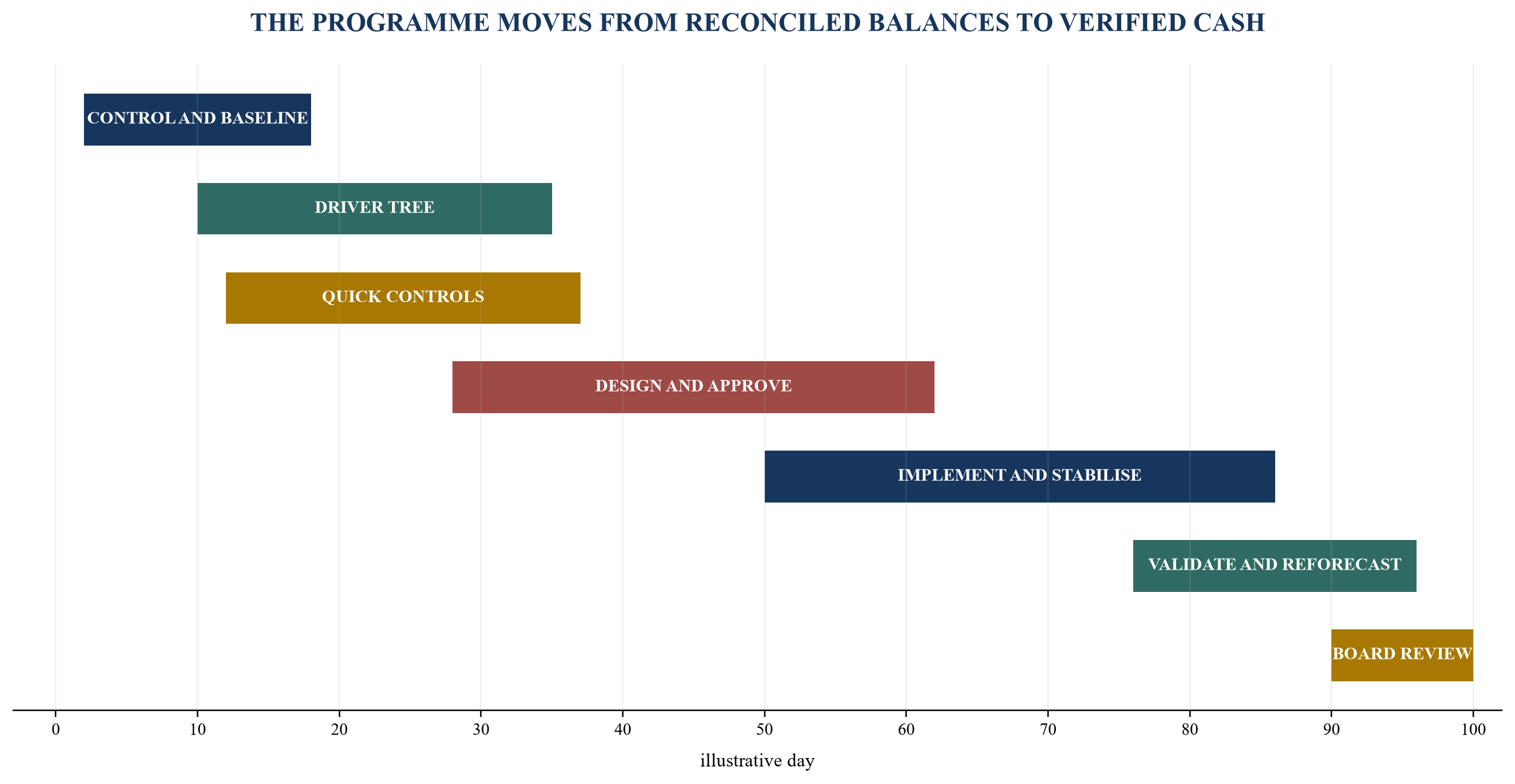
The sequence preserves control while moving from baseline to verified cash and recurring discipline.
22. Recognise the limits of the framework
The framework organises decisions, evidence and accountability. It does not determine the correct customer term, inventory level, supplier payment, financing structure, accounting treatment or equity value for a company. Those choices depend on operating facts, contracts, law, tax, regulation, financing documents, market conditions and professional judgement.
Cash conversion metrics can mislead. Denominators can change with revenue, purchases, cost, mix, seasonality, acquisitions, disposals, inflation and currency. Period-end balances can conceal intraperiod peaks. A lower balance can reflect decline, write-off, financing or accounting rather than operating improvement. The metric dictionary and bridge reduce ambiguity without removing judgement.
Some cash release reverses. Inventory rebuilds before demand, supplier payments become due and customers may alter payment behaviour. Growth consumes working capital. External finance can be withdrawn or become more expensive. The forecast should preserve reversal, capacity and downside scenarios.
Operating trade-offs remain uncertain. A stock reduction can cause a future service event that was not visible during the review period. A tighter credit policy can affect sales. A term extension can change supplier behaviour. Guardrails, pilots and repeated-cycle evidence improve decisions but cannot remove uncertainty.
Jurisdictional requirements evolve. Payment rules, disclosure, tax, assignment, insolvency, secured lending, accounting and transaction treatment require current validation. Official frameworks cited in this paper illustrate relevant controls and do not establish applicability to a specific company.
Behaviour can defeat the programme. Aggressive targets may encourage late payments, accounting pressure, customer concessions, unsafe inventory reductions or hidden financing. The board must preserve authority to reduce the target, fund resilience, stop an action and report a lower result when evidence requires it.
23. Conclusion
Working capital becomes an equity lever when the board governs it as an operating-value system. The programme begins with reconciled balances, explicit metric definitions and a causal view of receivables, inventory and payables. It separates structural release, growth avoidance, timing, financing and accounting effects.
The framework places customer, supplier, service, quality, accounting, tax, legal and financing controls inside the programme. It connects each action to cash, liquidity, debt, durability and transaction treatment. It uses a board scorecard and one-hundred-day sequence to move from opportunity to verified result.
The governing test is clear: every claimed release should connect to a reconciled baseline, an authorised operating cause, observed cash, protected performance, finance validation and a review date. That chain gives the board a stronger basis for allocating cash and assessing value throughout the ownership period.
References
- IFRS Foundation, IAS 7 Statement of Cash Flows, https://www.ifrs.org/issued-standards/list-of-standards/ias-7-statement-of-cash-flows/
- IFRS Foundation, IAS 2 Inventories, https://www.ifrs.org/issued-standards/list-of-standards/ias-2-inventories/
- IFRS Foundation, IFRS 9 Financial Instruments, https://www.ifrs.org/issued-standards/list-of-standards/ifrs-9-financial-instruments/
- IFRS Foundation, IFRS 15 Revenue from Contracts with Customers, https://www.ifrs.org/issued-standards/list-of-standards/ifrs-15-revenue-from-contracts-with-customers/
- IFRS Foundation, IAS 1 Presentation of Financial Statements, https://www.ifrs.org/issued-standards/list-of-standards/ias-1-presentation-of-financial-statements/
- IFRS Foundation, IAS 37 Provisions Contingent Liabilities and Contingent Assets, https://www.ifrs.org/issued-standards/list-of-standards/ias-37-provisions-contingent-liabilities-and-contingent-assets/
- United States Securities and Exchange Commission, Amendments to Modernize and Enhance Management's Discussion and Analysis, https://www.sec.gov/newsroom/press-releases/2020-290
- United States Securities and Exchange Commission, Final Rule 33-10890 Management's Discussion and Analysis, https://www.sec.gov/files/rules/final/2020/33-10890.pdf
- United States Office of the Comptroller of the Currency, Accounts Receivable and Inventory Financing, https://www.occ.treas.gov/topics/supervision-and-examination/credit/commercial-credit/accounts-receivable.html
- United States Office of the Comptroller of the Currency, Comptroller's Handbook Accounts Receivable and Inventory Financing, https://occ.treas.gov/publications-and-resources/publications/comptrollers-handbook/files/accts-rec-inventory-financing/pub-ch-accts-rec-inventory-financing.pdf
- United Kingdom Department for Business and Trade, Duty to Report Payment Practices and Performance, https://www.gov.uk/government/publications/business-payment-practices-and-performance-reporting-requirements/duty-to-report-guidance-to-reporting-on-payment-practices-and-performance
- United Kingdom Cabinet Office, Prompt Payment Policy, https://www.gov.uk/guidance/prompt-payment-policy
- United Kingdom Small Business Commissioner, Fair Payment Code, https://www.smallbusinesscommissioner.gov.uk/fpc/about/
- European Commission, Late Payment Directive, https://single-market-economy.ec.europa.eu/smes/sme-strategy/late-payment-directive_en
- European Commission, Proposal for a Regulation on Combating Late Payment in Commercial Transactions, https://single-market-economy.ec.europa.eu/system/files/2023-09/COM_2023_533_1_EN_ACT_part1_v7.pdf
- United Arab Emirates Ministry of Economy and Tourism, Commercial Transaction Legislations, https://www.moet.gov.ae/en/web/guest/laws
- United Arab Emirates Ministry of Economy and Tourism, Federal Decree-Law No. 50 of 2022 Issuing the Commercial Transactions Law, https://www.moet.gov.ae/documents/20121/0/DecreeLaw_50_2022_pdf.pdf/d34d9209-b407-6e73-9acb-3b01522e94e6
- United Arab Emirates Federal Tax Authority, VAT Public Clarification VATP024 Adjustment on Account of Bad Debt Relief, https://tax.gov.ae/DataFolder/Files/Pdf/VATP024%20-%20Adjustment%20on%20account%20of%20Bad%20Debts%20-%2017%2003%202021.pdf
- Reserve Bank of India, Guidelines for Setting Up and Operating the Trade Receivables Discounting System, https://www.rbi.org.in/scripts/NotificationUser.aspx?Id=12445
- Reserve Bank of India, Trade Receivables Discounting System Statistics, https://www.rbi.org.in/Scripts/TREDSStatisticsView.aspx?TREDSid=25
- Reserve Bank of India, Trade Receivables Discounting System Frequently Asked Questions, https://systemhealth.rbi.org.in/Scripts/FAQDisplay.aspx_Id%3D132.html
- Government of India Ministry of Micro Small and Medium Enterprises, Annual Report 2025-26, https://msme.gov.in/sites/default/files/MSMEANNUALREPORT2025-26ENGLISH_0.pdf
- Government of India Ministry of Micro Small and Medium Enterprises, MSME Samadhaan, https://ramp.msme.gov.in/ramp/RAMP-initiative/msme-samadhaan/msme-samadhaan
- Government of India Ministry of Micro Small and Medium Enterprises, MSME Online Dispute Resolution Portal, https://odr.msme.gov.in/
- Australian Government Payment Times Reporting Regulator, About the Payment Times Reporting Scheme, https://paymenttimes.gov.au/about/about-payment-times-reporting-scheme
- Australian Government Payment Times Reporting Regulator, Guidance Materials, https://paymenttimes.gov.au/guidance/regulatory-resources/guidance-materials
- Australian Government Payment Times Reporting Regulator, Who Must Report and When, https://paymenttimes.gov.au/reporting/who-must-report-and-when
- World Bank Enterprise Surveys, B-READY 2025 Questionnaire, https://www.enterprisesurveys.org/content/dam/enterprisesurveys/documents/methodology/ES_B-READY%202025%20Questionnaire.pdf
- International Finance Corporation, Global Supply Chain Finance Program, https://www.ifc.org/en/what-we-do/sector-expertise/trade-and-supply-chain-finance/global-supply-chain-finance
- International Finance Corporation, Global Warehouse Finance Program, https://www.ifc.org/en/what-we-do/sector-expertise/trade-and-supply-chain-finance/global-warehouse-finance-program
- Bank for International Settlements, Theory of Supply Chains: A Working Capital Approach, https://www.bis.org/publ/work1070.htm
- Organisation for Economic Co-operation and Development, G20 OECD Principles of Corporate Governance 2023, https://www.oecd.org/en/publications/2023/09/g20-oecd-principles-of-corporate-governance-2023_60836fcb.html
- Organisation for Economic Co-operation and Development, The Responsibilities of the Board, https://www.oecd.org/en/publications/g20-oecd-principles-of-corporate-governance-2023_ed750b30-en/full-report/component-8.html
Sources and further reading
- IFRS Foundation, IAS 7 Statement of Cash Flows, Official source
- IFRS Foundation, IAS 2 Inventories, Official source
- IFRS Foundation, IFRS 9 Financial Instruments, Official source
- IFRS Foundation, IFRS 15 Revenue from Contracts with Customers, Official source
- IFRS Foundation, IAS 1 Presentation of Financial Statements, Official source
- IFRS Foundation, IAS 37 Provisions Contingent Liabilities and Contingent Assets, Official source
- United States Securities and Exchange Commission, Amendments to Modernize and Enhance Management's Discussion and Analysis, Official source
- United States Securities and Exchange Commission, Final Rule 33-10890 Management's Discussion and Analysis, Official source
- United States Office of the Comptroller of the Currency, Accounts Receivable and Inventory Financing, Official source
- United States Office of the Comptroller of the Currency, Comptroller's Handbook Accounts Receivable and Inventory Financing, Official source
- United Kingdom Department for Business and Trade, Duty to Report Payment Practices and Performance, Official source
- United Kingdom Cabinet Office, Prompt Payment Policy, Official source
- United Kingdom Small Business Commissioner, Fair Payment Code, Official source
- European Commission, Late Payment Directive, Official source
- European Commission, Proposal for a Regulation on Combating Late Payment in Commercial Transactions, Official source
- United Arab Emirates Ministry of Economy and Tourism, Commercial Transaction Legislations, Official source
- United Arab Emirates Ministry of Economy and Tourism, Federal Decree-Law No. 50 of 2022 Issuing the Commercial Transactions Law, Official source
- United Arab Emirates Federal Tax Authority, VAT Public Clarification VATP024 Adjustment on Account of Bad Debt Relief, Official source
- Reserve Bank of India, Guidelines for Setting Up and Operating the Trade Receivables Discounting System, Official source
- Reserve Bank of India, Trade Receivables Discounting System Statistics, Official source
- Reserve Bank of India, Trade Receivables Discounting System Frequently Asked Questions, Official source
- Government of India Ministry of Micro Small and Medium Enterprises, Annual Report 2025-26, Official source
- Government of India Ministry of Micro Small and Medium Enterprises, MSME Samadhaan, Official source
- Government of India Ministry of Micro Small and Medium Enterprises, MSME Online Dispute Resolution Portal, Official source
- Australian Government Payment Times Reporting Regulator, About the Payment Times Reporting Scheme, Official source
- Australian Government Payment Times Reporting Regulator, Guidance Materials, Official source
- Australian Government Payment Times Reporting Regulator, Who Must Report and When, Official source
- World Bank Enterprise Surveys, B-READY 2025 Questionnaire, Official source
- International Finance Corporation, Global Supply Chain Finance Program, Official source
- International Finance Corporation, Global Warehouse Finance Program, Official source
- Bank for International Settlements, Theory of Supply Chains: A Working Capital Approach, Official source
- Organisation for Economic Co-operation and Development, G20 OECD Principles of Corporate Governance 2023, Official source
- Organisation for Economic Co-operation and Development, The Responsibilities of the Board, Official source
