

1. Define the preparation gap
The fund should identify where projects lose quality, time or market confidence before procurement. The required output is a preparation-gap diagnosis. Record the accountable owner, source evidence, approval authority, cost, schedule, dependency, decision criterion and review date [1][2].
Test the work against public need, strategic fit, technical and site evidence, demand, economic value, environmental and social safeguards, legal authority, affordability, fiscal risk, delivery options, market appetite, procurement integrity and implementation capacity. Reconcile assumptions across studies and retain a traceable evidence baseline.
The principal risk is that a fund can finance activity without solving the binding capability problem. Quantify the effect on preparation cost, cycle time, decision quality, competition, bid contingencies, public payments, financing, value for money, delivery certainty and future service. Compare continuation with redesign, pause, alternative procurement and disciplined termination.
Translate the conclusion into funding gates, advisor deliverables, quality assurance, decision rights, data ownership, recovery terms, monitoring and learning. Refresh it after material scope, policy, market, fiscal or evidence change.
2. Set the public objective
The fund should connect preparation support to service, access, resilience, productivity and investment outcomes. The required output is a fund-purpose charter. Record the accountable owner, source evidence, approval authority, cost, schedule, dependency, decision criterion and review date [3][4].
Test the work against public need, strategic fit, technical and site evidence, demand, economic value, environmental and social safeguards, legal authority, affordability, fiscal risk, delivery options, market appetite, procurement integrity and implementation capacity. Reconcile assumptions across studies and retain a traceable evidence baseline.
The principal risk is that transaction volume can displace public value as the operating objective. Quantify the effect on preparation cost, cycle time, decision quality, competition, bid contingencies, public payments, financing, value for money, delivery certainty and future service. Compare continuation with redesign, pause, alternative procurement and disciplined termination.
Translate the conclusion into funding gates, advisor deliverables, quality assurance, decision rights, data ownership, recovery terms, monitoring and learning. Refresh it after material scope, policy, market, fiscal or evidence change.
3. Integrate the public-investment system
The fund should place the fund within planning, appraisal, budgeting, debt and procurement institutions. The required output is an institutional integration map. Record the accountable owner, source evidence, approval authority, cost, schedule, dependency, decision criterion and review date [5][6].
Test the work against public need, strategic fit, technical and site evidence, demand, economic value, environmental and social safeguards, legal authority, affordability, fiscal risk, delivery options, market appetite, procurement integrity and implementation capacity. Reconcile assumptions across studies and retain a traceable evidence baseline.
The principal risk is that a parallel PPP pipeline can bypass normal capital-allocation discipline. Quantify the effect on preparation cost, cycle time, decision quality, competition, bid contingencies, public payments, financing, value for money, delivery certainty and future service. Compare continuation with redesign, pause, alternative procurement and disciplined termination.
Translate the conclusion into funding gates, advisor deliverables, quality assurance, decision rights, data ownership, recovery terms, monitoring and learning. Refresh it after material scope, policy, market, fiscal or evidence change.
4. Keep delivery options open
The fund should preserve public procurement, PPP, concession, regulated, hybrid and reform choices until evidence supports selection. The required output is an options-neutral mandate. Record the accountable owner, source evidence, approval authority, cost, schedule, dependency, decision criterion and review date [7][8].
Test the work against public need, strategic fit, technical and site evidence, demand, economic value, environmental and social safeguards, legal authority, affordability, fiscal risk, delivery options, market appetite, procurement integrity and implementation capacity. Reconcile assumptions across studies and retain a traceable evidence baseline.
The principal risk is that eligibility can bias agencies toward PPP before value for money is tested. Quantify the effect on preparation cost, cycle time, decision quality, competition, bid contingencies, public payments, financing, value for money, delivery certainty and future service. Compare continuation with redesign, pause, alternative procurement and disciplined termination.
Translate the conclusion into funding gates, advisor deliverables, quality assurance, decision rights, data ownership, recovery terms, monitoring and learning. Refresh it after material scope, policy, market, fiscal or evidence change.
5. Define eligible sponsors
The fund should specify ministries, municipalities, utilities, state enterprises and other public bodies. The required output is an eligibility schedule. Record the accountable owner, source evidence, approval authority, cost, schedule, dependency, decision criterion and review date [1][9].
Test the work against public need, strategic fit, technical and site evidence, demand, economic value, environmental and social safeguards, legal authority, affordability, fiscal risk, delivery options, market appetite, procurement integrity and implementation capacity. Reconcile assumptions across studies and retain a traceable evidence baseline.
The principal risk is that weak legal authority or ownership can strand preparation expenditure. Quantify the effect on preparation cost, cycle time, decision quality, competition, bid contingencies, public payments, financing, value for money, delivery certainty and future service. Compare continuation with redesign, pause, alternative procurement and disciplined termination.
Translate the conclusion into funding gates, advisor deliverables, quality assurance, decision rights, data ownership, recovery terms, monitoring and learning. Refresh it after material scope, policy, market, fiscal or evidence change.
6. Define eligible sectors and stages
The fund should set coverage across upstream planning, prefeasibility, feasibility, transaction and close. The required output is a scope matrix. Record the accountable owner, source evidence, approval authority, cost, schedule, dependency, decision criterion and review date [10][11].
Test the work against public need, strategic fit, technical and site evidence, demand, economic value, environmental and social safeguards, legal authority, affordability, fiscal risk, delivery options, market appetite, procurement integrity and implementation capacity. Reconcile assumptions across studies and retain a traceable evidence baseline.
The principal risk is that unclear boundaries can leave critical work unfunded or duplicated. Quantify the effect on preparation cost, cycle time, decision quality, competition, bid contingencies, public payments, financing, value for money, delivery certainty and future service. Compare continuation with redesign, pause, alternative procurement and disciplined termination.
Translate the conclusion into funding gates, advisor deliverables, quality assurance, decision rights, data ownership, recovery terms, monitoring and learning. Refresh it after material scope, policy, market, fiscal or evidence change.
7. Create a pipeline intake
The fund should standardise need, sponsor, site, demand, cost, authority, readiness and strategic fit. The required output is a project concept note. Record the accountable owner, source evidence, approval authority, cost, schedule, dependency, decision criterion and review date [12][13].
Test the work against public need, strategic fit, technical and site evidence, demand, economic value, environmental and social safeguards, legal authority, affordability, fiscal risk, delivery options, market appetite, procurement integrity and implementation capacity. Reconcile assumptions across studies and retain a traceable evidence baseline.
The principal risk is that political visibility can substitute for a minimally evidenced project concept. Quantify the effect on preparation cost, cycle time, decision quality, competition, bid contingencies, public payments, financing, value for money, delivery certainty and future service. Compare continuation with redesign, pause, alternative procurement and disciplined termination.
Translate the conclusion into funding gates, advisor deliverables, quality assurance, decision rights, data ownership, recovery terms, monitoring and learning. Refresh it after material scope, policy, market, fiscal or evidence change.
8. Apply an initial screen
The fund should test strategic priority, additionality, affordability, safeguards, complexity and plausible delivery routes. The required output is a screen-and-stop decision. Record the accountable owner, source evidence, approval authority, cost, schedule, dependency, decision criterion and review date [7][14].
Test the work against public need, strategic fit, technical and site evidence, demand, economic value, environmental and social safeguards, legal authority, affordability, fiscal risk, delivery options, market appetite, procurement integrity and implementation capacity. Reconcile assumptions across studies and retain a traceable evidence baseline.
The principal risk is that scarce preparation capital can be locked into projects with no credible pathway. Quantify the effect on preparation cost, cycle time, decision quality, competition, bid contingencies, public payments, financing, value for money, delivery certainty and future service. Compare continuation with redesign, pause, alternative procurement and disciplined termination.
Translate the conclusion into funding gates, advisor deliverables, quality assurance, decision rights, data ownership, recovery terms, monitoring and learning. Refresh it after material scope, policy, market, fiscal or evidence change.
Table 1. Initial project screen
| Dimension | Evidence | Gate |
|---|---|---|
| public need | service gap | proceed or stop |
| readiness | site and sponsor | prepare or remediate |
| delivery | credible options | keep routes open |
| fiscal | affordability range | within envelope |
Illustrative analytical structure; verified programme and jurisdiction evidence governs.
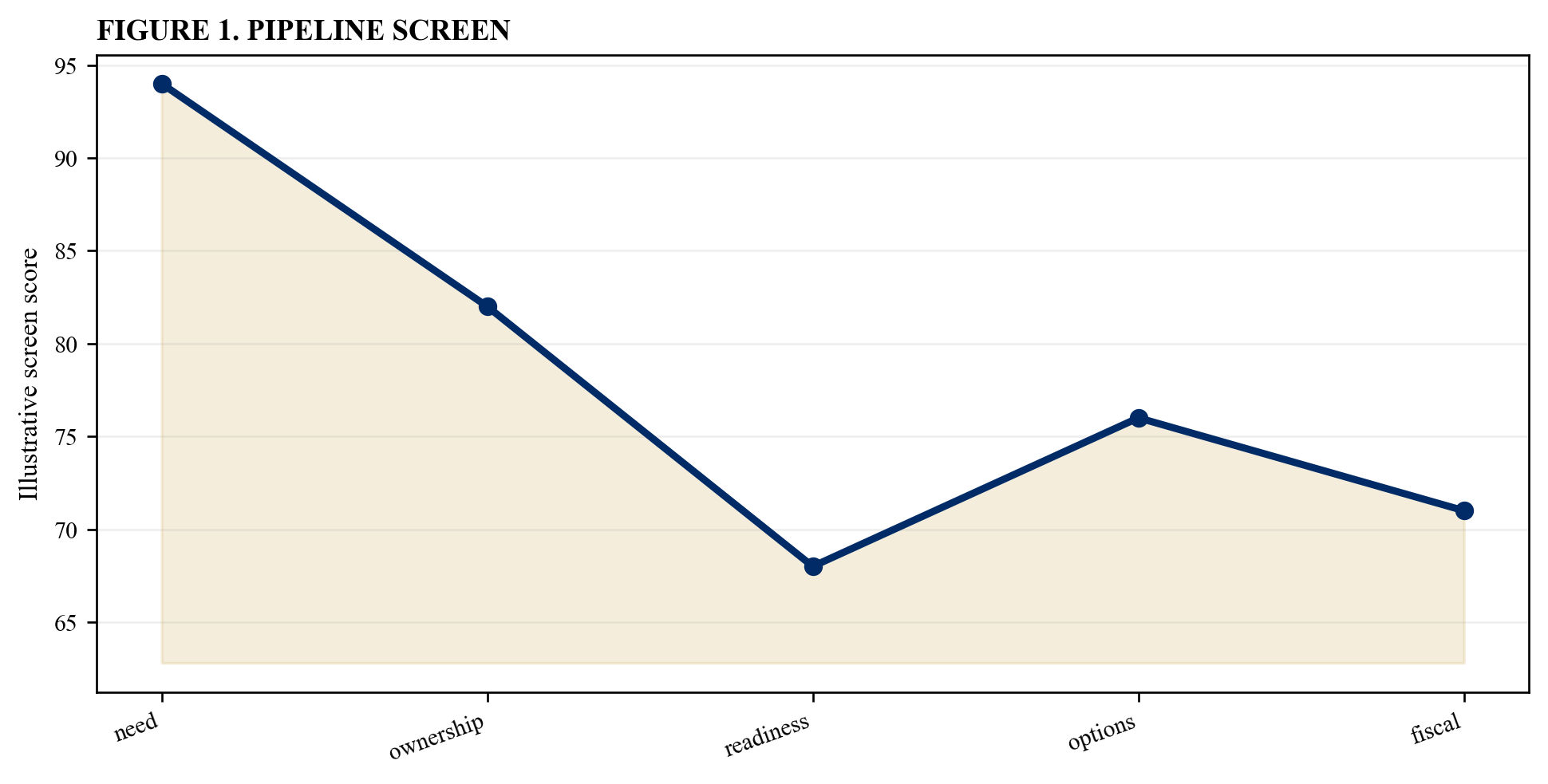
Illustrative analytical scenario; verified programme evidence should replace values.
9. Assess sponsor capacity
The fund should evaluate leadership, technical ownership, budget authority, decision speed and advisor-management ability. The required output is a sponsor-capacity plan. Record the accountable owner, source evidence, approval authority, cost, schedule, dependency, decision criterion and review date [15][16].
Test the work against public need, strategic fit, technical and site evidence, demand, economic value, environmental and social safeguards, legal authority, affordability, fiscal risk, delivery options, market appetite, procurement integrity and implementation capacity. Reconcile assumptions across studies and retain a traceable evidence baseline.
The principal risk is that external consultants cannot replace an accountable public project owner. Quantify the effect on preparation cost, cycle time, decision quality, competition, bid contingencies, public payments, financing, value for money, delivery certainty and future service. Compare continuation with redesign, pause, alternative procurement and disciplined termination.
Translate the conclusion into funding gates, advisor deliverables, quality assurance, decision rights, data ownership, recovery terms, monitoring and learning. Refresh it after material scope, policy, market, fiscal or evidence change.
10. Set readiness thresholds
The fund should define land, site, data, demand, legal, stakeholder, budget and policy prerequisites. The required output is a readiness scorecard. Record the accountable owner, source evidence, approval authority, cost, schedule, dependency, decision criterion and review date [11][17].
Test the work against public need, strategic fit, technical and site evidence, demand, economic value, environmental and social safeguards, legal authority, affordability, fiscal risk, delivery options, market appetite, procurement integrity and implementation capacity. Reconcile assumptions across studies and retain a traceable evidence baseline.
The principal risk is that funding can begin before dependencies needed for useful studies exist. Quantify the effect on preparation cost, cycle time, decision quality, competition, bid contingencies, public payments, financing, value for money, delivery certainty and future service. Compare continuation with redesign, pause, alternative procurement and disciplined termination.
Translate the conclusion into funding gates, advisor deliverables, quality assurance, decision rights, data ownership, recovery terms, monitoring and learning. Refresh it after material scope, policy, market, fiscal or evidence change.
11. Budget the preparation programme
The fund should estimate study, advisor, survey, consultation, procurement and close costs by stage. The required output is a preparation cost plan. Record the accountable owner, source evidence, approval authority, cost, schedule, dependency, decision criterion and review date [2][18].
Test the work against public need, strategic fit, technical and site evidence, demand, economic value, environmental and social safeguards, legal authority, affordability, fiscal risk, delivery options, market appetite, procurement integrity and implementation capacity. Reconcile assumptions across studies and retain a traceable evidence baseline.
The principal risk is that headline advisory fees can omit surveys, approvals, safeguards and transaction support. Quantify the effect on preparation cost, cycle time, decision quality, competition, bid contingencies, public payments, financing, value for money, delivery certainty and future service. Compare continuation with redesign, pause, alternative procurement and disciplined termination.
Translate the conclusion into funding gates, advisor deliverables, quality assurance, decision rights, data ownership, recovery terms, monitoring and learning. Refresh it after material scope, policy, market, fiscal or evidence change.
12. Choose funding sources
The fund should combine appropriations, donor grants, development finance, recoveries and retained earnings. The required output is a capitalisation plan. Record the accountable owner, source evidence, approval authority, cost, schedule, dependency, decision criterion and review date [19][20].
Test the work against public need, strategic fit, technical and site evidence, demand, economic value, environmental and social safeguards, legal authority, affordability, fiscal risk, delivery options, market appetite, procurement integrity and implementation capacity. Reconcile assumptions across studies and retain a traceable evidence baseline.
The principal risk is that short-term financing can fail before multi-year preparation completes. Quantify the effect on preparation cost, cycle time, decision quality, competition, bid contingencies, public payments, financing, value for money, delivery certainty and future service. Compare continuation with redesign, pause, alternative procurement and disciplined termination.
Translate the conclusion into funding gates, advisor deliverables, quality assurance, decision rights, data ownership, recovery terms, monitoring and learning. Refresh it after material scope, policy, market, fiscal or evidence change.
13. Design the fund vehicle
The fund should select legal form, banking, commitment, procurement, retention and reflow powers. The required output is a legal and operating structure. Record the accountable owner, source evidence, approval authority, cost, schedule, dependency, decision criterion and review date [21][22].
Test the work against public need, strategic fit, technical and site evidence, demand, economic value, environmental and social safeguards, legal authority, affordability, fiscal risk, delivery options, market appetite, procurement integrity and implementation capacity. Reconcile assumptions across studies and retain a traceable evidence baseline.
The principal risk is that the vehicle can lack authority to hold funds or make conditional multi-year commitments. Quantify the effect on preparation cost, cycle time, decision quality, competition, bid contingencies, public payments, financing, value for money, delivery certainty and future service. Compare continuation with redesign, pause, alternative procurement and disciplined termination.
Translate the conclusion into funding gates, advisor deliverables, quality assurance, decision rights, data ownership, recovery terms, monitoring and learning. Refresh it after material scope, policy, market, fiscal or evidence change.
14. Establish independent governance
The fund should separate sponsoring, funding, challenge, procurement and approval roles. The required output is a governance and delegation matrix. Record the accountable owner, source evidence, approval authority, cost, schedule, dependency, decision criterion and review date [23][24].
Test the work against public need, strategic fit, technical and site evidence, demand, economic value, environmental and social safeguards, legal authority, affordability, fiscal risk, delivery options, market appetite, procurement integrity and implementation capacity. Reconcile assumptions across studies and retain a traceable evidence baseline.
The principal risk is that the institution seeking support can also control quality and release decisions. Quantify the effect on preparation cost, cycle time, decision quality, competition, bid contingencies, public payments, financing, value for money, delivery certainty and future service. Compare continuation with redesign, pause, alternative procurement and disciplined termination.
Translate the conclusion into funding gates, advisor deliverables, quality assurance, decision rights, data ownership, recovery terms, monitoring and learning. Refresh it after material scope, policy, market, fiscal or evidence change.
15. Set portfolio allocation rules
The fund should balance sectors, regions, maturity, social priority, climate and mobilisation potential. The required output is a portfolio allocation policy. Record the accountable owner, source evidence, approval authority, cost, schedule, dependency, decision criterion and review date [3][25].
Test the work against public need, strategic fit, technical and site evidence, demand, economic value, environmental and social safeguards, legal authority, affordability, fiscal risk, delivery options, market appetite, procurement integrity and implementation capacity. Reconcile assumptions across studies and retain a traceable evidence baseline.
The principal risk is that visible megaprojects can crowd out smaller high-impact preparation needs. Quantify the effect on preparation cost, cycle time, decision quality, competition, bid contingencies, public payments, financing, value for money, delivery certainty and future service. Compare continuation with redesign, pause, alternative procurement and disciplined termination.
Translate the conclusion into funding gates, advisor deliverables, quality assurance, decision rights, data ownership, recovery terms, monitoring and learning. Refresh it after material scope, policy, market, fiscal or evidence change.
16. Release capital by stage gate
The fund should fund concept, prefeasibility, feasibility, transaction and close against specified evidence. The required output is a gated funding agreement. Record the accountable owner, source evidence, approval authority, cost, schedule, dependency, decision criterion and review date [7][26].
Test the work against public need, strategic fit, technical and site evidence, demand, economic value, environmental and social safeguards, legal authority, affordability, fiscal risk, delivery options, market appetite, procurement integrity and implementation capacity. Reconcile assumptions across studies and retain a traceable evidence baseline.
The principal risk is that full commitment at entry weakens stop, redesign and reprioritisation discipline. Quantify the effect on preparation cost, cycle time, decision quality, competition, bid contingencies, public payments, financing, value for money, delivery certainty and future service. Compare continuation with redesign, pause, alternative procurement and disciplined termination.
Translate the conclusion into funding gates, advisor deliverables, quality assurance, decision rights, data ownership, recovery terms, monitoring and learning. Refresh it after material scope, policy, market, fiscal or evidence change.
Table 2. Preparation stage gates
| Stage | Funded evidence | Decision |
|---|---|---|
| concept | need and ownership | screen |
| prefeasibility | options and baseline | prepare |
| feasibility | integrated appraisal | procure or stop |
| transaction | tender and close | award and close |
Illustrative analytical structure; verified programme and jurisdiction evidence governs.
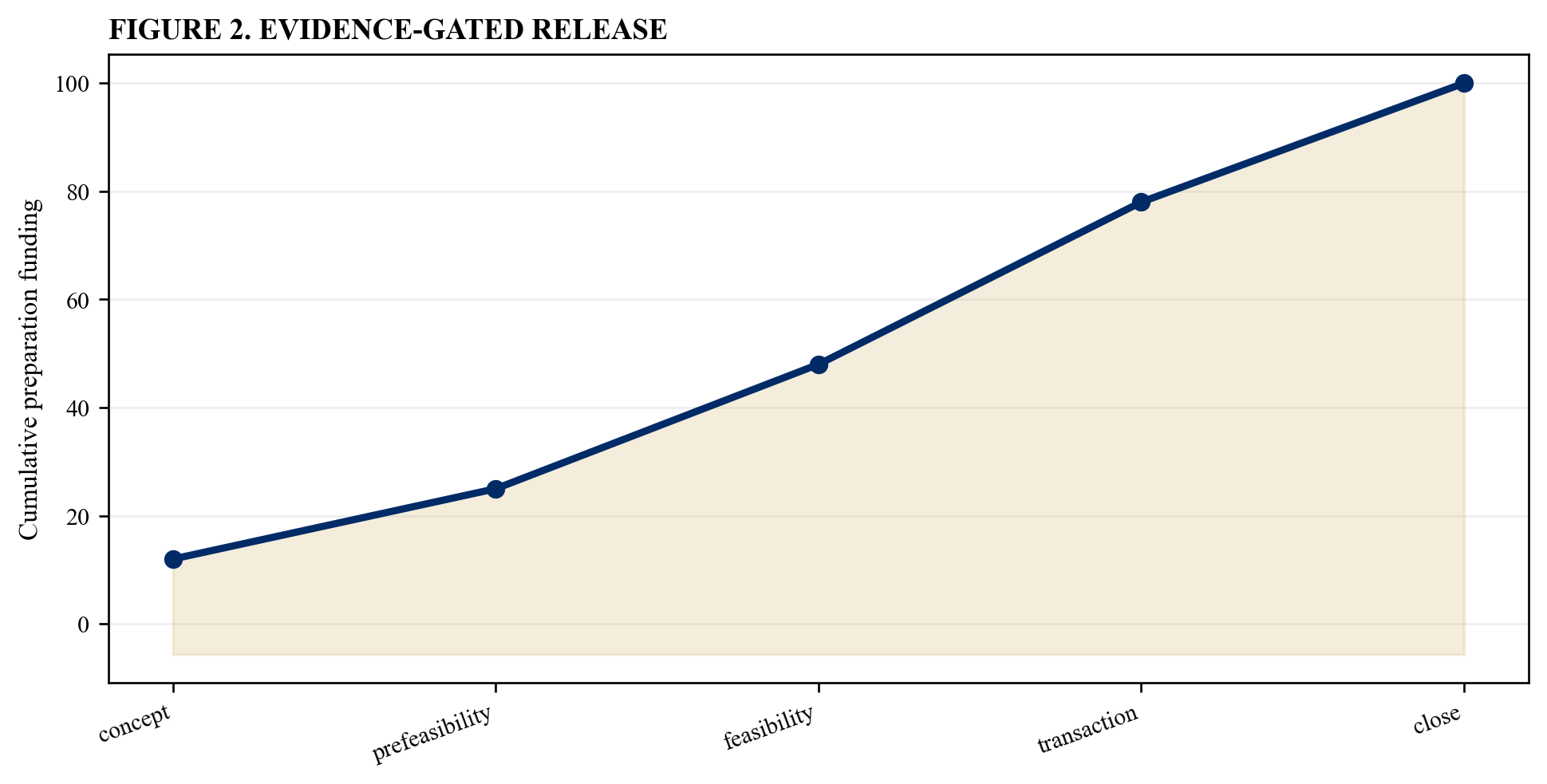
Illustrative analytical scenario; verified programme evidence should replace values.
17. Define feasibility evidence
The fund should cover demand, technical, economic, financial, fiscal, legal, environmental, social and institutional work. The required output is an integrated feasibility scope. Record the accountable owner, source evidence, approval authority, cost, schedule, dependency, decision criterion and review date [1][27].
Test the work against public need, strategic fit, technical and site evidence, demand, economic value, environmental and social safeguards, legal authority, affordability, fiscal risk, delivery options, market appetite, procurement integrity and implementation capacity. Reconcile assumptions across studies and retain a traceable evidence baseline.
The principal risk is that separate studies can use inconsistent baselines and reach incompatible conclusions. Quantify the effect on preparation cost, cycle time, decision quality, competition, bid contingencies, public payments, financing, value for money, delivery certainty and future service. Compare continuation with redesign, pause, alternative procurement and disciplined termination.
Translate the conclusion into funding gates, advisor deliverables, quality assurance, decision rights, data ownership, recovery terms, monitoring and learning. Refresh it after material scope, policy, market, fiscal or evidence change.
18. Fund site and baseline evidence
The fund should commission surveys, land, geotechnical, network, environmental and asset-condition work. The required output is a verified baseline dossier. Record the accountable owner, source evidence, approval authority, cost, schedule, dependency, decision criterion and review date [28][29].
Test the work against public need, strategic fit, technical and site evidence, demand, economic value, environmental and social safeguards, legal authority, affordability, fiscal risk, delivery options, market appetite, procurement integrity and implementation capacity. Reconcile assumptions across studies and retain a traceable evidence baseline.
The principal risk is that unresolved physical evidence can create redesign, bid contingencies and claims. Quantify the effect on preparation cost, cycle time, decision quality, competition, bid contingencies, public payments, financing, value for money, delivery certainty and future service. Compare continuation with redesign, pause, alternative procurement and disciplined termination.
Translate the conclusion into funding gates, advisor deliverables, quality assurance, decision rights, data ownership, recovery terms, monitoring and learning. Refresh it after material scope, policy, market, fiscal or evidence change.
19. Test economic value
The fund should measure costs, benefits, distribution, externalities, resilience and uncertainty. The required output is an economic appraisal. Record the accountable owner, source evidence, approval authority, cost, schedule, dependency, decision criterion and review date [5][30].
Test the work against public need, strategic fit, technical and site evidence, demand, economic value, environmental and social safeguards, legal authority, affordability, fiscal risk, delivery options, market appetite, procurement integrity and implementation capacity. Reconcile assumptions across studies and retain a traceable evidence baseline.
The principal risk is that financial bankability can be mistaken for social desirability. Quantify the effect on preparation cost, cycle time, decision quality, competition, bid contingencies, public payments, financing, value for money, delivery certainty and future service. Compare continuation with redesign, pause, alternative procurement and disciplined termination.
Translate the conclusion into funding gates, advisor deliverables, quality assurance, decision rights, data ownership, recovery terms, monitoring and learning. Refresh it after material scope, policy, market, fiscal or evidence change.
20. Test affordability and fiscal risk
The fund should model public payments, support, guarantees, retained risk and portfolio headroom. The required output is a fiscal assessment. Record the accountable owner, source evidence, approval authority, cost, schedule, dependency, decision criterion and review date [6][31].
Test the work against public need, strategic fit, technical and site evidence, demand, economic value, environmental and social safeguards, legal authority, affordability, fiscal risk, delivery options, market appetite, procurement integrity and implementation capacity. Reconcile assumptions across studies and retain a traceable evidence baseline.
The principal risk is that preparation can proceed toward a structure the public budget cannot sustain. Quantify the effect on preparation cost, cycle time, decision quality, competition, bid contingencies, public payments, financing, value for money, delivery certainty and future service. Compare continuation with redesign, pause, alternative procurement and disciplined termination.
Translate the conclusion into funding gates, advisor deliverables, quality assurance, decision rights, data ownership, recovery terms, monitoring and learning. Refresh it after material scope, policy, market, fiscal or evidence change.
21. Compare delivery models
The fund should test risk-adjusted whole-life value, capability, timing and flexibility across credible routes. The required output is a delivery-model recommendation. Record the accountable owner, source evidence, approval authority, cost, schedule, dependency, decision criterion and review date [8][32].
Test the work against public need, strategic fit, technical and site evidence, demand, economic value, environmental and social safeguards, legal authority, affordability, fiscal risk, delivery options, market appetite, procurement integrity and implementation capacity. Reconcile assumptions across studies and retain a traceable evidence baseline.
The principal risk is that financing preference can determine the answer before evidence is assembled. Quantify the effect on preparation cost, cycle time, decision quality, competition, bid contingencies, public payments, financing, value for money, delivery certainty and future service. Compare continuation with redesign, pause, alternative procurement and disciplined termination.
Translate the conclusion into funding gates, advisor deliverables, quality assurance, decision rights, data ownership, recovery terms, monitoring and learning. Refresh it after material scope, policy, market, fiscal or evidence change.
22. Undertake market sounding
The fund should test sponsor, operator, lender, investor, insurer and supply-chain appetite under controlled disclosure. The required output is a market-evidence report. Record the accountable owner, source evidence, approval authority, cost, schedule, dependency, decision criterion and review date [33][34].
Test the work against public need, strategic fit, technical and site evidence, demand, economic value, environmental and social safeguards, legal authority, affordability, fiscal risk, delivery options, market appetite, procurement integrity and implementation capacity. Reconcile assumptions across studies and retain a traceable evidence baseline.
The principal risk is that generic appetite can be confused with willingness to bid on proposed risk allocation. Quantify the effect on preparation cost, cycle time, decision quality, competition, bid contingencies, public payments, financing, value for money, delivery certainty and future service. Compare continuation with redesign, pause, alternative procurement and disciplined termination.
Translate the conclusion into funding gates, advisor deliverables, quality assurance, decision rights, data ownership, recovery terms, monitoring and learning. Refresh it after material scope, policy, market, fiscal or evidence change.
23. Procure specialist advisors
The fund should use quality, expertise, conflicts, team continuity, method and price criteria. The required output is an advisor procurement plan. Record the accountable owner, source evidence, approval authority, cost, schedule, dependency, decision criterion and review date [15][35].
Test the work against public need, strategic fit, technical and site evidence, demand, economic value, environmental and social safeguards, legal authority, affordability, fiscal risk, delivery options, market appetite, procurement integrity and implementation capacity. Reconcile assumptions across studies and retain a traceable evidence baseline.
The principal risk is that lowest-fee selection can increase rework, delay and transaction failure. Quantify the effect on preparation cost, cycle time, decision quality, competition, bid contingencies, public payments, financing, value for money, delivery certainty and future service. Compare continuation with redesign, pause, alternative procurement and disciplined termination.
Translate the conclusion into funding gates, advisor deliverables, quality assurance, decision rights, data ownership, recovery terms, monitoring and learning. Refresh it after material scope, policy, market, fiscal or evidence change.
24. Manage advisor conflicts
The fund should disclose mandates, lenders, bidders, sponsors, suppliers and success-fee incentives. The required output is a conflict and independence protocol. Record the accountable owner, source evidence, approval authority, cost, schedule, dependency, decision criterion and review date [23][36].
Test the work against public need, strategic fit, technical and site evidence, demand, economic value, environmental and social safeguards, legal authority, affordability, fiscal risk, delivery options, market appetite, procurement integrity and implementation capacity. Reconcile assumptions across studies and retain a traceable evidence baseline.
The principal risk is that commercial relationships can shape options, assumptions or bidder access. Quantify the effect on preparation cost, cycle time, decision quality, competition, bid contingencies, public payments, financing, value for money, delivery certainty and future service. Compare continuation with redesign, pause, alternative procurement and disciplined termination.
Translate the conclusion into funding gates, advisor deliverables, quality assurance, decision rights, data ownership, recovery terms, monitoring and learning. Refresh it after material scope, policy, market, fiscal or evidence change.
Table 3. Illustrative funding waterfall
| Source | Illustrative share | Primary condition |
|---|---|---|
| public budget | 45 | priority and control |
| development partner | 25 | eligible programme |
| sponsor contribution | 10 | ownership |
| project recovery | 20 | successful close |
Illustrative analytical structure; verified programme and jurisdiction evidence governs.
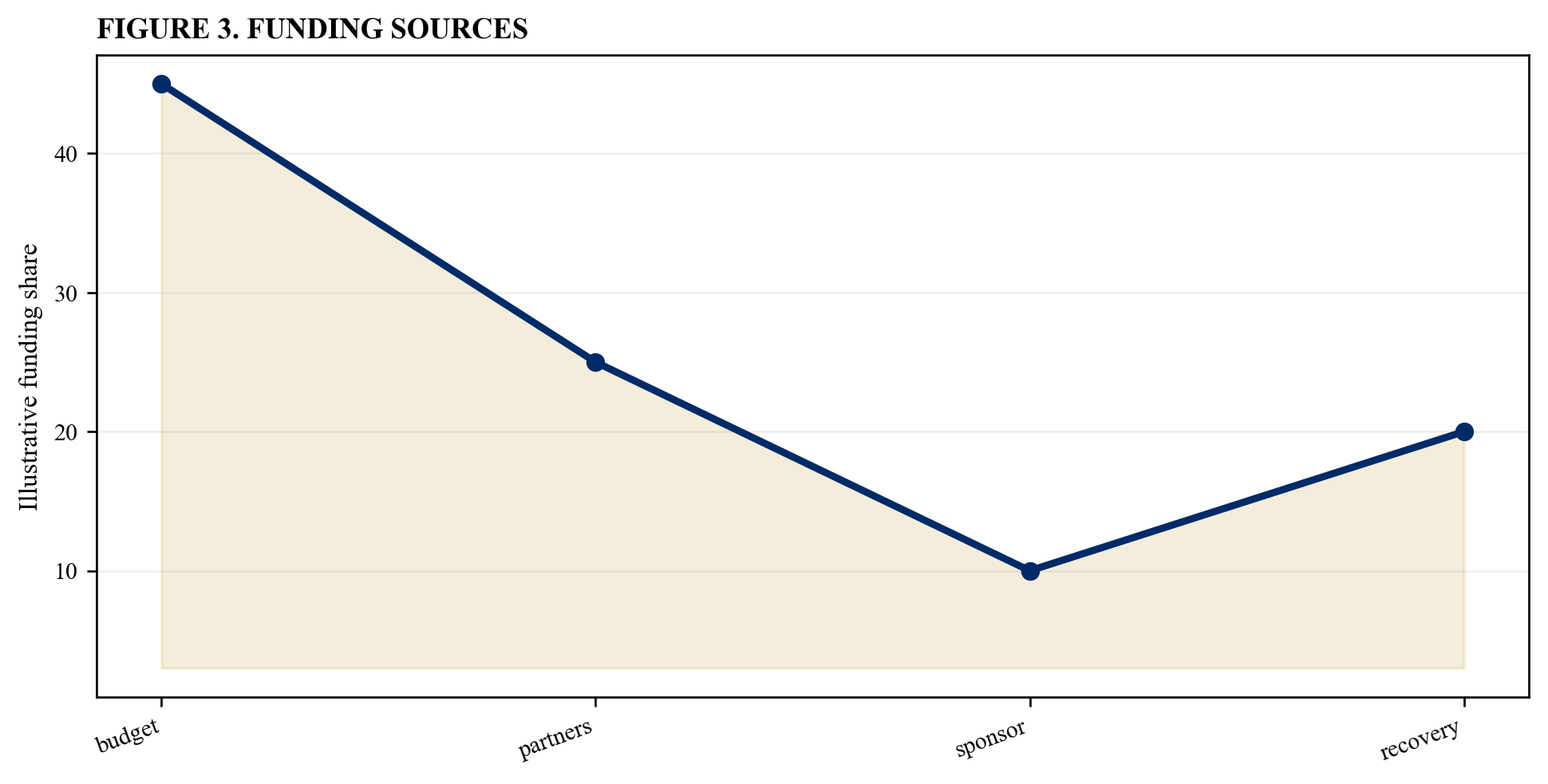
Illustrative analytical scenario; verified programme evidence should replace values.
25. Control scope and deliverables
The fund should set questions, evidence, models, drafts, reviews, acceptance and change control. The required output is an advisor work order. Record the accountable owner, source evidence, approval authority, cost, schedule, dependency, decision criterion and review date [16][35].
Test the work against public need, strategic fit, technical and site evidence, demand, economic value, environmental and social safeguards, legal authority, affordability, fiscal risk, delivery options, market appetite, procurement integrity and implementation capacity. Reconcile assumptions across studies and retain a traceable evidence baseline.
The principal risk is that broad deliverables can produce reports that do not support an approval decision. Quantify the effect on preparation cost, cycle time, decision quality, competition, bid contingencies, public payments, financing, value for money, delivery certainty and future service. Compare continuation with redesign, pause, alternative procurement and disciplined termination.
Translate the conclusion into funding gates, advisor deliverables, quality assurance, decision rights, data ownership, recovery terms, monitoring and learning. Refresh it after material scope, policy, market, fiscal or evidence change.
26. Create an evidence data room
The fund should retain source data, models, assumptions, decisions, surveys, permits and version history. The required output is a governed preparation repository. Record the accountable owner, source evidence, approval authority, cost, schedule, dependency, decision criterion and review date [37][38].
Test the work against public need, strategic fit, technical and site evidence, demand, economic value, environmental and social safeguards, legal authority, affordability, fiscal risk, delivery options, market appetite, procurement integrity and implementation capacity. Reconcile assumptions across studies and retain a traceable evidence baseline.
The principal risk is that knowledge can remain with advisors and be lost between stages or staff changes. Quantify the effect on preparation cost, cycle time, decision quality, competition, bid contingencies, public payments, financing, value for money, delivery certainty and future service. Compare continuation with redesign, pause, alternative procurement and disciplined termination.
Translate the conclusion into funding gates, advisor deliverables, quality assurance, decision rights, data ownership, recovery terms, monitoring and learning. Refresh it after material scope, policy, market, fiscal or evidence change.
27. Own intellectual property and models
The fund should secure usable, auditable and transferable rights in documents, data and calculations. The required output is a data-and-IP schedule. Record the accountable owner, source evidence, approval authority, cost, schedule, dependency, decision criterion and review date [37][39].
Test the work against public need, strategic fit, technical and site evidence, demand, economic value, environmental and social safeguards, legal authority, affordability, fiscal risk, delivery options, market appetite, procurement integrity and implementation capacity. Reconcile assumptions across studies and retain a traceable evidence baseline.
The principal risk is that licensing restrictions can impair procurement, lender diligence and later contract management. Quantify the effect on preparation cost, cycle time, decision quality, competition, bid contingencies, public payments, financing, value for money, delivery certainty and future service. Compare continuation with redesign, pause, alternative procurement and disciplined termination.
Translate the conclusion into funding gates, advisor deliverables, quality assurance, decision rights, data ownership, recovery terms, monitoring and learning. Refresh it after material scope, policy, market, fiscal or evidence change.
28. Run independent quality assurance
The fund should challenge methods, consistency, optimism bias, sensitivity and decision relevance. The required output is a gateway assurance report. Record the accountable owner, source evidence, approval authority, cost, schedule, dependency, decision criterion and review date [24][40].
Test the work against public need, strategic fit, technical and site evidence, demand, economic value, environmental and social safeguards, legal authority, affordability, fiscal risk, delivery options, market appetite, procurement integrity and implementation capacity. Reconcile assumptions across studies and retain a traceable evidence baseline.
The principal risk is that sponsor and advisor confirmation can become circular assurance. Quantify the effect on preparation cost, cycle time, decision quality, competition, bid contingencies, public payments, financing, value for money, delivery certainty and future service. Compare continuation with redesign, pause, alternative procurement and disciplined termination.
Translate the conclusion into funding gates, advisor deliverables, quality assurance, decision rights, data ownership, recovery terms, monitoring and learning. Refresh it after material scope, policy, market, fiscal or evidence change.
29. Stop or redesign weak projects
The fund should define failure, remediation, pause, termination and re-entry criteria. The required output is a stop-and-redesign protocol. Record the accountable owner, source evidence, approval authority, cost, schedule, dependency, decision criterion and review date [7][26].
Test the work against public need, strategic fit, technical and site evidence, demand, economic value, environmental and social safeguards, legal authority, affordability, fiscal risk, delivery options, market appetite, procurement integrity and implementation capacity. Reconcile assumptions across studies and retain a traceable evidence baseline.
The principal risk is that sunk-cost pressure can keep an uneconomic project in the pipeline. Quantify the effect on preparation cost, cycle time, decision quality, competition, bid contingencies, public payments, financing, value for money, delivery certainty and future service. Compare continuation with redesign, pause, alternative procurement and disciplined termination.
Translate the conclusion into funding gates, advisor deliverables, quality assurance, decision rights, data ownership, recovery terms, monitoring and learning. Refresh it after material scope, policy, market, fiscal or evidence change.
30. Prepare procurement documents
The fund should translate evidence into output requirements, risk allocation, evaluation and draft contracts. The required output is a tender-ready package. Record the accountable owner, source evidence, approval authority, cost, schedule, dependency, decision criterion and review date [1][32].
Test the work against public need, strategic fit, technical and site evidence, demand, economic value, environmental and social safeguards, legal authority, affordability, fiscal risk, delivery options, market appetite, procurement integrity and implementation capacity. Reconcile assumptions across studies and retain a traceable evidence baseline.
The principal risk is that study conclusions can fail to reach enforceable procurement terms. Quantify the effect on preparation cost, cycle time, decision quality, competition, bid contingencies, public payments, financing, value for money, delivery certainty and future service. Compare continuation with redesign, pause, alternative procurement and disciplined termination.
Translate the conclusion into funding gates, advisor deliverables, quality assurance, decision rights, data ownership, recovery terms, monitoring and learning. Refresh it after material scope, policy, market, fiscal or evidence change.
31. Protect procurement integrity
The fund should control market engagement, confidential information, bidder equality and audit trails. The required output is a procurement-integrity plan. Record the accountable owner, source evidence, approval authority, cost, schedule, dependency, decision criterion and review date [9][36].
Test the work against public need, strategic fit, technical and site evidence, demand, economic value, environmental and social safeguards, legal authority, affordability, fiscal risk, delivery options, market appetite, procurement integrity and implementation capacity. Reconcile assumptions across studies and retain a traceable evidence baseline.
The principal risk is that early advisor or sponsor access can distort competition. Quantify the effect on preparation cost, cycle time, decision quality, competition, bid contingencies, public payments, financing, value for money, delivery certainty and future service. Compare continuation with redesign, pause, alternative procurement and disciplined termination.
Translate the conclusion into funding gates, advisor deliverables, quality assurance, decision rights, data ownership, recovery terms, monitoring and learning. Refresh it after material scope, policy, market, fiscal or evidence change.
32. Support evaluation and negotiation
The fund should fund clarifications, bid assessment, value testing, approvals and lawful negotiations. The required output is a transaction-support plan. Record the accountable owner, source evidence, approval authority, cost, schedule, dependency, decision criterion and review date [10][33].
Test the work against public need, strategic fit, technical and site evidence, demand, economic value, environmental and social safeguards, legal authority, affordability, fiscal risk, delivery options, market appetite, procurement integrity and implementation capacity. Reconcile assumptions across studies and retain a traceable evidence baseline.
The principal risk is that preparation funding can end before the most decision-intensive stage. Quantify the effect on preparation cost, cycle time, decision quality, competition, bid contingencies, public payments, financing, value for money, delivery certainty and future service. Compare continuation with redesign, pause, alternative procurement and disciplined termination.
Translate the conclusion into funding gates, advisor deliverables, quality assurance, decision rights, data ownership, recovery terms, monitoring and learning. Refresh it after material scope, policy, market, fiscal or evidence change.
Table 4. Illustrative portfolio dashboard
| Measure | Illustrative index | Control response |
|---|---|---|
| evidence quality | 86 | release next gate |
| cycle time | 62 | remove bottleneck |
| market depth | 74 | refine structure |
| fiscal readiness | 81 | confirm authority |
Illustrative analytical structure; verified programme and jurisdiction evidence governs.
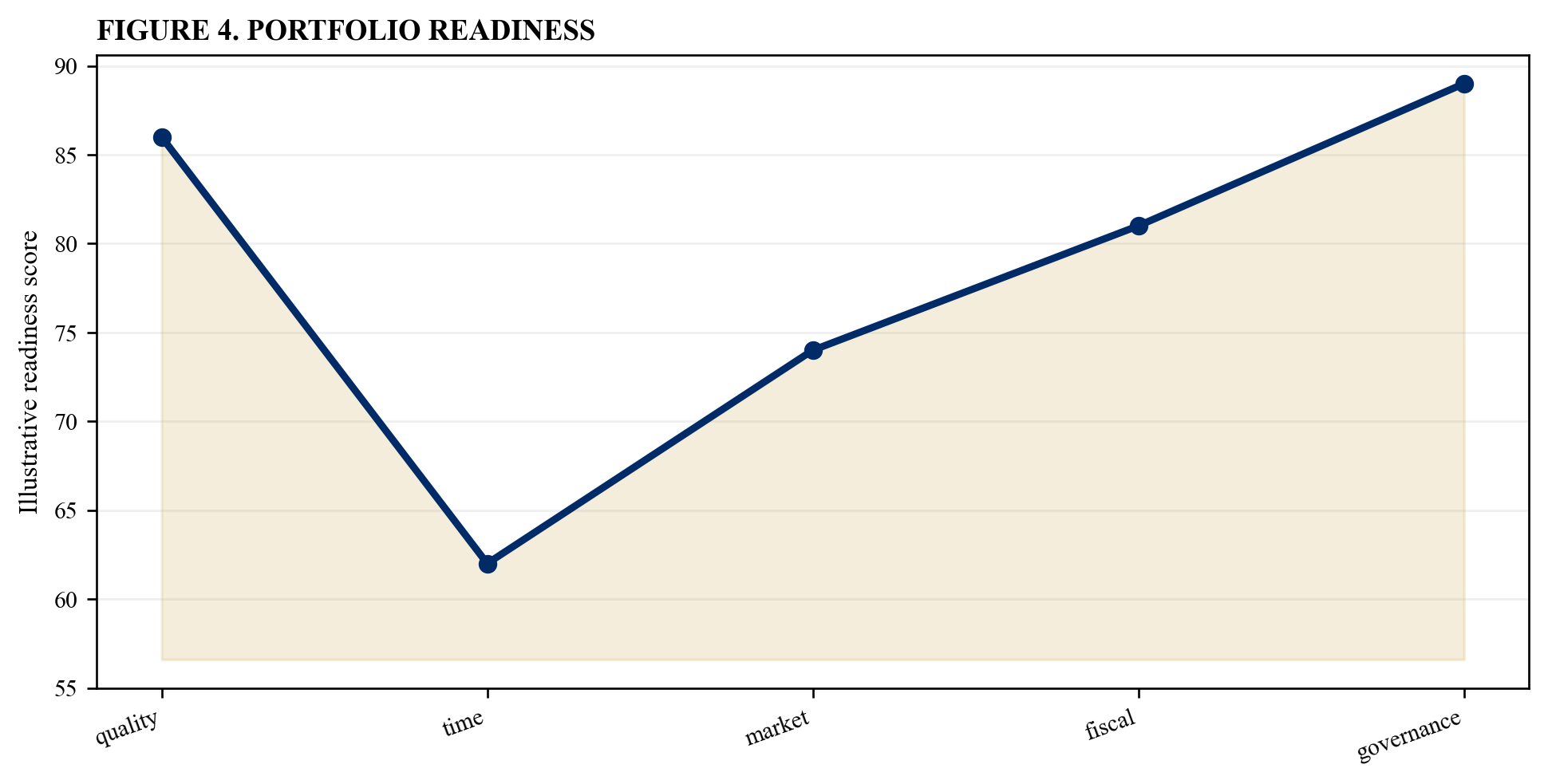
Illustrative analytical scenario; verified programme evidence should replace values.
33. Support financial close
The fund should manage conditions precedent, financing, guarantees, permits and final affordability. The required output is a close-readiness register. Record the accountable owner, source evidence, approval authority, cost, schedule, dependency, decision criterion and review date [11][34].
Test the work against public need, strategic fit, technical and site evidence, demand, economic value, environmental and social safeguards, legal authority, affordability, fiscal risk, delivery options, market appetite, procurement integrity and implementation capacity. Reconcile assumptions across studies and retain a traceable evidence baseline.
The principal risk is that award can precede evidence required for finance and contract effectiveness. Quantify the effect on preparation cost, cycle time, decision quality, competition, bid contingencies, public payments, financing, value for money, delivery certainty and future service. Compare continuation with redesign, pause, alternative procurement and disciplined termination.
Translate the conclusion into funding gates, advisor deliverables, quality assurance, decision rights, data ownership, recovery terms, monitoring and learning. Refresh it after material scope, policy, market, fiscal or evidence change.
34. Choose cost-recovery policy
The fund should allocate preparation cost through grants, sponsor contributions, bidder recovery or success fees. The required output is a recovery waterfall. Record the accountable owner, source evidence, approval authority, cost, schedule, dependency, decision criterion and review date [19][20].
Test the work against public need, strategic fit, technical and site evidence, demand, economic value, environmental and social safeguards, legal authority, affordability, fiscal risk, delivery options, market appetite, procurement integrity and implementation capacity. Reconcile assumptions across studies and retain a traceable evidence baseline.
The principal risk is that recovery can deter competition or reward only projects that reach close. Quantify the effect on preparation cost, cycle time, decision quality, competition, bid contingencies, public payments, financing, value for money, delivery certainty and future service. Compare continuation with redesign, pause, alternative procurement and disciplined termination.
Translate the conclusion into funding gates, advisor deliverables, quality assurance, decision rights, data ownership, recovery terms, monitoring and learning. Refresh it after material scope, policy, market, fiscal or evidence change.
35. Design revolving capital
The fund should set repayment triggers, timing, interest, waivers, defaults and use of reflows. The required output is a revolving-fund model. Record the accountable owner, source evidence, approval authority, cost, schedule, dependency, decision criterion and review date [20][21].
Test the work against public need, strategic fit, technical and site evidence, demand, economic value, environmental and social safeguards, legal authority, affordability, fiscal risk, delivery options, market appetite, procurement integrity and implementation capacity. Reconcile assumptions across studies and retain a traceable evidence baseline.
The principal risk is that project recoveries are uncertain and cannot finance early years alone. Quantify the effect on preparation cost, cycle time, decision quality, competition, bid contingencies, public payments, financing, value for money, delivery certainty and future service. Compare continuation with redesign, pause, alternative procurement and disciplined termination.
Translate the conclusion into funding gates, advisor deliverables, quality assurance, decision rights, data ownership, recovery terms, monitoring and learning. Refresh it after material scope, policy, market, fiscal or evidence change.
36. Treat failed projects fairly
The fund should distinguish disciplined stops, sponsor failures, market shocks and poor preparation. The required output is a failed-project loss policy. Record the accountable owner, source evidence, approval authority, cost, schedule, dependency, decision criterion and review date [26][40].
Test the work against public need, strategic fit, technical and site evidence, demand, economic value, environmental and social safeguards, legal authority, affordability, fiscal risk, delivery options, market appetite, procurement integrity and implementation capacity. Reconcile assumptions across studies and retain a traceable evidence baseline.
The principal risk is that staff may conceal problems if every stopped project is treated as failure. Quantify the effect on preparation cost, cycle time, decision quality, competition, bid contingencies, public payments, financing, value for money, delivery certainty and future service. Compare continuation with redesign, pause, alternative procurement and disciplined termination.
Translate the conclusion into funding gates, advisor deliverables, quality assurance, decision rights, data ownership, recovery terms, monitoring and learning. Refresh it after material scope, policy, market, fiscal or evidence change.
37. Measure fund performance
The fund should track evidence quality, cycle time, competition, bankability, affordability, close and service outcomes. The required output is a preparation performance dashboard. Record the accountable owner, source evidence, approval authority, cost, schedule, dependency, decision criterion and review date [3][25].
Test the work against public need, strategic fit, technical and site evidence, demand, economic value, environmental and social safeguards, legal authority, affordability, fiscal risk, delivery options, market appetite, procurement integrity and implementation capacity. Reconcile assumptions across studies and retain a traceable evidence baseline.
The principal risk is that counting money spent or projects launched can reward weak pipeline throughput. Quantify the effect on preparation cost, cycle time, decision quality, competition, bid contingencies, public payments, financing, value for money, delivery certainty and future service. Compare continuation with redesign, pause, alternative procurement and disciplined termination.
Translate the conclusion into funding gates, advisor deliverables, quality assurance, decision rights, data ownership, recovery terms, monitoring and learning. Refresh it after material scope, policy, market, fiscal or evidence change.
38. Learn across the portfolio
The fund should compare forecasts with bids, contracts, claims, delivery and operating performance. The required output is a preparation learning loop. Record the accountable owner, source evidence, approval authority, cost, schedule, dependency, decision criterion and review date [38][40].
Test the work against public need, strategic fit, technical and site evidence, demand, economic value, environmental and social safeguards, legal authority, affordability, fiscal risk, delivery options, market appetite, procurement integrity and implementation capacity. Reconcile assumptions across studies and retain a traceable evidence baseline.
The principal risk is that the same demand, cost and allocation errors can recur across sectors. Quantify the effect on preparation cost, cycle time, decision quality, competition, bid contingencies, public payments, financing, value for money, delivery certainty and future service. Compare continuation with redesign, pause, alternative procurement and disciplined termination.
Translate the conclusion into funding gates, advisor deliverables, quality assurance, decision rights, data ownership, recovery terms, monitoring and learning. Refresh it after material scope, policy, market, fiscal or evidence change.
39. Plan institutional sustainability
The fund should build staffing, panels, standards, digital systems, reflows and long-term appropriations. The required output is a fund sustainability plan. Record the accountable owner, source evidence, approval authority, cost, schedule, dependency, decision criterion and review date [19][22].
Test the work against public need, strategic fit, technical and site evidence, demand, economic value, environmental and social safeguards, legal authority, affordability, fiscal risk, delivery options, market appetite, procurement integrity and implementation capacity. Reconcile assumptions across studies and retain a traceable evidence baseline.
The principal risk is that a donor-supported facility can disappear before domestic capability is embedded. Quantify the effect on preparation cost, cycle time, decision quality, competition, bid contingencies, public payments, financing, value for money, delivery certainty and future service. Compare continuation with redesign, pause, alternative procurement and disciplined termination.
Translate the conclusion into funding gates, advisor deliverables, quality assurance, decision rights, data ownership, recovery terms, monitoring and learning. Refresh it after material scope, policy, market, fiscal or evidence change.
40. Issue the preparation certificate
The fund should reconcile need, readiness, evidence, options, affordability, market, procurement and governance. The required output is an auditable preparation certificate. Record the accountable owner, source evidence, approval authority, cost, schedule, dependency, decision criterion and review date [1][7].
Test the work against public need, strategic fit, technical and site evidence, demand, economic value, environmental and social safeguards, legal authority, affordability, fiscal risk, delivery options, market appetite, procurement integrity and implementation capacity. Reconcile assumptions across studies and retain a traceable evidence baseline.
The principal risk is that procurement can begin with unresolved evidence distributed across disconnected reports. Quantify the effect on preparation cost, cycle time, decision quality, competition, bid contingencies, public payments, financing, value for money, delivery certainty and future service. Compare continuation with redesign, pause, alternative procurement and disciplined termination.
Translate the conclusion into funding gates, advisor deliverables, quality assurance, decision rights, data ownership, recovery terms, monitoring and learning. Refresh it after material scope, policy, market, fiscal or evidence change.
Table 5. Preparation certificate
| Decision | Evidence | Owner |
|---|---|---|
| need | strategic and economic case | sponsor |
| structure | options and risk appraisal | fund and finance ministry |
| procurement | market and tender readiness | procurement authority |
| capital | budget and recovery | fund board |
Illustrative analytical structure; verified programme and jurisdiction evidence governs.
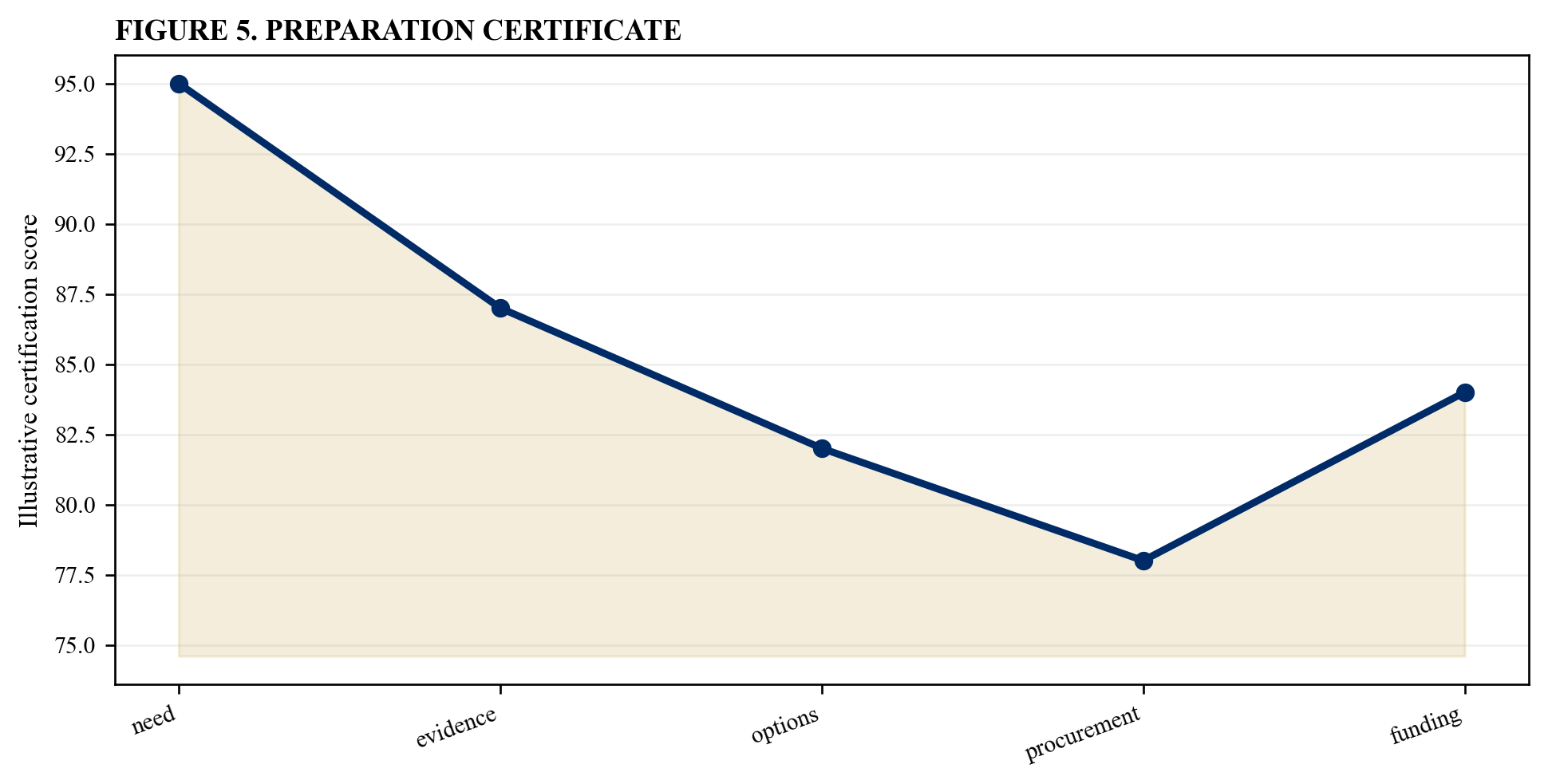
Illustrative analytical scenario; verified programme evidence should replace values.
References
- World Bank PPP Resource Center, Project Development Facility, https://ppp.worldbank.org/project-development-facility
- World Bank PPP Resource Center, Introduction to Project Development Funds, https://ppp.worldbank.org/introduction-primer-project-development-funds
- World Bank PPP Resource Center, Executive Summary: Project Development Funds, https://ppp.worldbank.org/executive-summary-primer-project-development-funds
- World Bank PPP Resource Center, Government Support, https://ppp.worldbank.org/government-support
- IMF, Public Investment Management Assessment, https://infrastructuregovern.imf.org/content/PIMA/Home/PimaTool.html
- IMF, PPPs and PFRAM, https://infrastructuregovern.imf.org/content/PIMA/Home/PPPs-and-PFRAM.html
- World Bank PPP Resource Center, Project Selection: Project Development Funds, https://ppp.worldbank.org/project-selection-primer-project-development-funds
- World Bank Group, PPP Reference Guide Version 3, https://ppp.worldbank.org/sites/default/files/2024-08/PPP%20Reference%20Guide%20Version%203.pdf
- OECD, Recommendation on Public Procurement, https://legalinstruments.oecd.org/en/instruments/OECD-LEGAL-0411
- Asian Development Bank, Asia Pacific Project Preparation Facility, https://www.adb.org/what-we-do/funds/asia-pacific-project-preparation-facility
- Global Infrastructure Facility, About GIF, https://www.globalinfrafacility.org/
- World Bank PPP Resource Center, PPP Project Cycle, https://ppp.worldbank.org/ppp-cycle
- OECD, Recommendation on Governance of Infrastructure, https://legalinstruments.oecd.org/en/instruments/OECD-LEGAL-0460
- World Bank PPP Resource Center, Appraising Potential PPP Projects, https://ppp.worldbank.org/appraising-potential-ppp-projects
- World Bank PPP Resource Center, Hiring and Managing Advisors, https://ppp.worldbank.org/hiring-and-managing-advisors
- World Bank PPP Resource Center, Operational Considerations for PDFs, https://ppp.worldbank.org/operational-considerations-primer-project-development-funds
- World Bank PPP Resource Center, Project Readiness, https://ppp.worldbank.org/project-selection-primer-project-development-funds
- UK HM Treasury, Green Book, https://www.gov.uk/government/publications/the-green-book-appraisal-and-evaluation-in-central-government
- World Bank PPP Resource Center, Funding Project Development Funds, https://ppp.worldbank.org/funding-primer-project-development-funds
- World Bank PPP Resource Center, Funding Sources for PDFs, https://ppp.worldbank.org/funding-primer-project-development-funds
- World Bank PPP Resource Center, Structure of Project Development Funds, https://ppp.worldbank.org/structure-primer-project-development-funds
- Asian Development Bank, Project Readiness Financing Facility, https://www.adb.org/what-we-do/public-sector-financing/project-readiness-financing
- World Bank, Governance and Institutions, https://www.worldbank.org/en/topic/governance
- OECD, Infrastructure Governance, https://www.oecd.org/en/topics/infrastructure-governance.html
- World Bank PPP Resource Center, PDF Motivations and Experience, https://ppp.worldbank.org/motivations-and-experience-primer-project-development-funds
- World Bank PPP Resource Center, Project Development Fund Lessons, https://ppp.worldbank.org/lessons-practitioners-primer-project-development-funds
- World Bank PPP Resource Center, Feasibility Study Tasks, https://ppp.worldbank.org/project-selection-primer-project-development-funds
- World Bank, Environmental and Social Framework, https://www.worldbank.org/en/projects-operations/environmental-and-social-framework
- IFC, Performance Standards, https://www.ifc.org/en/insights-reports/2012/ifc-performance-standards
- UK HM Treasury, Aqua Book, https://www.gov.uk/government/publications/the-aqua-book-guidance-on-producing-quality-analysis-for-government
- World Bank PPP Resource Center, Assessing Fiscal Implications, https://ppp.worldbank.org/assessing-fiscal-implications-ppp-project
- World Bank PPP Resource Center, Structuring PPP Projects, https://ppp.worldbank.org/structuring-ppp-projects
- World Bank PPP Resource Center, Market Sounding, https://ppp.worldbank.org/market-sounding
- EPEC, The Guide to Guidance, https://www.eib.org/epec/g2g/index.htm
- World Bank PPP Resource Center, PPP Advisor Procurement, https://ppp.worldbank.org/hiring-and-managing-advisors
- UNCITRAL, Model Legislative Provisions on PPPs, https://uncitral.un.org/en/texts/procurement/modellaw/public_private_partnerships
- World Bank, Framework for Disclosure in PPPs, https://ppp.worldbank.org/public-private-partnership/library/framework-disclosure-public-private-partnership-projects
- World Bank PPP Resource Center, PPP Contract Management, https://ppp.worldbank.org/ppp-contract-management
- Open Contracting Partnership, Open Contracting Data Standard, https://standard.open-contracting.org/latest/en/
- World Bank PPP Resource Center, Managing PPP Contracts, https://ppp.worldbank.org/managing-ppp-contracts
