

1 Treat the first meeting as a set of testable claims
An owner may leave an adviser meeting with a vivid impression of likely buyers, price and speed. Those topics are central to an exit, yet a verbal answer can combine a forecast, a historical fact and a sales judgment in one sentence. The decision is to appoint a particular firm and team for a specified transaction. The owner should therefore write down what was actually said, what question it answered and what the adviser meant by its terms. The record is useful even where the adviser is candid and highly capable. It prevents a later dispute about whether a range was a preliminary illustration, a formal valuation or an expectation of proceeds.
The unit of analysis in this paper is an individual claim in a dated pitch. A claim is sufficiently specific when another professional can ask what would confirm or contradict it. “We know the buyers” is too broad. “Our proposed lead spoke with the corporate-development director of a named acquirer about companies of this type in the past twelve months, and the relationship may permit a confidential approach subject to owner approval” can be checked. The adviser should be free to say that a matter is uncertain or confidential. Silence about the evidence is a different condition from an explained limit on disclosure.
The owner should provide the same transaction brief to every candidate before comparing answers. The brief should identify the proposed sale perimeter, owner objectives, material jurisdictions, financial reporting period, known liabilities and confidentiality constraints. A candidate who receives only a teaser cannot reasonably be required to produce a fully diligence-ready valuation. A candidate who receives controlled records can be asked to reconcile assumptions to them. This sequence makes the verification burden proportional to the information available.
This paper uses a UAE private-company sale as the decision setting. It does not assert that one licensing or data-protection rule applies uniformly to every UAE entity, free zone or cross-border activity. The owner should have counsel confirm the relevant regimes. The verification protocol itself is a decision tool: it helps separate what a candidate has evidenced from what remains a hypothesis before an exclusive mandate begins.
2 Use research to frame the questions, not to score a pitch
Sibilkov and McConnell find that prior client performance influences acquirers' choice of investment-bank adviser in their sample [1]. That finding makes historical performance a relevant subject for inquiry. It does not tell a founder how to verify the role of a proposed sell-side team or what price that team can obtain in a private UAE transaction. Golubov, Petmezas and Travlos show that the value associated with adviser reputation depends on the transaction setting they study [2]. A league-table position is therefore a starting signal, not an outcome guarantee for an individual owner.
Research on advisory-firm networks examines the informational role of connections in M&A [3]. A network measure built from historical transactions is different from current permission to approach a buyer, a buyer's appetite for a particular target, or that buyer's access to financing. Guo, Liu and Tu study comparables chosen in merger valuations using US public filings [4]. Their work shows why the selected peer set is a decision worth examining. It cannot validate a private-company valuation range merely because an adviser supplied a table of listed peers.
International Valuation Standards describe the scope, bases, approaches, data, models and reporting relevant to valuation assignments [5]. Their existence does not make every pitch valuation an IVS-compliant assignment. A founder should ask whether a number is an indicative discussion, an analytical model, a formal valuation or a buyer's proposed price. The IVSC's discussion of valuation risk distinguishes process risk from uncertainty about the underlying value [6]. That distinction supports checking source quality and method without suggesting that a good process removes genuine market uncertainty.
The studies and standards answer different questions. None supplies a verified population of adviser pitches, claim-level evidence and subsequent UAE private-sale outcomes. This paper reports no measured frequency of unsupported claims. Its research contribution is an auditable classification and proposed study design that could, with consent and suitable data, make the survival question answerable. Until such data exist, the owner can use the protocol for a specific appointment rather than treating it as a predictive score.
3 Freeze each claim before asking for proof
Claim verification begins with the original words, date, speaker and context. The owner or an authorised representative should prepare a short record after the meeting and invite the adviser to correct it. A correction at this stage is useful; it defines what is actually being offered. The record should separate a claim of historical fact, a claim about present capability, a forward-looking judgment and a contractual promise. Those classes require different evidence. A completed transaction can be checked against a lawful record; a forecast can only be tested for assumptions and internal consistency.
For each claim, record the unit, population and time period. “Ten transactions” may mean announced, signed or completed deals, mandates of the firm or experience gained elsewhere by its people, transactions of any size or only relevant sizes. “Access to buyers” may mean a database, a prior meeting, a current mandate or a named route to an investment committee. “A six-month sale” may measure from engagement, launch, indication of interest, signing or completion. The verifier should ask the candidate to choose one definition and retain the alternative definitions in the file.
Evidence should be graded for what it establishes, not for how impressive it appears. A public announcement can establish that a transaction was announced and may name firms. It may not establish which banker created the buyer map or whether the sale completed. A consented client reference may establish that a named person managed a difficult phase. It may not prove that the person can devote enough time now. A private buyer contact can be meaningful, but the adviser may need to protect that buyer's identity until confidentiality conditions are agreed. The method should accept a narrower supported claim rather than demand an improper disclosure.
The claim ledger below is an author-developed tool. Its categories are not accusations. “Supported” means the stated evidence supports the precise proposition recorded. “Conditional” means a named assumption or missing third-party step remains. “Unresolved” means the available evidence cannot decide the proposition. “Contradicted” requires a material conflict with reliable evidence and an opportunity for the candidate to explain it. Each entry records who reached the conclusion and on what date.
Table 1. The first-meeting claim ledger
| Claim class | Exact proposition to record | Minimum permissible evidence | What remains open |
|---|---|---|---|
| Prior transaction | Firm or named person advised a stated side and reached a stated stage | Dated deal sheet, public record where available, consented reference | Role detail, confidentiality and comparability |
| Buyer access | Named team has a current route to a buyer with a relevant thesis | Buyer rationale, relationship owner, access route and conflict check | Buyer interest, finance and internal approval |
| Valuation | Range reflects a defined perimeter and dated inputs | Assumptions bridge, peer selection, cash-flow case and sensitivity | Actual bids, conditions and seller proceeds |
| Completion | A stated share of a defined mandate population completed | Cohort definition, status ledger, treatment of stopped cases | Attribution and changes in market conditions |
| Delivery | Proposed people will perform specified work | Named team, capacity plan, review cadence and substitution terms | Future availability and performance |
Author-developed protocol. Classifications describe evidence status, not honesty or predicted performance.
4 Verify historical deals at the correct level
A firm may have advised on a relevant transaction without the people at the table having worked on it. A banker may have worked on a transaction at a previous employer. Both can be valuable experience; they should be represented accurately. Ask for a deal record showing the legal entity or group involved, side represented, adviser entity, named individuals, workstreams, year, transaction stage and publicly shareable source. Where confidentiality prevents naming a client, request a sufficiently detailed anonymised description and a client reference with permission. The owner should never require a breach of another client's confidence to win the mandate.
The deal stage matters. An announcement is an event, a signed agreement creates contractual obligations, and completion can remain subject to regulatory, financing or other conditions. “Closed” should refer to completion under the stated deal documents. A prospective candidate might also cite a mandate that was paused after identifying a material issue. Such experience can be relevant to judgment, provided it is described as a paused process. Counting it as a completed sale would change the proposition. The verifier should preserve the status that was true at the stated date.
Comparability requires more than an industry label. A founder-led profitable software company with recurring revenue differs from a distressed services carve-out, even if both are called technology. Ask what made the transaction difficult: customer consents, related-party assets, multiple jurisdictions, debt release, retention of the founder, regulatory approval, uncertain intellectual-property rights or a competing bidder. Then ask which named person handled that difficulty and how. A narrow, well-evidenced experience can be more useful than a long list with no role detail.
Reference checks should seek a disconfirming case. Ask for one completed engagement and one that changed direction, subject to client consent. A candidate willing to explain a stop decision may reveal more about its process discipline than one that shows only successful closes. The owner should use identical core questions across references: the candidate's actual role, senior involvement, quality of financial work, control of disclosure, treatment of an unexpected issue and whether the client would appoint the same team again for the same assignment.
5 Turn buyer access into an executable hypothesis
Buyer access is an interaction between a target's attributes and a buyer's strategy, not a count of contacts. A candidate should state why a named corporate, sponsor or family office might value this company's assets, which part of that buyer could sponsor a proposal, who would decide, and how the adviser could reach that person appropriately. The test also asks whether the buyer can acquire the relevant perimeter, operate in the jurisdiction, finance the consideration and tolerate known liabilities. The answer may be uncertain before confidential contact. The candidate should identify the uncertainty rather than turn it into a claim of interest.
A pitch list can contain several kinds of name. One may be a strategic fit with no current acquisition budget. Another may have funding but a conflict involving the adviser's other clients. A third may have expressed generic sector interest while excluding the seller's geography. A fourth may have a trusted relationship with a team member but an investment committee that requires a different asset size. The owner needs an annotated route to a decision, with exclusions and conflicts, rather than a larger undifferentiated list. That record can be shared initially without revealing private contact details.
The adviser should distinguish past interaction from present appetite. A prior transaction with a buyer may help open a conversation; it does not establish that the buyer is currently in market or prepared to pay. Where the candidate claims a live dialogue, ask what can be verified without disclosing the seller prematurely. A dated, permissioned account of the topic and participant may be possible. Where even that is unavailable, treat the route as an untested hypothesis and make a controlled outreach milestone part of the mandate. A confidentiality agreement, owner approval and a defined disclosure sequence should precede sensitive contact.
Buyer evidence decays. The candidate should date its research and update the map after changes in corporate leadership, fund life, borrowing conditions, regulation or acquisition strategy. A reproducible map should preserve the reason each buyer was included, the source for that reason, the last validated contact route and the obstacle most likely to stop a bid. The owner can then see whether lack of offers reflects weak buyer selection, a changed market, a target-specific issue or information that was unavailable at appointment.
6 Distinguish a reachable buyer from a qualified offer
A buyer's willingness to receive a teaser is a modest signal. A signed confidentiality agreement is evidence of controlled access, not a commitment to bid. Data-room entry, a management meeting and an indicative price each show increasing engagement, but none by itself proves authority or finance. A qualified offer should be defined before the process. The proposed definition can require an identified buyer entity, stated transaction perimeter, price or price mechanism, consideration form, material conditions, decision authority, financing path and a timetable. A seller can choose a different threshold, provided it is applied consistently.
The candidate's first-meeting claim should be mapped to that sequence. “We can get you offers” should not be accepted merely because the team can send a teaser to many recipients. Ask what percentage of the suggested universe is realistically addressable after confidentiality, conflicts, strategic fit and known financing constraints. This is a request for an analytical estimate, not a published conversion statistic. The adviser should show its assumptions, and the owner should retain the option of a narrower process when protecting customers, staff or proprietary data is more valuable than broad exposure.
The sequence below is a decision map, not a measured funnel. It gives the owner a way to assign evidence and approval rights at each step. No implied conversion rate, timetable or minimum buyer count follows from the number of boxes. A candidate can propose a private bilateral approach, a staged shortlist or a broader auction; the claim ledger should state which route its buyer-access statement actually supports.
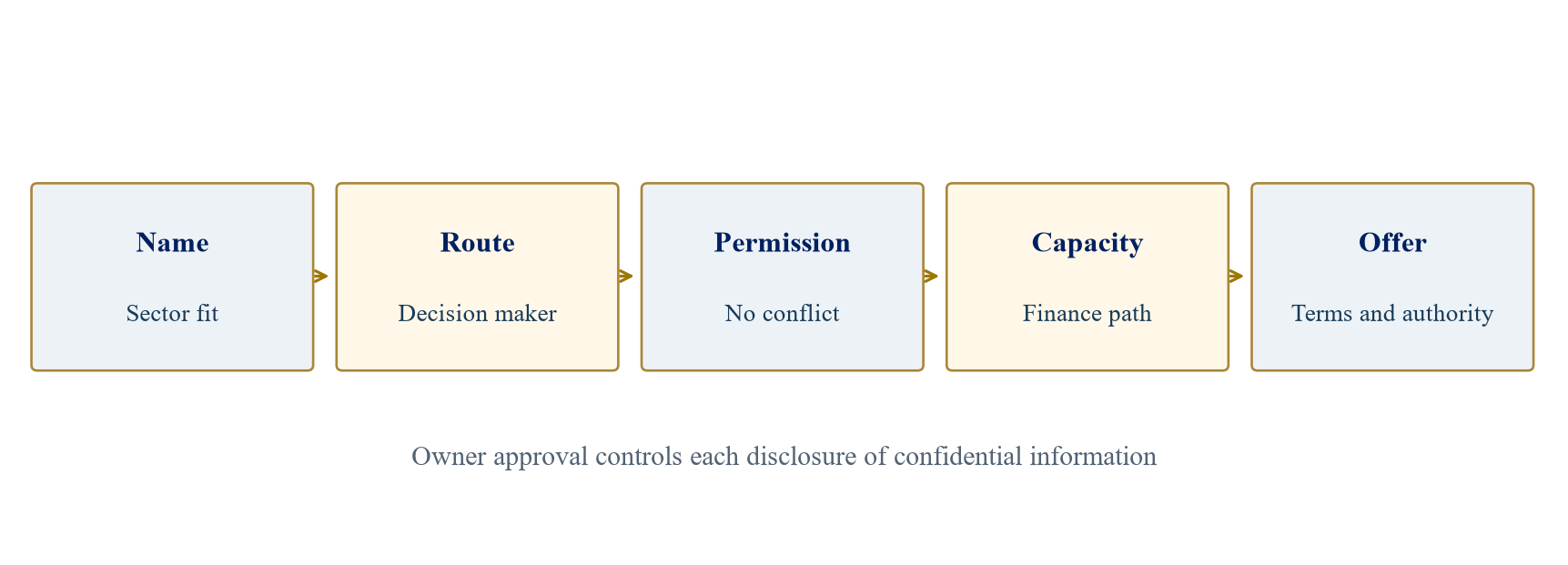
Author-developed evidence sequence. Arrows show additional tests, not observed conversion probabilities.
7 Rebuild the valuation range from its assumptions
A valuation headline at the first meeting has an important legitimate role: it helps the owner decide whether an exit is worth exploring. Its precision must match its information base. Ask the adviser to state the legal and asset perimeter, valuation date, currency, base of value, financial period, normalisation adjustments, debt and cash definition, capital expenditure, working-capital need, tax assumptions and method. A price range without these labels can inadvertently combine enterprise value, equity value and expected cash received by the sellers. Those are different quantities.
For a comparable-company method, request the peer list and why each name belongs. Revenue model, growth, geography, margin, customer concentration, leverage, liquidity and control rights can all matter. A very high multiple from a large listed company may be a useful benchmark for understanding the market but an unsuitable direct input for a much smaller private operating company. Ask to see rejected peers as well as selected ones, the dates of observed values, treatment of one-off earnings and the sensitivity of the range to the peer set. Guo, Liu and Tu's US public-merger research underlines that peer choice is an analytical decision rather than a neutral list [4].
For a discounted-cash-flow method, ask which forecast is management's, which revisions are the adviser's, and how downside cases are constructed. The terminal period and discount rate often dominate an apparently detailed model. A candidate should identify when a target's growth depends on winning uncontracted customers, financing a new facility or retaining a key licence. The owner need not demand false precision at the pitch stage. It should demand a visible bridge from evidence to assumptions and a separate statement of what further diligence could materially change the range.
The IVS framework addresses scope, data, methods and documentation in valuation work [5]. It provides a useful set of questions, even where the adviser is providing only an indicative discussion rather than undertaking a formal valuation assignment. The pitch should label the status of the analysis. No valuation range is an offer, and a buyer's price may depend on control, synergies, financing, risk allocation and terms beyond the model. A credible adviser can explain those limitations while still giving an owner a useful decision range.
8 Separate the price bridge from seller proceeds
An owner may remember the largest number in the presentation. The relevant decision may concern cash at completion, retained equity, contingent consideration and post-closing obligations. Ask the adviser to show a bridge from illustrative enterprise value to equity value and then to expected seller proceeds under specified terms. The bridge should include debt-like items, cash, working capital, minority interests, transaction fees, tax assumptions and any earn-out or escrow. Legal, accounting and tax advisers should validate their respective items. The point is to make the pitch's economic claim auditable, not to suggest that an indicative estimate is a final funds-flow statement.
Consider a fictional seller whose presentation uses a high case based on management's adjusted earnings and a peer multiple. The same company may have a lower case if a customer contract ends, working capital must be funded by the buyer, or an earn-out replaces cash at completion. This is a direction-of-effect example; it is not a valuation of an actual company. The adviser should show which fact would move each assumption and how a buyer might price or structure the uncertainty. That exercise gives the owner a more useful question than whether the adviser can defend its preferred single number.
Valuation claims have different verbs. “Could be worth” describes a scenario. “We estimate” describes an analysis under assumptions. “We can sell for” implies execution confidence. “A buyer will pay” implies knowledge of a third party's decision. Each verb merits different proof and different contractual treatment. The candidate should be able to revise its wording after a closer review without being punished for a justified correction. The owner should instead look for a clear change log: what new evidence arrived, which assumption changed, and whether the firm's recommendation to launch still stands.
The author-developed bridge below makes the units explicit. It contains no market multiple or numerical value because an actual pitch would need company records, current market evidence and a defined transaction structure. The diagram can accompany a scenario table showing low, base and high cases once those inputs exist. The record should preserve what was known at the first meeting and what was learned during the diagnostic phase.
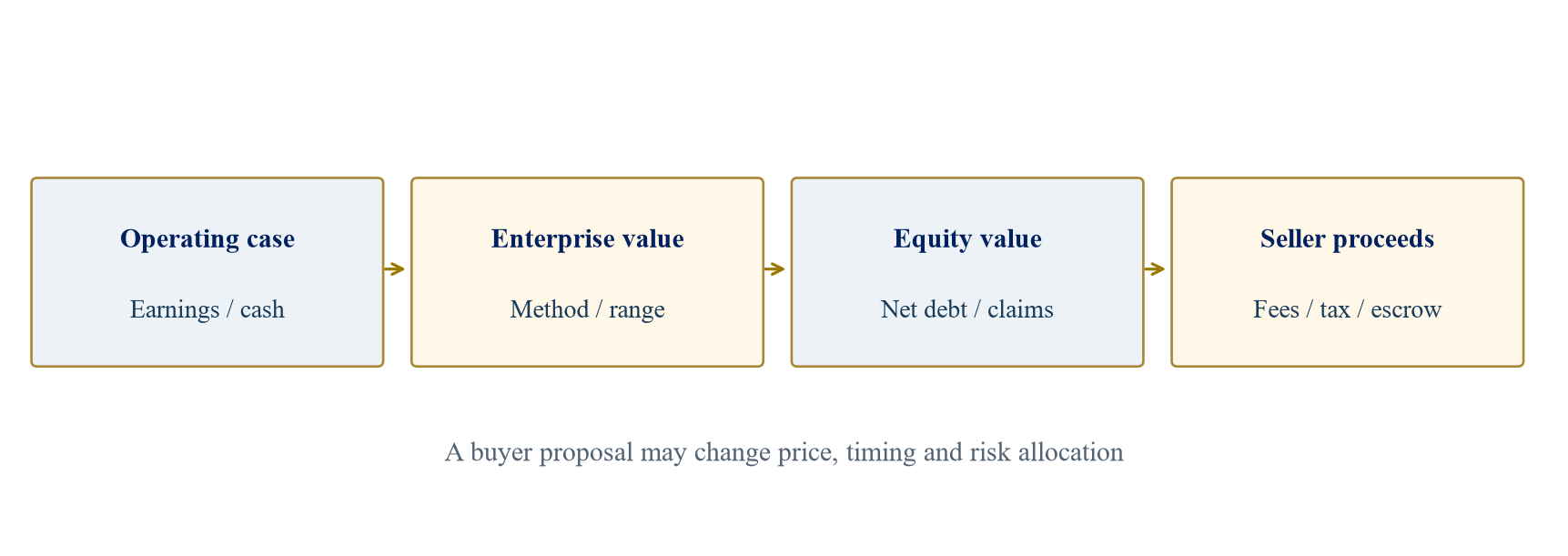
Author-developed bridge. Every arrow requires dated assumptions and transaction-specific evidence.
9 Audit completion claims with a visible denominator
“We close most of our deals” cannot be assessed without a denominator. The candidate should define which engagements entered the population, when they began, what constitutes a completed transaction and the observation window. A ratio calculated only from announced transactions omits assignments that were withdrawn, paused, still active or converted to another type of transaction. A ratio calculated only from completed sales says nothing about completion probability. These are selection problems, not evidence of dishonesty. The owner should ask for a dated status ledger or an independently reviewable summary that includes every relevant mandate under a consistent definition.
The denominator should separate work the adviser could influence from conditions outside its control. A seller may withdraw because the strategic case changed. An acquirer may lose financing. A regulator may refuse approval. Diligence may reveal that the target's earnings were misstated. The outcome matters to the owner, but causal attribution requires more information. A candidate can still be judged on whether it identified foreseeable issues, documented decisions and preserved an option to stop. A completion statistic cannot carry all of that information.
“Similar deals” also needs a rule. Comparability might include jurisdiction, sector, revenue model, size, ownership, distress status and transaction structure. An adviser may have a strong record across very different situations yet a thin cohort matching the owner's proposed sale. A small relevant cohort should not be given a precise percentage that implies statistical stability. The candidate could instead provide every case under the stated filter and discuss how it differs. Confidential cases can be coded or anonymised with an agreed verification route.
The owner should request at least three outputs: the full assignment population by status, the relevant subset selected by a documented rule, and the outcome definitions used in the pitch. A claim that survives these tests may still be unsuitable as a prediction for this company. The owner should retain the status ledger as a baseline for later assessment of what the appointed adviser actually delivers.
10 Interview references without converting anecdotes into proof
References are strongest when they address the precise claim under review. Before contacting a previous client, ask the candidate to obtain consent and agree what the reference may discuss. The interview should ask about the named people, the phase of the transaction, accuracy of initial valuation and buyer claims, problem escalation and communication when the process changed. A reference can describe experience; it cannot make another client's confidential data public. The owner should record the questions, answers and limitations rather than translate a positive tone into a verified transaction statistic.
References offered by a candidate are selected. A founder can reduce that bias by asking for different outcomes: a completed sale, a sale that was paused and a mandate in which the candidate's senior team changed. The candidate may be unable to provide all three for confidentiality or availability reasons. That should be recorded as a data limit rather than an automatic negative. An owner can also use lawfully public deal announcements and independent professional references where the facts and permissions permit. Any unsanctioned approach to a former client may damage trust or breach an obligation.
Ask whether the reference observed the claimed buyer relationship directly. A former client may know that several buyers attended management presentations, but not whether the adviser had a pre-existing relationship with the decision maker. Ask whether the initial price range survived diligence and what changed. If a sale closed, ask what portion of the consideration was conditional and whether the reference is describing signing, completion or cash receipt. These distinctions often explain apparent disagreement between a pitch statement and a lived outcome without requiring the verifier to infer misconduct.
After the call, send the candidate a fair summary of material discrepancies and allow an explanation. A reference may be mistaken about dates or people. The candidate may have an engagement letter or public filing that resolves the point. A verification protocol is most useful when it corrects the record before appointment. It should not become a mechanism for collecting confidential competitor intelligence or publishing allegations that have not been substantiated.
11 Check the adviser entity and the relevant permissions
The legal entity that pitches may differ from the one named on the engagement letter or from an affiliate that would introduce investors. The owner should ask for the contracting entity, office, licence or registration identifiers where relevant, and a written explanation of which entity and people will perform each activity. A public register is useful for checking an entity's status and stated permissions in the applicable jurisdiction. The DFSA maintains a public register for DIFC firms [7]. The UK Financial Services Register records authorised firms, individuals and permissions for activities within its scope [9]. FINRA BrokerCheck serves a different US purpose for relevant brokers and firms [10]. A search result from one regulator does not settle requirements in another jurisdiction.
The candidate and counsel should determine which contemplated activities require authorisation in each place. A private-company sale, securities placement, financing introduction and investment advice may have different regulatory treatment. A registered name alone does not prove that the proposed transaction service is within the permission granted, that an affiliate may act, or that a named individual is available. Conversely, absence from a particular register does not by itself establish that a firm is acting unlawfully; the activity may be outside that regulator's perimeter. This paper offers a document checklist, not a legal conclusion about an unnamed firm.
The check should be dated and tied to the contracting record. Ask the candidate to identify the body that regulates the proposed activity, the exact legal entity, the permissions it relies on, and any appointed representative, introducer or cross-border arrangement. Counsel should compare those answers with official records and the agreement. If the answer changes after appointment, the owner needs a notice and approval mechanism before a different entity begins work. This is especially important where the pitch trades on one group's brand while the contract names a smaller or newly established affiliate.
12 Put conflicts beside each buyer and fee claim
An adviser may have relationships with prospective buyers, lenders or competing sellers. Those relationships can help reach a decision maker, but they can also affect what information can be shared or which transaction the adviser has an incentive to complete. The DFSA's 2026 thematic review describes its expectations for authorised DIFC firms to maintain documented, proportionate conflict controls [8]. That review is not a finding about any candidate in this paper. It supports asking a firm within the relevant regime how it identifies and manages a conflict rather than treating a generic statement of independence as sufficient.
The buyer map should contain a conflict status for each proposed approach. The candidate can initially identify categories of potential conflict where names are confidential. Before outreach, it should disclose enough to let the owner, counsel and the candidate's compliance team decide whether a buyer may be contacted and under what restrictions. A statement that the adviser knows a buyer should be qualified if it also advises that buyer, has a financing role, expects a referral payment or holds a material economic interest. The precise disclosure obligation depends on the governing engagement and law.
Fee claims deserve the same precision. A low retainer may be followed by a minimum success fee, an expense allowance, a long tail or fees triggered by a transaction outside the proposed perimeter. A high valuation scenario can increase a seller's willingness to accept a mandate even when the adviser expects a lower executable price. The owner should ask the candidate to model fees under a no-sale case, a lower-price sale, a changed buyer, a minority investment and an owner-sourced approach. The paper does not claim that any one fee schedule causes inflated pitches; it asks whether the pitch and contract describe the same incentives.
A conflict check should produce an action. The owner may approve a disclosure, restrict an individual, require another firm to handle a financing role, narrow the buyer list or decline the mandate. Recording the action is more informative than retaining an unsigned declaration in a file. The claim ledger should be revised when a conflict changes the buyer reach or valuation case originally presented.
13 Verify the proposed team's availability after the meeting
An owner may be persuaded by a senior banker who attends the pitch. The next question is who will produce the financial analysis, negotiate terms, manage questions and coordinate diligence. Ask for a named team with roles, planned phase effort, review cadence and escalation path. The candidate need not reveal other clients' confidential details to state whether its essential people can meet the proposed timetable. A six-week workplan can show which deliverables require senior judgment and which can be prepared by associates or specialists.
Capacity should be tested through a short assignment rather than inferred from biographies alone. Give each shortlisted team the same limited, appropriately anonymised issue. It could be a customer concentration question, a debt-like item in the price bridge or a buyer with a regulatory constraint. Ask for the question the team would investigate, the source it would request, the owner decision it would defer and the evidence that would cause it to change its view. A simulation does not prove future performance. It reveals whether the named people can explain their method using the facts provided.
The engagement should state material substitution rules. If a pitch promised that a named specialist would lead regulatory diligence, the contract can identify that role, the expected contribution and the owner's consent right if the person changes. A founder can accept a firm with a flexible staffing model; the key is to understand it before appointment. The first meeting may be a business-development event rather than the actual working team. A role map and review calendar convert a present-capability claim into a deliverable the owner can monitor.
There is a practical limit to verification. A candidate may forecast availability honestly and still face an unforeseen departure or urgent client matter. The owner should therefore ask for an escalation path, a replacement standard and access to the working files. Those measures respond to changed circumstances without implying that the original pitch was false. They also reduce dependence on one person for institutional memory during negotiation.
14 Control the use of databases and automated summaries
Deal databases, customer relationship systems and automated research can accelerate a pitch. They can also produce convincing lists with stale ownership, duplicate transactions, missing statuses or incorrectly assigned adviser roles. The candidate should identify which material claims came from a public source, a licensed database, internal records, a personal relationship or an automated summary. Each source has a different scope and error risk. A database entry is useful as an index to a transaction; it should not substitute for checking the underlying announcement, filing or consented client account when the distinction matters to appointment.
If an AI system produced a buyer shortlist, the owner should ask for the input date, source links, filtering rules and human review. An untraceable output should remain a research lead. The team must verify buyer identity, current strategy, financing and contact permissions before sensitive information is sent. If a generated summary attributes a prior transaction to a proposed banker, the banker should confirm the role and provide permissible corroboration. The method needs to work even when the firm does not use AI; it asks for provenance of every material assertion.
Data rights and confidentiality should be considered before the candidate uploads the owner's records into an external service. The UAE federal personal-data law provides a legal framework for personal-data processing [11], and other regimes may apply to an entity or the recipients. Counsel and privacy specialists should advise on the actual data flow, lawful basis, service terms and cross-border transfer. The owner can initially provide anonymised information and restrict copying. The paper does not declare that a particular tool is lawful or unlawful for this transaction.
A good provenance record is short. It names the source, timestamp, preparer, reviewer, material transformation and remaining uncertainty. The owner can ask the adviser to reproduce a sample of its claims from those inputs. Reproducibility catches clerical and automated errors before they become part of a price expectation or a buyer contact list. It also lets the adviser correct a mistake promptly without turning every correction into a dispute about intent.
15 Work a fictional pitch through the protocol
Consider a fictional owner of a privately held industrial-software supplier. One candidate says it advised on three comparable regional sales, can reach six strategic buyers and expects a strong valuation. The owner has provided only an anonymised summary and two years of unaudited management accounts. The paper supplies no market price, buyer interest or actual transaction outcome for this company. The example exists to show how the claims can be narrowed before the owner grants exclusivity.
The candidate's three deal entries require separate checks. One public announcement names the firm as a financial adviser but the transaction was a minority investment; it supports firm experience and not the stated full-sale comparability. A second entry is a completed sale handled by the proposed lead at a previous employer; it supports that person's experience and not necessarily the current firm's transaction record. The third is subject to client confidentiality; a consented reference can discuss the work but cannot disclose price. The candidate can revise its statement to specify one firm transaction of a different type, one relevant personal role and one confidential engagement with limited corroboration. That corrected description remains useful.
Of six buyer names, two may have relevant public acquisition strategies, one may be outside its investment-size range, one may have an unresolved conflict, and two may be untested database candidates. Those are hypothetical categories, not observed facts. The adviser can present a conditional map with evidence dates and propose a consented test of the most promising routes. It cannot describe all six as likely bidders before contact and diligence. The owner can authorise a narrow diagnostic mandate and hold back sensitive customer data until the contact route is approved.
The valuation case is likewise conditional. Without audited or reconciled earnings, customer-retention data and a defined perimeter, the candidate can show how a range would be constructed, which facts might widen it and what buyer terms could alter seller proceeds. The owner should record the initial indicative range and its assumptions, then ask for a revision after a short financial review. A change in the number can be evidence of better information. The relevant quality test is whether the adviser explains the revision and the consequences for the sale decision.
Table 2. Treatment of the fictional first-meeting claims
| Pitch statement | Evidence now available | Properly narrower statement | Owner action |
|---|---|---|---|
| Three comparable sales | One different transaction type, one personal role, one confidential case | Several relevant experiences with different scope and verification limits | Request role-specific deal sheets and a consented reference |
| Six strategic buyers | Two public strategic fits, one size mismatch, one conflict and two untested names | Six research candidates; no verified offer or current appetite | Approve only a controlled diagnostic contact plan |
| Strong valuation | Anonymised summary and unaudited accounts | Indicative analytical scenario, subject to financial and perimeter review | Require an assumptions bridge and revision gate |
| Quick close | No common start or end date and no financing evidence | No supported completion timetable | Define stages and conditions before promising timing |
Author-created example. It is not a record of an actual adviser, company or buyer.
16 Decide which claims survive and which need revision
A claim survives verification only to the extent of its exact wording. The owner's review should classify each material assertion after giving the candidate a fair chance to clarify it. An unchanged claim can be supported by independent or permissioned evidence. A revised claim can be supported in narrower form. A conditional claim can be retained with an explicit dependency. An unresolved claim can remain open if the owner can proceed without relying on it. A material contradiction may require additional evidence, a changed scope or a decision not to appoint. The classification should name the evidence, not assign a moral label to the speaker.
Evidence quality is multidimensional. A public source may have high independence but little detail about a person's role. A client reference may have rich detail but be selected by the adviser. A model may be transparent but depend on uncertain earnings. A buyer email may show an actual reply but not funding authority. The owner should resist converting these dimensions into a single unvalidated score. A claim register can show provenance, recency, relevance, independence, permission to use and remaining uncertainty side by side. That layout makes disagreements productive: the parties can identify the exact missing item.
The diagram below turns the first meeting into a decision sequence. It makes correction a normal step. A candidate may prefer not to disclose certain client records and still substantiate a narrower proposition. The owner may decide to fund a short diagnostic engagement to resolve a high-value uncertainty. The sequence ends with an appointment decision based on evidence and acceptable residual risk, not with a mechanical pass mark. No box represents an empirically measured survival probability.
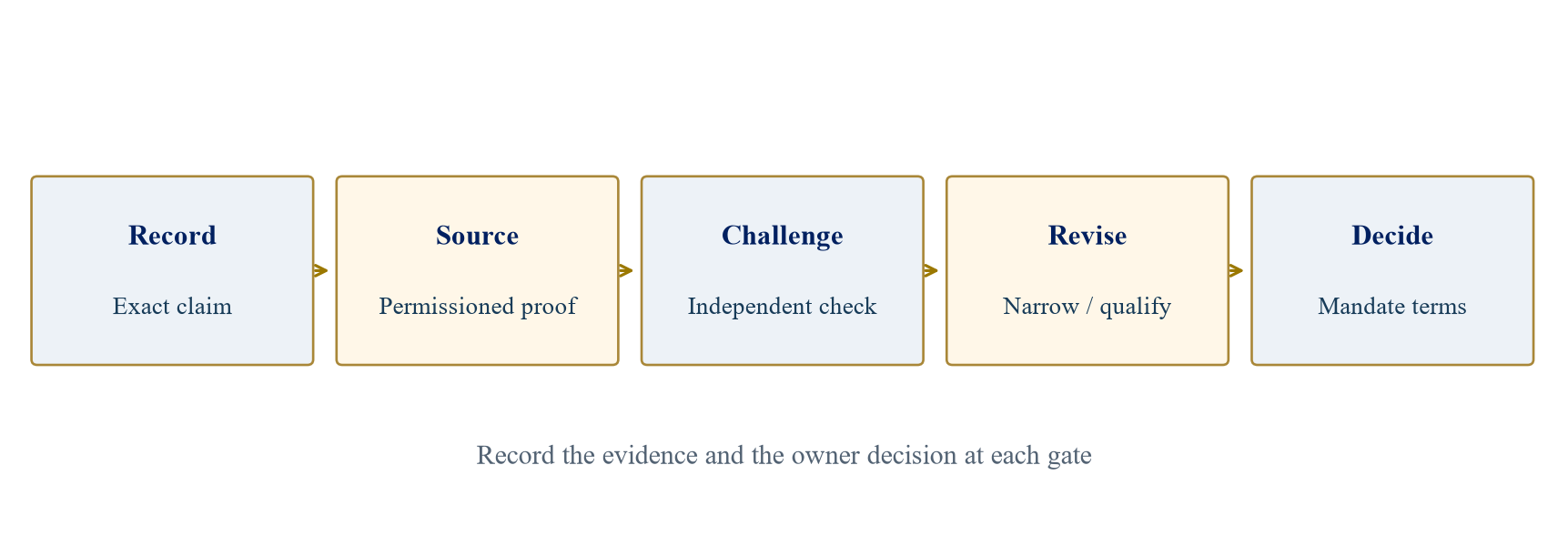
Author-developed governance sequence. A revision can strengthen the final decision.
17 Convert important pitch claims into mandate controls
The appointment letter should match the service actually sold. It should identify the client entity, transaction perimeter, contracting adviser, named team, services, deliverables, fees, expenses, confidentiality, conflicts, approval rights, termination and post-termination tail. Counsel should adapt the wording to the governing law and facts. A pitch claim that matters to the owner's decision should be translated into a measurable deliverable or expressly treated as a hypothesis. For example, “buyer reach” can become an owner-approved buyer map and a controlled outreach plan; it should not be written as a guarantee of offers.
The first diagnostic phase can test the most material uncertainties before broader exclusivity. The adviser can reconcile financial information, revisit a disputed valuation assumption, screen proposed buyers and confirm permission issues. The owner can then decide whether to launch, revise scope or stop. The fee schedule should show the cost of that option and any obligation that survives it. A candidate who asks for a long exclusive period may still be suitable, but the owner should know what work and decision rights attach to each part of the period.
The agreement should state what happens if the promised team changes or a relevant conflict emerges. It can require timely notice, a substitute with specified qualifications and owner consent where appropriate. The candidate may need legitimate flexibility to handle staffing changes; the owner needs continuity of work and clear responsibility. The weekly report can show the material claims being tested, evidence obtained, assumptions changed, buyer contact authorised and unresolved decisions. That record supports constructive supervision rather than retrospective argument over the pitch deck.
The owner should keep a dated copy of the pitch and the corrected claim ledger with the mandate file. Where legal negotiations change the proposed economics or scope, the register should identify which earlier claim is no longer relied upon. An agreed change is not a defect. The risk is an unrecorded shift that leaves the owner believing it purchased one service while the contract provides another. Contractual drafting alone cannot make a weak buyer thesis strong; it can preserve the right to notice, review and stop.
18 Design a study that could answer the survival question
The central empirical question is how often material pitch claims survive a defined documentary and reference check. A suitable study would require consent from owners and advisers, lawful handling of confidential information, and a pre-agreed classification protocol. The sampling frame should include invited advisers, selected advisers and pitches that did not win an appointment. Collecting only successful mandates would bias the picture. For each pitch, an independent reviewer would freeze claim wording before requesting evidence and would record the evidence window, permitted source, correction and final classification.
Claims should be grouped by type and materiality. Historical deal claims can be checked for transaction existence, adviser entity, side, stage and proposed individual's role. Buyer-access claims can be checked for the dated thesis and route, with current buyer appetite kept separate until contact is authorised. Valuation claims can be checked for perimeter, method, source data, peer selection and sensitivity. Completion claims need a defined population and status. A claim that was honestly forward-looking should not be marked false merely because a buyer later declines or the market changes.
The outcome measure could report the share of claims supported exactly as stated, supported after narrowing, conditional, unresolved or contradicted. It should also report how many claims could not lawfully be examined and why. Reviewers should assess a common subset independently, reconcile disagreements under a written rule and retain an audit trail. A confidential data trustee might allow verified aggregate results without disclosing identifiable clients or commercially sensitive fees. Legal and ethical review would be needed before collecting private correspondence or reference interviews.
The study would be descriptive at first. A later analysis could ask whether verified claim quality is associated with qualified offers, seller proceeds or process duration after accounting for target quality, deal size, sector, market period and selection of advisers. Causal identification would be difficult: capable owners may attract more capable advisers and easier companies may generate stronger buyer interest. This paper has not assembled the cohort. It offers a protocol that makes the question researchable and avoids claiming a rate from anecdotes.
19 Keep the evidence secure and the interpretation fair
The ledger should contain only information needed for the appointment decision. A founder should designate who may receive pitches, client references, buyer names and valuation assumptions, how long the records are retained and how they are protected. Personal contact data, employee information and confidential client material may have legal restrictions. The UAE personal-data framework is one relevant source [11]; DIFC, ADGM, foreign and contractual rules may also apply depending on the transaction. Counsel should specify the operative requirements. A claim check is not permission to circulate a previous client's data or to run an unauthorised buyer sounding.
The verifier should preserve source context. A valuation page prepared before a material trading change should not be judged as though the change was already known. A role description at a previous firm may be correct even when the current firm's marketing presentation could be clearer. A reference may have a different recollection of a transaction's outcome because one person means signing and another means completion. The ledger should state dates, definitions and corrections so that a disagreement can be resolved on evidence.
False negatives and false positives both matter. Rejecting a capable specialist because it cannot reveal confidential clients can deprive the owner of relevant expertise. Accepting a polished claim without a lawful check can distort price expectations or expose information to unsuitable buyers. The owner should allow alternative forms of corroboration, such as a redacted work sample, a consented referee or a limited diagnostic. The threshold should rise with the claim's importance. A minor biographical detail and a promise of a funded buyer deserve different scrutiny.
The protocol should also have an expiry rule. Buyer appetite, financing, staffing and comparable valuations can change between the pitch and launch. A supported historical claim remains historical; a present-capability claim should be refreshed at the decision gate. The owner can ask the adviser to update only material items and explain changes. This keeps verification useful after appointment without creating an unmanageable compliance exercise.
20 Make the appointment decision on a reviewed record
The first meeting should end with a short request for evidence, not an immediate inference about price or buyer demand. Ask the candidate to confirm the exact pitch claims, provide permissible support, identify what it cannot yet know and nominate the people who will do the work. The owner can then compare candidates under a common brief and a common evidence standard. A candidate who narrows an overbroad statement after checking the facts may become more credible. A candidate who cannot explain a material contradiction should face a higher burden before exclusivity is granted.
The decision record can fit on a few pages. It should state the owner's sale objective, facts supplied to candidates, claims that matter to appointment, evidence classification, unresolved dependencies, conflicts, proposed diagnostic phase, fee exposure and approval rights. A separate schedule should show when buyer outreach may begin and who can authorise disclosure. A decision to pause or choose another route is a valid outcome when the evidence is weak or the company is unready. The owner is buying a process and judgment under uncertainty, not certainty of a bid.
No empirical result in this paper shows that one verification method increases sale proceeds or that a particular adviser claim is usually false. The academic sources concern different settings, while the figures and matrices here are author-developed. The practical conclusion is narrower and operational: put exact words, sources, dates and permissions beside the assertions that drive appointment. Revise the claims when evidence changes. Carry the supported parts into a mandate whose deliverables and stop rights the owner understands. That discipline makes the first meeting a useful start to execution rather than the final test of it.
Table 3. Owner decision record after pitch verification
| Decision item | Record to retain | Approval question | If unresolved |
|---|---|---|---|
| Historical experience | Dated role-specific deal record and reference limits | Does the proposed team have relevant work? | Narrow the claim or interview another team member |
| Buyer thesis | Candidate map, source dates and conflict screen | May this buyer be approached and on what terms? | Hold confidential outreach |
| Valuation case | Perimeter, inputs, methods and sensitivity | Is the diagnostic range useful for a decision? | Reconcile accounts and refresh assumptions |
| Completion claim | Population and transaction-stage definitions | Does the history support the exact wording? | Use case descriptions without a percentage |
| Mandate design | Named work, fees, approvals and stop rights | Is the service aligned with the owner's objective? | Revise terms or decline appointment |
Author-developed summary; it does not assign numerical weights or predicted outcomes.
References
- Sibilkov, V. and McConnell, J. J. “Prior Client Performance and the Choice of Investment Bank Advisors in Corporate Acquisitions.” Review of Financial Studies 27(8), 2014, 2474-2503. Accessed 6 October 2026. https://academic.oup.com/rfs/article-abstract/27/8/2474/1582510
- Golubov, A., Petmezas, D. and Travlos, N. G. “When It Pays to Pay Your Investment Banker: New Evidence on the Role of Financial Advisors in M&As.” Journal of Finance 67(1), 2012, 271-311. Accessed 6 October 2026. https://onlinelibrary.wiley.com/doi/10.1111/j.1540-6261.2011.01712.x
- Chaudhry, A. N., Kontonikas, A. and Vagenas-Nanos, E. “Social Networks and the Informational Role of Financial Advisory Firms Centrality in Mergers and Acquisitions.” British Journal of Management 33(2), 2022, 958-979. Accessed 6 October 2026. https://onlinelibrary.wiley.com/doi/10.1111/1467-8551.12477
- Guo, F., Liu, T. and Tu, D. “Neglected Peers in Merger Valuations.” Review of Financial Studies 36(8), 2023, 3257-3310. Accessed 6 October 2026. https://academic.oup.com/rfs/article/36/8/3257/6984732
- International Valuation Standards Council. “Standards: What Are International Valuation Standards?” Accessed 6 October 2026. https://ivsc.org/standards/
- International Valuation Standards Council. “Getting the Process Right: Exploring Valuation Risk under IVS.” 30 May 2025. Accessed 6 October 2026. https://ivsc.org/valuation_risk/
- Dubai Financial Services Authority. “Public Register: Firms.” Accessed 6 October 2026. https://www.dfsa.ae/public-register/firms
- Dubai Financial Services Authority. “New DFSA Thematic Review: Conflicts of Interest across DIFC Firms.” 9 January 2026. Accessed 6 October 2026. https://www.dfsa.ae/news/new-dfsa-thematic-review-conflict-interest-across-difc-firms
- Financial Conduct Authority. “Financial Services Register.” Updated 13 February 2026. Accessed 6 October 2026. https://www.fca.org.uk/firms/financial-services-register
- Financial Industry Regulatory Authority. “BrokerCheck.” Accessed 6 October 2026. https://brokercheck.finra.org/
- United Arab Emirates. Federal Decree-Law No. 45 of 2021 Concerning the Protection of Personal Data. Accessed 6 October 2026. https://www.uaelegislation.gov.ae/en/legislations/1972/download
About the Author
Chennakeshav (CK) is a corporate finance and investment banking executive with 25+ years of global experience in deal origination, structuring and execution across M&A, growth capital and corporate strategy. He has led value-creation mandates for founders, corporates and funds — bridging the boardroom view to hands-on execution and close.
His career spans Morgan Stanley, HSBC, Lloyds Banking Group, EWEC, ADQ portfolio companies and Emirates Growth Fund, across TMT, real estate, fintech, deeptech, cleantech, infrastructure and energy. He has partnered with C-suite leaders, private equity and venture funds, sovereign wealth funds and family offices to finance complex fund raises and scale-up ventures, and has led M&A due diligence, post-merger integration and business-transformation initiatives to create value.
At Matchpoint Partners he is Managing Partner, leading the firm's corporate finance, M&A and capital-raising practice. He holds an MBA from London Business School, an engineering degree from VTU and a Master of Laws (LLM, in progress) from UCL London.
An active start-up mentor, CK mentors at Techstars, DIFC FinTech Hive, Startup Grind, Founder Institute and IN5, serves as Entrepreneur Mentor in Residence (EMiR) at London Business School, and judges the Entrepreneurship World Cup.
