

1. Set the pre-close accounting mandate
The transaction finance team should define the decisions, reporting frameworks, governance, materiality, evidence standard, timetable and permitted use of provisional ranges. The required output is a board-approved acquisition-accounting mandate. Record the accounting conclusion, applicable framework, source data, valuation method, key assumptions, sensitivity, owner, reviewer and supporting evidence [1][2].
Translate the conclusion into a linked model. Separate acquisition-date measurement from contractual price mechanics, operating forecasts, financing effects, synergies and later management actions. Reconcile the balance-sheet entry to depreciation, amortisation, tax, cash flow, EPS and impairment consequences.
The principal risk is that valuation work can begin without agreement on the questions it must answer. Quantify consideration, asset or liability value, goodwill, annual expense, tax, EPS, leverage and headroom across base, adverse and supportable alternative cases.
Retain agreements, ledgers, contracts, forecasts, valuation inputs, specialist work, contrary evidence, approvals, disclosures and open-item records. Refresh for facts available at the acquisition date and govern later information through the measurement-period protocol.
2. Identify the accounting acquirer
The transaction finance team should test control, voting rights, governance, relative size, consideration and variable-interest indicators under the applicable framework. The required output is an accounting-acquirer conclusion map. Record the accounting conclusion, applicable framework, source data, valuation method, key assumptions, sensitivity, owner, reviewer and supporting evidence [1][3].
Translate the conclusion into a linked model. Separate acquisition-date measurement from contractual price mechanics, operating forecasts, financing effects, synergies and later management actions. Reconcile the balance-sheet entry to depreciation, amortisation, tax, cash flow, EPS and impairment consequences.
The principal risk is that the legal buyer can be assumed to be the accounting acquirer without analysis. Quantify consideration, asset or liability value, goodwill, annual expense, tax, EPS, leverage and headroom across base, adverse and supportable alternative cases.
Retain agreements, ledgers, contracts, forecasts, valuation inputs, specialist work, contrary evidence, approvals, disclosures and open-item records. Refresh for facts available at the acquisition date and govern later information through the measurement-period protocol.
3. Distinguish a business from an asset acquisition
The transaction finance team should apply the relevant definition, substantive-process analysis and optional concentration test where available. The required output is a transaction-classification memorandum. Record the accounting conclusion, applicable framework, source data, valuation method, key assumptions, sensitivity, owner, reviewer and supporting evidence [1][4].
Translate the conclusion into a linked model. Separate acquisition-date measurement from contractual price mechanics, operating forecasts, financing effects, synergies and later management actions. Reconcile the balance-sheet entry to depreciation, amortisation, tax, cash flow, EPS and impairment consequences.
The principal risk is that goodwill, deferred tax and transaction-cost treatment can be modelled on the wrong basis. Quantify consideration, asset or liability value, goodwill, annual expense, tax, EPS, leverage and headroom across base, adverse and supportable alternative cases.
Retain agreements, ledgers, contracts, forecasts, valuation inputs, specialist work, contrary evidence, approvals, disclosures and open-item records. Refresh for facts available at the acquisition date and govern later information through the measurement-period protocol.
4. Determine the acquisition date
The transaction finance team should link transfer of control to approvals, consideration, governance, closing mechanics and substantive rights. The required output is an acquisition-date evidence schedule. Record the accounting conclusion, applicable framework, source data, valuation method, key assumptions, sensitivity, owner, reviewer and supporting evidence [1][5].
Translate the conclusion into a linked model. Separate acquisition-date measurement from contractual price mechanics, operating forecasts, financing effects, synergies and later management actions. Reconcile the balance-sheet entry to depreciation, amortisation, tax, cash flow, EPS and impairment consequences.
The principal risk is that the contractual closing date can be used without proving when control passes. Quantify consideration, asset or liability value, goodwill, annual expense, tax, EPS, leverage and headroom across base, adverse and supportable alternative cases.
Retain agreements, ledgers, contracts, forecasts, valuation inputs, specialist work, contrary evidence, approvals, disclosures and open-item records. Refresh for facts available at the acquisition date and govern later information through the measurement-period protocol.
5. Freeze the accounting perimeter
The transaction finance team should reconcile entities, assets, liabilities, carve-out boundaries, shared arrangements and excluded operations. The required output is a legal-to-accounting perimeter bridge. Record the accounting conclusion, applicable framework, source data, valuation method, key assumptions, sensitivity, owner, reviewer and supporting evidence [1][6].
Translate the conclusion into a linked model. Separate acquisition-date measurement from contractual price mechanics, operating forecasts, financing effects, synergies and later management actions. Reconcile the balance-sheet entry to depreciation, amortisation, tax, cash flow, EPS and impairment consequences.
The principal risk is that unmapped perimeter differences can distort both consideration and acquired net assets. Quantify consideration, asset or liability value, goodwill, annual expense, tax, EPS, leverage and headroom across base, adverse and supportable alternative cases.
Retain agreements, ledgers, contracts, forecasts, valuation inputs, specialist work, contrary evidence, approvals, disclosures and open-item records. Refresh for facts available at the acquisition date and govern later information through the measurement-period protocol.
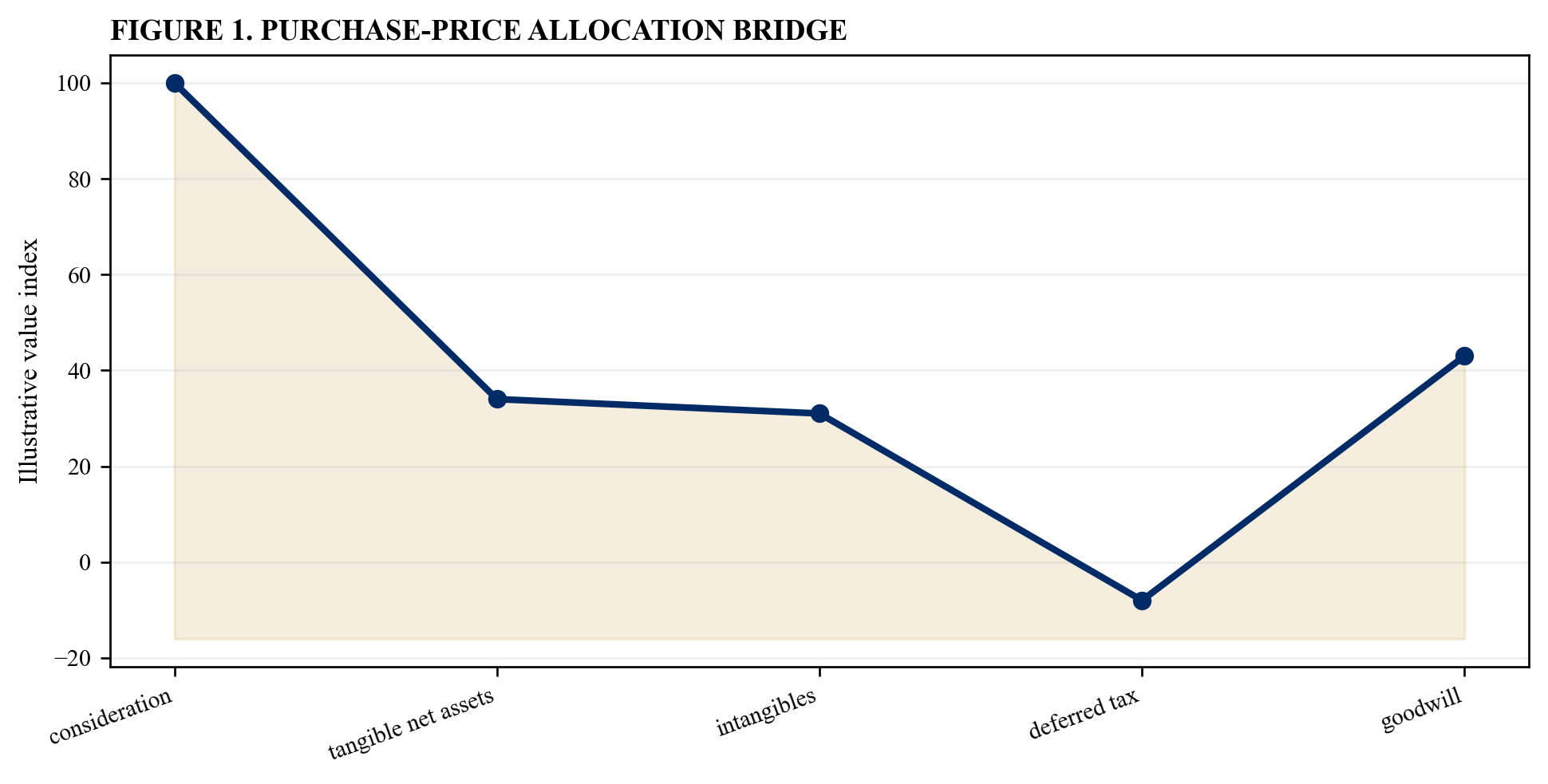
Illustrative analytical scenario; verified transaction evidence should replace index values.
6. Build the consideration bridge
The transaction finance team should map cash, shares, replacement awards, contingent payments, prior interests, settlement items and separate transactions. The required output is a consideration-at-fair-value schedule. Record the accounting conclusion, applicable framework, source data, valuation method, key assumptions, sensitivity, owner, reviewer and supporting evidence [1][7].
Translate the conclusion into a linked model. Separate acquisition-date measurement from contractual price mechanics, operating forecasts, financing effects, synergies and later management actions. Reconcile the balance-sheet entry to depreciation, amortisation, tax, cash flow, EPS and impairment consequences.
The principal risk is that headline enterprise value can be mistaken for accounting consideration. Quantify consideration, asset or liability value, goodwill, annual expense, tax, EPS, leverage and headroom across base, adverse and supportable alternative cases.
Retain agreements, ledgers, contracts, forecasts, valuation inputs, specialist work, contrary evidence, approvals, disclosures and open-item records. Refresh for facts available at the acquisition date and govern later information through the measurement-period protocol.
Table 1. Consideration bridge
| Component | Measurement basis | Earnings implication |
|---|---|---|
| cash and shares | acquisition-date fair value | capital structure |
| contingent payment | probability-weighted fair value | remeasurement risk |
| replacement award | service allocation | compensation expense |
| settlement item | separate transaction test | gain or loss |
Illustrative structure; verified transaction evidence and specialist review govern.
7. Map non-controlling interests
The transaction finance team should select and document measurement elections, ownership percentages, rights and expected post-close presentation. The required output is an NCI measurement file. Record the accounting conclusion, applicable framework, source data, valuation method, key assumptions, sensitivity, owner, reviewer and supporting evidence [1][8].
Translate the conclusion into a linked model. Separate acquisition-date measurement from contractual price mechanics, operating forecasts, financing effects, synergies and later management actions. Reconcile the balance-sheet entry to depreciation, amortisation, tax, cash flow, EPS and impairment consequences.
The principal risk is that the goodwill result can change without decision-makers seeing the effect of the NCI basis. Quantify consideration, asset or liability value, goodwill, annual expense, tax, EPS, leverage and headroom across base, adverse and supportable alternative cases.
Retain agreements, ledgers, contracts, forecasts, valuation inputs, specialist work, contrary evidence, approvals, disclosures and open-item records. Refresh for facts available at the acquisition date and govern later information through the measurement-period protocol.
8. Inventory acquired balance-sheet items
The transaction finance team should trace trial-balance accounts, contracts, off-ledger rights, obligations, contingencies and operating records. The required output is an acquired-assets-and-liabilities register. Record the accounting conclusion, applicable framework, source data, valuation method, key assumptions, sensitivity, owner, reviewer and supporting evidence [1][9].
Translate the conclusion into a linked model. Separate acquisition-date measurement from contractual price mechanics, operating forecasts, financing effects, synergies and later management actions. Reconcile the balance-sheet entry to depreciation, amortisation, tax, cash flow, EPS and impairment consequences.
The principal risk is that historical accounting can conceal assets and liabilities recognised only on acquisition. Quantify consideration, asset or liability value, goodwill, annual expense, tax, EPS, leverage and headroom across base, adverse and supportable alternative cases.
Retain agreements, ledgers, contracts, forecasts, valuation inputs, specialist work, contrary evidence, approvals, disclosures and open-item records. Refresh for facts available at the acquisition date and govern later information through the measurement-period protocol.
9. Reconcile accounting-policy differences
The transaction finance team should identify recognition, classification, measurement, useful-life, impairment and presentation differences between buyer and target. The required output is a policy-conversion ledger. Record the accounting conclusion, applicable framework, source data, valuation method, key assumptions, sensitivity, owner, reviewer and supporting evidence [2][10].
Translate the conclusion into a linked model. Separate acquisition-date measurement from contractual price mechanics, operating forecasts, financing effects, synergies and later management actions. Reconcile the balance-sheet entry to depreciation, amortisation, tax, cash flow, EPS and impairment consequences.
The principal risk is that forecast and pro forma results can mix incompatible accounting bases. Quantify consideration, asset or liability value, goodwill, annual expense, tax, EPS, leverage and headroom across base, adverse and supportable alternative cases.
Retain agreements, ledgers, contracts, forecasts, valuation inputs, specialist work, contrary evidence, approvals, disclosures and open-item records. Refresh for facts available at the acquisition date and govern later information through the measurement-period protocol.
10. Separate completion accounts from purchase accounting
The transaction finance team should distinguish contractual price adjustments from acquisition-date fair-value measurement and later true-ups. The required output is a completion-to-PPA reconciliation. Record the accounting conclusion, applicable framework, source data, valuation method, key assumptions, sensitivity, owner, reviewer and supporting evidence [1][11].
Translate the conclusion into a linked model. Separate acquisition-date measurement from contractual price mechanics, operating forecasts, financing effects, synergies and later management actions. Reconcile the balance-sheet entry to depreciation, amortisation, tax, cash flow, EPS and impairment consequences.
The principal risk is that working-capital mechanics can be double counted in consideration and net assets. Quantify consideration, asset or liability value, goodwill, annual expense, tax, EPS, leverage and headroom across base, adverse and supportable alternative cases.
Retain agreements, ledgers, contracts, forecasts, valuation inputs, specialist work, contrary evidence, approvals, disclosures and open-item records. Refresh for facts available at the acquisition date and govern later information through the measurement-period protocol.
11. Value property, plant and equipment
The transaction finance team should map asset condition, capacity, economic obsolescence, replacement cost, market evidence and remaining life. The required output is a tangible-asset valuation range. Record the accounting conclusion, applicable framework, source data, valuation method, key assumptions, sensitivity, owner, reviewer and supporting evidence [2][12].
Translate the conclusion into a linked model. Separate acquisition-date measurement from contractual price mechanics, operating forecasts, financing effects, synergies and later management actions. Reconcile the balance-sheet entry to depreciation, amortisation, tax, cash flow, EPS and impairment consequences.
The principal risk is that book value can obscure excess capacity, deferred maintenance or location value. Quantify consideration, asset or liability value, goodwill, annual expense, tax, EPS, leverage and headroom across base, adverse and supportable alternative cases.
Retain agreements, ledgers, contracts, forecasts, valuation inputs, specialist work, contrary evidence, approvals, disclosures and open-item records. Refresh for facts available at the acquisition date and govern later information through the measurement-period protocol.
12. Measure lease positions
The transaction finance team should reconcile contracts, embedded leases, terms, options, market rents and framework-specific acquisition adjustments. The required output is a lease measurement schedule. Record the accounting conclusion, applicable framework, source data, valuation method, key assumptions, sensitivity, owner, reviewer and supporting evidence [13][14].
Translate the conclusion into a linked model. Separate acquisition-date measurement from contractual price mechanics, operating forecasts, financing effects, synergies and later management actions. Reconcile the balance-sheet entry to depreciation, amortisation, tax, cash flow, EPS and impairment consequences.
The principal risk is that lease data gaps can shift assets, liabilities and post-close expense. Quantify consideration, asset or liability value, goodwill, annual expense, tax, EPS, leverage and headroom across base, adverse and supportable alternative cases.
Retain agreements, ledgers, contracts, forecasts, valuation inputs, specialist work, contrary evidence, approvals, disclosures and open-item records. Refresh for facts available at the acquisition date and govern later information through the measurement-period protocol.
13. Measure inventory step-up
The transaction finance team should segment finished goods, work in progress and raw materials; test selling price, completion cost, disposal cost and profit allowance. The required output is an inventory fair-value and expense-release model. Record the accounting conclusion, applicable framework, source data, valuation method, key assumptions, sensitivity, owner, reviewer and supporting evidence [2][15].
Translate the conclusion into a linked model. Separate acquisition-date measurement from contractual price mechanics, operating forecasts, financing effects, synergies and later management actions. Reconcile the balance-sheet entry to depreciation, amortisation, tax, cash flow, EPS and impairment consequences.
The principal risk is that early gross margin can be overstated when step-up expense is omitted. Quantify consideration, asset or liability value, goodwill, annual expense, tax, EPS, leverage and headroom across base, adverse and supportable alternative cases.
Retain agreements, ledgers, contracts, forecasts, valuation inputs, specialist work, contrary evidence, approvals, disclosures and open-item records. Refresh for facts available at the acquisition date and govern later information through the measurement-period protocol.
14. Identify customer-related intangibles
The transaction finance team should test contractual rights, separability, retention, renewal, attrition, concentration and contributory assets. The required output is a customer-relationship recognition and valuation file. Record the accounting conclusion, applicable framework, source data, valuation method, key assumptions, sensitivity, owner, reviewer and supporting evidence [1][9].
Translate the conclusion into a linked model. Separate acquisition-date measurement from contractual price mechanics, operating forecasts, financing effects, synergies and later management actions. Reconcile the balance-sheet entry to depreciation, amortisation, tax, cash flow, EPS and impairment consequences.
The principal risk is that relationship value can be left in goodwill despite meeting recognition criteria. Quantify consideration, asset or liability value, goodwill, annual expense, tax, EPS, leverage and headroom across base, adverse and supportable alternative cases.
Retain agreements, ledgers, contracts, forecasts, valuation inputs, specialist work, contrary evidence, approvals, disclosures and open-item records. Refresh for facts available at the acquisition date and govern later information through the measurement-period protocol.
15. Identify technology and software intangibles
The transaction finance team should map source code, patents, models, data, architecture, technical debt, obsolescence and replacement alternatives. The required output is a technology asset register. Record the accounting conclusion, applicable framework, source data, valuation method, key assumptions, sensitivity, owner, reviewer and supporting evidence [9][16].
Translate the conclusion into a linked model. Separate acquisition-date measurement from contractual price mechanics, operating forecasts, financing effects, synergies and later management actions. Reconcile the balance-sheet entry to depreciation, amortisation, tax, cash flow, EPS and impairment consequences.
The principal risk is that one technology value can combine assets with different risks and useful lives. Quantify consideration, asset or liability value, goodwill, annual expense, tax, EPS, leverage and headroom across base, adverse and supportable alternative cases.
Retain agreements, ledgers, contracts, forecasts, valuation inputs, specialist work, contrary evidence, approvals, disclosures and open-item records. Refresh for facts available at the acquisition date and govern later information through the measurement-period protocol.
16. Assess brands and trade names
The transaction finance team should test legal rights, market recognition, geographic reach, royalty economics, migration plans and indefinite-life evidence. The required output is a brand recognition and life conclusion. Record the accounting conclusion, applicable framework, source data, valuation method, key assumptions, sensitivity, owner, reviewer and supporting evidence [9][16].
Translate the conclusion into a linked model. Separate acquisition-date measurement from contractual price mechanics, operating forecasts, financing effects, synergies and later management actions. Reconcile the balance-sheet entry to depreciation, amortisation, tax, cash flow, EPS and impairment consequences.
The principal risk is that brand value can be recognised while management plans immediate retirement. Quantify consideration, asset or liability value, goodwill, annual expense, tax, EPS, leverage and headroom across base, adverse and supportable alternative cases.
Retain agreements, ledgers, contracts, forecasts, valuation inputs, specialist work, contrary evidence, approvals, disclosures and open-item records. Refresh for facts available at the acquisition date and govern later information through the measurement-period protocol.
Table 2. Intangible-recognition matrix
| Candidate asset | Recognition evidence | Principal value driver |
|---|---|---|
| customer relationships | contractual or separable | retention and margin |
| technology | rights and utility | obsolescence and replacement |
| brand | legal or separable | royalty economics |
| IPR&D | identifiable project | technical and commercial probability |
Illustrative structure; verified transaction evidence and specialist review govern.
17. Assess backlog and order book
The transaction finance team should verify enforceability, cancellation rights, fulfilment economics, margin, churn and overlap with customer relationships. The required output is a contract-backlog valuation schedule. Record the accounting conclusion, applicable framework, source data, valuation method, key assumptions, sensitivity, owner, reviewer and supporting evidence [9][17].
Translate the conclusion into a linked model. Separate acquisition-date measurement from contractual price mechanics, operating forecasts, financing effects, synergies and later management actions. Reconcile the balance-sheet entry to depreciation, amortisation, tax, cash flow, EPS and impairment consequences.
The principal risk is that backlog and customer relationships can overlap and be double counted. Quantify consideration, asset or liability value, goodwill, annual expense, tax, EPS, leverage and headroom across base, adverse and supportable alternative cases.
Retain agreements, ledgers, contracts, forecasts, valuation inputs, specialist work, contrary evidence, approvals, disclosures and open-item records. Refresh for facts available at the acquisition date and govern later information through the measurement-period protocol.
18. Assess licences, permits and franchises
The transaction finance team should map transferability, renewal, regulation, exclusivity, remaining term, compliance and market-participant use. The required output is a licence and permit asset file. Record the accounting conclusion, applicable framework, source data, valuation method, key assumptions, sensitivity, owner, reviewer and supporting evidence [9][18].
Translate the conclusion into a linked model. Separate acquisition-date measurement from contractual price mechanics, operating forecasts, financing effects, synergies and later management actions. Reconcile the balance-sheet entry to depreciation, amortisation, tax, cash flow, EPS and impairment consequences.
The principal risk is that critical operating rights can be omitted because they are not recorded historically. Quantify consideration, asset or liability value, goodwill, annual expense, tax, EPS, leverage and headroom across base, adverse and supportable alternative cases.
Retain agreements, ledgers, contracts, forecasts, valuation inputs, specialist work, contrary evidence, approvals, disclosures and open-item records. Refresh for facts available at the acquisition date and govern later information through the measurement-period protocol.
19. Assess in-process research and development
The transaction finance team should identify projects, technical feasibility, remaining spend, probability, market opportunity, alternatives and abandonment rights. The required output is an IPR&D project valuation file. Record the accounting conclusion, applicable framework, source data, valuation method, key assumptions, sensitivity, owner, reviewer and supporting evidence [9][19].
Translate the conclusion into a linked model. Separate acquisition-date measurement from contractual price mechanics, operating forecasts, financing effects, synergies and later management actions. Reconcile the balance-sheet entry to depreciation, amortisation, tax, cash flow, EPS and impairment consequences.
The principal risk is that portfolio-level optimism can conceal project-specific failure and funding risk. Quantify consideration, asset or liability value, goodwill, annual expense, tax, EPS, leverage and headroom across base, adverse and supportable alternative cases.
Retain agreements, ledgers, contracts, forecasts, valuation inputs, specialist work, contrary evidence, approvals, disclosures and open-item records. Refresh for facts available at the acquisition date and govern later information through the measurement-period protocol.
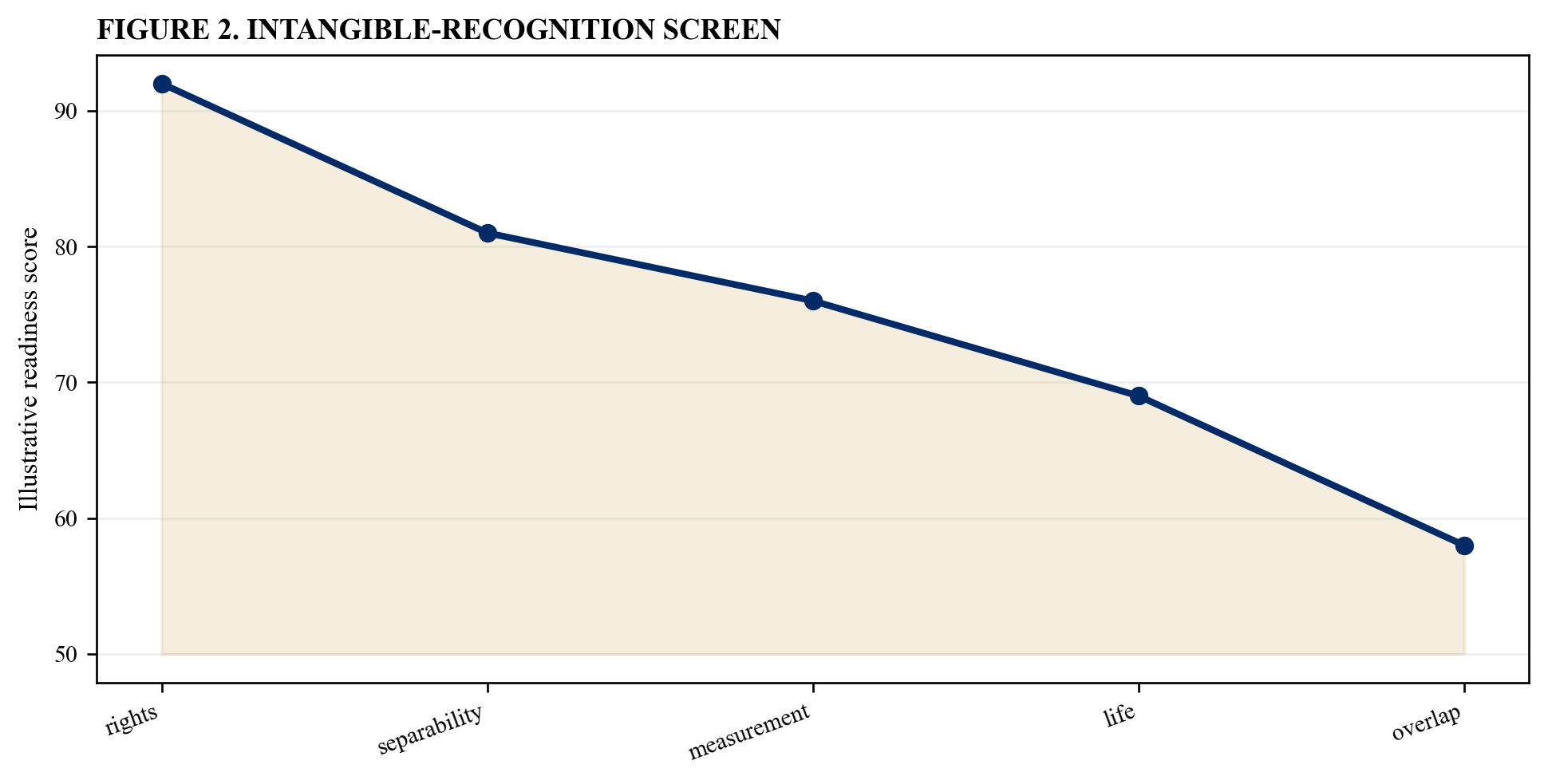
Illustrative analytical scenario; verified transaction evidence should replace index values.
20. Assess reacquired rights and non-compete arrangements
The transaction finance team should separate contractual settlement effects, remaining contractual terms, market value and post-close restrictions. The required output is a special-intangibles schedule. Record the accounting conclusion, applicable framework, source data, valuation method, key assumptions, sensitivity, owner, reviewer and supporting evidence [1][20].
Translate the conclusion into a linked model. Separate acquisition-date measurement from contractual price mechanics, operating forecasts, financing effects, synergies and later management actions. Reconcile the balance-sheet entry to depreciation, amortisation, tax, cash flow, EPS and impairment consequences.
The principal risk is that settlement gains, rights and compensation can be combined incorrectly. Quantify consideration, asset or liability value, goodwill, annual expense, tax, EPS, leverage and headroom across base, adverse and supportable alternative cases.
Retain agreements, ledgers, contracts, forecasts, valuation inputs, specialist work, contrary evidence, approvals, disclosures and open-item records. Refresh for facts available at the acquisition date and govern later information through the measurement-period protocol.
21. Map contract assets and liabilities
The transaction finance team should reconcile performance obligations, billing, fulfilment, returns, rebates, warranties and acquisition-date contract terms. The required output is a revenue-contract accounting bridge. Record the accounting conclusion, applicable framework, source data, valuation method, key assumptions, sensitivity, owner, reviewer and supporting evidence [17][21].
Translate the conclusion into a linked model. Separate acquisition-date measurement from contractual price mechanics, operating forecasts, financing effects, synergies and later management actions. Reconcile the balance-sheet entry to depreciation, amortisation, tax, cash flow, EPS and impairment consequences.
The principal risk is that future revenue and margin can be modelled from historical balances without acquisition-date analysis. Quantify consideration, asset or liability value, goodwill, annual expense, tax, EPS, leverage and headroom across base, adverse and supportable alternative cases.
Retain agreements, ledgers, contracts, forecasts, valuation inputs, specialist work, contrary evidence, approvals, disclosures and open-item records. Refresh for facts available at the acquisition date and govern later information through the measurement-period protocol.
22. Identify contingencies and provisions
The transaction finance team should map litigation, warranties, environmental matters, onerous contracts, restructuring intentions and uncertain obligations. The required output is a liability recognition and range matrix. Record the accounting conclusion, applicable framework, source data, valuation method, key assumptions, sensitivity, owner, reviewer and supporting evidence [1][22].
Translate the conclusion into a linked model. Separate acquisition-date measurement from contractual price mechanics, operating forecasts, financing effects, synergies and later management actions. Reconcile the balance-sheet entry to depreciation, amortisation, tax, cash flow, EPS and impairment consequences.
The principal risk is that management plans can be confused with present acquisition-date obligations. Quantify consideration, asset or liability value, goodwill, annual expense, tax, EPS, leverage and headroom across base, adverse and supportable alternative cases.
Retain agreements, ledgers, contracts, forecasts, valuation inputs, specialist work, contrary evidence, approvals, disclosures and open-item records. Refresh for facts available at the acquisition date and govern later information through the measurement-period protocol.
23. Value debt and financial instruments
The transaction finance team should reconcile principal, accrued interest, embedded features, derivatives, guarantees, credit spreads and settlement terms. The required output is a financial-instrument fair-value schedule. Record the accounting conclusion, applicable framework, source data, valuation method, key assumptions, sensitivity, owner, reviewer and supporting evidence [14][23].
Translate the conclusion into a linked model. Separate acquisition-date measurement from contractual price mechanics, operating forecasts, financing effects, synergies and later management actions. Reconcile the balance-sheet entry to depreciation, amortisation, tax, cash flow, EPS and impairment consequences.
The principal risk is that financing and acquired-liability effects can be mixed in the earnings bridge. Quantify consideration, asset or liability value, goodwill, annual expense, tax, EPS, leverage and headroom across base, adverse and supportable alternative cases.
Retain agreements, ledgers, contracts, forecasts, valuation inputs, specialist work, contrary evidence, approvals, disclosures and open-item records. Refresh for facts available at the acquisition date and govern later information through the measurement-period protocol.
24. Build the tax bridge
The transaction finance team should map tax bases, fair-value adjustments, loss carryforwards, uncertain positions, withholding, jurisdictions and recognition limitations. The required output is a deferred and current tax schedule. Record the accounting conclusion, applicable framework, source data, valuation method, key assumptions, sensitivity, owner, reviewer and supporting evidence [1][24].
Translate the conclusion into a linked model. Separate acquisition-date measurement from contractual price mechanics, operating forecasts, financing effects, synergies and later management actions. Reconcile the balance-sheet entry to depreciation, amortisation, tax, cash flow, EPS and impairment consequences.
The principal risk is that deferred tax can materially enlarge goodwill and future tax expense without clear attribution. Quantify consideration, asset or liability value, goodwill, annual expense, tax, EPS, leverage and headroom across base, adverse and supportable alternative cases.
Retain agreements, ledgers, contracts, forecasts, valuation inputs, specialist work, contrary evidence, approvals, disclosures and open-item records. Refresh for facts available at the acquisition date and govern later information through the measurement-period protocol.
25. Measure pensions and employee benefits
The transaction finance team should reconcile plan assets, obligations, actuarial assumptions, settlements, curtailments and local requirements. The required output is an employee-benefit measurement file. Record the accounting conclusion, applicable framework, source data, valuation method, key assumptions, sensitivity, owner, reviewer and supporting evidence [25][26].
Translate the conclusion into a linked model. Separate acquisition-date measurement from contractual price mechanics, operating forecasts, financing effects, synergies and later management actions. Reconcile the balance-sheet entry to depreciation, amortisation, tax, cash flow, EPS and impairment consequences.
The principal risk is that change-of-control and benefit obligations can be omitted from the consideration and liability analysis. Quantify consideration, asset or liability value, goodwill, annual expense, tax, EPS, leverage and headroom across base, adverse and supportable alternative cases.
Retain agreements, ledgers, contracts, forecasts, valuation inputs, specialist work, contrary evidence, approvals, disclosures and open-item records. Refresh for facts available at the acquisition date and govern later information through the measurement-period protocol.
26. Allocate replacement awards
The transaction finance team should separate pre-combination service, post-combination service, cash and equity treatment, vesting and forfeiture assumptions. The required output is a share-based-payment allocation schedule. Record the accounting conclusion, applicable framework, source data, valuation method, key assumptions, sensitivity, owner, reviewer and supporting evidence [1][25].
Translate the conclusion into a linked model. Separate acquisition-date measurement from contractual price mechanics, operating forecasts, financing effects, synergies and later management actions. Reconcile the balance-sheet entry to depreciation, amortisation, tax, cash flow, EPS and impairment consequences.
The principal risk is that purchase consideration and future compensation expense can be misclassified. Quantify consideration, asset or liability value, goodwill, annual expense, tax, EPS, leverage and headroom across base, adverse and supportable alternative cases.
Retain agreements, ledgers, contracts, forecasts, valuation inputs, specialist work, contrary evidence, approvals, disclosures and open-item records. Refresh for facts available at the acquisition date and govern later information through the measurement-period protocol.
Table 3. Liability and tax matrix
| Item | Acquisition-date question | Future effect |
|---|---|---|
| contingency | present obligation and fair value | settlement volatility |
| deferred tax | book and tax basis | tax expense and goodwill |
| benefits | obligation and plan assets | service and finance cost |
| earnout | classification and fair value | remeasurement |
Illustrative structure; verified transaction evidence and specialist review govern.
27. Value contingent consideration
The transaction finance team should model probability-weighted outcomes, market-participant assumptions, discounting, classification and subsequent remeasurement. The required output is an earnout fair-value and volatility model. Record the accounting conclusion, applicable framework, source data, valuation method, key assumptions, sensitivity, owner, reviewer and supporting evidence [1][2].
Translate the conclusion into a linked model. Separate acquisition-date measurement from contractual price mechanics, operating forecasts, financing effects, synergies and later management actions. Reconcile the balance-sheet entry to depreciation, amortisation, tax, cash flow, EPS and impairment consequences.
The principal risk is that the headline price can omit future P&L or equity volatility. Quantify consideration, asset or liability value, goodwill, annual expense, tax, EPS, leverage and headroom across base, adverse and supportable alternative cases.
Retain agreements, ledgers, contracts, forecasts, valuation inputs, specialist work, contrary evidence, approvals, disclosures and open-item records. Refresh for facts available at the acquisition date and govern later information through the measurement-period protocol.
28. Recognise indemnification assets
The transaction finance team should link seller protections to the corresponding liability, collectability, caps, duration and contractual mechanics. The required output is an indemnification recognition schedule. Record the accounting conclusion, applicable framework, source data, valuation method, key assumptions, sensitivity, owner, reviewer and supporting evidence [1][22].
Translate the conclusion into a linked model. Separate acquisition-date measurement from contractual price mechanics, operating forecasts, financing effects, synergies and later management actions. Reconcile the balance-sheet entry to depreciation, amortisation, tax, cash flow, EPS and impairment consequences.
The principal risk is that a liability can be recorded without the economically linked recovery. Quantify consideration, asset or liability value, goodwill, annual expense, tax, EPS, leverage and headroom across base, adverse and supportable alternative cases.
Retain agreements, ledgers, contracts, forecasts, valuation inputs, specialist work, contrary evidence, approvals, disclosures and open-item records. Refresh for facts available at the acquisition date and govern later information through the measurement-period protocol.
29. Remeasure prior interests
The transaction finance team should identify step-acquisition gains or losses, accumulated amounts, valuation evidence and NCI consequences. The required output is a control-transition bridge. Record the accounting conclusion, applicable framework, source data, valuation method, key assumptions, sensitivity, owner, reviewer and supporting evidence [1][8].
Translate the conclusion into a linked model. Separate acquisition-date measurement from contractual price mechanics, operating forecasts, financing effects, synergies and later management actions. Reconcile the balance-sheet entry to depreciation, amortisation, tax, cash flow, EPS and impairment consequences.
The principal risk is that the economics of acquiring control can be obscured by the previous carrying amount. Quantify consideration, asset or liability value, goodwill, annual expense, tax, EPS, leverage and headroom across base, adverse and supportable alternative cases.
Retain agreements, ledgers, contracts, forecasts, valuation inputs, specialist work, contrary evidence, approvals, disclosures and open-item records. Refresh for facts available at the acquisition date and govern later information through the measurement-period protocol.
30. Construct the provisional goodwill bridge
The transaction finance team should reconcile consideration, NCI, prior interests, identifiable assets, liabilities, deferred tax and bargain-purchase checks. The required output is a source-to-goodwill waterfall. Record the accounting conclusion, applicable framework, source data, valuation method, key assumptions, sensitivity, owner, reviewer and supporting evidence [1][2].
Translate the conclusion into a linked model. Separate acquisition-date measurement from contractual price mechanics, operating forecasts, financing effects, synergies and later management actions. Reconcile the balance-sheet entry to depreciation, amortisation, tax, cash flow, EPS and impairment consequences.
The principal risk is that goodwill can become an unexplained plug instead of a governed residual. Quantify consideration, asset or liability value, goodwill, annual expense, tax, EPS, leverage and headroom across base, adverse and supportable alternative cases.
Retain agreements, ledgers, contracts, forecasts, valuation inputs, specialist work, contrary evidence, approvals, disclosures and open-item records. Refresh for facts available at the acquisition date and govern later information through the measurement-period protocol.
31. Allocate goodwill to operating units
The transaction finance team should connect acquisition benefits, internal monitoring, cash-generating units or reporting units and management accountability. The required output is a goodwill-allocation map. Record the accounting conclusion, applicable framework, source data, valuation method, key assumptions, sensitivity, owner, reviewer and supporting evidence [27][28].
Translate the conclusion into a linked model. Separate acquisition-date measurement from contractual price mechanics, operating forecasts, financing effects, synergies and later management actions. Reconcile the balance-sheet entry to depreciation, amortisation, tax, cash flow, EPS and impairment consequences.
The principal risk is that goodwill can be assigned where impairment testing is least informative. Quantify consideration, asset or liability value, goodwill, annual expense, tax, EPS, leverage and headroom across base, adverse and supportable alternative cases.
Retain agreements, ledgers, contracts, forecasts, valuation inputs, specialist work, contrary evidence, approvals, disclosures and open-item records. Refresh for facts available at the acquisition date and govern later information through the measurement-period protocol.
32. Set useful lives and amortisation patterns
The transaction finance team should test legal term, renewal, attrition, technology cycles, consumption, integration plans and residual value. The required output is an amortisation schedule by asset. Record the accounting conclusion, applicable framework, source data, valuation method, key assumptions, sensitivity, owner, reviewer and supporting evidence [9][16].
Translate the conclusion into a linked model. Separate acquisition-date measurement from contractual price mechanics, operating forecasts, financing effects, synergies and later management actions. Reconcile the balance-sheet entry to depreciation, amortisation, tax, cash flow, EPS and impairment consequences.
The principal risk is that earnings can be forecast using arbitrary straight-line lives unsupported by economics. Quantify consideration, asset or liability value, goodwill, annual expense, tax, EPS, leverage and headroom across base, adverse and supportable alternative cases.
Retain agreements, ledgers, contracts, forecasts, valuation inputs, specialist work, contrary evidence, approvals, disclosures and open-item records. Refresh for facts available at the acquisition date and govern later information through the measurement-period protocol.
33. Build the transaction-accounting pro forma
The transaction finance team should apply required transaction and autonomous-entity adjustments on a consistent accounting basis with transparent assumptions. The required output is a regulation-ready pro forma model. Record the accounting conclusion, applicable framework, source data, valuation method, key assumptions, sensitivity, owner, reviewer and supporting evidence [29][30].
Translate the conclusion into a linked model. Separate acquisition-date measurement from contractual price mechanics, operating forecasts, financing effects, synergies and later management actions. Reconcile the balance-sheet entry to depreciation, amortisation, tax, cash flow, EPS and impairment consequences.
The principal risk is that synergies and discretionary actions can be blended into required accounting adjustments. Quantify consideration, asset or liability value, goodwill, annual expense, tax, EPS, leverage and headroom across base, adverse and supportable alternative cases.
Retain agreements, ledgers, contracts, forecasts, valuation inputs, specialist work, contrary evidence, approvals, disclosures and open-item records. Refresh for facts available at the acquisition date and govern later information through the measurement-period protocol.
34. Translate measurement into future earnings
The transaction finance team should bridge inventory expense, depreciation, amortisation, financing, tax, contingent consideration and integration costs by period. The required output is a reported-earnings conversion waterfall. Record the accounting conclusion, applicable framework, source data, valuation method, key assumptions, sensitivity, owner, reviewer and supporting evidence [2][29].
Translate the conclusion into a linked model. Separate acquisition-date measurement from contractual price mechanics, operating forecasts, financing effects, synergies and later management actions. Reconcile the balance-sheet entry to depreciation, amortisation, tax, cash flow, EPS and impairment consequences.
The principal risk is that deal-model EBITDA can be mistaken for post-close reported profit. Quantify consideration, asset or liability value, goodwill, annual expense, tax, EPS, leverage and headroom across base, adverse and supportable alternative cases.
Retain agreements, ledgers, contracts, forecasts, valuation inputs, specialist work, contrary evidence, approvals, disclosures and open-item records. Refresh for facts available at the acquisition date and govern later information through the measurement-period protocol.
Table 4. Future-earnings bridge
| Adjustment | Timing | Communication control |
|---|---|---|
| inventory step-up | early periods | separate from operations |
| amortisation | useful life | asset-specific schedule |
| financing | from closing | verified terms |
| integration action | when incurred | exclude from accounting PPA |
Illustrative structure; verified transaction evidence and specialist review govern.
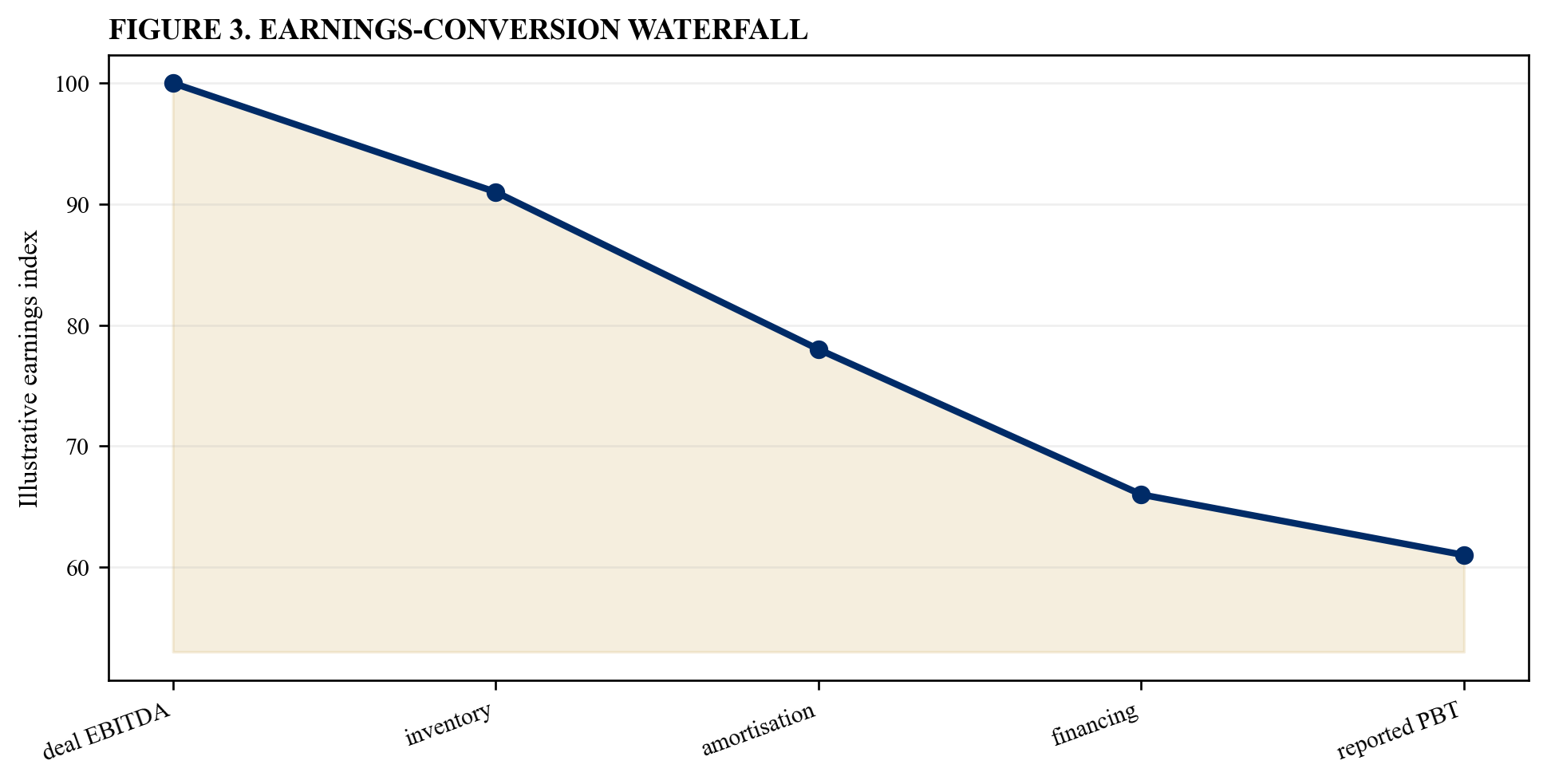
Illustrative analytical scenario; verified transaction evidence should replace index values.
35. Test EPS and leverage communication
The transaction finance team should model share count, financing, interest, tax, purchase-accounting charges, covenant definitions and timing. The required output is an accretion, dilution and leverage range. Record the accounting conclusion, applicable framework, source data, valuation method, key assumptions, sensitivity, owner, reviewer and supporting evidence [29][31].
Translate the conclusion into a linked model. Separate acquisition-date measurement from contractual price mechanics, operating forecasts, financing effects, synergies and later management actions. Reconcile the balance-sheet entry to depreciation, amortisation, tax, cash flow, EPS and impairment consequences.
The principal risk is that a single accretion figure can conceal accounting and financing sensitivities. Quantify consideration, asset or liability value, goodwill, annual expense, tax, EPS, leverage and headroom across base, adverse and supportable alternative cases.
Retain agreements, ledgers, contracts, forecasts, valuation inputs, specialist work, contrary evidence, approvals, disclosures and open-item records. Refresh for facts available at the acquisition date and govern later information through the measurement-period protocol.
36. Govern non-GAAP measures
The transaction finance team should define each adjustment, recurring-cost assessment, consistency, reconciliation, prominence and control ownership. The required output is a non-GAAP acquisition-measures policy. Record the accounting conclusion, applicable framework, source data, valuation method, key assumptions, sensitivity, owner, reviewer and supporting evidence [31][32].
Translate the conclusion into a linked model. Separate acquisition-date measurement from contractual price mechanics, operating forecasts, financing effects, synergies and later management actions. Reconcile the balance-sheet entry to depreciation, amortisation, tax, cash flow, EPS and impairment consequences.
The principal risk is that normal operating expenses or inconsistent adjustments can produce misleading performance claims. Quantify consideration, asset or liability value, goodwill, annual expense, tax, EPS, leverage and headroom across base, adverse and supportable alternative cases.
Retain agreements, ledgers, contracts, forecasts, valuation inputs, specialist work, contrary evidence, approvals, disclosures and open-item records. Refresh for facts available at the acquisition date and govern later information through the measurement-period protocol.
37. Run linked sensitivities
The transaction finance team should vary customer attrition, useful lives, royalty rates, technology obsolescence, discount rates, tax and consideration together. The required output is an earnings and goodwill sensitivity matrix. Record the accounting conclusion, applicable framework, source data, valuation method, key assumptions, sensitivity, owner, reviewer and supporting evidence [2][27].
Translate the conclusion into a linked model. Separate acquisition-date measurement from contractual price mechanics, operating forecasts, financing effects, synergies and later management actions. Reconcile the balance-sheet entry to depreciation, amortisation, tax, cash flow, EPS and impairment consequences.
The principal risk is that independent one-variable cases can understate correlated downside. Quantify consideration, asset or liability value, goodwill, annual expense, tax, EPS, leverage and headroom across base, adverse and supportable alternative cases.
Retain agreements, ledgers, contracts, forecasts, valuation inputs, specialist work, contrary evidence, approvals, disclosures and open-item records. Refresh for facts available at the acquisition date and govern later information through the measurement-period protocol.
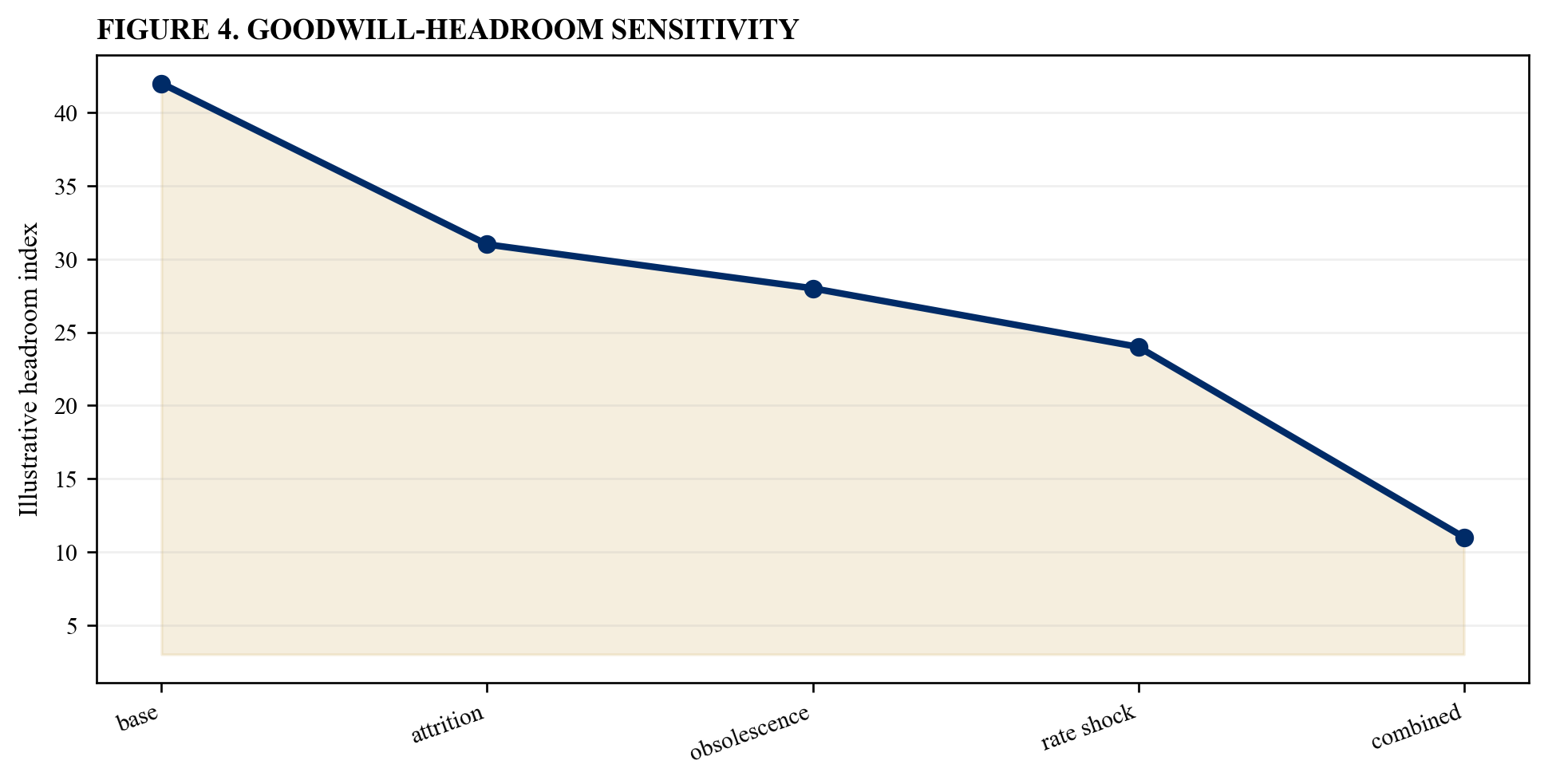
Illustrative analytical scenario; verified transaction evidence should replace index values.
38. Prepare audit-ready evidence
The transaction finance team should retain methods, source data, control evidence, specialists, assumptions, contrary evidence, approvals and subsequent-event tests. The required output is an estimate-audit evidence pack. Record the accounting conclusion, applicable framework, source data, valuation method, key assumptions, sensitivity, owner, reviewer and supporting evidence [33][34].
Translate the conclusion into a linked model. Separate acquisition-date measurement from contractual price mechanics, operating forecasts, financing effects, synergies and later management actions. Reconcile the balance-sheet entry to depreciation, amortisation, tax, cash flow, EPS and impairment consequences.
The principal risk is that valuation conclusions can be supported by presentation quality rather than sufficient evidence. Quantify consideration, asset or liability value, goodwill, annual expense, tax, EPS, leverage and headroom across base, adverse and supportable alternative cases.
Retain agreements, ledgers, contracts, forecasts, valuation inputs, specialist work, contrary evidence, approvals, disclosures and open-item records. Refresh for facts available at the acquisition date and govern later information through the measurement-period protocol.
39. Govern the measurement period
The transaction finance team should set issue owners, information requests, provisional disclosures, adjustment criteria, deadlines and restatement controls. The required output is a measurement-period control register. Record the accounting conclusion, applicable framework, source data, valuation method, key assumptions, sensitivity, owner, reviewer and supporting evidence [1][29].
Translate the conclusion into a linked model. Separate acquisition-date measurement from contractual price mechanics, operating forecasts, financing effects, synergies and later management actions. Reconcile the balance-sheet entry to depreciation, amortisation, tax, cash flow, EPS and impairment consequences.
The principal risk is that post-close information can be used to rewrite acquisition-date facts without discipline. Quantify consideration, asset or liability value, goodwill, annual expense, tax, EPS, leverage and headroom across base, adverse and supportable alternative cases.
Retain agreements, ledgers, contracts, forecasts, valuation inputs, specialist work, contrary evidence, approvals, disclosures and open-item records. Refresh for facts available at the acquisition date and govern later information through the measurement-period protocol.
40. Issue the closing-ready accounting certificate
The transaction finance team should reconcile perimeter, consideration, net assets, intangibles, tax, goodwill, earnings, disclosures, sensitivities and open items. The required output is a retained acquisition-accounting certificate. Record the accounting conclusion, applicable framework, source data, valuation method, key assumptions, sensitivity, owner, reviewer and supporting evidence [1][33].
Translate the conclusion into a linked model. Separate acquisition-date measurement from contractual price mechanics, operating forecasts, financing effects, synergies and later management actions. Reconcile the balance-sheet entry to depreciation, amortisation, tax, cash flow, EPS and impairment consequences.
The principal risk is that management can close without a controlled view of the first reported balance sheet and earnings path. Quantify consideration, asset or liability value, goodwill, annual expense, tax, EPS, leverage and headroom across base, adverse and supportable alternative cases.
Retain agreements, ledgers, contracts, forecasts, valuation inputs, specialist work, contrary evidence, approvals, disclosures and open-item records. Refresh for facts available at the acquisition date and govern later information through the measurement-period protocol.
Table 5. Closing-ready accounting certificate
| Conclusion | Retained evidence | Approval test |
|---|---|---|
| perimeter and acquirer | control analysis | resolved |
| PPA range | data and methods | supportable |
| earnings bridge | linked schedules | reconciled |
| open items | owner and deadline | bounded |
Illustrative structure; verified transaction evidence and specialist review govern.
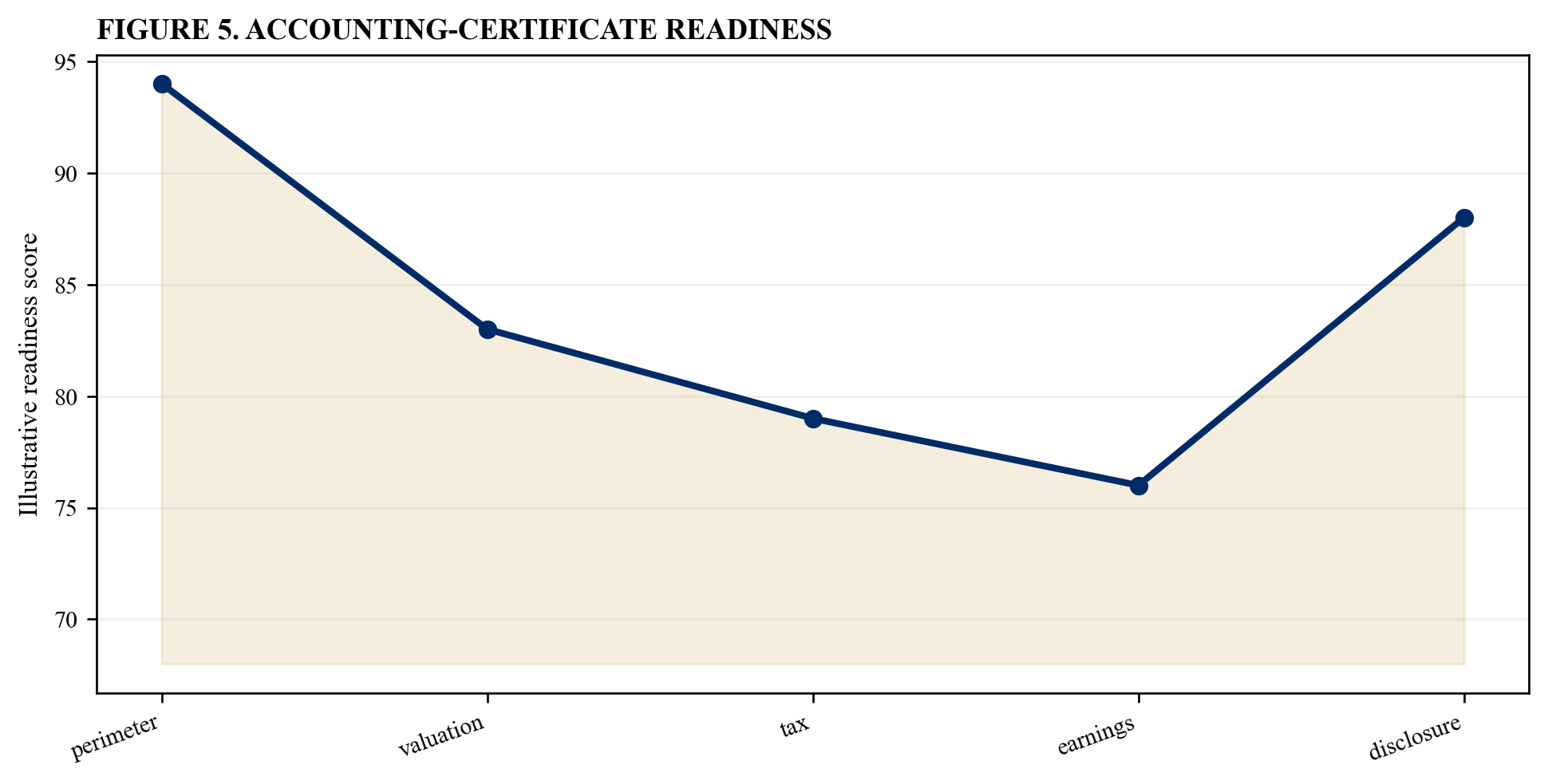
Illustrative analytical scenario; verified transaction evidence should replace index values.
References
- IFRS Foundation, IFRS 3 Business Combinations, https://www.ifrs.org/issued-standards/list-of-standards/ifrs-3-business-combinations/
- IFRS Foundation, IFRS 13 Fair Value Measurement, https://www.ifrs.org/issued-standards/list-of-standards/ifrs-13-fair-value-measurement/
- Financial Accounting Standards Board, ASU 2025-03, Determining the Accounting Acquirer in the Acquisition of a Variable Interest Entity, https://storage.fasb.org/ASU%202025-03.pdf
- IFRS Foundation, Definition of a Business amendments to IFRS 3, https://www.ifrs.org/news-and-events/news/2018/10/iasb-amends-definition-of-business-in-ifrs-standard-on-business-combinations/
- IFRS Foundation, IFRS 10 Consolidated Financial Statements, https://www.ifrs.org/issued-standards/list-of-standards/ifrs-10-consolidated-financial-statements/
- US Securities and Exchange Commission, Financial Reporting Manual Topic 2, https://www.sec.gov/about/divisions-offices/division-corporation-finance/financial-reporting-manual/frm-topic-2
- IFRS Foundation, IFRS 2 Share-based Payment, https://www.ifrs.org/issued-standards/list-of-standards/ifrs-2-share-based-payment/
- IFRS Foundation, IFRS 12 Disclosure of Interests in Other Entities, https://www.ifrs.org/issued-standards/list-of-standards/ifrs-12-disclosure-of-interests-in-other-entities/
- IFRS Foundation, IAS 38 Intangible Assets, https://www.ifrs.org/issued-standards/list-of-standards/ias-38-intangible-assets/
- IFRS Foundation, IAS 8 Accounting Policies, Changes in Accounting Estimates and Errors, https://www.ifrs.org/issued-standards/list-of-standards/ias-8-accounting-policies-changes-in-accounting-estimates-and-errors/
- IFRS Foundation, IAS 1 Presentation of Financial Statements, https://www.ifrs.org/issued-standards/list-of-standards/ias-1-presentation-of-financial-statements/
- IFRS Foundation, IAS 16 Property, Plant and Equipment, https://www.ifrs.org/issued-standards/list-of-standards/ias-16-property-plant-and-equipment/
- IFRS Foundation, IFRS 16 Leases, https://www.ifrs.org/issued-standards/list-of-standards/ifrs-16-leases/
- IFRS Foundation, IFRS 9 Financial Instruments, https://www.ifrs.org/issued-standards/list-of-standards/ifrs-9-financial-instruments/
- IFRS Foundation, IAS 2 Inventories, https://www.ifrs.org/issued-standards/list-of-standards/ias-2-inventories/
- IFRS Foundation, IAS 36 Impairment of Assets, https://www.ifrs.org/issued-standards/list-of-standards/ias-36-impairment-of-assets/
- IFRS Foundation, IFRS 15 Revenue from Contracts with Customers, https://www.ifrs.org/issued-standards/list-of-standards/ifrs-15-revenue-from-contracts-with-customers/
- UK Government, Intellectual Property Office guidance on IP and business, https://www.gov.uk/intellectual-property-an-overview
- IFRS Foundation, IFRS 3 implementation material, https://www.ifrs.org/issued-standards/list-of-standards/ifrs-3-business-combinations/
- IFRS Foundation, IFRS 3 Business Combinations issued text, https://www.ifrs.org/content/dam/ifrs/publications/pdf-standards/english/2022/issued/part-a/ifrs-3-business-combinations.pdf
- US Securities and Exchange Commission, Financial Reporting Manual Topic 3, https://www.sec.gov/about/divisions-offices/division-corporation-finance/financial-reporting-manual/frm-topic-3
- IFRS Foundation, IAS 37 Provisions, Contingent Liabilities and Contingent Assets, https://www.ifrs.org/issued-standards/list-of-standards/ias-37-provisions-contingent-liabilities-and-contingent-assets/
- IFRS Foundation, IAS 32 Financial Instruments: Presentation, https://www.ifrs.org/issued-standards/list-of-standards/ias-32-financial-instruments-presentation/
- IFRS Foundation, IAS 12 Income Taxes, https://www.ifrs.org/issued-standards/list-of-standards/ias-12-income-taxes/
- IFRS Foundation, IAS 19 Employee Benefits, https://www.ifrs.org/issued-standards/list-of-standards/ias-19-employee-benefits/
- IFRS Foundation, IAS 21 The Effects of Changes in Foreign Exchange Rates, https://www.ifrs.org/issued-standards/list-of-standards/ias-21-the-effects-of-changes-in-foreign-exchange-rates/
- IFRS Foundation, Business Combinations Disclosures, Goodwill and Impairment project, https://www.ifrs.org/projects/work-plan/goodwill-and-impairment/
- IFRS Foundation, IASB Update April 2026, https://www.ifrs.org/news-and-events/updates/iasb/2026/iasb-update-april-2026/
- US Securities and Exchange Commission, Financial Disclosures about Acquired and Disposed Businesses, https://www.sec.gov/resources-small-businesses/small-business-compliance-guides/financial-disclosures-about-acquired-disposed-businesses
- US Securities and Exchange Commission, Regulation S-X, https://www.ecfr.gov/current/title-17/chapter-II/part-210
- US Securities and Exchange Commission, Non-GAAP Financial Measures Compliance and Disclosure Interpretations, https://www.sec.gov/rules-regulations/staff-guidance/corporation-finance-interpretations/non-gaap-financial-measures
- US Securities and Exchange Commission, Regulation G, https://www.ecfr.gov/current/title-17/chapter-II/part-244
- Public Company Accounting Oversight Board, AS 2501 Auditing Accounting Estimates Including Fair Value Measurements, https://pcaobus.org/oversight/standards/auditing-standards/details/AS2501
- Public Company Accounting Oversight Board, AS 1210 Using the Work of an Auditor-Engaged Specialist, https://pcaobus.org/oversight/standards/auditing-standards/details/AS1210
