

1 Make physical resilience a transaction decision
The question at the investment committee is not whether climate change matters in general. It is whether a proposed acquisition price, financing structure and operating plan remain defensible when a specific asset or dependency faces a plausible physical stress. The answer requires a map of what is being bought, what can fail, how failure reaches earnings and cash flow, which countermeasures can be delivered, and who will pay. A site can have a low reported loss history and a costly forward-looking adaptation requirement. It can also screen as exposed while being well protected. Both states are decision-relevant.
A buyer should establish three dates at the outset: the historical operating period used to normalise earnings, the expected holding period, and the economic life of material assets. A five-year sponsor hold does not end the exposure of a warehouse roof, transmission connection or water intake that the exit buyer will inherit. Future obligations may therefore affect both cash flow during ownership and terminal value. Conversely, a long-horizon national climate scenario cannot be inserted mechanically into a five-year EBITDA forecast. The analyst must connect each time horizon to the transaction's own assets and contracts [1,2,4].
The committee needs a disciplined decision record. For each material exposure it should identify the asset, hazard, evidence quality, possible operating channel, insurance response, proposed adaptation, timing, cost and owner. The record should distinguish an observed repair invoice from an engineering estimate and from a management assumption. It should also show where the conclusion depends on a local expert's assessment. A purchase agreement cannot solve a site-level design defect by calling it an ESG risk.
This paper presents an analytical method, not a prediction for a named target. Its numerical example is invented for teaching and its geography is deliberately unspecified. The method applies across infrastructure, industrial services, logistics, data centres, real estate and utilities, with engineering standards, law and financing terms adapted to each transaction. Legal, technical, actuarial and insurance specialists should determine asset-specific conclusions.
2 Define the transaction perimeter before mapping the weather
The legal perimeter can differ from the physical perimeter. A share acquisition may transfer owned sites, leases, environmental obligations, insurance histories, customer contracts, supplier dependencies and debt covenants. An asset sale may leave some historic liabilities behind while creating new separation dependencies. A carve-out can depend on a seller's drainage network, grid connection, emergency response team or shared insurance policy after closing. Physical-risk diligence therefore begins with a transaction map, not with a climate map.
List every material operating location, owned and leased property, concession, critical supplier, utility connection, access route, data centre, control room and backup site. Link each node to legal ownership, revenue, EBITDA, replacement cost and business-continuity role. A small site can be economically critical if it houses a single control system. A supplier outside the legal acquisition perimeter can still determine whether the target meets customer service levels. This mapping should be reconciled to fixed-asset records, property schedules, customer contracts and disaster-recovery plans.
The map should also name exclusions. A buyer may acquire a profitable operating company while a seller retains the land, water entitlement or flood barrier on which it depends. The acquisition model must record the contractual rights, maintenance obligations, step-in provisions and duration of access. These facts can decide whether a resilience project is feasible. If a stormwater system is controlled by an adjoining landlord, the buyer's proposed capex may not be deliverable without a new agreement.
For a lender, collateral and cash-flow perimeters matter as much as group ownership. The security package may exclude a critical leased site. Debt service may depend on cash from a regulated utility whose tariffs do not permit immediate recovery of resilience expenditure. The perimeter map should therefore flow into both the operating case and the financing memorandum. An asset-level hazard score without the transaction perimeter can misdirect the entire analysis.
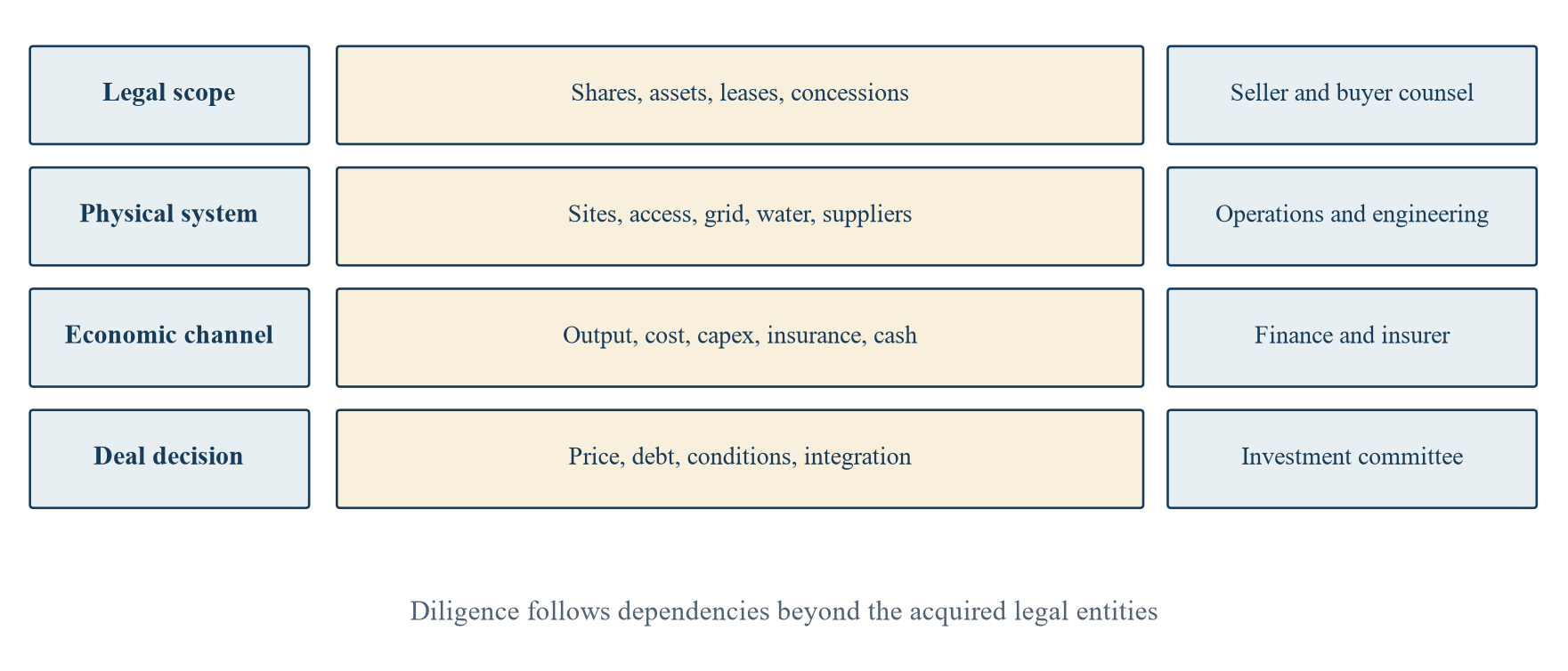
Author-developed process diagram. Nodes and dependencies are conceptual, not a depiction of an actual transaction.
3 Separate hazard, exposure, vulnerability and loss
Physical climate analysis uses terms that must not be collapsed. A hazard describes the potential occurrence or intensity of an event or condition. Exposure places an asset, person or activity where that condition can reach it. Vulnerability describes how susceptible the particular system is to damage or interruption. Loss reflects a financial consequence after protections, operating responses, contracts and insurance have been considered. A regional flood layer can indicate where to investigate. It does not state whether a site's electrical switchgear is elevated, whether drainage works, or whether a customer will tolerate a shutdown.
The IPCC assesses regional changes in heat, heavy precipitation, flood potential, drought and fire weather; their direction and confidence vary by region and warming level [1,2]. That evidence supports a set of relevant hazards, not a universal annual loss factor. The World Bank's climate and disaster risk screening tools and Climate Change Knowledge Portal provide country and project screening information [3]. Screening is an entry point for detailed work at material sites. A buyer should not translate a national map cell directly into a property-level damage estimate.
For each site, record coordinates and elevation, asset age, design standard, building-system location, maintenance history, past incidents, near misses, insurance claims and business-continuity performance. Record dependencies such as cooling water, road access, workforce availability and the stability of upstream electricity supply. Commission site surveys when those facts are missing or material. An apparently low-risk facility can fail through a supplier or access road; an exposed facility may have credible protection and tested redundancy.
The output is a triage decision. Some locations need engineering assessment, some need contractual or insurance clarification, and some can remain under routine monitoring. Record why each route was chosen and what new evidence could change it. This prevents a colourful heatmap from masquerading as a quantified loss model.
4 Test heat as an operating constraint
Heat can affect a target through worker safety, equipment derating, cooling demand, energy prices, water use, maintenance and service levels. The operative measure depends on the asset. An outdoor engineering crew may need an assessment of wet-bulb or work-rest conditions; a data hall needs inlet-temperature, cooling-capacity and power-redundancy data; a transmission asset needs conductor and transformer limits. A location's annual average temperature is not a substitute for the operating threshold of the actual equipment or workforce.
The diligence team should connect hourly or event-level conditions to operating records. Ask when output fell, overtime rose, service levels breached or backup systems were used. Compare those records with weather data, shift patterns and customer penalties. The buyer may discover that historical EBITDA includes unusually mild periods or that current cooling equipment is near its design limit. It may also find that management has already invested in capacity and that the modeled exposure is overstated. Both findings should be documented.
Adaptation measures can include shade, ventilation, cooling-system upgrades, equipment replacement, scheduling changes, thermal monitoring and backup capacity. Each measure has capital cost, operating cost, delivery time and residual exposure. A buyer should not record an avoided loss in the base case unless the measure is within its control, funded and scheduled. Cooling upgrades may increase electricity demand, so the energy and grid-capacity implications belong in the same forecast. A tariff or customer contract may determine whether the cost can be passed through.
The investment committee should see the operating threshold, the historical evidence, the forward-looking sensitivity and the funded intervention side by side. A physically hot site is not automatically a bad acquisition. Its resilience economics may be attractive if the price and post-close plan reflect the required work. No single regional heat projection establishes the site-level cash-flow effect [1-3].
5 Map flood routes and failure points
Flood risk is often treated as one coloured polygon. A transaction team needs to distinguish river, coastal, surface-water, storm-surge and groundwater pathways, and the interaction of rainfall with drainage and pumping systems. Elevation of the parcel, basement entrances, loading bays, critical electrical equipment and access roads can decide the actual interruption. Historic flood claims are relevant but may understate a future condition or miss near misses. The team should request both event records and design documents.
The relevant financial channels are direct repair, inventory damage, lost output, recovery time, customer penalties, deductible, higher premium, capital works and potentially stranded space. The same event should not be counted in each line without a causal reconciliation. For example, the model should separate physical repairs from business-interruption loss and net the amount the insurer is contractually expected to reimburse. The insurer's solvency and claim conditions are separate considerations. The cover may exclude surface water, have waiting periods or cap business interruption.
A site visit should verify whether protective measures are continuous across the actual flow path. A raised electrical room may be ineffective if a single access conduit remains below the design water level. A barrier may protect one building while a public road remains impassable. Engineering advice should state the standard used, event assumptions, residual risk and maintenance requirements. The purchase agreement may need to allocate the cost of an outstanding drainage project or require completion before closing.
Regional scenario analysis helps ask whether a design based only on historical conditions remains suitable. The IPCC and World Bank provide context [1-3]. The quantitative event return period and damage function for an individual site require qualified, location-specific assessment. An acquisition team should disclose when that assessment has not been completed.
6 Treat wildfire and storm as system risks
Wildfire exposure includes flame contact, ember attack, smoke, power shut-off, access closure and disruption of local labour or suppliers. The first question is whether the operating site or its dependencies lie in a material fire-weather and vegetation context. The second is whether a specific vulnerability exists in roof, ventilation, defensible space, transmission route or evacuation plan. A broad fire-risk score can prioritise visits; it does not say which retrofit is necessary.
Storm exposure similarly needs asset-specific analysis. Wind, heavy rain, storm surge and prolonged grid outage can arrive together. A warehouse roof may remain intact while inventory spoils because power fails. A water utility may lose a pumping station and a road route simultaneously. The model should therefore test correlated dependencies rather than add independent single-hazard losses as though all protections and recovery teams were available at once. The IPCC identifies compound and cascading risks as a feature of physical climate impacts [1,2].
The post-close plan can include roof and envelope works, fuel management, filtration, backup power, redundant communications, secondary inventory sites and emergency agreements. Each action should have a named operator, permit path, procurement lead time and recurring cost. The board should be told when an action is technically feasible but cannot be delivered within the first season of ownership. A supposed mitigation that arrives after the anticipated period of exposure should not be credited in the near-term base case.
Insurance needs separate diligence. Coverage may change with an insurer's view of hazard, claims history and local protection standards. EIOPA's public dashboard shows protection-gap information by peril and country in Europe [8]. It is a contextual data source, not a quote for the target. The buyer needs current policy wording, broker correspondence, renewal terms and a realistic estimate of retained loss.
7 Use a diligence heatmap that leads to action
A useful heatmap has rows for sites and dependencies, columns for hazards and an additional field for financial mechanism. Each cell should carry a source, date, confidence level and next action. Colour alone is inadequate. A high-exposure site with a documented engineered defence may warrant monitoring; a medium-exposure critical control room with no flood survey may warrant a condition precedent or an immediate post-close reserve. The heatmap is a workflow instrument, not a fabricated probability grid.
The team can use three evidence states: confirmed by records or expert review; management assertion awaiting support; and unknown. The third state should remain visible. A numerical model should only use a provisional assumption when the committee explicitly approves it as an assumption and sees the range that matters. The heatmap should identify what a signed engineering report, insurance endorsement or customer contract could settle before a final bid.
Commercial due diligence should run in parallel. Ask whether the target can pass increased cooling or insurance costs to customers, whether service-level penalties apply during a weather event, whether a concession has force-majeure relief, and whether there is an exclusive supply node. The legal wording matters. A physical event can have limited EBITDA impact where costs are recoverable, or a large impact where a key customer can terminate. The deal team should connect engineering findings to actual contracts.
The following table is an author-developed decision template. Its example pathways are hypothetical and are deliberately phrased as tests, not findings about an acquired business. A real team should fill the evidence and decision columns with source documents before using the table to set price or financing terms.
Table 1. Physical-risk diligence heatmap and financial handoff
| Site or dependency | Hazard test | Asset-level evidence | Financial channel | Deal action |
|---|---|---|---|---|
| Critical substation | Extreme heat and storm | Design limit, fault history, grid agreement | Output loss, cooling capex, repair | Engineer review and funded works |
| Logistics hub | Surface-water flood | Elevation, drainage, claims, road access | Inventory, interruption, deductible | Survey, policy check and price reserve |
| Remote plant | Wildfire smoke and grid shut-off | Vegetation, filters, power redundancy | Downtime, filtration, backup fuel | Continuity test and retrofit |
| Water intake | Drought and flood | Permit, source yield, pumps, access | Volume loss, emergency supply, capex | Permit and hydraulic review |
| Contracted supplier | Storm interruption | Supplier site, contract, alternate source | Revenue delay and penalties | Dual-source option and covenant test |
Author-developed transaction template. All rows are hypothetical tests, not observed target risks.
8 Choose scenarios that match a leveraged hold
Climate scenarios describe plausible pathways under specified assumptions. They are not forecasts for a named site. NGFS long-term pathways support macro-financial exploration, while its short-term climate scenarios were designed to examine nearer-term policy and weather shocks [4,5]. The NGFS warns that the academic paper underpinning some Phase V long-term physical-damage estimates was retracted; users should read the accompanying notices and limitations rather than treat a modelled macro loss as an asset-specific fact [4]. This caveat is especially important when a sponsor holds an asset for a handful of years.
For the LBO, construct a small set of conditional operating cases. A base operating case should use the diligence team's actual backlog, maintenance and capital plan. A physical-stress case can ask what happens if a critical asset experiences a defined outage and insurance recovery is delayed. A managed-adaptation case can fund specific measures and test their cost and residual exposure. The scenarios should be internally coherent: an assumed storm that closes the only road also delays repair crews, and an assumed heatwave may raise both cooling cost and local grid stress.
Avoid the apparent precision of a single expected-loss percentage when the frequency, vulnerability or cover is unknown. If probabilistic catastrophe modelling is commissioned, identify the peril, model vendor, version, exposure data and insured versus gross loss. The model's tail outputs should not be equated with management's annual budget. The sponsor can still price a conditional risk using ranges, covenants and contractual protections.
Scenario selection is a board judgment informed by specialist evidence. IFRS S2 requires an entity to use climate-related scenario analysis to assess climate resilience and to disclose decision-useful information about physical risks and anticipated financial effects within its scope [6]. That disclosure architecture is useful in diligence, even where the target itself is not subject to IFRS S2. It does not prescribe a particular LBO return model.
9 Translate the hazard into a cash-flow pathway
The operating model should contain an explicit bridge from an event or condition to the financial statement. For a heat pathway, begin with hours above an equipment or labour threshold, translate that into output or overtime, then apply contract prices, penalties and variable costs. For flood, distinguish physical repair, inventory, revenue interruption and insurance recovery. For wildfire, test smoke filtration, evacuation or grid shut-off. For drought, test water input and substitute supply. For storm, test repair time and network dependencies. Each path needs evidence from the target's own operations.
The bridge should preserve timing. A repair invoice paid in year one is not a permanent annual EBITDA reduction. A recurring cooling expense belongs in operating costs; an equipment replacement belongs in capital expenditure; a deductible is cash when a covered incident occurs. Insurance proceeds may arrive after debt service is due. A loss of customer confidence can affect multiple years but requires a separate commercial assumption, not an automatic multiple of physical damage.
Working capital matters. A weather event can increase inventory buffers, delay receivables or cause customer advances to reverse. A repair reserve does not automatically finance the working-capital gap. The acquisition model should show when money leaves and returns, alongside the debt-service schedule. A borrower can remain profitable yet breach a liquidity covenant while waiting for a claim payment.
The analyst should avoid double counting. If an engineering upgrade is funded and expected to reduce interruption, the model must show both its capex and a carefully bounded reduction in residual loss. If a lower exit multiple already reflects continuing risk, do not also apply an identical perpetual cash-flow penalty without explaining why both effects are distinct. The value bridge should state which assumptions affect EBITDA, cash conversion, leverage and exit price.
10 Make adaptation capex a funded underwriting line
Resilience measures often compete with growth capex, maintenance and debt repayment. The investment committee should label each measure as required for continuity, required for a contract or permit, economic improvement, or optional enhancement. This is an analytical classification, not a substitute for a legal obligation. Engineering diligence should set scope, design basis, procurement route and contingency. Finance should show the cash funding source and year. Operations should own commissioning and ongoing maintenance.
The 2026 IFC infrastructure adaptation report presents evidence and case studies for targeted resilience investment in transmission, water and roads, while explaining the difference between rapid screening and deeper site appraisal [9]. That supports an economic examination of adaptation. It does not imply that every proposed retrofit has a positive net present value. The buyer should compare the cost, avoided interruption, service quality and residual exposure for the actual site.
In an LBO, the capital structure determines whether a resilience programme can be executed when needed. A sponsor can inject equity, ring-fence cash at closing, establish a committed capital facility or adjust debt sizing so the borrower retains headroom. The debt agreement may restrict distributions, additional indebtedness and capital expenditure. The financing memo should describe the agreed treatment of climate-related capex, including cash sweeps and covenant calculations. An unfunded plan in a tight cash-sweep structure is a business risk.
Require milestones that are physically verifiable: engineering design approval, permits, contractor award, installed asset, commissioning test and updated insurer survey. The amount spent alone is not evidence of resilience. A buyer should reserve capital for residual risk and delay. A project may depend on a third-party grid operator or municipality, and the assumed completion date may be outside management's control.
11 Build a transparent hypothetical LBO case
The following example is an author-created teaching case. It is not based on a real target, climate model, insurer quote, market multiple or lender proposal. Assume a buyer pays USD 800 million enterprise value for a geographically dispersed industrial-services business with USD 80 million current EBITDA. The entry multiple is ten times EBITDA. Assume USD 400 million acquisition debt and USD 400 million sponsor equity at closing, ignoring transaction fees, tax, cash, working capital and other liabilities. These simplifications make the physical-risk bridge visible; they would be inappropriate for a live bid.
Assume the unadjusted plan reaches USD 95 million EBITDA in year five, has USD 250 million net debt at exit and attracts a ten-times exit multiple. The illustrative enterprise value is USD 950 million, leaving USD 700 million sponsor equity proceeds before exit fees or taxes. The scenario is a management-style base assumption created by the author, not observed operating performance.
In a physical-stress case, assume persistent disruption and costs leave year-five EBITDA at USD 88 million, net debt at USD 300 million because free cash flow is lower, and the exit buyer pays nine times EBITDA because residual exposure is unresolved. The arithmetic is USD 792 million enterprise value less USD 300 million net debt, or USD 492 million sponsor proceeds. This is a conditional sensitivity, not an estimate of hazard probability or expected transaction value. It deliberately combines operating, deleveraging and multiple effects to expose their separate contributions.
In a funded-adaptation case, assume an additional USD 35 million sponsor equity programme after closing. Suppose year-five EBITDA reaches USD 93 million, net debt is USD 270 million, and the exit multiple is 9.5 times. Enterprise value is USD 883.5 million; sponsor proceeds are USD 613.5 million. Sponsor capital committed across acquisition and programme is USD 435 million. The case does not imply that the works guarantee these outcomes. It shows what must be supported by engineering, contracts, delivery timing and market evidence before underwriting.
Table 2. Hypothetical acquisition and year-five exit cases, USD million
| Metric | Unadjusted plan | Physical-stress case | Funded-adaptation case |
|---|---|---|---|
| Entry enterprise value | 800.0 | 800.0 | 800.0 |
| Entry acquisition debt | 400.0 | 400.0 | 400.0 |
| Entry sponsor equity | 400.0 | 400.0 | 400.0 |
| Additional sponsor adaptation equity | 0.0 | 0.0 | 35.0 |
| Year-five EBITDA | 95.0 | 88.0 | 93.0 |
| Exit EBITDA multiple | 10.0x | 9.0x | 9.5x |
| Exit enterprise value | 950.0 | 792.0 | 883.5 |
| Exit net debt | 250.0 | 300.0 | 270.0 |
| Exit sponsor proceeds | 700.0 | 492.0 | 613.5 |
Entire table comprises author assumptions. Exit equity equals exit enterprise value less exit net debt. Equity capital excludes fees and taxes. These are conditional scenarios, not forecasts or market observations.
12 Read the valuation bridge without false precision
The USD 208 million difference between unadjusted and physical-stress sponsor proceeds is not one climate-loss number. Starting from USD 700 million, reducing exit EBITDA from 95 to 88 at the same ten-times multiple reduces enterprise value by USD 70 million. Reducing the multiple from ten to nine on USD 88 million EBITDA reduces it by a further USD 88 million. Increasing exit net debt from 250 to 300 reduces sponsor equity by another USD 50 million. The three steps sum to USD 208 million. Their order is a presentation convention; it does not establish causation or probabilities.
The adaptation case recovers USD 121.5 million of exit proceeds relative to the stress case, before considering the additional USD 35 million sponsor capital and timing. Its assumed EBITDA is USD 5 million higher than the stress case, the multiple half a turn higher, and net debt USD 30 million lower. The deal team must show how an actual programme could produce each effect. A flood barrier may reduce direct interruption; it might not justify a higher exit multiple unless buyers see installed protection, a better insurance profile and durable operating records.
Do not describe the difference between USD 700 million and USD 613.5 million as a proven price discount. The unadjusted case may itself be unrealistic, and the three terminal assumptions are hypothetical. A live transaction should derive a price range from comparable transactions, operating diligence, asset surveys, financing terms and negotiations. This bridge helps the committee see which beliefs matter enough to investigate before bid submission.
Debt magnifies the result. Under the author assumptions, the exit enterprise value falls by 16.6% from USD 950 million to USD 792 million, while sponsor proceeds fall by 29.7% from USD 700 million to USD 492 million. The percentages result from simple arithmetic on the stated cases; they do not describe a realised return. Leverage should therefore be sized on cash-flow headroom and resilience spend, not merely the target's historic EBITDA.
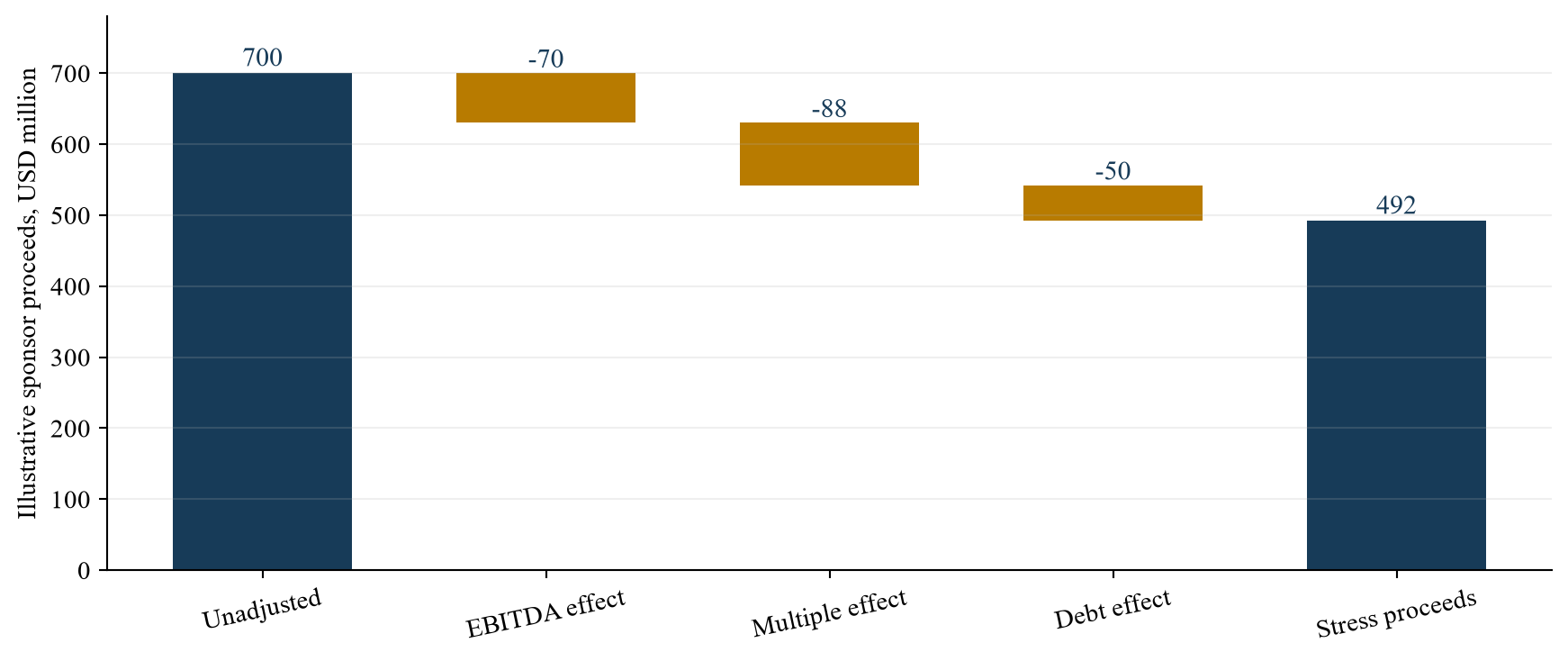
Author assumptions, USD million. Sequential presentation separates EBITDA, exit multiple and debt effects; it does not assign event probabilities.
13 Size the debt around resilience and interruption
An acquisition lender evaluates repayment capacity, collateral, insurance and covenant headroom. The physical-risk case can affect all four. Debt sizing should use a forecast that includes funded adaptation capex, plausible interruption timing and delayed claims receipts. If resilience work is deferred to protect cash sweeps, the lender may face greater exposure later. The credit memo should therefore identify protected capex, permitted debt and draw conditions rather than assume an operating plan outside the legal documents.
Interest cover, fixed-charge cover and debt-service cover should be calculated with the actual financing terms. A simple stress test can compare monthly liquidity and covenant dates with an outage, repair payment and insurance recovery. The lender should ask whether the borrower can draw a revolver after a material adverse event, whether the event changes borrowing-base eligibility and whether cash trapping accelerates at the wrong moment. A headline five-year leverage ratio can hide a year-one liquidity failure.
Insurance is a partial risk-transfer mechanism. Inspect exclusions, sublimits, deductibles, waiting periods, contingent business interruption, named locations and claims documentation. The broker's view of next-year renewal matters for the hold period. EIOPA's protection-gap dashboard is a reminder that economic and insured loss can differ materially by peril and country [8]; it cannot substitute for the target's policy. A lender may require insurance, but the sponsor should model retained loss and liquidity before reimbursement.
For EU-regulated lenders, the EBA's 2025 guidelines establish requirements for identifying, measuring, managing and monitoring ESG risks, applying from January 2026 for most institutions and later for small and non-complex institutions [7]. Those rules inform the bank's processes within their scope. A sponsor outside that perimeter still has an economic reason to present asset-level evidence and scenario cash flows. Better evidence can make a credit decision more transparent, without promising cheaper financing.
14 Put risk allocation into the deal documents
The sale agreement, financing documents and insurance programme should be reconciled with the physical-risk register. Representations can cover ownership, past claims, known damage, maintenance, permits and disclosed assessments. Covenants can require ordinary-course maintenance and preservation of cover between signing and closing. Specific known works may be handled by a price adjustment, escrow, closing condition or seller obligation. The right instrument depends on evidence and negotiation; a generic climate representation is rarely an adequate engineering solution.
The interim period deserves attention. A buyer may sign before a seasonal flood or fire period and close after it. The agreement should address a material incident, repair responsibility, insurer proceeds, information access and the buyer's right to inspect. Transaction insurance may have exclusions, and ordinary property policies may not cover all business interruption. Counsel and brokers should compare the policy language with the proposed contractual allocation.
Where a carve-out depends on the seller's shared systems, the transition services agreement should specify drainage, cooling, power, emergency response, data and access services. It should state service standards, costs, incident response, termination assistance and responsibility for capital works. A physical hazard can expose a separation failure that is invisible in the target's stand-alone EBITDA. The closing model should include any replacement facility, backup supplier or new insurance premium required after separation.
Transaction terms can allocate known costs while leaving the buyer accountable for the operating plan. An escrow can fund a repair, but it cannot make an unpermitted barrier available. A lower price can compensate for risk only if the buyer has the cash and legal rights to remediate it. The committee should align legal protection with engineering deliverability and financing capacity before approval.
15 Make integration or separation operational
The first hundred days should turn diligence findings into funded work orders. Assign each material hazard to an operating executive, technical lead, insurer contact and finance owner. Reconcile the acquired asset list with actual location data and maintenance systems. Confirm that emergency plans, customer notice procedures and supplier alternatives transfer on closing. A checklist stored in a deal room does not operate a pump or mobilise a contractor.
Prioritise by consequence and lead time. A cheap sensor may be installed quickly, while a substation relocation or flood-wall permit can take longer than the sponsor's first high-risk season. Sequence interim controls, permanent engineering and insurance changes. Make the temporary control explicit; for example, deploy mobile pumps while drainage redesign is permitted, with a test and named maintenance owner. The model should retain residual exposure until the permanent measure is commissioned.
For a carve-out, separation milestones should include ownership of shared climate data, access to historical claims, transfer or replacement of policies, emergency services and communications with landlords or utilities. A buyer may discover that the seller's enterprise risk platform holds the only usable site records. The separation plan must specify data extraction and verification. For a platform acquisition, the buyer should integrate new sites into common resilience standards without discarding site-specific design information.
The roadmap figure is a process recommendation. Its timing is indicative; a real transaction should set dates from permits, seasons, debt documents and contracts. The exit data room should begin at close with evidence of completed works, asset performance, incidents, policy renewals and residual risk. The sponsor cannot rely on a narrative at exit if it has not collected the proof while operating the business.
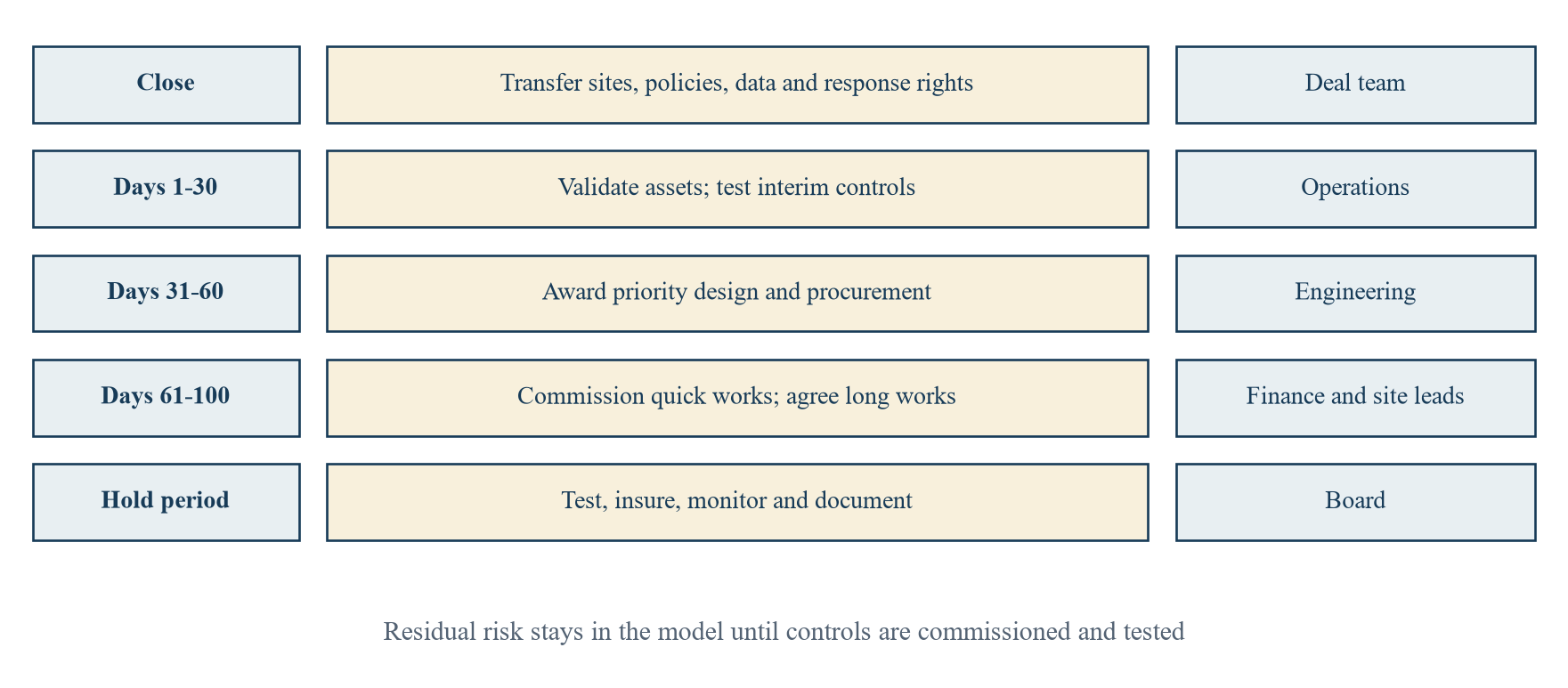
Author-developed management roadmap. Sequencing and owners require transaction-specific validation.
16 Govern the evidence through the hold period
Physical-risk diligence is a dated assessment. A target can add a new facility, alter a supplier, change a customer contract or experience an event after the original bid model was approved. The owner needs a register that links each asset to coordinates, legal interest, design documents, hazard screening version, specialist survey, incident history, policy terms, capex action and financial model line. A quarterly board pack should show changes, not merely repeat an old risk score.
The governance should distinguish responsibility for data, assessment and decision. Site operations confirm physical condition and incidents. Engineering reviews design and intervention. Finance models cash, debt and capital allocation. Legal reviews rights and obligations. Risk and insurance teams review coverage. The investment committee decides whether a new finding changes capital, covenants or exit planning. These are proposed roles; actual accountabilities depend on the acquired organisation and its contracts.
IFRS S2's framework of governance, strategy, risk management and metrics provides a useful organising structure for a climate-related information pack [6]. For a covered reporting entity, its specific requirements must be followed. For an acquisition team using the structure voluntarily, the objective is decision traceability. The board should be able to answer which site contributes a material share of earnings, what it is exposed to, what was funded, and what remains uncertain.
Data analytics can help reconcile locations, events, claims and work orders, but automated hazard tagging can produce false matches. Site geocoding must be checked, asset boundaries distinguished from postal addresses, and old properties removed from the model. A generative summary of engineering reports should be reviewed against the actual source. No model output should quietly become an audited fact in a lender presentation.
17 Prepare the exit buyer's evidence pack
An exit buyer will examine whether the sponsor improved resilience or merely spent money. The pack should present dated site surveys, as-built drawings, commissioning records, maintenance logs, incident and near-miss trends, insurance renewals, customer service history and actual capital spend. It should reconcile these to earnings and cash conversion. A building retrofit is more credible when performance and insurance terms confirm that the asset functions as intended.
The exit case should also show residual risk. Every protection system has a design limit and a maintenance dependency. Some hazards may increase during the buyer's future ownership, and some permits or third-party protections may be unresolved. Disclosing these constraints allows a purchaser to assess the business on evidence rather than discover an issue late and demand a broad price cut. A claim that the platform is climate-proof would be unsupported.
For a portfolio company with multiple jurisdictions, local evidence matters. The same heat threshold, building code or flood return period cannot be copied to every site. The seller can nevertheless offer a consistent data architecture: one asset key, one hazard register, one financial bridge and clear version history for engineering assumptions. This reduces time spent reconstructing facts. It does not determine the exit multiple by itself.
The sponsor should revisit its original LBO model before sale. Separate realised operating improvement from weather variation and customer mix. If a recent year was unusually mild or severe, normalise it with support from operating records and independent context. A buyer will pay for durable cash flow and funded future obligations, not the existence of a heatmap. The sponsor's evidence pack should allow the buyer to underwrite both.
18 Use a committee decision standard
The investment committee should receive a compact decision pack that connects the transaction perimeter, material sites, evidence gaps, scenarios, funded work, insurance, debt and contractual protection. Each proposed adjustment needs an owner and a defined assumption. Where the evidence cannot be completed before a bid, the committee should decide whether to lower price, change financing, set a closing condition, hold an escrow, commission a rapid survey or decline the exposure. These are options for discussion, not instructions to use a particular legal structure.
A decision threshold can be explicit. The committee might require engineering review for sites whose interruption could breach a customer contract or a debt covenant, and board approval for capital works above a stated budget. The threshold must be calibrated to the target and financing. A generic global threshold would be arbitrary. It is more useful to state a maximum acceptable liquidity draw and the evidence needed to demonstrate that the borrower can withstand it.
The committee should test consistency across documents. Does the bid model fund the same works described to the insurer? Do lender covenants allow the capital programme? Does the sale agreement give the buyer rights to access a shared drainage asset? Does the post-close plan start before the relevant season? Does the exit valuation assume a resilience benefit before commissioning? Any mismatch becomes an action item with a deadline.
Approval should record both the decision and its limits. A bid may be approved subject to a site survey, confirmation of insurance renewal and a committed capex reserve. That is stronger than a blanket statement that physical risk was reviewed. It also protects the team from treating a conditional scenario as a verified forecast. The paper's hypothetical numbers are useful only as an example of this discipline.
Table 3. Investment-committee decision record
| Question | Minimum evidence | Model handoff | Possible committee decision |
|---|---|---|---|
| What is acquired? | Legal schedules and physical dependency map | Revenue and collateral perimeter | Confirm or reprice perimeter |
| What can interrupt cash? | Site survey, operating logs, contracts | EBITDA, working capital, interruption | Commission deeper work or reserve |
| What is insured? | Policy, exclusions, broker renewal view | Retained loss and claim timing | Negotiate cover or liquidity |
| What must be built? | Scope, permit, quote, schedule | Capex and residual risk | Fund, condition or defer bid |
| Can debt absorb it? | Term sheet, covenant and cash model | Liquidity and debt service | Resize debt or retain capital |
| Who owns delivery? | Post-close work order and authority | Milestone and exit evidence | Assign executive and board review |
Author-developed template. Proposed decision routes are illustrative and require transaction-specific legal, financial and technical judgment.
19 Bound the claims and research agenda
This paper's framework does not estimate the climate-related value impact of a real target. The fictional USD 800 million purchase, USD 35 million adaptation programme, EBITDA cases, multiples and debt balances are author assumptions. They were selected to illustrate arithmetic and decision dependencies. They are not transaction comparables, actuarial expected losses, climate-model outputs, lender terms or a recommendation to acquire a business. The model omits tax, fees, purchase accounting, interest, working capital, dividends, refinancing, detailed debt amortisation and timing of additional equity.
The sources have different units. IPCC material describes climate processes and assessed regional risks [1,2]. World Bank tools support screening [3]. NGFS provides scenario pathways with stated limitations [4,5]. IFRS S2 and EBA provide disclosure or regulated-risk-management requirements within their scopes [6,7]. EIOPA documents insurance protection gaps in Europe [8]. IFC discusses infrastructure-adaptation opportunities and appraisal approaches [9]. None should be imported as a target-specific hazard probability, capex quote or multiple adjustment without additional evidence. The 2024 academic retraction flagged by NGFS is a specific caution against uncritical use of Phase V macro damage estimates [4].
Further research could use anonymised transaction-level data to study how site surveys, actual adaptation expenditure and insurance renewals affect debt terms and exit prices. Such research would need controls for sector, geography, vintage, sponsor quality, leverage, insurance cycles and exposure. A comparison between companies that spend more on adaptation and those that do not would not establish causation by itself. Data on failed bids and unreported near misses would also matter.
The practical limit is evidence quality. A buyer can act under uncertainty when it states the uncertainty, funds credible options and protects liquidity. It should not turn a screening colour into a quantified loss or describe a hypothetical case as realised performance. This paper is not legal, tax, accounting, actuarial, engineering, insurance or investment advice.
20 Conclusion
Physical climate risk belongs in the LBO when it can change the acquired business's operating cash, required capital, debt headroom or exit value. The decision process starts with what is legally and operationally inside the deal, identifies site-specific pathways, tests vulnerability with evidence, and funds the adaptation measures that the underwriting assumes. Insurance and contractual allocation are part of the structure, with their limits disclosed. The committee should see cash timing and residual risk, not only an annualised headline estimate.
The hypothetical bridge demonstrates why the issue is material to equity. Under its invented assumptions, sponsor proceeds move from USD 700 million in an unadjusted case to USD 492 million in a physical-stress case through three separate effects: earnings, multiple and net debt. A funded adaptation case yields USD 613.5 million proceeds after USD 35 million of additional sponsor capital. None of those figures predicts an actual acquisition. The point is that a bid which assumes resilience must specify who builds it, when, with what funding and on what evidence.
The best transaction output is a traceable chain from climate source to site survey, operating record, cash-flow line, financing term, contract and post-close work order. Revisit that chain after an incident, acquisition, new site, insurer renewal or change in the operating plan. By exit, the sponsor should be able to show what was done and what remains exposed. That evidence can support a more informed negotiation with lenders and buyers while preserving an honest account of uncertainty.
References
- Intergovernmental Panel on Climate Change. AR6 Synthesis Report: Summary for Policymakers, 2023. Accessed 6 October 2026. https://www.ipcc.ch/report/ar6/syr/summary-for-policymakers/
- Intergovernmental Panel on Climate Change. AR6 Working Group I, Chapter 12: Climate Change Information for Regional Impact and Risk Assessment, 2021. Accessed 6 October 2026. https://www.ipcc.ch/report/ar6/wg1/chapter/chapter-12/
- World Bank. Climate and Disaster Risk Screening Tools and Climate Change Knowledge Portal guidance. Accessed 6 October 2026. https://climatescreeningtools.worldbank.org/ ; https://climateknowledgeportal.worldbank.org/guidance-note
- Network for Greening the Financial System. Climate Scenarios for Central Banks and Supervisors, Phase V; current notice concerning the underlying physical-damage paper. Accessed 6 October 2026. https://www.ngfs.net/en/publications-and-statistics/publications/ngfs-climate-scenarios-central-banks-and-supervisors-phase-v
- Network for Greening the Financial System. Short-term Climate Scenarios: Main Takeaways, May 2025. Accessed 6 October 2026. https://www.ngfs.net/system/files/2025-05/NGFS%20Short-term%20scenarios%20-%20Main%20takeaways.pdf
- IFRS Foundation. IFRS S2 Climate-related Disclosures and implementation material. Accessed 6 October 2026. https://www.ifrs.org/issued-standards/ifrs-sustainability-standards-navigator/ifrs-s2-climate-related-disclosures/
- European Banking Authority. Final Guidelines on the Management of ESG Risks, 9 January 2025. Accessed 6 October 2026. https://eba.europa.eu/publications-and-media/press-releases/eba-publishes-its-final-guidelines-management-esg-risks
- European Insurance and Occupational Pensions Authority. Dashboard on insurance protection gap for natural catastrophes, updated 5 December 2025. Accessed 6 October 2026. https://www.eiopa.europa.eu/tools-and-data/dashboard-insurance-protection-gap-natural-catastrophes_en
- International Finance Corporation, AXA Climate and Scientific Climate Ratings. Low Cost, High Yield: The Adaptation and Resilience Investment Opportunity for Infrastructure, 2026. Accessed 6 October 2026. https://www.ifc.org/en/insights-reports/2026/adaptation-and-resilience-investment-opportunity-for-infrastructure
About the Author
Chennakeshav (CK) is a corporate finance and investment banking executive with 25+ years of global experience in deal origination, structuring and execution across M&A, growth capital and corporate strategy. He has led value-creation mandates for founders, corporates and funds — bridging the boardroom view to hands-on execution and close.
His career spans Morgan Stanley, HSBC, Lloyds Banking Group, EWEC, ADQ portfolio companies and Emirates Growth Fund, across TMT, real estate, fintech, deeptech, cleantech, infrastructure and energy. He has partnered with C-suite leaders, private equity and venture funds, sovereign wealth funds and family offices to finance complex fund raises and scale-up ventures, and has led M&A due diligence, post-merger integration and business-transformation initiatives to create value.
At Matchpoint Partners he is Managing Partner, leading the firm's corporate finance, M&A and capital-raising practice. He holds an MBA from London Business School, an engineering degree from VTU and a Master of Laws (LLM, in progress) from UCL London.
An active start-up mentor, CK mentors at Techstars, DIFC FinTech Hive, Startup Grind, Founder Institute and IN5, serves as Entrepreneur Mentor in Residence (EMiR) at London Business School, and judges the Entrepreneurship World Cup.
