

Introduction
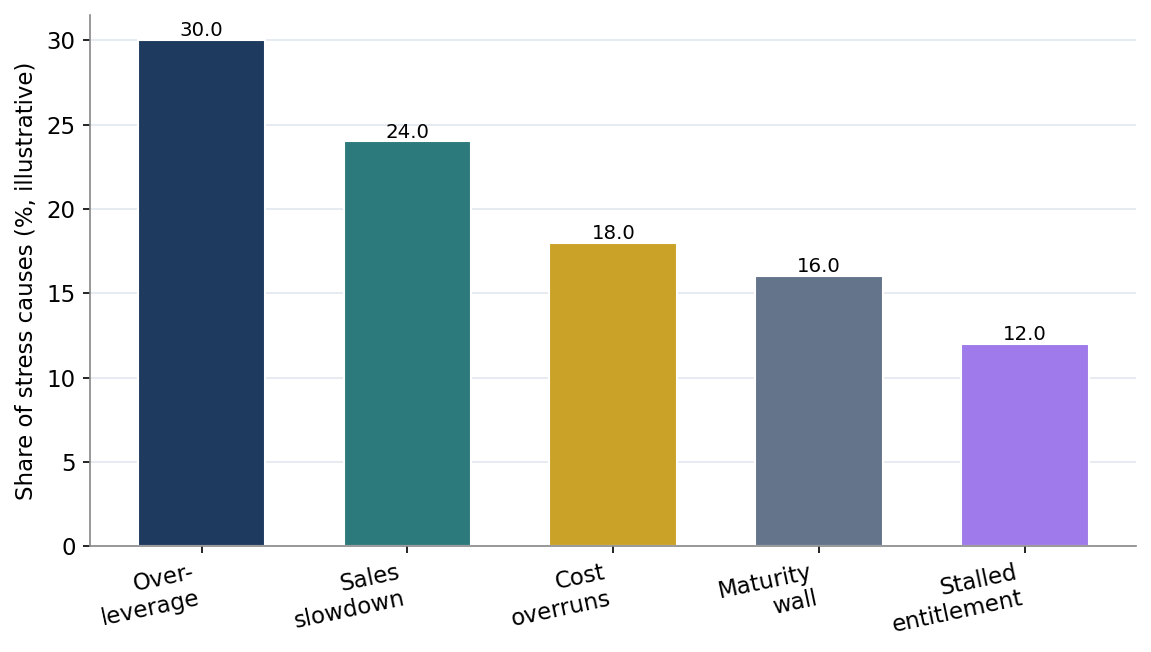
Real estate development is a cyclical business, and stress is a normal, if unwelcome, part of it. A portfolio assembled in a buoyant market can become over-leveraged when conditions turn; a project can stall when sales slow or costs overrun; a wall of debt can mature at a moment when refinancing is unavailable on the original terms. These situations are not the same as failure, and the sponsors that navigate them best are those that recognise stress early, address it with a clear plan, and recapitalise their way back to health, preserving the value, the reputation and the ownership that a disorderly collapse would destroy.
This paper sets out a playbook for that process. It is written for the sponsor facing stress, and its premise is that recapitalisation is a structured, manageable process rather than a counsel of despair, provided it is begun early and pursued with discipline. The playbook distinguishes the kinds of stress, sets out the tools available to address each, and sequences their use, so that a sponsor confronting a stressed portfolio has a clear path from diagnosis to recovery. The tone throughout is practical and forward-looking: stress is a problem to be solved, and the sponsor that approaches it as such, rather than denying it or despairing of it, can frequently emerge with its business and much of its value intact.
The central argument has three parts. First, the cost of inaction rises steeply with delay, so that a sponsor that addresses stress early preserves far more value than one that delays, and the single most important determinant of the outcome is often the speed with which the sponsor acts. Second, the right recapitalisation depends on whether the stress is one of liquidity, a viable portfolio that is temporarily short of cash, or of solvency, a portfolio whose value no longer covers its debt, and confusing the two leads to the wrong remedy. Third, a sponsor that acts proactively with a clear playbook can frequently recover while retaining a meaningful stake and its reputation, whereas a sponsor that delays into a disorderly process loses both value and control.
Diagnosing the Stress
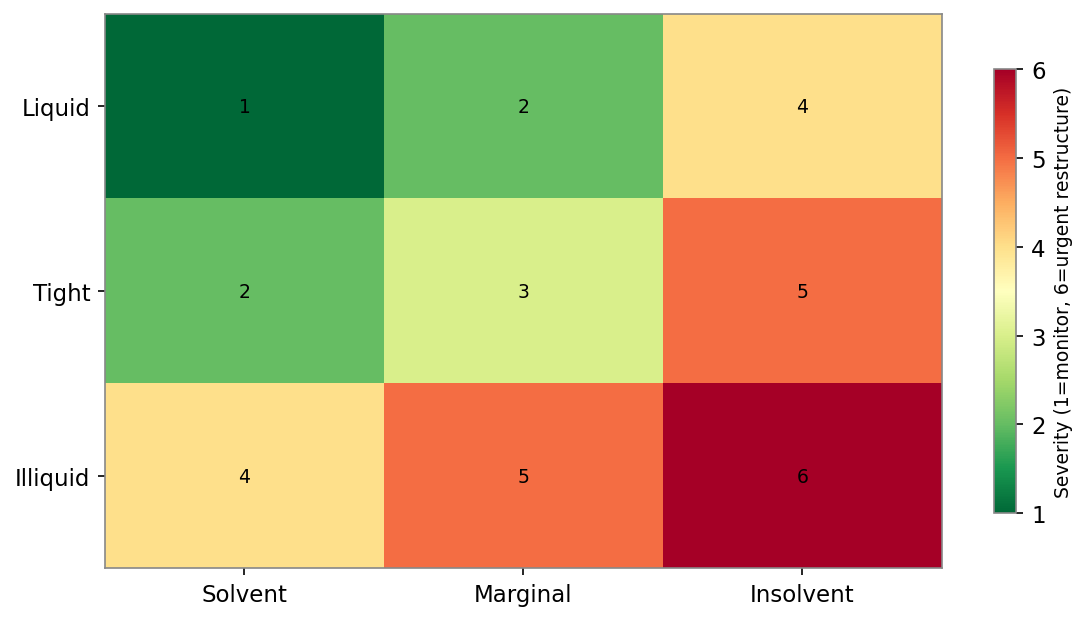
The recapitalisation begins with an honest diagnosis, because the right remedy depends on the nature and severity of the stress. Figure 2 sets out a diagnostic that locates the portfolio on two dimensions: its liquidity, from liquid to illiquid, and its solvency, from solvent to insolvent.
Figure 2. The Liquidity-Solvency Diagnostic
Severity rises from a liquid, solvent portfolio to an illiquid, insolvent one. Not a forecast.
A portfolio that is solvent but illiquid, viable assets temporarily short of cash, has a liquidity problem, and the remedy is to provide liquidity, through a bridge, an asset sale or an amendment of the debt terms, while preserving the sponsor ownership and the portfolio value. A portfolio that is marginally solvent has a more serious problem requiring new money and a right-sizing of the debt, and the sponsor may have to concede some control or value to attract the new capital. A portfolio that is deeply insolvent, its debt materially exceeding its asset value, requires a fundamental restructuring, a debt reduction or a change of ownership, and the sponsor stake may be substantially diluted or eliminated.
The honesty of the diagnosis is critical, because sponsors have a strong tendency to diagnose their stress as a liquidity problem when it is in fact a solvency problem, hoping that a bridge will tide them over until conditions improve. This optimism is natural but dangerous, because injecting liquidity into an insolvent portfolio merely deepens the eventual loss, and it delays the fundamental restructuring that the situation requires. A sponsor that diagnoses honestly, distinguishing a genuine liquidity problem from a solvency problem dressed up as one, can apply the right remedy; a sponsor that deceives itself applies the wrong one and worsens its position. The diagnostic should therefore be conducted with rigour and, ideally, with independent input that counters the sponsor optimism.
Negotiating with Existing Lenders
The negotiation with existing lenders is central to most recapitalisations, because the lenders hold claims that must be addressed, and their cooperation is usually necessary for any solution. The negotiation typically seeks one or more of a standstill, in which the lenders agree not to enforce while a solution is developed; an amend-and-extend, in which the maturity and terms of the debt are revised to a sustainable profile; and, where the portfolio is insolvent, a haircut or a debt-for-equity swap that reduces the debt to a level the value can support. The lenders agree to these because the alternative, enforcement against a stressed portfolio, usually recovers less than a consensual restructuring.
The key to the negotiation is to demonstrate to the lenders that the consensual restructuring leaves them better off than enforcement. A lender enforcing against a stressed development portfolio faces a forced sale into a weak market, the cost and delay of enforcement, and the destruction of value that a disorderly process causes, and it frequently recovers far less than par. A consensual restructuring that stabilises the portfolio, brings in new money, and allows the value to recover offers the lender a better recovery, even if it requires the lender to extend its maturity, amend its terms, or accept a haircut. The sponsor task is to present a credible plan that makes this case, supported by a realistic valuation that shows the lender its recovery is improved by cooperation.
The negotiation is easier and more successful when begun early and conducted in good faith. Lenders respond better to a sponsor that comes to them early, before the stress is a crisis, with an honest assessment and a credible plan, than to a sponsor that conceals its stress until enforcement is imminent and then seeks a rescue. Early, honest engagement builds the lender confidence and cooperation that a consensual restructuring requires, while late, defensive engagement breeds the mistrust that pushes lenders toward enforcement. The relationship with the lenders, and the credibility the sponsor maintains with them, is therefore a critical asset in a recapitalisation, and it is built through the honesty and the early engagement that the playbook emphasises.
Governance and Control in a Recapitalisation
A recapitalisation almost always involves a change in governance and control, because the new money and the restructured claims bring new parties with rights, and the sponsor must navigate this change while preserving as much control as the situation allows. The new-money provider will require governance rights appropriate to its priority capital and the stressed situation, often including board representation, reserved matters, and rights that strengthen if the recovery falters. The existing lenders, if they extend or amend, may require enhanced monitoring and controls. The sponsor, in turn, seeks to retain enough control to execute the recovery, which it is best placed to do, while conceding the governance the new parties require.
The degree of control the sponsor retains depends on the severity of the stress and the timing of the action. In a liquidity stress addressed early, the sponsor may retain substantial control, conceding only the monitoring and protections that a bridge or an amend-and-extend requires. In a solvency stress requiring substantial new money and a deep restructuring, the sponsor may have to concede significant control, and in a deep insolvency the sponsor may be substantially or wholly diluted, with control passing to the new-money provider or the lenders. The control the sponsor retains is, again, a function of how early and how well it acts, which is the recurring lesson of the playbook.
A constructive approach to the governance change can preserve the sponsor role even where its stake is diluted. A sponsor that has the expertise to execute the recovery is valuable to the new-money provider and the lenders, who need someone to run the recovery, and a sponsor that engages constructively can frequently retain an operational role and an incentive, such as a recovery-linked stake, even where its ownership is diluted. A sponsor that fights the governance change destructively, by contrast, may find itself removed entirely, as the new parties conclude that the recovery is better executed without it. The sponsor that approaches the governance change as a necessary adjustment to be navigated constructively, rather than a loss to be resisted, frequently preserves more of its role and its upside than one that resists.
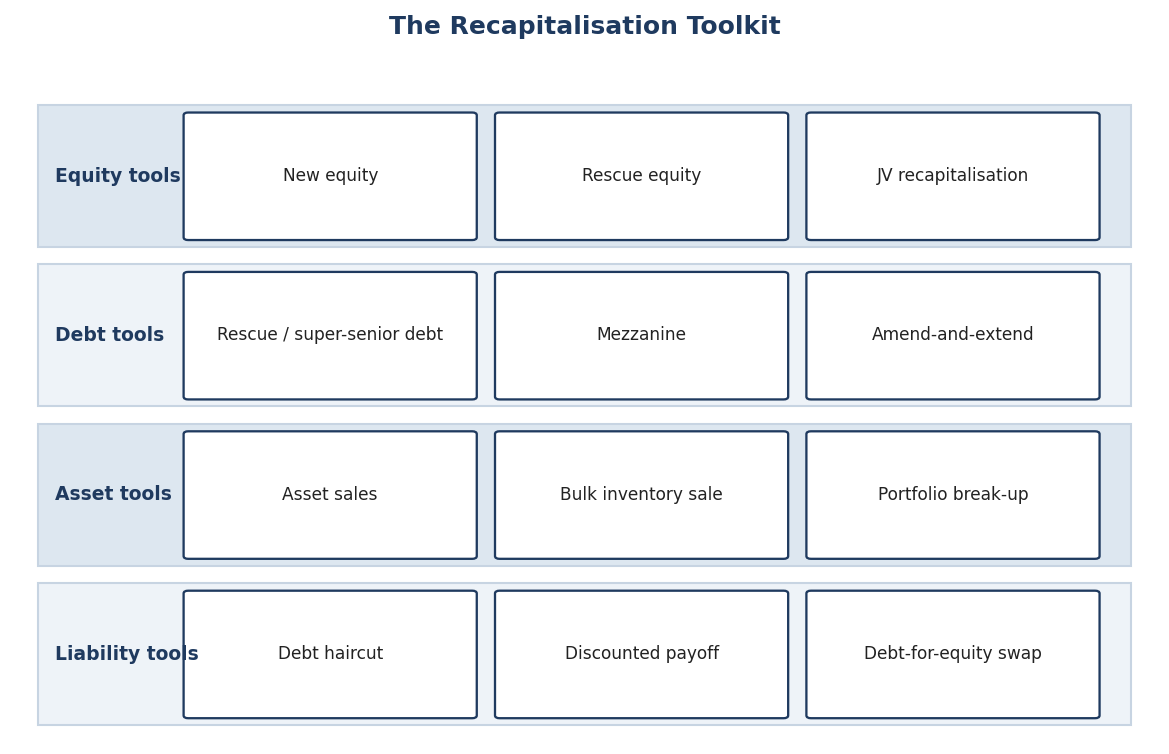
| Tool | Type | When appropriate |
|---|---|---|
| New / rescue equity | Equity | Viable portfolio needing capital |
| JV recapitalisation | Equity | Partner provides capital for stake |
| Rescue / super-senior debt | Debt | Critical liquidity, priority needed |
| Amend-and-extend | Debt | Maturity wall, viable assets |
| Asset / bulk sale | Asset | Generate cash, reduce exposure |
| Portfolio break-up | Asset | Realise stronger parts |
| Debt haircut / DPO | Liability | Debt exceeds value |
| Debt-for-equity swap | Liability | Deep restructuring, ownership change |
Indicative Case Studies
Three indicative cases show the playbook applied to different severities of stress. The figures are synthetic and constructed for analytical clarity, not drawn from any specific transaction.
Case A: over-levered portfolio, amend-and-extend
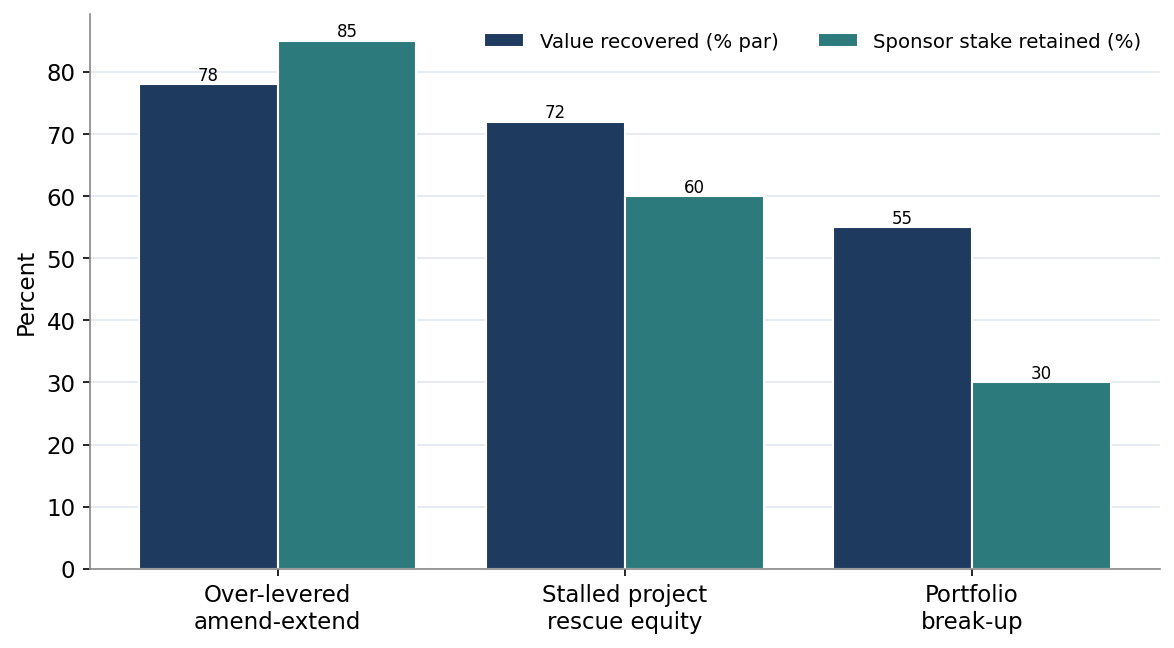
Case A is a fundamentally viable portfolio that has become over-leveraged and faces a maturity wall it cannot refinance on the original terms, but whose assets are worth more than its debt, a liquidity and capital-structure problem rather than a solvency one. The sponsor acts early, secures a standstill, and negotiates an amend-and-extend that revises the maturity and terms of the debt to a sustainable profile, supported by a modest asset sale to reduce leverage. The portfolio recovers a high proportion of its value and the sponsor retains most of its stake, because the early action and the viability of the portfolio allowed a relatively gentle solution.
Table 2. Case A: Over-Levered Portfolio
Early action on a viable portfolio preserves value and control. Not transaction-specific.
Case B: stalled project, rescue equity
Case B is a project stalled by a cost overrun and a sales slowdown, marginally solvent, that needs new money to complete and recover. The sponsor brings in rescue equity from a special-situations investor, which provides the new money with priority and governance rights in exchange for a significant stake, and the project is completed, delivered and its value recovered. The sponsor is diluted by the rescue equity but retains a meaningful stake and an operational role, and the project is saved from the failure that would have followed without the new money. The case illustrates a solvency-edge situation requiring new money and accepting dilution to save the project.
Table 3. Case B: Stalled Project Rescue
New money with priority saves the project at the cost of dilution. Not transaction-specific.
Case C: portfolio break-up
Case C is a deeply stressed portfolio, parts of it insolvent, where the sponsor acted late and the options have narrowed. The solution is a portfolio break-up: the stronger projects are recapitalised or sold to realise their value, the weaker are restructured through debt-for-equity swaps or surrendered to lenders, and the portfolio is divided so that value can be recovered where it exists. The sponsor retains only a minority stake in the recovered parts, having been heavily diluted by the new money and the debt-for-equity swaps, and the case illustrates the cost of late action and deep stress: value is recovered where possible, but the sponsor loses much of its stake and control.
Figure 5. Value Recovered and Sponsor Stake Retained by Case
| Attribute | Detail | Note |
|---|---|---|
| Diagnosis | Solvent, illiquid | Maturity wall |
| Action timing | Early | Strong position |
| Tools | Standstill, amend-and-extend, asset sale | Gentle solution |
| Value recovered | ~78% of par | High |
| Sponsor stake retained | ~85% | Control preserved |
| Attribute | Detail | Note |
|---|---|---|
| Diagnosis | Marginally solvent | Stalled, needs capital |
| Action timing | Prompt | Before deep deterioration |
| Tools | Rescue equity with priority | New money |
| Value recovered | ~72% of par | Project saved |
| Sponsor stake retained | ~60% | Diluted but meaningful |
Sensitivity and Scenario Analysis
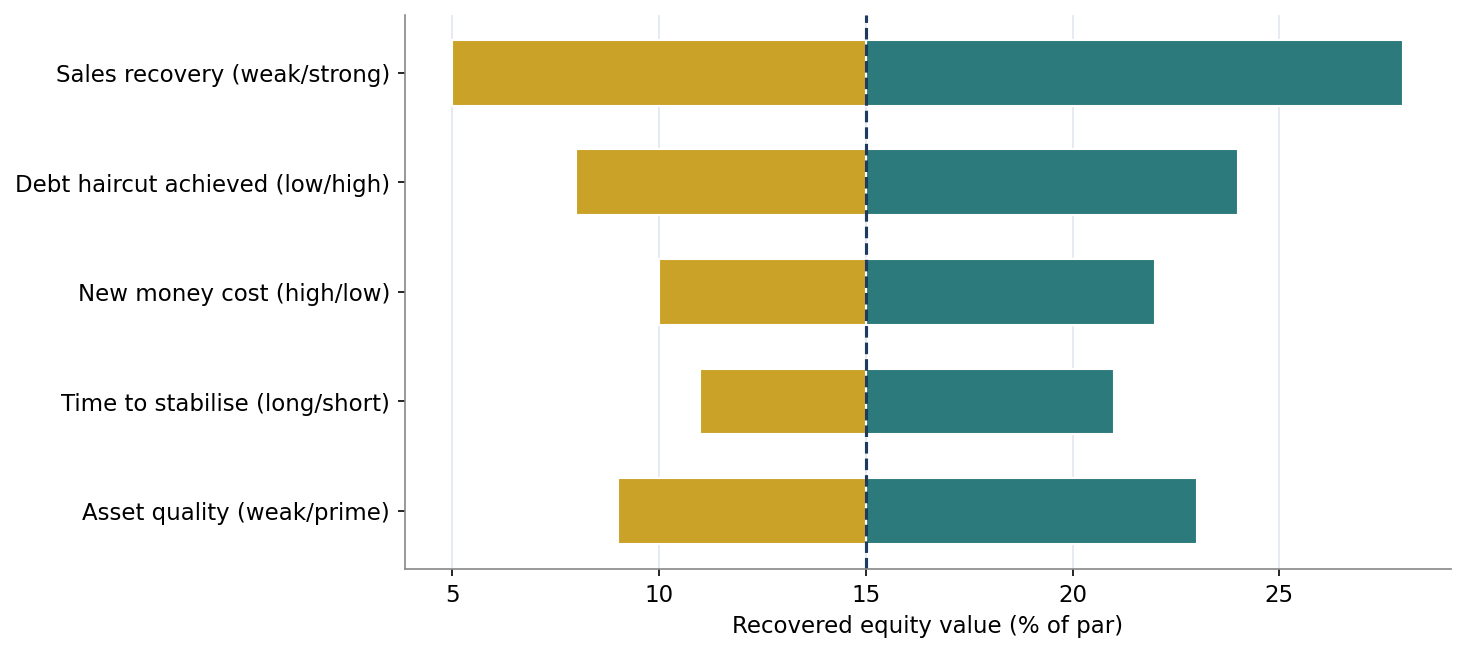
A tornado analysis identifies the variables that most influence the recovered equity value in a recapitalisation. Figure 6 presents the result.
Figure 6. Sensitivity of Recovered Equity Value to Key Variables
Each bar shows the recovered value when the labelled variable moves to its low or high case. Dashed line is the base case. Indicative.
The analysis shows that the sales recovery and the debt haircut achieved dominate the recovered equity value, with the new-money cost, the time to stabilise and the asset quality also significant. The sales recovery matters because it determines whether the portfolio value rebuilds, which is the ultimate source of the recovery; a strong sales recovery rebuilds the value and a weak one does not. The debt haircut matters because reducing the debt directly increases the equity value that remains after the debt is satisfied. The new-money cost and the time to stabilise matter because they determine how much value the recapitalisation itself consumes, and the asset quality determines the underlying value available to recover.
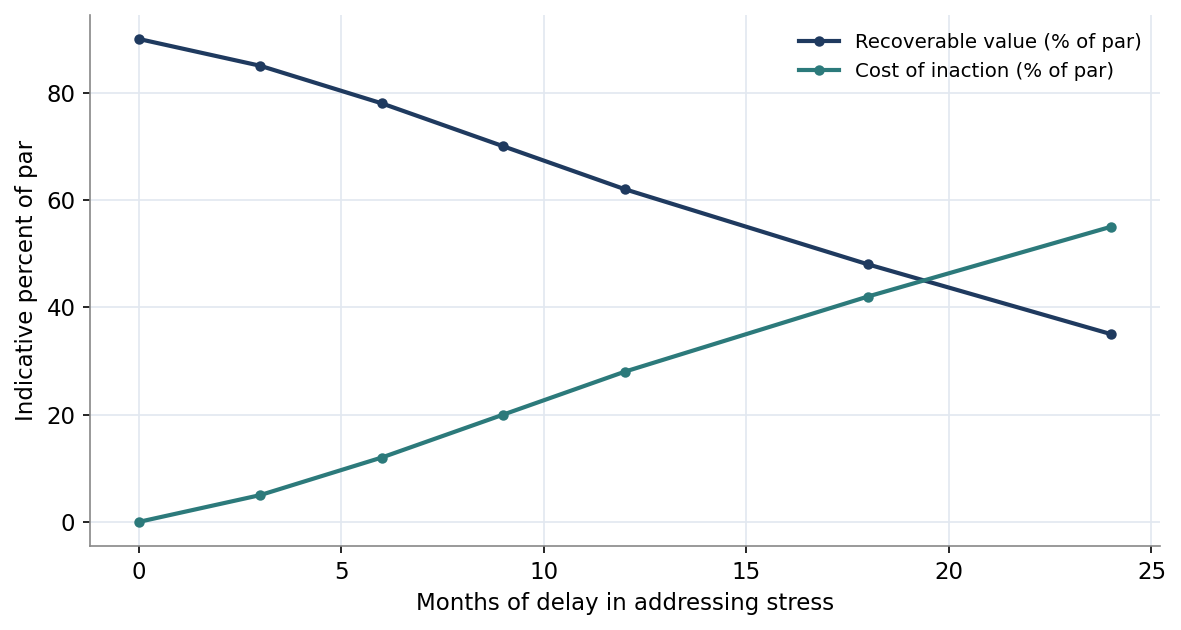
Figure 7. The Cost of Delay: Value Erosion and Cost of Inaction
Recoverable value falls and the cost of inaction rises with delay. Not a forecast.
Figure 7 returns to the central theme of the playbook, the cost of delay. It shows the recoverable value falling steadily with the months of delay in addressing the stress, while the cost of inaction rises, so that a sponsor that delays a year recovers far less than one that acts in the first months. This relationship is the quantitative heart of the playbook: it shows that the single most valuable action a stressed sponsor can take is to act early, because the value preserved by early action dwarfs the value preserved by any refinement of the recapitalisation structure. A sponsor that takes one lesson from this paper should take this one: act early, because delay destroys value faster than any structure can recover it.
Table 4. Scenario Matrix for Recovery
Indicative scenarios. Recovery falls sharply with delay and weak sales. Not a forecast.
Implementation Roadmap
Diagnose the stress honestly and rigorously, distinguishing a liquidity problem from a solvency problem and valuing the portfolio realistically, ideally with independent input.
Act early, recognising that the value recovered and the control retained both decline steeply with delay.
Stabilise first, securing a standstill, bridging critical liquidity and stopping value leakage, before attempting the fuller restructuring.
Engage the lenders early and honestly, presenting a credible plan that demonstrates their recovery is improved by cooperation rather than enforcement.
Attract new money with the priority it requires, recognising that early action secures it on better terms and with less dilution.
Choose between an asset-level and a portfolio-level approach according to the structure of the stress and the linkages in the existing financing.
Navigate the governance change constructively, preserving an operational role and an incentive where possible, and protect the sponsor reputation by treating all stakeholders fairly.
Conclusion
Stress is a normal part of the cyclical business of real estate development, and it is not the same as failure. This paper has set out a sponsor playbook for recapitalising stressed GCC development portfolios, built on three central lessons: that the cost of inaction rises steeply with delay, so early action preserves far more value than late; that the right recapitalisation depends on an honest diagnosis distinguishing a liquidity problem from a solvency one; and that a sponsor that acts proactively, stabilises before restructuring, engages its lenders honestly, attracts new money on the terms it requires, and navigates the governance change constructively, can frequently recover while retaining a meaningful stake and its reputation.
The playbook is framed throughout as a tool for value preservation rather than a counsel of despair, because a stressed but viable portfolio addressed early can usually be recovered, preserving value that a disorderly collapse would destroy. The sponsor that internalises the playbook, diagnosing honestly, acting early, following the sequence of triage, stabilisation, restructuring and recovery, and protecting its stakeholders and its reputation, gives itself the best chance of emerging from stress intact. And the sponsor that draws the deeper lesson, building resilience in good times and accepting stress as a recurring feature of the cycle to be prepared for, positions itself to endure where less prepared sponsors are destroyed. In a cyclical market, the capacity to navigate stress is as important as the capacity to grow in good times, and the playbook in this paper is intended to help sponsors build it.
Limitations and Directions for Further Research
This paper is framework-oriented and relies on indicative data, and its conclusions are directional rather than precise. The recovery figures, value-erosion curves and recapitalisation structures are calibrated to observable conditions but are not empirical estimates, and they vary with the severity of the stress, the quality of the portfolio and the market conditions. The legal and insolvency considerations are described in general terms and require specialist advice for any specific situation.
Several extensions would strengthen the analysis. An empirical study of recovery outcomes across a sample of GCC development recapitalisations, correlated with the timing of action and the tools used, would replace the indicative figures with data and test the central claim about the cost of delay. A detailed analysis of the regional insolvency and restructuring frameworks and how they shape recapitalisation outcomes would sharpen the legal dimension. And a study of how the regional special-situations capital market prices and structures rescue capital would illuminate the new-money terms that the playbook treats indicatively. Each is a natural subject for a later paper in this series.
| Scenario | Action timing | Sales recovery | Recovered value |
|---|---|---|---|
| Best case | Early | Strong | ~80% of par |
| Base | Prompt | Moderate | ~65% of par |
| Delayed | Late | Moderate | ~45% of par |
| Worst case | Very late | Weak | ~25% of par |
