

1. Start with cash that can be traced and controlled
The central financing question is how much verified cash a lender can expect to receive, when it should arrive, what can reverse it and who can redirect it. Gross merchandise value, booked revenue and point-of-sale authorisations are useful operating indicators. None is automatically the lender's collateral. The analysis should follow each transaction from customer order through authorisation, capture, fulfilment, settlement file, processor deduction, bank receipt, refund window and final dispute outcome.
A merchant may show strong sales while liquidity weakens. The causes can include longer settlement lags, an acquirer reserve, higher returns, fraud disputes, marketplace deductions, tax payments, supplier obligations or debt service swept before unrestricted cash becomes available. The same merchant may use multiple stores, legal entities, processors, currencies and bank accounts. A monthly general-ledger balance can conceal the daily movement.
The first diligence output should therefore be a transaction-to-cash lineage. A sample of orders should reconcile to processor identifiers, settlement batches and bank credits. Exceptions should have documented causes and owners. The lineage should distinguish contractual settlement timing from actual timing and should preserve negative entries, reversals and deductions.
This approach changes facility design. Availability is derived from cash evidence rather than narrative growth. Account control, data access and reporting become part of credit support. A lender can then test whether settlement cash remains sufficient after refunds, operating needs, taxes and prior claims.
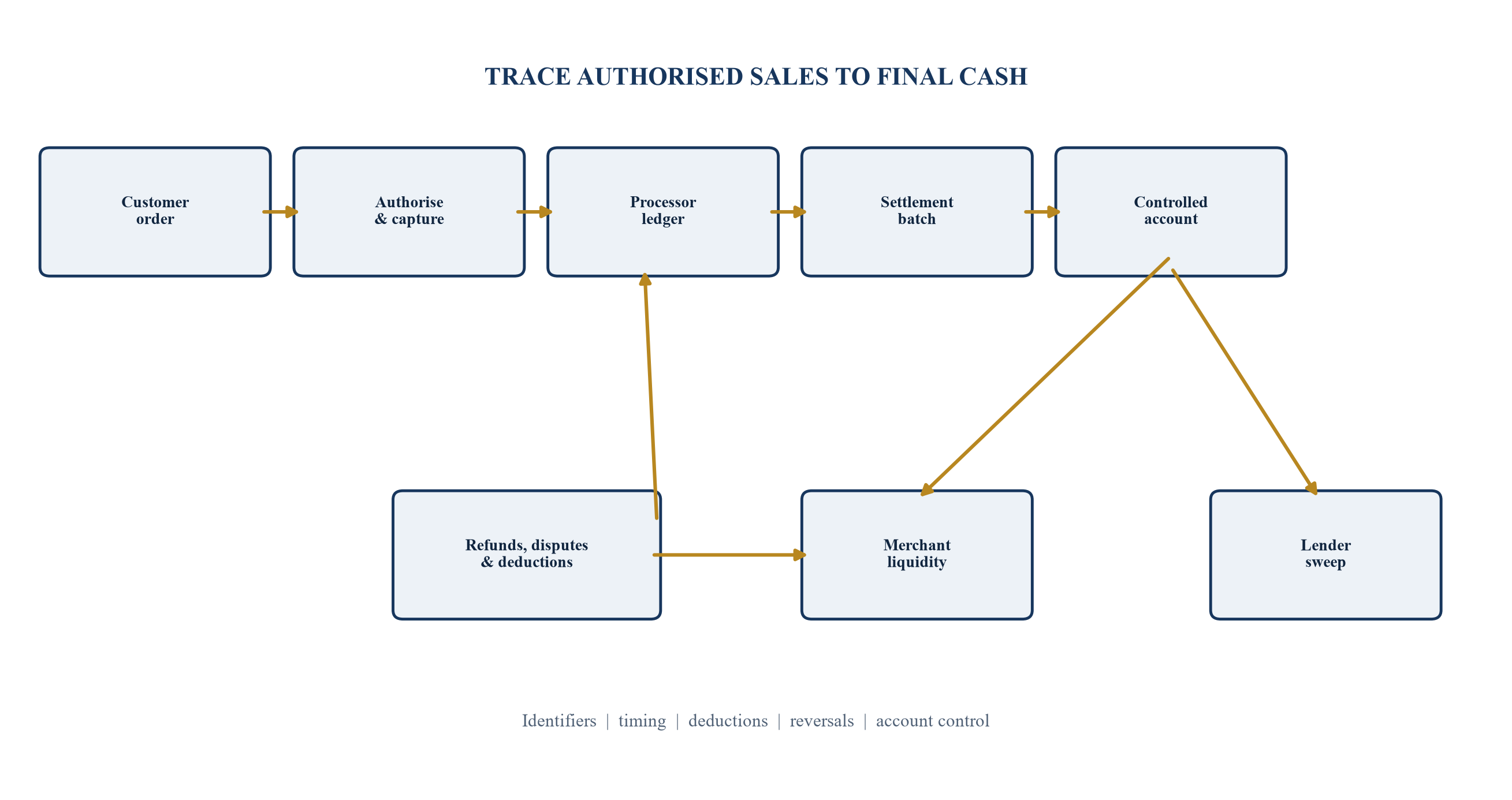
The map is an analytical control framework; the legal character and timing of each claim must be verified.
2. Separate the economic objects before valuing them
A consumer transaction creates several distinct economic objects. An authorised card transaction is permission to proceed, subject to network and issuer rules. A captured transaction may create a claim within a payment system. A fulfilled sale may create revenue and a customer obligation under the merchant contract. A processor settlement claim is a contractual claim against the acquirer, aggregator or platform. A bank credit is cash, potentially subject to account-bank rights. Each object has different evidence, timing and reversibility.
The facility should define which object is financed. A purchase of eligible receivables differs from a loan secured by receivables. A revenue-based advance repaid from future settlements can create a functionally debt-like obligation even where the contract uses different language. A lender should obtain jurisdiction-specific advice on assignment, perfection, priority, notification, set-off, commingling and enforcement.
UAE Federal Decree-Law No. 16 of 2021 defines factoring and transfers of current or future receivables and applies to transfers with or without recourse, subject to exclusions.[5] UAE Federal Law No. 4 of 2020 permits security rights over present and future accounts receivable and provides a registration-based framework for enforceability against third parties.[4] These statutes support analysis of receivable financing, while the exact treatment depends on the transaction and related laws.
The credit file should contain a legal-character matrix for every proposed collateral type. The matrix records origin, obligor, contract, assignability, governing law, control path, notice, priority, defences, set-off, dispute rights and enforcement route. Availability should remain zero until the evidence gate for that object is satisfied.
3. Build a complete settlement-source inventory
Consumer groups frequently operate more payment rails than treasury reporting reveals. The inventory should include store terminals, ecommerce gateways, wallets, marketplaces, delivery platforms, buy-now-pay-later providers, gift cards, loyalty credits, cash-on-delivery collectors, bank transfers and foreign-currency acquirers. It should capture each legal entity, merchant identifier, processor, contract, account, currency, fee schedule, settlement cycle, reserve, deduction right, refund path and data-access method.
The inventory should be tied to observed cash. Twelve months of settlement files and bank statements can establish the normal relationship between captured sales and net credits. Longer history is preferable where seasonal peaks, product launches or promotions matter. The lender should obtain read-only application-programming-interface access or controlled daily files where feasible, plus the right to preserve access after a trigger.
Processor concentration deserves explicit treatment. A single dominant acquirer may provide cleaner control and faster monitoring while creating termination, reserve and operational concentration. Multiple processors can reduce dependency while increasing reconciliation and redirection risk. The facility can use per-processor eligibility caps and a minimum controlled-share test.
Table 1. Settlement-source inventory and evidence map
| Source | Minimum evidence | Principal uncertainty | Facility response |
|---|---|---|---|
| card acquirer | merchant agreement, IDs, settlement files, bank receipts | reserve, chargeback and termination rights | controlled account, reserve and concentration cap |
| marketplace | seller terms, order and payout data, deduction statements | platform set-off, returns and account suspension | net-settlement eligibility and platform cap |
| wallet or aggregator | service contract, ledger export, bank mapping | commingling and intermediary credit | counterparty test and direct-data covenant |
| buy-now-pay-later | merchant contract, funding and refund files | deferred refunds and provider set-off | vintage reserve and separate reconciliation |
| cash-on-delivery | courier contract, collection files, deposit evidence | custody, delay and leakage | haircut, ageing limit and controlled deposits |
Availability should follow verified contracts, data and cash receipts for each source.
4. Reconcile the daily settlement equation
The daily settlement equation should explain the movement from captured value to cash received. A useful form is captured sales plus prior-period releases, less cancellations, refunds, chargebacks, processor fees, taxes withheld, reserves, platform commissions, promotional funding, foreign-exchange adjustments, financing deductions and other set-offs. Timing differences should be separated from permanent dilution.
The reconciliation should operate at transaction and batch levels. Batch-level matching provides daily control; transaction-level matching diagnoses exceptions and supports eligibility. Every unexplained variance should be aged. Repeated small variances can be more important than a single large operational break because they may reveal data mapping errors or contractual deductions outside treasury oversight.
A rolling bridge should compare expected settlement date with actual credit date. Weekends, public holidays and cross-border settlement cycles can create normal lags. An unexplained extension can indicate processor review, reserve action, operational failure or distress. The facility can measure the proportion settling within the contractual window and trigger investigation when it falls below an agreed threshold.
Automation helps only when identifiers and ownership remain controlled. The reconciliation engine should preserve original source files, transformation logic, exception logs, approval history and manual adjustments. Finance and treasury should sign off the daily control; credit should receive an exception dashboard.
5. Treat refunds, returns and chargebacks as a waterfall
Refunds and disputes are not one risk. A cancellation can occur before capture. A merchant refund follows the commercial relationship and may be paid before the related processor settlement. A chargeback reverses value through network procedures after an issuer dispute. A marketplace can deduct customer compensation under its seller rules. Each item has a different timing, evidential standard and recourse path.
IFRS 15 states that an entity recognising revenue for a product sold with a right of return should recognise revenue for the expected retained consideration, a refund liability and an asset for the right to recover products, updated at each reporting date.[6] This accounting treatment reinforces the financing need to separate the headline sale from the cash expected to remain.
Visa describes a dispute as a reversal of transaction value by the issuer to the acquirer and usually from the merchant bank to the merchant.[8] Visa and Mastercard publish detailed rules and merchant dispute materials, while the applicable obligations depend on region, product and contract.[9][10] A lender should use the merchant's actual network and acquirer rules, not a generic assumed window.
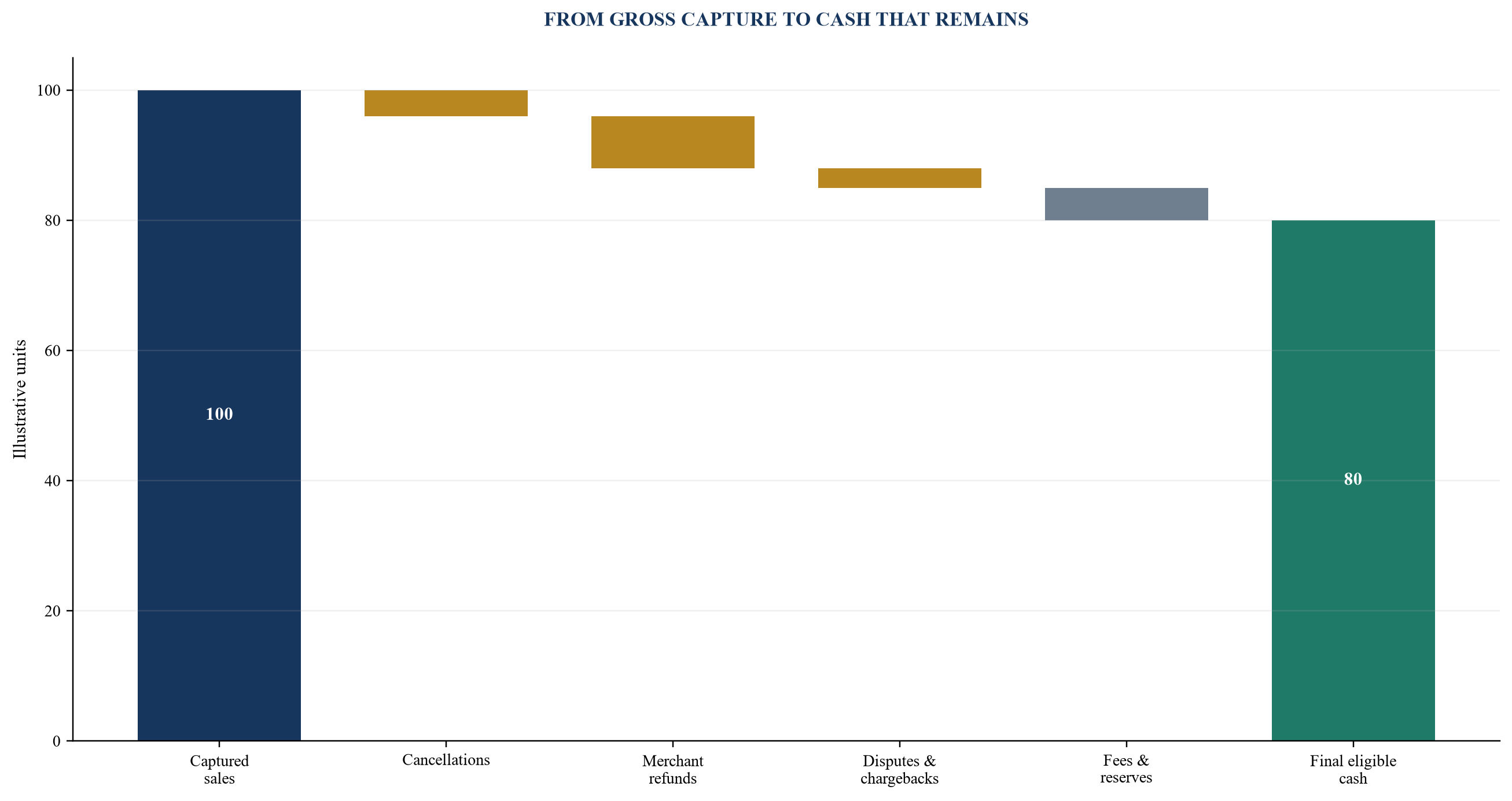
Percentages are hypothetical analytical assumptions and should be replaced with verified merchant history.
6. Measure dilution by cause and vintage
Dilution is the reduction between an eligible claim and cash ultimately retained for reasons other than obligor credit default. In POS finance, it can include returns, rebates, credits, pricing corrections, loyalty redemptions, fraud disputes, chargebacks, taxes, fees and platform deductions. A single aggregate percentage hides very different behaviours.
The lender should measure dilution by sale vintage, product, channel, processor, store, geography and reason code. Vintage analysis matters because a recent sales cohort may still be inside refund and dispute windows. A merchant growing rapidly can appear to have low dilution when the numerator contains immature sales and the denominator reflects later reversals from older cohorts.
Eligibility can use a stressed dilution reserve. The reserve should reflect observed mean, volatility, tail events, seasonality, channel mix and time to finality. A dynamic reserve can respond to recent changes while a floor protects against false comfort during growth. The calculation should avoid double counting where the advance rate already embeds a specific risk.
Root-cause governance belongs beside the metric. Rising refunds from product quality differ from fraud chargebacks or processor errors. The facility can require management remediation, channel caps or temporary exclusion rather than simply increasing price.
Table 2. Eligibility and dilution controls
| Risk driver | Measurement | Eligibility treatment | Escalation evidence |
|---|---|---|---|
| refunds | value by sale vintage and product | reserve through refund window | return reason, recovery value and policy change |
| chargebacks | count and value by reason code | trailing and stressed reserve | fraud control, representment and network status |
| processor reserve | withheld and released cash | exclude until released | contract, reserve notice and release history |
| platform deductions | deduction type and ageing | finance net claim only | seller statement and disputed deduction log |
| settlement delay | expected versus actual days | ageing haircut or exclusion | batch trace and counterparty explanation |
Thresholds and haircuts are hypothetical and require verified historical calibration.
7. Define eligibility as a sequence of evidence gates
Eligibility should be a sequence rather than a percentage applied to gross sales. The transaction must be genuine, captured and fulfilled. The claim must belong to the financing entity, arise under an eligible contract, be supported by required data, settle into a controlled account, remain within ageing limits, avoid prohibited concentration and carry no known dispute, refund, fraud or prior-financing flag.
The lender should distinguish ineligible from temporarily pending. A sale awaiting fulfilment may become eligible later. A disputed transaction may return to eligibility after final resolution, depending on documentation. A claim under a terminated processor contract may require exclusion even if the underlying customer sale was valid.
Negative eligibility is equally important. Refund liabilities, processor reserves and chargebacks can exceed current positive settlements. The borrowing base should carry these obligations forward rather than reset daily. A merchant cannot create artificial availability by shifting new sales to one processor while reversals remain at another.
Evidence gates should be machine-testable where possible and independently sampled. Manual overrides need named authority, reason, expiry and performance tracking. Repeated overrides indicate a rule or data problem and should be reported to the lender.
8. Set advance rates from loss, volatility and control
The advance rate should reflect how much of eligible settlement cash can be funded while protecting against timing, dilution, operational and legal uncertainty. Historical net settlement is a starting point. The lender should apply stresses for refund tails, chargeback spikes, processor reserves, delayed settlement, concentration, sales shocks, data interruption and account-control failure.
A higher advance rate can be supported by short settlement periods, strong data, low and stable dilution, diversified processors, controlled accounts and rapid stop-funding. Longer dispute windows, immature vintages, volatile returns or uncertain priority call for lower availability or larger reserves. Price does not substitute for a weak control structure.
The facility should define a maximum commitment, an availability amount and a permitted draw. A minimum liquidity reserve may reduce the permitted sweep even where collateral is sufficient. This prevents a structure that extracts cash required to buy inventory, pay staff, fund refunds or deliver existing orders.
Table 3. Hypothetical borrowing-base calculation
| Step | Amount | Treatment | Rationale |
|---|---|---|---|
| captured eligible sales | 100.0 | starting pool | verified capture and fulfilment |
| pending finality | (8.0) | exclude | immature refund and dispute period |
| dilution reserve | (7.0) | deduct | stressed returns, credits and chargebacks |
| processor and channel concentration | (5.0) | deduct | exposure above approved caps |
| net eligible settlement | 80.0 | collateral base | cash expected after defined adjustments |
| advance rate | 70% | apply | calibrated to volatility and controls |
| preliminary availability | 56.0 | calculated | before senior claims and liquidity reserve |
| prior claims and required liquidity | (16.0) | deduct | debt service, reserve and operational cash |
| permitted draw | 40.0 | final | subject to commitment and trigger tests |
Amounts are illustrative analytical assumptions in currency units and do not represent a proposed facility.
9. Make seasonality explicit
Seasonality can increase sales, refunds, inventory commitments, advertising spend and settlement pressure at different times. Ramadan, Eid, year-end holidays, tourism cycles, school periods and major promotions can affect GCC consumer businesses, but the direction and magnitude vary by category and geography. A single trailing average can misstate the financing need.
The model should use weekly or daily history by channel and product, with at least one full seasonal cycle where available. It should compare bookings, fulfilment, captures, refunds, net settlements, inventory purchases, payroll, tax and debt service. The objective is to identify the lowest cash point, not merely the highest sales point.
A seasonal facility can use a temporary commitment step-up subject to pre-agreed evidence. The advance rate may remain stable while reserves rise for immature peak-season cohorts. Alternatively, the commitment can stay fixed and the borrower prefunds a refund reserve. Both structures require a clear step-down after the season.
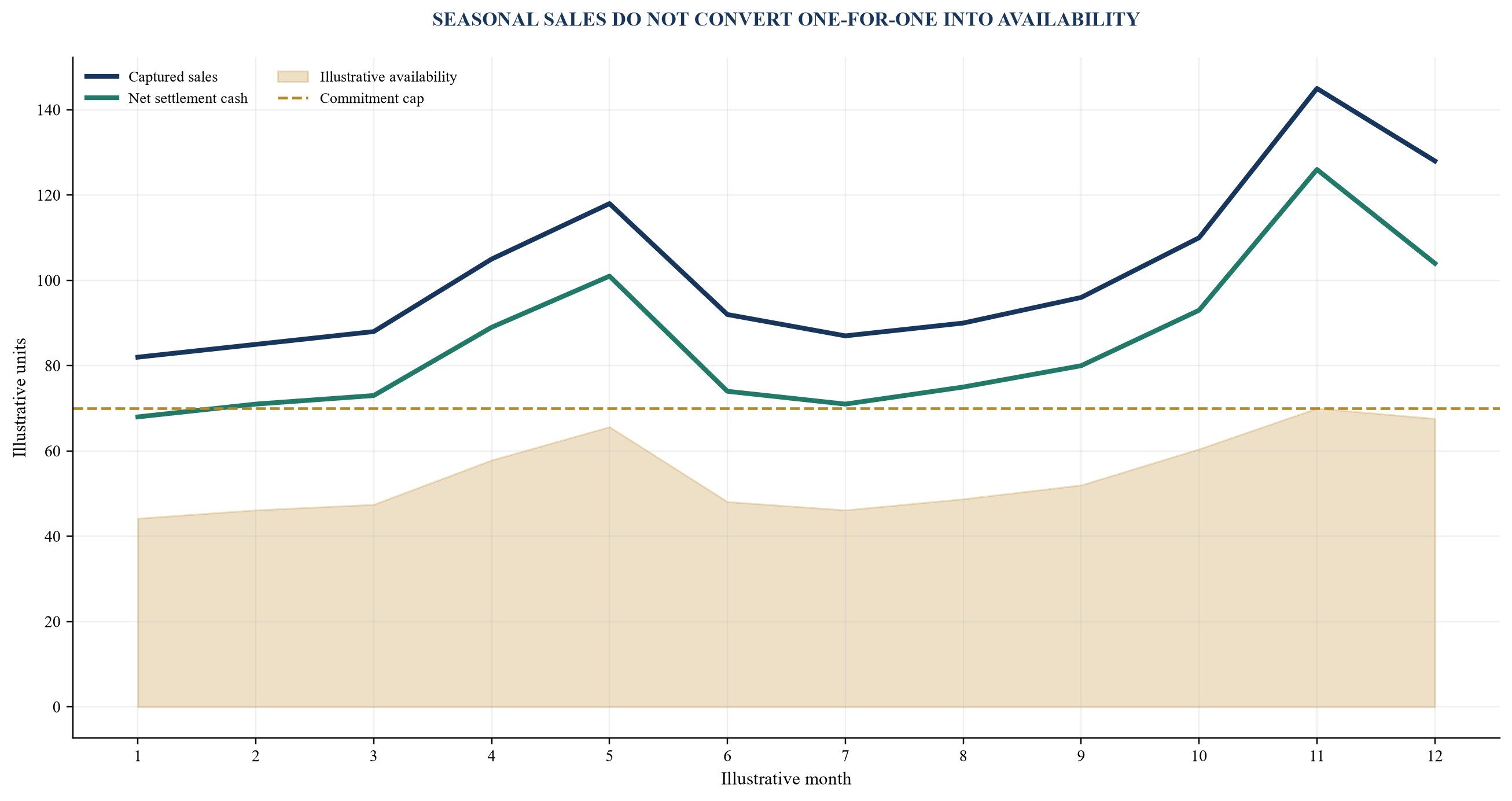
Values are hypothetical analytical assumptions designed to illustrate timing differences.
10. Reconcile every existing and debt-like obligation
The debt blind spot arises when obligations are recorded outside a conventional loan schedule. A merchant may have bank facilities, shareholder loans, leases, supplier finance, inventory finance, marketplace advances, processor-based advances, revenue-share instruments, buy-now-pay-later settlement deductions, tax arrears, guarantees and cash-pooling balances. Some may have recourse to the same settlement cash.
The reconciliation should begin with legal-entity bank statements, general ledgers, credit registers where available, processor contracts, platform statements, supplier terms, lease schedules, board papers and management representations. Cash deductions should be traced back to contracts. A recurring settlement deduction with no ledger debt is a priority and leverage warning.
The schedule should record creditor, borrower, guarantor, committed amount, drawn amount, currency, maturity, repayment, pricing, security, account rights, covenants, default, cross-default, set-off and change-of-control terms. Contingent liabilities and undrawn commitments should remain visible.
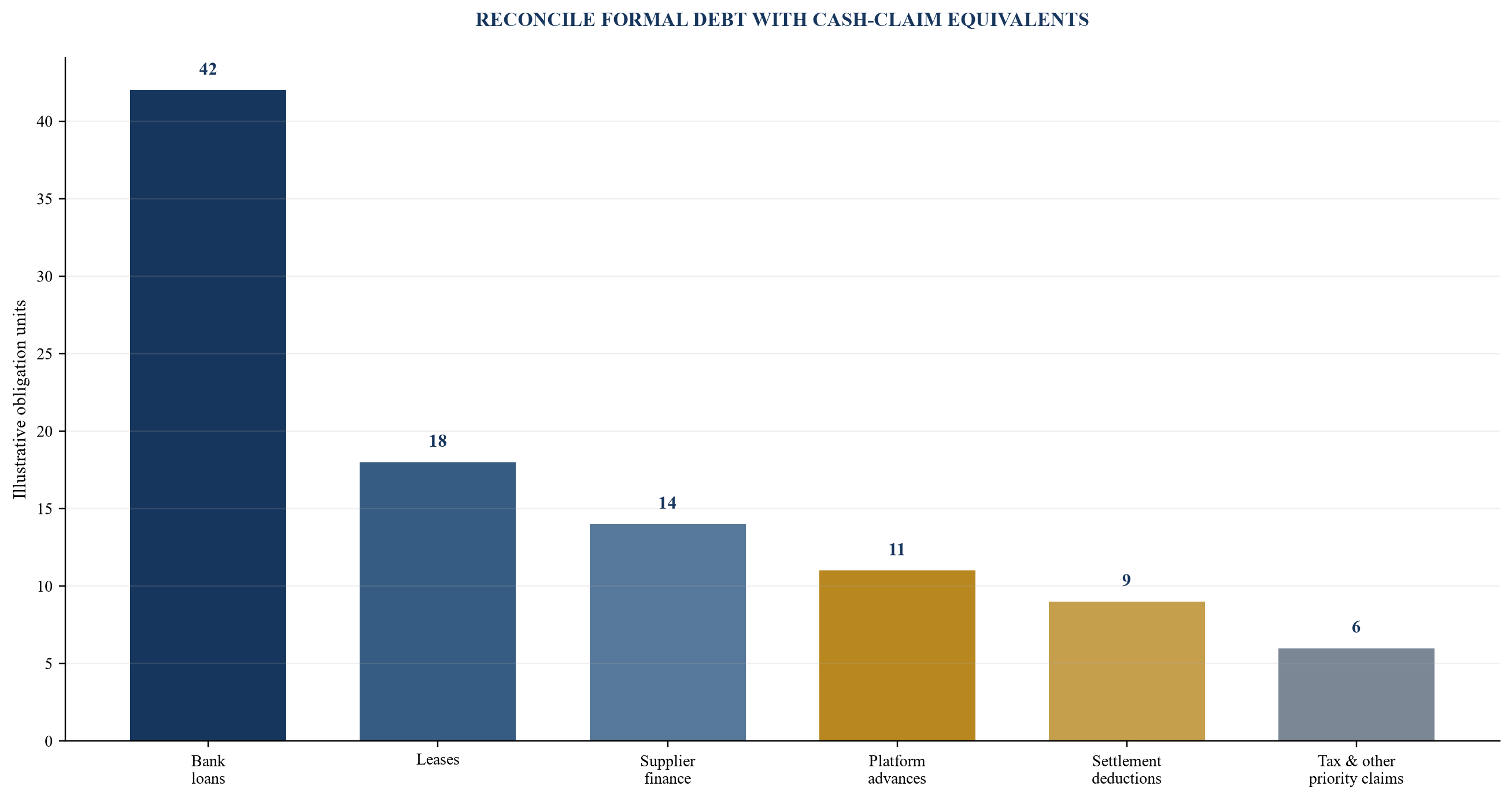
Amounts are hypothetical analytical assumptions and categories require contract-level verification.
11. Establish account control and cash dominion
Data visibility cannot replace control over cash. The lender should verify where each processor can send settlement, how account instructions can be changed, what notice is required and whether the account bank has prior rights. A controlled collection account can receive eligible settlements, preserve operating liquidity and apply an agreed waterfall.
The account arrangement should address authentication, dual approval, processor notification, bank acknowledgment, permitted withdrawals, sweeps, reserves, blocked-account triggers and post-default control. It should also cover currencies and local restrictions. A structure that depends on an informal promise not to redirect cash is fragile.
Commingling should be measured. If controlled accounts contain unrelated receipts, taxes or third-party funds, the lender needs identification and release rules. Where direct control is unavailable, eligibility and advance rate should reflect the weaker position and monitoring should detect redirection quickly.
12. Test legal transfer, perfection and priority
Receivable finance can fail through legal gaps even when the cash history is strong. The lender should confirm that the financing entity owns the relevant claim, the contract permits transfer or security, required notices and registrations are completed, priority is established and enforcement can reach proceeds. Choice of law, debtor location, processor location and bank-account location may differ.
UNCITRAL's Model Law on Secured Transactions uses a functional approach across tangible and intangible movable assets, including receivables and bank accounts, and supports notice registration as a basis for third-party effectiveness and priority.[11][12] It is a model framework rather than proof of local law. The operative analysis must use the law of each relevant jurisdiction.
The UAE framework includes receivables within movable security and addresses transfer of current and future receivables.[4][5] The lender should still examine excluded claims, anti-assignment clauses, set-off, debtor defences, proceeds, control agreements and competing registrations. A legal memorandum should connect each conclusion to the exact transaction documents.
13. Evaluate processor and platform counterparty risk
Settlement cash is exposed to the entity that receives customer funds before the merchant. The diligence team should identify whether that entity is a licensed acquirer, payment-service provider, aggregator, marketplace or other intermediary; which legal entity contracts with the merchant; and where funds are held. Regulatory status does not remove commercial, operational or contractual risk.
CBUAE's retail-payment regulation covers merchant acquiring and payment aggregation and sets licensing and supervisory requirements in the UAE.[1][2] Saudi Arabia's implementing rules govern payment services and provider licensing under its national framework.[3][13] Other GCC markets have their own payment laws and supervisory regimes, so the facility should maintain a jurisdiction matrix.
Counterparty monitoring can include licensing status, contract termination, reserve changes, settlement punctuality, service outages, fraud alerts, disputes and concentration. Eligibility should cease if data access or settlement performance falls outside agreed tolerances. A replacement processor plan supports continuity.
14. Align accounting, tax and financing data
Revenue, receivables, processor settlements and taxable supplies can follow different recognition and timing rules. The financing model should reconcile them without using one as a substitute for another. Sales with returns may create a refund liability under IFRS 15.[6] Trade receivables within IFRS 9 may require lifetime expected-credit-loss measurement under the simplified approach, with a provision matrix adjusted for current and forward-looking information.[7][14]
The facility should reconcile the borrowing base to the general ledger, while preserving the transaction-level evidence that determines eligibility. Accounting provisions are useful context and may differ from financing reserves because objectives and horizons differ. Tax liabilities should be identified separately and paid from an agreed waterfall.
True-sale, derecognition, continuing involvement, presentation and disclosure require qualified accounting analysis. The paper does not prescribe an accounting outcome. The lender should require the borrower and auditor to document the adopted treatment and notify changes.
15. Design the repayment waterfall around operating continuity
A controlled waterfall should preserve the business that creates the receivables. Net settlement cash can first fund statutory or trust obligations, approved refunds and chargebacks, minimum operating liquidity, scheduled lender payment, reserves and then unrestricted distributions. The order depends on law, account arrangements and credit design.
An aggressive daily sweep can create a self-defeating facility. If the merchant cannot replenish inventory or honour refunds, sales and customer trust may fall. The financial model should estimate cash conversion by category and maintain a minimum operating buffer linked to inventory lead times, payroll and fulfilment obligations.
Repayment can be fixed, percentage-based or availability-driven. A percentage of net settlements aligns payment with volume while extending tenor in a downturn. A fixed amortisation schedule provides certainty while increasing liquidity risk. The chosen structure should be stress-tested under sales, margin and dilution shocks.
16. Convert risk into covenants and reporting
Covenants should use data the borrower can produce accurately and the lender can verify. Useful measures include controlled-settlement share, settlement punctuality, net dilution, chargeback rate, refund reserve coverage, processor concentration, minimum liquidity, fixed-charge coverage, total debt and data-delivery timeliness.
Definitions matter more than quantity. Each covenant should specify numerator, denominator, source system, cut-off, currency treatment, exclusions, correction process and testing frequency. A breach should map to a proportionate response such as information, reserve increase, reduced advance rate, stop-funding or cash dominion.
Reporting should distinguish a certified borrowing-base calculation from a management dashboard. The certificate determines contractual availability and should be signed by an authorised officer. The dashboard can contain faster estimates, forecasts and operational indicators. Differences between the two should be reconciled and explained. A provisional daily certificate may use processor data before bank settlement, followed by a true-up when cash arrives.
Metric governance prevents silent definition drift. A chargeback ratio can use transaction count or value; captured sales or settled sales; current disputes or final losses. A controlled-settlement share can be measured against eligible channels or total group sales. The facility should state the selected definition and preserve enough detail to reproduce it. Changes should require documented approval and parallel reporting for an agreed period.
The reporting calendar should match risk speed. Daily reports can cover captured sales, expected settlements, bank credits, redirection, refunds, disputes and availability. Weekly reports can cover vintage dilution, channel mix, processor concentration and exceptions. Monthly reports can add financial statements, total debt, tax, inventory, covenant calculations and a rolling cash forecast. Immediate notices should cover processor suspension, reserve action, cyber incident, material fraud, new debt and account changes.
Independent verification should be risk-based. The lender can sample transaction lineage, compare processor files with direct portal access, obtain bank confirmations, inspect contracts and engage an auditor or field examiner. Verification frequency can increase with growth, exception rates or weaker controls. The scope should respect data protection and payment-security requirements.
Remedies should preserve a path to cure. A late file caused by a documented system outage may warrant a short cure period and temporary reserve. Settlement redirection or undisclosed senior debt can justify immediate stop-funding. The documents should define authority and communications so action is timely and consistent.
Table 4. Covenant and reporting architecture
| Measure | Frequency | Evidence | Illustrative response |
|---|---|---|---|
| controlled-settlement share | daily | processor files and bank credits | exclude redirected channels; stop funding if persistent |
| net dilution and chargebacks | weekly by vintage | transaction and dispute ledgers | increase reserve; cap affected channel |
| settlement punctuality | daily | expected-to-actual batch bridge | counterparty review and temporary haircut |
| minimum liquidity | daily or weekly | controlled and operating accounts | restrict sweep or distributions |
| total debt and prior claims | monthly and on change | ledger, contracts and confirmations | block new debt; recalculate availability |
| data delivery and reconciliation | daily | signed control report and exceptions | cure period followed by stop-funding |
Thresholds should be calibrated to verified history, stress tests and applicable regulation.
17. Use early-warning indicators before cash fails
The strongest signals often appear before a payment default. They include a rise in cancelled orders, slower fulfilment, higher refund requests, changing product mix, processor reserve notices, settlement delays, more manual adjustments, bank-account changes, declining controlled share, unusual night or foreign transactions, supplier holds and tax arrears.
Indicators should be linked to owners and response times. A data anomaly can reflect mapping failure or genuine deterioration; both require action. The monitoring team should compare daily signals with weekly operating explanations and monthly financial statements.
The lender can maintain green, amber and red states. Amber can increase reporting, restrict affected eligibility and require a remediation plan. Red can stop new funding, increase cash control and activate independent review. Automatic actions should remain consistent with contract and law.
18. Stress the facility as a connected system
Single-variable sensitivities are insufficient because consumer stress often combines. A sales decline can coincide with greater discounting, lower margin, higher refunds, slower inventory turnover and a processor reserve. A cyber incident can stop sales, trigger disputes and interrupt data access. A regulatory issue can affect one processor while the merchant redirects volume.
The stress model should cover base, downside and severe scenarios with transparent assumptions. It should calculate eligible settlements, reserves, availability, operating cash, lender repayment and liquidity runway. Reverse stress testing should identify the combination that causes a covenant or payment failure.
The output should change documentation. If the structure fails when one processor holds a reserve, the facility may need a concentration cap, backup processor, additional cash reserve or lower commitment. If a refund spike creates the first failure, the reserve and monitoring window should be redesigned.
Consider a hypothetical multi-channel retailer that records 1,200 units of annual captured sales. Seventy per cent is card-acquired, twenty per cent flows through marketplaces and ten per cent is collected through other channels. Reported earnings are positive, yet year-end cash is weak because inventory purchases precede the peak season and refunds mature after it. The borrower seeks a 120-unit revolving facility secured by payment receivables.
The first reconstruction finds that only 900 units of captured sales settled into accounts owned by the borrowing entity. A marketplace contract belongs to an affiliate, one foreign-currency acquirer pays a group treasury account and cash-on-delivery receipts are commingled with third-party collections. The initial eligibility perimeter excludes these flows. The result demonstrates why group revenue cannot be used as the opening collateral pool.
Within the 900-unit perimeter, processor files show 72 units of refunds, 18 units of chargebacks, 36 units of fees and 14 units of reserves. Timing analysis finds that ordinary card settlements arrive in two business days, while marketplace payouts can take nine days and may include returns from earlier periods. The lender builds separate curves by channel and sale vintage. Recent peak-season sales receive a larger refund reserve because their return window remains open.
Debt reconciliation identifies 48 units of bank borrowing, 22 units of leases, 16 units of supplier finance and 12 units of platform advances repaid through settlement deductions. Management's original debt schedule included only the bank facility. The adjusted model treats the other obligations according to their verified cash claims, security and accounting characteristics. This avoids an unsupported assumption that every non-bank instrument ranks behind the proposed lender.
The base case assumes stable sales, observed dilution and normal settlement. The downside case reduces sales by twenty per cent, lowers gross margin through discounting and increases refunds by four percentage points. The severe case adds a processor reserve equal to two weeks of settlements, a three-day payout delay and a temporary interruption in marketplace data. These percentages and outcomes are hypothetical analytical assumptions; an actual calibration must use verified history and documented management actions.
Under the hypothetical base case, a 70 per cent advance against net eligible settlement supports a 92-unit peak draw after reserves and minimum liquidity. The requested 120-unit commitment is therefore larger than evidence supports. The downside case supports 61 units, while the severe case requires stop-funding and controlled cash application. The lender may approve a smaller commitment with a seasonal accordion available only when eligibility, liquidity and data gates pass.
The worked case also changes covenant design. A conventional leverage ratio would react slowly because monthly earnings and debt balances do not reveal daily settlement deterioration. Controlled-settlement share, refund-vintage development, processor reserve notices and settlement punctuality provide earlier signals. Total debt remains a monthly test, supplemented by an event-driven obligation update whenever a new platform or supplier arrangement is signed.
Finally, the case establishes management actions. The retailer moves the foreign-currency acquirer to an eligible account, transfers the marketplace contract to the appropriate operating entity subject to legal approval, closes unidentified settlement deductions and builds a daily exception queue. These changes improve financeability through evidence and control. They do not guarantee repayment or eliminate commercial risk.
The stress process should be rerun after material changes in product mix, processor concentration, refund policy, promotion calendar or debt structure. Results should be compared with actual cash after each month and seasonal event. Persistent variance should change availability, reserves or the operating plan rather than remain a model explanation.
19. Control fraud and financial-crime exposure
POS data can be manipulated through fabricated sales, related-party transactions, circular purchases, refund abuse, account takeover, synthetic identities and collusion. Financing can amplify the harm when availability is created before transactions become final. The lender should combine transaction validation with borrower, merchant, processor and beneficial-ownership diligence.
Controls can test device, terminal, geography, basket, timing, repeated card, refund destination, fulfilment and related-party patterns. Alerts should be investigated rather than treated as proof. The lender should understand the regulated institution's anti-money-laundering duties and information-sharing constraints.
FATF's Recommendations provide the international framework for risk-based anti-money-laundering and counter-terrorist-financing controls, while its June 2026 plenary highlighted payment transparency, fraud and public-private information sharing.[15][16] Local law and regulated-entity obligations determine the required programme.
20. Protect data quality, security and continuity
The facility relies on continuous data from processors, gateways, bank accounts and enterprise systems. Contracts should define access rights, permitted use, retention, security, service levels and transition support. The borrower should maintain an inventory of data sources, interfaces, transformations and owners.
Daily controls should test completeness, duplicates, sequence, timestamps, currency, identifier integrity and reconciliation totals. A system migration or processor change should require parallel testing before new data enters the borrowing base. Manual files need controlled templates and approvals.
Cyber resilience belongs in the credit structure because an incident can interrupt sales, corrupt evidence or redirect cash. The contingency plan should provide alternate data delivery, account verification, stop-funding authority and restoration testing. Data failure should reduce availability until evidence is restored.
21. Govern exceptions and changes
Consumer businesses change quickly. New channels, stores, products, processors, jurisdictions and promotions can alter the collateral profile. The facility should define which changes require notice, testing, lender consent or revised eligibility. An acquisition should not enter the borrowing base automatically.
Exceptions should be time-bound and visible. Each should record rule, reason, amount, approver, expiry, compensating control and outcome. Exception volume and performance should be reported. Persistent exceptions indicate that the policy is inaccurate or the business has moved outside the original credit case.
Change governance should include technology releases that affect transaction identifiers, refund workflows or settlement accounts. A small systems change can break reconciliation even when sales remain strong.
22. Structure lender rights for deterioration and enforcement
Rights should be exercisable before collateral disappears. The documents can provide information access, account control, processor notification, reserve adjustments, eligibility changes, stop-funding, cash dominion, audit, replacement servicing and enforcement, subject to law. The trigger ladder should be objective and proportionate.
Enforcement planning should test operational reality. Can the lender continue receiving settlement cash? Can processor instructions be changed? Are refunds and customer obligations funded? Are data and credentials available? Can a business sale preserve value? A theoretical security right has limited value without an executable cash and operations plan.
The lender should distinguish a temporary control event from acceleration. This preserves flexibility while protecting cash. Legal advice should confirm insolvency, set-off, avoidance, consumer and payment-system issues.
23. Connect the facility to valuation and strategic flexibility
A well-controlled settlement facility can support inventory, marketing and expansion while reducing dependence on unsecured cash. Its strategic value depends on incremental gross profit after financing cost, reserves, required liquidity and operational constraints. Management should evaluate it against bank working capital, factoring, asset-based lending, equity and supplier terms.
The transaction model should show how the facility affects net debt, cash conversion, covenant headroom and future refinancing. A short-term liquidity gain can reduce strategic flexibility if broad security, exclusivity, prepayment cost or change-of-control terms constrain a later financing or sale.
Board approval should therefore include a sources-and-uses case, downside repayment, all-in cost, priority map and exit path. The facility should serve a defined operating objective rather than fund structural losses without remediation.
24. Execute through a 100-day control programme
Implementation should move from evidence to controlled funding. The first phase maps entities, processors, accounts, contracts, obligations and data. The second reconciles historical transactions, defines eligibility and calibrates reserves. The third implements account control, reporting, documentation and trial calculations. The final phase funds only after exceptions are closed or explicitly approved.
Table 5. One-hundred-day implementation plan
| Period | Workstream | Required output | Funding gate |
|---|---|---|---|
| days 1-20 | perimeter and evidence | entity, processor, account, debt and contract maps | complete source inventory |
| days 21-45 | cash reconstruction | twelve-month transaction-to-bank reconciliation and dilution vintages | unexplained variance within approved tolerance |
| days 46-65 | legal and structural | transfer, security, priority, account control and waterfall documents | signed and perfected package |
| days 66-85 | systems and policy | daily borrowing base, exception workflow, reserves and covenant dashboard | parallel-run accuracy |
| days 86-100 | close and monitor | opening certificate, data access, control notices and response playbook | verified conditions precedent |
Timing is illustrative and should reflect system access, legal complexity and data quality.
25. Operate a decision dashboard with capital gates
The dashboard should answer five questions each day. How much eligible settlement cash exists? What can reverse or dilute it? Which creditors or counterparties can claim it first? How much operating cash must remain? Which evidence or trigger changes funding today?
The dashboard should show gross capture, fulfilment, net settlement, refund and chargeback vintages, processor reserves, controlled share, prior claims, liquidity, borrowing base, drawings and headroom. Trends and exception age matter alongside point estimates. Every number should link to a source and owner.
Management and the lender should review the dashboard at an agreed cadence and record decisions. The review should identify failed gates, unresolved exceptions, upcoming seasonal demands, data changes and actions due before the next funding request. A concise decision log creates accountability and supports later testing of whether controls worked as intended. It also prevents informal explanations from replacing source evidence when the facility is under pressure.
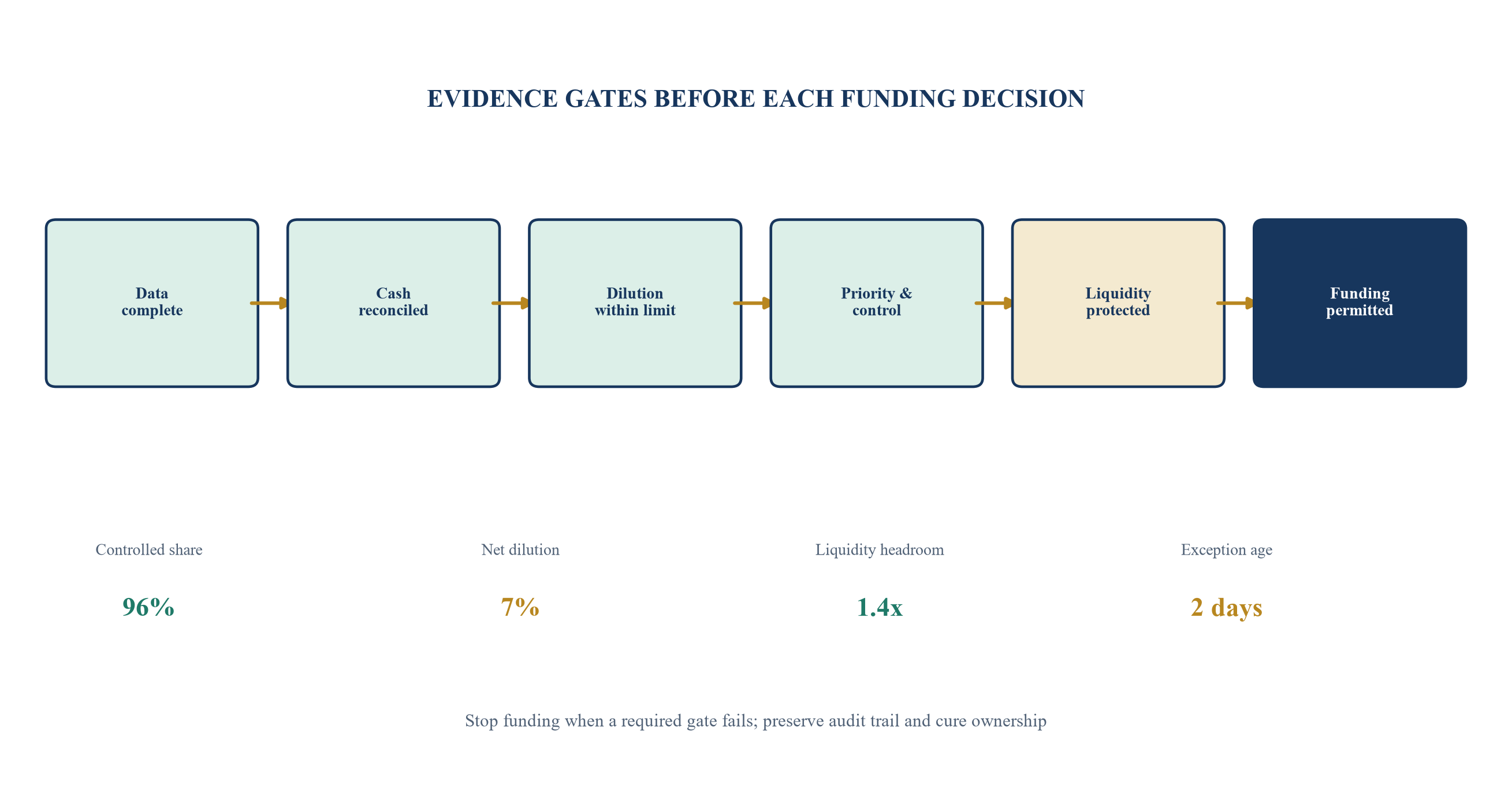
Colours and thresholds are illustrative; actual limits require verified calibration and legal documentation.
The funding decision should require all critical gates to pass. Amber conditions can reduce availability or increase reserves. A failed control, missing data or unresolved cash redirection should stop new funding until cured. This discipline keeps facility growth tied to evidence.
Conclusion
Receivables and POS finance can convert frequent consumer-payment flows into useful working capital. Its reliability depends on disciplined separation of sales, receivables, settlement claims and final cash. A lender should finance only verified eligible cash after deductions for refunds, disputes, reserves, concentration, timing and prior claims.
The framework in this paper joins transaction data, accounting, legal rights, operating liquidity and debt reconciliation. It makes seasonality visible, brings embedded obligations into the leverage picture and converts deterioration into measurable capital gates. The resulting structure can support growth while preserving the information and control required for responsible credit.
References
- Central Bank of the UAE. Retail Payment Services and Card Schemes Regulation. https://rulebook.centralbank.ae/en/rulebook/312-retail-payment-services-and-card-schemes-regulation
- Central Bank of the UAE. Retail Payment Services and Card Schemes Regulation, full rulebook text. https://rulebook.centralbank.ae/en/entiresection/1580
- Saudi Central Bank. Implementing Regulations of the Payments and Payment Services Law. https://rulebook.sama.gov.sa/en/implementing-regulations-payments-and-payment-services-law
- United Arab Emirates. Federal Law No. 4 of 2020 Regarding Securing the Rights in Movables. https://uaelegislation.gov.ae/en/legislations/1446
- United Arab Emirates. Federal Decree-Law No. 16 of 2021 on Factoring and Transfer of Receivables. https://uaelegislation.gov.ae/en/legislations/1515
- IFRS Foundation. IFRS 15 Revenue from Contracts with Customers, paragraphs -. https://www.ifrs.org/content/dam/ifrs/publications/pdf-standards/english/2024/issued/part-a/ifrs-15-revenue-from-contracts-with-customers.pdf?bypass=on
- IFRS Foundation. IFRS 9 Financial Instruments. https://www.ifrs.org/issued-standards/list-of-standards/ifrs-9-financial-instruments/
- Visa. Dispute Resolution. https://www.visa.com/en-us/support/business/dispute-resolution
- Visa. Visa Core Rules and Visa Product and Service Rules, public edition. https://bd.visa.com/dam/VCOM/download/about-visa/visa-rules-public.pdf
- Mastercard. Rules and merchant chargeback guidance. https://www.mastercard.us/en-us/business/overview/support/rules.html
- UNCITRAL. Model Law on Secured Transactions (2016). https://uncitral.un.org/en/texts/securityinterests/modellaw/secured_transactions
- UNCITRAL. Legislative Guide on Secured Transactions. https://uncitral.un.org/en/texts/securityinterests/legislativeguides/secured_transactions
- Saudi Central Bank. Payment Systems and Payment Services Providers circulars. https://rulebook.sama.gov.sa/en/payment-systems-and-payment-services-providers-circulars
- IFRS Foundation. Post-implementation Review of IFRS 9 Impairment; Request for Information. https://www.ifrs.org/content/dam/ifrs/project/pir-9-impairment/rfi-iasb-2023-1-ifrs9-impairment.pdf
- Financial Action Task Force. The FATF Recommendations. https://www.fatf-gafi.org/en/publications/Fatfrecommendations/Fatf-recommendations.html
- Financial Action Task Force. Outcomes of FATF Plenary, 17-19 June 2026. https://www.fatf-gafi.org/en/publications/Fatfgeneral/outcomes-fatf-plenary-june-2026.html
- Committee on Payments and Market Infrastructures. Fast payments: enhancing the speed and availability of retail payments. https://www.bis.org/publications/fast-payments-enhancing-speed-and-availability-retail-payments
- Saudi Central Bank. Monthly Bulletin Statistics, June 2026. https://sama.gov.sa/en-US/Statistics/Pages/MonthlyStatistics.aspx
- Central Bank of the UAE. Large Value and Retail Payment Systems Regulations. https://rulebook.centralbank.ae/en/rulebook/313-large-value-and-retail-payment-systems-regulations
- Central Bank of the UAE. Article 18, Card Schemes. https://rulebook.centralbank.ae/en/rulebook/article-18-card-schemes
- United Arab Emirates. Cabinet Resolution No. 29 of 2021 on the Executive Regulations of Federal Law No. 4 of 2020. https://www.uaelegislation.gov.ae/en/legislations/1487
- UNCITRAL. United Nations Convention on the Assignment of Receivables in International Trade. https://uncitral.un.org/en/texts/securityinterests/conventions/receivables
