Introduction
A completed apartment that has not been sold is, from a developer perspective, a paradox: it is simultaneously the most valuable and the least useful asset on the balance sheet. It is valuable because it is finished, saleable and worth its full retail price; it is useless because, until it is sold, it generates no liquidity, ties up the capital that built it, and costs money to hold. A developer with a tower of unsold units is rich on paper and poor in cash, and that gap between paper wealth and cash poverty is the problem this paper addresses.
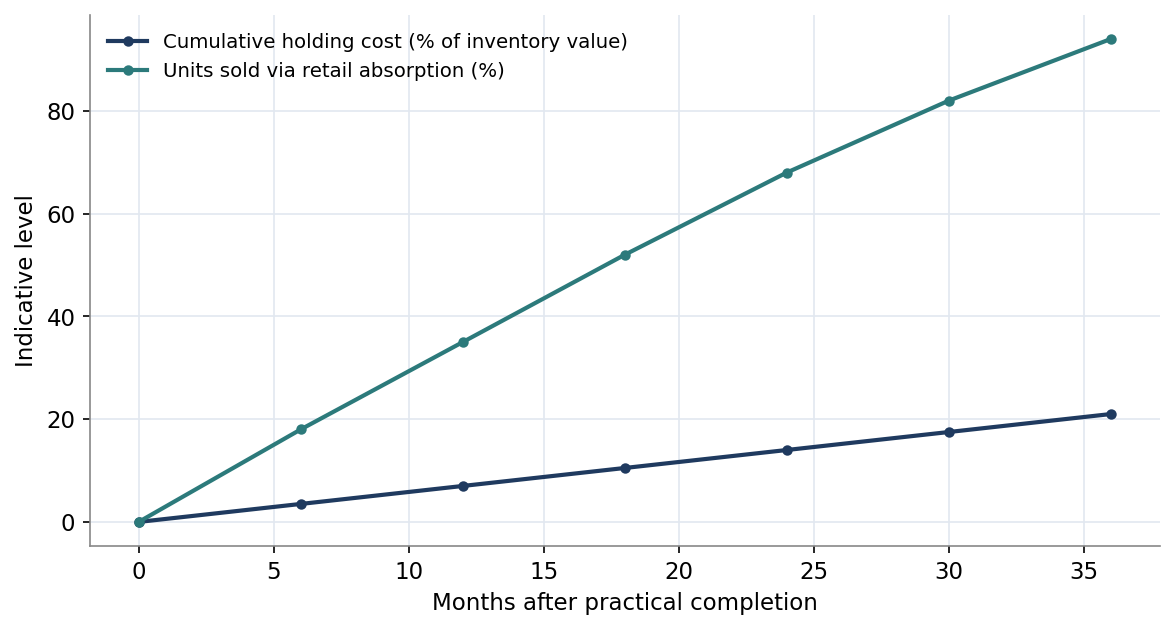
The conventional route to resolving the gap is retail absorption: selling the units one by one to individual buyers at full retail prices over whatever period the market takes to absorb them. Retail absorption maximises the price per unit, but it does so slowly, and during the absorption period the developer cannot recycle its capital, cannot start its next project, and continues to bear the holding, service and finance costs of the unsold stock. For a developer whose business model depends on recycling capital from one project into the next, the slow drip of retail absorption can be a serious constraint on growth, and in a downturn it can become a threat to solvency.
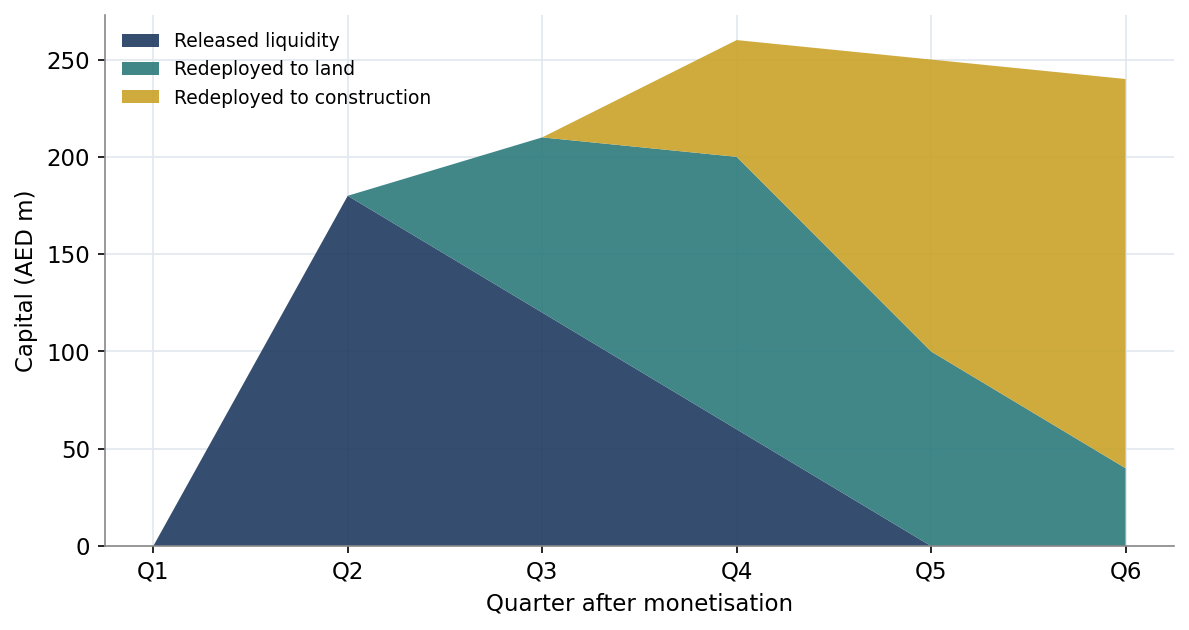
Bulk inventory monetisation is the alternative. Instead of selling units one by one to individuals, the developer sells a block of units, sometimes a whole tower, at a discount to a single investor or a small pool of investors who are willing to buy in volume. The bulk buyer pays less per unit than the retail market would, but it pays now, in size, with certainty, and it relieves the developer of the holding period and its costs. The central question this paper examines is whether, and when, that trade, accepting a lower price in exchange for immediate, certain, bulk liquidity, is a good one.
Anatomy of Bulk Monetisation Routes
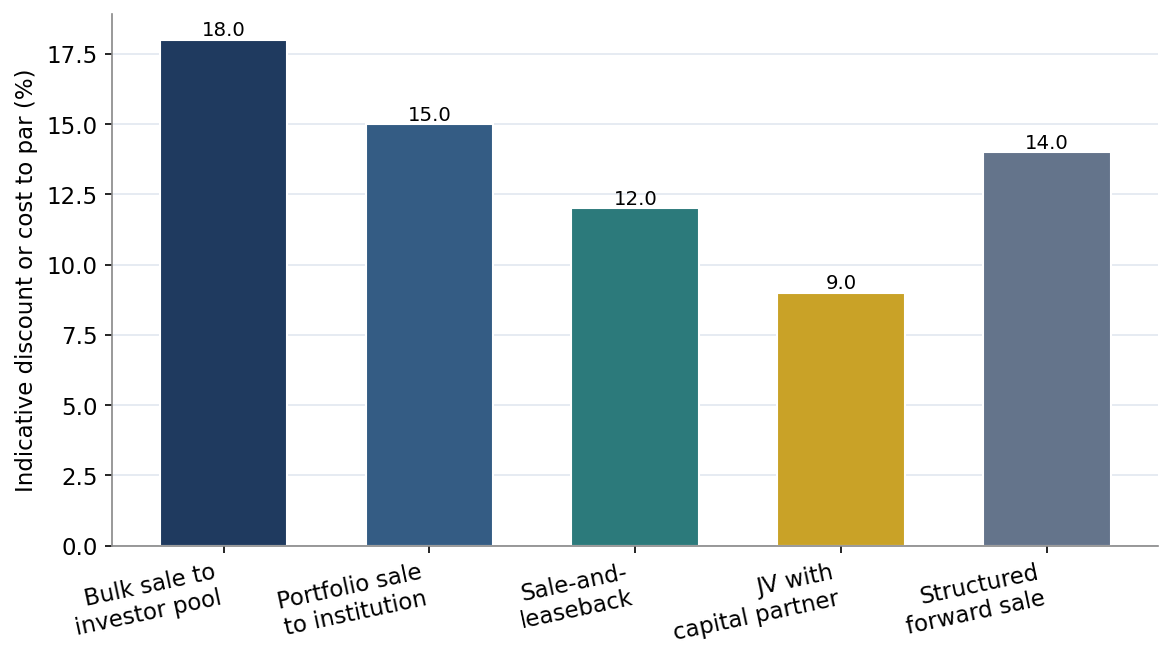
Bulk monetisation is not a single transaction type but a family of routes, each suited to a different combination of urgency, inventory quality and developer objective. Table 1 compares the principal routes, and the subsections that follow describe each.
Bulk sale to an investor pool
The simplest route is an outright bulk sale of a block of units to a single investor or a small syndicate, at a negotiated discount to the aggregate retail value. The developer receives the proceeds, transfers the units, and is relieved of all further holding and absorption risk. This route offers the greatest speed and certainty and is therefore the deepest-discount route, suited to a developer that prioritises immediate, clean liquidity over price.
Portfolio sale to an institutional buyer
A portfolio sale to an institutional buyer, such as a build-to-rent operator or a regional real estate investment trust, sells a block of units that the buyer intends to operate as an income-producing rental portfolio. Because the institutional buyer values the units for their rental yield rather than for resale, and because it can deploy patient capital, the discount required is often shallower than for an opportunistic bulk buyer, and the route suits good-quality, well-located inventory that will let readily.
Sale-and-leaseback of unsold units
Where a developer wishes to release the capital tied up in unsold units but retain some exposure or operational involvement, a sale-and-leaseback can transfer ownership to an investor while the developer, or an operator, leases the units back to manage them. This route releases capital at a smaller discount than an outright sale, because the investor retains a tenant and a yield, but it leaves the developer with an ongoing obligation and is more complex to structure.
Joint venture with a capital partner
A developer reluctant to crystallise a discount on a falling or recovering market can instead contribute the inventory into a joint venture with a capital partner, sharing the eventual retail proceeds rather than selling at a fixed discount today. This route preserves more of the upside if the market recovers, at the cost of slower and less certain liquidity, and it suits a developer that needs partial liquidity and believes the retail market will improve.
Structured forward sale
| Route | Speed | Typical discount | Upside retained | Best for |
|---|---|---|---|---|
| Bulk sale to pool | Fastest | ~18% | None | Urgent liquidity |
| Portfolio to institution | Moderate | ~15% | None | Lettable stock |
| Sale-and-leaseback | Moderate | ~12% | Partial | Capital release |
| JV with partner | Slow | ~9% effective | Significant | Market recovery view |
| Structured forward | Moderate | ~14% | Limited | Near-completion stock |
Pricing Framework
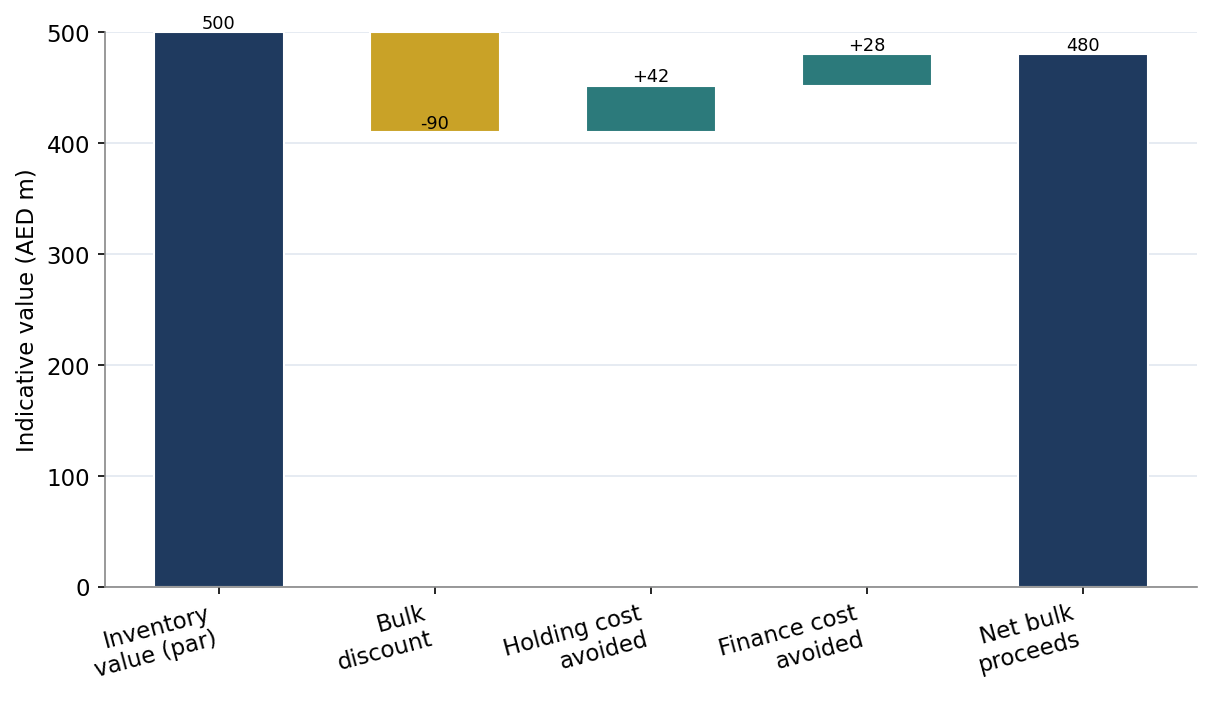
A disciplined pricing framework nets the bulk discount against the costs that bulk sale avoids, to arrive at the true economic cost of the route. Figure 5 sets out this calculation as a waterfall, beginning from the par retail value of the inventory and adjusting for the bulk discount conceded and the holding and finance costs avoided.
Figure 5. Net Bulk Proceeds After Avoided Costs
Par value reduced by the bulk discount but increased by the holding and finance costs avoided. Not a forecast.
The waterfall makes the central point visible. The bulk discount reduces the proceeds, but the holding and finance costs that the developer would have incurred during a multi-year retail absorption, and which the bulk sale avoids, add the discount back in substantial part. In the illustration, an eighteen percent headline discount is reduced to a net cost of only a few percent once the avoided carrying costs are credited, and if the released capital can be redeployed into a value-creating project, the net effect can be neutral or positive. The framework therefore reframes the decision: the relevant number is not the headline discount but the net cost after avoided carrying costs and the value of redeployment.
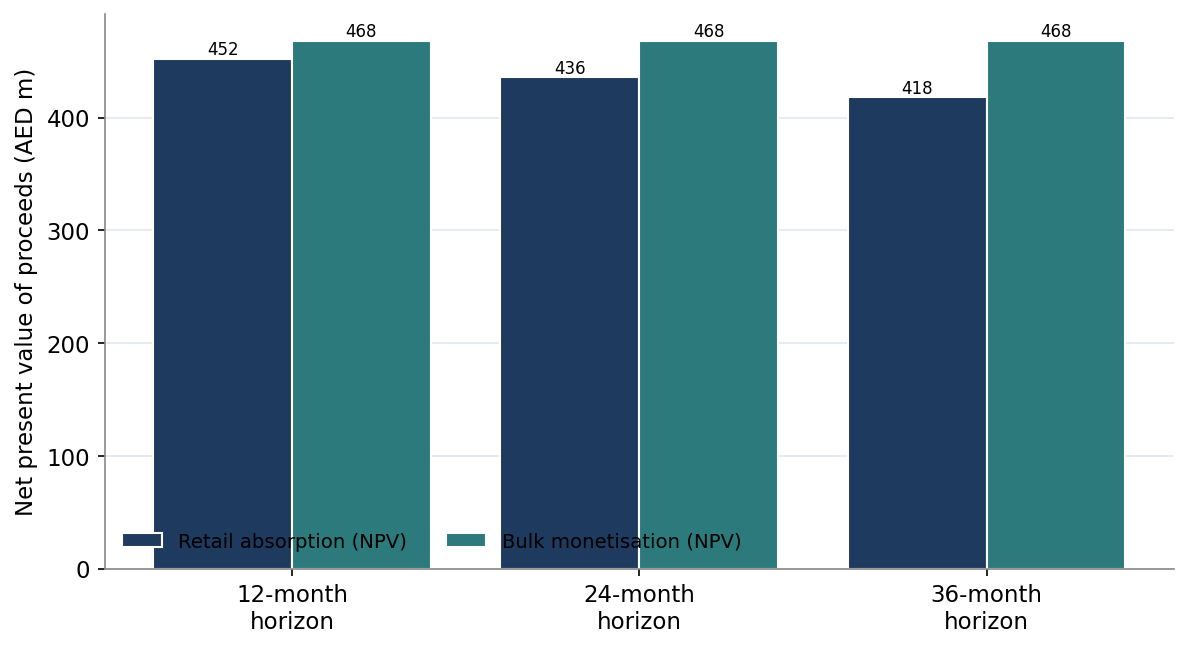
Constructing this framework for a specific decision requires the developer to estimate three quantities: the realistic retail absorption period and the holding and finance costs over that period, the discount the relevant buyer segment will require, and the return available on the capital that bulk sale releases. With these three in hand, the developer can compare the present value of the bulk route against the present value of retail absorption and make the decision on a like-for-like basis. The next section performs this comparison.
The pricing framework can be extended to incorporate the risk-adjusted nature of the retail proceeds. Because the retail proceeds are uncertain, they should arguably be discounted at a higher rate than the certain bulk proceeds, which widens the advantage of the bulk route still further. A developer that discounts both streams at the same rate understates the value of the certainty that bulk provides; a developer that applies a risk-adjusted discount rate to the uncertain retail stream sees the bulk route in its true, more favourable, light. The choice of discount rate is therefore not a technicality but a substantive judgement that materially affects the comparison.
Risk and Structuring Considerations
A bulk transaction carries its own risks and structuring complexities that the developer must manage. The principal risk is execution risk: a bulk buyer may seek to renegotiate the discount as due diligence proceeds or as the market moves, and a developer that has committed publicly to a sale, or that needs the liquidity urgently, has weak negotiating leverage. The defence is to run a competitive process with more than one credible buyer, preserving the developer ability to walk away, and to avoid signalling urgency that the buyer can exploit.
Structuring considerations include the treatment of any existing financing secured against the inventory, which must be released or assumed as part of the sale; the allocation of service charges and community fees, which can be a point of contention; the warranties the developer must give on the condition and title of the units; and the staging of the transfer and the proceeds, which can be phased to align with the developer liquidity needs. A bulk sale of near-completion units adds the further consideration of completion risk, since the buyer is taking units that are not yet finished and will seek protection against delay or defect.
A subtle but important structuring point concerns the interaction with the developer remaining retail sales. Selling a block of units in bulk at a discount can, if disclosed or discovered, undermine the retail prices the developer is seeking for the balance of the inventory, because retail buyers may anchor on the bulk price. A well-structured bulk sale manages this risk through confidentiality, through selling inventory in a different part of the development from the retail stock, or through selling to a buyer that will hold rather than resell, so that the discounted units do not reappear on the retail market to compete with the developer own sales.
A further structuring consideration concerns the financing that may already sit against the inventory. Where the completed units secure a development facility or a stabilisation loan, a bulk sale must coordinate the release of that security with the transfer to the buyer, and the timing and mechanics of that release can be a critical-path item. In some cases the buyer may be willing to assume the existing financing rather than requiring its repayment, which can simplify the transaction and widen the pool of buyers able to transact at speed. Engaging the incumbent lender early, and understanding its requirements for releasing security, is therefore an essential part of preparing inventory for bulk sale.
The Buyer Perspective
A bulk sale closes only if the buyer finds the trade attractive, and understanding the buyer underwriting is essential to pricing and structuring the sale. The opportunistic buyer underwrites a resale margin: it buys at a deep discount and plans to sell the units individually at retail over time, capturing the spread, and it therefore requires a discount large enough to fund its own holding costs and leave a profit. The buy-to-rent buyer underwrites a rental yield: it buys to operate the units as a rental portfolio, values them on the net income they produce, and requires a discount only sufficient to deliver its target yield, which is typically much shallower.
The family office buyer underwrites a long-term hold and a blend of income and capital appreciation, and is often willing to accept a moderate discount for a quality asset that fits its mandate, particularly where it can deploy patiently and values the relationship with the developer. The institutional real estate investment trust underwrites the contribution of the units to its portfolio and its distributions, and may pay a shallow discount for stabilised, income-producing stock that enhances its portfolio. In every case, the developer that understands what the buyer is underwriting can structure the sale to match, offering the buyer the certainty, the yield or the quality it values most and thereby minimising the discount it must concede in return.
Indicative Case Studies
Three indicative cases show the framework applied across different inventory situations. The figures are synthetic and constructed for analytical clarity, not drawn from any specific transaction.
Case A: distressed completed tower
Case A is a completed tower held by a developer that needs urgent liquidity to meet a maturing obligation. Retail absorption would take an estimated thirty months, during which the holding and finance costs would be substantial, and the developer cannot wait. It sells the tower in bulk to an opportunistic fund at a headline discount of twenty-two percent. The discount is deep, reflecting the urgency and the opportunistic buyer, but the net cost after the avoided thirty months of carrying cost is far smaller, and the sale resolves the liquidity crisis and avoids a default that would have been far more costly. The case illustrates that even a deep-discount distressed sale can be the value-preserving choice when the alternative is default.
Table 2. Case A Bulk Sale Economics, Distressed Tower
Net economic cost far below the headline discount once avoided carrying cost is credited. Not transaction-specific.
Case B: near-completion staged monetisation
Case B is a near-completion project whose developer wishes to lock in liquidity and transfer absorption risk before practical completion. It uses a structured forward sale of a block of units at a fourteen percent discount, with settlement staged across the completion schedule. The forward sale gives the developer price certainty and transfers the absorption risk to the buyer, while allowing the developer to complete the build with the comfort of committed proceeds. The discount is moderate, reflecting the balance between certainty and the buyer assumption of completion risk.
Table 3. Case B Economics, Near-Completion Forward Sale
Forward sale balances certainty against the buyer assumption of completion risk. Not transaction-specific.
Case C: institutional portfolio sale
Case C is a developer with a block of good-quality, well-located, lettable units in a strong rental location, monetising as a strategic capital-recycling decision rather than under any pressure. It sells the block as a rental portfolio to an institutional buy-to-rent operator at a discount of only thirteen percent, reflecting the buyer yield-based valuation and the absence of urgency. The developer recycles the proceeds into a new land acquisition, and because the redeployment return exceeds the modest net cost of the bulk sale, the transaction is value-accretive. The case illustrates the ideal use of bulk monetisation: a deliberate, unpressured sale of attractive inventory to the shallowest-discount buyer, funding a value-creating redeployment.
Table 4. Case C Economics, Institutional Portfolio Sale
| Line | AED m | Note |
|---|---|---|
| Aggregate retail value | 500.0 | Par value of inventory |
| Bulk discount (22%) | (110.0) | Opportunistic buyer, urgent |
| Holding cost avoided (30 mo) | 62.0 | Service, finance, carrying |
| Net economic cost of bulk | (48.0) | Effective ~9.6% net |
| Net bulk proceeds | 390.0 | Received immediately |
International Comparison
The bulk monetisation of residential inventory is well established in other markets, and the United Kingdom build-to-rent sector offers an instructive comparison. In the United Kingdom, institutional investors routinely acquire entire blocks of new residential units, frequently before completion through forward-funding or forward-purchase structures, to operate as professionally managed rental portfolios. The discounts in these transactions are typically modest, because the institutional buyers value the units on their rental yield and can deploy patient, long-term capital, and the market is deep and competitive enough to discipline pricing.
The lesson for the UAE is that the shallowest-discount bulk market is the institutional rental market, and that the depth and maturity of that market determines how cheaply developers can monetise inventory in bulk. As the UAE build-to-rent and institutional rental sector continues to develop, the discounts on bulk sales of lettable inventory should compress, making bulk monetisation an increasingly efficient tool. Developers that build relationships with institutional rental investors now, and that design and position inventory with the institutional buyer in mind, will be best placed to monetise in bulk at shallow discounts as this market matures. The United Kingdom experience also shows the value of forward structures, which transfer absorption risk to the buyer before completion, a route that the UAE structured-forward case illustrates and that is likely to grow as institutional buyers become more active.
The United Kingdom comparison also highlights the role of standardisation in compressing discounts. Institutional buyers pay shallower discounts for portfolios that are standardised, well-documented and easy to underwrite, because standardisation reduces their diligence cost and their uncertainty. As UAE developers increasingly design and document inventory with institutional buyers in mind, providing standardised information packs, clean title and predictable operating costs, the discounts on bulk sales of such inventory should compress toward the levels seen in mature institutional markets. The developer that invests in this institutional readiness ahead of need positions itself to monetise efficiently when the moment comes.
| Line | AED m | Note |
|---|---|---|
| Aggregate retail value | 420.0 | Lettable, well-located stock |
| Portfolio discount (13%) | (54.6) | Buy-to-rent buyer, no urgency |
| Holding cost avoided | 38.0 | Absorption would take ~24 mo |
| Redeployment value created | 45.0 | Proceeds fund new land at higher return |
| Net value vs retail | +28.4 | Bulk route is value-accretive |
Implementation Roadmap
Estimate the realistic retail absorption horizon for the inventory, underwriting the pace conservatively, and quantify the holding and finance costs over that horizon.
Identify the return available on the capital that bulk sale would release, since the redeployment opportunity is central to whether the bulk route creates value.
Compare the present value of bulk monetisation against the present value of retail absorption using the framework in Section 8, and proceed with bulk only where it is value-accretive.
Match the inventory to the right buyer segment, directing lettable, attractive stock to institutional buy-to-rent buyers and real estate investment trusts for the shallowest discount.
Run a discreet, competitive process with more than one credible buyer to preserve negotiating leverage and avoid signalling urgency.
Structure the transaction to manage existing financing, service charges, warranties and the interaction with the developer remaining retail sales.
Plan the redeployment of the released capital in advance, so that the time value that justifies the discount is actually realised through a value-creating reinvestment.
A brief worked illustration ties the analysis together. Consider a developer holding completed inventory with an aggregate retail value of five hundred million dirhams, facing a realistic retail absorption horizon of thirty months at a holding cost of seven percent a year, and with an attractive land acquisition available that would earn a development return well above its cost of capital. A bulk sale at a sixteen percent discount appears, on a headline basis, to sacrifice eighty million dirhams of value. But the avoided carrying cost over the thirty-month absorption, the time value of receiving the proceeds today, and the development return earned on the redeployed capital together exceed the discount, making the bulk sale the value-maximising choice. The headline discount, viewed in isolation, would have led the developer to the wrong decision; the net analysis leads it to the right one.
Conclusion
Bulk inventory monetisation is too often treated as a sign of weakness, a fire sale to be avoided unless forced, and too rarely analysed as the deliberate liquidity and capital-recycling tool it can be. This paper has argued that the apparent cost of a bulk discount is frequently overstated, because it is compared against a retail price that ignores the time, the holding costs and the redeployment opportunity that bulk sale unlocks, and that on a proper net present-value basis bulk monetisation is the value-maximising choice whenever the retail absorption horizon is long or the redeployment opportunity attractive.
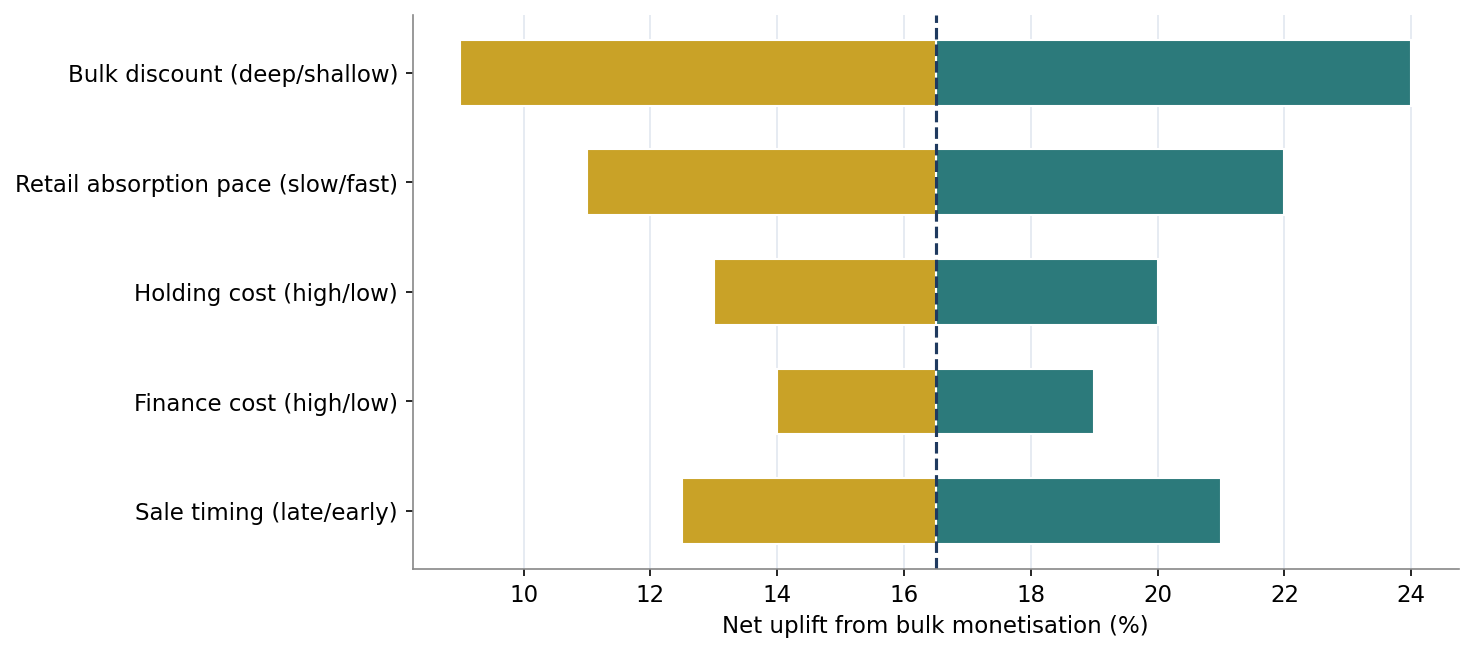
The analysis has shown that the discount and the absorption pace dominate the outcome, that the discount can be minimised by matching the inventory to the right buyer and selling without urgency, and that the strategic value of bulk monetisation lies in recycling idle capital from completed holdings into new development. The developer that internalises these lessons, analysing the decision on a net basis, selling to the shallowest-discount buyer, and redeploying the released capital into value-creating projects, will grow faster and manage its liquidity more effectively than the developer that holds completed inventory through a long and costly retail absorption. In a UAE market with a deepening institutional rental sector and an increasingly mature bulk buyer pool, the tools and discipline set out in this paper are becoming central to the way successful developers manage their balance sheets.
The roadmap is deliberately sequential because the order matters. A developer that approaches buyers before it has estimated its absorption horizon and redeployment return negotiates without knowing its own walk-away price, and is therefore vulnerable to accepting a discount it should refuse. A developer that has done the analysis first approaches the market with a clear view of the minimum proceeds it requires and the maximum discount it will accept, and negotiates from a position of knowledge. The analytical work is not a preliminary to the transaction but the foundation of the negotiating strength that determines the transaction terms.
| Scenario | Bulk discount | Retail absorption | Net uplift |
|---|---|---|---|
| Favourable | Shallow (13%) | Slow (36 mo) | +21% |
| Base | Moderate (16%) | Moderate (24 mo) | +12% |
| Marginal | Moderate (18%) | Fast (12 mo) | +2% |
| Unfavourable | Deep (22%) | Fast (12 mo) | -6% |
Limitations and Directions for Further Research
This paper is framework-oriented and relies on indicative data, and its conclusions are directional rather than precise. The discount ranges, absorption paces and holding costs are calibrated to observable conditions but are not empirical estimates drawn from a transaction dataset, and they vary materially across submarkets, product types and points in the cycle. The net present-value comparison depends on a discount rate and a redeployment return that are specific to each developer and that the paper treats indicatively.
Several extensions would strengthen the analysis. An empirical study of realised bulk discounts across UAE submarkets and buyer types would replace the indicative discount ranges with data. An analysis of retail absorption rates across product types and price points would sharpen the central absorption assumption that drives the decision. And a study of how bulk discounts and absorption rates behave through a full market cycle, particularly in a downturn when both move adversely together, would test the resilience of the framework in the conditions where the monetisation decision matters most. Each is a natural subject for a later paper in this series.