

1 Research design and acquisition decision
This paper develops a method for deciding how much to pay for an interest in a regulated transmission network when its investment programme is expanding. The method separates the acquisition of existing recoverable assets from expenditure on future capacity. It traces both into dated cash receipts before assessing a proposed price. The relevant decision is the maximum acquisition consideration consistent with the buyer's required return and available funding under identified regulatory and delivery conditions.
The research combines selected primary regulatory materials with a transparent constructed financial case. The regulatory evidence establishes the nature and scope of particular decisions. The constructed case tests the financial consequences of stated assumptions. It provides a reproducible illustration and makes no estimate of a named network's value. The framework is intended for acquisition teams, network owners and investment committees evaluating the relationship between a purchase premium, a capital programme and the conditions for recovering investment.
The proposed analytical contribution is a price test that retains the funding cost of growth. A transaction can acquire a large future investment opportunity while requiring substantial additional capital after completion. Each forecast addition needs a cash expenditure date, an eligibility assessment, a recognition date and an eventual recovery path. The model then reports the effect of these dates and amounts on the acquisition value. This links the premium argument to a traceable investment programme and makes alternative bid structures available for comparison.
2 Decomposing the price paid for regulated growth
A proposed acquisition appraisal should identify the cash flows supporting each part of the purchase price. This framework separates the operating network, future investments and substantiated purchaser effects. Each component receives its own funding schedule and downside test. The framework makes no claim about an observed sector premium. Its purpose is to expose how much a proposed bid depends on approvals, execution or financing assumptions beyond the operating business.
Ofgem's February 2026 regulatory-performance release describes return on regulated equity as achieved shareholder regulatory performance. Expenditure differences, incentives and financing costs influence that measure. The release distinguishes actual results through 2024/25 from forecasts and provides actual and notional gearing views. These are regulatory-performance observations with a defined reporting perimeter. They supply no current transaction cash yield, guarantee of future performance or direct estimate of the return available to a purchaser paying a different equity price. [3]
Ofgem's RIIO-3 finance annex evaluates financeability using an efficient licensee with a notional capital structure. It considers the regulatory package together, including allowances, returns, gearing, depreciation and capitalisation. The annex also identifies the scale and complexity of the transmission investment programme as relevant to simulated credit quality. This assessment concerns the regulated licensee and the stated settlement. It supplies no approval of a buyer's acquisition leverage, refinancing terms, distribution policy or actual credit rating. [2]
For an original valuation bridge, the buyer would translate assumed allowed revenues into operating cash, deduct cash expenditure and identify payments retained for future investment. It would then deduct obligations falling within the acquired perimeter before valuing the residual equity distributions. An acquisition premium would appear as additional investor capital required at closing. Keeping that payment explicit allows the buyer to test whether the forecast distributions compensate for the larger investment. A regulatory return parameter remains an input to this bridge; the investor's valuation also depends on timing, funding and the price paid.
The growth component would contain the incremental cash attributable to an assumed future investment programme after funding costs. Increasing asset value for planned expenditure while excluding its equity contributions would overstate illustrative equity value. The proposed decomposition therefore carries a commitment ledger alongside the forecast asset schedule. It identifies which shareholder supplies each contribution and whether that obligation precedes related receipts. Economic value and the buyer's capacity to finance the purchase and programme would receive separate examination.
3 Testing the connection evidence behind load growth
Ofgem's 15 April 2025 impact assessment accompanies approval of a connections-reform package applying readiness and strategic-alignment criteria to the existing queue and future applicants. The package introduces a batched application and offer process. The assessment describes the decision and expected impacts. It supplies no verification that an individual applicant subsequently accepted an offer, completed a connection or consumed electricity. Those outcomes require their own evidence, including any later applicable methodology changes. [4]
NESO's dated February 2026 joint statement sets revised offer windows by protected status, phase and connection type. It explains that background assumptions and engineering matters required further review and construction-planning work. The published windows extend into 2027 for some categories. A clarification was added in April. These statements describe offer sequencing and technical work; reading the timeline alone cannot establish actual delivery of a particular offer, energisation, metered consumption or cash received by a network company. [5]
The proposed load assessment would retain separate records for requested capacity, accepted contractual capacity, expected commissioning and assumed utilisation. A large request could affect a scenario without receiving the same valuation weight as evidenced operating load. For a hypothetical data-centre customer, the analyst would specify which development stage is supported and which remains a management forecast. The appraisal would also record whether the proposed network expenditure responds to that customer alone or to wider requirements. This avoids assigning the whole value of a shared reinforcement to a single commercial development.
Timing deserves an independent assumption because the connection and consumption profiles can diverge in an illustrative case. A customer could accept a connection offer and subsequently phase its facilities. The proposed demand schedule would therefore identify an energisation date, a ramp period and a utilisation path separately. Changes to the assumed ramp would be traced through the particular revenue and expenditure mechanisms selected for the valuation. The analyst would state whether customer utilisation affects the company's assumed cash directly, indirectly through subsequent investment decisions, or only as evidence supporting the need for reinforcement.
A queue-quality adjustment should also identify overlap. Multiple applications linked to one underlying development should not become several independent demand cases in the proposed model. The buyer would seek consistent identifiers for location, applicant and capacity, then record unresolved overlaps as uncertainty. It could value an evidenced programme separately from a wider management pipeline, with delayed and reduced-conversion scenarios for the latter. The resulting range would describe the sensitivity of an assumed acquisition value to evidence quality. It would provide no empirical conversion rate for the national queue or assurance that reform produces a particular growth outcome.
4 Following investment through allowance and delivery decisions
Ofgem's December 2025 electricity-transmission final determination covers April 2026 to March 2031. It combines baseline funding, uncertainty mechanisms and delivery incentives. Ofgem identifies uncertainty in the timing and location of network upgrades and describes in-period assessment when project need or design becomes clearer. The document also distinguishes cost reductions, insufficient justification and decisions deferred until greater clarity. Its incentive discussion cautions that all maximum upsides are not simultaneously achievable. The final determination provides a dated framework for investment assessment, with project-specific application still material. [1]
Version control remains necessary. Ofgem's August 2026 consultation proposes corrections and housekeeping to RIIO-3 licence conditions and financial instruments. On the page accessed 9 October 2026, its status is closed awaiting decision. The consultation supplies no basis for treating those proposed changes as adopted. The December 2025 determination and this later consultation should therefore retain their dates and documentary roles; together they are not an exhaustive consolidated account of every current licence provision. [7]
For the proposed appraisal, an investment would pass through distinguishable states: a management concept, a defined project, an assessed allowance, a funded construction programme and an operating asset with the applicable cash treatment. The same project would keep one identifier through those states. Moving it forward would require a dated supporting document and a recorded change to the forecast. This makes valuation assumptions auditable without claiming that the proposed states reproduce a regulator's formal process. Any project-specific mechanism would need to be read in its actual licence and decision context before use.
Cost recognition and physical completion would receive separate variables. An assumed project can be fully built while its recoverable amount remains contested, or have a defined allowance while construction still requires cash and delivery. The proposed model would retain actual expenditure, assumed recognised expenditure, funding timing and receipt timing as distinct schedules. Inflation assumptions would have a stated price base. A hypothetical increase in nominal asset amounts would be accompanied by the associated construction payments and financing effects, allowing the appraisal to identify whether the assumed investor benefit survives the additional funding burden.
The buyer would also remove contradictory forecasts. A delayed project should receive an early-delivery incentive only where the governing mechanism supports that combination. A reduced scope should change assumed costs, outputs and cash treatment consistently. The proposed assessment would examine these relationships across projects sharing a contractor or outage dependency. A premium justified by a broad growth programme would then receive a coordinated execution stress, including consequences for funding headroom and the availability of distributions.
5 Reading minority transaction evidence with its actual perimeter
SSE's 2023 accounts report the sale of a 25% non-controlling equity interest in Scottish Hydro Electric Transmission to Ontario Teachers. Cash consideration was GBP 1,465 million and completion occurred on 30 November 2022. SSE reported that control was retained and recognised the excess consideration within parent equity. This is a completed historical minority transaction. Its cash consideration is not a current enterprise-value quote, regulatory asset value, control-premium estimate or statement of growth capital received by the transmission company. [6]
The proposed transaction comparison would begin with the interest actually acquired. A minority stake, a controlling stake and a purchase of selected assets would occupy different rows, with the accompanying rights described from the available documents. The buyer would record obligations for future capital, distributions, reserved decisions and exit separately from percentage ownership. Public evidence could leave some terms unavailable. The comparison should then identify that limitation in natural language and leave the corresponding adjustment unresolved. Assigning a numerical control uplift without supporting rights or cash assumptions would obscure the difference being valued.
An original price bridge could express the proposed value of the acquired interest as its share of assumed standalone equity value, adjusted for documented economic rights and explicitly modelled purchaser effects. The denominator would be defined before calculating any multiple. Enterprise value, equity consideration, regulated asset amounts and book net assets would remain separate quantities. Their dates, currency and included debt would accompany them. A ratio would be useful only within that defined comparison; a historical minority transaction could help frame questions without becoming a mechanically transferable bid benchmark for a different perimeter.
Proceeds and contributions require similar discipline. If an assumed transaction pays a selling shareholder, the acquired company's construction funding schedule would continue to require identified sources. An additional subscription could supply company cash under its own terms. The appraisal would show each flow and its recipient individually, including transaction fees and any debt refinancing. This separation makes a premium and a growth-funding requirement visible at the same time. The investor could then compare a secondary stake purchase, a primary contribution and a combination using the same operating forecast and explicitly different sources and uses.
Control value would be treated as a conditional purchaser proposition. For example, a buyer might propose savings from a procurement change, with implementation cost, authority and timing stated. The appraisal would examine whether those savings remain with shareholders under the assumed regulatory treatment and whether achieving them requires changes outside the acquired rights. It would also include separation costs if shared services cease at closing. The resulting value would be attributed to the described actions and rights. This method provides no observed sector control premium and no claim that ownership alone increases regulated earnings.
6 Separating merger permission accounting and cost recovery
FERC's merger overview describes a public-interest review covering competition, rates, regulation and cross-subsidisation. That is the stated framework for the transactions within its jurisdiction. The accessed overview has a 2021 update date and supplies no complete current exemption analysis. No universal filing threshold or blanket-authorisation conclusion is used here. Transaction-specific jurisdiction and other required approvals remain outside what can be established from this general page. [8]
FERC staff's informal accounting questions distinguish plant-related purchase-price adjustments recorded in a separate acquisition-adjustment account from merger-cost treatment. Staff also explains that recording costs does not authorise their recovery through jurisdictional rates. The page expressly states that its answers are not binding on the Commission. These are bounded accounting explanations for the specified electric and gas context. They supply no IFRS conclusion, project rate order or permission to increase recoverable plant amounts by the price paid. [9]
FERC's final May 2016 hold-harmless policy statement considers commitments case by case. It distinguishes acquisition premiums from transaction-related costs and requires a separate section 205 proceeding with specific, measurable and substantial ratepayer benefits for premium recovery. This is dated policy guidance with transaction-specific application. It supports neither automatic premium recovery nor a categorical statement that a premium can never be recovered. An acquisition approval and a later rate-recovery request retain different purposes and evidence requirements. [10]
The proposed diligence record would assign each legal, accounting and cash claim to the document that supports it. A merger approval would answer a closing question. An accounting entry would explain where an amount is recorded. A recovery decision would determine which assumed receipts could enter the valuation. Leaving a column unresolved would be preferable to treating one document as evidence for all three questions. The reader could then see whether the bid depends on a recovery assumption that still requires a separate determination, alongside the cash exposure if that determination is adverse.
A purchaser-specific premium would also receive its own downside treatment. Where recovery has not been evidenced for an assumed US transaction, the illustrative model could charge the premium entirely to investor funds. A separate conditional case could include recovery only if the relevant permission and timing were specified. Comparing those cases would isolate the proposed premium's dependence on rate treatment. The analysis would preserve any other mechanism actually evidenced for the target and would avoid extending the US illustration to British or European regulatory settlements without checking their distinct instruments.
7 Financing the period before the growth cash arrives
FERC's transmission page describes incentives assessed case by case, including return incentives and treatment of prudently incurred construction work in progress or abandonment costs. Utilities must justify their selected package, and approved rates remain subject to Federal Power Act filing standards. This overview identifies mechanisms that may support qualifying investment. It provides no numerical allowed return, automatic construction advance, acquisition-debt reimbursement or commitment by a lender to finance a particular programme. [11]
FERC's published Order 1920 implementation schedule separates the principal compliance filing from a filing concerning interregional coordination. It identifies extensions and different deadlines by planning region, with an August 2026 page update. The schedule establishes neither completion of every listed filing nor approval of a target's projects or cash recovery. No individual deadline or litigation outcome is presumed here. A planning and allocation process, a selected investment and its funding documents need their respective evidence. [13]
The proposed funding appraisal would construct a dated cash sequence for each investment. Acquisition consideration, transaction expenses, retained company liquidity, construction payments and refinancing would be assigned to their actual intended payer. Expected regulatory receipts would enter only at their assumed payment dates. Funding capacity would be limited by both the specified legal borrower and the assumed financing conditions. A commitment to fund the acquisition vehicle would not be allocated to network construction in the illustration unless the structure expressly permitted that use and the same cash had not already met another obligation.
To test resilience, the analyst would combine slower assumed receipts with the construction schedule and debt maturities. A programme can show positive illustrative long-run equity value while requiring a sizeable contribution during its execution. The proposed analysis would identify the largest funding requirement and the period in which it arises. It would then test whether sponsor funding is committed, timely and available to the relevant entity under the assumptions. A forecast sale, future refinancing or discretionary distribution would remain a contingent source with its own conditions, timing and downside case.
The financing test would also distinguish distribution capacity from distributable cash paid to the acquired investor. An assumed operating surplus could be retained for construction, debt service or required liquidity. A minority investor's forecast receipts would follow the modelled distribution decisions and rights. At closing, the buyer would compare those receipts with the contribution obligations it accepts. This connects a proposed growth premium to the actual funding burden of the chosen structure. It leaves lender covenants, regulatory ring-fencing and lawful distributions to transaction-specific documentation, with no universal leverage or dividend rule assumed.
8 Keeping scenario benefits and recoverable revenue distinct
DOE's National Transmission Planning Study examines multiple potential futures using linked power-system models and economic, reliability and resilience indicators. Its official scope explicitly excludes approval of individual lines, evaluation of existing proposed projects and replacement of utility or regional planning. These scenario results can inform questions about network need. They supply no target-specific asset allowance, observed acquisition benefit or investor cash forecast. The dated 2024 study is used here for its analytical boundary, with no numerical scenario outcome represented as realised performance. [12]
ACER's May 2026 article distinguishes congestion-income distribution, inter-TSO compensation for hosting cross-border flows and allocation of new-infrastructure costs against expected cross-border benefits. It describes exploratory policy options and states that its paper supplies no definitive solutions. The article establishes no uniform European tariff, adopted reform, company funding award or recoverable cash amount. System benefits and the mechanism through which a particular company is remunerated therefore require separate evidence in an acquisition appraisal. [14]
The proposed scenario comparison would use a consistent baseline of demand, generation and network investment. A load-growth case would specify the changes to that baseline and identify which projects respond. It would hold unrelated assumptions constant where the purpose is to isolate load sensitivity. An alternative integrated case could change several variables together, provided the combination is identified. The analyst would then avoid counting a single outcome both as an assumed operating benefit and as a separate growth premium already embedded in the same forecast cash flows.
Counterfactual discipline also matters when a reinforcement serves several purposes. In the proposed method, the analyst would record reliability, connection and wider network functions separately, then identify the investment assumed to occur without the acquisition. Expenditure that would arise under either owner would remain within the common forecast. A purchaser effect would require an additional action, cost or timing change. This permits a conditional assessment of ownership-related value without attributing the whole programme's system value to the transaction or using consumer benefits as a direct shareholder receipt.
Benchmarking should preserve jurisdiction and valuation date. Different authorities' investment assessments could be compared with their allowed-revenue models kept separate. Combining a British return assumption, an assumed US incentive and a European grant in one unqualified case would lack a verified regulatory basis. The proposed valuation would use coherent jurisdiction-specific cases, explicitly hypothetical where project terms are unavailable. Common outputs would concern funding, timing and valuation sensitivity. The comparison would preserve the distinct mechanisms and require evidence for any cross-border benefits attributed to acquired shareholders.
9 Pricing permitting and regulatory change as conditional exposure
The Commission's TEN-E overview describes a framework connecting common-interest and mutual-interest project identification with permitting, regulatory assistance, cross-border cost allocation and financing opportunities. The inspected source is an official policy overview. It supplies no permit, designation, grant award or project-specific entitlement for an acquisition target. Direct access to the original legal text was unavailable for this review, so no article-specific deadline or exhaustive statement of current statutory conditions is used. Project documents and applicable national procedures remain necessary for transaction-level conclusions. [15]
The Commission's current European-grids page describes the December 2025 Grids Package as proposals to revise TEN-E and accelerate permitting. It separately identifies connections guidance and its recommended practices. These documentary forms retain their stated scope. A proposed amendment or recommendation is not represented here as an enacted provision or completed permitting improvement. No quantitative queue estimate from secondary material on the page is used, and no benefit for an individual network acquisition is established by the policy announcement. [16]
For the proposed price assessment, permitting progress would affect the assumed timing and probability of a project's cash flows. The analyst would identify the particular permission, its project perimeter and the consequences of delay or an adverse outcome. A management timetable could enter a clearly labelled forecast while supporting documents remained pending. The associated downside would include sunk development payments, later construction funding and changed receipts. A general reform announcement would receive no project-specific value until the appraisal explained how an applicable measure changes an actual permission or evidenced execution assumption.
Regulatory change would receive a similarly explicit valuation treatment. The proposed acquisition case could retain the evidenced settlement for its defined period and specify separate assumptions for later resets. A purchaser seeking value from a future policy change would state the requested change, the required decision and the cash mechanism it affects. The base and conditional cases would identify that dependency without asserting an outcome. This allows a bid to distinguish the price supported by its present evidence from additional consideration exposed to future policy or execution decisions, including the capital committed while those decisions remain unresolved.
The resulting decision record would state which portion of the proposed price survives a coherent delay, cost and funding stress. It would identify dependencies on new allowances, customer development or purchaser actions and who funds them. Unknown transaction terms would stay unresolved; hypothetical cases would disclose their assumed treatment. The acquisition judgement would remain conditional and specific to the target. A final bid would require its current licences, project decisions, financing terms and ownership documents. Subsequent evidence could change both value and capacity to complete.
10 Model interpretation and research limits
The numerical case deliberately uses a simplified regulated recovery structure. The existing asset balance runs off through annual capital recovery. New construction expenditure may enter a separate recoverable balance under explicitly assumed eligibility and construction-allowance rules. The buyer discounts the dated receipts and construction payments. The model reports balances left unrecovered when a stress restricts the assumed recognition or final recovery period. All amounts, percentages and transaction funding inputs are hypothetical.
The case excludes inflation, cash taxes, actual financing costs and licence-specific performance mechanisms. Operating-cost under-recovery appears only in the stated recognition-delay stresses. These limits constrain its valuation use. An investor applying the method to a real acquisition would need a consistent nominal or real framework, actual tax and depreciation schedules, operational cash costs, regulatory incentives and the relevant financing plan. The resulting cash flows must be discounted on the same tax and inflation basis. A pre-tax illustrative recovery return cannot be transferred directly into a post-tax equity valuation.
The runoff convention gives no cash value to residual physical equipment or future regulatory resets. It therefore supports a bounded comparison of specified recovery rights and growth investments. An actual long-lived network may require continuation and renewal assumptions. Those assumptions should be visible in a separate continuation valuation with explicit replacement expenditure and future permitted returns. Adding a terminal multiple without those obligations would change the meaning of the price test.
The regulatory sources cover selected UK, US and European questions. Their rules remain jurisdiction-specific. A documented UK minority investment can illustrate the importance of transaction perimeter and contractual governance. US approval and accounting requirements can illustrate separate legal and recovery questions. Neither supplies an acquisition multiple for another target. The paper offers an analytical comparison, and makes no empirical claim that queue reform by itself has caused observed takeover premiums.
11 Price the existing recovery stream before adding a growth story
The acquisition illustration values a fictional transmission business at time zero. Every numerical input is an author assumption. Its existing regulatory asset balance is USD 1,000 million, recovered through USD 50 million of annual depreciation over twenty years. The assumed allowed return is 6% of each year's opening balance. Annual operating expenditure of USD 12 million is recovered in the same year, so that expenditure and its cash reimbursement cancel in the valuation. All cash occurs at year-end. The calculation assumes collection of the stipulated revenue and includes no receivables, collection loss or payment delay.
The investor discounts those pre-tax, unlevered cash flows at an assumed 7.5%. Existing-asset value is USD 901.945 million. The declining opening balance produces progressively less return, while depreciation returns the original principal in equal instalments. By the end of year 20, the existing balance is zero. Replacement expenditure, continuing franchise value, salvage, tax and decommissioning liabilities are excluded. This is a deliberately finite recovery account. It cannot represent a continuing network without adding the investment and obligations needed to maintain that network.
The calculation makes the regulated-balance denominator explicit. Every enterprise-value ratio in the comparison uses the same USD 1,000 million existing balance at acquisition. Future construction balances and the subsequently approved growth balance occupy separate schedules. Adding a future balance to the denominator while valuing its expenditure at time zero would change the comparison's meaning. The annual reconciliation shows when balances enter service, how much principal is recovered and what remains after each year.
The first value comparison therefore separates the existing book balance, its discounted recovery cash, the business including growth and a hypothetical USD 1,100 million enterprise offer. That offer equals 1.100 times the existing balance. The model supplies no observed transaction multiple or evidence that this price is obtainable. It asks which stipulated cash recoveries could support that offer. An actual appraisal would replace the recovery schedule, costs and discount rate with project-specific evidence before using the resulting price boundary.
Table 1. Fictional acquisition and recovery assumptions
| Input | Value | Unit | Timing |
|---|---|---|---|
| Existing regulated balance | 1,000.000 | USD million | At acquisition |
| Existing annual depreciation | 50.000 | USD million | Years 1-20 |
| Growth cash expenditure | 300.000 | USD million | 100 at each year-end 1-3 |
| Growth recovery term | 15.000 | Years | Original years 4-18 |
| Allowed return | 6.000 | Percent | Opening recoverable balance |
| Investor discount | 7.500 | Percent | Year-end cash to time zero |
| Selected enterprise price | 1,100.000 | USD million | Time zero |
| Advisory cash cost | 15.000 | USD million | Time zero |
All numbers are author-created assumptions; no actual tariff or licence is represented. Tax, inflation, financing flows, terminal cash, working capital and post-closure costs are zero or excluded as described in the text.
Table 2. Full-runoff acquisition value
| Component | Present value | Cash or book basis |
|---|---|---|
| Existing recovery cash | 901.945 | 20 years; zero closing balance |
| Growth net cash | -24.877 | Includes actual construction spend |
| Enterprise value | 877.067 | Existing plus incremental growth |
| Premium to existing balance | -12.293 | Percent; denominator 1,000 |
| Unrecovered growth balance | 0.000 | Book amount; no terminal proceeds |
USD million except the explicitly labelled percent row. Enterprise value is an unlevered, pre-tax cash calculation. Projected growth RAB is excluded from the time-zero denominator.
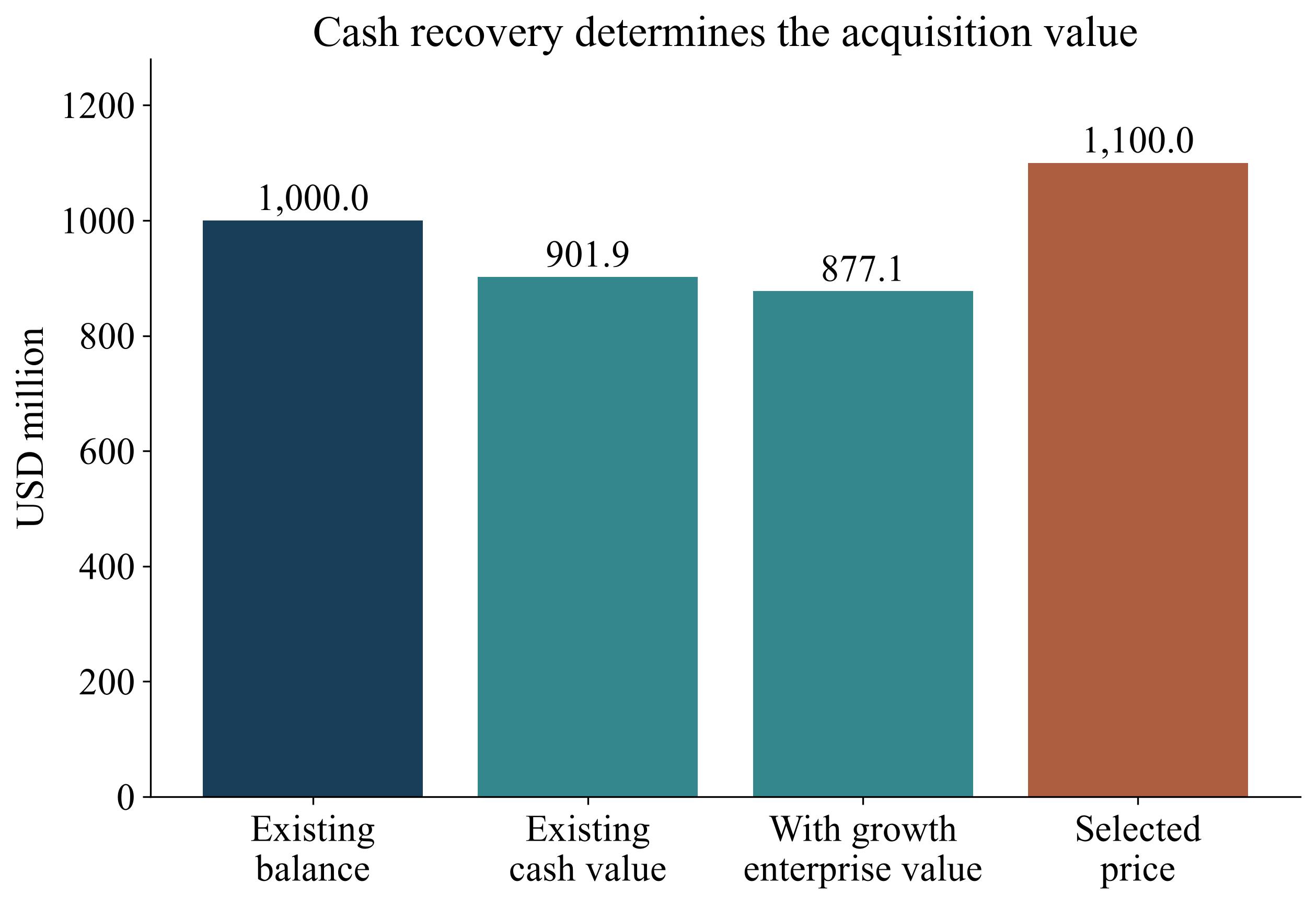
View figure at full size; scroll horizontally on smaller screens.
Author-created assumptions, USD million. The denominator is the time-zero existing regulated balance of 1,000. No actual transaction price, tariff or financing commitment is represented.
12 Trace construction expenditure into an approved recovery account
The growth programme spends USD 100 million at each year-end in years 1, 2 and 3. Commissioning occurs at the start of year 4. The fictional regulatory treatment admits all USD 300 million and permits a noncash construction allowance at the allowed return on the opening eligible construction balance. The first year's closing balance is 100; year 2 adds 6 of allowance and 100 of cash expenditure; year 3 adds 12.360 of allowance and another 100 of expenditure. The amount transferred into the growth recovery account is therefore USD 318.360 million.
This allowance is an express modelling assumption requiring actual approval in a transaction. It supplies no construction-period cash receipt. The cash valuation deducts expenditure on its payment dates and recovers the approved allowance only through the later revenue schedule. It does not add a separate receipt for the accounting increase. At commissioning, the construction account transfers into a growth balance with fifteen equal principal-recovery instalments of USD 21.224 million. The original recovery years are 4 through 18, with a return on each year's opening unrecovered balance.
Growth operating expenditure is USD 6 million per year from commissioning through year 18. The base case reimburses that expenditure in the same year. Combined revenue therefore equals regulatory depreciation, allowed return and operating-cost recovery. Owner cash deducts actual operating expenditure and construction payments once. Growth net present value is negative USD 24.877 million at the 7.5% investor discount rate. Adding that amount to existing-asset value produces enterprise value of USD 877.067 million, or 0.877 times the original regulatory balance.
The rate grid exposes the assumption responsible for this result. Four equal-rate checks, at 4.5%, 6%, 7.5% and 9%, each return an existing value of USD 1,000 million and incremental growth NPV of zero. Full eligibility, the construction allowance and timely recovery are essential to that identity. If allowed return equals the investor discount rate, recovering an additional approved balance provides the stipulated return on the funds invested. Growth does not automatically create an acquisition premium. Removing the construction allowance at the base rates reduces enterprise value to USD 863.505 million. The sensitivity makes the capital-admission rule a specific diligence item.
Table 3. Construction cash and approved allowance
| Year | Cash spend | Eligible cash | Allowance | Closing construction balance |
|---|---|---|---|---|
| 1 | 100.000 | 100.000 | 0.000 | 100.000 |
| 2 | 100.000 | 100.000 | 6.000 | 206.000 |
| 3 | 100.000 | 100.000 | 12.360 | 318.360 |
USD million. Allowance accrues on opening eligible construction balance only through original end-year 3. It is noncash; the approved total transfers to the growth balance at the start of year 4.
Table 4. Annual regulated cash and balance reconciliation
| Year | Depreciation | Allowed return | Cash capex | Net cash | Closing balances |
|---|---|---|---|---|---|
| 1 | 50.000 | 60.000 | 100.000 | 10.000 | 950.000 |
| 2 | 50.000 | 57.000 | 100.000 | 7.000 | 900.000 |
| 3 | 50.000 | 54.000 | 100.000 | 4.000 | 850.000 |
| 4 | 71.224 | 70.102 | 0.000 | 141.326 | 1,097.136 |
| 5 | 71.224 | 65.828 | 0.000 | 137.052 | 1,025.912 |
| 6 | 71.224 | 61.555 | 0.000 | 132.779 | 954.688 |
| 7 | 71.224 | 57.281 | 0.000 | 128.505 | 883.464 |
| 8 | 71.224 | 53.008 | 0.000 | 124.232 | 812.240 |
| 9 | 71.224 | 48.734 | 0.000 | 119.958 | 741.016 |
| 10 | 71.224 | 44.461 | 0.000 | 115.685 | 669.792 |
| 11 | 71.224 | 40.188 | 0.000 | 111.412 | 598.568 |
| 12 | 71.224 | 35.914 | 0.000 | 107.138 | 527.344 |
| 13 | 71.224 | 31.641 | 0.000 | 102.865 | 456.120 |
| 14 | 71.224 | 27.367 | 0.000 | 98.591 | 384.896 |
| 15 | 71.224 | 23.094 | 0.000 | 94.318 | 313.672 |
| 16 | 71.224 | 18.820 | 0.000 | 90.044 | 242.448 |
| 17 | 71.224 | 14.547 | 0.000 | 85.771 | 171.224 |
| 18 | 71.224 | 10.273 | 0.000 | 81.497 | 100.000 |
| 19 | 50.000 | 6.000 | 0.000 | 56.000 | 50.000 |
| 20 | 50.000 | 3.000 | 0.000 | 53.000 | 0.000 |
USD million; closing balances exclude pre-commissioning construction balances. In this base case cash operating costs and same-year pass-through cancel. Cash capex is deducted once; regulatory depreciation is recovered once.
Table 5. Allowed return and investor discount sensitivity
| Allowed return % | Discount % | Enterprise value | Growth NPV | EV / existing balance |
|---|---|---|---|---|
| 4.500 | 6.000 | 866.251 | -27.123 | 0.866 |
| 4.500 | 7.500 | 754.788 | -49.101 | 0.755 |
| 4.500 | 9.000 | 661.288 | -66.925 | 0.661 |
| 6.000 | 6.000 | 1,000.000 | 0.000 | 1.000 |
| 6.000 | 7.500 | 877.067 | -24.877 | 0.877 |
| 6.000 | 9.000 | 773.603 | -45.206 | 0.774 |
| 7.500 | 6.000 | 1,134.479 | 27.853 | 1.134 |
| 7.500 | 7.500 | 1,000.000 | 0.000 | 1.000 |
| 7.500 | 9.000 | 886.504 | -22.900 | 0.887 |
| 9.000 | 6.000 | 1,269.699 | 56.447 | 1.270 |
| 9.000 | 7.500 | 1,123.595 | 25.540 | 1.124 |
| 9.000 | 9.000 | 1,000.000 | 0.000 | 1.000 |
Fictional sensitivity; existing balance remains 1,000. Approved construction allowance varies with the assumed allowed return. No probability or forecast is attached to a cell.
Table 6. Equal-rate neutrality test
| Allowed and discount % | Existing value | Growth NPV | Enterprise value |
|---|---|---|---|
| 4.500 | 1,000.000 | 0.000 | 1,000.000 |
| 6.000 | 1,000.000 | 0.000 | 1,000.000 |
| 7.500 | 1,000.000 | 0.000 | 1,000.000 |
| 9.000 | 1,000.000 | 0.000 | 1,000.000 |
USD million except percent. Neutrality requires full eligibility, the specified construction allowance, timely original-calendar recovery and cost pass-through. It does not establish a legal entitlement.
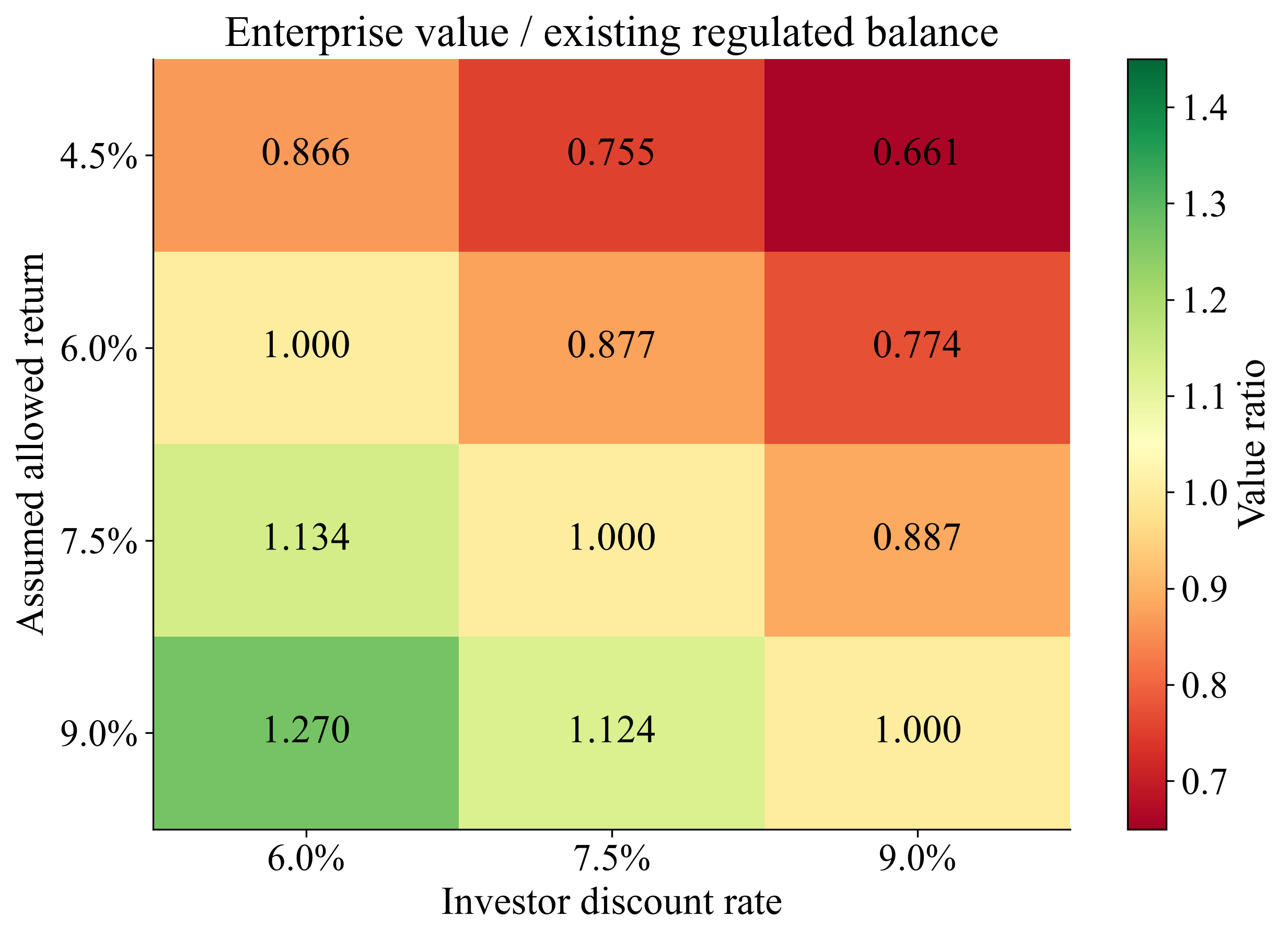
View figure at full size; scroll horizontally on smaller screens.
Fictional sensitivities with full expenditure admission, stipulated construction allowance and timely recovery. Equal allowed and discount rates give zero incremental growth NPV. No probability or empirical premium is inferred.
13 Keep recognition delays and unrecovered balances visible
The recognition stress assumes that commissioning still occurs in year 4, while permission to recover cash begins one, two or three years later. The annual depreciation allowance and final recovery year remain unchanged. The model introduces no catch-up payment, automatic extension, extra construction allowance or terminal receipt. These are deliberately restrictive scenario terms, with no claim that an actual licence uses them. The original construction-allowance cutoff remains the end of year 3 in every timing stress.
A two-year recognition delay begins recovery in year 6. Thirteen original instalments remain, leaving USD 42.448 million unrecovered after year 18. That balance stays visible through the year-20 endpoint and contributes zero terminal proceeds. It is a residual in the analytical recovery ledger, with no asserted recoverable legal claim. During the two completed but unrecognised years, the owner pays USD 12 million of operating expenditure without reimbursement. Enterprise value falls to USD 825.413 million. A buyer cannot treat the remaining balance as a collected payment without a separately supported recovery route.
The completion-delay case postpones both commissioning and first recovery to year 6. It retains the same expenditure dates, construction-allowance cutoff, annual recovery instalment and final recovery year. It also leaves USD 42.448 million unrecovered. Growth operating costs start at commissioning, so the two earlier operating payments do not arise. Enterprise value is USD 834.085 million. The difference between the two cases follows from their stated operating-cost timing. Additional construction maintenance, claims, financing expense or delay compensation would need explicit inputs; none is supplied here.
The recognition figure places enterprise value beside the residual balance across the four delay assumptions. Its line connects specified cases and carries no probability estimate. Each case keeps the whole annual cash and balance schedule. Depreciation recovered plus the remaining growth balance always equals the approved opening growth amount. The residual is retained in the accounting reconciliation even when the valuation assigns no proceeds. This discipline avoids concealing the cost of a truncated recovery period inside an unexplained terminal multiple.
Table 7. Recognition delay and unrecovered assets
| Lag years | First recovery | Enterprise value | Growth NPV | Unrecovered balance | Unfunded opex |
|---|---|---|---|---|---|
| 0 | 4 | 877.067 | -24.877 | 0.000 | 0.000 |
| 1 | 5 | 850.474 | -51.471 | 21.224 | 6.000 |
| 2 | 6 | 825.413 | -76.532 | 42.448 | 12.000 |
| 3 | 7 | 801.779 | -100.166 | 63.672 | 18.000 |
USD million. Commissioning remains year 4. Original annual depreciation and final recovery year 18 stay fixed. Missed amounts, operating costs and residual balances receive no catch-up, financing return or terminal cash.
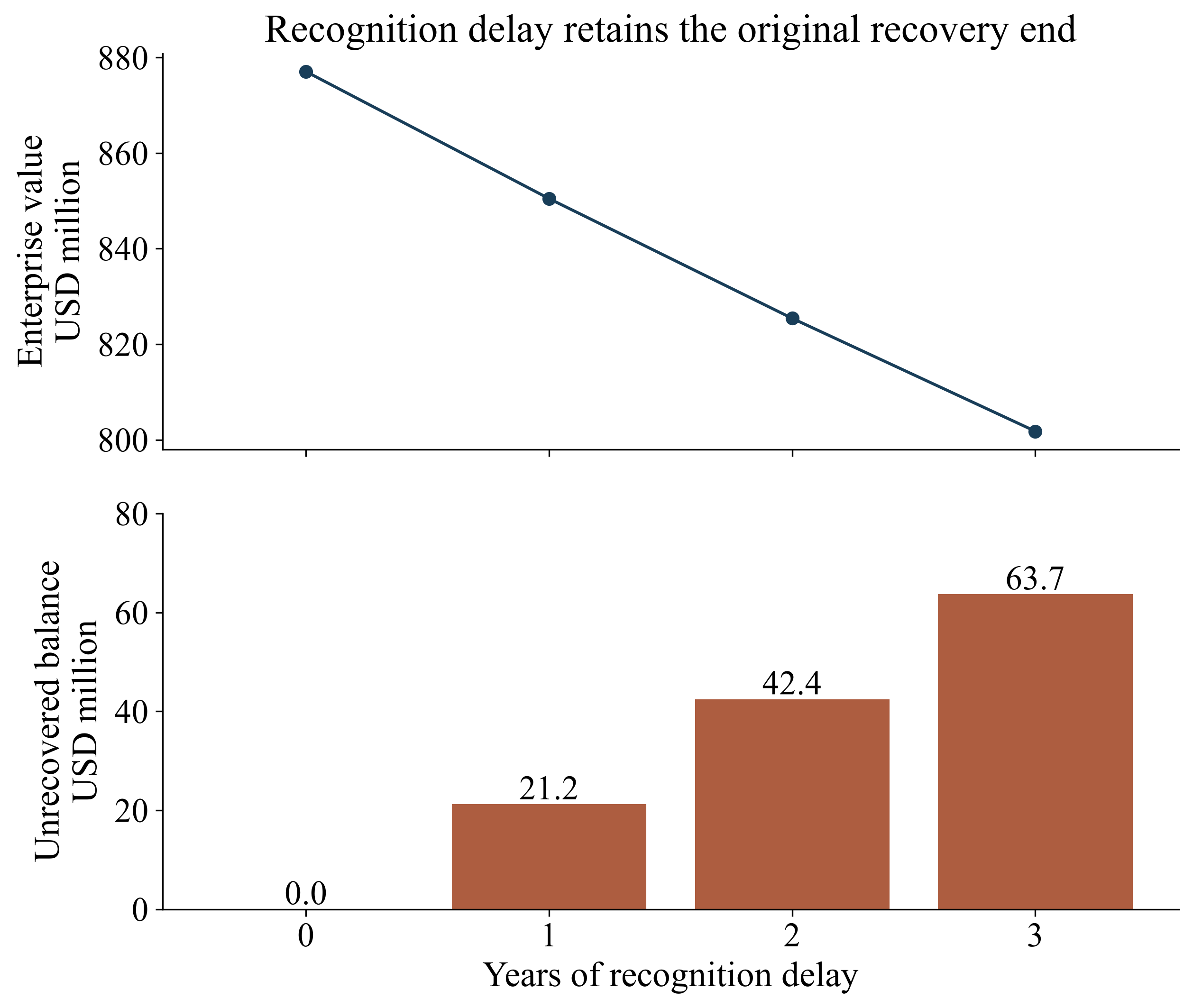
View figure at full size; scroll horizontally on smaller screens.
USD million. Commissioning remains year 4; recovery ends in year 18 with the original annual instalment. Residual amounts and delayed operating costs receive no catch-up or terminal proceeds in these assumed cases.
14 Separate approval risk from the amount of construction cash required
Approval denied before any commitment leaves growth expenditure and growth value at zero. Existing-asset value remains USD 901.945 million. Approval denied after the first USD 100 million payment produces a negative USD 93.023 million growth NPV and enterprise value of USD 808.922 million. The latter case assumes no subsequent expenditure, recovery, salvage or abandonment cost. These are alternative decision dates. Their difference quantifies the stipulated exposure created by committing cash before the assumed approval outcome; it supplies no estimate of how likely refusal is.
The low-load case reduces the programme before its third commitment. Expenditure is USD 100 million in each of years 1 and 2, followed by zero in year 3. The smaller project is assumed to remain technically viable and commissioned in year 4; that feasibility requires engineering evidence in practice. Its eligible construction balance continues to accrue the stipulated allowance through year 3, reaching USD 218.360 million. Growth NPV is negative USD 18.252 million. Existing recovery revenue remains unchanged. This is a management-stipulated change in future investment scope, with no inferred demand elasticity or volume adjustment to the existing revenue entitlement.
Overrun admission receives a separate test. A 25% overrun raises each construction payment to USD 125 million. If only the original expenditure is admitted, enterprise value becomes USD 812.054 million. Full admission increases the approved growth balance to USD 397.950 million and enterprise value to USD 870.848 million. The fully admitted expansion still earns the assumed 6% against a 7.5% investor requirement. A different case disallows 20% of the original cash expenditure, reducing the admitted balance and enterprise value to USD 830.032 million. Excluded cash has no later recovery in these scenarios.
The funding account uses undiscounted dated cash. Growth alone requires USD 300 million before its first recovery receipt. Existing-asset cash covers the base programme under the annual convention, assuming all prior surplus remains available. Both overrun cases create a USD 54 million cumulative combined shortfall by the end of year 3. This is an unlevered funding requirement before interest, debt amortisation, distributions and restricted-cash rules. Actual sponsor calls could differ materially. The result establishes no commitment to lend or contribute equity, and annual aggregation provides no evidence of intrayear liquidity.
Table 8. Approval and demand-dependent commitment cases
| Decision case | Actual capex | Approved growth balance | Growth NPV | Enterprise value |
|---|---|---|---|---|
| Full approved programme | 300.000 | 318.360 | -24.877 | 877.067 |
| No growth commitment | 0.000 | 0.000 | 0.000 | 901.945 |
| Approval denied before commitment | 0.000 | 0.000 | 0.000 | 901.945 |
| Approval denied after first spend | 100.000 | 0.000 | -93.023 | 808.922 |
| Low-load programme reduced | 200.000 | 218.360 | -18.252 | 883.693 |
USD million. Low load is a management-stipulated programme reduction before the third commitment, with the smaller approved programme still commissioned in year 4. It is not a volume haircut to existing permitted revenue. Denied sunk spend has no salvage.
Table 9. Capital admission and timing downside
| Case | Cash capex | Unapproved cash | Growth NPV | Residual balance | Enterprise value |
|---|---|---|---|---|---|
| Twenty-five percent overrun excluded | 375.000 | 75.000 | -89.891 | 0.000 | 812.054 |
| Twenty-five percent overrun admitted | 375.000 | 0.000 | -31.097 | 0.000 | 870.848 |
| Twenty percent spend disallowed | 300.000 | 60.000 | -71.912 | 0.000 | 830.032 |
| No construction allowance | 300.000 | 0.000 | -38.440 | 0.000 | 863.505 |
| Two-year completion delay | 300.000 | 0.000 | -67.860 | 42.448 | 834.085 |
| Two-year recognition delay | 300.000 | 0.000 | -76.532 | 42.448 | 825.413 |
USD million. Admitted overruns earn only the assumed allowed return; excluded amounts have no recovery. Completion and recognition delays both retain the original recovery end. A completed but unrecognised asset also incurs unrecovered operating cost.
Table 10. Dated construction funding boundaries
| Case | Growth cash need | Combined unlevered need | Residual asset | Terminal cash |
|---|---|---|---|---|
| Full approved programme | 300.000 | 0.000 | 0.000 | 0.000 |
| Twenty-five percent overrun excluded | 375.000 | 54.000 | 0.000 | 0.000 |
| Twenty-five percent overrun admitted | 375.000 | 54.000 | 0.000 | 0.000 |
| Two-year completion delay | 300.000 | 0.000 | 42.448 | 0.000 |
| Two-year recognition delay | 312.000 | 0.000 | 42.448 | 0.000 |
USD million. Each need is the largest negative cumulative undiscounted cash balance, assuming prior surplus retained. Combined cash includes existing-asset receipts, excludes debt service and distributions, and proves no actual sponsor or debt commitment.
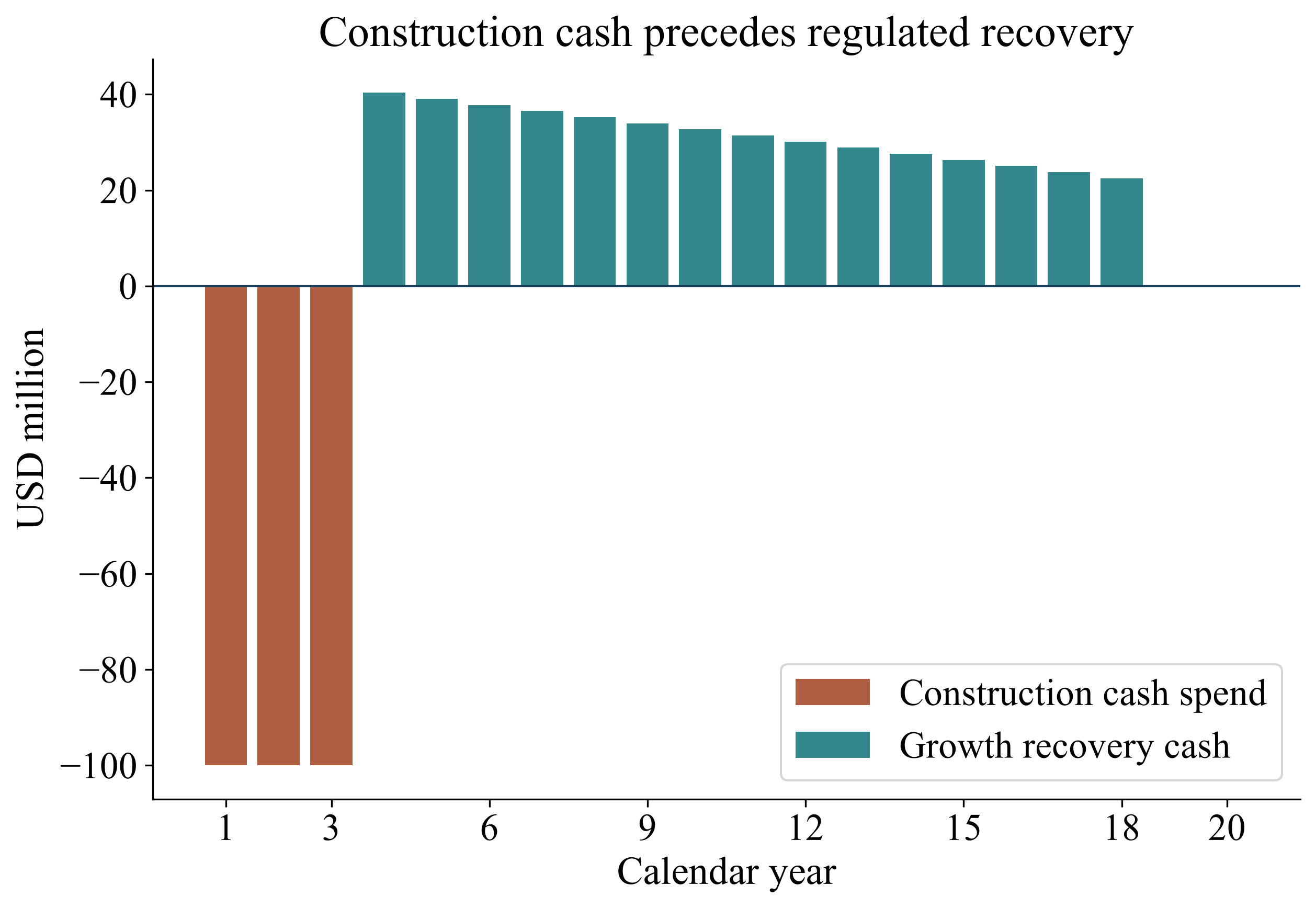
View figure at full size; scroll horizontally on smaller screens.
Base-case USD million. Noncash construction allowance enters approved recovery balance and is not a construction-period receipt. Operating cost and same-year reimbursement cancel in this case. Financing flows are excluded.
15 Convert the enterprise threshold into a conditional offer and funding test
The acquisition bridge assumes target debt of USD 400 million and transferable target cash of USD 60 million. A selected enterprise price of USD 1,100 million therefore implies a share price of USD 760 million. The buyer also pays USD 15 million of advisory costs at closing, producing a USD 775 million share-acquisition cash outlay. Against a separately assumed buyer equity budget of USD 500 million, the conditional closing gap is USD 275 million. Target cash has already increased the share price and is not credited again against the buyer's budget.
This bridge assumes no particular debt repayment, refinancing, security release or cash-sweep arrangement. The target debt is a price adjustment in this illustration; no financing schedule is embedded in the unlevered DCF. Debt-like liabilities, working-capital adjustments, restricted cash, transaction taxes and consent costs require their own verified schedules. The closing gap and subsequent construction cash requirement consequently describe different uses and dates. A financing plan must reconcile both before either becomes an executable funding instruction.
At the base assumptions, intrinsic enterprise value less the advisory cost gives a maximum conditional enterprise offer of USD 862.067 million. Applying the same net-debt bridge gives a maximum share offer of USD 522.067 million before paying that advisory cost. The selected enterprise offer and fee exceed intrinsic value by USD 237.933 million. Holding the other base assumptions fixed, the allowed-return threshold supporting those outlays is approximately 8.896%. That mathematical threshold supplies no prediction that a regulator will award such a return.
The reproducible calculation retains every annual row, all case inputs and the unrecovered balances. Author checks use 48-digit decimal arithmetic, cash identities, a separate existing-balance valuation identity and equal-rate neutrality tests. The finite horizon excludes taxes, inflation, replacement programmes, collection risk, terminal realisation and post-closure liabilities. Those omissions define the illustration's scope. A real acquisition decision requires the actual allowed-revenue instrument, engineering programme, expenditure commitments, operating obligations and buyer funding terms before converting a calculated price limit into an offer.
Table 11. Enterprise price to conditional share funding
| Bridge item | USD million | Treatment |
|---|---|---|
| Selected enterprise price | 1,100.000 | Hypothetical offer |
| Less target debt | -400.000 | Assumed debt-like claim |
| Add target cash | 60.000 | Assumed transferable cash |
| Selected equity price | 760.000 | Enterprise price less debt plus cash |
| Advisory cash cost | 15.000 | Buyer expense; outside target DCF |
| Buyer share cash outlay | 775.000 | Equity price plus advisory cost |
| Assumed buyer equity budget | 500.000 | Scenario input; no commitment |
| Conditional closing funding gap | 275.000 | Before financing terms and debt repayment choices |
The bridge supplies no leverage valuation, refinancing plan, debt consent or purchase-price adjustment. Target cash is added once to equity price; it is not credited a second time against the buyer budget.
Table 12. Acquisition price decision boundaries
| Boundary | Value | Unit | Condition |
|---|---|---|---|
| Maximum enterprise offer before fees | 862.067 | USD million | Intrinsic value less 15 advisory cost |
| Maximum equity offer before fees | 522.067 | USD million | Same net-debt bridge |
| Value less selected price and fee | -237.933 | USD million | 1,100 selected enterprise price |
| Break-even allowed return | 8.896 | Percent | 7.5% discount; all base recovery assumptions |
| Break-even selected EV / balance | 0.862 | Ratio | Existing balance denominator 1,000 |
Conditional pre-tax price limits, with no market-multiple or fairness-opinion interpretation. A positive model threshold is not evidence that an authority will permit that return or that an acquisition can close.

View figure at full size; scroll horizontally on smaller screens.
Intrinsic enterprise value less the assumed USD 15 million buyer advisory cost. The selected price is a fictional USD 1,100 million offer. Bars supply no fairness opinion, funding commitment or prediction of regulatory approval.
16 Define the purchased interest and the claimed premium
This paper proposes evaluating a transmission acquisition through a defined ownership and cash perimeter. The opening investment memorandum should identify the shares, assets, contractual rights and liabilities that the buyer would acquire. It should also identify the entity that receives regulated receipts and the entity that incurs acquisition debt. A purchase of control may give the buyer decision rights over an operating company, subject to applicable restrictions. Those rights require verification in the transaction documents, governance arrangements and relevant approvals. An asserted ability to redirect cash remains an assumption until its contractual and regulatory conditions have been examined.
The pricing analysis should separate the value assigned to the existing business from the additional amount offered for a proposed benefit of ownership. The buyer might propose operational savings, improved capital delivery or access to a specific development programme. Each proposed benefit needs a dated cash consequence, implementation expenditure and accountable owner. The investment committee should also identify benefits already included in the standalone forecast. Adding a separate premium for the same expected growth would charge the acquisition case twice for one source of cash. The price memorandum should retain a reconciliation from the standalone case to the buyer's proposed bid.
An asset-base multiple provides a comparison only after its numerator and denominator have been defined. The proposed analysis records the measurement date, included assets, debt treatment and adjustments attached to each figure. A regulatory asset base, accounting carrying amount, replacement-cost estimate and enterprise value can describe different perimeters. Diligence should reconcile the underlying schedules before drawing a conclusion from their ratio. If the buyer cites an observed transaction as a benchmark, the comparison should disclose which consideration components, assumed liabilities, ownership rights and future funding obligations are actually known. Unavailable terms remain unavailable.
The practical decision is whether the buyer can justify an incremental payment using cash it can obtain under the proposed ownership structure. The memorandum should show the purchase price separately from the capital still needed after closing. It should identify the portion of the investment thesis that depends on future permissions, customer readiness or an unapproved recovery assumption. Where a material dependency remains open, the committee can consider a lower unconditional commitment, a contingent structure or further diligence. Each response needs its own commercial feasibility assessment. The framework supplies no presumption that control itself creates recoverable regulated value.
Table 13. Define the acquisition price and benefit perimeter
| Price component | Evidence requested | Cash reconciliation | Decision affected |
|---|---|---|---|
| Existing business | Standalone forecast and asset schedule | Existing receipts and required capital | Unconditional price |
| Control benefit | Specific right and execution plan | Incremental cash after implementation cost | Additional bid amount |
| Growth expectation | Project and recovery records | Future capital before collection | Conditional commitment |
| Benchmark multiple | Consideration and denominator definitions | Known liabilities and funding obligations | Comparability of reference |
Proposed price-review matrix. No observed transaction multiple, market premium or regulatory recovery right is asserted.
17 Trace large load requests to dated deliverable demand
The proposed demand review begins with a request-level register linking each material forecast load to its legal applicant, physical site and evidence date. A data-centre development announcement, a connection application, a signed service agreement and metered consumption should occupy distinct fields. The analyst records requested capacity, expected energisation, phased utilisation and dependencies without treating one field as proof of another. If the target's forecast aggregates several datasets, the review should preserve the original identifiers so that duplicate applications and subsequent changes can be investigated. A cumulative headline cannot establish which specific loads underpin an acquisition forecast.
For each material customer, the diligence team should reconstruct the route from site preparation to sustained power use. The proposed record covers site control, relevant permissions, equipment delivery, connection works, financing conditions and the customer's own commercial commitments. Each item should be supported by the document or responsible party able to verify it. A forecast date should show whether it comes from the applicant, network operator, project engineer or the target's analyst. When the dates conflict, the acquisition case should retain the disagreement and explain the scenario used. An unresolved conflict should not disappear through an averaged date.
Requested connection capacity also needs a clear relationship to expected utilisation. The proposed operating case should distinguish installed facility capacity, reserved connection capacity, peak import and the annual consumption profile used in a revenue assumption. For a phased campus, the first energised block should not automatically carry the eventual full-site demand. The assessment should identify contractual ramp conditions and the evidence for subsequent phases. Any proposed price paid for expansion should trace to the particular network expenditure and recovery mechanism that the load could support. The paper assigns no empirical conversion rate to an application or announcement.
The committee should receive a demand bridge that separates evidenced commitments, conditional projects and scenarios requiring further information. These categories are recommended evidence states, with definitions set before the review. Their treatment in the financial model should be explicit. A project that loses a site, changes its connection point or revises its schedule should create a traceable forecast revision. The consequence may involve revenue timing, capital cancellation, replacement customers or unused capacity. Diligence should identify which consequence applies to the target's actual agreements. This connects the customer register to an acquisition decision without converting uncertain requests into assured cash.
Table 14. Link a load forecast to project evidence
| Evidence state | Record to retain | Open dependency | Model treatment to specify |
|---|---|---|---|
| Application | Applicant, site and request identifier | Project readiness and connection terms | Conditional case |
| Agreed connection | Executed terms and milestone schedule | Works and customer conditions | Dated assumptions |
| Energised phase | Acceptance and metering records | Utilisation and later phases | Separate initial ramp |
| Sustained use | Validated load and billing history | Future contract and operating changes | Observed period only |
Author-proposed evidence states for diligence. State names establish no legal status or empirical probability of progression. Each project requires its own supporting records.
18 Establish regulatory recovery and operating permissions
The proposed regulatory review should construct an asset-level reconciliation between legal ownership, operating permission, recognised investment and the receipts included in the forecast. Each material asset or expenditure programme needs an identified document supporting its treatment. The record should distinguish expenditure already recognised in an applicable recovery base from work awaiting a decision, work in progress and a future proposal. The analysis should retain the effective dates and conditions of each decision. A management forecast can be evaluated as a forecast while the underlying recovery status remains unresolved.
For a contemplated change of ownership, counsel and the regulatory team should determine the transaction-specific approvals and continuing obligations. The diligence request should cover the actual licence holder, permitted activities, geographic and asset scope, transfer or change-of-control provisions and any conditions affecting financing or distributions. It should also identify decisions held by another entity on which the target depends. The acquisition timetable should show the closing condition associated with each required consent. This paper proposes the evidence structure; the existence and effect of an approval requirement must come from the applicable documents and jurisdiction-specific advice.
The financial review should follow recovery into cash. A decision recognising expenditure may have a different effective date from construction completion, the start of an allowed return, customer billing and collection. The proposed bridge records those events separately. It should show the assumed treatment of construction financing costs, depreciation, efficiency adjustments and expenditure that might receive different treatment following review. Where the treatment is uncertain, the model should preserve the relevant alternative cases. The analysis should also identify whether a quoted return is nominal or real and how the forecast implements its stated convention. No generic regulatory return is assumed here.
An acquisition committee should therefore ask two connected questions: what treatment is evidenced, and what funding is required until the resulting cash is available? The answer should attach the actual decision, its conditions and the responsible review owner. A remaining dispute about eligibility or timing belongs in the price and funding analysis. The proposed matrix links each open regulatory item to an expenditure commitment and cash consequence. It helps the buyer distinguish a diligence gap that can be closed before signing from one that remains a commercial risk after completion. Asset labels and forecast inclusions require supporting approval evidence.
Table 15. Reconcile permissions and regulatory cash recovery
| Review item | Primary evidence | Date to reconcile | Unresolved exposure |
|---|---|---|---|
| Operating scope | Applicable licence and conditions | Effective term and expiry | Activity or asset outside scope |
| Ownership change | Relevant consent provisions and decision | Closing condition date | Completion delay |
| Investment recognition | Applicable determination and asset schedule | Recovery effective date | Excluded or deferred expenditure |
| Receipt availability | Billing and cash restrictions | Collection and release dates | Funding before accessible cash |
Proposed transaction-specific review. Applicable requirements and their legal effect must be established from actual documents and jurisdiction-specific advice.
19 Reconcile enterprise price to the completion funds flow
The proposed completion analysis starts with the exact price definition in the contemplated agreement. The financial model should show how enterprise consideration becomes the amount paid for equity, including the specified treatment of debt, cash, working capital and other adjustments. Each adjustment requires a measurement date, accounting policy and documentary support. The buyer should identify whether the price convention uses locked historical accounts, completion accounts or another agreed mechanism. The paper assumes no standard entitlement to an adjustment. The signed terms and their accounting schedules would determine the actual calculation.
The funds flow should distinguish money paid to sellers from money delivered to the business, lenders, advisers or restricted accounts. A target's cash balance may include amounts committed to construction, held as collateral or otherwise unavailable to fund the acquisition. The proposed review should trace these restrictions and the timing of any permitted release. Existing debt should be mapped by borrower, maturity, security and any transaction-related repayment requirement. A proposed refinancing remains conditional until its availability and draw conditions are evidenced. An assumed cash sweep should appear only where the relevant approvals and restrictions support it.
Growth commitments create another bridge between the price model and closing cash. A buyer might agree a price based on a development programme while also inheriting unpaid contractor invoices, equipment commitments or required customer-security arrangements. The proposed funds flow should identify these uses explicitly and distinguish liabilities included in the agreed price adjustment from future expenditure funded after closing. Counting an obligation in both categories would overstate the required adjustment. Omitting it from both would understate the investment. The diligence team should reconcile the transaction schedule to purchase orders, project accounts and the financial forecast.
Before signing, finance and legal reviewers should rehearse a hypothetical closing using the proposed documents. The rehearsal should identify the account receiving each transfer, the condition releasing it and the evidence that the related obligation has been discharged. It should also show any amount that cannot be determined until later. The committee should approve the maximum funding exposure consistent with that uncertainty and the mechanism for resolving it. At completion, the approved rehearsal becomes a reconciliation target. Differences in consideration, refinancing proceeds or restricted cash should receive explicit authorisation before the final transfers are instructed.
Table 16. Trace the completion cash recipients
| Payment recipient | Proposed use | Supporting schedule | Release condition to verify |
|---|---|---|---|
| Seller | Equity consideration | Agreed price adjustment bridge | Completion mechanics |
| Existing lender | Repayment or refinancing | Debt and discharge calculation | Security release conditions |
| Target business | Working cash and project funding | Dated operating and capital plan | Account access and restrictions |
| Restricted account | Reserve or collateral | Instrument-specific funding requirement | Permitted access and release |
Illustrative funds-flow categories only. Include a category when the actual transaction requires it; avoid counting an obligation in both price adjustments and future funding.
20 Fund growth before its recovery becomes cash
The proposed growth model should follow each material project from approval through procurement, construction, energisation and the cash-recovery period. Expenditure, regulatory recognition and collection should retain their own dates. This allows the buyer to see how a programme that adds recoverable assets can still require substantial interim funding. The case should include construction interest, committed fees, project working capital and any required reserve or security funding when those items apply. Their treatment must follow the actual financing and recovery assumptions. An accounting addition to an asset schedule should not be entered as a cash receipt.
Capital allocation should also distinguish maintenance of the existing network from growth associated with new connections or wider system requirements. The proposed classification should explain the operational purpose and approval basis of each programme. A customer-specific project may depend on a particular counterparty's readiness, while a wider programme could have different approval and utilisation drivers. The buyer should map shared assets and dependencies before allocating costs across the investment cases. Expenditure on one substation, route or control system should appear once in the combined capital plan, with its beneficiaries identified separately.
The financing review should retain the obligations of the regulated operating company and the acquisition holding company in separate schedules. Each borrower has its own receipts, costs, interest, amortisation and access to cash. A distribution assumed at the holding company should be supported by the operating company's available cash and applicable conditions. The proposed downside cases should test delayed recovery, construction overruns and reduced distributions together where they share a cause. Covenant definitions require review in the actual documents. The paper describes coverage and liquidity risks qualitatively without asserting a universal covenant threshold or cure right.
The investment decision should specify who funds the maximum cash requirement and when that funding becomes available. A committed facility, a contingent sponsor contribution and an uncommitted refinancing assumption have different evidential status. The proposed model should preserve that distinction in its sources and uses. The committee should also test the consequence of delaying optional expenditure: which commitments can be paused, what costs survive and how the change affects future receipts. A growth plan is financeable within the model only under its stated funding and timing assumptions. Actual availability of capital remains a separate approval condition.
Table 17. Locate funding needs along the growth programme
| Project stage | Potential cash use | Recovery evidence | Funding question |
|---|---|---|---|
| Development | Studies and permissions | Programme decision | Who funds work before commitment? |
| Procurement | Deposits and long-lead orders | Eligible scope and cost treatment | What survives cancellation? |
| Construction | Contractor payments and interest | Recognition conditions | What covers delay and overrun? |
| Service and recovery | Operating cost and receivables | Billing entitlement and collection | When is cash available to each borrower? |
Proposed funding questions. Expenditure recognition and cash recovery are separately evidenced events; no universal recovery treatment or financing availability is assumed.
21 Allocate queue and delivery uncertainty in the transaction
The proposed acquisition structure should allocate identified uncertainty to the decision or obligation that can address it. If a material part of the price depends on a connection milestone, the parties could consider contingent consideration tied to a precisely defined event. The event should identify the relevant project, evidence, measurement date and treatment of subsequent cancellation or revision. A payment triggered by an application, physical energisation or regulated recovery could have very different economics. The parties should evaluate which event reflects the benefit being priced and whether the proposed mechanism can be administered after ownership changes.
Seller representations, indemnities and completion conditions should be evaluated against the specific information gap. The proposed diligence process should distinguish a misstated historical fact from a forecast that later develops differently. It should identify disclosure qualifications, knowledge standards, claim periods and recoverability where those terms are under negotiation. Insurance or a contractual remedy should not be credited as cash protection without examining exclusions, limits, claim evidence and the payer's capacity. The paper recommends this review structure and asserts no particular remedy for any actual transaction.
Delivery dependencies also need operational ownership after closing. A customer, network operator, equipment supplier and permitting authority may control different milestones in a proposed project. The acquisition plan should record which party can change each date and what notice or approval is needed. Where the buyer inherits an interface risk, its forecast should show the expenditure that continues during a delay. A contractual cap on one supplier's liability may leave the target with a larger cash requirement. The transaction team should quantify that retained exposure using the proposed contract and the dated capital plan.
The resulting risk allocation should be tested against a small set of defined events before the bid is finalised. For example, the team could trace a customer's deferred energisation through construction obligations, recovery timing, financing costs and any contingent price payment. The example should use the actual proposed clauses and clearly labelled scenario inputs. The committee should see the residual exposure after each contractual response, including amounts that remain uncommitted or disputed. This makes transaction structuring an extension of the diligence evidence and cash model. It also identifies when an attractive headline price depends on protection the counterparties have yet to agree.
Table 18. Test proposed transaction protections against specific events
| Defined event | Mechanism to consider | Evidence required | Residual issue |
|---|---|---|---|
| Customer milestone deferred | Contingent consideration | Exact trigger and verification record | Continuing capital commitments |
| Historical information misstated | Negotiated representation or remedy | Scope, disclosure and claim support | Enforceability and payer capacity |
| Supplier completion delayed | Delivery allocation and response plan | Interface and liability terms | Uncompensated financing cost |
| Recovery treatment unresolved | Closing condition or priced scenario | Decision and effective date | Funding until actual receipts |
Possible mechanisms for negotiation, with no statement of existing rights, insurance cover or agreed compensation. Counsel and counterparties must establish feasibility.
22 Control forecasts and automated evidence extraction
The proposed data-governance method starts with a controlled definition of each forecasting input. Requested load, accepted capacity, construction progress, recoverable investment and collected revenue should have distinct field definitions and evidence owners. The model should identify which version of each source was used and the date on which it was available. Changes to a customer request or regulatory decision should remain traceable to the previous forecast. This is particularly important when the acquisition case combines engineering datasets, project accounts and commercial records with different update cycles and identifiers.
If automated extraction or artificial-intelligence tools are used to organise documents, the proposed process should preserve the underlying document, locator and extracted value for human review. A summary should not replace the agreement or decision on which a material assumption depends. The reviewer should check units, effective dates, exceptions, amendment hierarchy and negative conditions that could change the meaning of an extracted statement. Confidential material should be processed only within approved access and retention arrangements. Any uncertainty in the source should survive the extraction process and remain visible to the model owner.
Forecast validation should test the model's behaviour as well as its arithmetic. The proposed checks include moving a single commissioning date, removing a duplicated customer, changing a recovery lag and restricting a distribution between entities. Each test should produce an explainable effect in the related cash schedule. Independent reviewers should reconcile opening and closing debt, cash and receivables and confirm that a funding draw enters financing once. They should also inspect whether a terminal assumption conceals an earlier liquidity shortfall. A sensitivity is useful when its scope and causal path are clear to the committee.
The decision process should separate observed evidence, management estimates and author-created scenarios in ordinary language. It should record the purpose of each case and avoid attaching a probability without an evidential basis. A forecast of data-centre demand should disclose the customer and site assumptions on which it relies; a technology narrative alone supplies no customer commitment. The proposed sign-off requires the commercial, technical, regulatory and finance owners to accept the specific inputs within their remit. Any unresolved disagreement should appear in the investment memorandum with its consequence for price, timing or required funding.
23 Execute the first hundred days against cash gates
The first hundred days are proposed here as an implementation horizon for the buyer's transition plan. The plan should begin before closing with an inventory of obligations that cannot wait for organisational integration. The incoming team should identify near-term debt dates, procurement commitments, customer milestones, regulatory submissions and operational decisions. Each item needs an authorised owner and access to the supporting records. The objective is to carry the acquisition assumptions into controlled operating decisions while preserving service continuity and the target's applicable responsibilities.
During the initial handover, the buyer should reconcile opening cash, debt, restricted balances and project commitments to the approved completion statement. The team should obtain the customer register and confirm which connection dates have changed since the final bid. It should also verify authority over payment accounts and forecast submissions. A discrepancy should be assessed for its effect on current funding and subsequent decisions. The proposed transition record preserves the acquired company's evidence and distinguishes a corrected opening position from a new management action taken after completion.
The next stage should establish a common capital and recovery calendar. Project teams should reconcile physical milestones with purchase orders, cash forecasts and the documents supporting revenue treatment. The buyer should focus review effort on commitments with limited cancellation flexibility or a short period before funding is required. A proposed escalation meeting should decide the response to each material exception and record its cash consequence. The integration plan should avoid assuming that a new owner can immediately alter regulated expenditure, transfer customer obligations or change operating responsibilities without the applicable permissions.
By the end of the proposed horizon, the committee should receive a reforecast that explains movements from the acquisition case. The bridge should distinguish newly verified information, delivery changes, customer revisions and deliberate capital-allocation decisions. It should identify any remaining requirement for approval, additional equity or revised debt terms. The buyer can then evaluate the original premium thesis against the evidence now available. An unresolved benefit should retain its dependency and responsible owner. The hundred-day review is a proposed decision checkpoint, with no claim that the underlying network programme or regulatory process can be completed within that period.
Table 19. Set evidence checkpoints for the first hundred days
| Checkpoint | Work product | Owner to assign | Decision supported |
|---|---|---|---|
| Pre-closing readiness | Near-term obligation register | Incoming transaction and operating leads | Authority and funding continuity |
| Opening reconciliation | Cash, debt and commitment bridge | Finance with legal review | Correction of opening assumptions |
| Integrated capital review | Delivery and recovery calendar | Project and regulatory leads | Commit, pause or escalate expenditure |
| Hundred-day review | Acquisition-case variance bridge | Investment committee | Updated funding and premium thesis |
A proposed buyer review horizon, with no claim that network delivery, approvals or recovery can be completed within one hundred days.
24 Record the investment decision and its remaining conditions
The final acquisition memorandum should state the purchased interest, the price definition and the funding required through the chosen forecast horizon. It should identify the existing cash-generating assets, the growth commitments included in the bid and the evidence supporting their regulatory and customer assumptions. The proposed approval should distinguish the amount authorised at signing from subsequent expenditure requiring another decision. This permits the committee to evaluate the full capital exposure associated with the transaction while retaining control over commitments that depend on future evidence.
The premium case should be expressed through a reconciliation that another reviewer can reproduce. The reader should be able to trace each proposed increment of value to a specific cash assumption, ownership right or executable improvement. The memorandum should disclose where the benefit also depends on a customer ramp, an expenditure decision, timely construction or available financing. If the standalone and acquisition models use different assumptions, the difference should be explained. A premium supported solely by an unreconciled multiple or a broad load-growth narrative remains an incomplete investment argument under this proposed framework.
Downside approval should identify the funding response to the defined adverse cases. It should state the commitments that remain payable, the cash that could be restricted and the decisions needed before a proposed mitigation becomes effective. The committee should distinguish an available facility from a hoped-for refinancing and a documented customer obligation from an estimated demand ramp. Where the downside cannot be funded within the agreed authority, the memorandum should present the resulting constraint on price, structure or timing. It should not describe an unresolved support requirement as committed capital.
The contribution of the framework is a disciplined acquisition question: what incremental payment can the buyer support after accounting for the cost, timing and conditions of realising the proposed benefit? The answer remains transaction-specific. The recommended evidence register, completion bridge and post-closing review make that question operational without asserting a general regulated-grid premium. Application to an actual acquisition would require the relevant agreements, regulatory decisions, technical evidence and financing terms. Until those records are available, the analysis should preserve its conditional conclusions and the separate authority required for each material commitment.
25 Conclusions for a proposed acquisition
The acquisition decision should state a price, the recovery assumptions supporting it and the funding required to deliver the investment programme. The existing balance, growth expenditure and contingent investment rights need separate valuations before they enter a combined enterprise value. The buyer should record the outstanding evidence that could change each component and the financial consequence if that evidence develops adversely.
A proposed premium should remain conditional on the rights and economics included in the purchased interest. An approved investment programme still requires execution and financing. A load request still requires examination of its status, delivery conditions and relevance to the network's permitted recovery. A minority stake still requires examination of governance, distributions and future funding obligations. Each of these questions can alter the bid, transaction conditions or the amount held back pending a verified milestone.
The practical output is a dated investment decision record. It includes the valuation range, a recoverable-asset reconciliation, the acquisition-to-equity bridge, required financing approvals and the first actions after completion. Where a material assumption remains unsupported, the record can identify a conditional payment, a limit on committed expenditure or a decision to defer the acquisition. The worked calculations provide a way to quantify those choices under explicit assumptions; they do not establish a market price or a funded transaction.
References
Public sources accessed 9 October 2026. Model inputs, calculated examples and proposed decision records are author-created illustrations. The acquisition and investment cases represent no actual network, tariff, licence, transaction or financing commitment. The calculations use a hypothetical pre-tax unlevered runoff model with no cash terminal value. Calculated table values are displayed to three decimal places using round-half-up; floating-point noise is removed at twelve decimal places before display rounding. Calculations retain their underlying precision.
- Office of Gas and Electricity Markets. RIIO-3 Final Determinations: Electricity Transmission. 2025-12-04. Printed p. 8, paragraph 2.4; printed pp. 9-10, paragraphs 2.8-2.11; printed p. 12, paragraph 3.5. https://www.ofgem.gov.uk/sites/default/files/2025-12/RIIO-3-Final-Determinations-ET.pdf
- Office of Gas and Electricity Markets. RIIO-3 Final Determinations: Finance Annex. 2025-12-04. Printed p. 80, paragraphs 5.2-5.4; printed pp. 80-81, paragraphs 5.5-5.8. https://www.ofgem.gov.uk/sites/default/files/2025-12/RIIO-3-Final-Determinations-Finance-Annex.pdf
- Office of Gas and Electricity Markets. RIIO-2 regulatory performance data: 2025. 2026-02-13. Paragraphs beginning Return on Regulated Equity, This data file consolidates and RoRE reflects. https://www.ofgem.gov.uk/data/riio-2-regulatory-performance-data-2025
- Office of Gas and Electricity Markets. TMO 4+ Impact Assessment. 2025-04-15. Printed p. 1, opening three paragraphs and footnote 2. https://www.ofgem.gov.uk/sites/default/files/2025-04/TMO4-Impact-Assessment-Decision_0.pdf
- National Energy System Operator and joint industry delivery partners. Connections reform timeline. 2026-02-13. Joint statement paragraphs beginning As set out in the January joint statement and The following timeframes; FAQ Why has the timeline been revised. https://www.neso.energy/industry-information/connections-reform/connections-reform-timeline
- SSE plc. Annual Report 2023. 2023. 25% non-controlling equity stake in Scottish Hydro Electric Transmission plc paragraph and cash-consideration table. https://www.sse.com/media/dncdjrcw/sse-annual-report-2023-web-final.pdf
- Office of Gas and Electricity Markets. Amendments to the RIIO-3 licences and Price Control Financial Models (PCFM). 2026-08-21. Status Closed (awaiting decision); paragraphs on proposed corrections and housekeeping to licence conditions. https://www.ofgem.gov.uk/consultation/amendments-riio-3-licences-and-price-control-financial-models-pcfm
- Federal Energy Regulatory Commission. Mergers and Sections 201 and 203 Transactions. 2021-04-12. Opening paragraph on competition, rates, regulation and cross-subsidisation. https://www.ferc.gov/electric/general-information/mergers-and-sections-201-and-203-transactions
- Federal Energy Regulatory Commission staff. Accounting Questions and Answers. Undated. Questions 3 and 4 on plant-related acquisition adjustments and jurisdictional-rate recovery. https://www.ferc.gov/accounting-questions-and-answers
- Federal Energy Regulatory Commission. Policy Statement on Hold Harmless Commitments. 2016-05-19. Paragraph 47, printed p. 34, requiring a separate section 205 benefit showing for acquisition-premium recovery. https://www.ferc.gov/sites/default/files/2020-04/E-5_14.pdf
- Federal Energy Regulatory Commission. Electric Transmission. 2025-12-19. Paragraphs beginning The Commission has established rules and All rates approved under the rules; enumerated treatment of prudent CWIP and abandoned facilities. https://www.ferc.gov/electric-transmission
- United States Department of Energy. National Transmission Planning Study. 2024-10-03. Study scope and table What the study does / What the study Does not Do. https://www.energy.gov/oe/national-transmission-planning-study-0
- Federal Energy Regulatory Commission. Order No. 1920 Compliance Filings Schedule. 2025-06-16. First two paragraphs, relevant-state engagement paragraph and schedule headings. https://www.ferc.gov/news-events/news/order-no-1920-compliance-filings-schedule
- European Union Agency for the Cooperation of Energy Regulators. Reforming cost and benefit sharing to support Europe's electricity grid expansion. 2026-05-18. Description of congestion-income distribution, ITC and CBCA; final paragraph on policy-paper discussion scope. https://www.acer.europa.eu/news/reforming-cost-and-benefit-sharing-support-europes-electricity-grid-expansion
- European Commission Directorate-General for Energy. Trans-European Networks for Energy. Undated. Paragraphs on the 2022 regulation, PCI/PMI identification, permitting, cross-border cost allocation and financing opportunities. https://energy.ec.europa.eu/topics/infrastructure/trans-european-networks-energy_en
- European Commission Directorate-General for Energy. European grids. Undated. Paragraph beginning The Commission presented and subsequent proposed objectives; guidance paragraph. https://energy.ec.europa.eu/topics/infrastructure/european-grids_en
About the Author
Chennakeshav (CK) is a corporate finance and investment banking executive with 25+ years of global experience in deal origination, structuring and execution across M&A, growth capital and corporate strategy. He has led value-creation mandates for founders, corporates and funds — bridging the boardroom view to hands-on execution and close.
His career spans Morgan Stanley, HSBC, Lloyds Banking Group, EWEC, ADQ portfolio companies and Emirates Growth Fund, across TMT, real estate, fintech, deeptech, cleantech, infrastructure and energy. He has partnered with C-suite leaders, private equity and venture funds, sovereign wealth funds and family offices to finance complex fund raises and scale-up ventures, and has led M&A due diligence, post-merger integration and business-transformation initiatives to create value.
At Matchpoint Partners he is Managing Partner, leading the firm's corporate finance, M&A and capital-raising practice. He holds an MBA from London Business School, an engineering degree from VTU and a Master of Laws (LLM, in progress) from UCL London.
An active start-up mentor, CK mentors at Techstars, DIFC FinTech Hive, Startup Grind, Founder Institute and IN5, serves as Entrepreneur Mentor in Residence (EMiR) at London Business School, and judges the Entrepreneurship World Cup.
https://www.linkedin.com/in/ckadya/ https://www.matchpoint-partners.com/team/ck-adya.html
