

1. The consent decision begins with cash
An accelerated sale can have a willing seller, a funded buyer and an agreed price while still lacking a lawful route to completion. Competition clearance, national-security review, sector change-of-control approval, court or insolvency authority, lender consent, counterparty waiver and foreign-subsidy review can each control timing or perimeter. A distressed seller must connect those processes to the weekly cash forecast, because statutory timetables can outlast the company's unsupported runway.
The board's decision is therefore a portfolio of linked actions. It must identify every possible consent, decide which filings can start before signing, determine which information can be prepared or waived, assess whether a derogation or interim arrangement is legally available, fund the business through the review period and preserve an alternative route if clearance arrives late or with unacceptable conditions. Each conclusion needs an owner, source, date and decision gate.
This paper presents an evidence-led system for doing that work. The system combines a jurisdiction and consent map, filing-readiness room, authority matrix, liquidity overlay, regulatory engagement plan, conditions architecture, remedy design, contingency perimeter and ten-business-day implementation roadmap. Current UK, European Union and United States materials provide reference points. The governing requirements always depend on the transaction, sector, parties, assets, control rights and jurisdictions involved.
2. Classify every dependency before negotiating the timetable
The word consent can hide several different legal and commercial mechanisms. A mandatory suspensory filing prohibits completion before clearance. A voluntary regime may still expose the parties to investigation or later remedies. A regulator may approve a change in controller. A lender may waive a covenant or release security. A contract counterparty may consent to assignment or change of control. A court, administrator, creditor group or independent evaluator may control the insolvency route. Each mechanism has a different applicant, evidential test, timetable and consequence of failure.
The transaction team should classify each item by source, trigger, decision maker and effect. The source may be statute, licence, financing document, contract, constitutional document, court order or insolvency procedure. The trigger may depend on turnover, assets, sector activity, voting rights, material influence, beneficial ownership, nationality, location, data, technology, licence or transaction structure. The effect may be a closing prohibition, void transaction, penalty, licence risk, acceleration, termination right or operational disruption.
Table 1. Proposed consent classification register
| Consent class | Trigger evidence | Decision maker | Closing consequence | Contingency question |
|---|---|---|---|---|
| Competition | Turnover, supply, overlaps, control and jurisdiction | Competition authority | Clearance, remedy, investigation or later intervention | Can perimeter or control rights change? |
| National security | Sector, activity, technology, data, assets and acquirer | Investment-screening body | Prior approval, conditions, prohibition or unwind | Can sensitive assets remain outside the sale? |
| Sector change of control | Licence, controller thresholds and fitness | Financial, communications, energy or other regulator | Prior approval or licence consequence | Can operations remain under approved control? |
| Insolvency or court | Procedure, authority, connected status and disposal | Court, office holder, creditors or evaluator | Route authority and scrutiny | Is another process legally available? |
| Financing and contract | Facility, security, covenant, assignment and control clauses | Lender, security agent or counterparty | Waiver, release, repayment or termination | Can obligations be refinanced or excluded? |
Qualified advisers must confirm the governing rules and transaction-specific consequences.
3. Establish the legal and transaction perimeter
Consent analysis often fails because the team starts with a deal label rather than the legal perimeter. The seller may describe a business sale while the documents transfer shares in several entities, assets in selected countries, licences, data, contracts and intellectual property. Control may arise through voting rights, vetoes, board appointment, contractual influence or staged acquisitions. The applicant group can include direct and indirect owners, co-investors, financing providers and state-linked entities.
The perimeter map should connect every seller entity, target entity, asset, licence, jurisdiction, buyer entity, controller and financing source. It should show the rights transferred at signing, completion and any later step. It should also identify excluded assets, transitional services and the operating dependencies that make separation credible. A regulator cannot assess a vague perimeter, and a board cannot rely on a contingency structure that lacks operational substance.
The UK National Security and Investment regime illustrates the consequence of an incorrect perimeter. Certain acquisitions in 17 sensitive areas require mandatory notification and approval before completion. Completion without clearance can make the acquisition void and expose the acquirer to civil or criminal penalties [5]. The assessment must therefore reach the activities performed by each qualifying entity and the control rights actually acquired.
4. Make the jurisdiction map a board document
The jurisdiction map should be maintained as an accountable decision record rather than a legal appendix that appears shortly before signing. For each jurisdiction, it should record the potential regime, filing test, evidence relied upon, status of advice, applicant, filing event, review stages, information requirements, standstill rule, authority powers, expected decision range, remedy options and long-stop implications. Changes in price, structure or buyer identity should trigger a refreshed analysis.
The map should distinguish confirmed conclusions from open questions. A conclusion such as "no filing" needs the same evidential discipline as a planned notification because the commercial consequences can be severe if the conclusion is wrong. A concise basis should cite current law, guidance, financial data and factual inputs. Threshold calculations require reconciled revenue by entity, activity and geography, together with foreign-exchange assumptions and the correct reference period.
Multijurisdictional transactions also require coordination. Different authorities can examine competition, national security, subsidies and regulated ownership through separate tests. A remedy acceptable in one process may create difficulty in another. The team needs one integrated timetable and one controlled factual record so filings do not describe the transaction, market, ownership or financing inconsistently.
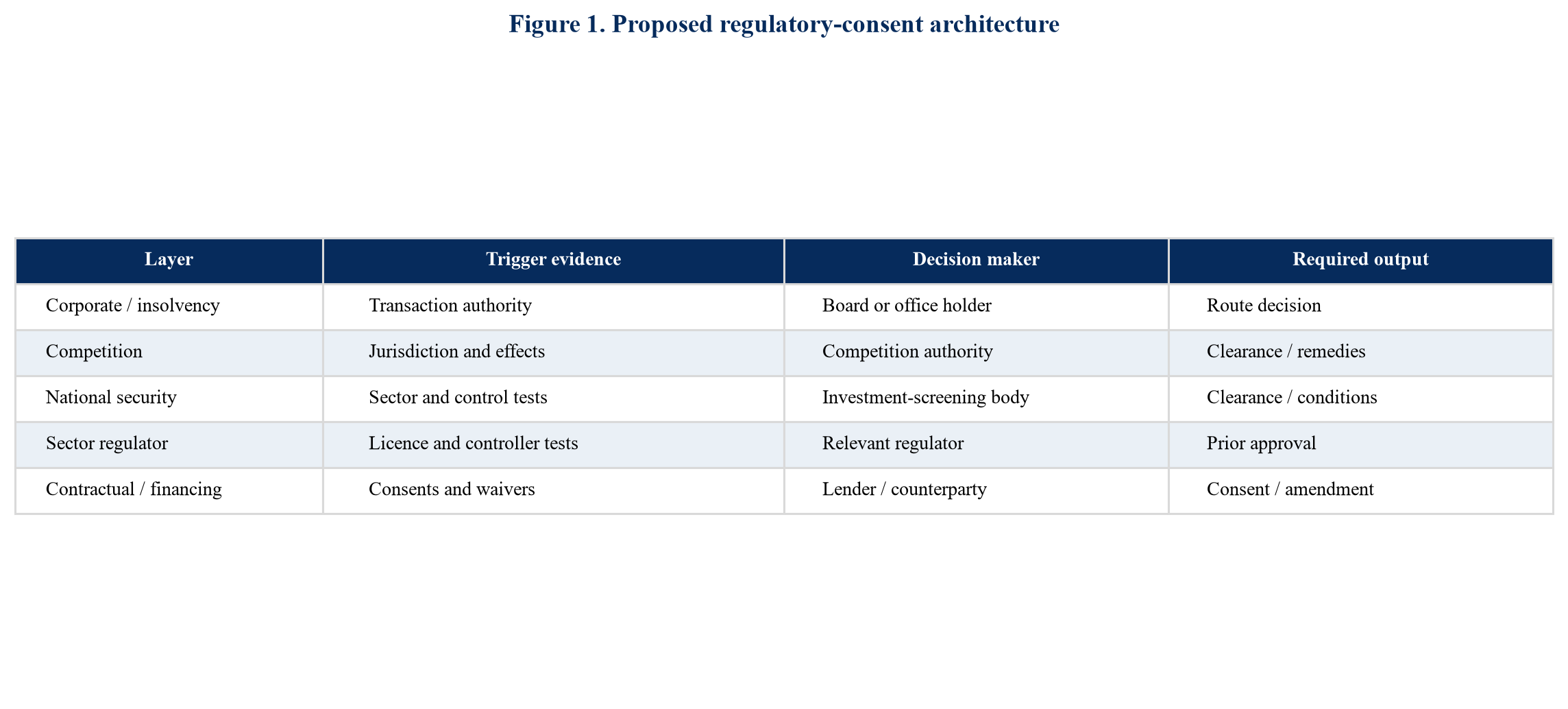
The architecture is a decision framework. Applicable duties, laws and approval requirements remain controlling.
5. Pre-filing is an evidence-production process
Early engagement can improve the quality and sequencing of a filing when the relevant authority offers a pre-notification channel. It cannot manufacture certainty or compress a statutory review by assertion. The transaction team should approach pre-filing as a structured evidence-production process with a stable perimeter, draft form, issue list, data book, ownership chart, market evidence and clearly framed questions.
CMA procedure illustrates the importance of preparatory dialogue. Current jurisdiction and procedure guidance describes pre-notification discussions for voluntary notifications and encourages parties considering fast-track reference to engage during pre-notification or early in phase 1 [3]. The value comes from resolving completeness and scope questions before the formal clock, identifying potential competition issues and agreeing an efficient route through information requests.
The pre-filing team should keep a question-and-answer ledger. Every authority question receives an owner, source, draft response, dependency and consistency check against other submissions. Responses should distinguish current facts, transaction commitments, forecasts and proposed remedies. Management claims about customers, competitors, capacity, funding or distress require documentary support.
6. Filing completeness is a financing variable
Many formal timetables begin only after an authority accepts a notification as complete. Missing ownership information, inconsistent structure charts, inadequate market data, incomplete controller forms or unsupported statements can delay the start or interrupt the clock. Those days consume cash and can weaken employee, customer, supplier and lender confidence.
The FCA change-of-control process provides a clear example. A proposed controller of an authorised firm generally must notify and obtain approval before acquiring or increasing control. The FCA states that it has up to 60 working days from a complete notification, excluding an interruption period, and may seek further information [6]. A submission that reaches completeness late can move the transaction outside a distressed seller's runway even when the statutory assessment itself proceeds within the stated limit.
Filing readiness should therefore sit in the transaction model. Each required field and attachment needs a verified source, accountable signatory and completion date. Beneficial ownership, source of funds, controller biographies, criminal-background checks, group financials, business plans, regulatory history and governance proposals can require substantial lead time. The board should see a readiness percentage only when the underlying checklist shows the missing items and their critical path.
7. Build a single source of transaction truth
Multiple advisers and authorities can create parallel versions of the same facts. One form describes the acquirer as a strategic operator, another as a financial sponsor, and a third leaves indirect state ownership unclear. Market shares differ between competition submissions and the board paper. The financing plan changes without reaching the national-security team. These inconsistencies invite questions and erode credibility.
The consent data room should contain controlled entity charts, beneficial ownership, transaction documents, financing commitments, source-of-funds evidence, business descriptions, product and technology classifications, licences, market data, customer and supplier information, geographic revenue, sensitive contracts, government relationships and prior regulatory matters. Every item should carry source, date, owner, permitted use and confidentiality level.
The process also needs a factual dictionary. Terms such as control, group, customer, market, sensitive data, critical technology and completion should be defined for each submission. Applicable legal definitions may differ, so the dictionary must record those differences. The purpose is consistency of facts, with legal characterisation remaining with qualified counsel.
8. Design conditions around actual authority risk
Transaction documents frequently contain a broad condition requiring all necessary approvals. That wording can leave the seller uncertain about which approvals matter, who controls the process, what effort is required and whether the buyer can abandon the transaction for a remote or self-created reason. The conditions schedule should identify each named approval, applicant, filing deadline, information obligation, conduct covenant, remedy standard, decision date and consequence.
The Takeover Code offers a public-market reference for condition discipline. Rule 13.5 restricts invocation of conditions or pre-conditions and requires the relevant circumstances to be of material significance to the offeror in the context of the offer [7]. A private or distressed transaction may sit outside that regime, yet the underlying discipline remains valuable: conditions should allocate identified execution risks and should not operate as unrestricted options.
The seller should require the buyer to pursue filings promptly, provide drafts, respond to information requests, maintain financing, accept agreed categories of remedies and report progress. Sensitive information can be handled through clean teams or counsel. The board should also approve matters that the seller may concede, because a quick clearance achieved through value-destructive remedies can undermine the chosen bid.
9. Translate each consent into a critical path
A long-stop date should follow the approval architecture rather than a rounded calendar assumption. The critical path begins with fact collection and drafts, passes through pre-filing and completeness, then includes review, information requests, potential remedies, governance approvals and completion mechanics. The model should show faster, base and slower ranges without presenting any regulatory decision as predictable.
Dependencies matter. A competition filing may need a signed agreement. A sector application may require a complete controller package. A national-security analysis may depend on export-control classification. A foreign-subsidy submission may require financial-contribution data across the acquirer's group. A lender consent may require the final structure and sources-and-uses schedule. The model should distinguish activities that can run in parallel from those that wait for another output.
Every critical-path item should connect to liquidity and financing expiry. A date beyond the seller's cash runway requires bridge funding, an earlier contingency route or a structure that can lawfully deliver value sooner. The board should treat unsupported assumptions about acceleration as a red risk.
Table 2. Proposed consent critical-path register
| Workstream | Earliest start | Clock-start evidence | Delay trigger | Board response |
|---|---|---|---|---|
| Competition | Perimeter and market facts stable | Complete notification accepted | Data gaps, overlaps or remedy issues | Fund review period or change perimeter |
| National security | Activities, control and ownership mapped | Complete mandatory or voluntary filing | Sensitive technology, data or ownership questions | Separate assets, mitigate or preserve alternative buyer |
| Sector approval | Controllers and operating plan identified | Complete controller application | Missing persons, funds or governance evidence | Adjust governance and extend funding |
| Contractual consents | Contract population reconciled | Counterparty request with agreed terms | Assignment dispute or leverage request | Novate, cure, replace or exclude contract |
| Insolvency authority | Route and office-holder powers confirmed | Appointment, creditor step, court filing or evaluator report | Challenge, connected-party scrutiny or evidence gap | Use approved alternative route |
Timings must be refreshed from current authority guidance and transaction evidence.
10. Link regulatory time to the thirteen-week cash model
The weekly cash forecast should carry each consent route as a scenario. It should include professional fees, filing fees, remedy costs, hold-separate expenditure, transition duplication, retention, customer or supplier reactions, financing expiry and the cost of any bridge. The model should show the minimum cash point and the date on which a route becomes unavailable without new funding.
The route can change cash before completion. Interim measures may require businesses to operate separately, restrict integration and create monitoring obligations. CMA guidance explains that merging businesses subject to interim measures may need permission for restricted actions, called a derogation, and should support requests with detail about nature, urgency and effect [4]. A distressed target may need a carefully evidenced request to preserve operations, secure funding or prevent deterioration.
The board pack should identify the legal stop line separately from the cash stop line. A transaction may remain legally capable of clearing while the company cannot fund operations to that date. A bridge commitment should cover the full downside period, relevant conditions and costs. A non-binding statement of support is not cash availability.
11. Use derogations for defined operational necessities
A derogation is a specific permission under the relevant regime. It should be framed around a defined action, evidence of urgency, safeguards and the limited effect on the authority's review. It should not be assumed available merely because the target is distressed. The team needs to identify the legal basis, decision standard, applicant, information package and fallback if the request is declined.
Under the EU Merger Regulation, Article 7 provides a standstill obligation for concentrations with an EU dimension and allows the Commission, on request, to grant a reasoned derogation. The Commission considers effects of suspension on the undertakings or third parties and the threat to competition, and may impose conditions or obligations [9]. This creates a potential tool for exceptional circumstances, with outcome and timing remaining case-specific.
A strong request explains the precise transaction or operational action, the harm caused by waiting, the absence of less intrusive alternatives, proposed ring-fencing, information controls, governance, reporting and reversibility. It attaches current cash evidence and operational records. The seller should model refusal and delayed decision so the request never becomes the only survival plan.
12. Preserve the business without premature integration
Distress can create a genuine need for buyer support before clearance. The buyer may offer procurement help, shared systems, customer reassurance, funding or management resources. Those actions can conflict with standstill rules, interim measures, competition law, confidentiality or the requirement for the target to remain independently managed.
The operating plan should separate permitted transaction planning from operational control. Clean teams can handle competitively sensitive information. Ring-fenced financing can be documented without granting prohibited influence. Transitional arrangements can begin at completion or after the relevant approval. Independent managers, monitoring trustees or hold-separate systems may be required in some cases.
Every interim action should have legal review, documented authority, scope, information boundaries, duration, reporting and reversal plan. The same discipline applies where the UK CMA can investigate a completed merger and impose interim measures. Its guidance warns that parties should consider the effect of restrictions before deciding to complete without notification [4].
13. Convert remedy risk into bid economics
Regulatory remedies can affect revenue, assets, contracts, people, technology, licences and control rights. The transaction model should quantify their effect instead of treating clearance as a binary event. A divestiture may reduce enterprise value and add separation cost. Access, interoperability, licensing or supply commitments may change margin and capital expenditure. Governance restrictions may reduce operational synergies. National-security mitigation can impose data localisation, security, board or access requirements.
The buyer's remedy obligation should be negotiated with the economic perimeter in view. Standards ranging from reasonable efforts to acceptance of specified remedies allocate different risks. A seller relying on a reverse termination fee still faces liquidity and business deterioration if the transaction fails. The fee amount, security, triggers and collection route should therefore be modelled alongside the value lost through delay.
The board should approve a remedy authority matrix. It can define remedies the buyer must accept, remedies requiring seller consent, value thresholds, protected assets and walk-away outcomes. Management should test the remedy against financing documents because material changes can create new lender conditions or require re-underwriting.
14. Foreign-subsidy information can become a hidden critical path
The European Union Foreign Subsidies Regulation adds a distinct review for certain concentrations involving foreign financial contributions. Notification obligations for qualifying concentrations have applied since October 2023 [10]. The Commission's published questions and answers explain that notifiable concentrations are subject to a standstill obligation and that foreign financial contributions granted during the relevant three-year period enter threshold analysis [11].
The required information can reach beyond the immediate acquisition vehicle. The buyer group may need to collect grants, loans, guarantees, tax measures, contracts and other contributions across jurisdictions and entities. A sponsor-backed buyer, sovereign-linked investor or large multinational can face a substantial reconciliation exercise. Waiting until signing to begin that work can delay completeness.
The seller should request a regulatory readiness certificate during bid evaluation. It should identify whether the regime is potentially engaged, who owns the contribution database, the collection status, internal signatories, adviser review and anticipated waivers of information. Buyer-specific sensitivity can be protected while the seller still receives credible evidence of readiness.
15. National-security review requires technology and ownership precision
National-security screening can depend on activities, technology, data, infrastructure, asset location, customer base, control rights and the direct and indirect owners of the acquirer. A generic sector description is insufficient. The target should maintain a product and capability map that links technical functions to current classifications, licences, government customers, research relationships and sensitive data.
In the United Kingdom, the mandatory notification analysis reaches specified activities in 17 sensitive areas and a notifiable acquisition requires approval before completion [5]. In the United States, CFIUS can review covered foreign investment transactions and certain real-estate transactions. Treasury materials explain that some filings are mandatory and that the process uses a secure case-management system; current initiatives include work on a Known Investor Program [14].
The contingency plan can preserve a viable perimeter by excluding a sensitive subsidiary, licence, dataset or facility, changing control rights, using a ring-fenced structure or selecting a buyer with a different risk profile. Any structure must be genuine and operationally credible. The team should test whether dependencies make the retained and sold businesses viable after separation.
16. Sector approvals need controller-ready evidence
Regulated financial, communications, energy, healthcare, defence, transport and infrastructure businesses can require prior approval, licence transfer or change-of-control notification. The relevant regulator may examine the buyer's fitness, ownership, governance, financial resources, business plan, systems, conduct and capacity to operate the regulated service.
FCA guidance shows the breadth of controller evidence. A proposed controller must identify all controllers and beneficial owners, complete applicable forms and provide supporting information. The regulator may interrupt the assessment period to request more information [6]. The practical timetable therefore depends on the entire controller chain and the quality of the submission.
The seller should diligence regulatory readiness before granting exclusivity. The bidder should provide the proposed acquisition structure, controller population, accountable executives, governance plan, source of funds, financial forecasts and adviser team. The seller can then identify missing individuals, approvals or documents that could delay completion. A buyer's price cannot compensate for an incomplete controller package when liquidity is short.
17. Contractual consents belong in the same control room
Commercial and financing consents can stop the transaction even when public-law approvals are progressing. Change-of-control, assignment, anti-transfer, exclusivity, termination, licence and security provisions may sit across thousands of agreements. Distress can add defaults, reservation-of-rights letters and counterparties seeking improved terms.
The contract population should be prioritised by value, operational dependency, substitutability, cure cost and leverage. The team should determine whether consent is legally required for the chosen structure, the notice period, required information, conditions, fees and consequence of refusal. A consent strategy can combine direct consent, novation, cure, replacement, transition service, alternative supplier or perimeter change.
The seller must control communications. Premature contact can trigger termination, rumours or demands. Late contact can leave the closing condition unsatisfied. Each approach should use an approved script, verified facts, authority, confidentiality controls and a recording process. Material counterparty reactions should flow into the cash and valuation models.
18. Insolvency route authority requires its own gate
An accelerated sale near insolvency raises questions about who has authority to sell, whose interests govern the decision, what marketing or valuation evidence is required and whether creditor or court steps apply. The route may involve a solvent share sale, asset sale, administration, court-approved process, restructuring plan or another jurisdiction-specific procedure. The board needs current advice before relying on a route.
UK Government distress guidance explains that accelerated M&A and pre-pack sales can preserve value and continuity, while connected-person disposals in the first eight weeks of administration may require creditor approval or an independent evaluator report [1][16]. UNCITRAL's Legislative Guide provides an international framework for insolvency law and sale treatment, while domestic law and court practice remain decisive [2].
The consent map should include office-holder appointment, security enforcement, creditor approvals, evaluator work, court dates, notices and challenge risk. These are execution dependencies with evidence and timing. They should appear in the same control room as competition and sector approvals.
19. The hypothetical routes show why sequence matters
Consider a seller with USD 9 million of unrestricted cash and weekly operating burn of USD 1.1 million. Three offers are available. Route A offers USD 112 million and assumes simultaneous clearances completed in week 14. Route B offers USD 106 million, funds a USD 6 million bridge in week 6 and uses a lawful hold-separate structure, with modeled completion in week 9. Route C offers USD 99 million for an alternative perimeter that can complete in week 5.
The model deducts stated regulatory, separation and liquidity costs. Modeled net proceeds are USD 100.2 million for Route A, USD 100.3 million for Route B and USD 96.0 million for Route C. Route A exceeds the unsupported eight-week runway and reaches negative cash without additional funding. Route B remains funded in the scenario. Route C closes inside the initial runway and preserves cash thereafter.
Every amount, timing, score and outcome is an author assumption with no empirical calibration. The illustration does not predict regulatory decisions, completion, market value, funding, solvency, creditor recovery or stakeholder behaviour. A live board must replace all inputs with verified transaction evidence and current specialist advice.
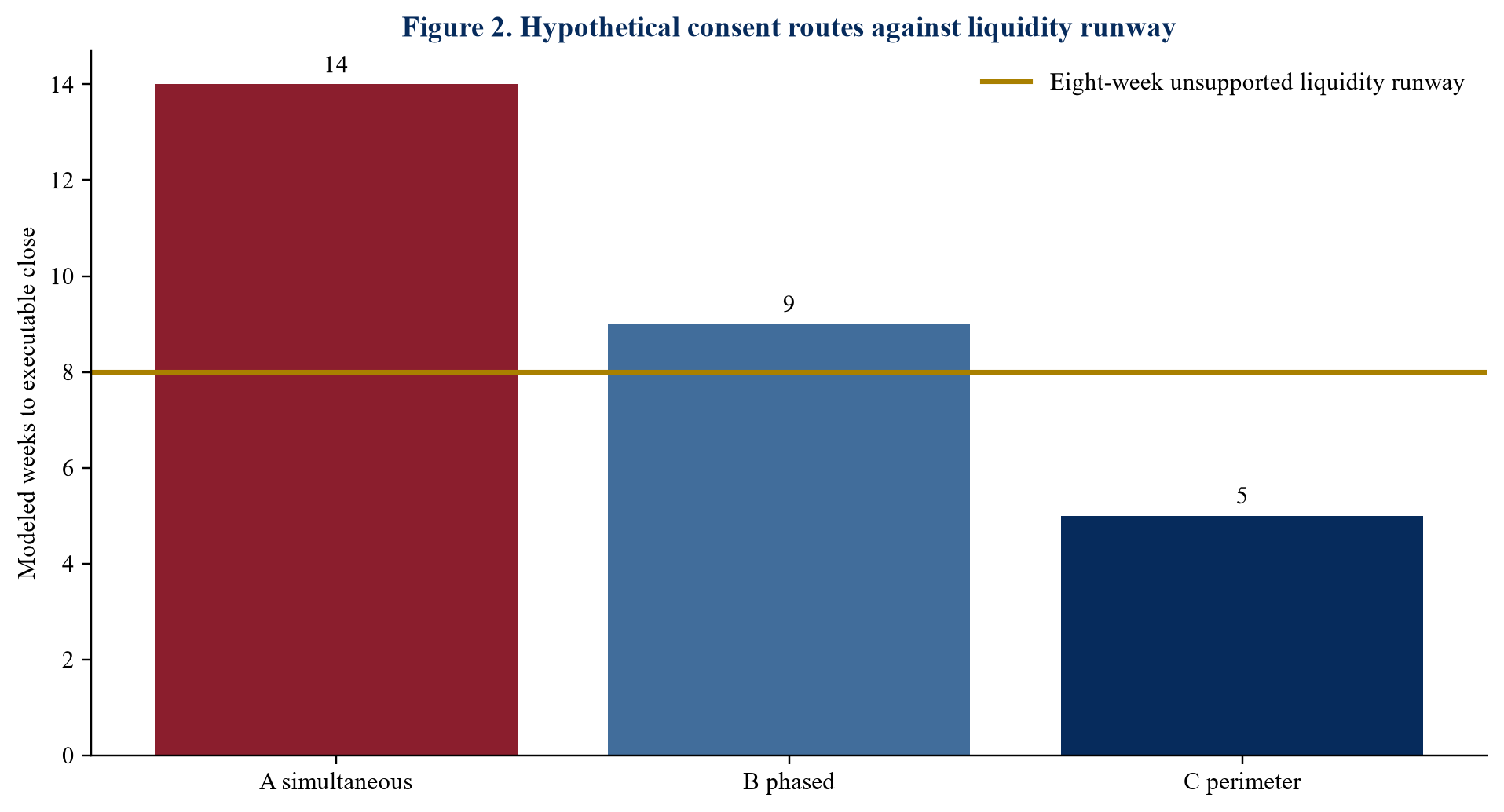
Author assumptions. The timing comparison is a decision illustration and does not predict authority outcomes.
20. Route A exposes a survival gap
Route A has the highest headline price and a modeled fourteen-week path. Regulatory and liquidity costs total USD 11.8 million in the illustration, producing net proceeds of USD 100.2 million. The unsupported cash balance becomes negative during week 9. The route is unavailable on the stated assumptions unless the seller secures committed funding or shortens the lawful critical path.
Management should not solve this gap by assuming that pre-filing will save six weeks. It should identify the missing evidence, earliest submission dates, statutory and practical ranges, remedy risk and the source of bridge capital. A funding commitment must survive the relevant approvals, conditions and downside period.
Route A may become preferred if the bidder commits adequate interim funding, completes filing packages early, accepts defined remedies and provides a funded fallback. The model preserves that possibility by showing which actions change the result. It does not permanently rank the bidder based on its initial submission.
21. Route B purchases time through structure and funding
Route B has a lower headline price and a nine-week modeled timetable. It includes a USD 6 million bridge at week 6 and a hold-separate plan. The model deducts USD 3.5 million of regulatory or separation cost and USD 2.2 million of liquidity cost, yielding USD 100.3 million of net proceeds.
The hold-separate arrangement requires a valid legal basis and authority acceptance where required. It needs independent governance, information barriers, operating funding, systems, reporting and a plan for either integration after clearance or separation if clearance fails. The bridge requires committed documents, draw mechanics, priority, security, repayment and treatment under each transaction outcome.
Route B illustrates how a bidder can convert regulatory work into value. The economic result slightly exceeds Route A after stated costs even though the headline price is lower. A live decision would require detailed legal, financing and valuation review.
22. Route C uses perimeter as a contingency tool
Route C removes assets or control rights that create the longest approval path and models completion in week 5. It deducts USD 3 million of separation cost from a USD 99 million headline price. The result is USD 96 million of modeled net proceeds and positive liquidity throughout the closing period.
The perimeter must leave both sides operationally credible. The seller should map people, contracts, systems, intellectual property, licences, data, facilities, working capital and shared services. It should calculate stranded costs, transition requirements and the financing needed for retained assets. A nominal carve-out that depends completely on the buyer after closing may fail regulatory or operational scrutiny.
Route C can operate as a backup while Routes A or B seek approvals. The board should preserve the buyer, data access, diligence status and documents needed to activate it. A contingency loses value when exclusivity or information decay makes it unavailable.
Table 3. Hypothetical consent-route economics
| Route | Headline price | Modeled close | Regulatory and separation cost | Liquidity cost | Modeled net proceeds |
|---|---|---|---|---|---|
| A simultaneous clearance | 112.0 | Week 14 | 4.0 | 7.8 | 100.2 |
| B phased hold-separate | 106.0 | Week 9 | 3.5 | 2.2 | 100.3 |
| C alternative perimeter | 99.0 | Week 5 | 3.0 | 0.0 | 96.0 |
USD millions and timing are author assumptions without empirical calibration.
23. Liquidity determines the available regulatory options
The cash paths make the timing constraint visible. Route A follows the unsupported burn and becomes negative. Route B receives the assumed bridge and remains funded through the modeled closing week. Route C closes earlier and receives an illustrative operating cash benefit after completion. These paths are accounting simplifications designed to force a funding decision.
The real cash model should include collections, supplier terms, payroll, taxes, rent, professional fees, retention, pension, customer refunds, regulatory costs, transition duplication and funding covenants. It should distinguish unrestricted cash from cash trapped by entity, jurisdiction, security or regulation. It should also show the effect of adverse stakeholder reactions.
The consent workstream should update the forecast every week. A delayed completeness date, new information request or remedy issue moves the expected funding need. The board should see that change before cash becomes critical.
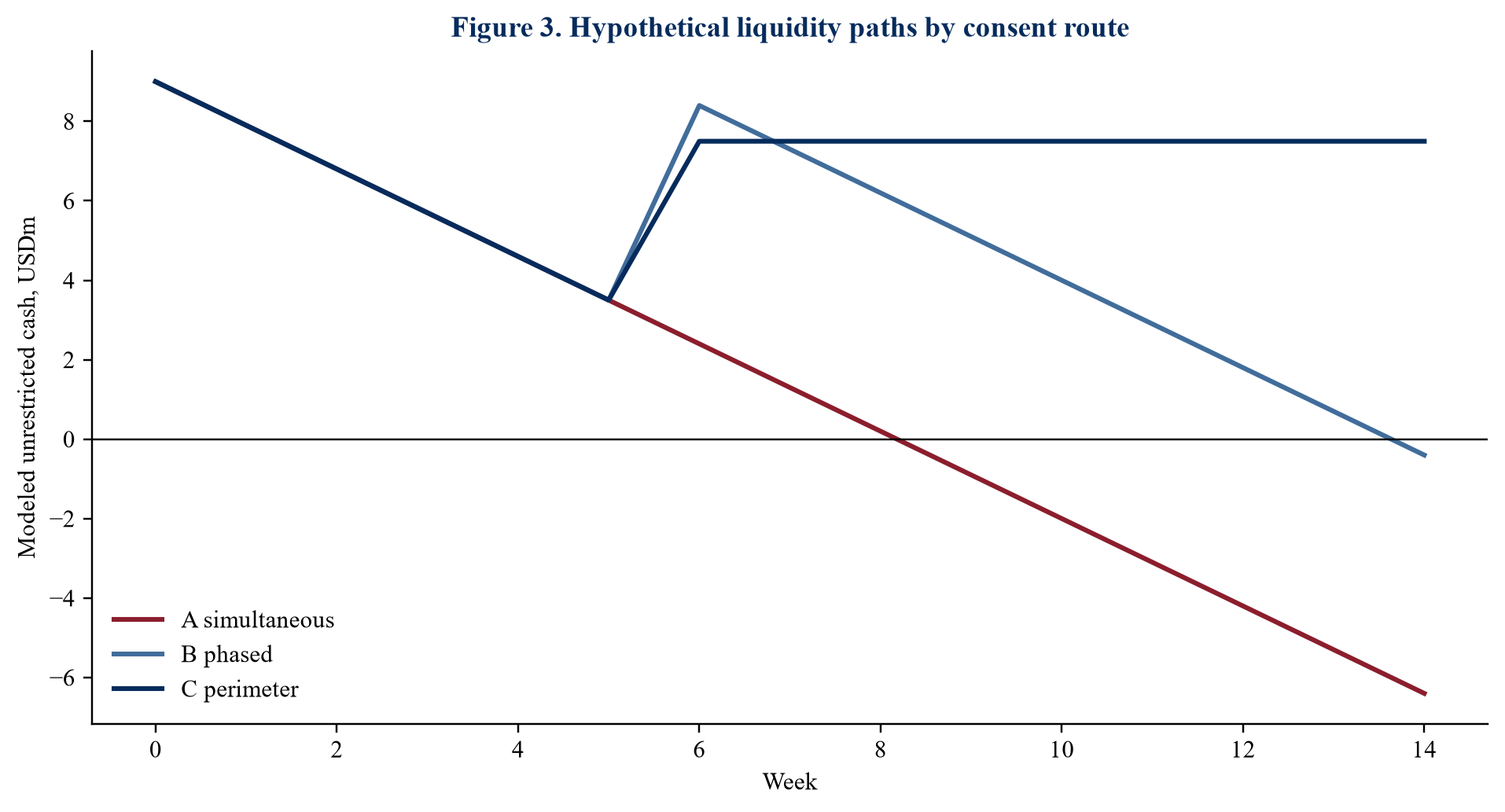
Author assumptions. Negative cash indicates a need for additional funding or an earlier route decision.
24. Score readiness through evidence rather than optimism
The hypothetical readiness score considers jurisdiction mapping, filing completeness, buyer evidence, remedy authority, liquidity fit and contingency route. Route A scores poorly on liquidity and remedy authority. Route B has strong preparation across the six dimensions. Route C scores highest because the narrower perimeter produces a complete filing and fits within the runway.
A scorecard helps the board compare evidence and monitor change. Each score should link to documents and an action. A score of five for filing completeness can require a signed form, complete ownership chain, reconciled financial data, approved narrative, supporting attachments and adviser confirmation. A score of one can mean the applicant, facts or required documents remain unresolved.
Weights should reflect the transaction. A regulated financial-services acquisition may place greater weight on controller evidence. A technology transaction may emphasise national security, export controls and data. A domestic asset sale may place greater weight on contract consents and insolvency authority. The board should approve weights before bids are ranked.
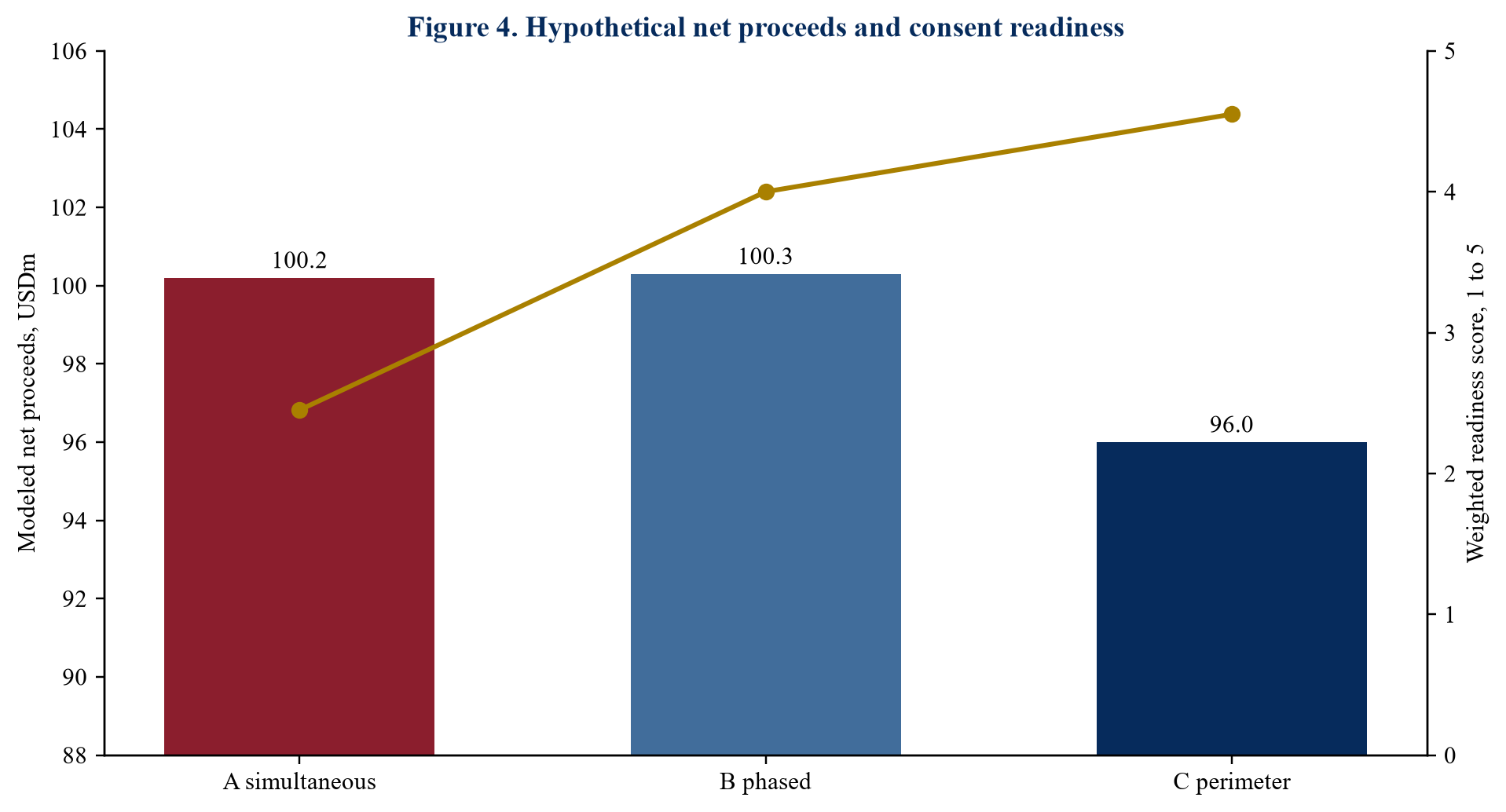
Values, weights and scores are author assumptions. The figure illustrates transparent comparison and does not predict completion.
25. Build a risk-control matrix with early indicators
Consent risks should be observable before the long-stop date. Early indicators include incomplete ownership data, inconsistent market definitions, delayed adviser appointment, unsigned filing forms, unresolved funding sources, missing technical classifications, regulator questions, absence of remedy authority, expired background checks and a cash forecast that reaches zero before the modeled decision.
Each failure mode needs an accountable control and evidence. The control can be a verified data pack, counsel opinion, authority meeting, draft filing, buyer covenant, bridge commitment, perimeter design, clean team, monitoring plan or backup offer. The evidence should be stored with date and version.
Table 4. Proposed consent risk-control matrix
| Failure mode | Early indicator | Control | Board evidence |
|---|---|---|---|
| Filing clock does not start | Missing ownership, turnover or signed forms | Completeness checklist and accountable sign-off | Authority acknowledgement and gap log |
| Clearance arrives after cash expiry | Critical path exceeds funded runway | Committed bridge and weekly cash trigger | Facility, funds flow and downside forecast |
| Remedy destroys transaction value | Buyer lacks mandate or protected assets unclear | Remedy authority matrix and valuation bridge | Approved thresholds and scenario model |
| Interim conduct breaches restrictions | Operational support begins without permission | Clean-team, hold-separate and derogation controls | Legal approval and monitoring report |
| Backup route disappears | Exclusivity blocks contact and diligence decays | Milestone-based exclusivity and warm reserve bidder | Current bid, access plan and activation checklist |
| Sector application stalls | Controller package incomplete | Pre-submission audit of all controllers | Complete forms, ownership and source-of-funds pack |
Controls require current evidence and qualified review.
26. Use explicit stop conditions
A board should know when to stop spending cash on a preferred route. Stop conditions can include failure to submit by a fixed date, inability to achieve completeness, financing expiry, refusal to fund the review period, unacceptable remedy exposure, loss of material contracts, regulatory feedback that changes the perimeter or a minimum cash threshold.
Each condition should trigger a predetermined response. The response can be escalation, additional funding, revised structure, activation of a reserve bidder, asset carve-out, insolvency filing or termination. The decision remains with the authorised board or office holder, informed by current duties and advice.
Stop conditions improve negotiating discipline. A bidder seeking more time must provide the evidence or value needed to justify that time. They also reduce the risk that sunk effort becomes the reason for continuing an increasingly fragile process.
27. Run one consent control room
The transaction should have a single consent control room with legal, regulatory, finance, operations, tax, technology, data, communications and M&A representation. The control room owns the integrated map and reports to the authorised decision maker. Individual advisers retain responsibility for specialist conclusions.
The weekly dashboard should show each consent, status, evidence quality, applicant, submission date, clock status, authority questions, remedies, decision range, cash dependency and contingency. Changes should be recorded against the prior version. A red issue should describe the precise missing evidence or decision.
The control room should also maintain consistency across filings. A controlled facts book and ownership chart prevent avoidable differences. Market-sensitive, personal and classified information should be shared only with authorised recipients through appropriate systems.
28. A ten-business-day implementation roadmap
The first ten business days can establish the decision infrastructure. Days one and two confirm authority, route, perimeter, liquidity and the adviser map. Days three and four complete the initial jurisdiction and consent register. Days five and six build filing checklists, ownership, financial and technical evidence packs. Days seven and eight open appropriate pre-filing channels, prepare conditions and remedy authority, and test funding. Days nine and ten approve the integrated critical path, stop conditions and contingency route.
Table 5. Proposed ten-business-day consent-readiness roadmap
| Period | Core action | Required output | Board gate |
|---|---|---|---|
| Days 1 to 2 | Confirm authority, perimeter, buyer and cash runway | Transaction map and weekly liquidity baseline | Approve decision standard |
| Days 3 to 4 | Map public, sector, court, financing and contract consents | Source-linked consent register | Confirm filing and waiver scope |
| Days 5 to 6 | Reconcile ownership, financial, market and technical evidence | Filing-readiness room and gap log | Fund critical evidence work |
| Days 7 to 8 | Engage authorities where appropriate and negotiate process covenants | Pre-filing plan, conditions schedule and remedy matrix | Approve buyer obligations |
| Days 9 to 10 | Model routes, funding, stop conditions and alternatives | Integrated critical path and contingency pack | Select executable route |
Regulatory processes may extend materially beyond the initial implementation period.
29. Technology and AI can accelerate controlled evidence work
Authorised technology can extract change-of-control clauses, classify contracts, reconcile ownership charts, compare bid versions, maintain filing checklists, detect inconsistent factual statements and update scenario dashboards. Natural-language tools can help counsel and deal teams search large document sets and prepare first drafts grounded in approved sources.
The control design matters. Systems should use permissioned data, preserve source links, maintain versions, protect privilege and confidentiality, record review and prevent autonomous submission. Market definitions, legal triggers, national-security classifications, regulatory answers and board decisions require accountable human validation.
Model outputs should state their assumptions and limitations. Automated confidence scores should not replace authority feedback or qualified judgment. The strongest use case is disciplined evidence production, issue detection and controlled workflow.
30. Limitations and conclusion
This paper provides a general transaction framework. It is not legal, insolvency, regulatory, competition, national-security, tax, accounting, financing, employment, pension, data-protection or valuation advice. Requirements vary by jurisdiction, sector, transaction structure, buyer, target and timing. Authority guidance and law can change.
The hypothetical routes use author assumptions with no empirical calibration. They exclude many potential taxes, claims, financing terms, remedy effects, stakeholder reactions and insolvency outcomes. No numerical result predicts a live transaction.
An accelerated sale needs a consent strategy that begins with perimeter and cash. The board should classify every approval and waiver, build complete evidence before the clock, integrate authority work with funding, negotiate conditions and remedy authority, preserve lawful operations and maintain a funded contingency. This approach gives decision makers a clear record of which route can close, what must change and when another route should take over.
References
- UK Government. Corporate Financial Distress Guidance Note. Updated 15 June 2026; accessed 6 September 2026. https://www.gov.uk/government/publications/the-sourcing-and-consultancy-playbooks/corporate-financial-distress-guidance-note-html
- United Nations Commission on International Trade Law. Legislative Guide on Insolvency Law. Accessed 6 September 2026. https://uncitral.un.org/en/texts/insolvency/legislativeguides/insolvency_law
- Competition and Markets Authority. Mergers: Guidance on the CMA's jurisdiction and procedure. Accessed 6 September 2026. https://www.gov.uk/government/publications/mergers-guidance-on-the-cmas-jurisdiction-and-procedure
- Competition and Markets Authority. Interim measures and derogations in merger investigations. Updated 23 June 2025; accessed 6 September 2026. https://www.gov.uk/government/publications/interim-measures-and-derogations-guidance-and-templates
- UK Government. National Security and Investment Act guidance on acquisitions. Updated 15 July 2026; accessed 6 September 2026. https://www.gov.uk/guidance/national-security-and-investment-act-guidance-on-acquisitions
- Financial Conduct Authority. Change in control. Updated 30 June 2026; accessed 6 September 2026. https://www.fca.org.uk/firms/change-control
- The Takeover Panel. Rule 13.5: Invoking conditions and pre-conditions. Accessed 6 September 2026. https://code.thetakeoverpanel.org.uk/tp/rules/rule-13/rule-13-5.html
- European Commission. Merger procedures. Accessed 6 September 2026. https://competition-policy.ec.europa.eu/mergers/procedures_en
- European Union. Council Regulation (EC) No 139/2004 on the control of concentrations between undertakings. Accessed 6 September 2026. https://eur-lex.europa.eu/legal-content/EN/TXT/?uri=CELEX:32004R0139
- European Commission. Foreign Subsidies Regulation legislation. Accessed 6 September 2026. https://competition-policy.ec.europa.eu/foreign-subsidies-regulation/legislation_en
- European Commission. Foreign Subsidies Regulation questions and answers. Accessed 6 September 2026. https://competition-policy.ec.europa.eu/foreign-subsidies-regulation/questions-and-answers_en
- United States Federal Trade Commission. Current premerger notification thresholds. Accessed 6 September 2026. https://www.ftc.gov/enforcement/premerger-notification-program/current-thresholds
- United States Federal Trade Commission. Premerger Notification: Reporting and Waiting Period Requirements, Final Rule. Accessed 6 September 2026. https://www.ftc.gov/system/files/ftc_gov/pdf/p110014hsrfinalrule.pdf
- United States Department of the Treasury. Committee on Foreign Investment in the United States. Accessed 6 September 2026. https://home.treasury.gov/policy-issues/international/the-committee-on-foreign-investment-in-the-united-states-cfius/
- United States Code. Title 11, section 363: Use, sale, or lease of property. Accessed 6 September 2026. https://uscode.house.gov/view.xhtml?req=granuleid:USC-prelim-title11-section363&num=0&edition=prelim
- The Insolvency Service. Requirements for independent scrutiny of disposals in administration, including pre-pack sales. Accessed 6 September 2026. https://www.gov.uk/government/publications/requirements-for-independent-scrutiny-of-the-disposal-of-assets-in-administration-including-pre-pack-sales/requirements-for-independent-scrutiny-of-the-disposal-of-assets-in-administration-including-pre-pack-sales
