

1. Put the remedy inside the investment decision
The board decision is whether the transaction remains value-accretive and executable under plausible merger-control outcomes. That decision requires more than a filing calendar and an external counsel assessment of clearance risk. The board needs to understand which competitive concern could arise, which assets or conduct could address it, whether the remedy can operate, how it changes the price and financing, and who controls the response.
Remedy planning should begin before the final bid or binding agreement. At that point the buyer can still change the perimeter, price, financing, synergy case and contractual allocation. It can test whether a potentially divested business is genuinely separable, whether an acceptable purchaser exists and whether regulatory timetables fit funding commitments. Once the transaction is signed, those choices narrow.
The operating principle is traceability. Each potential theory of harm should lead to a defined competition objective. That objective should lead to a remedy option. The option should identify assets, people, rights, contracts, data, approvals, transition support, purchaser criteria and implementation milestones. The economics should then flow back into the valuation model and transaction documents.
This paper does not predict regulator decisions. Public guidance shows recurring design questions, while acceptance depends on the facts, law, evidence and process in each case. The framework is intended to improve the board's decision record and the quality of a remedy proposal.
The transaction team should maintain one remedy register from initial antitrust assessment to implementation. It should record the concern, evidence, option, owner, regulator feedback, value effect, timing effect and remaining uncertainty. A remedy should never exist only in legal correspondence while finance, operations and integration continue on a different assumption.
2. Anchor the design in current regulatory principles
Competition authorities commonly require a remedy to address the identified harm, remain effective, be capable of implementation and be enforceable. The language and statutory tests differ. A transaction team should use the applicable authority's current guidance rather than treating a remedy accepted elsewhere as precedent that assures acceptance.
The UK CMA's revised guidance took effect on 19 December 2025 for relevant new phase 1 investigations. It separates effectiveness from proportionality and examines structural and behavioural remedies, purchaser suitability, asset risk, monitoring and implementation. The CMA generally starts from the whole overlap giving rise to a substantial lessening of competition when considering a structural remedy, while its analysis remains case-specific. [1][2]
The European Commission may accept commitments in phase I or phase II. Its remedies notice focuses on eliminating the competition concerns, and its model texts address divestiture commitments and trustee mandates. Timing matters because the procedural phase affects the available period for developing, testing and implementing commitments. [3][4][5]
US FTC guidance explains that a demonstrably autonomous ongoing business will usually be easier to assess than a collection of assets. The FTC examines the completeness of the package, buyer capability, financing, agreements, hold-separate measures and timing. The DOJ's published remedies manual emphasises effective structural relief, enforceability and allocating remedy failure risk to the parties rather than consumers. [7][8]
OECD data show that remedies remain a material intervention tool across jurisdictions. Its 2025 report states that 3.2 per cent of merger decisions in the 2023 dataset required remedies, the highest share in nine years. This aggregate does not indicate the risk for a particular deal. [9]
| Authority or framework | Core public principle | Practical design question | Evidence for the decision file |
|---|---|---|---|
| UK CMA | Remedy effectiveness is assessed before proportionality; structural and behavioural risks are examined separately | Does the proposal resolve the identified harm and remain implementable throughout the required period? | Concern map, asset perimeter, purchaser evidence, implementation plan and monitoring design |
| European Commission | Commitments must eliminate identified competition concerns; model divestiture and trustee texts support implementation | Is the package viable, saleable and capable of timely transfer under the applicable procedure? | Form RM support, package memorandum, buyer criteria, trustee mandate and milestone plan |
| US FTC and DOJ | Structural relief is generally preferred for horizontal concerns; package and purchaser viability are central | Does the buyer receive everything required to compete independently and promptly? | Standalone accounts, asset and rights schedules, buyer financing, transition terms and hold-separate plan |
| OECD and ICN | Effective remedies require sound design, implementation, coordination, monitoring and ex-post learning | Can the remedy work across jurisdictions and be evaluated after implementation? | Authority map, consistency matrix, compliance metrics and review protocol |
| Canada, Singapore and Australia | Remedies must address the competition concern under the relevant statutory and procedural framework | What commitment, direction or condition is lawful, effective and enforceable in the jurisdiction? | Current local advice, proposed terms, implementation evidence and enforcement route |
This table summarises public guidance and does not state the legal test for a specific transaction.
3. Translate the theory of harm into a remedy objective
A remedy cannot be designed from a general statement that the merger is concentrated. The team needs a precise account of how the transaction may change competitive incentives or capability. The concern might involve unilateral price effects, coordinated effects, foreclosure, access to an input, control of data, loss of innovation rivalry, labour-market power or aggregation of local market positions.
For each concern, the team should identify the affected product, customer group, geography, route to market, competitive constraint and time horizon. It should state the counterfactual against which the merger is assessed. The remedy objective should describe the competitive capability that must remain or be restored.
A horizontal overlap may require an independent business capable of replacing the lost rivalry. A vertical concern may require divestiture, access, interoperability, non-discrimination or information controls. A local-market concern may be resolved through a defined set of sites. An innovation concern may require research capability, intellectual property, personnel, data and development funding rather than a current revenue line alone.
The concern-to-remedy chain should be evidenced. Market shares, bidding data, customer switching, capacity, margins, internal documents, product roadmaps and entry conditions can alter the design. A proposed package should show why its assets and obligations address the mechanism of harm. A broad remedy without that chain can remove value while failing to solve the regulator's concern.
Management should test the remedy against three questions. Can the divestiture purchaser or protected market participant compete? Can it do so within the required time? Can the authority monitor and enforce the solution without relying on repeated discretionary cooperation from the merged business? Weak answers indicate a design problem.
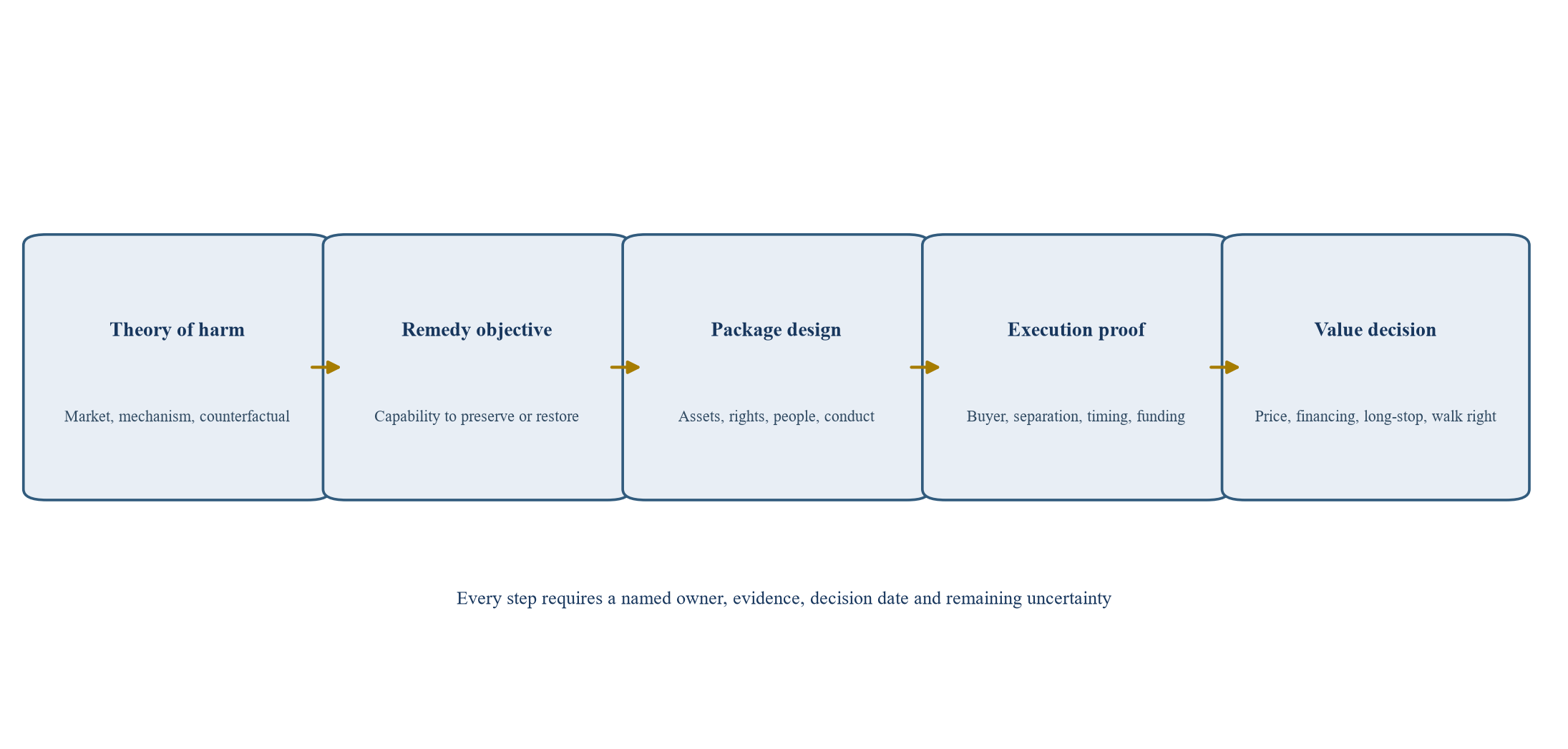
The architecture is a proposed governance sequence.
4. Build a remedy hypothesis before signing
The initial remedy hypothesis should describe the smallest package that the team believes could resolve each plausible concern, together with the evidence needed to test it. It is a working proposition rather than an offer to an authority. Its purpose is to expose constraints before the buyer commits to a value and timetable.
The hypothesis should define the candidate business perimeter, purchaser type, separation dependencies, transitional services, regulatory approvals and likely implementation sequence. It should identify assets that the buyer considers essential to its investment thesis and show how alternative remedies affect those assets. If every credible remedy removes the strategic rationale, the board should know before signing.
The team should prepare at least three outcomes: unconditional clearance, a practicable remedy and a severe remedy or prohibition pathway. The practicable case should have a value model and a deliverable work plan. The severe case should identify the contractual walk right, termination exposure, financing consequence and stakeholder plan.
Remedy planning should remain separate from advocacy. The parties may consider the concern unfounded and still prepare for a remedy. A clean internal process lets the deal team challenge the theory of harm while an execution team develops a contingent package. The remedy work should be protected by appropriate legal arrangements and information controls.
The hypothesis should be reviewed whenever the authority's concern changes. A market definition, customer segment, geographic scope or theory may narrow or expand. The package should follow the concern rather than the team's initial organisational chart.
5. Model transaction value under remedy outcomes
Remedy economics include more than divestiture proceeds. A package can remove revenue, EBITDA, growth options, data, research capability, customer relationships and synergies. It can also create separation cost, stranded cost, transition obligations, delay, financing fees, tax effects and management distraction.
The base valuation model should contain a remedy module. It should link each asset package to standalone financials, synergy dependencies, stranded costs and sale proceeds. It should distinguish present value from near-term cash and accounting effects. The model should identify which inputs are verified, estimated by management or assumed for scenario analysis.
In the hypothetical case, the buyer proposes a USD 3.20 billion enterprise-value acquisition. Gross synergy value is assumed at USD 260 million. A candidate divestiture business has USD 36 million standalone EBITDA and assumed sale proceeds of USD 410 million. The buyer also assumes USD 72 million of lost synergies, USD 18 million of separation and transition cost, USD 40 million of delay cost and USD 22 million of incremental financing cost. These values are scenario inputs and do not describe an actual company.
The board should evaluate economic value retained after the remedy and the cash needed before proceeds arrive. A divestiture may close after the main acquisition, creating a period in which debt funds the entire purchase price plus separation and financing costs. The model should test liquidity, leverage and covenant headroom during that interval.
The model should also recognise sale-price uncertainty. A regulatory sale may have a deadline, no minimum price or purchaser constraints. The base case should not assume a premium strategic buyer without evidence. Sensitivities should cover price, delay, transition cost, stranded cost and lost synergy.
| Item | Unconditional case | Early structural remedy | Late structural remedy | Board interpretation |
|---|---|---|---|---|
| Enterprise value paid | 3,200 | 3,200 | 3,200 | Acquisition funding requirement before any later divestiture proceeds |
| Gross synergy present value | 260 | 188 | 188 | Remedy removes 72 of assumed synergy value |
| Divestiture proceeds | 0 | 410 | 350 | Late process assumes a 60 reduction in proceeds |
| Separation and transition cost | 0 | 18 | 31 | Late design creates duplication and compressed execution |
| Delay cost | 0 | 15 | 40 | Includes assumed operating and opportunity cost |
| Incremental financing cost | 0 | 8 | 22 | Reflects longer commitment and funding period |
| Net remedy-related value effect | 260 | 557 | 445 | Synergy plus proceeds less separation, delay and financing costs |
All amounts are USD millions and are scenario assumptions. They are not forecasts or observed transaction data.
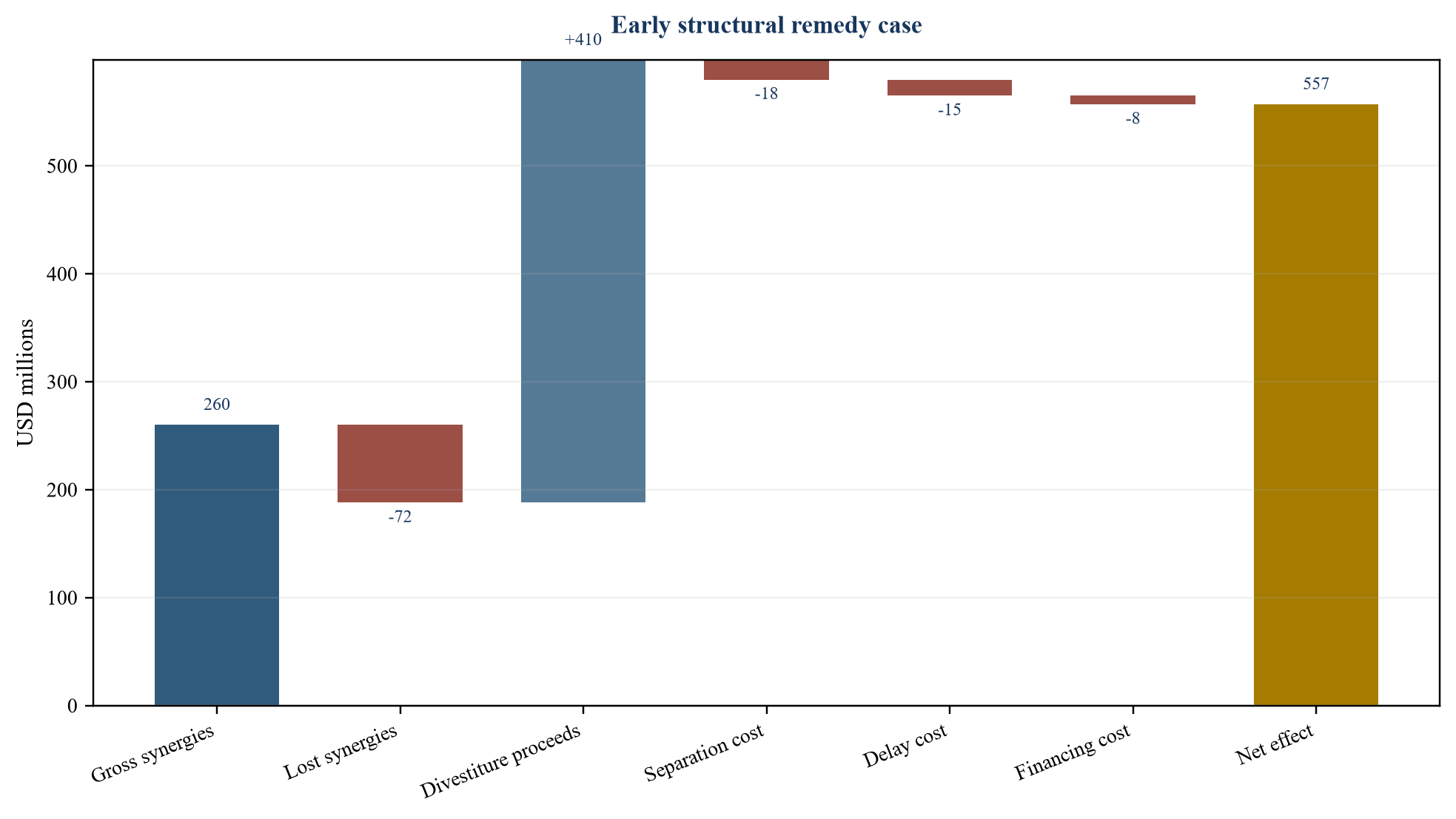
All amounts are USD millions and are scenario assumptions.
6. Select the remedy perimeter before the package hardens
The remedy perimeter is the boundary around the business, assets or rights to be transferred or controlled. A perimeter based only on legal entities may omit shared systems, contracts, personnel, intellectual property or data. A perimeter based only on the overlapping product may lack the scale and capabilities required for independent competition.
The team should start from competitive capability. It should identify products, customers, geographic reach, capacity, research and development, intellectual property, brands, licences, supplier arrangements, distribution, working capital, systems and leadership. It should then map those capabilities to legal assets and transfer mechanisms.
Three perimeter options should usually be tested. The first is an existing autonomous business. The second is a carve-out containing the overlap plus supporting capabilities. The third is a broader business that reduces execution risk. The broadest package may preserve competition more reliably while imposing a larger value cost. The decision requires regulator evidence and board visibility.
Shared dependencies should be classified by transfer, duplication, licence, service or replacement. A permanent licence can solve a rights issue when ownership cannot transfer, but it may create incentives and enforcement questions. A transition service can support migration, but it should have a defined scope, service level, price, duration, exit plan and dispute route.
The remedy perimeter should have a version-controlled asset schedule. Changes must reconcile to the valuation model, standalone accounts, buyer materials, draft commitments and separation plan. An asset mentioned in regulator submissions but absent from the sale agreement creates execution risk.
7. Prove standalone viability with evidence
An effective structural remedy needs a business that can compete independently. Standalone viability should be demonstrated through operating evidence rather than asserted through a management plan. The package should have resources, rights and relationships sufficient for the purchaser to operate and invest.
Standalone financial statements should separate revenue, direct cost, allocated cost, capital expenditure, working capital, tax and cash. They should explain shared-service allocations and the replacement cost of parent functions. The business plan should reconcile to customers, contracts, pipeline, capacity and personnel.
Operational viability requires leadership, technical capability, licences, systems, facilities, suppliers and service continuity. The separation plan should state which capabilities transfer at closing and which require transition. Critical dependencies should have tested exit dates.
The package should remain viable during the review and sale process. Hold-separate and asset-maintenance controls may restrict integration and require investment, staff retention and independent operation. The responsible manager should have authority and funding. Performance should be tracked against an approved baseline.
Evidence should be available to regulators and prospective purchasers through controlled processes. The team should establish a clean data room, management access, standalone accounts and a dependency register early enough for market testing. A package that can only be explained after the remedy deadline is unlikely to support a reliable process.
| Capability | Required evidence | Failure signal | Design response |
|---|---|---|---|
| Customers and revenue | Contract population, renewal profile, concentration, pipeline and billing reconciliation | Revenue cannot be separated or key contracts cannot transfer | Broaden perimeter, secure consent, amend agreement or include transition support |
| People and leadership | Named organisation, employment terms, incentives, key-person dependencies and transfer analysis | Essential staff remain with seller or lack retention plan | Expand transfer group, create incentives and identify replacements |
| Technology and intellectual property | Ownership schedule, licences, source repositories, architecture, data rights and roadmap | Buyer depends on retained platform or disputed rights | Transfer, duplicate, licence or broaden package with enforceable support |
| Operations and supply | Facilities, permits, capacity, suppliers, service levels and contingency arrangements | Shared production or supply cannot meet independent demand | Allocate capacity, transfer contracts or create time-limited supply support |
| Finance and systems | Standalone accounts, working capital, ERP, reporting, treasury and controls | Financial information is allocation-driven and systems are inseparable | Build standalone ledger, define migration and fund replacement capability |
| Governance and compliance | Board, policies, regulatory approvals, records and risk ownership | No accountable management or licence path | Appoint leadership, obtain approvals and establish independent controls |
The required scope depends on the concern, package, buyer and jurisdiction.
8. Define an acceptable purchaser strategy
The remedy can fail if the purchaser lacks the ability, incentive, independence or financing to compete. Purchaser planning should begin while the package is being designed. The team should identify buyer criteria and realistic candidates without coordinating competitive conduct.
The purchaser profile should cover financial capacity, industry capability, regulatory eligibility, conflicts, concentration effects, strategic intent and implementation readiness. A buyer that creates a new competition concern cannot solve the original problem. A buyer dependent on the seller for indefinite support may lack credible independence.
The sale process should distinguish commercial attractiveness from regulatory acceptability. The highest bid may come from a buyer that cannot be approved. The remedy model should test proceeds under a constrained buyer universe and under a compressed timetable.
An upfront buyer requirement can reduce implementation risk because the authority assesses the package and purchaser before the main transaction closes. It can also delay clearance and change negotiating leverage. A post-closing sale may allow more time, while introducing asset deterioration, funding and price risk.
The purchaser data room should be ready before formal market testing. It should include standalone financials, perimeter schedules, dependencies, licences, transition terms, management materials and regulatory conditions. Questions that reveal missing capability should flow back into the package design.
Buyer financing should be confirmed. The team should understand equity funding, debt conditions, approvals and closing mechanics. A regulatory deadline combined with uncertain buyer funding creates avoidable remedy failure risk.
9. Design technology, data and intellectual-property remedies
Technology transactions often depend on assets that do not follow legal-entity boundaries. Source code, models, datasets, cloud environments, developer tools, patents, trademarks, APIs, customer configurations and technical know-how may be shared across products. The remedy needs a rights and dependency architecture.
The team should map ownership, licence, access and operational control for every critical technology asset. It should distinguish transferable intellectual property from third-party rights, open-source components and data that cannot lawfully transfer. It should identify which people hold tacit knowledge and which systems support development, deployment, security and customer service.
Data remedies require attention to privacy, confidentiality, cybersecurity, localisation and competitive sensitivity. A purchaser may need historical data to operate or improve a product, while the merged business should not receive the purchaser's future competitive information. Access rights, deletion, segregation and audit should be explicit.
Interoperability or access commitments need measurable technical specifications. Product versions, APIs, capacity, latency, security standards, support, upgrade rights and pricing can change over time. A vague obligation to provide reasonable access may be difficult to monitor in a fast-moving market.
Personnel transfer is frequently decisive. A code repository without engineers, product managers, sales capability and support knowledge may not create a viable competitor. The package should identify essential teams, employment constraints, retention arrangements and knowledge-transfer obligations.
The buyer should price future development. If the divested business loses access to the seller's research platform or data scale, its standalone plan requires replacement investment. That cost belongs in purchaser viability and remedy economics.
10. Use behavioural remedies only with an operating design
Behavioural remedies regulate future conduct. Examples include access, supply, licensing, non-discrimination, firewall, interoperability and customer-choice commitments. They may preserve assets or efficiencies that a divestiture would remove, while creating specification, incentive, monitoring and enforcement risks.
The operating design should define the obligation, beneficiary, product or service, quality, capacity, price, duration, information flow, audit, dispute mechanism and consequence of breach. Each requirement should be measurable. The responsible operational team should confirm that systems can produce the required evidence.
Fast-moving technology can make a fixed specification obsolete. The remedy should address product changes, new versions, security updates, capacity constraints and industry standards. A change mechanism needs clear decision authority and limits. A commitment that depends on repeated commercial negotiation may create continuing disputes.
The team should model incentives. A merged business may have an economic reason to reduce service quality, delay access, limit upgrades or use competitively sensitive information. The remedy must constrain that behaviour in a way a monitor or authority can test.
Behavioural obligations should be costed. They may require separate teams, access controls, reporting systems, audits, support capacity and legal oversight for years. The acquisition model should include that cost and any restriction on integration benefits.
A hybrid remedy may combine structural relief with time-limited supply, licence or transition obligations. The supporting conduct should help the purchaser become independent. It should have an exit path rather than create permanent dependence.
11. Protect the asset before transfer
Asset deterioration can occur when customers, employees and suppliers become uncertain or when the seller underinvests in a business scheduled for divestiture. Hold-separate and maintenance arrangements should preserve competitive capability from the relevant date until transfer.
The protected business should have an operating baseline covering products, service, capital expenditure, staffing, pipeline, customer support, supply and innovation. Variances should be reported. Management should have authority and funding to continue ordinary-course investment.
Information barriers should prevent inappropriate access by the acquiring organisation while allowing approved oversight. The design should identify clean-team members, permitted data, escalation and audit. Integration planning should respect interim measures and gun-jumping rules.
Key-person retention should be funded and documented. Employees should receive accurate information within legal constraints. The remedy team should track departures, vacancies and recruitment. A business can lose viability through personnel attrition before any formal asset transfer.
Customer and supplier relationships need active preservation. Material renewals, service incidents, price decisions and supplier changes should be monitored. Actions that move value away from the divestiture perimeter should require review.
The board should receive a periodic asset-health report. It should show performance against baseline, exceptions, investment, staff, customer metrics, critical contracts and regulator or trustee findings. Preservation is an operating obligation, not a closing checklist.
12. Integrate remedies with the acquisition agreement
The acquisition agreement allocates clearance risk between buyer and seller. Its efforts standard, remedy covenant, control of strategy, information rights, cooperation, long-stop date, termination rights and fee structure should align with the remedy hypothesis.
A broad obligation to accept any remedy can expose the buyer to an uncapped change in value. A narrow obligation may leave the seller with execution uncertainty. The parties can define limits by assets, revenue, EBITDA, value, jurisdiction, remedy type or specified business. Each limit has interpretation and measurement issues.
The agreement should address who proposes, negotiates and implements remedies; who selects the divestiture buyer; how proceeds are allocated; which party bears separation cost; and what happens if the remedy extends beyond closing. Seller covenants should preserve the candidate business and support the process.
The long-stop date should reflect filing, information requests, remedy negotiations, market testing, purchaser approval, appeals and other approvals. Extension mechanics should be explicit. A date that covers the investigation but not remedy implementation may still create failure.
Representations and interim covenants should support the remedy file. The buyer needs accurate ownership, contract, personnel, intellectual-property and regulatory information. Restrictions on contacting employees, customers or purchasers should allow approved remedy work.
The board should review the signed risk allocation against the remedy model. The commercial team should understand which outcomes the buyer must accept and which permit renegotiation or termination.
13. Protect financing capacity and liquidity
Acquisition financing should remain available under the remedy cases the buyer is required to accept. Lenders should understand the potential perimeter, delay and divestiture process. The funding documents should be tested against the acquisition agreement and regulator timetable.
A remedy may reduce EBITDA, collateral, cash flow and synergy value. It may increase leverage and reduce covenant headroom. The financing model should include retained-group financials after each perimeter option. Ratings, hedging, bridge terms and permanent refinancing may also change.
Timing creates liquidity risk. The buyer may fund the full acquisition before divestiture proceeds arrive. It may also fund separation, retention, transition and financing fees. The model should show monthly sources and uses through the assumed sale date and a delayed case.
Commitment periods and ticking fees should accommodate a remedy process. Conditions precedent should not create a gap between the buyer's obligation to close and lender funding. Flex terms, market MAC provisions and syndication rights require transaction-specific review.
Divestiture proceeds may be subject to debt prepayment or cash-sweep provisions. The buyer should not assume those proceeds are available for reinvestment. Tax leakage and transaction costs should be modelled separately.
The treasury plan should identify minimum liquidity, backup facilities and escalation thresholds. The board should see the maximum cash requirement before approving a remedy that lengthens the process.
14. Establish the remedy critical path
The remedy timetable should start with the regulator process and work backwards from the long-stop date. It should include concern identification, proposal development, regulator engagement, market testing, buyer selection, purchaser approval, final commitments, separation, transfer and post-closing support.
Each jurisdiction has procedural rules and deadlines. The EU permits commitments in phase I and phase II. The CMA's phase 1 undertakings process has short statutory windows after an adverse decision, while its revised guidance encourages earlier engagement where useful. The transaction team should obtain current local advice on every deadline. [2][5]
The critical path should distinguish activities that can run in parallel from those dependent on regulator feedback. Standalone accounts, asset schedules, separation planning and buyer criteria can often begin before a formal concern. Formal market testing or purchaser contact may require legal and regulatory controls.
The plan should include decision gates. At each gate the board or delegated committee should decide whether to continue advocacy, develop or offer a remedy, change the package, accept a purchaser, extend financing or exercise contractual rights.
Contingency time is necessary. Information requests, third-party feedback, purchaser diligence, regulatory approvals and employee consultation can alter the schedule. The model should identify the last responsible date for each irreversible step.
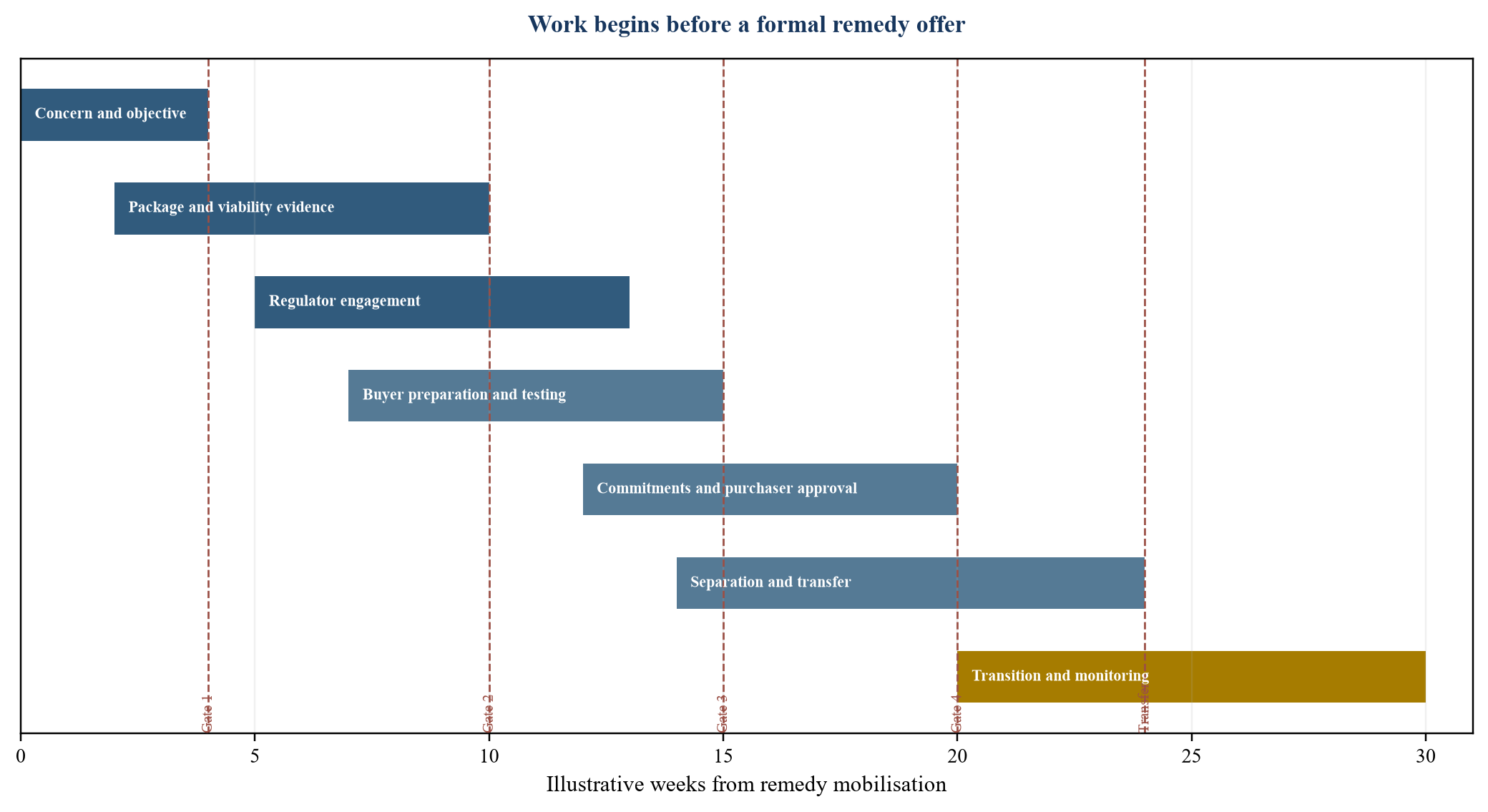
The timing is illustrative and does not represent a statutory timetable.
15. Coordinate multiple competition authorities
Cross-border transactions may face reviews in several jurisdictions with different legal tests, evidence, procedures and remedy preferences. The team should maintain one global concern map and a separate local analysis for each authority.
The objective is practical consistency. Asset perimeters, purchaser rights, transition arrangements and behavioural obligations should not conflict. A package accepted in one jurisdiction may require modification elsewhere. The team should identify conflicts early, including different buyer standards, divestiture deadlines, trustee roles and access obligations.
Waivers may allow authorities to exchange information, subject to law and strategy. The parties should understand the scope of any waiver and maintain consistency in submissions. Differences should have a documented factual or legal basis.
Global and local remedies can interact. A worldwide divestiture may solve overlapping concerns in several jurisdictions. A local remedy may need ring-fenced assets, contracts or access. The implementation plan should show which obligation governs when requirements overlap.
The purchaser may require approvals in several countries. Foreign investment, sector, data, labour and licensing requirements should enter the buyer plan. A competition remedy deadline does not displace other law.
The central team should maintain a commitments matrix. It should record every obligation, jurisdiction, owner, due date, evidence, monitoring route and conflict. Local counsel should validate the entries. The board should receive exceptions that affect value, timing or operational feasibility.
16. Build governance around evidence and decisions
The remedy programme needs a single accountable executive and a cross-functional team covering competition, corporate, finance, tax, operations, technology, people, communications, separation and financing. Legal advice should guide the process, while operating owners should validate execution.
The steering committee should approve the remedy objective, perimeter, purchaser criteria, economic model, regulator proposal and implementation plan. Reserved matters should include any change above defined value or timing thresholds, any transfer of strategic intellectual property and any obligation lasting beyond a stated period.
The evidence room should contain authority submissions, source data, models, perimeter schedules, standalone accounts, buyer materials, separation plans, commitments, trustee correspondence and approvals. Versions should be controlled. Oral feedback that changes the design should be recorded appropriately.
The finance function should own one remedy value bridge. Legal and operations should reconcile package changes to it. The model should have named inputs, sources and approval. Scenario assumptions should remain clearly identified.
The programme should maintain a risk register and decision log. Each risk needs consequence, likelihood, control, owner and next decision date. The decision log should record alternatives, evidence, advice, approval and unresolved matters.
Independent challenge can improve quality. A separation specialist, economist, industry expert or implementation adviser may test viability and monitorability. Their role and evidence should be defined rather than used as general endorsement.
17. Stress-test the remedy as an operating system
A remedy should be tested before it is offered. The team can conduct tabletop exercises covering package separation, purchaser diligence, data transfer, customer consent, employee movement, technology migration, reporting and breach response.
The purchaser test asks whether a credible buyer can understand, finance and operate the business. The package test asks whether every required capability transfers. The timing test asks whether approvals and separation fit the commitment. The conduct test asks whether obligations can be measured and enforced.
The team should simulate adverse events. A key employee may leave, a customer may refuse consent, a licence may not transfer, a system migration may fail or a purchaser may lose financing. The remedy should contain practical responses or escalation rights.
Metrics should measure readiness. Useful measures include percentage of perimeter assets verified, standalone accounts reconciled, critical dependencies with exit plans, key roles retained, required consents obtained, data-transfer controls tested and reporting fields automated.
The monitorability test is essential for behavioural obligations. The team should produce a sample compliance report and the underlying system evidence. If the obligation cannot be measured without subjective debate, it needs redesign.
The outcome should be a readiness certificate presented to the steering committee. It should list passed tests, exceptions, owners and dates. Certification does not assure regulator acceptance, but it reduces avoidable implementation failure.
18. Quantify remedy execution risk
The risk register should separate acceptance risk from implementation risk. Acceptance risk concerns whether the authority regards the proposal as effective and proportionate under its framework. Implementation risk concerns whether the business, buyer and obligations can be delivered.
High-consequence risks often include an incomplete perimeter, unsuitable purchaser, non-transferable rights, weak standalone financials, key-person loss, delayed approvals, conflicting authority requirements and funding expiry. Behavioural remedies add specification, monitoring, circumvention and change risks.
Risk scoring should guide resources rather than imply probability precision. A five-point likelihood and consequence scale can help compare issues, provided the basis is documented. Financial exposure should be modelled separately where possible.
Mitigation should change the evidence or operating design. A workshop alone does not mitigate a missing licence. The control might be obtaining consent, broadening the package, funding a replacement system, retaining staff or revising the commitment.
The register should connect to the long-stop plan and value model. A risk that can delay transfer by three months should have a cash and financing effect. A risk that removes a strategic asset should trigger an investment-thesis review.
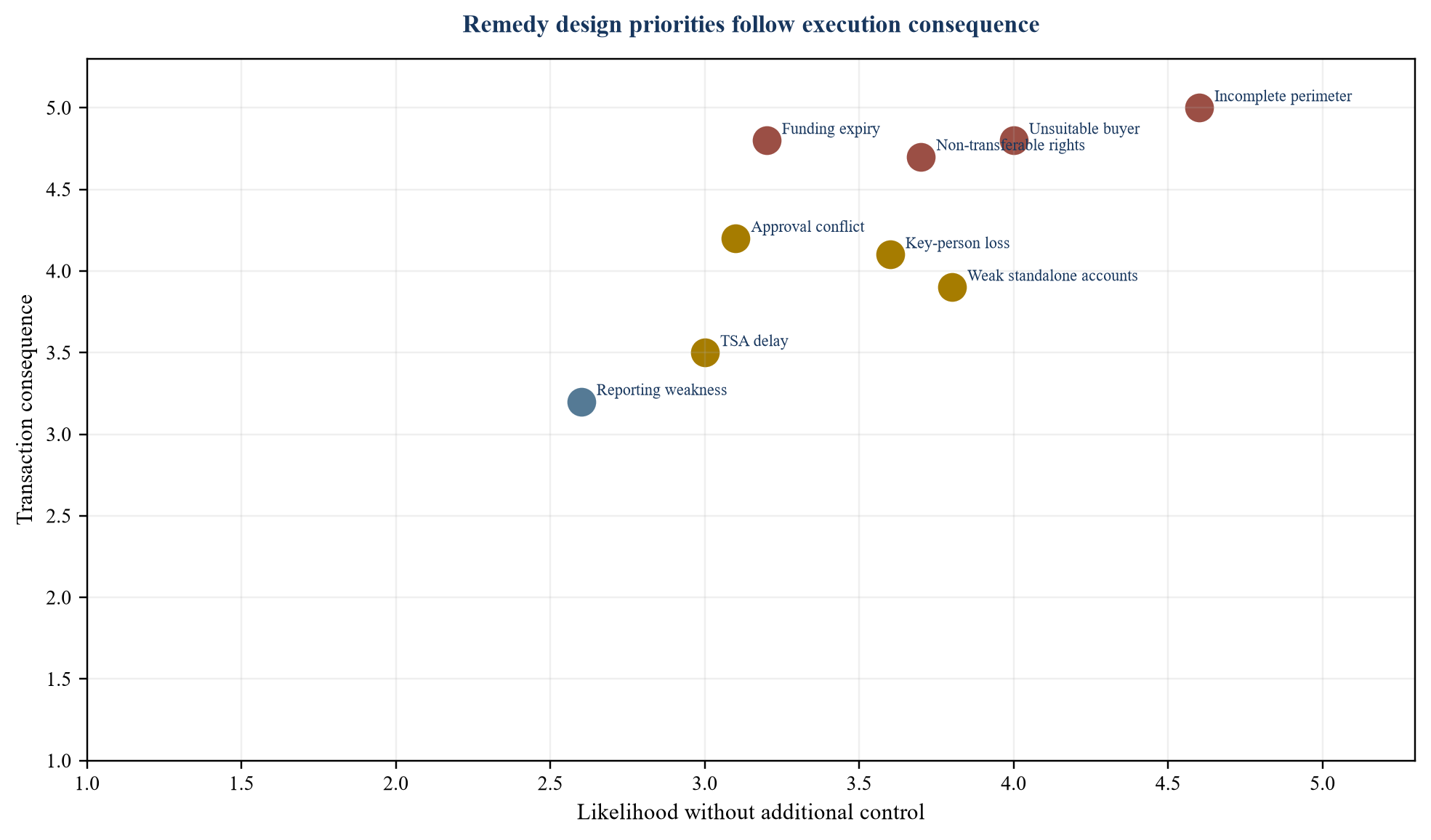
Positions are illustrative judgements for the hypothetical case.
19. Use a five-phase implementation roadmap
The roadmap should begin before signing and continue through post-transfer monitoring. Each phase should produce evidence that supports the next decision.
Phase one defines the concern map, jurisdictions, remedy hypotheses and decision rights. Phase two builds perimeter options, standalone evidence, buyer criteria and economic scenarios. Phase three engages with authorities and prepares the package for testing. Phase four executes commitments, purchaser approval, separation and transfer. Phase five operates transition, monitoring, compliance and review.
The roadmap should have deliverables rather than general workstreams. Examples include an asset schedule, standalone accounts, rights map, buyer-screening memorandum, remedy value bridge, separation plan, draft commitments, trustee plan and compliance report.
The schedule should assign one accountable owner to each deliverable. Contributors and reviewers should be identified. Completion should require evidence and approval, not a percentage estimate.
The programme should preserve flexibility. New regulator evidence may change the concern or perimeter. Change control should assess effect on value, financing, timetable, documents and implementation before approval.
| Phase | Primary purpose | Required outputs | Board or committee gate |
|---|---|---|---|
| Frame | Identify jurisdictions, possible concerns and decision rights | Concern map, filing plan, remedy hypotheses, governance and initial risk register | Approve bid assumptions and remedy limits |
| Evidence | Test perimeter, standalone viability, purchaser universe and economics | Asset schedule, standalone accounts, dependency map, buyer criteria and value bridge | Approve practicable and severe cases |
| Engage | Develop and test an authority-ready proposal | Submission, commitment draft, market-testing materials, separation plan and financing update | Authorise formal remedy offer |
| Execute | Secure purchaser approval and implement transfer | Sale agreement, final commitments, trustee mandate, consents, hold-separate controls and transfer certificate | Approve purchaser and closing sequence |
| Operate | Complete transition and demonstrate compliance | TSA exit, monitoring reports, breach process, retained-record archive and lessons review | Release governance after obligations end |
Timing is illustrative and must be adapted to the transaction and applicable procedures.
20. Prepare the board decision pack
The board pack should explain the regulator concern, remedy alternatives, value effect, timetable, financing, contractual position and recommendation. It should state which facts are verified and which numbers are scenario assumptions.
The first page should show the decision required. The second should map the theory of harm to the remedy objective and proposed package. The financial section should compare unconditional, practicable remedy and severe cases. The execution section should show critical path, purchaser strategy, separation readiness and principal risks.
The pack should identify limits in the acquisition agreement. It should state the remedies the buyer is obliged to accept, the control of engagement, extension rights, termination rights and fees. It should also show financing expiry, commitment costs and minimum liquidity.
The recommendation should be conditional where evidence is incomplete. Conditions might include regulator feedback, purchaser interest, verified standalone accounts, transferability of rights, lender confirmation or revised price. Each condition needs an owner and deadline.
The minutes should record the decision, alternatives and evidence. They should avoid implying legal conclusions beyond counsel's advice. The remedy model and supporting schedules should be retained with the board materials.
The pack should be updated at every material change. A remedy that grows from a local asset sale into a global business divestiture requires a new investment decision. Approval of the original transaction does not substitute for approval of a materially different perimeter.
21. Apply the framework to the hypothetical case
The hypothetical buyer begins with a USD 3.20 billion enterprise-value transaction and USD 260 million of assumed gross synergy value. Initial analysis identifies a possible horizontal concern in a defined cloud-management segment and a related concern over access to a software interface. The board authorises a contingent structural package and a separately costed access obligation for regulator discussion.
The candidate divestiture business has USD 36 million standalone EBITDA. Its perimeter includes product rights, customer contracts, named engineering and commercial staff, a development environment, data permitted for transfer, supplier arrangements and working capital. Shared identity, billing and security systems require migration under time-limited services.
The buyer assumes USD 410 million of divestiture proceeds in the early case. The package removes USD 72 million of synergy present value and adds USD 18 million of separation and transition cost. An assumed delay costs USD 15 million and financing adds USD 8 million. The net remedy-related value effect, defined as retained synergy plus proceeds less these costs, is USD 557 million. This metric does not include purchase price, tax or all standalone and stranded costs.
The late case assumes proceeds of USD 350 million, separation and transition cost of USD 31 million, delay cost of USD 40 million and financing cost of USD 22 million. Its net remedy-related value effect is USD 445 million. The USD 112 million difference from the early case illustrates why timing and preparation can affect transaction value. It is a scenario result rather than an empirical claim.
The board's conditions are purchaser viability, transferability of critical rights, lender confirmation, a tested separation plan and authority feedback consistent with the candidate package. A broader divestiture or longer behavioural obligation returns to the board because it may change the investment thesis.
The team builds the package before a formal offer. It reconciles the asset schedule, standalone accounts, technology map, employee plan, customer consents, buyer materials, financing model and draft commitments. The implementation committee reviews readiness weekly. The board receives value and risk updates at defined gates.
This case shows the framework's purpose. It makes the remedy a visible transaction variable and preserves the ability to change price, perimeter, funding or contractual strategy while choices remain available.
22. Conclusion
Merger-control remedies determine what the buyer owns, what the purchaser receives, how long financing remains committed and whether the transaction still creates value. Designing the remedy after the regulator identifies concerns can compress the timetable and weaken the buyer's commercial options.
The disciplined sequence begins with the theory of harm. The team defines the competitive capability to preserve or restore, builds perimeter options, tests standalone viability, identifies acceptable purchasers and models structural, behavioural or hybrid solutions. It then connects the package to valuation, financing, the acquisition agreement, hold-separate controls, implementation and monitoring.
Current authority guidance supports early, evidence-led work. The CMA's December 2025 guidance gives detailed attention to effectiveness, proportionality, structural and behavioural risk, purchaser suitability and monitoring. EU model texts, US remedy materials, OECD and ICN work, and guidance from Canada, Singapore and Australia reinforce the need for a complete package, credible buyer, enforceable obligations and implementation proof.
The hypothetical case quantifies the point without predicting an outcome. An early structural case produces a USD 557 million remedy-related value effect under its stated assumptions, while a late case produces USD 445 million. The difference arises from assumed sale proceeds, separation, delay and financing. Live transactions require verified data and current advice.
The board should treat a materially expanded remedy as a new investment decision. One version-controlled remedy register, value bridge, critical path and decision log allow legal, finance and operating teams to work from the same facts. That discipline protects the quality of regulator engagement and the integrity of the transaction decision.
Sources
- Competition and Markets Authority, Merger remedies, updated 19 December 2025, Read the primary source
- Competition and Markets Authority, Merger remedies guidance CMA87, December 2025, Read the primary source
- European Commission, Commission notice on remedies acceptable under Council Regulation 139/2004, Read the primary source
- European Commission, Mergers best practices and model texts, Read the primary source
- European Commission, Merger procedures, Read the primary source
- European Commission, Statistics on merger cases, updated 4 August 2026, Read the primary source
- Federal Trade Commission, Negotiating Merger Remedies, Read the primary source
- US Department of Justice, Merger Remedies Manual and modernised remedies announcement, Read the primary source
- OECD, Competition Trends 2025, Read the primary source
- OECD, Ex-post Assessment of Merger Remedies, 2023, Read the primary source
- International Competition Network, Merger Remedies Guide, 2016, Read the primary source
- Competition Bureau Canada, Information Bulletin on Merger Remedies in Canada, Read the primary source
- Competition and Consumer Commission of Singapore, Guidelines on the Substantive Assessment of Mergers, Read the primary source
- Australian Competition and Consumer Commission, Mergers and acquisitions under the mandatory regime, Read the primary source
- Australian Competition and Consumer Commission, Guidance documents for the merger control regime, Read the primary source
