

Introduction
Renewable-energy sponsors frequently own portfolios that are operationally diverse and financially fragmented. A platform may contain rooftop solar leases, commercial power-purchase agreements, utility-scale projects, storage contracts, renewable certificates and merchant exposure across several legal entities. Each asset can produce a recurring cash flow, yet the portfolio may still be financed through project-level bank debt, sponsor equity or short-dated warehouse facilities. This creates a capital-recycling problem. Mature cash flows remain tied to the original capital structure while the sponsor needs funds for new construction, acquisitions or repowering.
Securitisation can convert a defined pool of financial exposures into notes whose payments depend on collections from that pool. The structure can broaden the investor base, extend tenor, diversify refinancing sources and release sponsor capital. These benefits require a portfolio that can be described, transferred, serviced, monitored and stressed as one financial system. A collection of renewable assets does not become financeable merely because the technologies are low carbon or the underlying projects are operating.
The transaction question is specific: how can an owner bundle renewable cash flows into a securitisation that institutional investors can underwrite and that leaves the assets operationally resilient? The answer begins with the unit of finance. It continues through eligibility, portfolio construction, data, legal isolation, waterfall design, credit enhancement, servicing and investor reporting. The framework is relevant to renewable developers, independent power producers, utilities, infrastructure funds, banks, credit funds, insurers and advisers considering capital recycling through asset-backed or portfolio debt.
1. Define the financing objective before selecting assets
The sponsor should state what the transaction must achieve. Objectives can include refinancing expensive warehouse debt, monetising seasoned receivables, releasing equity, extending tenor, matching fixed-rate revenue, financing acquisitions or establishing a repeat issuance platform. Each objective changes the eligible pool, target investors and structure.
A one-time financing can tolerate more bespoke diligence than a programme intended to issue repeatedly. A capital-recycling transaction may prioritise cash proceeds and true-sale treatment. A balance-sheet financing may prioritise speed and operational flexibility. A green label can widen investor relevance, while the underlying credit remains determined by cash collection and loss allocation.
The objective should be converted into measurable constraints: minimum proceeds, maximum all-in cost, required maturity, target amortisation, retained risk, collateral release, asset substitution and reporting capability. These constraints prevent the structure from being designed around an attractive headline advance rate that the sponsor cannot operate after closing.
2. Distinguish securitisation from ordinary portfolio debt
Portfolio debt gives a lender recourse to a group of assets or companies. Securitisation generally allocates credit risk through tranches whose payments depend on a defined pool of exposures. The European Securitisation Regulation describes a securitisation as a transaction in which credit risk associated with an exposure or pool is tranched, payments depend on pool performance and tranche subordination determines loss distribution.[5] The economic substance matters even when legal labels differ.
This distinction affects governance and disclosure. A portfolio loan may rely on negotiated lender covenants and a borrowing base. A securitisation adds a bankruptcy-remote issuer, cash waterfall, note classes, transaction parties, detailed investor reporting and restrictions on asset substitution and cash leakage. It can also create regulatory capital, risk-retention and due-diligence consequences for regulated investors and originators.
The sponsor should compare four routes: project refinancing, holdco debt, borrowing-base warehouse and term securitisation. The correct route depends on pool seasoning, standardisation, size, investor demand, legal transferability and recurring issuance plans. Securitisation should solve a financing problem whose scale and repeatability justify its transaction cost.
3. Select the financial exposure, not the physical technology
The securitised asset is normally a contractual payment right, receivable, loan, lease or similar financial exposure. The solar panel, turbine or battery supports performance, while the investor receives cash through the financial contract. This separation is fundamental. Two technically identical projects can have different credit quality because their offtakers, tariffs, settlement rules, operating obligations and transfer restrictions differ.
The United States Securities and Exchange Commission defines an asset-backed security by reference to cash flows from a discrete pool of receivables or other financial assets that convert into cash within a finite period, together with related rights or assets supporting servicing and distributions.[18] A renewable portfolio should therefore be mapped from each physical asset to the exact contractual claim intended for the pool.
Eligible exposures can include customer leases, power-purchase receivables, availability payments, capacity payments, tariff receivables, contracted environmental attributes or project-loan receivables. Merchant electricity revenue may be included, but its price and volume volatility can reduce advance rates and require stronger enhancement. Future development value, uncontracted repowering upside and speculative certificate prices should remain outside the base pool unless the structure explicitly allocates those risks.
4. Establish the transaction perimeter
The transaction perimeter should identify the originator, seller, depositor, issuer, asset-owning companies, servicer, account bank, trustee, security agent, hedge counterparties, offtakers and operating contractors. It should show which receivables transfer, which physical assets remain with the sponsor, and which rights support enforcement, replacement and servicing.
Renewable portfolios often contain project-level restrictions. Financing documents may prohibit assignment. Land rights, grid agreements, licences, warranties and insurance may sit with special-purpose project companies. Offtake contracts may require consent or contain change-of-control provisions. The securitisation must therefore distinguish transfer of receivables, transfer of contract rights, security over project-company interests and beneficial or equitable assignments that become perfected after a trigger.
The perimeter should also include operational dependencies that do not transfer. Central forecasting, billing, asset management, cybersecurity, spare-parts procurement and market trading can remain with the sponsor. The transaction must preserve these services through enforceable agreements, replacement rights, data access and a funded transition plan.
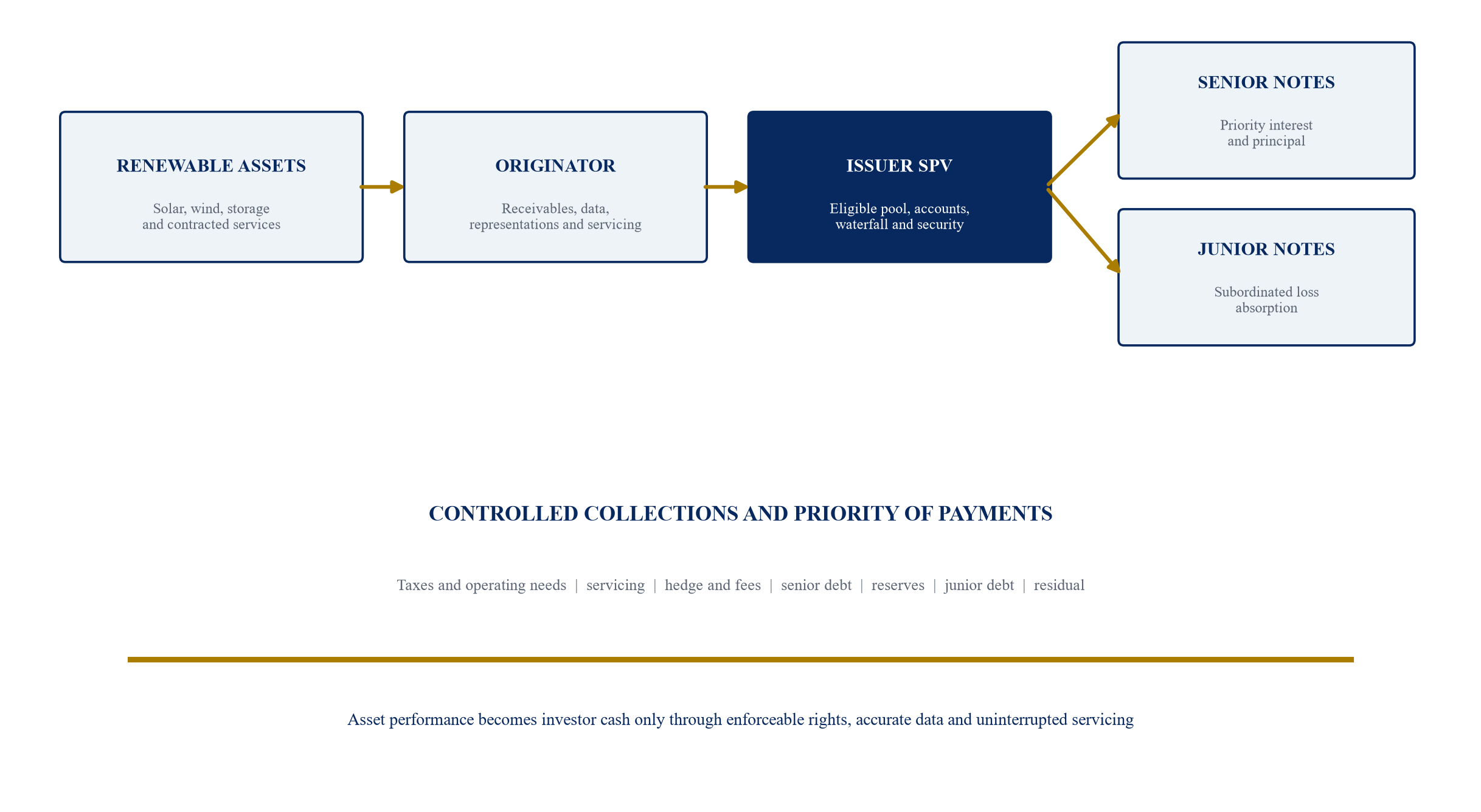
Conceptual structure; legal form, transfer mechanics and regulatory treatment require transaction-specific advice.
5. Build an eligibility matrix
Eligibility criteria convert the financing thesis into enforceable pool rules. Each exposure should satisfy tests for legal ownership, transferability, operating status, contract term, payment currency, data completeness, arrears, disputes, insurance, permits, technology, counterparty, location, minimum remaining life and absence of prohibited liens.
The tests should be measurable at cut-off and during any revolving period. A rule such as “high-quality offtaker” is too subjective. A rule based on rating, audited financial information, government ownership, payment history or defined internal credit categories can be tested. Exceptions should be documented and limited through concentration caps or higher credit enhancement.
Eligibility is distinct from credit quality. An asset can meet the legal entry conditions and still carry material risk. Pool construction therefore requires both binary eligibility tests and continuous stratification variables. The first prevents defective assets from entering; the second allows investors to understand the risk distribution.
Table 1. Renewable cash-flow eligibility and evidence matrix
| Eligibility area | Example test | Required evidence | Failure consequence | Possible treatment |
|---|---|---|---|---|
| Contract | Enforceable payment obligation with sufficient remaining term | Executed agreement; amendments; legal review; consent status | Cash flow may not survive transfer or note maturity | Exclude; obtain consent; shorten debt tenor |
| Operating status | Commercial operations achieved and performance history available | Completion certificate; operating data; acceptance tests | Construction and ramp risk enter the pool | Exclude until seasoned; cap exposure; add reserve |
| Collections | Payments directed to controlled account without material dispute | Bank records; invoices; settlement statements; account control | Leakage, set-off or commingling risk | Perfect account control; add commingling reserve |
| Data | Complete asset-level history reconciles to accounts | Data tape; meter records; billing ledger; audit trail | Investors cannot test pool performance | Cure data; exclude asset; increase verification |
| Compliance | Required permits, insurance and grid rights remain effective | Registers; policies; regulator and network records | Interruption, fines or invalid receivable | Condition precedent; reserve; indemnity |
| Credit | Counterparty and concentration within approved limits | Financials; ratings; payment history; group mapping | Correlated default or delayed payment | Concentration cap; enhancement; guaranty |
| Sustainability | Green claim and activity eligibility supported separately | Taxonomy mapping; technical criteria; external review | Green label or investor mandate may fail | Remove label; replace exposure; improve evidence |
Illustrative criteria; the final tests should reflect the selected jurisdiction, asset type and investor requirements.
6. Create an investor-grade asset data tape
The data tape should contain one record per exposure and link it to the physical asset, contract, counterparty, invoices, collections and performance history. Core fields include asset identifier, technology, capacity, location, commercial-operation date, contract type, offtaker, currency, tariff, indexation, remaining term, monthly generation, availability, curtailment, billed amount, collected amount, arrears, disputes and current debt.
The European securitisation framework requires information about underlying exposures, transaction structure and performance. ESMA publishes disclosure templates and technical reporting instructions for non-ABCP and ABCP securitisations, including an esoteric-exposure template where a dedicated asset class is unavailable.[7] In a 2024 consultation response, ECB staff observed that a dedicated renewable-energy template could help a developing solar and wind ABS market, while noting that fields should reflect industry characteristics.[8]
The sponsor should design a renewable data dictionary before investor diligence begins. Each field needs a definition, source system, owner, frequency, permissible values, validation rule and reconciliation control. Historical values should be frozen at cut-off, with a clear process for corrections. Data quality should be reported as a transaction risk rather than concealed through aggregate averages.
7. Reconcile physical production to billed and collected cash
Renewable securitisation requires a chain from resource to cash. For a solar asset, irradiance and system availability affect generation; metered generation affects billing; tariff and settlement rules affect invoiced revenue; payment behaviour affects collections. Wind, storage and other technologies have different physical drivers, while the control principle is the same.
The model should reconcile meter data, settlement statements, invoices, cash receipts and general-ledger revenue by asset and month. Unbilled revenue, estimates, true-ups, disputed invoices and tax should be identified. Cash collections are the primary source of debt service. Accounting revenue can include accruals that do not reach the controlled account on schedule.
Reconciliation variance should be monitored. Persistent differences can arise from meter replacement, estimation, billing errors, settlement lags, withholding, netting or cash posted to the wrong account. The transaction should define cure periods and cash-trap triggers for material data or reconciliation failures.
8. Season the pool before term issuance
Seasoning provides evidence of operations, collections and servicer performance. A newly commissioned asset may meet technical specifications and still lack evidence of degradation, curtailment, billing disputes, seasonal cash flow and counterparty behaviour. A warehouse can fund eligible assets while they season and while data is standardised.
Seasoning should be measured against the risk. One year can cover a seasonal cycle, while a longer period may be needed for technology degradation, customer churn or policy settlement. The sponsor should disclose the distribution of seasoning rather than a simple average. A pool dominated by recently added exposures can perform differently from the historic portfolio.
A revolving structure can replenish amortising or prepaid exposures. Replenishment criteria should prevent quality migration. The transaction should test new assets against the same eligibility, concentration and data standards, with stop-purchase events when pool performance or sponsor condition deteriorates.
9. Stratify technology, geography and operating model
Diversification should be measured by factors that drive cash flow. Technology affects resource variability, maintenance, degradation and residual value. Geography affects weather, grid constraints, regulation and natural hazards. Operating model affects customer behaviour, billing, service obligations and replacement cost.
A pool with many assets can remain concentrated. Rooftop systems across one climate zone may experience correlated weather. Multiple projects can rely on the same inverter model, EPC contractor, network area, offtaker group or market price. Corporate names should be mapped to ultimate parent and economic sector. Geographic diversification should consider grid zone and weather regime as well as political boundary.
Concentration limits should therefore cover offtaker, parent group, technology vendor, operator, asset, jurisdiction, grid zone, currency, contract type, merchant exposure and remaining term. Limits can tighten during a revolving period and after performance triggers.
10. Separate contracted price from merchant exposure
Contracted revenue should be analysed by fixed price, indexed price, floor, collar, contract-for-difference, availability payment or capacity payment. Each form transfers different risk. A fixed nominal tariff exposes the project to inflation. Indexation can be capped or lagged. A floor can depend on settlement and collateral. A contract for difference can create payments in either direction.
Merchant revenue should use observable market curves and stress scenarios, with attention to basis between the project node and reference price. Capture price can fall below the average market price when renewable output is concentrated in the same hours. Negative prices, curtailment and congestion should be modelled explicitly where relevant.
The securitisation should state how much debt service relies on uncontracted revenue. Merchant cash can support accelerated amortisation or junior returns while senior debt is sized to contracted or conservative stressed revenue. This protects the structure from capitalising optimistic price forecasts into fixed obligations.
11. Underwrite offtaker and payment mechanics
Offtaker risk combines ability to pay, willingness to pay and the legal mechanics of settlement. A sovereign, utility, corporate or household pool can each fail in different ways. Government ownership does not remove budget, appropriation, dispute or transfer risk. Investment-grade status does not prevent concentration.
The diligence should review financial capacity, payment history, contract enforceability, set-off, termination, force majeure, change in law, curtailment compensation and security. Payment history should distinguish late invoicing from late payment. Disputes should be mapped to contract interpretation, metering, service quality and tax.
Where an offtaker represents a large share of collections, the structure can use concentration enhancement, a guaranty, political-risk insurance, a reserve or shorter debt tenor. The sponsor should avoid treating diversification across project companies as diversification when the same buyer ultimately pays them.
12. Measure generation and resource risk
Generation forecasts should use independent resource assessments, operating history and equipment availability. The base case should state whether it reflects expected production, probability-of-exceedance cases or contractual availability. The financing case should reconcile the forecast method with actual portfolio data.
Weather diversification can reduce volatility, while common climate patterns can create correlation. Historical data may not fully represent future heat, storms, drought, wind regimes or hydrology. Stress tests should combine resource shortfall with equipment downtime and price effects rather than applying each risk independently.
For distributed assets, customer sites and roof conditions can affect availability. For utility-scale assets, grid outages and curtailment can dominate physical production. The pool should capture cause codes for lost output so that investors can distinguish resource variance, equipment failure, network constraint and contractual curtailment.
13. Treat curtailment and grid access as credit variables
Grid connection is not a one-time construction milestone. Operating assets face congestion, planned outages, dispatch rules, export limits and changing compensation. The transaction should document connection rights, network agreements, dispatch priority, curtailment history and payment treatment.
Curtailment that is fully compensated by a creditworthy counterparty can behave differently from uncompensated economic curtailment. Compensation can still be disputed or delayed. The data tape should record curtailed energy, cause, contractual entitlement, invoice and collection separately from generated energy.
Projects sharing a connection point, network zone or substation can experience common failure. Concentration analysis should therefore include physical grid dependencies. A reserve or enhancement calibrated only to individual asset volatility can understate portfolio risk.
14. Underwrite operations and maintenance
Operating cash flow depends on availability, maintenance, spares, warranties and skilled personnel. The servicer and asset manager should provide work-order history, preventive-maintenance compliance, failure rates, response times, warranty claims, spare-parts inventory and major-maintenance forecasts.
Long-term service agreements can transfer some performance risk, while exclusions, caps and counterparty credit remain important. A guarantee is valuable only when the failure is covered, measured and recoverable. The pool model should separate expected routine expense, lifecycle replacements and uninsured events.
The securitisation should preserve funds needed to operate the assets before distributing residual cash. Deferred maintenance can temporarily increase collections and damage later performance. The waterfall should fund budgeted operating needs, taxes, insurance and required reserves according to the legal and operating perimeter.
15. Model degradation, repowering and residual value
Solar modules, batteries, inverters, turbines and balance-of-plant equipment have different degradation and replacement profiles. Contracted revenue may extend beyond a component's expected life. Repowering can improve production but require permits, grid studies, downtime and new capital.
Debt maturity should fit the remaining contract and useful life after conservative degradation. Residual value should be excluded from senior repayment unless it is supported by enforceable contracts or robust market evidence. Salvage and merchant tail assumptions belong in a separate case.
The model should identify who funds replacements and how collections are treated during downtime. A funded reserve, sponsor obligation or excess-spread trap can support lifecycle capital. Investors should receive asset-condition and major-maintenance reporting before a known replacement period.
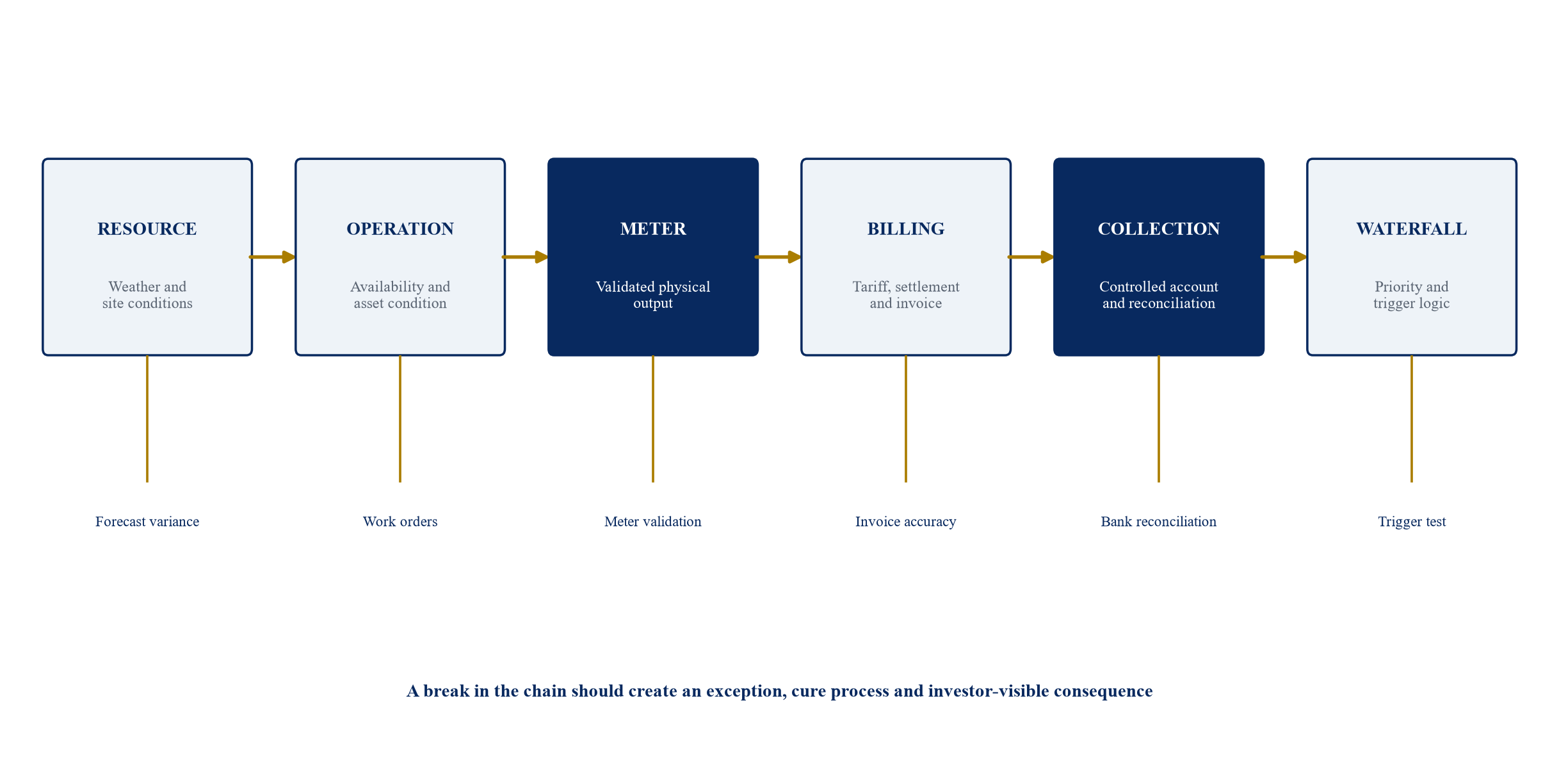
Each link requires a defined owner, source system, reconciliation control and exception process.
16. Construct the pool to reduce idiosyncratic risk
Pool construction should be iterative. The sponsor begins with eligible exposures, measures concentrations and loss drivers, applies exclusions and caps, then tests cash flow under stress. The objective is a pool whose aggregate behaviour can support the intended notes without hiding tail risk.
Diversification benefits depend on correlation. A single storm, grid event, regulatory change or equipment defect can affect many assets. The model should include common-cause scenarios and compare them with independent asset losses. Concentration limits should be tested after assumed defaults and substitutions, because surviving exposure can become more concentrated.
The sponsor may reserve higher-quality assets for future transactions or retain difficult exposures outside the pool. Investors should understand selection policy to assess adverse selection. The transaction should document how the cut-off pool was chosen and how any subsequent additions are tested.
17. Use a warehouse to standardise and season assets
A warehouse can acquire or finance exposures before term issuance. It provides time to reach scale, resolve consents, standardise data and establish performance. The warehouse borrowing base can apply eligibility, advance rates, concentration limits and reserves that anticipate the term structure.
Warehouse design should avoid a cliff at takeout. If the term market cannot refinance the facility, the sponsor may face margin increases, amortisation or asset sales. Extension options, backup financing, eligibility alignment and conservative ramp assumptions reduce this risk.
The warehouse should also preserve evidence. Each acquisition should enter with a complete contract file, data record, legal review and operational history. Retrospective file reconstruction before term issuance is expensive and can reveal defects after capital has already been advanced.
18. Establish true sale and bankruptcy remoteness
The transfer of exposures to the issuer should be analysed under the applicable insolvency, property, contract and securities laws. The legal objective is to isolate the pool from the seller's insolvency and give the issuer or trustee enforceable rights to collections and related security. Opinions commonly address true sale, non-consolidation, perfection and enforceability, subject to jurisdiction-specific qualifications.
Transfer restrictions, set-off, commingling and recharacterisation can weaken isolation. Receivables arising from continuing service obligations can depend on future sponsor performance. The structure should identify which obligations remain executory and what happens if the originator or servicer fails.
Bankruptcy remoteness also requires governance. The issuer should have limited purposes, restrictions on debt and activities, separate records and accounts, and independent decision processes where required. These features protect the transaction only when they are followed in practice.
19. Design the priority of payments
The cash waterfall translates collections into operating and financing priorities. A renewable structure may pay taxes and essential operating costs, servicing and trustee fees, hedge amounts, senior interest, senior principal, reserve replenishment, junior interest and principal, then residual distributions. The exact order should reflect legal ownership of the physical assets and the risk allocated to noteholders.
Interest and principal waterfalls can differ. Scheduled amortisation may follow a profile, while excess collections accelerate principal. A turbo can deleverage the structure after performance weakness. Pro rata payments can shift to sequential payments after a trigger.
Definitions matter. Available funds, principal collections, interest collections, permitted withdrawals and recoveries should be unambiguous. A cash-flow model should reproduce the legal waterfall for every payment date and reconcile to trustee reports.
20. Size tranches to stressed collections
Tranche size should be derived from stressed cash flow rather than a percentage of asset value. The model should apply generation, price, default, delay, operating-cost, curtailment, interest-rate, currency and recovery assumptions. Senior debt service must remain covered after priority expenses and reserve requirements.
Subordination allocates loss. A senior tranche benefits from junior notes, overcollateralisation, reserve accounts and excess spread. The thickness of each tranche should reflect expected and stressed loss, timing risk and target investor requirements. A high advance rate can be offset by costly enhancement or trapped cash.
The Basel securitisation framework requires banks to understand underlying pools, access timely performance information and analyse structural features such as waterfalls, triggers and enhancements.[12] This reinforces a practical point: the structure cannot substitute for weak asset evidence.
21. Calibrate credit enhancement
Credit enhancement should address identified risks. Subordination covers losses until junior capital is exhausted. Overcollateralisation creates collateral value above note balance. Excess spread absorbs losses when collections exceed expenses and interest. Reserves cover liquidity, operating needs, commingling or specific lifecycle costs.
Enhancement should be sized through scenarios and legal mechanics. A reserve funded at closing reduces proceeds. A reserve funded from excess cash may be unavailable during early stress. A guaranty creates counterparty exposure. Insurance contains exclusions, limits and claims timing.
The sponsor should avoid double counting. A conservative cash-flow haircut and a reserve can address the same risk. The model should state which risk each protection covers, when it is available, how it replenishes and who benefits.
22. Separate liquidity from credit risk
Renewable cash flows can be delayed without being permanently lost. Settlement true-ups, government payments, insurance claims and certificate issuance can create timing gaps. A liquidity reserve or facility can bridge these gaps, while it should not conceal a structural inability to pay.
Liquidity sizing should use the longest credible interruption in collections, priority expenses and interest obligations. It should reflect seasonality and payment frequency. A monthly collection pool with semiannual debt service can accumulate cash; a delayed major offtaker payment can still create a shortfall at the payment date.
Draw conditions, repayment priority, provider rating and replacement should be explicit. A liquidity facility can itself become unavailable when the provider is downgraded or when a draw is classified as credit support rather than temporary liquidity.
23. Use performance triggers as automatic governance
Triggers protect investors by changing cash allocation when performance weakens. Measures can include debt-service coverage, cumulative defaults, delinquency, availability, generation variance, concentration, reserve shortfall, servicer termination, data failure and breach of representations.
Trigger definitions should be objective and resistant to timing manipulation. A coverage test based on annual forecast cash can react slowly. A test based on rolling collected cash provides earlier evidence, while seasonality needs adjustment. Cure rights should be time-limited and consistent with the underlying problem.
Consequences can include cash trapping, sequential amortisation, suspension of substitutions, accelerated reserve funding or an event of default. The waterfall model should demonstrate each consequence. Investors should receive the calculation and supporting data on every reporting date.
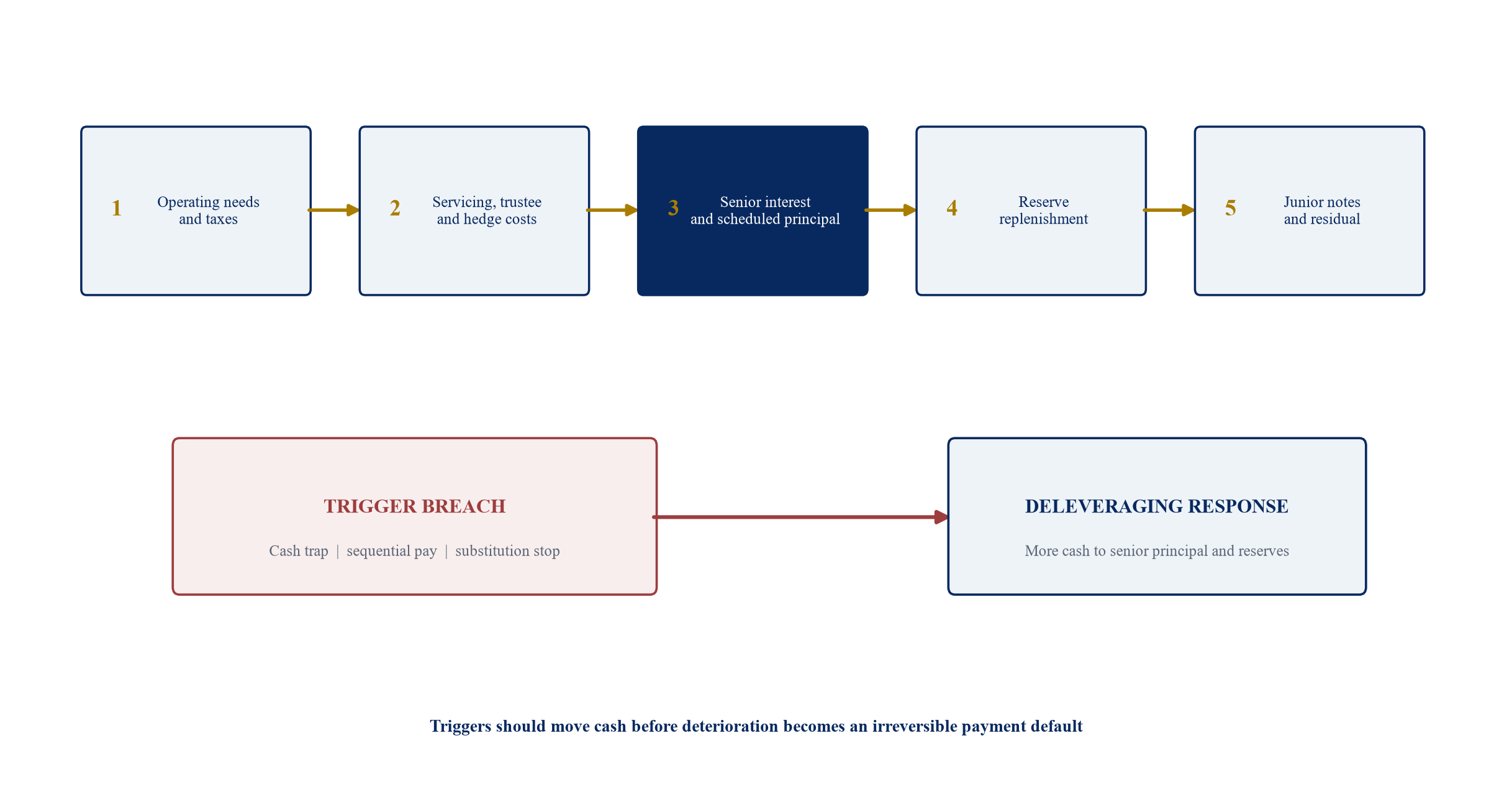
Conceptual priority sequence; transaction documents determine the actual order and trigger effects.
24. Protect collections from commingling
Commingling occurs when pool collections pass through an originator or servicer account before reaching the issuer. Insolvency, operational failure or cash management can delay or trap those funds. The transaction should direct payments to controlled accounts or require rapid sweeps.
Where direct payment is impractical, a commingling reserve, guaranty or replacement trigger can reduce exposure. The structure should identify every payment route, including utility settlements, customer debits, certificate sales, insurance proceeds and tax refunds. Netting and set-off should be analysed.
Account-bank eligibility and replacement mechanics also matter. A downgrade can require transfer of accounts within a short period. Operational readiness should be tested before closing, including payment instructions, standing orders and data feeds.
25. Design servicing for operational continuity
Servicing includes billing, collection, payment allocation, arrears management, contract administration, reporting and enforcement. Renewable portfolios also require technical asset management, forecasting, market settlement, warranty administration and regulatory compliance. The transaction should allocate each function to a named party.
The SEC's Regulation AB guidance treats servicing according to the functions performed and emphasises information material to pool administration and investor assessment.[17] A trustee or calculation agent can participate in the servicing function when it calculates allocations and distributions. This functional view is useful even for private transactions outside the registered ABS regime.
The sponsor should prepare for servicer failure. A backup servicer can maintain data and payment operations, while specialised technical functions may require separate transition arrangements. The transaction should fund transfer costs and provide access to contracts, customer records, systems, passwords, meter data and staff procedures.
26. Build reporting around investor decisions
Investor reporting should show opening and closing pool balance, collections, generation, availability, curtailment, arrears, defaults, recoveries, prepayments, substitutions, concentrations, reserve balances, trigger calculations and note payments. It should reconcile to controlled bank accounts and the legal waterfall.
Aggregate reporting should be supported by asset-level data or sufficiently granular stratification. The Basel framework links regulatory treatment to ongoing access to pool performance and structural information.[12] ESMA's disclosure regime similarly emphasises underlying exposures, transaction performance and significant events.[7]
Reporting quality should be tested before issuance. A parallel run can produce two or three mock investor reports using live data. Exceptions should be resolved and controls documented. The first investor report should not be the first complete calculation of the transaction.
27. Address representations and repurchase mechanics
The seller commonly represents that exposures meet eligibility criteria, documents are complete, information is accurate, contracts are enforceable and no prohibited liens exist. A breach can require cure, substitution or repurchase. These remedies protect against defective transfer and information, not ordinary credit deterioration.
Repurchase obligations should be operationally credible. A weak sponsor cannot support an unlimited remedy. The transaction should specify discovery, notice, materiality, cure period, valuation and dispute process. Investors should receive information about material breaches and remedies where required.
The sponsor should maintain a representation register linked to source evidence. This reduces closing risk and supports future issuance. Repeated breaches can trigger suspension of asset additions or servicer replacement.
28. Comply with risk-retention and due-diligence rules
The applicable securitisation regime depends on issuer, assets, investors and offering jurisdictions. Under Regulation (EU) 2017/2402, the originator, sponsor or original lender generally retains an ongoing material net economic interest of at least 5 percent, with specified retention methods and restrictions on hedging or sale.[5] Commission Delegated Regulation (EU) 2023/2175 provides further detail on retention methods and measurement.[6]
Institutional investors also have due-diligence obligations. They should understand pool risk, structure, retention and performance. A transaction marketed across jurisdictions should identify which party retains risk, how the interest is held and how investors verify compliance.
Regulatory treatment should be analysed early. A structure can be economically attractive and produce inefficient capital treatment for target investors. Legal, regulatory, accounting and tax advisers should confirm the final approach for the relevant jurisdictions.
29. Separate green credentials from credit quality
A renewable pool can support a green-labelled security, yet environmental eligibility does not establish debt repayment. Credit analysis concerns enforceable cash flow, operations, counterparties and structure. Green analysis concerns use of proceeds, asset eligibility, taxonomy alignment, reporting and external review.
Regulation (EU) 2023/2631 establishes the European Green Bond standard and contains specific provisions for securitisation bonds, including the role of the originator and allocation of proceeds.[9] The treatment requires careful review because a green label can depend on how proceeds relate to eligible assets rather than on the colour of every cash flow in the pool.
The transaction should maintain separate credit and sustainability evidence registers. A failure in environmental reporting can damage label integrity and investor eligibility even when cash collections continue. A payment default can occur even when every asset is environmentally aligned.
30. Assess accounting consolidation and derecognition
Accounting outcomes should be analysed for the seller, issuer and consolidated group. IFRS 9 contains derecognition requirements for financial assets and examples involving transfers to securitisation vehicles.[14] A transfer can fail derecognition when risks and rewards or control remain. IFRS 10 can require consolidation of a structured entity when an investor has power, exposure to variable returns and the ability to use power to affect those returns.[15]
The legal sale and accounting treatment answer different questions. A transaction can achieve legal isolation and remain consolidated for accounting. Retained servicing, residual interests, guarantees, liquidity support and decision rights can affect the analysis.
The sponsor should model balance-sheet, income-statement and cash-flow effects before pricing. It should identify servicing assets or liabilities, transaction costs, expected credit losses, hedge accounting and disclosure. Accounting advice should be based on final documents and factual control arrangements.
31. Model tax, withholding and transfer costs
Cash available to noteholders can be reduced by transfer taxes, withholding, value-added tax, corporate tax and limitations on interest deductibility. Asset transfers can create gains, losses or recapture. Cross-border structures can introduce treaty, substance and permanent-establishment questions.
The model should follow cash through each legal entity and payment. Gross contractual revenue may not equal distributable issuer cash. Tax reserves and indemnities should reflect identified obligations, while they should not replace a supportable tax analysis.
Tax law and administrative practice can change. The transaction should allocate change-in-law risk and reporting obligations. Investors should understand whether tax affects senior payments, sponsor residual or both.
32. Apply a hypothetical pool and structure
Consider a hypothetical portfolio of 84 operating solar, wind and storage-linked exposures across three jurisdictions. The portfolio has a notional eligible receivables balance of USD 420 million, weighted-average remaining contract term of 12.4 years and 82 percent of base-case collections under fixed or indexed contracts. The remaining 18 percent is merchant or certificate-linked. These figures are scenario assumptions for explaining structure and do not represent an identified market transaction.
The illustrative issuer purchases the eligible exposures and issues senior and junior notes. A reserve is funded at closing, and the sponsor retains a junior interest. Senior principal amortises sequentially. Excess cash accelerates senior principal after a coverage or generation trigger. Asset substitutions are permitted for two years within eligibility and concentration limits.
The example shows the decisions required. It does not provide a market advance rate, rating or price. Actual sizing requires asset-level data, legal review, investor feedback and current market conditions.
Table 2. Hypothetical renewable portfolio and securitisation structure
| Item | Base assumption | Downside test | Structural response |
|---|---|---|---|
| Eligible receivables | USD 420m | 6% assets excluded after diligence | Reduce purchase price or substitute qualified assets |
| Contracted collections | 82% of base collections | Two concentrated offtakers pay 90 days late | Liquidity reserve and concentration enhancement |
| Merchant exposure | 18% of base collections | 35% price fall with lower capture price | Exclude from senior sizing or apply conservative haircut |
| Generation | Independent base case | 12% portfolio shortfall plus common grid outage | Senior sizing to stressed cash; cash trap after trigger |
| Senior notes | USD 294m illustrative balance | Coverage falls below trigger | Sequential amortisation and suspended residual |
| Junior and retained interest | USD 63m illustrative balance | First-loss absorption | Losses and cash shortfalls allocated before senior |
| Overcollateralisation and reserves | Remaining collateral and funded accounts | Delayed collections and operating cost increase | Liquidity draw; reserve replenishment; accelerated paydown |
All values are management-model assumptions for illustration and require replacement with transaction-specific evidence.
33. Stress the pool through combined scenarios
Stress testing should combine correlated risks. A low-resource year can coincide with low merchant prices. Equipment failure can increase operating cost and reduce generation. An offtaker downgrade can delay payment and reduce the value of a termination claim. A regulatory change can affect certificates across the entire pool.
The model should test timing as well as amount. Delayed collections can cause a payment-date shortfall even when annual revenue ultimately recovers. Prepayment can return principal early and reduce excess spread. Slow amortisation can extend exposure to technology and counterparty risk.
Results should be shown as debt-service coverage, principal repayment timing, reserve use, trigger breach and loss by tranche. The model should identify the smallest combination of events that impairs senior principal. This is more decision-useful than a single severe case with many arbitrary shocks.
34. Use securitisation within an M&A and capital-recycling plan
A buyer can use securitisation to refinance an acquired operating portfolio after closing, while the acquisition should not assume takeout before the pool is eligible. The M&A model should bridge enterprise value, existing project debt, transaction costs, securitisation proceeds, retained junior capital and release of restricted cash.
Diligence should test whether contracts and financing permit transfer, additional debt and cash sweeps. Change-of-control consents, tax equity, grants, minority shareholders and project lenders can constrain the structure. A financing plan that depends on unverified consents creates closing risk.
The buyer can also separate mature assets from development and repowering activities. Operating receivables enter the financing pool; development risk remains with sponsor equity or specialised capital. This can improve capital discipline when governance prevents value leakage between the two perimeters.
35. Plan execution as a controlled sequence
The first phase defines financing objectives, asset perimeter and jurisdiction. The second builds the data tape, eligibility rules and historical reconciliation. The third conducts legal, tax, accounting, technical and credit diligence. The fourth designs the issuer, waterfall, enhancement, triggers and reporting. The fifth engages investors, finalises documents, tests operations and closes.
Workstreams should use one issue register. An asset excluded for legal transfer may also affect concentration, cash flow and green allocation. A data gap can affect eligibility, representations and investor disclosure. Changes should flow through the model and documents together.
Before pricing, the sponsor should run a closing rehearsal and mock payment date. Accounts, payment instructions, data feeds, reports and waterfall calculations should operate with test data. Unresolved operational readiness should be treated as a closing condition.
36. Allocate transaction and operating risk
Risk should be allocated to the party that can control or price it. The originator controls asset selection, documentation and representations. The servicer controls billing, collections and reporting. Operators control maintenance and evidence. Investors bear defined pool credit risk after structural protection. Account banks, trustees and hedge providers control their contracted functions.
Some risks remain with the structure. Systemic resource, price and regulatory changes cannot be transferred fully through representations. They should be addressed through conservative sizing, diversification, enhancement and cash retention. Sponsor support should be explicit and limited rather than assumed.
Table 3. Renewable securitisation risk allocation and controls
| Risk | Primary control owner | Pre-closing protection | Ongoing control | Residual exposure |
|---|---|---|---|---|
| Defective eligibility or transfer | Originator and seller | Representation; legal review; exclusion; repurchase remedy | File audit and breach register | Seller credit and legal uncertainty |
| Generation and availability | Operator and asset manager | Independent review; seasoning; conservative forecast | Metering; work orders; availability reporting | Weather and common equipment events |
| Offtaker payment | Servicer and credit function | Concentration cap; payment history; security review | Arrears, disputes and downgrade monitoring | Systemic or sovereign credit deterioration |
| Merchant and certificate price | Sponsor at pool design; issuer thereafter | Haircut; cap; hedge where available | Market reporting and cash trap | Basis, liquidity and policy change |
| Servicing and data | Servicer and backup servicer | Operational audit; data test; transition plan | Reconciliation; exception and attestation | Complex technical transfer and cyber events |
| Liquidity and waterfall | Issuer, trustee and calculation agent | Reserve; tested model; clear documents | Payment-date reconciliation and trigger calculation | Extreme timing mismatch or provider failure |
| Regulatory, accounting and tax | Relevant transaction parties | Specialist opinions and documented assumptions | Compliance reporting and change monitoring | Law, interpretation and enforcement change |
Contractual protection should follow control capability and remain consistent with the legal isolation of the issuer.
37. Recognise the limits of the framework
Renewable securitisation varies by jurisdiction, asset type, contract, investor base and offering format. A portfolio of household solar leases differs from a pool of utility power-purchase receivables or project loans. The framework should be adapted with legal, tax, accounting, technical, regulatory and rating expertise.
Public rules and market information can change after publication. The European Commission proposed changes to the EU securitisation framework in June 2025, and its March 2026 Clean Energy Investment Strategy described collaboration with the EIB Group on an operator securitisation facility intended to convert future regulated revenue streams into liquidity.[10][11] Final legal treatment and availability should be checked at the transaction date.
The hypothetical pool and capital structure illustrate mechanics only. They do not provide market pricing, ratings, investor demand or expected performance. A financing decision requires current asset-level evidence, current law and transaction-specific advice.
Conclusion
Renewable portfolio securitisation can convert seasoned operating cash flows into institutional funding and recycle sponsor capital. The financing unit is the enforceable financial exposure supported by the asset, contract, data and servicing system. Installed capacity and environmental benefit remain relevant, while they do not determine cash available for debt service.
A financeable transaction begins with a defined objective and eligible pool. It reconciles physical output to billed and collected cash, measures concentration and common-cause risk, isolates the exposures legally, preserves servicing and operational continuity, and allocates collections through a tested waterfall. Credit enhancement and triggers should respond to identified risks. Investor reporting should make the pool and structure observable throughout the life of the notes.
The sponsor should separate green credentials, credit quality and accounting treatment. Each has its own evidence and consequences. When the operating, legal and information architecture is built before issuance, securitisation can become a repeatable capital-recycling platform rather than a one-time refinancing exercise.
Frequently Asked Questions
1. Which renewable cash flows are most suitable for securitisation?
Seasoned, transferable and enforceable payment rights with reliable data, controlled collections and sufficient remaining term are generally more suitable. Contracted receivables can support stronger sizing than speculative development value or unhedged merchant revenue.
2. Does a green label make the notes lower risk?
No. A green label addresses environmental eligibility, use of proceeds and related reporting. Credit risk depends on collections, operations, counterparties, legal isolation and structural protection.
3. How much operating history is required?
The required period depends on technology, seasonality, customer behaviour and investor expectations. The pool should contain enough history to test generation, billing, collections, curtailment, availability and servicing across relevant cycles.
4. Can merchant electricity revenue enter the pool?
Merchant revenue can enter when the structure measures price, basis, capture-price and curtailment risk. Senior sizing commonly applies conservative haircuts, caps exposure or relies on contracted revenue for fixed debt service.
5. Why is a controlled collection account important?
It reduces leakage and commingling risk, gives the issuer and trustee visibility over cash, and supports accurate application of the priority of payments.
6. What does a performance trigger do?
A trigger changes cash allocation after a defined deterioration. It can trap cash, stop substitutions, increase reserve funding or accelerate senior principal before losses become irreversible.
7. Can securitisation fund an acquisition?
It can refinance eligible operating cash flows within an acquisition plan. The buyer should not assume takeout until transfer, data, consents, structure and investor requirements are verified.
8. Are the financial examples market forecasts?
No. They are hypothetical management-model assumptions used to explain transaction mechanics and require replacement with current portfolio-specific evidence.
References
- National Renewable Energy Laboratory, Financing U.S. Renewable Energy Projects Through Public Capital Vehicles: Qualitative and Quantitative Benefits, 2013, https://docs.nrel.gov/docs/fy13osti/58315.pdf
- United States Securities and Exchange Commission, Sunnova Energy International Inc. Form 8-K, Solar Asset Securitization, filed 21 February 2025, https://www.sec.gov/Archives/edgar/data/1772695/000177269525000011/nova-20250221.htm
- United States Securities and Exchange Commission, Sunnova SOL IX Issuer LLC Indenture, dated 21 February 2025, https://www.sec.gov/Archives/edgar/data/1772695/000177269525000011/exhibit101-solixindenture.htm
- United States Securities and Exchange Commission, Dodd-Frank Act Rulemaking: Asset-Backed Securities, accessed 3 October 2026, https://www.sec.gov/spotlight/dodd-frank/assetbackedsecurities.shtml
- EUR-Lex, Regulation (EU) 2017/2402 laying down a general framework for securitisation, consolidated text accessed 3 October 2026, https://eur-lex.europa.eu/legal-content/en/TXT/?uri=celex:32017R2402
- EUR-Lex, Commission Delegated Regulation (EU) 2023/2175 on risk-retention requirements, 7 July 2023, https://eur-lex.europa.eu/eli/reg_del/2023/2175/oj/eng
- European Securities and Markets Authority, Securitisation: disclosure requirements, templates and repositories, accessed 3 October 2026, https://www.esma.europa.eu/esmas-activities/markets-and-infrastructure/securitisation
- European Central Bank staff, Response to ESMA consultation on securitisation disclosure templates, 13 March 2024, https://www.esma.europa.eu/system/files/webform/206390/101184/ecb_staff_response_ESMA_consultation_securitisation_disclosure_templates240313_78ffd4958d.en_.pdf
- EUR-Lex, Regulation (EU) 2023/2631 on European Green Bonds, consolidated text, https://eur-lex.europa.eu/legal-content/EN/TXT/?uri=CELEX:02023R2631-20240109
- European Commission, Securitisation policy and June 2025 legislative package, accessed 3 October 2026, https://finance.ec.europa.eu/financial-markets/financial-markets-policy/securities-markets/securitisation_en
- European Commission, Clean Energy Investment Strategy, 10 March 2026, https://energy.ec.europa.eu/document/download/1790254c-aed1-4b00-a0f5-5c1001b460c4_en
- Bank for International Settlements, Basel Framework, CRE40 Securitisation: general provisions, version effective 1 January 2023, https://www.bis.org/baselframework/BaselFramework.pdf
- Bank for International Settlements, Basel III Securitisation Framework Executive Summary, accessed 3 October 2026, https://www.bis.org/publications/fsi-summary-basel-iii-securitisation-framework-executive-summary
- IFRS Foundation, IFRS 9 Financial Instruments, issued standards text, https://www.ifrs.org/content/dam/ifrs/publications/pdf-standards/english/2022/issued/part-a/ifrs-9-financial-instruments.pdf?bypass=on
- IFRS Foundation, IFRS 10 Consolidated Financial Statements, issued standards page, https://www.ifrs.org/issued-standards/list-of-standards/ifrs-10-consolidated-financial-statements/
- IFRS Foundation, IFRS 7 Financial Instruments: Disclosures, issued standards page, https://www.ifrs.org/issued-standards/list-of-standards/ifrs-7-financial-instruments-disclosures/
- United States Securities and Exchange Commission, Asset-Backed Securities: Corporation Finance Interpretations, updated 23 March 2026, https://www.sec.gov/rules-regulations/staff-guidance/corporation-finance-interpretations-cfis/asset-backed-securities
- United States Securities and Exchange Commission, Financial Reporting Manual, Topic 2, Regulation AB definition and reporting, accessed 3 October 2026, https://www.sec.gov/corpfin/cf-manual/topic-2
- United States Securities and Exchange Commission, Asset-Backed Securities Disclosure and Registration, final rule, 27 August 2014, https://www.sec.gov/rules-regulations/2014/09/s7-08-10
- United States Securities and Exchange Commission, SEC Adopts Asset-Backed Securities Reform Rules, 27 August 2014, https://www.sec.gov/newsroom/press-releases/2014-177
About the Author
Chennakeshav (CK) is a corporate finance and investment banking executive with 25+ years of global experience in deal origination, structuring and execution across M&A, growth capital and corporate strategy. He has led value-creation mandates for founders, corporates and funds — bridging the boardroom view to hands-on execution and close.
His career spans Morgan Stanley, HSBC, Lloyds Banking Group, EWEC, ADQ portfolio companies and Emirates Growth Fund, across TMT, real estate, fintech, deeptech, cleantech, infrastructure and energy. He has partnered with C-suite leaders, private equity and venture funds, sovereign wealth funds and family offices to finance complex fund raises and scale-up ventures, and has led M&A due diligence, post-merger integration and business-transformation initiatives to create value.
At Matchpoint Partners he is Managing Partner, leading the firm's corporate finance, M&A and capital-raising practice. He holds an MBA from London Business School, an engineering degree from VTU and a Master of Laws (LLM, in progress) from UCL London.
An active start-up mentor, CK mentors at Techstars, DIFC FinTech Hive, Startup Grind, Founder Institute and IN5, serves as Entrepreneur Mentor in Residence (EMiR) at London Business School, and judges the Entrepreneurship World Cup.
