

1. The capital required to own the recovery
A distressed acquisition requires a funded operating plan as well as an agreed purchase price. The buyer must establish how the acquired business will meet its obligations while trading recovers, facilities become usable and restructuring actions take effect. The amount paid to the seller captures only one part of that requirement. This paper proposes a method for connecting the purchase decision to the dated cash needs of stabilisation.
We define the stabilisation curve as the sequence of cash balances and accessible funding from completion through an explicitly stated operating horizon. The definition is analytical. It does not assume that the business becomes viable at the end of thirteen weeks or that a particular financing product will be available. Its purpose is to reveal when cash must arrive, which conditions govern its use and what happens if operating milestones slip.
The proposed method has two linked schedules. The first records payments and receipts at the acquired operating entities. The second records funding sources, borrowing limits, conditions, repayments and reserves. Connecting them allows a buyer to distinguish an attractive price from a transaction that can be funded through its downside. Both assessments belong in the investment decision.
The paper develops an original hypothetical example with a revolving asset-based facility and a receipt-delay sensitivity. All monetary inputs, advance rates, interest assumptions and recovery paths are author-designed teaching inputs. They describe no company, lender or actual transaction. The calculations illustrate a decision process; transaction-specific evidence and professional advice remain necessary before using that process for a bid.
2. Define the acquisition and funding perimeters
Start with a list of the entities, assets, contracts and obligations included in the contemplated acquisition. For each cash flow, identify the payer or recipient, account, currency and expected date. The purpose is to locate money where it must actually be available. A consolidated surplus can coexist with a shortfall at an operating entity whose funds cannot be transferred when needed.
Separate the seller's proceeds from the acquired business's cash. Record whether existing cash transfers, remains with the seller, is restricted, supports outstanding obligations or must repay a lender. An accounting balance is insufficient to establish usable completion liquidity. Treasury and counsel should confirm the relevant access, security and transfer conditions before the model relies on that balance.
The legal form also matters to the evidence required. A share purchase, an asset transfer and financing provided inside an insolvency proceeding have different counterparties and documentation. The model should identify the contemplated structure without assigning legal consequences merely from its label. Record unresolved issues as decision conditions with named professional reviewers.
Use an explicit completion cut-off. A supplier payment made immediately before closing may change the opening liability and cash position. A receipt arriving immediately afterwards may belong to a party other than the buyer. The sources-and-uses statement and weekly forecast should reconcile to the same cut-off, supported by transaction documents and bank evidence. Otherwise a single amount can become both purchase funding and operating liquidity in the presentation.
3. Build a gross cash schedule before choosing instruments
The proposed starting point is a schedule of gross receipts and payments. Customer cash should follow expected collection dates, with evidence about delivery, acceptance, invoicing and payment. Supplier cash should follow the terms that are expected to apply after completion. Payroll, tax, occupancy and essential service payments need their own dates. Historical averages can be retained as context while the near-term schedule uses the relevant obligations.
IAS 7's public overview distinguishes operating, investing and financing cash flows and describes direct presentation of major gross receipts and payments. It also calls for reconciliation of cash and cash equivalents. Those principles provide useful accounting context. The acquisition forecast proposed here is a forward-looking decision model and does not claim to constitute an IAS 7 financial statement. [4]
A gross schedule makes timing assumptions reviewable. A single working-capital movement may conceal accelerated supplier payments and delayed customer receipts. It can also combine normal trading with settlement of historical balances. Show those mechanisms separately before aggregating them into a funding requirement. The reviewer should be able to trace a material weekly change to a specific assumption or obligation.
Preserve the original forecast alongside revisions. When collection timing changes, identify whether the cause is a customer dispute, an operational delay, a changed term or simply new information. Replacing the opening forecast with the latest estimate removes the ability to explain the funding variance. A versioned schedule helps the investment committee understand how much of the reserve has been consumed and why.
4. Separate opening obligations from the recovery plan
Create distinct categories for purchase consideration, transaction costs, opening obligations, normal operations, stabilisation expenditure and financing costs. These are proposed management categories rather than universal accounting classifications. Their purpose is to prevent duplication and make approval responsibilities clear. The acquisition agreement and applicable accounting treatment should determine where amounts ultimately appear.
An overdue payable may enter a debt-like adjustment, a working-capital calculation or an explicit buyer-funded settlement. Trace it once through the price bridge and once through the cash schedule where payment is required. Those entries can serve different purposes. The reconciliation should explain why they do not subtract the same economic obligation twice from the buyer's assessment.
Recovery expenditure requires its own justification. A proposed equipment repair should identify the affected operation, supplier quotation, payment timetable and condition for use. A restructuring payment should identify its agreed basis and necessary approvals. A generic contingency percentage can provide a sensitivity, but it gives little information about which action must happen before the business can trade.
Distinguish a committed payment from an optional intervention. The model should not defer a binding obligation simply to avoid a cash deficit. Where an optional action is delayed, its operating consequence belongs in the same scenario. Deferring expenditure while preserving all associated receipts would give the investment committee an internally inconsistent recovery case.
Table 1. Proposed funding evidence register
| Field | Evidence required | Decision use |
|---|---|---|
| Source and borrower | Identified parties and documents | Funding perimeter |
| Amount and currency | Commitment and available balance | Usable capacity |
| First draw date | Satisfied conditions and authority | Payment timing |
| Permitted use | Agreement and adviser review | Allocation |
| Repayment | Terms and cash schedule | Exit funding |
Proposed transaction controls; no actual source or commitment is represented.
5. Test access to cash and credit
Each financing source should have an amount, borrower, currency, availability date, permitted purpose and evidence status. Record conditions that remain unsatisfied, the relevant approval authority and the period during which the commitment can be drawn. The sources schedule should distinguish a signed and usable commitment from an indicative proposal or a requested facility.
US Courts explains that a debtor in possession cannot use cash collateral without secured-party consent or court authorisation, within the relevant adequate-protection framework. This is a specific Chapter 11 context. It illustrates why a bank balance or expected receipt does not by itself establish unrestricted operating cash. It does not establish the treatment of a different transaction or jurisdiction. [2]
For a buyer's model, a practical consequence is to state the dependency explicitly. If access requires an account-control arrangement, consent or completion document, show the associated date and fallback. A source expected after the first payroll cannot fund that payroll unless an earlier bridge is separately available. Legal and treasury confirmation should support the dates used.
Avoid probability-weighting a necessary cash payment against an uncertain financing offer. A weighted average may have an analytical use, but the business must meet the actual payment when it falls due. The executable case should contain sources that can be accessed under its stated conditions. A separate uncommitted-funding scenario can show the consequences if those conditions remain unresolved.
6. Understand the borrower and the financing process
Financing an insolvency estate, financing an acquisition vehicle and financing the acquired operating business are separate questions. Identify which entity receives the advance, grants any security and repays the lender. The use of a familiar term such as rescue finance does not resolve those questions. The documentation and relevant legal process do.
Section 364 of the US Bankruptcy Code provides different routes for obtaining credit. Its provisions include court-authorised priority or secured borrowing under specified conditions. Under subsection (d), a senior or equal lien on already encumbered estate property requires, among other things, inability to obtain the credit otherwise and adequate protection of the existing lienholder's interest. These statutory requirements do not create an automatic entitlement to finance. [1]
UNCITRAL's secured-transactions recommendations reproduce guidance on post-commencement finance and the treatment of existing security. They contemplate authorisation, consent and protections in specified circumstances. They are legislative recommendations rather than evidence that a particular national law implements the same mechanism. The acquisition team should establish the actual rules through jurisdiction-specific advice. [5]
The financing schedule should therefore show legal process alongside commercial terms. An attractive proposed rate has limited decision value if the borrower cannot grant the contemplated security by the required date. Conversely, a documented bridge with an explicit cost and repayment source may be relevant to execution. The paper makes no recommendation about a particular instrument or jurisdiction without the transaction facts.
7. Translate the borrowing base into dated availability
The OCC's asset-based lending handbook explains that an outstanding balance is limited by both the facility commitment and the borrowing base. Its monitoring discussion connects availability to collateral eligibility, advance rates and reporting under the loan agreement. A headline commitment therefore requires a second calculation before it can be used as a funding source. [3]
For this paper's proposed model, calculate the permitted balance at each observation date and compare it with the amount already drawn. Show any reserve, exclusion or contractual restriction explicitly. Availability should remain tied to the actual agreement and evidence. The percentages used in the numerical example are hypothetical inputs, with no claim that they represent lender practice or a regulator's recommended rates.
Test the borrowing-base path during the same downside as the operating forecast. An assumption that receivables remain eligible requires its own support when collection performance changes. Inventory may have different ownership, saleability and documentation characteristics. A borrowing-base estimate should not treat every balance-sheet asset as interchangeable collateral.
The model must also represent repayment when a permitted balance falls below outstanding debt. Simply limiting new draws omits that cash requirement. Where the agreement provides a cure period or an alternative remedy, use the documented terms. The teaching model imposes immediate weekly repayment of any excess solely to make the constraint visible; it is not a statement about a real facility.
8. Establish the hypothetical operating case
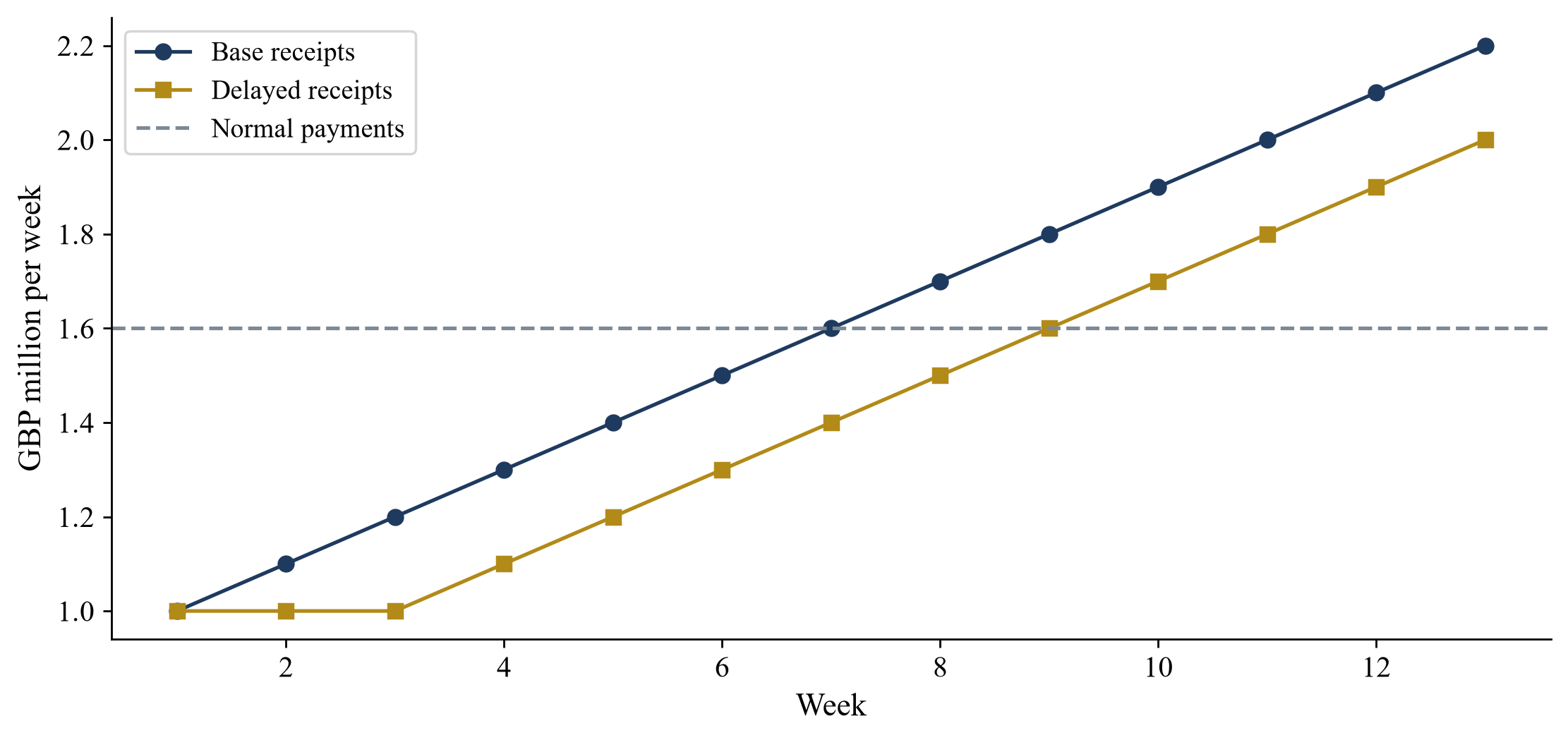
The numerical example uses GBP millions and thirteen weekly periods after completion. Opening unrestricted operating cash is 0.25. A common mobilisation cost of 0.08 is paid at the start in every case. Normal weekly operating payments are 1.60. Base receipts begin at 1.00 and increase by 0.10 each week, reaching 2.20 in week thirteen. These amounts are assumed cash flows, not revenues or profitability measures.
Additional capital expenditure is 0.50 in week one, 0.30 in week four and 0.20 in week six. Assumed restructuring cash is 0.40 in week two and 0.30 in week five. The categories are distinct from normal operating payments. The example assumes their timing and legal permissibility solely for calculation. It contains no claim that such payments are authorised for any actual acquisition.
The minimum cash reserve is 0.25 at the start and at every weekly close. New equity is injected at the start and remains in the operating business throughout the example. There are no dividends or equity withdrawals. The exercise solves for the smallest opening equity injection that meets the reserve and financing constraints under these conventions.
The horizon and weekly timing are limitations. A payment due before a receipt on the same day could create an intraday shortfall even when the weekly close is adequate. The example also excludes taxes outside normal payments, transaction-specific claims and financing charges other than the stated interest. It is a teaching model that an actual transaction team would need to replace with a more complete cash calendar.
Table 2. Hypothetical operating cash inputs
| Item | GBP million | Timing |
|---|---|---|
| Opening cash | 0.25 | Before week 1 |
| Common mobilisation | 0.08 | At start |
| Base receipts | 1.00 to 2.20 | Increase 0.10 weekly |
| Normal payments | 1.60 | Every week |
| Capital expenditure | 0.50 / 0.30 / 0.20 | Weeks 1 / 4 / 6 |
| Restructuring | 0.40 / 0.30 | Weeks 2 / 5 |
| Cash reserve | 0.25 | Opening and weekly close |
Author-designed assumptions; additional transaction-specific cash flows and intraday timing are excluded.
9. Specify the hypothetical facility
The model assumes a revolving commitment of 2.00, available throughout the horizon. The permitted weekly debt balance is the smaller of that commitment and 75% of assumed eligible receivables plus 50% of assumed eligible inventory, less a reserve of 0.15. Eligible inventory is fixed at 0.60. All of these are author assumptions. No lender is represented as offering this facility.
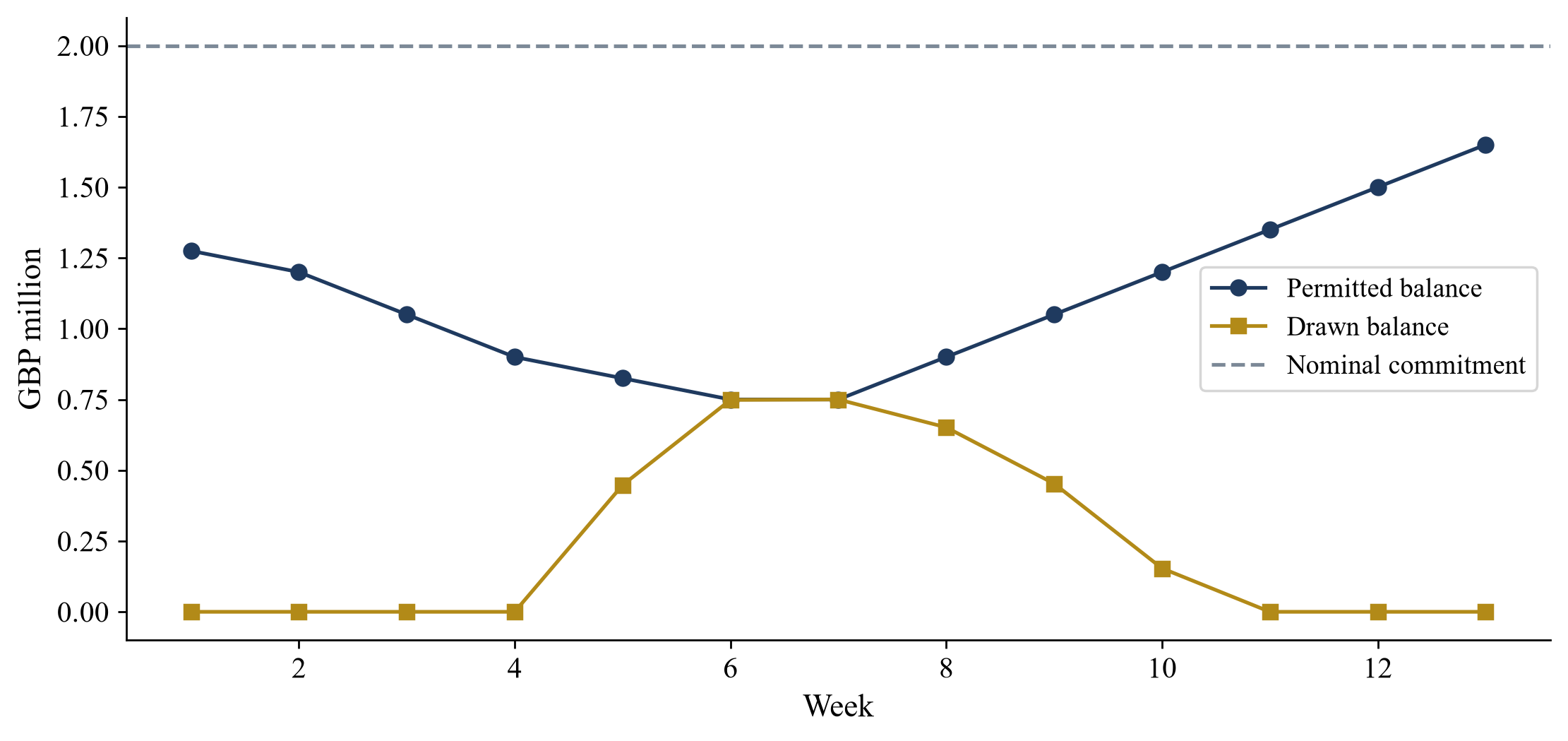
The receivables inputs for weeks one through thirteen are 1.50, 1.40, 1.20, 1.00, 0.90, 0.80, 0.80, 1.00, 1.20, 1.40, 1.60, 1.80 and 2.00. They are a separate eligibility path, not a complete balance-sheet roll-forward. The resulting permitted debt balance begins at 1.275, falls to 0.750 in weeks six and seven and reaches 1.650 in week thirteen.
Interest is assumed at 0.2% per week on opening debt and paid during that week. This is a calculation convention, not a quoted market rate. Initial debt is zero. After operating cash flows and interest, the model repays any amount above the current borrowing limit, draws available credit if needed to reach the cash reserve, and uses surplus cash to repay outstanding debt.
The order of operations matters. Draws are limited by remaining capacity, and repayments reduce both cash and debt. The equity solver checks every weekly close and the opening position. It does not permit a later surplus to offset an earlier reserve breach. An actual facility could use different sweep, interest, reporting and cure mechanics; those terms must replace these conventions before the model supports execution.
Author inputs; capex, restructuring, mobilisation and interest are additional to the normal payments shown.
10. Interpret the base funding requirement
Under the base assumptions, the minimum opening equity injection is approximately 3.1324. Peak revolving debt is 0.7500, and total modelled interest is approximately 0.0064. The business ends week thirteen with cash of approximately 1.5960 and no drawn debt. Those results follow from the assumed receipts, payments and facility mechanics.
The ending cash balance should be interpreted alongside the earlier constraint. Equity is required before the temporary operating deficit and one-time payments reach their maximum cumulative effect. Later receipts repay the revolving debt and rebuild cash. The final balance therefore does not establish that the initial equity injection was excessive at the time it was needed.
The 2.00 commitment is larger than the amount drawn. In this example, the borrowing base constrains debt around the funding trough. Treating the entire commitment as available would understate the equity needed. The relevant contribution of the facility is determined by its usable capacity at the binding dates, together with its interest and repayment effects.
The model verifies the result by reducing opening equity by 0.001 and checking that at least one reserve test then fails. It also reconciles ending cash to opening cash, equity, operating flows, one-time payments, interest and ending debt. These are arithmetic controls. They validate the calculation under its assumptions and provide no evidence that the assumed operating recovery or financing terms can be achieved.
Author calculation with minimum opening equity and stated collateral, interest and sweep assumptions.
Table 3. Base-case weekly funding checks
| Week | Cash | Drawn debt | Debt limit |
|---|---|---|---|
| 1 | 2.2024 | 0.0000 | 1.2750 |
| 2 | 1.3024 | 0.0000 | 1.2000 |
| 3 | 0.9024 | 0.0000 | 1.0500 |
| 4 | 0.3024 | 0.0000 | 0.9000 |
| 5 | 0.2500 | 0.4476 | 0.8250 |
| 6 | 0.2500 | 0.7485 | 0.7500 |
| 7 | 0.2500 | 0.7500 | 0.7500 |
| 8 | 0.2500 | 0.6515 | 0.9000 |
| 9 | 0.2500 | 0.4528 | 1.0500 |
| 10 | 0.2500 | 0.1537 | 1.2000 |
| 11 | 0.4960 | 0.0000 | 1.3500 |
| 12 | 0.9960 | 0.0000 | 1.5000 |
| 13 | 1.5960 | 0.0000 | 1.6500 |
GBP million; rounded display. Solver retains unrounded values. Weekly checks do not test intraday cash.
11. Test a two-week delay in receipts
The delayed case shifts the receipt sequence two weeks later. Weeks one, two and three each receive 1.00, followed by the original increasing path, so week thirteen receives 2.00. Normal payments, capital expenditure, restructuring payments and collateral eligibility stay unchanged. This isolates a receipt-timing sensitivity while holding other assumptions fixed.
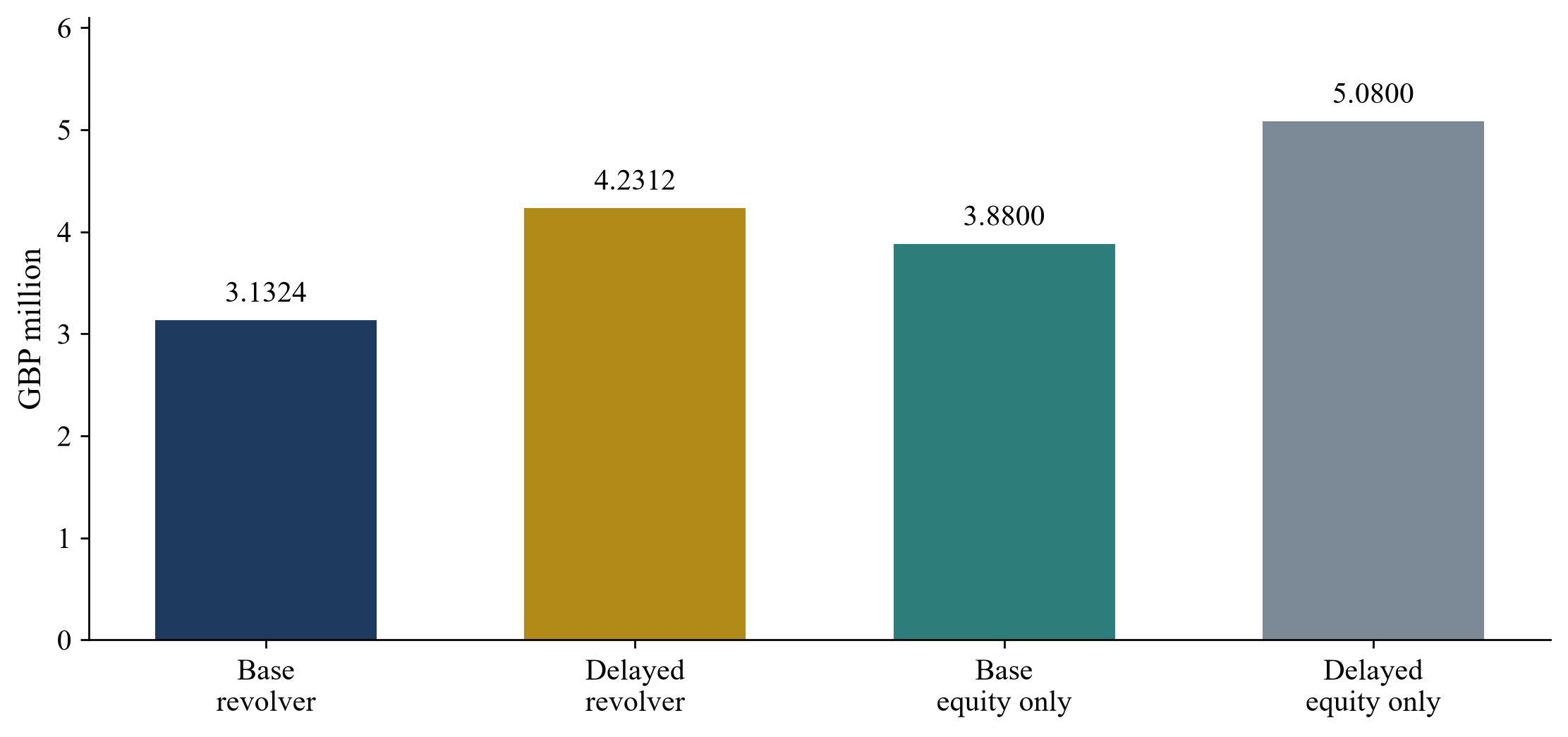
The required opening equity rises to approximately 4.2312, an increase of about 1.0988 over the base case. Peak revolving debt is approximately 0.8532, total interest approximately 0.0092, and ending cash approximately 0.3920. Debt is fully repaid by the final week under the assumed sequence. The delayed case therefore requires materially more equity despite ending with positive cash and no revolving balance.
The shift is deliberately simplified. Receipts that would arrive after week thirteen are outside the calculation. The model does not construct an invoice-level receivables roll-forward, and collateral eligibility does not respond to the delay. An actual collection problem could change eligibility, reserves and customer behaviour as well as cash timing. This example quantifies one sensitivity without claiming to capture those interactions.
For a transaction decision, the next question is what evidence supports the base timing. Identify receipts that depend on acceptance, dispute resolution or a milestone beyond management's control. A proposed contingency should correspond to those dependencies. The model can then compare explicitly defined delays and their funding consequences rather than use an unexplained percentage haircut across all customer cash.
12. Compare the all-equity alternatives
The comparison cases remove revolving availability while retaining the same operating assumptions and common mobilisation cost. The base all-equity case requires 3.8800 of opening equity. The delayed all-equity case requires 5.0800. Neither incurs the model's revolving interest, and both finish with more cash than their corresponding borrowing cases because equity is not swept out during recovery.
The facility reduces required opening equity by approximately 0.7476 in the base case and 0.8488 in the delayed case. These amounts differ from the headline commitment. They reflect the timing of usable capacity and interest under the assumed sweep rule. They also differ slightly from peak debt because interest consumes cash while the facility is drawn.
This comparison is a funding calculation rather than a recommendation to maximise debt. The model excludes commitment fees, legal costs specific to the facility, covenant consequences, refinancing risk and the economic cost of equity. A complete financing comparison would include those items and the actual alternatives available to the buyer. The common 0.08 cost is held constant solely to isolate this model's financing mechanism.
Availability must be tested independently of attractiveness. If the assumed facility has no executable commitment, the all-equity case may be a relevant funding scenario. That observation does not establish that equity is obtainable either. Both sources need evidence, approvals and a timetable. The investment committee should see the consequences of each source being absent before it approves a price that consumes the remaining funding capacity.
Table 4. Hypothetical financing comparison
| Case | Opening equity | Peak debt |
|---|---|---|
| Base with revolver | 3.1324 | 0.7500 |
| Delayed with revolver | 4.2312 | 0.8532 |
| Base equity only | 3.8800 | 0.0000 |
| Delayed equity only | 5.0800 | 0.0000 |
GBP million; common mobilisation cost included in all cases; no actual financing availability is implied.
Author calculations; the receipt-delay case holds collateral assumptions fixed and omits receipts beyond week thirteen.
13. Connect rescue funding to the bid budget
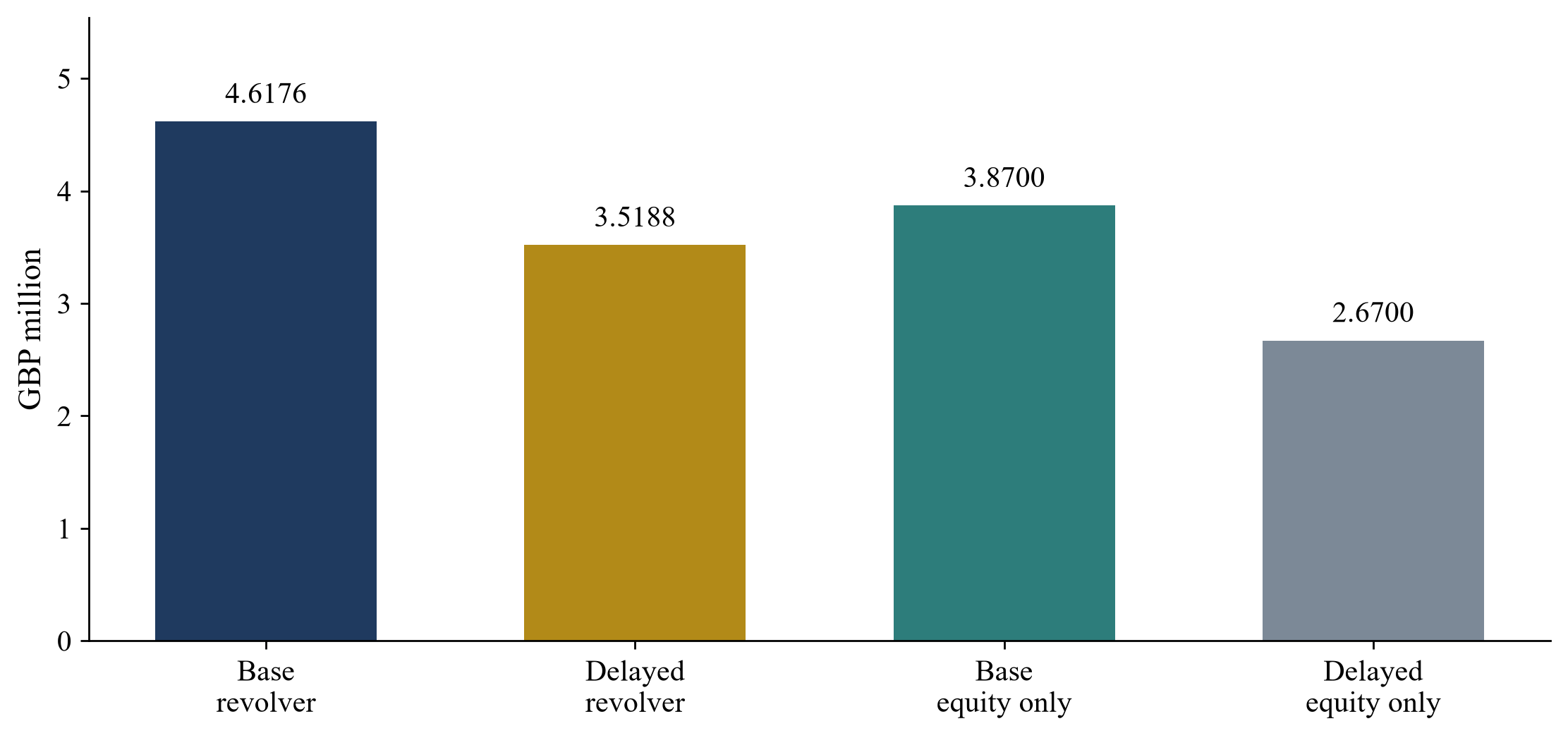
Assume, solely for a further illustration, that the buyer has an 8.00 equity budget for consideration, transaction costs and the opening stabilisation injection. Transaction costs at the acquisition vehicle are 0.25, separate from the operating mobilisation cost already included in the cash model. No acquisition term debt or additional equity is assumed. The budget-constrained amount available for consideration is 8.00 less 0.25 less the required operating injection.
This produces approximately 4.6176 in the base revolving case and 3.5188 in the delayed revolving case. The all-equity operating cases leave 3.8700 and 2.6700 respectively. These are budget ceilings under specified assumptions. They are not estimates of enterprise value, fair value, an appropriate offer or a seller's willingness to transact.
A buyer should separately assess the value of the acquired business and the risk of delivering its plan. A budget calculation cannot establish investment merit. It can, however, reveal that a proposed consideration would leave insufficient capacity for the adopted downside. The committee can then reconsider price, scope, funding sources, conditions or the transaction itself using explicit evidence.
Avoid adding peak revolving debt to the acquisition budget as if it were free consideration funding. In this model it is reserved for operating liquidity and repaid by the business. Any proposal to use it for another purpose requires a new sources-and-uses analysis and the relevant lender permissions. The same unit of borrowing capacity cannot fund both the purchase and the recovery at the same time without affecting the forecast.
Assumed 8.00 equity budget less 0.25 acquisition costs and the operating injection. These are budget ceilings, not valuations.
14. Design milestones that govern cash releases
The proposed financing plan should connect material cash uses to observable operating milestones. A repair payment might depend on a verified supplier commitment and access to the site. A systems migration payment might depend on an agreed test and lawful access. The purpose is to identify what evidence supports the spending and what receipt or capability depends on it.
Milestones should reflect the actual sequence. If expenditure must occur before a customer acceptance test, making funding conditional on that acceptance creates a circular plan. The team should identify the earlier financing required and the later evidence that permits subsequent spending. Where a milestone is uncertain, the downside should include both the delay and any costs that continue during it.
Use care with staged equity. A promised future injection can be modelled as available only under its stated commitment, conditions and timing. If it requires a new investment decision, record that uncertainty. A staged structure may conserve initially deployed capital, but it introduces another date at which funding must be executable. The paper's all-at-start assumption avoids that dependency solely for analytical clarity.
The investment record should state who may approve changes in timing and amount. A delay in a non-critical project can be reviewed through its operating consequence. A mandatory payment or safety-critical repair requires the relevant professional authority. The financial model should describe the consequences of decisions; it should not silently substitute for legal, operational or safety approval.
15. Reconcile supplier support with working capital
Supplier discussions should establish which terms will apply to the acquired business and when they become effective. A forecast that assumes continued historical credit requires evidence that those terms remain usable. Proposed deposits, cash-on-delivery payments and settlement of old amounts should appear separately, with their contractual basis reviewed by the appropriate advisers.
For a supplier-finance proposal, trace the entire payment chain. Identify who pays the supplier, when the buyer pays the finance provider, the applicable charges and any event that accelerates payment. A change in presentation or counterparty does not by itself establish that the business has more cash across the full horizon. The schedule must capture both the initial timing benefit and subsequent settlement.
Avoid financing inventory twice. If a supplier-supported purchase contributes to collateral, the borrowing-base assessment must reflect the actual ownership, security and agreement terms. The paper does not determine that legal treatment. It proposes a joint review by procurement, finance, counsel and the lender so the cash model and availability calculation use consistent assumptions.
Supplier support may also depend on operating evidence. A supplier could require a revised order, payment authority or confirmation of the contracting entity. These are matters for verification rather than assumptions about universal practice. Record the evidence obtained, unresolved terms and fallback cash requirement. The result should let the buyer see how the funding need changes if proposed support is not agreed by completion.
16. Match capital expenditure to cash generation
The acquisition team should distinguish spending needed to preserve current operations from discretionary expansion. For each material project, identify the asset condition, technical recommendation, contractual commitment and payment profile. Link the proposed outflow to the operational capability it supports. A generic capex allowance can remain as a sensitivity where evidence is incomplete, with that limitation visible.
A deferral scenario must carry its consequences into receipts and costs. If equipment cannot operate until a repair is completed, moving the repair payment later while keeping production unchanged would misstate the scenario. Technical management should establish the relevant dependency. Finance can then model the dates and cash effects without inventing the engineering conclusion.
Consider progress payments, installation, testing and commissioning as separate events where they are relevant. A financing advance tied to delivery may arrive after a deposit must be paid. The funding calendar needs to identify that gap. The same applies where a customer milestone receipt follows acceptance rather than the purchase or arrival of equipment.
The hypothetical model treats capex as three fixed outflows and does not estimate the return on those projects. A transaction-specific extension should compare the cash consequences of feasible technical options, including downtime and implementation risk. It should also identify which choices are unavailable because of safety, regulatory or contractual requirements. A lower cash requirement alone does not establish that an option is executable or appropriate.
17. Use data tools to improve reconciliation
The proposed role for data tools is to make forecast inputs traceable. A controlled workflow can organise bank transactions, ledger balances, payment schedules and evidence links for human review. A candidate match between an invoice and a receipt should retain its basis and unresolved exceptions. The paper makes no accuracy claim for any software or model.
AI-generated extraction requires source checks before it changes a material cash assumption. A payment term can depend on a clause elsewhere in a contract, and a date in correspondence may be provisional. Retain the original document, the extracted field and the reviewer decision. Do not treat a fluent summary as confirmation that a financing condition has been satisfied.
Forecast assistance should be evaluated against the decision it supports. A tool that explains historical variance has a different evidential burden from one used to predict a receipt date. Establish the relevant test data, error measures and handling of unusual events before relying on a prediction. The numerical examples in this paper use explicit deterministic assumptions and do not claim machine-learning validation.
Access should follow the permissions of the transaction. Banking records, employee payments and confidential contracts need appropriate controls. The analytical benefit of combining data does not itself authorise that combination or external disclosure. Material funding decisions should remain with the accountable transaction team, supported by a reviewable record of inputs, changes and approvals.
18. Check cash inside the weekly period
A weekly closing test can be useful for planning while remaining insufficient for payment execution. Consider a separate hypothetical day that begins with 0.25 of cash, pays 0.40 in the morning and receives 0.50 in the afternoon. The day's net movement is positive 0.10, giving an apparent closing balance of 0.35. Before the receipt arrives, however, the scheduled payments would take cash to negative 0.15.
Under an assumed requirement to maintain 0.25 throughout that day, an additional 0.40 would need to be available before the morning payment. A later receipt cannot cure the earlier inability to pay at the required time. These amounts are a separate timing illustration and should not be added mechanically to the thirteen-week example, which has no intraday data.
An actual funding calendar should identify the largest payment clusters and their cut-off times. Payroll files, settlement transfers and foreign-currency payments can be scheduled separately where necessary. Treasury should confirm the relevant banking arrangements. The model should not assume that a receipt at one institution or entity is immediately usable for a payment elsewhere.
The analytical response is to increase time resolution around binding dates. A daily or event-based schedule may be needed near completion and large payment days, while later periods remain weekly. Preserve a reconciliation between the schedules so that higher-frequency detail does not introduce duplicate receipts or payments. The resulting bridge should show which additional liquidity requirement comes from timing within the period.
19. Choose and explain the reserve
The example's 0.25 minimum cash reserve is an author input. It is not a recommended level for an acquisition of any particular size. A transaction reserve should have an explicit purpose, such as covering a defined payment timing risk or allowing time to respond to a documented forecast variance. Record how its amount relates to those obligations and the available response period.
Avoid counting the same downside in both operating cash and a separate contingency without explanation. If a delayed receipt is already moved in the forecast, an additional reserve for that identical delay may duplicate the assumption. A reserve can cover different uncertainty, but the distinction should be visible. The team should be able to explain each layer of protection without relying on labels alone.
A lender's availability reserve and management's cash reserve also serve different roles. The first can reduce what may be borrowed under the agreement; the second is cash the plan seeks to retain. The numerical example includes both a 0.15 deduction in the borrowing-base formula and a 0.25 minimum cash balance. Neither is a substitute for the other in its arithmetic.
Reserve sensitivity should be reported alongside the operating cases. It can show the effect of a stricter liquidity policy on required equity, but it cannot establish that the chosen policy is sufficient for unmodelled risks. The investment committee should approve the reserve's purpose, supporting evidence and escalation process. Any later reduction should be recorded as an explicit change in the adopted funding assumptions.
20. Combine stresses only when their relationship is stated
The receipt-delay example varies one mechanism. A further transaction analysis could combine slower collection with lower collateral eligibility, accelerated supplier payments or additional repair costs. Each combination should state its rationale. A severe case can be a useful resilience test without being presented as a statistically likely outcome.
Avoid describing an arbitrary bundle as a particular confidence level. Assigning a probability requires evidence and a model appropriate to the risks. The deterministic cases here contain no such calibration. They show the resources required if the specified sequence occurs, with no claim about how often it would occur or whether it is the worst possible sequence.
Dependencies should be represented consistently. If a production delay causes both deferred collection and a change in inventory, those cash and collateral effects should arise from the same operating event. Applying independent percentage shocks can obscure that connection or count it twice. A reviewer should be able to reconstruct the event sequence from the operating assumption through payment, receipt and borrowing availability.
Use a reverse test where helpful: identify the earliest combination that breaches the adopted reserve or commitment and ask what evidence would make that combination relevant. This is a proposed decision technique, not a validated forecasting method. It can focus diligence on the receipt, cost or financing condition that has the greatest effect on the transaction's ability to meet its dated obligations.
Table 5. Proposed stabilisation controls
| Risk | Evidence | Response |
|---|---|---|
| Receipt delayed | Customer and delivery records | Update cash timing |
| Capacity unavailable | Facility terms and conditions | Confirm fallback |
| Collateral reduced | Current eligibility support | Recalculate limit |
| Payment brought forward | Agreed obligation and date | Fund earlier need |
| Reserve threatened | Reconciled cash schedule | Escalate before breach |
Proposed review framework; transaction-specific authority and actions must be established.
21. Monitor the recovery after completion
At each forecast update, reconcile bank cash, outstanding debt and collateral evidence to the model's opening position. Separate timing variances from changes in amount. A receipt that moves one week later has a different implication from a permanently reduced collection, even if both create the same immediate cash shortfall. The response should follow the identified cause.
Track the remaining amount available under each source, including any conditions that have changed. An unused nominal commitment can remain unusable if an agreed requirement has not been met. The reporting pack should identify the unresolved item, the person responsible for resolving it and the next date on which it affects payments. Do not mark it resolved on the basis of an expected future approval.
Connect spending approval to the updated operating plan. A cost overrun may reflect a newly discovered obligation or an optional change in scope. Both require an explanation, while their approval routes can differ. Retain the original forecast and the decision authorising the change so that the effect on rescue capital and the acquisition economics remains traceable.
The monitoring process should have an escalation trigger before available funds fall below the adopted threshold. The paper does not prescribe a universal trigger. It proposes defining one from the actual payment calendar, response time and committed sources. The report should show the action required and available authority, rather than rely on a colour rating without an executable response.
22. Test the financing exit separately
The teaching cases repay revolving debt within thirteen weeks because of their specified receipt paths. That outcome does not demonstrate that an acquired business can refinance other debt, fund future investment or sustain its operations. The initial liquidity horizon should connect to a longer model that reflects the actual maturity profile and continuing business requirements.
For each proposed refinancing source, record its status and conditions. A future facility that depends on a recovery milestone remains conditional until the relevant requirements are satisfied. The downside should show the consequences of delay or absence. An assumed refinancing receipt should not be used to erase a maturity without an accompanying assessment of its evidence and fallback.
The source of debt repayment should also remain explicit. Conversion of operating assets, recurring free cash generation, an asset sale and a new financing each require different supporting evidence. If an asset sale reduces the operating capacity represented in the forecast, adjust the related receipts and costs. The model should not preserve the full business case after selling an asset required to deliver it.
The purchase decision should therefore consider both initial funding and the next material capital event. Record what must be achieved before that event, the information that will be available and who can commit additional capital if required. This extends the stabilisation analysis into a financing plan without claiming that a positive short-term closing balance establishes long-term viability.
23. Limitations and the next stage of analysis
The model is intentionally narrower than an executable financing plan. Its weekly timing can miss earlier shortfalls within a period. It assumes the revolving commitment remains available, uses a simplified collateral path and omits many transaction-specific fees, claims and taxes. It also assumes all required equity arrives at the start. None of those assumptions has empirical calibration.
The receipt-delay case holds collateral eligibility fixed and omits receipts outside the horizon. It demonstrates the funding sensitivity of a specified cash sequence rather than a complete accounting forecast. A fuller model should reconcile opening receivables, billings, receipts, write-offs and eligibility changes. It should also test joint adverse movements where the transaction evidence supports them.
Further analysis should extend beyond the initial horizon to refinancing, maintenance investment and the durability of operating recovery. Repayment of the modelled revolver by week thirteen does not establish long-term viability. The buyer needs evidence that the business can meet continuing obligations under the adopted capital structure, together with a plan for material uncertainties.
The proposed decision discipline is to reserve funding for the stabilisation curve before committing the residual budget to consideration. Establish the cash uses, test accessible sources at the dates they are needed, and reconcile the downside to the bid. Keep the distinction between a calculated budget and an investment valuation explicit. That connection allows the acquisition team to discuss price and recovery funding within one reviewable transaction plan.
References
- United States Code. Title 11, section 364, Obtaining credit. Statutory subsections reviewed 5 September 2026. https://www.law.cornell.edu/uscode/text/11/364
- United States Courts. Chapter 11 Bankruptcy Basics, Cash Collateral, Adequate Protection, and Operating Capital. Accessed 5 September 2026. https://www.uscourts.gov/court-programs/bankruptcy/bankruptcy-basics/chapter-11-bankruptcy-basics
- Office of the Comptroller of the Currency. Comptroller's Handbook, Asset-Based Lending, Version 1.1. Establishing and monitoring the borrowing base, printed pages 15 and 27. https://www.occ.treas.gov/publications-and-resources/publications/comptrollers-handbook/files/asset-based-lending/pub-ch-asset-based-lending.pdf
- IFRS Foundation. IAS 7 Statement of Cash Flows, standard overview. Accessed 5 September 2026. https://www.ifrs.org/issued-standards/list-of-standards/ias-7-statement-of-cash-flows/
- UNCITRAL. Legislative Guide on Secured Transactions, Terminology and Recommendations. Chapter XII, reproduced insolvency recommendations on post-commencement finance, printed pages 96-97. https://uncitral.un.org/sites/uncitral.un.org/files/media-documents/uncitral/en/terminology-and-recs.18-1-10.pdf
