

1. INTRODUCTION
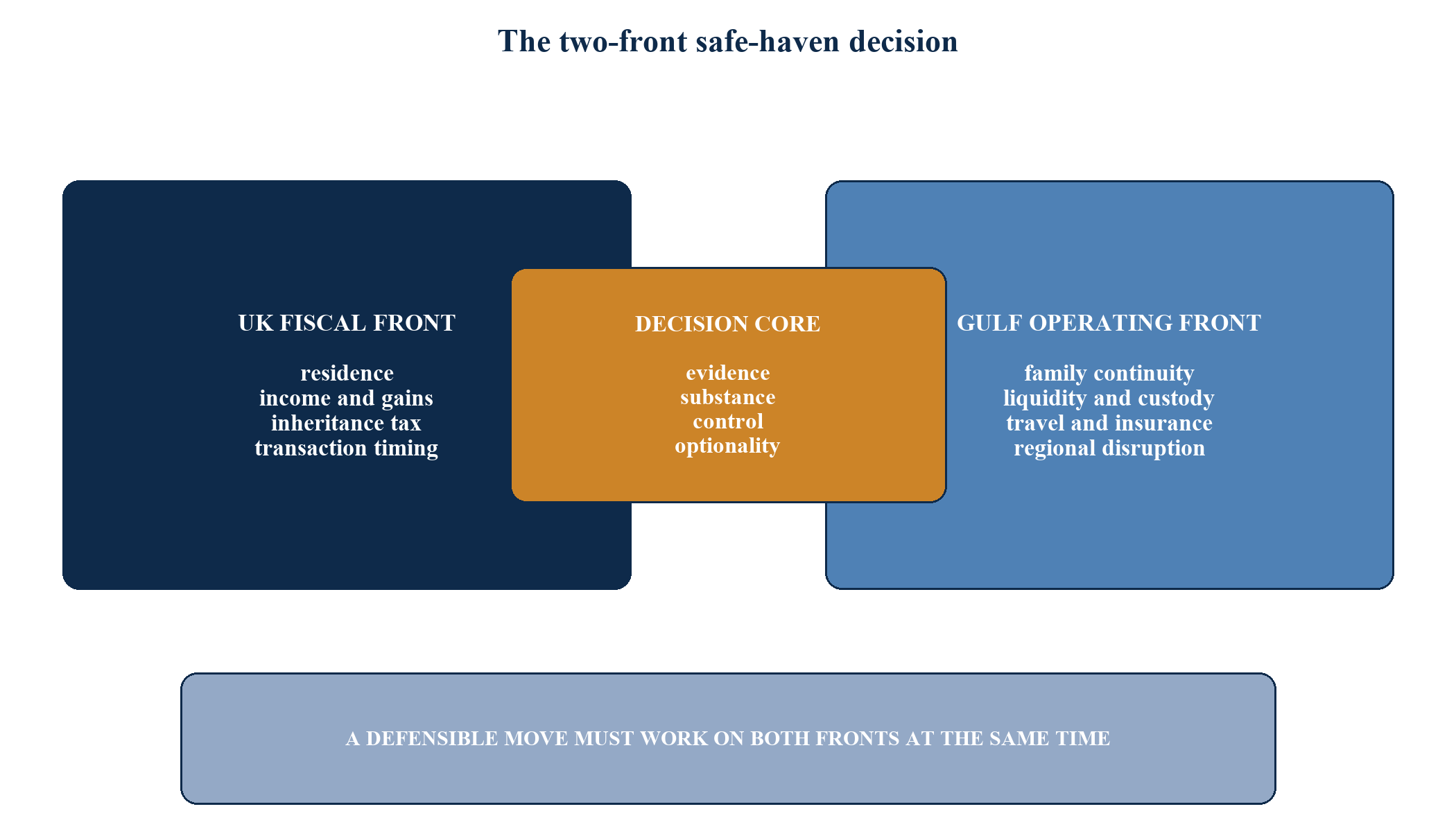
A safe haven is useful only when it protects the risks that matter to the family. A jurisdiction can offer favourable personal-tax conditions and still expose the family to weak execution, concentrated custody, travel interruption, banking friction or an avoidable return-to-UK charge. The opposite is also true. A family can remain in a familiar legal and operating environment while accepting a tax, succession or transaction outcome that no longer fits its objectives. The UK-to-UAE decision therefore requires two independent tests: a fiscal-residence test and an operating-resilience test.
The UK framework changed materially from 6 April 2025. The four-year foreign income and gains regime replaced the former remittance basis. UK residents are generally taxed on worldwide income and gains on the arising basis, subject to available claims and reliefs [3]. Inheritance Tax moved from a domicile-led framework to a long-term residence framework for many purposes. An individual who meets the long-term residence test can remain within the overseas-asset scope for a period after departure [7]. From 6 April 2026, Business Asset Disposal Relief applies at 18 percent to qualifying gains, and the highest rate of Business Relief is capped at GBP 2.5 million of qualifying property, with 50 percent relief generally applying above the allowance [1,2]. A revised carried-interest regime also took effect from 6 April 2026 [4,12].
These measures do not create one universal answer. The tax result depends on residence history, asset class, ownership, transaction date, return pattern, trust history, source of income, business activity and treaty position. A founder preparing a sale has a different decision from a family that intends to hold an operating company for another generation. A fund professional receiving carried interest has a different exposure from an investor living from portfolio income. A family with children, housing and work in Britain can satisfy a different Statutory Residence Test outcome from a principal whose life has moved in substance to the UAE.
The Gulf operating environment also changed during 2026. Official UAE, IMO and multilateral sources recorded attacks on commercial vessels, severe shipping disruption and continuing volatility around the Strait of Hormuz [13-17]. The U.S. Energy Information Administration estimated that 20.9 million barrels per day of oil moved through the Strait in the first half of 2025, equivalent to about 20 percent of global petroleum-liquids consumption and one quarter of maritime-traded oil [18]. IMF statements during 2026 described losses of supply, inventory drawdowns and asymmetric impacts on energy, food and economic activity [19-21]. These facts justify an explicit continuity plan. They do not establish that every UAE resident or investment is unsafe, or that every UK location is safer for every family.
The purpose of this paper is to replace a single-axis relocation question with a controlled decision system. The system asks:
- Which UK tax and reporting exposures change on departure, and which remain?
- What evidence supports UK non-residence and UAE residence?
- Which assets, entities and decisions continue to carry UK source, situs, management or control connections?
- What family, banking, custody and operating capabilities must remain available during regional disruption?
- Which sequence preserves options without creating false certainty?
The analysis uses official sources available through 2 August 2026. It does not calculate a reader's tax liability. It provides a framework for assembling facts, questions and controls before qualified advisers reach a fact-specific conclusion.
| Decision dimension | Core question | Evidence output |
|---|---|---|
| residence | where is the individual resident under domestic rules and any applicable treaty? | day-count record, homes, work, family ties, adviser opinion and certificates |
| tax scope | which income, gains, transfers and assets remain within UK or UAE rules? | asset-by-asset tax map and transaction calendar |
| entity | where are companies, partnerships, funds and trusts managed, controlled and taxed? | governance map, board evidence, permanent-establishment and control analysis |
| succession | how long can worldwide assets remain within UK Inheritance Tax scope? | long-term residence history, asset situs and succession plan |
| operating resilience | can the family and office function through disruption? | liquidity ladder, delegated authority, custody map and tested continuity plan |
| return option | what happens if the principal or family returns? | return triggers, temporary non-residence review and pre-return gate |
2. THE 2025-2026 UK TAX RESET
2.1 The end of the old remittance-basis reference point
From 6 April 2025, the four-year foreign income and gains regime replaced the remittance basis. A qualifying new resident can claim relief on eligible foreign income and gains during the first four years of UK residence after at least ten consecutive tax years of non-UK residence. The claim can affect access to personal allowances and other reliefs, and eligibility must be examined year by year [3].
For a long-standing UK resident considering the UAE, the central point is that the former non-domicile label no longer provides a sufficient description of current exposure. The analysis now begins with tax residence, residence history and the type of income, gain, asset or transfer. A relocation paper should therefore avoid broad statements such as "non-dom tax has ended, so leave". That statement cannot identify the individual result.
The changed framework also affects the return option. A family that later returns to Britain may enter a different regime depending on the duration of non-residence and its prior history. The evidence file should preserve the dates and facts needed to test eligibility at that future point. A return is a new tax event sequence, not a reversal switch.
2.2 Founder disposals and Business Asset Disposal Relief
HMRC states that qualifying gains under Business Asset Disposal Relief are charged at 18 percent for qualifying disposals from 6 April 2026. The rate was 14 percent for disposals from 6 April 2025 to 5 April 2026 [1]. Eligibility contains detailed conditions, including requirements applying to personal companies, employment or office holding, ownership percentages and holding periods. The lifetime limit also matters.
The rate change can influence a founder's planning arithmetic, yet residence and disposal timing require more than a date comparison. A binding contract, completion, anti-forestalling rules, earnout, rollover, share exchange, option exercise, distribution and later return can each produce different questions. A founder should document the commercial reason for the transaction sequence and obtain advice before committing to it.
The paper's decision framework uses four transaction questions:
- What creates the disposal for UK tax purposes?
- On what date does that disposal occur under the relevant rule?
- Is the individual UK resident, treaty resident elsewhere or temporarily non-resident at the relevant time?
- Which asset-specific, company-specific or anti-avoidance provisions remain applicable?
2.3 Business Relief and succession exposure
For deaths on or after 6 April 2026, HMRC states that 100 percent Business Relief is capped at GBP 2.5 million for qualifying business or agricultural property. Qualifying amounts above the allowance can generally receive 50 percent relief. Unused allowance can be transferable between spouses or civil partners, subject to the rules and claims process [2,27].
This change can affect family-business succession, insurance, gifting, trust planning, shareholder agreements and the balance between retaining and selling a company. It does not mean that every business interest qualifies, that the full allowance is available, or that migration removes the exposure. Ownership period, business activity, asset mix, long-term residence and other conditions remain important.
A family-business move plan should therefore include a succession ledger. The ledger records each business interest, ownership, value basis, qualifying status advised by counsel, relief allowance, insurance, liquidity source, shareholder restrictions and intended recipient. It should also record which information is still unresolved. A stated uncertainty is preferable to a false tax estimate.
2.4 Long-term residence and the Inheritance Tax tail
From 6 April 2025, a person is generally a long-term UK resident when resident in the UK for at least ten of the twenty tax years immediately preceding the relevant tax year. HMRC guidance states that a long-term resident who leaves can remain within scope for overseas assets for a minimum of three and a maximum of ten tax years, depending on residence history [7].
This tail is central to the safe-haven paradox. Physical departure, UAE residence and a UAE Tax Residency Certificate do not themselves establish that worldwide assets immediately leave the UK Inheritance Tax net. The family needs a residence-history schedule that covers at least twenty tax years, along with a trust and transfer history. The schedule should be refreshed before a death, lifetime transfer, new trust contribution, major restructuring or return.
2.5 Carried interest and fund professionals
The revised UK carried-interest regime sits wholly within the Income Tax framework from 6 April 2026 [4,12]. A fund professional considering the UAE needs a dedicated workstream because award, vesting, performance, services, fund location, management activity, payments and residence can span several periods and jurisdictions. The location of the investment manager, general partner, carried-interest vehicle and limited partners does not answer the individual's tax position on its own.
This flagship paper does not model the carried-interest rules. It treats them as one example of why role-specific papers are necessary inside the broader Capital in Motion series.
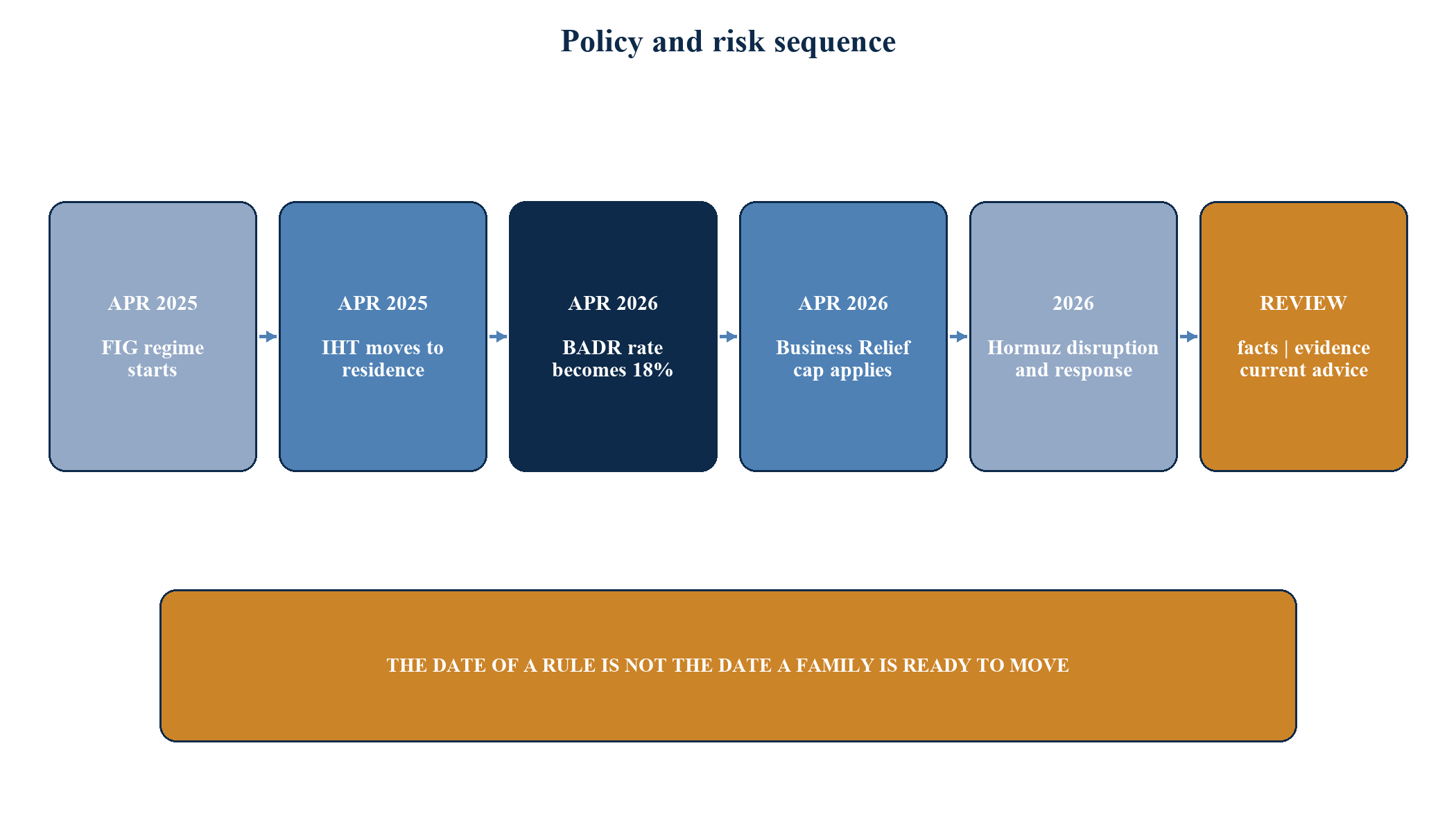
| UK change | Effective point | Decision implication |
|---|---|---|
| four-year foreign income and gains regime | 6 April 2025 | residence history and claims replace the old non-domicile shorthand |
| long-term residence for Inheritance Tax | 6 April 2025 | departure may leave a multi-year worldwide-asset tail |
| Business Asset Disposal Relief at 18 percent | qualifying disposals from 6 April 2026 | transaction timing and eligibility require specific analysis |
| GBP 2.5 million Business Relief allowance | deaths and relevant transfers from 6 April 2026 | succession liquidity and ownership planning need revision |
| revised carried-interest treatment | 6 April 2026 | fund professionals require role, service and payment mapping |
3. THE RESIDENCE ARCHITECTURE
3.1 UK residence begins with the Statutory Residence Test
HMRC's Statutory Residence Test guidance sets out automatic overseas tests, automatic UK tests, the sufficient ties test, split-year treatment and temporary non-residence [5]. A person spending 183 days or more in the UK is UK resident under the first automatic UK test. Other tests can produce UK residence at much lower day counts when homes, work and ties are present. Counting only flights or passport stamps is therefore incomplete.
The sufficient ties analysis can involve family, accommodation, work, prior presence and country ties. A family member's location, a continuously available UK home, workdays and prior UK residence can change the permitted day range. Facts may also change during the year. A defensible process maintains a real-time calendar rather than reconstructing it after the tax year closes.
3.2 Split-year treatment is conditional
UK residence is ordinarily determined for the whole tax year. Split-year treatment may apply when one of the specified cases and all relevant conditions are met [5]. It should not be assumed merely because the individual moved mid-year. The move plan should identify the proposed case, the expected split date, the conditions that must remain satisfied and the consequence if any condition fails.
The control file can contain:
- a dated departure and arrival record;
- UK and overseas home-availability evidence;
- employment contracts and workday records;
- spouse, partner and child location records;
- transaction dates and board decisions;
- travel disruption exceptions considered by advisers;
- a year-end re-performance of the test.
3.3 Temporary non-residence creates a return risk
HMRC guidance states that temporary non-residence can apply when an individual returns after a period of non-residence lasting five years or less and the preceding residence-history conditions are met. Certain income and gains received during the period can be taxed in the year of return [5,6,25]. The period must be longer than five years, not simply five calendar anniversaries, for the special rules not to apply in the example described by HMRC [5].
The practical control is a return gate. Before the principal begins spending substantial time in Britain again, buys or reoccupies a home, accepts a UK role, or changes the family pattern, the advisers should re-run the residence and temporary non-residence analysis. The gate should cover distributions from closely controlled companies, capital gains, offshore income gains, pensions and other categories relevant to the individual.
3.4 UAE domestic tax residence
UAE Cabinet Decision No. 85 of 2022 and Ministerial Decision No. 27 of 2023 provide domestic tax-residence rules. The Ministry of Finance explains that all days or parts of days physically present in the UAE count toward the 183-day or 90-day thresholds. A permanent place of residence need not be owned, but it must be continuously available. The centre of financial and personal interests is assessed through the strength of work, personal, economic and other connections [9].
The Federal Tax Authority's Tax Residency Certificate service sets out evidence by case. For a natural person relying on at least 183 days, relevant evidence can include identity, visa and entry-exit records. For 90 to 182 days, the evidence can include employment or business and a permanent place of residence. A person relying on primary residence and centre of interests must provide a broader factual statement and supporting records [10].
The availability of a certificate is valuable evidence. It does not replace the United Kingdom's domestic residence test, the treaty analysis or fact-specific advice.
3.5 Treaty residence
The UK-UAE Double Taxation Convention defines residence for treaty purposes and provides a sequence for addressing dual-resident individuals. The treaty text refers to a permanent home, centre of vital interests, habitual abode and nationality, followed by competent-authority resolution where necessary [8]. The exact application depends on the facts and the taxes covered.
A domestic UAE certificate and a domestic UK conclusion can therefore sit within a further treaty analysis. A move file should state which question each document answers:
- UK domestic residence;
- UAE domestic residence;
- treaty residence;
- entitlement to a specific treaty benefit;
- administrative evidence requested by a bank, custodian or tax authority.
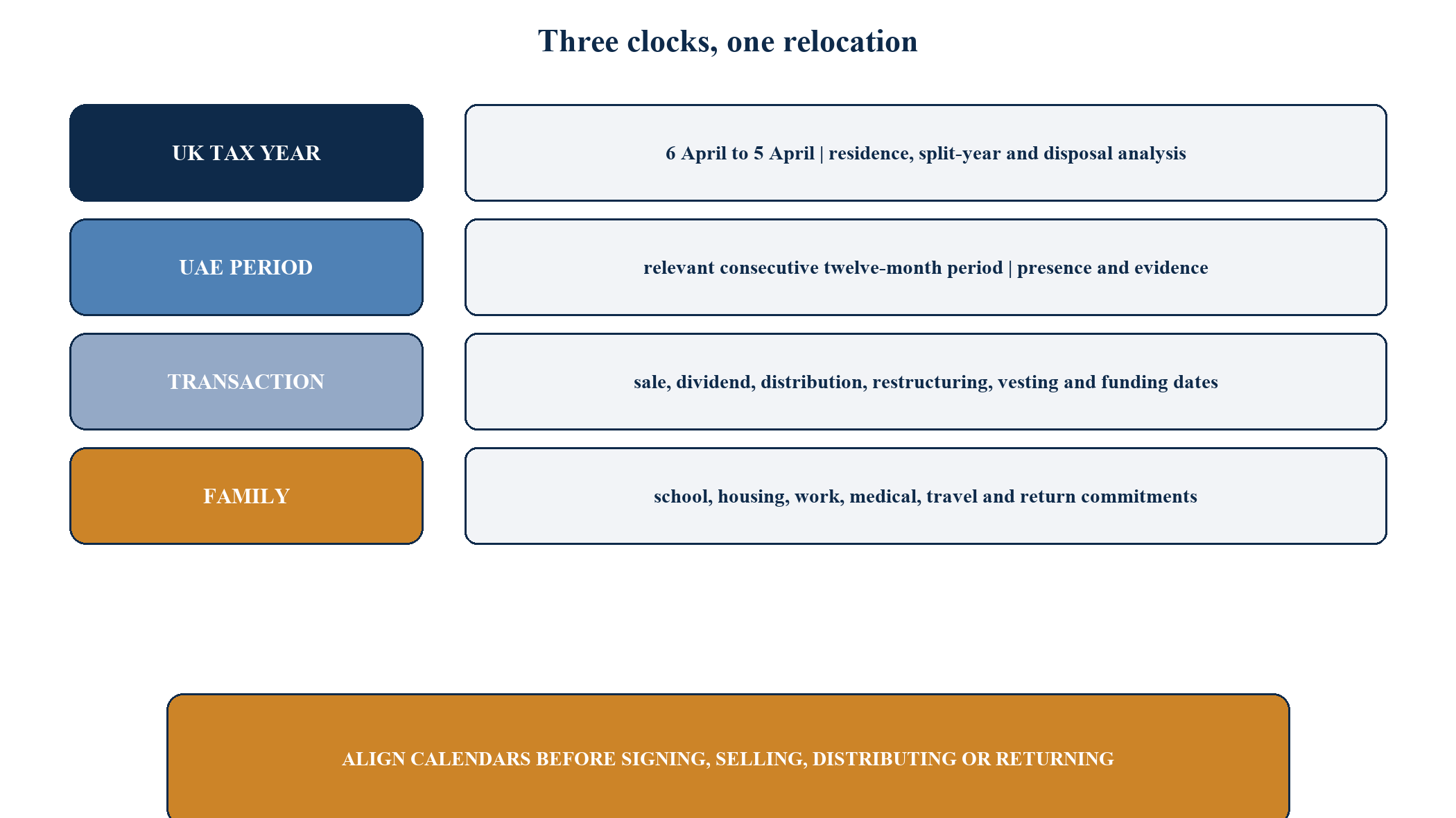
| Clock | Unit | Principal control | Failure mode |
|---|---|---|---|
| UK residence | UK tax year | daily SRT calendar and tie register | assuming one day threshold applies to every person |
| UAE residence | relevant consecutive twelve-month period | entry-exit report, home and work evidence | counting a visa as conclusive tax residence |
| treaty | facts at the relevant time | permanent home and centre-of-interests file | using the certificate without a dual-residence review |
| transaction | legal and commercial event date | signed transaction chronology | relocating after the taxable event has already occurred |
| family | school, housing, work and care commitments | family calendar and authorised exceptions | decisions by one member recreate ties for another |
4. THE ASSET-BY-ASSET MAP
4.1 Residence is one connecting factor
A residence conclusion does not erase source, situs, property, company, trust, pension or permanent-establishment rules. The family should classify each material asset before changing ownership or completing a transaction. The classification exercise begins with legal title and beneficial ownership, then records source, location, income, gain, control, encumbrance and succession route.
The output is a balance-sheet map with one row per asset or liability. It should be prepared before the move because advisers often need historical cost, acquisition date, base cost, valuations, tax elections, trust contributions and transaction records that become harder to assemble later.
4.2 UK land remains a UK workstream
HMRC states that non-residents must report disposals of UK property or land, including cases with no tax to pay, and the regime can cover rights deriving at least 75 percent of their value from UK land [23]. Non-resident owners also continue to face UK income, financing, succession and compliance questions connected with the property.
A principal who retains a London home has two separate questions. The property can create an ongoing UK tax and reporting workstream. Its availability and use can also affect the Statutory Residence Test. Leasing, restricting availability or selling the property may change facts, but each action has its own legal and tax consequences.
4.3 Operating companies
An operating-company interest can generate salary, dividends, benefits, sale proceeds, loans, guarantees, carried value and succession exposure. The company itself may also face residence, management-and-control, permanent-establishment and transfer-pricing questions when executives move. A personal move should not cause corporate decisions to occur casually from a new location.
The governance file should distinguish shareholder activity from director, employee and executive activity. Board meetings, delegated decisions, bank mandates, contract approvals, strategic management and record location should reflect the intended company position and professional advice. A UAE address or entity does not create substance by itself.
4.4 Portfolio and custody assets
Listed securities, private funds, cash, bonds, derivatives and insurance policies need separate income, gain, withholding, treaty, custody and reporting analysis. The operational question is whether the principal can access records and assets during travel or communications disruption without concentrating all authority in one person or one institution.
Automatic exchange of financial-account information also matters. The UAE has Common Reporting Standard rules and guidance [24]. A relocation should be built for accurate reporting and documentation. It should not rely on secrecy or the assumption that a change of address removes disclosure obligations.
4.5 Trusts, foundations and family vehicles
Trust and foundation analysis requires the history of the settlor, additions, trustees or council, protectors, beneficiaries, residence, asset location and powers. UK long-term residence and pre-6 April 2025 history can remain relevant [7]. UAE foundations and companies can support governance and succession objectives when appropriately designed, but the name of the vehicle does not determine every UK or UAE result.
The vehicle register should identify who can appoint and remove decision makers, approve distributions, direct investments, access bank accounts, alter beneficiaries and terminate the structure. These powers matter to governance, tax, banking and operational continuity.
4.6 UAE personal investment and business activity
The UAE Federal Tax Authority distinguishes wages, personal investment income and real-estate investment income from business activity for natural-person Corporate Tax purposes. A natural person conducting business or business activity in the UAE can fall within Corporate Tax when turnover exceeds AED 1 million in the calendar year, subject to the detailed rules [11].
An investor who begins advising companies, charging management fees, running a family-office business or operating a consultancy should test whether the activity remains personal investment or has become a business. Immigration permission, professional licensing, VAT and regulatory status are separate questions.
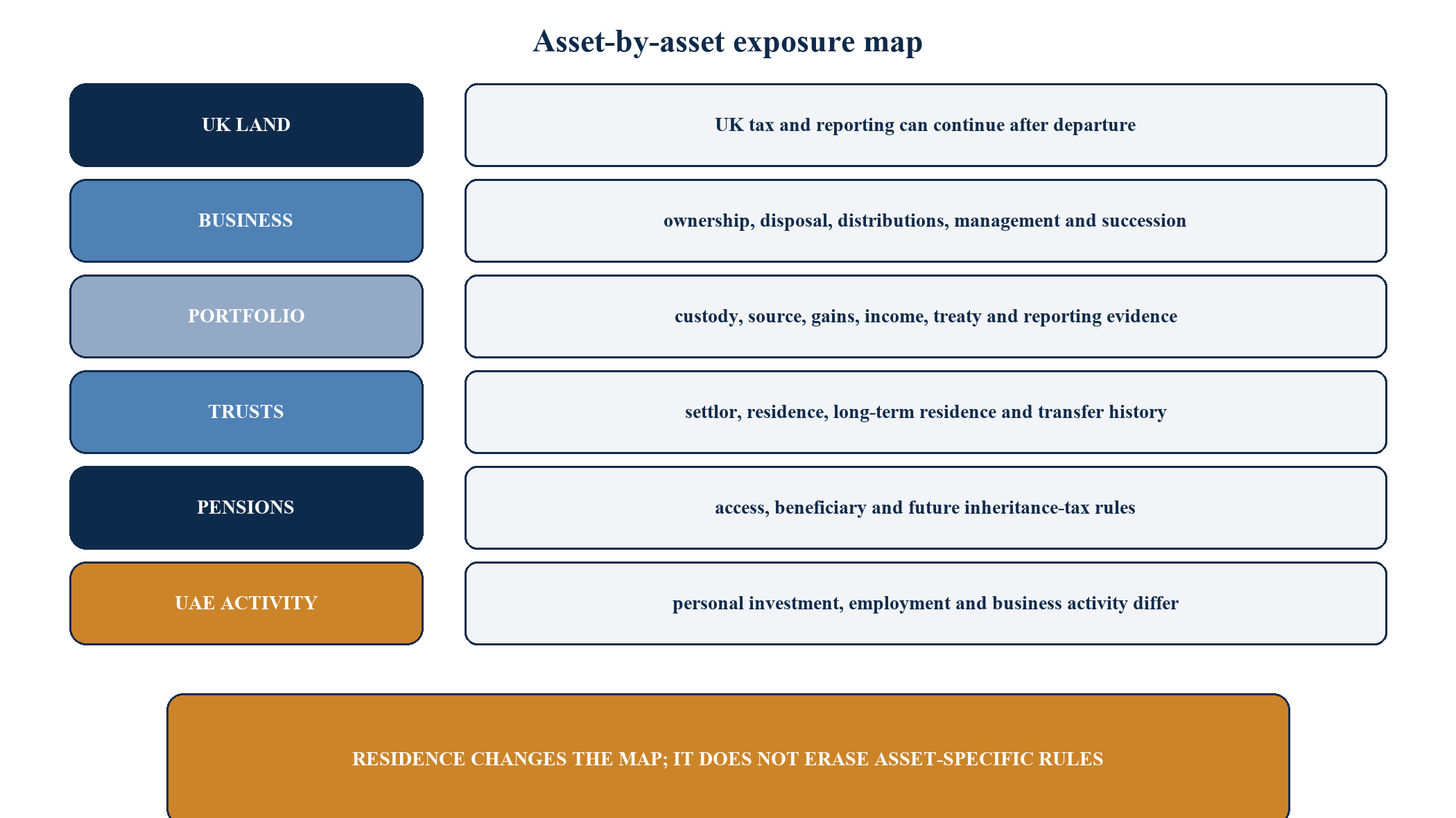
| Asset or activity | UK question | UAE question | Continuity question |
|---|---|---|---|
| UK residence | SRT, split year and temporary non-residence | domestic residence and certificate | evidence quality and calendar ownership |
| UK home | property tax, reporting and SRT availability | funding and remittance records | access, insurance and emergency use |
| operating company | share disposal, distributions, employment and company control | management, licence, entity and business activity | signatories, board quorum and banking |
| investment portfolio | income, gains, treaty and reporting | custody, reporting and personal investment | multi-custodian access and liquidity |
| trust or foundation | settlor, long-term residence, transfer and trust rules | vehicle, council, substance and reporting | protector, alternate and records |
| private fund interests | gains, distributions, carried interest and return | investor or business status | capital calls, currency and custody |
5. SUCCESSION, FAMILY AND THE RETURN OPTION
5.1 Succession begins with liquidity
Tax exposure becomes a family-governance problem when the estate lacks liquid resources, ownership is concentrated in a business, or heirs cannot act quickly. The 2026 Business Relief allowance change increases the importance of current valuations, qualifying-status review, insurance, shareholder agreements and a funded succession plan [2].
The estate liquidity schedule should show expected administration costs, debt, tax, maintenance, school and care needs, company funding requirements and time to realise assets. It should then identify which cash, insurance, credit or disposal route can meet each need. Using the operating company as the only liquidity source can damage the asset the family is trying to preserve.
5.2 One family can have several residence outcomes
Spouses, partners and adult children can have different work, home, day-count and tie patterns. A principal's non-residence does not establish the position of another family member. The family map should be person-specific and should avoid collecting unnecessary personal data outside the controlled adviser process.
Education often creates durable UK connections. The analysis should cover where children live outside term, who provides care, where the family home is available, how often the principal returns and where work occurs during those visits. The aim is accurate facts, not a predetermined conclusion.
5.3 The return option is a designed product
A return option preserves the ability to return to Britain for family, health, business or personal reasons. It requires three layers:
- legal and immigration ability to return;
- a tax and transaction review before residence changes;
- an operating plan for homes, schools, banking, insurance and company roles.
The option has a cost. Retaining a permanently available UK home, frequent workdays and family ties can reduce residence flexibility. Selling every UK asset can increase friction if the family later returns. The correct balance depends on likelihood, cost and consequences rather than a universal rule.
5.4 Pre-return gate
The pre-return gate should be activated before any of the following:
- accepting a UK employment or executive role;
- reoccupying or acquiring a UK home;
- moving a spouse, partner or children to Britain;
- crossing a planned UK day-count threshold;
- receiving a large distribution or selling a material asset;
- making a new trust contribution;
- changing company management or board practice;
- concluding that the temporary non-residence period has ended.
The gate records the intended facts, adviser conclusions, alternative dates and residual risk. It is an approval process, not a memory aid.
5.5 The transaction calendar after departure
Departure can coincide with dividends, share sales, loan repayments, pension access, trust distributions, option exercises, carried-interest receipts and property transactions. These events should be placed on one calendar with the residence conclusion and the legal event date. The calendar should distinguish negotiation, signing, unconditional obligation, completion, payment, vesting, delivery and receipt because different rules can attach to different events.
The calendar should also separate cash timing from tax timing. A payment received after the move can relate to rights, services or a disposal that arose before the move. A transaction signed before departure can complete afterwards. A deferred or contingent amount can be affected by the original disposal rules. The family should retain the executed documents and the advisers' analysis of the relevant event rather than relying on the bank receipt date.
For each event, the transaction register should record:
- legal parties and beneficial owners;
- governing documents and amendments;
- commercial purpose;
- each legally relevant date;
- work and service periods;
- residence and treaty assumptions;
- asset source and situs;
- expected tax filing and payment obligations;
- banking, currency and liquidity path;
- conditions that require renewed advice.
5.6 Family governance during a staged move
A staged move can create a period when family members, homes, companies and assets are divided across jurisdictions. The governance plan should state which decisions remain individual, which require joint approval and which belong to a company, trustee, foundation council or investment committee. Personal preference should not override an entity's legal duties.
The family can use a monthly relocation committee for the first year. Its agenda covers day counts, homes, work, transactions, children and care, evidence, banking, entity activity, succession, continuity tests and pending advice. The committee records decisions and open items without turning private family information into broad corporate records.
| Family decision | Normal owner | Evidence | Escalation trigger |
|---|---|---|---|
| personal travel | individual with tax coordinator | calendar and workday record | planned threshold or unexpected extended stay |
| home availability | property lead and legal adviser | lease, access and occupancy record | acquisition, disposal, renewal or family use change |
| child and care arrangements | parents or guardians | private family calendar | change affecting home or family ties |
| major transaction | legal owner and authorised committee | transaction memo and advice | date, structure, value or residence assumption changes |
| company decision | board or delegated executive | minutes and authority record | reserved matter or management-location concern |
| emergency action | named crisis authority | incident log and later ratification | action beyond normal limit or more than seventy-two hours |
6. THE HORMUZ OPERATING SHOCK
6.1 Official evidence of disruption
A joint statement published by the UAE Ministry of Foreign Affairs on 21 March 2026 condemned attacks on unarmed commercial vessels and described a de facto closure of the Strait of Hormuz [13]. The IMO subsequently reported continuing volatility, threats to seafarers and an absence of reliable security assurances for safe passage in June 2026 [15]. Its Middle East hub recorded evacuations, guidance and incident information during the disruption [17].
At a June 2026 GCC-US ministerial meeting, the UAE highlighted freedom of navigation, regional stability and the need for consultation in de-escalation [14]. These official sources provide a basis for operational stress testing. They do not support precise predictions about the timing or outcome of the conflict.
6.2 Why the Strait matters beyond oil
The EIA describes the Strait as one of the world's most important oil chokepoints and estimates that 20.9 million barrels per day passed through it in the first half of 2025. It also notes that available pipelines can bypass only a portion of the flows [18]. The UAE statement identifies impacts extending to gas, fertilisers, minerals, petrochemicals and essential goods [13].
The family-office transmission channels therefore include:
- energy and transport prices;
- portfolio valuation and volatility;
- insurance coverage and premiums;
- aviation and travel routes;
- banking and settlement operations;
- staff safety and mobility;
- supply chains of operating companies;
- policy and sanctions change.
6.3 Macroeconomic transmission
In May 2026, the heads of the IEA, IMF, World Bank Group and WTO referred to major losses of supply through the Strait, record-paced inventory drawdowns and asymmetric effects on fuel, fertiliser, jobs and livelihoods [19]. The IMF's July 2026 World Economic Outlook Update projected a sharp slowdown in the Middle East and Central Asia during 2026 under assumptions including a longer closure than previously expected [20]. These are macroeconomic assessments, not forecasts for a particular family office or asset.
The operating plan should therefore use scenarios rather than a single forecast. Scenarios can include short disruption, prolonged disruption, partial reopening, renewed escalation and rapid de-escalation. Each scenario should trigger pre-agreed actions rather than ad hoc speculation.
6.4 Location risk and concentration risk
The primary continuity question is often concentration. A family can be exposed because all liquid accounts are at one bank, all signatories are in one location, all records sit on one device, all flights depend on one route, or all advisers require the principal's personal approval. Reducing concentration can improve resilience regardless of which geopolitical scenario occurs.
The framework distinguishes three locations:
- physical location of people;
- legal location of assets and entities;
- operational location of access and decision rights.
These locations can differ. A UAE resident can hold globally custodied assets and maintain authorised alternates outside the region. A UK resident can remain exposed to Gulf operating-company cash flows and shipping. Residence alone is an incomplete risk measure.
6.5 Scenario triggers and observable indicators
A scenario plan works when it identifies observable triggers, the source used to verify them and the action owner. The family office should avoid triggering major actions from rumours, social-media posts or an isolated market movement. Official government, maritime, aviation, bank, insurer and service-provider notices should form the evidence hierarchy.
Possible trigger categories include verified closure or reopening notices, vessel-security guidance, airline route suspension, government travel advice, bank operating restrictions, insurance exclusions, payment-system disruption, office-access restrictions and staff-safety incidents. The trigger should state whether one source is sufficient or whether confirmation from two independent authoritative sources is required.
The action library can then assign a proportionate response:
- move from monitoring to daily committee review;
- increase immediately accessible cash within approved limits;
- defer non-essential travel;
- relocate critical staff or activate remote work;
- move a meeting or signing process;
- activate an alternate payment or custody route;
- increase operating-company inventory or financing review;
- pause discretionary commitments;
- seek current tax or legal advice before a location change.
6.6 Portfolio and company exposure under combined stress
Families often analyse portfolio risk and operating-company risk separately. A regional disruption can affect both through the same energy, transport, insurance, travel and financing channels. The office should therefore aggregate exposures across listed holdings, private funds, direct investments, property, companies, debt and contingent commitments.
The aggregated view should identify first-order and second-order effects. A logistics company can face route disruption directly. A consumer company can face input inflation and weaker demand. A property investment can experience changing occupancy or financing conditions. A global portfolio can be affected through energy prices, interest rates and market volatility even when no asset is located in the Gulf.
The stress test should avoid double counting. A portfolio valuation decline can already reflect lower operating-company cash flows. A higher discount rate and a separate arbitrary valuation haircut can count the same effect twice. Assumptions should be documented at the lowest practical level and reconciled to consolidated liquidity.
| Indicator | Evidence source | Example response | Decision owner |
|---|---|---|---|
| maritime transit restriction | IMO and relevant government notices | shipping and operating-company review | COO and portfolio lead |
| airline route suspension | airline and aviation authority | travel and staff-location plan | family-office COO |
| bank operating restriction | regulated institution notice | alternate payment route | CFO or treasury lead |
| insurance exclusion or notice | insurer or broker confirmation | coverage and activity review | risk lead |
| material portfolio liquidity decline | custodian and manager statements | capital-call and cash ladder review | investment committee |
| official tax or residence change | tax authority and qualified adviser | residence and transaction re-review | principal and tax lead |
7. THE TWO-FRONT DECISION FRAMEWORK
7.1 Frame the decision before scoring it
The framework begins with the objective statement. Examples include establishing the UAE as the family's primary home, moving an investment office, preparing a founder exit, improving succession governance, reducing a specific tax exposure within the law, or building a dual-location operating model. Each objective should have a date, owner, success measure and reason it matters.
The decision is then divided into twelve gates:
| Gate | Question | Required output |
|---|---|---|
| 1 objective | what outcome is the family seeking? | approved objective and non-negotiables |
| 2 residence | what are the UK, UAE and treaty conclusions? | adviser-reviewed residence memo |
| 3 tax scope | which income, gains and transfers are affected? | tax exposure map |
| 4 succession | what remains within the estate and for how long? | succession and liquidity schedule |
| 5 assets | which assets retain UK or other connections? | asset register |
| 6 entities | where are companies and vehicles managed and controlled? | governance and substance map |
| 7 family | can the household facts support the plan? | person-specific family calendar |
| 8 banking | can institutions evidence identity, source and purpose? | onboarding and source-of-wealth file |
| 9 continuity | can the office operate through disruption? | tested continuity plan |
| 10 transaction | does the sequence fit the sale, distribution or funding timetable? | critical-path calendar |
| 11 return | what facts trigger a pre-return review? | return gate |
| 12 implementation | who owns every action and evidence item? | signed ninety-day plan |
7.2 Score readiness, not jurisdictional superiority
A numerical score can create false precision when the inputs are uncertain. The recommended model uses four readiness states:
- Green: verified requirement met and evidence retained;
- Amber: likely achievable, with a named action and deadline;
- Red: material requirement not met or advice indicates unacceptable exposure;
- Open: information or advice is missing.
No overall score should turn a red residence, legal or continuity gate into an approved move. The committee should identify which gates are vetoes and which can be staged after arrival.
7.3 Sequence before optimising
The move sequence matters because tax years, residence periods, transactions, school calendars and regulatory approvals do not share one clock. A typical sequence can include fact gathering, residence advice, housing, immigration, banking, employment or entity setup, transaction review, board changes, travel, evidence capture and year-end confirmation.
The sequence should include decision points where the family can remain, stage, redesign or defer. A reversible step can be taken earlier than an irreversible share transfer or trust contribution. A tax rate should not force a transaction before legal, commercial and family readiness.
7.4 Independent challenge
At least one adviser or committee member should challenge the plan from the opposite direction. If the working assumption is to move, the challenger asks how remaining in Britain could meet the objectives. If the assumption is to stay, the challenger identifies the cost of inaction. The challenge memo should focus on facts and consequences rather than preference.
8. OPERATING RESILIENCE FOR THE FAMILY OFFICE
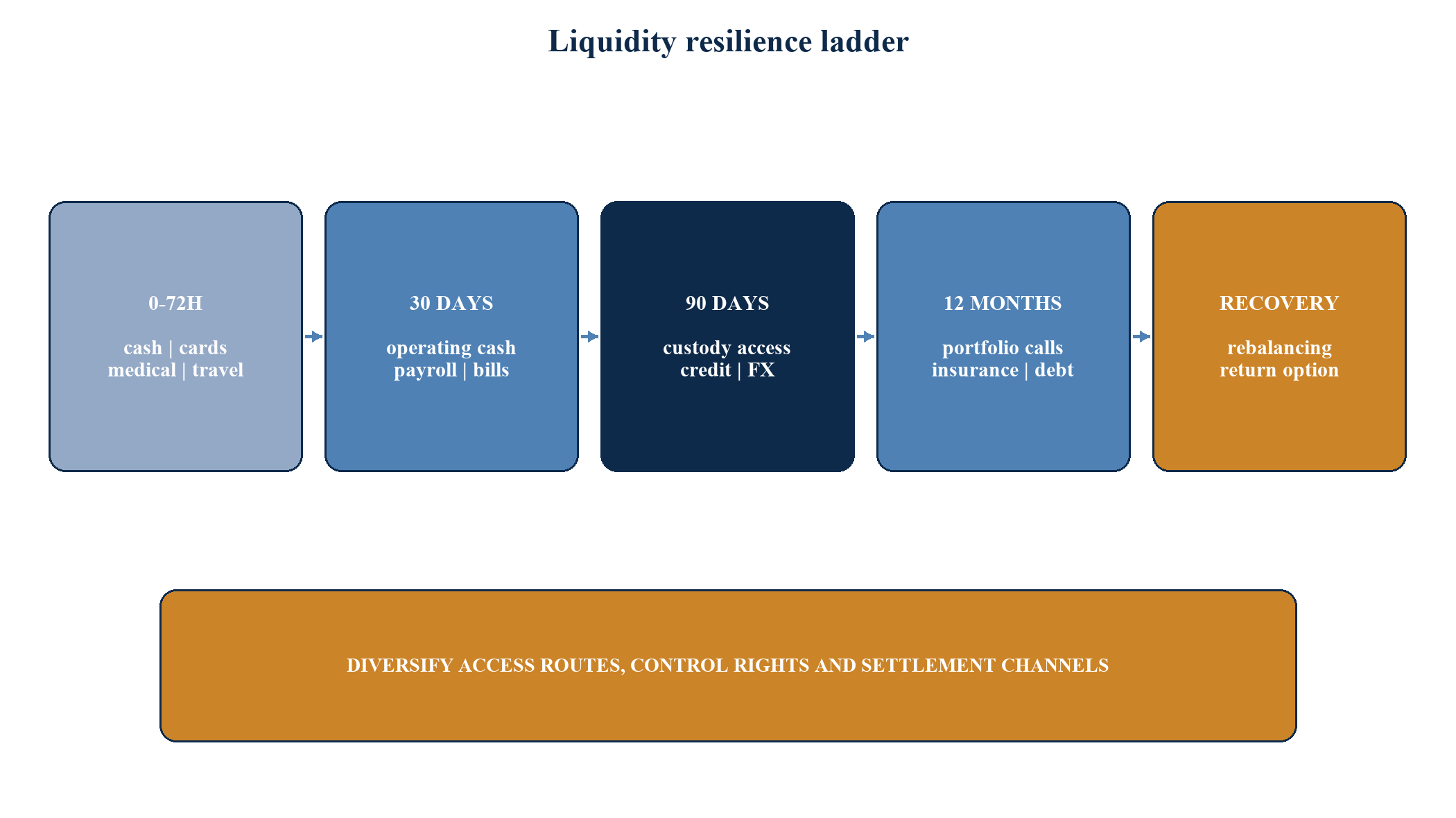
8.1 The first 72 hours
The first layer covers people, immediate cash and decision authority. The office should know the location and contact route for family members and critical staff, while respecting privacy and data-minimisation principles. It should maintain emergency payment capacity, medical and travel information, secure communication alternatives and a current authority matrix.
An effective authority matrix answers who can act when the principal is unavailable, what limits apply, how two-person controls operate, how a decision is logged and when authority expires. Emergency authority should be bounded and reviewed after use.
8.2 Thirty-day operating cash
The office should identify thirty days of payroll, household, debt, insurance, school, healthcare, property and operating-company commitments. Funds should be accessible through more than one tested payment route. The purpose is operational continuity, not an assumption about bank failure.
The cash register should record currency, institution, legal owner, authorised user, daily limit, settlement time, security method and most recent access test. It should also document restrictions on transferring from investment accounts, companies, trusts or regulated vehicles.
8.3 Ninety-day custody and funding access
Private-market capital calls, loan covenants and asset purchases can continue during disruption. The office should maintain a forward obligation calendar and identify which liquid assets can meet each call without a forced sale. Credit lines should be documented by availability conditions, collateral, draw process, currency and material-adverse-change provisions.
Custody resilience includes asset segregation, legal entity, sub-custodian exposure, transfer process, authorised signers, communication channel and recovery records. A second custodian can reduce concentration only if the assets, authority and processes are genuinely usable.
8.4 Twelve-month balance-sheet resilience
A prolonged scenario can affect operating-company earnings, real estate occupancy, borrowing costs, insurance, travel and portfolio values together. The office should stress-test combined cash flows. Correlation can rise during stress, so the model should not treat every asset or revenue stream as independent.
The stress model can use clearly identified assumptions for:
- market-value declines;
- delayed distributions and capital calls;
- higher energy, transport and insurance costs;
- operating-company revenue and margin changes;
- property vacancy or collection delays;
- restricted travel and staff relocation;
- currency and interest-rate movements;
- reduced credit availability.
The model is a governance tool. It is not a forecast and should not be presented as one.
8.5 Travel, insurance and medical continuity
Travel disruption can change residence facts as well as family safety. The office should record the difference between a planned stay, an unavoidable extension and a permanent change of intention. Any exceptional-circumstance treatment under tax law requires specific advice and evidence; the continuity plan should not assume that a cancelled flight automatically removes a day from the residence analysis.
Insurance should be reviewed by territory, insured person, asset, activity, exclusion, notification duty and claim route. Health, life, property, directors-and-officers, cyber, marine, aviation and political-risk policies answer different questions. A broker's summary should be checked against the policy and endorsements before the family relies on it.
Medical continuity should cover access to records, prescriptions, provider networks, evacuation terms, advance payments, decision authority and family communication. The plan should respect privacy and store only the information needed for the authorised purpose.
8.6 Communications and cyber resilience
A family office can lose access through a compromised phone, unavailable authentication method, blocked account or failed cloud service. Critical systems should have approved recovery methods, current administrators, independent backups and tested multi-factor authentication. Recovery credentials should not be stored with the device they recover.
The cyber plan should state which channels are authorised for bank instructions, investment approvals, identity documents and family information. High-value payment changes should require out-of-band verification. An incident should trigger credential containment, bank notification, preservation of evidence and legal or regulatory escalation where required.
8.7 People and key-person concentration
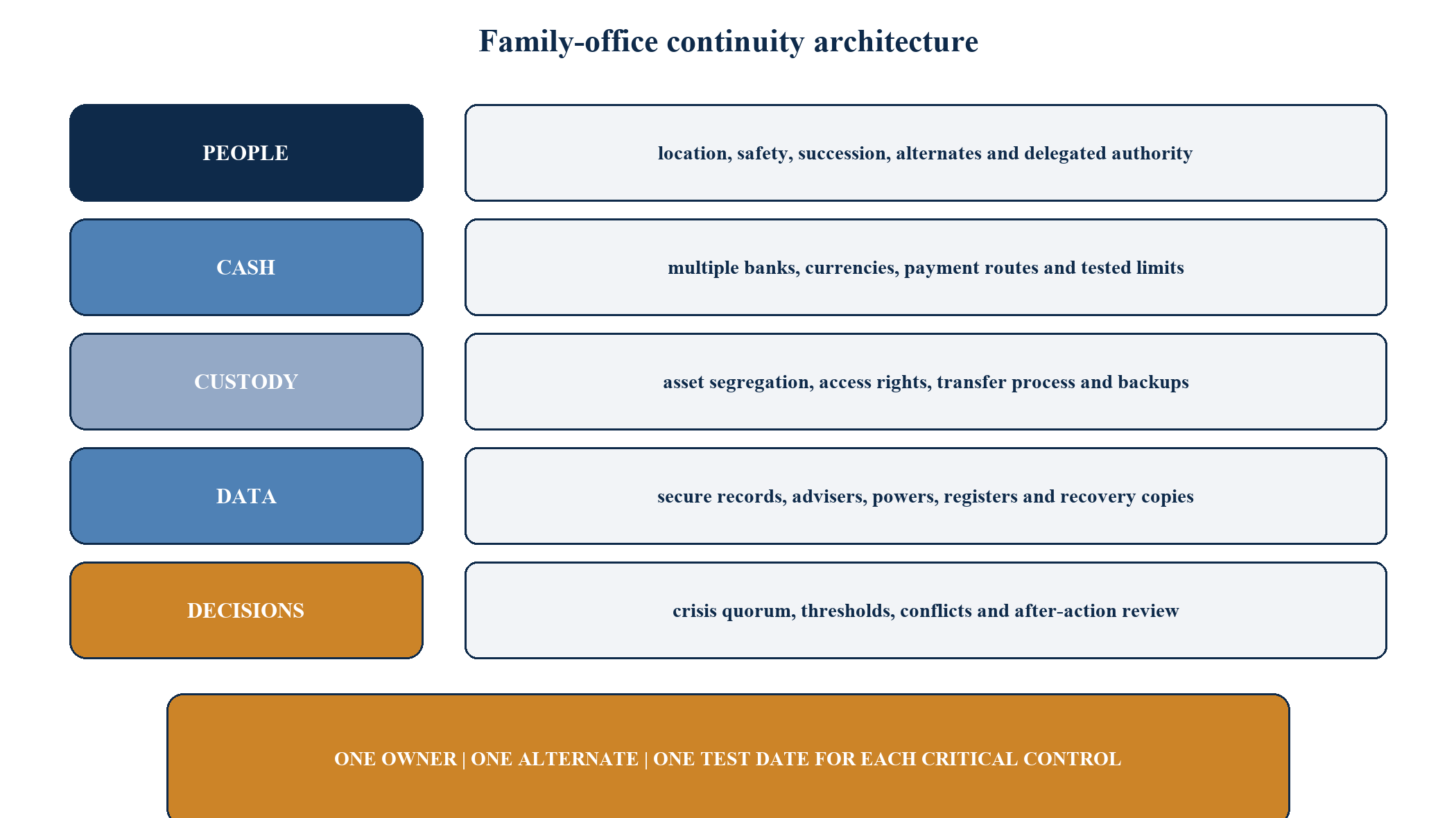
Small family offices often depend on one principal, one executive assistant or one finance professional. The continuity register should identify every process that stops when that person is unavailable. Each critical process needs an alternate, documented authority, access prerequisites and a test date.
Delegation should be narrow enough to protect the family and broad enough to work during an incident. Transaction-value limits, dual approval, prohibited actions, duration and reporting requirements should be explicit. Emergency powers should expire or be ratified after the event.
| Continuity domain | Minimum control | Test evidence |
|---|---|---|
| people | principal and alternate for every critical role | call-tree test and signed authority matrix |
| cash | two independent payment paths for priority obligations | successful low-value test and limit record |
| custody | documented transfer and recovery route | custodian confirmation and access test |
| data | encrypted current records with controlled backup | recovery drill and access log |
| decisions | crisis quorum, thresholds and conflict rules | simulated committee decision |
| advisers | tax, legal, banking, insurance and security contacts | current engagement and escalation list |
| return | facts that trigger UK pre-return advice | signed return gate and calendar alert |
9. BANKING, SOURCE OF WEALTH AND DOCUMENTATION
9.1 A relocation changes the evidence question
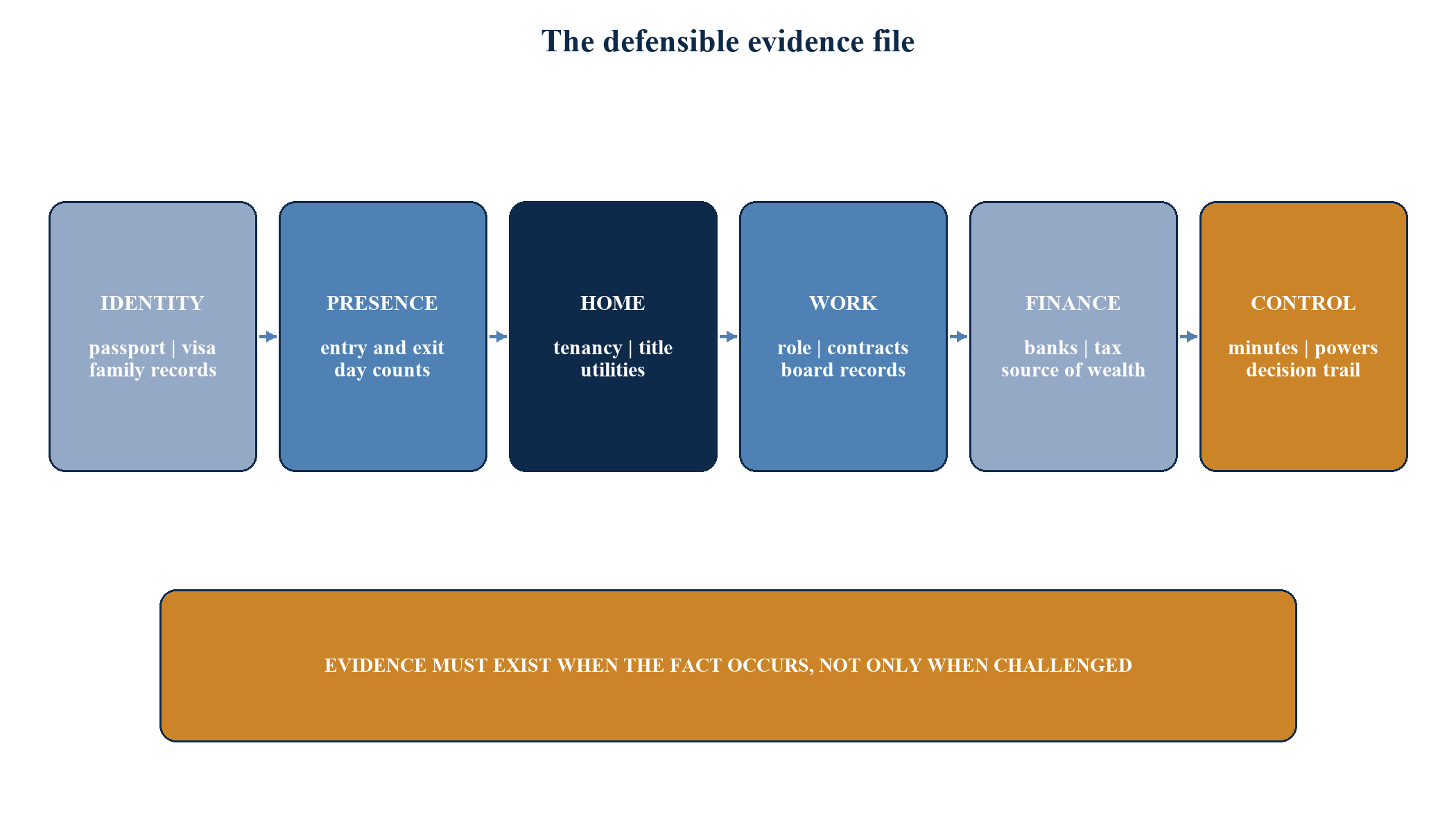
Banks and custodians can ask why the client moved, how wealth was created, how funds were accumulated, which entities are involved, where taxes are paid and what transactions are expected. The strongest file is contemporaneous, consistent and capable of being updated.
The source-of-wealth narrative should link to objective records: company formation and accounts, audited statements, transaction documents, tax filings, probate, dividends, employment income, investment statements, trust records and bank flows. The narrative should avoid marketing language and should identify unresolved gaps.
9.2 Source of wealth and source of funds are different
Source of wealth explains how the overall wealth arose. Source of funds explains the origin and path of the money used in a specific transaction. A family can have a well-documented business sale and still face a source-of-funds delay when transaction cash moved through several entities or accounts without a clean record.
The transaction file should reconcile legal owner, beneficial owner, sending account, receiving account, currency, purpose, agreement, approval and tax treatment. It should explain loans, gifts, distributions and intra-family transfers with appropriate documents.
9.3 Address and tax-residence self-certification
Changing a mailing address is operationally necessary and can support evidence. It is not the residence test. Banks may request self-certification under automatic-exchange rules, a UAE Tax Residency Certificate or additional proof. The client should provide accurate, current information and maintain consistency across banks, custodians, insurers, companies and advisers [10,24].
9.4 Reputation risk
A move described solely as a tax escape can create avoidable questions for employees, counterparties, banks and family members. A truthful narrative can explain the full business and family rationale, including regional investment, operating presence, family location, succession planning and global portfolio management. The narrative cannot replace substance; it should describe the facts that exist.
10. ENTITY, MANAGEMENT AND SUBSTANCE
10.1 Personal residence and company residence are separate
A founder can become UAE resident while the UK company remains UK resident. A UAE company can also face questions about where it is effectively managed and controlled, where activities occur, and whether it has a permanent establishment elsewhere. Board minutes alone are not sufficient when actual strategic decisions occur in another place.
The governance design should identify reserved matters, directors, executive roles, meeting locations, information flows, contract authority, banking authority and adviser conclusions. It should also state where records and decision makers are available during disruption.
10.2 UAE entity selection
The UAE offers mainland and free-zone structures, foundations, partnerships and regulated financial-centre vehicles. Selection should follow the intended activity, ownership, customers, staffing, regulation, tax, treaty, banking and substance requirements. A structure selected only for a headline rate can fail commercially or administratively.
The family should ask:
- What activity will the entity actually conduct?
- Does it require a commercial, professional, financial-services or other licence?
- Who will work for it, where and under what authority?
- Which income can be personal investment and which is business income?
- What office, records, accounts and governance are required?
- How will the entity interact with UK companies, trusts and family members?
10.3 Personal investment versus business
The UAE FTA states that wages, personal investment income and real-estate investment income are outside business activity for natural-person Corporate Tax purposes, while a natural person conducting business in the UAE can be subject to Corporate Tax when calendar-year turnover exceeds AED 1 million [11]. This boundary should be reviewed when a private investment activity begins providing services, hiring staff, charging fees or operating with commercial organisation.
10.4 Regulated activity
Investment management, arranging, advising, dealing, fund management, credit and insurance activities can require regulatory permission. A family office's treatment depends on its activities, clients, legal form and jurisdiction. The move plan should obtain specialist regulatory advice before marketing services, managing third-party money or charging fees.
10.5 Annual re-performance
Residence, treaty, entity and continuity conclusions can drift as facts change. The family should re-perform the framework at least annually and before a material transaction or return. The annual review should not merely roll forward last year's memorandum. It should test current homes, travel, work, family ties, entity activity, board practice, asset ownership, trust changes, banking, insurance and regional operating conditions.
The review should also close obsolete arrangements. Dormant entities, unused bank accounts, expired powers, old addresses and duplicated custody relationships can create cost and inconsistent evidence. Closure decisions should follow legal, tax, regulatory and record-retention advice.
An annual control statement can report:
- current residence conclusions and evidence period;
- material changes from the prior year;
- transactions completed and advice obtained;
- entities, roles and decision locations;
- succession and liquidity coverage;
- continuity tests passed or failed;
- open legal, tax, banking or regulatory issues;
- planned return or relocation triggers for the next year.
11. ILLUSTRATIVE DECISION CASES
The following cases use hypothetical families, values and assumptions. They do not describe Matchpoint clients. They demonstrate how the framework changes the questions; they do not estimate a reader's tax or investment result.
11.1 Case A: founder approaching a sale
The founder owns a UK trading company, retains a London home, has adult children in Britain and is considering a sale within eighteen months. The proposed UAE move begins with three registers: personal residence, transaction sequence and company management.
The residence workstream tests home availability, UK workdays, family ties and split-year conditions. The transaction workstream identifies when a disposal can occur, whether Business Asset Disposal Relief conditions are met, how earnout and rollover elements are treated and whether temporary non-residence could apply on return. The company workstream keeps strategic management, board decisions and sale execution aligned with advice.
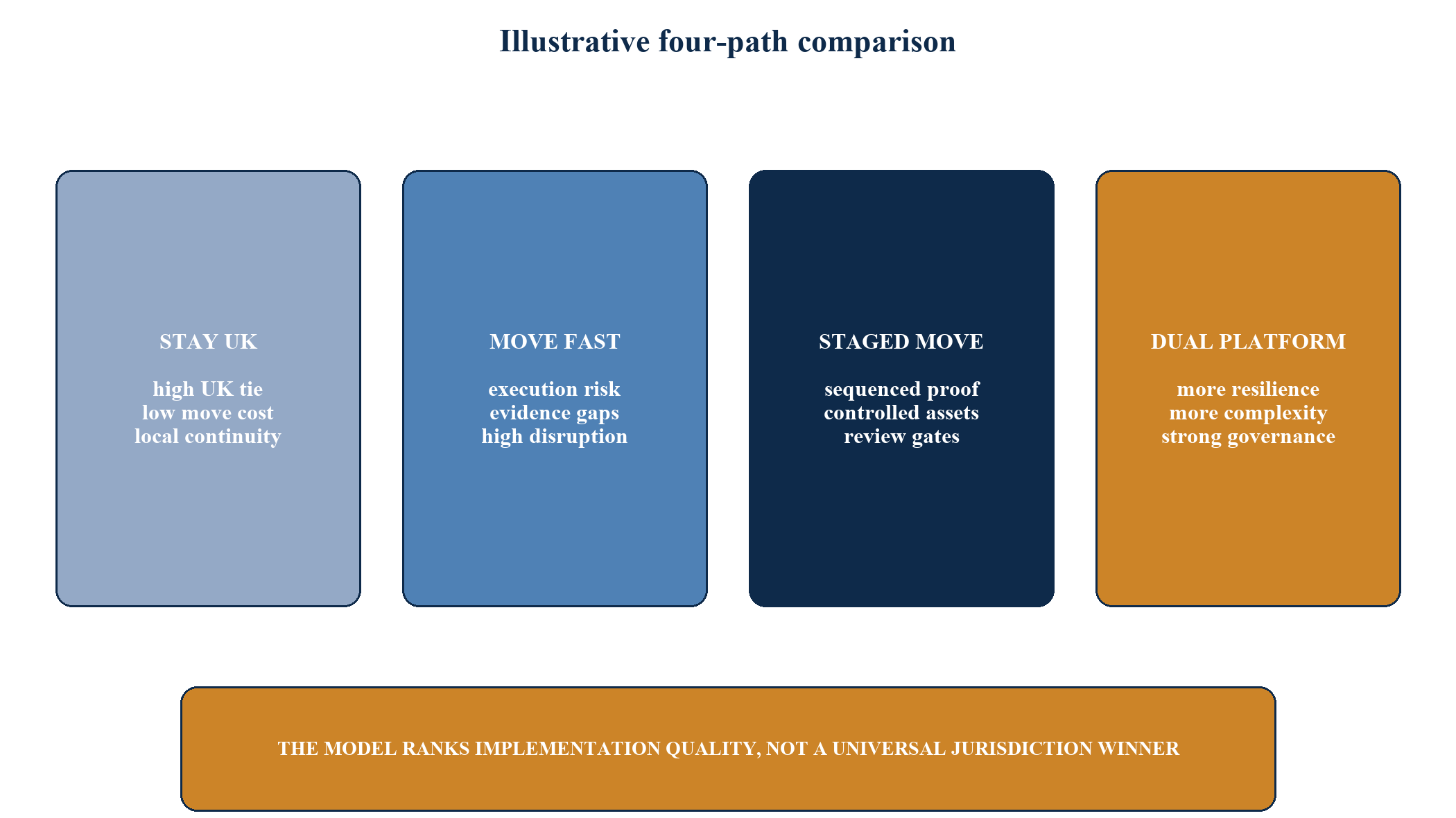
The framework can lead to several outcomes. The founder can remain UK resident through the sale; establish UAE residence and defer the sale until evidence and advice are complete; move personally while keeping company governance in Britain; or restructure the transaction on commercial grounds. The framework does not choose a path without facts and advice.
11.2 Case B: family office with global assets
The family holds listed portfolios, private funds, real estate in several countries and an operating company. It wants a UAE investment office and global custody. The primary risks are dispersed ownership, concentrated signatory authority and incomplete source-of-wealth records.
The staged plan first builds a consolidated ownership and authority map. It then selects which functions belong in the UAE office, which remain with external managers and which require regulated permissions. Custody is divided across two institutions with tested transfer procedures. A liquidity ladder covers household needs, operating-company support and private-fund capital calls.
The family's tax-residence and succession workstreams proceed separately. The office can become operational before every family member has the same residence outcome, provided the facts, governance and reporting accurately reflect the arrangement.
11.3 Case C: fund professional with carried interest
The professional has roles in a UK manager, offshore fund vehicles and portfolio-company boards. Payments can arise from salary, bonus, carried interest, co-investments and distributions. The family intends to spend school terms partly in Britain.
The control file maps each role, service location, payment right and vesting or crystallisation event. It records UK workdays, board activity and family ties. Specialist advice covers the revised carried-interest regime, treaty, employment, entity and temporary non-residence questions. The UAE office is not assumed to change the character or source of existing rights.
11.4 Case D: dual-platform resilience
The family establishes the UAE as its primary home while retaining a limited UK operating base and globally diversified custody. It accepts higher administrative cost in exchange for access options. The platform uses clear entity roles, multiple payment routes, independent signatories and a pre-return gate.
This case can improve operational resilience only when the dual platform has substance and control. Two addresses, two companies or two bank accounts without tested authority can add complexity without adding resilience.
| Path | Potential advantage | Principal risk | Required evidence |
|---|---|---|---|
| remain UK | familiar home, advisers and operations | tax or succession outcome may remain misaligned | quantified stay case and no-action cost |
| rapid move | early physical relocation | residence, banking, family and corporate gaps | red-gate exception approvals and rapid remediation |
| staged move | fact gathering, sequencing and reversible gates | longer period and implementation cost | dated ninety-day plan and adviser sign-offs |
| dual platform | diversified access and return flexibility | additional cost, control and residence complexity | substance map, authority design and annual re-performance |
12. THE NINETY-DAY DECISION PROGRAMME
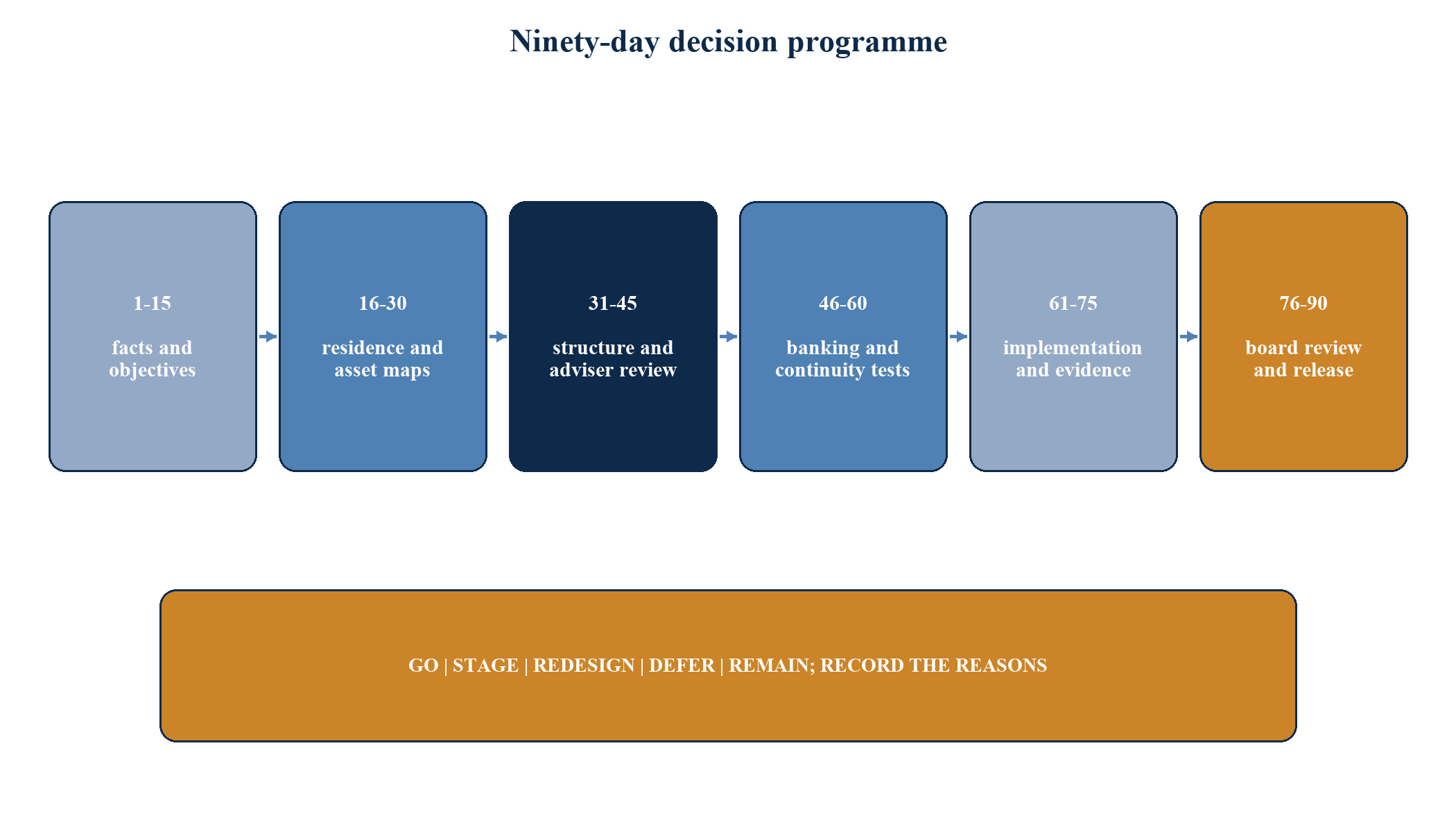
12.1 Days 1 to 15: facts and objectives
The first phase collects facts without restructuring anything. The family prepares the twenty-year residence history, five-year travel record, family map, homes, roles, entities, asset register, trusts, pensions, transactions under consideration and existing adviser opinions. It records the objective and constraints.
Outputs include:
- objective and non-negotiables;
- residence-history schedule;
- ownership and asset map;
- current transaction calendar;
- family and operational dependency map;
- open-question register.
12.2 Days 16 to 30: residence and tax maps
UK and UAE advisers test domestic residence, treaty, split-year, temporary non-residence and long-term residence. The team prepares the asset-by-asset map and identifies which proposed transaction dates require further advice. No assumed saving is recognised until the advice is documented.
12.3 Days 31 to 45: structure and governance
The family selects the intended operating model and evaluates entity, licensing, regulation, corporate residence, management, staffing and succession. The governance map assigns directors, committees, signatories, reserved matters and emergency alternates. Proposed trusts, foundations, companies, loans and transfers remain conditional on formal advice.
12.4 Days 46 to 60: banking and continuity tests
The source-of-wealth file is prepared. Banks and custodians are approached with consistent facts. The office tests payment routes, access, secure communications, record recovery and delegated authority. Insurance, travel and medical arrangements are reviewed through qualified providers.
12.5 Days 61 to 75: implementation and evidence
Approved actions are implemented in sequence. The team captures evidence when each fact occurs: entry and exit, home availability, employment, board meetings, bank onboarding, entity activity and family movement. Day-count and transaction calendars become live controls.
12.6 Days 76 to 90: review and release
The decision committee reviews every gate. The available outcomes are go, stage, redesign, defer or remain. The committee records reasons, missing evidence, residual risks and the next formal review date. A tax deadline alone is not a reason to override a red legal or residence gate.
12.7 The first-year operating cycle
The first ninety days create the platform. The following nine months establish whether the facts remain consistent. The office should schedule monthly day-count and evidence reviews, quarterly continuity tests, transaction-specific advice gates and an annual residence and entity review.
The first-year calendar should include the UK tax-year end, UAE certificate evidence period, company year ends, tax filing dates, visa and identity renewals, insurance renewals, school and family travel, private-fund capital calls, debt maturities and expected transactions. It should assign one owner to every calendar item and one alternate for every critical action.
At the end of year one, the family should compare the intended operating model with actual behaviour. Repeated UK workdays, unplanned home use, decisions taken from the wrong location, missing evidence or unused UAE activity should be escalated. The purpose is to correct facts and governance early, not to rewrite history.
13. IMPLEMENTATION CHECKLIST
13.1 Personal and family
- Complete a person-specific UK Statutory Residence Test calendar.
- Record UAE presence, home, employment, business and centre-of-interests evidence.
- Identify the intended treaty-residence analysis and supporting facts.
- Map spouse, partner, child, school, care and housing commitments.
- Establish the pre-return advice gate.
- Review immigration, medical and insurance arrangements with qualified providers.
13.2 Tax and succession
- Prepare a twenty-year UK residence history.
- Determine long-term residence and the expected Inheritance Tax tail.
- Review Business Relief eligibility, values, allowance and liquidity.
- Map UK property, businesses, portfolios, trusts, pensions and liabilities.
- Record temporary non-residence risks by income and gain category.
- Obtain advice before material disposals, distributions, gifts, trust additions or restructuring.
13.3 Entities and governance
- Identify actual business activity and required licence or permission.
- Separate personal residence from company residence and management.
- Define board, executive, shareholder and investment roles.
- Record decision location, authority, minutes and supporting evidence.
- Review related-party, transfer-pricing and permanent-establishment questions.
- Test emergency authority and alternate signatories.
13.4 Banking and custody
- Build a complete source-of-wealth and source-of-funds file.
- Align tax self-certifications and addresses across institutions.
- Maintain more than one tested payment route for critical obligations.
- Document custody, transfer, recovery and sub-custodian arrangements.
- Maintain a forward capital-call, debt and insurance calendar.
- Preserve secure and recoverable records.
13.5 Geopolitical and continuity
- Use official sources for regional alerts and travel decisions.
- Define short, prolonged, partial-reopening and renewed-escalation scenarios.
- Assign triggers for cash, travel, staff, custody and operating-company actions.
- Test the first seventy-two hours and the thirty-day cash plan.
- Review the ninety-day funding and twelve-month balance-sheet stress cases.
- Record each test, failure, corrective action and owner.
14. LIMITATIONS AND CONCLUSION
14.1 Limitations
This paper uses sources available through 2 August 2026. Tax law, administrative guidance, treaty practice, immigration, sanctions, insurance, travel conditions and the regional security environment can change. The paper does not have a reader's residence history, assets, family circumstances, transaction documents, adviser opinions or risk tolerance.
Official macroeconomic and maritime statements describe system-level conditions. They do not measure a specific family's probability of loss or the safety of a particular city, bank, custodian, route or asset. The illustrative cases and timing plans are modelling devices.
The paper also does not estimate the number of millionaires, founders, fund managers or family offices moving from the UK to the UAE. No single official source reviewed for this paper provided a complete, current and directly comparable measure of that population.
14.2 Conclusion
The safe-haven paradox has a practical resolution. A family should avoid treating tax and security as competing headlines. It should translate both into controlled workstreams, evidence and decision gates.
The UK tax reset creates real questions about foreign income and gains, business disposals, succession and carried interest. The answers remain person-specific and asset-specific. UAE residence requires facts and evidence. Treaty residence can require a further analysis. UK property, temporary non-residence and long-term residence can preserve UK exposure after physical departure.
The Hormuz disruption creates a separate operating question. It affects shipping, energy, travel, insurance, portfolio risk and family-office continuity. The response is diversified access, tested authority, a liquidity ladder and scenario triggers. It is not a claim that residence can be selected by geopolitical forecast.
A defensible UK-to-UAE move therefore has five characteristics:
- the residence conclusion is documented;
- the tax map is asset by asset and event by event;
- the family and company facts support the stated arrangement;
- the office can operate through disruption; and
- the return option has a formal gate.
The most valuable output is not a jurisdiction label. It is a decision file that remains coherent when reviewed by the family, its advisers, banks, counterparties and future decision makers.
APPENDIX A. EVIDENCE REGISTER
| Evidence item | Purpose | Owner | Refresh trigger |
|---|---|---|---|
| passport, visa and Emirates ID | identity and immigration evidence | family office administrator | renewal or status change |
| entry-exit report | UAE presence and day-count support | tax coordinator | monthly and year end |
| UK day-count calendar | Statutory Residence Test support | tax coordinator | every trip and workday |
| home documents | availability, residence and banking evidence | legal and property lead | acquisition, lease, disposal or access change |
| employment and role records | work and centre-of-interests evidence | company secretary | role or contract change |
| board minutes and decision logs | company management and control | company secretary | every reserved decision |
| source-of-wealth file | banking and counterparty diligence | finance lead | major wealth event |
| asset and tax map | tax, succession and liquidity | tax advisers and family CFO | acquisition, disposal, gift or restructuring |
| trust and foundation register | powers, ownership and succession | legal advisers | contribution, appointment or deed change |
| Tax Residency Certificate | UAE administrative evidence | tax coordinator | relevant period and renewal |
| continuity test log | operating resilience | COO or family-office lead | quarterly and after incident |
| pre-return gate | temporary non-residence and future UK residence | principal and UK adviser | before any return trigger |
APPENDIX B. HYPOTHETICAL STRESS MODEL
The model below demonstrates the mechanics of a continuity review. Every number is a hypothetical planning input and is not a forecast, market observation or recommendation.
| Variable | Base planning input | Moderate disruption | Severe disruption |
|---|---|---|---|
| immediately accessible household cash | 12 months of planned spending | 12 months | 12 months |
| operating-company distribution delay | 0 months | 6 months | 12 months |
| private-fund distribution delay | 0 months | 9 months | 18 months |
| private-fund capital calls | scheduled plan | 110 percent of plan | 125 percent of plan |
| listed portfolio value | 100 index | 85 index | 70 index |
| insurance and logistics cost | 100 index | 130 index | 175 index |
| primary travel route | available | intermittent | unavailable |
| credit-line availability | full committed terms | 75 percent usable | 50 percent usable |
The committee uses the model to identify a funding gap, authority gap or concentration. It should not use the output as an expected return or probability-weighted forecast unless those assumptions are separately supported and approved.
APPENDIX C. TERMS
Domestic tax residence. Residence under the internal law of a jurisdiction.
Treaty residence. Residence determined for purposes of a tax treaty when the treaty applies.
Split-year treatment. UK treatment that can divide a qualifying tax year into UK and overseas parts when all conditions of a specified case are met.
Temporary non-residence. UK rules that can bring certain income and gains received during a period of non-residence into charge when the person returns within the relevant period.
Long-term UK residence. The residence-based connecting factor used for Inheritance Tax from 6 April 2025, subject to detailed statutory rules.
Source of wealth. Evidence explaining how overall wealth was created and accumulated.
Source of funds. Evidence identifying the origin and transaction path of specific money or assets.
Operating resilience. The ability to continue critical decisions, payments, custody access, records and family support during disruption.
APPENDIX D. DECISION MEMORANDUM TEMPLATE
D.1 Decision requested
State the precise decision, legal owner, approving body, amount or value, intended date and commercial purpose. Separate the decision from related actions that require their own approval.
D.2 Facts and evidence
List the material residence, family, asset, entity, transaction, banking and continuity facts. Link each fact to a dated source. Mark missing information as open and assign an owner and deadline.
D.3 Advice obtained
Record adviser, jurisdiction, scope, date and conclusion. Attach the written advice or identify the controlled file. State which assumptions could change the conclusion.
D.4 Options considered
Describe remain, move, stage, redesign and defer where relevant. Compare commercial, family, tax, legal, banking, operational and return-option consequences. Avoid reducing the comparison to one tax rate.
D.5 Two-front review
| Front | Question | Status | Evidence or condition |
|---|---|---|---|
| UK fiscal and residence | is the residence and transaction analysis complete? | Green, Amber, Red or Open | adviser memorandum and calendar |
| UAE residence and substance | do actual facts support the intended position? | Green, Amber, Red or Open | presence, home, work and control records |
| succession and assets | are tail exposure and liquidity addressed? | Green, Amber, Red or Open | asset map and succession schedule |
| Gulf operating resilience | can people, cash, custody and decisions continue? | Green, Amber, Red or Open | tested continuity controls |
| return option | are return triggers and consequences defined? | Green, Amber, Red or Open | signed pre-return gate |
D.6 Decision, conditions and review
Record the decision, votes or authority, conditions precedent, actions, owners, dates, residual risks and next review. A condition should be observable and capable of being closed. The memorandum should state when a material fact change requires the decision to return to the committee.
APPENDIX E. FIRST-YEAR CONTROL CALENDAR
E.1 Monthly residence close
Within five working days of each month end, the coordinator should reconcile passports, entry-exit records, travel bookings, device or expense records used with consent, work calendars and the family travel log. Differences should be resolved while evidence is available. The review should record UK midnights, UK workdays, UAE days or parts of days, home availability and any unexpected family or work change.
The coordinator should escalate when a planned threshold is approaching, when a trip changes purpose, when work occurs during a personal visit, when a UK or UAE home becomes available or unavailable, or when family circumstances change. The adviser should decide the tax effect; the coordinator supplies accurate facts.
E.2 Quarterly entity and continuity review
Each quarter, the company secretary or family-office lead should compare actual governance with the intended structure. The review covers board and committee meetings, strategic decisions, contract approvals, bank mandates, employees, office activity, intercompany transactions and records. Any decision made outside the intended process should be explained and corrected with advice.
The same meeting should review the liquidity ladder, custody access, payment-route tests, capital calls, debt, insurance, staff alternates, secure communications and return triggers. A failed test receives an owner, remediation date and retest.
E.3 Transaction gate
Every material transaction should receive a separate gate before commitment. The gate should be early enough to change sequence or structure. It should identify whether the transaction changes residence facts, creates a disposal, distribution, gift, loan, service income, trust addition, company-control issue, source-of-funds requirement or regulated activity.
The gate should not close until the legal documents and adviser assumptions agree. If the value, parties, completion date, consideration or family plan changes, the gate should reopen.
E.4 Annual re-performance
Before the relevant filing and certificate cycle closes, the family should re-perform the UK, UAE and treaty analysis, long-term residence schedule, entity map, asset map and succession liquidity plan. The review should compare actual behaviour with the prior memorandum and document every material change.
| Frequency | Review | Core evidence | Approval |
|---|---|---|---|
| real time | travel, workday and home change | calendar and contemporaneous record | coordinator; adviser on escalation |
| monthly | residence close and open items | reconciled day count and tie register | principal or family-office lead |
| quarterly | entity governance and continuity | minutes, authority, test logs and liquidity | board or investment committee |
| transaction | disposal, distribution, gift, loan or restructuring | documents, timeline and written advice | legal owner and authorised body |
| annually | full residence, tax, succession and substance re-performance | consolidated evidence file | principal, board and advisers |
| pre-return | planned UK role, home, family move or day threshold | refreshed SRT and temporary non-residence analysis | principal after written advice |
APPENDIX F. MINIMUM RISK REGISTER
The risk register should be short enough to govern and specific enough to act on. Each entry needs a cause, event, consequence, existing control, owner, indicator, action and review date. The table below provides the minimum coverage for a UK-to-UAE move.
| Risk | Principal consequence | Minimum control |
|---|---|---|
| UK residence differs from plan | worldwide UK tax and filing exposure | live SRT calendar, tie register and adviser review |
| UAE residence evidence is incomplete | certificate or treaty-position difficulty | entry-exit report, home, work and centre-of-interests evidence |
| split-year conditions fail | whole-year UK residence treatment | named split-year case, conditions and year-end re-performance |
| temporary non-residence applies on return | certain income or gains charged on return | pre-return gate and transaction history |
| long-term residence tail is misunderstood | overseas assets remain within Inheritance Tax scope | twenty-year residence history and succession advice |
| UK property is omitted | tax, reporting or residence-tie exposure | property register and disposal or use review |
| company control drifts | unintended corporate residence or permanent-establishment issue | board protocol, reserved matters and decision evidence |
| UAE activity is misclassified | licensing, tax or regulatory non-compliance | activity description and specialist advice |
| source-of-wealth file is weak | bank or transaction delay | reconciled narrative and primary records |
| one bank or custodian is inaccessible | payment or asset-access interruption | tested alternate institution and authority |
| principal is unavailable | decisions and payments stop | bounded delegation and alternate signatory |
| travel routes are interrupted | family, staff or residence-plan disruption | official-source triggers and alternate route plan |
| insurance response differs from assumption | uninsured loss or delayed assistance | policy and endorsement review with provider |
| cyber compromise blocks access | payment fraud, data loss or operational outage | multi-factor recovery, out-of-band verification and backups |
| operating-company cash falls | family and portfolio liquidity pressure | consolidated cash forecast and funding ladder |
| private-market calls rise or distributions stop | forced sale or default | obligation calendar and liquid reserve |
| rapid return recreates UK ties | unplanned residence and transaction consequences | return trigger calendar and prior written advice |
The register should distinguish a legal conclusion from a management control. A green management control cannot convert an adverse tax conclusion into an acceptable one. It can show that the conclusion is known, funded and governed.
REFERENCES
[1] HM Revenue & Customs. "Business Asset Disposal Relief: Eligibility." Updated 2026. https://www.gov.uk/business-asset-disposal-relief
[2] HM Revenue & Customs. "Business Relief for Inheritance Tax: What qualifies for Business Relief." Updated 2026. https://www.gov.uk/business-relief-inheritance-tax/what-qualifies-for-business-relief
[3] HM Revenue & Customs. "Check if you can claim the 4-year foreign income and gains regime." 2025, updated 2026. https://www.gov.uk/guidance/check-if-you-can-claim-the-4-year-foreign-income-and-gains-regime
[4] HM Revenue & Customs. "Reform of the tax treatment of carried interest." 2025. https://www.gov.uk/government/publications/reform-of-the-tax-treatment-of-carried-interest
[5] HM Revenue & Customs. "RDR3: Statutory Residence Test notes." Updated 11 June 2026. https://www.gov.uk/government/publications/rdr3-statutory-residence-test-srt/guidance-note-for-statutory-residence-test-srt-rdr3
[6] HM Revenue & Customs. "RFIG21630: Temporary non-residence: Capital gains and offshore income gains." Updated 2026. https://www.gov.uk/hmrc-internal-manuals/residence-and-fig-regime-manual/rfig21630
[7] HM Revenue & Customs. "Inheritance Tax if you are a long-term UK resident." 2025, updated 2026. https://www.gov.uk/guidance/inheritance-tax-if-youre-a-long-term-uk-resident
[8] Government of the United Kingdom. "2016 UK-UAE Double Taxation Convention." https://www.gov.uk/government/publications/united-arab-emirates-tax-treaties/2016-uk-uae-double-taxation-convention
[9] UAE Ministry of Finance. "Ministerial Decision on Implementation of Certain Provisions of Cabinet Decision No. 85 of 2022 on Determination of Tax Residency." 2023. https://mof.gov.ae/en/news/following-cabinet-decision-85-of-2022/
[10] UAE Federal Tax Authority. "Issuance of Tax Certificates for Tax Residency." Updated 6 April 2026. https://tax.gov.ae/en/services/issuance.of.tax.certificates.aspx
[11] UAE Federal Tax Authority. "Basis of Taxation: Natural Person." https://tax.gov.ae/en/taxes/corporate.tax/corporate.tax.topics/basis.of.taxation.natural.person.aspx
[12] United Kingdom. Finance Act 2026. https://www.legislation.gov.uk/ukpga/2026/11/contents
[13] UAE Ministry of Foreign Affairs. "Joint Statement on the Strait of Hormuz." 21 March 2026. https://www.mofa.gov.ae/en/mediahub/news/2026/3/21/uae-strait-of-hormuz
[14] UAE Ministry of Foreign Affairs. "UAE Stresses Need for Unity at GCC-US Joint Ministerial Meeting." 26 June 2026. https://www.mofa.gov.ae/en/MediaHub/News/2026/6/26/UAE-GCC-US-Joint-Ministerial-Meeting
[15] International Maritime Organization. "No safe passage: Strait of Hormuz remains highly volatile." 9 June 2026. https://www.imo.org/en/mediacentre/pressbriefings/pages/statement-no-safe-passage-strait-of-hormuz.aspx
[16] International Maritime Organization. "No safe transit through Strait of Hormuz: IMO Secretary-General." 24 April 2026. https://www.imo.org/en/mediacentre/pressbriefings/pages/no-safe-transit-through-hormuz-imo-secretary-general.aspx
[17] International Maritime Organization. "Middle East: Strait of Hormuz." Updated 2026. https://www.imo.org/en/mediacentre/hottopics/pages/middle-east-strait-of-hormuz.aspx
[18] U.S. Energy Information Administration. "World Oil Transit Chokepoints." 2026. https://www.eia.gov/international/content/analysis/special_topics/World_Oil_Transit_Chokepoints/
[19] International Monetary Fund, International Energy Agency, World Bank Group and World Trade Organization. "Joint Statement by the Heads of the IEA, IMF, World Bank Group and WTO." 29 May 2026. https://www.imf.org/en/news/articles/2026/05/29/pr26176-joint-statement-by-heads-of-iea-imf-wbg-and-wto
[20] International Monetary Fund. "World Economic Outlook Update: Global Economy in Crosscurrents of War and Technology." July 2026. https://www.imf.org/en/Publications/WEO/Issues/2026/07/08/world-economic-outlook-update-july-2026
[21] International Monetary Fund. "Global Economy Endures War Shock - So Far." 15 June 2026. https://www.imf.org/en/blogs/articles/2026/06/15/global-economy-endures-war-shock-so-far
[22] HM Revenue & Customs. "Tax on your UK income if you live abroad: Selling or inheriting assets." https://www.gov.uk/tax-uk-income-live-abroad/selling-or-inheriting-assets
[23] HM Revenue & Customs. "Tell HMRC about Capital Gains Tax on UK property or land if you are not a UK resident." Updated 13 January 2026. https://www.gov.uk/guidance/capital-gains-tax-for-non-residents-uk-residential-property
[24] Organisation for Economic Co-operation and Development. "Guidance Notes for the Common Reporting Standard: United Arab Emirates." https://www.oecd.org/content/dam/oecd/en/topics/policy-issue-focus/aeoi/uae-guidance.pdf
[25] HM Revenue & Customs. "HS278 Temporary non-residents and Capital Gains Tax (2026)." 2026. https://www.gov.uk/government/publications/temporary-non-residents-and-capital-gains-tax-hs278-self-assessment-helpsheet/hs278-temporary-non-residents-and-capital-gains-tax-2026
[26] UAE Federal Tax Authority. "Corporate Tax Guide: Taxation of Natural Persons." 2023. https://tax.gov.ae/Datafolder/Files/Guides/CT/Taxation%20of%20natural%20persons%20-%2025%2011%202023.pdf
[27] HM Revenue & Customs. "IHTM25001: Business relief and businesses: Introduction." Updated 7 April 2026. https://www.gov.uk/hmrc-internal-manuals/inheritance-tax-manual/ihtm25001
[28] HM Revenue & Customs. "IHTM47001: Long-term UK residence test: Introduction." Updated 7 April 2026. https://www.gov.uk/hmrc-internal-manuals/inheritance-tax-manual/ihtm47001
ABOUT THE AUTHOR
Chennakeshav Adya is an independent researcher and Managing Partner of Matchpoint Partners. His research focuses on cross-border capital, private markets, family offices, corporate finance, transaction execution and the institutional controls required to turn strategic decisions into defensible outcomes.
