

1 Start with the amount the owner can actually retain
A proposed sale price is an incomplete answer to the owner's question. A buyer may describe an enterprise value, while the shares are exchanged for an equity value after debt, cash, working-capital and other agreed adjustments. Part of the consideration may be paid into escrow, rolled into the buyer or earned after completion. The adviser may calculate its fee on a different amount and collect it at a different time. The owner needs a cash bridge before comparing advisers or accepting a bid.
This paper uses a founder-led private-company sale as its decision setting. The engagement letter, sale agreement and funds-flow statement govern the actual calculation. A founder may own the shares personally, through a holding company or alongside other shareholders. The legal payer of the advisory fee may differ from the person ultimately bearing its economics. Each entity and shareholder should be identified before a model is presented as “net proceeds.” The same discipline applies when some owners reinvest and others take cash.
The first output is cumulative owner cash through completion under a defined perimeter. A second output is the completion-day transfer. A third is the present value of uncertain later payments, reported separately from cash already received. Those outputs cannot be merged without an assumption about timing, collectability and tax. A seller may prefer an offer with a lower announced price and higher certain cash. Another seller may accept a longer earn-out for a genuine strategic reason. The model keeps both decisions visible.
An adviser earns compensation for work that may improve process quality, price, terms or completion. This paper does not assume that the cheapest proposal is best. It asks the owner to understand what must be paid under each proposal and what service is attached to the payment. A fee can be commercially sensible while giving the adviser an incentive to favour a faster close, a particular buyer or a particular definition of value. These effects should be examined before exclusivity, while the owner can still alter scope and terms.
2 Locate the evidence and its limits
McLaughlin studied investment-banker fee contracts in tender offers from 1978 to 1986 and found mixed evidence on how fee design addresses agency problems [1]. Hunter and Jagtiani investigated adviser choice, fees and effort in a historical public-company M&A sample [2]. Golubov, Petmezas and Travlos studied adviser reputation and fees across acquisition settings and found that the value associated with an adviser varies by transaction type [3]. These studies establish an analytical reason to examine incentives. Their samples and periods do not set a fee norm or completion probability for a UAE private-company sale in 2026.
Publicly filed engagement terms demonstrate contract variety. One SEC-filed agreement specifies a retainer, a 2.5% success fee, a nine-month tail and an opinion-fee credit [4]. A 2023 proxy describes an adviser fee with one percentage up to a consideration threshold and another above it, with retainer and opinion fees credited at closing [5]. A 2026 proxy describes a fixed aggregate fee split among a retainer, an opinion fee and an amount contingent on completion [6]. These are named US transaction documents. Their amounts and percentages are not evidence of prevailing terms in a different market or mandate size.
The DFSA's 2026 thematic review addresses the management of conflicts across DIFC authorised firms [7]. The FCA's conflicts framework expressly treats corporate-finance and M&A activity as an area requiring attention to conflicts within its scope [8]. The FCA's investment and corporate banking market study describes how restrictive clauses can influence a client's choice of future banking services in the UK setting it studied [9]. None automatically determines the law applicable to a particular UAE entity, free-zone adviser or cross-border sale. Counsel should identify the contracting entity, permitted activity, governing law and applicable duties.
The unresolved empirical question is how real private-company fee terms affect seller proceeds after accounting for company quality, buyer competition, transaction complexity and selection of advisers. No consented UAE mandate dataset was available for this paper. Its model is a reproducible framework and its arithmetic is illustrative. The proposed cohort design appears later so that a future empirical study could test the question without converting published anecdotes into a market statistic.
3 Define the monetary base before discussing a percentage
“Transaction value” may mean the price paid for shares, enterprise value, total consideration including assumed debt, or a contract-specific amount. An engagement letter may include deferred cash, shares, rollover equity, earn-outs, assumed liabilities or a later capital raise in that definition. A 1% fee has no determinate cash effect until its base is specified. The owner should ask the adviser to provide a worked calculation on the transaction it actually proposes to pursue.
Enterprise value is a useful negotiating reference when a buyer values operations before a financing bridge. Equity value then depends on the agreement's debt, cash, working-capital and other adjustment definitions. The proceeds distributable to shareholders can diverge further because of transaction expenses, taxes, escrow, retention payments, seller notes or a management incentive pool. A term sheet may use “purchase price” for one stage and “consideration” for another. The mandate should identify the exact defined term used for fees and reconcile it with the sale documents.
The fee base should be tested against changes in structure. Suppose a buyer proposes USD 40 million at completion plus USD 10 million of contingent consideration. A contract charging 2% on a USD 50 million headline produces a USD 1 million fee even if the contingent part is never collected. A contract charging 2% when cash is received produces USD 800,000 at completion and a further USD 200,000 only if the later payment arrives. These amounts are author-created arithmetic, not a description of an actual engagement. The owner should also ask how a fee is calculated if consideration is non-cash, if its value changes, or if an earn-out is disputed.
The table below defines the minimum bridge used throughout this paper. It separates a valuation label from a payable amount and a payable amount from the cash the owner retains. The owner and adviser should mark where the contractual definitions differ from the model. Where a sale is an asset transfer, a partial sale or a recapitalisation, the bridge must be rebuilt for that perimeter. An apparent fee discount loses meaning when its denominator changes.
Table 1. Monetary bases and the owner cash bridge
| Line | Calculation or definition | Decision question | Evidence to retain |
|---|---|---|---|
| Enterprise value | Agreed value of operations before the specified financing bridge | Does the buyer and adviser use the same perimeter? | Signed term sheet and adjustment schedule |
| Equity value | Enterprise value less agreed debt plus agreed cash and other adjustments | What is payable for the shares? | Completion statement and debt/cash definitions |
| Fee base | The mandate's defined consideration or transaction value | Which amounts enter each fee tier? | Engagement letter and worked example |
| Completion cash | Equity consideration paid at completion less escrow, rollover and deferrals | What can be wired now? | Sale agreement and funds-flow statement |
| Owner cash through close | Completion cash less advisory and other transaction payments borne by the owner through close | What has the owner retained cumulatively? | Paid invoices and completion ledger |
| Later receipts | Escrow release, seller note, earn-out or other conditional payment when received | What remains at risk? | Payment conditions and monitoring record |
Author-developed analytical definitions. Executed agreements control actual amounts and legal payment duties.
4 Build the proceeds bridge without counting a fee twice
The proceeds bridge should begin with the buyer's agreed consideration and finish at the owner account. It should show each adjustment with its sign, timing, beneficiary and documentary source. The seller should identify the amount already paid to advisers before completion as well as the amount due from closing funds. A credited retainer is an advance against a later fee, not a second fee. The completion-day wire and cumulative cash retained through completion can therefore differ even when the lifetime advisory cost is the same.
The illustrative model later in this paper assumes that the owner funds pre-close retainers separately and that the stated company cash at completion is unaffected by those payments. This avoids subtracting the same retainer from both the equity bridge and the fee ledger. In a real transaction, a company-paid retainer may reduce the closing cash balance or be treated as a transaction expense. The model must then adjust either company cash or the separate owner payment, with one accounting entry for each economic cost. The accountant and counsel should reconcile the completion statement to the invoice trail.
The other transaction-cost line should be disaggregated. Legal, accounting, tax, data-room, fairness-opinion, regulatory and financing costs can be borne by different parties and triggered at different stages. A buyer may reimburse some expenses or deduct them from price. A company may pay a bonus from its own cash before the cash-free, debt-free bridge is fixed. Without entity-level accounting, two offers with the same stated price may leave different shareholder cash. The owner should demand a dated, version-controlled funds-flow forecast from the outset.
Figure 1 shows the arithmetic path. It deliberately omits tax rates and forecasts because those depend on owner identity, jurisdiction and transaction form. It also keeps later receipts off the completion-day line. The diagram is a control, not a claim that every sale follows an identical accounting or legal sequence. Each arrow should be supported by a defined term in the offer, mandate or sale documentation.
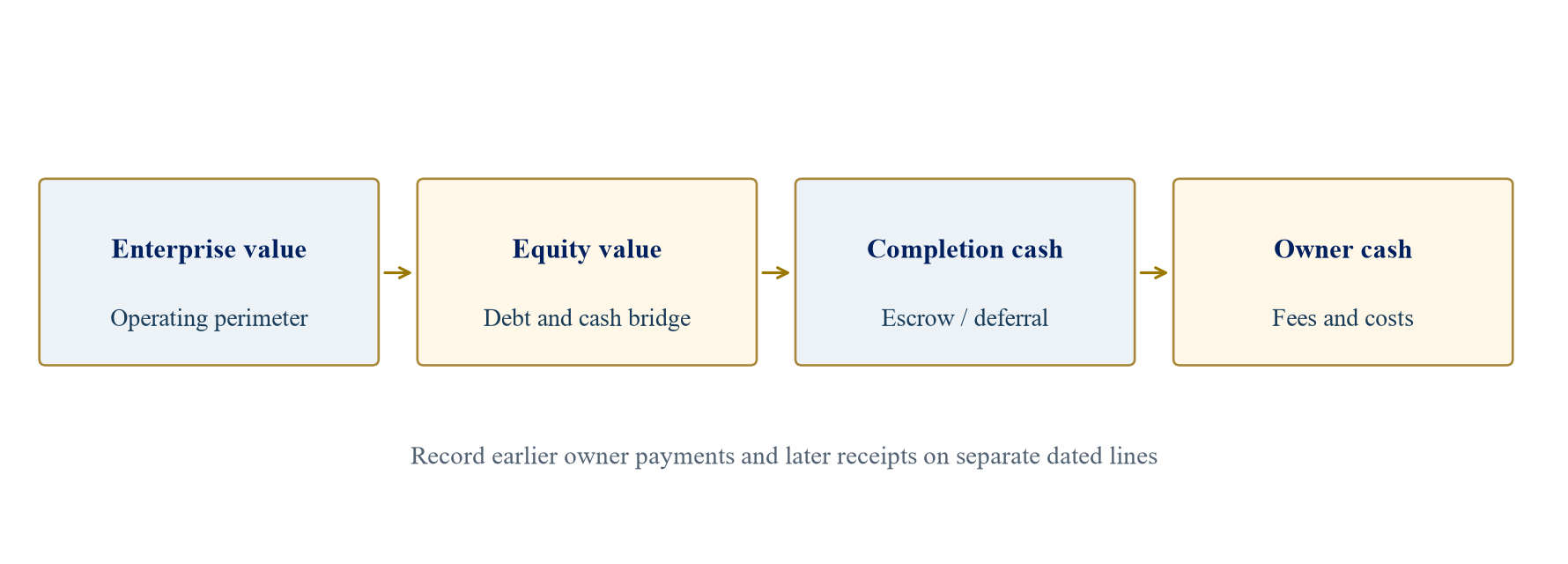
Author-developed bridge. The amounts and legal incidence of each adjustment require transaction-specific evidence.
5 Price the retainer as a payment and a commitment
A retainer may pay for initial analysis, reserve named team capacity or provide working capital for the adviser. The agreement should state what work is earned as the retainer becomes payable. The owner should ask whether it is a single amount, a monthly amount, a milestone payment, refundable, creditable against a later fee or payable even after early termination. The amount alone says little about the full mandate economics. A modest monthly retainer can become material in a long process; a large retainer may be partly offset by a lower fee at completion.
A credit changes the fee ledger. If the contract provides a USD 100,000 retainer credited in full against a USD 300,000 completion fee, the owner has paid USD 100,000 before closing and owes USD 200,000 at closing. The lifetime advisory fee is USD 300,000. Treating the retainer as an additional USD 100,000 would overstate cost. Conversely, if the retainer is expressly non-creditable, the lifetime cost is USD 400,000 under those stated amounts. The actual invoice and tax treatment may require separate analysis.
The no-close branch matters as much as the completion branch. A creditable retainer may remain non-refundable if the sale stops. The owner therefore bears the early outlay even though a larger success fee is never triggered. The adviser's work may still have been valuable: an informed decision to pause can avoid an unsuitable sale. The contract should connect that payment to specific deliverables such as a financial diagnostic, valuation-assumption bridge, buyer map or readiness report. A retainer with no deliverable and no agreed review date gives the owner little basis for assessing performance.
Retention should also be modelled over time. A retainer payable on signature, a further payment on data-room opening and a monthly continuation all create different incentives about when the adviser proposes to launch, pause or extend. The owner should record a budget ceiling and a renewal decision. Where another professional is expected to perform legal or accounting work, the advisory retainer should not imply that those services are included. The engagement should identify who pays for each discipline and what happens when the owner stops after the initial phase.
6 Test the success fee against its base and trigger
A success fee aligns a portion of the adviser's payment with a stated event, often completion. The owner should locate the precise event in the agreement. A signed sale contract can later fail to complete; an accepted offer can change materially before signing. A fee triggered at signing exposes the owner to a different risk from one triggered when consideration is actually received. The contract should also address partial sales, staged purchases, deferred consideration, rollover, stock, side payments and a transaction completed by an affiliate.
The percentage should be applied to every plausible structure under one transparent worksheet. If an adviser charges 1.5% on a USD 50 million enterprise value, the arithmetic fee is USD 750,000. If the same percentage applies to an illustrative USD 42.5 million equity value, it is USD 637,500. The USD 112,500 difference results only from the denominator. It says nothing about the adviser's quality. The owner must choose the economically appropriate base in the negotiation and record it unambiguously.
The adviser should specify when a fee on non-cash consideration becomes payable and how that consideration is valued. A seller that receives buyer shares could owe a cash fee before those shares can be sold. A rollover interest may have a headline value with transfer restrictions and future capital calls. A seller note may be paid years later or default. The mandate can match fee collection to cash receipt, establish a capped valuation process or exclude particular components. Each choice allocates financing and collectability risk. Counsel should test it against the sale structure and applicable law.
An adviser can create value by improving the price and also by improving certainty, financing, warranties, indemnities and escrow terms. A contract based solely on headline value may not reward the latter. The owner can ask for a fee schedule that recognises a qualified closing outcome and protects against a purely nominal price increase financed by risk shifted to the seller. The specific mechanism needs care: a complicated formula can produce ambiguity that costs more than its intended incentive benefit.
7 Measure the minimum fee at smaller exits
A minimum success fee can compensate an adviser for a substantial fixed workload on a small transaction. It can also make a low percentage economically misleading. If a mandate charges 1.5% of value subject to a USD 300,000 minimum, the minimum binds at transaction values below USD 20 million and exactly equals the percentage fee at USD 20 million. The threshold is USD 300,000 divided by 1.5%. At USD 10 million, the contractual fee is USD 300,000, equal to 3% of that stated value. Those figures are an author-created arithmetic illustration, not evidence of market pricing.
The owner should calculate this threshold for every offered structure. Ask whether the minimum includes retainers and opinion fees or is payable in addition to them. Ask whether the minimum applies to a partial sale, an asset sale, a restructuring that preserves owner equity or a sale at a price below the owner's walk-away value. A minimum can be reasonable for a complex assignment, but it changes the fee burden most sharply where the owner's sale proceeds are already constrained.
The owner should also distinguish a minimum fee from a minimum acceptable sale price. The adviser's minimum protects its revenue. The seller's reservation price protects its own decision. A mandate can state that no bid below the owner's documented threshold will be pursued without renewed consent. That threshold should account for cash debt repayment, transaction expenses, contingent proceeds and the owner's credible alternative to selling. A valuation range alone is not an instruction to accept an offer.
Figure 2 depicts the three illustrative fee schedules used later. Its curves use enterprise value solely for model consistency. The actual denominator, credits, thresholds and payment dates must come from a draft engagement letter. The steepening of the second schedule above USD 50 million is a deliberately chosen example of a price ratchet, not an observed industry pattern or a recommendation to use that exact term.
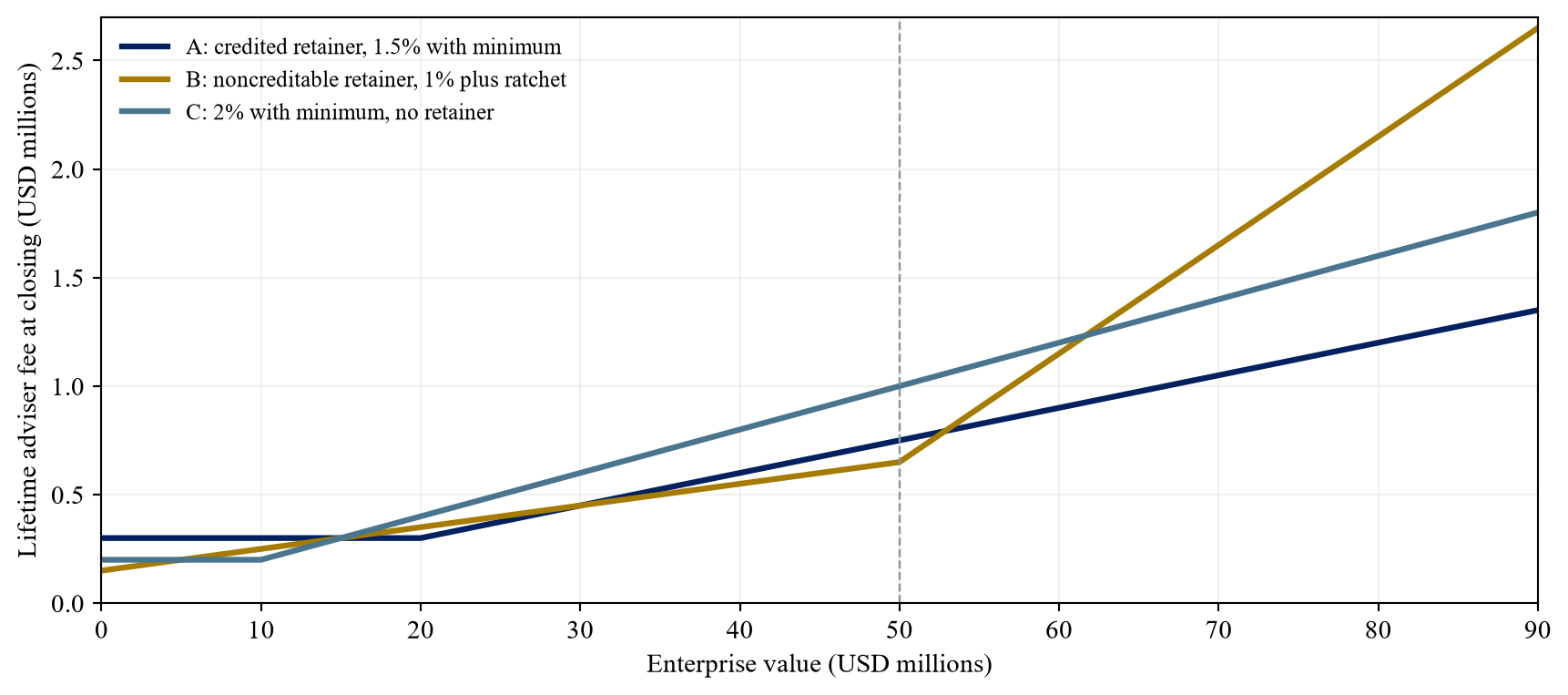
Author-created fee schedules in USD millions. Lines show contract arithmetic, not market rates or observed outcomes.
8 Read a price ratchet alongside the sale terms
A graduated fee can pay a higher marginal percentage above an agreed threshold. This may encourage the adviser to keep negotiating once the seller's baseline is met. It can also create a sharp change in the adviser's payoff near a threshold. The owner should ask whether the threshold is based on enterprise value, equity value or cash retained; whether the higher rate applies only to the increment; and whether the threshold is adjusted for debt, cash, rollover or an earlier owner's capital contribution. A clear marginal ratchet is easier to audit than a rate applied retroactively to the entire deal value.
The second illustrative schedule used here charges a USD 150,000 noncreditable retainer, 1% of enterprise value at closing, and 4% of enterprise value above USD 50 million. At USD 80 million, the additional fee is 4% of USD 30 million, or USD 1.2 million, on top of the USD 800,000 base success fee and USD 150,000 retainer. The lifetime total is USD 2.15 million. The USD 50 million threshold creates no payment on its own; it changes the fee on the incremental value above it. The owner should test a draft on both sides of every threshold to catch discontinuities or ambiguous wording.
A price ratchet may fail to reward a safer offer. A bidder can offer more contingent consideration, a larger rollover or a longer seller note while delivering less cash at closing. If the fee counts all stated consideration at its face value, the adviser's marginal fee may rise while the owner's certain cash falls. The owner should model alternatives with the same expected or headline value and different payment certainty. A narrow premium on cash received above an agreed baseline can reduce this mismatch, but it may under-reward a valuable rollover. The right choice depends on the seller's objectives and the transaction's economics.
The adviser and owner should also record who proposed the threshold. A benchmark built from an unaudited management forecast can become a poor incentive reference after diligence changes the company's earnings. The mandate can provide a documented reset only with owner approval, or it can use a simple fee with a periodic commercial review. A ratchet should not turn the adviser into the judge of its own starting point. The owner's board or authorised representatives should retain the decision to accept an offer and to change the transaction perimeter.
9 Work three illustrative exits through the same bridge
The model now compares the three fee schedules against identical sale economics. Schedule A has a USD 100,000 retainer fully credited against a completion fee equal to the greater of USD 300,000 and 1.5% of enterprise value. Schedule B has a USD 150,000 noncreditable retainer, a 1% completion fee and a 4% fee on enterprise value above USD 50 million. Schedule C has no retainer and a completion fee equal to the greater of USD 200,000 and 2% of enterprise value. These are author-created terms. No actual adviser has offered them in this paper.
For the USD 20 million exit, the model assumes USD 4 million of debt and USD 1 million of cash under the agreed equity bridge. Equity value is USD 17 million. A 10% escrow of equity value holds back USD 1.7 million, and other transaction costs borne by the seller are USD 350,000. Schedule A's lifetime fee is USD 300,000, B's is USD 350,000 and C's is USD 400,000. Cumulative owner cash through closing is USD 14.65 million, USD 14.60 million and USD 14.55 million respectively. These figures exclude tax and later escrow recovery.
The USD 50 million exit assumes USD 10 million debt, USD 2.5 million cash, USD 4.25 million escrow and USD 500,000 other costs. Equity value is USD 42.5 million. Lifetime fees are USD 750,000, USD 650,000 and USD 1 million. Cumulative owner cash is USD 37.0 million, USD 37.1 million and USD 36.75 million. At USD 80 million enterprise value, the model assumes USD 16 million debt, USD 4 million cash, USD 6.8 million escrow and USD 800,000 other costs. The corresponding lifetime fees are USD 1.2 million, USD 2.15 million and USD 1.6 million; cumulative owner cash is USD 59.2 million, USD 58.25 million and USD 58.8 million.
The completed table preserves the arithmetic and the fee ranking. At the middle sale value, B is least expensive despite its noncreditable retainer. Above the ratchet threshold, B becomes the most expensive. That comparison does not establish which adviser would deliver the best sale. Bid quality, certainty, team capability and the owners' alternatives may outweigh the fee differences. The model's value is that each candidate's economics can be put on the same cash basis before the owner evaluates the proposed service.
Table 2. Illustrative fee schedules and cumulative owner cash through closing
| Enterprise value | Equity value | Escrow | Other costs | Fee A / owner cash A | Fee B / owner cash B | Fee C / owner cash C |
|---|---|---|---|---|---|---|
| 20.00 | 17.00 | 1.70 | 0.35 | 0.30 / 14.65 | 0.35 / 14.60 | 0.40 / 14.55 |
| 50.00 | 42.50 | 4.25 | 0.50 | 0.75 / 37.00 | 0.65 / 37.10 | 1.00 / 36.75 |
| 80.00 | 68.00 | 6.80 | 0.80 | 1.20 / 59.20 | 2.15 / 58.25 | 1.60 / 58.80 |
USD millions. All assumptions are author-created; debt, cash, escrow and other costs are shared across schedules at each enterprise value. Tax and later receipts are excluded.
10 Distinguish lifetime cost from the completion-day wire
Schedule A's retainer is paid before completion and credited. At the USD 20 million example, the remaining fee collected from closing funds is USD 200,000, even though lifetime advisory cost is USD 300,000. If the other stated costs and escrow are deducted at closing, the completion-day wire before recognising that earlier owner payment is USD 14.75 million. The owner has already paid USD 100,000 and therefore retains USD 14.65 million cumulatively. A transaction closing statement and a bank statement can both be correct while showing different figures.
Schedule B has a USD 150,000 noncreditable retainer. At the same exit, its completion fee is USD 200,000, and the completion-day wire under the model is USD 14.75 million. Cumulative owner cash is USD 14.60 million after the earlier retainer. Schedule C has no earlier retainer, so its completion-day wire and cumulative owner cash are both USD 14.55 million. These results depend on the model's assumption that the owner funded the earlier payments separately. If the company funded them, the equity bridge needs a corresponding change.
The completion statement should contain a reconciliation from the headline price to amounts actually transferred. It should identify every adviser invoice, any credit note, unpaid expense and amount withheld for a later period. Finance staff should compare it to the signed engagement terms and to the settlement agent's instructions. A spreadsheet whose advisory fee is a manual plug can conceal a double charge. A second reviewer should independently recompute the formula from the underlying term definitions and check that the payee matches the appointed legal entity.
After closing, the owner should continue a ledger for escrow, deferred cash, earn-out and seller-note payments. A fee charged on those amounts at completion should be marked as paid against future receipts, so a later adviser invoice is not raised again. A fee deferred until receipt should be linked to the same payment event and any agreed cap. The invoice process matters because a deal can close correctly and still leave a dispute about later payment rights.
11 Separate signing, completion and later cash receipts
The date of an advisory fee trigger can affect liquidity more than a small difference in percentage. A firm may request payment on signing, on completion, upon a stated valuation event or when the seller actually receives consideration. Signing and completion can be separated by regulatory approvals, financing, consents and conditions. The owner should ask what happens if a sale agreement is signed but the conditions fail, if the buyer changes the price, or if the seller validly terminates. The contract should define both the trigger and the amount then due.
Public documents illustrate the range. The 2026 SEC proxy cited earlier allocates an aggregate adviser fee among a retainer, an opinion delivery payment and a completion-contingent payment [6]. That structure does not set a standard for private mandates. It shows why a single headline total can conceal separate dates and separate work products. Another filed arrangement provides retainer and opinion-fee credits toward a later success fee [4]. The owner should obtain a payment schedule rather than infer crediting from the word “retainer.”
Deferred consideration needs its own clause. An earn-out may depend on future operating performance and be vulnerable to disputes over buyer conduct. A seller note introduces credit risk. Buyer shares may be subject to lock-ups or market price changes. Rollover equity may remain illiquid for years. For each component, the owner should decide whether a fee is due at closing, upon receipt, at a contractually defined valuation date or not at all. Counsel can then draft the definition and any later true-up, with the accountant checking how tax and invoicing rules apply.
An adviser may legitimately prefer a completion trigger because it reflects the considerable effort required to close. The owner may prefer to defer payment on consideration that has not arrived. Those interests can be negotiated. A solution could allocate separate fees to closing cash and later receipts, with a cap and audit mechanism. The paper makes no claim that such a structure is legally required. It asks the parties to make timing an explicit economic choice rather than a hidden consequence of one defined term.
12 Treat the post-termination tail as a live economic exposure
A tail period may preserve the adviser's right to a success fee when a transaction closes after the mandate ends. It can protect work that creates a buyer relationship and a sale opportunity. It can also create overlapping fee claims if the owner appoints a replacement adviser or talks to a buyer through an unrelated route. The owner should model the tail as a contingent liability and negotiate its start, duration, covered parties, covered transaction types and fee amount.
One publicly filed engagement letter in the cited US example specifies a nine-month tail [4]. That document establishes a contractual possibility in its setting, not a customary duration elsewhere. The owner's draft may require a longer or shorter period for transaction-specific reasons. The key control is a dated, owner-acknowledged list of covered counterparties and a record of the work performed with each. A broad formula that covers every transaction with any person “contacted or advised about” can create uncertainty. The parties should know which interactions count and whether an affiliate or a buyer group is included.
The tail should also address changed scope. A mandate for a full share sale can end, followed by a later minority financing, asset disposal or joint venture. If the adviser may claim a fee on any of those outcomes, the contract should state it. The same applies where an acquirer completes through a newly formed vehicle or where an introduced party joins a consortium. Counsel should draft the attribution and exclusions. The owner should preserve records of independent inbound approaches and prior relationships so a later dispute can be assessed on facts.
When two advisers overlap, the total contingent exposure can exceed the fee expected for either alone. Before signing a replacement mandate, the owner should deliver the prior agreement and buyer contact record to counsel, subject to confidentiality. A successor can price or exclude covered names. A narrow agreement between advisers may resolve a particular overlap, but the owner should not rely on an informal understanding. The expected fee under a tail cannot be estimated responsibly without transaction probability and buyer attribution evidence; the paper leaves that probability unspecified.
13 Put every additional payment on one fee schedule
The success fee may be one line in a larger bill. Engagements can include opinion fees, announcement fees, financing fees, breakup-fee sharing, expense reimbursement, taxes and payments to a related entity. A filed US engagement letter includes a separate opinion fee and a breakup-fee provision [4]. Another public filing describes a fee contingent on the merger and a cap on out-of-pocket expense reimbursement [5]. The owner should review the actual draft, not assume that any one filing describes the intended mandate.
A fee stack should identify each payer, payee, event, base, credit and cap. If the adviser helps raise acquisition finance, the owner should ask whether a debt placement fee is payable by the seller, the buyer or another entity. If the adviser also receives a buyer-side fee, the relationship needs a conflict analysis and appropriate disclosure. If an affiliate delivers a fairness opinion or tax service, the main mandate should say whether that charge is included, optional or separately contracted. A proposal that lists a low success fee can become expensive after necessary ancillary services are added.
Expenses need a budget. The owner can require preapproval above a stated amount, itemised invoices and exclusion of internal overhead unless expressly agreed. A travel line may be reasonable for face-to-face buyer meetings, while a percentage-based “expense allowance” may behave like an additional fee. The contract should explain whether reimbursed expenses attract tax, whether an annual or transaction cap applies, and what happens if the sale is abandoned. The answer may differ under different tax and invoicing regimes, so the paper provides no universal tax treatment.
The owner should add the fee stack to the proceeds model before evaluating offers. A breakup payment from a failed buyer may compensate the seller for cost and disruption, but an adviser may also have a contractual claim on part of it. The owner's net recovery is the amount left after any such claim and the costs incurred. It should be documented separately from a successful-sale scenario because the buyer payment, timing and scope can be materially different.
14 Examine conflicts created by the fee formula and other roles
An adviser whose compensation depends heavily on completion has a financial interest in a completed transaction. That interest does not establish misconduct. It creates a question for mandate design: who can challenge a weak buyer, recommend a pause or reject a price that falls below the owner's reservation level? The owner should record the right to accept or decline all offers, the circumstances for stopping outreach, and the information that must accompany a recommendation to sign.
The DFSA's conflict review describes expectations for authorised firms in the DIFC to identify, manage and mitigate conflicts within its remit [7]. The FCA's SYSC 10 material highlights financial incentives, other clients and corporate-finance activity in its own regulatory framework [8]. A UAE private-company owner cannot simply apply UK handbook provisions to a UAE adviser. The practical question is whether the relevant entity has a relationship, compensation stream or other interest that could impair its advice, and which obligations apply. Counsel should confirm the jurisdiction and the relevant permissions.
Buyer relationships deserve specific attention. An adviser may have assisted a proposed buyer, lender or competing seller. It may hope to win future business from that buyer. Those facts do not automatically exclude the adviser, but they can affect access, confidential information and advice on competing bids. The engagement should require timely disclosure of material relationships, approval before conflicted contact and a documented plan for handling any role that cannot be managed. The owner may decide to exclude a counterparty, restrict staff access or appoint independent advice for a discrete decision.
The compensation analysis should also consider the firm's internal allocation of fees. A fixed retainer to the firm does not reveal whether a team member is paid on gross deal value, completion or additional financing. The owner may not have a right to individual compensation data; it can still ask who makes recommendations and who approves changes to process. An independent owner committee or authorised director can review bids using the same proceeds bridge. This leaves the adviser free to advocate while the owner retains a clear decision record.
15 Compare bids on cash, risk and retained exposure
An owner receives an offer, not an abstract enterprise value. A buyer may offer USD 60 million with a large earn-out, or USD 57 million entirely in cash subject to ordinary closing adjustments. The fee schedule may favour the larger headline number while the owner's expected cash depends on performance conditions and buyer credit. No probability can be assigned to the earn-out without deal-specific evidence. The offer comparison should show completion-day cash, possible later cash, rollover rights, obligations, escrow, tax analysis and fee payment under each bid.
The definition of “consideration” should be applied to each proposal on the same date. A buyer's shares may have a quoted price but limited liquidity. A seller note may include interest and security, yet its collectability depends on the obligor. A management retention payment may be compensation for future work rather than purchase price. The adviser and counsel should reconcile these legal and economic categories before a success fee is calculated. A formula that charges on an amount the seller never owns produces a different bargain from one based on value actually transferred.
Consider a purely illustrative choice. Offer X pays USD 40 million at closing and promises a further USD 10 million if a customer milestone is achieved. Offer Y pays USD 46 million at closing with no earn-out. A 2% fee charged on X's full USD 50 million stated consideration is USD 1 million at closing. The same percentage charged on Y's USD 46 million is USD 920,000. X could ultimately pay more, less or the same to the owner depending on the milestone and other terms. The model cannot rank the offers from these two numbers alone. It records the timing and fee exposure so the owner can make a reasoned choice after reviewing the milestone and buyer capacity.
The seller should ask the adviser to produce a bid-comparison memo that contains both the headline and the net, with a sensitivity for contested adjustments. A “better price” recommendation should specify the metric. If the adviser believes an earn-out is highly likely, it should identify the evidence and assumptions. If a low-cash bid offers strategic upside through rollover, the owner should see the governance rights and exit path before attributing value. The fee clause should be stress-tested on the actual offer mix before any offer is accepted.
16 Make the mandate timetable accountable to the fee structure
Adviser compensation interacts with process design. A long exclusive mandate may be justified by preparation, controlled outreach and negotiation. It can also leave an owner paying retainers while progress is hard to observe. A heavily contingent mandate may give the adviser an incentive to launch before the company's records are ready. The owner should negotiate a timetable that makes the work inspectable: diagnostic, preparation, approved buyer list, outreach, indications, final bids, documentation and completion support.
Each phase should have a deliverable and an owner decision. The diagnostic can reconcile accounts, debt, shareholder consents and the sale perimeter. Preparation can produce a buyer thesis, teaser, information memorandum and data room. Outreach begins only after the owner approves the list and confidentiality protocol. The adviser can report actual buyer responses against the agreed definitions, including rejections and delays. These records help the owner distinguish weak effort from an unfavourable market without inventing a success probability.
Figure 3 maps the decision sequence. The owner can stop after the diagnostic, authorize a narrower launch or renew the mandate for a defined period. The contract should state the payment due at each exit point. A release from exclusivity may still leave a tail for evidenced buyer work; that exposure should appear beside the stop right. If named people change, the agreement can require notice and an approved replacement where the team's identity influenced appointment. The process protects both parties by making work, payment and authority observable.
The mandate should also accommodate a legitimate strategic change. An owner may decide to raise minority capital instead of selling, or a buyer may require a different transaction form. A change of scope should lead to a revised fee base and work plan rather than an assumption that every related transaction falls within the original success fee. Counsel should document the amendment. The cash model can then be rerun before the owner authorizes the new path.
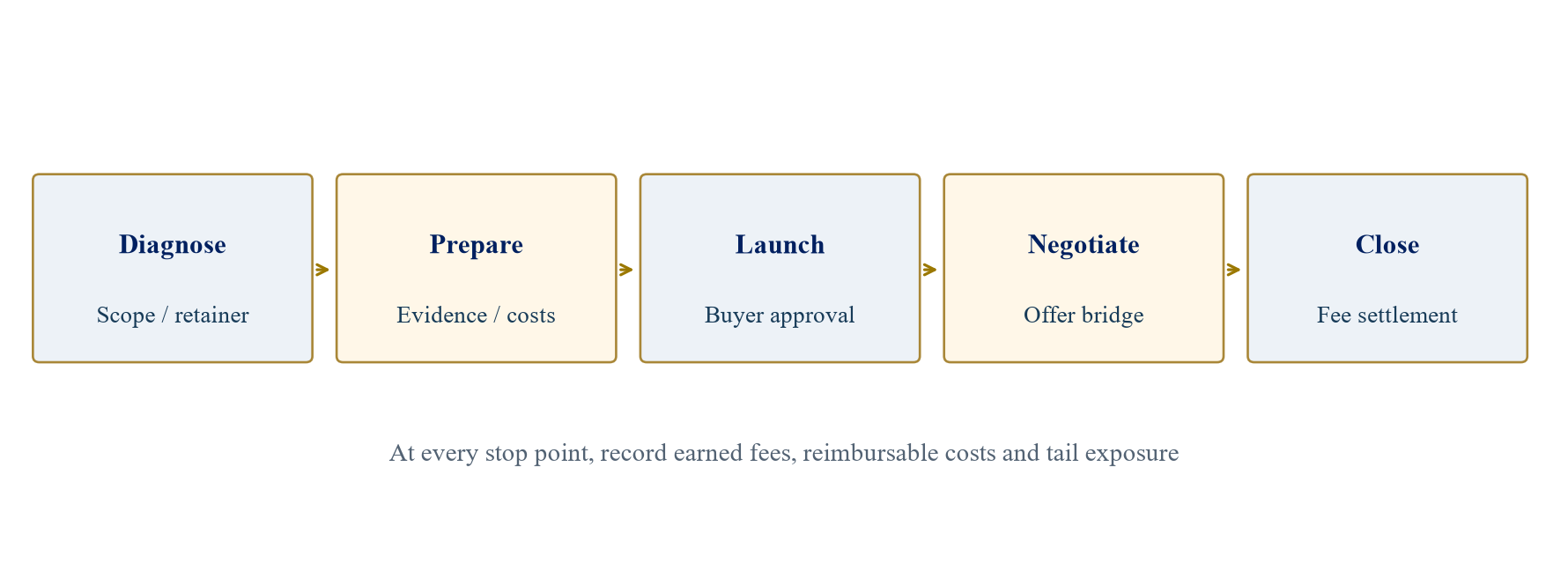
Author-developed sequence. The owner decides whether to proceed at each gate; no sale probability is implied.
17 Test the no-close and changed-buyer branches
The illustrative schedules have different no-close costs. If the process ends without a triggering transaction, A has a USD 100,000 retainer payment, B has USD 150,000 and C has no stated retainer. Other professional fees and agreed expenses may still be due. These amounts do not measure wasted spending. A diagnostic that prevents an unsuitable sale can have value, even when no success fee follows. The owner should assess the work received against the payment and record why the process stopped.
A proposed fee comparison that assumes closing in every case hides this branch. The owner should run at least four paths: no buyer interest, credible interest but no signed agreement, signed agreement that fails to close, and a later sale to a party covered by the tail. Each path needs a fee amount, payment date, evidence of the trigger and remaining commitment. If a break fee is received after a failed sale, calculate any adviser share separately. If a new adviser is appointed, add possible overlapping tails before estimating seller cash.
The economic choice can be analysed without making up a completion probability. For each schedule, the owner can identify the fee paid at every outcome and the break-even price improvement needed to offset an additional fee. At the USD 50 million modelled sale, schedule C costs USD 350,000 more than B. A buyer offer generated under C would need to improve the owner's retained cash by more than that amount, after any associated change in escrow, taxes and costs, for fee alone to be outweighed. This is an arithmetic threshold, not evidence that C can or cannot deliver it.
The owner should ask how the fee formula behaves when the price changes during diligence. A buyer may reduce the enterprise value after discovering a liability but provide a cleaner cash structure. A fee based on the originally announced value would then be disconnected from the actual outcome. The engagement can require a final reconciliation to the definitive completion statement, with a documented true-up for later adjustments. The adviser should be able to check the calculation without receiving private information unrelated to its fee. The owner should retain the underlying audit trail.
18 Design a consented study that could test the empirical question
The proposed empirical study would collect executed fee schedules and transaction outcomes from a consented cohort of private-company sell-side mandates. The sampling frame should include appointments that did not complete, advisers that were shortlisted but not selected where consent permits, and transactions whose scope changed. A dataset containing only announced successful deals would omit the no-close costs and the selection process that matter to owners. A trusted data custodian would need to protect client identity and confidential terms.
For each mandate, the study would record the contract version, retainer, credits, minimum, percentage tiers, fee base, trigger, tail, expenses and additional work. It would also record company size, sector, sale perimeter, readiness, bid process, number of qualified bids, deal terms, date and market conditions. Proceeds should be reconstructed from signed transaction documents and funds-flow records, with cash at completion separated from contingent later amounts. If a fee is disputed or unpaid, the dataset should record that status rather than treat an invoice as cash paid.
The first descriptive outputs could show how often each term occurs, how much total adviser compensation was paid at each stage, and what proportion of disclosed consideration reached selling shareholders at completion. These results would require a defined sample, denominator and disclosure permissions. A later analysis could compare schedules after controlling for company and transaction characteristics. Even then, fee choice is endogenous: owners select advisers and advisers choose mandates. A simple comparison of mean sale proceeds could reflect underlying company quality, deal difficulty or buyer interest.
The paper has not assembled such a cohort and reports none of those statistics. Published academic work informs the research questions [1-3], while public filings demonstrate possible contract forms [4-6]. The author-developed model gives future researchers a consistent set of fields and a cash reconciliation that can be independently checked. A study would require legal and ethics review before acquiring confidential agreements or personal information. Aggregate publication should suppress transactions that could be reidentified from size, sector and date.
19 Negotiate a mandate that matches the owner's decision
The owner's fee discussion should begin with a written sale objective and a transaction perimeter. The adviser can then price the actual work rather than a vague promise to “find a buyer.” The engagement should name the client and adviser entities, people responsible for the work, deliverables, decision gates, payment dates, fee base, minimum, credits, expenses, conflicts, exclusivity, termination and tail. The owner should request a worked example for a low, central and high offer and for one abandoned process. Counsel should align the definitions with the contemplated transaction structure.
A comparison matrix can help, but numerical scoring can conceal judgment. One adviser may offer a lower fee with a narrow team and limited preparation; another may cost more and deliver a deeper buyer process. The owner should examine demonstrated sector work, named-team availability and a credible route to buyers, while keeping the fee model beside each proposal. A sales pitch about a valuation range should be tested separately from the economics of the adviser engagement. The decision is whether this adviser, on these terms, offers a process worth buying.
The owner can use a short paid diagnostic before granting a longer exclusive sale mandate when records or buyer demand are uncertain. The diagnostic should specify what will be delivered and whether its payment is credited against later work. The owner should not assume a diagnostic fee is refundable. If it reveals that the business is unready, the stop decision should be documented and the remaining obligations closed out. If the sale proceeds, the mandate can be amended with agreed scope, current assumptions and a buyer launch gate.
Table 3 converts the analysis into clauses for review, not model contract wording. A party could reasonably choose different terms. The table makes the economic consequences explicit so the owner, adviser, accountant and counsel can discuss them using the same facts. The final engagement letter remains a negotiated legal document and should be reviewed under the applicable law. The owner's internal model should be updated every time the offered economics change.
Table 3. Fee and deliverables checklist before appointment
| Clause or workstream | Exact item to record | Owner decision | Consequence if left open |
|---|---|---|---|
| Scope and team | Transaction perimeter, named leads, milestones and substitutions | Approve the work actually purchased | Retainer may be paid without a testable deliverable |
| Retainer and credit | Amount, due date, refundability, credit formula and cap | Confirm no-close cost and closing set-off | Lifetime fee can be double counted or understated |
| Success fee | Base, tiers, minimum, trigger and non-cash treatment | Run low, central and high sale cases | Headline percentage can misstate owner cash |
| Extra charges | Opinion, financing, expenses, tax and break-fee sharing | Approve budget and separate roles | Aggregate cost can exceed the quoted success fee |
| Tail and exit | Duration, covered parties, transaction scope and contact record | Define termination and replacement options | Two advisers may claim the same later transaction |
| Conflicts and approvals | Buyer relationships, disclosure, buyer list and bid authority | Retain decision control | Incentives can shape the process without owner review |
Author-developed decision checklist. It does not prescribe contract language or a market-standard rate.
20 Choose on the basis of cash, work and control
The owner can close the appointment decision with a compact file. It should contain the same transaction brief given to all candidates, a comparison of the people and services offered, the three-scenario fee worksheet, the no-close and tail cases, a buyer-contact and conflict record, and counsel's review of the draft. The proceeds bridge should show which amounts are evidenced, which remain estimates and which depend on later events. A board or shareholder approval should identify the version of the contract and model reviewed. A later change to a fee trigger or consideration definition deserves renewed approval.
The illustrative model shows a concrete result: the lowest fee varies with the sale amount under the three stated formulas. At USD 20 million enterprise value, A has the lowest lifetime fee. At USD 50 million, B does. At USD 80 million, A does again. The relative cash differences follow directly from the model's stated debt, cash, escrow and cost assumptions. They do not establish that one adviser is more effective, that any fee is market-standard, or that a particular exit size is likely. Those questions require evidence outside the model.
The seller should preserve the same discipline during a live process. When a buyer changes price or form of consideration, update the equity bridge, the owner's cash forecast and the advisory fee together. When a process pauses, record which services were delivered, which fees have accrued and which tail rights remain. When a deal closes, reconcile the final invoice to the signed mandate and funds-flow statement before settlement. Later payments should be linked to the original fee ledger so they are charged once under the agreed terms.
An owner can pay a substantial advisory fee and still make a strong decision when the work improves an executable outcome. The evidence required to reach that judgment is specific: a clear service, a documented fee function, a reconciled cash result and retained approval rights. The appointment should be made on that record. Price and fee then become parts of the same transaction decision rather than separate headlines presented at different meetings.
References
- McLaughlin, R. M. “Does the Form of Compensation Matter? Investment Banker Fee Contracts in Tender Offers.” Journal of Financial Economics 32(2), 1992, 223-260. Accessed 6 October 2026. https://www.sciencedirect.com/science/article/pii/0304405X9290019T
- Hunter, W. C. and Jagtiani, J. “An Analysis of Advisor Choice, Fees, and Effort in Mergers and Acquisitions.” Review of Financial Economics 12(1), 2003, 65-81. Accessed 6 October 2026. https://www.sciencedirect.com/science/article/pii/S1058330003000077
- Golubov, A., Petmezas, D. and Travlos, N. G. “When It Pays to Pay Your Investment Banker: New Evidence on the Role of Financial Advisors in M&As.” Journal of Finance 67(1), 2012, 271-311. Accessed 6 October 2026. https://onlinelibrary.wiley.com/doi/10.1111/j.1540-6261.2011.01712.x
- US Securities and Exchange Commission. Filed Petrie Partners engagement letter, exhibit dated 2014, including retainer, success fee, opinion-fee credit and tail. Accessed 6 October 2026. https://www.sec.gov/Archives/edgar/data/1502377/000115752314000288/a50792491_ex99-1.htm
- US Securities and Exchange Commission. First Guaranty Bancshares and Lone Star Bank proxy/prospectus, 2023, financial adviser compensation disclosure. Accessed 6 October 2026. https://www.sec.gov/Archives/edgar/data/1408534/000138713123003896/fgbi-s4_032323.htm
- US Securities and Exchange Commission. Filed merger proxy, 2026, Rothschild & Co financial-adviser fee disclosure. Accessed 6 October 2026. https://www.sec.gov/Archives/edgar/data/1855457/000114036126025086/ny20068726x6_defm14a.htm
- Dubai Financial Services Authority. “New DFSA Thematic Review: Conflicts of Interest across DIFC Firms.” 9 January 2026. Accessed 6 October 2026. https://www.dfsa.ae/news/new-dfsa-thematic-review-conflict-interest-across-difc-firms
- Financial Conduct Authority. “SYSC 10: Conflicts of Interest.” Accessed 6 October 2026. https://handbook.fca.org.uk/handbook/sysc10?timeline=true
- Financial Conduct Authority. “Investment and Corporate Banking Market Study: Final Report.” 2016. Accessed 6 October 2026. https://www.fca.org.uk/publication/market-studies/ms15-1-3-final-report.pdf
About the Author
Chennakeshav (CK) is a corporate finance and investment banking executive with 25+ years of global experience in deal origination, structuring and execution across M&A, growth capital and corporate strategy. He has led value-creation mandates for founders, corporates and funds — bridging the boardroom view to hands-on execution and close.
His career spans Morgan Stanley, HSBC, Lloyds Banking Group, EWEC, ADQ portfolio companies and Emirates Growth Fund, across TMT, real estate, fintech, deeptech, cleantech, infrastructure and energy. He has partnered with C-suite leaders, private equity and venture funds, sovereign wealth funds and family offices to finance complex fund raises and scale-up ventures, and has led M&A due diligence, post-merger integration and business-transformation initiatives to create value.
At Matchpoint Partners he is Managing Partner, leading the firm's corporate finance, M&A and capital-raising practice. He holds an MBA from London Business School, an engineering degree from VTU and a Master of Laws (LLM, in progress) from UCL London.
An active start-up mentor, CK mentors at Techstars, DIFC FinTech Hive, Startup Grind, Founder Institute and IN5, serves as Entrepreneur Mentor in Residence (EMiR) at London Business School, and judges the Entrepreneurship World Cup.
